The Woman Who Stood Me Up Never Knew a Waitress Had Been Waiting Six Years to Take Her Seat
At forty minutes, I stopped looking at the door.
There is a particular kind of humiliation in being stood up in a public place. It isn’t loud. Nobody points. Nobody laughs. The cruelty of it is quieter than that.
It is the waitress refilling your water even though you haven’t ordered.
It is the couple in the next booth finishing their dinner while you are still pretending someone is coming.
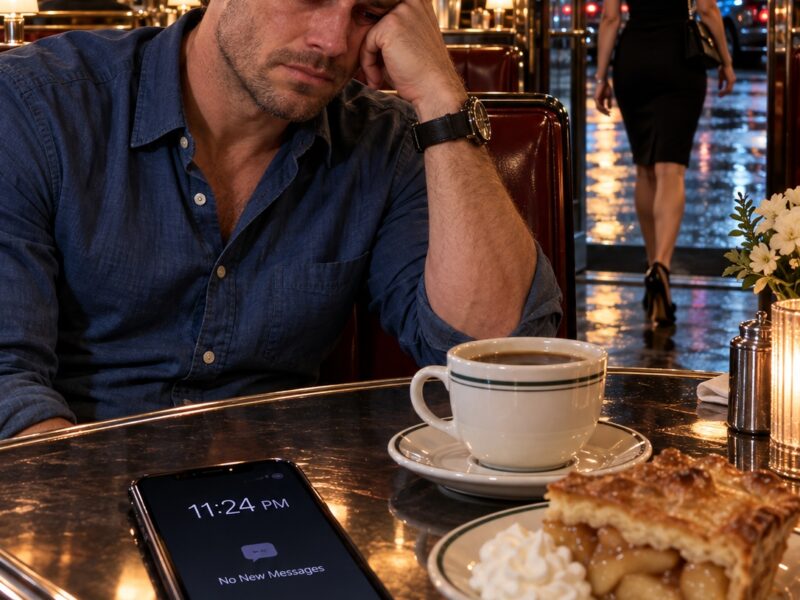
It is checking your phone for the seventh time even though you know perfectly well it hasn’t buzzed.
And it is finally realizing that every time the front door opens, you’ve been lifting your head like a dog hearing footsteps outside.
By 8:17 that Thursday night, I had stopped doing that.
I sat in a cracked vinyl booth at Marlene’s Diner off Route 9, wearing a blue button-down shirt I had ironed twice, staring at a slice of lemon floating in a glass of water.
My blind date was forty minutes late.
No text.
No call.
Nothing.
I was reaching for my wallet when the waitress approached.
I’d noticed her earlier because she’d been watching me.
Not obviously.
She was too good at her job for that.
But every time she passed my table with the coffeepot, her eyes lingered half a second longer than necessary.
She looked around my age, maybe a few years younger. Dark hair pulled into a loose ponytail. Black apron. White sneakers. Tired eyes.
The kind of tired I recognized.
There are different kinds of exhaustion.
Some people are tired because they didn’t sleep enough.
Some are tired because life has been charging them interest for years.
She looked like the second kind.
I pulled a ten-dollar bill from my wallet.
“I’m going to get out of your way,” I said. “Sorry for taking up the booth.”
She didn’t take the money.
Instead, she set down a mug of coffee.
Then a slice of apple pie.
I frowned.
“I didn’t order—”
“I know.”
Before I could say anything else, she slid into the booth across from me.
Into the empty seat.
The seat I’d spent forty minutes pretending someone else was going to fill.
For a moment, neither of us spoke.
She folded her hands on the table.
Then unfolded them.
Then folded them again.
Whatever she wanted to say, she was nervous about it.
“I’m sorry,” she said.
“For the pie?”
A tiny smile flickered across her face.
“No.”
“Coffee?”
“No.”
“Then you’re going to have to help me out.”
She stared at me.
Not at my shirt.
Not at my face exactly.
Through me.
Like she was trying to line up the man sitting in front of her with somebody who existed only in a memory.
“I’ve been trying to work up the nerve to do this for almost an hour,” she said.
My first thought was that she felt sorry for me.
That was almost worse than being stood up.
A waitress had watched some middle-aged guy sit alone long enough to realize nobody was coming, and now she was performing an act of mercy.
I pushed the ten toward her.
“You don’t have to—”
“It’s you.”
My hand stopped.
“What?”
Her eyes filled before I understood why.
“I kept telling myself I was wrong. Six years is a long time, and you look a little different.”
I stared at her.
She swallowed.
“But it’s you.”
“I’m sorry. Have we met?”
“Not really.”
Something about the way she said it made the diner disappear around us.
The clatter of silverware.
The old country song playing above the kitchen.
The cook calling something through the pass.
All of it seemed to move farther away.
She leaned forward.
“You don’t remember me.”
I searched her face.
Nothing.
“I’m sorry.”
“You shouldn’t.”
That answer surprised me.
She breathed in slowly.
“My name is Lena.”
I waited.
“Six years ago, you came to my apartment in an ambulance.”
Something inside me shifted.
Not recognition.
Not yet.
Just the instinct that comes from fourteen years of emergency medicine.
A door opening into an old room.
“I had a five-year-old son,” she continued. “His name is Max.”
My stomach tightened.
She looked down at her hands.
“He had a seizure.”
And suddenly I remembered a staircase.
Not all of it.
Just pieces.
A narrow third-floor walk-up.
A bicycle chained near the bottom railing.
Someone shouting from above.
My partner carrying the airway bag.
A woman barefoot in a hallway.
A little boy on the floor.
Lena looked back at me.
“He stopped breathing.”
The memory came back all at once.
And I realized the woman sitting across from me had not taken my missing date’s seat because she felt sorry for me.
She had been waiting six years to sit there.
And I had no idea that one forgotten Tuesday night had changed both our lives.
My name is Owen Walsh.
I was thirty-nine that night, and I had been a paramedic for fourteen years.
That sounds heroic when people say it at parties.
It isn’t.
Most of the time, it’s fluorescent lights, bad coffee, back pain, paperwork, and arriving at somebody’s house at the exact moment their ordinary life has split in half.
A man clutching his chest on a kitchen floor.
A teenager trapped behind a steering wheel.
A grandmother who fell beside her bed at seven in the morning and wasn’t found until four in the afternoon.
A baby with a fever.
A drunk who swears he isn’t drunk.
A woman sitting on a bathroom floor whispering that she doesn’t know how she got there.
You walk in.
You keep your voice calm.
You figure out what is killing them.
Then you do the next necessary thing.
And the next.
And the next.
If you’re lucky, you hand them over alive at the emergency department.
Then dispatch sends you somewhere else.
That’s the job.
People think saving lives must make a man feel important.
Sometimes it does.
Mostly, it teaches you how temporary importance is.
For twenty minutes, you may be the most necessary person in someone’s world.
Then the hospital doors close.
Their family gathers.
Doctors take over.
They recover or they don’t.
Either way, you disappear.
That’s how it’s supposed to work.
You aren’t the story.
You’re the bridge between disaster and whatever comes after.
The trouble is, if you spend enough years being a bridge, you can start believing nobody is supposed to stop on you.
My life outside the ambulance wasn’t tragic.
I want to make that clear.
Nothing dramatic had happened to me.
No dead wife.
No terrible divorce.
No childhood catastrophe I could point to and say, There. That’s why.
I had simply gotten good at being alone.
Those things can happen quietly.
One missed relationship becomes three.
One year becomes five.
Friends marry.
Then they have children.
Then they start inviting you to birthday parties instead of Friday-night drinks.
You tell yourself you’re busy.
They tell themselves you’re busy.
Eventually everybody believes it.
I worked overtime because rent kept going up.
I drove an eleven-year-old Honda Accord that had developed a noise somewhere behind the dashboard that I refused to investigate because knowing what was broken would obligate me to pay for it.
My apartment was clean because nobody else lived there.
There was one mug in the drying rack.
One towel hanging in the bathroom.
One side of the bed permanently undisturbed.
I wasn’t miserable.
That’s important too.
Loneliness isn’t always misery.
Sometimes it’s just a room you’ve lived in so long you stop noticing the dimensions.
My sister Beth noticed.
Beth notices everything.
“You give everything to everybody else,” she told me one Sunday afternoon. “Then you go home and act surprised nobody’s there.”
“I don’t act surprised.”
“That’s somehow sadder.”
“Thank you.”
“I’m serious, Owen.”
“So am I.”
She had been trying to set me up for years.
I had resisted for equally long.
Then she met a woman at her office named Rachel.
Thirty-seven.
Divorced.
Liked hiking.
Apparently found men with steady jobs attractive.
Beth sent me her number before I had agreed to anything.
Two days later, she informed me that Rachel had agreed to meet me at Marlene’s Thursday at 7:30.
“If you cancel,” Beth said, “I will tell Mom you’re avoiding happiness.”
“Mom’s dead.”
“I know. I’ll go to the cemetery.”
That was Beth.
So I went.
I even bought a new shirt.
Well, not new.
New to me.
It had been hanging in my closet for almost a year with the tags still on.
I ironed it once.
Put it on.
Decided the left sleeve looked wrinkled.
Ironed it again.
Then I stood in front of the mirror and had the ridiculous thought that I looked like a man dressed as a man going on a date.
I nearly canceled.
But Beth’s voice was already in my head.
So at 7:22, I walked into Marlene’s.
At 7:30, I ordered water.
At 7:40, I checked my phone.
At 7:50, I told myself traffic.
At 8:00, I stopped inventing excuses for Rachel.
At 8:10, the waitress asked whether I wanted to order.
“I’m waiting for someone.”
She nodded.
At 8:17, she came back.
“You sure I can’t get you something?”
“Maybe another few minutes.”
I hated how quiet my voice sounded.
At 8:23, I knew.
You develop instincts in emergency work.
You can walk into a room and know a call has gone bad before anybody gives you vitals.
Sometimes your body understands the truth before your mind accepts it.
Rachel wasn’t coming.
Maybe she had a good reason.
Maybe she didn’t.
Maybe she’d seen me through the window and changed her mind.
That possibility hurt more than I wanted to admit.
I pictured her slowing down outside, seeing a tired thirty-nine-year-old man sitting alone in a twice-ironed shirt, then continuing down Route 9.
It didn’t matter whether it was true.
Humiliation doesn’t need evidence.
It manufactures its own.
Of course she didn’t come.
That sentence appeared in my head with such familiarity that I barely noticed it.
Of course.
What did you expect?
I pulled out my wallet.
Then Lena brought the pie.
“I remember the call,” I told her.
Her mouth trembled.
“I knew you would.”
“No. I mean—I didn’t at first.”
“I know.”
“I see a lot of people.”
“I know that too.”
She wasn’t offended.
That made it worse somehow.
I looked at her carefully.
Six years earlier, she had been younger, thinner, terrified beyond recognition.
Now I began seeing pieces.
The eyes.
Mostly the eyes.
That night they had been enormous.
I remembered them over two hands pressed against her mouth.
“You were in the apartment on Hawthorne,” I said.
Lena’s face changed.
“Third floor.”
She nodded.
“Green hallway?”
“It was supposed to be green.”
“The landlord was optimistic.”
She laughed once through the tears.
Then I remembered more.
Max had been five.
Febrile seizure initially, we thought.
Except it lasted too long.
By the time we reached him, his lips had started turning gray.
My partner, Luis, was calling out numbers.
I was on the floor beside the boy.
Lena stood against the wall.
She had gone beyond panic.
People imagine panic as screaming.
Sometimes it is.
But the most frightened people I’ve ever seen often become completely silent.
Their minds simply stop moving.
Lena had been standing there barefoot, hands over her mouth, watching strangers work on her child.
I remembered looking up.
“Mom.”
Nothing.
“Mom, look at me.”
Her eyes found mine.
“I need your help.”
Those words are useful.
They give terror somewhere to go.
“He needs to hear your voice,” I told her. “Come down here.”
“I can’t.”
“Yes, you can.”
“I’m going to make it worse.”
“No, you’re not.”
“My baby—”
“Then come help your baby.”
She dropped to her knees.
I told her to breathe.
In for four.
Hold for four.
Out for four.
Again.
Again.
Again.
Part of it was for her.
Part of it was so Max could hear his mother’s voice.
Part of it was so she wouldn’t collapse.
It’s a technique.
Nothing magical.
I’ve used versions of it hundreds of times.
Give a terrified person a task.
Ask them to hold something.
Count something.
Tell you a birthday.
Breathe on a rhythm.
Helplessness is its own trauma.
Sometimes the kindest thing you can do is give someone a job while the world is ending.
What I hadn’t understood was that Lena remembered every second.
“You kept counting,” she said in the diner.
I nodded slowly.
“You told me not to watch the monitor. You said, ‘Watch me.'”
I remembered that too.
“You were breathing too fast.”
“I thought he was dying.”
“We were worried.”
“You never said that.”
“We don’t usually.”
“Why?”
“Because you already knew.”
Her eyes dropped.
For a while neither of us spoke.
Then she whispered, “He was gone, wasn’t he?”
I knew what she meant.
“For a little while.”
“How little?”
“Lena—”
“I’ve wondered for six years.”
I looked at the pie between us.
“Long enough.”
She closed her eyes.
I regretted answering.
Then she reached across the table and put her fingers against the coffee mug, grounding herself against the warmth.
“But he came back.”
“Yes.”
“You brought him back.”
“We brought him back.”
“No.”
“Lena.”
She shook her head.
“You don’t get to do that.”
“Do what?”
“Disappear inside the word we.”
I didn’t answer.
She leaned toward me.
“I know there were other people there. I know there were doctors and nurses. I know I’m not stupid. But I remember who looked at me when I couldn’t breathe. I remember who stayed.”
That part I didn’t remember.
“What do you mean?”
“You rode with us.”
“Probably because—”
“Your shift was over.”
I stared at her.
She smiled sadly.
“I asked later.”
Of course she had.
People search for meaning after almost losing someone.
They reconstruct timelines.
Collect names.
Find the edges of the disaster.
“They told me your shift had ended almost an hour earlier,” she said. “But you stayed at the hospital until the doctor came out and told me Max was stable.”
A faint memory surfaced.
Luis asking whether I wanted a ride back.
Me saying I’d catch the next unit.
A vending machine.
A terrible cup of coffee.
Lena sitting in a plastic chair wearing somebody’s jacket.
I shrugged.
“I probably didn’t want to leave you alone.”
“Exactly.”
“Anybody would’ve done it.”
“No.”
The word came hard enough to stop me.
“No, Owen. That’s what you don’t understand. Everybody says that about the kind things they do. Anybody would’ve done it. It was nothing. I barely remember. But the person receiving it remembers.”
My throat tightened.
She wiped beneath one eye.
“When the doctor finally said Max was stable, I tried to thank you.”
Another memory.
A hallway.
A woman crying.
Me exhausted.
“What did I say?”
Lena laughed.
“You said, ‘That’s the job, ma’am. You did great.'”
That sounded like me.
“And then you left.”
“Also sounds like me.”
“I didn’t even get your name.”
She looked at me for a long moment.
“Six years, Owen.”
The diner suddenly felt very small.
“Six years I’ve wanted to thank the man who saved my son. Six years I’ve wondered who you were. Every birthday, Max and I say thank you to somebody whose name we don’t know.”
I looked away.
That was easier.
The neon OPEN sign reflected backward in the window.
Cars passed on Route 9.
Ordinary Thursday night.
Except nothing felt ordinary anymore.
“And then tonight,” she continued, “you walked into my diner.”
“Your diner?”
“My shift. Marlene owns the diner.”
“Right.”
“You sat in my section.”
She laughed softly.
“And I nearly dropped a coffee pot.”
I smiled despite myself.
“I’ve been watching you for almost an hour.”
“I noticed.”
“I was trying to make sure.”
“Apparently I’ve aged badly.”
“You’ve aged six years.”
“Generous.”
“And then I realized you were waiting for somebody.”
My embarrassment returned.
“Yeah.”
“I kept thinking she’d show up.”
“That makes one of us.”
“I was hoping she wouldn’t.”
I looked at her.
Lena’s cheeks reddened.
She glanced down.
Then back up.
“That came out wrong.”
“No, I think it came out pretty clearly.”
“For six years, I’ve imagined meeting you. I just never imagined I’d have to wait for another woman not to show up first.”
For the first time that night, I laughed.
Actually laughed.
And something loosened in my chest.
Then she reached for her phone.
“Do you want to see him?”
I didn’t understand at first.
“Max.”
My heart stumbled.
“Yeah.”
She unlocked the screen.
Scrolled.
Then turned it toward me.
A boy in a hockey-style goalie jersey grinned at the camera, missing one tooth.
Eleven years old.
Messy brown hair.
Pads almost too large for his body.
Alive.
Completely, gloriously ordinary.
I stared at the photograph.
Emergency medicine teaches you to measure success in clinical terms.
Return of spontaneous circulation.
Oxygen saturation.
Stable blood pressure.
Neurologically intact.
Discharged home.
Those are good words.
Necessary words.
But they don’t tell you what happens afterward.
They don’t tell you the five-year-old grows to eleven.
They don’t tell you he becomes obsessed with sharks.
They don’t tell you he hates peas.
They don’t tell you he gets nervous before games.
They don’t tell you his mother keeps buying shoes because his feet won’t stop growing.
They don’t tell you life continues.
“He’s a goalie?” I asked.
Lena smiled.
“Unfortunately.”
“Why unfortunately?”
“Do you know what goalie equipment costs?”
“I don’t.”
“Then protect your innocence.”
I smiled.
She swiped.
Another photo.
Max holding a science-fair ribbon.
Another.
Birthday cake.
Another.
Halloween.
Another.
Sleeping on a couch with a dog across his legs.
Six years of Tuesdays.
Six years I had never known existed.
“He hasn’t had a seizure in four years,” she said.
“That’s good.”
“It’s wonderful.”
I handed the phone back.
My fingers weren’t steady.
Lena noticed.
“You okay?”
“Yeah.”
I wasn’t.
There are calls you lose.
Those stay.
Everyone in emergency medicine has ghosts.
You remember their addresses years later.
The angle of a kitchen.
The smell of rain on asphalt.
A mother’s scream.
A shoe in the road.
The exact silence after somebody says, “Time of death.”
The ones you save are different.
They disappear.
You have to let them.
If you carried everybody, you couldn’t continue.
So I had developed a mental filing system without realizing it.
The dead stayed.
The living left.
And because the living left, some part of me had begun believing maybe nothing I did traveled beyond the hospital doors.
Then Lena put six years of a boy’s life in my hand.
It was more than I knew how to carry.
“I need to tell you something,” I said.
“What?”
“I almost left before you came over.”
“I know.”
“No, I mean I was about five seconds from walking out.”
She studied me.
“I figured.”
“I was sitting here thinking…”
I stopped.
“Thinking what?”
I shouldn’t have told her.
We were strangers.
Except we weren’t.
Maybe that’s why I did.
“Thinking, of course.”
Her eyebrows drew together.
“Of course what?”
“Of course she didn’t come.”
Lena said nothing.
I hated how vulnerable the words sounded once they were outside my head.
I rubbed my thumb against the edge of the table.
“I don’t know. You go home alone enough years, you start building explanations. Maybe I’m just not somebody people choose.”
Her expression changed.
Not pity.
Thank God.
Something closer to anger.
“That’s what you thought?”
“I didn’t say it was rational.”
“You save people’s lives for a living.”
“That’s work.”
“You stayed an hour after your shift for a terrified stranger.”
“Also work.”
“No, it wasn’t.”
I looked at her.
She leaned forward.
“You want to know what I saw tonight?”
“I’m afraid to ask.”
“I saw a man sitting here for forty minutes trying to make excuses for someone who couldn’t even send a text.”
“Maybe something happened.”
“See?”
“What?”
“You’re doing it again.”
“Doing what?”
“Giving everybody else the benefit of the doubt and yourself none.”
That landed harder than it should have.
I looked toward the counter.
“Marlene’s going to fire you if you keep sitting with customers.”
“Marlene is my aunt.”
“Ah.”
“Also, she went home twenty minutes ago.”
I glanced around.
The diner had emptied.
I hadn’t noticed.
The cook was wiping down the grill.
The overhead lights near the back had been switched off.
Outside, darkness pressed against the windows.
“What time do you close?”
“Ten.”
I checked my phone.
9:52.
We had been talking for more than an hour.
Lena stood.
My heart sank unexpectedly.
Then she took the coffeepot.
“You’re not leaving.”
“Am I being detained?”
“Yes.”
“For what?”
“Six years of unpaid gratitude.”
“That sounds expensive.”
“It is.”
She poured coffee.
“Drink.”
And for reasons I couldn’t explain, I stayed.
At ten, the cook left.
At ten-fifteen, Lena locked the front door.
At ten-thirty, she turned off half the lights.
And somewhere between cold pie and her second cup of coffee, we stopped talking about Max.
We talked about ourselves.
She told me Max’s father had left before the boy turned three.
Not dramatically.
No affair discovered.
No screaming match.
He simply decided parenthood was harder than he’d expected and gradually removed himself from their lives until there was nothing left to remove.
“I used to hate him,” Lena said.
“Used to?”
“Now I don’t have the energy.”
“Progress.”
“Therapy.”
“Also progress.”
She had worked two jobs for years.
The diner at night.
Bookkeeping during the day.
Her mother watched Max when she could.
There had been months when Lena slept four hours a night and lived with a low, constant fear that the seizure would happen again.
“Every noise from his room woke me,” she said. “Every fever. Every time he slept too deeply, I’d put my hand under his nose.”
“That’s normal after something like that.”
“I know that now.”
“Back then?”
“Back then I thought I was losing my mind.”
“You weren’t.”
She smiled.
“Where were you six years ago when I needed somebody to tell me that?”
“Apparently in your living room.”
“Fair.”
I told her about Beth.
The apartment.
The overtime.
The Honda.
I did not intend to tell her about the loneliness.
That came out anyway.
Maybe because it was nearly midnight.
Maybe because dark diners make confession easier.
Maybe because she already knew me at my best, and there is something strangely freeing about letting somebody see the rest.
“I’ve always been good in emergencies,” I said.
“That’s useful.”
“Less useful on dates.”
“I wouldn’t know. I’ve been out of practice.”
“How long?”
She made a face.
“Do I have to answer?”
“No.”
“Five years.”
“That’s impressive.”
“Don’t congratulate me.”
“I wasn’t.”
She laughed.
Then she grew quiet.
“I tried twice after Max’s dad left. The first guy acted like dating me meant auditioning to become Max’s father. He panicked.”
“And the second?”
“He liked me.”
“Sounds terrible.”
“He didn’t like my life.”
There it was.
A sentence with years inside it.
I understood those.
“So I stopped,” she said.
“Me too.”
“Stopped what?”
“Expecting.”
Lena stared at me.
“That’s sad, Owen.”
“I know.”
“No. I don’t think you do.”
The clock above the counter clicked toward midnight.
She stood and retrieved her coat.
When she unlocked the door for me, cold air rushed inside.
My Honda sat beneath a buzzing parking-lot light.
I stepped outside.
Then turned.
“Thank you for telling me.”
Her expression softened.
“I’ve wanted to for six years.”
“I mean it.”
“So do I.”
I hesitated.
I could have asked for her number.
She could have offered.
Neither of us did.
Instead, she said, “Good night, Owen Walsh.”
The way she said my full name did something strange to me.
For six years, she had remembered a nameless man.
Now she had a name.
“Good night, Lena.”
I walked to my car feeling lighter than I had in years.
Then I drove home.
And by the time I reached my apartment, I had managed to convince myself the entire evening meant nothing.
Fear rarely sounds like fear inside your own head.
It sounds reasonable.
That’s what makes it dangerous.
By the time I climbed the stairs to my apartment, the voice was already explaining things.
Lena was grateful.
That was all.
You saved her son.
She was emotional.
She felt sorry for you because your date didn’t show.
Don’t confuse gratitude with attraction.
Don’t turn one beautiful moment into something embarrassing.
Don’t go back there making eyes at a woman whose child you once treated.
Don’t contaminate the memory.
Leave it clean.
Leave while you are still the good guy.
That last part sounded especially convincing.
I had spent fourteen years leaving.
Not abandoning.
Leaving appropriately.
Patient stabilized?
Leave.
Hospital takes over?
Leave.
Shift ends?
Leave.
Family reunites?
Leave.
Somewhere along the way, departure had become my safest skill.
So I didn’t go back to Marlene’s.
Friday passed.
Then Saturday.
On Sunday, Beth called.
“How was the date?”
“She didn’t show.”
There was silence.
“Rachel?”
“Unless there was another woman I was supposed to meet.”
“I’m going to kill her.”
“Don’t.”
“She texted me Friday morning.”
I sat straighter.
“What did she say?”
“That she panicked. She apologized.”
“Okay.”
“That’s not okay.”
“People panic.”
Beth exhaled hard.
“You’re defending the woman who stood you up.”
“I don’t need to be angry.”
“No. You just need to make everybody else’s behavior understandable so you never have to admit when somebody hurts you.”
I almost laughed.
“What?”
“Nothing.”
“What?”
“A waitress told me something similar.”
Beth went silent.
Then her voice changed completely.
“What waitress?”
“I have to go.”
“Owen.”
“Dispatch.”
“You’re not at work.”
“Emotionally, I am.”
I hung up.
Monday, I drove past the Route 9 exit.
Tuesday too.
Wednesday, I considered turning.
Didn’t.
Thursday marked one week.
I told myself going back would be strange.
Friday, I told myself Lena had probably forgotten about me.
Saturday, I told myself she deserved somebody less complicated.
By Sunday, I had assembled an entire moral philosophy around cowardice.
I was protecting her.
I was respecting boundaries.
I was preserving something meaningful.
The truth was simpler.
I was terrified she would look at me differently the second time.
The first meeting had been an accident.
Accidents don’t require courage.
Going back would have been a choice.
And choices can be rejected.
So I stayed away.
A week and a half after the diner, I was at Station 12 finishing paperwork when Marcus, one of our EMTs, leaned into the crew room.
“Walsh?”
“Yeah?”
“Somebody’s asking for you.”
“If it’s billing, I’m dead.”
“Woman.”
I looked up.
Marcus grinned.
“Pretty woman.”
“Grow up.”
“She’s got a kid.”
My pen stopped.
“What?”
“Front lot.”
I stood so fast the chair rolled backward.
Marcus’s grin widened.
“Oh, this is definitely interesting.”
“Shut up.”
I walked toward the bay doors.
My heart had started pounding.
Ridiculous.
I’d entered burning buildings calmer than this.
Then I stepped outside.
Lena stood near the ambulance.
And beside her was Max.
I knew him immediately.
Goalie jersey.
Brown hair.
Gap in his teeth.
Eleven years old.
Alive.
The photograph had not prepared me for the movement of him.
That’s what stunned me.
Photos freeze life.
Max bounced on his heels.
Looked at the ambulance.
Adjusted the strap of a backpack.
Squinted into the sunlight.
All those tiny movements existed because he existed.
Lena saw me.
Her expression was difficult to read.
Not angry.
Not exactly.
Max looked from her to me.
Then his eyes widened.
“You’re the guy.”
I stopped.
He walked toward me.
“Max,” Lena warned gently.
“What? He is.”
I couldn’t speak.
He stopped three feet away.
“You’re Owen.”
“Yeah.”
“The paramedic.”
“Yeah.”
“You’re the guy who saved me when I was little.”
Children have a brutal relationship with truth.
Adults decorate it.
Children simply put it on the table.
I lowered myself onto one knee.
Six years earlier, I’d knelt beside this boy while he wasn’t breathing.
Now he stood in front of me, healthy and impatient and slightly embarrassed by his mother’s emotions.
“I’m the guy,” I managed.
He studied my face.
“You look older than I thought.”
Behind him, Lena closed her eyes.
I laughed.
“You’re not the first person to tell me that.”
“My mom says you were younger.”
“Your mom is very kind.”
“She also says you saved her.”
I looked at Lena.
She looked away.
Max stuck out his hand.
It was such a serious gesture that for a second I didn’t understand.
Then I took it.
His hand was warm.
Alive.
“Thank you for not letting me die,” he said.
I have heard people scream while dying.
I have held pressure on wounds with both hands while blood ran between my fingers.
I have watched monitors flatten.
I have told mothers their children were gone.
I have carried bodies.
I have done CPR until my shoulders failed.
I did not cry.
Not because I’m strong.
Because sometimes the body puts emotion somewhere else so you can finish the work.
But kneeling in front of an eleven-year-old goalie who thanked me for not letting him die?
I broke.
Completely.
My throat closed.
My eyes burned.
I looked down because I didn’t want the kid to see.
That made it worse.
“I—”
Nothing came out.
Max looked alarmed.
“Mom?”
Lena crouched beside me.
Her hand touched my shoulder.
And then she said four words.
“In for four, Owen.”
I froze.
Her voice softened.
“Come on.”
I looked at her.
“In for four.”
I inhaled.
“Hold.”
I held.
“Out for four.”
I exhaled.
Again.
Six years disappeared.
A terrified young mother kneeling on an apartment floor.
A five-year-old boy struggling for air.
My voice giving her a rhythm because she had nothing else to hold.
Now Lena was giving it back.
“In for four.”
I breathed.
“Hold.”
My chest loosened.
“Out for four.”
Max watched us.
“Is this, like, a weird adult thing?”
Lena laughed through her tears.
“Very weird.”
I finally managed to stand.
Marcus had wisely disappeared.
Max wandered toward the ambulance to inspect it through the open bay.
Lena stayed beside me.
For several seconds, neither of us spoke.
Then she said, “You didn’t come back.”
There was no accusation in her voice.
That somehow made it harder.
“I know.”
“I waited.”
“I’m sorry.”
“A week.”
I looked down.
“I thought maybe—”
“I know what you thought.”
“You do?”
She crossed her arms.
“I had six years to imagine the personality of the man who saved my son. Turns out I wasn’t far off.”
“That’s unsettling.”
“You’re good at helping people.”
“Occupational hazard.”
“You’re also very good at deciding what other people feel without asking them.”
I winced.
“Fair.”
“You decided I was grateful.”
“You are.”
“I am.”
“You decided that was all.”
I didn’t answer.
“You decided coming back would embarrass me.”
“Possibly.”
“You decided I didn’t want you to.”
I looked at her.
There it was.
The thing I had refused to let myself hear.
Lena stepped closer.
“I spent six years looking for the man who told me I wasn’t helpless.”
My heart hammered.
“Then I finally find him, and apparently he’s scared of a diner.”
“I wasn’t scared of the diner.”
“Pie?”
“No.”
“Coffee?”
“Lena.”
Her eyes softened.
“You.”
That stopped her.
I swallowed.
“I was scared of being wrong about you.”
For the first time, all the teasing disappeared.
Lena nodded.
“Okay.”
“Okay?”
“That’s at least honest.”
“I thought that night was about Max.”
“It was.”
“See?”
“And you.”
I stared at her.
“Both things can be true, Owen.”
Max was pretending to drive the ambulance twenty feet away.
Lena glanced toward him, then back at me.
“I am grateful to you for saving my son. I will be grateful until I die.”
I nodded.
“But I didn’t sit across from you until midnight because I wanted to discuss pediatric emergency medicine.”
Despite myself, I smiled.
“I wondered.”
“No, you didn’t. That’s the problem.”
She took another step closer.
“I liked you.”
The world became strangely quiet.
“I liked talking to you. I liked the way you looked embarrassed when I complimented you. I liked that you made me laugh. I liked that you listened. And when you walked out that night, I hoped you’d come back.”
I didn’t know what to say.
“So when you didn’t,” she continued, “I waited a week.”
“I’m sorry.”
“Stop apologizing.”
“Sorry.”
She almost smiled.
“Then I realized something.”
“What?”
“You were never coming back.”
That hurt.
“Because you didn’t want to?”
“No.”
Her eyes held mine.
“Because you wanted to.”
I stared at her.
“And wanting something scares you more than losing it.”
That sentence found a place inside me I had spent years avoiding.
Lena looked toward Max.
Then back at me.
“So we came to you.”
“We?”
“He’s been asking to meet you since I told him.”
“You told him?”
“Of course.”
“What did you tell him?”
“The truth.”
“Which version?”
“The one where his mother finally found the mysterious paramedic she’s been talking about every birthday since he was five.”
I looked toward Max.
He was now talking to one of the firefighters.
Probably asking dangerous questions.
“Lena—”
She touched my arm.
“You don’t get to save everybody and then run away before anybody gets a chance to save you back.”
My chest tightened.
“I’m not asking you for anything huge.”
“What are you asking?”
“Dinner.”
I blinked.
“Dinner?”
“Yes.”
“With you?”
“No, Owen. With the governor.”
I laughed.
She smiled.
“Tonight.”
“I’m working.”
“Tomorrow.”
“I work tomorrow too.”
“Sunday.”
I had no excuse ready.
She knew it.
“Sunday,” I said.
“Seven.”
“At Marlene’s?”
“No.”
“Why?”
“Because I work there.”
“Right.”
“And this time,” she said, “if somebody doesn’t show up, I’m coming to your apartment and dragging you out.”
“I’ll show.”
“Promise?”
That word frightened me more than it should have.
So I looked at Max.
Then at her.
And for once, I didn’t reach for the exit.
“I promise.”
Our first real date was terrible.
That’s one of my favorite parts.
People like to believe important relationships announce themselves with perfect evenings.
Ours started with Lena arriving twenty minutes late because Max had lost one shin guard.
Then the restaurant lost our reservation.
Then I spilled water.
Then Lena’s mother called because Max had convinced himself a headache meant another seizure.
Lena’s face changed instantly.
We left before ordering.
I drove her home.
By the time we got there, Max’s headache was gone.
He had eaten two bowls of cereal and was playing a video game.
Lena stood in her driveway looking exhausted.
“Best date you’ve had lately?” I asked.
She laughed.
“Top three.”
“I haven’t even fed you.”
“You drove twelve miles without complaining while I called my mother four times.”
“Low standards.”
“Single motherhood.”
I should have kissed her.
I didn’t.
Instead I said good night.
She grabbed the front of my jacket and kissed me.
When she stepped back, I probably looked like somebody had hit me with a defibrillator.
“You were taking too long,” she said.
Then she went inside.
I sat in my Honda for five full minutes.
The dashboard noise seemed louder than ever.
I didn’t care.
We went slowly.
Not because the feelings were slow.
Because trust was.
Lena had learned that people leave.
I had learned not to ask them to stay.
Those wounds fit together badly at first.
Some nights after her shift, we sat in the last booth at Marlene’s drinking coffee while Max did homework at the counter.
I started going to his games.
The first time, I stood behind the glass and had absolutely no idea what was happening.
“Why did everybody stop?” I asked Lena.
“Icing.”
“What’s icing?”
She stared at me.
“You’re embarrassing us.”
“I’m a medical professional.”
“Not a hockey professional.”
Max heard about that later and spent a week explaining rules to me with the patience of a disappointed teacher.
He didn’t trust me at first.
Not really.
He liked me.
That’s different.
Children who have been left learn to test permanence.
Max would mention his father casually and watch my face.
He would become rude after particularly good weekends.
He once told me I wasn’t family when I asked him to clean his room.
Lena looked horrified.
I didn’t.
I recognized fear when I saw it.
Even when fear was eleven and wearing mismatched socks.
“You’re right,” I told him.
He looked surprised.
“I’m not your dad.”
His jaw tightened.
“But I’m still going to help your mom clean the garage Saturday.”
He frowned.
“And I’ll still be at your game Sunday.”
He looked away.
“And you still need to clean your room.”
“That part sucks.”
“Life is cruel.”
He almost smiled.
The next Sunday, he kept looking toward the stands during warmups.
Checking.
I was there.
I learned that being present is not a grand gesture.
It is repetition.
You come Monday.
Then Thursday.
Then Sunday.
You answer the phone.
You remember the game.
You bring the charger he forgot.
You sit through the school concert.
You show up when nobody is clapping.
You show up enough times that eventually a frightened person stops checking the door.
That was something I understood.
Show up.
Stay calm.
Don’t leave.
I had built an entire career around those instructions.
It turned out they worked for families too.
The hardest part wasn’t Max.
It wasn’t Lena.
It was me.
Six months in, things became good.
Too good.
That’s when I panicked.
There was no dramatic fight.
No betrayal.
Nothing was wrong.
That was exactly the problem.
I had something to lose.
So I did what I’d always done.
I worked extra shifts.
Answered texts more slowly.
Found reasons to go home instead of staying over.
Told myself Lena needed space.
One Friday, after a brutal twenty-four-hour rotation, I sat in my car outside the station and saw a message from her.
Two words.
In for four.
I stared at the screen.
That was all.
No accusation.
No Why are you pulling away?
No Are you leaving?
Just the rhythm.
I put my phone down.
Inhaled.
Four.
Held.
Four.
Exhaled.
Four.
Then I started the car.
For most of my life, fear had made my decisions quietly.
That night, I decided it didn’t get to.
I drove to Marlene’s.
Lena was closing.
She saw me through the glass.
Unlocked the door.
I walked in.
“I’m scared,” I said.
No hello.
No setup.
She put down the towel in her hand.
“Okay.”
“I don’t know how to do this.”
“Do what?”
“Have people.”
Her eyes softened.
“I keep waiting for something to happen.”
“Something always happens.”
“No. Something that proves I was right.”
“About what?”
“That this isn’t mine.”
She came around the counter.
“Us?”
“You. Max. All of it.”
“Owen.”
“I’ve never been the person anybody chose.”
She flinched slightly.
I regretted the sentence immediately.
“Lena, I didn’t mean—”
“Yes, you did.”
“I—”
“And you’re wrong.”
I looked at her.
She stopped a few feet away.
“You’ve been choosing other people your entire life.”
“That’s different.”
“Why?”
“It just is.”
“No. You decided it was.”
She pointed toward the window.
“You run into strangers’ houses when they’re screaming. You kneel beside people covered in blood. You stay after your shift because some terrified mother shouldn’t sit alone. You choose people every day.”
“That’s my job.”
“And there it is again.”
“What?”
“The place you hide everything good about yourself.”
I didn’t speak.
Lena’s voice softened.
“Let somebody choose you for once.”
My throat tightened.
“I don’t know how.”
“Stand still.”
“That’s it?”
“That’s it.”
She came closer.
“Stand still long enough to let it happen.”
So I did.
Five years have passed since that Thursday night.
Max is sixteen now.
He is taller than Lena.
Almost taller than me.
He still plays goalie.
He still reads about sharks, although now he pretends he doesn’t because apparently enthusiasm becomes embarrassing around fifteen.
He has also developed the ability to consume approximately forty dollars of groceries between 3:00 and 5:00 p.m.
Lena and I got married three years ago.
At Marlene’s.
After closing.
There was never another place it could have happened.
Marlene cooked.
Beth cried before the ceremony even started.
Marcus gave a speech that violated several workplace policies.
And Max stood beside me in a jacket he’d nearly outgrown before the wedding day arrived.
He wasn’t officially my best man.
At least, that wasn’t what we called it.
But that’s what he was.
About a year before the wedding, he called me Dad for the first time.
Accidentally.
We were driving home after a game.
He was angry because they’d lost.
He tossed his gloves into the back seat and said, “Dad, can we just not talk about it?”
Then silence.
I pulled the car over.
Max looked at me.
“What are you doing?”
I couldn’t speak.
His face turned red.
“Oh my God.”
“Give me a second.”
“You’re not going to cry, are you?”
“Absolutely not.”
“You look like you’re going to cry.”
“I have allergies.”
“In December?”
“Severe winter allergies.”
He groaned.
“Can we please drive?”
I did.
Neither of us mentioned it again for months.
He kept calling me Dad.
I never corrected him.
Some things are too sacred to touch once they arrive.
I still work on the ambulance.
People ask why.
Fourteen years became nineteen.
My knees complain more.
Night shifts hurt longer.
The coffee has somehow gotten worse.
But somebody still has to walk into the room when a stranger’s world splits open.
So I do.
The difference is what happens afterward.
I come home.
Such a small sentence.
I come home.
For fourteen years, I finished shifts and drove to an apartment.
Now I come home.
There is a difference.
A light is usually on.
There are shoes by the door.
Too many shoes.
Max leaves glasses everywhere except the dishwasher.
Lena steals my side of the blanket and denies it despite overwhelming evidence.
Some nights I walk in at 3:00 a.m. after a call I don’t want to discuss, and she wakes just enough to touch my wrist.
Sometimes that’s all I need.
We still use the count.
In for four.
Hold for four.
Out for four.
Max uses it before important games.
Lena uses it when work gets ugly.
I use it after calls that follow me home.
It has become family shorthand.
A rhythm.
A tiny inheritance passed between three people who once thought they were each carrying fear alone.
Sometimes I think about the absurd chain of events required to create my life.
A five-year-old boy had a seizure.
A terrified mother needed something to do.
A paramedic gave her a breathing count because it was Tuesday and that was the next useful thing.
Six years passed.
A woman agreed to a blind date.
Then she didn’t show up.
A waitress recognized a man she had spent years trying to find.
And because I remained in that booth five seconds longer than I intended, my whole life changed.
For years, I believed the important moments announced themselves.
Sirens.
Monitors.
Shouting.
Doors thrown open.
But most of the moments that determine us arrive quietly.
A hand on a shoulder.
A cup of coffee.
A text containing two words.
An eleven-year-old boy extending his hand.
A woman unlocking a diner after closing because the frightened man outside finally came back.
The smallest kindnesses are strange that way.
You release them without knowing where they go.
Most never return.
You hold a door.
You stay late.
You make a phone call.
You tell a frightened person they’re doing well when they believe they’re falling apart.
Then you move on.
You assume the moment disappeared because it disappeared from your sight.
But disappearance is not the same thing as meaninglessness.
I know that now.
Somewhere, someone may still remember the version of you that you forgot.
A sentence you don’t remember saying may have become part of the architecture of another person’s life.
A kindness you considered ordinary may have been extraordinary simply because of the moment in which it arrived.
That doesn’t mean every kindness comes back.
It doesn’t.
Life isn’t a ledger.
You don’t earn love by accumulating good deeds.
Lena and Max were never a reward for saving somebody.
That would make love a transaction, and it isn’t.
What happened was stranger and better.
I was allowed to see what one forgotten moment had meant.
And then, when life placed something beautiful in front of me, I almost ran from it.
That’s the part I think about most.
Not the seizure.
Not the blind date.
Not even the diner.
The parking lot outside Station 12.
Lena looking at me and saying I didn’t get to save everyone else and disappear before anyone could save me back.
She was right.
I had mistaken being needed for being loved.
They’re not the same.
Being needed is easy for people like me.
It gives you instructions.
Do this.
Carry that.
Stop the bleeding.
Start the IV.
Drive faster.
Love is harder.
Sometimes love asks you to do nothing heroic.
It asks you to remain.
To be known.
To admit fear.
To sit in the chair after the emergency is over.
To believe somebody might still want you when you have nothing left to fix.
That was the skill I didn’t have.
Lena taught me.
Max taught me.
Slowly.
Patiently.
Sometimes painfully.
They taught me that staying can be braver than rescuing.
Last Tuesday, I came home after midnight.
It had been a bad shift.
I won’t tell you about the call.
Some stories belong to the families who lived them.
I parked outside our house and sat behind the wheel for a while.
Rain ticked against the windshield.
The porch light was on.
I could see through the front window.
One lamp burning in the living room.
Max had left his backpack near the stairs despite being told roughly nine hundred times not to.
There was a mug on the coffee table.
A blanket hanging over the couch.
Ordinary evidence of people.
My people.
I thought about the apartment I used to return to.
One mug.
One towel.
One untouched side of the bed.
I thought about the man who sat in Marlene’s staring at a sweating glass of water, convinced the empty seat across from him proved something permanent.
Of course she didn’t come.
That had been the sentence.
Of course.
I wish I could sit across from that man now.
I wouldn’t tell him everything gets better.
That isn’t true.
I wouldn’t tell him good people are always rewarded.
They aren’t.
I wouldn’t tell him loneliness ends if you’re patient.
Sometimes it doesn’t.
I’d tell him something smaller.
Something I know.
I’d tell him the empty chair in front of him isn’t evidence.
I’d tell him not to confuse what hasn’t happened yet with what never will.
I’d tell him he has no idea where the things he has given away have landed.
I’d tell him that somewhere in the same diner, a woman is staring at him because she has spent six years trying to find him.
I’d tell him not to leave yet.
Just five more minutes.
Stay in the booth.
When I finally went inside that night, the house was quiet.
I locked the door.
Put my keys down.
Then I noticed Max asleep on the couch.
Sixteen years old now.
Long legs hanging over one end.
Chemistry textbook open on his chest.
Lena had fallen asleep beside him, her head against the cushion.
The television was playing silently.
For a moment, I simply stood there.
Nineteen years as a paramedic have taught me to assess a scene before entering it.
Look.
Listen.
Understand what is in front of you.
So I did.
A boy breathing.
A woman breathing.
A house breathing around them.
My home.
Lena opened her eyes.
She saw my face.
Didn’t ask about the call.
Didn’t need to.
She lifted one hand toward me.
Four fingers.
I smiled.
In for four.
I breathed in.
Hold.
I held.
Out for four.
And somewhere inside that breath was a third-floor apartment six years before a diner.
A frightened young mother.
A dying little boy.
A paramedic who believed he was merely doing his job.
A lonely man in a twice-ironed shirt.
A waitress carrying pie toward an empty seat.
All those versions of us still existed somehow, connected by one simple rhythm.
Lena moved over on the couch.
Making room.
I sat beside her.
She rested her head against my shoulder.
Max snored softly from the other end.
And I thought about how many years I had spent believing my place in the world was at the door.
Arrive when needed.
Help.
Then leave.
Maybe that’s why I remember the diner so clearly.
Not because someone failed to come.
Because someone else sat down.
For fourteen years, I thought my life was about being the person who showed up.
I was wrong.
The most important thing that ever happened to me was discovering that somewhere along the way, without knowing it, I had given someone a reason to show up for me.
And when she finally did, I almost missed it.
I almost walked out five seconds too early.
Sometimes I still wonder about Rachel, the woman who stood me up.
I hope she’s okay.
I mean that.
Because if she had arrived, Lena might never have sat down.
If Rachel had sent a text ten minutes earlier, maybe I would’ve left.
If I’d chosen another diner, another booth, another night, perhaps Lena and I would have remained strangers connected by a Tuesday neither of us understood in the same way.
Life can turn on embarrassingly small hinges.
That’s frightening if you think about it too long.
It’s beautiful too.
Because it means a day you consider ordinary may not be ordinary at all.
You may already have changed somebody’s life and never been told.
You may already be remembered in a house you’ve never seen.
Your name may be missing from the story, but your kindness may still be inside it.
And if you’re the person who always carries everyone else, be careful what you conclude from the nights nobody seems to carry you.
You don’t know everything yet.
Neither did I.
I thought I was invisible.
I wasn’t.
I simply couldn’t see where I had landed.
A five-year-old boy grew up.
A mother remembered.
Six years passed.
And one Thursday night, after a stranger failed to show up, a waitress placed a slice of pie in front of me, took the empty seat across the table, and gave me back a life I hadn’t even realized I’d been waiting for.
She had carried my four-count for six years.
Now I carry hers.
In for four.
Hold for four.
Out for four.
Then stay.
That last part isn’t medical protocol.
Lena taught me that one.









