They Called Her Barren and Sent Her Away—Then a Duke Arrived Asking for Her

The morning Isabella Ashkam was ordered out of her father’s house, she had nowhere left to go.
Her husband was dead. His family had blamed her for failing to give him an heir, and now her own family wanted her gone.
But before she could lift her trunks into the waiting carriage, a stranger arrived who knew something about her marriage that she had never been told.
The rain had been falling since dawn.
It struck the tall windows of Ashkam Manor in thin, uneven streams, blurring the gray countryside beyond. Somewhere upstairs, a maid was folding the last of Isabella’s clothes into a traveling trunk. The sound of footsteps carried down the staircase, followed by the faint scrape of wood against the polished floor.
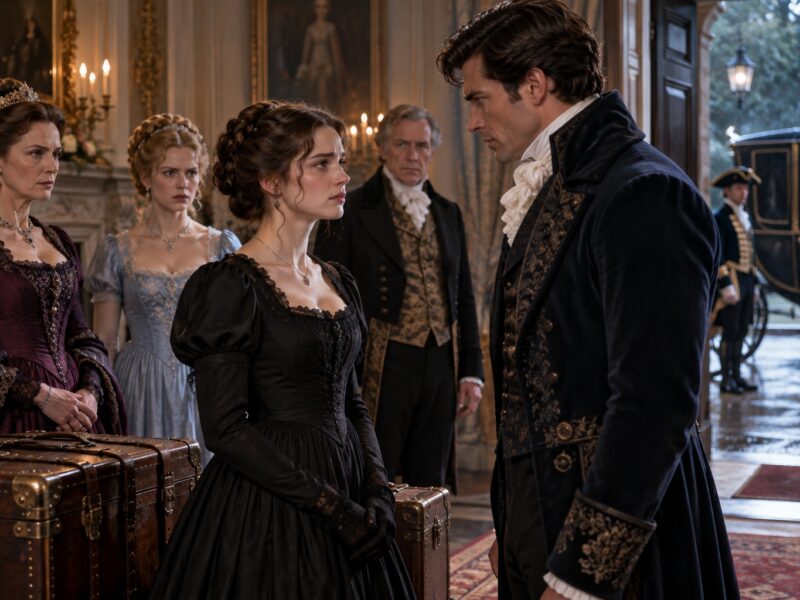
Isabella stood in the entrance hall wearing a plain black dress.
She was twenty-eight years old, a widow, and had spent most of her adult life learning how to remain composed while other people discussed her failures.
At her feet sat two trunks.
Everything she had brought back from her marriage fit inside them.
Across the room, Lady Beatrice Ashkam adjusted the lace cuff of her sleeve.
“I believe we have been patient enough,” her stepmother said.
Isabella looked at her. “Patient?”
“You know perfectly well what I mean.”
“No, I’m afraid I don’t.”
Beatrice sighed, as though Isabella were deliberately making a difficult situation worse.
“The circumstances of your husband’s death have caused considerable embarrassment. Your return has only prolonged the unpleasantness.”
Isabella glanced toward the fireplace, where her father stood with one hand resting on the mantel.
“Father?”
Lord Henry Ashkam did not immediately look at her.
The silence was familiar.
It was the same silence he had offered when she was a girl and Beatrice criticized her manners. The same silence he had offered when Edmund’s family began making cruel remarks about her marriage. The same silence he had maintained when Isabella returned home, exhausted and grieving, with nowhere else to turn.
Henry finally cleared his throat.
“Your stepmother is merely concerned about the family’s reputation.”
Isabella felt something inside her grow very still.
“My husband died.”
“I know, my dear.”
“I buried him.”
“Isabella—”
“And his family sent me away because I hadn’t given him a child.”
Henry lowered his eyes.
She waited, hoping he might finally say something that sounded like a father’s defense of his daughter.
He did not.
Near the staircase, her younger stepsister Charlotte watched the exchange with barely concealed satisfaction.
Charlotte wore a pale blue gown trimmed with delicate embroidery. Her hair had been arranged that morning by a maid who had once helped Isabella dress for her wedding.
“You really cannot expect everyone to overlook what happened,” Charlotte said.
Isabella turned toward her.
“What happened?”
Charlotte hesitated.
Then she gave a small shrug.
“Well, you know. Your inability to fulfill your obligations.”
The words struck with the force of something much older than that morning.
For four years, Isabella had heard different versions of the same accusation.
At first, Lord Edmund Vale had been affectionate.
Their wedding had been everything her father could have wanted: a beautiful ceremony, a respectable family, and a match that strengthened the Ashkam name.
Edmund had smiled when he took her hand at the altar. During their first weeks together, he brought flowers to her rooms and spoke warmly of the children they might someday have.
He wanted a son.
That had never been a secret.
His family’s estate, its inheritance, and its future all seemed to depend upon the arrival of one small boy.
At first, Isabella had shared his excitement.
She imagined a child with Edmund’s dark eyes running through the gardens. She imagined Christmas mornings, muddy shoes abandoned beside the nursery door, and tiny fingers curled around her own.
Then one month passed.
And another.
Every month that she did not conceive became a quiet disappointment.
Eventually, the disappointment stopped being quiet.
Edmund’s mother began asking questions over breakfast. Physicians arrived at inconvenient hours. Remedies appeared on Isabella’s dressing table without explanation.
She drank bitter preparations that made her nauseated. She endured examinations that left her embarrassed and frightened. She carefully counted days on a private calendar until even the sight of it filled her with dread.
One evening, after another physician had departed, she found Edmund staring into the fire.
“Did he say anything?” she asked.
Edmund did not turn around.
“Nothing useful.”
“Perhaps we should seek another opinion.”
He looked at her then.
“How many opinions do you require, Isabella?”
She remembered the way her hands had tightened around the fabric of her skirt.
“I only thought—”
“I know what you thought.”
His voice was not loud.
Somehow, that made it worse.
Afterward, he stopped coming to her rooms as frequently. Their dinners grew quieter. His mother began referring to the nursery as a wasted expense.
Isabella learned not to speak of children.
She learned not to cry when acquaintances announced pregnancies.
She learned to smile when strangers asked whether she had any happy news.
And when Edmund died unexpectedly after a fever, she discovered that even death could not free her from blame.
His mother had stood beside the grave in a black veil.
“Four years,” she whispered to a relative standing close enough for Isabella to hear. “Four years, and she has given this family nothing.”
Isabella remembered the wet grass beneath her shoes.
She remembered wanting to turn around and tell them she had loved Edmund, even when loving him had become lonely.
Instead, she stood still.
She had been standing still ever since.
Now, in her father’s entrance hall, Charlotte folded her hands.
“You should be grateful anyone is willing to accommodate you at all.”
Isabella looked at her sister for a long moment.
“I used to think you would defend me.”
Charlotte’s smile faded.
“You always were too sensitive.”
“No,” Isabella said quietly. “I think I was simply willing to excuse too much.”
Beatrice drew herself upright.
“That is quite enough.”
Isabella felt her eyes burning, but she refused to lower them.
She turned toward her father.
“Are you truly asking me to leave?”
Henry shifted his weight.
“There are arrangements that can be made.”
“What arrangements?”
“A small cottage, perhaps. Somewhere discreet.”
“Somewhere nobody will have to see me?”
“Don’t twist my words.”
“Then say what you mean.”
He glanced helplessly at Beatrice.
And with that single movement, Isabella understood.
Her father had not brought her home because he wanted her there.
He had brought her home because refusing a grieving daughter would have looked improper.
Now that enough time had passed, he wanted the inconvenience to disappear.
She bent toward the nearest trunk.
“Very well.”
The words almost broke her.
But she managed to say them.
“I will go.”
A carriage rolled into the courtyard before anyone could reply.
Its wheels made a heavy sound against the wet gravel.
Beatrice turned sharply toward the windows.
Charlotte stepped closer to the glass.
A black carriage had stopped before the entrance. Its polished doors bore a crest that caused Charlotte to draw in a startled breath.
Two footmen descended.
The household butler hurried toward the front doors.
A moment later, he returned looking unusually pale.
“My lord,” he announced, “His Grace, the Duke of Blackthornne.”
Charlotte immediately straightened.
“The Duke?”
Beatrice’s entire manner changed.
“Good heavens. Henry, why were we not informed?”
Lord Henry looked equally astonished.
The Duke of Blackthornne was not a man who visited without purpose.
Arthur Blackthornne possessed one of the oldest titles in England, an immense fortune, and a reputation for keeping his private affairs firmly beyond the reach of society gossip.
He was unmarried.
That fact alone made him the subject of endless speculation among ambitious families.
Charlotte hurried toward the mirror in the hallway.
Beatrice smoothed the front of her dress.
Isabella watched them prepare to welcome a man they had never expected to see.
Then she looked down at her own black sleeves.
She wondered, briefly and foolishly, what it might feel like to be greeted with that same anticipation.
The thought embarrassed her.
She turned away.
The doors opened.
Arthur Blackthornne entered without haste.
He was tall, broad-shouldered, and dressed in a dark navy coat cut with understated precision. Rain clung to the shoulders of his coat, and his black boots were damp from the courtyard.
His expression was composed, but there was a searching quality to his blue-gray eyes.
Lord Henry approached him.
“Your Grace. This is an unexpected honor.”
Arthur inclined his head.
“Lord Ashkam.”
Charlotte stepped forward with a practiced smile.
“How delightful to meet you, Your Grace.”
Arthur acknowledged her politely.
Then his gaze passed beyond her.
It settled on Isabella.
“Lady Isabella Ashkam?”
She straightened.
“Yes, Your Grace.”
He looked at the two trunks beside her.
“Are you leaving?”
The question was so unexpected that she answered without thinking.
“Yes.”
“May I ask why?”
Beatrice moved forward.
“Your Grace, the matter is rather complicated—”
Arthur did not look away from Isabella.
“I was asking Lady Isabella.”
For a moment, Isabella could scarcely understand what had happened.
A man had asked her a question.
Someone had tried to answer for her.
And he had refused to allow it.
She swallowed.
“I am no longer wanted here.”
The hall fell silent.
Arthur looked toward Henry.
“Is that true?”
Henry’s face reddened.
“This is a private family matter.”
“I understand that.”
“Then surely—”
“But I would still appreciate an answer.”
Henry said nothing.
Arthur turned back toward Isabella.
“I have heard the rumors surrounding your first marriage.”
Her stomach tightened.
Of course he had.
The rumors had followed her from the churchyard to the drawing rooms of London. She doubted there was a respectable household in England where her name had not been discussed with pity or contempt.
“I imagine everyone has,” she replied.
“Yes,” Arthur said. “But I have also read the physician’s report.”
Isabella went cold.
“What report?”
“The report concerning the examinations conducted during your marriage.”
She stared at him.
Those examinations had been among the most humiliating experiences of her life.
She had never been given a full account of what the physicians had concluded. Edmund and his mother had handled the discussions, and Isabella had been informed only that she had failed to fulfill her duty.
Arthur watched her face carefully.
“The report does not say what your husband’s family has claimed.”
Beatrice made a sharp sound.
“Your Grace, surely you have not come here to involve yourself in such intimate affairs?”
Arthur turned toward her.
“Lady Beatrice, I would prefer not to discuss them in a room full of people.”
He faced Isabella.
“Would you allow me a private conversation?”
Isabella looked instinctively toward her father.
Then she stopped herself.
For once, she did not wait for his permission.
“Yes, Your Grace.”
She led Arthur into the library.
The room smelled of leather bindings, damp wood, and the fire that had been lit earlier that morning.
Arthur waited until the door had closed.
Then he spoke.
“Lady Isabella, I owe you an explanation.”
She stood beside her father’s writing desk.
“I would be grateful for one.”
He took a folded paper from inside his coat but did not offer it immediately.
“Your husband’s family has maintained that you were incapable of bearing children.”
“Yes.”
“They have spoken of that conclusion as though it were a medical certainty.”
She looked away.
“It was a certainty to Edmund.”
Arthur’s voice softened.
“That does not make it true.”
Isabella raised her eyes.
He continued carefully.
“The physician’s account does not establish that you were infertile. It records examinations, observations, and uncertainty. Nothing more conclusive than that.”
Isabella looked at the document.
For years, she had lived beneath the weight of a judgment she had never been permitted to examine.
“Why didn’t anyone tell me?”
Arthur did not pretend to know.
“I cannot answer that.”
She pressed her fingertips against the edge of the desk.
“But you have seen it.”
“Yes.”
“How?”
“I made inquiries after hearing how you were treated. The information reached me through people who knew of the examinations. I should have considered more carefully how distressing that intrusion might be.”
She studied him.
“Why make inquiries about me at all?”
Arthur hesitated.
It was the first time she had seen uncertainty disturb his composure.
“Because I had heard a great deal about you from people who seemed remarkably eager to condemn you.”
“That hardly makes me an object of interest.”
“No,” he agreed. “It made me question whether they were telling the truth.”
Isabella looked down at her hands.
There was an unfamiliar ache in her chest.
She had grown accustomed to defending herself.
She did not know what to do with a man who had questioned the accusations before meeting her.
“Your Grace,” she said, “I fear you have mistaken me for someone more interesting than I am.”
Arthur’s expression changed slightly.
“Perhaps you have spent too long being told how little you are worth.”
She almost laughed.
It would have been a bitter sound.
“You cannot know what these past years have been.”
“No,” he said. “I cannot.”
His answer surprised her.
He did not claim to understand suffering he had never experienced.
He did not offer the empty comfort she had heard so often.
Instead, he folded the document.
“But I can tell you that a physician’s uncertainty should never have been turned into a sentence against your character.”
Her eyes filled.
She looked toward the window before he could notice.
Arthur gave her a moment.
Then he said, “I came here for another reason as well.”
Isabella turned back.
“What reason?”
He held her gaze.
“I would like to offer you marriage.”
For several seconds, she could not speak.
The rain continued striking the windows.
Somewhere beyond the library door, Charlotte laughed nervously.
Isabella stared at Arthur as though she had misheard him.
“Marriage?”
“Yes.”
“To whom?”
A faint, almost reluctant smile touched his face.
“To me.”
She stepped backward.
“Your Grace, I believe you have made some terrible mistake.”
“I don’t believe I have.”
“You know nothing of me.”
“I know less than I would like. That is true.”
“And yet you would marry me?”
“I would ask whether you might consider it.”
She searched his face.
There was no amusement there.
No mockery.
Only seriousness, and something she did not yet know how to name.
“Why?”
Arthur took his time answering.
“I am expected to marry. My family expects an heir, and society expects a duchess who meets its approval.”
Isabella felt the familiar tightening in her chest.
“Then you should find someone younger. Someone whose reputation has not been ruined.”
“Is that what you believe?”
“That is what I have been told.”
“It is not what I asked.”
She looked at him helplessly.
Arthur continued.
“I have met women whose families were eager to arrange my future before I had even learned their names. I have met people who mistake wealth for character and obedience for virtue.”
He glanced toward the closed door.
“Your family was prepared to send you away while you stood beside your trunks. Yet when I arrived, you spoke to me without asking for anything.”
“I had nothing to ask for.”
“Perhaps. But I found myself wanting to know the woman who could stand there and still speak plainly.”
Isabella’s breath trembled.
“You make me sound courageous.”
“I suspect you have had to be.”
She looked at the paper in his hand.
“And the report?”
“I wanted to understand whether the accusations against you had any foundation. I found no medical certainty supporting them.”
“But you need an heir.”
“I do.”
“And what if I cannot give you one?”
Arthur’s expression grew solemn.
“Then we will have a marriage without a child.”
She stared at him.
He continued before she could answer.
“I will not tell you that inheritance is unimportant to me. It is. But I will not ask you to spend another marriage apologizing for something no one has proved, and that may be beyond either person’s control.”
Isabella wanted to believe him.
That frightened her more than anything.
She had once believed Edmund when he promised to love her.
She knew how promises could change.
Arthur seemed to understand that she was struggling.
“You do not have to answer today.”
“And if I refuse?”
“Then I will respect your decision.”
She looked toward the door.
Beyond it waited her father, her stepmother, Charlotte, and the two trunks containing everything she owned.
Her future was uncertain in either direction.
But for the first time in years, somebody had placed a choice before her and appeared willing to honor it.
“Will you tell them?” she asked.
“Only if you wish.”
She drew a slow breath.
“Then I would like to hear what they have to say.”
Arthur opened the library door.
The Ashkam family turned toward them.
Charlotte’s eyes immediately searched Arthur’s face.
Beatrice looked from the Duke to Isabella.
Lord Henry stepped forward.
“Your Grace, I trust everything has been settled.”
Arthur stood beside Isabella.
“Indeed.”
Henry smiled uncertainly.
“Excellent.”
“I have asked Lady Isabella to marry me.”
The silence that followed seemed to empty the room of air.
Charlotte’s expression went blank.
Beatrice gripped the edge of a nearby table.
Henry stared.
“Your Grace,” he said at last, “there must be some misunderstanding.”
“There is none.”
“But surely you mean—”
“Lady Isabella.”
Charlotte took a step forward.
“Why her?”
The question escaped before she could stop it.
Beatrice whispered her name sharply.
Arthur looked at Charlotte.
“Because she is the woman I wish to marry.”
Isabella felt her heart beating in her throat.
He turned toward her.
“But the decision remains yours.”
Everyone watched her.
For years, Isabella had waited for somebody to defend her, believe her, or tell her that she mattered.
Now a duke was offering her a new life, and she knew very little about him.
She was afraid of making another terrible mistake.
But she was more afraid of spending the rest of her life believing that fear was the only sensible thing left to her.
“I accept,” she said.
Charlotte made a small, strangled sound.
Arthur offered his hand.
Isabella placed hers in it.
Beatrice looked horrified.
“What have you done?”
Isabella turned toward her stepmother.
For once, her voice did not shake.
“I have made my own decision.”
And when Arthur helped her into his carriage that afternoon, the two trunks followed her.
She looked through the window as Ashkam Manor disappeared behind the rain.
She did not feel triumphant.
She felt frightened, relieved, and unexpectedly sad.
She had spent so many years waiting for that house to become a home again.
Now she was leaving it for the last time.
Arthur sat across from her.
“Are you regretting your answer?”
She shook her head.
“Not yet.”
His mouth curved slightly.
“Then I shall try not to give you reason.”
For the first time that day, Isabella smiled.
Their wedding took place twelve days later.
It was a quiet ceremony attended by a small number of witnesses.
Isabella wore an ivory gown with a delicate empire waist and a strand of pearls at her throat. The dress was beautiful, but she spent the morning worrying that she looked foolish in it.
She had already worn a wedding gown once.
She knew that a beautiful ceremony was no guarantee of happiness.
When she reached the altar, Arthur noticed the tension in her face.
“You look frightened,” he whispered.
“I am.”
“That makes two of us.”
She looked up at him.
“You?”
“Of course.”
“Why?”
He glanced toward the clergyman.
“Because I have made promises before. None quite so important.”
She felt a reluctant smile.
The ceremony proceeded.
And Isabella Ashkam, who had been dismissed as a barren widow, became the Duchess of Blackthornne.
The title changed how servants addressed her.
It changed where she sat at dinner.
It changed which invitations arrived and how quickly people stood when she entered a room.
It did not immediately change the way she saw herself.
At Blackthornne Hall, Isabella discovered that the estate was larger than any house she had ever occupied.
There were long galleries filled with portraits, gardens extending toward the woods, and corridors in which footsteps seemed to echo indefinitely.
Arthur was considerate but often occupied with estate business.
Isabella spent her first days learning the household routines and becoming acquainted with the staff.
Some servants welcomed her warmly.
Others were careful in a way she had learned to recognize.
A whispered conversation stopped when she entered the morning room.
Two maids exchanged a glance as she passed.
And one afternoon, while walking toward the gardens, Isabella heard a familiar word behind a half-open door.
“Barren.”
She continued walking.
Only when she reached the rose arbor did she allow herself to sit.
The late afternoon light rested on the climbing roses.
A small bird hopped across the gravel path.
Isabella folded her hands in her lap and tried to steady her breathing.
She had not realized how much she had hoped the whispers would stop.
A few minutes later, Arthur found her.
“You’ve been difficult to find.”
She looked up.
“I wasn’t aware anyone was looking.”
“I was.”
He sat beside her, leaving enough space that she did not feel cornered.
For a while, neither spoke.
Then Arthur said, “Something is troubling you.”
Isabella watched a rose petal fall onto the gravel.
“Do you think you will regret marrying me?”
He looked at her.
“No.”
“You answer very quickly.”
“Would you prefer me to hesitate?”
She almost smiled, but the feeling passed.
“People are talking.”
“I know.”
“Then you know what they are saying.”
“Yes.”
She twisted her wedding ring.
“I cannot promise you a child.”
Arthur turned toward her.
“I have not asked you to.”
“But you need an heir.”
“I would like one.”
“That isn’t the same thing?”
“No.”
She looked at him.
He continued quietly.
“I have spent most of my life being told what I owe my name. A great deal of it is true. I have responsibilities, Isabella. I cannot pretend otherwise.”
She waited.
“But when I married you, I understood that our future was uncertain. I do not intend to punish you for that uncertainty.”
Her eyes filled before she could stop them.
Arthur reached for her hand.
“I cannot promise that the world will always be kind to you.”
She looked down at their joined hands.
“But I can promise that I will not stand beside you and allow cruelty to pass for truth.”
She closed her fingers around his.
“I don’t know how to trust that yet.”
“Then we will begin with something smaller.”
“What?”
“Tomorrow.”
She looked at him.
He smiled faintly.
“Trust me tomorrow. We can concern ourselves with the day after that when it arrives.”
For the first time, she laughed without forcing herself.
Arthur looked quietly pleased.
Neither of them spoke of love.
It was too soon for that.
But something between them had softened.
Three days after their wedding, Isabella woke with an unfamiliar heaviness in her body.
At first, she blamed poor sleep.
She sat up slowly, waiting for the dizziness to pass.
Instead, the room seemed to tilt.
She caught the edge of the bed.
By the time her maid entered, Isabella had managed to stand, but her face had gone pale.
“Your Grace, shall I bring some breakfast?”
“Perhaps some tea.”
“Are you unwell?”
“Only a little lightheaded.”
The maid looked concerned.
“Shall I inform His Grace?”
“No. He is busy.”
Isabella sat down again.
She had spent four years being examined and questioned about every discomfort.
She could not bear the thought of another household watching her body for signs of disappointment.
After resting, she decided that some fresh air might help.
The garden paths were still damp from the previous night’s rain.
She walked slowly past the hedges.
Halfway toward the rose arbor, she stopped.
A wave of nausea rose suddenly in her throat.
She reached for the stone balustrade.
Her fingers missed it.
The garden blurred.
A maid screamed.
“Your Grace!”
Arthur had been returning from the stables when he heard the cry.
He crossed the lawn at a run.
Isabella’s knees buckled just as he reached her.
He caught her before she struck the gravel.
“Isabella!”
Her eyes fluttered open.
“I’m all right.”
“No, you’re not.”
She tried to sit upright.
Arthur tightened his hold.
“Don’t move.”
“I only felt faint.”
“You nearly fell.”
He lifted her carefully into his arms.
She rested her head against his shoulder, too dizzy to protest.
“Send for Dr. Whitmore,” Arthur ordered.
Within a short time, the physician arrived at Blackthornne Hall.
Dr. Whitmore was an older man with silver hair and a calm, observant manner.
He examined Isabella while Arthur waited outside her bedroom.
Arthur paced the corridor twice.
Then he stopped beside the window and watched the rain begin again.
When the bedroom door finally opened, Dr. Whitmore stepped out.
“Your Grace.”
Arthur turned immediately.
“Is she ill?”
“She has suffered a fainting episode. She will need rest, and I intend to monitor her carefully.”
Arthur exhaled.
“What caused it?”
The physician paused.
“There is something else you should know.”
Arthur felt his stomach tighten.
“Tell me.”
Dr. Whitmore looked toward the open doorway.
“Your wife appears to be expecting a child.”
Arthur stared at him.
For several seconds, the words seemed to have no meaning.
“A child?”
“Yes, Your Grace.”
Arthur’s eyes moved toward the bedroom.
Isabella was sitting upright against the pillows.
Her maid stood beside her, holding a handkerchief.
Tears were running down Isabella’s cheeks.
Arthur entered slowly.
“Isabella?”
She looked at him.
“Dr. Whitmore says I may be pregnant.”
Her voice trembled.
“I asked him twice.”
Arthur approached the bed.
“How are you feeling?”
She gave a small, disbelieving laugh through her tears.
“I don’t know.”
He sat beside her.
She looked frightened.
“Arthur, what if he’s mistaken?”
“Then we will face that together.”
“And if he isn’t?”
Arthur took her hand.
“Then we will face that together as well.”
She searched his expression.
“You’re not angry?”
He stared at her.
The question hurt more than she could know.
“Why would I be angry?”
“Because I don’t know how to believe it yet.”
Arthur bent and kissed her hand.
“You needn’t convince yourself of anything today.”
Her tears began falling again.
For years, she had been told that her body had failed.
Now a physician had spoken words she had stopped allowing herself to imagine.
She was not certain what to feel.
Joy frightened her.
So did the possibility that the joy might be taken away.
Arthur stayed beside her.
He did not ask for proof.
He did not immediately begin speaking of sons or inheritance.
He simply held her hand until her breathing grew steady.
The news spread through the household faster than either of them intended.
By the following morning, it had reached people far beyond Blackthornne Hall.
And before Isabella had even grown accustomed to the possibility of becoming a mother, a carriage bearing the Vale family crest arrived at the front entrance.
Edmund’s younger brother stepped out.
Behind him came Lady Vale.
Arthur received them in the drawing room.
Isabella entered a few minutes later, having insisted upon being present.
The sight of her former mother-in-law stirred an old, instinctive fear.
Lady Vale looked exactly as Isabella remembered.
Her black gown was immaculate.
Her expression was severe.
She offered no greeting.
“Is the news true?” she demanded.
Arthur stood beside the fireplace.
“If you refer to my wife’s condition, her physician has advised us that she appears to be expecting.”
Lord Vale stepped forward.
“Then we must discuss the child.”
Isabella frowned.
“What is there to discuss?”
Lord Vale looked directly at her.
“The possibility that the child belongs to our family.”
The room went quiet.
Isabella felt the floor shift beneath her, though this time she did not move.
Lady Vale lifted her chin.
“You were married to my son, Isabella. Surely you understand the implications.”
Arthur’s expression hardened.
“You will not speak about my wife as though she is absent.”
Lord Vale glanced at him.
“Your Grace, with respect, the timing raises questions that cannot simply be dismissed.”
“Questions are not proof,” Arthur replied.
“We have a responsibility to the Vale name.”
Isabella listened to the conversation with a strange sense of disbelief.
For years, the Vale family had regarded her as a failure.
When Edmund died, they had wanted nothing more to do with her.
Now, because a physician believed she was expecting a child, they had returned as though she had taken something that belonged to them.
Lady Vale faced her.
“You must understand that if there is any question of Edmund’s child surviving him, we cannot ignore it.”
Isabella swallowed.
“You called me barren.”
Lady Vale’s lips tightened.
“We acted on the information available to us.”
“You told everyone I could never have children.”
“That is what we believed.”
“And you made certain I believed it, too.”
Lord Vale cleared his throat.
“This is not the time for accusations.”
Isabella turned toward him.
“When would be the time?”
He did not answer.
She looked back at Lady Vale.
“You did not ask whether I had somewhere to live after Edmund died. You did not ask whether I was well. You stood beside his grave and told your friends I had given your family nothing.”
Lady Vale went rigid.
“That was a difficult day.”
“It was a difficult day for me as well.”
Arthur remained silent.
He was close enough to intervene, but Isabella could feel him waiting.
For the first time in her life, he seemed to understand that she needed the opportunity to speak for herself.
Lord Vale took a breath.
“We are not here to discuss old grievances. We are here because a child’s parentage may affect certain legal rights.”
“Then any legitimate question can be addressed through proper channels,” Arthur said. “But no one here will be permitted to threaten my wife.”
Lord Vale’s expression darkened.
“Your Grace, we have legal advisers.”
“As do I.”
A footman appeared at the doorway.
“My lord, Lord Henry Ashkam has arrived.”
Isabella closed her eyes.
For a brief moment, she wished she were anywhere else.
Then her father entered.
He paused when he saw her.
“Isabella.”
“Father.”
Henry bowed to Arthur before turning toward the Vales.
“I was informed there was some difficulty.”
Arthur’s voice was controlled.
“There is an attempt to question my wife’s position.”
Henry looked uncomfortable.
“I believe we ought to consider the matter carefully.”
Isabella stared at him.
“What do you mean?”
He avoided her eyes.
“If there is uncertainty regarding the child, we must not allow emotion to create unnecessary scandal.”
Something in Isabella finally gave way.
Not into tears.
Into clarity.
She looked at the man who had raised her.
The man she had spent her childhood trying to please.
The man she had begged, silently and aloud, to defend her when she was grieving.
“Father,” she said, “do you remember the day I came home after Edmund’s funeral?”
Henry shifted.
“Of course.”
“Do you remember what you told me?”
He glanced toward Arthur.
“Isabella, perhaps this would be better discussed privately.”
“No.”
The word surprised even her.
Henry went still.
“You told me that I must protect the family reputation.”
“That is not quite—”
“You told me it would be best if I disappeared quietly.”
His face tightened.
“I was trying to avoid further distress.”
“For whom?”
He said nothing.
Isabella felt tears gathering, but she continued.
“You let them call me a failure because disagreeing would have made your life uncomfortable. You let Beatrice send my belongings downstairs. You watched Charlotte humiliate me.”
Henry looked at the carpet.
“I never intended to hurt you.”
“I know.”
Her voice cracked.
“That was always the problem. You never intended anything. You simply allowed it to happen.”
The room was silent.
Arthur watched her, his expression heavy with something between pride and sorrow.
Isabella turned toward the Vale family.
“I cannot tell you today everything you may wish to know about this child. I will not pretend that uncertainty does not exist.”
Lord Vale opened his mouth.
She raised one hand.
“But uncertainty does not give you ownership of me.”
He fell silent.
“You had four years to treat me as a human being. You chose not to. You had the chance to show me kindness after your son died. You chose not to.”
Lady Vale’s face flushed.
“And now you have come into my home without asking whether I am well, because you believe there may be something for your family to claim.”
“Isabella—” Lady Vale began.
“No.”
Her voice was still quiet.
But everyone heard it.
“I have spent too many years apologizing for disappointing people who never cared whether I was happy.”
She looked toward her father.
“I am not your disgrace.”
Then toward Lord Vale.
“I am not your property.”
Finally, she looked at Arthur.
“And I will not spend another marriage believing my only worth is the child I might give my husband.”
Arthur crossed the room.
He stopped beside her and took her hand.
“You never needed to.”
Her composure broke.
For a moment, her eyes closed.
She had waited so long to hear those words that she could hardly bear the tenderness of them.
Arthur turned toward the visitors.
“Any further concerns may be addressed through my solicitor. My wife will not be subjected to another interrogation.”
Lord Vale looked as though he wanted to argue.
But Arthur’s expression left little room for it.
The visitors departed soon afterward.
Henry lingered.
He approached his daughter with an awkward, uncertain expression.
“Isabella, I hope you understand—”
She shook her head.
“Please don’t.”
He stopped.
She looked at him steadily.
“I have spent my whole life trying to understand you. I need you to try understanding me.”
Henry lowered his eyes.
For once, she did not soften the silence to make him comfortable.
She simply waited.
When he found nothing to say, she let him go.
The legal correspondence continued for a time.
Arthur’s solicitor answered the Vale family’s questions, while Dr. Whitmore remained responsible for Isabella’s medical care.
The uncertainty surrounding the pregnancy had not been something Arthur could make disappear with a title or a threat.
He never claimed otherwise.
But he made one point clear to everyone involved: Isabella would be treated with dignity, and no dispute would be permitted to strip her of her place in her own home.
Eventually, the threats ceased.
The letters grew less frequent.
And Isabella began, slowly, to turn her attention toward the life she was building.
She did not change overnight.
There were mornings when she still woke expecting criticism.
There were evenings when a careless remark could leave her silent for hours.
Sometimes, when Arthur was delayed at dinner, she caught herself wondering whether he had begun to tire of her.
Those habits had been learned over years.
She could not simply decide to forget them.
Arthur, to his credit, did not demand that she recover more quickly.
He learned that she disliked being interrupted when she was upset.
She learned that his silence usually meant he was considering his words, not withholding affection.
They disagreed occasionally.
She thought he worked too long.
He thought she exhausted herself trying to make every corner of Blackthornne Hall perfect.
One evening, he found her reviewing household accounts long after supper.
“Isabella, you have been at that desk for three hours.”
“So have you, most afternoons.”
“That is different.”
She looked up.
“How convenient.”
He stared at her for a moment.
Then he laughed.
The sound startled them both.
It was in such ordinary exchanges that their marriage began to feel real.
Not in grand promises.
Not in dramatic rescues.
But in the small, imperfect business of learning another person.
As her health allowed, Isabella turned her attention toward the neglected parts of the estate.
She visited the village school, where rain had damaged the roof and several windows had been boarded over.
She spoke with the schoolmistress and asked what repairs were most urgently needed.
She visited cottages where families struggled through damp winters.
She listened before making promises.
At first, the villagers addressed her with stiff politeness.
Gradually, they began to speak more freely.
A mother thanked her for arranging repairs to a leaking roof.
An elderly gardener showed her where the original rose beds had stood before years of neglect buried the paths.
Isabella began restoring the garden, not because anyone expected it of her, but because the work gave her pleasure.
She liked seeing things grow.
She liked knowing that something neglected could be cared for without being expected to repay the kindness.
Arthur noticed the change.
She stood straighter.
She spoke with confidence at estate meetings.
She no longer apologized each time she offered an opinion.
But the greatest change was quieter.
She had stopped waiting for someone else to tell her she belonged.
As the months passed, her pregnancy progressed under Dr. Whitmore’s care.
Her joy was real, but so was her anxiety.
Some nights, she lay awake listening to the wind beyond the bedroom windows, one hand resting over the small curve of her stomach.
She worried about the child’s health.
She worried about the future.
And occasionally, despite everything Arthur had told her, she worried that a daughter might disappoint him.
One evening, they walked together through the restored rose garden.
The air was cool.
A few late blossoms remained on the climbing vines.
Arthur offered her his arm as they followed the gravel path.
“Do you ever wonder what our child will be like?” she asked.
“Every day.”
“What do you imagine?”
He considered.
“Someone who dislikes taking advice.”
Isabella smiled.
“Like you?”
“Precisely like you.”
She laughed.
Then she grew quiet.
“Arthur?”
“Yes?”
“What if it’s a girl?”
He looked at her.
“Then we shall have a daughter.”
“And if that means the title passes elsewhere someday?”
He stopped walking.
“Isabella.”
She looked down.
“I know. I shouldn’t worry.”
“That is not what I was going to say.”
She raised her eyes.
Arthur took both her hands.
“I grew up being told that my greatest responsibility was to preserve what my ancestors had built.”
“Isn’t it?”
“It is one of my responsibilities.”
She waited.
“But I have come to understand that a family is more than a title passing from one generation to the next.”
Her eyes filled.
He continued.
“If our child is a boy, I will love him. If our child is a girl, I will love her. If we are given no other children, that will not diminish what we have.”
She searched his face.
“You truly mean that?”
“Yes.”
He brushed a loose strand of hair away from her cheek.
“I once thought that what I needed most was an heir.”
“And now?”
Arthur glanced toward the house.
Warm light shone through the windows.
Somewhere inside, the servants were preparing dinner.
The life they had been building waited for them.
“Now,” he said, “I want a home where nobody has to earn the right to be loved.”
Isabella’s tears slipped down her cheeks.
Arthur drew her gently into his arms.
She rested her head against his chest.
For years, she had believed that becoming a mother would be the only way to prove she was worthy of love.
Now she understood how deeply that belief had wounded her.
The child she carried was precious.
The hope of motherhood filled her with a happiness she had once thought impossible.
But the child was not proof that her life had value.
Her value had existed before the pregnancy.
Before Arthur arrived at her father’s house.
Before Edmund married her.
Before anyone had decided that a woman’s worth could be measured by the children she gave a family.
She thought of the girl she had once been, standing before a mirror in her wedding dress, believing that being loved meant never disappointing anyone.
She wished she could take that young woman’s hand.
Tell her she did not have to earn tenderness.
Tell her that grief and humiliation were not evidence of failure.
Tell her that one day she would stand in a garden with a man who did not regard her as a duty, and she would finally feel free to be herself.
Arthur kissed her forehead.
“What are you thinking?”
She leaned back enough to see his face.
“That I spent so much of my life waiting to become someone worthy.”
“And?”
She smiled through her tears.
“I think I was that person all along.”
Arthur smiled.
“I believe you were.”
They walked back toward the house as evening settled over Blackthornne Hall.
The roses swayed gently in the wind.
Inside, a fire waited in the drawing room.
There would still be difficult days, uncertain questions, and people who preferred the old stories about her.
But Isabella no longer needed every person in England to understand her.
She knew who she was.
And for the first time, that was enough.









