They Called Her Barren—Then the Most Feared Widower in Montana Asked Her to Raise His Five Children
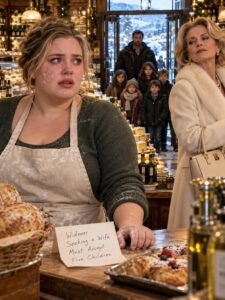
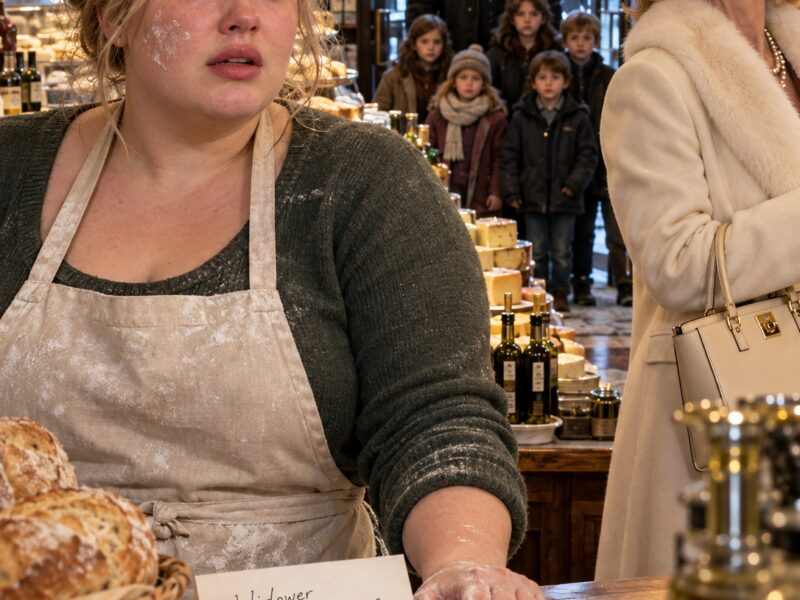
The first time Francesca Loredan heard someone call her useless, she was standing three feet away with flour on her cheek and a tray of almond cookies cooling between her hands.
The woman saying it knew exactly where Francesca was.
That was the point.
“A woman who can’t give a man children is like farmland that won’t grow anything,” Constance Ferrante announced from the front counter of Loredan Market, loud enough for every customer in the little Montana town to hear. “Pretty, perhaps. But what good is pretty land if a man can’t build a legacy on it?”
A few women laughed softly.
Others lowered their eyes.
Francesca placed another amaretti cookie in the glass display case.
Carefully.
One cookie.
Then another.
Then another.
Her hands had learned long ago how to remain steady while the rest of her was breaking.
“What a shame,” Constance continued, adjusting the sleeve of a cream Chanel coat that probably cost more than Francesca made in six months. “Twenty-seven years old. Still young. Still beautiful. And already finished.”
Francesca’s thumb pressed against a crack in the display glass.
She said nothing.
Constance sighed theatrically.
“The Moretti boy was right to end the engagement. Cruel, perhaps. But understandable. A man from a family like his needs heirs.”
That one landed exactly where Constance intended.
Eight years earlier, rheumatic fever had nearly killed Francesca.
It had taken her hair first.
Then her strength.
Then, according to three specialists, the possibility of ever carrying a child.
Her hair had eventually returned thicker than before, honey-blond and stubbornly wavy.
Her strength had returned too.
Her future had not.
At least, not the future everyone around her believed a woman should have.
In a town where old Italian-American families owned trucking companies, timber operations, construction firms, restaurants, half the commercial real estate, and nearly every important handshake, children were not merely children.
They were continuity.
They were inheritance.
They were alliances.
They were proof that the family would survive you.
Francesca could bake bread before sunrise, keep the market accounts without a calculator, repair a torn dress, butcher a chicken, negotiate with suppliers, and make sfogliatelle so delicate the pastry shattered like glass beneath a fork.
None of that mattered to people like Constance Ferrante.
They saw one thing.
An empty womb.
And because of that, they assumed Francesca herself must be empty.
The brass bell over the market door rattled.
Every conversation stopped.
Francesca looked up.
The man filling the doorway did not look like someone who entered rooms.
He looked like someone rooms rearranged themselves around.
Arsen Rogero stood well over six feet tall, broad through the shoulders, wearing a charcoal wool coat dusted with snow. His dark hair was threaded with premature gray at the temples, and a heavy beard sharpened an already hard face.
But it was his eyes people remembered.
Pale blue.
Cold winter sky over the Rockies.
Eyes that seemed to measure exits before faces.
Arsen Rogero owned a timber operation, a regional freight company, and several thousand acres in the mountains north of town.
People called him dangerous.
They lowered their voices when they said his name.
Two years earlier, his wife Angelina had died when an explosive device destroyed her SUV on a private mountain road.
She had been seven months pregnant.
The Rogero children had seen the fire from the upper terrace of their home.
No one had ever been convicted.
Everyone knew who had ordered it.
The Ferrantes.
Behind Arsen came the reason the entire market had gone silent.
Five children.
Nero, thirteen, entered first, thin and rigid, his hand resting too close to the folding knife clipped inside his belt. His eyes moved across the room with an adult’s suspicion.
Imelda, ten, stayed behind him.
She had not spoken since her mother died.
Rocco, seven, immediately noticed the biscotti jar.
Beppe, three, wrapped both arms around his father’s leg.
And strapped against Arsen’s chest beneath a heavy carrier was one-year-old Stella, chewing sleepily on the collar of his shirt.
They were clean.
But their clothes had been repaired with mismatched thread.
Their boots were scuffed.
Their eyes were older than their faces.
These were not neglected children.
They were surviving children.
Arsen approached the counter.
The five moved with him.
One body with six sets of lungs.
“Flour,” he said.
His voice sounded like gravel beneath truck tires.
“Fifty pounds. Sugar. Salt. Coffee.”
Then he pointed toward the display Francesca had just filled.
“And those.”
“The amaretti?”
He nodded.
Francesca began gathering the order.
She could feel him watching her.
Not the way drunk men sometimes watched women.
Not the way the married women watched her either, with that exhausting mixture of superiority and pity.
Arsen studied her the way a man might study a bridge before driving a heavy truck across it.
Looking for weakness.
Testing the structure.
Francesca filled a small paper bag with five cookies.
Then she walked around the counter.
Nero immediately stepped between her and the younger children.
His fingers tightened near his knife.
Francesca stopped.
She did not smile.
Children who had watched their mother burn alive probably had little use for strangers smiling too brightly.
Instead, Francesca extended the bag.
“For the road.”
Nero stared at it.
“No charge.”
He looked toward his father.
Arsen gave the smallest nod.
Nero accepted the bag.
“What’s your name?” Francesca asked.
“Nero.”
His voice cracked.
Thirteen years old, Francesca thought.
And already standing like a soldier.
Her gaze moved to Stella.
The baby’s fingertips were bluish.
“Nero.”
He stiffened.
“Put her hands inside the carrier. Against her body. She’s cold.”
For the first time, his expression changed.
Not gratitude.
Surprise.
The surprise of a child who had spent two years believing he was the only person responsible for noticing everything.
Nero tucked Stella’s hands inside the carrier.
Francesca returned behind the counter.
Constance Ferrante leaned toward another woman.
“Poor man,” she whispered, loudly enough to travel. “Five children and no wife. Imagine having to shop for his own household.”
Francesca saw Arsen’s jaw tighten.
He said nothing.
He paid cash.
Then he did something strange.
He removed a folded sheet of paper from inside his coat.
He flattened it on the counter.
“Put this on the community board.”
Francesca looked down.
The handwriting was heavy, almost carved into the paper.
WIDOWER SEEKING WIFE.
Must tolerate isolation.
Must accept five children.
Must be willing to work.
Inquire at Rogero property before Sunday.
Francesca looked at him.
“You’re advertising for a wife between snowplow services and used farm equipment?”
“I don’t have time for courtship.”
For the first time, there was the faintest suggestion of dry humor beneath his exhaustion.
“The mountain road closes after the next major storm,” he continued. “My children need someone in the house.”
“Someone?”
“A woman.”
“That sounds much better.”
His expression did not change.
“I need someone to share the weight.”
Francesca glanced toward the children.
“Most women aren’t looking to inherit five traumatized children.”
“I don’t need most women.”
Arsen lifted the fifty-pound flour sack onto one shoulder.
“I need one.”
He gathered the rest of the groceries.
At the door, he stopped.
Those winter-blue eyes found Francesca again.
“Sunday.”
Then he disappeared into the snow.
And Francesca had the strangest feeling that he had not been talking about the notice.
By Thursday afternoon, everyone in Bellweather County knew Arsen Rogero was looking for a wife.
By Friday, mothers were volunteering daughters.
By Saturday evening, Father Michael had somehow organized what he insisted was a “community supper” at Saint Anthony’s parish hall.
Nobody believed him.
It was an auction with lasagna.
Francesca sat near the back, repairing a torn altar cloth.
She had no reason to participate.
She knew that.
Every woman in the room knew that.
Constance Ferrante’s nineteen-year-old niece, Giselle, was the obvious favorite.
Tall.
Elegant.
Educated at a private college in Boston.
The kind of young woman old families described as “good breeding” without hearing how ugly the phrase sounded.
Giselle knelt beside Rocco and tried wiping dirt from his cheek with a silk handkerchief.
Rocco pulled away.
She grabbed his chin.
“Hold still.”
He reached for a pastry.
Giselle slapped his hand.
Quickly.
Quietly.
Hidden beneath the folds of her skirt.
But Francesca saw it.
Across the room, Arsen saw it too.
His coffee cup hit the table with a dull crack.
Giselle’s mother kept talking.
Arsen walked away.
Francesca returned to her stitching.
A few minutes later, the light over her hands disappeared.
She looked up.
Arsen stood in front of her.
“You’re the woman from the market.”
“Usually people call me Francesca.”
“Francesca Loredan.”
“So you do listen to gossip.”
“I listen when information is useful.”
She threaded the needle.
“And am I useful information?”
He pulled out the chair opposite her, turned it backward, and sat with his arms resting across the back.
“You’re not participating.”
“In what?”
He looked toward the women circling his children.
“The parade.”
Francesca laughed once.
“No. I’m not on the auction block.”
“Why?”
The question irritated her more than it should have.
“Either you haven’t lived here long enough, or you’ve somehow missed the favorite topic of every bored woman in town.”
“I’ve heard it.”
Her needle stopped.
Arsen’s gaze did not move.
“I heard they say you can’t have children.”
Francesca felt the air leave her lungs.
People whispered it constantly.
No one said it directly to her face.
Not like that.
Her fingers tightened around the cloth.
“They’re right.”
Arsen remained silent.
“I had rheumatic fever when I was nineteen. It caused permanent damage. The doctors said pregnancy is essentially impossible.”
Her voice hardened.
“So there. I’m barren. Sterile. Broken. Dry. Whatever charming word you prefer.”
Several people nearby had begun listening.
Francesca no longer cared.
“If you need a broodmare for the Rogero dynasty, you’re sitting at the wrong table. Giselle Ferrante is right there. She could probably give you six sons and a spare.”
She expected him to leave.
Arsen leaned closer.
“I already have five children.”
Francesca stared at him.
“My wife was pregnant with our sixth when she was murdered.”
His voice remained quiet.
“The children watched the explosion.”
The parish hall seemed to recede around them.
“I don’t want more children, Francesca.”
Something inside her stopped.
Arsen continued.
“In my world, pregnancy isn’t just a blessing. It can become a vulnerability. Angelina was moving slowly because she was seven months pregnant. Her security routine changed. The Ferrantes knew it.”
Across the room, Constance Ferrante was laughing at something.
Arsen never looked toward her.
“They used my unborn child to kill my wife.”
His hands tightened over the chair.
“So no. I am not looking for a woman to give me heirs.”
Francesca could hear her own heartbeat.
“What are you looking for?”
“A partner.”
His answer came immediately.
“Someone who can keep a fire burning. Feed children who forget they’re hungry. Stand beside me when things become difficult.”
“You decided that was me because I sold you flour?”
“No.”
His pale eyes dropped toward her hands.
“You gave Nero cookies without treating him like a charity case. You spoke to him like a man because you understood that’s what he thinks he has to be.”
Francesca said nothing.
“You noticed Stella was cold when I didn’t.”
That hurt him to admit.
She could hear it.
“You have calluses.”
Francesca looked down.
Flour beneath her nails.
Small burns across two fingers.
Cracked skin from winter soap and endless work.
“I need a woman with calluses, Francesca.”
His eyes shifted toward Giselle’s silk handkerchief lying on a table.
“Not silk.”
Francesca swallowed.
“You don’t know me.”
“I know enough.”
“No, you know what I can do.”
“That matters.”
“And what happens when I can’t be what you imagined?”
His face changed then.
Not softened.
Something deeper.
“Then we adjust.”
No man had ever said those words to her.
Every man before him had spoken about what Francesca lacked.
Arsen Rogero was talking about what remained.
He stood.
“My convoy leaves tomorrow at noon.”
“Arsen—”
“If you want to spend another twenty years behind that market counter while women like Constance Ferrante discuss your body as if they own shares in it, stay.”
His voice lowered.
“If you want a home where five people need exactly what you know how to give, meet me at the gate.”
He stepped away.
Then stopped.
“I won’t ask twice.”
He walked into the cold night.
Francesca remained on the bench.
Across the hall, Constance was already whispering.
Francesca looked at her hands.
Callused.
Cracked.
Useful.
For eight years, everyone had told her she was a field that could grow nothing.
Arsen Rogero had just offered her five living reasons to stop believing them.
The following morning, Francesca packed twenty-seven years into one canvas bag.
Three dresses.
Two aprons.
Her kitchen knives wrapped in leather.
Her mother’s cast-iron pastry mold.
A wooden box containing her grandmother’s silver cross.
That was all.
Mrs. Benedetti, her landlady, blocked the stairs.
“You’ve lost your mind.”
“Probably.”
“That man is dangerous.”
“So is black ice.”
“Those children are wild.”
“They’re grieving.”
“He’ll work you to death.”
Francesca adjusted the bag on her shoulder.
“Then you can rent my room to a woman with better judgment.”
Outside, Bellweather watched her leave.
Faces appeared behind windows.
Women clustered near the church steps.
Men pretended to clear snow while watching.
Francesca kept walking.
For eight years, this town had made her body public property.
That morning, she took it back.
Three black SUVs waited beside the Rogero gate.
The children were already bundled inside the lead vehicle.
Arsen was tightening a cargo strap when Francesca approached.
His hands stopped.
Only for a second.
“You came.”
“Yes.”
That was their proposal.
The wedding happened forty minutes later in the small stone chapel on Rogero land.
Francesca wore gray.
Arsen never removed his winter coat.
Father Michael rushed through the ceremony because snow was beginning to fall.
When he asked for the ring, Arsen removed a thick dark band from his pocket.
Iron.
Hand-forged.
Heavy.
Cold.
He slid it onto Francesca’s finger.
Nothing about it was romantic.
Yet somehow it felt more honest than every diamond she had ever seen.
Etio Marino, Arsen’s scarred security chief, served as witness.
When Father Michael asked whether anyone objected, Etio looked toward the chapel door.
Then at Arsen.
“Anyone with objections should schedule them for spring. The boss is already forty minutes behind.”
Francesca laughed.
Arsen almost did.
They drove into the mountains as the storm closed behind them.
Halfway up, Stella began coughing.
Nero held the baby stiffly, trying not to panic.
Francesca unbuckled herself.
“Give her to me.”
Nero hesitated.
Francesca held out her arms.
Eventually, he surrendered the child.
Stella’s body was cold.
Francesca opened her coat and pressed the baby against her chest.
Within minutes, Stella’s breathing slowed.
Francesca looked toward the rearview mirror.
Arsen was watching.
His jaw relaxed.
Barely.
But she saw it.
The Rogero property appeared through the snow like a fortress.
Stone walls.
Iron gates.
Security cameras.
Generators.
Garages.
Enough stored fuel and food to survive months cut off from civilization.
The house itself was enormous.
And dead.
Francesca noticed the smell first.
Cold stone.
Old grease.
Laundry.
Dust.
The kitchen was worse.
Dirty plates.
Blackened pans.
A commercial stove that looked as though it had not been properly used in months.
The room that should have been the heart of the house had become a morgue.
Arsen stood behind her.
For the first time since she had met him, he looked embarrassed.
Francesca understood immediately.
This was not laziness.
This was what happened when one man spent two years concentrating every ounce of energy on keeping five children breathing.
Nothing remained for beauty.
Nothing remained for order.
Nothing remained for himself.
Francesca put the sleeping baby in a basket.
Rolled up her sleeves.
“No.”
Arsen frowned.
“No?”
“This won’t do.”
She pointed toward Rocco.
“Firewood.”
Then Nero.
“Water.”
Then Arsen.
“Olive oil, salt, onions, and every pound of flour you have left.”
His eyebrows rose.
“Francesca—”
“We have three hours before dark.”
She tied on her apron.
“This kitchen is coming back to life.”
Arsen stared at her.
Then lifted the flour sack.
“My name is Arsen.”
That was how it began.
Not with a kiss.
With bread.
Every morning Francesca lit the stove before sunrise.
She baked.
Scrubbed.
Washed.
Sorted.
Opened windows when weather allowed.
Put blankets in sunlight.
Made soup thick enough to hold a spoon upright.
The children watched her constantly.
They expected shouting.
They expected punishment.
They expected her to leave.
She did none of those things.
On the fourth morning, Francesca made sfogliatelle from her grandmother’s recipe.
She set seven plates on the table.
Seven forks.
Seven napkins.
Imelda approached silently.
The ten-year-old grabbed two pastries and turned toward the corner where she usually ate beside the handmade doll her mother had sewn.
“Sit down, Imelda.”
The girl froze.
Nero stood immediately.
“Leave her alone.”
Francesca kept working at the stove.
“We eat at the table.”
“She eats where she wants.”
“No.”
Nero’s chair scraped backward.
“You’re not our mother.”
The words struck the room like a thrown glass.
“You’re just some woman Dad bought from town.”
Francesca turned.
Nero was breathing hard.
Waiting.
Waiting for the slap.
She saw it then.
The flinch already hiding inside him.
Francesca pulled out a chair.
“You’re right.”
Nero blinked.
“I am not your mother.”
Imelda tightened her grip on the pastries.
“Your mother is dead.”
Nero’s face went white.
“And nothing I bake, clean, fix, or say will change that.”
His lower lip trembled.
Francesca continued.
“I’m not here to replace Angelina.”
She pointed toward the chair.
“I’m here because children should eat warm food at a table instead of hiding cold food in bedrooms like they expect someone to steal it.”
Silence.
“I’m here because Stella needs warm hands. Beppe needs clean clothes. Rocco needs someone to stop him from killing himself climbing walls.”
Rocco looked mildly offended.
“And you, Nero, need permission to be thirteen once in a while.”
His eyes flashed.
“I don’t need—”
“Yes, you do.”
Francesca softened her voice.
“You just don’t know it yet.”
Nero stared at her.
Then at Imelda.
“Sit down,” he whispered.
Imelda slowly climbed into the chair.
Francesca placed warm milk in front of her.
She did not ask for thanks.
She returned to the stove.
An hour later, Arsen entered from outside.
Snow melted from his boots.
He stopped in the doorway.
The house smelled like cinnamon.
Bread.
Coffee.
Beppe was playing on a clean rug.
Stella slept beside the stove.
Imelda sat at the table peeling an orange.
Arsen looked toward Francesca.
Her hair had escaped its pins.
Her cheeks were flushed.
Her hands were red from scrubbing.
“You stood up to Nero.”
“He’s hurting.”
“He challenged you.”
“Anger is dough that hasn’t risen.”
Arsen blinked.
“Did you just compare my son to bread?”
“Everything is bread if you understand it properly.”
For several seconds, he simply stared.
Then one corner of his mouth moved.
Not quite a smile.
But close.
The children did not transform overnight.
Healing did not work that way.
They thawed like mountain ice.
Drop by drop.
Rocco surrendered first.
He slipped on black ice and split his knee open against a stone step.
He crawled into the kitchen bleeding and trying desperately not to cry.
Francesca lifted him onto the table.
“Look at the lantern.”
“It hurts.”
“I know.”
“Am I gonna die?”
“Not unless you continue being stupid professionally.”
He almost laughed.
Francesca cleaned the wound and stitched it with three neat sutures.
When she finished, she pushed a warm cornetto toward him.
“You’re tough.”
Rocco wiped his nose.
“Really?”
“Yes.”
Then Francesca tapped his forehead.
“Being tough does not mean being an idiot.”
From that day forward, Rocco followed her everywhere.
He carried wood.
Stole dough.
Sat beneath the kitchen table while she cooked.
Soon he stopped calling her Mrs. Rogero.
He called her Cesca.
Imelda took longer.
Three weeks later, Francesca gave her a small piece of pasta dough.
They worked side by side.
No questions.
No pressure.
Then, suddenly, Imelda whispered:
“Mom made pasta on Fridays.”
Francesca’s hands stopped.
She did not look up.
“What kind?”
“Orecchiette.”
The child’s voice was rusty from disuse.
“She said they looked like Beppe’s ears when he was born.”
Francesca pushed the dough toward her.
“Show me.”
Imelda pressed her thumb into the dough.
Made a tiny ear.
A tear fell onto the board.
Francesca wiped the girl’s cheek with a flour-covered thumb.
“We’ll make them every Friday.”
Imelda looked up.
“Mom’s recipe?”
“Angelina’s recipe.”
The girl’s face collapsed.
She leaned into Francesca’s apron and sobbed.
Not neatly.
Not quietly.
Two years of grief came out of her in broken gasps.
Francesca held her.
Across the room, Arsen stood in the doorway.
His eyes shone.
He turned away before either of them could acknowledge it.
That afternoon, Beppe climbed into Francesca’s lap.
He buried his face against her chest.
“Mama.”
Francesca stopped breathing.
“I’m Cesca.”
The three-year-old considered this.
“Cesca Mama.”
Francesca looked across the room.
Arsen was watching.
He did not correct his son.
Something shifted between them that day.
Their marriage had begun as logistics.
Two adults combining labor because survival was easier with four hands.
But quiet intimacy began slipping through the cracks.
Francesca always served Arsen the largest dinner portion because he worked outside most days.
He noticed.
Soon small objects began appearing beside her mixing bowl.
A better knife.
Saffron.
A thick pair of kitchen gloves.
A new rolling pin.
He never explained them.
She never thanked him aloud.
Then, late one January night, Francesca sat at the kitchen table rubbing cramps from her hands.
Twelve hours of kneading, lifting, washing and carrying had left her fingers swollen.
Arsen entered.
He saw her.
Said nothing.
He heated water in a copper basin.
Placed it on the table.
“Give me your hands.”
“I’m fine.”
“Francesca.”
She looked at him.
“Give me your hands.”
Slowly, she did.
Arsen took them between his.
His palms were enormous and rough.
His touch was astonishingly gentle.
He lowered her cracked hands into warm water.
Washed flour from each finger.
Massaged the swollen joints.
Cleaned around the heavy iron wedding band.
Francesca could barely breathe.
No man had ever touched her hands as though they mattered.
“You work too much,” he murmured.
“There’s work to do.”
“I didn’t bring you here to destroy yourself.”
She looked up.
Arsen’s eyes met hers.
“You’re carrying this whole house.”
His thumb moved across her knuckles.
“I see it.”
He paused.
“The children see it.”
For a long moment, neither moved.
The kitchen fire crackled.
Snow pressed against the windows.
His hands remained around hers.
Their priest had spoken vows over them.
But this felt more like one.
Then February came.
And the Ferrantes came with it.
The alarm screamed at 3:07 a.m.
Francesca woke instantly.
Arsen was already moving.
“South gate,” Etio’s voice crackled over the radio. “Multiple vehicles.”
Arsen pulled on body armor.
“Ferrante?”
“Confirmed.”
Francesca’s stomach turned cold.
The family that had killed Angelina.
Arsen opened the gun safe.
“Take the children to the safe room.”
“Arsen—”
“Now.”
Gunfire cracked somewhere beyond the walls.
Five frightened faces appeared in the hallway.
They knew that sound.
Francesca saw the memory hit them before the next shot came.
“Listen to me.”
Her voice became steel.
“Nero, Stella.”
He picked up the baby.
“Rocco, hold Beppe.”
Rocco grabbed his brother.
“Imelda, behind me.”
Nero reached for his knife.
Francesca caught his wrist.
“Not tonight.”
“I can help Dad.”
“Your job tonight is your siblings.”
His eyes filled with rage.
And terror.
“Move.”
They crossed the dark hallway.
The kitchen stove still held warmth.
Bread Francesca had prepared for morning was rising beneath cloth.
Gunfire rattled outside.
Francesca entered the security code.
The reinforced door opened.
She counted.
Nero.
Imelda.
Rocco.
Beppe.
Stella.
Five.
Then came the sound of metal collapsing.
The south gate.
Nero’s face drained of color.
Francesca pushed the children inside.
“Lock this after me.”
Nero grabbed her sleeve.
“Where are you going?”
“To make sure your father comes back.”
“Cesca—”
“Only open this door for him or me.”
She closed it.
The lock engaged.
Francesca ran back toward the kitchen.
On the wall above the pantry hung the double-barrel shotgun Arsen had taught her to load during her second week.
She took it down.
Loaded it.
Walked onto the terrace.
The storm swallowed everything.
Snow moved sideways.
Security lights cut through white darkness.
Men shouted near the vehicle yard.
Then Francesca saw Arsen.
On the ground.
Blood darkened his left sleeve.
A man had him pinned against a stone column.
A knife pressed against Arsen’s throat.
Francesca raised the shotgun.
Her hands shook.
They had been shaking, one way or another, for eight years.
They had still never dropped a pastry tray.
She rested the barrel against the terrace rail.
Breathed once.
And fired.
The blast shook snow from the roof.
The attacker spun sideways, wounded in the shoulder.
Arsen moved instantly.
He drove an elbow upward, disarmed the man, and slammed him onto the frozen ground.
Etio’s security team closed the breach.
Within a minute, the surviving Ferrante vehicles were retreating down the mountain.
Silence returned almost violently.
Arsen knelt in the snow, gripping his bleeding arm.
Then he looked up.
Francesca stood on the terrace in a nightgown beneath a heavy coat.
Shotgun smoking.
Flour still caught in her hair from the bread she had prepared before bed.
His expression was impossible to read.
“You didn’t stay in the safe room.”
Francesca’s knees were shaking now.
“You didn’t ask nicely.”
Then she nearly collapsed.
The knife wound became infected.
For twelve days, Arsen Rogero—the man Bellweather whispered about as if he were made of granite—became frighteningly mortal.
His fever climbed.
His skin turned gray.
He could barely lift a glass.
Francesca slept in a chair beside him.
She changed bandages.
Boiled water.
Forced broth between his lips.
Checked his temperature every ninety minutes.
The children changed too.
Nero stopped fighting her.
He wore his father’s coat and checked the windows.
Rocco carried water.
Imelda cooked orecchiette for her brothers.
Beppe sat outside Arsen’s room with his wooden blocks.
Stella slept against Francesca whenever Francesca’s arms were free.
They had become a family without noticing the exact moment it happened.
On the twelfth night, Arsen’s fever broke.
His eyes opened clearly.
He looked around.
Clean bandages.
Water.
Fire.
Five children sleeping safely nearby.
Then Francesca.
Still in the chair.
Still there.
“You stayed.”
His voice was barely audible.
Francesca opened one exhausted eye.
“Where else would I go?”
A faint smile touched his mouth.
“We’re almost out of firewood,” she added. “And your children ate every amaretti in the house.”
He laughed.
It hurt.
He winced.
Then reached for her wrist.
“You saved my life.”
“The shotgun?”
“The terrace.”
His thumb moved over her pulse.
Francesca shrugged.
“You owe me a coat.”
His brow furrowed.
“You bled all over mine.”
Arsen stared at her.
“You are the most impossible woman I’ve ever met.”
“And you are the worst patient.”
“Francesca.”
Something in his voice changed.
She stopped joking.
“I didn’t choose you because I was desperate.”
She raised an eyebrow.
“You literally advertised for a wife on a grocery-store bulletin board.”
“That was desperate.”
Despite herself, she smiled.
Arsen continued.
“But I chose you because in a room full of silk handkerchiefs, you were the only woman with calluses.”
His hand tightened gently around hers.
“And every day since then, you’ve proved I was right.”
Francesca looked down at the iron ring.
For the first time, it did not feel cold.
Spring eventually broke the mountain open.
Roads cleared.
Snow melted from roofs.
For the first time since their marriage, the Rogero family returned to Bellweather together.
All seven of them.
The annual Founders Gala filled the historic Grand Bellweather Hotel with three hundred guests.
Francesca wore crimson.
Her honey-blond hair fell loose across her shoulders.
Nero carried Stella.
Imelda held Beppe’s hand.
Rocco walked beside Francesca and, just before they entered the ballroom, slipped his hand into hers.
The room went silent.
Then the whispers began.
Constance Ferrante reached them before the first dance.
“Arsen.”
Her smile was polished enough to cut skin.
“What a surprise.”
Arsen said nothing.
“I assumed your arrangement would remain… private.”
Her gaze moved over the children.
“They look well.”
Then she looked at Francesca.
“I imagine raising another woman’s children must be especially difficult for someone with your condition.”
Francesca felt the old wound open.
Condition.
There it was.
The word that had followed her for eight years.
But before Francesca could answer, Arsen stepped forward.
He did not raise his voice.
He simply placed one scarred hand against the small of his wife’s back.
“My wife,” he said, “is the reason every member of my family is standing here.”
The ballroom quieted.
Constance’s smile faltered.
“She stitched my son’s knee when he was bleeding. She taught my daughter to speak again by making her mother’s pasta.”
Imelda squeezed Beppe’s hand.
“She kept my children alive during an armed attack.”
Arsen’s voice lowered.
“And she stood on my terrace at three in the morning with a shotgun while men connected to your family broke through my gate.”
Constance went pale.
“She kept me alive through twelve days of fever.”
Arsen looked directly into her eyes.
“So understand me carefully.”
No one moved.
“These children belong to Francesca as much as they belong to me.”
Francesca’s throat tightened.
“And if you ever use the word condition to diminish my wife again, I will purchase every commercial property your family owns on Main Street and donate the buildings to the women’s shelter under her name.”
Constance stared at him.
Arsen tilted his head.
“Have I made myself clear?”
She left without answering.
Only then did Arsen look at Francesca.
The ice disappeared from his face.
Music began.
“Dance with me.”
Francesca almost laughed.
“I don’t dance.”
“You do now.”
He took her hand.
They walked onto the floor.
Three hundred people watched the woman Bellweather had dismissed as barren dance with the man half the county feared.
Arsen’s hand settled at her waist.
Francesca looked up at him.
“You already bought the Ferrantes’ Main Street properties, didn’t you?”
Arsen’s expression remained perfectly serious.
“Thursday.”
She stared.
“Etio handled the paperwork.”
Francesca laughed.
Not politely.
Not carefully.
A real laugh.
Bright enough to make people turn.
Arsen pulled her closer.
For years, his eyes had looked at every room as though calculating what might collapse.
That night, he looked at Francesca as though she were the one structure he trusted to remain standing.
Hours later, they returned home.
Francesca changed clothes and went automatically to the kitchen.
The stove glowed.
The table was set for seven.
Stella slept nearby.
Beppe sat against Nero, who had somehow become a boy again instead of a soldier.
Imelda shaped orecchiette.
Rocco stole amaretti from the cooling rack and believed no one noticed.
Arsen stood in the doorway.
Watching.
“You’re staring,” Francesca said.
“I’m observing.”
“There’s a difference?”
“Staring is rude.”
He crossed the kitchen.
“Observing is strategic.”
Francesca smiled without looking up from the dough.
“And what has your strategic observation concluded?”
Arsen stopped behind her.
His arms slowly circled her waist.
Slowly enough that she could step away.
She did not.
His mouth rested near her hair.
“That you were never empty.”
Francesca’s hands stopped.
Arsen held her a little tighter.
“You were the fullest room in every house you entered.”
Her eyes burned.
“The world was just too stupid to notice.”
Francesca leaned back against him.
The iron ring pressed against the scars on his arm.
In the next room, five children were arguing over the last cookie.
The bread was rising.
The stove was warm.
Imelda was speaking.
Nero was laughing.
Rocco was lying badly about stolen amaretti.
Beppe was calling for “Cesca Mama.”
Stella was alive.
For eight years, people had measured Francesca by something her body could not create.
They had called her barren.
Incomplete.
A dead field.
A cold oven.
They had been asking the wrong question.
Because life was not only about what a person could bring into the world.
Sometimes it was about what they could keep from disappearing.
Francesca had not given birth to the five Rogero children.
She had simply noticed when Stella’s hands were cold.
She had put warm food in front of Imelda.
She had told Nero he was allowed to be thirteen.
She had stitched Rocco’s knee.
She had let Beppe call her Mama before she believed she deserved the word.
She had brought bread into a dead kitchen.
Then one winter night, when violence returned to finish what grief had started, she had stood between that violence and her family.
Perhaps motherhood could begin there too.
Not in blood.
Not in biology.
But in staying.
Francesca looked around the kitchen.
Years earlier, she had believed the doctors had sentenced her to an empty life.
Now there were seven plates on her table.
Seven coats by the door.
Tiny boots drying beside the fire.
A wooden doll on a chair.
A scarred man holding her as though letting go had become impossible.
And five children making enough noise to shake the mountain.
Francesca placed her flour-covered hand over Arsen’s.
“Tomorrow,” she said quietly, “you’re fixing the pantry shelf.”
He sighed against her hair.
“I own a timber company.”
“Exactly. There’s really no excuse.”
Behind them, Nero laughed.
Then Imelda.
Then Rocco.
Even Arsen finally gave in.
Francesca closed her eyes.
Outside, snowmelt ran down the mountain in silver streams.
Inside, the fire burned steadily.
She had spent eight years being told she could never create a family.
In the end, she discovered she had done something harder.
She had walked into the ruins of one—
and taught it how to live again.









