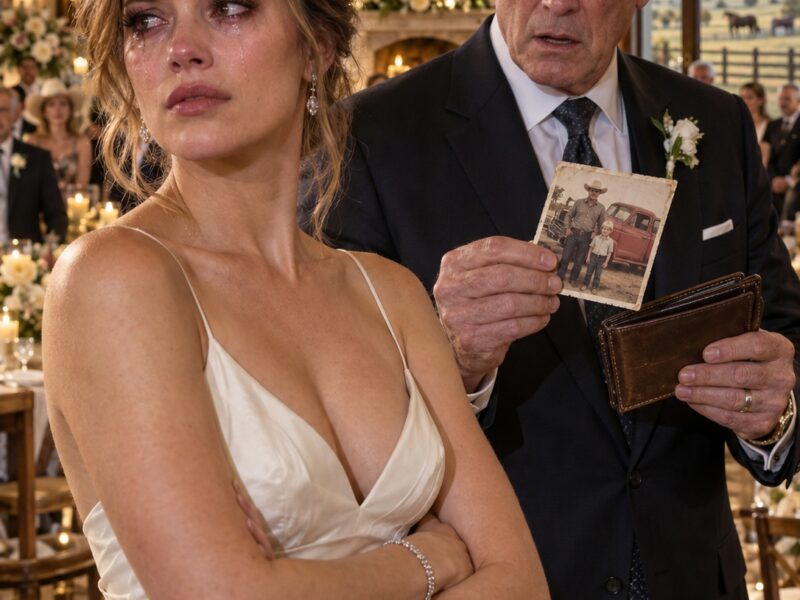
They Called Her Husband a Broke Ranch Hand—Until Her Father Saw the Photograph in His Wallet
Richard Whitmore had spent thirty years learning how not to tremble.
He had stared down bankers who threatened to call loans, attorneys who promised to bury him in litigation, competitors who tried to destroy his company, and board members who believed they could frighten him by walking away from deals worth eight figures.
Nothing had ever made his hands shake.
Not until the photograph slipped from Caleb Reed’s battered leather wallet.
It landed faceup on the wooden workbench inside the old Whitmore ranch barn.
Richard looked down.
The cold November wind kept pushing through the gaps in the barn walls, carrying the smell of hay, leather, damp earth, and horses. Somewhere behind them, a mare stamped against the floor. A loose chain tapped against a metal gate.
Richard heard none of it.
His eyes were fixed on the photograph.
Two people stood beside an old red cattle truck.
One was a lean, dark-haired man in his early thirties, grinning at the camera with one arm around a little boy.
The boy could not have been more than five.
Richard recognized the man immediately.
The years disappeared.
So did the barn.
For one impossible second, he was twenty-nine again, standing beneath a Texas sun beside the only man who had ever treated him like a brother before money complicated everything.
Richard bent down slowly.
“Where did you get this?”
Caleb stopped fastening the cuff of his work glove.
He looked at the photograph.
Then at Richard.
Something guarded entered his face.
“My father gave it to me.”
Richard swallowed.
The photograph shook between his fingers.
“No.”
His voice came out quieter than he intended.
Caleb’s eyes narrowed.
Richard turned the photograph over.
There, in faded blue ink, was handwriting he had not seen in more than three decades.
He read the first line.
His knees nearly gave beneath him.
Caleb stepped forward.
“What is it?”
Richard stared at the words.
Then he lifted his eyes to the ranch hand his family had mocked, insulted, dismissed, and called a nobody.
The man his daughter had married against all of their wishes.
And Richard finally understood exactly who was standing in front of him.
But by then, the damage had already been done.
Three months earlier, Eleanor Whitmore had stood beneath a chandelier worth more than the farmhouse she would soon call home and told her family she intended to marry a man who earned thirty-two dollars an hour repairing fences, breaking horses, and hauling feed.
For nearly five seconds, nobody spoke.
Then her older brother laughed.
It was not a nervous laugh.
It was the sharp, unbelieving sound of a man who thought someone had just told an exceptionally bad joke.
“You’re serious?”
Eleanor kept both hands resting on the back of a velvet dining chair because she knew that if she let go, her mother might see them trembling.
“Yes.”
Daniel leaned back against the marble fireplace.
“You’re marrying Caleb?”
“Yes.”
“Caleb Reed?”
She stared at him.
“How many Calebs work here?”
Daniel glanced at their mother, Margaret.
Margaret had gone pale.
Their aunt Vivian, who had come over for cocktails and somehow found herself witnessing a family catastrophe, lowered her glass of white wine.
Richard Whitmore said nothing.
That frightened Eleanor more than Daniel’s laughter.
Her father sat at the far end of the room beneath a portrait of Eleanor’s great-grandfather, a stern-faced man who had owned eighty acres and three dozen cattle long before the Whitmore name appeared on corporate headquarters and charity gala programs.
Richard slowly removed his reading glasses.
“When?”
Eleanor looked at him.
“October.”
“This October?”
“Yes.”
“That’s twelve weeks away.”
“I know.”
“Does he know?”
A bitter smile crossed her face.
“Generally, both people know about an engagement.”
Margaret closed her eyes.
“Eleanor.”
“What?”
“There’s no need to be sarcastic.”
“There’s also no need for everyone to act like I announced I’m joining a cult.”
Daniel laughed again.
Their father didn’t.
“What does he own?” Richard asked.
Eleanor blinked.
Of every question she had imagined, that was the one she should have expected.
“What?”
“Property. Investments. Savings. Does he own land?”
“I don’t know.”
Richard stared at her.
“You don’t know?”
“No.”
“And you agreed to marry him?”
Eleanor felt anger rising beneath the fear in her chest.
“I know how he treats people. I know he works harder than anyone I’ve ever met. I know he’s honest. I know he stays with a sick horse until four in the morning because he doesn’t want the animal to die alone. I know he drove Mr. Alvarez eighty miles to a cardiologist after his truck broke down.”
Daniel rolled his eyes.
“That’s touching. Does he have health insurance?”
“Daniel.”
“I’m asking practical questions.”
“No. You’re being cruel.”
Richard placed his glasses on the table.
“Your brother is asking the kind of questions someone should ask before marriage.”
“And what question are you asking, Dad?”
Richard’s jaw tightened.
“I’m asking whether the man marrying my daughter can support a family.”
“He supports himself.”
“That is not what I asked.”
“I have my own income.”
“You have a position in the Whitmore Foundation because your last name is Whitmore.”
The words struck harder than Eleanor expected.
Margaret glanced at her husband.
“Richard.”
But he was looking only at his daughter.
Eleanor straightened.
“I’ve worked there for six years.”
“And you’ve done good work. That doesn’t change reality.”
“What reality?”
“That you have never lived without a financial safety net.”
“And Caleb has.”
“That isn’t an achievement.”
Her voice hardened.
“No. To you, the only achievement is making enough money that people are afraid to tell you no.”
The room changed.
Daniel looked away.
Margaret whispered, “Eleanor, please.”
But Eleanor had spent twenty-eight years learning how silence functioned in the Whitmore family.
Silence kept dinner pleasant.
Silence protected appearances.
Silence allowed Richard to decide which truths were acceptable.
She was tired of it.
Richard stood.
“You think this is about my ego?”
“I think I told you I’m marrying a good man and your first question was what he owns.”
“Because marriage is not a horseback ride at sunset.”
“I know that.”
“It is mortgages. Children. Illness. Responsibility.”
“I know.”
“You have known this man eleven months.”
“And you knew Mom eight months before you proposed.”
“That was different.”
“Why?”
Richard’s answer came immediately.
“Because I had a plan.”
Eleanor stared at him.
There it was.
Not because he had loved Margaret more.
Not because he had known her heart better.
Because he had possessed a plan.
“You know what Caleb has that your plans don’t?”
Richard waited.
Eleanor’s voice became quieter.
“Peace.”
Nobody laughed after that.
She remembered the first time she had truly seen Caleb Reed.
Not noticed him.
Seen him.
It happened during a June thunderstorm on the western edge of the Whitmore estate.
Eleanor had driven from Dallas that afternoon to review plans for a youth equestrian program the family foundation funded. The sky had been heavy and green-gray all afternoon, the kind of Texas sky that made old ranchers stop what they were doing and start counting horses.
At six seventeen, the storm broke.
Rain slammed sideways against the stable roof.
Lightning cracked somewhere beyond the cottonwoods.
One of the younger horses, a chestnut gelding named Jasper, panicked when a tree branch came down across the outer fencing.
Someone shouted that the western gate was open.
The horse bolted.
Eleanor remembered standing beneath the stable awning with three employees as Jasper disappeared into sheets of rain.
Then Caleb ran past them.
No jacket.
No hesitation.
Just a rope in one hand.
“Are you insane?” the stable manager shouted.
Caleb kept going.
Eleanor watched him disappear into the storm.
Fifteen minutes later, he emerged from the rain leading Jasper slowly toward the barn.
The horse’s nostrils flared.
Caleb’s shirt clung to his body, mud covered his jeans, and blood ran from a shallow cut above his eyebrow.
He kept one hand against the horse’s neck.
“Easy,” he murmured. “Nobody’s chasing you.”
Eleanor stepped forward.
“You’re bleeding.”
Caleb touched his forehead as if he had forgotten he possessed one.
“Huh.”
“You need stitches.”
“I need a towel.”
“You ran into a lightning storm for a horse.”
“He was scared.”
“So?”
Caleb looked at her as though the answer were obvious.
“So you don’t leave something scared just because getting to it is inconvenient.”
She remembered those words.
Months later, she would understand why.
Caleb was not impressive in the way men in Eleanor’s world had been trained to be impressive.
He did not name-drop.
He did not talk about restaurants that required six-week reservations.
He did not casually mention the square footage of his home or the price of his watch.
He wore a Timex with a scratched face.
He drove a fifteen-year-old Ford F-150 that made a whining sound above fifty-five miles an hour.
His boots had been resoled twice.
His phone screen was cracked in one corner.
At first, Eleanor thought his refusal to talk about money meant he was embarrassed.
Eventually she realized he simply did not find it interesting.
They started with coffee.
Then lunch.
Then dinners in roadside places Eleanor’s family had driven past for years without noticing.
The first time Caleb took her to Rosa’s Diner outside Weatherford, he watched Eleanor examine the laminated menu.
“You’re disappointed.”
“I’m deciding between chicken-fried steak and something called the Heart Attack Melt.”
“You’re disappointed elegantly.”
She smiled.
“Did you bring me here as a test?”
“No.”
“Good.”
“I brought you here because Rosa makes the best peach pie in Texas.”
“That sounds like a test.”
“It’s a fact.”
She ordered the chicken-fried steak.
He gave her half his pie.
Two tables away, an elderly ranch worker coughed into a napkin.
Caleb’s attention shifted immediately.
“You okay, Mr. Alvarez?”
The older man waved him off.
“Fine.”
“You said that yesterday.”
“I was fine yesterday too.”
Caleb frowned.
Three days later Eleanor learned Caleb had paid for the man’s cardiology consultation because Alvarez’s insurance deductible was more than he could afford.
When she confronted him, Caleb looked embarrassed.
“How did you know?”
“Mr. Alvarez told Rosa, Rosa told me.”
“Small towns are unconstitutional.”
“You paid nearly nine hundred dollars.”
“He’ll pay me back.”
“Will he?”
“No.”
“Can you afford that?”
Caleb took a sip of coffee.
“Not comfortably.”
“Then why did you do it?”
He shrugged.
“Because he needed a cardiologist more than I needed new tires.”
She stared at him.
“You need new tires?”
“That wasn’t the part you were supposed to hear.”
Eleanor laughed.
But later that night she sat in her Mercedes outside her parents’ mansion and cried for reasons she did not fully understand.
Nobody in her family was evil.
That was what made it complicated.
Her father donated millions.
Her mother served on hospital boards.
Daniel had funded a scholarship at his university.
They knew how to be generous.
But somewhere along the way, generosity had become something performed from podiums.
Caleb’s kindness was different.
It happened in parking lots.
Barn stalls.
Hospital waiting rooms.
Places with no photographers.
She fell in love with him there.
Richard Whitmore saw none of that.
He saw cracked boots.
A worn truck.
An employee number.
Two weeks after Eleanor announced the engagement, Richard summoned Caleb to his office.
Eleanor did not know about the meeting until afterward.
Richard’s office occupied the southwest corner of Whitmore Agricultural Holdings, thirty-one floors above downtown Dallas.
The windows looked over a city that seemed to prove everything Richard believed about ambition.
Caleb arrived wearing clean jeans, polished work boots, and a white shirt.
Richard noticed the boots first.
That would haunt him later.
“Sit.”
Caleb sat.
Richard remained standing.
“I assume you know why you’re here.”
“I have an idea.”
“My daughter says she intends to marry you.”
“She does.”
“And you?”
“I intend to marry her.”
Richard walked behind his desk.
“You understand that Eleanor has lived a particular kind of life.”
“I do.”
“She has expectations.”
Caleb almost smiled.
“Have you met your daughter?”
Richard’s expression cooled.
“This isn’t a joke.”
“No, sir.”
“What exactly is your plan?”
“For marriage?”
“For providing for her.”
“I work.”
“As a ranch hand on property my company owns.”
“For the moment.”
Richard paused.
“What does that mean?”
“It means I’ve worked other places before. I can work somewhere else.”
“You’re willing to leave?”
“If working for your family creates a problem for Eleanor, yes.”
Richard studied him.
Most men would have tried to impress Richard.
Caleb did not.
That irritated him.
“How much money do you have saved?”
Caleb’s face changed.
“That’s private.”
“You’re asking to marry my daughter.”
“I asked Eleanor. She said yes.”
Richard leaned against the desk.
“She doesn’t understand what it means to live the way you live.”
“Maybe you should let her decide what she understands.”
“I have spent my entire life protecting my family.”
“From what?”
“Uncertainty.”
Caleb looked around the office.
The paintings.
The awards.
The photographs of politicians, senators, governors, CEOs.
Then he looked back at Richard.
“Does it work?”
Richard’s eyes narrowed.
“What?”
“Protecting them from uncertainty.”
Richard did not answer.
Caleb stood.
“I know what you think I want.”
“And what is that?”
“Access.”
Richard said nothing.
“Your name. Your money. A better life.”
“Do you?”
“No.”
Caleb stepped toward the door, then stopped.
“I want Eleanor to stop apologizing for being unhappy.”
Richard’s expression changed.
Caleb continued.
“She does it every time she talks about this family.”
“That’s enough.”
“Probably.”
“You don’t know us.”
Caleb looked at him.
“I know she cries in her car before walking into your house.”
Richard froze.
For the first time, Caleb looked angry.
Not loud.
Not threatening.
Just angry.
“You want to know my plan?” Caleb said. “My plan is to build a home where she never has to do that.”
Then he left.
Richard told himself the man was manipulative.
It was easier than admitting the words had frightened him.
The wedding took place on October 17 in a small limestone church outside Weatherford.
Eleanor had originally imagined something larger.
Not extravagant, but large enough to include everyone she loved.
By September, the guest list had become a record of who had chosen sides.
Aunts declined.
Family friends suddenly had travel plans.
Daniel said he was attending a conference in New York.
Margaret spent three weeks saying she was “still deciding.”
Richard never gave an answer.
Eleanor pretended she did not care.
Caleb knew better.
The morning of the wedding, he found her sitting alone in the church’s small dressing room.
Her ivory dress was simple.
No designer label.
No cathedral-length train.
Just soft silk, long sleeves, and pearl buttons down the back.
She stared at a phone that had not rung.
Caleb stood in the doorway.
“You’re not supposed to see me.”
“I’ve already seen you.”
“Before the ceremony.”
He stepped inside.
“You want me to go?”
“No.”
He sat beside her.
She looked at the phone.
“My mother said she’d call.”
Caleb nodded.
“She might.”
“She won’t.”
He did not lie to comfort her.
That was another thing she loved.
Eleanor swallowed.
“What if they’re right?”
Caleb turned toward her.
“About me?”
“About everything.”
“What everything?”
“That I’m romanticizing this. That love feels simple because we haven’t been tested yet.”
Caleb was quiet.
Then he reached for her hand.
“We’ll be tested.”
“That’s not comforting.”
“No.”
He rubbed his thumb across her knuckles.
“The furnace will break. Somebody will get sick. We’ll fight about money. You’ll do something that makes no sense to me, and I’ll do something stupid because I’m a man and apparently that’s in the contract.”
She gave a wet laugh.
“What else?”
“Some morning one of us will wake up scared.”
“Of what?”
“Losing the other one.”
Her smile disappeared.
Caleb squeezed her hand.
“And we’ll decide what to do that day. Then we’ll decide again the next day.”
“That’s your big romantic speech?”
“That’s all I’ve got.”
She leaned her forehead against his.
“It’s enough.”
A knock sounded at the door.
The minister’s wife opened it.
“Eleanor?”
“Yes?”
“There’s someone here to see you.”
Eleanor’s heart jumped.
She stood.
For one desperate second, she expected her mother.
It was Richard.
He stood at the end of the hallway in a charcoal suit.
No tie.
No Margaret.
No Daniel.
No apology.
Just Richard.
Eleanor’s eyes filled.
“You came.”
“I said I might.”
“No. You didn’t.”
Richard looked toward Caleb.
Caleb rose.
“I’ll give you a minute.”
He walked away.
Richard watched him go.
“He should have stayed.”
“Why?”
“Because I’m not here to stop the wedding.”
Eleanor studied her father.
“Then why are you here?”
Richard looked at his daughter in her wedding dress.
Something softened behind his eyes and disappeared almost immediately.
“Because despite what you think of me, you’re still my daughter.”
“That isn’t the same as supporting me.”
“No.”
“Do you support me?”
Richard’s silence lasted too long.
Eleanor nodded.
“I thought so.”
She started to turn.
“Eleanor.”
She stopped.
Richard reached inside his jacket and removed a small velvet box.
Inside was a pair of pearl earrings.
Her grandmother’s.
Eleanor stared at them.
“She wanted you to have these.”
“Grandma died eleven years ago.”
“I know.”
“You’ve had them eleven years?”
“Yes.”
“Why give them to me now?”
Richard looked at her.
“Because you’re getting married.”
The simplicity of it almost broke her.
Eleanor took the box.
“Thank you.”
Richard nodded.
Then she asked the question that mattered.
“Will you walk me down the aisle?”
He inhaled slowly.
“I think you’ve made your choice.”
Her throat tightened.
“That wasn’t my question.”
His face revealed the answer before he said it.
“I don’t want to stand in front of everyone and pretend I agree with it.”
Eleanor closed the box.
“Then you don’t get to stand beside me.”
Richard flinched.
She walked past him.
Caleb was waiting near the church doors.
Eleanor did not explain.
She simply held out her hand.
He took it.
And when the music began, Eleanor Whitmore walked down the aisle alone for the first twelve feet.
Then Caleb stepped forward from the altar.
Gasps moved through the little church.
He met her halfway.
Not because she needed rescuing.
Because she should never have been made to walk alone.
Richard stood at the back and watched his daughter marry a man he believed was beneath her.
He did not know that the man beside her carried a last name Richard had once promised never to forget.
The farmhouse was twenty-three minutes from the main ranch.
It had peeling white paint, uneven floors, two bedrooms, one bathroom, and a kitchen built during an era when people apparently had no need for electrical outlets.
The first night, Eleanor stared at a cabinet door that refused to close.
Caleb pushed it.
It swung open again.
He pushed harder.
It opened.
“Strong personality,” he said.
“It hates us.”
“It’s testing our commitment.”
“To marriage?”
“To cabinetry.”
She laughed.
Three weeks later the water heater failed.
In December, the furnace quit during the coldest night of the year.
Caleb spent four hours under the house with a flashlight while Eleanor sat on the kitchen counter wearing two sweaters and reading repair instructions aloud from her phone.
At 1:12 a.m., warm air finally came through the vent.
Caleb crawled out covered in dust.
Eleanor applauded.
He bowed.
Then the furnace made a grinding sound and died again.
She stared at him.
He stared at the vent.
“We’re moving to Florida.”
They slept beside a space heater.
Eleanor had never been happier.
That frightened her sometimes.
Happiness had always seemed like something that required perfect conditions.
A beautiful table.
A reservation.
A vacation planned six months in advance.
But her favorite mornings became the ones when she sat beside Caleb on the porch with coffee in a chipped ceramic mug while the sunrise turned the pasture gold.
Some days they barely spoke.
She had not known silence could feel safe.
Her family remained a wound she tried not to touch.
Margaret called secretly.
The first calls felt almost criminal.
“I only have a minute,” her mother would whisper.
“Are you being held hostage?”
“Eleanor.”
“I’m asking because you sound like you’re hiding from federal agents.”
“I don’t want your father thinking I’m interfering.”
“You’re my mother.”
“I know.”
“Then why do you have to hide when you call me?”
Margaret never had a good answer.
Daniel sent photographs of luxury resorts and once texted a picture of muddy work boots from a fashion advertisement.
Found Caleb’s Christmas gift.
Eleanor blocked him for two weeks.
Richard sent nothing.
Not even on Thanksgiving.
On Christmas morning, Caleb found Eleanor standing at the kitchen sink before sunrise.
She was looking toward the road.
“You think they’re coming?”
“No.”
“You’re looking.”
“I know.”
He came behind her and wrapped his arms around her.
“My mother used to say disappointment is just hope refusing to learn.”
“That’s depressing.”
“She was a complicated woman.”
Eleanor turned.
“You never talk about her.”
Caleb’s face shifted.
It happened every time she asked about his family.
A door closing somewhere behind his eyes.
“She died when I was young.”
“How young?”
“Twelve.”
“And your father?”
Caleb looked toward the window.
“He was gone by then.”
“Gone how?”
He rubbed his jaw.
“I don’t know.”
“You don’t know if he died?”
“No.”
“Caleb.”
“I told you my family history is messy.”
“You told me you moved around.”
“I did.”
“With who?”
“Relatives.”
“What relatives?”
He smiled faintly.
“You conducting an audit?”
“I’m trying to know my husband.”
The smile disappeared.
He reached for his coffee.
Eleanor watched him.
There were many things Caleb never hid.
His exhaustion.
His frustration.
His fear of failing her.
But his childhood existed behind a locked door.
She had noticed that before the wedding.
She had decided not to push.
That morning, for the first time, she wondered whether she had confused privacy with secrecy.
“What did your father do?” she asked.
Caleb’s eyes remained on the mug.
“He worked cattle.”
“So he was a rancher?”
“In a way.”
“What does that mean?”
“It means he believed a man should know how to work with his hands even if he could afford not to.”
Eleanor frowned.
“Could he afford not to?”
Caleb looked at her.
Then the phone rang.
He glanced at the screen.
Something changed in his expression.
He walked outside to answer.
Eleanor stood alone in the kitchen.
Through the window, she watched Caleb cross the yard toward the barn.
He spoke for almost fifteen minutes.
When he came back, his face was pale.
“Who was that?”
“Wrong number.”
She stared at him.
Caleb had many flaws.
He left cabinet doors open.
He forgot appointments unless they involved horses.
He considered duct tape a legitimate tool for almost anything.
But he was a terrible liar.
Eleanor set down her mug.
“Try again.”
He exhaled.
“It’s nothing.”
“People don’t go white over nothing.”
“I’m handling it.”
“What are you handling?”
Caleb looked away.
And for the first time since their marriage, Eleanor felt something cold move between them.
The letter arrived nine months after the wedding.
It came by certified mail in a thick cream envelope.
No return address Eleanor recognized.
She found Caleb standing beside the barn holding it open.
He had read whatever was inside at least twice.
“Bad news?”
He folded the pages.
“No.”
“Good news?”
“I don’t know.”
Eleanor moved closer.
“Can I see?”
Caleb slid the letter into his jacket.
“Not yet.”
Those two words hurt more than they should have.
Not because she believed married people had no right to privacy.
Because Caleb had never used them with her before.
Not yet.
“What’s happening?”
He looked toward the pasture.
“I need to make a call.”
“To who?”
“An attorney.”
Her stomach tightened.
“Why do you need an attorney?”
“It’s complicated.”
“You keep saying that.”
“I know.”
“Is someone suing us?”
“No.”
“Did you do something?”
His head snapped toward her.
“No.”
“Then tell me.”
“I will.”
“When?”
“When I understand it myself.”
Eleanor stepped back.
She hated the suspicion entering her thoughts.
She hated her father more for planting it there.
What do you actually know about him?
Where did he come from?
What does he want?
That night Caleb barely ate.
The next morning, he left before five.
Two days later, he drove to Austin without explaining why.
Then came private calls.
Names Eleanor did not recognize.
Harlan.
Pritchard.
Sanders.
Words like probate.
Trust.
Title history.
Beneficiary.
One evening, she found a business card in the laundry.
Jonathan Pritchard
Estate & Trust Counsel
Austin, Texas
She placed it on the kitchen table.
Caleb came home at eight thirty.
He saw the card.
Stopped.
Eleanor folded her arms.
“I’m done pretending I’m not scared.”
He closed the door.
“I never wanted you scared.”
“Then stop making me guess.”
Caleb removed his hat.
His hair was damp from rain.
For several seconds he said nothing.
Eleanor felt anger pushing against her ribs.
“Are you in debt?”
“No.”
“Is someone coming after you?”
“No.”
“Do you have another family?”
Caleb looked genuinely startled.
“What?”
“I don’t know, Caleb. That’s the point.”
He crossed the room.
“There is no other woman.”
“I didn’t ask about another woman.”
“You said family.”
“Do you have children?”
“No.”
“A wife?”
“No.”
“Someone you’re responsible for?”
“No.”
“Then what?”
He looked exhausted.
“Come with me.”
“Where?”
“The barn.”
“Now?”
“Yes.”
Rain ticked against the kitchen windows.
Caleb took a flashlight.
They walked through the wet yard without speaking.
Inside the barn, he moved behind stacked tack boxes and pulled away an old canvas tarp.
Underneath sat a wooden chest.
Eleanor had seen it before.
She assumed it held tools.
Caleb knelt.
He unlocked it with a small brass key.
Inside were documents wrapped in oilcloth, a leather folder, three letters tied together with twine, and an old photograph.
Eleanor’s anger disappeared.
“What is this?”
Caleb sat on an overturned feed bucket.
For once, he looked younger than thirty-three.
Not like the man who could calm a frightened horse.
Like a boy who had been waiting years for someone to ask the right question and terrified they finally had.
“My father wasn’t a ranch hand.”
Eleanor said nothing.
“He worked cattle. That part was true. But he owned cattle too. Thousands at one point.”
She stared at him.
“He owned ranches?”
“Several.”
“How many?”
“I’m still trying to figure that out.”
“Caleb.”
“My father’s name was Samuel Reed.”
The name meant nothing to her.
She waited.
“He and two other men built one of the largest breeding operations in this part of the state during the eighties.”
“Why have I never heard of him?”
“Because everything fell apart.”
Caleb lifted one of the letters.
“There was a dispute. Land rights. Financing. A failed expansion. People accused each other of things. Partners split. Lawsuits started.”
“What happened to your father?”
“He disappeared.”
Eleanor stared at him.
“Disappeared?”
“I was seven.”
“What do you mean disappeared?”
“One day he was there. Then he wasn’t.”
“Did police search for him?”
“Yes.”
“And?”
“Nothing.”
“Was he murdered?”
“I don’t know.”
“Did he leave?”
“I don’t know.”
Caleb’s voice tightened.
“That’s the answer to most questions about my childhood.”
Eleanor crouched in front of him.
“What happened to your mother?”
“She spent five years trying to find him. She sold almost everything. Lawyers. Investigators. Debts. Then she got sick.”
“The cancer?”
He nodded.
“She died when I was twelve.”
Eleanor’s anger collapsed into grief.
“Why didn’t you tell me?”
“Because I didn’t want to be Samuel Reed’s son anymore.”
“That doesn’t explain why you hid it from me.”
“No.”
He looked at her.
“You deserve that answer.”
Eleanor waited.
Caleb’s eyes moved to the open chest.
“When my mother died, every adult around me had an opinion about the Reed money.”
“What money?”
“The money everyone believed existed.”
He gave a humorless laugh.
“My aunt took me because she thought there was a trust. When she learned nobody could locate it, I became expensive.”
Eleanor’s throat tightened.
“How old were you?”
“Twelve.”
“She abandoned you?”
“Not officially.”
“What does that mean?”
“It means she found another relative willing to take me.”
“And then?”
“Another one.”
His voice stayed calm.
That made it worse.
“By sixteen, I’d lived in six houses.”
“Oh, Caleb.”
“Everywhere I went, someone asked about my father. Bank accounts. Deeds. Land. Safe-deposit boxes. People didn’t ask what I missed. They asked what he left.”
He reached into the chest and lifted the photograph.
“My dad used to tell me money doesn’t reveal character. It puts pressure on it.”
He looked at Eleanor.
“I decided if I ever had anything of my own, I wanted to know who would still see me without it.”
Her eyes filled.
“You thought I might not?”
“No.”
“Then why didn’t you tell me?”
“Because by the time I trusted you, I’d already built my whole life around not being that person.”
“What person?”
“An heir.”
He handed her the letter.
Eleanor unfolded it.
She read slowly.
Then again.
The law firm had located an irrevocable trust established thirty-two years earlier.
The trust held cash investments, mineral rights, and controlling ownership interests in several parcels of land across Parker, Hood, and Palo Pinto counties.
Caleb Reed was listed as sole beneficiary.
The estimated value was not written as one number because several assets required appraisal.
But the preliminary figures were enough.
Eleanor sat down.
“Caleb.”
“I know.”
“This is…”
“I know.”
“Some of these properties are worth millions.”
“I know.”
Her eyes moved across the page.
“How much?”
“They don’t know yet.”
“Estimate.”
His jaw flexed.
“Possibly over a hundred million.”
Eleanor looked at him.
Outside, rain hammered the metal roof.
Caleb looked miserable.
Not amazed.
Not triumphant.
Miserable.
“You’re scared,” she whispered.
“Yes.”
“Of what?”
He looked at her.
“That everyone will become exactly who I remember.”
She reached for his hand.
“I married you when your truck needed a transmission.”
“That truck still needs a transmission.”
“You know what I mean.”
He smiled faintly.
Then she tightened her fingers around his.
“What do you want to do?”
“I don’t know.”
“Do you want the money?”
“It’s legally mine.”
“That wasn’t my question.”
Caleb looked at the chest.
“I want to understand what happened to my father.”
Eleanor felt something inside her shift.
This was not an inheritance story.
Not really.
The money was simply the door.
Whatever waited behind it had been buried for thirty years.
And someone else had already discovered that door was opening.
A week later, Richard Whitmore was halfway through a quarterly meeting when his general counsel walked in without knocking.
Martin Shaw never entered Richard’s meetings uninvited.
Richard stopped speaking.
Martin held a folder.
“We need ten minutes.”
“Can it wait?”
“No.”
The room emptied.
Martin closed the door.
“What happened?”
“We received notice on the Parker County tract.”
Richard frowned.
“What notice?”
“A title challenge.”
“That land has been in our portfolio for twenty-seven years.”
“Parts of it.”
“From whom?”
Martin placed the folder on the table.
“An heir.”
Richard opened it.
“Whose heir?”
“Samuel Reed’s.”
Richard’s hand stopped.
He looked up.
Martin continued.
“The original Reed trust was apparently never dissolved. Our title company is reviewing the chain, but Reed held interests through several entities.”
Richard stared at him.
“Samuel Reed is dead.”
“Possibly.”
“What does that mean?”
“No death certificate was ever filed.”
Richard knew that.
Of course he knew.
He simply had not thought about it in years.
“Who is the heir?”
Martin hesitated.
That tiny pause made Richard’s skin go cold.
“Who?”
“Caleb Reed.”
Silence.
Richard almost laughed.
“That’s impossible.”
Martin said nothing.
“My daughter’s husband?”
“It appears so.”
“No.”
“The date of birth matches. Social Security records match. Samuel Reed’s estate attorney identified him.”
“Caleb is a ranch employee.”
“Yes.”
“He grew up with relatives.”
“Yes.”
“He has no money.”
“That may no longer be true.”
Richard stood.
The city spread beyond the glass walls.
His own reflection stared back at him.
Older.
Grayer.
Suddenly uncertain.
“Let me see the documents.”
Martin pushed the folder forward.
Richard read the first page.
Then the second.
On page four, he found a signature.
Samuel Thomas Reed.
Richard stopped breathing.
He knew that signature.
He had watched Sam Reed sign cattle purchase contracts on the hood of a pickup truck.
He had seen that signature at the bottom of birthday cards, loan guarantees, ranch agreements.
And once, on the back of an old photograph.
Richard closed the folder.
“Leave.”
Martin stared at him.
“Richard—”
“Please.”
Martin left.
Richard sat alone.
For thirty years, he had told himself Samuel Reed belonged to another life.
Before Whitmore Agricultural Holdings.
Before private jets.
Before magazine profiles.
Before Richard had learned to speak about acreage in numbers too large to walk.
Back then, Richard owned two hundred acres and more debt than cattle.
Sam owned considerably more.
Yet Sam had never treated him like a smaller man.
They met at a livestock auction in Fort Worth.
Richard was twenty-seven.
Sam was thirty-one.
Richard had bid too aggressively on a group of heifers and discovered afterward that his trailer had broken an axle.
Sam stayed three hours to help.
That was how it began.
Within four years, they were doing business together.
Sam knew cattle.
Richard knew leverage.
Sam understood land.
Richard understood numbers.
They made each other better.
Until money started arriving.
Then everything became complicated.
Expansion.
Investors.
Banks.
Lawyers.
A disputed breeding contract.
Land pledged against loans Richard believed Sam had approved.
Sam believed Richard was moving too fast.
Richard believed Sam was becoming afraid.
Their last argument took place outside a ranch office during a thunderstorm.
“You’re betting land that belonged to your family before either of us were alive,” Sam shouted.
Richard shouted back.
“Land doesn’t care who your grandfather was.”
“It matters to me.”
“Then stay small.”
Sam stared at him.
Richard remembered the hurt in his face.
Not anger.
Hurt.
“You think bigger means better now.”
“It means surviving.”
“No, Richard.”
Sam shook his head.
“It means you’ve gotten afraid of being ordinary.”
Three weeks later, their partnership collapsed.
Six months later, Samuel Reed vanished.
Richard attended the search.
He helped Sam’s wife make calls.
He paid one investigator anonymously.
Then his own company entered a crisis, Margaret became pregnant with Daniel, banks threatened foreclosure, and life became an endless series of emergencies.
Weeks became months.
Months became years.
Richard survived.
Prospered.
Expanded.
He told himself Sam’s family had moved on.
He told himself someone else had handled it.
He told himself many things.
Then one memory returned with unbearable clarity.
A photograph.
Sam had given it to Richard two months before the disappearance.
Sam beside an old red truck with five-year-old Caleb.
Richard remembered laughing.
“Kid looks exactly like you.”
“Poor bastard,” Sam said.
Then Sam became serious.
“If anything ever happens to me, don’t let people tell him who he is because of what I leave behind.”
Richard had rolled his eyes.
“You planning on dying?”
“I’m planning on you not turning into an asshole.”
Richard laughed.
Sam had written something on the back of the photograph.
Richard could not remember all the words.
But he remembered making a promise.
And then forgetting the boy entirely.
Richard sat alone for nearly an hour.
At four twenty, he called Margaret.
“I need you to tell me something.”
“Hello to you too.”
“When Eleanor first mentioned Caleb, did she ever tell you his father’s name?”
“I don’t think so.”
“Did you ask?”
“No.”
Richard closed his eyes.
Neither had he.
He had asked what Caleb owned.
Not who had raised him.
Not where he came from.
Not what his parents were called.
“How old is Caleb?”
“Thirty-three, I think. Why?”
Richard looked at the documents.
“I have to go.”
“Richard?”
He hung up.
At five twelve, he left the office.
At six forty-three, his black Range Rover rolled down the dirt road toward Eleanor’s farmhouse.
She saw it from the kitchen window.
“Caleb.”
He looked up.
“What?”
“My father.”
Caleb walked toward the window.
The vehicle stopped beside the barn.
Richard stepped out wearing a wool coat and office shoes entirely unsuited for mud.
Eleanor’s stomach tightened.
“He knows.”
Caleb said nothing.
“You think that’s why he’s here?”
“Yes.”
“How?”
“Lawyers.”
Eleanor grabbed her jacket.
Caleb touched her arm.
“I’ll talk to him.”
“You don’t have to face him alone.”
“I know.”
“Then why are you asking me to stay?”
“Because this might not be about the money.”
She studied him.
Caleb’s face was unreadable.
He crossed the yard.
Richard stood beside the fence watching him approach.
For several seconds, neither spoke.
Then Richard said, “Samuel Reed was your father.”
It was not a question.
Caleb stopped.
“Yes.”
“You knew.”
“Yes.”
“How long?”
“My whole life.”
“I mean about the trust.”
“Three weeks.”
Richard exhaled.
“Why didn’t you tell Eleanor before you married her?”
Caleb’s eyes hardened.
“I told her when I knew the trust existed.”
“You knew who your father was.”
“So?”
“You hid something significant.”
“From your daughter?”
“Yes.”
Caleb stepped closer.
“You want to compare notes on hiding things from Eleanor?”
Richard’s jaw tightened.
“I came here to talk about your father.”
“Then talk about him.”
Richard looked beyond Caleb at the ranch.
“You know I knew him?”
Caleb’s expression changed.
“No.”
Richard nodded.
“I did.”
“How?”
“We were business partners.”
Caleb went still.
“What?”
“For almost five years.”
“My father never mentioned you.”
“That doesn’t surprise me.”
“Why?”
“Because we didn’t part well.”
A long silence stretched between them.
Caleb’s voice became colder.
“How badly?”
Richard looked at him.
“Badly enough that I spent thirty years telling myself it didn’t matter.”
“That’s not an answer.”
“No.”
“Were you involved in what happened to him?”
Richard’s face drained.
“No.”
“You sure?”
“Yes.”
“My father disappeared after a business dispute.”
“I know.”
“You were his business partner.”
“Yes.”
“And you never thought that might be something I should know?”
“I didn’t know who you were.”
“You never asked.”
The words landed cleanly.
Richard looked away.
Caleb continued.
“You interviewed me before I married Eleanor. Remember?”
“Yes.”
“You asked how much money I had.”
Richard said nothing.
“You asked what property I owned. You asked how I planned to support your daughter.”
Caleb’s voice remained calm.
“You never asked my father’s name.”
Richard felt each sentence like a blow.
“No.”
“You looked at my boots and decided you knew my story.”
“Yes.”
That answer stopped Caleb.
Richard forced himself to meet his eyes.
“Yes,” he repeated. “I did.”
Wind moved through the pasture.
Caleb looked toward the fence.
“What happened between you?”
Richard told him.
Not everything.
Not yet.
But more truth than he had spoken about Sam Reed in decades.
He described their partnership.
The expansion.
The disputed financing.
The anger.
The final argument.
Caleb listened without interrupting.
When Richard finished, Caleb asked, “Did you take his land?”
“No.”
“My attorney says some Whitmore holdings overlap old Reed interests.”
“After your father disappeared, several lenders foreclosed on partnership parcels. I bought some years later.”
“Cheap?”
Richard hesitated.
“Yes.”
“Knowing they had belonged to him?”
“Yes.”
“Did you know about the trust?”
“No.”
Caleb stared at him.
Richard added, “If I had, this conversation would be different.”
“You expect me to believe that?”
“No.”
That answer again.
No defense.
No demand.
Richard looked toward the barn.
“I expect you to investigate me.”
Caleb’s eyes narrowed.
“You’re telling me to investigate you?”
“Yes.”
“Why?”
“Because if I were you, I would.”
Richard took a breath.
“And because you deserve answers I should have helped you find a long time ago.”
Caleb looked at the older man in front of him.
This was not the Richard Whitmore he knew.
The Richard Whitmore Caleb knew issued judgments.
This man seemed to be waiting for one.
“What was my father like?” Caleb asked.
Richard’s expression broke for the first time.
“He was the best man I ever disappointed.”
Caleb looked away quickly.
Richard swallowed.
“He talked about you constantly.”
Caleb’s face tightened.
“Don’t.”
“It’s true.”
“I said don’t.”
Richard stopped.
Caleb turned toward the barn.
“I have something.”
He disappeared inside.
When he returned, he carried a photograph.
Richard recognized it before Caleb reached him.
The old red truck.
Sam.
The little boy.
His hands started trembling.
“Where did you get this?”
“My mother kept it.”
Richard took it.
Then he turned it over.
The handwriting struck him like a voice from a grave.
Richard—if Sam Reed’s stubbornness finally gets him killed, remember the boy beside me. If Caleb ever comes back this way, don’t welcome him because of what I owned. Welcome him because he’s family. And remind him his worth is not measured by what I leave behind. —Sam
Richard read it twice.
Then a third time.
His eyes burned.
Caleb watched him.
“You’ve seen that before.”
Richard nodded.
“When?”
“Your father showed me the day he wrote it.”
“You knew?”
“I knew there was a photograph.”
“But you forgot me.”
Richard closed his eyes.
“Yes.”
Caleb’s laugh contained no humor.
“Impressive.”
“I don’t have an excuse.”
“No.”
“I spent years telling myself your relatives had taken care of you.”
“They didn’t.”
Richard looked at him.
Caleb’s jaw tightened.
“I moved six times before I was seventeen.”
Richard stared at the photograph.
“I’m sorry.”
“That doesn’t give a kid his childhood back.”
“No.”
“It doesn’t bring my mother back.”
“No.”
“It doesn’t make you family.”
Richard’s eyes lifted.
“No.”
Something in Caleb’s anger seemed to falter because Richard would not fight him.
The older man handed the photograph back.
“I judged you.”
Caleb said nothing.
“I judged you before I knew your name.”
“You knew my name.”
Richard flinched.
Caleb continued.
“You just didn’t think it mattered.”
Richard looked toward the farmhouse.
Through the window, Eleanor stood watching them.
“I hurt my daughter because I thought protecting her meant controlling the kind of life she chose.”
“That’s between you and her.”
“I know.”
“Do you?”
“Yes.”
Richard looked back at Caleb.
“And I’m going to spend whatever time she allows me proving it.”
Caleb placed the photograph inside his jacket.
Richard started toward his vehicle.
“Mr. Whitmore.”
Richard turned.
Caleb had never called him Richard.
Not once.
“What?”
“If the title dispute proves part of your land belongs to the Reed trust, I’m not walking away from it to make this easier.”
Richard nodded.
“I wouldn’t ask you to.”
“And I want every record involving my father.”
“You’ll have them.”
“All of them.”
“Yes.”
“Even the ones that make you look bad.”
Richard met his eyes.
“Especially those.”
For the first time, Caleb believed him.
Only slightly.
But enough to make the next thing more painful.
Because when Richard reached his office the following morning, an archivist had already placed three decades of old partnership records on his conference table.
Buried inside them was a letter Richard had never seen.
It had been mailed by Samuel Reed eleven days before he disappeared.
And the person who received it had never answered.
The letter was addressed to Richard.
He sat down slowly.
The envelope had been opened.
A former assistant’s notation ran across the top.
R.W. traveling—forward to legal.
Richard unfolded it.
Sam’s handwriting covered two pages.
There were no accusations.
That almost made it worse.
Sam wrote that he was afraid.
Not of Richard.
Of two investors who had entered their expansion project through a third-party company.
He believed money was being diverted.
He suspected forged transfer documents.
He wanted Richard to stop the financing and meet him privately.
At the bottom:
We can fight later. Right now I need to know whether I can still trust you.
Richard stared at that sentence until the words blurred.
He had never received the letter.
But Sam had died—or vanished—believing he ignored it.
Richard called Martin.
“I want everything on Western Plains Livestock Partners from 1991 through 1994.”
“That entity was dissolved decades ago.”
“Everything.”
“What are we looking for?”
Richard stared at the letter.
“The reason Samuel Reed disappeared.”
Caleb’s inheritance appraisal took six weeks.
The number eventually settled near one hundred and forty-eight million dollars.
Mineral rights could push it higher.
Eleanor read the figure at the kitchen table.
Then she looked at Caleb.
He was eating cereal.
“You’re worth nearly a hundred and fifty million dollars.”
“Apparently.”
“You’re eating store-brand corn flakes.”
“They were on sale.”
She stared at him.
Caleb looked up.
“What?”
“Nothing.”
“You’re doing the thing.”
“What thing?”
“The rich-person anthropology thing.”
“I am rich.”
“You were already rich.”
“You know what I mean.”
He pushed the cereal box toward her.
“Want some?”
Eleanor laughed.
Then her expression softened.
“Are you okay?”
“No idea.”
He leaned back.
The last six weeks had changed nothing and everything.
The farmhouse remained.
Caleb still went to work.
Eleanor still drove to the foundation office three days a week.
But lawyers now called before breakfast.
Accountants wanted meetings.
Bankers who had never heard Caleb’s name suddenly wanted to take him to dinner.
Three luxury wealth-management firms had sent presentation boxes.
One included a bottle of whiskey worth more than Caleb’s truck.
He gave it to Mr. Alvarez for his seventieth birthday.
The strangest change came from Eleanor’s family.
Daniel called.
Caleb stared at the phone until it stopped ringing.
Then Daniel called again.
And again.
Eleanor finally answered.
“What?”
“Hey.”
“What do you want?”
“Nothing.”
“Daniel.”
“Okay. I heard about Caleb.”
“From who?”
“Dad.”
Eleanor closed her eyes.
“Of course.”
“I just wanted to say…that’s crazy.”
“What is?”
“The inheritance.”
Silence.
Daniel tried again.
“I mean, wow. A hundred million?”
Eleanor’s face went cold.
“You haven’t spoken to me in months.”
“I’ve texted.”
“You made jokes about my husband’s boots.”
“I was messing around.”
“You called him a charity project at Christmas.”
“I said I was sorry.”
“You didn’t.”
“Well, I’m saying it now.”
Eleanor looked across the room at Caleb.
He shook his head once.
Not because he wanted her to hang up.
Because he already understood what she was hearing.
Daniel was apologizing to the money.
Not the man.
Eleanor’s voice became quiet.
“Would you be calling if the trust had been empty?”
Daniel said nothing.
“That’s what I thought.”
She hung up.
Caleb stared into his coffee.
“That answer your question?”
“Which one?”
“Why I didn’t tell people who my father was.”
Eleanor sat beside him.
“It answers part of it.”
He looked at her.
“What’s the other part?”
“You were afraid money would show you who people really were.”
“Yeah.”
“But maybe that’s not always bad.”
“How do you figure?”
“At least now you know.”
He considered that.
Then the phone rang again.
This time it was Richard.
Caleb answered.
“Yes?”
“I found something.”
Caleb straightened.
“What?”
“A letter from your father.”
Silence.
“What did it say?”
Richard exhaled.
“That he was afraid.”
Caleb stood.
“Of you?”
“No.”
“Who?”
“Two men named Charles Voss and Edwin Hale.”
Caleb closed his eyes.
He knew one of those names.
“Hale?”
“Yes.”
“My mother had that name in a notebook.”
Richard went silent.
“What notebook?”
“She kept records after Dad disappeared.”
“Do you still have it?”
“I think so.”
“Caleb.”
“What?”
“Don’t throw anything away.”
“I wasn’t planning to.”
Richard’s voice became darker.
“Good. Because I think your father discovered someone was stealing from the partnership.”
The investigation that followed did not turn into a dramatic murder mystery.
Reality was messier.
Charles Voss had died in 2006.
Edwin Hale lived in Arizona and suffered from advanced dementia.
Most records were gone.
But enough survived.
Money had been diverted through shell companies.
Signatures had been forged.
Samuel Reed had discovered it.
He had contacted Richard.
The letter had never reached him.
Then Sam withdrew almost two hundred thousand dollars from a personal account and disappeared.
No body had ever been found.
No confirmed sighting followed.
Caleb wanted an answer the records could not provide.
Had his father been killed?
Had he run?
Had he intended to protect his family?
Had he abandoned them?
No document could answer.
That uncertainty hurt more than Caleb expected.
One evening Eleanor found him sitting alone in the barn beside the open wooden chest.
He held his mother’s notebook.
“Anything?”
“No.”
She sat beside him.
“I spent half my life imagining there was a correct version of this story somewhere.”
“What do you mean?”
“A file. A witness. Something that would explain why he left.”
Eleanor leaned against him.
“And now?”
“Now I think maybe some people disappear without leaving a clean answer.”
She touched his hand.
“You can be angry with him.”
“I know.”
“You can love him too.”
Caleb stared at the dirt floor.
“He left my mother to spend five years wondering whether he was dead.”
“Yes.”
“He left me.”
“Yes.”
“But if he thought people were after him…”
“Then maybe he made a terrible decision for a reason he thought was good.”
Caleb looked at her.
“That sounds familiar.”
She smiled faintly.
“Your father and mine would probably have been exhausting together.”
He laughed.
For a moment, the ache loosened.
Then headlights crossed the barn wall.
A vehicle pulled into the yard.
Eleanor looked outside.
Richard.
Again.
This time Margaret was with him.
Eleanor’s smile disappeared.
“I didn’t invite them.”
“I know.”
“You?”
“No.”
Margaret stepped out holding a covered casserole dish.
Caleb blinked.
“Is that food?”
“My mother brings food when she’s emotionally incapable of using sentences.”
“That’s very specific.”
“You’re about to see.”
Eleanor walked outside.
Margaret stopped halfway across the yard.
For a moment mother and daughter simply looked at each other.
Then Margaret held up the casserole.
“I made lasagna.”
Eleanor stared.
“Mom.”
“I didn’t know what else to bring.”
“You could have brought an apology.”
Margaret lowered the dish.
Richard remained near the car.
He did not interfere.
Margaret’s eyes filled.
“You’re right.”
Eleanor had expected defense.
Excuses.
Anything but agreement.
Margaret continued.
“I have behaved terribly.”
Eleanor folded her arms.
“You didn’t come to my wedding.”
“I know.”
“You called me in secret like loving me was something you had to hide from Dad.”
“I know.”
“You let Daniel humiliate Caleb.”
“I know.”
Each answer made Eleanor angrier.
“Stop saying you know.”
Margaret’s face crumpled.
“What do you want me to say?”
“The truth.”
Margaret looked down at the casserole.
The ridiculousness of the object between them made the moment almost unbearable.
Finally she whispered, “I was ashamed.”
Eleanor felt as if something inside her cracked.
“Of me?”
“No.”
“Of Caleb?”
Margaret hesitated.
“Yes.”
Caleb stood several feet away.
Eleanor’s jaw tightened.
Margaret looked toward him.
“I was ashamed of what people would say about my daughter marrying someone who worked for us.”
Caleb did not react.
Margaret looked back at Eleanor.
“And I was wrong.”
“Because he has money now?”
“No.”
The answer came quickly.
Margaret stepped closer.
“I was wrong before we knew.”
Eleanor said nothing.
“I knew it the morning after the wedding.”
“Then why didn’t you come see me?”
“Because knowing you’re wrong doesn’t automatically make you brave.”
Eleanor’s eyes burned.
Margaret continued.
“I spent most of my life thinking keeping peace was the same thing as being kind. It isn’t. Sometimes it’s just cowardice dressed politely.”
Richard looked away.
Margaret’s voice shook.
“When you were a little girl, you used to bring injured birds into the house. Do you remember?”
Eleanor nodded.
“You never cared if they were ugly. Or dirty. Or likely to ruin my towels.”
A weak smile passed between them.
“I don’t know when I started caring more about what strangers thought than what my own daughter knew about her own life.”
Margaret looked at Caleb.
“I’m sorry.”
Caleb nodded slowly.
“Thank you.”
Not forgiveness.
Not yet.
Just acknowledgment.
It was enough for that night.
Richard carried the lasagna inside.
They ate at Eleanor’s small kitchen table because there was nowhere else to sit.
The Whitmores had hosted senators at tables forty feet long.
Richard had eaten dinner with royalty, billionaires, governors, and presidents of multinational corporations.
Yet he had never looked more uncomfortable than he did holding a mismatched dinner plate in his daughter’s farmhouse.
Caleb handed him garlic bread.
Richard took it.
“Thank you.”
“Sure.”
Margaret looked around the kitchen.
“This is nice.”
Eleanor laughed.
“Mom, one cabinet doesn’t close and the dishwasher sounds like a helicopter.”
“I said nice. I didn’t say updated.”
For the first time in months, Eleanor laughed with her mother.
Richard watched.
He said very little.
Later, while Margaret helped Eleanor wash dishes, Richard stood with Caleb on the porch.
“You still angry?”
Caleb looked into the darkness.
“Yes.”
Richard nodded.
“Good.”
Caleb glanced at him.
“You expecting me to disagree?”
“No.”
Richard put his hands in his coat pockets.
“I spent most of my life around people who forgave me too quickly because I signed their checks.”
“That sounds lonely.”
“It was efficient.”
Caleb almost smiled.
Richard looked toward the pasture.
“I want to settle the title issue.”
“You mean pay me.”
“I mean determine what legally belongs to you.”
“And if it’s part of your company?”
“Then it’s yours.”
“You’d give it up?”
“If it’s yours, I’m not giving you anything.”
Caleb studied him.
Richard continued.
“I built a large part of my life believing possession and ownership were the same thing.”
“They’re not?”
“No.”
He glanced toward the kitchen where Eleanor stood laughing with Margaret.
“I possessed a family for years.”
Caleb said nothing.
Richard’s voice lowered.
“I’m not sure I knew how to belong to one.”
The title dispute ended without a courtroom battle.
Several thousand acres were transferred to the Reed trust.
Other claims were compensated financially.
Attorneys called it an unusually cooperative resolution.
Caleb called it exhausting.
Richard called it overdue.
Daniel remained the final unresolved piece.
He arrived at the farmhouse one Saturday afternoon driving a silver Porsche that looked absurd beside Caleb’s truck.
Caleb was repairing a water trough.
Daniel approached carefully.
“Hey.”
Caleb kept working.
“Hey.”
Daniel waited.
“I was hoping we could talk.”
“You’re doing it.”
Daniel shoved his hands in his pockets.
“I deserve that.”
Caleb tightened a fitting.
Daniel looked toward the farmhouse.
“Is Eleanor here?”
“Store.”
“Okay.”
Silence.
Daniel cleared his throat.
“I acted like an ass.”
Caleb looked at him.
“That an apology?”
“I’m building up to it.”
“You always this slow?”
Daniel laughed nervously.
“I was jealous.”
That answer surprised Caleb.
“Of what?”
“You.”
Caleb stared at him.
Daniel gestured toward the farmhouse.
“Not this.”
“The broken water trough?”
“Your life.”
Caleb leaned against the fence.
Daniel looked toward the pasture.
“My whole life, Dad had a version of who I was supposed to become.”
“I figured.”
“I went to his school. Joined his company. Bought the house he said was a good investment. Married the woman everyone thought made sense.”
Caleb frowned.
“I thought you were divorced.”
“I am.”
Daniel looked down.
“She told me I never made a decision without imagining Dad’s reaction.”
“That why you made fun of Eleanor?”
Daniel nodded.
“She did what I didn’t.”
“Which was?”
“She picked something Dad hated and survived.”
Caleb was quiet.
Daniel continued.
“I needed her to be wrong.”
The honesty softened something.
Not enough.
But something.
“So you humiliated her.”
“Yes.”
“And me.”
“Yes.”
“Because you were jealous.”
“Yes.”
Caleb wiped his hands on a rag.
“That’s pathetic.”
Daniel laughed once.
“It really is.”
Caleb studied him.
“You calling because I’m rich?”
Daniel’s expression tightened.
“At first?”
He looked embarrassed.
“Yeah.”
Caleb appreciated the answer more than a lie.
“But then Dad told me about your father. About the photograph. About what he did. What all of us did.”
Daniel took a breath.
“I realized if the trust had never been found, I would’ve gone my whole life believing I was better than you.”
Caleb waited.
Daniel’s eyes met his.
“And that scared the hell out of me.”
Caleb nodded slowly.
“Good.”
Daniel almost smiled.
“Dad said the same thing.”
Months passed.
The Whitmore family did not magically become healthy because a secret inheritance forced them to examine themselves.
Margaret still cared too much about appearances.
Daniel still became defensive when ashamed.
Richard still confused advice with commands.
Eleanor still carried old wounds into new conversations.
Caleb still withdrew when afraid.
But now the wounds had names.
That mattered.
Richard began visiting the ranch.
At first he arrived in office clothes.
Eventually he started keeping boots in the back of his Range Rover.
One morning, Caleb caught him trying to repair a section of fence.
“You’re doing that wrong.”
Richard looked over.
“I’ve been fixing fences since before you were born.”
“You’ve been paying people to fix fences since before I was born.”
Richard scowled.
Caleb handed him pliers.
“Hold that.”
They worked without speaking.
At noon, Caleb’s phone rang.
It was the attorney managing the trust.
A final asset had been discovered.
A dormant foundation account Samuel Reed had created shortly before his disappearance.
The documents specified its intended purpose.
Medical assistance.
Education.
Support for ranch workers and agricultural laborers.
Caleb sat on the fence post after the call.
Richard watched him.
“What?”
“My father started a foundation.”
Richard’s face changed.
“For workers?”
Caleb looked at him.
“How did you know?”
Richard smiled sadly.
“Because Sam used to complain that ranchers spent more on breeding bulls than on the men raising them.”
Caleb laughed softly.
“That sounds like him?”
“Very much.”
Caleb looked over the land.
“I think I know what I want to do.”
The Samuel Reed Foundation opened eighteen months later.
There was no enormous statue.
No gold letters spelling Caleb’s name.
No gala featuring celebrity musicians.
The building sat on six acres near Weatherford.
It contained a small medical clinic, scholarship offices, emergency family assistance services, and a legal resource center for agricultural workers.
The first scholarship went to the daughter of a ranch mechanic.
The first medical grant paid for a foreman’s heart surgery.
Mr. Alvarez cried when he saw the building.
“You put your father’s name on it.”
Caleb nodded.
“You think he would’ve liked that?”
“I think he would’ve complained the sign was too expensive.”
Alvarez laughed.
Then hugged him.
Richard funded part of the medical clinic.
Caleb initially refused.
Richard did not argue.
He simply said, “Sam helped me when I had nothing. Let me repay a fraction.”
Caleb accepted.
Not because the money was needed.
Because sometimes allowing someone to make amends is its own kind of grace.
The family held dinner at the Whitmore mansion after the foundation opened.
It was the first time Caleb had returned there since before the wedding.
The marble hallway looked exactly the same.
Eleanor did not.
She paused beneath the chandelier.
Caleb touched her back.
“You okay?”
She nodded.
“Just remembering.”
“What?”
“The night I told them about us.”
He looked toward the dining room.
“Want to leave?”
“No.”
“You sure?”
Eleanor smiled.
“I don’t need this house to agree with me anymore.”
They walked in together.
Daniel was already there.
Margaret had placed flowers on the table.
Richard stood at the head.
For a moment Eleanor felt the past pressing over the present.
Then Richard did something unexpected.
He moved away from the head of the table.
He pulled out a chair beside Margaret.
Daniel noticed.
“So who sits there?”
Richard looked toward Eleanor.
“Nobody.”
“What?”
“I’m tired of sitting at the head of things.”
Daniel laughed.
Margaret looked shocked.
Caleb smiled.
They ate.
Halfway through dinner, Daniel asked Caleb about the foundation.
Margaret asked Eleanor about expanding its family-support programs.
The conversation felt almost ordinary.
Then Richard set down his fork.
“There’s something I should say.”
Eleanor tensed.
Old instincts.
Richard noticed.
His face tightened with regret.
“I’m not making an announcement.”
Daniel grinned.
“Thank God.”
Richard ignored him.
He looked at Caleb.
“When Eleanor first brought your name into this house, every one of us reduced you to what we could see.”
The table became quiet.
“Your job. Your clothes. Your truck. Your bank account.”
Caleb leaned back.
Richard continued.
“Then we discovered your inheritance, and there was a danger we would make the same mistake in reverse.”
Margaret looked at him.
Richard’s voice remained steady.
“Suddenly people who thought Caleb was beneath us could have decided he was worthy because a legal document placed enough zeros after his name.”
Daniel lowered his eyes.
Richard looked at his son.
“I include myself.”
Then he turned back to Caleb.
“That would have been another insult.”
Caleb said nothing.
Richard looked around the table.
“A ranch hand can be honorable.”
His gaze moved toward the family portraits along the wall.
“A billionaire can be miserable.”
Margaret’s eyes filled.
“A beautiful house can be lonely.”
Eleanor swallowed.
“And a man who owns almost nothing can still possess everything that makes a life worth living.”
Caleb’s expression shifted.
Richard stopped.
“That sounded rehearsed.”
Daniel laughed.
“It absolutely did.”
Even Caleb smiled.
Richard shook his head.
“I had a better version in the car.”
The tension broke.
Then Caleb spoke.
“I don’t need anyone here to admire me for walking away from privilege.”
Richard listened.
“I didn’t walk away because I was noble. I walked away because I was scared.”
Eleanor turned toward him.
Caleb continued.
“I was afraid money would make everyone around me false. So I built a life where nobody knew there was money.”
He looked at Daniel.
“That didn’t make me wiser than you.”
Then Margaret.
“Or better.”
Then Richard.
“It just made me good at hiding.”
Eleanor reached for his hand.
Caleb squeezed it.
“My father tried to teach me that worth isn’t measured by inheritance. But I spent years measuring people by whether they knew about mine.”
Richard considered this.
Caleb gave a small shrug.
“Turns out we were all doing versions of the same thing.”
The room became quiet.
Not uncomfortable.
Honest.
Later, after dinner, Richard asked Caleb to follow him upstairs.
They entered Richard’s study.
An old leather box sat on the desk.
“I found this in storage.”
Caleb opened it.
Inside were photographs.
Richard and Samuel at cattle auctions.
Standing beside trailers.
Covered in mud.
Laughing with beer bottles in their hands.
Young men who had no idea which parts of themselves they would lose.
Caleb picked up one picture.
His father was maybe twenty-eight.
He looked happy.
“I’ve never seen him this age.”
Richard leaned against the desk.
“He was insufferable.”
Caleb smiled.
“How?”
“Thought he knew everything about cattle.”
“Did he?”
“Unfortunately.”
Caleb kept looking.
Richard pointed toward another photo.
“That was the first ranch we bought together.”
Caleb studied the faded image.
“What happened to it?”
“Sold.”
“Why?”
“Debt.”
Richard paused.
“I spent years being angry at your father because I thought he lacked ambition.”
Caleb looked up.
“What changed?”
“I got everything I wanted.”
Richard looked around the study.
“And discovered he may have understood ambition better than I did.”
Caleb returned his attention to the photograph.
“What did he want?”
“To have enough.”
“Enough what?”
Richard smiled sadly.
“That’s exactly the question I never asked.”
He handed Caleb the box.
“These belong to you.”
Caleb shook his head.
“Keep some.”
Richard hesitated.
“Why?”
“Because he was your friend too.”
Richard’s eyes filled.
“He was.”
Caleb chose half the photographs.
He left half.
Neither man called it forgiveness.
Some things did not need to be named before they became real.
Three years after Eleanor walked down a church aisle without her father, she stood on a hill overlooking the Reed ranch.
Spring had turned the grass bright green.
Below them, horses moved through the pasture.
The foundation’s clinic roof could be seen beyond a line of cottonwoods.
Caleb stood beside her with one hand in his jacket pocket.
Eleanor looked toward the old farmhouse.
They no longer had to live there.
They could have bought any house they wanted.
For six months, architects had sent Caleb plans for estates with swimming pools, guest wings, wine cellars, home theaters, and garages large enough to hold collections of cars Caleb had no interest in owning.
They stayed.
They fixed the furnace.
Replaced the dishwasher.
Rebuilt the cabinets.
Caleb finally bought a newer truck.
Used.
Eleanor teased him for weeks.
“Do you ever think about how strange all of this is?” she asked.
“Which part?”
“You.”
“Very strange.”
She bumped him with her shoulder.
“I mean us.”
He looked across the field.
“Sometimes.”
“My family thought I was ruining my life.”
“I remember.”
“I thought I was choosing the poor ranch hand.”
“You did choose a ranch hand.”
She smiled.
“I know.”
Caleb turned toward her.
The wind moved strands of hair across her face.
Eleanor brushed them aside.
“Do you ever wish you’d told me everything before we married?”
He considered the question.
“Yes.”
She looked surprised.
“Really?”
“I wish I’d trusted you enough.”
“That isn’t the answer I expected.”
“I’m becoming emotionally sophisticated.”
“Terrifying.”
He laughed.
Then his face softened.
“But there’s one thing I’m glad about.”
“What?”
“You chose me when you thought there was nothing else to choose.”
Eleanor looked at him.
“I didn’t think there was nothing.”
“You know what I mean.”
“No.”
She took his hand.
“You keep saying that like your inheritance was the hidden value.”
Caleb frowned.
“It wasn’t.”
She looked down at the pasture.
“You were.”
For a moment he said nothing.
The old hurt in him had not vanished.
Some wounds became part of the architecture.
His father was still missing.
His mother was still gone.
No amount of money could return his childhood.
No apology could erase the years Richard had failed to remember a promise.
No reconciliation could transform the Whitmores into people who had never hurt one another.
But healing had never required pretending the damage did not exist.
It required choosing what to build beside it.
Down the hill, a black Range Rover pulled onto the ranch road.
Richard got out.
He was carrying a box.
Caleb sighed.
“What now?”
Eleanor smiled.
“Probably paperwork.”
Richard spotted them and waved.
Caleb waved back.
They walked down the hill.
Richard met them halfway.
“What’s in the box?” Eleanor asked.
“Your mother made pie.”
Caleb looked alarmed.
“What kind?”
“Peach.”
He glanced at Eleanor.
“She’s competing with Rosa.”
Richard nodded seriously.
“That has become a problem.”
They started toward the farmhouse.
After a few steps, Richard slowed.
“Caleb.”
Caleb looked over.
Richard reached into his jacket.
For one terrible instant, Caleb thought there was another document.
Instead, Richard removed the old photograph.
Sam beside the red truck.
Caleb as a little boy.
“You left this in my study last week.”
Caleb stared.
“I thought you wanted it.”
Richard looked down at the image.
“I did.”
He turned it over.
Sam’s handwriting was almost faded now.
Caleb read the familiar words.
If Caleb ever comes back this way, don’t welcome him because of what I owned. Welcome him because he’s family.
Richard handed it over.
“He was right.”
Caleb slipped it carefully into his wallet.
“About what?”
Richard looked toward Eleanor.
Then toward the farmhouse.
Then back at the man he had once dismissed because of mud on his boots.
“That family has nothing to do with what a man can afford to leave behind.”
Caleb nodded.
They continued walking.
Eleanor stayed slightly behind them.
Her father was explaining something about a damaged fence.
Caleb was telling him he had fixed it wrong again.
Richard was arguing.
Caleb was laughing.
Three years earlier, Eleanor would have given almost anything for that picture.
Her father and her husband.
Not tolerating one another.
Not performing politeness.
Belonging.
She understood now that life rarely repaired itself in dramatic moments.
The dramatic moments only opened the door.
A photograph could reveal a forgotten promise.
An inheritance could expose hypocrisy.
An apology could make forgiveness possible.
But real change happened afterward.
In kitchens.
Across fences.
During uncomfortable phone calls.
In decisions nobody applauded.
It happened when a mother admitted she had been ashamed.
When a brother confessed jealousy instead of disguising it as cruelty.
When a wealthy father stopped believing love was a liability to be managed.
When an abandoned boy became a man who could inherit millions without letting the money decide who he was.
And when a daughter stopped confusing her family’s approval with permission to trust her own heart.
At the farmhouse, Margaret appeared on the porch.
“Is that my pie?”
Richard raised the box.
“Yes.”
“Keep it level.”
“I know how to carry pie.”
“You carried the last one sideways.”
“That road is terrible.”
Caleb whispered to Eleanor, “Hundred-fifty-million-dollar problem.”
She laughed.
Richard heard him.
“I can still remove you from my will.”
Caleb smiled.
“You think I married into this family for money?”
Everyone stopped.
For one second, the old sentence hung there.
Then Richard laughed first.
A deep, helpless laugh.
Margaret joined him.
Eleanor covered her mouth.
Even Caleb bent forward, laughing.
Years earlier, that question would have carried accusation.
Now it carried history.
The kind that no longer controlled them.
That evening they ate dinner around the farmhouse table.
The same table where Eleanor had once stared at an attorney’s letter and discovered the poor ranch hand she married might be worth a fortune.
The table was too small.
Daniel arrived late and stole Richard’s chair.
Margaret complained that nobody appreciated the pie properly.
Mr. Alvarez stopped by and stayed for coffee.
A dog Caleb had rescued years earlier slept beneath the table.
Nobody wore formal clothes.
Nobody discussed net worth.
Nobody cared that one of the richest men in three counties was drinking coffee from a mug with a cracked handle.
At one point, Richard looked around the room.
Eleanor caught him.
“What?”
He shook his head.
“Nothing.”
“Dad.”
Richard smiled.
“I spent half my life trying to build a table important people would want to sit at.”
He looked around again.
“And?”
He leaned back.
“I think I had it backward.”
Eleanor felt the old ache in her chest.
Not pain this time.
Something gentler.
“What should you have been building?”
Richard looked at his daughter.
“A table where the people I loved wanted to stay.”
Nobody spoke for a moment.
Then Caleb reached for another piece of pie.
Margaret slapped his hand.
“Leave some for Daniel.”
“I’m family now.”
“That doesn’t mean you get two pieces.”
Richard smiled.
Outside, dusk settled over the ranch.
The fences threw long shadows across the grass.
Horses moved slowly toward the water trough.
The farmhouse windows glowed gold against the blue evening.
From a distance, there was nothing extraordinary about the place.
No gate announcing the wealth behind it.
No marble columns.
No famous architect.
No security detail.
Just an old house, a porch, a barn, and people learning how to stay.
Years later, when business reporters occasionally asked Richard Whitmore about his daughter’s marriage to Caleb Reed—the mysterious heir who had unexpectedly reclaimed a nine-figure fortune—Richard never mentioned the inheritance first.
Sometimes he never mentioned it at all.
He would simply smile and say, “My daughter married a good man.”
If the reporter waited for more, Richard occasionally added, “It took me too long to notice.”
And that was the truth Richard carried for the rest of his life.
The great revelation had never been that Caleb Reed was secretly wealthy.
The money was only the thing dramatic enough to force everyone to look.
What they discovered when they finally did was far more uncomfortable.
Caleb had been honorable before anyone knew his inheritance existed.
He had been generous when generosity cost him something.
He had been loyal when loyalty earned him no status.
He had worked hard when nobody important was watching.
He had loved Eleanor when marrying her brought him more judgment than advantage.
Nothing inside that forgotten trust had created his worth.
It had merely revealed how badly everyone else had measured it.
And perhaps that was the lesson Richard found hardest to forgive himself for missing.
Because sometimes the person standing before us in worn-out boots is carrying a history greater than we can imagine.
Sometimes the people we dismiss as ordinary are the ones quietly preserving the values powerful families have forgotten.
Sometimes a person with millions has very little.
Sometimes a man with thirty-two dollars an hour, an old truck, and mud on his hands possesses something money cannot reproduce.
And sometimes the bravest decision is not choosing someone because you know what they will become.
It is choosing them because you already see who they are.
Eleanor had chosen Caleb before the land.
Before the attorneys.
Before the trust.
Before anyone told her there was a fortune hidden behind his name.
She chose him when the farmhouse furnace was broken.
When his boots were cracked.
When her brother laughed.
When her mother stayed away.
When her father refused to walk her down the aisle.
She chose the man waiting halfway down that aisle with his hand extended toward her.
Everything that came later—the inheritance, the truth about Samuel Reed, the land, the foundation, even Richard’s transformation—was important.
But none of it changed the reason she had walked toward Caleb.
On the final photograph Richard kept in his office, Samuel Reed was young.
He stood beside an old red cattle truck with dust on his jeans and sunlight behind him.
Whenever Richard looked at it, he remembered the friend he had lost.
The promise he had broken.
The boy he had forgotten.
And the man that boy eventually became.
Beneath the photograph, Richard kept one sentence handwritten on a plain piece of paper.
It was not a business principle.
Not an investment rule.
Not advice about building an empire.
Just seven words he wished he had understood much earlier.
See the person before you measure the life.
Because by the time Richard Whitmore finally learned that lesson, the ranch hand his family once considered unworthy did not need their approval anymore.
He never had.
He had been worthy all along.









