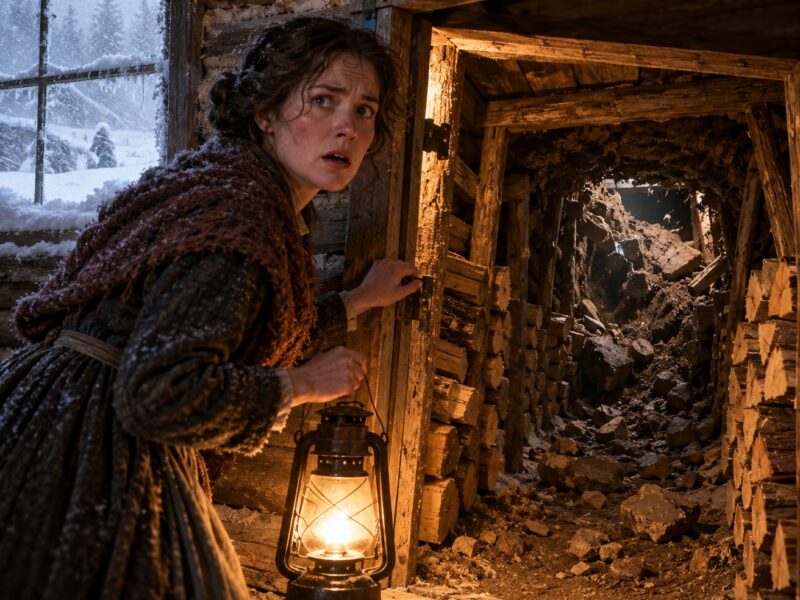
THEY CALLED THE LONELY WIDOW CRAZY FOR DIGGING A TUNNEL BEHIND HER CABIN—UNTIL THE DEADLIEST BLIZZARD OF 1887 REVEALED WHAT SHE HAD BEEN PREPARING FOR
“She’s digging herself a grave.”
That was what the men of Silver Hollow said about the thirty-one-year-old widow carving a tunnel into the frozen mountainside behind her cabin.
But when the great blizzard buried their valley beneath mountains of snow, the same men who had laughed at Adelaide Whitfield would find themselves praying that her strange little tunnel was still standing.
And on the fourth night, when something began moving beneath the earth behind her cabin wall, Adelaide discovered that the mountain was holding a secret even her dead husband had never told her.
PART 1 — THE WIDOW WHO REFUSED TO LISTEN
The first time Adelaide Whitfield heard someone call her crazy, she was standing knee-deep in mud with a pickaxe in her hands and her dead husband’s wedding ring hanging from a chain beneath her wool dress.
It was late October of 1886, and the first snow had already dusted the Idaho mountains surrounding Silver Hollow. Smoke curled from the settlement’s crooked chimneys, and the road leading into town had begun to freeze overnight.
Adelaide was thirty-one years old, although the past eighteen months had made her feel considerably older.
Her husband, Ezekiel, had been killed when a support beam failed inside the Black Ridge silver mine. They had brought his body home wrapped in canvas, along with eleven dollars in unpaid wages and an apology from the mine superintendent.
She had buried him beneath a cottonwood tree before the first snowfall.
Since then, she had lived alone in the cabin they had built together, three miles beyond Silver Hollow, where the mountain rose steeply behind the north wall and a narrow creek twisted through a stand of pine trees.
The cabin was small, sturdy, and filled with things that still belonged to Ezekiel.
His boots remained beside the door. His favorite blue cup hung above the stove. A crooked shelf he had built during their first winter still leaned slightly to the left, no matter how many times Adelaide tried to straighten it.
Some mornings, she could almost convince herself he was outside splitting firewood.
Then the silence would return.
The previous winter had nearly killed her.
A January storm had buried her outdoor woodpile beneath five feet of snow. By the time she managed to dig down to the logs, freezing rain had soaked the exposed wood and turned the pile into a solid mass.
She had spent hours chopping and prying at frozen logs, her fingers stiff inside damp mittens.
One night, the stove went cold before dawn.
Adelaide remembered lying beneath three quilts, watching frost spread across the inside of her bedroom window while she tried to decide whether she possessed enough strength to walk to town.
She had survived by burning a broken chair, two shelves, and the wooden crate that had once held her wedding china.
When spring arrived, she made herself a promise.
She would never spend another winter begging the weather for permission to live.
The idea came from a memory of her grandmother’s farm in Pennsylvania.
Behind that old farmhouse stood a hillside cellar dug deep into the earth. In summer, it kept apples cool. In winter, it protected potatoes and preserves from the worst of the cold.
Adelaide remembered the thick wooden door, the smell of damp earth, and the remarkable steadiness of the temperature inside.
What if she could build something similar for firewood?
Not an ordinary outdoor shed, where snow could crush the roof or rain could soak the logs, but a storage chamber dug directly into the hill behind her cabin, with a narrow passage connecting it to the kitchen.
She would be able to reach her wood without stepping into the storm.
It seemed simple when she first drew it on a scrap of brown paper.
The mountain proved considerably less cooperative.
By the third morning, her palms had blistered. By the fifth, her shoulders burned whenever she raised the pickaxe.
The soil was packed with stones and tangled roots. Every few feet, she encountered another stubborn obstacle that required hours of work.
She carried the excavated dirt away in buckets, dumping it along the edge of the creek.
When the first curious neighbors arrived, she was too exhausted to explain herself politely.
Obadiah Prescott, a broad-shouldered wagon driver with a gray beard, stood watching her from beside his mule.
“Mrs. Whitfield,” he called, “what in God’s name are you doing to that mountain?”
“Digging.”
“I can see that.”
“Then we’re making progress.”
His companion laughed.
Obadiah stepped closer and studied the narrow opening.
“You’re going to bring half that hillside down on your head.”
“Not if I brace it properly.”
“And who’s going to brace it? Your husband?”
The words escaped him before he appeared to realize what he had said.
Adelaide stopped digging.
For a moment, the only sound was water moving beneath the thin ice in the creek.
Obadiah removed his hat.
“Didn’t mean anything by that.”
“I know.”
She turned back toward the hillside.
“But I’d appreciate it if you didn’t say it again.”
He left without offering to help.
By the following Sunday, the entire settlement had heard about her tunnel.
At the general store, men joked that the widow was preparing to live underground with the prairie dogs. Someone suggested that losing Ezekiel had unsettled her mind.
Others wondered how long it would take before the hill collapsed.
The storekeeper’s wife, Martha Bell, told Adelaide she should sell the cabin and move into town.
“A woman alone has no business fighting a mountain,” Martha said while wrapping a pound of flour in brown paper.
Adelaide counted out her coins.
“Then it’s fortunate the mountain hasn’t complained.”
Martha did not smile.
“People are worried about you.”
“No,” Adelaide said quietly. “People are talking about me. Those aren’t always the same thing.”
She took her flour and walked home.
But the words followed her.
There were nights when she sat beside the stove and wondered whether the townspeople were right.
The tunnel was barely six feet long after two weeks. Her shoulders ached. Her boots were wearing thin, and she had begun waking with numb fingers.
She could have moved into the settlement.
She could have sold the land.
But the thought of strangers taking down Ezekiel’s shelves or tearing out the little garden fence made something tighten painfully behind her ribs.
This was the home they had built when they believed they had decades ahead of them.
She was not ready to surrender it.
One evening, while searching Ezekiel’s old tool chest for spare nails, Adelaide discovered a folded sheet of paper beneath a bundle of measuring cords.
It contained rough sketches of timber braces.
Beside one drawing, in Ezekiel’s unmistakable handwriting, were five words.
Never trust unbraced mountain earth.
Adelaide stared at the page.
Her husband had worked underground for twelve years. He had once told her that mountains did not forgive careless men.
Now, even in death, he seemed to be warning her.
She took the sketches to the kitchen table, lit another lamp, and began studying them.
The following morning, she changed her approach.
Instead of digging farther, she strengthened what she had already opened.
She cut timber posts from fallen pine trees, squared them with a hand axe, and fitted crossbeams across the passage.
Each new section required bracing before she advanced.
It was slower.
It was safer.
And for the first time, Adelaide began to believe she might finish.
In November, she injured her shoulder.
She was lifting a heavy timber into position when her boot slipped on wet clay. The post twisted, knocking her sideways against the tunnel wall.
Pain shot through her left arm.
She dropped to her knees and sat there for several minutes, unable to catch her breath.
That night, she tried to lift the kettle from the stove and nearly dropped it.
For three days, she could barely dress herself.
She considered leaving the project unfinished.
Then a cold wind slipped through the gap beneath her cabin door, carrying the sharp smell of approaching snow.
Adelaide looked toward the north wall.
She remembered the frozen woodpile.
She remembered burning her furniture.
And she remembered Ezekiel telling her, during their first winter together, that courage was rarely a matter of feeling unafraid.
“Most days,” he had said, “it’s just doing tomorrow’s work while you’re still hurting from yesterday’s.”
On the fourth morning, she returned to the tunnel.
She worked carefully, using her good arm for the lighter tasks, and eventually her shoulder began to heal.
By early December, the passage extended fifteen feet into the hill.
At its far end, Adelaide had carved a chamber large enough to hold several orderly stacks of split firewood. She lined the floor with raised wooden supports so the logs would remain off the damp ground, and she fitted timber braces beneath the ceiling.
Then she completed the most important feature.
A small hatch through the cabin’s north wall opened directly into the passage.
She covered its interior with thick boards and fitted a simple wooden latch.
From the kitchen, it looked almost like a cupboard.
Behind it stood enough dry firewood to keep her stove burning for weeks.
The first time Adelaide opened the hatch and carried a log directly to the stove, she began laughing.
Not because anything was particularly funny.
But because, after months of loneliness and exhaustion, she had made something work.
She placed the log on the fire.
Then she sat in Ezekiel’s chair and cried.
Two weeks later, Obadiah Prescott returned.
He found her outside spreading a canvas cover over the tunnel’s original entrance, which she had sealed with a timber door.
“Still digging?” he asked.
“Finished.”
He looked surprised.
“Well, I suppose you’ve proved you can dig a hole.”
“It’s more useful than a hole.”
“Maybe.” He glanced toward the mountain. “But you won’t catch me standing inside it.”
Adelaide brushed snow from her sleeves.
“Then don’t.”
Obadiah studied her for another moment.
“There’s talk of a hard winter.”
“There’s always talk of a hard winter.”
“This year feels different.”
For once, his voice held no amusement.
He told her the passes had begun closing earlier than usual. Hunting parties had reported unusually deep snow in the higher valleys.
Adelaide looked toward the distant peaks.
The white line had descended farther down the mountains than she remembered seeing in December.
“Then you’d better cover your woodpile,” she said.
Obadiah gave a short laugh.
“Already done.”
He climbed onto his wagon.
As he turned the mule toward town, he called over his shoulder, “If that mountain falls, Mrs. Whitfield, don’t say I didn’t warn you.”
Adelaide watched him disappear around the bend.
Then she returned inside and closed the door.
On January 8, 1887, the wind stopped.
Not gradually.
It simply stopped.
Adelaide noticed it while carrying water from the creek.
The pine branches had gone perfectly still. There were no birds calling from the trees, and even the creek seemed quieter beneath its ice.
The sky was the pale, unnatural gray of old pewter.
She stood beside the porch, listening.
Something about the silence frightened her.
She brought in another bucket of water, checked the animals in her small lean-to, and filled every pot she owned.
Then she carried the last of her outdoor wood into the storage tunnel.
By noon, snow began falling.
By two o’clock, the mountain had disappeared.
By evening, the blizzard had swallowed the trail, the fence, and the lower branches of the pine trees.
Wind struck the cabin so fiercely that the walls trembled.
Adelaide wedged blankets around the doorframe and fastened the shutters.
The stove roared.
Each time the flames weakened, she opened the little hatch, stepped into the tunnel, and returned with another armful of dry logs.
Outside, snow piled higher than her windows.
Inside, her kettle continued to steam.
For the first time since Ezekiel’s death, Adelaide felt a small measure of safety.
She did not know that three miles away, Obadiah Prescott was already fighting to keep his kitchen fire alive.
Nor did she know that several families in Silver Hollow had begun digging through frozen drifts to reach their buried woodpiles.
The storm lasted through the second day.
Then the third.
The cold became so severe that Adelaide found frost along the edges of her window coverings, despite the heat from the stove.
On the fourth night, she woke to a sound.
A dull, heavy thump.
She sat upright beneath her quilts.
The cabin was dark except for the low glow of the stove.
Another sound followed.
A faint trickle, like sand slipping through an hourglass.
Adelaide turned toward the north wall.
It was coming from the tunnel.
She rose, wrapped a shawl around her shoulders, and lifted the lantern from its hook.
As she crossed the kitchen, she heard it again.
Thump.
Then a slow scraping noise.
Her heartbeat quickened.
She unlatched the hatch.
Cold, damp air touched her face.
At first, the passage appeared unchanged.
The timber supports stood where she had placed them. The stacked firewood cast long shadows along the earthen walls.
Then her lantern illuminated something near the far end.
A thin line of fresh soil had fallen across the floor.
One of the support posts had shifted.
And behind it, where she had always believed there was nothing but solid mountain, a narrow opening had appeared.
Adelaide raised the lantern.
From somewhere beyond the darkness came three deliberate knocks.
Not falling stones.
Not shifting earth.
Someone was knocking from inside the mountain.
PART 2 — THE SECRET BENEATH BLACK RIDGE
Adelaide did not move for several seconds.
She had spent months alone in the cabin, growing accustomed to the ordinary noises that followed a hard mountain winter.
She knew the creak of the roof beams, the rattle of loose shutters, and the sharp crack of ice forming along the creek.
This sound was none of those things.
Three knocks came again.
Then a man’s voice, so faint she almost mistook it for the wind.
“Help.”
Adelaide’s hand tightened around the lantern.
“Who’s there?”
A pause.
Then a ragged cough.
“Please.”
She stepped carefully into the passage.
The firewood chamber remained intact, but a section of packed earth beyond the final support had crumbled away. Through the gap, she could see darkness extending farther into the mountain.
She lowered her lantern toward it.
There was just enough room for a person to crawl.
“Can you move?” she called.
A strained voice answered, “Not much.”
“Are you alone?”
“No.”
Adelaide felt the cold rise through her slippers.
“How many?”
There was a long silence.
Then the man whispered, “Three.”
She set down the lantern and hurried back into the cabin for Ezekiel’s hand saw, a coil of rope, and her thickest gloves.
When she returned, the voice spoke again.
“Don’t pull the timber.”
Adelaide froze.
“What?”
“Beam’s holding the roof. Pull it and we’ll all die.”
She raised the lantern and looked more closely.
The opening had formed beside a heavy wooden brace, blackened with age. It was not one of her supports.
It belonged to an older passage.
A mine passage.
Adelaide’s stomach tightened.
The Black Ridge mine had operated on the opposite side of the mountain for almost twenty years before its lower tunnels were abandoned.
Ezekiel had worked there.
And eighteen months earlier, he had died beneath it.
She crouched beside the opening.
“What’s your name?”
“Daniel Mercer.”
She recognized it immediately.
Daniel was a young miner from Silver Hollow, barely twenty-five, with a wife and a little daughter.
He worked in one of the remaining shafts farther up Black Ridge.
“Daniel, it’s Adelaide Whitfield.”
A rough breath escaped from the darkness.
“Mrs. Whitfield?”
“Yes.”
“God Almighty.”
“What happened?”
“The upper shelter collapsed. We found an old mine opening and went inside. Thought we could follow it down toward the valley.”
His voice weakened.
“Then the entrance disappeared behind snow and rock.”
Adelaide looked at the ancient timber.
“How long have you been in there?”
“Since yesterday morning. Maybe longer.”
“And the others?”
“My brother Samuel. And Mr. Bell.”
Her eyes widened.
“Thomas Bell?”
“Yes, ma’am.”
Thomas Bell was the storekeeper’s husband, a quiet man with silver spectacles who had gone up the mountain two days before the storm to collect a shipment of mining supplies.
Adelaide had seen his wife Martha only the previous week.
She moved closer.
“Are any of you badly hurt?”
“Samuel’s ankle. Mr. Bell can’t stay awake.”
Adelaide closed her eyes briefly.
Then she said, “Listen carefully. I have a passage on this side. I think I can open enough room to get you through.”
“Don’t take out the beam.”
“I won’t.”
She hurried to the cabin.
For several minutes, she studied Ezekiel’s old drawings beside the stove.
She remembered his warnings about load-bearing supports and how removing the wrong timber could bring down a ceiling.
Her own tunnel was braced separately from the older passage, but she knew that digging carelessly could destabilize both.
She selected two spare posts, a short crosspiece, and several wooden wedges.
Then she returned to the opening.
Working from the supported side, she fitted a temporary frame around the narrow breach without disturbing the old beam.
It was awkward work.
The space was cramped, her shoulder began aching again, and every few minutes she stopped to listen for fresh movement in the soil.
Finally, she widened the opening enough to crawl through.
“Daniel,” she called, “I’m coming.”
“No, ma’am. It’s not safe.”
“Neither is staying where you are.”
She slid the lantern ahead of her and crawled beneath the low stone ceiling.
The old passage smelled of wet earth, timber rot, and something metallic.
Twenty feet beyond the breach, she found Daniel sitting against a wall with his arm around a younger man.
Samuel’s ankle was swollen grotesquely beneath his boot.
Several feet away, Thomas Bell lay on his side beneath a torn coat.
His lips had turned pale blue.
Adelaide knelt beside him.
“Mr. Bell?”
His eyelids fluttered.
“Martha?”
“No. Adelaide.”
He stared at her without recognition.
She touched his cheek.
His skin was frighteningly cold.
“We need to get him warm.”
Daniel tried to stand.
His knees buckled.
Adelaide caught his arm before he fell.
“When did you last eat?”
“Yesterday. A little bread.”
She looked toward the opening.
The journey back to her warm cabin was short, but moving three exhausted men through the narrow breach would be difficult.
And the unstable mine roof would not tolerate much disturbance.
“Daniel, can you crawl?”
“I think so.”
“Then you’re going first. I’ll help Samuel after.”
He hesitated.
“Mr. Bell—”
“I won’t leave him.”
Something in her voice ended the argument.
It took nearly an hour to move Daniel through the opening.
He was so weak that he stopped twice, his head resting against the dirt while Adelaide spoke to him from behind.
Once he reached her tunnel, he sat beside the woodpile, staring at the stacks of dry logs with an expression she would never forget.
“How did you know?” he whispered.
Adelaide leaned against a timber support, catching her breath.
“Know what?”
“That we’d be here.”
“I didn’t.”
He looked around.
“Then why would you build this?”
She glanced toward the little hatch, through which warm lamplight spilled from her kitchen.
“Because I was cold last winter.”
Daniel began to laugh.
It was a broken, exhausted sound that turned into coughing.
But he was alive.
Samuel came next.
With his brother helping from the far side, Adelaide supported his injured leg while he dragged himself through the breach.
By the time they reached the storage chamber, she was trembling with fatigue.
Thomas Bell was more difficult.
He had become confused and resisted when they tried to move him.
Adelaide wrapped a blanket beneath his shoulders and used the rope to help pull him slowly through the narrow section, protecting his head and keeping him away from the damaged supports.
At one point, soil began falling from the ceiling.
Everyone stopped.
The faint trickling continued.
Adelaide stared at the old beam.
A crack had appeared in its surface.
“Move,” she said.
Daniel looked up.
“Mrs. Whitfield—”
“Get him through. Now.”
Together, they pulled Thomas past the breach.
A heartbeat later, a heavy section of rotten timber gave way behind them.
Earth collapsed into the old passage with a deep, grinding roar.
The lantern swung wildly in Adelaide’s hand.
She stumbled backward.
Daniel grabbed her shoulder.
For several terrible seconds, the entire mountain seemed to shudder.
Then silence returned.
The old mine passage was gone.
Adelaide stared at the wall of fresh earth.
If she had delayed by another minute, Thomas Bell would have remained on the other side.
Daniel looked at her.
“You saved us.”
Adelaide could barely speak.
“Help me get him to the stove.”
They carried the men into the cabin.
She laid Thomas near the hearth, removed his soaked outer clothing, and wrapped him in dry blankets.
She warmed him gradually, watching his breathing while Daniel sat beside his brother with a steaming cup of broth between his hands.
The cabin grew crowded and damp.
Boots, coats, blankets, and strips of torn cloth covered the floor.
For the first time in eighteen months, Adelaide’s home was filled with voices.
And for the first time in eighteen months, those voices frightened her almost as much as the silence had.
Thomas remained confused.
Samuel’s ankle required attention she could not properly provide.
Daniel was shaking badly, although he insisted he was fine.
Outside, the blizzard continued.
Adelaide had enough dry wood for herself.
She had not planned to heat a cabin for four people, three of them exhausted and injured.
She opened the hatch and looked at her remaining stacks.
Then she returned to the stove and added two logs.
By morning, Thomas Bell could recognize her.
He stared at her from the floor.
“Adelaide?”
“You’re in my cabin.”
“How?”
She handed him a cup of warm water.
“It’s a long story.”
His gaze drifted toward the north wall.
Daniel explained about the tunnel.
Thomas listened without speaking.
Then his eyes filled with tears.
“Martha told me you were going to bury yourself in that hill.”
Adelaide looked down at the cup.
“She wasn’t alone.”
Thomas swallowed.
“I wish I’d helped you.”
She sat beside him.
“You’re here now.”
He reached for her hand.
She let him take it.
By the fifth day, the storm had weakened enough for the wind to become audible as individual gusts rather than a continuous roar.
Adelaide opened the front door only a few inches.
Snow rose higher than the doorframe.
The landscape beyond had vanished.
The fence was gone.
The creek was gone.
Only the tops of several pine trees protruded above the white drifts.
There was no way to walk to town.
Daniel came to stand beside her.
“We have to tell them we’re alive.”
“We will.”
“My wife thinks I’m dead.”
Adelaide understood what it meant to wait for a husband who did not come home.
She looked away.
“Then we’ll get you back to her.”
But the storm had not finished with Silver Hollow.
That afternoon, Adelaide noticed a new problem.
Water was seeping through the lower edge of the north wall.
At first, she assumed it was melting snow.
Then she opened the tunnel hatch.
A small stream of muddy water was running along the floor.
Her stomach sank.
The old mine collapse had redirected underground seepage into her storage chamber.
Water was pooling near the far end, close to the last remaining stacks of wood.
She and Daniel carried the dry logs into the cabin as quickly as possible.
Then she inspected the passage.
The timber supports were still holding, but the water continued rising.
“We should seal it,” Daniel said.
Adelaide studied the floor.
“If we block it here, the water could build behind the wall.”
“Then what do we do?”
She remembered a shallow drainage cut she had started beneath the tunnel floor and never finished because the ground had frozen.
It ran toward a lower slope outside the cabin.
If they could reopen it, the water might escape.
But the old mine had already partially collapsed.
Digging farther into unstable earth could be dangerous.
Adelaide studied the supports.
“We work from this end,” she said. “And if anything starts moving, we stop.”
Daniel looked toward his brother, who lay near the stove.
“Mrs. Whitfield, you’ve already done enough.”
She picked up the shovel.
“Then let’s hope enough is nearly enough.”
For two hours, they cleared the existing drainage channel, working in short shifts while the others rested.
The water began to flow away from the storage chamber.
Then the stream weakened.
By evening, the floor was damp but no longer flooding.
Adelaide leaned against the wall, exhausted.
Daniel handed her a cup of water.
“You ever think about moving to town?”
“Sometimes.”
“Why don’t you?”
She hesitated.
“Because this is where Ezekiel and I were happy.”
Daniel glanced toward the shelf above the stove.
“He’s been gone a while.”
“Eighteen months.”
“My father used to say you can’t build a life by keeping everything exactly where a dead man left it.”
Adelaide looked at her husband’s blue cup.
“And was your father good at following his own advice?”
Daniel smiled faintly.
“Terrible.”
For the first time, Adelaide smiled back.
That night, she found Thomas Bell sitting upright near the hearth.
He was examining a small piece of rotten timber that Daniel had carried out of the mine passage.
Thomas turned it in his hands.
“Where did this come from?”
“The collapse,” Adelaide said.
He rubbed away a layer of mud.
A dark mark appeared on the wood.
Two letters.
E.W.
Adelaide stopped breathing.
She knew those initials.
Ezekiel Whitfield had marked his personal tools and specially cut timber with the same letters.
Thomas looked up.
“Adelaide, there’s something I never told you about the accident.”
She stared at him.
“What?”
He placed the timber on the table.
“The collapse that killed Ezekiel wasn’t in the working shaft.”
The stove cracked behind her.
Thomas’s voice dropped.
“He went into an abandoned section that morning. Said he needed to inspect an old drainage passage.”
Adelaide gripped the back of a chair.
“Nobody told me that.”
“I know.”
“Why?”
Thomas looked at the timber.
“Because the mine superintendent ordered the lower workings closed, and nobody wanted questions about why Ezekiel had gone inside.”
Adelaide stared at the letters burned into the wood.
Eighteen months earlier, she had buried her husband believing an ordinary support beam had failed.
Now she was holding a piece of a hidden passage he had been investigating.
And beyond the hatch, beneath the same mountain that had nearly killed three more men, lay the unanswered question of why Ezekiel had gone there in the first place.
PART 3 — WHAT THE MOUNTAIN REMEMBERED
Adelaide slept very little that night.
She sat at the kitchen table with Ezekiel’s marked timber resting beside the lantern.
Thomas had returned to sleep near the stove, but his words remained awake inside her.
He went into an abandoned section.
The official account of Ezekiel’s death had been brief.
A support had failed.
The mine was dangerous.
Nothing more could be done.
She had accepted those words because grief left little room for investigation.
But now a piece of his timber had appeared in an abandoned passage near her cabin.
At dawn, she opened his old tool chest again.
She removed the measuring cords, the brace sketches, and several notebooks stained with coal dust.
She had looked through them before, mostly because they contained his handwriting.
This time, she read them carefully.
Most pages recorded ordinary work.
Lengths of timber.
Tunnel measurements.
Supply orders.
But near the back of the final notebook, Ezekiel had drawn a rough map of Black Ridge.
Several old mine passages appeared as narrow lines.
One ran toward the northern slope.
Toward their cabin.
Beside it, Ezekiel had written:
Old drainage heading. Water rising. Upper workings may not hold if spring runoff reaches the weakened supports.
Adelaide read the sentence three times.
Then she turned the page.
Another note appeared.
Reported to Superintendent Harlan. No repairs authorized. Inspect again before thaw.
There was no accusation.
No hidden confession.
Only the words of a careful man who had noticed a danger and tried to prevent it.
Adelaide closed the notebook.
Her husband had not gone underground chasing silver.
He had gone because he feared the old drainage passage might fail.
And the man responsible for the mine had refused to repair it.
For a long time, Adelaide sat motionless.
She thought of the eleven dollars delivered with Ezekiel’s body.
She thought of the superintendent’s polished boots standing on her porch.
And she thought of how quietly she had accepted his explanation because there had been no one beside her to challenge it.
Then Samuel groaned from the corner.
Adelaide put the notebook away and returned to the living.
There was still a storm outside.
There were still injured men inside her cabin.
And the mountain, whatever secrets it held, would not be going anywhere.
Two days later, the sky finally cleared.
The blizzard had transformed the valley into a silent white wilderness.
Silver Hollow lay hidden beyond the trees, its buildings half buried beneath wind-packed snow.
Adelaide and Daniel spent the morning clearing a narrow exit through the drift at the side of the cabin.
They worked slowly, taking care not to exhaust themselves.
By afternoon, they had opened a passage to the lower woods.
Daniel stood in the sunlight, staring toward town.
“I can see the church steeple.”
Adelaide joined him.
Far away, a black point rose above the snow.
It was all that remained visible of Silver Hollow.
They fashioned a simple sled from spare boards and blankets, then prepared Thomas and Samuel for the journey.
Daniel would travel with them.
Adelaide packed food, matches, and dry kindling.
As she tied the final bundle, Thomas touched her arm.
“You should come with us.”
“I have animals to look after.”
“The whole town needs to know what you’ve done.”
Adelaide looked toward the hillside.
“Get your families back first.”
They left just after sunrise the following morning, following the creek where the drifts were lower.
Adelaide walked beside the sled until the trail began descending toward the valley.
Daniel stopped and turned.
“Mrs. Whitfield?”
“Yes?”
He looked at the cabin behind her.
“My wife will want to thank you.”
“Tell her to keep you out of abandoned mines.”
He laughed.
Then his expression changed.
“I mean it. We wouldn’t have made it.”
Adelaide nodded.
She could not find a graceful answer.
So she handed him the last wrapped piece of bread and watched the three men disappear among the pines.
She remained there until she could no longer hear the sled.
Then she went home.
The cabin seemed unbearably quiet.
Thomas’s blankets were folded beside the stove. Samuel’s makeshift splint lay on the table.
Four cups stood near the washbasin.
Adelaide looked at them for a long moment.
Then she began washing the dishes.
Two days passed before visitors arrived.
She was clearing snow from the roof of the lean-to when she heard voices from the lower trail.
A group of men emerged from the trees.
Obadiah Prescott walked in front.
Behind him came Reverend Collins, two miners, and Martha Bell.
Martha’s face was red from the cold.
When she saw Adelaide, she stopped.
For an instant, neither woman spoke.
Then Martha hurried through the snow.
She embraced Adelaide so fiercely that the widow nearly lost her balance.
“My Thomas came home,” Martha whispered.
Adelaide closed her eyes.
“I’m glad.”
Martha pulled back.
Tears had frozen along the edges of her scarf.
“He told me everything.”
Adelaide looked toward the men.
Obadiah removed his hat.
For once, the wagon driver seemed uncertain what to say.
Finally, he cleared his throat.
“Mrs. Whitfield.”
“Mr. Prescott.”
He glanced at the mountain.
“Looks like that tunnel of yours came in handy.”
“Yes.”
He shifted his weight.
“I was wrong about it.”
Adelaide waited.
Obadiah stared at his boots.
“Wasn’t just wrong. I was unkind.”
The other men remained silent.
“I made jokes when I should’ve offered to carry timber.”
Adelaide looked at his weathered face.
“You could’ve.”
He nodded slowly.
“I know.”
Then he lifted his eyes.
“If you’ll allow it, I’d like to help with whatever repairs it needs.”
Adelaide considered him.
The tunnel was damaged.
The water channel needed strengthening.
And although she hated admitting it, she could not safely handle all the work alone.
“Bring a shovel tomorrow,” she said.
Obadiah’s expression softened.
“Yes, ma’am.”
Martha stepped forward again.
“Thomas says you found something connected to Ezekiel.”
Adelaide nodded.
“There’s a notebook.”
“Will you show it to the mine inspector?”
“I intend to.”
Martha took her hand.
“Then Thomas will go with you.”
The investigation began in February.
A territorial mine inspector examined Ezekiel’s notes, interviewed Thomas and several former workers, and reviewed the old maintenance records.
The superintendent, Charles Harlan, initially insisted that the abandoned drainage heading had never posed a serious threat.
Then records surfaced showing that Ezekiel had requested timber and labor for repairs several weeks before his death.
The request had been denied.
Two other miners confirmed that Ezekiel had complained about water gathering behind damaged supports.
The inspector could not prove exactly which failure had caused the fatal collapse.
The original scene had been sealed for too long, and the winter’s damage had made the underground workings unsafe to enter.
But the evidence established that management had ignored documented warnings about the abandoned heading.
The mine was ordered to close the affected workings until they could be properly examined and reinforced.
The superintendent lost his position.
For Adelaide, there was no perfect justice.
No amount of evidence could return Ezekiel to the kitchen table.
There was no dramatic confession, no sudden fortune waiting beneath the mountain.
But one thing changed.
For eighteen months, she had believed her husband died because of an accident nobody could have anticipated.
Now she knew he had seen danger approaching.
He had tried to stop it.
And the people in charge had failed to listen.
That knowledge hurt.
It also brought an unexpected measure of peace.
Ezekiel had not been foolish.
He had been careful.
He had been brave.
And in an extraordinary turn of circumstance, the abandoned passage he had investigated became the very passage through which three men escaped death.
In March, when the worst snow began melting from the roofs, the men of Silver Hollow returned to Adelaide’s property.
Obadiah brought timber.
Daniel Mercer brought tools.
Thomas Bell arrived with a wagon full of gravel and several lengths of drainage pipe salvaged from old mining supplies.
Together, they repaired the tunnel, reinforced the damaged end, and sealed the unsafe connection to the old mine passage.
They improved the drainage channel and added a second protective door between the wood storage area and the cabin.
Adelaide supervised every measurement.
Whenever Obadiah suggested something questionable, she made him explain it twice.
By the end of the week, he had learned to ask her opinion before raising his hammer.
One afternoon, while they were working, a young woman arrived carrying a basket.
Her name was Ruth Mercer.
Daniel’s wife.
She stood beside the porch with her daughter, a little girl of four who wore a red scarf wrapped twice around her neck.
Ruth set down the basket.
“I brought bread.”
Adelaide wiped sawdust from her hands.
“That’s kind of you.”
Ruth looked toward the tunnel.
“Daniel told me what happened.”
Adelaide glanced at the little girl.
“He’s a strong man.”
“He is.” Ruth’s voice trembled. “But he couldn’t have come home without you.”
She reached for Adelaide’s hand.
“I spent three days looking out my window because I didn’t know where else to look.”
Adelaide knew that feeling.
She knew it more intimately than she wished.
Ruth took a breath.
“When Daniel came through the door, our daughter ran so fast she fell on the floor.”
The little girl looked up.
“Papa cried,” she announced.
Ruth gave a tearful laugh.
“Yes, sweetheart. Papa cried.”
Adelaide knelt in front of the child.
“What’s your name?”
“Emily.”
“That’s a pretty name.”
Emily studied her seriously.
“Papa says you dug a house inside the mountain.”
“A little room,” Adelaide corrected.
“Was it dark?”
“Very.”
“Were you scared?”
Adelaide considered the question.
“Sometimes.”
Emily touched the wedding ring hanging from Adelaide’s neck.
“My mama says brave people get scared too.”
Adelaide looked up at Ruth.
The younger woman smiled through her tears.
“She listens to everything.”
Adelaide gently tucked the ring back beneath her dress.
“Your mama is right.”
That spring, Silver Hollow changed in small, practical ways.
Several families built better-protected wood storage sheds.
Others dug root cellars into suitable hillsides, with proper timbering and drainage.
The settlement organized a shared supply of emergency firewood near the church.
A few men began checking on widows and isolated homesteads before storms arrived rather than waiting until after the roads disappeared.
No one pretended that Adelaide’s tunnel could have saved every family in the valley.
It had been designed for one cabin on one particular hillside.
But it had demonstrated something the settlement should have understood much earlier.
Preparation was not foolish simply because it looked unusual.
And a person did not become incapable of wisdom when she was left alone.
In late April, Adelaide received a letter from a woman in a neighboring valley.
The woman had heard about the tunnel and wanted advice about protecting her winter firewood.
Adelaide sat at the kitchen table and wrote a careful reply.
She explained the importance of choosing stable ground, providing drainage, keeping wood raised above moisture, and using properly braced construction.
She also warned that digging into an unfamiliar hillside could be deadly without experienced help.
At the bottom of the letter, she added a sentence.
The safest work is the work done before you need it.
She folded the paper and sealed it.
Then she went outside.
The snow had retreated from the lower slopes.
Water ran freely through the creek.
Along the fence, the first pale green shoots pushed through the wet ground.
Adelaide stood beneath the cottonwood tree where Ezekiel was buried.
She had planted a few early flowers there, although the soil was still stubbornly cold.
For a while, she said nothing.
Then she rested her hand against the rough bark.
“They came home, Zeke.”
The wind moved gently through the bare branches.
“Three of them.”
She swallowed.
“I think you would’ve liked that.”
A tear slipped down her cheek.
This time, she did not wipe it away immediately.
She stood beneath the tree until the sun began sinking behind Black Ridge.
Then she walked toward the cabin.
Through the kitchen window, she could see the blue cup hanging above the stove.
She had finally straightened the crooked shelf beneath it.
Not because she wanted to erase the things Ezekiel had left behind.
But because she was beginning to understand that loving someone did not require freezing a home at the moment they died.
A week later, Adelaide accepted an invitation to supper at the Bell family’s house.
It was the first evening meal she had shared in town since Ezekiel’s funeral.
Obadiah sat across from her, looking uncomfortable in a freshly washed collar.
Daniel and Ruth arrived with Emily, who immediately climbed into Adelaide’s lap.
There was roast chicken, warm bread, and too much conversation for one small dining room.
At one point, Thomas Bell raised his glass.
“To Mrs. Whitfield.”
Adelaide looked embarrassed.
“Please don’t.”
But Thomas continued.
“To the woman we all thought was digging herself a grave.”
The room grew quiet.
Thomas looked around the table.
“Turns out she was building a way to keep people alive.”
For a moment, Adelaide could not speak.
Then Emily tugged her sleeve.
“Miss Adelaide?”
“Yes, sweetheart?”
“Are you going to dig another tunnel?”
Everyone laughed.
Adelaide looked toward Obadiah.
His face turned pale.
“Not unless somebody volunteers to do the digging,” she said.
The laughter grew louder.
And Adelaide laughed with them.
Not the polite, exhausted laugh she had learned to offer strangers after Ezekiel died.
A real laugh.
The kind that surprised her with its own sound.
The following October, when the first snow returned to the mountains, Adelaide stood beside her cabin and watched the valley turn white.
Her firewood was dry.
Her tunnel had been reinforced.
Fresh bread cooled on the kitchen table.
Beside the stove stood a second chair, brought from town by Ruth Mercer, who insisted that visitors ought to have somewhere comfortable to sit.
Adelaide had protested that she rarely entertained.
Ruth had merely smiled.
“That’s going to change.”
And it did.
People came for advice, for tea, or sometimes simply because the trail past Adelaide’s cabin was beautiful in the late afternoon.
She still missed Ezekiel.
There were mornings when the ache of his absence returned without warning.
But grief was no longer the only thing living inside her home.
One evening, as the first winter wind pressed against the shutters, Adelaide opened the little hatch behind the stove.
She stepped into the tunnel and lifted a dry log from the nearest stack.
The air smelled faintly of pine and earth.
The timber braces stood firm.
Behind the sealed wall lay the old mine passage and the darkness that had once taken her husband.
She touched the wooden support beside her.
Then she carried the log into the kitchen.
Outside, snow began falling.
Inside, the fire burned steadily.
And somewhere in Silver Hollow, people were telling their children the story of the widow who had spent an autumn digging into a mountain while everyone called her crazy.
Most remembered the blizzard.
Some remembered the three men who came home alive.
But Adelaide remembered something else.
She remembered standing alone with a pickaxe, a hurting shoulder, and a mountain that seemed determined to defeat her.
She remembered the laughter coming from the road.
And she remembered choosing to keep working.
Because the tunnel had not begun as an act of extraordinary courage.
It had begun with one ordinary woman refusing to spend another winter cold.
THE END









