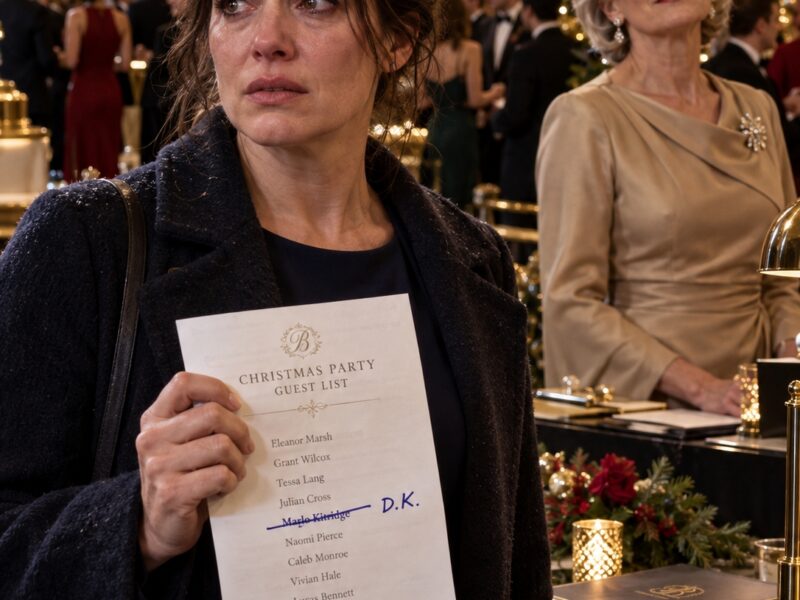
THEY CROSSED HER NAME OFF THE COMPANY CHRISTMAS PARTY LIST—THEN THE CEO SAW WHO SIGNED BESIDE IT

The first thing Marlo Kitridge noticed was that her name had not been forgotten.
It had been crossed out.
There was something worse about that.
Forgetting could be explained by a clerical mistake, a rushed volunteer, a spreadsheet copied badly from one computer to another.
But someone had found MARLO KITRIDGE halfway down the employee Christmas party list and drawn one clean blue line through it.
Beside the line were two initials.
D.K.
Marlo knew exactly who they belonged to.
Behind her, the lobby of the Kingsley Hotel glittered with Christmas lights. A twelve-foot tree stood beside the marble staircase, its branches decorated with miniature wooden sleds handmade at Bridger Sled Works over the decades. Somewhere beyond the ballroom doors, a piano was playing “Have Yourself a Merry Little Christmas.”
Three hundred people were already inside.
Men Marlo usually saw covered in sawdust had put on ties. Women from shipping wore dresses instead of steel-toed boots. Children ran between tables while bartenders poured champagne beneath chandeliers old enough to remember another century.
It was Bridger Sled Works’ eightieth Christmas celebration.
The first without Amos Bridger.
And apparently, the first without Marlo.
The young volunteer behind the registration table swallowed.
“Maybe there’s another—”
“No.”
The voice came softly from Marlo’s left.
Deardra Kemp stepped beside her.
Perfect camel-colored dress. Silver brooch at her collar. Silver hair pinned neatly behind her ears.
For thirty-one years, Deardra had been Amos Bridger’s right hand.
She had answered his telephone, guarded his office, remembered birthdays, arranged funerals, negotiated with suppliers, corrected contracts, and somehow knew which employees were getting divorced before Human Resources did.
Tonight she placed one gentle hand on Marlo’s forearm.
“Sweetheart,” she murmured, “it’s been a difficult year for everyone.”
Marlo looked at her.
Deardra’s smile never moved.
“Maybe this just isn’t your night.”
Something cold settled beneath Marlo’s ribs.
Not anger.
Not yet.
Recognition.
Because Marlo had spent enough years around people who hurt you politely to recognize the language.
This wasn’t about a seating chart.
Across the lobby, two women from shipping had stopped talking.
Walt Hensley from finishing looked quickly away.
The volunteer’s cheeks had turned pink.
Marlo felt every eye without looking at any of them.
And from somewhere in the back of her mind came a man’s voice she had not heard in three years.
Her ex-husband.
Don’t make a scene, Marlo.
He used to say it whenever she disagreed with him.
Don’t make a scene.
When he spent money they didn’t have.
Don’t make a scene.
When he disappeared for two days.
Don’t make a scene.
When she finally discovered another woman’s earrings beneath the passenger seat of their car.
By the time Marlo divorced him, she had become very good at disappearing while standing in the middle of a room.
Apparently, the habit had survived him.
She smiled at the volunteer.
“It’s okay.”
“Marlo—”
“Really.”
She buttoned her wool coat again.
Underneath it was a navy dress she’d bought four years earlier for a cousin’s wedding, the only dress in her closet that didn’t smell faintly of machine oil no matter how many times she washed it.
There was sawdust tangled in her dark hair.
She had tried brushing it out in the truck mirror and eventually given up.
In her pocket was a receipt for two extra hours of babysitting because her nine-year-old daughter Pippa’s choir concert had run late.
Marlo had stood at the back of the school gymnasium still wearing her work boots, silently mouthing every word of “Silver Bells” along with her daughter.
Afterward, Pippa had hugged her and whispered, “Bring me cake.”
“The corner piece,” Marlo had promised.
Now she wasn’t even getting through the ballroom doors.
She turned toward the exit.
Then she saw the photograph.
It stood on a small table beneath the Christmas tree.
Amos Bridger.
Canvas apron.
White hair.
Laughing at something outside the frame.
A candle burned beneath the photograph.
Marlo stopped.
For one second, the lobby disappeared.
She wasn’t standing beneath chandeliers anymore.
She was kneeling on cold concrete.
Her knees hurt.
Steam hissed somewhere behind her.
A man’s hand was crushing hers with surprising strength.
His breathing sounded wet and frightened.
And a cell phone lay glowing on the floor.
Marlo closed her eyes.
One year.
She had kept that night buried for one entire year.
Nobody here knew.
Nobody had ever asked.
Then the front doors flew open.
Snow rushed into the lobby.
A tall man stepped through it.
Dark coat. No tie. Snow melting across his shoulders.
James Bridger.
Amos’s grandson.
CEO of the company.
And the one person in the building who had absolutely no idea what Marlo had done for his grandfather.
He stamped snow from his shoes, glanced toward the ballroom—
and saw her putting her gloves back on.
His expression changed.
“Marlo?”
She stopped.
They had spoken exactly twice before.
Once when a cracked runner had threatened a rush shipment.
Once in an elevator when he’d commented on the weather and she’d answered with something so painfully ordinary she’d spent the next three floors regretting it.
Tonight he looked at her coat.
Then at the ballroom.
Then back at her.
“You’re leaving already?”
She could have lied.
Instead, exhaustion made her honest.
“Apparently I’m not invited.”
James stared at her.
“What?”
Marlo nodded toward registration.
“I’m not on the list.”
The volunteer suddenly became fascinated with her clipboard.
Deardra remained perfectly still.
James walked to the table.
Nobody said anything.
He picked up the guest list.
His eyes moved down the page.
Stopped.
Marlo watched him see her name.
Watched him see the blue line through it.
Then the initials beside it.
D.K.
His jaw tightened.
Only slightly.
But Deardra saw it too.
James placed the paper down.
He walked back to Marlo.
And held out his arm.
“Come with me.”
Marlo stared at him.
“Mr. Bridger—”
“James.”
“I’m really okay.”
“I know.”
His arm remained there.
“This isn’t about whether you’re okay.”
Something in his voice made her stop arguing.
Marlo slowly slipped her hand around his arm.
The ballroom doors opened.
Three hundred faces turned toward them.
The piano faltered.
And across the room, Deardra Kemp dropped her champagne glass.
It shattered on the parquet floor.
Marlo heard it above everything.
And she had no idea yet that the sound of that glass breaking was the beginning of a secret that had been waiting twelve months to destroy three lives.
James did not hurry across the ballroom.
That somehow made it worse.
Marlo could feel whispers spreading behind them like wind through dry leaves.
She wanted to pull her arm away.
She didn’t.
James stopped at the round table closest to the stage.
Table One.
The founders’ table.
A place card beside James’s belonged to a Denver buyer who had canceled that afternoon. James picked it up and slipped it into his pocket.
“Sit.”
Marlo blinked.
“Here?”
“Please.”
She sat.
For nearly a minute she forgot to remove her coat.
When she finally noticed, embarrassment heated her face. She slipped it from her shoulders and folded it over the chair.
“I’m sorry,” she murmured.
James poured water into her glass.
“For what?”
“You didn’t need to do that.”
“Yes, I did.”
He looked around the ballroom.
Then, unexpectedly, he exhaled.
“And you’re probably saving me.”
“From what?”
“This.”
She almost laughed.
“You own this.”
“Exactly.”
That got a small smile from her.
James leaned back.
“My grandfather loved this night.”
His eyes drifted toward Amos’s photograph beyond the ballroom doors.
“He stood at the entrance every year and shook everyone’s hand.”
Marlo knew.
Amos remembered spouses’ names. Children’s birthdays. Which employee had just bought a house. Whose mother was sick.
James looked across the crowded room.
“I don’t know half these people.”
There was no self-pity in his voice.
That made the admission sadder.
Marlo nodded toward the rear tables.
“Table Nine is finishing.”
James followed her gaze.
“The man with the red tie is Walt Hensley.”
“Walt.”
“Forty-one years.”
James looked surprised.
“He probably sanded the runners on your first sled.”
James looked again.
This time, really looked.
“Forty-one years?”
“He’ll tell you about all forty-one if you ask.”
For the first time that evening, James smiled.
Then a heavy hand landed on his shoulder.
“There he is.”
Dwight Pomeroy.
Plant manager.
Broad, red-cheeked, loud enough that he never needed to repeat himself.
He shook James’s hand enthusiastically.
Then he noticed Marlo.
His smile remained.
His eyes changed.
“Kitridge.”
“Dwight.”
“Didn’t expect to see you tonight.”
The sentence was harmless.
The glance he sent toward his sister wasn’t.
Deardra stood near the dessert table holding a fresh champagne glass.
Watching.
Dwight moved away.
A few minutes later, the ballroom lights dimmed.
James went to the stage.
The microphone squealed once.
Conversation died.
James spoke about Amos without corporate language.
The canvas apron he’d refused to replace.
The terrible jokes.
The way he insisted on cutting the Christmas cake himself every year despite being incapable of cutting a straight line.
People laughed.
Walt Hensley removed his glasses.
Then James stopped.
His hand tightened around the microphone.
“One year ago tonight,” he said, “my grandfather collapsed on the shop floor.”
Marlo’s fingers went cold.
“Someone found him.”
The room became very still.
“Someone called 911. Someone stayed with him until the ambulance came.”
Marlo couldn’t breathe.
James looked down.
“The report only says ‘employee.’ We’ve spent a year trying to identify that person.”
Across the ballroom, Deardra turned toward Marlo.
Their eyes met.
James continued.
“If you’re here tonight, please find me.”
His voice cracked almost imperceptibly.
“I owe you something I don’t know how to say.”
Marlo heard nothing after that.
Because suddenly she was remembering a telephone ringing before sunrise.
Deardra’s voice.
Soft.
Concerned.
The family wants privacy, honey.
Then quieter:
You were off the clock in that shop with your daughter. And you’re already on final warning.
A pause.
I’d keep this quiet if I were you.
Marlo had obeyed.
For twelve months.
And now she understood something that changed the entire shape of that night.
James had never asked her to stay silent.
Someone else had made sure he never learned her name.
Her phone vibrated.
LUPE.
Marlo escaped into the hallway.
“She won’t sleep until she talks to you,” Lupe whispered.
Then Pippa came on.
“Mom?”
Marlo closed her eyes.
“Hey, baby.”
“Is there cake?”
A laugh almost escaped her.
“There is.”
“Good frosting?”
“The good frosting.”
“Corner piece.”
“I remember.”
“Promise?”
Marlo pressed her forehead against the cold plaster wall.
“Promise.”
When she returned, Deardra was standing beside James.
One hand rested lightly on his elbow.
The same touch she’d used on Marlo.
Gentle.
Guiding.
Controlling.
Deardra smiled when she saw her.
Then steered James toward a group of buyers.
Marlo understood the message.
Later.
Not here.
Not tonight.
At ten, James found her near the coat rack.
A corner piece of cake was wrapped carefully inside a napkin in her hand.
“For your daughter?”
Marlo smiled.
“Nonnegotiable.”
“I’ll walk you out.”
Snow had thickened over 25th Street.
Their footsteps were nearly the only sound.
At Marlo’s truck, James stopped.
“Thank you for staying.”
Marlo looked at him.
This was the moment.
“James.”
He waited.
“About your grandfather…”
Her heart began hammering.
“The night he—”
Something white beneath her windshield wiper caught her eye.
A folded square of paper.
Marlo pulled it free.
The ink had bled slightly from the snow.
But the sentence remained perfectly readable.
SOME NIGHTS ARE BETTER LEFT ALONE.
Her blood went cold.
“What is it?” James asked.
Marlo folded the note.
“Nothing.”
His eyes narrowed.
“Marlo?”
“Flyer.”
She shoved it into her coat pocket.
James waited.
He remembered exactly where she’d stopped.
“About my grandfather?”
She looked toward the dark street.
For the first time, the snow didn’t feel beautiful.
It felt like cover.
“Another time.”
James studied her face.
He knew she was lying.
But he didn’t force her.
“All right.”
Marlo climbed into her truck.
She checked the rearview mirror at every intersection on the drive home.
That night, after Pippa fell asleep with white frosting still at the corner of her mouth, Marlo sat alone at the kitchen table.
The note lay in front of her.
And after twelve months of refusing to remember, she finally allowed herself to go back to the night Amos Bridger died.
A year earlier, Marlo couldn’t afford a babysitter for the Christmas party.
So she’d volunteered for the rush shift instead.
Pippa had fallen asleep on a cot in the break room beneath Marlo’s coat, one sneaker still on.
Near ten, Marlo stepped outside for something she’d left in her truck.
That’s when another pickup tore past her.
Fast.
Too fast for an icy lot.
She slammed on her brakes.
The truck fishtailed toward the exit.
Across the roof was a bar of white work lights.
Then it disappeared into the snow.
Marlo remembered thinking someone desperately wanted to get home.
Inside, the shop was almost dark.
The old steam box hissed.
And Amos Bridger lay beside it.
“Mr. Bridger?”
No response.
She ran.
Her knees struck concrete.
His face was gray.
His phone lay near his hand, screen glowing.
A call had failed.
One letter was visible beside it.
D.
Marlo called 911.
Then she held Amos’s hand.
She didn’t know what else to do.
His fingers closed around hers.
Hard.
His lips moved.
Marlo bent closer.
He whispered something.
Then something else.
Words meant for two people who weren’t there.
Words Marlo had carried alone ever since.
The next morning, Deardra called.
By Monday, Dwight had moved Marlo permanently onto nights.
No discussion.
No warning.
When Marlo questioned him, he barely looked up from his clipboard.
“Holiday demand.”
“Five nights?”
“We need the steam box running.”
“Lupe can only keep Pippa three nights.”
Dwight shrugged.
“You’re the best operator we’ve got. Be flattered.”
At dinner, Pippa pushed peas around her plate.
“I can sleep at the shop.”
Marlo stared at her daughter.
Pippa shrugged.
“Like before.”
She said it casually.
That was what frightened Marlo.
Her daughter was already learning to make herself smaller around other people’s decisions.
And Marlo had taught her how.
Tuesday night, close to ten, Marlo was pulling an ash runner from the steam box when she sensed someone behind her.
James.
Still wearing his coat.
He didn’t approach immediately.
Instead, he walked toward the runner wall.
Eighty years of Bridger history hung there.
The first successful runner bent by every apprentice.
Names.
Dates.
Initials burned into wood.
James found Amos’s first.
The ash had darkened to honey.
Then his eyes traveled downward.
Until he found:
M.K.
Marlo wiped her hands.
When she turned around, James was standing behind her.
“Was it you?”
No introduction.
No small talk.
The steam box ticked softly.
Marlo looked at him.
Then nodded.
“Yes.”
She told him.
The overtime.
Pippa asleep in the break room.
Finding Amos.
Calling 911.
Holding his hand.
Then she told him about Deardra’s call the following morning.
James went completely still.
“My family never asked for that.”
“I know.”
“No one.”
“I know that now.”
He looked toward the concrete beside the steam box.
Marlo almost told him everything.
Almost.
But the note beneath her windshield wiper seemed to burn inside her coat.
“There’s something else.”
James looked up.
“He had his phone.”
“What?”
“When I found him.”
Marlo swallowed.
“The screen was still on. He’d been calling somebody.”
James stared at her.
“The hospital returned his wallet, watch and coat.”
He paused.
“They told us there was no phone.”
Neither spoke.
Suddenly Amos Bridger’s death contained a new absence.
And someone had spent an entire year making sure nobody noticed it.
James returned the following night.
And the night after that.
He said almost nothing about the phone.
He only told Marlo he was looking into it quietly.
Instead, on his second night, he stood beside the steam box and said something she never expected.
“Teach me.”
“What?”
“To bend a runner.”
Marlo stared at him.
“My grandfather tried for twenty years.”
“And?”
“I always had somewhere more important to be.”
The words cost him something.
So she taught him.
How to read ash grain.
How to find the straight line hidden inside wood.
How steam didn’t make wood weak—it made it willing.
“One hour for every inch of thickness,” she told him. “Don’t cheat it.”
James’s first runner cracked halfway into the form.
He stared at it.
“I ruined it.”
“You rushed it.”
“It broke.”
“Not the same thing.”
She took the damaged runner from him.
“Amos used to say wood remembers the shape you bend it into. So you’d better be patient with it.”
James looked at her.
“He said that to me.”
“When?”
“Fourteen.”
A faint smile.
“I thought he was talking about sleds.”
From the break room, Pippa announced, “Mom says old people are always talking about two things at once.”
Marlo turned.
“I have never said that.”
Pippa didn’t look up from her spelling homework.
“You said it about Grandma.”
James laughed.
It was the first time Marlo heard him laugh without sadness immediately following it.
Something changed after that.
Not romance.
Not yet.
Something quieter.
James brought three vending-machine hot chocolates one night and took one sip.
“This is terrible.”
Pippa stared at him.
“Everybody knows that.”
She beat him twice at Uno.
When the break-room heater died, James removed his expensive coat, crawled onto the dusty floor, and repaired it himself.
Marlo watched Pippa watching him.
That scared her more than watching herself.
Near one in the morning, Pippa asleep again, James sat on an overturned crate holding a scrap of ash.
“I spoke to him that afternoon.”
Marlo stopped working.
“Amos?”
James nodded.
“I was in Denver closing our biggest retail account.”
His thumb moved along the grain.
“I told him I’d fly home for the party.”
“What did he say?”
James gave a sad laugh.
“‘It’s busy season, Jimmy. Close the deal.’”
Marlo’s throat tightened.
The words Amos had whispered to her came rushing back.
James stared at the floor.
“I stayed.”
“You couldn’t know.”
“I could have come home.”
“He told you not to.”
“I still stayed.”
Marlo nearly told him.
The words were right there.
But she remembered the warning note.
She remembered Deardra.
The missing phone.
Someone was afraid of what Amos had said.
And Marlo didn’t yet know why.
So she only whispered, “I’m sorry.”
James nodded.
For that night, it had to be enough.
Wednesday afternoon, someone knocked on Marlo’s front door.
Deardra Kemp stood outside holding a round tin.
“Molasses cookies.”
She smiled.
“Amos’s favorite.”
Marlo let her inside.
Because some habits were harder to break than marriages.
Deardra admired Pippa’s drawings on the refrigerator.
Asked about choir.
Asked whether the neighborhood was safe.
Then she folded her hands on the kitchen table.
“I spoke with Dwight.”
Marlo waited.
“He’ll move you back to days after New Year’s.”
Silence.
“And there’s going to be a raise.”
Marlo looked at her.
“A real one,” Deardra added.
“Why?”
Deardra smiled.
“You’ve earned it.”
Marlo understood then.
This wasn’t kindness.
It was a transaction.
At the door, Deardra touched her arm.
“That boy is grieving.”
“James?”
“Digging through the past won’t help him.”
Her fingers tightened slightly.
“Let him grieve in peace.”
Then she walked into the snow.
That night, Marlo entered the Bridger lot before eleven.
A pickup sat beneath the loading-bay light.
White light bar across the roof.
She stopped walking.
One year disappeared.
Same truck.
Same lights.
Dwight Pomeroy’s truck.
The truck that had screamed out of the lot minutes before Marlo found Amos dying.
Marlo finally understood why someone might be frightened of what she’d seen.
But she was still wrong about the reason.
She told James everything.
The truck.
The note.
The white light bar.
James called Dwight.
“Come to the shop.”
Near midnight, Dwight arrived.
He entered loudly.
Then saw Marlo.
His confidence vanished.
James stood beside the silent steam box.
“Where were you when my grandfather collapsed?”
Dwight laughed.
Nobody else did.
His laugh stopped.
“I was here.”
Marlo felt her pulse in her throat.
Dwight rubbed both hands over his face.
“He caught me drinking in my truck.”
James said nothing.
“I’d had a couple.”
“You were drinking on company property?”
“It was Christmas.”
“And?”
“He told me after the holidays I was done on the floor.”
Dwight’s voice rose.
“Forty years, James. Forty goddamn years, and he told me like he was reading tomorrow’s weather.”
“You argued.”
“Of course we argued.”
“What happened?”
“I left.”
“When?”
“Before he collapsed.”
“You’re sure?”
Dwight slammed a palm against his chest.
“He was standing when I drove away.”
His voice cracked.
“He was angry. Red-faced. Yelling at me. But he was standing.”
Marlo watched him.
“The note.”
Dwight finally looked at her.
“What?”
“The note under my windshield.”
His face answered before his mouth did.
James stepped forward.
“You wrote it?”
Dwight sagged.
“I saw you two walk into the party together.”
His eyes were wet now.
“I thought she knew.”
“Knew what?”
“That she’d seen my truck.”
Dwight looked at Marlo.
“Everyone would think I killed him.”
Before anyone could speak, the side door crashed open.
Deardra rushed inside.
Snow clung to her silver hair.
“Dwight.”
She stepped between her brother and James.
“Stop talking.”
“D, he already—”
“I said stop.”
Then Deardra looked at Marlo.
And for the first time, there was nothing maternal in her face.
“You want truth?”
Her voice was quiet.
“Ask why she was here that night.”
Marlo froze.
“She was off the clock. Her eight-year-old daughter was sleeping in a building full of saws, boilers and steam lines.”
“Deardra,” James warned.
“She was already on final warning.”
Deardra continued.
“And now she’s suddenly spending every night with the man who signs her paycheck.”
The accusation landed harder because it was carefully designed to.
Marlo saw the flicker in James’s eyes.
Not belief.
But surprise.
A question.
That was enough.
Her ex-husband’s voice returned.
Don’t make a scene.
For once, Marlo ignored it.
“He had his phone.”
Her voice echoed off the steel rafters.
Everyone stopped.
“When I found Amos, his phone was in his hand.”
Marlo stared directly at Deardra.
“The screen was lit.”
Deardra’s face drained white.
“He had called D.”
Dwight slowly turned toward his sister.
James didn’t move.
And Marlo suddenly understood.
Not Dwight.
Deardra.
But Deardra wasn’t finished.
Her eyes glistened.
“Ask her what he said.”
James frowned.
“What?”
“Your grandfather spoke before the ambulance came.”
Deardra looked at Marlo.
“She knows exactly what he said.”
James turned.
“He spoke to you?”
Marlo’s chest tightened.
Twelve months.
She had carried those words for twelve months.
But not here.
Not because Deardra demanded them.
Not as ammunition.
“Marlo?”
She shook her head.
“Not like this.”
James’s face changed.
He stepped back.
For him, it wasn’t refusal.
It was another person deciding what he was allowed to know about his grandfather.
He walked out.
Marlo heard the door slam.
And for the first time since all of this began, she wondered whether silence could hurt people just as badly as the truth.
James didn’t call the next morning.
But at work, Walt Hensley quietly approached her near the time clock.
“Boss had Dwight and Deardra upstairs at seven.”
Marlo’s stomach tightened.
“And?”
“Door open.”
Walt adjusted his glasses.
“Whole hallway heard.”
“What did he say?”
Walt looked at her.
“Nobody gets fired. Nobody gets punished. Nobody touches your schedule until you’re ready to speak.”
Marlo stared at him.
Walt added, “Said your word deserved to be heard before anybody else’s temper.”
Marlo looked away.
James was hurt.
She knew he was hurt.
And he had still protected her right to tell the truth in her own time.
By noon, the shop had chosen sides.
Some workers stopped talking when Marlo passed.
Someone moved his lunch to another bench.
But when she returned to the steam box, a cup of coffee waited on the ledge.
No name.
Still hot.
Dwight remained plant manager while James investigated.
And Dwight moved through the building like a man whose walls were closing in.
At two, he taped a new order beside the steam-box controls.
CUT CYCLE TO 40 MINUTES.
INCREASE STEAM PRESSURE.
D.P.
Marlo found him.
“No.”
Dwight kept walking.
“You can’t remove twenty minutes by increasing pressure.”
“We need output.”
“These fittings are older than you are.”
“They’ll survive.”
“Dwight.”
He turned.
For one second, Marlo saw desperation rather than authority.
“Just do your job.”
Then he walked away.
At 3:30, nineteen-year-old Rafe Tuilangi leaned toward the steam box to check the clamps.
Marlo heard something.
A whistle.
Thin.
High.
Wrong.
She looked at the pressure needle.
Too high.
“Rafe.”
He turned.
“Back up.”
“What?”
“BACK UP!”
The fitting exploded.
Marlo grabbed the back of his jacket and threw him sideways.
White steam erupted through the space where his face had been.
Pain struck Marlo’s left forearm.
Pure white heat.
Then noise.
Shouting.
Running.
Someone shut the valve.
Someone wrapped her arm.
Rafe knelt beside her shaking.
“You pushed me.”
Marlo couldn’t answer.
“You pushed me.”
By the time she returned from urgent care, Dwight had already told the shop his version.
Marlo had ignored the gauge.
Marlo was exhausted.
Marlo had become careless.
At home, Pippa saw the bandage.
Her little face changed.
She didn’t cry.
She sat beside Marlo and stared at the gauze.
Then she asked a question Marlo would remember longer than the burn.
“Did they say it was your fault?”
Marlo didn’t answer.
Pippa swallowed.
“Did you make a scene this time?”
Marlo looked at her daughter.
Nine years old.
Trying to be brave.
Trying to be quiet.
Trying to become her mother.
And something inside Marlo finally broke.
She had spent years believing silence kept the peace.
What she had actually been teaching Pippa was how to disappear.
At nine that night, someone knocked.
James stood on the porch.
He looked exhausted.
In his hand was a blackened brass fitting.
Split down the side.
Wired to it was Dwight’s order.
CUT CYCLE TO 40 MINUTES.
“Rafe brought this to me.”
James placed it carefully in Marlo’s good hand.
“He wouldn’t leave my office until I listened.”
Marlo stared at the fitting.
James looked at her bandaged arm.
“I didn’t come to tell you what to do.”
She looked up.
“I didn’t come to rescue you either.”
Snow gathered in his hair.
“I came because I needed to know you were okay.”
Silence stretched between them.
Then he closed her fingers around the broken fitting.
“What happens next is your decision.”
He walked back to his truck.
Marlo watched his taillights disappear.
At eleven, her phone rang.
DEARDRA KEMP.
Marlo answered.
For several seconds, there was only breathing.
Then Deardra whispered:
“I have his phone.”
Marlo stood.
“What?”
“Amos’s phone.”
Silence.
“Come to the shop tomorrow night.”
Deardra’s voice trembled.
“Alone.”
Marlo did not go alone.
That was the first difference.
She called James.
She told him everything.
Then she said, “Wait outside.”
A pause.
“I want to speak to her myself.”
Another pause.
“Okay.”
No argument.
No command.
“I’ll be there.”
For the first time in her life, Marlo asked for help without surrendering control.
December 23.
Snow covered the empty Bridger lot.
Inside, the steam box was cold.
Deardra sat beside it.
No silver brooch.
No perfect hair.
No careful smile.
In her hands was a phone in a worn leather case.
Amos’s phone.
“Sit down, honey.”
Marlo remained standing.
Deardra nodded.
Fair enough.
“We argued that afternoon.”
“About what?”
“He was retiring.”
Marlo waited.
“He planned to hand everything to James in spring.”
Deardra looked around the shop.
“Thirty-one years.”
Her thumb moved across the leather case.
“I sat outside that man’s office for thirty-one years.”
Her voice weakened.
“I never married. Never had children. This place became my family.”
Marlo understood before Deardra said it.
“You thought James would replace you.”
Deardra smiled bitterly.
“I thought James would bring in people with degrees and laptops and words like restructuring.”
She looked at the phone.
“That night, during the party, Amos called me.”
Marlo’s stomach tightened.
“I was still angry.”
Deardra’s eyes filled.
“So I let it ring.”
Silence.
“Then he called again.”
She covered her mouth.
“And I let it ring again.”
Marlo saw it now.
The whole year.
Not murder.
Not conspiracy.
Shame.
“When I reached the hospital, his coat was on a chair. James was still in Denver. Everyone knew me. Nobody questioned me when I collected Amos’s belongings.”
She held up the phone.
“I found it.”
“Two missed calls.”
Deardra nodded.
“To me.”
Her voice collapsed.
“I put it in my purse.”
Marlo stared at her.
“I couldn’t let James know.”
“Why cross my name off the party list?”
Deardra began crying.
“James told me he intended to publicly thank whoever stayed with Amos.”
There it was.
“I couldn’t watch him thank you.”
Her mouth twisted.
“The woman who answered when I didn’t.”
Marlo felt anger.
But underneath it was something more difficult.
Pity.
Deardra had spent a year punishing Marlo for possessing the one thing she desperately wanted to rewrite.
The fact that when Amos needed someone—
Marlo had been there.
Then the side door crashed open.
Dwight staggered inside.
Snow covered his shoulders.
Marlo smelled whiskey immediately.
“D?”
Deardra stood.
“What are you doing here?”
Dwight’s eyes landed on the phone.
“What did you tell her?”
“Go home.”
“You’re going to put everything on me.”
“Dwight—”
He crossed the room.
Ripped the phone from Deardra’s hands.
“This thing destroys all of us.”
Then he turned toward the old boiler.
Its firebox glowed orange.
Marlo understood.
“Stop.”
Dwight kept moving.
Marlo stepped forward.
“STOP!”
The word thundered through the shop.
Dwight froze.
Outside, boots pounded through snow.
The door flew open.
James rushed inside.
Dwight lifted the phone toward the fire.
James moved between them.
For one terrible second, nobody moved.
Then Dwight’s hand opened.
The phone hit the concrete.
Skidded.
Stopped at Marlo’s feet.
Unbroken.
Marlo bent down.
Picked it up.
And when she stood again, James was looking at her.
No demands.
No questions.
Just waiting.
Marlo realized the time had finally come.
“When I found your grandfather…”
James stopped breathing.
“He held my hand.”
Her voice shook.
“And he said something.”
Deardra closed her eyes.
Marlo looked only at James.
“He said, ‘Tell Jimmy it’s all right.’”
James’s face emptied.
Marlo continued.
“Then he said, ‘It’s busy season. He did right.’”
James didn’t move.
“He knew.”
Marlo stepped closer.
“He knew you’d blame yourself for staying in Denver.”
James covered his mouth.
“He made sure somebody would tell you that you did what he wanted you to do.”
A sound escaped James.
Small.
Broken.
Then his shoulders began shaking.
A year of guilt finally found somewhere to go.
Marlo crossed the distance between them.
She held him.
And this time she didn’t worry who was watching.
After a while, she looked at Deardra.
“There was something else.”
Deardra’s face filled with terror.
Marlo finally understood Amos’s last strange words.
“He said, ‘D, be mad at me.’”
Deardra covered her mouth.
“And then he said, ‘Tell her I’m sorry.’”
Deardra made a sound Marlo would never forget.
Not a scream.
Something lower.
The sound of a person discovering that the punishment she’d given herself had been unnecessary all along.
“He was calling me.”
She stared at the phone.
“He was calling to apologize.”
Her body folded forward.
“Both times.”
She began to sob.
Not elegantly.
Not quietly.
Thirty-one years of loyalty, resentment, love, fear and regret collapsed around her.
Across the shop, Dwight sat heavily on an overturned crate.
He stared at Marlo’s bandage.
“I changed the cycle.”
Nobody spoke.
“I ordered the pressure increase.”
He rubbed his face.
“And afterward I told everyone you ignored the gauge.”
Marlo watched him.
“I’ll tell them.”
“When?”
“Tomorrow.”
His voice was hoarse.
“All of them.”
Outside, snow continued falling beneath the yard lights.
Later, James and Marlo stood alone in it.
Neither knew what to say.
So Marlo did something she’d almost never done first.
She reached for his hand.
James looked down.
Her bandaged arm between them.
Her fingers around his.
Such a small thing.
But neither of them could pretend it was gratitude.
Or grief.
Or rescue.
Not anymore.
Dwight kept his promise.
On Christmas Eve morning, he climbed onto an overturned crate in the middle of the factory floor.
He admitted everything.
The argument with Amos.
The drinking.
The warning note.
The shortened steam cycle.
The pressure order.
The lie about Marlo.
Nobody interrupted.
That afternoon, Dwight resigned.
By February, he had entered a recovery program in Salt Lake City.
In March, Rafe received a handwritten letter.
The final sentence read:
I’m glad Marlo was quicker than I was stupid.
Rafe pinned it inside his locker.
Deardra retired at the end of January.
Every Sunday afterward, she drove to the cemetery.
She sat beside Amos’s grave wearing her camel coat and spoke to him the way she’d once spoken through his office door.
One February Saturday, she appeared on Marlo’s porch carrying a familiar round tin.
“Molasses cookies,” Marlo said.
Deardra nodded.
“No offers this time.”
Her eyes filled.
“No conditions.”
Marlo waited.
“Just… I’m sorry.”
Marlo opened the door.
They drank coffee for two hours.
Forgiveness didn’t happen in one afternoon.
But something began.
Sometimes beginning was enough.
James offered Marlo an office upstairs.
She refused.
He offered again.
She refused again.
“The steam box is where I’m good,” she finally told him.
“You’re good at more than that.”
“I know.”
That answer surprised both of them.
Marlo smiled.
“But I want to stay where I’m good.”
So James stopped trying to promote her away from the work she loved.
Instead, Marlo began training apprentices.
Rafe became her deputy.
She taught him that machines spoke before they failed.
That wood couldn’t be bullied.
That pressure always went somewhere.
And that if something sounded wrong, you didn’t stay quiet just because someone important told you it was fine.
In April, Pippa had her science fair.
Halfway through, Marlo’s phone buzzed.
A message from Rafe.
Handled it. Enjoy the volcano.
Marlo smiled.
She put the phone away.
Pippa’s baking-soda volcano erupted over the edge of the table.
And among the parents scrambling for paper towels was James Bridger.
Their relationship grew like everything worthwhile in Marlo’s life had grown.
Slowly.
Runner lessons after work.
Saturday sledding in the hills above Ogden.
Dinner around Marlo’s little kitchen table.
Uno games James continued to lose with suspicious consistency.
He never asked Pippa to call him anything except James.
He never tried to occupy a place nobody had offered him.
And somehow, that was why space slowly opened for him.
One year later, snow fell over 25th Street again.
The Kingsley Hotel glowed.
The twelve-foot Christmas tree stood beside the staircase.
Tiny wooden sleds hung from its branches.
But one thing was missing.
The registration list.
James had eliminated it in January.
If you worked for Bridger, you and your family belonged at the Christmas party.
Period.
Marlo wore the same navy dress.
Altered slightly.
Pippa had informed her that buying another was “financially irresponsible.”
Then she’d disappeared toward the cookie table before Marlo had even removed her coat.
Earlier that afternoon, something new had been added to the runner wall.
James’s fifth attempt.
The first four had cracked.
The fifth had held.
Now two sets of initials hung side by side.
M.K.
J.B.
At dinner, James stood for the toast.
Three hundred people became quiet.
Marlo expected him to speak about Amos.
Instead, James turned toward her.
He lifted his glass.
For one second, Marlo couldn’t breathe.
A year earlier, these same people had watched her enter the ballroom because the CEO had taken her arm after someone crossed her name off a list.
Now every face turned toward her again.
But this time, she didn’t want to disappear.
Marlo stood.
She looked toward Walt Hensley.
Rafe.
The shipping crew.
The apprentices.
Deardra wasn’t there.
Dwight wasn’t either.
Their absences mattered.
But they no longer controlled the room.
“Amos used to say something,” Marlo began.
Her voice carried easily.
“Wood remembers the shape you bend it into.”
A few older workers smiled.
“So you’d better be patient with it.”
Marlo paused.
“I used to think he was talking about sleds.”
Soft laughter.
She looked around the ballroom.
“I don’t anymore.”
Walt removed his glasses.
Marlo continued.
“I think people remember too.”
The room became still.
“They remember every time they’re told to be quiet. Every time someone makes them smaller. Every time fear teaches them that keeping peace matters more than telling the truth.”
Pippa was watching her from beside the dessert table.
Marlo saw herself in that little face.
But not the version she feared anymore.
Something stronger.
Marlo smiled.
“But people can learn another shape.”
No applause came immediately.
That made it better.
For several seconds, the room simply held the words.
Then Walt started clapping.
Rafe followed.
Then the entire ballroom rose around her.
Later, long after dinner, Marlo realized James was gone.
She found him in the hotel lobby.
Standing in front of Amos’s photograph.
The candle beneath it burned low.
James had both hands in his pockets.
Marlo knew that posture.
She had worn it herself once.
A year earlier, she had stood in this same lobby wearing her coat because somebody had decided she didn’t belong.
James had found her.
He had held out his arm.
Come with me.
Now he was the one standing outside the room.
So Marlo walked toward him.
She didn’t ask whether he was all right.
Some questions were really invitations to lie.
She simply stopped beside him.
James looked at Amos’s photograph.
“I still miss him.”
“I know.”
“I thought knowing what he said would fix that.”
Marlo looked at the candle.
“Did it?”
“No.”
She nodded.
“Good.”
James looked at her, surprised.
Marlo smiled sadly.
“If it fixed it, that would mean you were finished missing him.”
For a moment, James said nothing.
Then he laughed quietly.
“You always do that.”
“Do what?”
“Say something simple and make me think about it for three days.”
“Occupational hazard.”
“Steam-box philosophy?”
“Exactly.”
Music drifted through the ballroom doors.
Pippa’s laughter rose above it.
James looked toward the sound.
Then back at Amos.
Marlo thought about the year behind them.
A blue line through her name.
A missing phone.
A warning beneath a windshield wiper.
A broken brass fitting.
A frightened woman who had confused shame with self-preservation.
A frightened man who had confused control with strength.
A grieving grandson who had spent a year believing he’d failed someone he loved.
And Marlo herself.
A woman who had once believed silence was the price of surviving.
Maybe Amos had been right.
Wood remembered the shape it was bent into.
So did people.
But he’d left out something important.
Wood could be steamed again.
Carefully.
Patiently.
It could be given another shape.
Marlo turned toward James.
Then she held out her hand.
“Come with me.”
James looked down at it.
Then at her.
Recognition slowly warmed his face.
The same words.
The same lobby.
A different year.
A different Marlo.
He took her hand.
Together, they walked toward the ballroom.
Toward the lights.
Toward Pippa.
Toward the noise of people who knew exactly who Marlo Kitridge was now.
At the threshold, Marlo glanced back once at Amos Bridger’s photograph.
The candle flame moved gently beneath his smiling face.
Then she crossed into the room.
A year ago, she’d needed someone else to tell her she belonged there.
Tonight, she didn’t.
And perhaps that was the thing Amos had been trying to teach all of them.
Not that wood remembered the shape it had been bent into.
But that remembering wasn’t the same thing as being trapped by it.
Behind them, snow continued falling over 25th Street, covering old tire tracks, old footprints, old paths through the dark.
Inside, the music rose.
James tightened his hand around hers.
Pippa waved wildly from across the ballroom.
And Marlo walked toward her daughter without lowering her eyes.
Her name wasn’t on a list.
It didn’t need to be.
No one would ever cross it out again.









