They Dumped a Starving Widow and Her Three Daughters at a Giant Rancher’s Door—But His Locked Pantry Held a Secret That Would Change Their Lives Forever

The men who abandoned Mabel Harlo and her three starving daughters in the Wyoming snow expected Gideon Cross to throw them out before nightfall.
Instead, the feared rancher opened a pantry he had kept nearly untouched for six years—and revealed the three little girls he had lost.
But before Mabel could understand what his kindness meant, the men returned with a county official and a demand that threatened to tear her family apart.
December 1878 brought a winter so bitter that even the cattle seemed reluctant to leave their shelters.
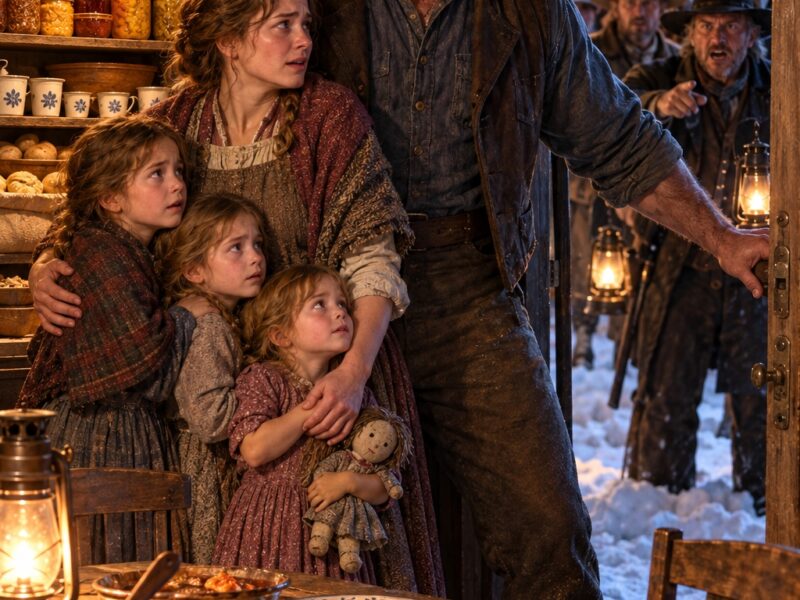
Across the Wyoming prairie, snow lay in deep, uneven drifts, filling wagon ruts and burying the fence posts along the road to Cross Ranch. The afternoon sky was already turning the color of old pewter when a freight wagon stopped before the isolated farmhouse. Three little girls sat huddled beneath a threadbare horse blanket, their mother holding the youngest so tightly that her arms had begun to ache.
Mabel Harlo was thirty-two years old, although the past eight months had aged her beyond that.
Her husband, Thomas, had died in April after a fever that came on suddenly and carried him away within eleven days. Before that, they had not been wealthy, but there had been a rented house, a little garden, and a table where their daughters could count on supper. After his death, every part of their ordinary life had begun slipping away.
The doctor had to be paid. The undertaker had to be paid. The landlord, who had once called Thomas a good and honest fellow, waited exactly two months before demanding the rent Mabel could no longer provide.
She sold Thomas’s watch first, then her sewing machine, then the walnut rocking chair in which she had nursed all three babies.
By November, there was nothing left worth selling.
She had walked from house to house asking for work, taking in washing whenever anyone would trust her with it. She had scrubbed boardinghouse floors until her knees swelled and mended shirts by candlelight for wages so small she sometimes spent more on thread than she earned. Every evening, she counted the remaining coins beneath the eyes of three children who had learned not to ask for anything.
Nine-year-old Ruth had begun saying she wasn’t hungry whenever food ran short.
Seven-year-old Clara saved crumbs in her pockets for Annie.
And four-year-old Annie had recently developed the terrible habit of falling asleep wherever she happened to be standing.
The last woman Mabel approached for employment had suggested that she send her daughters to separate households.
“Three girls would be easier to place than four mouths together,” the woman had said, arranging the lace at her wrist. “You could keep your wages for yourself.”
Mabel had stood very still.
“My children aren’t goods to be divided among strangers.”
“Well, pride doesn’t feed anybody.”
Mabel had wanted to explain that pride was not what kept a mother from surrendering her daughters. Instead, she thanked the woman for her time and walked back into the cold.
Two days later, the wagon drivers agreed to carry them toward Cross Ranch after hearing that its owner sometimes needed household help.
Only when the wagon reached the house did Mabel discover that the journey had been intended as a cruel joke.
“Hey, Cross!” called the driver, a narrow-faced man named Walter Pike. “Brought you a widow! Says she’ll work for her supper!”
Beside him, Amos Bell laughed and slapped his knee.
“Comes with three little mouths, too. Should keep your pantry empty by morning!”
Mabel lowered her face, wishing her children were too young to understand.
“Please,” she said. “Not in front of the girls.”
Neither man answered.
The farmhouse door opened.
Gideon Cross stepped onto the porch, and the laughter died as abruptly as if someone had closed a fist around it.
He stood nearly six and a half feet tall, broad through the shoulders and thick in the chest, wearing a faded wool shirt beneath a heavy coat. A dark beard framed his weathered face. His hands were large and scarred, the hands of a man who had spent much of his life hauling timber, setting fence posts, and wrestling stubborn animals through winter storms.
People in the nearest settlement spoke about him in lowered voices.
Some called him dangerous. Others said he had once broken a man’s jaw outside a saloon and never apologized. Nearly everyone agreed that Gideon Cross wanted nothing to do with other people.
He looked first at Pike, then at Bell.
Finally, his gaze moved to the mother standing in the snow.
“What is this?”
Pike made an exaggerated gesture toward Mabel.
“Housekeeper for you, Cross. Provided she doesn’t eat you out of house and home.”
Gideon didn’t smile.
“Did you bring them here knowing I hadn’t agreed to take them?”
Pike shifted in his seat.
“Now, don’t get particular.”
“Answer me.”
Bell stopped grinning.
“She needed work. We brought her where there might be some.”
Gideon’s eyes remained on them until Pike gathered the reins.
“Well, she’s your problem now.”
The wagon lurched away, its wheels grinding through the snow.
Mabel listened to the men’s laughter recede into the empty prairie. Only after the sound disappeared did she dare look toward the rancher.
“I’m sorry, sir. I didn’t mean to trouble you.”
“What do you want?”
“Work. Any honest work you have.”
“Can you cook?”
“Yes, sir.”
“Wash and mend?”
“Yes.”
“Handle a woodstove?”
“I’ve done it all my life.”
He glanced at the girls.
“Any family nearby?”
Mabel’s mouth went dry.
“Just them.”
For a moment, he seemed to study something beyond her shoulder. Then his eyes settled on Annie’s pale face, half-hidden against her mother’s neck.
“Kitchen’s inside.”
Mabel blinked.
“Sir?”
He stepped away from the doorway.
“You’re letting the cold in.”
She entered before he could change his mind.
The house was larger than she expected, built of solid timber with a stone chimney and wide plank floors. It should have been comfortable, even handsome. Instead, dust lay thick across the furniture, and every room seemed to carry the same heavy silence.
A pair of muddy boots stood beside the hearth. Unwashed dishes crowded the kitchen counter. A wool coat hung where it had apparently been left weeks earlier.
There were no flowers, no bright curtains, no photographs on the mantel.
Nothing suggested that anyone had taken pleasure in living there for a very long time.
Mabel settled Annie near the stove and instructed Ruth to keep her sisters close.
Then she tied on her faded apron.
She carried water from the pump, scrubbed dishes, swept the kitchen, and cleared a table covered with old newspapers and broken harness fittings.
Her fingers were swollen from the cold. Two had split across the knuckles, and the soap burned whenever it touched the cracks.
Still, she worked.
She understood that shelter could disappear as quickly as everything else had.
An hour passed before Clara whispered loudly enough for Mabel to hear.
“Mama, do you think the big man hates children?”
Mabel glanced toward the doorway.
Gideon stood there, holding an armful of firewood.
“No, sweetheart. I don’t believe he does.”
“Then why doesn’t he smile?”
Mabel had no answer.
Gideon crossed the kitchen without speaking. He filled the stove, coaxed the fire until the iron began radiating warmth, then brought three heavy blankets from the adjoining room.
He laid them beside the girls.
“Keep those wrapped around you.”
Ruth looked up cautiously.
“Thank you, sir.”
He nodded once.
Mabel watched him retreat toward the doorway.
Something about his kindness frightened her almost as much as his silence. She had grown so accustomed to calculating the price of every favor that she could no longer accept one without wondering what would be demanded in return.
She had just finished wiping the table when Gideon spoke again.
“When did you last eat?”
Mabel kept her eyes on the cloth.
“We’ve managed.”
“That wasn’t what I asked.”
“The girls had some bread yesterday.”
He looked toward the stove.
“Yesterday?”
“And broth.”
“What about you?”
She couldn’t remember the last proper meal she’d eaten. There had been a crust two mornings earlier, a spoonful of cold beans the night before that, and water whenever her stomach began cramping.
“I’m all right.”
Gideon regarded her for several seconds.
Then he looked down at the clean table, at her trembling hands, and at the little girl whose eyes followed every movement in the kitchen.
“Mrs. Harlo.”
She braced herself.
“I’ll work harder, sir. I promise. I can scrub the house from top to bottom, and I won’t ask you to pay me anything until spring. Only please let the girls stay somewhere warm.”
Her voice failed.
“I won’t even ask you to feed me. Just them.”
Ruth began to cry.
Clara put an arm around her older sister, trying to look brave.
Annie lifted her head from the blanket.
“Mama?”
Mabel hurried to her.
“What is it, darling?”
“Is there supper tonight?”
For a moment, Mabel could not speak.
She had stood beside her husband’s grave without collapsing. She had signed away the last of their possessions and accepted charity from neighbors who made certain everyone knew about it.
But the trusting way Annie asked that question nearly undid her.
“I’m trying, sweetheart.”
Annie touched her mother’s cheek.
“I know, Mama.”
Across the room, Gideon turned his face toward the wall.
He stood still for so long that Mabel wondered if she had offended him.
Then he walked to a tall wooden pantry.
A tarnished iron key hung from a cord beneath his shirt. He drew it out slowly, slipped it into the lock, and paused with one hand resting against the wood.
Mabel watched the enormous rancher’s shoulders rise and fall.
When he finally opened the door, she stepped closer.
And stopped.
The shelves were overflowing.
Flour. Beans. Potatoes. Cornmeal. Dried apples. Jars of peaches and pears. Smoked hams hanging from hooks. Crocks of preserved vegetables. Sugar wrapped carefully against damp.
There was enough food to sustain several people for months.
But it was not the abundance that made her chest tighten.
At the end of one shelf stood four small wooden bowls.
Beside them sat three little drinking cups, each decorated with faded blue flowers.
The cups had been washed and arranged so carefully that Mabel knew they were not ordinary kitchen utensils.
Gideon followed her gaze.
“Those belonged to my daughters.”
Mabel turned toward him.
“You have daughters?”
His expression changed.
“Had.”
He lifted one of the cups and turned it slowly between his fingers.
“Three girls. Lost them six winters ago.”
The fire popped softly behind them.
Mabel looked from the cups to the three children huddled beside her stove.
Gideon placed the cup back on the shelf.
“They were about the same ages as yours.”
His voice was so quiet she almost missed the words.
“They were always hungry after coming in from the snow. Their mother used to say she couldn’t keep bread in the house.”
A brief, painful softness crossed his face.
“Back then, I complained about how much they ate.”
Mabel felt tears gathering.
“Mr. Cross—”
“Don’t.”
He reached for a sack of flour.
“There’s enough here for supper.”
She tried to thank him, but her throat had closed.
He glanced toward the table.
“Set five places, Mrs. Harlo.”
“Five?”
“You and your girls aren’t eating alone.”
Before Mabel could answer, Annie slipped out of her blanket.
She approached him with the hesitant curiosity of a child who had never learned to fear someone simply because he was large.
“Did your little girls go to heaven?”
Gideon went still.
Then he nodded.
Annie slipped her tiny hand into his.
“Maybe God sent us here because you were lonely.”
The cup trembled against the shelf.
Gideon knelt slowly, as though his legs had forgotten how.
For the first time in six years, the enormous rancher began to cry.
Mabel took a step toward him.
Then three sharp knocks struck the front door.
“Cross!” a man shouted. “Open up!”
Mabel recognized Walter Pike’s voice.
Her stomach clenched.
“We’ve come for the widow and her children!”
A second voice followed, older and unfamiliar.
“Mr. Cross, this is Deputy Harlan Voss. I need to speak with the woman you took inside.”
Gideon rose.
Mabel caught sight of a folded paper through the narrow window beside the door.
It bore an official seal.
Pike had not returned merely to humiliate her.
He had brought someone who believed he had the right to take her daughters away.
And Gideon Cross, who had lost three little girls of his own, was standing between them and the door.
The deputy knocked again.
“Mrs. Harlo, I have a county order concerning the placement of your children.”
Mabel’s knees nearly gave way.
Behind her, Ruth whispered the words that made everything worse.
“Mama, does that mean they’re going to separate us?”
Gideon’s large hand closed around the door latch.
“No one,” he said quietly, “is taking those girls into the cold tonight.”
He opened the door.
The wind rushed in, carrying snow across the threshold.
And the first thing Gideon saw was the signature at the bottom of the deputy’s paper.
The name belonged to the same man who had refused to help when his own daughters were dying.
The deputy stood on the porch with his hat pulled low and the official document tucked beneath one arm.
Harlan Voss was a lean man nearing fifty, with a gray mustache and a face weathered by years of riding county roads. He looked uncomfortable standing beside Pike and Bell, whose earlier amusement had returned now that they believed they possessed the stronger hand.
“Evening, Cross,” Voss said.
“Not for the people you brought.”
Pike opened his mouth, but Gideon kept looking at the deputy.
“What’s this about?”
Voss drew the paper from beneath his arm.
“Widow Harlo’s landlord petitioned the county regarding the children. Claims they’re without suitable housing or means of support.”
Mabel stepped forward.
“I’ve been looking for work.”
“I know, ma’am.”
“Then you know I haven’t abandoned them.”
“Nobody said you had.”
Pike gave a small, contemptuous laugh.
“She was sleeping in a stable three nights ago.”
Gideon’s eyes moved to him.
“Where did you leave them this afternoon?”
Pike shifted.
“Right here.”
“On my porch, with no agreement from me, in freezing weather.”
“Well, I figured—”
“You figured I would send them back into the snow.”
Pike looked away.
Voss unfolded the paper.
“The county judge has authorized an inquiry into temporary placements. This isn’t a warrant to seize the children, Cross, but I’m obliged to establish whether they’re being properly cared for.”
Mabel gripped the back of a chair.
“Placements?”
Voss hesitated.
“There’s a family willing to take the oldest girl. Another for the middle one. The youngest might go to Mrs. Ellison in town.”
Ruth made a small sound.
Annie buried her face in Clara’s skirt.
Mabel crossed the room and gathered them against her.
“No.”
“Mrs. Harlo—”
“No. They have already lost their father and their home. I will not make them lose each other.”
Voss lowered the paper.
“I understand how you feel.”
“No, sir. You don’t.”
Her voice was quieter now, but steadier.
“You don’t hear my youngest calling for her father in her sleep. You don’t know how Ruth pretends she isn’t hungry because she thinks it helps me. And you don’t see Clara hiding bread because she’s afraid there won’t be any tomorrow.”
Tears rolled down her cheeks.
“They’re children, Deputy. Not empty places at somebody else’s table.”
For several seconds, nobody spoke.
Then Gideon stepped aside.
“Come in, Voss. Leave those two outside.”
Pike stiffened.
“Now, see here—”
“You heard me.”
Voss entered. The door closed before Pike could protest.
Gideon gestured toward the clean kitchen, the warm stove, and the blankets surrounding the girls.
“Mrs. Harlo is employed here.”
Mabel turned sharply.
She hadn’t been promised employment.
Gideon continued.
“Housekeeper. Meals and lodging provided. Wages to be agreed upon tomorrow.”
Voss raised his eyebrows.
“With three children?”
“They live here, too.”
“That’s a considerable undertaking.”
“It’s my undertaking.”
The deputy glanced toward the table, where Mabel had begun arranging bowls.
“Can you maintain them?”
Gideon looked toward the pantry.
“Come see.”
He opened the door.
Voss stared at the provisions, then at the small blue-flowered cups on the shelf.
Something changed in his expression.
“Gideon.”
“Don’t say it.”
Voss swallowed.
“I wasn’t going to.”
The deputy had been present six winters earlier when three small coffins were carried from Cross Ranch to the cemetery beyond the settlement. He remembered the winter storm, the frozen roads, and the terrible silence of the man who walked behind them.
He also remembered the name printed beneath the signature on the county paper.
Dr. Silas Whitcomb.
Voss folded the document without another word.
“Mrs. Harlo, I’ll report that you and your children have secured suitable lodging and employment. The judge may request confirmation, but there’s no authority here to remove them tonight.”
Mabel pressed one hand to her mouth.
“You mean we can stay?”
“If Mr. Cross is willing.”
Gideon looked almost irritated by the question.
“I’ve already told you.”
Voss nodded.
“I’ll make certain the judge hears it from me.”
Outside, Pike began pounding on the door.
“Deputy! We aren’t leaving without settling this!”
Voss sighed and reached for his hat.
“Those fools have caused enough trouble.”
He opened the door.
Gideon followed him onto the porch.
Mabel remained inside, holding Annie while the deputy’s muffled voice carried through the timber walls.
“You brought me out here on false pretenses, Pike. The children have shelter. The matter is closed for tonight.”
A moment later, Gideon’s voice rose.
“And if either of you ever leaves a woman and three little girls on my doorstep in weather like this again, you’ll answer for it.”
The men departed soon afterward.
When Gideon returned, snow clung to his beard.
He found Mabel still standing beside the stove.
“You should sit,” he said.
She tried to answer.
Instead, she began crying.
Not loudly. There was no strength left for that. Her shoulders simply folded, and she covered her face with both hands.
Gideon stood uncertainly beside her.
He had faced stampeding cattle and violent men without knowing fear.
But he had no idea what to do with a woman who cried because someone had allowed her children to remain together.
Finally, he pulled out a chair.
“Sit down, Mrs. Harlo.”
She obeyed.
Ruth came to stand beside her mother.
“Are we safe now?”
Mabel looked toward Gideon.
He considered the question carefully.
“Tonight, you are.”
It was the first promise he had made in years.
And unlike the men who had brought them there, Gideon Cross intended to keep it.
Supper was plain but abundant.
Mabel made thick potato soup with beans, onions, and pieces of smoked ham. She baked cornbread in a cast-iron pan and warmed preserved peaches over the stove.
The fragrance filled the house so completely that Annie woke from a brief sleep and asked whether it was Christmas.
“No, sweetheart,” Mabel answered, brushing the girl’s hair away from her face.
“Then why does it smell so good?”
Mabel could not answer without crying again.
She gave the girls modest servings, knowing their empty stomachs would need time to adjust. Gideon waited until they were settled before taking his own bowl.
At first, Ruth ate cautiously, watching him over the rim of her spoon.
Clara whispered that the peaches tasted better than candy.
Annie fell asleep halfway through supper with one hand still holding a piece of cornbread.
Gideon watched her for a moment.
Then he rose and brought another blanket.
He laid it gently over the sleeping child.
Mabel saw the care with which he tucked the wool around Annie’s feet.
It was a practiced movement.
And it nearly broke her heart.
After the girls had been carried to a spare bedroom upstairs, Mabel returned to the kitchen.
Gideon sat beside the fire with a cup of black coffee in his hand.
She stood in the doorway.
“Mr. Cross?”
He looked up.
“I haven’t properly thanked you.”
“You made supper.”
“That’s not what I mean.”
He said nothing.
Mabel crossed to the table and sat opposite him.
“I need to know what you expect from me.”
Gideon frowned.
“Work, Mrs. Harlo. That’s what you asked for.”
“And how much will you pay?”
He named a reasonable monthly wage, along with food and lodging.
Mabel looked down, startled by the fairness of it.
“That’s more than anyone else offered.”
“Most people were offering you nothing.”
She gave a faint, exhausted smile.
“That’s true.”
For a moment, the quiet between them was almost comfortable.
Then she glanced toward the pantry.
“May I ask about your daughters?”
Gideon’s hand tightened around his cup.
“You may ask.”
She waited.
He stared into the fire.
“My wife was named Eleanor. Our girls were Grace, Lily, and June.”
He spoke the names slowly.
“Grace was nine. Lily was seven. June was four.”
Mabel felt the awful coincidence settle between them.
Exactly the ages of her own daughters.
Gideon continued.
“They loved this place. Grace rode before she could properly reach the stirrups. Lily collected every injured bird she found. And June followed me everywhere.”
He almost smiled.
“Couldn’t saddle a horse without that child asking to help.”
Mabel listened without interrupting.
“Six winters ago, we had a storm that lasted nearly a week. The girls took sick before the roads closed. Eleanor thought it was an ordinary winter illness. Then Grace developed a fever so high she couldn’t recognize me.”
His voice changed.
“I rode for the doctor.”
Mabel remembered the signature.
“Dr. Whitcomb?”
Gideon nodded.
“He was caring for the wife of a wealthy cattleman. Said he couldn’t leave her.”
“Did he know how ill your girls were?”
“I told him.”
Gideon looked toward the dark window.
“I begged him.”
Mabel’s throat tightened.
“What happened?”
“He said he’d come the next morning.”
The fire cracked softly.
“By morning, the road was blocked.”
Gideon swallowed.
“I tried bringing him myself. My horse went down in a drift. I walked most of the way back.”
He fell silent.
Mabel waited.
“When I got home, Eleanor was sitting between the girls’ beds. June had already stopped breathing.”
Mabel lowered her head.
“Grace died that night. Lily the following morning. Eleanor caught the same illness while nursing them. She lived another four days.”
He spoke the last sentence without expression.
“Afterward, the house was too quiet.”
Mabel stared at the untouched coffee in his hand.
He looked toward the pantry.
“Eleanor had put up more preserves than we needed that autumn. She said our girls were growing and winter would be long.”
He paused.
“Every year since, I’ve kept the pantry stocked. The ranch hands use another storehouse. I tell myself it’s practical to have reserves.”
His eyes glistened.
“But I suppose some part of me never accepted that there wouldn’t be anyone coming down the stairs asking for breakfast.”
Mabel said nothing.
There was no sentence that could repair what he had suffered.
Instead, she reached across the table and laid her hand beside his.
Not touching him.
Only close enough that he could choose whether to accept the comfort.
After a long moment, Gideon shifted his hand until his fingers rested lightly against hers.
Neither spoke.
Outside, the wind pressed against the windows.
Inside, the first human warmth Gideon Cross had allowed himself in six years remained between them, quiet and uncertain.
By morning, the ranch house sounded different.
Mabel woke before dawn, alarmed by the unfamiliar comfort of a mattress beneath her back. For one disorienting moment, she thought she was in her old bedroom, before Thomas became ill and the world began coming apart. Then she heard Clara whispering to Ruth across the room and remembered the enormous rancher downstairs.
She dressed quietly and went to the kitchen.
Gideon was already outside tending the horses. The stove had been filled with fresh wood, and a covered pail of water stood beside the sink. On the table sat four apples and a folded piece of paper.
For the girls. There are eggs in the cellar.
The handwriting was blunt and uneven.
Mabel held the note for a moment longer than necessary.
She had received so many demands in recent months—bills, warnings, notices to vacate—that a message asking nothing of her felt almost strange.
She folded it and tucked it inside her apron.
When the girls came downstairs, Annie found the apples.
“Are these for us?”
“Mr. Cross says they are.”
“All four?”
Mabel nodded.
Annie considered them carefully.
“Then Mama gets one, too.”
The simplicity of it caught Mabel off guard.
She crouched beside her youngest daughter.
“Yes, darling. Mama gets one, too.”
Annie looked pleased, as though some important injustice had finally been corrected.
That morning, for the first time in weeks, Mabel ate breakfast alongside her daughters.
The ranch settled into a cautious rhythm over the following days.
Mabel cleaned the bedrooms, aired blankets, baked bread, and discovered that Gideon possessed enough clean linen to furnish a boardinghouse. Most had been packed into trunks after Eleanor’s death. She left those trunks untouched, understanding that there were places in a grieving person’s life where even kindness needed permission.
Gideon spent his days tending cattle, repairing fences, and inspecting the winter feed stores.
He rarely spoke more than necessary.
Yet the girls gradually began approaching him.
Ruth asked about the horses first.
She had watched him lead a chestnut mare into the barn and wanted to know why he spoke to the animal so softly.
“Because Daisy listens better when I don’t shout,” he explained.
“Does she know her name?”
“She knows the sound of it.”
“Could I help brush her?”
Gideon considered Ruth’s thin arms and solemn expression.
“After breakfast tomorrow. If you wear your warmest coat.”
Ruth smiled for the first time since arriving.
Clara discovered that he could repair nearly anything.
When the wooden leg of her doll broke, she brought it to him with a trembling lower lip.
“Can you fix her?”
He turned the doll over in his hands.
“Probably.”
“Will it hurt?”
Gideon looked up at her.
“I don’t expect she’ll complain.”
Clara giggled.
The sound startled him.
For an instant, he remembered Lily sitting on the barn floor with a wooden horse whose tail had broken off. He remembered the child’s indignation when he’d suggested that a horse could manage perfectly well without a tail.
He had laughed that day.
He could still hear it.
Gideon returned the repaired doll to Clara that evening. She thanked him with a hug so sudden that he nearly dropped his lantern.
Annie was the boldest of the three.
She followed him into the kitchen, asked why his beard was so large, and wondered aloud whether his boots had been made for a giant.
One afternoon, she found him sitting alone near the hearth.
“Mr. Cross?”
“Hmm?”
“Did you used to sing to your little girls?”
He looked at the fire.
“Their mother did.”
“Did you?”
“Sometimes.”
“What song?”
He thought for a moment.
“Mostly whatever they asked for.”
Annie climbed carefully onto the chair beside him.
“Could you sing one to me?”
Gideon stared at her.
He hadn’t sung in six years.
“I don’t remember the words.”
“That’s all right,” Annie said. “Mama forgets words sometimes, too.”
He looked toward the kitchen, where Mabel stood kneading bread.
She pretended not to hear.
A moment later, a rough, uncertain melody began near the fireplace.
Gideon’s voice broke twice.
Annie didn’t seem to mind.
She laid her head against his arm and listened until he finished.
That evening, Mabel found him standing in the hallway outside the girls’ room.
He was looking toward the narrow gap beneath their door, where lamplight spilled across the boards.
“They’re asleep,” she whispered.
“I know.”
He didn’t move.
Mabel waited beside him.
Finally, Gideon said, “I used to stand here listening to mine.”
His voice was almost inaudible.
“Sometimes I’d complain they were making too much noise. Then one day there wasn’t any.”
Mabel looked toward the door.
“Children make a great deal of noise when they’re happy.”
“I’d forgotten.”
She rested a hand against the wall.
“Maybe you’ll get used to it again.”
He looked at her.
There was no smile, but something in his expression had softened.
“I think I already am.”
The trouble began on the sixth morning.
Gideon had gone to inspect a distant pasture when a rider appeared at the gate.
Mabel recognized Dr. Silas Whitcomb immediately.
She had seen him twice in town, once when she begged him to examine Annie’s persistent cough. Both times, he had insisted on payment before treatment.
He dismounted and approached the porch with a leather satchel in his hand.
“Mrs. Harlo.”
Mabel stepped outside and shut the door behind her.
“Doctor.”
“I understand you’ve taken employment with Mr. Cross.”
“Yes, sir.”
“An unusual arrangement.”
She folded her hands inside her sleeves.
“Mr. Cross has been very generous.”
Whitcomb glanced at the house.
“Generosity can be misunderstood, particularly in isolated places.”
Mabel felt herself grow still.
“What do you mean?”
“A respectable widow living with an unmarried man. Three young daughters in the household. You must appreciate how people might talk.”
Heat rose beneath her collar.
“I am his housekeeper.”
“Of course.”
He looked past her toward the kitchen window.
“I’ve known Gideon a long time. The man has never recovered from his family’s deaths.”
“That’s no concern of mine to discuss.”
Whitcomb’s expression tightened.
“Perhaps you don’t know everything about him.”
Mabel remembered the cups, the pantry, and Gideon’s rough voice when he spoke his daughters’ names.
“I know he’s been kind to my children.”
“Kindness isn’t necessarily evidence of sound judgment.”
Whitcomb opened his satchel and removed a folded letter.
“The county judge will be reviewing your circumstances after Christmas. If you return to town and cooperate with the placement arrangements, I can recommend that you retain regular visiting rights.”
Mabel stared at the letter.
“You want me to give up my daughters.”
“I want them properly cared for.”
“They are properly cared for.”
“For the moment.”
The words chilled her more than the wind.
Whitcomb continued, “And I would strongly advise you against becoming too attached to your present situation. Gideon Cross has a history of anger when certain matters are mentioned.”
Mabel lifted her chin.
“Then perhaps people should have been more careful about how they treated him.”
Whitcomb’s face changed.
“You’ve heard his version of what happened.”
She said nothing.
He lowered his voice.
“There are two sides to every tragedy, Mrs. Harlo.”
Mabel thought of the three little cups and the man who still kept them polished.
“Perhaps,” she said. “But there were four children and a mother in that house, and only one doctor was asked to come.”
Whitcomb went rigid.
For several seconds, he examined her as though seeing her clearly for the first time.
Then he put the letter away.
“I suggest you consider your future very carefully.”
He turned and walked back to his horse.
Mabel stood on the porch until he disappeared beyond the gate.
Only then did she realize that her hands were shaking.
When Gideon returned, she told him everything.
He listened without interrupting.
At the mention of Whitcomb’s warning about his temper, his expression hardened.
“Did he threaten you?”
“Not plainly.”
“He never does.”
Gideon removed his gloves and placed them on the table.
“I should have known he’d involve himself.”
Mabel watched him.
“Why is he so determined to have the girls placed elsewhere?”
Gideon looked toward the window.
“Whitcomb chairs the county relief committee. He’s been helping arrange placements for destitute children for years.”
“Is that necessarily wrong?”
“No.”
His answer surprised her.
“Some families need that help. Some children have nowhere safe to go. But a woman finding honest employment shouldn’t have her children taken simply because she was poor yesterday.”
Mabel lowered herself into a chair.
“I keep wondering what more I should have done.”
Gideon looked at her.
“You worked. You begged for help. You kept them fed as long as you could.”
“Not always.”
“They’re still together.”
Her eyes filled.
“Only because you opened your door.”
He shook his head.
“You brought them here. Whatever those fools intended, you kept walking toward a chance.”
Mabel looked away.
She was unused to having her efforts described as anything but failure.
Gideon sat opposite her.
“The judge will have to see that the girls are safe and provided for. I’ll give you a written employment agreement. We can ask Voss to witness it.”
Mabel hesitated.
“Will that be enough?”
“It should be.”
She heard the qualification.
“So we may still lose them.”
Gideon leaned forward.
“Not without a proper hearing. And not because Whitcomb says so.”
He paused.
“I won’t promise you what a judge will do. But I will stand beside you.”
Mabel held his gaze.
She had spent months hearing people explain what they could not do for her.
Gideon Cross was the first man since Thomas’s death who had offered to stand beside her without asking her to surrender something in return.
Christmas arrived with another storm.
By then, the girls had gained color in their cheeks. Ruth had learned to brush Daisy without startling her. Clara had begun keeping a small collection of feathers and stones on her bedroom windowsill. Annie had decided that Gideon ought to be called Mr. Gideon because she thought his full name sounded too serious.
He tolerated it with surprising patience.
Mabel found a little evergreen growing near a sheltered creek and asked Gideon whether she might bring it inside.
He stood looking at the tree after she placed it in a wooden bucket near the fireplace.
For several minutes, he said nothing.
Then he went upstairs.
He returned carrying a small box.
Inside were handmade ornaments.
Three painted wooden stars. Several strings of dried berries. A carved horse, a little bird, and an angel sewn from scraps of white cloth.
Mabel recognized the careful needlework.
“Eleanor’s?”
Gideon nodded.
“The girls helped her make them.”
She looked at the box.
“Would you rather we put the tree away?”
He shook his head.
“No.”
He lifted the little horse.
“Grace made this. Insisted every Christmas tree needed a horse.”
Ruth approached.
“Can I hang it?”
Gideon examined her face.
Then he placed the ornament in her hands.
“Put it somewhere it won’t fall.”
Ruth chose a sturdy branch.
Clara hung the bird.
Annie was given the cloth angel.
She held it against her cheek before Gideon lifted her so she could reach the highest branch.
Mabel stood beside the stove, watching his enormous hands steady the child.
The scene was so ordinary that it hurt.
Six years of carefully preserved Christmas memories had not been replaced. They had simply been allowed into the room again.
That night, the five of them ate roast chicken, potatoes, carrots, and the last jar of Eleanor’s spiced peaches.
Gideon told a story about Lily trying to teach a stubborn rooster to follow commands.
Ruth laughed so hard she nearly spilled her cider.
Clara demanded to hear it again.
And Annie, seated beside Gideon, leaned against his arm as naturally as if she had always belonged there.
Later, when Mabel came downstairs to bank the fire, she found Gideon sitting beside the Christmas tree.
The painted stars swayed faintly in the warm air.
“Did we do wrong?” she asked.
He looked up.
“Wrong?”
“Using their decorations.”
Gideon glanced toward the angel.
“No.”
His voice was thick.
“Eleanor made those things because she wanted the house to be happy. I think she’d be disappointed to learn I kept them in a box for six years.”
Mabel sat beside him.
For a while, they listened to the fire.
Then Gideon said, “I thought if I stopped grieving every minute, it would mean I’d forgotten them.”
Mabel looked at the little wooden horse.
“When Thomas died, I was afraid to laugh in front of the girls.”
He turned toward her.
“I thought it might mean I didn’t love him enough.”
“What changed?”
“Annie made a funny face at supper one evening. Clara laughed, and then Ruth did. I tried not to, but I couldn’t help it.”
Her mouth trembled.
“Afterward, I cried because I felt guilty.”
Gideon watched her silently.
“Then Ruth asked whether Papa would have wanted us to be miserable forever.”
Mabel brushed a tear from her cheek.
“I told her no. He would have wanted them to eat their supper and laugh when something was funny.”
Gideon looked into the fire.
“Sounds like a sensible man.”
“He was.”
There was no jealousy in Gideon’s voice when he said, “You must miss him terribly.”
“I do.”
She folded her hands.
“I think there will always be days when I do.”
He nodded.
“I understand.”
Their eyes met.
Neither had any desire to erase the people they had loved.
But both were beginning to understand that remembering the dead did not require abandoning the living.
The hearing took place in January.
The sky was clear and fiercely cold when Gideon brought the family to town in a covered wagon. Mabel wore her best remaining dress, freshly pressed beneath a dark wool coat Gideon had insisted she accept as part of her winter clothing allowance.
Ruth sat beside her mother, holding Clara’s hand.
Annie slept beneath a thick blanket.
They entered the county office together.
Judge Nathaniel Mercer, a gray-haired man with a stiff back and tired eyes, sat behind a desk covered with papers. Deputy Voss stood beside the window. Dr. Whitcomb waited near the stove, speaking quietly with Walter Pike.
Mabel felt the old humiliation creeping back.
She was suddenly aware of the worn hem of her dress, the patches in Clara’s coat, and the fact that her livelihood depended upon a man the town regarded with suspicion.
Gideon noticed her expression.
“Look at me,” he said quietly.
She did.
“You’ve done nothing wrong.”
Mabel took a careful breath.
The hearing began.
Whitcomb described Mabel’s previous homelessness, the girls’ hunger, and their arrival at Cross Ranch. He presented the temporary placement arrangements as a sensible alternative to an uncertain domestic situation.
Then Judge Mercer looked toward Mabel.
“Mrs. Harlo, is it true your children lacked adequate food before your arrival at the ranch?”
“Yes, Your Honor.”
“Did you have stable employment?”
“No, sir.”
“Why did you refuse the proposed placements?”
Mabel glanced at her daughters.
“Because I believed I could find work that would allow me to keep them with me.”
“Even when that search failed?”
She looked down briefly.
“Yes, sir.”
Mercer leaned back.
“That must have been a difficult choice.”
“It was.”
Mabel swallowed.
“I know hunger is dangerous, Your Honor. I know children need more than their mother’s love. But I also knew that if I gave them away separately, they would lose the one thing I could still give them—a home with each other.”
Her voice steadied.
“I never believed love alone was enough. That’s why I kept looking for work.”
The judge studied her.
Then Gideon produced the employment agreement.
It specified Mabel’s responsibilities, a fair monthly wage, separate living quarters for her and the girls, and continued provision of food and lodging.
Judge Mercer read it carefully.
“Mr. Cross, do you intend this arrangement to continue?”
“Yes, sir.”
“For how long?”
“As long as Mrs. Harlo wishes to remain employed.”
Mercer looked up.
“Can your property sustain four additional residents?”
Gideon laid his ranch accounts on the desk.
The judge examined the livestock records, feed reserves, and household provisions. Voss confirmed what he had personally observed during his December visit.
Whitcomb shifted uneasily.
“Your Honor, there’s also the question of Mr. Cross’s temperament.”
Gideon stiffened.
Mercer raised one hand.
“What specifically do you allege?”
“His reputation is well established.”
“Reputation isn’t evidence.”
Whitcomb hesitated.
“The death of his family affected him profoundly.”
A silence settled over the room.
Mabel saw Gideon’s fingers tighten around the brim of his hat.
For a moment, she feared he would lose his temper and give Whitcomb exactly what he wanted.
Instead, Gideon spoke softly.
“My wife and daughters died. I grieved for them. I still do.”
Whitcomb looked away.
Gideon continued.
“That doesn’t make me dangerous to children.”
Mercer nodded slowly.
“No, Mr. Cross. It does not.”
Mabel watched Gideon’s expression.
There was pain in his face, but no anger.
Only the exhaustion of a man who had carried his grief for so long that strangers had begun treating it as a defect.
Then Judge Mercer turned to Deputy Voss.
“You’ve inspected the house?”
“Yes, sir.”
“And found it suitable?”
“Warm, clean, well supplied, and spacious. The children appeared comfortable.”
“Any evidence of neglect or mistreatment?”
“None.”
Mercer set down his pen.
“Then I see no grounds for disrupting the present arrangement.”
Mabel stopped breathing.
The judge continued.
“The county’s responsibility is to protect these children, not punish their mother for temporary poverty. Mrs. Harlo has obtained lawful employment and suitable housing.”
He looked directly at her.
“Provided these conditions remain, your daughters will remain in your care.”
Clara squeezed Ruth’s hand.
Mabel closed her eyes.
Beside her, Gideon let out a long breath.
Judge Mercer signed the final paper.
“The placement inquiry is closed.”
Whitcomb began to object.
Mercer raised his hand again.
“The matter is settled, Doctor.”
For the first time in months, Mabel felt the ground beneath her feet become solid.
Her daughters were not being taken away.
She had work.
They had a place to sleep.
And none of it had required her to stop being their mother.
Outside the office, Ruth threw her arms around Mabel.
“Does this mean we’re staying at the ranch?”
Mabel knelt beside her.
“Yes, sweetheart.”
“All of us?”
“All of us.”
Annie looked toward Gideon.
“Even Mr. Gideon?”
The rancher cleared his throat.
“Well, I was planning to remain there.”
Annie considered this, then nodded approvingly.
“Good.”
For the first time in public since anyone could remember, Gideon Cross laughed.
It was a deep, rusty sound, brief and unexpected.
Mabel turned toward him.
He looked faintly embarrassed.
But he did not try to hide his smile.
Winter loosened its grip slowly.
By March, patches of brown grass appeared along the southern slopes. Water began running beneath the creek ice, and the horses grew restless in their stalls.
Mabel had been at Cross Ranch nearly four months.
She no longer woke each morning afraid that she would be told to leave. Her wages were carefully saved in a small tin beneath her bed. The girls had warm coats and sturdy boots, and Ruth had begun lessons with a neighboring family whose children visited twice each week.
The house had changed.
There were curtains at the windows now, fresh bread on the counter, and clean quilts folded across the backs of chairs. Clara’s little collections occupied one windowsill, while Annie’s repaired rag doll often lay abandoned beside the hearth.
Gideon had stopped leaving the dining table after supper.
Sometimes he sat with the girls while Mabel washed dishes, listening to their stories or helping Ruth with arithmetic.
He learned that Clara was afraid of thunderstorms.
That Ruth often tried to take responsibility for things no nine-year-old should carry.
And that Annie believed the moon followed the ranch house whenever she went outside.
In return, the girls learned that Gideon disliked burnt coffee, loved horses more than he admitted, and could carve nearly anything from wood.
The house became noisy.
Not always pleasantly.
There were arguments over toys, spills at supper, and the occasional broken dish.
Once, Clara and Ruth quarreled so fiercely over a ribbon that Gideon retreated to the barn in bewilderment.
Mabel found him mending a harness.
“Something wrong?” she asked.
He looked toward the house.
“Are they always like that?”
“Only when they’re awake.”
Gideon shook his head.
“Mine used to quarrel over which one got to sit beside me.”
Mabel smiled.
“Did you settle it?”
“Usually.”
“How?”
“I sat on the floor.”
She laughed.
He watched her for a moment, then began laughing, too.
Their friendship grew in moments like that.
Not through grand declarations, but through ordinary acts of trust.
When a young calf became trapped in a muddy ditch, Mabel helped Gideon pull it free despite his insistence that she remain on dry ground. When he sliced his palm repairing a broken gate, she cleaned and bandaged the wound without listening to his protests that it was nothing.
In the evenings, they sometimes sat together after the girls were asleep.
They spoke about Thomas and Eleanor.
About their childhoods.
About things they had done badly and opportunities they regretted losing.
Gideon admitted that he had once been impatient with his wife over small matters that now seemed foolish.
“I used to complain when she’d move my tools,” he said one night.
Mabel smiled.
“Thomas never remembered where he put his.”
“I’d give anything to find one of Eleanor’s sewing needles in my chair again.”
She looked toward the fire.
“I’d give anything to hear Thomas come through the door complaining about his boots.”
They sat in silence.
Then Gideon reached across the narrow space between their chairs and took her hand.
Mabel didn’t pull away.
For a long time, neither spoke.
There was no need to pretend their pasts had disappeared.
They were simply sitting together in the present, discovering that it held possibilities neither had expected.
In late April, nearly a year after Thomas’s death, Mabel found Gideon standing beside the family cemetery at the edge of his property.
Four simple headstones faced the rising sun.
Eleanor Cross.
Grace Cross.
Lily Cross.
June Cross.
He had cleared away the last of the dead winter grass and placed small bunches of early wildflowers beside each stone.
Mabel approached quietly.
“I hope you don’t mind my coming.”
He shook his head.
“No.”
She stood beside him.
For several minutes, they looked at the graves without speaking.
Then Gideon said, “I used to come here every morning and tell them about the ranch.”
Mabel glanced toward him.
“What did you tell them?”
“Mostly what needed fixing.”
She smiled faintly.
“Grace would have liked hearing about the horses.”
He nodded.
“And Lily would have wanted to know whether I’d found any injured birds.”
“What about June?”
Gideon’s mouth trembled.
“She would’ve asked whether I remembered to eat breakfast.”
Mabel reached for his hand.
He held it tightly.
“After they died, I thought the only decent thing I could do was keep everything the way they’d left it.”
She listened.
“I kept their cups. Their ornaments. Their rooms. I kept buying enough food for all of us, even though I knew they’d never come back.”
He looked toward the house in the distance.
“Then your girls arrived, and I was angry with myself for enjoying their company.”
“Why?”
“Because I thought I was being disloyal.”
Mabel squeezed his hand.
“And now?”
Gideon watched a bird settle on the fence.
“Now I think Eleanor would have marched straight down from heaven and told me to stop being such a stubborn fool.”
Mabel laughed softly through her tears.
“She sounds like a woman I would have liked.”
“You would have.”
He turned toward her.
“Mabel, there’s something I need to say.”
She felt her heartbeat quicken.
“I don’t want you to believe you owe me anything because I gave you work.”
“I don’t.”
“And I don’t want you or the girls to feel that you have to stay.”
Her face changed.
“Gideon—”
“Let me finish.”
He took a slow breath.
“I’ve come to care for you. More than I expected. More than I thought I could again.”
Mabel looked down at their joined hands.
He continued.
“But you’ve spent nearly a year surviving one loss after another. I’m not going to ask you for promises simply because this house has become a refuge.”
She lifted her eyes.
“And what if I wanted to make a promise?”
Gideon stared at her.
Mabel’s cheeks colored.
“I loved Thomas. I always will. And I know you loved Eleanor.”
“Yes.”
“But I don’t believe either of them would want us to spend the rest of our lives apologizing for being alive.”
He drew a breath.
She stepped closer.
“You haven’t asked me to become someone else, Gideon. You’ve allowed me to be myself, even when I was frightened and exhausted and difficult.”
A tear slipped down her cheek.
“And somewhere along the way, I stopped thinking of this as the place where my children were saved.”
She looked toward the distant farmhouse.
“I started thinking of it as home.”
Gideon lifted one hand to her cheek.
He touched her as carefully as though she were something precious he had been afraid to reach for.
Then he kissed her.
It was gentle and uncertain, the kiss of two people who understood exactly what love could cost.
When they drew apart, neither spoke for several seconds.
Finally, Mabel smiled.
“You’re still a very serious man, Mr. Cross.”
He gave a low chuckle.
“And you’re still not afraid to tell me what I’m doing wrong.”
“Someone has to.”
He leaned his forehead against hers.
For once, he did not look lonely.
They married in September 1879.
There was no grand ceremony.
Judge Mercer performed the service in the farmhouse sitting room, with Deputy Voss serving as witness. A handful of neighbors brought food, flowers, and enough laughter to fill the house.
Ruth wore a blue ribbon in her hair.
Clara carried wildflowers.
Annie insisted that Gideon bend down so she could straighten his collar before the ceremony.
“You have to look nice,” she informed him.
Gideon obeyed.
Mabel wore a simple cream-colored dress she had sewn herself.
Before the vows, she stood briefly beside the upstairs window, looking across the ranch.
She thought of Thomas.
Of the life they had built together, the children they had welcomed, and the love that had been taken from them far too soon.
She did not feel that she was leaving him behind.
His daughters were downstairs, laughing.
His kindness lived in Ruth’s sense of responsibility, Clara’s tenderness, and Annie’s boundless curiosity.
Mabel pressed two fingers against the little gold wedding ring she had kept on a chain since his death.
Then she went downstairs.
Gideon stood waiting near the fireplace.
His beard had been neatly trimmed. His hands were clasped before him, and he looked more nervous than he had on the day Walter Pike abandoned four strangers at his door.
When Mabel entered, his expression softened.
Judge Mercer smiled.
“Shall we begin?”
Annie raised her hand.
“Wait.”
Everyone turned.
She hurried toward Gideon carrying a small wooden cup.
It was one of the three blue-flowered cups from the pantry.
She had insisted on bringing it downstairs that morning.
Gideon knelt.
“What is it, sweetheart?”
Annie held out the cup.
“I think your little girls should be here, too.”
The room went silent.
Mabel’s eyes filled.
Gideon stared at the little cup, his enormous hands motionless.
Then he took it carefully.
“Thank you, Annie.”
He placed it on the mantel beside Eleanor’s photograph.
One by one, he brought the other two cups from the pantry.
Three little blue-flowered cups stood beneath the photograph, washed and shining in the afternoon light.
Not hidden.
Not forgotten.
Simply present.
Gideon turned back toward Mabel.
She held out her hand.
He took it.
And together they made their vows.
The following winter was cold, but it was nothing like the one before.
Snow still buried the fence posts. The wind still rattled the shutters, and the cattle still needed feeding before dawn.
Yet the house no longer stood silent against the prairie.
Every morning, Ruth ran downstairs asking whether she could help in the barn.
Clara carried her latest discoveries to the kitchen table.
Annie demanded stories before bed.
And Mabel, who had once begged strangers for scraps, presided over a kitchen where no child ever had to pretend she wasn’t hungry.
Gideon developed a habit of checking the pantry each evening.
At first, Mabel assumed he was counting supplies.
Then one night she found him standing before the open shelves, looking at the little bowls and jars with a thoughtful expression.
“Are we running short of anything?” she asked.
He shook his head.
“No.”
She stepped beside him.
The shelves were still well stocked, but they no longer looked untouched.
The jars were opened and used. Flour dusted the boards. A small fingerprint marked a jar of peach preserves, and one wooden bowl had developed a crack from daily use.
Mabel smiled.
“The girls have certainly made their way through your preserves.”
“Clara’s responsible for most of the peaches.”
“Annie helps.”
“And Ruth thinks I don’t notice when she slips apples into her pockets for the horses.”
Mabel laughed.
Gideon closed the pantry door.
For the first time in years, he no longer locked it.
Later that evening, while the girls slept upstairs, he sat beside Mabel at the kitchen table.
A small lamp burned between them.
She was mending one of Ruth’s stockings, and he was working a piece of pine with his pocketknife.
“What are you making?” she asked.
“A shelf.”
“For what?”
“Annie’s books. She keeps leaving them under my chair.”
Mabel glanced toward his hands.
“She’ll be pleased.”
He continued carving for a moment.
Then he said, “I’ve been thinking about something.”
She looked up.
“What?”
“The pantry.”
Mabel smiled.
“Should I be worried?”
“No.”
He set down the wood.
“For six years, I kept that room full because I couldn’t bear to admit the girls were gone.”
His voice was steady now.
“I thought having enough food waiting might somehow make the house less empty.”
Mabel laid aside the stocking.
“And did it?”
He shook his head.
“Not until somebody needed it.”
She reached for his hand.
Gideon looked toward the staircase.
Above them, Annie laughed in her sleep.
He smiled.
“I spent six years keeping a place ready for people who couldn’t come home.”
Mabel squeezed his fingers.
“And then?”
He looked back at her.
“Then four people who needed a home found their way to my door.”
Outside, snow began falling again, softly covering the wagon tracks and fences.
Inside, the kitchen smelled of fresh bread.
Five coats hung beside the entrance. Five places waited at the table. And upstairs, three little girls slept without hunger or fear.
Gideon Cross had not forgotten the family he buried.
Mabel Harlo had not forgotten the husband she loved.
But their hearts had made room for something neither believed they would ever have again.
A life that was not merely endured.
A home where the pantry stood open.
And a family that no longer had to wonder whether it would still be together in the morning.









