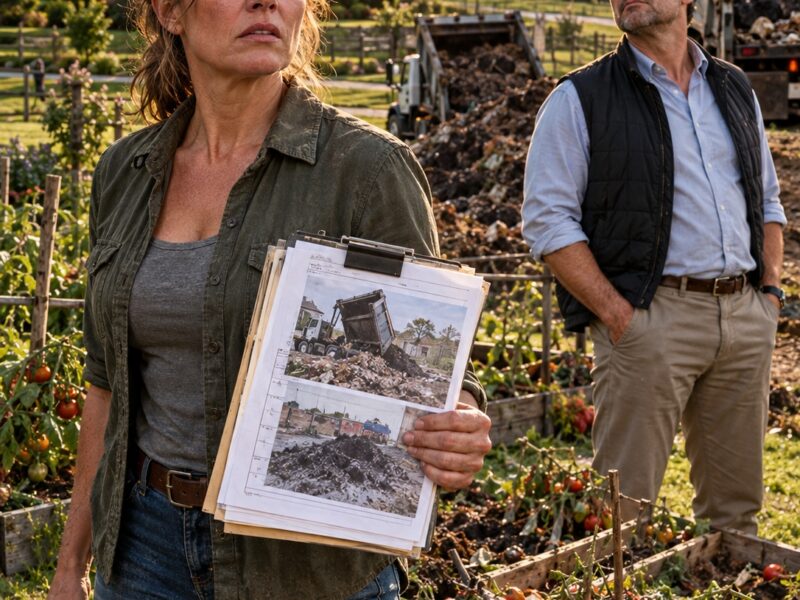
THEY DUMPED THEIR WASTE ON HER FARM AND TOLD HER SHE COULDN’T FIGHT BACK—THREE YEARS LATER, THEY HAD TO BUY IT BACK FROM HER
The second truck was already raising its bed when Lenora Mercer came running across the field.
“STOP!”
The driver either didn’t hear her or pretended not to.
The hydraulic lift groaned higher.
Then the rear gate opened.
A wet, heavy mass slid from the truck with a sound Lenora would remember for years—a thick, collapsing rush followed by the slap of material hitting the ground.
Except it wasn’t hitting the ground behind her barn.
It was landing beside her vegetable beds.
Her tomatoes.
Her kale.
The eastern rows that represented nearly a third of what she expected to sell at the county market that month.
Lenora stopped twenty feet from the truck.
For half a second, she simply stared.
Then she reached into the back pocket of her jeans.
Not for a weapon.
For her phone.
She took a photograph.
The truck.
The license plate.
The raised bed.
The pile.
Then she turned slightly and photographed the wooden stake marking the eastern vegetable rows so there could never be any question where the material had been dumped.
Only then did she walk toward the driver.
“What are you doing?”
The man leaned out his window.
“Delivery.”
“I know it’s a delivery. Why are you putting it here?”
He looked toward the barn, then back at her.
“Dispatch changed the drop point.”
“No. They didn’t.”
He frowned.
Lenora pointed toward the back acreage.
“The agreement says behind the barn. Cleared ground. West side.”
The driver shrugged.
“Same property.”
“It isn’t the same location.”
“Ma’am, I just go where they tell me.”
“Who told you?”
“Brier Creek.”
“Who at Brier Creek?”
That finally seemed to irritate him.
“I don’t know. Grant, probably.”
Lenora looked at the pile again.
The smell was already spreading in the August heat.
“Don’t unload anything else.”
“I’m empty.”
“Then don’t come back.”
The driver gave her the tired look people sometimes gave women they had already decided were overreacting.
“You’ll have to call the office.”
“I will.”
He pulled away eleven minutes later.
Lenora knew because she wrote the time down.
She also wrote the temperature, the approximate volume deposited, the location, the condition of the plants closest to the spill line, and the driver’s description.
Then she called Grant Pritchard.
Grant answered on the fourth ring.
“Brier Creek operations.”
“This is Lenora Mercer.”
A pause.
“Oh. Hey, Lenora.”
“Your truck dumped beside my garden.”
Another pause.
Smaller this time.
“Okay.”
“Okay?”
“I’m sure there was just some confusion about the drop location.”
“There wasn’t.”
“Lenora—”
“The agreement says behind the barn.”
“I know what it says.”
“Then why is your material beside my tomatoes?”
Grant sighed.
It was the sigh that changed something inside her.
Not the mistake.
Not even the damage.
The sigh.
It carried the quiet impatience of a man being forced to explain something to someone he did not consider important enough to inconvenience him.
“Your garden isn’t worth much anyway,” he said.
Lenora went still.
Grant continued before he realized he should have stopped.
“It’s organic material. It breaks down. Honestly, you may thank us come spring.”
Lenora looked across the field at the truck disappearing down her gravel road.
“How many more deliveries are scheduled?”
“One next Tuesday. Maybe two.”
“No.”
“What?”
“I agreed to one trial delivery.”
“Schedules are already set.”
“Then unset them.”
“It doesn’t work like that.”
“It does on my property.”
Silence.
Grant’s voice hardened slightly.
“We’re on a schedule, Lenora.”
“And you’re on my land.”
That earned another silence.
Then he said, “I’ll see what I can do.”
Lenora ended the call.
She stood beside the damaged rows while flies began gathering over the fresh deposit.
Most people would later assume that was the moment she decided to fight Brier Creek Dairy.
It wasn’t.
At that point, Lenora still believed she was dealing with a mistake.
An arrogant man, perhaps.
A careless company.
A bad afternoon.
What she didn’t know was that someone at Brier Creek had already made a much larger calculation.
They had looked at six acres, an aging farmhouse, a weathered barn, a forty-something woman growing vegetables for county markets, and concluded there was almost nothing she could do to them.
And for a while, they were nearly right.
Lenora had owned the six-acre property outside Verona, Wisconsin, for eleven years.
It wasn’t picturesque in the way magazines liked rural properties to be picturesque. The farmhouse needed paint. The barn leaned just enough to make strangers ask whether it was safe. The gravel driveway developed potholes every spring, and one gutter on the north side of the house had been held in place by the same temporary bracket for four years.
But Lenora loved the place precisely because nobody else needed to.
She had bought it after her divorce with a down payment so small the realtor had gently suggested she keep looking.
She hadn’t.
She wanted quiet.
She wanted ground that belonged to her.
And she wanted a place where nobody could tell her that she had taken up too much space.
For years, the vegetable garden had been a weekend project.
Then the packaging plant where Lenora had worked for nine years announced it was closing.
The news came on a Monday morning.
By Friday, people were carrying cardboard boxes to their cars.
Lenora left with nine years of experience, a severance payment smaller than she had hoped, and the realization that the nearest comparable employer was too far away to make financial sense.
She had $8,600 in savings.
She also had a roof repair loan.
Property taxes.
Utilities.
Fuel.
Insurance.
And no husband sending a second paycheck into the house.
So the garden stopped being a hobby.
It became arithmetic.
Kale became electric bills.
Tomatoes became loan payments.
Squash became diesel.
Every crate she loaded into her pickup had a number attached to it.
By her second growing season after the plant closed, she was supplying three stalls at the county market and selling regularly to several small buyers.
She wasn’t becoming wealthy.
She was surviving.
There was a dignity in that Lenora didn’t know how to explain to people who had never had to calculate whether replacing a broken refrigerator would erase two months of savings.
What she had carried away from the packaging plant, however, was more valuable than she understood.
At the plant, Lenora had worked in quality control.
Her job had been to notice boring things.
Lot numbers.
Missing signatures.
Weight discrepancies.
Temperature variations.
Shipment times.
Seal failures.
She had learned that catastrophes rarely announced themselves as catastrophes.
Usually, they appeared first as a number that didn’t match another number.
A form dated Tuesday when the shipment had left Wednesday.
A signature from a supervisor who had been on vacation.
A batch that weighed four pounds less than it should.
Tiny things.
Until somebody put them together.
Lenora kept records because that was what she knew how to do.
Receipts went into folders.
Phone conversations became notes.
Agreements were copied.
Dates were written down.
She never imagined those habits would someday become the difference between losing her property and rebuilding her life.
Brier Creek Dairy operated a processing facility approximately four miles away.
The company had expanded aggressively during the previous decade. More production created more revenue, more trucks, more jobs—and more byproduct that needed somewhere to go.
That was how Grant Pritchard first appeared at Lenora’s kitchen table.
He had seemed pleasant then.
Professional.
Almost neighborly.
“This is pretty straightforward,” he had told her, sliding a two-page agreement across the table.
Brier Creek wanted to conduct a small land-application trial using organic dairy-processing byproduct.
One load.
Placed on unused ground behind the barn.
Grant explained that the material could improve soil composition as it broke down.
If Lenora didn’t like the result, Brier Creek would arrange removal.
“No long-term commitment?” she asked.
“None.”
“One load?”
“One.”
“And nowhere near the active beds.”
Grant smiled.
“Absolutely.”
Lenora read every line.
Grant checked his phone twice while she did.
When she reached the location clause, she tapped it with one finger.
“This means here.”
She pointed through the kitchen window toward the cleared ground behind the barn.
“Yes.”
“Not anywhere else.”
“That’s right.”
She initialed the clause.
Grant smiled again.
“You’re thorough.”
“I used to work quality control.”
“Then you know paperwork better than I do.”
He had laughed.
Years later, Lenora would remember that sentence.
The first load arrived exactly as agreed.
She photographed it anyway.
Not because she was suspicious.
Because that was Lenora.
Date.
Time.
Location.
Done.
The second load changed everything.
After speaking with Grant, Lenora emailed Brier Creek that afternoon.
She kept the message short.
No emotional language.
No accusations.
The delivery had been placed outside the authorized location.
No additional deliveries were permitted.
She requested written confirmation.
Grant did not provide it.
Instead, he sent her a copy of the agreement.
His message read:
As discussed, our understanding is that the agreement allows reasonable flexibility within the property.
Lenora read the sentence twice.
Then she opened her original copy.
The agreement did not say that.
It identified the cleared area behind the barn.
She scanned the page and circled nothing.
Highlighted nothing.
She simply attached it to her reply.
Please identify the clause granting that flexibility.
Grant never answered the question.
Five days later, another truck came.
Lenora heard it before she saw it.
She was carrying a basket of squash toward the farmhouse when the diesel engine rolled up the barn road.
She dropped the basket.
Three squash split against the gravel.
Lenora ran toward the gate.
The driver slowed.
She stepped into the road.
He stopped.
“Turn around.”
“I’ve got a delivery.”
“No, you don’t.”
“Brier Creek.”
“I know.”
He held up a clipboard.
“Ma’am, I’m scheduled.”
“I revoked permission.”
“You need to call them.”
“I did.”
He glanced behind her.
Then toward the road.
“I can’t take this back.”
“That isn’t my problem.”
“It becomes my problem if I go back loaded.”
“And it becomes mine if you unload.”
The driver stared at her.
For one moment, Lenora believed she had won.
Then his phone rang.
He answered.
Listened.
Looked at Lenora.
“Yeah,” he said.
Another pause.
“Okay.”
He hung up.
“Grant says unload.”
Lenora felt something cold move through her chest.
“I am telling you not to.”
“He says you’re covered under the agreement.”
“He is lying.”
The driver looked genuinely uncomfortable now.
But discomfort wasn’t enough.
Twenty minutes later, another load sat on Lenora’s land.
She photographed everything.
Two days later, she sent another written notice.
Then another.
The fourth delivery arrived the following week.
By then the late-summer heat had turned the eastern edge of her property into something she could smell from inside the house.
Flies collected around the deposits.
The plants nearest the material began yellowing.
Then browning.
Two tomato rows died.
Lenora pulled the plants herself.
She wore gloves and worked until after sunset, loading ruined vines into piles while mosquitoes gathered around her neck.
At 8:17 that evening, she sat on the back steps with dirt beneath her nails and called one of her regular buyers.
“I’m going to be short this week.”
“How short?”
Lenora looked toward the dark rows.
“Enough that I can’t fill your full order.”
The man was quiet.
“I’ve got commitments too, Lenora.”
“I know.”
“If I have to replace your supply somewhere else, I may have to stay there.”
“I understand.”
She hated saying it.
But she understood.
Two weeks later, he stopped ordering.
That loss hurt more than the dead tomatoes.
Plants could be replanted.
Trust was slower.
Lenora filed a formal complaint.
Brier Creek told her the matter was being reviewed.
Days became weeks.
Every answer sounded temporary.
They needed to determine the exact scope of the agreement.
They needed to review delivery records.
They needed to confirm the composition of the material.
They appreciated her patience.
Lenora wasn’t patient.
She was broke.
There was a difference.
Then Grant came to the farm carrying a folder.
He found her repairing irrigation tubing.
“You have a minute?”
“Depends.”
“I think we can solve this.”
Lenora stood.
Grant opened the folder.
“We stop everything.”
“You already should have.”
“I understand you’re frustrated.”
“Don’t call it frustration.”
He looked at her.
“What would you call it?”
“Damage.”
Grant inhaled slowly.
“Fine. The company is prepared to stop further deliveries and close this out.”
He handed her a document.
Lenora read it.
The first paragraph said she had voluntarily accepted all material delivered to date.
The second made her responsible for disposal.
The third released Brier Creek from liability.
Attached behind it was an estimate.
$19,400.
Lenora stared at the number.
Grant mistook her silence for weakness.
“We know that’s significant.”
“You want me to pay nineteen thousand four hundred dollars?”
“That’s the disposal estimate.”
“For material you put here after I told you to stop.”
“The agreement is disputed.”
“No. You dispute it. The words aren’t confused.”
Grant’s jaw tightened.
“This lets everybody move forward.”
Lenora looked at him.
For the first time, she understood what he had expected from her all along.
Not agreement.
Exhaustion.
They were waiting for the bills to become heavier than her anger.
She placed the document on the fence post.
“I’m not signing it.”
“Lenora, think carefully.”
“I have.”
“You don’t have unlimited resources.”
There it was.
The sentence behind everything.
Lenora looked directly at him.
“Neither do you.”
Grant almost smiled.
The difference between them was that he thought she was bluffing.
That afternoon Lenora bought a padlock.
She locked the barn-road gate.
Then she cleared her kitchen table.
Original agreement.
Copies of every email.
Written stop notices.
Photographs.
Delivery dates.
Text messages.
Market invoices.
Crop-loss estimates.
She organized them chronologically.
Then she started another folder.
The first folder documented what had already happened.
The second was for whatever they tried next.
But Lenora knew paperwork alone would not repair her land.
Through the county agricultural extension office, she found Marin Doyle, an independent soil consultant with a reputation for being careful enough to annoy people.
Lenora liked her immediately.
Marin spent nearly three hours walking the affected ground before offering an opinion.
Finally Lenora asked, “How bad?”
Marin crouched beside one deposit.
“I don’t know.”
“You’ve been here three hours.”
“Which is why I know enough not to guess.”
That answer made Lenora trust her.
Marin stood and brushed dirt from her gloves.
“We sample separately. Every zone.”
“Can any of it be salvaged?”
“Maybe.”
“For what?”
“Don’t get ahead of the testing.”
Lenora looked toward the damaged beds.
“I need two things.”
“What?”
“I need them held responsible.”
Marin waited.
“And?”
Lenora looked at the piles Brier Creek had left behind.
“I need to know whether they left me anything I can use.”
Marin studied her.
“You’re thinking about processing it.”
“I’m thinking about not paying nineteen thousand dollars to make their problem disappear.”
For the first time that afternoon, Marin smiled.
“Then we start with samples.”
For three days Lenora walked her property carrying collection bags, labels, a marker, and a notebook.
Every sample received a location.
Estimated delivery date.
Condition.
Color.
Moisture.
Odor.
She treated the ground like a production line.
Marin noticed.
“You really did work QC.”
“Nine years.”
“Most people hate documentation.”
“Most people haven’t had someone tell them a contract means something different after they sign it.”
The laboratory results came back gradually.
Some of the material was unsuitable and needed isolation.
But a portion—particularly from earlier deposits—had an organic composition that Marin believed could be processed into something stable.
Not garden soil.
Not material for food production.
A soil amendment.
Potentially useful for restoration sites, disturbed construction ground, erosion-prone slopes.
Lenora heard only one word.
Useful.
They began experimenting with dry wood fiber from a local milling operation.
The first batch was a disaster.
Too wet.
Too compact.
Within days, it smelled almost as bad as the original deposits.
A neighbor called.
“Lenora, whatever you’re doing over there, I can smell it from my porch.”
“I know.”
“My wife won’t open the windows.”
“I know.”
“How long?”
“Give me a week.”
“You sure?”
“No.”
The honesty surprised him.
Lenora added, “But I’ll fix it.”
She fixed it in five days.
The failed batch cost her material, equipment rental, labor, and sleep.
She reduced the scale.
Adjusted the blend.
Started again.
During the day she worked outside.
At night she took whatever extra work she could find.
Then, after midnight, she sat at the kitchen table beneath the yellow pendant light and organized evidence for the attorney she had finally hired.
His name was Tobin Reece.
He had asked for everything.
“No summaries,” he told her. “Give me originals, copies, receipts, dates. Let the documents tell me what happened.”
So Lenora built a timeline.
One night, sometime after eleven, she found something that made her stop breathing for a second.
A delivery receipt.
She had seen it before.
But never in context.
She checked the date.
Then opened her email folder.
Eight days earlier, Lenora had sent Brier Creek written notice ordering all deliveries stopped.
She looked back at the receipt.
The location field did not say rear property.
It did not say east field.
It said:
Garden beds.
Lenora sat very still.
Then she pulled another receipt.
And another.
Three deliveries had occurred after her written stop request.
Two identified locations outside the authorized zone.
Suddenly Grant’s explanation about scheduling didn’t merely sound careless.
It sounded false.
Lenora called Tobin the next morning.
“I found something.”
“How good?”
“I don’t know.”
“Send it.”
She did.
Twenty minutes later he called back.
His voice had changed.
“Where did you get these?”
“They came with the delivery paperwork.”
“You kept all of them?”
“Yes.”
“All originals?”
“Yes.”
Tobin was silent.
“What?” Lenora asked.
“Grant told us rerouting wasn’t possible because those loads were already scheduled.”
“Yes.”
“This receipt identifies your garden as the destination eight days after your stop notice.”
“I know.”
“No,” Tobin said quietly. “I don’t think you do.”
Lenora gripped the phone.
“What does that mean?”
“It means we may no longer be arguing about an accidental deviation.”
That night Lenora made two copies of every flagged receipt.
One set went into Tobin’s file.
The other went into an envelope she kept in her car.
She no longer believed Brier Creek had simply been careless.
Someone had made a calculation.
Lenora Mercer was alone.
Her farm was small.
Her savings were limited.
She couldn’t afford a prolonged fight.
Therefore, eventually, she would surrender.
They had correctly understood everything except the last part.
Months passed.
The processing trials improved.
Marin refined moisture targets.
Lenora found a covered workspace.
Three consecutive batches stabilized successfully.
Then she hired Owen Bell.
Owen operated equipment for farms, grading crews, and construction companies throughout the county.
He wasn’t talkative.
That was one of the first things Lenora liked about him.
He arrived when he said he would.
He maintained equipment before it broke.
He didn’t ask Lenora to explain the lawsuit.
And when something went wrong, he didn’t stand around explaining why it wasn’t his fault.
He fixed it.
One evening after loading material, Owen pointed toward a batch.
“You selling this?”
“Eventually.”
“To who?”
“Don’t know yet.”
“What’s it called?”
Lenora looked at him.
“The material?”
“The company.”
“There isn’t a company.”
Owen shrugged.
“Looks like one.”
That night Lenora registered a business.
She called it Second Acre Soil Works.
Because the first use of the land had been hers.
The second had been forced upon her.
She intended to own what came after.
Her first customer was a small landscaping contractor.
Lenora offered a limited trial.
“You only pay if it performs to the standard we put in writing.”
The contractor raised an eyebrow.
“You put failures in writing too?”
“Especially failures.”
He laughed.
“That’s unusual.”
“So am I.”
The material performed.
He ordered again.
Then another contractor called.
Second Acre remained tiny.
Almost painfully tiny.
Revenue went back into testing, equipment, rental costs, and processing.
Lenora still worked evenings.
She still checked her bank balance before buying anything unnecessary.
But something had changed.
The piles Brier Creek had treated as a burden were leaving her property as tested material with invoices attached.
Then Grant found out.
The message came through Tobin.
Brier Creek claimed that because Second Acre’s product originated partly from material produced by their facility, Brier Creek retained an interest in it.
Lenora read the letter twice.
Then laughed.
It was the first time Tobin had heard her laugh about anything involving the case.
“They dumped it on my property,” she said.
“I’m aware.”
“They wanted me to pay to remove it.”
“I’m aware of that too.”
“And now they own it?”
“Apparently it underwent a spiritual transformation when you made it valuable.”
Lenora laughed again.
Tobin didn’t.
“They’re testing another angle.”
“Can it work?”
“Not based on what I’ve seen.”
His response to Brier Creek was clinical.
There was no consignment agreement.
No shared-product provision.
No retained ownership clause.
Brier Creek had consistently characterized the material as waste transferred for disposal.
They could not call it unwanted waste when avoiding responsibility and valuable property when demanding profit.
Soon afterward, Brier Creek offered a settlement.
One payment.
Lenora would withdraw her claims.
Release the company from liability.
End the dispute.
The amount did not cover her crop losses.
It did not cover what she had already spent.
It did not replace the customer she had lost.
Lenora declined.
That decision became much harder several months later.
Second Acre received its largest order yet.
Lenora scaled production carefully.
For the first time, she could see a path toward breathing room.
Then final testing flagged instability in part of the batch.
Owen stared at the results.
“How much fails?”
“We don’t know yet.”
“The whole load?”
“No.”
“Then ship the good section.”
Marin shook her head.
“We don’t have enough isolation data.”
The delivery deadline was forty-eight hours away.
Lenora knew what losing the contract would mean.
Five weeks of operating capital.
Maybe less.
Her personal loan payment was approaching.
Equipment rental was due.
Owen needed paying.
The client needed material.
Everything inside Lenora wanted the test result to be less important than it was.
She stared at the numbers.
Then picked up her phone.
She called the customer.
“We’re not shipping.”
Silence.
“Excuse me?”
“One section of the batch failed stability testing.”
“How much?”
“I don’t know yet.”
“Our project starts Monday.”
“I know.”
“Can you replace it?”
“Not by Monday.”
Another silence.
Then the client said the words Lenora had feared.
“We’ll have to use another supplier.”
“I understand.”
She refunded the deposit.
Afterward she sat alone inside the covered workspace.
Owen found her there.
“You okay?”
“No.”
He leaned against the loader.
“You did the right thing.”
“So everybody keeps telling me.”
“Doesn’t make it cheaper.”
Lenora looked at him.
“No.”
Three weeks later, Brier Creek sent what Grant called a final settlement offer.
Lenora could have taken it.
The money would have bought time.
Instead, she told Tobin to reject it.
Then she let Owen go.
Temporarily, she insisted.
He didn’t argue.
“Call me when you need me.”
“I can’t promise when.”
“I didn’t ask when.”
The following Saturday, Lenora heard equipment outside.
She walked from the house and found Owen reorganizing the storage area.
“What are you doing?”
“Working.”
“I can’t pay you.”
“I know.”
“Owen.”
He kept moving a pallet.
“You’re blocking the aisle.”
“That isn’t the point.”
“It’s my point.”
She stared at him.
“You don’t have to save me.”
He finally looked at her.
“Good. Because I wasn’t planning to.”
He pointed toward the labeled batches.
“I’m saving myself from fixing this mess after you stack everything wrong.”
Then he went back to work.
He didn’t submit an invoice.
The third year began quietly.
No miracle investment.
No enormous contract.
No television crews.
Second Acre simply refused to die.
Lenora and Marin extended stabilization periods.
They tightened testing requirements.
Production slowed.
Quality improved.
Contractors returned because the product worked.
More importantly, they trusted Lenora.
If something failed, she told them before delivery.
She had learned exactly what it felt like when a supplier treated someone else’s land as an acceptable place to hide a problem.
She would not build her company that way.
Meanwhile, Tobin kept building the case.
Five written notices.
Delivery receipts.
Photographs.
Texts.
Crop records.
Invoices.
And the receipt that mattered most.
Garden beds.
Eight days after the written stop order.
When formal negotiations finally began, Brier Creek’s lawyers sat across a table from Lenora and Tobin.
One attorney tried to characterize the deliveries as administrative confusion.
Tobin slid the receipt forward.
“Then explain this.”
The attorney read it.
“We’d need context.”
Tobin placed Lenora’s stop notice beside it.
“There’s your context.”
Nobody spoke for several seconds.
Grant didn’t look at Lenora.
She noticed.
But the thing that finally ended the standoff wasn’t just legal pressure.
It was irony.
Brier Creek was expanding its processing site.
The construction project included grading, erosion control, and restoration of disturbed ground.
Their general contractor needed a specific volume of soil amendment quickly.
The contractor had already used Second Acre material on two previous projects.
It met specification.
It was tested.
Reliable.
Available.
And located four miles away.
Alternative suppliers meant higher transportation costs and approximately two additional weeks.
The construction schedule couldn’t absorb the delay.
The contractor gave Brier Creek the options.
Eventually, the problem reached Grant.
Tobin called Lenora.
“You should sit down.”
“I’m covered in dirt.”
“Then sit in the dirt.”
She lowered herself onto an overturned bucket.
“What happened?”
“Brier Creek needs soil amendment.”
Lenora waited.
Tobin continued.
“Their contractor wants yours.”
She said nothing.
“They want a meeting.”
Still nothing.
“Lenora?”
“I’m here.”
“Did you hear me?”
“Yes.”
“And?”
Lenora looked toward the eastern field.
Three years earlier, Grant had stood near those beds and handed her a $19,400 disposal estimate.
Now his company needed to purchase the material she had created from the problem they left behind.
“When?”
“Wednesday.”
Grant arrived shortly after nine.
Lenora had unlocked the gate herself.
She stood near the covered storage area as his truck approached.
He stopped at the gate anyway.
For a moment neither of them moved.
Then Lenora waved him through.
Grant parked and climbed out.
His hair had more gray than she remembered.
He looked around.
Labeled inventory.
Covered processing areas.
Equipment.
Testing sheets clipped beside batch numbers.
A business.
The last time Grant had stood there, he had seen a woman with contaminated ground and no leverage.
Now he was standing inside her leverage.
“Looks different,” he said.
Lenora nodded.
“It is.”
Tobin joined them at the worktable.
Lenora spread out the sourcing documents.
Grant recognized the receipts.
His expression changed.
The very records proving Brier Creek’s unauthorized deliveries now established the chain of custody for Second Acre’s source material.
Grant picked up one sheet.
“You kept all this?”
Lenora looked at him.
“Yes.”
He glanced at another.
“And these correspond to the batch records?”
“Yes.”
“How far back?”
“The beginning.”
Grant put the paper down.
For once, he had nothing dismissive to say.
Tobin opened two folders.
“Before anybody gets creative, these are separate matters.”
One contained the purchase agreement.
The other contained the remediation settlement.
Brier Creek could not purchase favorable treatment in the dispute by overpaying for material.
Lenora would not discount material in exchange for a better settlement.
Two transactions.
Two sets of obligations.
Grant studied the purchase contract.
“Market rate?”
“Yes,” Lenora said.
“Ninety-two a ton.”
“Yes.”
“We cover transportation.”
“Yes.”
“Payment before delivery.”
“Yes.”
Grant looked up.
“Anything else?”
Lenora met his eyes.
“Nothing ships without completed testing.”
“We’re under a deadline.”
“So was my biggest customer last year.”
Grant waited.
Lenora didn’t explain.
She didn’t need to.
“We need two hundred sixty tons,” he said.
“I have two hundred sixty tons cleared.”
“And if another batch becomes available?”
“You can place another order like everyone else.”
His mouth tightened slightly.
“Everyone else.”
“Yes.”
There was no triumph in her voice.
That made it worse.
Brier Creek Dairy purchased 260 tons of Second Acre material at $92 per ton.
$23,920.
Three years earlier, the company had left its unwanted material on Lenora’s property and expected her to absorb the consequences.
Now it paid her for what that material had become.
But Lenora didn’t celebrate the check as some fantasy jackpot.
It wasn’t.
The money paid immediate operating debt.
It stabilized Second Acre.
It allowed her to bring Owen back at his full rate.
It gave her enough working capital to stop making every business decision with a loan payment breathing against the back of her neck.
The remediation agreement was finalized separately.
Brier Creek compensated documented crop losses and qualifying out-of-pocket costs associated with the unauthorized deposits.
The company also formally acknowledged that no further material could be placed on Lenora’s property without a new agreement, specific authorization for the delivery location, and her right to reject any load.
Lenora read that clause three times.
Then she signed.
Not because she distrusted Tobin.
Because some habits were worth keeping.
The following spring, she rebuilt the eastern vegetable beds.
It took longer than she expected.
Marin helped design the remediation plan.
Owen returned the Monday after the contracts were signed.
Lenora saw his truck pull up and walked outside.
“I was going to call you.”
“Sure.”
“I was.”
“When?”
“Today.”
Owen climbed down.
“You’ve been saying that for six months.”
She smiled.
“I can pay you now.”
“That’s usually how employment works.”
“You want to come back?”
Owen looked around the yard as though seriously considering it.
Then he said, “I’ve been wondering what took you so long to ask.”
Second Acre continued growing.
Slowly.
Lenora preferred slowly.
Brier Creek became one customer among several.
That mattered more to her than revenge ever could.
She didn’t want her business dependent on the company that had almost destroyed her livelihood.
She wanted them ordinary.
Just another name on an invoice.
A month after the first contract, Grant returned to arrange another scheduled pickup.
His truck rolled down the county road and stopped at Lenora’s gate.
The gate was closed.
Grant waited.
Years earlier, trucks had entered because Brier Creek had decided its schedule mattered more than her permission.
Now nothing crossed that line until Lenora allowed it.
She walked from the covered workspace carrying a clipboard.
Grant lowered his window.
“Morning.”
“Morning.”
He handed her the paperwork.
Lenora checked the purchase order.
Batch numbers.
Quantity.
Delivery authorization.
Everything matched.
Grant watched her.
“You still check every line?”
Lenora looked up.
“Yes.”
He almost smiled.
“I figured.”
She handed the paperwork back.
Then she walked to the gate.
Her hand rested on the chain for a moment.
Beyond it stood the eastern vegetable beds, green again.
Tomatoes climbed their supports.
Kale leaves moved softly in the Wisconsin wind.
Nothing about them looked dramatic.
Nobody driving past would have known what that strip of soil had cost her.
Nobody would have known about the nights at the kitchen table, the failed batches, the dead crops, the customer she lost, the five weeks of cash she nearly burned through, or the document Grant once placed on a fence post expecting desperation to do his negotiating for him.
There was no monument.
No plaque.
Just soil.
Lenora unlocked the chain.
Grant started his engine.
Before she opened the gate, he spoke.
“Lenora.”
She looked at him.
He hesitated.
Maybe he was going to apologize.
Maybe he had finally found the words.
Maybe he was simply going to say something about the next shipment.
Lenora never found out.
Because Grant looked toward the rebuilt garden, then toward the Second Acre sign beside the barn, and whatever he had intended to say seemed to disappear.
He nodded once.
Lenora nodded back.
Then she opened the gate.
Not because Brier Creek had arrived.
Because the paperwork was correct.
And because this time, permission belonged entirely to her.
Grant drove through.
Lenora closed the gate behind him.
For three years, people had talked about her fight as though the most remarkable thing she’d done was turn someone else’s waste into something valuable.
But that wasn’t quite right.
The material had never been the real transformation.
Lenora was.
She had learned that power did not always arrive looking like power.
Sometimes it was a photograph taken while your hands were shaking.
Sometimes it was an email nobody answered.
A receipt nobody expected you to keep.
A failed batch you refused to sell.
A customer you were willing to lose rather than lie to.
A gate you finally had the right to open—or leave closed.
None of those choices felt heroic when she made them.
Most felt expensive.
Some felt terrifying.
A few nearly broke her.
But together, they became something no corporate attorney could explain away.
A record.
A reputation.
A business.
A life rebuilt one documented decision at a time.
That evening, after the last truck left, Lenora walked alone to the eastern beds.
The sun was dropping behind the barn.
She picked a tomato from one of the rebuilt rows and wiped the dirt from its skin with the bottom of her shirt.
For years, she had imagined that winning would feel loud.
She thought there would be some moment when anger finally disappeared and the world acknowledged what had been done to her.
There wasn’t.
The farm was quiet.
Owen had gone home.
The processing equipment was still.
Crickets had begun calling from the ditch.
Lenora stood where the first unauthorized load had damaged her crops and bit into the tomato.
It was warm from the sun.
Juice ran across her thumb.
She laughed softly.
Not because everything had been restored.
Some things weren’t.
Three years had passed.
Money had been lost.
Sleep had been lost.
A version of Lenora who once believed a signed agreement was enough protection had disappeared completely.
Maybe that woman was another cost nobody could reimburse.
Lenora looked toward the gate.
She remembered Grant telling her that her garden wasn’t worth much anyway.
Perhaps he had been right about one thing.
The garden itself wasn’t worth millions.
Neither was the farmhouse.
Neither was the leaning barn.
Neither were the folders stacked in her office.
But value, Lenora had learned, was a dangerous thing to measure from a distance.
Brier Creek had looked at her six acres and seen somewhere cheap enough to leave a problem.
They had looked at Lenora Mercer and seen someone small enough to absorb it.
Three years later, their trucks were still coming down the same road.
But now they stopped at the gate.
They waited.
They brought purchase orders.
And they didn’t unload anything.
They came to take away something Lenora had built.
Something tested.
Something documented.
Something they had paid for in advance.
Lenora finished the tomato and walked toward the farmhouse as the last light settled over Second Acre Soil Works.
Behind her, the gate clicked shut.
It wasn’t a loud sound.
But after everything that had happened, it sounded exactly like ownership.









