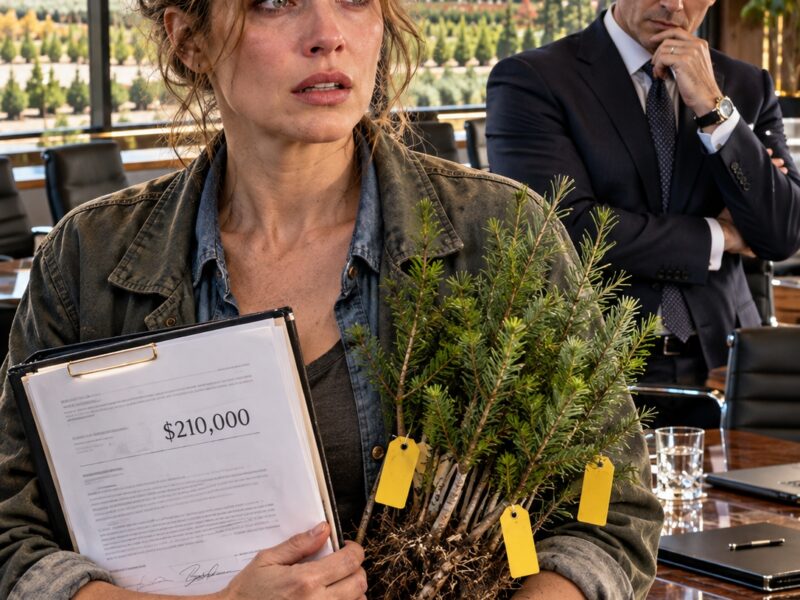
THEY FIRED HER AFTER 16 YEARS—THEN OFFERED $210,000 FOR THE “WORTHLESS” TREES SHE TOOK HOME
“You took our waste, Elena. You don’t get to come back two years later and tell us what it’s worth.”
Warren Pike said it without raising his voice.
That was what made it worse.
He sat at the far end of the polished conference table with one hand resting beside a black leather folder, looking exactly as he had for most of the sixteen years Elena Brooks had worked under him at Green Ridge Forest Nursery—controlled, reasonable, almost bored.
Between them lay a contract worth $210,000.
Enough money to save Elena’s farm.
Enough to repair the failing irrigation pump.
Enough to erase the machinery loan that woke her at three in the morning.
Enough to make the last two years of exhaustion feel less like insanity.
There was only one problem.
Green Ridge did not merely want the trees.
It wanted the records.
Every handwritten measurement.
Every survival comparison.
Every original lot tag.
Every irrigation log.
And Elena’s silence.
She looked at Warren across the table.
“Then why do you need them so badly?”
For the first time, something moved behind his eyes.
Not fear.
Not quite.
Calculation.
Warren leaned back.
“Forty-eight hours. Sign the agreement or the offer disappears.”
Elena glanced at the contract again.
The confidentiality clause was six paragraphs long.
The section describing the trees themselves was barely half a page.
That told her everything.
She closed the folder.
“I know what I have.”
Warren gave a small, tired smile.
“Then you have nothing.”
Two years earlier, Elena might have believed him.
That was the part Warren did not understand.
Two years earlier, she had still believed Green Ridge knew how to measure value.
She had spent sixteen years helping them do exactly that.
Elena had started there in her twenties as a seasonal harvest worker, wearing cheap gloves that split at the fingertips and boots that never completely lost the smell of wet soil.
She worked before sunrise.
She worked through cold rain.
She learned which roots could survive transplant shock and which ones were already dying before the needles showed it.
Eventually, someone noticed she had an eye for details.
She moved into quality control.
It suited her.
Elena liked measurements because measurements did not flatter anyone.
A stem was either thick enough or it wasn’t.
A seedling either reached specification or it didn’t.
Every morning she walked the nursery with a clipboard against her hip, measuring stem diameter, checking height, inspecting roots and assigning grading codes to thousands of seedlings destined for timber companies, restoration projects, state forestry programs and private landowners.
But after enough years, Elena began noticing something that did not fit neatly into Green Ridge’s charts.
Some of the seedlings they rejected were not unhealthy.
They were simply slow.
Their stems were thinner.
Their height was below target.
Above the soil, they looked behind.
Below it, something else was happening.
The first time Elena noticed, she thought it was an anomaly.
She dug up another.
Then another.
Dense roots.
Wide roots.
Deep roots.
These little trees were not failing to grow.
They were growing somewhere Green Ridge barely measured.
She mentioned it to Warren one afternoon.
He was standing beside a loading bay, checking a shipping manifest.
“Some of the undergrade lots have unusually developed root systems,” Elena said.
Warren kept reading.
“Undergrade is undergrade.”
“I know. But if we held certain lots another season—”
That made him look up.
“Another season costs land.”
“I understand.”
“Water.”
“Yes.”
“Labor.”
“I know.”
“Then you understand the problem.”
Elena hesitated.
“I understand the cost. I’m not sure it’s the same thing as the value.”
Warren sighed and lowered the clipboard.
“Elena, we grow inventory. We don’t adopt strays.”
He smiled when he said it.
She was supposed to smile too.
So she did.
And she stopped bringing it up.
But she never stopped noticing.
Years passed.
Then Green Ridge installed the machine.
It was an automated optical grading system—fast, consistent, tireless.
It could inspect seedlings faster than Elena and several other employees combined.
Management called it modernization.
Efficiency.
The future.
Six months later, Elena received a plain envelope.
Inside were three pages explaining that her position had been eliminated.
Sixteen years reduced to a severance calculation.
There was no farewell meeting.
No one asked what she knew.
No one asked what she had seen.
Warren shook her hand near the administrative building.
“You did good work here.”
Did.
Past tense.
Elena looked down at his hand before taking it.
“Was there something wrong with my work?”
“No.”
“Then why me?”
“It isn’t personal.”
People said those words when they wanted the consequences to belong to no one.
Warren glanced toward the nursery floor.
“The system is more efficient.”
Elena nodded slowly.
“Does it know why the rejected trees have stronger roots?”
His expression changed for less than a second.
Then he smiled.
“Take care of yourself, Elena.”
She drove home with the severance envelope on the passenger seat.
For sixteen years, she had taken the same highway in the opposite direction each morning.
The next morning, there was nowhere to go.
Her parents had left her twenty-four acres outside town, an aging barn, an old irrigation well and enough machinery to require payments without generating much income.
For the first few weeks, Elena woke at 5:10 anyway.
Her body did not understand unemployment.
She would make coffee, sit at the kitchen table and stare through the dark window.
At Green Ridge, trucks would already be moving.
Workers would be checking pumps.
Somebody else would be carrying a clipboard.
Eventually she began sleeping later.
That frightened her more.
One morning she found her old Green Ridge work boots beside the back door and realized she had not touched them in three weeks.
She stood there looking at them for a long time.
Maybe Warren had been right about more than seedlings.
Maybe usefulness had an expiration date.
Maybe people could become obsolete too.
Then, several months after Green Ridge replaced her, her phone rang.
The caller was a former coworker from transportation.
“Elena?”
“Yeah?”
“You still have that land?”
She sat up.
“Why?”
There was a pause.
“We’ve got a disposal problem.”
The spring had been brutal.
Cold temperatures.
Irregular rainfall.
Several Green Ridge lots had fallen below shipping specifications.
Most of the seedlings were alive.
Many had perfectly healthy roots.
But their stems were too thin and their height was behind schedule.
They could not fulfill the contracts they had been grown for.
Green Ridge needed the beds cleared for the next production cycle.
“How many?” Elena asked.
The man hesitated.
“About thirty-one thousand.”
She stopped writing.
“Thirty-one thousand?”
“Warren already approved disposal.”
“How?”
“Chipper.”
Elena stared across her empty property toward the barn.
“When?”
“Starts next week.”
She was at Green Ridge the following morning.
Warren actually laughed when she told him what she wanted.
“All of them?”
“Yes.”
“Elena, do you know what thirty-one thousand seedlings looks like?”
“Yes.”
“Apparently not.”
“Give them to me.”
His smile faded.
“You’re serious.”
“You’re paying someone to destroy them.”
“That doesn’t make them valuable.”
“I didn’t say they were valuable.”
“What are you going to do with them?”
“Find out.”
Warren stared at her.
For a second Elena saw the manager she remembered—the man who disliked unanswered questions because unanswered questions could not be scheduled.
Then practicality won.
“If they leave Green Ridge, they become your responsibility.”
“Fine.”
“Transportation?”
“I’ll handle it.”
“Mortality?”
“Mine.”
“Disposal if they fail?”
“Mine.”
“Cost to Green Ridge?”
“Nothing.”
That got his attention.
Warren sat back.
“You’re saving me money.”
“Yes.”
A few minutes later, they had an agreement.
As Elena stood to leave, she stopped.
“One more thing.”
Warren frowned.
“What?”
“I want the lot tags.”
“Why?”
“And the seed-zone records.”
“Elena—”
“And the grading codes showing why each lot was rejected.”
He studied her.
Then shrugged.
“Fine.”
To Warren, the paperwork meant nothing.
The trees had already been classified as disposal material.
The records were merely labels attached to garbage.
Three weeks later, Green Ridge trucks began backing through Elena’s gate.
Again.
And again.
And again.
Bundles accumulated beside the barn.
Thousands of seedlings.
Then tens of thousands.
A neighbor stopped his pickup on the county road and leaned through the window.
“What the hell are you building, Elena?”
“A nursery.”
He looked toward the sagging bundles.
Brown needles already showed on several.
“That looks more like a cemetery.”
Elena stared at the field.
“So far, you’re not wrong.”
Then she picked up a shovel.
For ten days, she barely stopped.
She hired one seasonal worker, Marcus Reed, a thirty-year-old with quiet eyes and the useful habit of fixing things before complaining about them.
They dug.
Watered.
Tagged.
Moved irrigation line.
Dug again.
Then the wind changed.
Hot, dry air crossed the region for days.
Several shipments arrived with partially dehydrated roots.
Elena could not plant fast enough.
The first hundred died.
Then five hundred.
Then a thousand.
By the end of the second week, almost four thousand seedlings were dead or damaged beyond recovery.
Elena walked the rows every morning watching the brown spread.
Every dead tree felt like Warren speaking.
Waste.
Waste.
Waste.
On Thursday afternoon, Marcus crouched beside one of the worst rows and pulled apart a dead root ball.
He turned it in his hands.
“Elena?”
She knew from his voice what was coming.
“Say it.”
He looked uncomfortable.
“Maybe Green Ridge was right.”
She stared at him.
Marcus quickly added, “I’m not saying you were stupid to try.”
“That makes it much better.”
“I’m saying maybe they knew these lots wouldn’t make it.”
Elena looked over the field.
Four thousand dead trees did not care about pride.
Neither did the bank.
Neither did the diesel company.
“Go home, Marcus.”
“Elena—”
“Go home.”
He did.
She stayed.
By dusk the field had gone gray.
Elena walked into the barn, sat at the old ledger table and looked at the bills she had stacked beside the wall.
Irrigation pipe.
Fuel.
Equipment rental.
Wages.
Repairs.
She calculated what she had already spent.
Then she calculated what she could save if she stopped tomorrow.
For the first time, she seriously considered plowing the entire field under.
Maybe Warren had not thrown away an opportunity.
Maybe Elena had simply been arrogant enough to confuse curiosity with expertise.
She put both hands over her face.
That was when she smelled coffee.
Elena looked up.
A metal thermos sat beside her ledger.
Marcus must have left it before going home.
No note.
No speech.
Just coffee.
She poured a cup.
It was still warm.
And for reasons she could not explain, that small gesture kept her sitting at the table another ten minutes.
Ten minutes became an hour.
Eventually Elena reached for the original Green Ridge grading records.
If the trees were dying, she thought, then the dead ones might still tell her something.
She began comparing lot numbers.
At first there was nothing.
Then a pattern appeared.
Elena frowned.
She checked again.
The seedlings dying fastest were not consistently the smallest ones.
They were not all from the same seed zone.
They were not even the weakest by Green Ridge’s original height measurements.
But many shared something else.
Mechanical root trimming.
The lots that had undergone the most aggressive root trimming before disposal were dying disproportionately fast.
Elena stood so quickly her chair scraped backward.
She carried the records beneath the barn light.
Read them again.
Then again.
The problem might not have been what the seedlings lacked.
It might have been what Green Ridge had removed.
The next morning Marcus found her already outside.
She had a notebook in one hand.
“What are you doing?”
“Starting over.”
“With what?”
“Everything.”
From that day forward, Elena measured what Green Ridge had not.
Stem diameter.
Root length.
Root mass.
Planting depth.
Water volume.
Soil temperature.
Weekly survival.
Seasonal growth.
Lot by lot.
Row by row.
Week by week.
The question changed.
She was no longer asking whether rejected trees could survive.
She was asking why some refused to die.
The first year did not reward her quickly.
The survivors recovered, but they remained unimpressive.
Small.
Uneven.
Behind conventional commercial growth curves.
A local grower visited late that summer and walked through Elena’s rows with the expression of a doctor examining a patient whose family had unrealistic expectations.
He pulled one seedling from the soil.
Looked at it.
Put it back.
“You know what you’ve done?”
Elena folded her arms.
“What?”
“You spent most of a year making bad trees slightly less bad.”
Marcus was standing near the barn.
Elena could feel him listening.
She smiled politely.
“Thanks for stopping by.”
After the man’s truck disappeared, Marcus approached.
“You want me to say something encouraging?”
“No.”
“Good. I didn’t have anything.”
She laughed despite herself.
It was the first time she had laughed all week.
But the money problem was no joke.
Most of her severance was gone.
She could have planted crops with a seasonal return.
Instead, she was pouring cash into trees that might need another two years before anyone would buy them.
Some nights she lay awake calculating exactly how many months remained before belief became financial stupidity.
Then she would go outside the next morning and dig.
Because beneath the soil, certain lots kept telling her the same thing.
The seedlings that had escaped heavy root trimming were developing extraordinarily dense lateral root systems.
Above ground, they were behind.
Below ground, they were building something.
Elena began marking those lots separately.
Then came the heat.
The second summer arrived hotter than the first.
Regional water restrictions forced Elena to cut irrigation.
Marcus found her studying the field map in the barn.
“How bad?”
“Bad enough.”
“We cut every zone?”
Elena shook her head.
“Not equally.”
He looked at her.
“You’re thinking of testing them.”
“We don’t have enough water anyway.”
“So you’re turning a drought into an experiment?”
“I’m turning a drought into data.”
She divided the field.
Some sections received normal irrigation.
Others received less.
A smaller zone received only enough water to prevent immediate collapse.
Then they watched.
Days passed.
Then weeks.
Some trees weakened quickly.
Others slowed.
But the lots Elena had marked for dense root development kept surviving.
They were not beautiful.
They were not tall.
They did not suddenly explode with growth.
They simply stayed alive.
One evening Marcus walked the restricted zone with a flashlight.
He crouched beside one of the marked seedlings and loosened the soil around its base.
Elena watched him expose the roots.
Marcus stared.
“Look at this.”
“I have.”
“No, seriously.”
“I know.”
He turned the root ball slowly beneath the flashlight.
“These things really don’t want to die.”
Elena was holding her notebook.
She smiled and wrote the sentence down.
Marcus laughed.
“You’re putting that in the official record?”
“Maybe.”
“What category?”
Elena closed the notebook.
“Scientific terminology.”
Two years after the first Green Ridge truck entered her property, Elena stood at the same fence where her neighbor had once called the place a cemetery.
It did not look like a cemetery anymore.
The surviving trees had thickened.
Terminal buds were strong.
Root structures were dense and healthy.
Combined with replacement stock Elena had introduced during the second season, the operation was again approaching thirty-one thousand trees.
For the first time, she let herself look across the field without seeing Warren’s word.
Waste.
Marcus convinced her to attend Green Ridge’s annual grower event that fall.
She almost refused.
Then she decided she was tired of avoiding buildings she had once belonged inside.
Warren spotted her within fifteen minutes.
He walked over carrying a drink.
“Elena Brooks.”
“Warren.”
“I heard you’re still running that retirement home for rejected trees.”
Two former coworkers laughed.
Not cruelly.
That almost made it worse.
Elena looked at Warren.
“Come see them.”
He smiled.
“Excuse me?”
“Come to the farm.”
“Why?”
“You seem curious.”
“I’m not.”
“Then you’ve got nothing to lose.”
Warren arrived two days later.
He stepped out of his SUV wearing clean boots.
Elena noticed.
She said nothing.
For the first several rows, Warren behaved exactly as she expected.
He asked about irrigation.
Commented on spacing.
Mentioned labor costs.
Then he noticed a yellow tag.
Green Ridge yellow.
He bent down.
Picked it up.
Read the lot number.
His expression changed.
He moved to another tree.
Another original tag.
Then another.
He dug one seedling.
Examined the roots.
Walked twenty feet and dug another.
Elena watched his pace slow.
By the third row, Warren was no longer talking.
Marcus came out of the barn wiping his hands on a rag.
He glanced at Elena.
She gave the smallest shake of her head.
Let him look.
Warren stayed nearly two hours.
When he finally left, he said only, “Interesting.”
Three days later, a courier delivered an envelope.
Inside was a formal purchase offer from Green Ridge Forest Nursery.
$210,000.
For the entire inventory.
Marcus read the number twice.
Then nearly spilled his coffee.
“Two hundred and ten thousand dollars?”
Elena nodded.
“For the trees they gave you?”
“Yes.”
“For free?”
“Yes.”
Marcus stared toward the field.
“I would like to formally apologize to every tree I insulted.”
Neighbors heard.
Calls started.
Congratulations.
Vindication.
People who had quietly thought Elena was wasting her life now told her they had always admired her determination.
For several hours, she let herself enjoy it.
Then evening came.
The barn grew quiet.
Elena sat alone with the offer.
And something began bothering her.
Green Ridge produced hundreds of thousands of seedlings.
Thirty-one thousand trees were not enough to justify this urgency.
Not at that price.
Not this quickly.
Unless Green Ridge was buying something other than trees.
Elena picked up the phone.
She called an old coworker.
Then a forestry contractor.
Then a private landowner.
The first conversation disturbed her.
The second frightened her.
The third made her reopen every notebook she had kept for two years.
Several recent Green Ridge commercial plantings had performed poorly on drought-stressed restoration land.
Not everywhere.
Not every lot.
But enough.
Green Ridge’s current stock had been optimized for rapid, uniform growth.
It looked excellent leaving the nursery.
Under limited water after transplantation, some lots were failing at rates buyers had not expected.
Elena walked outside.
She stared across her rows.
Slow above ground.
Dense below it.
The trait that had made these seedlings commercially undesirable might be the same trait keeping them alive under drought stress.
She returned to the barn and opened Green Ridge’s offer again.
This time, she did not read the price first.
She read the contract.
Every tree.
Every original lot tag.
Every irrigation record.
Every survival comparison.
Every field measurement.
Every document connecting Elena’s results to Green Ridge’s original rejected lots.
Then she reached the confidentiality section.
Elena stopped breathing for a moment.
Green Ridge was not offering $210,000 merely to purchase valuable inventory.
It was offering $210,000 to control the comparison.
A week later, Elena sat across from Warren in the conference room.
The same room where Green Ridge negotiated supply contracts with companies far larger than her farm.
Warren noticed immediately that she had not brought the signed agreement.
Instead, Elena placed two things on the table.
The original disposal agreement.
And her notebooks.
Warren looked at them.
“What’s this?”
“A question.”
“Elena—”
“Are you buying my trees because they’re valuable?”
She leaned forward.
“Or because you don’t want anyone asking why they survived?”
Silence.
Warren’s face hardened.
Not much.
Enough.
“Elena, Green Ridge produced those seedlings.”
“And discarded them.”
“You received thirty-one thousand units of nursery stock at no cost.”
“Because you classified them as waste.”
“We have decades of relationships in this industry.”
“I know.”
“We have legal counsel.”
“I know that too.”
“Then understand your position.”
Elena looked at him.
“What position is that?”
Warren tapped the contract.
“You have forty-eight hours.”
“For what?”
“Sign it.”
“And if I don’t?”
“The offer is withdrawn.”
Elena stared at him.
Two hundred and ten thousand dollars.
Her machinery loan vanished in her mind.
The irrigation pump became new.
The sleepless nights stopped.
She could breathe again.
All she had to do was sign.
And hand over the reason she had been right.
“I won’t sign under a forty-eight-hour threat.”
Warren closed the folder.
“Then we’re finished.”
Elena rose.
“I know what I have.”
Warren looked at her almost sadly.
“Then you have nothing.”
The offer was formally withdrawn that afternoon.
What happened next was worse than Elena expected because almost none of it happened openly.
No one threatened her.
No one appeared at her gate.
No dramatic lawsuit arrived.
Instead, phone calls stopped.
A restoration contractor who had been close to placing an order suddenly wanted to “wait for clarity.”
Another buyer mentioned hearing there could be questions about the legal origin of Elena’s stock.
A third stopped returning calls.
Then Green Ridge’s attorneys sent a letter challenging her right to commercially publish survival data associated with Green Ridge lot identifiers and internal grading codes.
Marcus read it at the barn table.
“Can they do this?”
“They can send a letter.”
“That’s not what I asked.”
Elena rubbed her forehead.
“I don’t know.”
“Lawyer?”
“With what money?”
As if the farm wanted to join the attack, the main irrigation pump began losing pressure.
Marcus found Elena beside it one morning.
The gauge trembled.
“How long?”
“Could be tomorrow. Could be a month.”
“How much to replace it?”
Elena told him.
Marcus looked away.
That night he asked the question neither of them wanted to ask.
“You thought about calling Warren?”
Elena kept staring at the ledger.
“Every day this week.”
The $210,000 would have solved everything.
That was what made the decision hurt.
It was not imaginary money.
It was not greed.
It was survival.
“I could call him tomorrow,” she said.
Marcus did not answer.
“Pay the machinery loan. Replace the pump. Expand the beds. Probably have enough left to breathe for a year.”
“Yeah.”
Elena looked at him.
“You think I should?”
Marcus leaned back.
“I think I’m the guy who told you Green Ridge might’ve been right.”
She almost smiled.
“I remember.”
“And you’re the woman who kept records for two years after everybody stopped asking why.”
“That doesn’t pay for a pump.”
“No.”
“What if I lose all of it?”
Marcus looked toward the dark field beyond the barn door.
“Then lose it because the answer was wrong.”
He turned back to her.
“Not because somebody paid you to stop asking the question.”
Elena did not sleep that night.
At 2:17 a.m., she returned to the barn and opened the original disposal agreement.
This time she read every line.
Slowly.
Green Ridge had transferred full physical ownership and responsibility upon delivery.
The trees were not research specimens.
They were not loaned material.
They were not experimental stock.
They had been formally classified as disposal material with no determined commercial value and permanently removed from Green Ridge inventory.
Elena read that sentence again.
No determined commercial value.
She looked at the notebooks surrounding her.
Green Ridge had declared the trees worthless.
Whatever value existed now had emerged afterward.
On her land.
Under her irrigation.
Through her measurements.
Because of her work.
At 3:04 a.m., Elena stopped trying to figure out how to beat Green Ridge in court.
She realized she did not need to.
She needed to beat them in a field.
Not with accusations.
Not with lawyers.
With trees.
Over the next several days, Elena contacted an independent forestry consultant, a private timberland owner familiar with recent survival problems, and a university extension specialist involved in reforestation research.
Her proposal was deliberately simple.
A controlled comparison.
Green Ridge’s current commercial seedlings on one side.
Elena’s formerly rejected stock on the other.
Same site.
Same planting period.
Same water.
Same monitoring.
Measure transplant shock.
Root development.
Water efficiency.
Summer survival.
Elena told the extension specialist, “I’m not asking you to prove I’m right.”
“What are you asking?”
“Look.”
Green Ridge initially refused.
Then buyers began asking why.
A company confident in its stock should have welcomed comparison.
Refusal started creating the exact suspicion Green Ridge had been trying to prevent.
Eventually Warren agreed.
The test began.
And for several weeks, Elena regretted everything.
Nothing dramatic happened.
Some Green Ridge seedlings performed beautifully.
Some of Elena’s struggled.
A few of her supposedly resilient lots showed no meaningful advantage at all.
The independent consultant did not soften his assessment.
“If the difference isn’t visible by late summer, your notebooks won’t carry this by themselves.”
Elena nodded.
“What happens then?”
“You’ll have data from your farm.”
“And Green Ridge?”
“They’ll have commercial history.”
Meaning reputation.
Scale.
Relationships.
Money.
Everything Warren had reminded her she did not possess.
Elena began visiting the test site near sunset.
She checked soil moisture.
Touched foliage.
Looked for stress.
Waited.
June became July.
Then the heat arrived.
A brutal stretch settled across the region.
As planned, irrigation at the trial site was reduced to approximate difficult restoration conditions.
That was when the field changed.
Not overnight.
That would have been easier.
It happened slowly enough that nobody could dismiss it as spectacle.
Green Ridge’s fastest-growing lots began showing transplant stress.
Needles dulled.
Foliage thinned.
Several rows began flagging.
Elena’s undergrade lots were still shorter.
Still less impressive from a distance.
But they held.
One week.
Then another.
Then another.
At the end of the test period, representative trees were excavated.
Elena stood beside Warren while soil fell away from the first root system.
Nobody needed a speech.
The difference was visible.
Green Ridge’s conventional stock had invested heavily above ground.
Height.
Stem.
Speed.
Several of Elena’s formerly rejected lots had done the opposite.
Their root systems were wider.
Denser.
More developed relative to their above-ground size.
The exact trait that had made them too slow for Green Ridge’s production schedule had given them an advantage when water became scarce.
Elena looked at Warren.
He did not look back.
The results circulated.
First among participants.
Then among buyers.
Then among contractors.
Questions Green Ridge had tried to contain became questions it had to answer.
Several weeks later, a familiar SUV appeared at Elena’s gate.
Marcus looked through the barn window.
“Your boyfriend’s here.”
Elena gave him a look.
“I hate you.”
“I know.”
Warren stepped out carrying a folder.
But this time, he did not ask Elena to come to Green Ridge.
He came to her.
They sat at the same old barn table where she had once considered plowing everything under.
Warren placed the folder between them.
Elena did not touch it.
“What is it?”
“A proposal.”
“I’ve seen one.”
“This is different.”
“How?”
Green Ridge still wanted the thirty-one thousand trees.
The price was still $210,000.
But now there was more.
A five-year agreement.
Selected undergrade lots would be transferred annually to Elena’s operation for extended growth.
She would have independent field-testing rights.
Survival data would be shared.
Qualifying stock would be purchased back at contracted prices.
Green Ridge also wanted Elena’s help redesigning the undergrade evaluation process.
She read every page.
Warren waited.
Finally Elena closed the folder.
“One condition.”
Warren exhaled.
“Of course.”
“My protocol stays mine.”
“Elena—”
“My farm’s name appears on research derived from my methods.”
“We can discuss attribution.”
“No. We can discuss everything except attribution.”
Warren stared at her.
“I’ll license the methodology. I’ll share the data under the agreement. I’ll work with your team.”
She pushed the folder toward him.
“But you don’t erase me.”
The barn became quiet.
Outside, irrigation clicked across the field.
Warren looked through the open door at the rows of trees his company had once paid to throw away.
Then he looked back at Elena.
“You’ve changed.”
Elena shook her head.
“No.”
She tapped the notebooks.
“You just never measured this part.”
Warren almost smiled.
Then he asked the question that had started the entire fight.
“So will you sell us the trees?”
Elena looked toward the field.
“Yes.”
He reached for his pen.
“But the story of why they survived isn’t part of the inventory.”
This time, Warren did smile.
“Fair enough.”
The new agreement was signed.
The $210,000 cleared Elena’s machinery loan.
The failing irrigation system was replaced.
Additional nursery beds went in.
She leased neighboring acreage.
Within the following season, the operation expanded from twenty-four acres to nearly seventy.
Marcus Reed became her first full-time operations manager.
He complained about the title for three days and then ordered shirts.
The sign at the gate changed too.
BROOKS RESILIENCE NURSERY.
More than eighty thousand seedlings entered extended-growth trials.
Forestry companies began contacting Elena directly for survival data.
Green Ridge revised its grading system and created a new category for seedlings with strong root characteristics that previously might have been automatically discarded.
They called it extended growth stock.
Elena never liked the name much.
But she liked what it meant.
One spring morning, years after the first load of unwanted seedlings arrived, another Green Ridge truck backed through Elena’s gate.
The driver climbed down holding a manifest.
“Where do you want the trial stock?”
Elena took the paper.
Marcus and a new crew were stretching irrigation line across the expanded field behind her.
The old barn was still there.
She had repaired the roof but refused to tear it down.
Too much had happened under it.
Elena looked at the first bundle.
Green Ridge tag.
Lot number.
Seed zone.
Grading information.
She loosened the wrapping and checked the roots.
Then she looked at the driver.
“It’s not trial stock.”
He frowned.
“What?”
Elena lifted the bundle.
“It’s inventory.”
She carried it toward the field.
There was an easier version of Elena Brooks’s story to tell.
In that version, a woman gets fired after sixteen years, takes thirty-one thousand worthless trees, proves everyone wrong and sells them back for $210,000.
It is clean.
Satisfying.
Shareable.
And incomplete.
Because the money was never the most important number.
Green Ridge had measured those seedlings.
Their measurements had been real.
The stems were too thin.
The height was below specification.
They were too slow for the contracts they were supposed to fill.
Green Ridge had measured Elena too.
Her job could be automated.
The machine was faster.
Cheaper.
More consistent.
Those facts were real as well.
The mistake was not necessarily in the measurements.
The mistake was believing the measurements contained the whole truth.
Those trees had not stopped growing.
They had been growing where no one was looking.
Down.
Wide.
Deep.
Building the part that would matter when the rain stopped.
And during sixteen years at Green Ridge, Elena had been doing something similar.
She had been watching.
Learning.
Remembering.
Connecting details no automated grading system had been designed to connect.
There was no column for that on her severance paperwork.
No line item for it in Green Ridge’s disposal order.
No price attached to it until someone needed what she knew.
The $210,000 did not create the value of those trees.
It merely acknowledged it.
The five-year agreement did not suddenly make Elena an expert.
It recognized the expertise she had already spent years building.
And the name above her gate did not become meaningful because Green Ridge finally respected it.
It became meaningful during the nights nobody was watching—when four thousand seedlings were dead, the bank balance was shrinking, the pump was failing, and Elena Brooks kept opening the ledger anyway.
That was why, on another quiet morning, when a young employee brought her a tray of seedlings and said, “These aren’t growing as fast as the others,” Elena did not immediately reach for the rejection tag.
She set down her coffee.
“How do the roots look?”
The employee shrugged.
“I didn’t check.”
Elena handed the tray back.
“Then you haven’t measured the tree yet.”
The young woman disappeared toward the field.
Marcus, older now and carrying two coffees, had heard the exchange.
He handed Elena one.
“You know you sound like Warren sometimes.”
Elena stared at him.
“Take that back.”
Marcus laughed.
“I said sometimes.”
She looked across nearly seventy acres of young trees moving in the morning wind.
Some were tall.
Some were small.
Some would be sold that year.
Some needed another season.
And somewhere among those thousands of seedlings, Elena knew there were probably a few that would make no sense according to the numbers they currently knew how to measure.
Years earlier, that uncertainty would have been treated as a problem.
Now it was a reason to look closer.
Elena opened the new ledger.
On the first empty line, she wrote the date.
Then the lot number.
Then one question.
What are we not seeing yet?
She left the rest of the page blank.
Because some things are worthless only until someone learns where to look.









