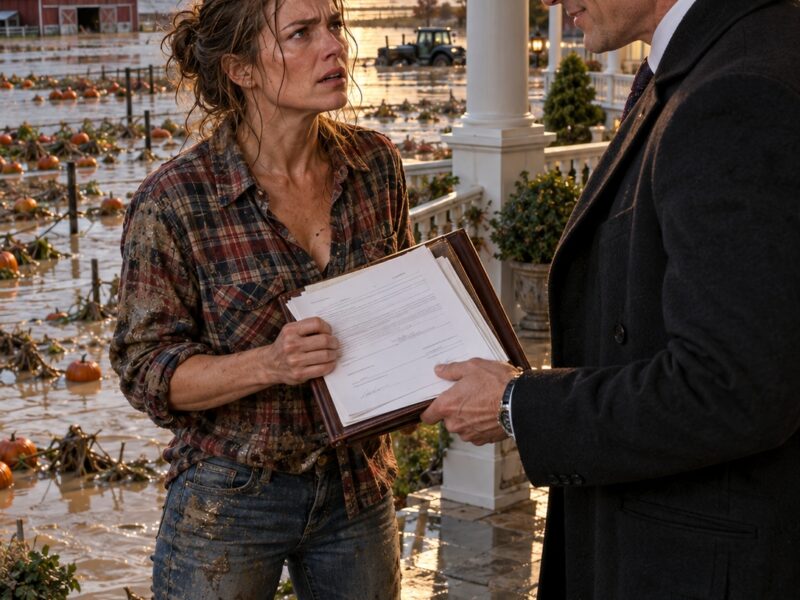
THEY FLOODED HER FARM TO FORCE A $228,000 SALE—THEN THE WATER EXPOSED WHAT THEY WERE REALLY TRYING TO STEAL
“Do you still think this place is worth half a million dollars?”
Warren Pike asked the question while standing on Mara Sutton’s porch with muddy water behind him and a purchase contract in his hand.
The rain had stopped almost six hours earlier.
That was the part Mara could not stop thinking about.
Not the ruined pumpkin field.
Not the equipment shed with brown water halfway up its walls.
Not the dead refrigerator in the barn office or the overturned feed barrels floating against the fence.
The water.
It was still rising.
Grant Danner, the loan officer from Cedar Veil Bank, stood beside Warren in polished brown boots that had already collected a rim of mud. He looked irritated by it, as though the destruction around him were mostly an inconvenience to his shoes.
“We can settle the outstanding balance directly with the bank today,” Grant said. “No foreclosure process. No additional penalties. You walk away clean.”
Mara looked from him to Warren.
Warren held out the contract.
“This is a fair offer.”
“Two hundred twenty-eight thousand dollars.”
“That’s right.”
“My property was appraised at five hundred forty thousand fourteen months ago.”
Warren gave her the kind of patient smile men used when they wanted cruelty to sound like arithmetic.
“That was before this.”
He gestured toward the water.
A pumpkin rolled slowly past the porch steps.
Mara watched it bump against a fence post.
Then she looked past Warren toward Alder Creek.
The sky over western Virginia had cleared into a pale gray morning. Rainwater still dripped from the porch roof, but the storm itself had moved east before dawn.
Yet the creek was pushing harder than it had at midnight.
Mara felt something inside her become very still.
Grant mistook the silence for surrender.
“You’ve had two bad harvests,” he said. “You’re carrying sixty-seven thousand dollars in outstanding debt. Your next payment is due soon, and now you have significant equipment loss. Warren is offering you a way out before this becomes uglier.”
Mara looked at him.
“Uglier for who?”
Grant’s expression changed almost imperceptibly.
Warren lowered the contract.
“Mara, nobody is trying to make an enemy here.”
“No?”
“No.”
She stepped off the porch.
Cold water covered the toes of her rubber boots.
Grant frowned. “Where are you going?”
Mara didn’t answer.
She walked to the edge of the yard, crouched, and stared at a wooden fence post she had marked with pencil at 5:40 that morning.
The waterline was nearly an inch above the mark.
Behind her, Warren said something about reservoir safety.
She barely heard him.
Mara had spent almost twenty years repairing agricultural equipment before inheriting this farm. She understood pumps, hydraulic pressure, valves, drainage systems, diesel engines, and the thousand small mechanical truths that people ignored until something broke.
Water obeyed gravity.
It followed pressure.
It did not continue climbing indefinitely beneath a clearing sky without a source.
She stood.
“Your reservoir,” she said.
Warren stopped talking.
Mara turned toward him.
“You released water.”
His eyes hardened for perhaps half a second.
Then the smile returned.
“There was an emergency discharge.”
“How much?”
“That’s an operational question.”
“When?”
“During the storm.”
“How long?”
“Mara—”
“How long, Warren?”
Grant stepped between them verbally before Warren had to answer.
“This isn’t productive.”
Mara stared at him.
Then she looked at the contract again.
A strange thought came to her.
They had arrived at nine in the morning.
Together.
The water had not even begun receding.
Her losses had not been calculated.
No insurance adjuster had inspected the property.
No county official had assessed the drainage.
Yet Warren Pike already had a contract prepared.
Signed on his side.
Ready for hers.
Mara looked down at the signature line.
For the first time since waking to the sound of water striking the equipment shed, she was no longer thinking about what she had lost.
She was wondering why two men had been so certain she would lose it.
“I’m not signing.”
Grant exhaled through his nose.
“Mara.”
“No.”
Warren’s smile disappeared.
“You may want to reconsider after you see what replacing that equipment costs.”
“I know what equipment costs.”
“Then you know what your position is.”
Mara stepped close enough to take the contract from his hand.
For one brief second, Warren seemed satisfied.
Then she folded it once.
Twice.
And handed it back.
“My position,” she said, “is that the rain stopped before sunrise.”
Neither man answered.
“And the creek is still rising.”
That was when Warren Pike looked toward the water.
It was only a glance.
But Mara saw it.
And that glance saved her farm.
Three years earlier, Mara Sutton had not planned on becoming a farmer.
At forty-one, she had been running the service department at a regional agricultural equipment company outside Roanoke. Her hands were permanently marked by work—small white scars across her knuckles, a burn near her left wrist, grease that sometimes seemed embedded beneath her nails no matter how hard she scrubbed.
She liked machines because machines rarely lied.
If a hydraulic pump lost pressure, there was a reason.
If a diesel engine overheated, something caused it.
People were different.
People could smile while destroying you.
She learned that lesson after her mother died.
Dorene Sutton had lived on eighty-four acres along Alder Creek outside the small town of Bell Ridge for almost her entire life. The farm had belonged to the Sutton family since 1954.
Three generations had worked it.
Nobody had become wealthy.
Nobody had lost it either.
Mara used to joke that this was the family business model.
When Dorene developed heart problems, Mara began driving out on weekends. After her mother died, she intended to sell the equipment, lease the fields for a year, settle the estate, and return to her old life.
Then she spent one October morning standing alone in the north field.
The pumpkins were ready.
Fog hung over the creek.
The barn doors were open exactly the way her mother used to leave them.
And Mara realized that selling the place felt less like settling an estate and more like erasing a language only she still understood.
So she stayed.
The farm punished that decision almost immediately.
She learned that understanding machinery did not mean understanding markets.
She learned that a crop could look beautiful and still lose money.
She learned that goats possessed both extraordinary intelligence and a personal commitment to escaping fences.
She learned that weather forecasts were promises written by strangers.
And she learned that sentimental attachment did not impress banks.
The first bad harvest hurt.
The second nearly broke her.
By the beginning of her third year, she owed Cedar Veil Bank $67,000.
That was when Grant Danner stopped behaving like her banker and began behaving like someone waiting for a door to open.
Grant was fifty-seven, silver-haired, careful with his shirts, and never raised his voice. He had managed agricultural accounts for more than twenty years.
For the first few months, he talked about restructuring.
Then he began mentioning buyers.
One buyer in particular.
Ridgerest Aggregates.
The company was owned by Warren Pike.
Warren had spent years buying parcels along Alder Creek for an expanding sand-and-gravel operation. His company already controlled much of the land bordering Mara’s property, including a small reservoir upstream.
The first time Warren approached Mara, he offered $210,000.
She laughed because she thought it was an opening tactic.
He did not laugh.
The second offer came four months later.
$220,000.
“No,” Mara said.
“You haven’t heard the conditions.”
“I don’t need to.”
“You have debt.”
“I also have land.”
“Land is worth what someone will pay for it.”
“No,” Mara said. “Land is worth what it’s worth. What someone offers tells me something about them.”
Warren stared at her for a long moment.
Then he smiled.
“You’re Dorene’s daughter.”
Mara had not taken it as a compliment.
After that, Grant began calling.
At first once a month.
Then every two weeks.
He spoke sympathetically about commodity prices and debt exposure. He mentioned foreclosure without technically threatening it. He suggested that Mara could leave with enough money to “start fresh.”
Eight months of pressure.
Eight months of the same question.
Why did they want her land?
The obvious answer was expansion.
Ridgerest owned adjoining parcels. Her eighty-four acres would connect several pieces.
But Mara had looked at county maps.
There were other parcels Warren could buy.
Cheaper parcels.
Easier owners.
Still, he kept coming back to hers.
Then the storm arrived.
At 1:17 in the morning, Mara woke because something hit the equipment shed hard enough to make a hollow metallic boom.
She sat upright.
Another impact followed.
Then another.
She crossed the bedroom and looked through the window.
Water.
Not puddles.
Moving water.
She dressed in seconds, grabbed a flashlight, and ran outside.
Rain cut sideways through the beam.
The lower field was already disappearing.
“Damn it.”
She splashed toward the goat enclosure.
The animals were agitated, crowding toward higher ground. Mara opened the upper gate and drove them uphill.
By the time she returned, water had reached the lower equipment shed.
She managed to move one tractor.
The second would not start.
She climbed into the cab, turned the key again, heard the starter grind, and slapped the steering wheel.
“Come on.”
Nothing.
Water swirled around the tires.
She abandoned it.
By four, the pumpkin field was underwater.
By five, the storm weakened.
By six, the rain stopped.
And still the creek rose.
At nine, Grant and Warren arrived with the contract.
After they left, Mara stood alone on the porch for nearly ten minutes.
Her mother’s old wind chime moved softly above her.
Everything else seemed unnaturally quiet.
Then she put on fresh boots.
If the water had been pushed onto her land, it had followed a path.
Paths left evidence.
She started walking.
The lower boundary of the Sutton property followed an old access road before bending south toward Alder Creek. Mara moved slowly, photographing damage as she went.
Broken fencing.
Eroded soil.
Debris.
Water marks.
She reached the southwestern corner and stopped.
There was a secondary drainage culvert beneath the access road.
Or there was supposed to be.
The opening was blocked.
Not with branches.
Not with leaves.
Not with random flood debris.
Rock.
Compacted soil.
Gravel.
Mara crouched.
The material had been packed tightly enough to redirect water away from the culvert and across her lower field.
She touched nothing.
Instead, she photographed it.
Wide shot.
Medium shot.
Close-up.
Then the tire tracks.
A vehicle with a wide wheelbase had crossed the muddy shoulder on the far side of the road.
Fresh.
Mara photographed those too.
Her pulse had begun beating in her throat.
She walked nearly half a mile to Tom Hadley’s property.
Tom was sixty-eight and answered the door wearing suspenders over a thermal shirt.
“You okay?”
“No.”
His face changed.
“What happened?”
“I need you to see something before somebody removes it.”
Tom looked at her for a moment.
Then he reached for his coat.
They returned together.
Tom stood over the blocked culvert and said nothing for almost a minute.
Finally, he looked at Mara.
“That didn’t wash in.”
“No.”
“Who would do this?”
Mara looked upstream.
She did not answer.
By the time she got anyone from the county to inspect the site, the obstruction was gone.
Someone had cleared it.
Cleanly.
Warren Pike had already begun telling people the flooding was an unfortunate weather event.
Grant called Mara that afternoon.
“I heard you’re making accusations.”
“I haven’t accused anybody.”
“You’re asking questions.”
“Are those the same thing now?”
“Mara, I’m trying to help you.”
She almost laughed.
Instead, she said, “Then send me everything you have regarding Ridgerest’s interest in my property.”
Silence.
“I’m not sure what you mean.”
“Yes, you are.”
Another pause.
“Your loan remains due regardless of whatever disagreement you have with Warren.”
There it was.
Not concern.
Not curiosity about a potentially sabotaged drainage system.
The debt.
Always the debt.
Mara hung up.
She sold her second truck the following week.
It hurt more than she expected.
The truck had belonged to her mother.
But sentiment did not pay lawyers, laboratories, or loan installments.
She took repair jobs at three neighboring farms and worked until her fingers cramped at night.
She also began keeping a notebook.
Dates.
Calls.
Vehicles.
Names.
Weather.
Anything unusual.
She wrote it all down because she had learned something from the blocked culvert.
Evidence disappeared.
Memory did too.
Paper was harder to intimidate.
Two weeks after the flood, she walked the creek bank to document erosion.
The surge had stripped nearly two feet of topsoil from a forty-yard section along the south bank.
Underneath was a layer of dark, coarse gravel.
Mara nearly walked past it.
Then sunlight struck something between two stones.
A yellow flash.
She stopped.
Bent down.
Pulled the object free.
It was smaller than her fingernail.
Irregular.
Heavy for its size.
And yellow in a way iron staining was not yellow.
Mara rubbed it between her fingers.
It did not crumble.
She stood slowly.
“No.”
The word escaped before she could stop it.
She took the fragment back to the house.
For twenty minutes, she sat at the kitchen table staring at it.
Then she remembered the box.
Her grandfather Leon had kept rock samples in the barn.
Mara had found them while cleaning after Dorene’s death—little envelopes, jars, stones with dates written on masking tape. She had almost thrown them away.
Instead, she had placed them in a wooden crate with Leon’s field notebooks.
She carried the crate into the kitchen.
Dust rose when she opened it.
There were repair receipts from 1971.
Seed records.
Hand-drawn drainage maps.
And then she found a notebook with a faded green cover.
Alder Creek appeared repeatedly.
One entry was dated 1973.
Leon described an unusual gravel formation along the south bank during a dry summer. He believed the modern creek channel might overlap an older buried watercourse.
Then came two words Mara read three times.
Placer deposition.
Her heartbeat changed.
She kept reading.
Leon had collected samples.
He had wanted them professionally analyzed.
He never had the money.
The final sentence was written more heavily than the rest.
Worth knowing before selling.
Mara stared at those four words.
Then at the yellow fragment beside the notebook.
Her grandfather had died believing there might be something under the creek.
Warren Pike had spent years buying land along that same creek.
And somebody had just released enough water to tear open a geological layer that had been hidden for decades.
For the first time, Mara wondered whether the flood had exposed more than evidence of a crime.
Maybe it had exposed the reason for it.
She collected six samples.
She did it methodically.
Separate bags.
Separate locations.
GPS coordinates.
Photographs before removal.
She drove them herself to a shipping center forty miles away and sent them to an independent assay laboratory two counties over.
She paid cash.
Then she waited eleven days.
On the eleventh morning, an email arrived while she was replacing a hydraulic hose on a neighbor’s baler.
She saw the laboratory name on her phone.
For a moment, she was afraid to open it.
Because uncertainty could still be dismissed.
A result could not.
She wiped grease from her thumb and tapped the screen.
Every sample contained natural gold.
Mara read the sentence twice.
Then a third time.
Three samples showed concentrations significant enough for the laboratory to specifically flag them.
There was a warning underneath.
The findings were preliminary.
No commercial conclusion should be drawn without further geological assessment.
Mara understood.
Gold in a sample did not make her rich.
It made her dangerous.
She called Celia Hart.
Celia was an independent geologist, forty-three, blunt, practical, and unimpressed by dramatic conclusions.
She spent an afternoon examining the creek bank.
At sunset, she removed her gloves and looked at Mara.
“What do you want me to tell you?”
“The truth.”
“That’s refreshing.”
“Is it gold?”
“The assay already answered that.”
“Is there enough to matter?”
“That I can’t tell you from a surface examination.”
Mara’s disappointment must have shown.
Celia pointed toward the dark gravel.
“But this formation is consistent with an ancient alluvial channel. Those can concentrate placer gold over very long periods.”
“So Warren could know.”
Celia looked at her.
“Know what?”
“That this was here.”
“I didn’t say that.”
“I know.”
“What I’m saying is the geology is worth investigating.”
Mara stared down the creek.
“What would somebody need to recognize it?”
“Experience. Historical surveys. Old geological records. Test drilling.”
“Or an extraction company buying property along the creek.”
Celia’s expression became guarded.
“That sounds like a legal question.”
It was.
And Mara knew exactly where to look next.
The county planning office had digitized most commercial applications.
Mara spent two nights searching.
At 12:46 a.m. on the second night, she found Ridgerest Aggregates.
Expansion application.
Filed ten months earlier.
She opened the attached map.
The proposed extraction corridor followed Alder Creek.
Mara zoomed in.
South bank.
Closer.
Closer.
Then she stopped breathing.
The corridor ended exactly at the Sutton property line.
She checked the filing date.
Ten months earlier.
Grant Danner’s first formal conversation about selling had happened eight months earlier.
Mara sat back.
The kitchen seemed suddenly too quiet.
Her grandfather’s notebook lay beside the laptop.
Worth knowing before selling.
Someone else had known.
And they had been trying very hard to make sure Mara never did.
Audra Keen’s law office occupied the second floor above a pharmacy in the next town.
Audra was forty-six, wore black-framed glasses, and had the unsettling habit of becoming quieter when something interested her.
Mara placed everything on her desk.
Flood photographs.
Assay results.
Celia’s assessment.
Ridgerest’s expansion filing.
The property appraisal.
Loan correspondence.
Leon’s notebook.
Audra read for nearly an hour.
Finally, she looked up.
“Do you own the mineral rights?”
“I own the farm.”
“That wasn’t my question.”
Mara’s stomach tightened.
Audra ordered the chain-of-title documents.
Two days later, she called.
“No severance.”
“What does that mean?”
“It means nobody separately sold or reserved the mineral rights. Whatever is legally beneath that land belongs to the landowner.”
Mara closed her eyes.
“So I own it.”
“Yes.”
The relief lasted approximately three seconds.
Then Audra said, “Now the bad news.”
“Of course.”
“Gold in the ground isn’t cash.”
Mara opened her eyes.
“You need additional geological work. Permitting. Environmental review. Water planning. Potentially a commercial extraction partner. Months, maybe longer.”
“My bank deadline is weeks.”
“I know.”
“So I could be standing on something worth millions and still lose the property for sixty-seven thousand dollars.”
Audra’s silence answered her.
Mara laughed once.
It contained no humor.
“That’s almost impressive.”
“Mara.”
“What?”
“Do not let desperation make the next decision for you.”
“That’s easy to say when it isn’t your mother’s house.”
“I know.”
“No, you don’t.”
Audra accepted the anger without reacting.
Then she pushed the flood photographs back across the desk.
“That’s why we need to prove the flood wasn’t an accident.”
They hired Russell Voss.
Sixty-one.
Hydraulic engineer.
He spent three days examining rainfall records, topography, water marks, culvert capacity, and the reservoir.
His preliminary conclusion was careful.
But devastating.
The timing and volume of the surge were inconsistent with rainfall alone.
They were consistent with a controlled upstream release.
The blocked culvert would have redirected water that should have drained away.
Mara read the report standing in Audra’s office.
“So he flooded me.”
“We can’t write that sentence yet,” Audra said.
“What else do you call it?”
“We call it what we can prove.”
Ridgerest refused to provide reservoir operating logs voluntarily.
Their engineer issued a statement saying the event fell within normal storm parameters.
Grant informed Mara that Cedar Veil Bank would continue collection proceedings regardless of any private civil dispute.
Then the loan entered formal default.
Mara received the notice by certified mail.
She stood at her kitchen counter holding the envelope.
Sixty-seven thousand dollars.
That number had once felt large.
Now it seemed absurdly small compared with everything surrounding it.
Land.
Gold.
Sabotage.
Three generations.
A corporation.
A bank officer.
And Mara, standing alone beneath a kitchen light with grease still under her fingernails.
Her phone rang.
Audra.
“Warren contacted me.”
Mara gripped the counter.
“Why?”
“He has a revised offer.”
“How much?”
Audra told her.
It was higher.
Still nowhere near enough.
“And the conditions?”
Audra paused.
“He wants all land and mineral rights transferred.”
Mara said nothing.
“And?”
“You withdraw every outstanding records request.”
There it was.
Not just the land.
Silence.
They wanted her silence.
“Tell him no.”
“Mara, think carefully.”
“I have.”
“You’re in default.”
“I know.”
“The restraining order hasn’t been granted yet.”
“I know.”
“You could lose everything.”
Mara looked at Leon’s notebook.
Worth knowing before selling.
“Then I’ll lose it knowing what they were trying to buy.”
Audra exhaled.
“All right.”
“Tell him something else.”
“What?”
“Tell Warren the price went up.”
That evening, Mara drove to the hardware store for electrical connectors.
She was loading the bag into her truck when a man approached.
She recognized him.
Dale Richter.
He worked at Ridgerest’s reservoir control station.
They had met once at a county fair.
He looked around the parking lot before speaking.
“You need to stop asking people about the reservoir.”
Mara shut the truck door.
“Why?”
“I’m serious.”
“So am I.”
Dale rubbed a hand across his jaw.
“The gate was opened manually.”
Mara did not move.
“When?”
“That night.”
“By who?”
“I operated it.”
The parking lot seemed to disappear around them.
“Why?”
“Because Warren called.”
Mara stared at him.
“Say that again.”
“I can’t.”
“You just did.”
“Not officially.”
“Dale—”
“I’ve got a daughter starting college.”
His voice cracked on the last word.
“I lose this job, I lose her tuition. Maybe the house.”
“You helped him flood my property.”
“I opened a gate. I was told it was an emergency discharge.”
“Was it?”
Dale looked at her.
“No.”
Mara felt cold.
“Then help me prove it.”
“I can’t.”
He walked away.
“Dale.”
He stopped.
“Did Warren know about the culvert?”
Dale’s shoulders stiffened.
He did not turn around.
But that was enough.
Audra filed the lawsuit.
She also petitioned for a temporary restraining order preventing the ownership status of the Sutton property from changing while the dispute was litigated.
The order was granted.
For the first time in months, Mara could breathe.
Not deeply.
But enough.
Foreclosure paused.
The farm remained hers.
Temporarily.
They still needed evidence.
One night, Mara sat at the kitchen table scrolling through the flood photographs.
She had looked at them dozens of times.
Culvert.
Mud.
Rocks.
Tracks.
Fence.
Culvert again.
She almost closed the folder.
Then something in the lower-right corner of one image caught her eye.
Red.
She zoomed in.
A vehicle.
Only part of it.
Rear quarter panel.
Mudguard.
A fragment of license plate.
Mara called Audra at 11:38 p.m.
“Tell me you’re awake.”
“I’m a lawyer. Unfortunately.”
“I found a truck.”
“What?”
“In one of the photographs.”
Audra went silent.
“Send it.”
The image was professionally enhanced.
The plate remained incomplete.
But enough characters were recoverable to identify the registered owner.
Ridgerest Aggregates.
Mara stared at the report.
“They were there.”
Audra corrected her.
“A Ridgerest vehicle was there.”
“You lawyers are exhausting.”
“And useful.”
“Sometimes.”
“Now we find out why.”
Then Audra remembered Tom Hadley.
His gate camera.
It faced the driveway rather than the road, but motion near the entrance sometimes triggered it.
Tom had never checked the archive.
They did.
There were two recordings.
The first was timestamped forty minutes before water reached Mara’s lower field.
A wide-body Ridgerest truck passed slowly toward the culvert.
The second was ninety minutes later.
Same truck.
Returning.
Tom watched the footage twice.
Then he leaned back.
“Well,” he said quietly. “I suppose that answers why somebody cleaned that culvert before the county got there.”
It answered one question.
It created a much bigger one.
What exactly had Warren ordered his employees to do?
Audra used the photographs and camera footage to compel Ridgerest’s dispatch records.
The truck had been assigned to two employees.
Official purpose:
Routine drainage inspection.
The driver was subpoenaed.
He testified that he had been told to inspect the drainage area.
He also admitted his crew had carried gravel and fill material.
“Did you place material near the Sutton culvert?” Audra asked.
His lawyer objected.
The driver looked terrified.
Then he said, “Yes.”
“Why?”
“We were told to reduce uncontrolled runoff.”
“By blocking the drainage route?”
“I followed instructions.”
“Whose?”
Another objection.
But the wall was cracking.
Then came the reservoir records.
The manufacturer of the gate-control system produced independent maintenance data.
A manual override had been issued on the night of the flood.
Maximum discharge.
The timestamp was forty-seven minutes earlier than the time recorded in Ridgerest’s operational log.
Audra called Mara.
“I need you sitting down.”
“I’m replacing a fuel injector.”
“Sit down anyway.”
Mara lowered herself onto a shop stool.
“What happened?”
“We have the manufacturer’s record.”
“And?”
“Their timestamp doesn’t match Ridgerest’s.”
Mara stopped breathing.
“How far off?”
“Forty-seven minutes.”
“Could it be a clock error?”
“Russell already checked.”
“And?”
“It isn’t.”
Mara stared across the workshop.
Someone had changed the record.
Not panicked.
Not improvised.
Changed it.
Deliberately.
Which meant the flood had not simply been engineered.
It had been covered up.
Three days later, Dale Richter called.
Not Mara.
Audra.
“I’ll testify.”
His deposition lasted almost four hours.
Dale admitted Warren Pike had personally called the reservoir station before the rainfall reached emergency thresholds.
He ordered the primary outflow gate opened to maximum discharge.
Ninety minutes later, Warren called again.
The drainage crew had finished at the culvert.
Then came the sentence that changed the case.
Two days after the flood, Warren ordered Dale to alter the operational log.
Dale had complied.
But he had kept the original printout.
“Why?” Audra asked.
Dale looked down at his hands.
“Because Mr. Pike told me it was routine.”
He swallowed.
“And when somebody tells you something is routine while asking you to change the time it happened, you know it isn’t routine.”
The original printout matched the manufacturer’s data.
Exactly.
Mara sat in Audra’s office when she saw it.
For months she had been told she was imagining patterns.
That she was emotional because of the flood.
That she was desperate because of debt.
That weather had ruined her farm.
That Warren’s offer was generosity.
Now there was a piece of paper showing the gate had opened when Mara said it had.
A truck at the culvert.
A deliberately blocked drain.
A false operational log.
A witness.
But Audra was not smiling.
“What?”
“We’re not finished.”
“What else do you need?”
“The connection to Grant.”
Mara’s stomach tightened.
Because Warren could claim a rogue operational decision.
A bad judgment call.
A drainage mistake.
Even altered records could be framed as corporate misconduct after the fact.
But if Grant Danner had used Mara’s private financial information to help Warren time the pressure campaign, the story became something else.
Discovery produced the answer.
Emails.
Messages.
Four months of them.
Mara sat beside Audra while they read.
Grant had flagged her account after the second bad harvest.
Vulnerable.
That was the word he used.
Warren replied that increased financial pressure could improve their acquisition position.
Another message discussed the likelihood that Mara would miss a payment if she suffered additional operational losses.
Then they found the message from the week before the storm.
Weather event expected midmonth.
Reservoir gives us options.
Mara read it once.
Then again.
Audra closed the file.
“Mara?”
She didn’t answer.
“Mara.”
“He sat in my kitchen.”
“Who?”
“Grant.”
She stared at the screen.
“After Mom died. He sat at that table and told me Cedar Veil understood family farms. He said they wanted people like me to succeed.”
Audra said nothing.
Mara laughed softly.
“He knew exactly how close I was to the edge.”
“Yes.”
“And he gave that to Warren.”
“That’s what these communications appear to show.”
“He didn’t just wait for me to fail.”
“No.”
“He helped somebody push.”
Audra removed her glasses.
“That’s what we’re going to argue.”
Russell Voss updated his hydraulic report.
This time there was no ambiguity.
Manual override.
Maximum discharge.
Blocked culvert.
Redirected surge.
The chain was mechanical and measurable.
The reservoir gate opened.
The released volume exceeded the drainage system’s capacity.
The culvert had been deliberately obstructed.
Water that should have dispersed through the drainage network was forced across Mara Sutton’s lower field.
Weather had supplied the opportunity.
People had supplied the flood.
Sixteen months after the night Mara woke to water hitting her equipment shed, the case settled.
The amount was $960,000.
Mara did not celebrate when Audra told her.
She sat quietly.
“Say it again.”
“Nine hundred sixty thousand.”
“And the land?”
“Still yours.”
“Mineral rights?”
“Yours.”
“The loan?”
“You can pay it tomorrow if you want.”
Mara looked out the office window.
Cars moved through the intersection below.
People carried coffee.
Someone waited for a bus.
The world had continued while she spent sixteen months trying to prove that what happened to her had actually happened.
Audra studied her.
“You won.”
Mara looked back at her.
“No.”
“No?”
“I survived long enough for the paperwork to catch up.”
That was closer to the truth.
She paid the loan.
All $67,000.
She paid the legal and engineering costs.
She rebuilt the equipment shed.
She replaced damaged machinery.
The drainage culvert was reconstructed with reinforced pipe.
Grant Danner was placed on administrative leave within a week of the settlement becoming public.
Cedar Veil Bank opened an internal review.
His communications with Warren Pike were examined.
So was his handling of Mara’s account.
He was terminated.
The reservoir override, blocked culvert, and altered records were referred to the county district attorney.
The civil settlement was not a criminal conviction.
Mara understood the difference.
She had learned to understand differences like that.
Proof was not justice.
Money was not restoration.
Survival was not the same thing as being unharmed.
And gold was not wealth until someone could responsibly get it out of the ground.
After the settlement, Celia Hart returned with a larger geological team.
This time they conducted a full survey.
Core samples.
Mapping.
Depth measurements.
Hydrological analysis.
Weeks later, Celia arrived at Mara’s house carrying a thick binder.
Mara poured coffee.
Neither woman spoke until they were seated.
“Well?” Mara asked.
Celia placed the binder between them.
“The alluvial layer continues along the southern creek bank.”
“How far?”
“Far enough.”
Mara smiled despite herself.
“That sounds suspiciously like a geologist trying to be dramatic.”
“I’m never dramatic.”
“You drove here instead of emailing me.”
Celia allowed herself a small smile.
“The deposit appears sufficient to support commercial extraction.”
Mara stared at her.
For years, she would remember that moment differently than she expected.
There was no screaming.
No champagne.
No jumping from the chair.
She simply looked toward the shelf above the kitchen table.
Leon Sutton’s notebook sat there.
Worth knowing before selling.
Her grandfather had never known.
Her mother had never known.
Warren Pike had apparently known enough to want the land.
And Mara had almost lost it for less than half its appraised surface value.
Not because she was foolish.
Because somebody had constructed a moment in which surrender was supposed to look rational.
That realization stayed with her longer than the number in the geological report.
Mara did not sell.
Instead, she negotiated.
Several extraction companies approached.
She rejected the first two.
One wanted outright purchase rights.
Another wanted broad control over water access.
The third agreed to a royalty structure, strict reclamation requirements, independent environmental monitoring, and an extraction corridor limited to the southern creek bank.
The cultivated fields stayed untouched.
Mara retained ownership.
The first time she signed a contract after the flood, she read every page herself.
Then Audra read it.
Then Mara read it again.
“You know,” Audra said, “most clients eventually trust their lawyers.”
“I trust you.”
“You’ve corrected three commas.”
“I trust commas less.”
Operations began only after permitting and water-management planning were completed.
There were no overnight riches.
No dump truck filled with gold.
No miraculous transformation into a mansion-owning millionaire.
What arrived instead were quarterly royalty payments.
Predictable money.
Boring money.
The best kind.
Money that paid for feed before winter.
Money that repaired tractors before breakdowns became emergencies.
Money that allowed Mara to replace temporary fencing with permanent fencing.
Money that meant one bad harvest no longer put eighty-four acres of family history in a banker’s hands.
Three years after the flood, pumpkins grew again on the north side of the farm.
The goat herd had been rebuilt.
Regional market sales resumed.
On autumn weekends, families came to buy pumpkins, cider, and goat cheese.
Most of them had no idea what had happened there.
Children ran between hay bales.
Parents took photographs.
People complained about parking.
Life returned in the ordinary ways Mara had once taken for granted.
She preferred it that way.
One Tuesday morning in late October, Mara walked toward the repaired culvert.
The air was cold enough that she could see her breath.
Harvest workers were already in the north field.
Their voices carried faintly across the property.
She stopped at the culvert.
Water moved through the reinforced pipe.
Cleanly.
Exactly where it was supposed to go.
Mara watched it for a while.
Three years earlier, water at this same spot had been weaponized against her.
Someone had blocked a drain.
Someone had opened a gate.
Someone had calculated her debt.
Someone had looked at an approaching storm and seen an opportunity.
Then two men had stood on her porch while her land was underwater and offered to rescue her from the disaster they had helped create.
Take it or lose everything.
She could still hear Warren’s voice.
Mara crouched beside the creek.
The bank had been repaired, but if she looked carefully she could still distinguish the darker gravel beneath the newer soil.
The flood had been intended to destroy the value of what everyone could see.
Instead, it exposed the value nobody was supposed to see.
There was something almost cruelly beautiful about that.
Mara stood and brushed dirt from her jeans.
Her phone vibrated.
A quarterly royalty payment had arrived.
She looked at the notification.
Then dismissed it without opening the banking app.
The number mattered.
Of course it did.
But not as much as it once would have.
She walked back toward the farmhouse.
Leon’s notebook remained on the kitchen shelf.
The original yellow fragment of gold sat inside a small glass jar beside it.
Visitors occasionally asked why she kept something potentially valuable in such an ordinary place.
Mara never knew how to explain that the fragment itself was not the valuable thing.
The valuable thing was what it had interrupted.
Fear.
Urgency.
The belief that she had no choice.
Warren Pike and Grant Danner had understood something about desperate people.
If you make the clock loud enough, they stop asking why it is ticking.
If you damage something badly enough, they may accept whatever you say it is worth.
If you create the crisis yourself, you can arrive afterward pretending to be the solution.
They had understood all of that.
What they had misunderstood was Mara.
They thought debt had made her careless.
It had made her observant.
They thought losing a harvest would make her panic.
Instead, she looked at the water.
They thought the blocked culvert would disappear before anyone important saw it.
She took photographs first.
They thought an employee would remain afraid forever.
Dale eventually spoke.
They thought records could be changed.
The manufacturer had another copy.
They thought a rural woman with a failing pumpkin farm would look at $228,000 and see rescue.
Mara looked at the number and wondered what they knew that she didn’t.
That question had saved everything.
At the farmhouse, she washed mud from her boots before stepping inside.
The kitchen smelled faintly of coffee.
Morning sunlight fell across the table where Grant Danner had once sat and told her the bank wanted her to succeed.
Mara took Leon’s notebook from the shelf.
She opened to the old entry.
The handwriting had faded, but the final sentence remained legible.
Worth knowing before selling.
She ran one finger beneath the words.
For years she had imagined Leon writing them as a practical note to himself.
Maybe he had planned to investigate the creek.
Maybe another harvest demanded the money instead.
Maybe a tractor failed.
Maybe Dorene needed something.
Maybe life simply happened, as it usually did, and the question stayed inside a notebook waiting for somebody else.
Mara closed it.
Outside, a tractor started.
The engine turned twice before catching.
She recognized the sound immediately and smiled.
One of the harvest workers would probably ask her to look at it before lunch.
That was fine.
Machines still made sense to her.
Pressure caused movement.
Blocked lines changed direction.
A damaged system left clues.
People were not as different as she once believed.
She returned the notebook to its shelf and looked through the window toward Alder Creek.
The men who flooded her land had wanted to make her desperate enough to sell it.
They succeeded at almost everything.
They ruined a harvest.
Destroyed equipment.
Pushed her loan into default.
Made her sell her mother’s truck.
Cost her sleep, money, time, and sixteen months of her life.
They came closer than anyone would ever know.
But they made one mistake.
They pushed too much water across the wrong piece of ground.
And in trying to wash away Mara Sutton’s future, they stripped off just enough earth for her to finally see what they had been trying to steal.









