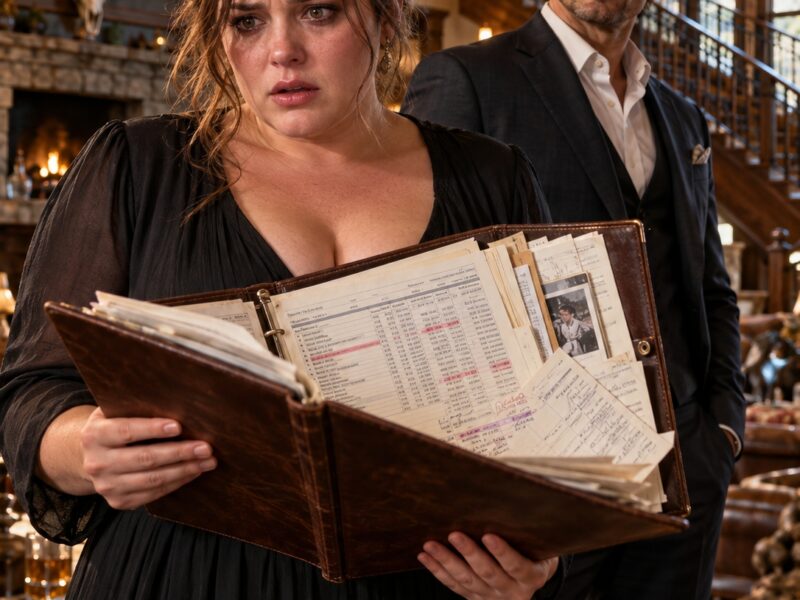
They Forced the “Unwanted” Widow to Marry a Broken Rancher—Then She Discovered Why His Brother Needed Him to Stay Broken

The morning Norah Briggs became a wife for the second time, nobody asked whether she wanted the husband.
They only asked whether she understood the arrangement.
Six weeks earlier, she had buried Calvin Briggs.
Now she stood in the county clerk’s office with forty cents in her purse, one decent dress on her body, and nowhere left in Grover’s Bend that would take her without expecting payment she could not give.
Across the room, she heard a cane strike the wooden floor.
Once.
Pause.
Again.
The sound came closer.
Then Jesse Cain stepped through the doorway.
Norah had heard what people said about him.
Everyone had.
Eighteen months earlier, Jesse had been one of the strongest ranchers in that part of Wyoming. He could rope a steer from horseback, repair a fence in a thunderstorm, and work from before sunrise until the stars came out.
Then there had been an accident.
A horse had thrown him.
His leg had never recovered.
His wife had left four months later.
By the following spring, people no longer talked about Jesse Cain as though he were injured.
They talked about him as though he were finished.
Norah had expected a defeated man.
Instead, she saw broad shoulders filling the doorway, a weathered face darkened by years of sun, and eyes that were painfully alert.
He walked badly.
That was true.
But there was nothing weak about the way he entered the room.
His cane hit the floor with deliberate precision, as if even pain would happen on his terms.
Jesse looked at Norah.
Not at her body first.
Not at the dress stretched too tightly around her waist.
Not at the place where the hem had been repaired twice.
Her face.
He looked directly at her face.
That alone unsettled her.
Most men in Grover’s Bend looked away from Norah quickly, embarrassed by their own judgment, or looked too long, believing a heavy widow with no money had forfeited the right to notice.
Jesse did neither.
He studied her.
She studied him.
Two people taking inventory of the stranger everyone else had chosen for them.
Wade Cain cleared his throat.
Jesse’s older brother stood beside the clerk with his hat tucked beneath one arm. His coat was better than anyone else’s in the room. His boots had almost no dust on them.
He had arranged everything.
“Practical solution,” Wade had called it.
Jesse needed someone to manage the ranch house.
Norah needed somewhere to live.
The county preferred not to support an impoverished widow.
Everyone benefited.
That was how Wade explained it.
Norah had discovered that cruel things were often easier for respectable people to accept when someone called them practical.
Jesse lowered himself into the chair opposite her.
He leaned his cane against his knee.
The clerk opened the marriage ledger.
Jesse didn’t touch the pen.
Instead, he looked at Norah and said quietly, “I didn’t ask for this.”
Wade shifted behind him.
The clerk stared down at his papers.
Norah felt something inside her loosen.
Not because Jesse was kind.
He wasn’t.
Not yet.
But he had told her the truth.
So she gave him the same thing.
“Neither did I.”
For the first time, something changed in his eyes.
Barely.
Recognition, perhaps.
The clerk pushed the pen toward them.
They signed their names.
And in less than a minute, Norah Briggs became Norah Cain.
Again.
Only this time there was no church.
No flowers.
No promise of love.
Just two signatures on the same line and a town relieved that two inconvenient people had become each other’s problem.
Norah did not know then that someone in that room had been counting on exactly that.
Wade drove them to the ranch.
He talked almost the entire way.
County agreements.
Feed contracts.
Pasture rotations.
Taxes.
He spoke about Jesse’s property with the easy authority of a man describing something he already considered partly his.
Jesse sat forward, saying almost nothing.
Norah watched the road.
At the ranch gate, Jesse climbed down first.
Slowly.
Painfully.
He refused Wade’s offered hand.
Norah noticed.
She climbed down next.
Wade caught her elbow.
His fingers stayed there.
Too long.
“I know this isn’t easy,” he murmured.
Norah looked at his hand.
“I’ll manage.”
“I’m sure you will.”
But he didn’t release her.
His voice dropped.
“If you ever find yourself needing anything, anything at all, you come to me.”
She raised her eyes.
Wade smiled.
“A man in Jesse’s condition can only offer so much.”
There was sympathy in the words.
There was something else in his eyes.
Norah had spent six years married to Calvin Briggs.
She knew the difference.
She looked at Wade’s hand again.
He removed it.
“Remember that,” he said.
Norah walked through the gate.
Behind her, Wade’s buggy eventually disappeared down the road.
Ahead of her, Jesse Cain never turned around.
The ranch house was clean.
Almost painfully clean.
There was one plate beside the stove.
One cup.
One chair pulled away from the kitchen table.
One coat hanging beside the door.
It did not look like the home of a man expecting a wife.
It looked like the home of a man who had stopped expecting anybody.
Jesse showed her the bedroom.
One bed.
One lamp.
One chair in the corner.
“There’s no other room ready.”
He said it to the window rather than to her.
Norah placed her small bag beside the bed.
Inside were two pairs of stockings, a comb, a photograph of her mother, and nothing else worth naming.
She looked down at her dress.
“Do you have something I could change into?”
Jesse turned.
His eyes went to the dress, then immediately away.
Without speaking, he crossed to an old cedar chest and pulled out a clean work shirt.
He handed it to her.
Norah unfolded it.
Then she almost smiled.
It might have fit a woman half her size.
“I can’t wear this.”
Jesse looked at the shirt.
Then at her.
For one terrible second, she expected the expression she knew so well.
Amusement.
Disgust.
Pity.
Instead he simply nodded.
“All right.”
He took the shirt back and placed it on the chest.
Nothing more.
No joke.
No apology designed to make the moment worse.
He sat in the corner chair and opened a book.
Norah turned her back.
She reached behind herself to loosen the collar of her dress.
The fabric caught.
She pulled.
Nothing.
Again.
The seam tightened painfully across her shoulder.
Behind her, a page stopped turning.
Norah froze.
She heard Jesse stand.
The cane.
One step.
Another.
Then silence directly behind her.
Every instinct Calvin had taught her told her to prepare.
But Jesse’s fingers touched only the fabric.
Not her skin.
He worked the snag loose slowly.
Carefully.
Norah could feel his breath against the back of her neck.
She could also feel how hard he was trying not to touch her.
The fabric released with a tiny rip.
Immediately, Jesse stepped away.
Norah smoothed the dress.
“Thank you.”
He returned to the chair.
That night, she slept on top of the blanket wearing the same dress.
Jesse remained in the chair.
The lamp burned low.
Eventually, darkness swallowed the room.
Then Jesse’s voice came from across it.
“This isn’t a real marriage.”
Norah stared at the ceiling.
“I know.”
Silence.
She expected that to hurt.
Instead, she found herself thinking about his hands.
About how close he had been.
About the strange dignity of a man who had stepped backward the instant he was no longer needed.
She had known men who could walk perfectly and had never understood boundaries.
Jesse Cain could barely cross a room without pain.
Yet somehow, he had understood.
Norah fell asleep wondering which kind of man was truly broken.
When she woke, Jesse was gone.
The blanket on his chair had been folded neatly.
In the kitchen, he had already made breakfast.
For himself.
One plate.
One cup.
One chair.
“I’m sorry,” Norah said. “I should have been up.”
“Don’t.”
He continued eating.
“I can cook.”
“I know.”
“I can clean.”
“I know.”
His jaw tightened.
“I don’t need anything done for me.”
Norah understood then.
It wasn’t independence.
It was defense.
Every offered hand sounded like pity to him.
So she did something Calvin had never allowed her to do.
She stopped arguing.
Norah made her own breakfast.
Then she pulled another chair to the table.
Not beside Jesse.
Across from him.
She sat.
Ate.
Washed her own plate.
And said nothing.
Three days later, Cobb, Jesse’s ranch hand, appeared with a brown paper parcel.
“For you.”
“From whom?”
Cobb scratched his beard.
“Wasn’t told to say.”
He left.
Inside was a plain cotton dress.
Dark brown.
Practical.
Almost exactly her size.
Norah stood at the table holding it.
She knew.
Jesse never mentioned it.
Neither did she.
That became the language of their marriage.
Things left unsaid.
Coffee already made.
Wood stacked beside the stove.
A dress on a table.
A repaired hinge.
A second chair that remained where Norah had placed it.
Small permissions.
Tiny territories.
Nothing anyone else would call love.
Not yet.
But loneliness recognizes kindness long before pride allows it to be named.
During her first week, Norah began noticing the ranch.
Not merely the beauty of it.
The wrongness.
The land was too good for the ranch to be struggling this badly.
Feed arrived late.
Invoices seemed high.
Cattle were sold through a broker Jesse never mentioned.
Pastures that should have been rotated were overused.
And whenever Jesse returned from riding the fence line, his face carried the expression of a man trying to solve a problem whose pieces kept moving.
Then Wade came.
He brought coffee and sugar.
He smiled.
He asked Norah how she was adjusting.
He asked whether Jesse slept.
Whether Jesse seemed depressed.
Whether Jesse talked about money.
Whether he had mentioned the supply contracts.
Each question sounded harmless.
Together, they felt like fingers searching a pocket.
Norah answered honestly.
Why wouldn’t she?
Wade was Jesse’s brother.
Wade had arranged the marriage.
Wade was the one person who appeared to be helping.
“He worries about Jesse,” Norah told him as he prepared to leave. “I can see that.”
Then she noticed Jesse standing in the hallway.
He had heard her.
Wade smiled and left.
The buggy disappeared.
Jesse remained motionless.
“Did he ask about the contracts?”
Norah frowned.
“Yes.”
“And you told him?”
“Only what I knew.”
Jesse’s face changed.
Not anger.
Something older.
“I didn’t think it mattered.”
“It matters.”
He walked away.
From that afternoon forward, Jesse withdrew.
He stopped sharing breakfast with her.
At supper, he answered questions but asked none.
When Norah entered a room, some invisible door inside him seemed to close.
She could not understand what she had done.
So she stopped trying to understand Jesse.
And started understanding the ranch.
Cobb answered her questions because she listened.
The feed merchant showed her the accounts because he assumed a woman like Norah would not know what she was looking at.
That assumption became his mistake.
Norah had managed Calvin’s household accounts for six years.
Calvin had gambled.
Drunk.
Borrowed.
Lied.
Keeping them fed had taught her more about numbers than anyone in Grover’s Bend knew.
At the feed merchant’s counter, Norah found two versions of the same month.
Same deliveries.
Different totals.
She turned the page.
Another discrepancy.
Then another.
Someone had been taking money.
Not enough at once to cause panic.
Just enough, month after month, to bleed a ranch slowly.
Norah closed the ledger.
“Everything all right, Mrs. Cain?”
She looked up.
“Perfectly.”
On the walk home, she thought about Wade.
His questions.
His interest in contracts.
His hand on her arm.
A man in his condition can only offer so much.
For the first time, the sentence sounded less like an insult to Jesse.
It sounded like reassurance to himself.
A few days later, Norah approached Jesse about his leg.
Her mother had taught her massage techniques when Norah was young. Nothing miraculous. Warm water, pressure, circulation, repetition.
She waited four days before asking.
Then she abandoned the speech she had prepared.
“I want to try something.”
Jesse stopped.
“With your leg.”
His shoulders hardened.
“It might do nothing,” she said. “But it might help.”
He looked at her for a long time.
Norah expected refusal.
“After supper.”
That evening she filled a clay bowl with warm water.
Jesse sat.
Removed his boot.
Lowered his foot into the water.
Norah began working.
Slow pressure.
Heel.
Arch.
Ankle.
The kitchen was almost silent.
The fire settled.
The lamp hissed.
Jesse stared at the wall.
Norah did not ask whether it hurt.
She trusted him to tell her.
Eventually he spoke.
“Margaret left in April.”
Norah’s hands continued moving.
“Four months after the accident.”
She said nothing.
“She didn’t leave a note.”
Still Norah said nothing.
That was why Jesse kept talking.
People always wanted grief to perform for them.
They wanted tears.
Confessions.
Forgiveness.
Norah gave him silence.
When she finished, she dried his foot.
“Same time in two days.”
Jesse stared at her.
“Fine.”
Outside, Norah emptied the water into the yard.
For reasons she could not explain, her hands were shaking.
The sessions continued.
Every second evening.
Warm water.
Lamplight.
Silence.
Slowly, Jesse began speaking.
He told her about the ranch before the accident.
About Saturday horseshoe games behind the barn.
About cattle contracts he had built himself.
About Margaret.
Never much.
Never enough to sound like confession.
But enough for Norah to understand something.
Jesse did not miss the woman who had abandoned him.
He missed the man he had been before she decided he was no longer worth staying for.
Meanwhile, Norah kept studying the accounts.
Wade visited again.
This time, he found her talking with Cobb near the south pasture.
“You don’t need to concern yourself with ranch business,” Wade said pleasantly.
Norah smiled.
“No?”
“Accounts. Contracts. Those things are complicated.”
“I imagine.”
“Leave them to me.”
His smile widened.
“It isn’t women’s work.”
Norah looked at him.
Something cold settled inside her.
“Of course.”
Wade relaxed.
He believed her.
That was his second mistake.
That evening, Jesse placed his foot in the bowl.
Norah worked.
When she reached for the lamp, she lost her balance.
Her hand landed on his knee.
Her body tipped forward.
Suddenly their faces were inches apart.
Neither moved.
Norah saw Jesse’s defenses disappear.
Not weaken.
Disappear.
His eyes dropped briefly to her mouth.
Then returned to hers.
His hand covered hers.
Warm.
Large.
Still.
Norah could feel her pulse in her throat.
For years, Calvin had made her believe desire was something women like her should be grateful to receive in whatever form it came.
But Jesse looked at her as though the choice belonged equally to both of them.
That frightened her more than hunger ever had.
Norah pulled away.
Jesse released her immediately.
They finished the session without another word.
But the silence had changed.
Two mornings later, Norah found a jar of honey on the table.
No note.
Weeks earlier, she had mentioned to Cobb that her mother used honey in cornbread.
One sentence.
She had not known Jesse was nearby.
Norah made cornbread.
She put a piece on his plate.
Jesse ate it.
He said nothing.
She said nothing.
But he stayed at the table until she finished her coffee.
And for Norah, that was almost unbearable in its tenderness.
Then something happened that neither of them could pretend away.
During one session, Jesse’s toes moved.
All five.
A sudden curl beneath her fingers.
Norah froze for half a heartbeat.
Then continued.
“I felt that.”
Jesse gripped the table.
She did not look up.
She gave him privacy.
Minutes later, she heard a long breath leave his body.
That night, Norah woke to the sound of the front door.
Through her window, she saw Jesse near the barn.
Without his cane.
Both hands at his sides.
Both feet beneath him.
Standing.
Nothing more.
Just standing in darkness where no one could see him fail.
Norah watched from the window.
She did not go outside.
She did not congratulate him.
She understood instinctively that some victories become smaller when witnessed too soon.
So she let Jesse own his.
The next week, Wade Cain opened Norah’s bedroom door without knocking.
He closed it behind him.
For the first time, he wasn’t smiling.
“I know what you’ve been doing.”
Norah remained beside the dresser.
“With his leg.”
She said nothing.
“Stop.”
“No.”
The word seemed to surprise him.
Wade moved closer.
“I’m telling you once.”
Norah held his eyes.
“Stop, or I will take everything he has left.”
“The ranch?”
Wade smiled faintly.
“Not the ranch.”
A pause.
“Him.”
Norah felt fear then.
Real fear.
But Calvin had taught her one useful thing without intending to.
A frightened woman did not have to look frightened.
Wade studied her.
When she gave him nothing, he turned.
He opened the door.
Jesse stood in the hallway.
Cane in hand.
Wade did not explain.
Instead, he looked back at Norah.
Smiled.
Slowly adjusted his collar.
Smoothed his coat.
Then walked past Jesse.
“Couldn’t find you anywhere, brother.”
Jesse’s eyes moved from Wade to Norah.
Closed bedroom door.
Wade’s satisfied smile.
Norah alone inside.
Wade had created an entire story without speaking a single lie.
And Jesse believed enough of it to hurt.
That evening, Norah prepared the bowl.
He never came.
The next evening, she prepared it again.
Empty doorway.
On the third evening, Norah sat beside the cooling water until her knees hurt.
Finally, footsteps sounded in the hall.
Jesse appeared.
Norah looked up.
“I know what he did,” she said.
Jesse said nothing.
“I know what you think.”
His jaw tightened.
“I’m still here.”
Three words.
That was all.
Jesse crossed the kitchen.
Sat.
Removed his boot.
Placed his foot into the water.
Norah lowered her hands into the bowl.
Something between them had survived.
Barely.
But survived.
And now she was ready to tell him what she had found.
“The feed merchant keeps two sets of numbers.”
Jesse became completely still.
“I copied the second ledger.”
Silence.
“Someone has been pulling money from this ranch for years.”
Jesse’s hands tightened on his knees.
“Someone with access.”
He stared at the wall.
Then said something Norah would remember for the rest of her life.
“He put a rattlesnake in my saddlebag.”
Her hands stopped.
“What?”
“The accident.”
Jesse turned toward her.
“It wasn’t an accident.”
Norah could hear the stove.
The wind.
Her own breathing.
“I knew by the second month.”
“Who?”
But she already knew.
Jesse’s voice dropped.
“Wade.”
The room seemed to tilt.
Jesse told her.
The morning before the accident, Wade had been near the stable.
The next day Jesse reached into his saddlebag while mounted.
A rattlesnake struck.
The horse panicked.
Jesse fell badly.
The horse came down against his leg.
There had never been proof.
Afterward, Wade stepped in to “help.”
He managed contracts.
Negotiated accounts.
Spoke for Jesse in town.
Margaret left.
Jesse became isolated.
And month by month, Wade took more control.
Norah sat back.
“He didn’t want you dead.”
Jesse looked at her.
The truth arrived between them.
“He wanted you helpless.”
That was worse.
Norah told him about Wade’s threat.
Jesse closed his eyes.
“I thought something happened between you.”
“For two days,” he added.
Norah could hear the shame in his voice.
She nodded once.
No punishment.
No dramatic forgiveness.
Just truth.
Then she opened the household ledger.
Inside were copied accounts.
Survey records.
Statements.
The original doctor’s notes.
A horse trader’s recollection.
Weeks of quiet work.
Jesse stared at the pages.
“You did all this?”
“I didn’t know what I was building.”
She met his eyes.
“I only knew something was wrong.”
Jesse looked at her differently then.
Not as the woman the county had placed in his house.
Not as someone who had helped his leg.
As a partner.
The next morning, Wade moved first.
Norah was at the feed merchant’s store when he entered with the sheriff, a county official, and three town elders.
Wade’s face carried grave concern.
He spoke about Jesse’s instability.
About unauthorized medical treatment.
About an impoverished widow taking advantage of a vulnerable man.
About Norah’s “reputation.”
The room listened.
Grover’s Bend always listened to men like Wade.
Norah stood behind the counter.
Once, the weight of those eyes would have crushed her.
She had spent years believing silence was the price women paid for surviving.
Not anymore.
She opened her ledger.
“Which numbers would you like to discuss first?”
Wade stopped.
Norah removed a copied page.
“The ones your feed merchant shows customers?”
Another page.
“Or the ones in the back ledger with your name beside them?”
The room changed.
Wade’s expression barely moved.
Norah placed down the survey records.
Then the doctor’s original notes.
Then the horse trader’s signed statement.
One page at a time.
No shouting.
No performance.
Just evidence.
Wade looked around the room.
He realized facts were closing doors he had always assumed would remain open.
So he used the weapon that had worked against Norah her entire life.
Shame.
“A lonely man,” Wade said sadly. “A woman with nothing. Living together under one roof.”
He let the insinuation breathe.
“I think we all understand what’s really been happening at that ranch.”
Norah felt the old humiliation enter the room.
The looks.
The judgment.
The same invisible court that had sentenced her before she ever entered.
Then she heard footsteps outside.
Boots on the boardwalk.
Slow.
Uneven.
No cane.
The door opened.
Jesse Cain walked inside.
Every person in the store turned.
He crossed the floor.
One difficult step.
Then another.
His gait was imperfect.
His face showed the cost.
But he was walking.
Wade’s face went white.
Jesse stopped beside Norah.
On his own two feet.
Then he looked at his brother.
“You arranged this marriage because you thought she was stupid.”
Wade opened his mouth.
Jesse continued.
“You thought because she was poor, she’d be grateful. Because people mocked her weight, she’d have no pride left. Because she was a widow, nobody would believe her.”
Norah looked at Jesse.
His voice remained steady.
“You wanted her in my house because you thought she’d report everything I did.”
Wade swallowed.
“And instead,” Jesse said, “she found your ledger in three weeks.”
The room went silent.
“It took me eighteen months.”
Then Jesse stepped closer.
“You put a rattlesnake in my saddlebag.”
No one moved.
The sheriff looked down at the doctor’s report.
Then at the horse trader’s statement.
Then at Wade.
“Mr. Cain.”
Wade’s eyes flicked toward the door.
“Come with me.”
For the first time since Norah had known him, Wade Cain looked ordinary.
No authority.
No warm smile.
No invisible ownership of every room.
Just a frightened man whose power had depended on everyone else believing his version first.
He looked at Norah.
Perhaps he expected triumph.
She gave him none.
That was the one thing he had never understood about her.
Norah did not need to humiliate him.
She only needed him exposed.
Wade left with the sheriff.
Afterward, the store remained quiet.
Cobb stood near the back holding a box of fence nails.
He cleared his throat.
“Man walks pretty steady for someone everybody buried.”
A few people looked down.
Norah folded the evidence back into her ledger.
Jesse watched her hands.
“How long?”
“Since the third week.”
“You never told me.”
“You wouldn’t have believed me.”
He considered that.
Then nodded.
“You’re right.”
Outside, the morning was bright.
Jesse held the door.
Norah walked through.
They began the road home.
No buggy.
No Wade talking between them.
Just Norah.
Jesse.
And the sound of two sets of footsteps.
At the ranch gate, Jesse stopped.
Norah turned.
The barn stood beyond him.
Cottonwood leaves moved softly overhead.
The ranch looked exactly as it had the morning she arrived.
Yet nothing was the same.
Norah suddenly felt exhausted.
The kind that arrives only after danger has passed.
Then Jesse’s hand found hers.
Not cautiously.
Not accidentally.
His fingers closed around hers.
Norah looked down.
Then up.
“I meant what I said that first night,” Jesse said.
Her chest tightened.
“This wasn’t a real marriage.”
She waited.
He stepped closer.
“But somewhere along the way, that stopped being true.”
Norah could not speak.
Jesse lifted his free hand.
His palm touched her cheek.
No hesitation.
No pity.
No gratitude mistaken for affection.
He looked at her exactly as he had the first day in the clerk’s office.
Directly.
Only now there was nothing guarded in his eyes.
Norah leaned into his hand.
For six years, Calvin had taught her that being wanted was a privilege someone else granted.
For six weeks after his death, Grover’s Bend had taught her that being unwanted was a verdict.
Jesse taught her neither was true.
People could decide what they thought you were.
They could not decide what you became.
Jesse pulled her against him.
This time, Norah did not stiffen.
She put her arms around him.
His heart beat beneath her cheek.
Behind them, a horse shifted in the barn.
The wind moved through the grass.
Somewhere beyond the ridge, the world continued exactly as worlds do after enormous things happen quietly.
Three weeks later, on a Saturday afternoon, Norah cleared the old horseshoe pit behind the barn.
She pulled weeds.
Reset the post.
Found the old shoes stacked behind the supply shed.
At sunset, she found Jesse sitting on the porch.
“The pit’s ready.”
He looked at her.
Then stood.
No cane.
They walked behind the barn.
Jesse stopped at the edge of the pit.
For a moment, he simply stared.
Norah realized this was not about horseshoes.
It was about the man who used to stand there on Saturday nights before a rattlesnake, a fall, a brother’s betrayal, a wife’s abandonment, and eighteen months of humiliation convinced him that his life had already happened.
Jesse bent.
Picked up a horseshoe.
Tested its weight.
His body shifted.
Searching for balance.
Not his old balance.
That was gone.
Something new.
Earned.
He drew back his arm.
Threw.
The horseshoe turned through the evening air.
Once.
Twice.
Then landed cleanly around the post.
The metallic ring cut through the quiet.
Jesse stared at it.
Norah waited.
Slowly, he turned.
And smiled at her.
A real smile.
Not at the horseshoe.
At her.
Norah stood beneath a sky turning gold behind the barn.
She remembered the county clerk’s office.
Forty cents.
One dress.
A stranger with a cane.
Nobody had asked what she wanted.
That had been the cruelty at the beginning of her story.
But perhaps that was not where the story had to end.
Because now Jesse was standing before her without his cane.
And Norah was standing before him without shame.
The ranch still needed work.
Jesse’s leg would never become exactly what it had been.
The money Wade stole would take time to recover.
The town would gossip tomorrow.
Some people would apologize.
Others would pretend they had never judged either of them.
Life would remain imperfect.
But the second chair stayed at the kitchen table.
The honey stayed beside the flour.
The clay bowl remained near the stove, though they needed it less often now.
And every Saturday evening, when weather allowed, Jesse walked behind the barn and threw horseshoes.
Sometimes Norah joined him.
Sometimes she simply watched.
Months later, there would still be nights when Jesse woke from dreams of a horse screaming beneath him.
There would still be moments when Norah caught herself apologizing for taking up space.
Healing did not arrive like sunrise.
It arrived like their marriage had.
Quietly.
Unevenly.
One small choice after another.
One morning, Norah found Jesse repairing the ranch gate.
He looked up.
“You going into town?”
“Yes.”
“Need anything?”
Norah almost said no.
The word was already forming.
It was the answer she had learned to give the world.
Then she stopped.
“Honey,” she said.
Jesse smiled.
“We’re out?”
“Almost.”
He nodded.
“I’ll get some.”
Such a small exchange.
No one else would have understood.
Norah did.
Once, she had believed needing something made her vulnerable.
Jesse had believed the same.
Perhaps that was why Wade had chosen them.
A woman convinced she should be grateful for scraps.
A man convinced accepting help made him less of a man.
Wade had seen two broken people and assumed broken things were easy to control.
What he had failed to understand was that sometimes two people do not repair each other.
Sometimes they simply create a place where neither has to pretend they are unbroken.
That evening, Norah stood at the kitchen window while Jesse returned from town.
He carried a small paper parcel beneath one arm.
He came through the gate with the slightest unevenness in his walk.
She knew there would always be some unevenness.
She loved him without needing it gone.
Jesse looked toward the window.
Saw her.
Raised the parcel.
Norah laughed.
A real laugh.
It surprised her enough that she covered her mouth.
Jesse stopped in the yard.
For a second, he simply watched her.
Then he laughed too.
And somewhere behind the barn, moved by the wind, an old horseshoe hanging from a nail struck softly against the wooden wall.
Once.
Like a bell.
The first time Norah Cain heard a sound like that, she had been standing in a county office listening to a cane approach and wondering what kind of prison waited on the other side of the door.
Now she stood inside a warm kitchen watching her husband come home.
Nobody had chosen this ending for them.
That was precisely why it belonged to them.









