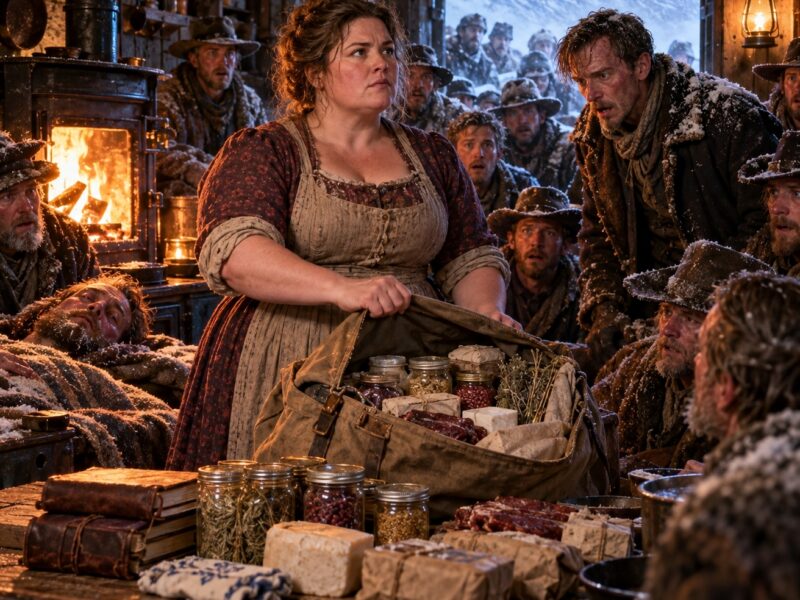
They Gave Her a Burned-Out Kitchen Because They Thought She Was Worthless—Six Weeks Later, Fifty Cowboys Were Begging at Her Door
The men at Hawthorne Ranch laughed when Beatrice Gallagher accepted a job nobody else would have taken.
They had given her a kitchen without half its roof, a bed in a moldy pantry, and enough insults to send most women running.
Six weeks later, when a Montana blizzard brought fifty men to the edge of death, that ruined kitchen was the only place still offering warmth.
And Beatrice was the only person they knew who might be able to save them.
It began on a cold October afternoon in 1883, when twenty-eight-year-old Beatrice Gallagher stepped down from a freight wagon into the muddy yard of Hawthorne Ranch.
Her boots sank almost to the ankles.
Behind her, the driver hauled down a battered canvas bag, set it beside a fence post, and offered a sympathetic nod before turning his horses around.
Beatrice watched the wagon disappear along the rutted road.
For the first time since leaving her previous position, she was completely alone.
She slipped a hand inside her coat and touched the folded employment letter resting against her chest.
HEAD COOK WANTED.
Fair wages. Private accommodations. Meals provided.
The writing beneath those promises bore the signature of Levi Hawthorne, owner of one of the largest cattle ranches in that part of Montana Territory.
She had read the letter so many times during the journey that the paper had begun to soften along its creases.
It was not a particularly generous offer. The wages would barely allow her to save much after purchasing a few personal necessities.
But the job offered something Beatrice had not enjoyed in years.
A chance to begin again.
She adjusted her plain brown wool dress, lifted her bag, and approached the main ranch house.
The property spread across a broad valley beneath the distant Bitterroot Mountains. Gray smoke rose from the main chimney. Horses shifted inside a long stable, and the air carried the familiar smells of wet leather, hay, and cattle.
Men were repairing a wagon near the bunkhouse.
Another group stood beside a corral, watching a horse being saddled.
To Beatrice, the place looked busy, established, and well supplied.
A good ranch.
One that could afford a proper cook and a proper kitchen.
She allowed herself a small, cautious smile.
Then a voice rang out from the porch.
“Good Lord Almighty!”
Beatrice stopped.
A tall, narrow-faced man in a weathered coat stepped forward, his boots striking the wooden boards.
He wore a wide-brimmed hat pushed back from his forehead. A wad of tobacco rested in one cheek.
He examined her openly, from her mud-stained boots to her broad shoulders.
“Hawthorne ordered a cook,” he announced. “Not a prizewinning heifer.”
Laughter burst from the men near the corral.
Beatrice felt the familiar heat rise along her neck.
The tall man spat into the yard.
“What’s your business here, ma’am?”
She held out the letter.
“My name is Beatrice Gallagher. Mr. Hawthorne hired me as head cook.”
The man took the paper without asking permission.
“Dexter Hayes,” he said. “Foreman.”
He unfolded the letter and read it.
Another cowboy wandered closer.
“What’s going on?”
“New cook,” Dexter replied.
The cowboy looked at Beatrice, then grinned.
“Better lock up the winter supplies. She might eat us clean out before Thanksgiving.”
Someone laughed so hard he had to lean against the wagon.
Beatrice stood still.
She was a large woman, broad through the shoulders and waist, with strong arms and work-worn hands.
Her body had carried heavy flour sacks, hauled water from frozen wells, lifted enormous cooking pots, and endured days that began before sunrise.
But people seldom looked at her long enough to see those things.
They noticed her size.
Then they decided what it meant.
She had learned not to respond to every insult. Some men mistook any reply for an invitation to continue.
Still, these were the men she would be feeding.
She had hoped they might at least wait until she made their first meal before deciding what sort of woman she was.
“Mr. Hayes,” she said evenly, “the letter says I’m to report to the ranch house.”
Dexter glanced at the signature again.
Before he could answer, the front door opened.
A thin woman wearing a severe black dress emerged onto the porch.
Her hair was pulled tightly away from her face, and the keys hanging from her waist jingled as she descended the steps.
“What is all this noise?”
Dexter held up the letter.
“Mrs. Higgins, seems the boss hired us a new cook.”
Martha Higgins, the ranch’s house manager, stopped in front of Beatrice.
Her eyes moved slowly over the younger woman’s figure.
“Absolutely not.”
Beatrice blinked.
“Ma’am?”
“You’re not coming into my kitchen.”
“I have a written offer from Mr. Hawthorne.”
“I can see that.”
Martha did not take the letter.
Instead, she folded her arms.
“And I can also see you would barely squeeze through the pantry door.”
A fresh wave of laughter rolled across the yard.
Beatrice looked down at her hands.
Her knuckles were red from the cold, and a small split had opened beside her thumbnail during the journey.
She pressed her thumb against it.
“I’ve worked in large kitchens before,” she said. “I can handle the meals.”
“Oh, I’m sure you can handle meals,” Martha replied. “Eating them, at least.”
Dexter gave a sharp laugh.
Beatrice looked back toward the road.
The freight wagon was already gone.
The nearest settlement lay miles away. The money in her purse would hardly pay for another journey, and the mountain passes had already begun collecting snow.
She could leave.
She was not chained to this ranch.
But she would be walking away with almost nothing, into country growing colder by the day.
Martha followed her glance toward the road.
Then the house manager exchanged a look with Dexter.
“Take her to the old summer kitchen.”
Dexter’s eyebrows rose.
“The one that burned?”
“That’s the one.”
For a moment, Beatrice thought she had misunderstood.
“The summer kitchen?”
Martha gave her a thin smile.
“You wanted a kitchen, Miss Gallagher. We’ll give you one.”
Nobody mentioned why the building had been abandoned.
Nobody asked whether it was safe.
Dexter simply picked up Beatrice’s canvas bag and started across the yard.
“Come along, sweetheart. Let’s show you your accommodations.”
She followed him past the livestock pens.
A half-dozen cowboys trailed behind, more interested in the spectacle than in their afternoon chores.
The old kitchen stood beyond a weathered fence, separated from the main buildings by a stretch of muddy ground.
Its stone walls had survived a fire, but little else had.
Blackened rafters reached through a roof that had partially collapsed. One window had lost its glass entirely, while another held only jagged fragments.
Weeds pushed between warped floorboards.
A broken shutter knocked against the wall in the wind.
Inside, cold daylight streamed through the missing roof.
Beatrice smelled damp wood, old soot, and the mustiness of a room shut away too long.
A massive cast-iron stove stood against the far wall.
Its surface was rusted, and ash lay thick inside the firebox.
Near it rested a cracked wooden table and two benches.
A narrow pantry occupied one corner, where a mold-spotted cot had been pushed beneath a shelf.
Dexter swept off his hat with an exaggerated flourish.
“Welcome to your palace, Miss Gallagher.”
The cowboys roared.
“Think she’ll stay a week?”
“Not without eating the furniture.”
One man kicked a loose board across the floor.
“Careful. The whole place might fall down.”
Beatrice walked slowly toward the stove.
She touched its iron surface.
Cold.
Rough.
Solid.
She crouched and opened the lower door, checking the hinges. Then she peered up toward the chimney, looking for fallen masonry or an obvious blockage.
Dexter watched her.
“Well?”
She rose.
“Does the stove draw?”
He frowned.
“What?”
“The chimney. Was it damaged by the fire?”
“How should I know?”
“Has anyone used it since?”
“No.”
She glanced toward the ruined roof.
“And are there boards I might use for repairs?”
Dexter stared at her.
Behind him, someone snickered.
“You’re seriously thinking of staying?”
Beatrice turned to face him.
“Yes.”
His smile faded.
“Yes, what?”
“I’ll take the job.”
For a moment, even the cowboys fell quiet.
Dexter looked around, apparently waiting for her to admit she was joking.
Then he shrugged.
“Suit yourself.”
He tossed her bag onto the cot.
“Don’t come crying when you freeze.”
The men walked away, their laughter following them across the yard.
Beatrice stood in the doorway until the last one disappeared behind the livestock pens.
Only then did she let her shoulders drop.
The silence seemed enormous.
Wind moved through the broken windows. Somewhere inside the roof, a loose board groaned.
She turned toward the pantry and sat carefully on the cot.
The canvas sagged beneath her weight.
For several minutes, she did nothing.
She thought about the rooms she had cleaned in other people’s homes, the kitchens where employers praised her food and then complained that she took up too much space.
She thought about the meals she had prepared for people who never asked whether she had eaten.
And she thought of the letter she had carried across the valley, believing that a stranger’s written promise might be enough to earn her a fair beginning.
She reached into her coat and unfolded it again.
Private accommodations.
Meals provided.
The words looked almost ridiculous inside the ruined building.
She could have cried.
Instead, she carefully refolded the paper.
Then she stood, rolled up her sleeves, and began clearing the floor.
The first afternoon was miserable.
Beatrice dragged rotten timber outside, sorting anything dry enough to burn from wood too damaged to use.
She swept years of dirt from the corners.
She carried broken glass into a bucket and pulled weeds from the gaps between the floorboards.
When she found loose planks behind the building, she tested each one before carrying it inside.
By sundown, she had covered the worst of the broken windows.
By lantern light, she began packing the gaps against the wind.
Her back ached.
Her knees throbbed every time she stood.
But the stove demanded the most attention.
She scraped away rust and soot, cleared its old ashes, examined the firebox, and made certain the flue was open before attempting to light it.
She worked slowly, remembering what heat could do inside a damaged structure.
Long after darkness settled over the ranch, she placed a small bundle of dry kindling inside the iron stove.
She struck a match.
The flame caught.
For several tense seconds, she watched the smoke.
It rose.
The chimney drew.
And soon a steady orange light flickered through the little opening in the stove door.
Beatrice sank onto the nearest bench.
Warmth began to spread through the room.
It did not fix the roof.
It did not erase the laughter.
But it was a beginning.
“There you are,” she whispered.
For the first time that day, she smiled.
The following morning, thin gray smoke curled from the abandoned chimney.
One of the younger ranch hands noticed it while leading a horse toward the corral.
He stopped and stared.
“I’ll be damned. She’s got that thing working.”
By midmorning, Beatrice had carried the provisions allowed for the ranch hands’ meals into the summer kitchen.
She organized the usable shelves and scrubbed the cracked table.
Then she began cooking.
First came bread.
She measured flour with practiced hands, worked the dough until it was smooth, and covered it while the stove warmed.
There was no time for elaborate preparation.
She had hungry men to feed.
She soaked beans, cut preserved meat into small pieces, and added what seasonings she could find.
A pot began to simmer.
The smell traveled beyond the broken windows.
By noon, it reached the livestock pens.
Dexter was speaking with two cowboys when one of them raised his head.
“What’s that?”
“What’s what?”
“That smell.”
Dexter sniffed.
Something rich and savory drifted through the cold air.
The younger man started toward the summer kitchen.
Dexter frowned.
“Where are you going?”
“To see what’s cooking.”
“You have work.”
“And I have a stomach.”
By the time the noon meal was ready, several men were waiting outside Beatrice’s door.
They looked uncomfortable.
A few avoided meeting her eyes.
Yesterday they had laughed while she stood alone in the ruins.
Today they were staring at the bread cooling on her table.
Beatrice opened the door.
“Lunch is ready.”
Nobody moved at first.
Then a cowboy with a reddish beard stepped inside.
He filled a bowl and took a cautious spoonful.
He stopped chewing.
Another man watched him.
“Well?”
The red-bearded cowboy swallowed.
Then he took a second spoonful.
“Well, I’ll be damned.”
“What’s wrong with it?”
“Nothing.”
He looked toward the pot.
“That’s the trouble. There’s absolutely nothing wrong with it.”
A second man helped himself.
Then a third.
Within minutes, the kitchen filled with the clatter of spoons and the scrape of boots.
The men ate with the fierce appetite of ranch hands who had spent the morning working in cold weather.
One of them tore open a piece of bread, watched the steam rise from its center, and shook his head.
“Best bread I’ve had in years.”
Another scraped his bowl clean.
“Any chance there’s more stew?”
Beatrice lifted the lid.
“There’s enough for seconds if everyone has eaten.”
The man nodded.
“Thank you, ma’am.”
Those three words nearly unsettled her more than the insults had.
She kept her expression neutral.
“You’re welcome.”
She did not demand an apology.
Not because the previous day had been forgotten.
It hadn’t.
She remembered every word.
But the men were hungry, and she had been hired to feed them.
That was the work she knew.
And she would do it well whether or not they deserved her kindness.
Over the following weeks, the summer kitchen changed.
Not all at once.
It became better in small, ordinary ways.
A sturdy board appeared beside the back door one morning.
Someone left a bundle of dry kindling beneath the overhang.
A cowboy returning from a supply run carried in a sack of beans without being asked.
Another repaired a loose shutter after watching it bang against the wall through an entire meal.
Nobody made a ceremony of these gestures.
Beatrice didn’t ask who had done them.
She simply used what was given and continued working.
She made thick soups from scraps that other cooks might have discarded.
She saved cooking water when it could be reused.
She stretched flour carefully, baked whenever the stove was hot, and learned which men needed an extra portion after particularly demanding work.
Some arrived too exhausted to talk.
She placed food in front of them anyway.
Others lingered after supper, warming their fingers around coffee cups while talking about broken fences, missing cattle, and the weather gathering beyond the mountains.
They began leaving their hats by the door.
They stopped tracking mud through the cleanest part of the floor.
And slowly, almost without anyone noticing, they started treating the summer kitchen like a place worth protecting.
One evening, a young ranch hand with chapped cheeks held out his empty plate.
“Miss Gallagher?”
“Yes?”
He hesitated.
“Could I have another piece of bread?”
She looked at the plate.
Then at his face.
“Of course.”
He smiled.
“Thank you.”
When he had gone, Beatrice stood beside the table for a moment longer than necessary.
It was such a small thing.
A request made politely.
A thank-you offered without mockery.
She had spent years telling herself those things didn’t matter.
But they did.
They mattered more than she liked to admit.
Dexter Hayes, however, remained cold.
He ate her food without complaint, sometimes taking a second helping, but he never acknowledged what she had accomplished.
When other men praised the meals, he changed the subject.
Martha Higgins was no kinder.
She continued running the main house as though the summer kitchen were an inconvenience, not an improvement.
Beatrice had noticed something about both of them.
They disliked being wrong more than they disliked being cruel.
And her continued presence reminded them of the afternoon they had tried to drive her away.
Still, she had no intention of leaving.
The old building was warmer now.
The walls kept out most of the wind.
The stove worked beautifully once she understood its temperamental draft.
And beneath the pantry cot rested her canvas bag.
She had never unpacked everything inside.
Some possessions were easier to keep close than to explain.
On quiet evenings, after the last dishes were washed, she sometimes drew the bag toward her and rested a hand on its worn canvas.
Then she pushed it back beneath the cot.
Outside, the Montana autumn grew colder.
The mountains turned white.
And November came early.
The first serious warning arrived with the wind.
For two days, it blew steadily down from the high country, sweeping dust and frozen leaves across the ranch yard.
The horses grew restless.
The cattle pressed closer together.
Men returning from the outer pastures spoke of heavy clouds gathering beyond the Bitterroot Mountains.
One afternoon, Beatrice stepped outside with a bucket of ashes.
She looked toward the western peaks.
They were gone.
A dark wall of cloud had swallowed them.
Dexter stood near the main barn, speaking sharply to a ranch hand.
“Get the stock inside the lower pens. I don’t want anybody riding out after sundown.”
Beatrice listened.
There was something in his voice she had not heard before.
Concern.
She crossed to the woodpile and counted the split logs she had stacked beside the kitchen.
Not enough.
She brought more inside.
Then she checked the pantry.
Three sacks of flour.
Beans.
A modest supply of preserved meat.
Coffee.
Salt.
Enough provisions for ordinary meals over the coming days, provided the supply wagons could still travel.
She made a quiet calculation.
Then she checked again.
By late afternoon, the first snowflakes appeared.
They were large and wet, melting when they struck the kitchen windows.
Within an hour, the wind changed.
Snow began falling sideways.
The yard turned white.
The cattle pens disappeared behind a shifting curtain.
At supper, the men spoke less than usual.
One cowboy pushed back from the table and rubbed his hands.
“Feels like it’s going to be a bad one.”
Another nodded toward the window.
“My father saw a storm like this when I was a boy. Said you couldn’t find your own barn from the front steps.”
Dexter entered before Beatrice could answer.
“Anyone finished eating, get back to the bunkhouse. Now.”
The men obeyed.
Within minutes, the kitchen stood empty except for Beatrice.
She washed the bowls while the wind strengthened.
The shutter she had repaired weeks earlier rattled against its frame.
She checked the latch.
Then she added another log to the stove.
By nightfall, the storm had become something she could feel through the walls.
The wind no longer came in gusts.
It struck continuously, pressing snow into every crack, making the roof timbers creak.
The patched windows shuddered.
Outside, there were no familiar landmarks.
No corral.
No barn.
No main house.
Only whiteness and movement.
Beatrice lit her lantern and set it on the table.
She prepared a pot of broth, more from habit than expectation.
Then she sat beside the stove and listened.
The first pounding came shortly after midnight.
At first, she thought a loose shutter had torn free.
Then she heard a voice.
“Hello! Anybody there?”
She hurried to the door.
Another blow struck the wood.
“Please!”
Beatrice pulled back the latch.
The wind nearly wrenched the door from her hands.
A cowboy stumbled inside, his beard coated in ice.
He fell against the table.
She forced the door shut behind him.
For several seconds, he couldn’t speak.
His body shook uncontrollably.
Beatrice guided him toward a bench near the stove.
“Sit down.”
He tried to answer.
She knelt and examined his stiff gloves.
“Can you move your fingers?”
A faint nod.
“Good. We’ll warm you slowly. Don’t rub them.”
She helped him remove his wet outer clothing and wrapped a dry blanket around his shoulders.
Then she pressed a cup of warm coffee into his trembling hands.
“Small sips.”
The man stared at her.
“Couldn’t… find…”
“Don’t talk yet.”
He swallowed.
“Couldn’t find the bunkhouse.”
Beatrice looked toward the door.
“Is anyone else outside?”
He closed his eyes.
“I don’t know.”
Five minutes later, someone pounded again.
Three more men stumbled into the kitchen.
One had lost his hat.
Another clutched his right hand against his chest.
The third was crying, though he seemed unaware of it.
Beatrice moved quickly.
She cleared space beside the stove, found more blankets, and divided the warm broth among them.
The men spoke over one another.
They had been trying to get from the stable to the bunkhouse.
The snow had erased the trail.
They had become separated from the others.
Then one of them saw smoke drifting above the dark shape of the summer kitchen.
They followed it.
As Beatrice listened, she felt a cold heaviness settle in her stomach.
The kitchen’s chimney.
The same chimney everyone had laughed at her for repairing.
It was becoming a beacon.
More pounding came.
Seven men arrived together.
Then another group.
Then a pair so exhausted that the others had to support them through the doorway.
The kitchen filled with wet coats, shaking hands, frightened voices, and the heavy smell of melting snow.
Beatrice moved among them, counting.
She had never needed to count so carefully.
Every person meant another portion of food.
Another place to sit.
Another body that needed warmth.
Outside, the temperature was falling.
Inside, the stove burned steadily, but the room was filling faster than she could make space.
She had spent six weeks transforming the ruins into a functioning kitchen.
Now every repair was being tested at once.
One of the older cowboys approached her.
“Miss Gallagher, how much longer do you reckon this storm will last?”
Beatrice looked toward the shuttered window.
“I don’t know.”
The man glanced at the pantry.
“We’ve got enough supplies?”
She did not immediately answer.
Instead, she handed him a stack of clean cups.
“Help me pass these around.”
He took them.
“Yes, ma’am.”
She poured broth, spreading it into smaller portions.
The room grew quieter as the men began to realize how serious their situation had become.
They could not safely reach the main house.
They could not see the bunkhouse.
They did not know whether the men still outside were alive.
And the roof above them was held together partly by old stonework and the repairs Beatrice had made with discarded boards.
A hard blow rattled the door.
Before anyone could reach it, the latch lifted.
Dexter Hayes stumbled inside.
He slammed the door behind him and stood gasping.
His hat was gone.
Ice clung to his eyelashes, and his face had a frightening grayish pallor.
The man who had greeted Beatrice with a joke about a heifer now looked barely capable of standing.
“Mr. Hayes?”
He tried to answer.
His knees buckled.
Beatrice caught his arm, and another cowboy helped lower him onto a bench.
“Get him away from the draft.”
Dexter’s hands shook violently.
He struggled to draw a full breath.
Beatrice put a blanket around his shoulders.
“How long have you been outside?”
“Don’t… know.”
“Where were you coming from?”
“The lower pens.”
He looked up suddenly.
“There’s more coming.”
Beatrice stopped.
“How many?”
Dexter swallowed.
“Nearly fifty men altogether. Counting those still out there.”
A terrible silence spread through the room.
Beatrice could hear the fire shifting inside the stove.
Fifty.
She turned toward the pantry.
Three sacks of flour, already partly used.
A dwindling quantity of dried meat.
Beans that would take time and fuel to cook.
A small supply of coffee.
And a stack of firewood that might last another day if she rationed it carefully.
If the storm held them longer, they would need more.
More food.
More warmth.
More space.
She looked at the faces around her.
These men were accustomed to working through pain, cold, and exhaustion.
Most had spent years surviving in harsh country.
But not one of them could make the weather stop.
For the first time, Beatrice saw their confidence beginning to fail.
One young cowboy stood near the stove, staring at his boots.
“My brother’s still out there.”
Nobody answered.
“He went back to get the horses settled.”
The boy lifted his eyes.
“What if he can’t find us?”
Beatrice crossed the room.
“What’s his name?”
“Thomas.”
She touched the boy’s shoulder.
“Then we’ll listen for Thomas.”
His lips trembled.
He nodded.
A few minutes later, pounding erupted against the door.
“Help! Open up!”
Two cowboys hurried forward.
When they dragged the door open, three men stumbled through the snow carrying a fourth between them.
The unconscious man’s boots scraped against the threshold.
His clothes had frozen stiff.
His face was unnaturally pale.
“He collapsed near the cattle pens!” someone shouted.
“He’s barely breathing!”
“Make room,” Beatrice ordered.
Her voice cut through the panic.
The men moved aside.
“Put him down here. Carefully.”
They lowered him onto blankets spread across the floor, away from direct contact with the stove.
Beatrice knelt beside him.
She brought her face close enough to watch for breathing, then pressed her fingers against his neck.
There.
A faint pulse.
She felt it again to be certain.
“He’s alive.”
Dexter staggered toward her.
“Can you save him?”
Beatrice did not look up.
“Get the wet outer clothes off him carefully. Bring dry blankets. Keep him sheltered from the wind, and don’t try to make him drink while he’s unconscious.”
The cowboys obeyed.
One hurried to the pantry.
Another gathered blankets from the benches.
Beatrice continued checking the fallen man’s breathing.
He needed more help than she could reliably provide.
She knew that.
She also knew that carrying him back into the storm could kill him before they reached another building.
She looked around at the crowded room.
So many men.
So little time.
The unconscious cowboy’s chest rose shallowly beneath the blankets.
Dexter crouched beside her.
“Miss Gallagher?”
She shook her head.
“Let me work.”
He fell silent.
The stove popped.
Snow rattled against the boards.
Then the door opened again.
A ranch hand stumbled inside, breathing so hard he could barely speak.
“The bunkhouse!”
Every face turned toward him.
“What about it?” Dexter demanded.
“The roof’s coming down!”
The cowboy doubled over, fighting for breath.
“There are men trapped out there. We could hear them shouting, but we couldn’t get through the snow.”
A murmur of alarm swept the kitchen.
Someone swore.
Another man headed instinctively for the door.
Dexter grabbed his coat.
“You go out alone, you’ll be dead before you reach them.”
“We can’t leave them!”
“I didn’t say we would!”
Beatrice rose slowly.
The fire had begun to settle.
One of the smaller logs collapsed inward, sending sparks up the chimney.
She looked at the woodpile.
At the pantry.
At the men huddled shoulder to shoulder.
At the unconscious cowboy whose breathing was still dangerously faint.
The men wanted answers.
Dexter wanted orders.
The frightened boy wanted his brother.
And outside, somewhere beyond the walls, other men might already be dying.
There was no way to solve everything at once.
Beatrice felt her own fear rising.
She was tired.
Her hands ached.
Her kitchen had never been meant to shelter this many people.
She had spent her life making meals, not commanding men through disasters.
But she knew the building.
She knew its stove.
She knew exactly what provisions remained.
And she knew something else.
Fear could spread through a room faster than cold.
She turned toward the men.
“Nobody opens that door without telling me where they’re going.”
The command surprised even her.
Dexter stared.
One of the ranch hands opened his mouth, then closed it again.
Beatrice continued.
“Anyone who can still work, help those who can’t. Keep the wet coats away from the fire. Don’t waste the hot water. And stop crowding the door.”
The men began to move.
Not because she had threatened them.
Not because she had raised her voice particularly high.
But because she was the only person giving them anything useful to do.
Dexter looked at her.
For the first time since she had arrived at Hawthorne Ranch, there was no mockery in his face.
Only exhaustion.
And something very close to shame.
“Miss Gallagher,” he said quietly, “please tell me you can keep us alive.”
Beatrice looked into his eyes.
Six weeks earlier, that same man had stood in this doorway and laughed as he told her not to come crying when she froze.
She remembered his grin.
She remembered the voices behind him.
She remembered sitting alone on the moldy cot, holding an employment letter that promised her a home.
Now Dexter Hayes was trembling in front of her.
Waiting for mercy.
Beatrice could have reminded him of every cruel word.
She could have asked whether she still looked useless.
For one fleeting moment, she wanted to.
Not because she wished him dead.
But because she wanted him to understand what humiliation felt like when there was nowhere to escape it.
Then she heard the unconscious cowboy struggling to breathe.
The moment passed.
She turned toward the pantry.
Beneath the cot was the old canvas bag she had carried across the Bitterroot Valley.
Its leather straps were cracked.
One corner had been repaired with dark thread.
She had kept it close from the day she arrived.
The cowboys had assumed it held a few dresses and whatever personal belongings a woman like Beatrice might own.
She had never corrected them.
Now she pulled it into the center of the room.
Dexter watched.
“What are you doing?”
Beatrice knelt and unfastened the buckles.
Her fingers hesitated over the worn flap.
She had carried the bag through every lonely mile of her journey.
She had kept its contents hidden even after the men began accepting her cooking.
Whatever was inside belonged to a part of her life she had not been ready to discuss.
A part she had hoped to leave behind.
But beyond the patched walls of the summer kitchen, the storm was still raging.
Men were trapped.
A man was dying.
And fifty lives might depend on decisions made in the next few minutes.
Beatrice opened the bag.
Dexter leaned forward.
His expression changed.
“What in God’s name is that?”
Around the stove, the cowboys went silent.
Beatrice lifted her eyes.
For the first time since arriving at Hawthorne Ranch, she was no longer afraid of what they would think of her.
She was afraid of what would happen if they didn’t listen.
She looked directly at Dexter Hayes.
And began to speak.









