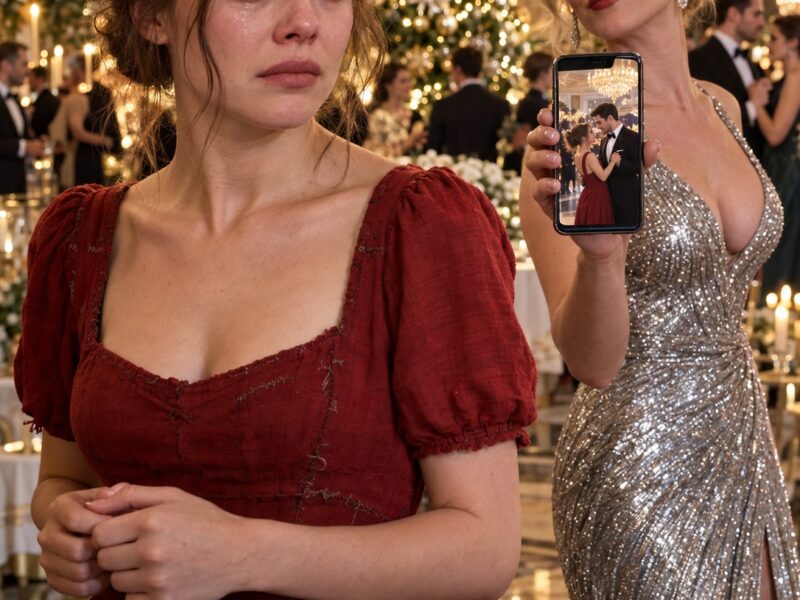
THEY HUMILIATED HER FOR WEARING A SEVEN-YEAR-OLD DRESS—THEN THE MILLIONAIRE CEO ASKED HER TO DANCE… BUT THE PHOTO HIS JEALOUS EXECUTIVE TOOK EXPOSED A SECRET THAT COULD DESTROY THEM ALL!

The red dress was hanging in an evidence photograph when Emily Kowalski finally understood that humiliation had been the least dangerous thing Celeste Marlo had done to her.
Three weeks earlier, people had laughed at that dress.
Now lawyers were studying it.
The photograph lay in the center of a polished walnut table fourteen floors above downtown Pittsburgh. Emily was frozen beneath a chandelier, one hand resting in Alexander Hawthorne’s, her faded red dress impossible to miss among black tuxedos and silver gowns.
Someone had enlarged the picture.
Someone had circled her face.
And beside it sat a confidential complaint accusing Emily of using a personal relationship with the millionaire CEO of Hawthorne Medical Supply to gain access to financial information.
Information that had exposed hundreds of suspicious labor hours.
Missing overtime.
A warehouse shift that appeared to have happened during a snowstorm when the warehouse had actually been closed.
And a trail leading toward one of the most powerful executives in the company.
Emily stared at the photograph until the people around the table blurred.
She had spent seven years making herself invisible at Hawthorne.
Arrive early.
Do the work.
Check every number twice.
Don’t gossip.
Don’t complain.
Don’t give anyone a reason to say the woman from accounts payable was trying to become something she hadn’t earned.
Then Alexander Hawthorne had asked her for one dance.
Three minutes.
That was all.
Three minutes had been enough to turn her into a joke.
And now someone was trying to turn that joke into evidence.
The attorney across from her folded his hands.
“Ms. Kowalski, we need you to answer this very carefully.”
Emily lifted her eyes.
“Did Mr. Hawthorne ever give you access to information you were not authorized to see?”
“No.”
“Did he ever ask you to investigate Keystone Labor Partners?”
“No.”
“Did he promise you a promotion?”
“No.”
“Did you have a personal relationship with him while you were investigating these invoices?”
Emily looked again at the photograph.
There they were.
The lonely millionaire and the woman in the cheap red dress.
Everyone thought they knew what that picture meant.
Nobody knew what had happened five minutes before it was taken.
Nobody knew what would happen afterward.
And almost nobody knew that if Emily had simply left the Christmas gala when she intended to, millions of dollars in questionable payments might never have been examined.
She drew a slow breath.
“No,” she said.
The attorney leaned closer.
“Then tell us how this started.”
Emily looked at the faded red fabric in the photograph.
And suddenly she was back beneath the Christmas lights.
Back before the lawyers.
Before the stolen records.
Before the anonymous complaint.
Back when the worst thing she thought could happen was being laughed at.
The ballroom of the Grand Allegheny Hotel looked like money pretending to be Christmas.
Gold light spilled from chandeliers the size of small cars. Silver garland wound around marble columns. A Christmas tree rose nearly twenty feet beside the windows, covered in white lights and glass ornaments that reflected the skyline.
A string quartet played near the dance floor.
Servers moved silently between executives carrying champagne.
Emily Kowalski stopped just inside the doorway.
For one foolish second, she considered turning around.
She was twenty-nine years old, worked in accounts payable at Hawthorne Medical Supply, and had spent most of her adult life learning how to enter rooms without expecting anyone to notice.
Tonight, unfortunately, her dress made invisibility impossible.
It was red.
Not fashionable red.
Not expensive red.
The softer, slightly faded red of fabric that had been washed carefully for seven years.
Emily smoothed the skirt.
The left cuff had been repaired twice.
There was a nearly invisible stitch near the waist where the fabric had once caught on a chair.
The lining was hand-sewn.
Every seam had been made by Helen Kowalski.
Her mother.
Seven years earlier, Emily had been finishing community college when she came home crying because several girls in her class were discussing the dresses they had bought for graduation dinner.
One had spent four hundred dollars.
Emily had forty-two dollars in her checking account.
Helen had said nothing.
That night, long after midnight, Emily had walked into their tiny kitchen on Pittsburgh’s South Side and found her mother bent over an old sewing machine beneath one yellow light.
Red fabric covered the table.
“Mom.”
Helen kept sewing.
“Go back to bed.”
“You have work tomorrow.”
“So do you.”
“Mom, seriously. It doesn’t matter.”
Helen finally looked up.
Her dark hair had already begun turning gray around her temples.
“A dress doesn’t have to be expensive to be made with care.”
Emily never forgot that sentence.
Now Helen was sixty-four.
Arthritis had twisted several joints in her fingers and taken the needle from her hands.
There would never be another dress like this one.
So when Emily had stood in a department store two days before the gala holding a new black dress that cost $189, she had eventually returned it to the rack.
She told herself she was being practical.
Rent was due.
Her car needed brakes.
Christmas was coming.
But the truth was simpler.
The red dress still felt like her mother’s hands.
She had barely taken ten steps into the ballroom when Celeste Marlo noticed it.
Celeste was director of vendor relations, forty-something, immaculate, ambitious, and so socially precise that even her insults arrived wearing perfume.
Her silver gown shimmered as she approached.
“Emily.”
Emily forced a smile.
“Hi, Celeste.”
Celeste’s eyes traveled slowly down the dress.
Then back up.
“What a brave choice.”
Emily already knew what was coming.
Celeste tilted her head.
“Is vintage back in fashion? I must have missed the memo.”
Two people nearby laughed.
Emily smiled because that was what women like her learned to do when people with more power made them uncomfortable.
“It’s been a good dress to me.”
A man from purchasing named Greg raised his champagne glass.
“Maybe we should start a collection.”
Emily looked at him.
“A collection?”
“To get you a real gown next year.”
The laughter came louder this time.
Not cruel enough for anyone to admit later that it had been cruel.
Just enough.
Emily felt heat climb from her throat to her cheeks.
Someone asked whether the dress had come from a costume shop.
Someone else muttered something about Cinderella before the makeover.
Then Emily saw Celeste lifting her phone.
Maybe she was checking a message.
Maybe she was taking a photograph.
Emily couldn’t tell.
She suddenly didn’t want to know.
“Excuse me.”
She walked away before her face betrayed her.
The coat-check hallway was quieter.
The music became muffled behind the doors.
Emily touched the repaired cuff.
For one terrible moment she was twenty-two again, standing in her mother’s kitchen, ashamed because she couldn’t afford what other girls could.
Except back then, her mother had been there.
Tonight Emily was alone.
She handed the attendant her ticket.
Then a voice behind her said, “Excuse me.”
She turned.
Alexander Hawthorne stood several feet away.
Emily’s first thought was that something had gone wrong with payroll.
Her second was that she must have accidentally taken someone else’s coat ticket.
Because there was no reasonable third explanation for why the CEO of Hawthorne Medical Supply was standing in front of her.
Alexander was forty-one.
Tall, dark-haired, controlled in the particular way of men who had spent years being watched in every room they entered.
His father, Charles Hawthorne, had founded the company.
Eight years earlier, Charles had died of a heart attack at his desk.
Alexander had inherited the chair at thirty-three and spent every year since trying to prove he deserved it.
He was wealthy enough that people wrote articles about the value of his house.
Powerful enough that senior executives straightened when he walked past.
And lonely enough that most nights he returned to that expensive house and could hear the refrigerator humming from the kitchen.
Christmas parties were particularly bad.
Everyone wanted something.
A promotion.
A contract.
A photograph.
Thirty seconds of access.
Almost nobody simply wanted his company.
Emily didn’t know any of that yet.
She only knew that Alexander Hawthorne had seen her reaching for her coat.
“Mr. Hawthorne.”
He glanced toward the ballroom.
Then back at her.
“May I have this dance?”
Emily stared at him.
She actually looked behind herself.
Alexander almost smiled.
“I was asking you.”
“Why?”
It came out before she could stop it.
That surprised him.
Most people didn’t ask him why.
Emily lowered her voice.
“People are watching.”
“They usually are.”
“You don’t understand.”
“I probably don’t.”
His hand remained at his side.
He wasn’t grabbing hers.
Wasn’t performing for the room.
Wasn’t ordering.
“I’d still like to dance.”
Emily knew what saying yes could look like.
She also knew that if she walked out now, Celeste’s laughter would become the final memory of the evening.
Slowly, she put her hand in his.
The ballroom changed when they entered it together.
Conversations didn’t stop completely.
They fractured.
Heads turned.
Celeste’s smile disappeared for half a second.
Alexander seemed not to notice.
The quartet had moved into a slow Christmas standard.
Emily placed one hand carefully on his shoulder.
“Just so we’re clear,” she murmured, “I don’t really dance.”
“Good.”
“Good?”
“I’m terrible.”
He stepped on her shoe almost immediately.
Emily looked down.
Alexander closed his eyes.
“That was faster than I expected.”
A laugh escaped her.
A real one.
He looked almost relieved.
“I warned you.”
“You did.”
She stepped on his shoe thirty seconds later.
“Was that revenge?”
“Possibly.”
For the first time that evening, Emily forgot about the dress.
Alexander asked what department she worked in.
“Accounts payable.”
His expression became solemn.
“So you’re one of the people keeping this company alive while the rest of us make PowerPoints about it.”
She smiled.
“Something like that.”
“I’m Alexander.”
“I know.”
“Right.”
“I’m Emily.”
“I know that now.”
She raised an eyebrow.
“Very impressive leadership.”
He laughed.
And for three minutes, the ballroom disappeared.
He didn’t ask about her ambitions.
She didn’t ask about his money.
He didn’t offer her a business card.
She didn’t pretend to admire him.
They simply talked.
When the song ended, Alexander stepped back.
“Thank you.”
“For surviving?”
“For making this the best part of my evening.”
There was no flirtatious promise behind it.
No whispered invitation.
He nodded once and walked away.
Emily collected her coat.
Outside, snow drifted beneath the streetlights.
She walked toward the parking garage with her hands in her pockets, strangely lighter than she had been ten minutes earlier.
Someone had wanted her company.
Not her résumé.
Not access to someone she knew.
Not anything she could give them.
Her.
She didn’t know that across the ballroom, Celeste Marlo was looking down at her phone.
And the photograph on that screen would soon become a weapon.
Monday morning, Emily arrived at 7:43.
She turned on her computer.
Forty-two unread emails.
The first had been forwarded repeatedly.
She opened it.
The photograph filled her monitor.
Emily and Alexander dancing beneath the chandelier.
Her red dress looked brighter in the photograph than it had in the mirror.
Below it, someone had typed:
LOOKS LIKE ACCOUNTS PAYABLE FOUND HERSELF A WEALTHY NEW SPONSOR.
Emily’s hand stopped on the mouse.
By ten o’clock, half the building had seen it.
By Tuesday, probably everyone had.
The breakroom became an experiment in silence.
Conversations died when she entered.
People who had ignored her for years suddenly smiled.
A marketing manager who had never learned her name held the door.
“If you get another minute with the boss,” he joked, “put in a good word for me.”
Emily poured coffee.
“What’s my name?”
He blinked.
“What?”
“You’ve worked here three years. What’s my name?”
His smile vanished.
Emily walked away with her coffee.
That afternoon an email appeared.
From: Alexander Hawthorne.
She hesitated before opening it.
Emily,
I’ve heard the gala photograph has been circulating. I’m sorry if my asking you to dance has made things difficult. If there’s anything you need, please let me know.
Alexander
Emily read it three times.
Then answered.
Thank you, Mr. Hawthorne. I can handle my own coworkers, but I appreciate you asking.
She stared at the message before sending it.
It wasn’t cold.
It wasn’t warm.
It was exactly what she wanted it to be.
The work, at least, still made sense.
Numbers didn’t whisper when she entered a room.
Numbers didn’t care what dress she wore.
Numbers either matched or they didn’t.
Thursday afternoon, Emily was reconciling invoices from Keystone Labor Partners, a staffing agency supplying temporary workers to Hawthorne’s Monroeville distribution warehouse.
At first, nothing looked unusual.
Then she compared one invoice against approved shift records.
Emily frowned.
She opened the source file again.
Keystone had billed Hawthorne for 1,842 labor hours.
The warehouse records supported considerably fewer.
Emily recalculated.
Same answer.
She checked employee counts.
Same problem.
She went backward through the previous invoice.
Another discrepancy.
Not enormous.
But similar.
Emily leaned toward the monitor.
“That’s weird.”
Rosa Morales looked over the partition.
“What?”
“Nothing yet.”
Rosa had supervised Emily for four years and understood what “nothing yet” meant.
It meant Emily had found something.
At 6:18 that evening, Emily finally shut down her computer.
The parking lot was nearly empty.
She had just unlocked her car when someone called her name.
“Emily?”
A woman hurried toward her wearing a dark warehouse jacket.
Emily instinctively tightened her hand around her keys.
“Are you Emily from accounts payable?”
“Yes.”
The woman stopped beneath the yellow parking-lot light.
She looked exhausted.
Mid-thirties.
Work boots.
No gloves.
“My name is Denise Carter. I work at Monroeville through Keystone.”
She pulled a folded pay stub from her pocket.
“They’ve been shorting my overtime.”
Emily looked at her.
“How long?”
“Three weeks.”
Denise glanced behind herself.
“Some other people too.”
Emily unfolded the stub.
The numbers made her stomach tighten.
Keystone had billed Hawthorne for hours that Denise had apparently never received.
“Why did you come to me?”
“Because you’re the person who pays them.”
“Who told you that?”
“A supervisor said invoices go through accounts payable. I asked around.”
Denise swallowed.
“Please don’t use my name.”
Emily looked up.
“The last guy who complained had his shifts cut. I’ve got two kids. My rent doesn’t care about company politics.”
Emily folded the stub carefully.
“I won’t use your name without permission.”
Denise searched her face.
“You promise?”
“Yes.”
After Denise left, Emily sat inside her car without starting it.
The gala photograph suddenly seemed childish.
There were people working ten-hour shifts whose paychecks were missing money.
And Hawthorne might be paying for those same missing hours.
The next morning, Emily pulled the Keystone contract.
Vendor Relations.
Executive sponsor:
Celeste Marlo.
Emily sat back.
Across the office, someone laughed.
For one irrational second, she heard the ballroom again.
Vintage back in fashion?
She shut the memory down.
This wasn’t about a dress.
She carried her notes to Rosa.
Her supervisor read them silently.
Once.
Then again.
Rosa removed her glasses.
“You may be right.”
Emily waited.
“But?”
“When you question someone powerful, you don’t get to be almost right.”
Rosa tapped the papers.
“You check every number. Then you check them again.”
Emily nodded.
“And Emily?”
“Yes?”
“Don’t make this about Celeste.”
“I’m not.”
“Good. Make it about the numbers.”
Two floors above them, Alexander Hawthorne had problems of his own.
A major hospital system needed a critical shipment before quarter-end.
Monroeville was already behind.
Gerald Wickham, Hawthorne’s board chairman and his father’s oldest friend, had called that morning.
“Your father never missed a delivery, Alex.”
Alexander stood by his office window after the call ended.
He had heard variations of that sentence for eight years.
Your father would have known.
Your father would have acted faster.
Your father built this.
Your father never hesitated.
Sometimes Alexander wondered whether Charles Hawthorne had actually died eight years earlier.
The man seemed to attend every board meeting as a ghost.
On Friday, Alexander walked through accounting during a routine operational visit.
He stopped at Emily’s desk.
She immediately became aware of six people pretending not to notice.
“How bad is Monroeville?” he asked.
“Depends what you’re asking.”
“Delivery delays.”
Emily gave him the numbers.
No speculation.
No complaint.
He listened.
Then his eyes landed on a framed photograph beside her monitor.
Emily at twenty-two.
Graduation cap.
Red dress.
Alexander looked at the photograph.
Then at her.
“That’s the dress.”
Emily nodded.
“My mother made it.”
“For graduation?”
“Yes.”
“Does she still sew?”
Emily’s expression changed.
“Not anymore. Arthritis.”
“I’m sorry.”
“She misses it.”
Alexander studied the photograph.
“My father never took Christmas off.”
Emily waited.
“Not once,” he continued. “I used to think that was admirable.”
“And now?”
He looked toward the office windows.
“Now I’m not sure.”
For several seconds, neither spoke.
He wasn’t the CEO.
She wasn’t the woman in the photograph.
They were simply two people carrying things inherited from their parents.
Then a phone rang.
Alexander stepped back.
“Have a good weekend, Emily.”
“You too.”
After he left, Emily looked again at Denise’s pay stub.
Her eyes moved across the missing hours.
Rent.
Groceries.
Gas.
Children’s shoes.
Numbers weren’t abstract anymore.
Monday brought the invoice that changed everything.
It was Keystone’s largest of the month.
Emily opened it.
Scrolled.
Stopped.
A full day of labor billed at overtime rates.
Sunday, December 8.
Emergency recovery shift.
Full crew.
Emily remembered December 8.
Everyone in Pittsburgh remembered it.
A winter storm had shut down roads across Allegheny County.
The Monroeville warehouse had been closed.
She pulled the closure notice.
Then the schedule.
Then the invoice.
At the bottom was an approval signature.
CELESTE MARLO.
Emily didn’t accuse anyone.
She did what Helen had taught her years earlier whenever a seam tore.
Don’t yank the whole thing apart.
Find exactly where it failed.
For three evenings, Emily stayed late.
Six months of invoices.
Shift schedules.
Approval records.
Duplicate descriptions.
Hours billed twice.
Employees listed under different categories.
The pattern emerged slowly.
Then all at once.
Someone hadn’t made a mistake.
Someone had designed one.
Thursday morning, Emily placed a formal hold on the invoice.
Then she filed an exception report.
She requested an independent review of unpaid worker overtime.
And she requested Monroeville’s gate and security logs from the storm Sunday.
Rosa read the report.
“Good work.”
Emily exhaled.
“Very good work.”
Rosa tapped Celeste’s signature.
“But she’s going to take this personally.”
Emily looked at the signature.
“I didn’t put her name there.”
Rosa’s mouth tightened.
“No. She did.”
Word moved upward.
Alexander heard that accounting had flagged a Keystone invoice.
He assumed it was a vendor dispute.
He had no idea yet that the woman he had danced with for three minutes was standing at the edge of something capable of shaking his company.
Saturday, Hawthorne held its annual winter clothing drive at a church hall in Lawrenceville.
Emily had volunteered weeks earlier.
She arrived at nine and stopped when she saw Alexander folding coats at the next table.
“You volunteer?”
He looked at her.
“I signed the company memo telling everyone else to volunteer.”
“That wasn’t my question.”
He smiled.
“I figured I should show up.”
They worked beside each other most of the afternoon.
Without the office around them, conversation became easier.
Emily told him about a landlord who had once taken six weeks to repair her heater.
Alexander admitted he couldn’t remember the last weekend he hadn’t answered a work call.
“Not one?”
“My phone is buzzing in my pocket right now.”
“That’s depressing.”
“I own the company. You’re supposed to tell me it’s impressive.”
“Wrong table.”
At two, a food truck pulled outside.
Alexander looked through the window.
“I’m getting a sandwich. They’re enormous. Want to split one?”
Emily hesitated.
Then shook her head.
“People already think I got something from you.”
His expression changed.
“I can’t give them more.”
Alexander nodded once.
“Fair enough.”
No argument.
No wounded pride.
No second attempt.
He returned to folding coats.
That stayed with Emily.
Not because he had offered lunch.
Because he had accepted no.
Tuesday night, snow began falling heavily again.
After work, Emily drove to Monroeville.
She wanted to speak with Harold “Hal” Pruitt, the sixty-seven-year-old guard who had worked the warehouse gate for nineteen years.
Hal was an Army veteran with a gray crew cut, an old thermos and the expression of a man unimpressed by job titles.
Emily stepped into the guard station.
Then stopped.
Alexander was already there.
Snow dusted his coat.
“What are you doing here?”
He lifted an eyebrow.
“I could ask you the same thing.”
“Invoice review.”
“Loading delays.”
Hal looked between them.
“Wonderful. Corporate has arrived in pairs now. Sit down before you freeze.”
The station was cramped.
A space heater rattled.
Snow pushed against the windows.
Emily asked about December 8.
Hal answered immediately.
“Closed.”
“No workers?”
“No.”
“Trucks?”
“No.”
“Any emergency crew?”
Hal shook his head.
“Nobody worked that day.”
Emily’s pulse changed.
“Do you keep records?”
Hal nodded toward a locked metal cabinet.
“Nineteen years. Everything through that gate goes in my book.”
Emily wanted the book.
Badly.
But she had already requested it through official channels.
She would not give anyone a reason to say she had manipulated evidence.
“The investigators may request it.”
“Then they’ll get it.”
“Please keep it secure.”
Hal almost looked offended.
“Always do.”
When they left, Alexander and Emily stood close together in the narrow doorway.
Close enough that she could feel warmth from his coat.
Neither moved toward the other.
Neither moved away.
For one dangerous second, Emily imagined what it might be like if he weren’t Alexander Hawthorne.
If she weren’t Emily from accounts payable.
If there were no photograph.
No company.
No hierarchy.
Then Hal spoke.
“Funny thing.”
They turned.
“Somebody from corporate called last week.”
Emily’s body went still.
“What did they want?”
“Asked how long we keep gate logs.”
Alexander looked at Emily.
“Who called?”
“Didn’t give a name.”
Outside, the wind struck the building hard enough to rattle the glass.
The next morning Rosa was waiting at Emily’s desk.
Her face was pale.
“Celeste came down yesterday.”
Emily slowly removed her coat.
“What did she want?”
“To know who filed the exception report.”
“What did you tell her?”
“That it came through proper procedure.”
“Did she find out?”
Rosa said nothing.
She didn’t need to.
At exactly nine o’clock, Emily’s computer chimed.
Meeting Request.
KEYSTONE LABOR PARTNERS INVOICE REVIEW.
EXECUTIVE CONFERENCE ROOM.
10:00 A.M. TOMORROW.
Emily stared at it.
The fourteenth floor was where decisions were made by people whose names appeared on annual reports.
She had never been invited there.
Until now.
The executive conference room had glass walls, a long walnut table and a view of the Allegheny River under a gray winter sky.
Emily expected the controller and maybe legal.
Instead four people waited.
Rosa.
The finance controller.
Alexander.
And Celeste Marlo.
Celeste wore cream.
She smiled.
“Emily. Thank you for coming.”
Emily sat directly across from her.
The controller began explaining the payment hold.
Celeste interrupted gently.
“I want to say that I appreciate Emily’s effort.”
Emily knew that tone.
It was the same tone Celeste had used when complimenting her dress.
“Temporary staffing is complicated,” Celeste continued. “Hours shift. Crews change. From accounts payable, I understand how some of those adjustments could look unusual.”
Every word was polite.
Every word meant the same thing.
You don’t understand what you’re looking at.
The controller asked about December 8.
“Emergency recovery crew,” Celeste answered immediately. “Keystone sent workers to prepare for reopening. The paperwork will confirm it.”
Emily felt heat rise in her face.
Not embarrassment this time.
Anger.
She opened her folder.
“I’m not saying anyone did anything wrong.”
Celeste’s smile sharpened.
“Of course.”
“I’m saying the numbers don’t match.”
Emily slid the records forward.
Approved schedules.
Duplicated hours.
Invoice descriptions.
County closure notice.
“The warehouse was closed December 8. If an emergency crew worked, it wasn’t listed on any approved schedule I’ve found.”
Celeste leaned back.
“And you’re certain you’ve reviewed every operational adjustment?”
“No.”
Celeste smiled.
Emily continued.
“That’s why I requested the gate logs.”
The smile stopped.
Only for a fraction of a second.
But Alexander saw it.
And in that instant, something changed for him.
His attention shifted from the numbers to the people.
Emily had found a discrepancy.
Celeste’s first instinct wasn’t to explain it.
It was to make Emily smaller.
How many employees had experienced the same thing?
How many had noticed something wrong and decided silence was safer?
The meeting ended without resolution.
The review would continue.
Outside the conference room, Alexander caught Emily near the elevator.
“That was excellent work.”
“Thank you.”
“I mean it. You have instincts that belong in senior finance.”
Emily stiffened.
“If you ever want to discuss a different role, my door is open.”
He meant it as encouragement.
She knew that.
But all Emily could hear was tomorrow’s gossip.
The girl in the photograph.
Promoted by the man in the photograph.
“Mr. Hawthorne.”
He stopped.
“I don’t need a special position.”
His expression changed.
“And I don’t need a favor.”
“I wasn’t—”
“I know.”
The elevator doors opened.
Emily didn’t enter yet.
“What I need is for this company’s rules to protect people who report real problems.”
Alexander said nothing.
“Even when the problem has a powerful name attached to it.”
She stepped into the elevator.
“Especially then.”
The doors closed.
Alexander remained in the hallway.
For the first time, he understood that his power could damage Emily even when he was trying to help her.
Thursday night, Emily’s phone buzzed.
Denise.
Keystone cut all my shifts.
No reason.
Rent is due Monday.
Emily sat on the edge of her bed.
She read the message twice.
She had protected Denise’s name.
But someone at Keystone knew questions were being asked about overtime.
And the worker with the least power had been punished first.
Emily typed:
I’m sorry. I haven’t stopped fighting this. I promise.
She turned off the lamp.
Sleep never came.
At 8:15 the next morning, an email arrived from Human Resources.
CONFIDENTIAL NOTICE OF COMPLAINT.
Emily opened it.
Her hands went cold.
An anonymous employee had accused her of using a personal relationship with Alexander Hawthorne to obtain confidential information and influence company decisions.
Three photographs were attached.
All from the gala.
Emily and Alexander dancing.
By lunch, everyone knew.
No one confronted her.
That was worse.
Conversations stopped.
A coworker Emily had trained moved her chair away at lunch.
Someone printed the gala photograph and left it face-up on the copier.
Emily stared at it.
Then folded it once.
Twice.
Dropped it into recycling.
Alexander asked to speak with her that afternoon.
Emily chose a small glass conference room on the third floor.
Door open.
Everyone could see.
Alexander entered angry.
“This is a smear.”
Emily closed her notebook.
“Probably.”
“Whoever filed it has nothing.”
“Then we shouldn’t be afraid of it.”
He paced once.
“We keep our heads down. HR investigates. They find nothing. It goes away.”
Emily watched him.
“We keep quiet about the dance?”
“Emily—”
“The clothing drive?”
“That’s not what I’m saying.”
“The warehouse?”
“We don’t hand them ammunition.”
She shook her head.
“As long as we hide ordinary things, they look shameful.”
Alexander stopped.
“And whoever sent those photographs gets to tell the story.”
“What do you want me to do?”
“Go to the board.”
He stared at her.
“Tell them everything yourself.”
“Do you understand what you’re asking?”
“Yes.”
“No, I don’t think you do.”
His voice stayed low, but anger had entered it.
“Gerald already thinks I can’t run this company. If I walk into that boardroom and announce I’ve had private conversations with an employee involved in a financial investigation, I’m giving him exactly what he’s been waiting for.”
Emily looked at him.
“I know.”
“Then why—”
“Because I’m risking my name to tell the truth.”
Alexander went silent.
Emily’s voice softened.
“I can’t trust a man who won’t risk his.”
The words landed harder than either expected.
Alexander looked through the glass wall.
Rows of desks.
Employees typing.
People who depended on decisions made floors above them.
“My father handled everything alone,” he said eventually.
Emily waited.
“Every problem. Every mistake. Every crisis. He never told anyone anything until he’d solved it.”
Alexander’s jaw tightened.
“I thought that made him strong.”
Emily didn’t interrupt.
“He died at his desk.”
Her expression changed.
“The cleaning crew found him.”
Alexander looked down.
“There was nobody at home wondering why he was late.”
The anger left the room.
“I don’t want to become him,” he said. “I just don’t know how to be anything else.”
Emily held his gaze.
“Then start here.”
That evening, Emily filed everything through Hawthorne’s independent reporting channel.
The Keystone discrepancies.
The missing overtime.
The retaliation against workers.
The anonymous complaint.
She requested an impartial investigation.
Monday morning, she approached Rosa.
“They’ll ask you what I found.”
Rosa nodded.
“You don’t have to get involved.”
Rosa removed her glasses.
For nearly twenty years she had survived Hawthorne by understanding when not to speak.
She had watched people get pushed aside.
Watched promotions disappear.
Watched powerful executives turn questions into career problems.
“I’ve stayed out of things my entire career,” Rosa said.
She looked at Emily.
“I’m tired of it.”
Two days later, Alexander entered the boardroom.
Gerald Wickham sat at the head.
Alexander told them everything.
The dance.
The photograph.
The conversations.
The clothing drive.
The warehouse.
He said nothing improper had happened.
Then he said something his father never would have said.
“But I understand why it must be examined.”
He withdrew himself from every decision involving Emily.
Then requested an independent review of his own conduct.
Gerald stared at him.
“Your father would never have walked into this room and said all that.”
Alexander nodded.
“No.”
A pause.
“He wouldn’t have.”
The board voted unanimously to review Alexander’s conduct as well.
For the first time since his father’s funeral, something important would happen inside Hawthorne Medical Supply without Alexander controlling it.
That night he sat alone in his office.
He expected fear.
Instead he felt relief.
He had stopped trying to rescue Emily.
Now he could only tell the truth and stand beside her.
Monday afternoon, Emily’s phone rang.
Hal.
“Miss Kowalski.”
His voice sounded wrong.
Emily stood.
“What happened?”
“The investigators came for my gate book.”
“And?”
“Somebody got there first.”
Emily stopped breathing.
“The cabinet was forced open.”
Hal paused.
“This year’s book is gone.”
The investigation widened.
Auditors discovered that Keystone had paid “volume rebates” back to Hawthorne for nearly two years.
The money flowed into an incentive account controlled by Celeste’s department.
Celeste had an explanation.
Vendor events.
Client dinners.
Promotional expenses.
Messy accounting, she admitted.
Nothing criminal.
Without the gate book, proving the fake storm shift became much harder.
Then Human Resources placed Emily on paid administrative leave.
The letter emphasized that it wasn’t punishment.
It felt exactly like punishment.
She still received salary.
But no overtime.
Overtime paid the difference between surviving and falling behind.
Emily sat at her kitchen table with a calculator, rent notice, car payment and grocery receipts.
For years, she had balanced other people’s accounts.
Now she calculated how long she could afford to tell the truth.
The phone stayed quiet.
Coworkers she had eaten lunch with for years didn’t call.
Emily understood.
Association had become dangerous.
Friday evening, someone knocked.
Helen stood outside holding two grocery bags and a suitcase.
“Mom.”
“Move.”
“What?”
“I’m staying for the weekend.”
“You don’t have to—”
“Emily.”
That ended the discussion.
Helen cooked stuffed cabbage.
The apartment filled with the smell of onions, tomato and childhood.
After dinner, Helen spoke about the wealthy women whose dresses she used to alter in Fox Chapel and Sewickley.
“They’d spend more on one gown than we spent on rent for three months.”
Emily smiled faintly.
“Did that bother you?”
“Sometimes.”
Helen looked at her stiff hands.
“But I learned something.”
“What?”
“Those rooms don’t get to decide what you’re worth.”
Emily’s smile disappeared.
A memory surfaced.
She was fifteen.
Standing beside her mother inside a mansion.
Helen had repaired a woman’s torn evening gown twenty minutes before a charity event.
Afterward everyone gathered for a photograph.
Teenage Emily happened to be standing at the edge.
The photographer had looked at her.
“Could you step out, sweetheart? Guests only.”
Emily had stepped away.
Nobody objected.
Not even the woman whose evening Helen had just saved.
Emily had never told her mother.
She pushed the memory down again.
Tuesday, outside employment attorneys questioned her for hours.
Why had she continued investigating after learning Celeste controlled the contract?
Why had she gone to Monroeville?
Did she know Alexander would be there?
“No.”
Had Alexander encouraged her?
“No.”
Had she wanted Celeste punished because of the gala?
“No.”
Every truthful answer somehow sounded dangerous after it left her mouth.
Rosa faced her own interview.
She was two years from retirement.
She could have protected herself with vague memories.
Instead she arrived carrying a folder.
Dates.
Notes.
Initials.
Every step Emily had taken.
Every instruction Rosa had given.
Every document Emily had reviewed before Alexander knew anything about the discrepancy.
Meanwhile, Monroeville began collapsing operationally.
Keystone threatened to remove its entire workforce unless Hawthorne paid the frozen invoices.
A major hospital shipment was at risk.
Alexander was forbidden from touching the investigation.
But he still ran the company.
He hired another staffing agency.
It cost substantially more.
Then he issued one instruction.
Every displaced Keystone worker would receive first consideration.
Including Denise Carter.
He personally informed Hawthorne’s lender of the potential losses.
What he didn’t do was call Emily.
Investigators had asked them to avoid private contact.
So he obeyed.
Some nights he opened her contact on his phone.
Then locked the screen.
Emily noticed the silence.
At first it hurt.
Then she understood.
Alexander had finally learned something.
Sometimes protecting someone meant doing nothing that could make her look protected.
Thursday afternoon, Rosa called.
“Celeste submitted time sheets.”
Emily sat straighter.
“What time sheets?”
“December eighth.”
Emily went cold.
“They’re signed?”
“Yes.”
“By workers?”
“Yes.”
Emily closed her eyes.
“That shift didn’t happen.”
“I know.”
Without the stolen gate book, Celeste now had signed documents supporting her story.
Worse, rumors had begun circulating that Emily’s entire investigation was revenge for being humiliated at the gala.
Emily sat alone in her apartment after the call.
For the first time, she wondered whether truth was actually enough.
The audit committee met Monday morning.
Emily sat against the wall.
Celeste presented first.
Calm.
Elegant.
Convincing.
Signed time sheets.
Emergency recovery crew.
Vendor incentive fund.
Administrative irregularities.
Then she turned slightly toward Emily.
“I think we should acknowledge how this began.”
Emily’s stomach tightened.
Celeste gave the committee a sad, almost compassionate smile.
“Someone was embarrassed at a Christmas party.”
Two committee members exchanged looks.
“And afterward,” Celeste continued, “she went looking for someone to blame.”
Emily felt something inside her collapse.
Not because Celeste sounded cruel.
Because she sounded reasonable.
Then the door opened.
Hal Pruitt walked in wearing an old brown suit and the only tie he owned.
Under one arm, he carried a metal coffee can.
Celeste’s eyes narrowed.
Hal sat.
The investigator asked about the missing gate book.
“Stolen.”
“Then we’re relying on your memory?”
“No.”
Hal put the coffee can on the table.
“I’ve used carbon paper for nineteen years.”
Nobody moved.
“Every entry I write makes a copy.”
He opened the can.
“I keep the carbons in my garage.”
Emily stopped breathing.
Hal pulled out a bundle of thin blue sheets.
“This is December.”
An investigator found December 8.
He read aloud.
“No crews. No trucks. Gate closed.”
Silence.
Then he continued.
“One visitor. C. Marlo. 2:14 p.m. Duration: twelve minutes.”
Every face turned toward Celeste.
Her expression barely changed.
“I was checking storm damage.”
Hal shrugged.
“I don’t know why you were there.”
Then he looked directly at her.
“I just know you were.”
That wasn’t the only evidence.
Denise had photographs of original schedules.
Investigators interviewed workers whose names appeared on Celeste’s time sheets.
Several said they had never worked that day.
Forensic review showed signatures copied from legitimate payroll records.
Hours had been added later.
Then investigators recovered parking-lot footage from the night Hal’s cabinet was broken open.
Celeste’s car entered the warehouse property.
The camera didn’t show her stealing the book.
It didn’t need to.
Access records placed her there.
Financial analysis exposed the rest.
Inflated Keystone invoices had generated money that flowed into the vendor incentive account.
Some of that money had been spent on expenses unrelated to Hawthorne business.
And the supposed “savings” Celeste had reported to senior leadership had increased her own performance bonuses.
The structure was finally visible.
The workers had been shorted.
Hawthorne had been overbilled.
Records had been falsified.
Evidence had disappeared.
And when Emily noticed, someone had tried to destroy her credibility before she could destroy the scheme.
Celeste had one last card.
It failed.
Investigators traced the original gala photographs.
Celeste had supplied them.
They also established that she had encouraged another employee to submit the anonymous complaint against Emily.
By late afternoon, Celeste Marlo was dismissed.
The findings were referred to authorities.
Emily stood near the elevators when Celeste walked out carrying nothing.
Security followed several feet behind.
Celeste stopped.
For several seconds, the two women simply looked at each other.
Then Celeste’s eyes dropped to Emily’s clothes.
“Enjoy it.”
Emily said nothing.
Celeste smiled bitterly.
“It’s still a cheap dress.”
Emily thought about responding.
She thought about every clever sentence she could have used.
Instead she held Celeste’s gaze.
Silence stretched.
And eventually Celeste looked away first.
That was enough.
Emily’s name was formally cleared.
Investigators found that she had accessed only records appropriate to her position.
Alexander had given her no confidential information.
No promotion.
No financial benefit.
No improper favor.
The board closed its review of Alexander too.
Hawthorne terminated Keystone’s contract and began recovering the money.
Then Alexander did something executives were usually trained not to do.
He stood before the entire company and accepted responsibility.
“This happened on my watch.”
Hundreds of employees watched.
“I didn’t steal the money. I didn’t falsify the records. But I helped build a company where some people believed telling the truth was more dangerous than staying silent.”
He looked around the room.
“That is a leadership failure.”
Nobody moved.
“That changes now.”
Then he opened the floor.
“Ask me anything.”
They did.
For almost an hour.
On the next corrected payday, Emily drove to Monroeville.
Workers opened envelopes containing unpaid overtime.
One man stared at his check for several seconds before sitting down.
A woman began crying.
Denise crossed the warehouse floor wearing the badge of Hawthorne’s new staffing agency.
She hugged Emily hard.
“I thought I’d lose my apartment.”
Emily closed her eyes.
“I know.”
“No.”
Denise pulled back.
“You don’t.”
She held up the check.
“This isn’t numbers.”
Emily smiled.
“I know that now.”
Hal shook Emily’s hand.
“You did it right, Miss Kowalski.”
“I almost lost.”
“Doing it right doesn’t mean you can’t lose.”
He glanced toward the warehouse.
“It just means when you win, nobody gets to say you cheated.”
When Emily returned to the office, some people still avoided her.
Some apologized.
A few apologized too much.
Rosa had saved Emily’s usual chair in the breakroom.
Neither woman mentioned it.
That evening, Alexander found Emily outside Monroeville watching the winter sun sink behind the loading docks.
For the first time in weeks, they were allowed to talk without attorneys somewhere between them.
Emily tucked her hands into her coat.
“Can I tell you why the gala hurt so much?”
Alexander nodded.
“When I was a teenager, I went with my mother to jobs sometimes.”
He listened.
“Rich houses. Charity events. Women who owned closets bigger than our kitchen.”
She smiled without humor.
“My mother repaired their clothes. Once, a woman tore a gown twenty minutes before a party. Mom fixed it.”
Emily looked toward the orange sky.
“They took a photograph afterward.”
Alexander waited.
“I was standing at the edge.”
Her throat tightened even after all these years.
“The photographer asked me to step out because I wasn’t a guest.”
Alexander said nothing.
That was exactly what Emily needed.
“I’ve spent my whole life thinking if I worked hard enough, eventually nobody could ask me to step out of the picture.”
She looked at him.
“Then you asked me to dance.”
Alexander’s expression softened.
“For three minutes, I felt seen.”
She laughed quietly.
“Then Monday came, and suddenly everybody thought the only reason I mattered was because a rich man had picked me.”
Alexander looked down.
“My first instinct was to fix it.”
“I know.”
“To protect you.”
“I know.”
He looked at her again.
“You taught me there’s a difference between protecting someone and standing beside them.”
Emily’s eyes burned.
She changed the subject before emotion could take over.
“I applied for another job.”
Alexander went still.
“Where?”
“Vendor compliance. Independent healthcare network.”
He absorbed that.
“I want something that has nothing to do with you.”
A lesser man might have heard rejection.
Alexander heard what she actually meant.
“Then you should take it.”
“You don’t even know if they’ll offer it.”
“They will.”
“Arrogant.”
“Optimistic.”
Emily smiled.
Two weeks later, the offer arrived.
She read it three times at her kitchen table.
Higher salary.
Better hours.
Compliance work.
A future built directly from the thing she had nearly been punished for doing.
Emily accepted.
Not because she wanted distance from Alexander.
Not because she wanted revenge against Hawthorne.
Because she had earned it.
Her last day was strangely ordinary.
Rosa hugged her by the elevators.
The controller gave her a reference letter that made her cry in the parking garage.
Denise texted a photograph of her children eating pizza.
Hal sent nothing because Hal didn’t text unless someone was dying.
Alexander did not appear.
Emily understood.
He waited until her final paycheck had cleared.
Then her phone rang.
“Emily?”
She smiled.
“Hello, Mr. Hawthorne.”
“Actually, that’s why I’m calling.”
“Why?”
“I’m not your boss anymore.”
Emily leaned against her kitchen counter.
“No.”
“So I’d like to ask you something.”
“Okay.”
“Dinner.”
A pause.
“You can say no.”
Emily smiled wider.
“I know.”
Alexander waited.
“That’s why I’m saying yes.”
Their first real date was not at a private club.
Not at a rooftop restaurant.
Not somewhere requiring reservations six months in advance.
It was Friday night in March in the basement of Helen’s church.
The annual Lenten fish fry.
They sat at a folding table beneath fluorescent lights eating pierogi from paper plates while three elderly women who had known Emily since infancy openly studied Pittsburgh’s millionaire medical-supply CEO.
Alexander took a bite.
“Potato and cheese is clearly superior.”
Emily stared at him.
“Sauerkraut.”
“Absolutely not.”
“You have terrible taste.”
“You wore that red dress voluntarily.”
Emily kicked him under the table.
He nearly dropped his fork.
At the next table, Helen laughed so hard she had to wipe her eyes.
The months afterward were surprisingly undramatic.
That was what made them beautiful.
Alexander learned to take Saturdays off.
Then entire weekends.
He sometimes left his phone in the car.
Emily learned that accepting kindness did not automatically create debt.
They argued.
Once about whether Alexander could pay for her car repair.
Emily won.
Once about whether Emily needed to drive forty minutes through freezing rain rather than let him pick her up.
Alexander won.
On Sundays, he ate at Helen’s row house.
Helen did not care about his net worth.
She cared that he looked too thin.
She sent him home with containers of stuffed cabbage and soup.
At Hawthorne, the reforms remained.
The independent reporting line became genuinely independent.
Contract-worker wages were audited quarterly.
Vendor rebates required external review.
Retaliation complaints went directly to the board’s audit committee.
Alexander changed one more tradition.
The next Christmas gala would include warehouse crews, contractors and support staff.
No more invisible employees.
In early December, Emily received an invitation.
She would attend as Alexander’s guest.
She stood inside a department store holding a new gown.
Two hundred dollars.
Dark green.
Beautiful.
She looked at herself in the mirror.
Then remembered laughter beneath chandeliers.
The photograph on the copier.
Celeste’s final words.
Still a cheap dress.
Emily returned the gown to the rack.
That night, she brought the old red dress to Helen’s kitchen.
Her mother ran stiff fingers across the faded fabric.
“You’re wearing this?”
“Yes.”
Helen smiled.
“Good.”
The cuffs needed repair.
Helen could no longer control a needle.
So she placed her hands over Emily’s.
“Not there.”
Emily frowned.
“Here?”
“Smaller stitch.”
“Mom, nobody will see it.”
Helen looked at her.
“That’s not why we do things properly.”
Emily smiled.
Together, slowly, they repaired the dress.
Seven years after Helen had first sewn it.
One year after strangers had laughed at it.
“It doesn’t need to be new,” Helen whispered.
Emily knew the rest.
“It just needs to be made with care.”
The ballroom looked almost exactly the same.
Gold lights.
Silver garland.
Christmas tree.
Music.
But Emily was different.
She entered wearing the same red dress.
Helen was on her arm.
Hal attended in his brown suit.
Denise arrived with friends from the warehouse and laughed openly at the chandeliers.
Rosa waved from across the room.
Emily noticed a few familiar glances.
This time she didn’t lower her eyes.
The band began playing.
Alexander crossed the ballroom.
For a moment Emily thought he was coming toward her.
He wasn’t.
He stopped in front of Helen.
Helen looked startled.
Alexander held out his hand.
“Mrs. Kowalski.”
“Yes?”
“May I have this dance?”
Helen’s mouth opened.
Alexander smiled.
“I’d like to thank the woman who made that dress.”
Helen laughed.
“Oh, you’re dangerous.”
“I’ve been told.”
She placed her stiff hand in his.
They moved slowly onto the floor.
A sixty-four-year-old seamstress and a millionaire CEO beneath the Christmas lights.
Emily watched.
Her eyes filled.
She didn’t wipe them.
A year earlier, everyone had looked at her dress and seen what it cost.
Alexander had finally learned to see what it meant.
When the song ended, he returned Helen safely.
Then he faced Emily.
He held out his hand.
Exactly as he had one year earlier.
“May I have this dance?”
Emily looked around the ballroom.
Nobody had asked her to leave.
Nobody had invited her to stay.
She no longer needed either.
She put her hand in his.
“Yes.”
They stepped onto the dance floor.
Alexander leaned closer.
“Last Christmas, I was surrounded by hundreds of people.”
Emily waited.
“I’d never felt more alone.”
She smiled.
“Last Christmas, you were also a terrible dancer.”
He laughed.
“I’ve practiced.”
“Really?”
“Your mother gave me lessons.”
Emily looked toward Helen.
Her mother raised one innocent eyebrow.
“You betrayed me.”
“She’s very persuasive.”
They moved beneath the chandeliers.
No proposal came.
No diamond ring appeared.
No dramatic announcement stopped the music.
Emily was grateful for that.
Some stories didn’t need a grand gesture to prove they mattered.
Sometimes a woman simply needed to know that the man beside her would not make himself the hero of a battle she had already learned to fight.
When the gala ended, Emily, Alexander and Helen stepped outside together into the Pittsburgh cold.
Snow had begun falling.
Alexander wanted breakfast.
Helen insisted nothing decent would be open.
Emily suggested a twenty-four-hour diner.
They argued all the way to the car.
The next morning, sunlight entered Emily’s bedroom.
The red dress hung inside her closet.
New stitches reinforced the old cuffs.
The fabric was still faded.
Still inexpensive.
Still hers.
Beside it stood a photograph Rosa had taken the night before.
Emily and Alexander were dancing in the center.
Christmas lights blurred behind them.
Denise was laughing somewhere in the background.
Hal’s brown suit was visible near the edge.
Rosa had caught Helen too.
She was watching her daughter.
Smiling.
Emily picked up the photograph.
For several seconds, she simply looked.
Years ago, in another wealthy room, a photographer had asked a fifteen-year-old girl to step out of the picture because she wasn’t a guest.
Emily had obeyed.
For years afterward, some small part of her had kept obeying.
At work.
At parties.
Around wealthy people.
Around powerful people.
She had tried to become useful enough, quiet enough and careful enough that nobody would notice she had entered rooms she secretly feared she did not deserve to occupy.
Then one December night, people laughed at a dress her mother had sewn by hand.
A lonely man asked her to dance.
And everyone assumed that was the moment her life changed.
They were wrong.
Alexander Hawthorne hadn’t rescued Emily Kowalski.
The dance hadn’t rescued her.
The investigation hadn’t even rescued her.
The moment that changed Emily’s life came later.
It came when she looked at numbers that powerful people wanted ignored and decided to keep looking.
When a frightened warehouse worker trusted her with a pay stub.
When Rosa told her to check every number twice.
When Hal protected a carbon copy because nineteen years of experience had taught him never to trust a single record.
When Alexander finally understood that love wasn’t using power to clear the road for someone.
Sometimes it was stepping aside so nobody could question whether she had walked it herself.
Emily touched the edge of the photograph.
There she was.
Not standing near the edge.
Not waiting for permission.
Not somebody’s employee.
Not somebody’s charity case.
Not the poor girl in the old dress.
Not the CEO’s girlfriend.
Just Emily.
Right in the middle of the picture.
Exactly where she belonged.
She set the photograph down.
Then she looked once more at the red dress hanging in the morning light.
People had called it cheap.
They had mocked the faded fabric, the repaired cuffs and the hand-sewn seams because they had mistaken price for value.
Emily knew better now.
Some things survived precisely because someone had cared enough to repair them.
A dress.
A company.
A reputation.
A frightened worker’s faith that telling the truth might matter.
A lonely man’s idea of strength.
And sometimes, if you were very lucky, yourself.
Outside, Pittsburgh was waking beneath a thin layer of snow.
Emily’s phone buzzed.
Alexander.
Breakfast?
She smiled and typed back.
Only if you’re paying.
Three dots appeared immediately.
I thought you hated letting me pay.
Emily looked at the red dress.
Then at the photograph.
She typed:
I’m learning.
She slipped the phone into her pocket and walked toward the kitchen.
Behind her, morning light moved slowly across the photograph until it reached the center.
And this time, nobody asked her to step out.









