They Laughed at Her 47 Goats—Until the Biggest Wildfire in 30 Years Came Straight for Their Ranches
At 5:20 on a Saturday afternoon, with nearly two hundred people standing in a parking lot eighteen miles away, the largest wildfire Callahan Valley had seen in almost thirty years reached Tessa Callaway’s property.
For most of that summer, the valley had laughed at her.
Now nobody was laughing.
Through binoculars, the fire looked less like flame than weather—a moving orange wall pushed by fifty-mile-an-hour wind, swallowing pasture, fence, brush, and anything else unfortunate enough to exist in front of it.
Four miles west of Tessa’s ranch, Preston Blackwood had already watched his family’s land disappear piece by piece.
Nine miles of fence.
Four hundred acres of fall pasture.
His grandfather’s juniper windbreak.
A hay barn containing three hundred tons of feed.
Years of money and generations of certainty had burned in a matter of hours.
Grant Worthington had lost a hay shed and part of his pipe fence.
Other ranchers stood beside trucks with radios turned up and phones clutched uselessly in their hands.
And then the fire reached Juniper Hollow Ranch.
The ranch everyone had mocked.
The ranch with the pale, ugly strips across its hillsides.
The ranch Preston had publicly suggested was being ruined by an inexperienced woman who did not understand western land.
The ranch Grant had jokingly named the Callaway Desert.
The ranch protected by forty-seven mismatched goats.
Grant raised the binoculars again.
For several seconds, he said nothing.
Then his face changed.
Because the fire was doing something over Tessa’s land that it had not done anywhere else.
It was breaking apart.
And standing ten feet away, with ash settling onto his shoulders, Preston Blackwood finally began to understand what Tessa had been doing while the entire valley laughed.
But by then, understanding had become very expensive.
Three months earlier, Juniper Hollow Ranch had looked like a mistake waiting for someone desperate enough to buy it.
The property sat on 240 acres of rolling bench land along the western edge of Callahan Valley. The house needed a roof. The barn needed so many repairs that making a list felt optimistic. The well worked most days, provided nobody asked too much of it.
The realtor had called it “a property with potential.”
Tessa Callaway had spent enough years around ranchers to understand real-estate language.
Potential meant trouble somebody else had gotten tired of paying for.
At thirty-eight, she had spent nearly her entire adult life working land owned by other people.
She had moved cattle across three states.
She had repaired wire in freezing rain.
She had slept in bunkhouses where the windows rattled when the wind came down from the mountains.
She had worked summers that split the skin across her knuckles and winters when she learned to start a truck by listening to what the engine wanted.
And she had saved money with the grim patience of someone who understood that nobody was coming to make her dream affordable.
No expensive vacations.
No new truck.
No kitchen remodel in a house she didn’t own.
No pretending thirty dollars here and eighty dollars there did not matter.
For years, Tessa had wanted one thing.
Ground with her name on the deed.
When Juniper Hollow sat unsold for almost two years, she finally had enough.
The first evening after closing, she stood on the porch with a mug of coffee and looked west.
A stranger might have called the view beautiful.
Golden hills.
Dark junipers.
Sage filling the draws.
Blackberry tangling itself along the lower ground.
The last light turning everything soft.
Tessa saw something else.
Fuel.
Cheatgrass covered the hillsides and would cure gold and brittle by June.
Dead gray branches had accumulated beneath living sage.
Blackberry vines climbed into fence lines.
Low juniper limbs touched dry grass.
Fine twigs filled the spaces between larger brush.
Everything was connected.
Grass to brush.
Brush to branches.
Branches to trees.
A staircase for fire.
Tessa stood there until the coffee cooled in her hand.
She had seen a hillside like that before.
And she had seen what happened after it caught.
She said nothing.
That silence would become a habit.
During her first month, neighbors arrived carrying advice.
Callahan Valley had been cattle country for generations, and many of the people offering their opinions spoke with the calm confidence of people who had never needed to wonder whether their opinion would be welcomed.
“Start with twenty head,” one rancher told her.
“Build toward sixty,” another said.
“Run calves on the bench.”
“Don’t overthink it.”
“Country’s been raising cattle longer than either of us has been alive.”
Tessa listened.
She thanked them.
She committed to nothing.
Then, during the second week of April, a stock trailer rattled up the county road.
The sound alone attracted attention.
When the trailer turned through Juniper Hollow’s gate, forty-seven goats began complaining from behind the steel sides.
They were not impressive animals.
Some were Spanish crosses with long hanging ears.
Others were heavier Kiko mixes.
Several were old.
A few were scarred.
Their colors did not match.
Their sizes did not match.
Most had been bought cheaply from an operation two counties over that was liquidating before the bank could finish the job.
When Tessa opened the trailer, they came pouring down the ramp in a clattering gray, white, brown, and black wave.
By dinner, half of Callahan Valley knew.
By the next afternoon, Grant Worthington was at her fence.
Grant was forty-five and owned a modern ranch three miles east. His shop building was cleaner than most people’s homes, and his pickup looked as if dirt needed an appointment before getting inside.
He rested one elbow on Tessa’s fence while the goats investigated a patch of blackberry.
“So,” he said, “are you running a ranch or opening a petting zoo?”
He smiled before finishing the sentence.
Grant enjoyed an audience, even when the audience was only himself.
Tessa kept coiling wire.
“You can come through the gate if you want a closer look.”
Grant glanced toward the goats.
“No, I’m good.”
“Then I guess the fence is working.”
His smile tightened.
He stayed another minute, trying to find a second joke.
Tessa never gave him anything to work with.
Three days later, Preston Blackwood arrived.
Preston never went anywhere accidentally.
At fifty-two, he ran Blackwood Cattle Holdings, and his family had owned land in Callahan Valley since before the county had a courthouse.
The Blackwood name appeared on donation plaques, scholarship programs, fundraiser banners, and enough local buildings to make forgetting it difficult.
In public, Preston was generous.
In private, he had a more practical understanding of human beings.
There were people who mattered.
And there were people temporarily occupying something that eventually might.
He stepped out of his truck and studied the herd.
One goat stood on its hind legs, pulling leaves from a blackberry vine.
Another was chewing something that looked completely inedible.
Preston watched them.
“Forty-seven?”
Tessa nodded.
“That’s not much of a herd.”
“Enough for me.”
“For cattle?”
“They’re goats, Preston.”
He gave her a patient smile.
“You know what I mean.”
“I usually don’t.”
The smile disappeared for half a second.
Then it returned.
He looked across the property.
“I’ve seen people come into this valley with money and ideas before.”
“I came with money?”
“You bought 240 acres.”
“Most of it belongs to the bank.”
“That puts you in good company.”
He laughed softly.
Tessa waited.
Preston eventually nodded toward the goats.
“What exactly are you planning to do with forty-seven of those?”
Tessa looked at the hillside.
“They’re enough for what I need.”
That sentence traveled faster through Callahan Valley than anything Tessa could have deliberately advertised.
They’re enough for what I need.
Within weeks, it became a joke.
At the feed store, somebody bought too few bolts.
“Don’t worry. They’re enough for what I need.”
At the café, somebody received half a cup of coffee.
“That’s all right, honey. It’s enough for what I need.”
At a branding on the east end, Grant repeated the sentence in a high imitation of Tessa’s voice and twelve men laughed.
Tessa heard about it.
Eventually she heard it herself.
She never reacted.
That bothered people more than anger would have.
Anger could be answered.
Silence forced them to imagine what it meant.
They decided it meant embarrassment.
They were wrong.
Every morning before the valley became hot, Tessa moved electric netting.
She had bought several thousand feet of portable fencing and two solar chargers. Using them, she divided sections of Juniper Hollow into temporary paddocks, usually no larger than two acres.
She moved the goats into one section.
She gave them water.
And she waited.
The animals ate almost everything cattle ignored.
They stripped blackberry vines.
They pulled leaves from sagebrush.
They ate cured cheatgrass.
They worked through dry litter beneath shrubs.
They chewed fine dead twigs.
They reached low branches.
They removed vines climbing toward junipers.
After two or three days, Tessa moved them.
Then she did it again.
And again.
And again.
From the county road, the result looked terrible.
Healthy-looking brush ended abruptly at pale bands of cropped ground.
Some strips appeared almost dead.
Grant Worthington gave them a name.
“The Callaway Desert.”
The name stuck.
But one man didn’t laugh.
Cole Barrett was sixty-one and had spent twenty-six years fighting wildland fire, including nine on a hotshot crew.
His wife had once made him promise to stop assessing fuel loads every time they drove through the country.
Cole had agreed.
Then he had continued doing it silently.
In the middle of May, he drove past Juniper Hollow and instinctively slowed.
Something on the lower bench looked wrong.
He backed up.
Stopped.
Got out.
A band of vegetation had been stripped from the ground to roughly shoulder height.
Grass had been cropped short.
Dead material beneath the shrubs was gone.
The boundary between treated and untreated ground was sharp enough to look drawn.
Cole stood at the fence.
Then he looked at where the band went.
That was what changed everything.
It wasn’t following the best forage.
It wasn’t designed around animal weight gain.
It ran uphill from the barn.
Cole stared at it.
Fire in that country usually came from the west.
If it crossed the rim, it would accelerate downhill and through the drainage before climbing toward Juniper Hollow.
The strip was exactly where a firefighter might wish bare ground already existed.
Tessa came down carrying a post driver.
Cole did not smile.
“Where’d you learn to do this?”
She stopped.
“Do what?”
“You know what.”
She looked toward the goats.
“Feed animals?”
“No.”
Cole pointed.
“That.”
For the first time since buying the ranch, Tessa looked slightly uncomfortable.
Cole walked toward the treated ground.
“That’s not grazing.”
“It involves goats eating.”
“You know what I mean.”
Apparently everybody in Callahan Valley liked that sentence.
Tessa rested the post driver against her shoulder.
Cole kicked at the short grass.
“You’re taking out ladder fuel.”
She said nothing.
“Dead material. Low branches. Fine fuels. You’re separating the ground from the canopy.”
Still nothing.
Cole looked uphill.
“And you’re doing it on the windward side.”
Tessa finally met his eyes.
“You going to tell everybody?”
Cole almost laughed.
“Tell them what? That you’re doing what I’ve spent half my life begging landowners to do?”
“I’d rather you didn’t.”
That surprised him.
“Why?”
“Because then they’ll argue.”
“Let them.”
“I have work to do.”
Cole stared at her.
“You could explain this at the landowners meeting.”
“No.”
“I’d back you.”
“No.”
“They’d listen.”
That finally produced the faintest change in her expression.
Not amusement.
Something older.
“If I’m right,” Tessa said, “they’ll see it themselves.”
Cole remembered those words later.
At the time, they sounded stubborn.
By June, the jokes became louder.
At Blackwood Cattle Holdings’ summer landowners meeting, Preston spoke for thirty-five minutes about responsible stewardship.
Tessa had not been invited.
Preston would later call that an oversight.
He showed photographs of his new pivot irrigation system.
He mentioned its cost twice.
Then he displayed an industrial flail mower capable of grinding heavy brush into mulch.
“Modern problems require measurable solutions,” he told the room.
Several people nodded.
Then an aerial photograph appeared.
Tessa’s property.
Preston never used her name.
He didn’t need to.
He pointed toward the pale strips.
“Inexperience can sometimes be mistaken for innovation.”
A few people laughed.
“Overgrazing,” he continued, “creates its own long-term problems.”
More nodding.
Grant leaned back in his folding chair.
“Looks like the moon.”
Someone behind him said, “Callaway Desert.”
The room laughed.
Meanwhile, the woman they were discussing owned forty-seven goats, eleven rolls of electric netting, two solar chargers, a water tank, and a 1994 pickup with a failing second gear.
It was almost everything Juniper Hollow could afford.
It was also the only system in Callahan Valley already working on the problem nobody in that room understood they had.
Ten days later, Preston visited Tessa again.
This time, he came with an offer.
He was polite.
That made it worse.
“I know first years are hard,” he said.
Tessa leaned against a fence post.
“Do you?”
“No shame in finding out a piece of ground is more than you expected.”
“What are you buying, Preston?”
He paused.
Then smiled.
“The western eighty.”
It was Juniper Hollow’s steepest ground.
Worst brush.
Best view.
And Preston offered roughly half its value.
Tessa listened until he finished.
“No.”
“You haven’t thought about it.”
“I thought about it while you were talking.”
His smile flattened.
“You might not get another offer.”
“I’ll survive.”
“That’s exactly what I’m trying to help you do.”
“No, you’re trying to buy eighty acres cheaply.”
There it was.
No anger.
No drama.
Just arithmetic.
Preston looked toward the western slope.
“You’ll sell eventually.”
“Maybe.”
“In two years?”
“Maybe.”
“To the bank?”
“If they ask nicely.”
That irritated him.
“Selling to a neighbor is better than selling to a bank.”
“Then if the bank ever owns it, you should call them.”
She walked away.
Preston remained beside his truck for several seconds.
In his experience, people who were losing usually knew they were losing.
Tessa’s refusal therefore looked like pride.
It never occurred to him that he might be looking at calculation.
By late June, the state forestry office issued its seasonal outlook.
Snowpack: thirty-one percent of normal.
Live fuel moisture: far below seasonal expectations.
Fire danger: severe.
The final paragraph abandoned bureaucratic caution and warned that the region could experience its worst fire season in several decades.
Most of Callahan Valley read the report.
Some discussed it over coffee.
Then they went back to work.
Tessa read it once.
Walked outside.
And moved the fence.
July arrived hot.
Then became hotter.
Nineteen days passed without measurable rain.
Then twenty-six.
Then thirty-four.
The creek behind Juniper Hollow shrank into disconnected pools.
Cheatgrass turned from gold to white.
Afternoon humidity dropped into single digits.
Burn restrictions appeared.
Campgrounds closed.
Cole Barrett started sleeping badly.
Tessa changed her rotation.
Until then, she had worked methodically outward.
Now the pattern became unmistakably defensive.
She created a 150-foot ring around the house.
Another around the barn and equipment shed.
She connected them.
She cleared both sides of the access road.
Then she attacked the western slope.
Two hundred feet deep in some sections.
Nearly four hundred in the steepest ground.
Forty-seven goats worked there for twenty-two days.
From the highway, it looked uglier than ever.
At the August pancake breakfast at the volunteer fire department, Preston decided to make one final joke.
Nearly ninety people were in the room.
Tessa stood near the end of the serving line holding a paper plate.
Preston raised his voice.
“Tessa.”
She looked over.
“What’s the plan if a fire actually comes down the valley?”
A few people smiled before he finished.
Preston continued.
“Those forty-seven goats going to line up at the fence and blow it out?”
Laughter filled the hall.
Some of it uncomfortable.
Most of it wasn’t.
Tessa waited.
She didn’t smile.
She didn’t glare.
She simply waited until the laughter died.
“No.”
Someone coughed.
Preston raised his eyebrows.
Tessa picked up her plate.
“They’ve already done their part.”
Then she walked away.
Preston laughed with everyone else.
But that sentence followed him home.
Already done their part.
Past tense.
People bluffing usually talked about what they were going to do.
Tessa spoke like something important had already happened.
In early September, the mockery changed shape.
It became paperwork.
Preston raised concerns through the landowners association about browsing animals near common boundary fences.
Grant submitted a complaint to the county regarding vegetation removal along a fence shared with Blackwood Cattle Holdings.
Tessa spent two days driving between Juniper Hollow and the county office carrying her deed, survey, and photographs proving the portable netting sat fifteen feet inside her property.
The complaint was dismissed.
Nobody apologized.
Tessa drove home.
Then widened the strips they had complained about.
A week later, Cole found her sitting on the porch as the sun dropped red through the smoke haze of distant fires.
He sat beside her.
For several minutes, neither spoke.
Then Cole asked a different question.
“What happened to you?”
Tessa looked at him.
“What?”
“I know what you’re doing.”
He nodded toward the hills.
“I want to know why.”
She stared toward the western rim.
For so long that Cole assumed she wouldn’t answer.
Then she did.
“When I was twenty-seven, I worked a ranch in Northern California.”
Cole waited.
“Fourth season there, fire came out of a canyon below us.”
Her voice changed.
Not much.
But enough.
“Two in the afternoon. Wind behind it.”
She rubbed her thumb along a crack in the porch railing.
“We had about ninety minutes.”
“What’d you lose?”
“Almost everything.”
Hay barn.
Shop.
Three hundred tons of feed.
Nine miles of fence.
Most of a herd the family had spent generations building.
But those weren’t the memories that returned when Tessa couldn’t sleep.
It was the sound.
A wildfire large enough to create its own voice.
It was noon becoming darkness.
It was animals screaming behind smoke.
It was grown men making decisions with no good choices left.
And it was the realization afterward that by the time they saw flames, nearly every decision that mattered had already been made.
Cole listened without interrupting.
“There was one section,” Tessa said.
“About sixty acres. Eastern shoulder.”
“What was different?”
“The owner’s father ran goats there in the nineties.”
Cole turned toward her.
Tessa nodded.
“Brush never grew all the way back.”
“And the fire?”
“Burned through.”
She paused.
“But low.”
“How low?”
“Low enough you could stand near it. Fence posts stayed. Barn beyond it stayed.”
Cole looked toward her western slope.
Now he understood.
“I stood there afterward with a shovel,” Tessa said. “Everything around me black. And I kept thinking—fire doesn’t hate anybody.”
Cole said nothing.
“It isn’t angry. It doesn’t care who deserves what. It burns what’s available.”
Her eyes remained on the horizon.
“Fire is arithmetic.”
Cole would remember that phrase too.
“You change the arithmetic before the fire comes,” she said, “you change what happens after.”
Two days later, smoke rose thirty-seven miles west of Callahan Valley.
By sunset, everyone could see it.
The fire began Tuesday afternoon on public land in the Ridgeline drainage, likely from a vehicle.
By nine that night, it had burned eight hundred acres.
Wednesday noon: 4,100.
Crews attacked it.
Engines arrived.
Aircraft worked the edges.
Officials sounded cautiously optimistic.
Thirty-seven miles felt far away.
Then Thursday morning, the wind changed.
At eleven, it swung west-northwest.
Twenty-five miles per hour.
Gusts near forty.
Humidity: seven percent.
By one in the afternoon, the fire crossed its first containment line.
At three, it crossed the highway everyone expected to hold it.
By evening, 11,000 acres had become 31,000.
A Type One incident management team was ordered.
Callahan Valley began paying attention.
Friday morning, ash fell.
Soft gray flakes landed on trucks, roofs, horses, water tanks.
The sun became a red disk.
Then disappeared.
At two in the afternoon, the valley looked like evening.
Power flickered.
Then failed.
Phones buzzed with evacuation warnings.
For the first time since April, nobody at the café joked about Tessa’s goats.
Tessa was already working from a list she had written in July.
Her twelve cattle and two horses went to a leased pen eleven miles east.
The stock trailer stayed hitched.
Keys remained in the truck.
She filled the 2,000-gallon water tank.
Set a gas pump and hose where firefighters could see them.
Moved propane cylinders.
Cleaned debris from the roof valley.
Opened interior gates so frightened animals could move toward cleared ground.
Then she put all forty-seven goats in the center paddock.
There had been almost nothing combustible there since July.
Four miles away, Preston Blackwood discovered something money had never taught him.
Equipment and time were different currencies.
Blackwood Cattle Holdings had 1,100 deeded acres and another 4,000 leased.
Preston owned the flail mower he had proudly displayed.
He owned a water truck.
Generators.
Welders.
Heavy equipment.
What he also owned was chest-high sage along miles of fence.
Two-foot cured grass across hundreds of acres.
A juniper windbreak planted by his grandfather.
He could clear perhaps six acres with the mower in a good day.
He had hundreds needing treatment.
And roughly eighteen hours.
No amount of money could make those numbers agree.
At four that afternoon, Grant Worthington drove into Juniper Hollow.
He did not lean against the fence.
He climbed out.
Ash landed on his hat.
He removed it and held it in both hands.
“You think it’s really coming this far?”
It was the first question Grant had ever asked Tessa because he actually wanted her answer.
She looked west.
The smoke column leaned east.
“It already is.”
Grant swallowed.
Tessa looked at him.
“Your hay under metal or wood?”
Grant blinked.
“I… don’t know.”
“Find out.”
He drove away.
At 9:15 Friday night, the official briefing reported 58,000 acres.
The fire had made a nine-mile run in six hours.
Forecast winds were thirty to thirty-five miles per hour, gusting to fifty-five.
The phrase critical fire weather appeared repeatedly.
The projected spread map aligned directly with Callahan drainage.
Mandatory evacuation orders arrived at 11:40.
Cole Barrett spent the night at his kitchen table with a laptop and paper map.
He traced the projected axis with one finger.
Across the western valley.
Through Blackwood Cattle Holdings.
Across the shared boundary fence Preston had complained about.
Then directly into Juniper Hollow.
Saturday morning, everyone left.
Tessa drove out at 7:40.
Her dog sat beside her.
Behind the seat was a box of documents.
On top was her grandmother’s quilt.
That was almost everything she took.
She did not look in the mirror.
Tessa understood something many people only learn when disaster is already visible.
The final twelve hours are rarely when a wildfire is defeated.
The work had been done—or not done—for months.
Sometimes years.
She had spent four months making her decisions.
Now the fire would grade them.
Evacuees gathered eighteen miles east in a parking lot at Danbury.
By ten, roughly sixty vehicles and two hundred people filled the asphalt.
Someone tuned a radio to fire traffic.
Every twenty minutes, a calm voice said something terrifying in professional language.
At a little after one, the fire crossed the western rim.
People stopped talking.
From eighteen miles away, it looked like a moving orange horizon.
By 2:30, it reached Blackwood Cattle Holdings.
Preston’s phone began ringing.
It would continue for seven hours.
His west fence went first.
Brush accumulated against wire for two decades carried fire from wooden post to wooden post.
The rested meadow followed.
Four hundred acres of cured grass disappeared in minutes.
At 3:10, the juniper windbreak caught.
Embers traveled ahead.
Two reached the hay barn.
Preston stood at the edge of the parking lot holding his phone with both hands.
Someone approached him.
He turned away.
There was nothing to say.
His ranch owned machinery worth more than Juniper Hollow.
None of it mattered.
The fire did not understand invoices.
It did not recognize family names.
It did not respect equipment brochures.
It consumed fuel.
That was all.
Grant lost his hay shed around four.
After that, he stopped watching his own ranch.
He started watching Tessa.
She stood beside Cole with her arms folded.
Not calm exactly.
But not surprised.
At 5:20, someone with binoculars said:
“It’s at Callaway’s.”
Heads turned.
Tessa didn’t move.
The wildfire crossed Juniper Hollow’s western boundary.
And this was the moment the story would later be exaggerated.
People would say the goats stopped the fire.
They didn’t.
Forty-seven goats cannot stop sixty thousand acres of wildfire.
The fire entered Tessa’s property.
It burned her land.
But when it reached the western slope, it encountered something different.
For hours, it had been feeding through continuous brush.
Fifteen-foot flames.
Twenty-foot flames.
Sometimes thirty.
Heat ignited fuel before the front even reached it.
Then the fire entered a strip nearly four hundred feet deep where the shrub canopy had been broken apart.
Dead material was gone.
Low branches were gone.
Fine grass had been cropped short.
The fire kept moving.
But the fuel feeding those enormous flames disappeared.
Fifteen-foot flame lengths became smaller.
The canopy fire dropped.
Two feet.
Three feet.
Ground fire.
Workable fire.
Four engines and a water tender had spent much of the afternoon retreating from driveways because crews could not safely anchor anywhere.
At 5:40, they reached Juniper Hollow.
They found a wide access road.
Cleared on both sides.
A 150-foot treated area around the structures.
A full water tank.
A pump.
Open ground behind them.
The supervisor needed less than a minute.
They stayed.
Embers landed on the roof.
Crews extinguished them.
A north fence line ignited.
They cut it off.
Fire passed around both sides of the structures.
But for the first time that afternoon, firefighters were standing somewhere they could fight without standing somewhere that might kill them.
Nobody in Danbury knew those details yet.
They could only see the fire.
And something was wrong with its shape.
For hours, it had moved as a continuous orange front.
Across Juniper Hollow, the front fractured.
Separated.
Dropped.
Slowed.
Grant raised the binoculars.
His mouth opened slightly.
The pale strips.
He knew them.
Everybody did.
They had driven past them all summer.
They had laughed at them.
Grant lowered the binoculars.
“The Callaway Desert.”
Nobody laughed.
Cole stood beside him.
“No,” he said.
Grant looked at him.
Cole pointed toward the western slope.
“Fire line.”
Grant stared.
“Those goats?”
“Forty-seven goats. Four months.”
Preston stood nearby.
Cole continued.
“She finished it before the first match was ever struck.”
Preston said nothing.
For the rest of that afternoon, he barely spoke.
Neither did Grant.
The jokes ended in Callahan Valley that Saturday.
They never returned.
Eighteen days later, the wildfire was declared contained at approximately 94,000 acres.
Nobody died.
That was the number officials cared about.
Then people returned home and began counting everything else.
Blackwood Cattle Holdings had lost nine miles of fence, its hay barn and three hundred tons of feed, a tractor shed, equipment trailers, the windbreak, and roughly six hundred acres of fall pasture.
The house survived.
The cattle Preston had moved east survived.
Grant lost his hay shed, pipe fence, and around eighty acres.
Juniper Hollow was not untouched.
That mattered to Tessa.
She hated hearing people later tell the story as though the fire had politely gone around her property.
It hadn’t.
She lost roughly two thousand feet of fence.
A storage shed burned to the slab, taking a welder and most of her fencing supplies.
Approximately sixty acres burned.
Some burned hard enough to kill the sage.
Two goats developed respiratory problems.
She would spend months rebuilding.
But the house stood.
The barn stood.
The equipment shed stood.
The well house stood.
Every animal lived.
On the first Tuesday after the road reopened, Tessa drove back through the gate.
She stopped the truck.
For a while, she couldn’t get out.
Wet ash had a smell unlike ordinary smoke.
Cold.
Mineral.
Final.
Her dog whined.
Tessa opened the door.
Boots touched black earth.
She walked toward the barn.
The metal siding was stained.
A section of fence was simply gone.
The storage shed was a rectangle of ash.
She touched the barn wall.
Solid.
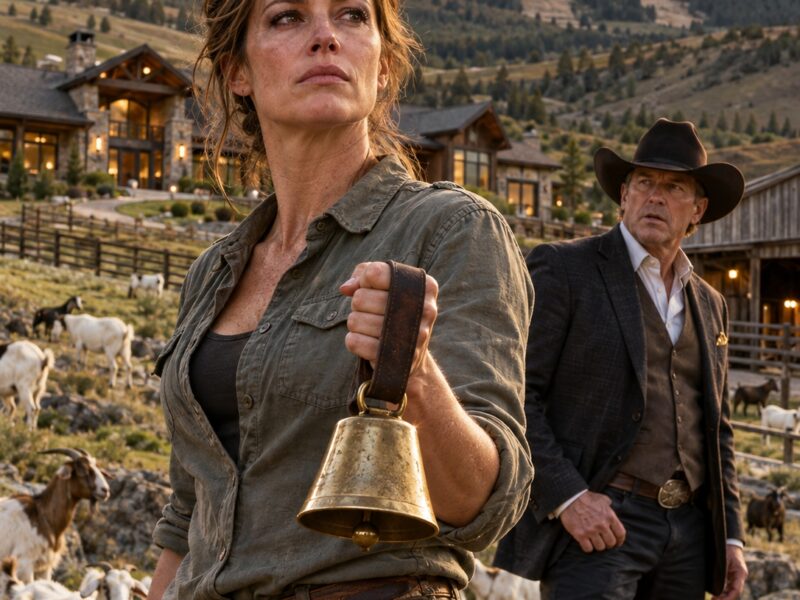
Behind her, a bell rang.
One of the goats was already trying to eat a surviving shrub.
Tessa laughed.
It surprised her.
Then the laugh broke.
She covered her mouth.
For the first time since buying Juniper Hollow, Tessa Callaway sat down in the dirt and cried.
Not because she had won.
She hadn’t.
Fire wasn’t a competition.
She cried because she still had something left to repair.
Three weeks later, roughly forty people gathered at the fire district hall for a debrief.
A fire behavior analyst displayed a map showing the final perimeter.
She explained where the fire had accelerated.
Where wind shifted.
Where suppression worked.
Where it failed.
Then she pointed to the northeast corner of Juniper Hollow.
Tessa looked up.
That section shared a boundary with Evelyn Harrington.
Evelyn was fifty-eight and owned nine hundred acres that had been in her husband’s family since the 1940s.
She had quietly agreed with Preston throughout the summer.
Modern machinery made sense to her.
Goats didn’t.
The analyst pointed to a roughly three-hundred-foot treated band.
“When the fire entered this area, intensity dropped enough for a dozer and two engines to establish an anchor.”
The room became quiet.
“They held that line through the night.”
She changed the map.
“If they hadn’t established here, the fire was positioned to run down the eastern side of the drainage.”
The pointer moved across Harrington land.
Then four additional ranches.
“Wind conditions improved after midnight,” the analyst added. “No single factor determines wildfire behavior. But without this treated area, crews would have had nowhere safe to anchor.”
Evelyn Harrington stared at the map.
She said nothing.
Afterward, she stood beside her car for a long time before leaving.
Cole visited Juniper Hollow several days later.
Tessa was rolling electric netting.
“I’ve got a question.”
“Everybody does now.”
“This one’s bothering me.”
She kept rolling.
Cole pointed northeast.
“That strip.”
“What about it?”
“It’s two-thirds of a mile from your buildings.”
Tessa stopped.
“So?”
“So it didn’t protect anything of yours.”
She resumed rolling.
“It protected ground.”
“Eighteen days of work in the hottest part of summer.”
Tessa said nothing.
“You knew.”
She looked at him.
“Knew what?”
“That if fire crossed there, it could run into Harrington’s.”
Tessa considered the question.
Cole waited.
Finally she shrugged.
“Fire doesn’t know whose fence it is.”
Cole stared at her.
That sentence followed him for the rest of his life.
He repeated it at fire-safety meetings.
At landowner workshops.
At community planning sessions.
Because it explained what everyone had missed.
Tessa had never built a wall around herself.
She had looked at terrain.
Wind.
Drainage.
Fuel.
She had put breaks where breaks mattered.
Property lines were human agreements.
Fire had never signed them.
The valley had spent months laughing at a woman who appeared to be ruining her own ranch.
In reality, she had quietly been protecting parts of theirs.
On the third Saturday in October, Preston Blackwood drove to Juniper Hollow alone.
No foreman.
No employee.
No audience.
Ash remained packed into the seams of his truck hood.
He stopped outside the gate.
He waited.
That alone told Tessa something had changed.
The old Preston would have driven through.
She walked down from the barn.
In her shirt pocket were figures for replacing the two thousand feet of shared fence.
She had calculated them three times.
Custom said neighbors split the cost.
Tessa needed Preston’s half.
She had practiced asking without sounding like she needed it.
Preston never mentioned the fence.
Instead, he looked beyond her.
Forty-seven goats were working surviving sage along the northern draw.
He watched them.
A long time.
Then he asked:
“Where’d you buy them?”
Tessa stared at him.
Of all the things she had imagined Preston Blackwood eventually saying, that was not one of them.
“Excuse me?”
“The goats.”
He cleared his throat.
“Where’d you get them?”
There are moments when life hands a person revenge so perfectly shaped that refusing it almost feels irresponsible.
Tessa could have asked if forty-seven still wasn’t a serious herd.
She could have asked about the petting zoo.
She could have asked how Preston’s expensive flail mower had performed while his hay barn burned.
She could have reminded him about the western eighty acres.
Half price.
She could have made him stand there and swallow every joke.
Tessa looked at him.
Then she turned around.
“Wait here.”
She walked into the house.
Preston stayed by the gate.
She returned with a notepad.
Wrote down a name.
A phone number.
“Broker two counties over.”
Preston accepted it.
“He still selling?”
“Don’t know. Call him.”
Tessa went back into the house.
When she returned again, she carried several photocopied sheets of graph paper.
Preston unfolded them.
Paddock sizes.
Rotation sequence.
Rest periods.
Water points.
Dates.
Treated acreage.
Her entire original plan.
He looked at her.
“Why are you giving me this?”
Tessa leaned against the gate.
“You don’t have to believe me.”
Preston looked down.
“You don’t have to like me either.”
His jaw tightened.
“I’m not asking for either one.”
“Then what are you asking?”
Tessa looked past him toward the western country.
Black scars remained visible for miles.
“Next time?”
Preston waited.
“Stop laughing long enough to look first.”
For twenty years, Preston Blackwood had found something to say at every public meeting in Callahan Valley.
That afternoon, he couldn’t find one sentence.
He folded the papers carefully.
Put them inside his jacket.
“Thank you.”
Tessa nodded.
He drove away.
By November, six ranchers had contacted her about targeted grazing.
Grant Worthington waited longest.
When he finally called, he spent forty seconds making painfully unnecessary small talk.
“How’s the roof?”
“Still leaks.”
“Truck?”
“Still hates second gear.”
“Weather’s changing.”
“Usually does.”
Silence.
Tessa waited.
Grant exhaled.
“All right.”
“All right what?”
“I’m just going to ask.”
“That’d save time.”
Another silence.
“Could your goats come over in spring?”
Tessa leaned back in her chair.
“Why?”
Grant groaned.
“You know why.”
“I’d like to hear you say it.”
“The north side of my place.”
He spoke faster now.
“Brush is heavy along the fence and I was thinking maybe before dry season you could clear it the way you did yours.”
Tessa let the silence stretch just enough.
“Yes.”
Grant exhaled audibly.
“Thank God.”
“One condition.”
“What?”
“This time they don’t work for free.”
Grant laughed.
Not because she was ridiculous.
Because he knew exactly what the sentence cost him.
“Fair enough.”
A year later, Juniper Hollow Ranch was still not the largest operation in Callahan Valley.
Tessa was not rich.
The house still needed work.
Her 1994 pickup remained in service, although she finally rebuilt the transmission.
But the thing everyone had mocked now produced her second income.
She registered a business.
Hollowline Grazing.
She bought a used gooseneck trailer.
Two guardian dogs.
Over eighteen months, the herd grew from forty-seven goats to 210.
From April through September, Hollowline ran fuel-reduction contracts across four counties.
The fire district began recommending her.
And in the second season, Blackwood Cattle Holdings signed a three-year contract covering nine hundred acres of fence line and windbreak.
Preston paid every invoice early.
He never discussed why.
Grant’s hand-painted sign—the one pointing toward Juniper Hollow with the word DESERT—disappeared sometime that winter.
Nobody asked where it went.
By the following spring, pale bands began appearing across other properties.
Along fences.
Beside roads.
On windward slopes.
Around barns.
What had once made Juniper Hollow look foolish slowly began making Callahan Valley look prepared.
Tessa kept something else from that first year.
Among the original forty-seven goats had been an old gray Spanish cross with a torn ear.
She had been one of the ugliest animals in the herd.
She had also been the first animal off the trailer that April.
Instead of hesitating, she had walked directly into a blackberry thicket as if she had spent her entire life waiting for somebody to finally give her useful work.
Around her neck was a brass bell from the liquidation sale.
Years later, when the old doe died, Tessa removed the bell.
She hung it beside the barn door for the winter.
The next spring, she fastened it to another lead goat.
And every spring afterward, the bell returned to the hillside.
On quiet evenings, Tessa would sometimes stand on the porch.
The roof eventually stopped leaking.
The barn remained imperfect.
The western slope grew back differently after the fire.
Sage returned in places.
Grass returned faster.
Fence posts weathered silver.
And from somewhere beyond the draw, the bell would sound.
Small.
Irregular.
Almost lost in the evening wind.
Tessa would remember the feed store.
The café.
The pancake breakfast.
The laughter.
They’re enough for what I need.
She remembered Preston asking whether the goats would line up at the fence and blow out the flames.
She remembered Grant naming the pale hillside the Callaway Desert.
She remembered the county complaint.
She remembered standing at twenty-seven years old in the black remains of another ranch, holding a shovel and realizing that most of the choices that decide what survives a wildfire are made long before anybody smells smoke.
And sometimes she remembered the Danbury parking lot.
Two hundred people watching an orange wall move across their valley.
Grant lowering his binoculars.
Preston holding a phone that would not stop ringing.
Cole pointing toward those ugly pale strips.
Not damaged ground.
Prepared ground.
That distinction had cost an entire valley a summer to understand.
Tessa never pretended the forty-seven goats defeated a wildfire.
They hadn’t.
Juniper Hollow lost fence.
A shed.
Tools.
Sixty acres.
Nothing that simple saves everything.
Nothing ever does.
What those animals had done was smaller.
And perhaps more important.
They changed what the fire found when it arrived.
Where there had been continuous fuel, they created separation.
Where crews would have found brush, they found ground.
Where an access road could have become a trap, they created a corridor.
Where fire could have climbed, they removed the ladder.
And on one far corner of Tessa’s property, where protecting her own buildings had nothing to do with anything, they helped create a place where firefighters could stand long enough to protect people who had spent months laughing at her.
That was the part Tessa cared about least publicly and remembered most privately.
Because Preston had been wrong about one thing larger than goats.
So had Grant.
So had Evelyn.
So had almost everyone.
They had believed survival belonged to whoever possessed the most land, the newest equipment, the biggest bank account, or the oldest family name.
Fire corrected that illusion in a single afternoon.
In a bad year, everyone in a drainage eventually stands on the same piece of ground.
The deed doesn’t matter to the wind.
The fence doesn’t matter to an ember.
And fire does not stop to ask who laughed at whom.
Years afterward, when Cole Barrett spoke at fire-safety meetings, somebody would inevitably ask him about the forty-seven goats.
“Did they really stop that wildfire?”
Cole always corrected them.
“No.”
Then he would explain.
The goats weren’t heroes.
Tessa wasn’t magical.
There had been firefighters.
Weather changes.
Dozers.
Engines.
Preparation.
Luck.
Thousands of variables no person controls.
But there had also been one woman who looked at an ordinary hillside and saw the future hiding inside the present.
And instead of trying to win an argument, she went to work.
People laughed.
She moved the fence.
People mocked the pale strips.
She moved the fence.
They excluded her from meetings.
She moved the fence.
They complained to the county.
She showed her survey, drove home—
and moved the fence.
Then one afternoon, the western sky turned orange.
And suddenly everyone could see what she had been seeing all along.
Years later, Tessa still disliked telling the story.
Whenever someone called it vindication, she shrugged.
Whenever someone called the goats miraculous, she corrected them.
Whenever someone suggested she must have enjoyed watching Preston Blackwood admit he had been wrong, she changed the subject.
Because she remembered something those versions usually left out.
The fear.
The ash.
The animals loaded into trailers.
The smell of burned earth.
The people who stood in that parking lot not knowing whether they still had homes.
The firefighters driving roads that could become death traps in seconds.
The blackened ground she walked onto afterward.
Victory was too clean a word.
Survival was closer.
One autumn evening, long after Hollowline Grazing had become an ordinary part of business in Callahan Valley, Tessa stood on the porch watching her herd work the northern slope.
The sun had dropped behind the rim.
Cold was settling into the draws.
From the hillside came the soft ringing of the old brass bell.
Tessa closed her eyes.
For a moment, she was thirty-eight again.
Forty-seven cheap goats.
A failing pickup.
A leaking roof.
A ranch most people hadn’t wanted.
A valley laughing at her.
Then the bell rang again.
Tessa opened her eyes.
Across Callahan Valley, pale treated strips now crossed properties that had once mocked hers.
One ran along Grant Worthington’s northern fence.
Another followed the windbreak at Blackwood Cattle Holdings.
Preston’s land.
Her land.
Evelyn’s land.
From a distance, the boundaries were almost impossible to see.
Maybe that was fitting.
Tessa rested her hands on the porch railing.
The herd kept moving through the sage.
The bell drifted down through the dusk.
And she thought about something she had learned years before the rest of Callahan Valley did:
The world doesn’t always warn you which ridiculous-looking thing will matter.
Sometimes wisdom arrives as a machine worth more than a house.
Sometimes it arrives in a report.
Sometimes it comes from somebody whose family has worked the same ground for four generations.
And sometimes it climbs out of a cheap livestock trailer with a torn ear, lowers its head into a blackberry thicket, and begins quietly eating the future before anybody else realizes it is coming.
Tessa smiled.
Then she listened to the bell until darkness swallowed the hillside.
The laughter had disappeared years ago.
The weather had never heard it anyway.









