They Laughed at the Girl in the Wheelchair—Then the Broke Foster Kid Knelt Down, and Her Father Saw Everything
“Nobody dances with the chair.”
The laughter hit Lily Bennett before the words had even finished crossing the ballroom.
It came from a table near the bar first—five or six young men in expensive jackets, drinks in their hands, phones already lifted.
Then it spread.
A few nervous laughs.
A few cruel ones.
A few from people who probably would have sworn the next morning that they hadn’t laughed at all.
Lily sat alone beneath the chandeliers, wearing a deep blue dress that had taken her mother three shopping trips to convince her to buy.
Her hands tightened around the rims of her wheelchair.
Across the polished dance floor, Brett Coleman grinned.
“Come on,” he called. “Somebody ask her.”
One of his friends stood.
For half a second, Lily’s face changed.
Hope was a dangerous thing because it could return even after you had spent years killing it.
The young man crossed the floor.
People began filming.
He stopped in front of Lily and bowed dramatically.
“Would you do me the honor?”
More phones rose.
Lily looked at him.
She knew.
Some part of her already knew.
Still, she whispered, “Sure.”
The boy straightened.
Then he laughed.
“Psych.”
He turned and walked away.
The table exploded.
Lily didn’t move.
Another boy approached.
Another exaggerated bow.
Another fake invitation.
This one glanced over his shoulder at Brett and said loudly, “Sorry. I can’t quite get down to your level.”
More laughter.
Someone whistled.
Someone started clapping.
Lily stared straight ahead.
She had learned that if you looked at the ceiling when you were about to cry, sometimes gravity helped.
Not always.
Tonight, apparently, not at all.
A crumpled cocktail napkin landed in her lap.
“Smile for the camera!”
She lowered her eyes.
For one terrible moment, she saw herself reflected in the black screen of a stranger’s phone.
Beautiful dress.
Perfect makeup.
Diamond earrings her mother had loaned her.
Wheelchair.
Punchline.
Two years ago, Lily Bennett had been the girl who danced on tables.
Tonight, an entire ballroom was waiting to see how quickly she could leave one.
“I can go,” she whispered.
One of her friends leaned closer.
“Lily—”
“It’s fine.”
It wasn’t.
She reached for her wheels.
And across the ballroom, behind a marble pillar where almost nobody had noticed him all night, Wesley Gardner closed his fingers around the broken pocket watch in his jacket.
He was nineteen years old.
He owned two decent shirts, one pair of dress shoes bought secondhand, three packets of ramen back in his dorm room, and the watch currently digging into his palm.
The suit he wore wasn’t even his.
He had no family in the ballroom.
No powerful last name.
No money.
No reason to make himself visible.
Everything life had taught Wesley Gardner told him to stay exactly where he was.
Then Brett Coleman shouted one final time.
“Last chance! Anybody want to dance with the chair?”
The room went strangely quiet.
Nobody moved.
Lily lowered her head.
And Wesley stepped out from behind the pillar.
Three weeks earlier, he had unpacked his entire life in less than ten minutes.
One duffel bag.
Two shirts.
Three pairs of socks.
A toothbrush.
A library card.
An acceptance letter.
And a pocket watch that hadn’t ticked in twelve years.
His new roommate had watched from the other side of the dorm room while Wesley arranged everything he owned inside half a dresser.
“You waiting on the rest of your stuff?”
Wesley had looked over.
“This is the rest.”
The roommate had laughed awkwardly because he thought Wesley was joking.
Wesley hadn’t corrected him.
He was good at that.
Letting people believe whatever made the moment easier.
At nineteen, Wesley had already learned that explanations were expensive.
Tell someone you grew up in foster care and suddenly their face changed.
Sometimes pity.
Sometimes discomfort.
Sometimes curiosity disguised as concern.
How many homes?
Did your parents die?
Were they addicts?
Were you abused?
Why didn’t anyone adopt you?
Questions asked as casually as if his childhood were a documentary they had discovered on Netflix.
So Wesley rarely explained.
He simply became good at taking up as little space as possible.
By age ten, he had already lived in eleven homes.
After eleven, he stopped counting.
There were foster parents who tried.
Others who didn’t.
There were social workers whose names he remembered and others whose faces had dissolved into a blur of clipboards and apologetic smiles.
There were trash bags used as luggage.
Bedrooms he was told not to get comfortable in.
Christmas mornings spent learning the names of people whose houses he would leave before spring.
Eventually Wesley developed a rule.
Don’t want things.
Wanting made losing hurt more.
At eighteen, he aged out of the system.
There was no party.
No mother crying at graduation.
No father slipping twenty dollars into his hand.
A tired caseworker shook his hand and gave him a bus ticket.
“Good luck, Wesley.”
That was adulthood.
A handshake.
A bus ticket.
Good luck.
Then something happened he hadn’t planned for.
He got into college.
Not merely accepted.
Scholarship accepted.
The envelope had arrived at the group home on a Tuesday afternoon, thick and cream-colored, with an embossed crest at the top.
Wesley read the first sentence six times.
Full tuition.
He carried the letter in his wallet afterward until the folds became soft.
It was proof that sometimes doors opened without immediately slamming shut again.
But scholarships had fine print.
Tuition was covered.
Hunger wasn’t.
Books weren’t always.
Bus fare wasn’t.
Random laboratory fees certainly weren’t.
So Wesley worked.
He shelved books at the university library until midnight.
Three mornings a week, he worked in the dining hall before classes.
He learned to sleep in pieces.
Forty minutes here.
Three hours there.
Sometimes he studied at a table with his forehead resting against one fist, fighting the strange floating sensation that came when his body had been awake too long.
He never complained.
Other students said they were exhausted after staying up until two playing video games.
Wesley smiled.
“Tough night.”
Tiredness wasn’t an emergency to him.
It was weather.
At the dining hall, he saw money most clearly in what people threw away.
Half a sandwich.
An unopened yogurt.
Fruit untouched.
Whole plates scraped into trash cans because somebody decided the chicken was dry.
Sometimes, after his shift, Wesley slipped sealed granola bars left on trays into his backpack.
He never stole from the kitchen.
Never took what belonged to someone else.
But abandoned food?
That was different.
Food was food.
His phone buzzed every Sunday.
Mrs. Holloway.
She had supervised the final group home where Wesley lived, and she was the closest thing to family he had.
Her messages were never dramatic.
Eat something green this week.
Did you wash your sheets?
Proud of you.
Call if you need me.
She lived four hundred miles away.
Wesley rarely called.
Calling might mean admitting he needed someone.
That was another habit he had never learned.
But he always answered.
Doing fine.
Classes good.
Eating plenty.
He never mentioned the ramen.
He never mentioned the granola bars.
And he never mentioned how strange it felt walking through a campus filled with students whose parents sent care packages because they were worried their children might get hungry.
Wesley’s father had left him exactly one thing.
The pocket watch.
A social worker handed it to him when he was seven.
“This belonged to your dad.”
That was almost everything Wesley knew about the man.
The watch was brass, scratched and heavy.
The hands were frozen at 10:03.
Inside the cover, two words had been carved by hand.
COME HOME.
As a child, Wesley used to stare at those words and wonder where home was supposed to be.
His father’s home?
His mother’s?
Some place they had planned to take him?
By nineteen, he no longer asked.
He simply carried the watch.
Other people carried photographs of family.
Wesley carried an invitation from a dead man to a place that apparently didn’t exist.
Still, he kept it.
Because broken things could matter.
Maybe especially broken things.
Then came the email about the university Winter Ball.
Wesley deleted it.
His resident adviser brought it up the next evening.
“You should go.”
“I’m working.”
“Switch shifts.”
“I don’t own a suit.”
“I do.”
Wesley stared at him.
“You’re taller than me.”
“Then don’t breathe too deeply.”
“I don’t dance.”
“Neither does half the engineering department. That hasn’t stopped them.”
Wesley smiled despite himself.
The adviser softened.
“You’re always either studying or working. Go be nineteen for one night.”
Wesley almost said no.
Instead, something small and stupid and hopeful inside him whispered:
Maybe.
Just once.
The borrowed suit was too large in the shoulders.
Wesley nearly turned around twice on the walk to Grand Hall.
Then the doors opened.
And he forgot to breathe.
Chandeliers hung from the ceiling like frozen explosions of light.
White roses covered the tables.
A live band played beneath an archway.
Students Wesley had seen wearing sweatpants all semester now looked like magazine advertisements.
Wesley immediately regretted coming.
His instincts sent him toward the nearest wall.
He found a place behind a pillar.
Perfect.
Visible enough to claim he had attended.
Invisible enough to survive it.
Then the crowd shifted.
And he saw Lily.
At first, he noticed only the woman.
Dark hair pinned elegantly above her shoulders.
Deep blue dress.
A face that made people look twice.
Then Lily moved.
Her hands touched the wheels.
And Wesley watched the entire room change its mind about her.
It happened in seconds.
Admiration.
Recognition.
Surprise.
Then pity.
Wesley knew that sequence.
Different reason.
Same look.
Lily Bennett knew it better.
Two years earlier, before the accident, she had been almost impossible to embarrass.
She danced badly and proudly.
She sang louder than the radio.
She had once climbed onto a restaurant chair on her eighteenth birthday because her favorite song came on and the manager threatened to throw her out.
Then came the rain.
A truck.
A turn taken too fast.
Metal folding.
Glass breaking.
A hospital ceiling.
And a doctor who spoke gently because gentle words were supposed to make permanent ones hurt less.
Lily lived.
Her legs never moved again.
At first, everyone came.
Flowers filled the hospital room.
Friends posted photographs.
Boys sent messages.
People called her brave so often that the word started sounding like a threat.
Then weeks became months.
The visits slowed.
Friends stopped inviting her places because they assumed she wouldn’t want to come.
Restaurants were chosen without checking entrances.
Parties happened upstairs.
Boys who once competed for her attention suddenly became excessively polite.
Polite was worse.
Polite meant distance.
Polite meant nobody wanted to admit what had changed.
Eventually Lily stopped going out.
Her father could buy almost anything.
He could not buy his daughter the feeling of being wanted.
The Winter Ball had been her friends’ idea.
“You have to come.”
“No.”
“Why?”
“Because I don’t feel like becoming an inspirational Instagram post tonight.”
They promised it wouldn’t be like that.
For almost an hour, they seemed right.
Then Brett Coleman got bored.
“Ten bucks says nobody asks her to dance.”
And the evening turned into something Lily would remember for the rest of her life.
Wesley watched from behind the pillar as the first boy mocked her.
Then the second.
He felt anger rise.
He pushed it down.
Not your fight.
He had survived nineteen years partly because he understood social hierarchies.
People like Brett Coleman controlled rooms.
People like Wesley survived them.
Keep your head down.
Finish school.
Don’t become somebody else’s target.
Then Brett shouted:
“Anybody want to dance with the chair?”
Nobody moved.
That was the part Wesley would remember.
Not the cruelty.
The silence.
A hundred people.
Nobody moved.
Lily’s fingers closed around her wheels.
She was leaving.
Wesley touched the watch inside his jacket.
COME HOME.
And suddenly he remembered every room in which nobody had chosen him.
Every group assignment where an odd number meant he stood alone.
Every waiting room.
Every foster bedroom.
Every moment when adults discussed his future while he sat three feet away as if he weren’t there.
He knew what it was to become furniture.
He knew what it was to disappear while people were still looking directly at you.
Before fear could catch him, Wesley started walking.
The first people noticed him near the band.
Then others turned.
“Who’s that?”
Wesley heard Brett.
“Hey, new guy. You lost?”
He kept walking.
Phones swung toward him.
He hated phones pointed at him.
He hated attention.
His heart was hammering.
But Lily was looking down now.
So Wesley crossed the last few feet.
Her hands were already positioned on her wheels.
Ready to escape.
He stopped.
She looked up.
Her eyes were red.
And the expression on her face broke something inside him because it wasn’t sadness.
It was defense.
She expected him to hurt her too.
“Whatever the joke is,” she whispered, “I’ve heard it.”
“No joke.”
She gave a tiny bitter laugh.
“Right.”
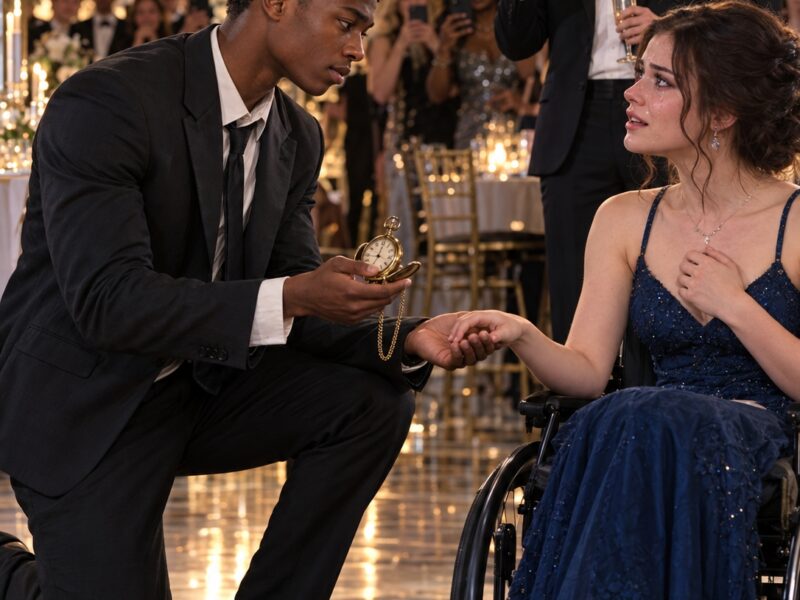
Then Wesley Gardner knelt.
Not the exaggerated bow the others had performed.
One knee.
Slowly.
Until his face was below hers.
Until he had to look up.
The ballroom quieted.
“My name’s Wesley.”
Lily stared at him.
“What are you doing?”
“Asking you to dance.”
He extended his hand.
“If you want to.”
She looked at it.
Not at him.
At his hand.
Like it might contain a trap.
“It’s another trick.”
“No.”
“You’ll pull away.”
“I won’t.”
“Everybody does.”
Wesley swallowed.
“I’m not everybody.”
Behind him, Brett laughed.
“This is pathetic.”
Wesley ignored him.
Lily didn’t.
Her eyes flicked toward the crowd.
Wesley kept his hand where it was.
“You can say no,” he said quietly.
She looked back at him.
“And then what?”
“Then I get up.”
“And everybody laughs.”
“Probably at me.”
That surprised her.
His mouth lifted slightly.
“I can live with that.”
Something in Lily’s face loosened.
Barely.
Wesley continued.
“I’m not going anywhere until you tell me yes or tell me to go.”
“Why?”
That question hurt more than he expected.
Why?
As though kindness required documentation.
As though no stranger could cross a room without wanting something.
Wesley looked at her.
“Because you were leaving alone.”
Her lips parted.
“And?”
“And nobody should have to leave a room like this because everybody else forgot how to be human.”
Silence.
Lily searched his face.
Wesley let her.
He had nothing to hide.
Slowly, she lifted her hand.
Her fingers touched his.
Cold.
He closed his hand gently around hers.
The ballroom changed.
Not loudly.
Not yet.
But Wesley felt it.
Lily did too.
He stood.
Then she stiffened.
“You’re not going to try to pull me up, are you?”
Wesley looked horrified.
“No.”
A laugh escaped her before she could stop it.
Tiny.
Real.
“Good.”
“I should probably warn you about something.”
“What?”
“I’m a terrible dancer.”
Lily stared at him.
Then another laugh.
“I’m a little out of practice.”
“Then expectations are low for both of us.”
He took both her hands.
The band had noticed.
The singer glanced toward the floor.
The song softened.
Wesley stepped backward.
Lily rolled forward.
He shifted left.
She followed.
It wasn’t a dance either of them had learned.
So they invented one.
Wesley guided her into a slow circle.
Lily turned the chair.
Her blue dress moved across her knees.
He lifted one of their joined hands.
She spun beneath it, wheels pivoting smoothly across the polished floor.
For a second she looked startled.
Then delighted.
“You’re spinning me.”
“You’re letting me.”
Again.
Faster this time.
Her hair came loose.
She laughed.
Not politely.
Not carefully.
She laughed the way people laugh when their bodies remember something their minds had buried.
Wesley forgot the crowd.
Lily forgot it too.
He turned her again.
She reached for his hand before he could offer it.
That mattered.
Minutes earlier she had been gripping her wheels to escape.
Now she was gripping him because she wanted to stay.
Near the edge of the floor, someone began clapping.
Then another person.
The sound spread.
Not mocking this time.
Real applause.
A girl covered her mouth and cried.
One of the boys who had pretended to ask Lily to dance lowered his phone.
His face had gone red.
Brett Coleman stood near the bar.
Nobody was laughing with him anymore.
That was his first punishment.
Not expulsion.
Not the consequences that came later.
It was the moment he realized the room no longer belonged to him.
Wesley had taken nothing from Brett.
He had simply given everyone something better to look at.
The song approached its final notes.
Wesley slowed.
Lily stopped in front of him.
Neither released the other immediately.
“Thank you,” she whispered.
“You don’t have to thank me.”
“I do.”
“No.”
Her eyes filled again.
This time she smiled through it.
“I didn’t think anyone would.”
Wesley understood exactly what she meant.
“That’s why I did.”
Applause filled Grand Hall.
People stood.
Wesley flinched.
Lily noticed.
“You hate this.”
“Very much.”
She laughed.
Above them, on the balcony overlooking the ballroom, a man in a dark suit gripped the railing.
He had watched everything.
The jokes.
The phones.
His daughter’s humiliation.
His own paralysis as he tried to decide whether stepping in would protect Lily or humiliate her further.
Then he had watched a stranger cross the floor.
A stranger in a suit too large for him.
A stranger who knelt.
And now Edward Bennett wasn’t looking at his daughter anymore.
He was looking at Wesley.
After the dance, people surrounded him.
“You’re incredible.”
“What’s your name?”
“Can I get a picture?”
“Dude, that was legendary.”
Wesley wanted to disappear.
Praise felt dangerous.
Attention had never been associated with anything good in his life.
“I should go.”
Lily caught his sleeve.
“Wait.”
He turned.
“At least let me buy you a drink.”
“You don’t owe me anything.”
“That isn’t why I offered.”
Wesley paused.
He believed her.
That almost made staying harder.
Her friends rushed around them.
One was crying.
Another hugged Lily.
A boy from Brett’s group approached Wesley holding folded cash.
“Hey, man.”
Wesley looked at him.
The boy offered the money.
“For the show. That was sick.”
Wesley stared at the bill.
Then at him.
“Keep it.”
The boy frowned.
“What?”
“She’s not a show.”
The smile vanished.
Wesley turned away.
As he buttoned his jacket, something slipped from the inside pocket.
Metal struck marble.
Clack.
The pocket watch slid across the floor and stopped beside Lily’s wheel.
She bent down.
“Wait.”
Wesley’s stomach tightened.
She picked it up.
The cover had opened.
Lily read the engraving.
“Come home.”
Everything around Wesley seemed to fade.
She looked up.
“Who gave you this?”
“My father.”
“Where is he?”
“I don’t know.”
The answer stopped her.
Wesley held out his hand.
“He died when I was little. At least that’s what I was told. I never really knew him.”
Lily ran her thumb over the scratched brass.
“The watch is broken.”
“Yeah.”
“But you still carry it.”
“Yeah.”
“Why?”
Wesley thought about it.
“Because broken doesn’t always mean worthless.”
Something moved across Lily’s face.
He realized too late how the words sounded.
“I wasn’t talking about—”
“I know.”
Her voice was soft.
She closed the watch.
Then placed it carefully in his palm and folded his fingers around it.
“It’s beautiful.”
Wesley looked at her.
“Broken, but beautiful?”
“Exactly.”
He smiled.
“Most things worth keeping are.”
For several seconds, neither spoke.
Then Wesley stepped backward.
“Good night, Lily.”
She blinked.
He had remembered her name.
“Wesley.”
He turned.
“Thank you.”
He gave her a small nod.
She shook her head.
“Not for dancing with me.”
He waited.
“For seeing me.”
That sentence followed Wesley all the way out of Grand Hall.
He walked past luxury cars waiting beneath the portico.
Past drivers.
Past students still filming.
Into the cold night.
He asked Lily for nothing.
Not her phone number.
Not her last name.
Not money.
Not recognition.
He simply went home to his dorm because he had a library shift the next morning.
What Wesley didn’t know was that the man on the balcony watched him leave.
Edward Bennett had spent two years asking himself a question.
Could anyone ever look at his daughter again without first seeing what had happened to her?
That night, a boy with almost nothing answered him.
By Monday, Wesley had nearly convinced himself the whole thing had been some strange dream.
He returned to work.
Classes.
Ramen.
The library.
The video appeared online.
Wesley avoided it.
He didn’t notice the crest on the Winter Ball invitation.
BENNETT FOUNDATION.
He didn’t connect it to the crest printed on the scholarship letter folded inside his wallet.
He had read that letter dozens of times.
He knew the amount.
The requirements.
The GPA he had to maintain.
He had never cared who funded it.
Three days after the ball, the dean’s office quietly requested Wesley Gardner’s file.
Across town, Edward Bennett sat in a study with a photograph on his desk.
Wesley kneeling.
Caroline Bennett stood beside him.
“You’ve watched that video forty times.”
“Forty-three.”
She looked at her husband.
“What are you looking for?”
Edward paused the video.
The screen showed Wesley’s open hand.
“I don’t know.”
“Yes, you do.”
Edward leaned back.
“I’ve spent twenty years giving money away.”
The Bennett Foundation had built hospital wings, funded scholarships, created accessibility programs and paid for thousands of things Edward would never personally see.
But wealth had made him suspicious.
People changed around money.
Good intentions acquired price tags.
Everyone seemed to want something eventually.
Then Wesley Gardner walked away.
No number.
No favor.
No photograph.
Nothing.
Edward looked at his assistant.
“Find out who he is.”
Caroline raised an eyebrow.
“Edward.”
“Nothing invasive.”
“That sentence usually comes immediately before something invasive.”
He almost smiled.
“I want to know why a kid who looked like he couldn’t afford that suit did what a room full of privileged people wouldn’t.”
His assistant hesitated.
“And if he wants something?”
Edward looked at the frozen image.
“He already had the chance to ask.”
His eyes returned to Wesley.
“He walked away.”
Thursday afternoon, an email arrived.
PLEASE REPORT TO THE SCHOLARSHIP OFFICE AT 4:00 P.M.
No explanation.
Wesley read it three times.
His stomach dropped.
Official meetings had never meant good things.
Placement changes.
Case closures.
We regret to inform you.
He spent the afternoon mentally dismantling his life.
Maybe there had been a mistake.
Maybe his scholarship was being reduced.
Maybe somebody had complained about the ball.
Maybe Brett’s family had influence.
By 3:52, Wesley was sitting outside the scholarship office wearing the borrowed jacket again because it was the closest thing he owned to professional clothing.
At exactly four, the door opened.
The dean herself appeared.
“Wesley?”
That made everything worse.
She brought him inside.
A man stood by the window.
Gray at the temples.
Dark suit.
Expensive without trying to look expensive.
He turned.
Wesley recognized him.
The balcony.
“Mr. Gardner.”
“Sir.”
“My name is Edward Bennett.”
Bennett.
The name traveled through Wesley’s mind.
The invitation.
The scholarship.
Lily.
His pulse quickened.
Edward noticed.
“Yes,” he said. “That Bennett.”
Wesley sat slowly.
“If this is about what happened at the ball—”
“It is.”
“I didn’t start anything.”
“I know.”
“I didn’t know who Lily was.”
“I know that too.”
Edward pulled a chair forward and sat opposite him.
Not behind the desk.
Eye level.
Exactly as Wesley had knelt in front of Lily.
“I was there.”
Wesley said nothing.
“I watched those boys humiliate my daughter.”
Edward’s jaw tightened.
“I watched adults do nothing. I watched students do nothing. And I stood on that balcony wondering whether going downstairs would make it worse.”
He looked away.
“That may be the most helpless I have ever felt.”
Wesley shifted uncomfortably.
“Sir, I—”
“Then you crossed the floor.”
Edward looked directly at him.
“A boy nobody seemed to know. Wearing somebody else’s suit.”
Wesley glanced down.
Edward almost smiled.
“I checked.”
“Of course you did.”
The words escaped before Wesley could stop them.
Edward laughed softly.
“Fair.”
Then his expression changed.
“Do you know what Lily told me when she came home?”
Wesley shook his head.
“She said, ‘He didn’t look away.’”
Edward’s voice broke slightly.
Wesley went still.
“Two years ago, Lily had an accident. You probably know that much.”
“A little.”
“She survived.”
Edward looked toward the window.
“I thought survival was the miracle.”
He paused.
“I was wrong.”
After the accident, he explained, the physical injuries had been brutal.
But Lily fought.
Rehab.
Pain.
Learning how to navigate spaces designed by people who had never imagined her body.
She fought all of it.
What broke her wasn’t the wheelchair.
It was what happened to everyone else.
Friends stopped calling.
Invitations disappeared.
Young men who once pursued her suddenly treated her like someone’s little sister.
The world praised her strength while quietly removing her from ordinary life.
“One night,” Edward said, “she told me, ‘Dad, nobody is ever going to choose me again. Not because they actually want me.’”
He swallowed.
“I’ve negotiated deals worth hundreds of millions of dollars. I’ve sat across from governors. I’ve funded medical programs.”
His eyes were wet now.
“And there was nothing I could say to my own daughter.”
Wesley looked down.
He knew the feeling from the other side.
Being unwanted.
Edward continued.
“Then you chose her.”
“I just asked her to dance.”
“To you.”
Edward leaned forward.
“To her, it was proof.”
Wesley’s throat tightened.
“I didn’t do anything special.”
“That is exactly why I wanted to meet you.”
Edward placed a leather folder on the desk.
Wesley immediately became wary.
“What’s that?”
“An offer.”
“I don’t need—”
“Read it.”
Wesley opened the folder.
His eyes moved down the page.
Then stopped.
Housing.
Meals.
Books.
Monthly living stipend.
Paid position with the Bennett Foundation.
Mentorship.
His brain rejected the numbers before it understood them.
Edward spoke quietly.
“Your current scholarship covers tuition. It doesn’t cover your life.”
Wesley looked up sharply.
“I reviewed your file.”
Something cold entered his expression.
“You reviewed my life.”
Edward absorbed the correction.
“Yes.”
“I didn’t ask you to.”
“No.”
Wesley closed the folder.
Edward didn’t move.
“I saw the work schedule,” he said. “Library until midnight. Dining hall mornings. I saw the housing history.”
Wesley pushed the folder back.
“No.”
Edward frowned.
“No?”
“I can’t take this.”
“Why?”
Wesley stood.
“Because I danced with your daughter.”
“This isn’t—”
“And now her billionaire father offers me housing and money and a job?”
His voice remained controlled, but his hands shook.
“You know what that makes it look like?”
“I don’t care how it looks.”
“I do.”
That silenced Edward.
Wesley pointed at the folder.
“The second I take that because of what happened that night, the dance changes.”
“No, it doesn’t.”
“Yes, it does.”
He took a breath.
“It becomes a transaction.”
Edward stared at him.
Wesley continued.
“Maybe nobody else knows. Maybe Lily doesn’t think that. Maybe you don’t. But I will.”
His voice dropped.
“I’ll know that I did one decent thing and got paid for it.”
Edward leaned back.
For several seconds he said nothing.
Then something unexpected happened.
He smiled.
Not amused.
Almost proud.
“What?”
Wesley’s defenses rose higher.
Edward shook his head.
“I’ve written very large checks in my life.”
“Congratulations.”
“I’ve never watched someone push one back so fast.”
“I’m not trying to impress you.”
“I know.”
Edward’s smile disappeared.
“That’s why you keep impressing me.”
Wesley didn’t know what to say.
Edward tapped the folder.
“So listen carefully. This is not payment for dancing with Lily.”
“Then what is it?”
“Investment.”
“In me?”
“In what you already are.”
Wesley almost laughed.
“You don’t know me.”
“I know you helped when there was nothing to gain.”
“That was one night.”
“I know you refused money from the boy afterward.”
Wesley’s expression changed.
Edward continued.
“I know you work two jobs while maintaining the grades required for your scholarship. I know you aged out of foster care. And I know that when my daughter found your pocket watch, you told her broken things can still matter.”
Wesley froze.
“How do you know about the watch?”
Edward’s face softened.
“Lily.”
Of course.
“She hasn’t stopped talking about you.”
Something uncomfortable and warm moved through Wesley.
Edward continued.
“She told me what it says.”
Wesley’s fingers automatically moved toward his pocket.
“Come home.”
The room became smaller.
“I don’t know what home it meant,” Wesley said.
Edward looked at him for a long moment.
“Maybe you were never supposed to.”
Wesley frowned.
Edward pushed the folder toward him again.
“I founded the Bennett Foundation because I believe opportunity is wasted when we give it only to people who already know how to reach it.”
He leaned forward.
“I can hire consultants. I can hire people with perfect résumés. What I cannot buy is the instinct to notice the person everyone else ignores.”
Wesley looked at the folder.
Edward’s next words were quieter.
“You have that.”
“I learned it because I was usually that person.”
“I know.”
Wesley looked up.
There was no pity in Edward’s face.
That mattered.
Edward continued.
“I’m offering you work because I think someday you could change how we do ours.”
Silence.
“And the money?”
“So you can sleep.”
Wesley blinked.
“So you can study without calculating how many granola bars equal dinner.”
His face hardened.
Edward saw he had gone too far.
“I’m sorry.”
Wesley looked away.
Shame came fast.
Ridiculous, irrational shame.
Edward waited.
Then said gently, “There’s one more thing.”
Wesley sighed.
“What?”
Edward Bennett—businessman, philanthropist, man whose name appeared on buildings—suddenly looked strangely nervous.
“My wife would like you to come to dinner Sunday.”
Wesley stared.
“What?”
“Caroline.”
“I know who your wife is.”
“She has already set a place.”
“Why?”
“Because she’s Caroline.”
“That doesn’t answer anything.”
Edward smiled.
“She told me this morning, ‘Bring the boy home.’”
Wesley stopped breathing.
Edward realized what he had said.
Neither moved.
Come home.
The words carved inside a broken watch.
The words Wesley had carried through eleven homes and every home afterward.
The words that had always felt like a cruel invitation addressed to the wrong person.
And now someone had said them again.
Bring the boy home.
Wesley’s eyes burned.
He hated that.
He looked down quickly.
“I’m not good at this.”
“At what?”
“People wanting me around.”
Edward’s expression changed.
Before he could answer, the office door opened.
Wesley turned.
Lily sat in the doorway.
No blue gown.
No diamonds.
Jeans.
Gray sweater.
Hair loose over her shoulders.
Her eyes were wet.
“You were listening?” Wesley asked.
“Most of it.”
“That’s incredibly rude.”
“I’m rich. Apparently we get away with things.”
A laugh escaped him.
Lily rolled farther inside.
Then her expression became serious.
“Say yes.”
“Lily—”
“Not because of the money.”
She stopped beside him.
“Not because my father feels grateful.”
Edward opened his mouth.
Lily lifted a finger.
“Dad.”
He closed it.
She looked back at Wesley.
“Say yes because that night was the first time in two years I didn’t feel like everyone was staring at what I lost.”
Wesley said nothing.
“You looked at me like I was just a girl sitting alone.”
“You were.”
“Exactly.”
Her voice trembled.
“And I don’t want that to be the last time I see you.”
That frightened Wesley more than the money.
Money had rules.
Contracts had clauses.
Jobs had hours.
Wanting someone around was dangerous.
Because people could change their minds.
Lily seemed to read it on his face.
“You think saying yes means you owe us something.”
“Doesn’t it?”
“No.”
“Everybody wants something.”
“Then start with dinner.”
He looked at her.
“Dinner?”
“Sunday.”
“That’s your counteroffer?”
“Yes.”
Edward leaned back, wisely staying silent.
Lily smiled.
“Come eat dinner. Hate us afterward if you want.”
“I have a library shift tonight.”
Edward laughed.
Wesley looked at him.
“What?”
“I think we can survive until Sunday without solving everything today.”
Wesley looked down at the folder.
His hand hovered over it.
Then he remembered Lily’s hand hovering over his in the ballroom.
Afraid.
Wanting to believe.
He had told her:
I’m not going anywhere until you say yes or tell me to go.
Maybe courage sometimes came back around asking for repayment.
Not money.
Trust.
Wesley pulled the folder toward himself.
His hand shook.
“I don’t know how to do this.”
Lily smiled.
“Neither did I.”
“What if I’m bad at being wanted?”
“Nobody’s good at it at first.”
He looked at Edward.
Then Lily.
Then the words inside his pocket that he could feel without touching.
Come home.
“Okay.”
His voice cracked.
He cleared his throat.
“Yes.”
What happened next was bigger than any of them expected.
The ballroom video exploded online.
First thousands of views.
Then millions.
People watched Wesley kneel.
They watched Lily’s suspicious expression.
They watched her place her hand in his.
They watched the moment she laughed.
Comments filled with people telling stories about being bullied, ignored, disabled, poor, lonely, different.
But the internet had preserved another video too.
The cruelty.
Someone placed the clips side by side.
In one, Brett Coleman laughed while boys mocked Lily.
In the other, Wesley crossed the same floor.
The contrast was devastating.
Brett’s fraternity expelled him.
An internship arranged partly through family connections disappeared.
Friends stopped answering.
For perhaps the first time in his life, Brett entered rooms and felt people judging whether he deserved to be there.
He was nineteen.
His life was not ruined.
Nor should it have been.
But for once, consequences stayed longer than laughter.
Maybe that would teach him what humiliation hadn’t.
The university announced changes.
With funding from the Bennett Foundation, it created the Open Floor Program.
Accessible dance spaces.
Inclusive seating.
Event planning that considered every body before invitations were sent.
The slogan was simple.
NO ONE SITS THIS ONE OUT.
What began partly as institutional damage control became real.
Other universities called.
Programs spread.
But the most dramatic change wasn’t institutional.
It was Lily.
The woman who had nearly rolled herself out of Grand Hall stopped hiding.
She founded a student organization focused on disability access and social inclusion.
She spoke publicly.
The first time she stood—figuratively—in front of the same campus that had watched her humiliation, Wesley stayed near the back.
Old habit.
Lily looked across the auditorium.
“For two years,” she said, “I believed I had become invisible.”
The room was silent.
“One person proved me wrong.”
She found Wesley.
“So I decided I’m going to become impossible to ignore.”
The auditorium rose.
Wesley applauded from the back.
A student beside him slapped his shoulder.
“That’s your girl up there.”
Wesley nearly choked.
“She is not my—”
The student grinned.
“Sure.”
Things changed slowly after that.
Then all at once.
Wesley started working with the Bennett Foundation’s accessibility team.
Edward didn’t treat him like a charity case.
If anything, he was harder on Wesley than everyone else.
“Your proposal is sentimental.”
“It’s human.”
“Human and measurable aren’t enemies.”
“Neither are spreadsheets and common sense.”
Edward stared at him.
Then smiled.
“Again.”
They fought.
Wesley learned.
Edward listened.
And because Wesley knew what it felt like to enter a world that had not been designed with you in mind, he began noticing flaws professionals missed.
Not just ramps.
Not just elevators.
Dignity.
Belonging.
Whether a person had to ask for special treatment just to participate.
Whether inclusion was technically possible but socially humiliating.
Lily joined some of the meetings.
She and Wesley argued constantly.
She thought he was too cautious.
He thought she occasionally treated consequences like suggestions.
She made him laugh.
He made her slow down.
Somewhere between foundation meetings, late coffee, campus walks and Sunday dinners, the viral video stopped mattering.
They became friends.
Then something neither named.
Sunday dinners became Wesley’s hardest habit to accept.
Caroline always set his place.
Even when he texted that work might make him late.
Especially then.
The first time he arrived forty minutes behind schedule, he entered the Bennett dining room apologizing.
Caroline looked up.
“Sit.”
“I’m sorry.”
“Your food’s in the oven.”
“You waited?”
“Of course.”
Two words.
Of course.
Wesley had to look away.
Nobody had ever waited dinner for him simply because his chair at the table belonged to him.
He stopped pocketing granola bars.
It took him months to notice.
One evening, he finished a foundation meeting, reached into his backpack and found nothing except books.
He stood there for several seconds.
Then he laughed.
He was no longer planning for hunger.
He slept eight hours.
That frightened him too.
Safety had strange side effects.
The body didn’t know what to do when it was no longer bracing for impact.
He kept the borrowed suit.
His resident adviser repeatedly asked for it back.
Eventually Wesley bought him a new one.
“Why not just return mine?”
Wesley looked at the oversized jacket hanging in his closet.
“Can’t.”
“Sentimental?”
“No.”
“Liar.”
Wesley smiled.
Maybe he was.
A year passed.
Grand Hall filled again.
Same chandeliers.
Same roses.
Same music.
But the floor had changed.
Level.
Wide.
Accessible.
Lily arrived in green.
Wesley wore a suit that finally fit.
People noticed them.
That still made Wesley uncomfortable.
But he had learned something.
Being seen was different from being displayed.
Halfway through the evening, he felt an old instinct.
His eyes scanned the edges of the room.
He found someone near a pillar.
Freshman.
Young.
Alone.
Jacket slightly too large.
Trying desperately to occupy less space.
Wesley stopped.
Lily followed his gaze.
She saw the boy.
Then looked at Wesley.
“Go.”
He smiled.
“You sure?”
“I have other dance partners now.”
“Cruel.”
“Go.”
Wesley crossed the ballroom.
Again.
Not toward the center this time.
Toward the edge.
The freshman straightened nervously as he approached.
“Hey.”
“Hey.”
“I’m Wesley.”
The boy nodded.
“I know.”
Wesley winced.
“Right. Internet.”
The boy smiled.
“I’m Aaron.”
“You having fun, Aaron?”
“Sure.”
It was the same lie Wesley had once told.
He leaned against the wall.
“I didn’t know anybody my first year either.”
Aaron looked toward the dance floor.
“I’m probably leaving soon.”
“You could.”
Wesley held out his hand.
“Or you could come meet some people.”
Aaron stared at it.
Wesley recognized the hesitation.
That calculation.
What does he want?
Where’s the joke?
What will this cost me?
Wesley kept his hand open.
“There’s a table over there that’ll know your name by the end of tonight.”
Aaron hesitated.
Then took it.
Across the ballroom, Lily watched.
Edward and Caroline stood nearby.
Nobody filmed.
Nobody applauded.
And somehow that made the moment more important.
Later, when the music slowed, Wesley stood near the windows and removed the pocket watch.
Edward had insisted on having it repaired that spring.
Wesley resisted for weeks.
“What if fixing it ruins it?”
Edward had looked at him.
“Sometimes we preserve damage because we confuse it with history.”
Wesley had hated how much sense that made.
So he agreed.
Now the watch ticked.
Softly.
Steadily.
The hands no longer sat frozen at 10:03.
Time had started moving again.
Wesley opened the cover.
COME HOME.
He ran his thumb across the engraving.
For years, those words had felt like a question.
Then an accusation.
Then a joke.
Come home.
Where?
To whom?
He had spent his childhood being sent from one house to another.
He had believed home was something other people inherited.
A permanent address.
A mother calling from downstairs.
A father complaining about the thermostat.
A place where your photograph stayed on the wall even after you left for college.
Wesley had thought home was a location.
He understood now that he had been wrong.
Across the ballroom, Caroline was adjusting Edward’s tie while he pretended to be annoyed.
Aaron was laughing with three students he had met twenty minutes earlier.
And Lily was watching Wesley.
She rolled toward him.
“You disappeared.”
“I’m standing in front of you.”
“Emotionally.”
“Terrifying phrase.”
She smiled.
Then noticed the watch.
“It works.”
“Yeah.”
“Does that feel weird?”
“Very.”
She stopped beside him.
Wesley looked down at the engraving.
“You know, I spent years trying to figure out where he wanted me to go.”
“Your dad?”
He nodded.
“Maybe he didn’t mean anywhere specific.”
“Maybe.”
Lily waited.
Wesley looked across the ballroom.
One year earlier, she had sat alone in its center.
One year earlier, he had hidden at its edge.
They had both believed the same lie for different reasons.
Nobody will choose me.
Then two lonely people had crossed the distance between them.
Not because either knew what would happen.
Not because there was a reward.
Not because someone was filming.
Just because one person saw another person hurting and refused to look away.
Wesley closed the watch.
Lily reached for his hand.
“Dance?”
He looked at her.
“I thought you’d never ask.”
She laughed.
As they moved toward the floor, Wesley glanced once more at the watch in his palm.
Come home.
For the first time, the words didn’t hurt.
He put the watch back inside his jacket.
Then he looked at Lily.
At Edward.
At Caroline.
At the table where a place would be waiting for him Sunday whether he arrived early, late, tired, successful, angry or afraid.
He finally understood.
Home had never been the place his father was asking him to find.
Maybe home was the place where somebody noticed when you were missing.
Maybe it was the table where your chair stayed empty until you arrived.
Maybe it was the person who saw the broken parts and never mistook them for the whole of you.
And maybe, sometimes, home began with nothing more extraordinary than one human being crossing a crowded room when everyone else had decided to stay where they were.
Wesley Gardner had spent most of his life believing kindness was the only thing he could afford to give away.
He had been wrong about that too.
Kindness had cost him nothing that night.
But it had changed Lily.
It had changed Edward.
It had changed a university.
Eventually, it had changed Wesley himself.
The boy who had entered Grand Hall wearing another man’s suit no longer stood behind pillars.
The girl who had once gripped her wheelchair and prepared to leave no longer apologized for taking up space.
The broken watch ticked against Wesley’s chest.
And beneath the chandeliers where strangers had once laughed, Lily held out her hand.
This time Wesley didn’t kneel.
He simply took it.
Because neither of them needed rescuing anymore.
They only needed what they had unknowingly given each other from the beginning.
A reason to stay.
And somewhere between one heartbeat and the next, with music rising around them and a family waiting nearby, Wesley realized the words he had carried almost his entire life had finally come true.
He had come home.









