They Laughed at the Old Janitor’s $3 Million Check—Two Hours Later, the University President Was Running After Her
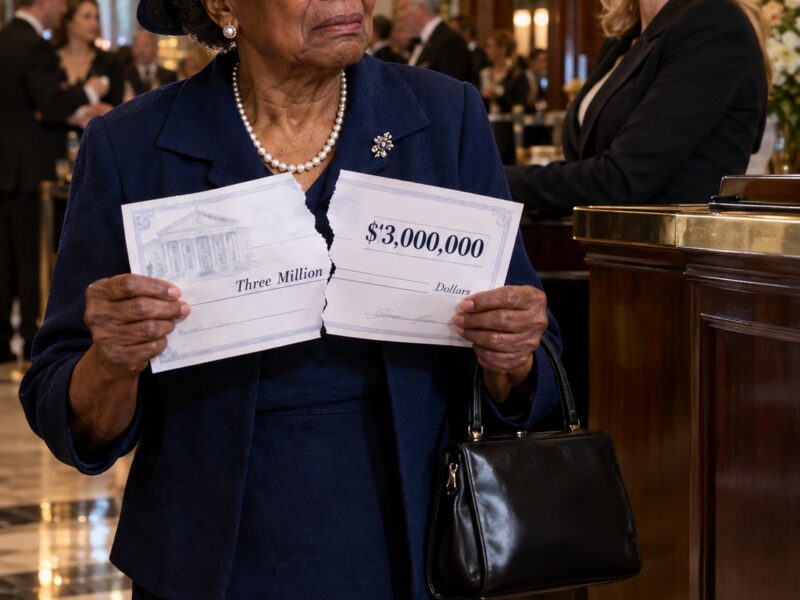
The first thing Whitney Sterling did when she saw the three-million-dollar check was laugh.
The second thing she did was tear it in half.
She never bothered to read the name at the bottom.
For several seconds, nobody in the marble lobby of Hawthorne University moved.
The sound of ripping paper had been surprisingly small.
Almost delicate.
Yet to Loretta Banks, it sounded louder than anything she had heard in thirty years of working inside those buildings.
Whitney held the two pieces between manicured fingers and stared across the polished mahogany reception desk at the elderly Black woman standing before her.
Loretta was seventy-three.
She wore a navy church dress she had owned for nearly twelve years, sensible black shoes, and a pearl pin that had belonged to her mother. Her handbag was plastic, though from a distance it tried very hard to look like leather.
She had ironed the dress twice that morning.
Not because she cared what wealthy people thought of her.
At least that was what she had told herself.
But perhaps some small part of her still did.
Behind Whitney, a young development assistant covered her mouth.
Another employee glanced at the torn check.
Then at Loretta.
Then at Whitney.
No one spoke.
Whitney finally leaned back.
“Oh my God.”
Her laughter returned.
“Three million dollars?”
Loretta’s hands remained folded over the handle of her handbag.
“Yes.”
Whitney lifted one half of the check.
“From you?”
“Yes.”
Someone near the back of the office snickered.
Whitney smiled.
“That check was real?”
Loretta asked the question quietly.
Not because she doubted it.
Because she wanted Whitney to say aloud what she apparently believed.
Whitney’s smile hardened.
“So is the door.”
She pointed toward the lobby.
“Security will walk you out.”
A few people laughed.
Not everyone.
But enough.
Loretta looked around the office.
She knew that room.
That was the strange part.
The furniture had changed. The carpet was new. The reception desk hadn’t existed when she first started working at Hawthorne University in 1982.
But the bones of the place were the same.
She had cleaned these windows.
She had polished that marble.
She had carried trays through the adjoining corridor during donor receptions where men with watches worth more than her annual salary discussed generosity over champagne.
Once, years earlier, she had scrubbed red wine from almost exactly the spot where Whitney was standing.
And now a woman who had probably never known her name was laughing because Loretta Banks had dared to write too many zeros on a check.
One of the younger employees whispered to another.
“Did she print it at the library?”
More laughter.
Loretta heard every word.
She lowered her eyes to the torn check.
Forty years.
That was what those two pieces of paper represented.
Forty years of saying no to things nobody noticed.
No new car.
No vacations.
No expensive furniture.
No second television.
No replacing a coat just because the lining had torn.
Forty years of putting something aside whenever she could.
And after her husband Samuel died, his pension had joined those savings.
He had spent thirty-six years repairing city buses.
He used to joke that they were the richest poor people in Providence because Loretta could make twenty dollars behave like fifty.
She had laughed every time.
Now Samuel was gone.
And Whitney Sterling was holding their life’s savings like a prop in a joke.
Loretta took a breath.
“No need to call security.”
Whitney raised an eyebrow.
“I know the way.”
Loretta turned toward the doors.
Then she stopped.
Her eyes traveled across the shining floor.
“I mopped these floors for thirty years.”
Nobody laughed that time.
She walked away.
Behind her, Whitney dropped the torn check into a wastebasket.
As casually as if she were throwing away a receipt.
And that should have been the end of it.
Except someone else had been watching.
Her name was Gabrielle Carter.
She was twenty-four, a temporary catering assistant working that afternoon because the university was preparing for its annual Founders Gala.
Gabrielle had been carrying a tray of water glasses when the confrontation began.
She had heard the laughter.
She had watched Loretta’s shoulders tighten.
And she had seen something in the old woman’s face that everyone else seemed to miss.
Loretta wasn’t embarrassed.
She was hurt.
There was a difference.
Embarrassment makes people want to disappear.
Hurt makes them remember.
Loretta reached the revolving doors.
Her shoe caught slightly against the edge of the rug.
She stumbled.
Gabrielle dropped the towel in her hand.
“Oh—ma’am.”
She rushed forward.
“Are you all right?”
Loretta steadied herself against the brass railing.
For the first time that afternoon, somebody touched her as if she mattered.
“I am fine, dear.”
Gabrielle glanced back toward the development office.
Whitney was already talking to someone else.
As though nothing had happened.
Gabrielle’s jaw tightened.
“Let me walk you out.”
“You don’t have to.”
“I know.”
That answer made Loretta look at her.
Gabrielle smiled faintly.
“I still want to.”
They walked through the doors together.
Outside, autumn wind moved across Hawthorne’s old brick buildings.
Students crossed the quad carrying laptops and coffee cups. A bell rang somewhere beyond Fuller Hall.
Life continued with the insulting normalcy it always seemed to have after somebody’s dignity had been wounded.
Gabrielle stayed beside Loretta.
They reached the stone steps.
She hesitated.
Then curiosity won.
“Was it really three million dollars?”
Loretta looked at her.
“Every penny.”
Gabrielle stopped walking.
Loretta almost smiled.
It was the first honest reaction she had received all afternoon.
“No offense,” Gabrielle said, “but… three million?”
“Forty years of saving.”
Loretta looked toward the campus.
“And my late husband’s pension.”
Gabrielle’s expression changed.
The number was no longer abstract.
It had become decades.
Two lives.
Thousands of ordinary sacrifices nobody had applauded.
“Why give it here?”
Loretta looked toward the old dining hall.
“I started in that building in 1982.”
She pointed.
“I was twenty-nine years old. Two children. Rent overdue. Samuel had just been laid off from the transit garage for six weeks.”
Gabrielle listened.
“My first supervisor told me the job was temporary. Thirty years is a strange definition of temporary.”
Gabrielle laughed softly.
Loretta did too.
Then the smile faded.
“I watched generations of students come through this place. Some were rich enough to complain about dorm rooms bigger than my apartment. Some were working two jobs just to stay enrolled.”
She looked at the stone buildings surrounding them.
“I could never afford a single class here.”
The sentence landed harder than Gabrielle expected.
Loretta continued.
“But I believed education could change a family’s direction.”
Gabrielle looked toward Fuller Hall.
“My father is a janitor there.”
Loretta stopped.
“What is his name?”
“Marcus Carter.”
Recognition came immediately.
“Marcus with the bad left knee?”
Gabrielle laughed.
“Yes.”
“He still hiding it from everybody?”
“He thinks nobody notices.”
“Everybody notices.”
Gabrielle smiled, but tears had already begun gathering behind her eyes.
“My dad wanted me to go here.”
“What happened?”
“I got accepted.”
Loretta waited.
“I couldn’t afford it.”
The wind moved between them.
Gabrielle looked away.
“So I went to community college for a year. Then Mom got sick. Dad needed help. I stopped.”
Loretta studied the young woman beside her.
Suddenly the humiliation inside the development office felt smaller than the reason she had entered it.
She reached over and touched Gabrielle’s hand.
“Then that money was for you.”
Gabrielle stared at her.
“For people like you.”
Loretta’s voice tightened.
“Children who grow up watching their parents clean classrooms they can never afford to sit in.”
Gabrielle didn’t know what to say.
Loretta did.
She opened her handbag.
Took out her phone.
And called her bank.
Two hours later, inside Hawthorne University’s ballroom, Whitney Sterling was preparing to congratulate herself.
The Founders Gala was one of the university’s biggest events of the year.
Crystal chandeliers glowed above white tablecloths.
A string quartet played near the staircase.
Waiters moved between donors carrying champagne.
The university had spent almost eighty thousand dollars creating an evening dedicated to celebrating generosity.
Whitney stood near the stage wearing a silver evening gown and speaking with a venture capitalist when her assistant approached.
“Ms. Sterling?”
“Not now.”
“It’s Mr. Dorson from the cashier’s office.”
Whitney sighed.
“What?”
“He says there’s an issue with a check.”
Her annoyance returned immediately.
“Please cancel it and issue a new one.”
Her assistant blinked.
“He says we can’t.”
Whitney turned.
“Why?”
“Because it isn’t ours.”
Whitney frowned.
“What are you talking about?”
Before the assistant could answer, University President Martin Kesler stepped onto the stage.
Martin was sixty-one and had spent most of his career learning how to make wealthy people feel indispensable.
Tonight was supposed to be simple.
Praise donors.
Announce gifts.
Smile for photographs.
Raise money.
“Ladies and gentlemen,” he said, “tonight we celebrate the people whose generosity makes Hawthorne’s future possible.”
Applause.
Martin continued.
“Vance Capital has pledged two hundred thousand dollars toward our student opportunity initiative.”
More applause.
At a table near the front, Richard Vance stood and nodded.
Whitney smiled.
Two hundred thousand.
A good gift.
Respectable.
The kind of number that got a donor photographed.
Then Martin’s chief of staff approached the stage and whispered something in his ear.
Martin’s expression changed.
Only slightly.
But Whitney noticed.
He leaned away from the microphone.
“What?”
The chief of staff whispered again.
Martin stared toward Whitney.
Then he stepped down from the stage.
“Sterling.”
Whitney walked toward him.
“What happened?”
“The bank called my office.”
Martin kept his voice low.
“A three-million-dollar check was issued to Hawthorne today.”
Whitney went still.
“What?”
“Three million.”
Around them, applause continued for another donor.
Martin didn’t seem to hear it.
“Where is it?”
Whitney’s mouth went dry.
A memory surfaced.
Navy dress.
Plastic handbag.
The sound of laughter.
Two torn pieces of paper.
She forced herself to smile.
“There was an old woman earlier.”
Martin stared.
“What old woman?”
“She brought in what looked like a fake check.”
“What did you do?”
“I handled it.”
Martin’s eyes narrowed.
“How?”
Whitney hesitated.
That was enough.
Martin’s chief of staff looked between them.
“What does ‘handled it’ mean?”
Whitney crossed her arms.
“She walked in without an appointment. She wasn’t on the donor schedule. She had no documentation. She handed me a personal check for three million dollars.”
“And?”
“I assumed it was fraudulent.”
Martin’s face was losing color.
“The bank says it was real.”
Whitney said nothing.
“Who issued it?”
Martin asked his chief of staff.
The answer came immediately.
“Loretta Banks.”
The name struck Martin with unexpected force.
He knew it.
Not well.
But he knew it.
Everyone who had been at Hawthorne long enough knew Loretta.
She had worked dining services.
Catering.
Night cleaning.
Special events.
She had retired more than a decade earlier.
Martin looked at Whitney.
“Loretta Banks?”
Whitney searched her memory.
“She was wearing some kind of church dress.”
Martin stared at her.
“And carrying a plastic handbag?”
Whitney’s expression confirmed it.
Martin closed his eyes.
For one second.
Then he opened them.
“Where did she go?”
“She left.”
“When?”
“About two hours ago.”
Martin stepped closer.
“Find her.”
Whitney’s voice sharpened.
“Martin—”
“Now.”
The gala continued behind them.
Champagne glasses clinked.
A donor laughed.
Someone announced another six-figure contribution.
But all Martin Kesler could think about was a three-million-dollar check lying in a wastebasket.
Real.
And somewhere outside the university, the woman who wrote it had just learned exactly how Hawthorne treated people who didn’t look wealthy enough to matter.
The torn check was recovered seven minutes later.
One half had coffee spilled across it.
The other had landed beneath a stack of discarded envelopes.
Martin held the pieces together.
$3,000,000.00.
Pay to the order of Hawthorne University.
Loretta M. Banks.
There was nothing fake about it.
The room around Whitney became painfully quiet.
Martin looked at her.
“You tore this?”
Whitney swallowed.
“I made a judgment call.”
“No.”
Martin stared at the check.
“You made a judgment.”
There was a difference.
And now the entire university was about to pay for it.
They found Loretta forty minutes later.
She hadn’t gone far.
Gabrielle had taken her to a small diner several blocks from campus because Loretta’s hands had begun shaking after she called the bank.
She wasn’t crying.
Gabrielle almost wished she were.
Tears would have made sense.
Instead, Loretta sat beside the window with a cup of coffee cooling between her hands.
Gabrielle’s phone kept buzzing.
University staff.
Her supervisor.
Someone from the president’s office.
She ignored them.
Then three black university vehicles pulled up outside.
Loretta saw them.
“So now they know.”
Gabrielle looked at her.
“You don’t have to talk to them.”
Loretta gave a tired smile.
“I spent thirty years talking to people who didn’t listen. Might as well try once more.”
Martin entered first.
Whitney followed.
Two members of Hawthorne’s board came behind them.
The diner suddenly felt very small.
Martin approached the booth.
“Mrs. Banks?”
Loretta didn’t stand.
“I am Martin Kesler. President of Hawthorne University.”
“I know who you are, Dr. Kesler.”
Martin paused.
Loretta lifted her coffee.
“I served you breakfast for six years.”
His face changed.
Not dramatically.
Just enough.
He remembered.
Not her name.
That was worse.
He remembered the woman who used to refill his coffee before faculty meetings.
The woman whose existence had apparently required a three-million-dollar check before he bothered to know who she was.
“Mrs. Banks,” he said, “I am deeply sorry for what happened today.”
Loretta looked at Whitney.
Whitney looked uncomfortable for the first time.
“It was a misunderstanding,” Martin continued.
Loretta’s gaze returned to him.
“No.”
Martin stopped.
“Excuse me?”
“A misunderstanding is when someone hears the wrong time for a meeting.”
Her voice remained calm.
“She tore my check in half before she read my name.”
Whitney shifted.
“I had reasonable concerns—”
Loretta turned toward her.
“You laughed.”
Whitney went silent.
“You didn’t ask where the money came from.”
Loretta continued.
“You didn’t call the bank. You didn’t ask for identification. You didn’t ask whether I had an appointment.”
Her eyes hardened.
“You looked at my dress, my shoes and my handbag.”
Nobody interrupted.
“And then you decided how much money a woman like me was allowed to have.”
Whitney’s cheeks flushed.
“That wasn’t—”
“That was exactly what happened.”
Loretta didn’t raise her voice.
She didn’t need to.
Martin pulled out the empty chair across from her.
“Mrs. Banks, may I sit?”
Loretta nodded.
He did.
“I cannot undo what happened.”
“No.”
“But I would like to understand what you intended the gift to accomplish.”
Loretta’s eyes moved toward Gabrielle.
Gabrielle looked confused.
Loretta turned back to Martin.
“Do you know what that money was for?”
“Please tell me.”
“A scholarship.”
Martin waited.
Loretta’s voice softened.
“For the sons and daughters of every janitor, cook, dishwasher, groundskeeper, maintenance worker and cafeteria employee on your campus.”
Gabrielle stared at her.
Loretta continued.
“I watched those people for thirty years.”
Her fingers tightened around the coffee cup.
“They come in before professors. They leave after students. They shovel snow before sunrise so somebody else’s child can walk safely to class.”
Martin lowered his eyes.
“They clean bathrooms.”
Loretta’s voice trembled now.
“They empty trash. They fix pipes. They serve food they cannot afford to buy at the restaurants your donors visit after meetings.”
Nobody moved.
“And many of them have children who grow up looking at this university every day.”
Loretta pointed through the diner window toward the distant campus.
“They see the towers. The classrooms. The lawns. They hear people talk about opportunity.”
She looked at Martin.
“But the door is always just a little too expensive to open.”
Gabrielle wiped at her cheek.
Loretta saw her.
“That money was supposed to change that.”
Martin took a breath.
“Mrs. Banks, we can still do that.”
Loretta said nothing.
“We can have another check prepared tonight. Our legal team can create the scholarship exactly as you intended.”
Whitney nodded quickly.
“Yes. Absolutely.”
Loretta looked at her.
Whitney stopped speaking.
“I already called my bank.”
Martin’s expression tightened.
“The check has been canceled.”
Silence.
Three million dollars had disappeared from Hawthorne University without ever reaching its account.
Martin looked genuinely shaken.
“Is there anything we can do?”
Loretta studied him.
For a long moment, she said nothing.
Then she looked at Whitney.
“There is.”
Whitney straightened.
Loretta’s voice was quiet.
“Ask yourself why she gets to decide who walks through that door.”
Martin looked at Whitney.
Whitney laughed nervously.
“Martin, surely we’re not turning an unfortunate mistake into some kind of public execution.”
Loretta said nothing.
She didn’t have to.
Martin stood.
“Whitney.”
Whitney stared at him.
“You are relieved of your duties.”
Her face emptied.
“What?”
“Effective tonight.”
“You cannot be serious.”
“I am.”
Whitney pushed back from the table.
“Over one check?”
Loretta finally spoke.
“No.”
Everyone looked at her.
She held Whitney’s gaze.
“Over every person you sent back out that door before me.”
Whitney’s expression changed.
And Martin noticed.
Not anger.
Fear.
Because Loretta had named the question nobody in the room had asked.
If Whitney had dismissed a three-million-dollar donor because of her appearance, how many people without three million dollars had she dismissed before?
How many scholarship applicants?
How many parents?
How many former employees?
How many people had entered that office with nothing but a question and been taught, within thirty seconds, that Hawthorne did not believe they belonged?
Whitney looked toward Martin.
“You’re destroying my career to impress a donor.”
Martin shook his head.
“You still don’t understand.”
“What am I supposed to understand?”
“That she stopped being a donor when she canceled the check.”
The words silenced the table.
Martin continued.
“I’m doing this because what happened today revealed a problem that existed before she walked into your office.”
Whitney looked around for support.
She found none.
She picked up her purse.
For one second, her eyes settled on Loretta.
There were a hundred things she could have said.
An apology.
A defense.
An accusation.
She chose silence.
Then she walked out.
Loretta watched the door close behind her.
She felt no triumph.
That surprised Gabrielle.
Perhaps it surprised Loretta too.
Justice, she had learned over seventy-three years, rarely felt like victory.
Usually it felt like finally putting down something heavy.
Martin remained standing.
“Mrs. Banks.”
Loretta looked up.
“Will you give us one more chance?”
She glanced at Gabrielle.
“No.”
Martin’s shoulders fell.
Then Loretta continued.
“But I will give Gabrielle a chance.”
Gabrielle blinked.
“Me?”
Loretta smiled.
“You walked me out when nobody else would.”
“I just—”
“You didn’t know about the money.”
Gabrielle fell silent.
That was the point.
Kindness after discovering three million dollars could be strategy.
Kindness before discovering it was character.
Loretta turned toward Martin.
“If this scholarship happens, she will help run it.”
Gabrielle’s eyes widened.
“I don’t know anything about running a scholarship.”
“You know who it’s for.”
Loretta looked at Martin.
“That matters more.”
Martin nodded.
“We can arrange training.”
“And there are conditions.”
“Name them.”
“The scholarship carries her father’s name.”
Gabrielle covered her mouth.
Loretta continued.
“Marcus Carter spent twenty-seven years cleaning Fuller Hall. His daughter should not have needed three million dollars to make somebody notice him.”
Gabrielle was crying openly now.
Martin nodded.
“Done.”
“And the program will not be run from the development office.”
“Where?”
Loretta looked toward the campus.
“The dining hall.”
Martin seemed surprised.
Loretta wasn’t.
“That is where I learned what this university actually is.”
She leaned forward.
“You want to find the people who need the scholarship? Don’t wait for them to climb the marble staircase to your donor office.”
Her voice sharpened.
“Go where they work.”
Martin nodded slowly.
“Done.”
“Applications must be available to every full-time and part-time service employee.”
“Done.”
“No recommendation letters from wealthy alumni.”
“Agreed.”
“No photographs of recipients used in fundraising without their permission.”
Martin hesitated.
Then nodded.
“Agreed.”
“And nobody gets rejected because their parents don’t know the right language to use on an application.”
Gabrielle looked at Loretta.
This wasn’t spontaneous.
Loretta had thought about it.
For years, perhaps.
Martin understood that too.
“You planned all of this.”
Loretta looked down at her hands.
“My husband and I talked about it before he died.”
Her voice softened.
“Samuel used to say if we ever had enough, we should build a door instead of putting our name on a wall.”
For the first time that evening, Martin smiled.
“Your husband sounds like a wise man.”
“He was annoying.”
Gabrielle laughed through her tears.
Loretta smiled.
“And wise.”
Martin looked toward the university.
“The gala is still happening.”
Loretta raised an eyebrow.
“I know.”
“Come back with us.”
“No.”
“Mrs. Banks—”
“I spent thirty years working those parties.”
She shook her head.
“I don’t need to attend one.”
Martin considered that.
Then he said something Loretta did not expect.
“You wouldn’t be attending this one.”
He looked at her.
“You would be changing it.”
Less than an hour later, the ballroom doors opened.
Conversations stopped one table at a time.
Martin Kesler stepped onto the stage.
Gabrielle stood behind the curtain, still wearing her catering uniform.
Loretta stood beside her.
“You nervous?” Gabrielle whispered.
“No.”
“You’re squeezing my hand.”
Loretta looked down.
She was.
“All right,” she admitted. “A little.”
Gabrielle smiled.
Martin reached the microphone.
“Ladies and gentlemen, our program has changed.”
Murmurs spread through the ballroom.
“Tonight we planned to celebrate generosity.”
Martin paused.
“But before we do that, I believe Hawthorne needs to confront the difference between celebrating generosity and recognizing humanity.”
The room became quiet.
“Earlier today, our university failed someone.”
Loretta listened.
Martin did not hide behind vague language.
He explained that a former employee had arrived with a major charitable gift.
He explained that she had been dismissed.
He explained that the check had been destroyed without verification.
Several board members shifted uncomfortably.
Good, Loretta thought.
Comfort had caused enough trouble today.
Martin looked toward the curtain.
“Please welcome Mrs. Loretta Banks.”
For half a second, nothing happened.
Then applause began.
Loretta didn’t move.
Gabrielle touched her arm.
“That’s you.”
“I know who I am.”
“Then go remind them.”
Loretta laughed.
She stepped onto the stage.
The applause grew.
She saw hundreds of faces.
Donors.
Faculty.
Trustees.
Administrators.
People she had served for decades.
Some recognized her.
Most didn’t.
That was all right.
Tonight they would.
Loretta reached the microphone.
She waited for the room to become silent.
“Thirty years ago, I mopped this floor during parties like this one.”
Nobody moved.
Loretta looked toward the chandeliers.
“I remember standing over there.”
She pointed toward the far wall.
“Guests would leave their glasses on tables, and I would wait until they moved before cleaning around them.”
A few people lowered their eyes.
“I knew which professors drank coffee after dessert. I knew which donors left food untouched. I knew which trustees tipped the coat-check girls and which ones didn’t.”
A ripple of nervous laughter moved through the ballroom.
Loretta smiled.
“People who clean rooms learn a lot about the people who believe nobody is watching.”
The laughter stopped.
“I never attended Hawthorne University.”
She looked across the crowd.
“I could not afford to.”
“But I worked here long enough to believe in what this place says it stands for.”
She paused.
“Opportunity.”
The word hung in the air.
“The problem with opportunity is that it sounds beautiful from inside an open door.”
Loretta’s eyes moved across the room.
“It sounds different when your family has been standing outside that door for generations.”
At that moment, the ballroom doors opened again.
Dozens of people entered.
Cooks.
Janitors.
Groundskeepers.
Maintenance workers.
Dining hall employees.
Some were still in uniform.
Martin had sent staff members to find everyone still working on campus.
The front row had been cleared.
Loretta’s throat tightened.
“Tonight,” she said, “the people who still mop this floor are sitting in the front row.”
The ballroom erupted.
Not polite applause.
Not donor applause.
Something louder.
Something less controlled.
Loretta stepped away from the microphone for a moment.
Gabrielle stood near the curtain.
Then she saw him.
Her father.
Marcus Carter sat in the front row wearing his navy maintenance uniform.
His hands were rough.
His left knee was angled slightly because it always hurt after long shifts.
He stared at Gabrielle.
She stared back.
Loretta noticed.
She leaned toward her.
“Your father is in the front row.”
Gabrielle’s lips trembled.
“I see him.”
“Then go.”
“What?”
“Go show him.”
“Show him what?”
Loretta smiled.
“That somebody finally saw him.”
Gabrielle walked toward her father.
Marcus stood.
He looked confused when she threw her arms around him.
“What happened?” he whispered.
Gabrielle couldn’t answer at first.
She simply held him.
Around them, people kept applauding.
Finally she whispered into his shoulder.
“Dad, they’re naming a scholarship after you.”
Marcus pulled back.
“What?”
Gabrielle laughed and cried at the same time.
“The Marcus Carter Scholarship.”
Her father’s face collapsed.
Not dramatically.
Quietly.
The way working men sometimes cry when life finally gives them something they never permitted themselves to ask for.
“No.”
“Yes.”
“For what?”
“For people like me.”
He looked toward Loretta.
Loretta nodded.
Marcus removed his glasses.
He wiped them even though they weren’t dirty.
Then he wiped his eyes.
Across the ballroom, Richard Vance stood.
The billionaire investor had spent most of the evening watching events unfold with unusual silence.
He approached the stage.
Martin offered him the microphone.
“Mrs. Banks.”
Loretta looked at him.
“Vance Capital would like to match your gift.”
A murmur swept across the room.
Three million dollars.
Matched.
Six million total.
Loretta looked at Richard.
“You sure?”
Laughter broke through the tension.
Richard smiled.
“Every penny.”
Loretta nodded.
“Then write the check.”
More laughter.
She waited.
“And this time nobody tears it.”
The ballroom exploded in applause.
Richard laughed.
“No, ma’am.”
But Loretta wasn’t finished.
Other donors began approaching Martin.
A hundred thousand.
Fifty thousand.
Twenty-five.
Another two hundred.
Within minutes, the scholarship that had almost died in a wastebasket was becoming something larger than Loretta had imagined.
Yet standing beneath the chandeliers, she felt an unexpected ache.
She wished Samuel were there.
He would have hated the tuxedos.
He would have complained about the tiny portions.
He would have stolen two dinner rolls and wrapped them in a napkin for later.
And when everyone began applauding, he would have leaned toward her and whispered:
Don’t let them make this about you.
Loretta could almost hear him.
So when Martin approached her after the gala with several board members, she was ready.
“Mrs. Banks,” he said, “the board has been discussing how Hawthorne might recognize what you’ve done.”
Loretta sighed.
“That sounds dangerous.”
Martin smiled.
“We would like to rename the dining hall in your honor.”
Gabrielle’s eyes widened.
The board chair nodded.
“Banks Hall.”
Loretta looked toward the ballroom.
Workers were clearing plates now.
The gala was ending.
She watched a young dishwasher push a cart through the service doors.
She remembered herself at twenty-nine.
Tired.
Broke.
Afraid.
She remembered herself at thirty-seven, working overtime because her daughter needed braces.
At forty-five, hiding a wrist injury because she couldn’t afford unpaid leave.
At fifty-two, packing leftover rolls after events because Samuel had been between jobs.
At fifty-nine, learning that a freshman she had encouraged during night shifts had become a doctor.
Thirty years.
A thousand invisible moments.
And suddenly they wanted to put one name above the door.
Loretta shook her head.
“Don’t name it after me.”
Martin looked surprised.
“Why not?”
“Because I wasn’t the only one who cleaned it.”
She looked at the workers moving through the room.
“I wasn’t the only one who missed birthdays because somebody needed the late shift.”
She pointed toward Marcus.
“I wasn’t the only one whose children grew up watching their parents work inside a university they couldn’t afford.”
Loretta touched the pearl pin on her dress.
“Name it after all of us.”
The board chair frowned slightly.
“How?”
Loretta thought for a moment.
Then smiled.
“The Commons.”
Martin waited.
“The Workers’ Commons.”
Gabrielle smiled.
Loretta nodded.
“Put every service employee’s name somewhere inside. Past and present. Janitors. Groundskeepers. Kitchen workers. Maintenance. Everyone you can find.”
Martin stared at her.
“That could be thousands of names.”
“Good.”
Loretta looked toward the entrance.
“Then maybe people will finally understand how many hands it takes to keep one door open.”
Three months later, construction began.
Not on a new building.
On a wall.
Hawthorne University gathered employment records going back nearly sixty years.
Thousands of names were engraved into dark stone panels inside the dining hall.
Marcus Carter found his name on the third panel.
He touched it with one finger.
Gabrielle stood beside him.
“You know what’s strange?” he said.
“What?”
“I cleaned this wall.”
Gabrielle laughed.
“I know.”
“For twenty-seven years.”
“I know, Dad.”
“Nobody ever told me they’d put my name on it.”
Gabrielle took his arm.
“Maybe they should have.”
The scholarship office opened inside the dining hall that same week.
Gabrielle Carter became its first program coordinator.
She went back to school part-time.
Hawthorne covered her tuition.
Loretta insisted that wasn’t charity.
“It is overdue wages from the universe,” she said.
Gabrielle didn’t argue.
The first year, thirty-two children of university service workers received scholarships.
The second year, there were fifty-eight.
Some became nurses.
Some teachers.
One became an engineer.
One dropped out after a semester and returned three years later.
Loretta liked that story best.
Not every open door leads to a straight road.
Whitney Sterling disappeared from Hawthorne’s donor world.
There were rumors that she found another job.
Loretta never asked.
She had not wanted revenge.
She had wanted the door changed.
And that distinction mattered.
One autumn afternoon, almost exactly a year after the check had been torn, Loretta returned to campus alone.
She walked slowly now.
Her knees were worse.
The buildings looked the same.
Students hurried past without recognizing her.
She liked that.
Legacy did not require recognition.
When she entered the dining hall, she found Gabrielle behind a desk helping a nervous seventeen-year-old boy complete a scholarship application.
His mother worked in the kitchen.
His father drove a city bus.
Loretta stopped several feet away.
The boy was staring at one question.
Gabrielle leaned toward him.
“You don’t have to make yourself sound impressive.”
He looked embarrassed.
“What should I write?”
“The truth.”
“What if the truth isn’t enough?”
Gabrielle smiled.
“It is here.”
Loretta felt something tighten in her chest.
She turned before Gabrielle could see her.
Near the entrance was the wall of names.
She found Samuel’s first.
Samuel Banks.
He had never worked at Hawthorne.
But the board had added a small inscription honoring the spouses and families whose sacrifices made the work possible.
Below it was Loretta M. Banks.
She touched both names.
For a moment she imagined Samuel standing beside her.
Probably complaining that the letters were too small.
She laughed under her breath.
Then she looked through the glass doors.
Students crossed the quad.
Workers pushed carts.
A groundskeeper raked leaves beneath an elm tree.
Nothing looked revolutionary.
That was perhaps the most beautiful part.
Real change rarely announces itself with music.
Sometimes it is simply a girl sitting behind a desk where her father once emptied trash cans.
Sometimes it is a scholarship application in the hands of a child who thought college belonged to somebody else’s family.
Sometimes it is an old woman walking into a building where people once laughed at her handbag and discovering that nobody remembers the laughter anymore.
But they remember the door.
Before leaving, Loretta noticed something above the entrance.
The university had installed a bronze plaque.
It did not carry her name.
It carried a sentence taken from her speech.
EVERY DOOR ON THIS CAMPUS SHOULD OPEN THE SAME.
Loretta stood beneath those words for a long time.
Then Gabrielle noticed her.
“Mrs. Banks!”
Loretta turned.
Gabrielle hurried across the room.
“You weren’t going to say hello?”
“You looked busy.”
Gabrielle hugged her.
“I always have time for you.”
Loretta glanced toward the young applicant.
“How is he doing?”
“Terrified.”
“Good.”
Gabrielle laughed.
“Why good?”
“Means he understands it matters.”
They stood together near the entrance.
Outside, evening settled over Hawthorne.
The same marble steps remained.
The same old buildings.
The same expensive windows reflecting the sunset.
Loretta thought about the afternoon one year earlier.
A woman behind a desk had looked at her dress and decided she could not possibly be worth three million dollars.
But Whitney Sterling had misunderstood something much larger than the value of a check.
Loretta’s worth had never been three million dollars.
Neither was Marcus Carter’s.
Neither was Gabrielle’s.
Neither was the cook working downstairs or the groundskeeper pushing leaves into a pile outside.
Money had simply forced the university to confront a truth it should have recognized without it.
Loretta looked through the open doors.
A janitor approached carrying a box.
A student immediately stepped aside and held the door for him.
The janitor nodded.
“Thank you.”
“No problem.”
Two ordinary words.
An ordinary gesture.
Nobody applauded.
Nobody took a photograph.
Nobody wrote a check.
Loretta smiled anyway.
Because maybe Samuel had been right.
You didn’t need your name on a wall.
Sometimes the best thing you could leave behind was a door that stayed open after you were gone.









