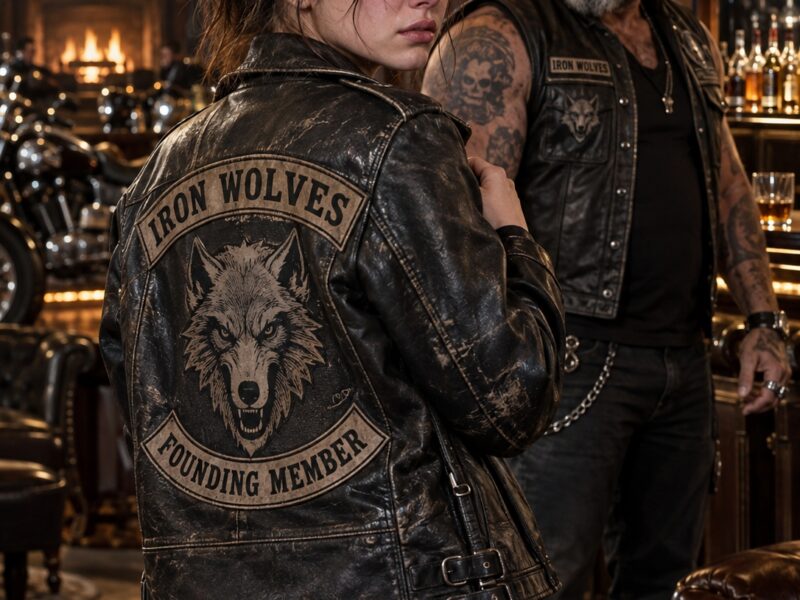
THEY LAUGHED WHEN A TEENAGE GIRL WALKED INTO THE IRON WOLVES’ BAR—THEN THEY SAW THE PATCH ON HER BACK
The first man who laughed at Mira Rivers would spend the rest of that night wishing he could take the sound back.
It happened just before sunset on a dry September evening outside Kingman, Arizona, in a roadside bar where strangers normally knew better than to walk in uninvited.
The Iron Den sat alone beside a forgotten stretch of old Route 66, its rust-red roof glowing under the last light of day. A dozen motorcycles stood angled outside like black animals resting after a hunt. Inside, the air smelled of grilled onions, gasoline, old wood, leather, and the faint cigarette smoke that still seemed trapped in the walls from a different era.
The Iron Wolves Motorcycle Club had occupied the back half of the bar for so many years that most locals no longer thought of the place as a public establishment.
It was their territory.
Their photographs covered one wall.
Their dead were remembered on another.
Men with gray beards and tattooed arms sat beneath faded license plates, drinking beer and arguing over an engine rebuild when the front door creaked open.
A narrow beam of orange sunlight cut across the floor.
Then a girl stepped through it.
She looked seventeen.
Maybe younger.
Her dirty sneakers made almost no sound against the floorboards. Her jeans were faded at the knees, her dark hair was pulled into a loose ponytail, and an oversized black leather jacket hung from her shoulders as if it belonged to somebody twice her size.
Every conversation in the room lost half its volume.
Mira stopped three steps inside.
Twenty men looked at her.
She could feel every pair of eyes.
She had imagined this moment during the forty-minute bus ride from town. She had imagined walking straight to the bar, saying the words clearly, refusing to cry.
In none of those versions had her hands trembled this badly.
She pushed them into the pockets of the jacket so nobody would see.
Behind the counter, Lou Mercer paused while drying a glass.
At a corner table, a huge man called Tank Wallace turned his chair.
Tank was fifty-four, six-foot-four, broad enough to make the wooden chair beneath him look temporary. His beard was streaked with silver, and the Iron Wolves insignia covered most of the back of his sleeveless vest.
He looked at Mira.
Then toward the door behind her.
Nobody followed.
Tank gave a short laugh.
“What is this?”
A couple of men chuckled.
Mira said nothing.
Tank leaned back.
“Somebody lose a Girl Scout?”
The laughter came louder this time.
Not vicious.
Not yet.
It was disbelief more than cruelty—the reaction of men whose world had been predictable for too long and had suddenly been interrupted by something that didn’t belong.
A younger member near the pool table whistled.
“Wrong clubhouse, kid.”
Another man said, “High school’s about ten miles east.”
More laughter.
Mira felt heat climbing her neck.
For one terrible second, she almost turned around.
Her mother had begged her not to come.
Those men have their own lives now.
Mira had answered, Dad said they were family.
Her mother had looked away.
That silence had frightened Mira more than any warning could have.
Now she understood it.
Maybe family was just another word adults used when they were young and brave and thought promises lasted forever.
Mira tightened her fingers around the lining of her father’s jacket.
Then she raised her head.
“I need to speak to whoever runs this club.”
That quieted a few men.
Tank looked amused.
“You do?”
“Yes.”
“About what?”
“That’s between me and him.”
Someone behind Tank murmured, “Kid’s got nerve.”
Tank’s smile thinned.
“I’m president.”
Mira looked directly at him.
“Then I need to talk to you.”
Tank motioned toward a chair.
“You selling cookies?”
The room laughed again.
This time Mira didn’t shrink.
She turned slightly.
And that was when Lou Mercer dropped the glass.
It struck the rubber mat behind the counter with a dull thud instead of breaking, but the sound was enough to pull several heads toward him.
Lou wasn’t looking at the girl.
He was looking at her back.
At the jacket.
More specifically, at the faded patch stitched between the shoulders.
The leather was cracked with age. The white thread had yellowed. Parts of the embroidered wolf were worn nearly smooth.
But the words were still readable.
IRON WOLVES
And beneath them:
FOUNDING MEMBER
Lou’s face lost its color.
“Turn around.”
Mira glanced over.
“What?”
Lou came slowly from behind the counter.
“Kid, turn around.”
The laughter died.
Something in Lou’s voice changed the room.
Mira turned.
Tank stopped smiling.
A chair scraped.
One of the older riders stood.
Then another.
The founding-member patch had not been issued in thirty-two years.
There had only ever been twelve.
Four of those men were still alive.
Seven were dead.
And one jacket had disappeared after a funeral nearly a decade earlier.
Tank stood so quickly his chair struck the wall.
“No.”
The word came out like air leaving him.
Mira turned back.
Tank stared at the patch, then at her face.
For the first time, she saw something other than amusement in his expression.
Fear.
Not fear of her.
Fear of a memory.
“Where did you get that jacket?”
Mira swallowed.
“It belonged to my father.”
Nobody moved.
Tank’s jaw tightened.
“What was his name?”
She had rehearsed the answer.
Still, saying it in that room felt different.
“My dad was Eli Rivers.”
Silence.
It was so complete Mira could hear an old ceiling fan clicking as it rotated above them.
Tank lowered himself back into the chair.
Lou gripped the edge of the bar.
A man near the pool table removed his cap.
Someone whispered, “Jesus Christ.”
Mira looked around.
The faces had changed.
These weren’t men staring at an intruder anymore.
They were men looking at a ghost.
Eli Rivers.
The name had once been painted across racing tanks, scratched into repair benches, yelled across highways, whispered in hospital corridors and funeral homes.
Eli had been nineteen when he rode with the first generation of Iron Wolves.
Twenty-three when he helped write their club rules.
Thirty-one when he became road captain.
Forty-two when his daughter was born.
Forty-seven when he died on Route 66 after pulling strangers from a burning SUV.
According to the newspaper, Eli had been driving home during a thunderstorm when he saw a vehicle overturn near mile marker 68.
He stopped.
The engine caught fire.
Two parents got out.
Their six-year-old boy did not.
Eli went back.
Witnesses later said the flames had already reached the rear compartment when he broke the window.
He got the boy out.
Then part of the fuel system ignited.
Eli survived long enough for paramedics to transport him to the hospital.
He died before sunrise.
Mira had been eight.
At his funeral, motorcycles stretched nearly half a mile down the road.
Tank Wallace had carried the coffin.
Lou Mercer had stood beside Mira’s mother.
Men she didn’t know had crouched in front of her, promising that if she ever needed anything, the Iron Wolves would come.
She remembered one of them saying, “Your daddy was our brother. That makes you ours too.”
At eight years old, Mira had believed him.
At seventeen, she had finally come to test the promise.
Tank stared at her.
“You’re Mira?”
She nodded.
His face changed again.
He rubbed one large hand across his mouth.
“I remember you being about this tall.”
He held his palm near his waist.
“I grew.”
A few men smiled uneasily.
Tank didn’t.
“What are you doing here?”
Mira looked around the room.
The question she had traveled all this way to answer suddenly felt humiliating.
She hated needing anyone.
Her mother had taught her how to stretch groceries through the end of the week, how to fix a leaking faucet with plumber’s tape, how to pretend final notices were ordinary mail.
They had survived nine years without coming here.
Mira almost lied.
Then she remembered the envelope in her backpack.
She pulled it out.
It had been folded so many times that the edges had softened.
She set it on Tank’s table.
He looked at it.
FINAL NOTICE OF FORECLOSURE PROCEEDINGS.
Tank didn’t touch it.
“What’s this?”
“They’re taking our house.”
His head came up.
Mira forced herself to continue.
“My mom’s sick.”
“How sick?”
“She has congestive heart failure.”
The words seemed to physically strike him.
“She worked until February. Then she started passing out. She can’t stand long enough to finish a shift anymore.”
Tank looked toward Lou.
Lou’s expression told Mira he hadn’t known.
Nobody had known.
Mira reached into her backpack again and removed another stack of papers.
Hospital bills.
Prescription invoices.
Mortgage notices.
A utility shutoff warning.
She spread them across the table, hating every second.
“I started working evenings at a grocery store. It covers food and some medicine. Mom gets disability now, but it’s not enough. She sold Dad’s tools. Then his truck. Then everything she could.”
Her voice nearly broke.
She stopped.
Tank stared at the papers.
“What about insurance?”
“Gone.”
“Family?”
“It’s just us.”
“Why didn’t your mother call?”
Mira laughed once.
There was no humor in it.
“You know my mother.”
That answer hurt him more than if she had shouted.
Tank looked down.
Yes.
He knew Claire Rivers.
Proud.
Quiet.
Stubborn enough to go hungry before asking for food.
The kind of woman who had once stitched up Eli’s arm in their kitchen because he refused to go to the emergency room.
“She never told us,” Tank said.
“No.”
“Why?”
Mira hesitated.
Then she said what her mother would have hated hearing.
“Because she didn’t think you’d come.”
The words settled heavily across the table.
Nobody spoke.
Tank’s eyes slowly lifted.
Mira could see shame appearing in them.
She hadn’t come to shame anyone.
She had come because the electricity had almost been shut off three nights earlier.
Because her mother’s oxygen concentrator needed electricity.
Because a bank representative was scheduled to come Wednesday.
Because she was seventeen and terrified.
“My mom told me not to come,” Mira said. “She said you all had families. Jobs. Problems. She said Dad’s been gone almost ten years and people move on.”
Tank flinched.
Mira continued.
“But when I was little, she used to tell me stories.”
“About what?”
“You guys.”
Several men looked away.
“She said when Dad broke his leg in Utah, three Wolves drove through the night to get him home. She said when Lou’s bar burned, Dad helped rebuild it for free. She said when Tank’s son was born early, Dad sat outside the NICU until sunrise because Tank was too scared to sit alone.”
Tank stared at her.
Nobody in the younger half of the club knew that story.
Mira’s voice softened.
“Mom said Dad believed the whole point of wearing that patch was that nobody had to face the worst day of their life alone.”
Tank looked down at his own patch.
For the first time in years, it felt heavy.
Mira picked up the foreclosure notice.
“I figured maybe she was wrong.”
Tank whispered, “About what?”
“About you forgetting.”
A long silence followed.
Then somebody at the back muttered, “Damn.”
Tank looked around the bar.
His men avoided his eyes.
That told him everything.
For years they had ridden charity toy runs at Christmas. They had attended veterans’ funerals. They had raised money whenever one of their own crashed.
They had congratulated themselves on loyalty.
And twelve miles away, the widow of one of their founders had been choosing between heart medication and electricity.
Tank slowly removed his cap.
“Kid…”
Mira shook her head.
“I’m not asking for a handout.”
“No?”
“I need time.”
Tank frowned.
“The bank says if we pay the missed amount by Wednesday, they’ll stop the foreclosure process. I thought maybe someone here knew somebody who could give me work. Real work. More hours.”
Tank stared at her.
“How much?”
“What?”
“How much do you owe?”
Mira hesitated.
“Six thousand eight hundred and forty dollars.”
A man near the wall swore under his breath.
Tank leaned back.
“When’s Wednesday?”
“Three days.”
“And you thought you were going to work off almost seven grand in three days?”
“No.”
Mira’s face reddened.
“I don’t know what I thought.”
That sentence changed something in the room.
Until then she had seemed composed beyond her years.
Now, suddenly, she looked seventeen.
Scared.
Exhausted.
Trying to solve an adult disaster with a teenager’s impossible arithmetic.
Tank pushed his chair back.
“Lou.”
“Yeah?”
“Close the bar.”
Mira looked up sharply.
Lou stared at him.
“It’s Saturday.”
“I know what day it is.”
“You serious?”
Tank looked around the room.
“Anybody here planning to complain?”
Nobody did.
Lou walked to the front door.
Turned the lock.
Flipped the sign from OPEN to CLOSED.
Tank picked up the foreclosure letter.
“Call Moose.”
A bearded rider pulled out his phone.
“Why?”
“He still know that attorney in Phoenix?”
“Yeah.”
“Get her.”
Another man said, “I know a guy at Desert Valley Bank.”
“Call him too.”
Mira stiffened.
“Wait.”
Nobody listened.
“Tank.”
He looked at her.
“I said I’m not asking you to pay everything.”
“I heard you.”
“Then what are you doing?”
Tank folded the foreclosure notice carefully.
“Keeping a promise about nine years late.”
Mira opened her mouth.
Then the front door rattled violently.
Everybody turned.
Somebody on the outside pulled the handle again.
Three hard knocks followed.
Lou frowned.
“We’re closed!”
A man’s voice answered from outside.
“Looking for Mira Rivers.”
Mira went still.
Tank saw it.
“Who is that?”
She didn’t answer.
“Mira.”
Another knock.
Harder.
The stranger called through the door.
“Miss Rivers, I know you’re in there. Your mother sent me.”
Mira’s face drained of color.
Tank lowered his voice.
“Kid. Who’s outside?”
She stared at the door.
Then whispered, “I don’t know.”
Tank and Lou exchanged a look.
The room changed instantly.
Chairs shifted.
Men stood.
The teasing atmosphere vanished.
Tank walked toward the door.
Mira grabbed his arm.
“Wait.”
He looked at her hand, then at her.
“What?”
“My mother doesn’t know I’m here.”
That stopped him.
Outside, the man knocked once more.
“Mira? We need to talk about Claire.”
Tank’s voice became quiet.
“Behind me.”
“I can handle—”
“Behind me.”
Something in his tone ended the argument.
Mira stepped back.
Lou unlocked the deadbolt but kept the chain in place.
He opened the door three inches.
A man in a pale dress shirt stood outside beside a silver sedan.
Mid-forties.
Clean haircut.
No tattoos.
No biker colors.
He held an envelope.
“I’m looking for Mira Rivers.”
Tank appeared beside Lou.
“Who are you?”
The stranger looked past him.
His gaze found Mira.
“There you are.”
Tank moved enough to block his view.
“I asked who you are.”
The man sighed.
“Daniel Mercer. I represent Desert Horizon Recovery.”
Nobody recognized the company.
Mira did.
Her stomach dropped.
“What do you want?”
Daniel looked directly at her.
“Your mother collapsed forty minutes ago.”
The room seemed to tilt.
Mira stopped breathing.
“What?”
“She was taken to Kingman Regional.”
Mira pushed past Tank.
“Is she okay?”
“I don’t know.”
Daniel raised the envelope.
“But there’s something else you need to understand before you leave.”
Tank’s eyes narrowed.
“What?”
Daniel looked at Mira’s jacket.
Then at the old founding-member patch.
For the first time, his confident expression changed.
He seemed to recognize it.
“That house your mother is about to lose?”
Mira stared.
Daniel continued.
“The bank isn’t the only party with a claim against it.”
Tank stepped closer.
“What the hell does that mean?”
Daniel pulled a document from the envelope.
“It means Eli Rivers left behind a debt nobody here seems to know about.”
Mira’s face hardened.
“My father didn’t owe anybody.”
Daniel looked almost sympathetic.
“That’s what your mother wanted you to believe.”
Then he handed Tank the document.
At the bottom was a signature.
ELIAS RIVERS.
And beside it was a number large enough to wipe the room silent all over again.
$146,000.
Mira looked from the paper to Tank.
“No.”
Her voice came out thin.
“That’s not real.”
Nobody answered.
Mira ripped the page from Tank’s hand.
She knew her father’s handwriting.
Or thought she did.
She had birthday cards upstairs in a shoebox.
Notes he had written inside books.
A message on the garage wall in black marker:
MIRA — NEVER TOUCH DAD’S TORQUE WRENCH. YES, I MEAN YOU.
The signature looked frighteningly close.
Daniel Mercer buttoned his jacket.
“There’s more.”
Tank looked at him.
“Then start talking.”
But Mira was already moving toward the door.
“My mom is in the hospital.”
Tank nodded once.
“You heard her. We’re going.”
“I came on the bus.”
“You’re not leaving on a bus.”
He turned toward the room.
“Wolves.”
Chairs scraped.
Keys came out.
Within two minutes, the Iron Den parking lot erupted.
Engines started one by one until the ground itself seemed to vibrate.
Mira stood in the middle of the noise, overwhelmed.
Tank brought around a black pickup instead of his motorcycle.
“Get in.”
Mira stared at the line of bikes assembling behind them.
“What are they doing?”
“Coming with us.”
“All of them?”
Tank looked into the rearview mirror.
“Not all.”
Mira counted sixteen headlights.
She looked back at him.
“That’s basically all.”
Tank put the truck in gear.
“You came to the Iron Wolves for help, kid.”
He pulled onto the highway.
“Turns out we’re finally listening.”
The convoy reached Kingman Regional just after nine.
Mira ran through the emergency entrance before Tank had fully parked.
She found her mother in a cardiac observation unit, pale beneath a hospital blanket, oxygen tubing beneath her nose.
Claire Rivers looked smaller than Mira remembered seeing her that morning.
Illness had a way of stealing people in increments.
First their appetite.
Then their color.
Then their strength.
Finally, the illusion that things would somehow return to normal.
“Mira?”
Claire tried to sit up.
“What happened?”
“I should ask you that.”
Mira reached the bedside.
“You passed out.”
“I’m fine.”
“You’re in the hospital.”
“I said I’m fine.”
Mira almost laughed from frustration.
Claire looked toward the doorway.
Her expression froze.
Tank Wallace stood there.
Behind him were Lou and two other Iron Wolves.
Claire’s eyes closed.
“Oh, no.”
Mira’s anger flared.
“Seriously?”
Claire looked at her daughter.
“You went there.”
“Yes.”
“I told you not to.”
“And I told you we’re losing the house.”
Claire’s eyes moved to Tank.
“You need to leave.”
Tank didn’t move.
“Claire.”
“No.”
“Please.”
“You had nine years.”
Lou looked down.
Tank took the words without defending himself.
Claire’s voice sharpened.
“My daughter does not need your pity.”
“It’s not pity.”
“Then what is it?”
Tank looked at the woman he had last seen standing beside Eli’s coffin.
Back then Claire had worn black and held eight-year-old Mira’s hand so tightly the child’s fingers had gone white.
Tank had promised her.
Anything you need.
Then came time.
Then work.
Then club politics.
Then deaths and divorces and bills of his own.
A month became a year.
A year became nine.
Eventually shame made calling harder than silence.
“That’s the problem,” Tank said.
Claire stared.
“We spent years telling ourselves loyalty meant showing up when somebody called.”
His voice thickened.
“Eli never waited for people to call.”
Claire looked away.
Mira remembered the document.
She pulled it from her jacket.
“Who is Daniel Mercer?”
Claire’s entire body went rigid.
Tank noticed.
So did Mira.
“Mom?”
Claire stared at the paper.
“Where did you get that?”
“A man came to the Iron Den.”
Claire’s monitor quickened.
Mira stepped closer.
“He says Dad owed a hundred forty-six thousand dollars.”
“Mira.”
“He says there’s a claim against the house.”
“Mira, stop.”
“Is it true?”
Claire closed her eyes.
That was the answer.
Mira stepped back.
“No.”
Claire whispered, “It’s complicated.”
“That’s what adults say when the truth is worse.”
Tank remained near the door.
Claire looked at him.
“You don’t need to hear this.”
“Yes, he does,” Mira said.
“No, he doesn’t.”
“He was Dad’s best friend.”
Claire’s voice snapped.
“That’s exactly why he doesn’t!”
Silence filled the hospital room.
Tank’s face changed.
Mira slowly turned toward him.
“What does that mean?”
Claire pressed her fingers to her forehead.
The cardiac monitor continued its electronic rhythm.
Tank took one step inside.
“Claire.”
She looked at him.
“Did Eli borrow that money for the club?”
No answer.
Tank’s jaw tightened.
“Claire.”
Her eyes filled.
“It wasn’t supposed to become this.”
Lou whispered, “Oh, hell.”
Mira looked between them.
“What wasn’t?”
Claire covered her face.
And ten years of secrets began to crack.
Four months before Eli Rivers died, the Iron Wolves had nearly lost their clubhouse and the Iron Den.
Most members never knew.
The club had invested in a repair garage during the recession, using the property as collateral. When the business collapsed, a lender moved toward foreclosure.
Tank had been road captain then.
The president, Hank Dwyer, had hidden the severity of the debt.
Eli discovered it.
He also discovered something worse.
Several younger members had borrowed against personal property because they believed the garage would save their jobs.
If the entire structure collapsed, three families would lose homes.
The bar would close.
The club would fracture.
Eli quietly obtained a private loan.
He pledged part of his own property.
Then he used the money to settle the most urgent debts.
Tank stared at Claire.
“He never told me.”
“He didn’t want you to know.”
“Why?”
“Because your son had just been born.”
Tank looked as though someone had struck him.
Claire continued.
“You were spending every night at the hospital. Tyler weighed three pounds. Eli said you had enough to worry about.”
Tank leaned against the wall.
“And Hank?”
“Knew.”
Tank’s head snapped up.
“Where is Hank?”
Lou answered quietly.
“New Mexico.”
Tank looked furious.
Claire said, “Eli made him promise the club would repay the loan gradually.”
“Did it?”
“No.”
Tank closed his eyes.
Mira felt sick.
“So Dad lost our house saving the club?”
Claire reached for her.
“No. Listen to me.”
Mira stepped away.
“All these years you told me Dad died a hero.”
“He did.”
“You didn’t tell me he left us buried in debt.”
“He didn’t leave us anything on purpose.”
“Then why hide it?”
Claire’s expression broke.
“Because you worshipped him.”
Mira went still.
Claire began crying silently.
“You were eight years old. You slept in his jacket for six months. Every night you asked me if heroes still knew their children after they went to heaven. What was I supposed to tell you?”
Mira’s anger faltered.
Claire wiped her cheek.
“That your father made a financial decision he thought he could fix? That the people he trusted didn’t know what he’d done? That I was angry at a dead man because I loved him?”
Her voice cracked.
“I wanted you to remember your father, not his mistakes.”
Tank stared at the floor.
Claire turned toward him.
“And I didn’t call because every time I thought about the Iron Wolves, I remembered that loan.”
Tank whispered, “We didn’t know.”
“I know.”
That hurt worse.
Claire looked exhausted.
“That’s the part I hated most. I knew you didn’t know. And if I told you, you’d feel responsible.”
“We are responsible.”
“No.”
“Yes.”
Tank finally looked up.
“Maybe not for Eli keeping it secret. But we’re responsible for disappearing.”
Claire didn’t argue.
Mira sat beside the window.
Outside, motorcycle headlights filled part of the hospital parking lot.
Sixteen men waiting.
Men her father had trusted enough to risk his family’s home for.
She didn’t know whether she wanted to hug them or scream at them.
Maybe both.
“Is Daniel’s claim legal?” Tank asked.
Claire shook her head slowly.
“I don’t know.”
“He said Desert Horizon Recovery.”
“They bought the debt years ago.”
“How much have you paid?”
Claire gave a bitter laugh.
“Enough that I stopped counting.”
Tank’s face darkened.
Lou pulled out his phone.
“I’m calling Rebecca.”
“Who’s Rebecca?” Mira asked.
“Attorney.”
Tank walked toward the door.
“Where are you going?” Claire asked.
“To find Hank Dwyer.”
Claire sat up.
“No.”
Tank turned.
“If he knew—”
“Tank.”
“If he knew Eli put your home against that loan and he let us go nine years without finding out—”
“Tank!”
Claire’s monitor alarmed briefly.
Mira grabbed her hand.
Tank stopped.
Claire breathed carefully until the numbers settled.
Then she looked at him.
“Eli died because he ran toward a burning car.”
Tank said nothing.
“Don’t turn his memory into an excuse to start another fire.”
The words stayed with him.
He nodded once.
“Fine.”
Then he looked at Mira.
“But I’m not letting them take that house.”
The legal truth emerged by morning.
It was ugly, but not hopeless.
The original debt had indeed belonged to Eli.
But the paperwork also contained irregular fees, questionable transfers and interest calculations so aggressive that Rebecca Chen, the attorney Lou contacted, used the phrase “predatory enough to make me cancel breakfast.”
More importantly, the foreclosure threat involved two separate obligations.
The mortgage delinquency was real.
The private lien was disputed.
They had time.
Not much.
But time.
Tank called an emergency club meeting.
At eleven the next morning, twenty-seven Iron Wolves stood inside the Iron Den.
Mira sat in the corner.
Nobody laughed now.
Tank placed Eli’s loan documents on the table.
Then he told them everything.
When he finished, an older member named Reaper Collins removed his glasses and rubbed his eyes.
“We were riding because of him.”
Nobody answered.
Reaper shook his head.
“We were riding because of him, and his widow was drowning twelve miles away.”
A younger man said, “We didn’t know.”
Tank looked at him.
“Stop saying that.”
The room fell quiet.
“We didn’t know because we didn’t ask.”
Nobody challenged him.
Tank looked around.
“Eli used to say brotherhood starts the morning after the funeral.”
Lou nodded slowly.
Tank continued.
“We were pretty damn good at funerals.”
Several men lowered their heads.
“Flowers. Flags. Engines. Speeches. We were there for all of it.”
His voice hardened.
“Then life got inconvenient.”
Mira watched men twice and three times her age absorb the accusation.
Tank pointed toward the photograph wall.
Eli’s picture was there.
Young.
Laughing.
One boot resting on the foot peg of a 1981 Harley-Davidson Shovelhead.
“The club owes Eli’s family.”
A man named Cole raised his hand slightly.
“How much?”
“All of it.”
Someone asked, “Club account?”
Tank shook his head.
“No.”
He reached into his pocket.
Pulled out an envelope.
Placed it on the table.
“My personal savings. Five thousand.”
Mira jumped up.
“No.”
Tank ignored her.
Lou put down another envelope.
“Two.”
Reaper said, “Three.”
The younger rider near the pool table who had laughed the night before opened his banking app.
“Eight hundred.”
Another man said, “Twelve hundred.”
“Five hundred.”
“Two thousand.”
“Three-fifty.”
Within eleven minutes, there was enough money pledged to stop the mortgage foreclosure.
Mira stood furious beside the table.
“I told you I didn’t want charity.”
Tank looked at her.
“You’re right.”
“Then stop.”
“This isn’t charity.”
“It looks like money.”
“It’s repayment.”
“For a debt I didn’t make?”
“No.”
Tank pointed at Eli’s photograph.
“For one we did.”
Mira had no answer.
They paid the mortgage arrears that afternoon.
But the money wasn’t the part that changed Kingman.
The next morning was.
At 7:10 a.m., Claire Rivers woke to the sound of engines.
She walked slowly toward the living room window.
Then stopped.
Motorcycles lined the street.
Pickup trucks followed.
Trailers.
Ladders.
Paint.
Lumber.
Toolboxes.
Food.
Mira stood on the porch in pajamas, staring.
Tank climbed from his truck carrying a circular saw.
Lou hauled two boxes of groceries.
Cole unloaded fence boards.
Reaper brought roofing materials.
Claire opened the door.
“No.”
Tank smiled.
“Morning.”
“No.”
“Roof’s leaking.”
“I know.”
“Fence is falling.”
“I know.”
“Back steps are rotten.”
“I know, Tank.”
He pointed toward the gutter.
“That thing’s one storm away from killing somebody.”
Claire crossed her arms.
“You paid the mortgage.”
“Temporary problem.”
“You called the lawyer.”
“Different problem.”
“You’re not rebuilding my house.”
Tank looked toward the driveway.
Twenty men stared back at him.
Then at Claire.
Lou whispered, “We already bought the paint.”
Claire glared at him.
Lou raised both hands.
“Can’t return custom color.”
Mira covered her mouth to hide a smile.
Claire saw it.
For the first time in weeks, maybe months, her expression softened.
Tank took advantage.
“Eli fixed my transmission in a motel parking lot at two in the morning once.”
Claire sighed.
“I know.”
“Wouldn’t take money.”
“I know.”
“Reaper says Eli roofed his mother’s garage.”
“I remember.”
“Lou says—”
“I was married to the man, Tank. I know what he did.”
Tank smiled faintly.
“Then you know why arguing is pointless.”
Claire stared at the riders.
Then at the damaged porch.
Then at her daughter.
Mira was smiling.
A real smile.
Something Claire had not seen enough lately.
“Don’t touch my roses,” she said.
Tank grinned.
“Yes, ma’am.”
By noon, half the neighborhood had come outside.
People who normally complained about the Iron Wolves’ exhaust were watching men with tattooed arms repaint window frames and replace rotten boards.
Tank rebuilt the back steps.
Lou repaired kitchen cabinets.
Two younger Wolves cleared weeds.
Reaper discovered electrical wiring behind a wall that made him whisper three different prayers despite not believing in God.
Mira painted the porch railing.
Her mother sat beneath an umbrella with a blanket over her legs, directing operations like a reluctant general.
For a few hours, the house felt alive.
Then a black SUV pulled to the curb.
Tank recognized the driver before the door opened.
Hank Dwyer.
The former president of the Iron Wolves was seventy now.
Thin.
White-haired.
Still tall.
Conversation died as he approached the house.
Mira noticed immediately.
“Who’s that?”
Tank set down his hammer.
“The man who knew about your dad’s loan.”
Mira put down her paintbrush.
Hank walked toward them.
His eyes found Eli’s jacket hanging from the porch chair.
He stopped.
For several seconds, nobody spoke.
Then Claire came outside.
Hank removed his sunglasses.
“I heard.”
Claire looked at him with an expression Mira couldn’t read.
“You took your time.”
Hank nodded.
“I did.”
Tank stepped down from the porch.
“You knew.”
“Yes.”
“And said nothing.”
“Yes.”
Tank’s hands curled.
Hank didn’t retreat.
“I deserve whatever you want to say.”
“You let Eli put his house on the line.”
“Yes.”
“You let Claire pay that debt.”
“Yes.”
“You let us believe everything was settled.”
Hank looked toward Claire.
“Yes.”
Tank stepped closer.
Mira saw several Wolves move instinctively.
Claire said, “Don’t.”
Tank stopped.
Hank reached into his jacket.
He pulled out an old envelope.
“I came because there’s something you don’t know.”
Mira felt the tension return.
“What?”
Hank looked at her.
“Your father didn’t just borrow money for the club.”
Tank frowned.
“What the hell else was there?”
Hank held out the envelope.
“He was investigating someone.”
Mira stared.
“Investigating who?”
“One of us.”
The porch went silent.
Hank gave the envelope to Mira.
Her father’s handwriting was on the front.
IF SOMETHING HAPPENS TO ME, GIVE THIS TO TANK.
Tank went pale.
Mira looked at him.
“You never got this?”
“No.”
Her eyes turned to Hank.
“Why?”
Hank’s face folded with shame.
“Because I was a coward.”
Inside were copies of bank records.
Repair invoices.
Property transfers.
Notes written by Eli.
Tank spread them across the porch table.
Piece by piece, the past changed.
The club garage had not simply failed.
Money had been disappearing from it.
Small amounts first.
Then larger ones.
Someone had been billing the garage for parts that never arrived.
Someone had created fake repair orders.
Someone had borrowed against the club’s property using forged authorization.
Eli had discovered it.
“Who?” Tank asked.
Hank looked toward the older members standing in the yard.
“Dean Hollis.”
The name moved through them.
Dean had been club treasurer.
He had died five years earlier.
Tank stared at the papers.
“He stole from us?”
“For nearly three years.”
“And Eli knew?”
“He suspected. Then proved it.”
Mira felt cold.
“Did my father’s accident have anything to do with this?”
Claire stood sharply.
“Mira.”
“What?”
“No.”
Hank looked at her.
“The police investigated the crash.”
Mira’s heart beat harder.
“That isn’t what I asked.”
Hank answered carefully.
“There was never evidence anybody caused it.”
“But?”
Tank glared at him.
“What are you holding back?”
Hank exhaled.
“Eli told me someone had followed him twice that month.”
Claire closed her eyes.
She already knew.
Mira turned toward her mother.
“You knew that too?”
Claire whispered, “He thought he was being paranoid.”
“Mom.”
“He didn’t want you frightened.”
“I was eight!”
“I know!”
Claire’s composure finally broke.
“He was supposed to come home that night!”
Everyone went silent.
Claire pressed a hand to her chest.
“He was supposed to come home. He called me at seven fourteen and said he was twenty minutes away. You were sitting on the kitchen floor making him a paper birthday crown because you had decided forty-seven was ancient.”
Mira stopped breathing.
She remembered the crown.
Blue construction paper.
Silver stars.
She had forgotten until now.
Claire’s voice trembled.
“Then it rained. Then that family crashed. Then your father did what your father always did.”
She looked at Hank.
“He stopped.”
Nobody spoke.
Claire looked at Mira.
“If you start turning his death into a conspiracy, you will lose the truth of who he was.”
Mira’s eyes filled.
“He ran toward people who needed him.”
Claire nodded.
“That’s how he died.”
Mira wiped her face.
“And that’s why you hated this jacket.”
Claire looked at the leather.
“No.”
“Then why did you hide it?”
Claire walked over.
Touched the sleeve.
“Because every time I saw it, I remembered how proud I was of him.”
She swallowed.
“And how angry.”
Mira understood.
Grief was not clean.
It could contain pride and rage.
Love and resentment.
Gratitude and abandonment.
You could know somebody died doing the right thing and still wish they had driven past.
Claire touched the founding-member patch.
“I wanted him to choose us once.”
Mira started crying.
Claire pulled her close.
“I know that sounds terrible.”
“No.”
“It does.”
“No.”
Mira held her mother.
“It sounds human.”
Behind them, Tank quietly folded Eli’s papers.
The Iron Wolves never proved anyone caused Eli’s crash.
They stopped trying.
There were truths worth discovering and suspicions that could consume everything around them.
Rebecca Chen used Eli’s records to challenge the remaining private lien.
Dean Hollis’s fraud mattered.
So did deficiencies in the transfers.
Weeks of negotiations became months.
During that time, something unexpected happened.
The Iron Wolves changed.
At first it was practical.
Claire needed rides to medical appointments.
Lou organized them.
Mira needed help repairing her bicycle.
Cole fixed it.
The elderly woman two doors down needed her porch ramp rebuilt.
Tank handled it.
Then somebody suggested collecting groceries for three local families.
They did.
A veteran named Samuel Ortiz needed transportation to Phoenix for surgery.
Eight motorcycles escorted his daughter’s car the entire way.
At Christmas, the Wolves delivered toys to a shelter.
In January, they raised money for a waitress whose apartment burned.
None of this appeared in any club rule.
Nobody voted.
It simply became what they did.
Tank called it “getting back to work.”
Mira understood it differently.
Her father had returned without returning.
Not as a ghost.
As a standard.
Every time one of the men asked, What would Eli have done?, the answer usually required getting off a motorcycle and helping someone.
The reputation of the Iron Wolves began changing around Kingman.
People still heard them coming.
That part never changed.
Engines remained loud.
Leather remained black.
Arguments still happened.
Tank still cursed enough to make nurses uncomfortable.
But residents started recognizing something else.
A woman with a flat tire would sometimes find two Iron Wolves stopping beside her.
A struggling family might discover groceries outside their door.
A high school welding program suddenly received twelve sets of donated equipment.
The club began holding monthly repair days for veterans and low-income residents.
They refused to call it charity.
Tank hated the word now.
“Neighbors,” he would say.
“Just helping neighbors.”
Mira spent weekends at the Iron Den.
At first Claire protested.
Then she realized the men were terrified of disappointing her.
Mira could ask for a soda and three people would bring one.
She could mention that her bicycle chain slipped and somebody would rebuild the entire drivetrain.
Once she sneezed twice and Lou tried to take her temperature.
“You people are insane,” she told him.
“Your father threatened to throw me through a window once.”
“What does that have to do with anything?”
“Nothing. Just miss him.”
Mira laughed.
It became easier.
She heard stories about Eli she had never known.
How he once drove six hundred miles to return a stranger’s wallet because the man’s military photograph was inside.
How he hated olives.
How he sang badly.
How he had once convinced Tank that rattlesnakes could climb ladders just to watch him sleep in a truck.
Mira discovered something about losing a parent young.
You didn’t only lose the person.
You lost access to all the versions of them you were too young to know.
The Iron Wolves gave those versions back.
Piece by piece.
Spring arrived.
Claire’s condition stabilized.
The lien case moved toward settlement.
The house remained hers.
And on Mira’s eighteenth birthday, Tank told her to come to the club garage.
A canvas sheet covered something near the back wall.
Mira looked suspicious.
“What did you do?”
Tank leaned against a tool cabinet.
“Nothing.”
“You’re smiling.”
“I smile.”
“Not like that.”
Lou appeared with Reaper.
Then Cole.
Then half the club.
Mira pointed at them.
“This is weird.”
Tank pulled the sheet away.
Mira stopped breathing.
Underneath stood a motorcycle.
Old.
Black.
Chrome restored.
Leather seat replaced but styled like the original.
On the fuel tank, barely visible beneath clear coat, was a hand-painted wolf.
Mira knew the motorcycle from photographs.
Her father’s 1981 Harley-Davidson.
She covered her mouth.
“No.”
Tank smiled.
“We found the frame in Hank’s storage unit.”
Mira approached slowly.
“You said Dad sold it.”
“Your mom thought he did.”
Claire stepped through the garage doorway.
Mira turned.
“You knew?”
Claire nodded.
“For three months.”
“You lied.”
“I prefer ‘maintained an emotionally necessary surprise.’”
Mira laughed through her tears.
She touched the handlebars.
“Does it run?”
Tank looked offended.
“Kid.”
Lou laughed.
“She asked if it runs.”
“I heard her.”
Tank crossed his arms.
“I have never been more insulted inside my own building.”
Mira looked at the engine.
Tank had spent months restoring it.
Every bolt.
Every cable.
Every piece of worn chrome.
“I can’t take this.”
“You can.”
“I barely have my motorcycle endorsement.”
“Then you learn properly.”
Claire immediately said, “Properly.”
Tank nodded.
“Your mother has provided seventeen pages of rules.”
“Twenty-one.”
Tank sighed.
“Twenty-one.”
Mira walked around the bike.
On the right side of the tank, beneath the wolf, somebody had preserved a small scratch.
“Why didn’t you fix that?”
Tank smiled.
“Your dad got that scratch outside Flagstaff in 2004.”
“How?”
“He said gravel.”
Lou coughed.
Tank looked annoyed.
Mira folded her arms.
“What actually happened?”
Lou grinned.
“Your father dropped the bike trying to impress your mother.”
Claire laughed.
For several seconds, Mira could only look at the motorcycle.
Her father had touched those grips.
Rested his boots on those pegs.
Watched the same speedometer needle rise beneath Arizona skies.
The machine was not him.
She knew that.
But grief often attached itself to objects because objects stayed where people couldn’t.
Tank cleared his throat.
“One more thing.”
He handed her something wrapped in black cloth.
Mira unfolded it.
A new patch.
The embroidery was simple.
LEGACY RIDER
Below it:
DAUGHTER OF ELI RIVERS
Mira stared.
Tank suddenly looked nervous.
“If you hate it, Reaper designed it.”
Reaper pointed at him.
“You lying son of a—”
“I don’t hate it.”
The room fell quiet.
Mira ran one finger over her father’s name.
“But I’m not wearing it.”
Tank blinked.
“What?”
Mira looked at the old leather jacket hanging nearby.
“I’m not sewing that onto Dad’s jacket.”
“Why?”
“Because that’s his.”
She looked at the new patch.
“This is mine.”
Nobody spoke.
Mira had purchased her own leather riding jacket two weeks earlier.
Plain black.
No markings.
She brought it from her backpack and laid it across the workbench.
Then she took out a sewing kit.
Tank watched.
“You know how to sew?”
“My mother raised me.”
Claire smiled.
Mira positioned the Legacy Rider patch carefully.
Not above anyone.
Not beneath anyone.
Centered on her own back.
Her own jacket.
Her own beginning.
Tank lowered his head.
For a man famous for surviving fistfights, broken bones and one disastrous marriage, he seemed dangerously close to crying.
Mira noticed.
“Are you okay?”
“Allergies.”
“We’re indoors.”
“Garage dust.”
Lou wiped his eyes.
“Same.”
Reaper muttered, “Whole damn place is dusty.”
Mira laughed.
Then Claire walked forward carrying Eli’s old jacket.
The founding-member patch faced outward.
She placed it beside Mira’s new one.
Father and daughter.
History and future.
Not identical.
Not required to be.
“You know what your dad once told me?” Claire said.
Mira looked at her.
“What?”
“He said people misunderstand patches.”
Tank smiled faintly.
Claire continued.
“He said the leather doesn’t make somebody brave. The words don’t make somebody loyal. Anybody can buy leather. Anybody can sew thread.”
Mira touched her new patch.
“What did he say it meant?”
Claire looked around the garage.
At Tank.
Lou.
Reaper.
The men who had failed them.
The men who had come back.
“He said it was supposed to remind you who you ride for.”
Silence filled the room.
Tank turned away briefly.
Months earlier, those words might have sounded like a slogan.
Now everyone understood the cost behind them.
A patch could not guarantee loyalty.
A promise could not guarantee action.
Even good men forgot.
Even families drifted.
Even heroes made mistakes.
What mattered was what happened after the forgetting was discovered.
Whether shame became an excuse to disappear again.
Or a reason to return.
Mira passed her motorcycle road test three weeks later.
Claire insisted on following in Tank’s truck.
Tank insisted he was not nervous.
Nobody believed him.
Mira made three minor mistakes and passed anyway.
When she came outside holding the paperwork, twenty-one Iron Wolves were waiting in the parking lot.
She stopped.
“Oh, come on.”
Tank grinned.
“What?”
“This is embarrassing.”
“We’re supportive.”
“You’re a parade.”
“Same thing.”
Mira put on her helmet.
Her first official ride on Eli’s restored motorcycle was not long.
Tank refused to let her near the interstate.
They took old Route 66 instead.
The desert opened around them beneath a huge blue sky.
Mira rode near the center of the formation, not the front.
Not yet.
The motorcycle vibrated beneath her.
Wind pressed against her jacket.
For several miles, she was afraid to think about her father.
Then she stopped fighting it.
She imagined him riding the same road.
Younger.
Alive.
Laughing.
Maybe scared sometimes.
Maybe uncertain.
Not the flawless hero of newspaper stories.
Not the reckless man her mother had occasionally resented.
Just Eli.
Her father.
A complicated human being who had tried to help people and had not always understood the cost.
Mira discovered that loving the truth about him did not diminish him.
It brought him closer.
At mile marker 68, Tank slowed.
Everyone behind him did the same.
They pulled onto the shoulder.
Mira knew immediately where they were.
There was no grand monument.
Just a small roadside marker the club had installed years earlier.
A metal plaque.
A few weathered flowers.
IN MEMORY OF ELI RIVERS
HE STOPPED.
Mira removed her helmet.
The desert wind moved through her hair.
Tank stayed back.
So did everyone else.
Mira walked alone toward the marker.
For years she had imagined this place as the point where her father disappeared.
Now she saw it differently.
It was where a frightened family had gotten their child back.
She knelt.
Touched the plaque.
“Hey, Dad.”
The words felt ridiculous.
Then they didn’t.
She looked toward the highway.
A truck passed in the distance.
“You caused a lot of trouble.”
She smiled through tears.
“Mom wants you to know that.”
Behind her, Claire laughed softly from beside Tank’s truck.
Mira wiped her face.
“We’re okay.”
She waited.
No voice answered.
No supernatural sign came.
Only wind.
Road.
Sunlight.
And engines cooling behind her.
Sometimes that had to be enough.
“We almost lost the house,” Mira whispered.
“But we didn’t.”
She looked back at the Iron Wolves.
Tank was pretending to examine his motorcycle so nobody would see him watching her.
Lou stood with both hands in his pockets.
Claire leaned against the truck.
Mira turned toward the marker again.
“They remembered.”
She paused.
“Eventually.”
Her smile faded.
“I think you’d be mad at them.”
Another pause.
“I think you’d forgive them too.”
She stood.
Then she noticed something wedged beneath the marker.
A fresh white envelope.
Her name was written across it.
MIRA.
Her heart lurched.
She picked it up.
Tank noticed immediately.
“What is that?”
“I don’t know.”
The handwriting wasn’t familiar.
Mira opened it.
Inside was a single photograph.
Eli Rivers stood beside his motorcycle twenty years earlier.
Tank was beside him.
Lou.
Reaper.
Hank.
And six other founding members.
On the back someone had written:
THE FIRST RULE WAS NEVER ABOUT THE CLUB.
Below it:
IT WAS ABOUT THE PERSON BESIDE YOU.
Mira turned the photograph over again.
“Who left this?”
No one answered.
Tank looked toward Hank.
Hank shook his head.
Lou examined the handwriting.
“Not mine.”
Reaper shrugged.
Claire smiled.
“Does it matter?”
Mira looked at the photograph again.
Maybe it didn’t.
They rode home as the sun began lowering across the Arizona desert.
This time Tank allowed Mira nearer the front.
Not first.
The front position was earned slowly, he told her.
Mira agreed.
She had no interest in inheriting a place simply because her father once occupied it.
Legacy was not a shortcut.
That lesson, more than any patch, belonged to Eli.
A year later, the disputed debt was formally settled.
Rebecca Chen discovered enough improper accounting and fraudulent transfers to reduce the claim dramatically, and the Iron Wolves established a fund that covered the remaining amount.
Claire kept the house.
She planted new roses.
Tank stayed away from them.
Mostly.
The club created the Eli Rivers Emergency Fund using donations from annual rides.
The purpose was simple.
If a family in Mohave County faced a medical crisis, house fire, sudden death or similar emergency, the fund could provide temporary assistance.
No membership required.
No motorcycle required.
No repayment expected.
Tank resisted naming it after Eli at first.
“He’d hate that.”
Mira agreed.
Then smiled.
“That’s why we should do it.”
The first year raised forty-three thousand dollars.
The second raised almost twice that.
People came from Phoenix.
Las Vegas.
Flagstaff.
Some came because they loved motorcycles.
Others came because they had heard about the strange little story of a teenage girl who once walked into a biker bar wearing her dead father’s jacket and accidentally reminded a room full of grown men what their own rules meant.
Tank hated that version.
“Accidentally?”
Mira teased.
“I knew exactly what I was doing.”
“You were terrified.”
“I was strategically terrified.”
“You nearly ran away.”
“Revisionist history.”
“You were shaking.”
“It was cold.”
“It was September in Arizona.”
“Garage dust.”
That became their joke.
Whenever anyone got emotional, they blamed garage dust.
At the third annual memorial ride, nearly three hundred motorcycles filled the road.
Mira was twenty.
She rode near the front.
Claire watched from the Iron Den parking lot with one hand resting above her heart.
Her health remained fragile but stable.
Mira had started community college and was studying emergency medical services.
Tank claimed it was because heroism was hereditary.
Mira told him to shut up.
Before the riders departed, Tank climbed onto a temporary stage.
He hated microphones.
Everyone knew it.
He tapped the top twice.
“Can you hear me?”
Three hundred people yelled yes.
“Unfortunately, I can hear you too.”
Laughter.
Tank looked toward Mira.
For a moment, he seemed unsure how to continue.
Then he removed his sunglasses.
“Most of you know why we do this ride.”
The crowd quieted.
“Some of you knew Eli Rivers.”
Heads nodded.
“Some only know the story.”
Tank looked down.
“I knew the man.”
His voice changed.
“He was stubborn. He cheated at cards. He lied about his chili recipe. And if anybody tells you he could sing, they are disrespecting the dead by lying.”
Laughter moved through the crowd.
Mira smiled.
Tank continued.
“He was also the kind of man who showed up.”
Quiet.
“That sounds simple until you realize how rare it is.”
He looked toward the old photograph wall inside the bar.
“Years ago, Eli died after stopping for strangers.”
Tank paused.
“We thought honoring him meant remembering that night.”
His eyes found Mira.
“We were wrong.”
Nobody moved.
“Honoring somebody isn’t just telling stories about the day they died.”
Tank’s voice roughened.
“It’s remembering how they lived when nobody was watching.”
Mira’s eyes filled.
Tank cleared his throat.
“Three years ago, Eli’s daughter walked through that door.”
Several old Wolves laughed softly.
“Some idiot made a Girl Scout joke.”
Everyone looked at Tank.
He sighed.
“It was me.”
More laughter.
“Worst joke of my life.”
Mira called, “Top five.”
Tank pointed at her.
“Do not interrupt your elders.”
“You raised me better.”
The crowd laughed.
Then Tank grew serious.
“She was seventeen.”
His smile disappeared.
“Her mother was sick. Her home was about to be taken. And she came to the men who had once promised her father they would always be there.”
He took a breath.
“We weren’t.”
Silence.
Tank did not excuse it.
That was part of the point.
“We could say we didn’t know. We could say life happened. We could say nine years went by fast.”
He shook his head.
“Doesn’t matter.”
He looked across the motorcycles.
“Loyalty that only exists when it’s convenient isn’t loyalty.”
Nobody moved.
“That girl gave us a second chance we didn’t deserve.”
Mira lowered her eyes.
Tank smiled.
“And because she did, seventy-two families received help from the Eli Rivers Emergency Fund last year.”
Applause erupted.
Tank waited.
“This ride isn’t about proving bikers are good people.”
The applause faded.
“We’ve got good people and idiots like everybody else.”
Someone yelled, “Especially Lou!”
Lou lifted one finger.
Tank continued.
“It’s about something simpler.”
He looked toward Mira.
“When somebody beside you is struggling, notice.”
The words settled.
“When somebody disappears, call.”
Another pause.
“When you make a promise, don’t wait nine years for a teenage girl to come collect it.”
Mira laughed through her tears.
Tank put his sunglasses back on.
“All right.”
Engines began starting.
“Let’s ride.”
Mira mounted her father’s motorcycle.
Or maybe it wasn’t her father’s anymore.
Not entirely.
Machines changed hands.
Stories did too.
She wore her own black jacket now.
Her Legacy Rider patch had faded slightly from sun and wind.
Inside the Iron Den, Eli’s original jacket remained behind glass beside his photograph.
Claire had made that decision.
Some things deserved to be preserved.
Others deserved to keep moving.
Mira pulled on her gloves.
Tank rolled up beside her.
“Nervous?”
“No.”
“Liar.”
She smiled.
“Garage dust.”
He laughed.
The line started moving.
One motorcycle after another rolled onto Route 66.
People stood beside the road waving.
Children covered their ears and grinned as engines thundered past.
Mira accelerated gently.
The desert opened ahead.
For years, she had thought legacy meant carrying something left behind by the dead.
A jacket.
A name.
A motorcycle.
A debt.
A promise.
She understood better now.
Legacy was not what you carried.
It was what you did with the weight.
Her father had left mistakes.
He had left debts.
He had left people who loved him, people who resented him, people who owed him and people he had helped without ever asking to be repaid.
He had also left one frightened eight-year-old girl who spent almost a decade believing strength meant never needing anyone.
That girl had grown up.
She had walked into a roadside bar because she had run out of options.
Men laughed.
Then they saw a patch.
But the patch had never been the important part.
The important part came afterward.
They listened.
They remembered.
They showed up.
Mira glanced toward the mirrors.
Hundreds of headlights followed.
For a second, she imagined another motorcycle among them.
An old black Harley.
A man laughing beneath the Arizona sun.
She knew it wasn’t there.
She didn’t need it to be.
She twisted the throttle.
The restored engine answered beneath her.
Tank rode on her left.
Lou on her right.
Her mother waited at the finish line.
Ahead, the highway stretched into light.
Mira smiled inside her helmet.
Then she rode forward—not behind her father’s shadow, not trapped inside his legend, but carrying the best part of what he had tried to teach them all.
The patch didn’t make you strong.
The motorcycle didn’t make you brave.
The crowd didn’t make you family.
Those things were only reminders.
The real test came when somebody stood alone in a doorway, frightened and embarrassed, asking for help.
And whether you laughed.
Looked away.
Made excuses.
Or stood up.
Years earlier, the Iron Wolves had promised a little girl that she would never face the worst day of her life alone.
They broke that promise.
Then, one September evening, she walked through their door and gave them the chance to make it again.
This time, they kept it.
And wherever the Iron Wolves rode after that, people still heard the thunder first.
But if they looked closely, they saw something quieter riding among them.
A young woman on an old motorcycle.
A faded name carried into a new generation.
And a reminder stitched across the back of her jacket that some legacies survive not because people never fail—
but because, when they finally remember who they were supposed to be, they choose to come back.









