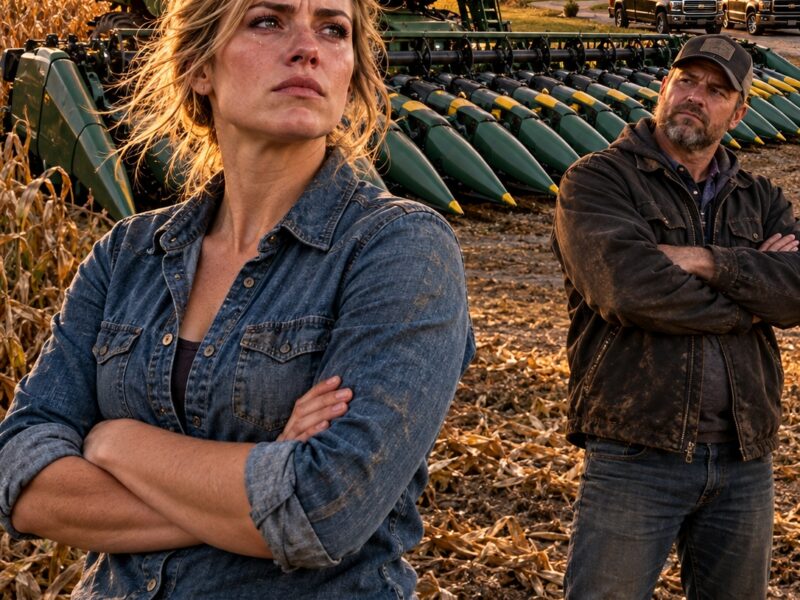
They Laughed When She Bought a 16-Row Harvester—By Midnight, the Men Who Mocked Her Were Begging for Her Help
“Sixteen rows on Bennett ground?”
Wade Mercer stared at the enormous folded corn head sitting on the flatbed as if someone had delivered a yacht to the middle of Iowa.
Then he laughed.
Not loudly at first.
Just enough for the men standing beside the county road to hear.
“You’ll fold more stalks than you’ll harvest.”
A few chuckles followed.
Claire Bennett stood beside the machine with one hand resting against the cold steel frame.
She had been awake since 3:47 that morning.
She had spent half the night studying field maps, weather projections, truck rotations, grain moisture estimates, fuel consumption, and the storm system crawling southeast across the radar.
She knew exactly how many acres were still standing.
She knew exactly how many hours she probably had.
And she knew Wade Mercer had come there for one reason.
He wanted to watch her discover that she wasn’t her father.
“I’ve run the numbers,” Claire said.
That got a bigger laugh.
One of the men near Wade repeated it.
“She’s run the numbers.”
Another voice came from beside a pickup.
“Robert actually let her do this?”
Claire felt the words before she fully heard them.
Robert.
Her father.
Even lying in a hospital bed twenty miles away after a stroke, Robert Bennett was still somehow the man everyone believed was running Bennett Farm.
Wade unfolded his arms.
“This machine isn’t about the farm, Claire.”
She looked at him.
“No?”
“No.”
His eyes moved from her to the massive C16F header.
“This is about proving something.”
The laughter disappeared.
Wade stepped closer.
“You think putting sixteen rows in front of that combine makes you Robert.”
Claire’s jaw tightened.
Wade pointed toward the fields behind her.
“You’ve got waterways that curve. Short headlands. Tight corners against the north fence. Ground that punishes wide equipment. Your father knows that.”
Claire said nothing.
“And you know it too,” Wade continued.
That was the part that hurt.
Because he was right.
Not about her.
About the land.
Claire knew every awkward turn on Bennett Farm.
She knew where the drainage tile curved beneath the north block. She knew where spring runoff softened the eastern edge. She knew which headlands could take a wide turn and which ones forced an operator to back up twice.
She knew all of it.
She had spent eight years learning it.
But Wade looked at her as though she had arrived yesterday.
Then he said the sentence she would remember long after the harvest was over.
“You’re not a farmer, Claire.”
Nobody laughed this time.
The silence was worse.
Three pickup trucks sat along the gravel road. Men leaned against tailgates. A few stared at their boots. Others watched her openly.
Claire looked at the sixteen steel snouts folded above the trailer.
Then she looked back at Wade.
“Then watch me.”
She turned away before he could answer.
What nobody standing on that road understood was that Claire Bennett had already spent most of her adult life being watched.
They had simply never noticed what she was doing.
For eight years, she had arrived at the machine shed before sunrise.
She had calibrated headers.
Tracked fuel costs.
Compared yield maps.
Monitored moisture.
Scheduled trucks.
Reworked planting plans after wet springs.
Adjusted harvest sequences during dry falls.
When a combine ran perfectly, someone at the elevator would slap Robert Bennett on the shoulder and say, “Still got the touch.”
When something broke and Claire solved it, somebody would ask:
“Your dad approve that?”
She used to correct them.
Then she stopped.
Not because it stopped bothering her.
Because correcting people took time, and farms did not care who received credit.
Corn did not know whether the person driving the combine was somebody’s daughter.
Weather did not care.
Debt certainly did not care.
So Claire learned to live in the strange space between responsibility and recognition.
She carried the first.
Robert carried the second.
And neither of them had ever really discussed it.
Until three weeks before harvest.
Robert had been walking from the machine shed toward the farmhouse when his right leg suddenly stopped cooperating.
He dropped beside the gravel lane.
Claire found him sitting against the side of the shed, confused and furious, trying to push himself upright with one arm.
“Dad?”
“I’m fine.”
“You’re on the ground.”
“I tripped.”
“You didn’t trip.”
“Claire—”
His words blurred.
That was when she called 911.
The doctors later called it a minor stroke.
Minor.
Claire learned that hospitals used words differently than families did.
Minor meant he survived.
Minor meant he could speak.
Minor meant he would probably walk normally again.
It did not mean he could climb into a combine twelve hours a day during harvest.
The doctor stood beside his bed and made that clear.
“No heavy work. No long days. No machinery until we clear you.”
Robert stared at him.
“When?”
“We’ll reassess.”
“That’s not a date.”
“No.”
Robert looked toward Claire.
She knew exactly what he was thinking.
Harvest.
Neither of them said it until the doctor left.
Then Robert asked one question.
“How much is standing?”
“Too much.”
The dry summer had weakened the stalks.
A strong wind could flatten entire sections.
And a weather front was building northwest of them, bringing heavy rain and gusts at almost the worst possible time.
Back at the farmhouse that evening, Claire spread maps across the kitchen table.
The old eight-row header had served Bennett Farm for years.
But the math was merciless.
She calculated the acres.
Then calculated them again.
She changed the assumed operating speed.
Adjusted truck turnaround.
Reduced downtime.
Optimized field order.
Still wrong.
There were not enough hours.
Her second option was Wade Mercer.
Wade ran custom harvest crews across three counties. Big machines. Experienced operators. Enough support equipment to swallow hundreds of acres quickly.
He could save the crop.
He could also take most of Bennett Farm’s projected margin with his emergency rate.
It wasn’t robbery.
Claire knew that.
Wade had labor, diesel, depreciation, insurance, transportation, and his own customers.
His price was fair.
It was simply devastating.
Bennett Farm could survive a year with almost no profit.
Probably.
But farms rarely died from one dramatic disaster.
They died from accumulation.
One bad year.
Then deferred maintenance.
Then a loan.
Then another weak season.
Then one morning someone realized the land had become more valuable than the operation sitting on it.
Claire refused to let that sequence begin because her father had gotten sick at the wrong time.
Then she heard about the C16F.
A sixteen-row folding corn head owned by a larger operation three counties east.
Lightly used.
Available immediately.
Claire studied the specifications.
Then she studied Bennett Farm.
Some fields were terrible candidates.
But the long center blocks—the fields responsible for much of their yield—were almost perfect.
If she harvested those blocks first…
If she could keep the grain cart moving…
If trucks never became the bottleneck…
If the weather held…
The numbers worked.
Barely.
She made the call.
Two days later, the machine arrived.
By sunrise the next morning, half the county seemed to know.
Which was how Claire ended up standing beside a piece of equipment almost nobody thought belonged on Bennett ground while Wade Mercer publicly told her she wasn’t a farmer.
That evening, she went to the hospital.
Robert was sitting upright when she entered.
A football game played silently on the television.
“You look terrible,” he said.
“Thank you.”
“You sleeping?”
“No.”
“Good.”
Claire almost smiled.
She sat beside him.
For several seconds, neither spoke.
Then she said, “Wade came by.”
Robert’s eyes shifted toward her.
“What did he want?”
“To tell me I’m an idiot.”
“He charge you for the consultation?”
This time she did smile.
Barely.
Then it disappeared.
“He said I bought the header because I’m trying to replace you.”
Robert looked toward the dark television.
Claire waited.
“He said I’m not a farmer.”
Still nothing.
“Dad.”
Robert finally looked at her.
“What?”
“Did I make a mistake?”
He could have told her no.
That was what she wanted.
One word.
No.
He could have said Wade was jealous, outdated, arrogant, threatened.
Instead Robert asked:
“Why are you harvesting tomorrow?”
Claire frowned.
“Because we have corn standing.”
“That’s not what I asked.”
“The storm—”
“Claire.”
She stopped.
Robert’s voice was softer now.
“Don’t harvest for them.”
She stared at him.
“What?”
“Don’t harvest for them.”
“For who?”
Robert looked toward the window.
“The people parked on the road.”
Claire drove home thinking about those words.
She still did not completely understand them when her alarm sounded at 4:35 the next morning.
At 5:20, the combine engine came alive in darkness.
Hydraulic lights illuminated the folded header.
Claire climbed into the cab.
The sky was turning gray when she reached the first field.
And the trucks were already there.
Spectators.
She could see headlights along the county road.
Wade’s pickup was among them.
Claire wrapped her fingers around the controls.
Sixteen snouts lowered into the corn.
She breathed once.
Then pushed forward.
For the first twenty minutes, everything seemed manageable.
Then the field reminded her why Wade had laughed.
The curved section near the drainage tile arrived faster than she expected.
Claire began turning.
Too late.
The outside rows drifted.
She corrected.
Overcorrected.
The header missed enough corn to force a second pass.
From the road, it must have looked awful.
Claire could practically hear the conversation inside Wade’s truck.
She kept going.
Then the engine load spiked.
A warning flashed.
“What now?”
The left side of the header began feeding unevenly.
Claire stopped.
She climbed down.
Residue had built around one of the gathering chains.
She cleared it.
Checked tension.
Adjusted it by hand.
Eleven minutes.
Eleven minutes standing in a field knowing people had come specifically to watch her fail.
When she climbed back into the cab, anger replaced embarrassment.
She pushed forward harder.
Faster.
The engine load climbed again.
She ignored it.
The header began feeding roughly.
Grain loss rose.
“Come on.”
She increased speed.
Then something Robert had said returned to her.
Don’t harvest for them.
Claire’s hand froze on the control.
She looked toward the road.
The trucks.
The silhouettes.
The audience.
Suddenly she understood.
She wasn’t driving the combine.
They were.
Every mile per hour she added was for Wade.
Every aggressive turn was for the men leaning against those trucks.
Every decision was becoming an argument.
And corn was losing that argument.
Claire reduced speed.
The engine note changed.
She slowed a little more.
The gathering chains settled.
Load stabilized.
Grain loss dropped.
She watched the numbers.
Adjusted again.
Then the machine found its rhythm.
Sixteen rows disappeared beneath the header.
Cleanly.
Continuously.
Behind her, standing corn became neat stubble.
The grain cart operator suddenly had to hurry.
Claire stopped looking toward the road.
By late morning, nobody there was laughing.
Wade stood against his pickup with his arms crossed.
But he wasn’t watching Claire anymore.
He was watching the acre counter.
Doing math.
The same math she had done at her kitchen table.
After lunch, Claire reached the field she had been waiting for.
Two hundred acres.
Long.
Straight.
Clean headlands.
This was where the C16F belonged.
She unfolded the header completely.
Aligned the machine.
And entered the first sixteen rows.
The difference was immediate.
The machine stopped feeling oversized.
It felt inevitable.
Row after row vanished.
Dean Holloway ran the grain cart, reading Claire’s rhythm almost without radio communication.
Trucks rotated in and out.
The afternoon light turned the remaining corn gold.
At 4:30, Wade returned.
He expected her pace to fall.
It didn’t.
At 5:20, Claire’s shoulders hurt.
At 5:47, she realized she had forgotten lunch.
At 6:12, she lined up with the final sixteen rows.
The sun hung low against the western tree line.
She lowered the header.
Drove forward.
Corn disappeared beneath her.
When she reached the far end and lifted the machine, Claire looked into the mirror.
Two hundred acres.
Gone.
Before sunset.
Dean walked the harvested ground checking grain loss himself.
When he returned, he climbed onto the cab ladder.
“Well?”
Claire asked.
Dean removed his cap.
“You know what the problem with proving people wrong is?”
“What?”
“They usually need another lesson.”
That evening was the annual Bennett harvest gathering.
Neighbors filled the old barn.
Robert arrived in a wheelchair.
Claire nearly didn’t go.
She wanted a shower.
Food.
Sleep.
Instead she walked through the barn doors.
Dean stood.
Then another farmer.
Then another.
Within seconds, most of the barn was standing.
Applause filled the old building.
Claire stopped.
For eight years, people had thanked Robert for harvests she had helped save.
Now they were looking at her.
Not through her.
At her.
She found her father across the room.
Robert didn’t clap wildly.
He simply watched her.
And something in his face made Claire’s throat tighten.
Pride, perhaps.
But there was something else too.
Recognition.
Wade stood near the back wall.
He wasn’t applauding.
Claire noticed that.
But he wasn’t laughing either.
Then her phone rang.
Unknown regional number.
Claire stepped outside.
“Claire Bennett?”
“Yes.”
“This is quality control from the processor.”
The tone of the man’s voice erased her smile.
“We’ve flagged three Bennett loads.”
Claire looked back through the barn door.
People were still celebrating.
“Flagged for what?”
“Cracked kernels. Mechanical damage above threshold.”
Her fingers tightened around the phone.
“How bad?”
“Bad enough that your premium contract is under review.”
The barn suddenly seemed very far away.
“If the remaining loads test the same,” he continued, “the pricing adjustment could apply across the harvest.”
Claire stopped breathing for a second.
“How many loads?”
“Three confirmed so far.”
She stared into the darkness.
Two hundred acres by sunset.
The achievement everyone inside was celebrating.
And now there was a possibility she had harvested it wrong.
By morning, the county had rewritten the story.
Claire heard versions at the elevator.
At the fuel station.
Through phone calls nobody realized would get back to her.
Two hundred acres before sunset had become:
Two hundred acres of damaged corn.
Wade did not mock her.
That almost made it worse.
He simply said:
“Acres per hour don’t matter if the processor doesn’t want what comes out the other end.”
Technically, he was right again.
Claire spent the first hour blaming herself.
Had she pushed too hard?
Was the C16F damaging kernels?
Had she become exactly what Wade said she was—someone operating equipment too big for her experience because she needed the county to see her succeed?
She sat at the kitchen table looking at sample reports.
Then she noticed something.
Not every load was failing.
Claire straightened.
She spread the paperwork out.
One load.
Clean.
Another.
Clean.
Third.
Damaged.
She began matching load numbers to handling records.
The pattern emerged slowly.
Then all at once.
The corn coming directly from the combine was clean.
The damaged loads shared something else.
They had passed through Bennett Farm’s older grain cart.
Claire went outside.
She climbed into the cart.
Opened the unloading system.
And found it.
The auger flighting was badly worn.
One section had deformed.
Under ordinary throughput, it had never created an obvious problem.
But Claire had nearly doubled the harvest flow.
More corn.
Faster unloading.
Greater pressure through worn equipment.
The old auger was crushing kernels.
Claire stood beside the cart with grease on her fingers.
The C16F had not ruined the crop.
But that didn’t mean she was innocent.
She had increased the capacity of one part of the operation without increasing the capacity of everything connected to it.
She had treated harvest like a machine.
It was a system.
And the system had failed.
Because she had failed to see all of it.
Her phone buzzed.
Weather alert.
The storm was now less than ten hours away.
More than four hundred Bennett acres remained standing.
That was when Wade Mercer drove into the yard with two combines behind him.
Claire watched from beside the grain cart.
He climbed from his pickup carrying a folder.
“I heard about the processor.”
“Apparently everybody did.”
Wade ignored the edge in her voice.
“I can finish your remaining acres.”
Claire looked past him toward the machines.
“Today?”
“If we start now.”
He opened the folder.
His price was there.
High.
But reasonable.
Operators.
Combines.
Grain carts.
Truck coordination.
Everything Claire’s operation suddenly seemed to lack.
Wade placed the agreement on the hood of his truck.
“You made your point yesterday.”
Claire looked at him.
“This isn’t about points.”
“No?”
“No.”
Wade nodded toward the damaged grain cart.
“Then let professionals finish what you started.”
There it was.
Not cruel.
Almost sympathetic.
Which made it worse.
Claire looked at the contract.
The storm was coming.
Her premium status was suspended.
Robert was recovering.
Her grain-handling system had failed.
And every rational argument seemed to lead to the same conclusion.
Sign.
Claire picked up the pen.
She almost did.
Instead she set it down.
“I need an hour.”
“For what?”
Claire was already walking toward her truck.
The hospital smelled like antiseptic and burnt coffee.
Robert was reading when Claire entered.
She dropped into the chair beside him.
“I screwed up.”
Robert closed the book.
Claire told him everything.
The damaged corn.
The auger.
The processor.
The storm.
Wade.
The contract.
When she finished, she stared at her hands.
“I think he was right about one thing.”
“Wade?”
“I think I have been trying to replace you.”
Robert didn’t immediately answer.
Claire laughed bitterly.
“I bought a bigger header. Tried to run everything. Tried to prove I could do what you did.”
Robert nodded.
“You’re right.”
Claire looked up.
She hadn’t expected that.
“What?”
“That’s been your mistake.”
Something inside her dropped.
Robert leaned back.
“You’re not supposed to replace me.”
“Then what am I supposed to do?”
“Run your farm.”
Claire stared at him.
Robert continued.
“I built decisions around what I had. The equipment. The fields. The people. The problems. You’re trying to build your decisions around me.”
Claire felt the room become strangely quiet.
“Don’t harvest for them,” Robert said.
This time she understood.
Not Wade.
Not the men along the road.
Not even Robert Bennett.
The farm did not need another Robert.
It needed Claire.
She returned to Bennett Farm.
Wade was still there.
The contract was still on his hood.
Claire picked it up.
Then tore it in half.
Wade stared at her.
“You’re turning down the crew?”
“No.”
“You just tore up the agreement.”
“I’m turning down your plan.”
Wade’s expression changed.
Claire unfolded a field map across his hood.
“I need your two combines here.”
She pointed.
“North block corners. Drainage sections. Short headlands.”
Wade looked down.
“My machines?”
“Smaller headers. Better turning radius. That ground suits you.”
“And your sixteen-row?”
Claire moved her finger across the map.
“Long center blocks only.”
Wade looked at her for several seconds.
Claire continued.
“I’m borrowing Dean Holloway’s grain cart. Mine is done. I need two additional trucks from neighboring farms. Processor gets clean samples from every new load.”
“You’ve got less than ten hours.”
“I know.”
“The wind arrives before the rain.”
“I know.”
Wade studied the map again.
Then he asked:
“Who’s coordinating?”
Claire looked at him.
“I am.”
For the first time since the C16F arrived, Wade Mercer did not tell her why something wouldn’t work.
He picked up his radio.
Harvest restarted early that afternoon.
And this time Claire did not ask one machine to save everything.
The C16F attacked the long center blocks.
Wade’s smaller headers worked the irregular ground.
Dean’s grain cart kept pace without damaging kernels.
Trucks moved according to a rotation Claire revised whenever conditions changed.
No spectators lined the road.
Nobody applauded.
Nobody had time.
It was the best harvest operation Bennett Farm had run in years.
At dusk, seventy acres remained.
The wind arrived.
Corn stalks moved in long waves.
Weak plants began leaning.
Wade’s voice came over the radio.
“You can gain another mile an hour.”
Claire checked engine load.
Moisture.
Grain loss.
“No.”
A pause.
“Storm’s getting close.”
“I know.”
“We can push.”
Claire looked at the monitor.
Yesterday, she had pushed because people were watching.
Tonight, she held her speed because the grain mattered more.
“No,” she repeated. “We hold here.”
Thirty acres.
Then twenty.
Then ten.
Finally, sixteen rows remained.
Claire aligned the C16F.
Near the field edge, a vehicle was parked.
Robert sat in his wheelchair beside it.
No crowd.
No barn.
No applause.
Just her father watching.
Claire lowered the header.
Sixteen rows entered.
She drove them clean to the far headland.
When the machine emerged, Bennett Farm was harvested.
The first heavy drops struck the windshield.
Claire closed her eyes.
For one second.
Just one.
Then she climbed down.
Robert was smiling when she reached him.
Claire had barely taken three steps when Wade’s radio erupted.
His expression changed.
“What?”
Claire asked.
“One of my machines is down.”
“Where?”
“About six miles east.”
“How bad?”
“Bad.”
Another voice came over the radio.
Then another.
Three neighboring farms still had corn standing.
Approximately three hundred fifty acres combined.
The storm had caught them exactly where Bennett Farm had been that morning.
And Wade was now one machine short.
He looked at Claire.
Then at the sixteen-row header behind her.
Hours earlier, Wade Mercer had arrived to rescue Claire Bennett.
Now he needed her.
“We could use that sixteen-row,” he said.
Claire looked toward the barn.
Her farm was safe.
Or nearly safe.
The new samples still had to clear processor testing, but the corn was out.
She had nothing left to prove.
She was exhausted.
Rain dotted her jacket.
And some of the men waiting six miles east were the same men who had parked along the road to watch her fail.
Claire pulled out her phone.
Radar covered the western sky.
She looked at Wade.
“Quit talking.”
“What?”
“Get your people moving.”
She climbed back into the combine.
The convoy rolled down the county road beneath a sky turning almost black.
Claire’s combine.
Wade’s remaining machine.
Two grain carts.
Semis.
Headlights cut through rain.
At the first farm, everyone wanted to start immediately.
Claire stopped them.
“No.”
Wade looked at her.
“We’re losing time.”
“We lose more if we use the wrong equipment.”
She studied the field.
Then pointed.
“C16F takes the center. Your header works the edges. Grain carts stage south. Trucks enter from the west and exit east. Nobody turns around loaded.”
A neighboring farmer started to object.
Then something happened.
Everyone looked at Claire.
Not Robert.
Not Wade.
Claire.
The moment lasted perhaps two seconds.
But it meant more than the applause in the barn.
Because nobody had planned it.
Nobody was being polite.
They were waiting for her decision.
Claire gave it.
The machines moved.
They cleared the first farm.
Then the second.
The wind strengthened.
Lightning flashed against the western horizon.
At the final property, outer rows were already leaning.
Wade pulled alongside Claire.
“One more cycle?”
Claire studied the field.
The radar.
The wind.
The machines.
Yesterday, she would have wondered what Wade thought.
Tonight, she wondered what the field required.
“Yes.”
The combines entered together.
Sixteen rows vanished beneath Claire’s header.
Rain began falling harder.
The last grain cart filled.
The final semi rolled forward.
Claire came out of the field as the sky opened.
The truck driver pulled the tarp across a full load while rain hammered the harvested ground behind them.
Nobody cheered.
Nobody needed to.
Two days later, Claire’s phone rang.
The processor.
She almost let it go to voicemail.
“Claire Bennett?”
“Yes.”
“We completed the testing.”
Claire stood motionless beside the kitchen counter.
“The new Bennett loads meet premium standards.”
She closed her eyes.
“And the damaged loads?”
“Mechanical damage traced to your grain-handling equipment. Based on the clean replacement samples and inspection results, your premium contract is restored.”
Claire sat down.
Not because she was celebrating.
Because suddenly her legs didn’t want to hold her.
That week, several farmers came to Bennett Farm.
Some had laughed at the C16F.
Some had watched from the road.
None offered dramatic apologies.
People in that county rarely worked that way.
Instead they brought coffee.
Field maps.
Questions.
Dean Holloway spread a county map across the Bennett kitchen table.
“We lose acres every year because everybody waits until their own machine breaks before calling somebody.”
Wade leaned against the counter.
Dean continued.
“We should coordinate emergency equipment before harvest. Know what machines are available. What headers fit what ground. Who has trucks. Who has carts.”
“That would require somebody running it,” one farmer said.
The room went quiet.
Then Wade spoke.
“Claire should.”
She looked at him.
The same man who had told her she wasn’t a farmer now wanted her deciding where his combines went when weather turned.
Claire waited for the satisfaction she thought she would feel.
It never came.
Instead she opened her notebook.
“All right,” she said. “Let’s map the equipment first.”
The following season, Bennett Farm looked almost the same from the county road.
That was the funny part.
People expected Claire’s victory to look like something large.
Another giant machine.
A new building.
A bigger sign.
Instead, she rebuilt things most people never noticed.
Truck rotations.
Maintenance schedules.
Grain-handling capacity.
Bottlenecks.
Contingency plans.
She replaced the worn equipment that had nearly cost them their premium contract.
She stopped asking one machine to solve problems it had never been designed to solve.
The C16F stayed.
On long, straight ground, it was extraordinary.
On tight corners and short headlands, Claire used something else.
Harvest losses fell.
Downtime dropped.
The processor renewed Bennett Farm’s premium relationship without hesitation.
And the county emergency harvest network became real.
Dean had more years in farming than Claire.
Wade still operated more harvesting equipment than anyone across three counties.
But when weather turned ugly and decisions had to be made quickly, the calls started coming to Bennett Farm.
To Claire.
Not because she had once cleared two hundred acres before sunset.
That made people notice her.
They trusted her because of what happened after sunset.
Because when her own operation began failing, Claire had resisted the easiest explanation.
Everyone had stared at the sixteen-row header.
She had looked deeper.
The machine wasn’t the whole system.
Neither was she.
Months later, Robert walked into the equipment shed without his wheelchair.
Slowly.
Carefully.
But on his own.
Claire was at the workbench checking maintenance records.
Robert carried an old notebook.
She recognized it immediately.
For almost thirty years, her father had recorded every Bennett harvest inside it.
Planting dates.
Moisture.
Breakdowns.
Yields.
Weather.
Mistakes.
Good decisions.
Bad ones.
Three decades of Bennett Farm written in Robert’s handwriting.
He placed it on the bench.
Claire looked at him.
“What’s this?”
Robert tapped the cover.
“You know what it is.”
“You want me to keep using it?”
Robert shook his head.
Then he pointed beside her.
There was a new notebook on the workbench.
Empty.
Claire looked from the blank notebook to her father.
Robert said nothing.
He didn’t need to.
She opened it.
For a moment, Claire held the pen above the first page.
Outside the shed, the C16F sat folded and clean beneath the Iowa afternoon sun.
The machine looked smaller now.
Not physically.
Just in meaning.
Once, Claire had believed it was the thing that would prove she belonged.
Then she believed two hundred acres before sunset would prove it.
Then applause.
Then surviving the processor scare.
Then beating the storm.
But standing there beside her father, she finally understood something she should have understood years earlier.
She had known how to farm long before Wade Mercer admitted it.
She had known before the county applauded.
Before the giant header.
Before the storm.
Before anyone looked toward her and waited for an answer.
Their doubt had never made her less capable.
Their approval had never made her more capable.
Robert rested one hand on the workbench.
Claire lowered the pen.
On the first page of the new notebook, she wrote:
Bennett Farm — Year One.
Robert read it.
He didn’t correct her.
Outside, autumn light stretched across the concrete floor.
For almost thirty years, Bennett Farm had been Robert Bennett’s story.
Claire had spent eight years believing her job was to prove she could carry it.
She had been wrong.
Her job was never to become her father.
It was to understand what he had built, see where it was failing, keep what still worked, change what didn’t, and accept that sometimes leadership meant being the person behind the wheel—
and sometimes it meant knowing when another machine belonged in the field beside yours.
Claire closed the notebook.
Far beyond the equipment shed, the harvested fields lay quiet beneath the fading light.
No spectators.
No laughter.
No applause.
Just clean stubble stretching toward the horizon.
Two hundred acres before sunset had made the county notice Claire Bennett.
But what she chose to do after sunset—
when the people who had doubted her needed her—
was what finally made them trust her.









