THEY LAUGHED WHEN SHE BOUGHT A $29,500 FARM—UNTIL SEVEN LOST MUSTANGS UNCOVERED THE SECRET HER FATHER DIED PROTECTING
The richest rancher in Red Willow offered Clare Morgan $100,000 for the abandoned farm he’d laughed at her for buying just three weeks earlier.
Seven starving mustangs had appeared on her property that morning, and the moment he saw the silver-gray stallion, his face lost all color.
By midnight, Clare would discover something buried beneath her northern pasture that connected those horses to her dead father—and a betrayal her family had carried for generations.
Three weeks earlier, Clare had stood outside the county courthouse in Red Willow, Wyoming, holding a property deed that everyone thought proved she had lost her mind.
Twenty-nine thousand, five hundred dollars.
That was what she had paid for Whitmore Creek Farm, forty-three acres of neglected pasture, a collapsing farmhouse, two rotting barns, and a well that supposedly hadn’t produced water in fifteen years.
The auctioneer had chuckled when her bid was accepted. “Congratulations, ma’am. You’ve just bought yourself the most expensive pile of firewood in Wyoming.”
A few men near the back of the room laughed. Someone muttered that city people would buy anything if it came with enough sentimental nonsense.
Clare heard every word.
She was thirty-four years old, had spent most of her adult life working as a veterinary assistant in Casper, and knew exactly how much money she had left in the bank. She also knew what rotten fence posts, cracked foundations, and neglected livestock could cost.
Still, she folded the deed carefully and slipped it into her father’s old leather handbag.
Daniel Morgan had died eleven months earlier, after a brief illness that gave them far less time together than either had expected.
He had been a quiet man with rough hands and an extraordinary patience for animals other people had already given up on. When a neighbor’s horse broke a leg badly enough that recovery was uncertain, Daniel had been the one to sit outside the stall all night, keeping the frightened animal calm until the veterinarian arrived.
He repaired fences for people who couldn’t afford to pay him. He brought home abandoned dogs. He once spent three days nursing an injured hawk that eventually flew away without so much as looking back.
Clare had sometimes resented how much of himself he gave away.
As a teenager, she had asked why he couldn’t just mind his own business for once. Her father had wiped grease from his fingers, smiled tiredly, and told her that looking after something helpless was everybody’s business.
After his death, Clare found a small notebook among his belongings.
On the first page, beneath a faded coffee stain, he’d written:
What the world throws away is sometimes what God asks someone else to protect.
Clare had read that sentence so often the paper was beginning to soften beneath her fingers.
She couldn’t explain why Whitmore Creek had caught her attention when she saw the auction notice. The name stirred something from childhood, the memory of her father standing beside a kitchen window and staring toward distant hills.
He had mentioned Whitmore Creek once.
His expression had changed, and when she asked about it, he told her it was an old place with a complicated history.
Now she owned it.
And for the first time since his funeral, she felt as though she’d made a decision entirely for herself.
“Clare.”
She turned.
Richard Caldwell was approaching in polished boots and an expensive ranch jacket, his silver hair carefully combed beneath a cream-colored cowboy hat.
At fifty-eight, Caldwell owned nearly twelve thousand acres around Red Willow. His ranch supplied cattle across several western states, his name appeared on the town’s largest charitable donations, and his family had been prominent in the county for generations.
He spoke quietly because he was accustomed to people listening.
“I heard you bought Whitmore Creek.”
“I did.”
He glanced at the deed in her hand.
“Your father was a good man. Hardworking. But he had some strange ideas about land.”
Clare felt her shoulders tighten.
“What does that mean?”
Caldwell gave a small, practiced smile. “Only that some properties aren’t worth saving. Twenty-nine thousand five hundred dollars is a lot to pay for a graveyard.”
He walked away chuckling.
Clare watched him climb into a truck worth more than her entire new property.
Then she drove home to a farmhouse without reliable electricity and a kitchen sink that produced nothing but rust-colored water.
By the seventeenth day, she understood why no one else had bid.
Rain leaked through the upstairs ceiling. Wind whistled through gaps in the walls, and the ancient furnace refused to work. One storm tore down nearly sixty feet of fencing, leaving her to haul posts through knee-deep mud.
Her savings shrank with every hardware-store receipt.
On the worst evening, she sat on the kitchen floor holding a $1,400 roofing estimate and cried until her throat hurt.
It wasn’t the money alone.
It was the empty chair at the table, the silence after sundown, and the terrible realization that she could no longer call her father and hear him say, “We’ll figure it out, sweetheart.”
The next morning, she got up anyway.
She put on his old work gloves, made coffee in a dented saucepan, and went outside to rebuild the fence.
On the eighteenth morning, she found hoofprints near the eastern boundary.
Several sets.
The tracks crossed a muddy wash and disappeared toward a stand of cottonwoods.
Clare followed them slowly, keeping her footsteps light.
At first, she heard nothing but wind rustling through the dried grass. Then came a low snort, followed by the unmistakable sound of hooves shifting against stones.
Seven horses stood beneath the trees.
They were beautiful in the heartbreaking way neglected animals sometimes were, when the shape of what they should have been remained visible beneath hunger and exhaustion.
A silver-gray stallion stood in front. Behind him were a chestnut mare, a dark bay gelding, two younger horses, a scarred black mustang, and a small dun mare with a tangled mane.
Their coats were dusty, their ribs too prominent.
The black horse was favoring its left hind leg. The chestnut mare had an old rope mark around her neck.
Clare stopped several yards away.
“Well, hello there.”
The stallion lifted his head.
He had a broad chest, intelligent dark eyes, and a white marking on his forehead shaped almost like a crooked star.
She crouched slightly, keeping her hands visible.
“I’m not going to hurt you.”
For several minutes, nothing happened.
Then the stallion took three cautious steps forward.
Clare held perfectly still as he stretched his neck toward her. His nostrils moved over her fingers, testing her scent.
When she slowly raised her hand, he permitted a brief touch between his eyes.
His skin trembled beneath her palm.
“You’re something, aren’t you?” she whispered.
The stallion stepped back but didn’t run.
Clare smiled for the first time in days.
“Ghost,” she said softly. “I think I’ll call you Ghost.”
She spent the afternoon making telephone calls.
The county livestock office explained that free-roaming horses could not automatically be treated as her property. Officials would need to investigate their origins, determine whether they belonged to a federally protected herd or had escaped private ownership, and establish the proper process for their care.
Clare agreed immediately.
She didn’t want to claim them.
She wanted them alive.
She contacted veterinarian Dr. Evelyn Brooks, repaired a water trough, and opened a safe pasture so the animals could reach water without becoming trapped.
By evening, word had spread through Red Willow.
Seven mustangs had appeared at Whitmore Creek.
People drove slowly past her fence. Some took photographs. Others laughed at the woman who had bought a worthless farm and apparently acquired seven more mouths to feed.
Then Richard Caldwell arrived.
His truck stopped so abruptly that gravel scattered across the road.
Clare watched him climb out and stare toward the cottonwoods.
When Ghost stepped into view, Caldwell’s expression changed.
For a moment, the confident rancher looked genuinely frightened.
“Where did you get those animals?”
“They came here.”
“From where?”
“I don’t know yet.”
Caldwell approached the fence.
Ghost moved immediately between the rancher and the other horses, flattening his ears.
Caldwell stopped.
Clare noticed how carefully he avoided looking directly at the stallion.
“Do you recognize him?”
“No.”
The answer came too quickly.
Then Caldwell glanced toward the northern hills.
“I’ll give you a hundred thousand dollars for the place.”
Clare thought she’d misheard.
“For Whitmore Creek?”
“Cash. We can have the paperwork finished tomorrow.”
“Three weeks ago, you called it a graveyard.”
“I was mistaken.”
She studied his face.
“Why do you want it now?”
His jaw tightened. “Because I’m making you a very generous offer.”
“Then you shouldn’t mind explaining it.”
His smile disappeared.
“Some things are better left alone, Clare.”
He returned to his truck and opened the driver’s door, but before climbing inside, he looked back.
“Keep those horses away from the north pasture.”
That night, Clare couldn’t sleep.
At 11:47, a metallic crash jolted her awake.
She grabbed a flashlight and hurried outside.
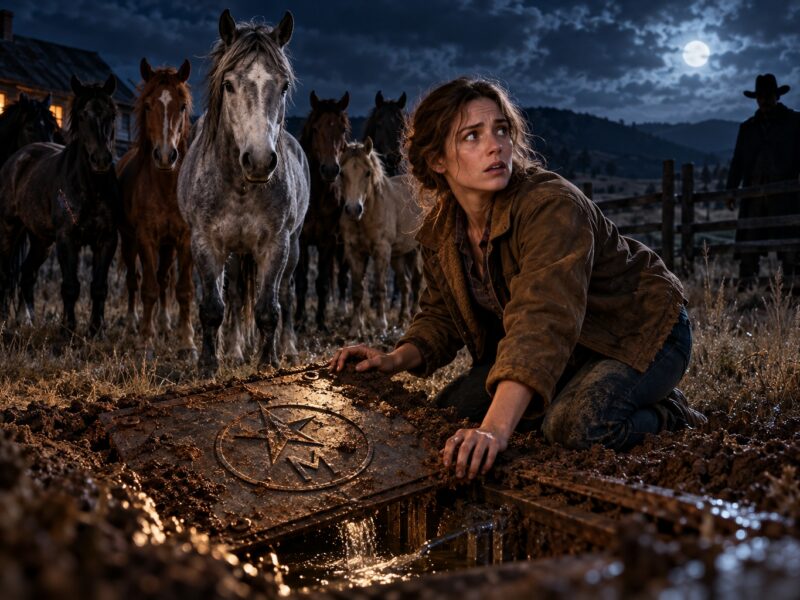
The seven mustangs stood near the northern fence. Ghost was pawing at a patch of bare ground, striking it repeatedly with one front hoof.
A section of old fencing had collapsed nearby.
“Easy, boy.”
Ghost lifted his head as she approached, then moved aside.
Something dark and metallic protruded from the soil.
Clare knelt, brushing loose dirt away with her gloved fingers.
It was an iron plate, corroded around the edges but still secured to a wooden frame buried beneath the ground.
At its center was an engraved symbol.
A circle.
A crooked star.
And the letter M.
Clare’s breath caught.
She knew that mark.
Her father’s pocket watch carried the exact same engraving.
She pressed her hand against the ground.
From somewhere beneath the iron plate came the unmistakable sound of running water.
Then a man’s voice spoke behind her.
“Your father should have left that buried.”
Clare spun around.
A figure stood beyond the fence, half-hidden beneath the branches of a cottonwood.
Her flashlight caught a weathered face, a gray beard, and eyes that looked more tired than threatening.
“Who are you?”
The stranger raised both hands.
“My name’s Walter Finch.”
Clare took a step backward.
“What are you doing on my property?”
“Trying to get here before Caldwell does.”
She tightened her grip on the flashlight.
Walter looked at the exposed iron plate.
“Your father spent twenty-six years making sure no one opened that gate without knowing what was behind it.”
Clare felt the cold air settle against her skin.
“My father never owned this farm.”
“No,” Walter replied. “But his grandfather did.”
He reached slowly into his coat and removed an old photograph.
In the flashlight beam, Clare saw three men standing beside a line of horses in front of the very farmhouse she had purchased.
One man bore the same unmistakable crooked star engraved on the iron plate, stitched into a leather patch on his vest.
Walter pointed to the youngest man.
“That’s your great-grandfather, Samuel Morgan.”
Clare stared at the photograph.
Then she noticed the handwritten date.
September 1912.
“And the other two?”
Walter swallowed.
“One was the man who stole this land from your family.”
Clare looked from the photograph to the dark hills.
Walter’s next words were barely louder than the wind.
“The other was his brother.”
And when Ghost suddenly turned toward the northern ridge and released a sharp, frightened cry, Walter’s face drained of color.
“Clare, get away from that gate. There’s something else your father never told you.”
The farmhouse kitchen smelled of damp wood, coffee, and the kerosene from the emergency lantern Walter placed on the table.
Clare sat across from him with her father’s pocket watch in her hands.
She had carried it since the funeral, though it had stopped working years ago. She used to turn it over when she missed him, rubbing her thumb across the engraving without wondering what it meant.
Now the symbol seemed unfamiliar.
Walter had worked as a survey technician for the county before retiring. He was seventy-two, lived alone on the far side of Red Willow, and had known Daniel Morgan for almost thirty years.
Clare remembered him vaguely from the funeral.
He had stood near the back of the church and left before the family photographs were taken.
“Why didn’t my father tell me any of this?”
Walter stared at the lantern.
“I asked him that once. He said you deserved a life that wasn’t built around somebody else’s wrongdoing.”
He unfolded the photograph.
Samuel Morgan had owned the original Whitmore Creek homestead in the early twentieth century. It was a modest horse-breeding operation, but the land possessed something more valuable than its rocky soil.
Water.
Not merely a shallow well, but a spring that emerged from the northern limestone ridge and supplied a small network of underground channels.
Samuel had used that spring to keep his horses alive through several devastating droughts.
When cattlemen in the region began competing for reliable water, the spring became enormously valuable.
Among the men interested in it were two brothers, Arthur and William Caldwell.
Arthur had negotiated with Samuel for access to the spring. William had helped survey the surrounding properties.
The arrangement eventually collapsed.
According to Walter, Samuel accused the brothers of altering boundary descriptions and filing misleading documents that placed the principal spring access on newly recorded Caldwell land.
The dispute dragged on for years.
Samuel lost his savings trying to challenge the transaction.
Then a barn burned.
His remaining horses scattered into the hills, and he died before the legal dispute was resolved.
Clare stared at Walter.
“Are you telling me the Caldwells stole his farm?”
“I’m telling you that’s what Samuel believed. And that your father found evidence suggesting the recorded boundaries were wrong.”
“Where?”
Walter looked toward the window.
“In the northern hills.”
Clare leaned back.
For eleven months, she’d been trying to accept the loss of her father. She had imagined every conversation she would never have with him, every ordinary question that would remain unanswered.
Now a stranger was telling her Daniel had carried a secret involving stolen land, lost horses, and one of Wyoming’s most influential ranching families.
“Why didn’t he go to court?”
“He tried to find enough evidence. Couldn’t. Some records disappeared long before he was born, and others were too incomplete to prove anything.”
Walter hesitated.
“Besides, the older he got, the more he worried about what would happen if he exposed the dispute without protecting the land first.”
Clare lowered her eyes to the watch.
“And the horses?”
Walter took a moment before answering.
Samuel had bred several lines of sturdy range horses, descended from animals used on western ranches. After the barn fire, some escaped into the hills. Over the decades, their descendants mixed with other free-roaming horses in the region.
Daniel had kept track of a small band when he could.
The crooked-star marking was not proof of ancestry, Walter cautioned, but Samuel’s breeding notes described a pale forehead marking that sometimes appeared among his gray horses.
Daniel had once photographed an older stallion with a nearly identical blaze.
Clare looked toward the dark pasture.
Ghost.
“Richard knew him,” she whispered.
Walter shook his head. “He recognized something. That’s not the same as knowing the horse.”
Clare stood and went to the window.
The mustangs were barely visible beneath the moonlight.
“Why did they come here?”
Walter followed her gaze.
“Animals remember water. Some routes survive longer than the fences people build across them.”
He explained that the old spring channel had been partially sealed decades earlier. Daniel believed groundwater still moved beneath Whitmore Creek, but finding the original access had proven difficult.
The buried iron plate was part of an old maintenance structure.
The sound of water meant the spring was still active.
It did not mean the farm’s well could be restored easily, or that Clare automatically owned the source.
But it changed what they knew about the property.
Walter pulled a yellowing map from his coat.
The paper showed a narrow strip extending north from the old homestead to a wooden access gate beneath the ridge.
“Your father found this in a box of Samuel’s belongings.”
Clare bent over the table.
“That strip isn’t on my deed.”
“Not on the modern drawing.”
“Then what is it?”
“A question that nobody ever answered properly.”
She studied the faint ink marks.
“Why didn’t you show me this before the auction?”
“Daniel asked me not to involve you unless there was a reason.”
Clare looked at him sharply.
“You don’t think buying the farm was reason enough?”
Walter accepted the criticism without defending himself.
“No. I was wrong.”
Outside, a vehicle moved along the distant county road, its headlights flickering between trees.
Walter stood.
“Tomorrow morning, call the county clerk and ask for the original survey records. Then hire a lawyer who doesn’t work for anybody around here.”
Clare folded the map carefully.
“What about Caldwell?”
“Don’t accuse him of anything. Not yet.”
The next morning, Dr. Evelyn Brooks arrived to examine the horses.
The veterinarian was in her late forties, practical and direct, with wind-reddened cheeks and a battered medical bag.
She examined the black mustang from a safe distance before arranging for appropriate handling equipment.
The horse had an infected wound near its left hind fetlock. The injury wasn’t immediately life-threatening, but it needed treatment.
The other horses were underweight and dehydrated.
“They’ve been through something,” Evelyn said, watching the chestnut mare recoil from a dangling rope near the fence.
Clare nodded.
“I think someone may have chased them.”
“Possibly. But let’s not assume. We’ll document their condition and let the investigators look at the evidence.”
The county and federal officials responsible for determining the horses’ status were contacted again. Pending that determination, Clare was advised on providing water and avoiding unnecessary handling.
Evelyn helped arrange appropriate feed and monitored the injured mustang.
Before leaving, she stood beside Clare at the northern fence.
“I knew your dad,” she said.
Clare smiled sadly. “Everybody seems to have known him better than I did.”
Evelyn looked at her.
“That’s not true. We knew what he did. You knew who he was when there was nobody around to thank him.”
Clare looked away before the veterinarian could see her eyes filling.
That afternoon, she drove into Red Willow and requested the oldest available property records.
A clerk named Marjorie Ellis spent nearly two hours retrieving scanned documents and directing Clare toward archival materials held off-site.
The modern survey showed Whitmore Creek ending well south of the ridge.
An older record, however, referred to a reserved access corridor associated with spring maintenance.
The notation was faint and partly obscured.
Several pages were missing from the indexed file.
Marjorie frowned.
“That doesn’t necessarily mean anything improper happened. Old county records can be a mess.”
Clare nodded.
“But there should be a record of how the corridor was extinguished, shouldn’t there?”
“If it was legally extinguished, yes. There should be documentation somewhere.”
Clare left with certified copies of what was available and the name of a regional title researcher.
On the drive home, a black pickup followed her for nine miles.
When she slowed, it slowed.
When she turned toward the farm, it continued past without stopping.
She told herself she was being paranoid.
Then she reached her gate.
Someone had cut the chain.
Inside the pasture, the water trough had been overturned.
And Ghost was missing.
Clare ran toward the cottonwoods.
The six remaining mustangs stood close together, restless and frightened.
There were fresh tire tracks beyond the fence.
She called Walter first, then the livestock officer, and finally Evelyn.
Within an hour, a deputy arrived to photograph the damaged chain and tire impressions.
Clare walked the pasture with her flashlight until her boots were soaked.
“Ghost!” she called.
Nothing answered.
At the northern gate, she found a strip of silver-gray hair caught against a splintered post.
Her stomach tightened.
Then a sound drifted down from the ridge.
A horse’s cry.
Clare looked up.
Far above the farm, on the narrow trail leading toward the old spring access, Ghost stood beneath the trees.
He wasn’t alone.
A man was approaching him with a rope.
And behind the man, parked on a ridge road, was a truck bearing the Caldwell Ranch emblem.
Clare didn’t run up the trail.
Her first instinct was to charge after the stranger, but she remembered the deputy’s warning not to confront anyone while the investigation was ongoing.
Instead, she retreated behind a cottonwood and called the deputy directly.
She described the truck, the man, and the horse.
By the time a patrol vehicle reached the ridge road, the truck was gone.
Ghost had moved down the slope and was standing near the old gate, breathing heavily.
The deputy found fresh bootprints and rope fibers nearby, but no identifiable suspect.
Clare led neither the horse nor the investigation.
She stayed at a safe distance, watching until Ghost eventually returned toward the herd.
Richard Caldwell denied knowing anything about the incident.
His ranch employed more than forty people, he explained. A truck with the company emblem did not prove he had authorized someone to enter her property.
Clare knew he was technically right.
That made her angrier.
Two days later, the first threatening letter arrived.
There was no return address.
Inside was a single sheet of paper.
Sell the farm while you still can.
Clare placed it in a plastic sleeve and called the sheriff’s office.
Then she called an attorney in Cheyenne.
Her name was Rebecca Hayes, and she specialized in property disputes and rural land issues.
Rebecca listened without interruption as Clare described the auction, the spring, the old documents, the horses, and Caldwell’s offer.
When Clare finished, the lawyer was quiet for a moment.
“There’s one thing I want you to understand,” Rebecca said. “A family story isn’t a property right. A century-old map isn’t automatically enforceable. And finding water doesn’t mean you can use it however you want.”
“I know.”
“But documents sometimes preserve rights that later owners overlook. We can investigate that.”
Clare looked down at the notebook beside her telephone.
“What if I can’t afford to fight him?”
“Then the first thing we do is establish what can actually be proven, before you spend money you don’t have.”
They began with records.
Rebecca hired a title researcher who located an old filing at the state archives. The document described a perpetual access easement intended to allow maintenance of the spring system serving the Whitmore Creek homestead.
The easement had been recorded before Samuel Morgan lost the property.
Later deeds referenced it inconsistently.
No properly executed release had yet been found.
The discovery did not prove the Caldwells had stolen the land.
But it raised a serious question about whether access rights had survived the intervening transfers.
Then the researcher found something stranger.
In a box of correspondence related to the original water dispute was a handwritten statement from William Caldwell, Arthur’s younger brother.
The statement had never been included in the county’s recorded deeds.
It described a survey discrepancy William claimed his brother had knowingly concealed.
He had written that the spring-access corridor was supposed to remain available to the Whitmore Creek owner.
At the bottom was a signature.
William Caldwell.
And beneath it, a date.
October 19, 1914.
Clare read the statement three times.
“Is this enough?”
Rebecca shook her head.
“It’s evidence worth investigating. We’ll need to authenticate it, establish how the later deeds were handled, and determine whether the easement remains valid.”
Clare was disappointed.
She wanted one page, one signature, one undeniable answer.
Instead, the truth arrived in fragments, each one demanding more patience than she thought she had left.
That evening, Walter came to the farmhouse with a cardboard box.
“I should’ve brought this sooner.”
Inside were Daniel’s old field notes, several photographs, and a small envelope marked For Clare, if Whitmore Creek ever becomes her concern.
Clare stared at the handwriting.
Her father had written those words years before she purchased the property.
She sat down before opening the envelope.
There were only two pages.
Daniel wrote about Samuel, the spring, and the horses. He explained that he’d spent years trying to understand what had happened to the Morgan family after the original dispute.
He also admitted something Clare had never known.
As a young man, he’d accepted money from Richard Caldwell’s father, Henry, for fencing work near the northern ridge.
During the job, Daniel discovered the old spring access had been deliberately blocked.
Henry told him the closure was necessary for safety.
Daniel believed him.
Years later, when drought struck the region, Daniel began noticing that wildlife and free-roaming horses were being driven away from the spring’s natural approaches.
He confronted Henry, who insisted the ridge was private property and refused further discussion.
Daniel regretted not questioning the situation sooner.
His letter ended with a confession that brought tears to Clare’s eyes.
I used to think protecting something meant being willing to fight for it. Age taught me that sometimes it means taking the time to understand it first.
If you ever find yourself at Whitmore Creek, don’t let anger make your decisions. The land has outlasted every man who tried to own it forever. It will outlast us, too.
And sweetheart, whatever happens, don’t mistake losing a fight for failing to do the right thing.
Clare pressed the letter against her chest.
For the first time since buying the farm, she stopped wondering whether her father would have approved.
He had already given her the answer.
The next morning, a land survey crew arrived.
They worked for two days, comparing historical landmarks with the newer legal descriptions.
Near the northern ridge, they located the remains of an old stone marker.
Its position was consistent with the access corridor shown in the early records.
Several yards away stood the locked gate Caldwell had warned Clare to avoid.
Beyond it, the ground sloped toward a concealed channel where water could be heard moving beneath limestone.
Ghost watched from the pasture below.
He remained unusually attentive whenever anyone approached the ridge, though Clare could not know whether he was responding to familiar terrain, the sound of water, or simply the presence of strangers.
By late afternoon, Rebecca called with the surveyor’s preliminary findings.
“The corridor may still exist as an enforceable easement,” she said. “We’re going to need a court determination if the other side disputes it.”
Clare looked toward the hills.
“And the water?”
“That’s a separate legal question. Wyoming regulates water rights, and a physical spring doesn’t automatically give you the right to divert or use its flow.”
“I understand.”
Rebecca hesitated.
“There’s something else. Caldwell’s attorney contacted my office.”
“What does he want?”
“He’s making another offer.”
Clare waited.
“Four hundred thousand dollars.”
For a moment, she couldn’t speak.
The sum was more money than she had ever held in her hands.
She could repay every expense, purchase a home with a working roof, and start over somewhere without mysterious letters or strangers cutting her fences.
She could finally stop being afraid.
“Did he give a reason?”
“He wants the property and a settlement releasing any claims connected to the old easement.”
Clare closed her eyes.
“That sounds like more than buying a farm.”
“It is.”
She looked at her father’s letter.
“Tell him no.”
Rebecca was silent for a beat.
“Clare, you should consider the financial implications carefully.”
“I have.”
“Then I’ll convey your decision.”
Three nights later, the northern barn caught fire.
Clare woke to the sound of horses screaming.
She ran outside barefoot, saw flames climbing along the barn’s rotten siding, and felt terror seize her chest.
The six mustangs were already running toward the open pasture.
Ghost stood near the fence, stamping and snorting.
Clare called emergency services, then grabbed the hose, only to discover the outside spigot had almost no pressure.
She dragged a water container toward the smaller shed, where her father’s tools and the remaining hay were stored.
Smoke rolled across the yard.
The heat drove her backward.
Then headlights swung through the gate.
Walter’s truck.
He jumped out and caught her arm.
“Get away from there!”
“My tools—”
“Clare!”
For one terrible moment, she heard her father’s voice in his.
She stopped struggling.
Walter pulled her toward the driveway as the first volunteer fire truck arrived.
The old barn collapsed before midnight.
No horses were injured, but most of Clare’s stored hay and equipment were destroyed.
Investigators later found evidence suggesting that the fire had been deliberately set.
They would not publicly identify a suspect.
Clare stood in the blackened yard the following morning, looking at the twisted hinges and wet ashes.
The smell reminded her of the day her father’s old workshop had burned when she was twelve, after a faulty heater ignited a pile of rags.
She remembered standing beside Daniel while firefighters carried out what remained of his tools.
He’d looked devastated.
Then he’d put an arm around her shoulders and said they were lucky the house hadn’t caught.
At the time, she thought he’d been pretending.
Now she understood he had been choosing what mattered most.
Evelyn arrived with coffee, hay donated by a neighboring farm, and an envelope containing several hundred dollars collected by people in town.
Clare tried to refuse.
Evelyn gave her a look.
“Your father helped half these people at one time or another. They aren’t buying your gratitude.”
Clare covered her mouth.
For a long moment, neither woman spoke.
Then Clare accepted the envelope.
That afternoon, a different kind of visitor arrived.
He was a young man named Thomas Caldwell.
Richard’s son.
He parked outside the gate, climbed out wearing work clothes, and stood beside his truck until Clare approached.
“I heard about the fire.”
“So did everyone.”
Thomas nodded.
“My father says you’re blaming him.”
“I’m blaming whoever did it.”
He looked toward the remains of the barn.
“I don’t know who started it.”
Clare studied him.
“Then why are you here?”
Thomas reached into his jacket and removed a small leather notebook.
It was badly worn, its pages swollen from old water damage.
“I found this in my grandfather’s desk after he died.”
He held it out.
Clare recognized the crooked star immediately.
Stamped into the leather cover was the same mark she had found on the iron plate and her father’s watch.
Thomas swallowed.
“My grandfather told me never to bring this book onto the Whitmore Creek property.”
Clare took it carefully.
“Why?”
“Because it belonged to Samuel Morgan.”
Clare opened Samuel’s notebook at the kitchen table while Thomas waited near the doorway.
The handwriting was small and cramped.
Several pages described ordinary ranch work: hay deliveries, mares foaling, an injured gelding that had recovered, and feed expenses written beside calculations in pencil.
Other entries concerned the spring.
Samuel recorded measurements of the channel, its seasonal flow, and the maintenance work required to keep sediment from blocking the waterway.
Toward the back, his writing became increasingly troubled.
He described arguments with Arthur Caldwell, missing survey stakes, and repeated attempts to negotiate access without surrendering the land.
Then, on a page dated March 1914, Samuel had written:
William says Arthur knows the line was moved. Says he will make it right.
Clare looked up.
“Why would your grandfather keep this?”
Thomas rubbed his forehead.
“I don’t know. Maybe his father kept it first. Maybe he took it from somebody. I can’t answer for people who died before I was born.”
“Did your father know you had it?”
“No.”
“Then why bring it to me?”
Thomas stared at the floor.
“Because when I was sixteen, my grandfather showed me a photograph of this place. He told me good families can do bad things and spend the next hundred years pretending they didn’t.”
Clare felt her anger waver.
Thomas continued.
“I didn’t understand what he meant. I thought he was talking about something that happened during the Depression.”
“And now?”
“Now my father is offering you money he won’t explain, and people are getting hurt.”
Clare closed the notebook.
“Has he threatened you?”
Thomas looked toward the open doorway.
“No.”
His silence lasted just long enough to make the answer uncertain.
“I still work for him,” he admitted. “He’s my father. I love him. That doesn’t mean I can pretend everything he does is right.”
Clare nodded slowly.
It was the first honest thing she’d heard from anyone connected to the Caldwell family.
She gave Thomas the name of her attorney and asked him to contact her directly.
He agreed.
Within a week, Rebecca had arranged to have the notebook examined and copied.
The pages supported the possibility that Samuel had been deprived of a valuable access right. They also pointed toward a private arrangement the Caldwell brothers had failed to disclose fully in later transactions.
But the documents did not prove that Whitmore Creek itself legally belonged to Clare’s ancestors at the time it had passed out of their ownership.
That distinction mattered.
Clare was disappointed when Rebecca explained it.
“You mean we can’t get back what they took?”
“We don’t yet know exactly what was taken in a legally recoverable sense,” Rebecca replied. “And more than a hundred years have passed. There are statutes, title protections, and questions of proof.”
Clare stared through the farmhouse window.
“So what are we fighting for?”
“For an accurate determination of the rights attached to your land today. And for accountability if someone has interfered with those rights.”
Clare considered that.
She had spent weeks imagining the moment when a judge would announce that everything her family had lost was finally theirs again.
Now she understood that justice might be smaller, slower, and less satisfying than the stories people told about it.
Yet it could still matter.
One Friday afternoon, Rebecca filed a civil action seeking judicial clarification of the recorded easement and related property rights.
Caldwell’s attorneys contested the claim.
They argued that the historic corridor had been abandoned, that later conveyances had extinguished any enforceable interest, and that some archival documents were unreliable.
The case attracted local attention.
A regional newspaper published a photograph of Clare standing beside the damaged barn, with Ghost visible near the cottonwoods.
The headline asked whether an abandoned Wyoming farm was hiding a century-old water dispute.
Reporters began calling.
Clare declined most interviews.
She didn’t want Ghost turned into a miracle, or her father reduced to a sentimental photograph in somebody else’s headline.
She wanted the horses safe and the facts examined.
The investigation into the barn fire continued separately.
Weeks passed.
Clare worked on the farmhouse while attorneys exchanged documents and officials investigated the horses’ origin.
The animals’ ownership and legal status remained unresolved longer than she wanted. In the meantime, the appropriate authorities coordinated their care and explored where the herd could be housed safely.
Clare knew she might not be permitted to keep them.
She had never expected that possibility to hurt so much.
One evening, while replacing boards along the porch, she watched Ghost standing in the late sunlight.
His ribs were less visible now. His coat had begun to regain its shine, and the scarred black mustang was putting weight more comfortably on its injured leg.
The chestnut mare rested beneath the trees.
For the first time since arriving, the entire group looked peaceful.
Walter joined her on the porch.
“You know they might have to leave.”
“I know.”
“You’ve done what you could.”
Clare kept hammering.
“That’s what people say when they’re trying to make you feel better about something you can’t control.”
Walter smiled faintly.
“Your father used to say the same thing.”
Clare stopped.
“I wish he’d told me about this place.”
“He wanted you to have your own life.”
“I could’ve had my own life and still known the truth.”
Walter nodded.
“Yes. He made mistakes, too.”
Clare sat on the porch step.
For months, she had remembered Daniel as the gentlest, wisest man who ever lived.
Hearing Walter admit her father had been imperfect should have hurt.
Instead, it made him seem closer.
He had been afraid. He had withheld things. He had made choices he might have regretted.
He had loved her anyway.
That was a version of him she could carry into adulthood without needing to turn him into a saint.
The following Monday, Rebecca called.
The title researchers had identified another recorded agreement—one that Caldwell’s attorneys had not mentioned in their initial response.
It had been filed in 1937, following the death of Arthur Caldwell.
The agreement acknowledged continuing maintenance access for the Whitmore Creek property owner through a defined section of the northern ridge.
It also contained a reference to protecting livestock passage across part of the corridor.
Rebecca sounded cautiously encouraged.
“This is significant. It undercuts the argument that the easement disappeared long before the modern deeds.”
Clare stood slowly.
“Does it mean we win?”
“It means we have better evidence. The court still has to decide.”
There was a pause.
“Clare, I also need to tell you something else.”
Her stomach tightened.
“The sheriff’s office contacted me. They have new information about the fire.”
She gripped the telephone.
“What information?”
“They’ve identified a person of interest.”
“Who?”
Rebecca exhaled.
“A former Caldwell Ranch employee.”
Clare closed her eyes.
“Did Richard send him?”
“They haven’t established that.”
But the investigators had discovered a connection between the suspect and the threatening letter.
A search authorized through the investigation recovered materials consistent with the type used to write and send it.
The suspect, a former maintenance supervisor named Dennis Rourke, had recently lost his job at Caldwell Ranch following a dispute over wages.
Rourke initially denied involvement.
Later, according to statements investigators made public after formal charges, he acknowledged entering Clare’s property and tampering with the gate and trough.
He also admitted setting the barn fire.
His lawyer disputed portions of the prosecution’s account, and the case proceeded through the courts.
Clare listened to the news in silence.
She had wanted a name to attach to her fear.
Now she had one, and it didn’t make her feel safer.
The day after Rourke’s arrest, Richard Caldwell came to Whitmore Creek.
He was alone.
Clare met him at the gate.
He looked older than he had at the auction.
“I didn’t order that fire,” he said.
Clare crossed her arms.
“I didn’t invite you here.”
“I know.”
“Then why come?”
He took off his hat.
“My son tells me he gave you Samuel Morgan’s notebook.”
“He did.”
Caldwell looked past her toward the farmhouse.
“My grandfather kept a lot of things he wouldn’t explain.”
“Your family’s been good at that.”
He accepted the insult.
“I grew up hearing that Whitmore Creek was trouble. My father told me it had been settled long ago, and that reopening it would ruin people who had nothing to do with what happened.”
“Like me?”
Richard looked at her.
“Yes.”
She hadn’t expected the answer.
“My father spent years trying to understand what happened here,” she said. “Did you know that?”
Richard nodded.
“Daniel came to see me after my father died.”
Clare felt a sharp ache beneath her ribs.
“What did he ask?”
“He wanted access to the old spring records. I told him they were private family papers.”
“And were they?”
“Some were. Some were documents my father should have turned over.”
Clare stared at him.
“You knew.”
“I knew there was a dispute. I knew the paperwork wasn’t clean.”
“And you offered me money to keep it that way.”
Richard lowered his eyes.
“Yes.”
The word was quiet.
For a moment, neither moved.
Then Clare spoke.
“You laughed at me outside the courthouse.”
Richard looked uncomfortable.
“I remember.”
“You called my home a graveyard.”
“I remember that, too.”
“I thought you were laughing because you believed I’d made a foolish mistake.”
Richard said nothing.
“But you were laughing because you thought I didn’t know what I was buying.”
His jaw tightened.
“That isn’t entirely unfair.”
Clare felt something settle inside her.
For weeks, she’d imagined confronting Caldwell and watching him crumble under the weight of his family’s secrets.
Instead, he stood before her as a frightened, stubborn man who had inherited power and spent much of his life defending it.
It didn’t excuse him.
It made the choice in front of him more obvious.
“You can keep fighting over every page,” Clare said. “Or you can tell the truth about what you know.”
Richard glanced toward the ridge.
“My father told me that spring was the reason our ranch survived the droughts.”
Clare waited.
“He also told me never to let anyone reopen the northern gate.”
“Why?”
Richard’s fingers tightened around his hat.
“Because the original survey would show how much of the access belonged to Whitmore Creek.”
For the first time, Clare understood the size of the lie.
The land itself had always looked worthless from the road.
The valuable thing was beneath it.
And the people who profited from controlling that access had spent generations pretending there was nothing there.
Richard looked at Ghost, standing under the cottonwoods.
“That horse looks like one my grandfather used to talk about.”
Clare followed his gaze.
“He isn’t your grandfather’s horse.”
“No.”
Richard gave a tired nod.
“But he may have come from the same line.”
He put on his hat.
“I’ll talk to my attorney.”
Clare stepped away from the gate.
“Then tell him to bring the records.”
The court process took months, not days.
There were title reports, survey exhibits, depositions, and arguments over the meaning of legal descriptions written by men who had been dead for generations.
Clare continued living at Whitmore Creek.
She patched the roof, repaired what she could, and took temporary work at Evelyn’s veterinary clinic to keep up with expenses.
Walter helped replace fence posts when his knees allowed it.
Thomas Caldwell supplied copies of additional family correspondence through the attorneys.
And Richard, after several difficult meetings with his lawyers and family, agreed to produce records relating to the old spring access.
The final settlement came after a judge had reviewed the central documents and the parties had completed negotiations.
It did not declare that the entire Caldwell ranch had once belonged to the Morgans.
It did not make Clare a millionaire.
But it formally recognized a continuing access easement benefiting Whitmore Creek, subject to surveyed boundaries and applicable water regulations.
Richard’s company agreed to remove unauthorized obstructions from the designated corridor, cooperate with lawful inspection and maintenance, and contribute to restoring portions of the historic infrastructure as permitted by regulators.
The settlement also included compensation for some of Clare’s documented property-related losses and costs.
Separate proceedings addressed Dennis Rourke’s criminal conduct.
Clare learned more about the night of the fire through those hearings, though investigators never established sufficient evidence to charge Richard with directing the arson.
That distinction frustrated some people in town.
Clare understood why.
But she had spent too long fighting over what could be proven to replace evidence with certainty simply because certainty would have felt better.
The question of the horses proved complicated in its own way.
Officials ultimately determined that the seven animals were not part of a currently identified federally managed herd, and no lawful private owner came forward despite the investigation and required notices.
Under the applicable arrangements, the horses were placed through an authorized equine rescue and care program.
Clare worked with the rescue, veterinarians, and local officials to establish Whitmore Creek as an approved location for their long-term care, with appropriate fencing, facilities, and support.
She did not become their owner simply because they had wandered onto her land.
Their future was settled through the proper process.
When the arrangement was finalized, Clare stood at the eastern fence holding the approval papers and cried openly.
Evelyn squeezed her shoulder.
“You all right?”
Clare laughed through her tears.
“I think so.”
The veterinarian looked toward Ghost.
“He’s certainly going to keep you busy.”
Clare smiled.
“He already has.”
By the following spring, Whitmore Creek looked different.
The farmhouse still leaned slightly to the west, and the porch steps squeaked when someone walked across them.
But the roof no longer leaked.
The fields had been cleared of dangerous debris, the fencing was stronger, and a new shelter stood where the old barn had burned.
Restoration of the historic spring system proceeded under professional supervision and the necessary approvals.
The old well was not magically repaired overnight.
Water delivery, pasture management, and the horses’ care remained expensive and demanding.
Some months, Clare still lay awake worrying about money.
But the property was no longer simply a ruin she had purchased because grief made her reckless.
It had become a place where she knew how to work, how to ask for help, and how to live with questions that did not have easy answers.
Thomas Caldwell visited occasionally, usually bringing fencing supplies or helping Walter with heavy repairs.
His relationship with Richard remained strained.
They had begun speaking again, but some conversations could not be repaired with a single apology.
Clare respected that Thomas was willing to have those conversations anyway.
One warm evening in May, Richard arrived at the farm.
He parked beyond the gate rather than driving in.
Clare was repairing a latch when she saw him.
“Afternoon,” he said.
“Richard.”
He looked at the newly repaired pasture.
“You’ve done a lot with the place.”
“Still plenty left.”
He nodded.
For a while, they watched the horses moving through the grass.
Then Richard reached into his coat.
Clare stiffened.
He withdrew a small envelope and handed it to her.
Inside was a photograph of Samuel Morgan standing beside a silver-gray horse.
The photograph was faded, but the horse’s forehead bore a pale crooked mark.
On the back, in old handwriting, someone had written:
Samuel and Star, Whitmore Creek, 1911.
Clare studied it.
“Where did you find this?”
“In my grandfather’s things.”
Richard looked toward Ghost.
“I thought you should have it.”
She ran a finger along the photograph’s edge.
“Thank you.”
Richard hesitated.
“My father was a difficult man. I spent most of my life trying not to disappoint him.”
Clare said nothing.
“At some point, I stopped asking whether the things he wanted were right.”
The confession didn’t absolve him.
But it was something.
Clare slipped the photograph into her jacket.
“My father made mistakes, too.”
Richard looked at her.
“Did he?”
“Plenty.”
She gave a small smile.
“He just kept trying to do better.”
Richard nodded slowly.
Then he turned toward his truck.
Clare watched him leave without asking for forgiveness or offering it.
Some things required time.
Others would remain unfinished.
That summer, on the anniversary of Daniel Morgan’s death, Clare carried his old pocket watch to the northern pasture.
The sunlight was low, turning the cottonwoods gold.
The seven horses grazed beyond the fence.
Ghost lifted his head when he saw her.
He approached slowly, ears forward, the pale star on his forehead bright against his gray coat.
Clare rested her hand against his neck.
For a while, she said nothing.
Then she took the watch from her pocket.
The metal was worn smooth along the edges. The engraved crooked star caught the evening light.
She remembered her father holding it when she was little, telling her that some things weren’t valuable because they were expensive.
They were valuable because someone had cared enough to keep them.
“I found it, Dad,” she whispered.
The wind moved through the grass.
Ghost lowered his head toward her shoulder.
Clare smiled through the ache in her chest.
She no longer believed her father had deliberately led her to Whitmore Creek from beyond the grave. He hadn’t known she would buy the farm, or that seven lost horses would appear just when she needed a reason to keep going.
But he’d given her something more useful than a map.
He’d taught her how to recognize something worth protecting, even when the world insisted it wasn’t worth the trouble.
A few yards away, the scarred black mustang moved without limping.
The chestnut mare grazed peacefully beside the two younger horses.
Beyond them, the northern ridge stood quiet against the fading sky.
For more than a century, the people who held power in Red Willow had decided which stories deserved to be remembered.
Clare had not recovered every piece of her family’s past.
She had not undone Samuel Morgan’s losses, or given Daniel the years he never had.
But she had opened the records, protected the access that remained, and given seven exhausted animals a safe place to live.
That was enough to begin something new.
She returned the watch to her pocket and walked toward the farmhouse.
Behind her, Ghost stood beneath the cottonwoods, watching until she reached the porch.
The house was still old.
The land was still difficult.
And twenty-nine thousand, five hundred dollars was still more money than Clare could comfortably afford to lose.
But when she turned on the kitchen light and saw her father’s notebook lying open beside the window, she understood something she’d missed on the day of the auction.
She hadn’t bought a farm because she knew how to save it.
She had bought it because she wanted to try.
And somehow, through hard work, uncomfortable truths, and seven horses that had arrived with nowhere else to go, Whitmore Creek had given her a home.









