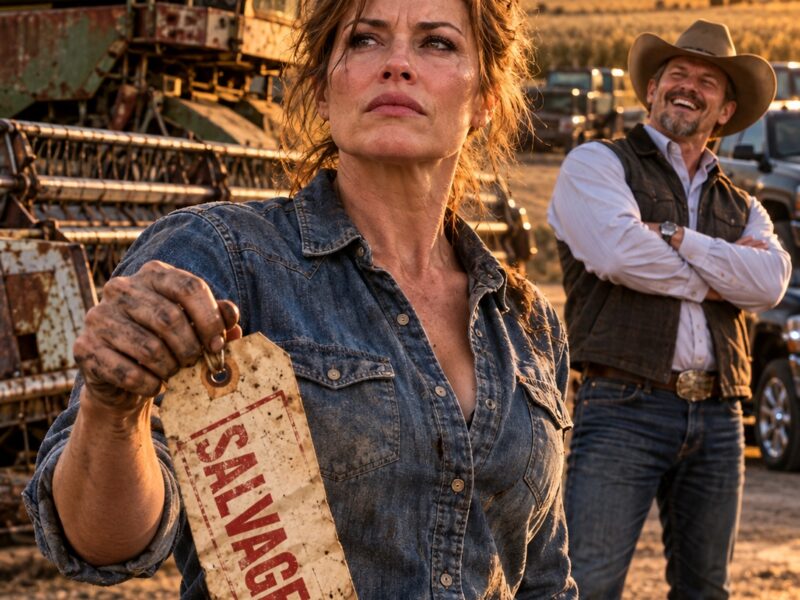
THEY LAUGHED WHEN SHE PAID $500 FOR A DEAD COMBINE—FOUR YEARS LATER, THE MAN WHO MOCKED HER CAME BEGGING FOR HELP
The first man to laugh when Lenora Benton offered five hundred dollars for the dead combine was Wade Keaton.
The second was standing beside him.
By the time the laughter rolled across the dusty Oklahoma auction yard, even the auctioneer was smiling.
Lenora wasn’t.
She stood beside the rust-streaked machine with a grease pencil tucked behind one ear, a battered black notebook under her arm, and a pale chalk mark she had made beneath the threshing drum still dusting the side of her hand.
The combine had been sitting for years.
Its paint had faded almost to gray.
One tire was soft.
The seat was split open.
Dust packed the corners of the engine compartment, and a bird had once built a nest beneath a section of sheet metal near the rear.
Someone behind her muttered, “Scrap.”
Wade heard him.
“Scrap?” he said loudly. “You’re being generous.”
More laughter.
The old man selling the machine, eighty-two-year-old Otis Merrick, lowered his eyes.
Lenora looked at the auctioneer.
“Five hundred.”
The laughter stopped for perhaps half a second.
Then Wade actually bent forward, one hand on his knee.
“Five hundred dollars?”
Lenora didn’t answer.
Auctioneer Grant Danner looked around.
“Five hundred. Do I hear six?”
Nobody raised a hand.
Wade grinned.
“Six hundred would require somebody else wanting it.”
A few men chuckled again.
Grant waited.
“Five hundred once.”
Lenora closed her notebook.
“Twice.”
Otis looked at her.
Something unreadable moved across his face.
“Sold.”
Grant slapped his clipboard against his palm.
“Five hundred dollars to Lenora Benton.”
Wade shook his head as if he’d just witnessed someone light money on fire.
Lenora walked toward the office to arrange payment.
Behind her, Wade called, “You counting all the money you’re about to lose?”
She kept walking.
That seemed to bother him more than an argument would have.
So he followed.
“Lenora.”
She stopped.
Wade was fifty, broad through the shoulders, permanently sun-darkened, and successful enough that people around Alva tended to forgive him for speaking as though every room belonged to him.
His custom harvesting operation ran some of the newest equipment in Woods County.
During harvest, his machines moved across northern Oklahoma like a private army.
Farmers waited for him.
Wade knew it.
That knowledge had become part of his posture.
He nodded toward the combine.
“Call me when that thing dies in the middle of your field.”
Lenora looked at him.
“Why would I call you?”
The men standing nearby went quiet.
Wade smiled.
“Because you’ll need somebody to finish the job.”
“I’ve needed somebody to finish the job before.”
His smile tightened.
That one landed.
For years, Wade’s crew had harvested Lenora’s eighty-four acres.
And for years, her eighty-four acres had been small enough to be moved down his schedule whenever a larger customer needed him.
Last August, she’d watched ripe wheat stand under a hard Oklahoma sun for three extra days because Wade had decided a six-hundred-acre contract east of the county mattered more.
Nothing personal, he’d told her.
Just business.
Lenora had never forgotten the phrase.
Wade shrugged.
“Well, don’t expect me to leave a big client when your antique quits.”
Lenora looked past him at the machine.
Then back at Wade.
“I wouldn’t expect you to leave a big client for me, Wade.”
She let the silence sit between them.
“You never have.”
His expression changed.
Only slightly.
But enough.
Lenora turned away.
She had almost reached the office when she heard Otis Merrick behind her.
“Mrs. Benton?”
She stopped again.
The old farmer had removed his cap.
He held it against his chest.
“There is something I need to tell you about that machine.”
And suddenly, for the first time that morning, Lenora wondered whether the five hundred dollars really had been a mistake.
Five years earlier, Lenora had buried her husband.
Three months before the auction, she had lost her job.
The two events were different kinds of grief.
Everett’s death had split her life into a before and an after.
The layoff had simply shown her how expensive the after could become.
For eighteen years, Lenora had worked at an agricultural service facility outside Alva, diagnosing the failures other mechanics couldn’t immediately explain.
Seized headers.
Damaged drivetrains.
Hydraulic problems.
Electrical faults that disappeared the moment someone brought the machine into the shop.
She had never been the loudest technician.
She had rarely been the fastest.
But when another mechanic said, “I don’t know what the hell is wrong with this thing,” somebody usually found Lenora.
Then came the memo.
Downsizing.
Management called it restructuring.
Lenora called it Tuesday because she still had to wake up Wednesday morning and figure out how to pay the electric bill.
Her last paycheck disappeared into property taxes, diesel, groceries, and the repair of a well pump that chose the worst possible week to fail.
She still owned the eighty-four acres Everett had left behind.
Wheat kept the place alive.
Small repair jobs helped.
But every harvest season she paid somebody else to cut her crop.
At forty-eight dollars an acre, Wade’s bill came to $4,032 before fuel, fertilizer, insurance, property taxes, equipment repairs, or life had taken its share.
The roof of her equipment shed had leaked for two years.
She kept a bucket beneath the worst spot.
Every time it rained, the bucket reminded her that there was always one more thing waiting for money she didn’t have.
That was why she had gone to Otis Merrick’s auction.
Not because she was sentimental.
Not because she believed old machines had souls.
And certainly not because she wanted to prove Wade Keaton wrong.
She went because machinery was something she understood.
And understanding something was one of the few forms of leverage she had left.
Otis walked with her toward the edge of the auction yard.
When they were far enough from the others, he stopped.
“That combine ran when I parked it.”
Lenora waited.
Old mechanics and old farmers had one thing in common.
If you interrupted them at the wrong moment, you usually lost the important part.
Otis looked back toward the machine.
“Last season I used it, I started getting a vibration.”
“Where?”
“Couldn’t tell you.”
“Engine speed?”
“Not at idle.”
That sharpened her attention.
“Under load?”
He nodded.
“Only under load. Came and went at first. Then got worse.”
“How much worse?”
“Enough that I stopped.”
Lenora studied him.
“Why didn’t you say that before the bidding?”
“I tried.”
She remembered.
He had.
Nobody had listened.
Otis rubbed his thumb along the edge of his cap.
“I don’t want you putting money into something because you think I hid the truth.”
“I inspected it.”
“Inspection doesn’t show everything.”
“No.”
“Could be expensive.”
“Yes.”
“Could be fatal.”
“To the machine?”
“To your wallet.”
That almost made her smile.
Almost.
Instead, she opened her notebook.
“What year did the vibration start?”
Otis told her.
She wrote it down.
“What had you repaired immediately before that season?”
He told her that too.
She kept writing.
After several questions, Otis frowned.
“You’re still taking it?”
“I already bought it.”
“You can probably get your money back in scrap.”
“I didn’t buy scrap.”
He studied her face.
“What did you buy?”
Lenora glanced toward the combine.
“I don’t know yet.”
That answer seemed to satisfy him more than confidence would have.
On the drive home, with the combine following hours later on a hired flatbed that cost her another $210, Lenora stopped at a red light outside town.
She opened the notebook on the passenger seat.
At the top of the first clean page, she wrote:
$3,600.
She underlined it once.
That was the ceiling.
Purchase.
Transport.
Parts.
Fabrication.
Tooling.
Everything.
If she could not make the combine dependable within that number, she would stop.
No emotional spending.
No pride.
No trying to “win” because Wade had laughed.
Everett used to tell her that pride was just another bill people forgot to budget for.
She could hear him saying it now.
Lenora looked at the number.
“$3,600,” she whispered.
Then the light turned green.
She drove home.
And the next morning, she discovered the first reason everyone else might have been right.
She did not begin by turning wrenches.
She began with water.
Lenora washed years of dirt, mouse debris, oil residue, chaff, and Oklahoma dust from the machine until she could see metal instead of history.
Then she waited for it to dry.
She measured.
Photographed.
Recorded.
Checked tolerances.
Tagged assemblies.
For two days she removed almost nothing.
Curtis Bell, who farmed the neighboring property, stopped by the second afternoon and found her sitting on an overturned bucket with a caliper in one hand and the notebook balanced across her knee.
“You fixing it or writing its biography?”
“Both.”
Curtis walked around the combine.
“Wade says you bought yourself a lawn ornament.”
“Wade says a lot of things.”
“That’s true.”
He kicked lightly at one tire.
“Think it’ll run?”
Lenora looked up.
“Running isn’t the same as working.”
Curtis laughed.
“You sound like Wade.”
“No. Wade happens to be right about that.”
That answer surprised him.
Lenora didn’t need Wade to be stupid.
In fact, that would have made everything easier.
Wade knew harvesting.
He knew equipment.
He knew the economics of farming.
His mistake wasn’t ignorance.
His mistake was assuming the things he understood were the only things worth understanding.
By the end of the second day, Lenora had created 198 inventory cards.
One hundred thirty-six components appeared serviceable.
Forty-four needed replacement.
Eighteen required fabrication, restoration, or sourcing that would be far more difficult.
The common parts didn’t scare her.
Belts.
Chains.
Roller bearings.
Fasteners.
Many of their specifications had survived even when the original part numbers hadn’t.
The specialized components were another story.
Some hadn’t been manufactured in years.
Suppliers asked for serial numbers that led to obsolete catalogs.
One parts dealer laughed softly over the phone.
“Ma’am, we stopped carrying that before my son was born.”
“How old is your son?”
“Thirty-two.”
“Then I assume you still know what replaced it.”
A pause.
“I like you.”
“Does that mean you have the part?”
“No.”
“Then don’t like me yet.”
She hung up with three additional numbers to call.
That became her life.
Repair jobs during the day.
The combine at night.
Bills on the kitchen table.
Coffee reheated until it tasted burned.
She sometimes woke at two in the morning thinking about bearing loads.
Other nights she woke reaching for Everett.
Those were worse.
The empty half of the bed still had a geography of its own.
She had never moved his nightstand.
His old reading glasses remained in the drawer beneath a stack of receipts she couldn’t bring herself to throw away.
Five years was long enough for people to stop asking whether she was okay.
It was not long enough for the house to stop remembering him.
One night, after spending nearly three hours searching for a discontinued coupling, Lenora walked into the kitchen and saw Everett’s old coffee mug on the shelf.
She stared at it.
“I know,” she said quietly.
The empty room said nothing.
“I know this might be stupid.”
She poured herself water.
“But stupid has numbers.”
She looked toward the notebook.
“I’ve got numbers.”
That was how she kept going.
Not faith.
Numbers.
Ruben Salazar became involved when Lenora reached the first components she couldn’t restore herself.
His machine shop sat about twenty miles outside town, behind a low metal building with two dogs that barked at everyone but never seemed willing to leave the shade.
Ruben studied Lenora’s sketches.
“Measurements?”
“In the folder.”
“Tolerances?”
“Second page.”
“Material specifications?”
“Third.”
He flipped through them.
Then looked at her.
“You knew I was going to ask.”
“I hoped you would.”
“Most people bring me a broken part and say, ‘Make me another one.'”
“Most people aren’t paying you with my money.”
That earned the beginning of a grin.
Ruben agreed to fabricate shielding panels and two deteriorated sections of the feed throat.
But only from written specifications.
No guesses.
No “close enough.”
Lenora liked him immediately.
Curtis helped with heavy assemblies she couldn’t safely lift alone.
In exchange, Lenora diagnosed the rough fuel system on his tractor.
Nothing was charity.
That mattered to her.
She didn’t want rescuing.
She wanted fair trades.
Weeks became months.
At the co-op, Wade turned the combine into a running joke.
People told Lenora about it because small towns have a strange way of delivering insults to the person they were intended to hurt.
Apparently Wade’s favorite version went like this:
Lenora paid five hundred dollars for junk.
Then she started spending real money trying to prove it wasn’t junk.
Soon she’d spend enough to buy a machine that actually worked.
The first time Curtis repeated it, Lenora kept sorting bolts.
The second time, she said, “How much does Wade think I’ve spent?”
Curtis shrugged.
“Didn’t say.”
“Then he doesn’t know whether the joke is funny.”
She kept working.
But later that night, alone in the shed, she opened the notebook and added every receipt again.
She checked the total twice.
Not because Wade had gotten inside her head.
Because she feared he might someday deserve to.
There was a difference.
The first time the engine started, Lenora did not celebrate.
Curtis did enough for both of them.
The old diesel coughed once.
Twice.
Then caught.
Smoke pushed from the exhaust.
The machine shook.
The engine settled into a rough mechanical rhythm that gradually smoothed as it warmed.
Curtis slapped the side panel.
“Listen to that!”
Lenora held up one hand.
“Don’t touch it.”
“What?”
“Listen.”
They listened.
Thirty seconds.
A minute.
Two.
No knock.
No irregular pulse.
No vibration matching Otis’s description.
Curtis looked at her.
“So?”
“So it runs.”
“That’s good.”
“It’s step one.”
“You ever let yourself enjoy anything?”
She glanced at him.
“I enjoyed step one.”
“You looked miserable.”
“That’s my enjoying face.”
He laughed.
Several days later, she arranged to test the combine on a strip of early-ripening wheat on a neighboring property.
That morning felt different.
A shop test could lie.
A field rarely did.
Lenora climbed into the cab.
The seat still had a repaired seam beneath her left thigh.
The steering wheel was worn smooth by Otis’s hands.
She thought about the years the old man had spent in that seat.
Then she lowered the header.
The machine moved forward.
Wheat disappeared beneath it.
For several seconds, Lenora felt something she had refused to feel for months.
Hope.
Then she looked behind her.
Her stomach dropped.
Too much grain was coming out the back.
She stopped.
Climbed down.
Knelt in the stubble.
Picked through the residue.
Curtis approached.
“Bad?”
“Yes.”
“How bad?”
“Bad enough.”
The sample confirmed it.
Too much foreign material.
Too much loss.
The machine ran.
It did not yet harvest properly.
And Wade Keaton happened to be at the elevator when Lenora brought the sample in.
He watched the man behind the counter examine it.
Then he saw Lenora’s face.
That was enough.
By the end of the week, Wade had photographs of the residue behind her test strip.
He showed them to landowners.
“The thing moves,” he said. “I’ll give her that.”
Then came the sentence Lenora herself had used.
“Running and working are two different things.”
When Curtis told her, she didn’t answer.
She adjusted cylinder speed.
Measured loss.
Changed concave clearance.
Checked the cleaning system.
Changed one variable.
Ran again.
Recorded.
Changed another.
Ran again.
Recorded.
No second pass for appearances.
No hiding the bad sample.
No frantic adjustment of five things at once.
Then, under load, she felt it.
A vibration.
Small.
Rhythmic.
Wrong.
Lenora immediately throttled down.
Her hands went cold.
Otis.
She shut the machine off.
The field became unnaturally quiet.
Curtis climbed down from the grain cart.
“What happened?”
Lenora was already moving.
“The vibration.”
“The one Otis told you about?”
“Yes.”
She crawled beneath the machine.
Minutes later, she found the source near the chalk mark she had made on auction day.
The main bearing assembly beneath the drum.
She pulled the housing.
And then she understood why Otis had stopped harvesting.
The bearing hadn’t merely worn.
It had worn out of alignment.
Replacing the bearing alone would accomplish almost nothing.
The housing geometry was wrong.
Run it that way through harvest and the misalignment would transfer stress into the shaft and adjacent components.
Eventually something far more expensive would fail.
Curtis crouched beside her.
“Can you fix it?”
Lenora didn’t answer.
She was staring at the part.
“Lenora?”
She finally said, “I can fix almost anything if you give me enough money.”
Curtis understood immediately.
“How much do you have left?”
“Not enough.”
That evening Ruben drove out.
He inspected the housing.
Measured it.
Measured again.
Then sat back on his heels.
“You were right.”
Lenora hated the sentence.
“Options?”
“Precision restoration.”
“Cost?”
He told her.
She shook her head.
“Replacement assembly?”
“If you can find one.”
“Can you?”
“No.”
They looked at the machine.
Outside, the wheat moved beneath a hot wind.
Her own crop would be ready in roughly two weeks.
Lenora called suppliers until the answers began repeating.
No.
Discontinued.
Wrong configuration.
No inventory.
Unable to cross-reference.
No.
No.
No.
The number in her notebook was approaching the line she’d promised herself she would not cross.
For the first time since the auction, she considered selling the combine for parts.
And then Otis Merrick appeared in her driveway.
He walked through the shed slowly.
Lenora didn’t try to make the situation look better than it was.
The machine was partly disassembled.
Tools covered the bench.
The failed housing sat beneath a work light.
Otis stared at it for a long time.
“That’s it.”
“You recognize it?”
“Not the part. The feeling.”
Lenora leaned against the bench.
“I found your vibration.”
“I figured you might.”
“I can’t find the replacement.”
Otis nodded.
“If you part the machine out, you’ll probably recover most of what you’ve put into it.”
She looked at him.
He continued before she could speak.
“That’s not me telling you to quit.”
“Sounds like it.”
“It’s me telling you not to lose your farm because of a machine I sold you.”
Lenora’s eyes dropped toward her notebook.
“What would you do?”
Otis smiled sadly.
“I’m eighty-two. At my age, that’s a dangerous question.”
“I’m asking anyway.”
“I’d decide whether I was fixing a machine or defending a decision.”
The words landed harder than Wade’s jokes ever had.
Otis turned toward the door.
Then stopped.
“Wait.”
He looked back.
“Did I ever give you that note?”
“What note?”
“At the auction.”
Lenora opened the notebook.
They went backward through months of records.
Receipts.
Measurements.
Part numbers.
Phone contacts.
Then she found it.
A small note in Otis’s handwriting.
Same model near Waynoka. Engine bad. Ask about drum assembly.
Lenora looked up.
“You remember this?”
“Barely.”
“Whose?”
“Don’t know if he’s still there.”
“How old is the address?”
“Old.”
“How old?”
Otis considered.
“Old enough that I wouldn’t waste too much diesel.”
Lenora stared at the note.
Her phone rang.
Wade.
She almost didn’t answer.
Then she did.
“Hello?”
“Lenora.”
“What?”
“Calling about harvest.”
Her grip tightened.
“What about it?”
“Your slot moved.”
She closed her eyes.
“To when?”
“Can’t give you an exact day.”
“My wheat will be ready.”
“I know.”
“You told me Tuesday.”
“A bigger operation extended its acreage.”
There it was.
The same arithmetic.
Eighty-four acres versus hundreds.
Lenora versus somebody worth more money.
“Wade.”
“It’s business.”
She looked at the broken combine.
Then at Otis’s note.
“No,” she said.
“What?”
“I said no.”
“To what?”
“To waiting.”
A pause.
“You got another crew?”
Lenora closed the notebook.
“I’ll handle my harvest.”
Wade laughed once.
It wasn’t loud.
That made it worse.
“With that?”
Lenora ended the call.
Otis raised an eyebrow.
“What did you just do?”
She tore the old address from the notebook and slipped it into her pocket.
“I think I just made this machine my only option.”
The farm near Waynoka still existed.
So did the combine.
It sat behind an equipment shed beneath a rusted tin lean-to, weeds climbing around the wheels.
The engine block was cracked.
The machine hadn’t moved in years.
Lenora crawled beneath it with measuring tools.
One hour later, dirt streaked her shirt and sweat ran into her eyes.
She called Ruben.
“I’ve got measurements.”
“Go.”
She read them.
Ruben made her repeat two.
Then he became quiet.
“Ruben?”
“It should fit.”
“Should?”
“If your measurements are right.”
“They’re right.”
“Then yes.”
For the first time in days, Lenora smiled.
She negotiated with the owner.
Four hundred fifty dollars for the parts machine.
There was one problem.
Lenora didn’t have four hundred fifty dollars.
Not money she could spend.
She sat in her truck staring at the steering wheel.
Then she remembered the livestock operation that had been calling for three weeks about a feed-system auger.
She called.
“You still need that auger fixed?”
The owner laughed.
“I needed it fixed three weeks ago.”
“I can be there this afternoon.”
“Thought you were too busy.”
“I was.”
“And now?”
Lenora looked at the dead combine behind her.
“Now I’m more motivated.”
For the next two days, she worked until her hands cramped.
She repaired the auger.
Collected exactly what she’d quoted.
Returned to Waynoka.
Bought the parts machine.
Removed the assembly herself.
Transported it home.
Ruben was waiting.
They fitted the replacement.
Aligned it.
Checked it.
Checked it again.
Then came the moment Lenora had learned not to romanticize.
She started the engine.
Brought the combine slowly toward operating speed.
The shed filled with mechanical noise.
Lenora watched.
Listened.
Felt the vibration through the floor.
Nothing.
She increased the load.
Nothing.
Ruben looked at her.
She did not smile yet.
They fed bundled wheat through the system.
Still nothing.
Lenora adjusted the concave gap twice.
Ran another test.
Then another.
Finally, she shut the machine down.
Silence fell.
Ruben wiped his hands.
“Well?”
Lenora opened the notebook.
She added the latest expenses.
The total stared back at her.
$4,050.
Four hundred fifty dollars over the ceiling she had sworn she would respect.
Ruben saw the number.
“Thought your limit was thirty-six.”
“It was.”
“So you broke your rule.”
Lenora stared at the page.
“No.”
“You spent over it.”
“I changed the decision when I had new information.”
“Sounds suspiciously like breaking the rule.”
She tapped the last $450.
“This didn’t buy hope. It bought a measured assembly I knew would fit and corrected a diagnosed failure.”
Ruben smiled.
“That’s the most mechanic answer I’ve ever heard.”
Lenora closed the notebook.
“Now we find out whether it bought a harvest.”
Outside the shed, eighty-four acres of wheat were almost ready.
And rain was moving toward Oklahoma.
The forecast worsened.
A significant system was coming from the southwest.
Lenora calculated approximately forty-two hours of cutting under normal conditions.
Forty-two hours assumed no major breakdown.
No prolonged stoppage.
No mistake she hadn’t already found.
The first morning she drove into her own wheat, she stopped at the edge of the field.
Everett had once stood there every harvest.
He would bring coffee out too early and complain that she never drank it before it got cold.
She could almost see him leaning against the truck.
“You sure?” he would have asked.
“No,” she whispered.
Then she lowered the header.
The combine entered the wheat.
Hours passed.
The machine held.
The sample looked cleaner.
She adjusted.
Measured.
Recorded.
Kept going.
By the time sixteen acres remained, the sky had changed.
Curtis looked toward the southwest.
“We can push harder.”
“No.”
“Rain’s coming.”
“I know.”
“Then push it.”
“No.”
He stared at her.
“Lenora, you’ve got sixteen acres.”
“And I’ve got a rated operating capacity.”
“It’s been running fine.”
“That’s why I’d like it to continue running fine.”
“You could lose the crop.”
“I could lose the machine and the crop if I get stupid.”
Curtis swore under his breath.
Then nodded.
“Fine.”
They worked efficiently instead.
Curtis moved the grain cart.
Refueled.
Checked fluids.
Eliminated unnecessary stops.
Lenora maintained speed.
No heroics.
No punishment.
No attempt to prove the old machine was something it wasn’t.
Near sunset, the final strip stood between Lenora and the county road.
The clouds were darker now.
Wind pressed the wheat.
She lowered the header.
Made the pass.
When she reached the end, there was nothing left standing behind her.
Curtis pulled alongside.
“That’s it?”
Lenora looked back.
“That’s it.”
He grinned.
She didn’t.
Not yet.
Because there was one more verdict.
At the elevator, she handed over the sample.
The man behind the counter examined it.
Lenora watched his face.
He checked the grain.
Checked again.
Then wrote something down.
Lenora waited.
“Well?”
He slid the paperwork toward her.
“Clean.”
One word.
That was all.
Lenora looked at the paper.
Months of work.
Thousands of dollars.
Wade’s laughter.
Otis’s warning.
The failed test.
The vibration.
The drive to Waynoka.
Two days repairing an auger just to earn enough for one more machine that didn’t run.
All of it reduced to one word.
Clean.
She folded the paper.
Outside, the first rain hit the windshield.
Three farmers called her before the week ended.
All three had previously used Wade.
All three had been rescheduled too many times.
Lenora accepted ninety-six additional acres.
Twenty-two.
Thirty-one.
Forty-three.
She charged forty dollars an acre.
More important, she gave every customer a written schedule.
One farmer asked, “You sure you can handle another forty?”
“No.”
He blinked.
Lenora continued.
“I can handle thirty-one. I can’t honestly promise forty.”
Most contractors would have taken the acreage and figured it out later.
Lenora didn’t.
She turned down two more jobs that season.
Curtis thought she was crazy.
“People are calling you.”
“I noticed.”
“This is when you grow.”
“This is when people usually grow faster than their equipment.”
“So buy another machine.”
“With what?”
“Eventually.”
“Eventually isn’t today.”
The old combine continued running.
By the end of the season, the numbers were clear.
She had avoided $4,032 in custom harvesting fees on her own farm.
Operating expenses on her eighty-four acres came to roughly a thousand dollars.
The ninety-six outside acres generated $3,840 in service revenue against approximately $1,460 in documented operating costs.
The net benefit was roughly $5,400.
Enough to cover the $4,050 restoration.
Curtis congratulated her.
Lenora corrected him.
“I haven’t made money yet.”
“What do you call fifty-four hundred dollars?”
“Proof.”
“Proof of what?”
“That it can work.”
“And profit?”
“Profit comes after I count my labor.”
Curtis stared at her.
“You are the least satisfying success story I’ve ever met.”
She laughed.
This time, she actually laughed.
But privately, Lenora understood something had changed.
She no longer had to wait for Wade.
And once one person stopped waiting, others began asking why they were waiting too.
Four harvests later, the bucket beneath the leaking roof was gone.
Lenora had finally repaired the shed.
The combine still wasn’t pretty.
She never wasted money making it pretty.
But it was clean.
Maintained.
Documented.
Every nonstandard part had a sourcing note.
Every calibration had a record.
Every repair had a date.
Her original 198 cards had become 267 entries.
And Lenora now provided harvest services for twelve small farms.
Not the biggest farms.
She didn’t want them.
Her customers were the farmers who had spent years being placed at the bottom of someone else’s list.
She understood that market because she had once been the market.
Wade, meanwhile, expanded.
More contracts.
More acres.
More commitments.
He had newer machines.
Faster machines.
Better machines.
And not enough of them.
The calculation worked until the third week of harvest in Lenora’s fourth season.
One of Wade’s combines suffered a gearbox failure.
Not a repair you solved before lunch.
He still had forty-two acres uncut across several properties.
Two customers had already been rescheduled twice.
Every other major crew in the area was committed.
At 9:17 on a Tuesday morning, Lenora heard a pickup turn into her driveway.
She was inside the shed performing post-harvest checks.
The whiteboard on the wall showed her schedule.
Completed jobs in black.
Remaining commitments in red.
She heard the truck door close.
Footsteps.
Then silence.
Lenora kept working.
She knew who it was before she looked up.
Wade Keaton stood in the doorway.
Four years earlier, he’d stood in an auction yard and laughed at the machine beside her.
Now that same machine was clean and ready for its next job.
Lenora set down her inspection lamp.
“Wade.”
He looked around the shed.
At the organized parts shelves.
The whiteboard.
The maintenance logs.
Finally, the combine.
“I need coverage.”
No hello.
No apology.
Lenora wiped her hands.
“How many acres?”
“Forty-two.”
“Where?”
He named the properties.
Lenora recognized several immediately.
Men who had stood in the auction yard four years earlier.
Men who had laughed.
She could have reminded Wade.
She didn’t.
“When?”
“Yesterday.”
“That’s not a date.”
His jaw tightened.
“As soon as possible.”
Lenora walked to the whiteboard.
Wade followed.
She studied the schedule.
“I can’t do forty-two.”
He exhaled sharply.
“Lenora—”
“I can do twenty-six before my next commitment.”
“I need all of it.”
“I heard you.”
“You know what’s going to happen if those fields sit.”
“Yes.”
“Then help me.”
She turned.
“I am.”
“Twenty-six doesn’t solve my problem.”
“No. It solves twenty-six acres of your problem.”
For a second, the old Wade appeared.
The man from the auction.
The man accustomed to people rearranging themselves around him.
Then he looked at the combine.
And the expression disappeared.
“What’s your rate?”
Lenora told him.
His eyebrows rose.
“That’s higher than what I quoted them.”
“Yes.”
“I’ll lose money.”
Lenora waited.
Wade stared at her.
She did not smile.
Did not say, It’s just business.
She didn’t need to.
He heard it anyway.
“You won’t match my rate?”
“No.”
“Even though they’re my customers?”
“Especially because they’re your customers. Your pricing agreement is with them. Mine would be with you.”
Wade looked away.
Four years earlier, he had told Lenora not to expect him to abandon a big client when her junk machine failed.
Now his big clients were the reason he couldn’t save his smaller ones.
And the woman with the junk machine was the only available crew in the county.
“Fine,” he said.
“Written confirmation.”
“What?”
“Acreage, locations, payment terms.”
“You know me.”
“That’s not paperwork.”
His face hardened.
Then, slowly, he nodded.
“Send it.”
“I will.”
He started toward his truck.
“Wade.”
He stopped.
Lenora pointed toward the whiteboard.
“I’ll take those twenty-six acres because I can reach them without breaking commitments I’ve already made. Don’t ask me for the other sixteen later.”
He looked at her.
“Why not?”
“Because I’ve already promised those hours to somebody else.”
Something moved in his expression.
Recognition, perhaps.
Or humiliation.
Maybe both.
Lenora picked up her inspection lamp.
“I don’t move smaller clients when a bigger one gets into trouble.”
Wade stood there another second.
Then walked out.
That was the moment he finally understood what Lenora had built.
It wasn’t a restored combine.
It was an alternative.
Two of Wade’s customers stopped Lenora after she finished their fields.
The first was a farmer named Jim Harlan.
He removed his cap.
“Next season, I’m calling you first.”
Lenora shut down the machine.
“You don’t have to decide today.”
“I already decided.”
The second farmer said almost exactly the same thing.
There was no dramatic speech.
No applause.
No crowd watching Wade lose.
Real shifts in power rarely announce themselves that way.
They happen quietly.
A phone number changes in someone’s contact list.
A contract isn’t renewed.
A customer stops waiting.
A person who once had no alternative suddenly has one.
Otis Merrick was eighty-six by then.
He came to watch Lenora cut the first of Wade’s stranded fields.
He parked near the fence and stood beside his truck.
Age had bent him slightly.
But not much.
Lenora saw him after completing the first pass.
She climbed down.
Instead of walking directly toward him, she went to the cab and retrieved her records.
The binder had grown thick.
Otis smiled when he saw it.
“Still writing everything down?”
“More than ever.”
“How many pages?”
“Don’t know.”
“That’s unlike you.”
“Two hundred sixty-seven active entries.”
He laughed.
“That’s more like you.”
Lenora opened the front cover.
Tucked inside was a faded auction tag.
Otis stared.
Printed across it was one word.
SALVAGE.
Beside it, Lenora had kept the original receipt.
$500.
Otis touched the edge of the paper.
“You kept that?”
“Of course.”
“Why?”
Lenora looked toward the field.
The combine waited in the wheat.
Wade’s stranded customer stood near a grain truck farther down the road.
“I used to think I’d keep it because it would remind me everybody was wrong.”
Otis looked at her.
“And now?”
“Now it reminds me they weren’t entirely wrong.”
His eyebrows lifted.
“That machine was almost finished. The bearing assembly was bad. Parts were nearly impossible to find. I went over budget. The first field test was terrible.”
“You’re not making this story very inspiring.”
Lenora smiled.
“Good.”
She handed him the binder.
“I didn’t save that combine because I believed in it.”
Otis looked down at the auction tag.
“I saved it because I checked what you had maintained. I measured what was still good. I replaced what wasn’t. And when something failed, I didn’t pretend it hadn’t.”
Otis was quiet.
Lenora continued.
“Belief would’ve ruined me if the numbers were bad.”
He closed the binder.
“Then what saved you?”
She thought about it.
The answer seemed too simple after four years.
“Discipline.”
The combine waited.
The field waited.
Lenora took the binder back.
Otis looked toward the wheat.
“You know Wade was here earlier.”
“I know.”
“He talked to me.”
That surprised her.
“About what?”
Otis smiled faintly.
“You.”
Lenora shook her head.
“I don’t want to know.”
“I think you do.”
She hesitated.
“What did he say?”
Otis looked at the combine.
“He said he still thinks buying it was a bad decision.”
Lenora laughed.
“That sounds like Wade.”
“He also said he’d have scrapped it.”
“Probably.”
“And then he said something interesting.”
“What?”
Otis turned toward her.
“He said, ‘I was looking at what it was worth that morning. She was looking at what was still usable.'”
Lenora’s smile faded.
The wind moved through the wheat between them.
For four years, she had imagined that if Wade ever admitted he was wrong, it would feel like victory.
It didn’t.
It felt quieter than that.
Almost sad.
Because Wade hadn’t been wrong about the machine’s value.
Not exactly.
He had been wrong about value itself.
He had looked at a faded combine and seen five hundred dollars of scrap.
He had looked at eighty-four acres and seen a customer small enough to postpone.
He had looked at Lenora after she lost her job and saw a widow with limited options.
His mistake wasn’t that he couldn’t calculate.
His mistake was believing every calculation would stay true forever.
Lenora had once depended on Wade.
Then she had built a way not to.
Other farmers had done the same.
That was how leverage disappeared.
Not with revenge.
With alternatives.
Otis handed her the binder.
“You better get back to work.”
Lenora nodded.
She took three steps.
“Otis?”
“Yeah?”
She looked back.
“Thank you.”
“For what?”
“For warning me about the vibration.”
He smiled.
“I almost didn’t.”
“Why?”
“Thought you’d bring the machine back.”
“I couldn’t. Auction sale.”
“I know.”
“Then why?”
Otis stared at the wheat.
“Because I didn’t want to watch somebody else find out the hard way that something I’d cared for was broken.”
Lenora swallowed.
For a moment, she thought of Everett.
Of the farm.
Of all the things people leave behind when their bodies can no longer keep up with them.
Machines.
Land.
Coffee mugs.
Habits.
Warnings.
Knowledge.
Sometimes the greatest kindness wasn’t preserving what someone had built.
Sometimes it was taking it seriously enough to learn where it could fail.
Lenora climbed into the combine.
The engine started.
Otis remained by the fence.
She lowered the header.
The machine entered the wheat.
Steady.
Level.
Unremarkable.
Exactly the way a machine should run when someone has spent years making sure nothing remarkable happens.
At the far edge of the field, Lenora turned.
For a moment, through the dusty cab glass, she could see Otis standing beside his truck.
Beyond him lay the road.
Beyond the road, miles of Oklahoma wheat moved beneath a late-summer wind.
Four years earlier, people had laughed because Lenora paid five hundred dollars for a machine labeled salvage.
They thought the story was about whether she could prove them wrong.
It never was.
If Lenora had discovered a cracked frame during those first two days, she would have stopped.
If the engine had been destroyed, she would have stopped.
If the cost of restoring the failed assembly had exceeded what the farm could survive, she would have stopped.
She hadn’t gambled everything because somebody insulted her.
She hadn’t “believed harder.”
She hadn’t won because the universe rewarded courage.
She had inspected.
Measured.
Budgeted.
Failed.
Adjusted.
Worked.
Recorded.
Refused jobs she couldn’t fulfill.
Honored the ones she accepted.
And when the facts changed, she changed with them.
That was the part Wade had never understood.
He thought confidence was power.
Lenora learned that reliability was.
He thought having the biggest machines gave him leverage.
Lenora learned that leverage belonged to whoever gave people another choice.
And Otis Merrick, standing beside that fence at eighty-six years old, received something he had never expected when he put his old combine up for auction.
He watched someone treat what he had spent decades maintaining as something worth understanding before deciding it was worthless.
The machine made another pass.
Inside the cab, Lenora’s notebook rested beside her.
The original $500 receipt was still tucked behind the front cover.
So was the faded tag.
SALVAGE.
She never removed it.
Not because it reminded her that everyone else had been wrong.
But because it reminded her how easy it was to confuse being dismissed with being worthless.
They were not the same thing.
They had never been the same thing.
The sun dropped lower across the Oklahoma fields.
Lenora kept the header straight.
Behind her, the wheat fell cleanly.
Ahead of her, another row waited.
And somewhere beneath the noise of the diesel engine, the years of laughter, doubt, grief, invoices, broken parts, late nights, and promises she had refused to break had finally become something quieter than revenge.
They had become a life that no longer required anyone else’s permission to keep moving.
So Lenora moved forward.
Steady.
Measured.
One clean pass at a time.









