THEY LAUGHED WHEN SHE PAID $8,750 FOR A “DEAD” BOAT—THEN THE OLD OWNER SAW WHAT SHE HAD KEPT FOR 26 YEARS
“Engine’s shot. Hull’s tired. Whoever maintained this thing gave up years ago.”
Derek Sloan said it loudly enough for half the dock to hear.
That was deliberate.
Men like Derek never simply inspected something. They performed the inspection. They made sure the seller heard every flaw, the other bidders heard every warning, and the auctioneer understood that the man with the expensive waterproof jacket had already decided what an object was worth.
A few people laughed when he added, “Scrap value. Maybe.”
The old man beside the boat did not laugh.
He stood with one hand resting on the weathered rail, his shoulders squared beneath a faded canvas jacket. He was somewhere in his early seventies, silver-haired, lean, and motionless except for his right hand.
Palm against knuckles.
Knuckles against palm.
Again.
Again.
A tiny movement almost nobody noticed.
Almost.
At the back of the crowd, a woman in a faded green rain jacket lowered her auction catalog.
Her name was Tessa Marlo.
And unlike Derek, she had been looking at the boat instead of the man selling it.
Thirty-four feet.
Built in 1994.
Dark blue lettering across the stern.
SECOND WIND.
The hull was faded. The cabin showed its age. Salt had bleached the trim, and twenty-five Maine winters had left enough scars to make Derek’s assessment sound reasonable.
But Tessa had learned a long time ago that reasonable and correct were not the same thing.
She looked again.
The exterior fuel lines were newer than the hull.
The bilge pump fittings showed almost no corrosion.
The electrical conduit above the cabin entrance had been secured with proper marine-grade ties instead of cheap hardware-store plastic.
The through-hull fittings below the waterline were clean.
And through the engine compartment opening, she could see something even more important.
No old oil staining down the external block face.
Someone had cared for this boat.
Not casually.
Not recently.
Religiously.
Derek saw a dying vessel.
Tessa saw thirty years of somebody refusing to let it die.
Then the auctioneer called for an opening bid.
“Forty-six hundred.”
Derek’s hand went up immediately.
“Forty-six.”
He turned toward the old man.
“Take it, Vernon. Before the hole costs you more than the boat.”
More laughter.
This time Tessa watched Vernon’s hand.
His fingers tightened around the rail until the knuckles turned white.
Then he released it.
He said nothing.
That silence bothered Tessa more than anger would have.
Because she knew that kind of silence.
It belonged to people who had already argued with reality in private and lost.
The auctioneer lifted his hand.
“Forty-six hundred once—”
“Fifty-two.”
The voice came from behind Derek.
Heads turned.
Tessa raised her catalog.
For one second, nobody said anything.
Then Derek looked her over.
First the patched elbow on her rain jacket.
Then her salt-stained rubber boots.
Then the old pickup parked beyond the auction lot.
His mouth curved.
“Fifty-five.”
“Six.”
“Sixty-five.”
“Seven.”
Now the crowd stopped laughing.
Derek turned fully toward her.
“Lady, have you actually looked at the engine?”
Tessa met his eyes.
“Yes.”
“Then you know what you’re buying.”
“I do.”
Something about her answer irritated him.
“Seventy-five.”
“Eight.”
“Eighty-two.”
“Eighty-five.”
The auctioneer barely had time to repeat the numbers.
Derek hesitated.
“Eight-seven fifty.”
Tessa lifted her catalog.
“Eight-seven fifty.”
The dock went quiet.
At that price, Derek could no longer strip the boat and guarantee himself the margin he wanted.
His expression changed almost imperceptibly.
It wasn’t disappointment.
It was insult.
He had expected the woman in the old jacket to disappear as soon as the numbers became serious.
Instead, she had forced him out of the auction.
He shoved his hands into his pockets.
“All yours.”
The auctioneer waited.
“Eight thousand seven hundred fifty dollars once.”
Tessa looked at Second Wind.
“Twice.”
Vernon Pike stared at the deck.
“Sold.”
The gavel came down.
A few people murmured.
Someone behind Tessa said, “She just bought herself a very expensive anchor.”
Derek smiled.
But Tessa wasn’t watching him.
She was watching Vernon.
The old man stepped toward her after the crowd began moving to the next lot.
“You paid too much.”
His voice was flat.
Not bitter.
Not grateful.
Just tired.
Tessa glanced at the fuel lines.
Then the bilge fittings.
Then the careful electrical work.
“Maybe,” she said quietly, “you’re pricing the wrong thing.”
For the first time that morning, Vernon Pike looked directly at her.
And something changed in his face.
Not recognition.
Not yet.
Just the faint uneasiness of a man who suddenly realized the stranger standing in front of him might know something she wasn’t saying.
Tessa had been waiting twenty-six years for this conversation.
She just wasn’t ready to tell him that.
She had arrived at Bracken Cove at 6:45 that morning, before the auction crew finished hanging its signs.
Her pickup had 160,000 miles on it and a crack across the passenger-side window she had ignored for almost two years.
Nothing about it suggested money.
That was intentional.
Three or four times a year, Tessa left Portland before sunrise and drove to working harbors along the Maine coast wearing clothes nobody in her corporate office had ever seen.
No assistant.
No driver.
No board members.
No introduction.
She went to auctions, repair yards, fuel docks, and diners where commercial fishermen complained about equipment while drinking coffee strong enough to remove paint.
She listened.
Which new systems failed after two seasons?
Which repair shops were cutting corners?
Which manufacturers were impossible to deal with?
Which electronic warnings were useful, and which ones experienced captains had learned to ignore?
Those conversations were worth more to Tessa than most industry reports.
Because nobody edited themselves when they thought the woman standing beside them was nobody important.
And Tessa wanted it that way.
Her phone remained inside the truck that morning because the black case had a silver logo embossed across the back:
NORTHLINE MARINE TECHNOLOGIES.
Tessa Marlo was its chief executive officer.
Northline supplied engine-monitoring systems, electrical components, and fleet diagnostic technology to commercial operators throughout the Northeast.
Its Portland headquarters occupied four floors of a glass-and-steel building overlooking the Fore River.
People wore badges to get into rooms where Tessa spent her weekdays.
At Bracken Cove, nobody looked at her twice.
She preferred the second version of herself.
That woman heard the truth.
And Second Wind had been telling her something from the moment she saw it.
The boat had not been abandoned.
Someone had maintained it until very recently.
Which meant Derek Sloan was wrong about the vessel.
But there was something else.
Something Tessa had noticed before the bidding began.
A small brass plate near the cabin hatch.
She had only seen it from a distance.
The letters were tarnished.
Still, she thought she knew what they said.
And if she was right, the auction had stopped being business the moment she read them.
After the sale, she could have signed the transfer papers and left.
Instead she turned to Vernon.
“Would you walk the boat with me?”
His brow tightened.
“You already bought it.”
“Final inspection before I accept delivery.”
“You didn’t inspect before bidding?”
“I did.”
That earned the smallest reaction.
“What exactly are you looking for?”
“I’ll know when I see it.”
Vernon studied her.
Then, without another question, he stepped aboard.
Tessa followed.
The deck flexed exactly where an old commercial deck should flex and nowhere it shouldn’t.
Inside, the boat smelled of diesel, salt, old wood, machine oil, and something almost impossible to describe unless you had grown up around working vessels.
Home.
Not her home anymore.
But once.
Vernon moved through Second Wind automatically.
“The fuel gauge reads low.”
Tessa glanced at him.
“How low?”
“Quarter tank, give or take.”
He opened a cabinet.
“That window leaks in heavy rain. Top left corner. Needs rebedding every couple seasons.”
“You did the work yourself?”
“Most of it.”
“Engine too?”
“Until my hand stopped cooperating.”
There it was again.
His right hand.
He tucked it into his jacket pocket.
Tessa pretended not to notice.
They reached the engine compartment.
The engine was old.
It was also clean.
Not showroom clean.
Working clean.
There was a difference.
Showroom clean meant somebody had washed away evidence.
Working clean meant somebody knew exactly where oil belonged and had noticed when it appeared somewhere else.
Tessa crouched.
“Maintenance records?”
Vernon pointed toward a narrow shelf.
She found a spiral notebook.
The cover was water-stained. Its corners had curled. The first pages had yellowed.
She opened it.
Oil change.
Hours recorded.
Next entry.
Belt replacement.
Coolant flush.
Injector inspection.
Fuel filter.
Year after year.
Same handwriting.
Small.
Precise.
Disciplined.
Tessa’s thumb stopped on the edge of the page.
She knew that handwriting.
Not because she had seen it often.
Because she had seen it once.
And sometimes once is enough.
She closed the notebook.
Her heart had begun beating harder.
“Something wrong?” Vernon asked.
“No.”
But her voice came out softer than she intended.
She moved toward the electrical panel.
And there it was.
A brass plate secured to the wooden frame by two aging screws.
The engraving was worn but legible.
PIKE MARINE REPAIR
BRACKEN COVE, MAINE
For several seconds, Tessa forgot the auction.
Forgot Derek.
Forgot Northline.
Forgot she was forty years old and had hundreds of employees waiting for decisions from her by Monday morning.
She was twelve again.
Standing inside a cold repair shop beside her mother.
Listening to sleet strike a metal roof.
Watching Celia Marlo count money twice because counting it a third time wasn’t going to create more.
“When did you open your shop?” Tessa asked.
Vernon looked up.
“Eighty-one.”
“You ran it yourself?”
“Until 2014. After that, just small jobs for regulars.”
“Always here in Bracken Cove?”
“Always.”
Tessa looked down at the brass plate.
Vernon noticed now.
“Why?”
She swallowed.
“I need to get something from my truck.”
Before he could ask another question, she climbed off Second Wind.
The walk across the dock felt longer than it was.
She passed the auction crew.
Passed Derek, who was talking to another buyer.
Passed men who still thought she had just wasted nearly nine thousand dollars.
At her truck, she opened the passenger door.
Then the glove compartment.
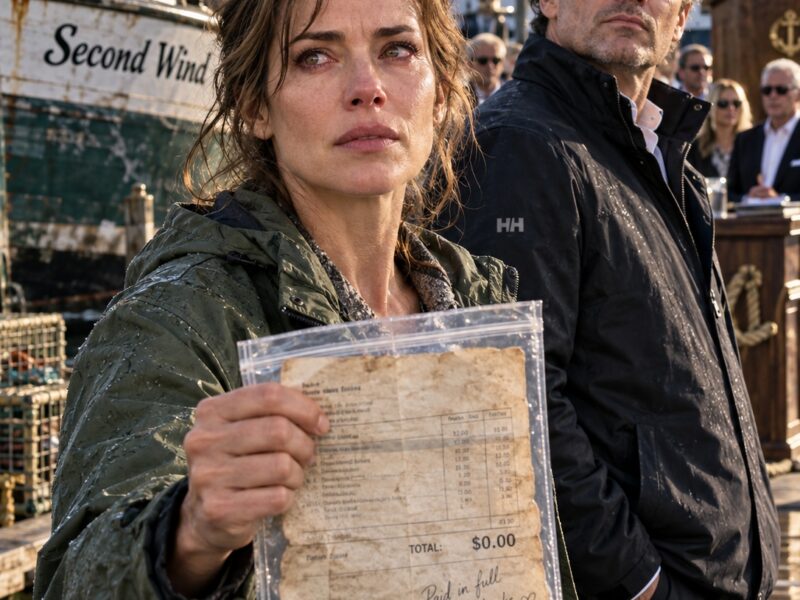
Beneath registration papers, an emergency flashlight, two pens, and an old ferry receipt was a clear plastic document sleeve.
She had carried it there for three years.
Before that, it had lived in a fireproof box in her Portland apartment.
Before that, in a cardboard box after college.
And before that, in a shoebox under her mother’s bed in Rockland.
Tessa took it out.
The paper inside had softened at the folds.
Twenty-six years.
She zipped the sleeve inside her rain jacket.
Then she returned to the boat.
Vernon was sitting on the stern bench.
Tessa sat opposite him.
Neither spoke.
Finally, she removed the sleeve.
“What’s that?”
She handed it to him.
“Something you gave my mother.”
Vernon’s expression changed.
He opened the sleeve.
Inside was a single invoice.
December 1999.
Pike Marine Repair.
Cooling system repair.
Parts.
Labor.
A vessel registered to:
CELIA MARLO
ROCKLAND, MAINE
Vernon stared at the name.
Tessa watched him search his memory.
Nothing came.
Then his eyes moved toward the bottom.
The total was written as:
$0.00
Below it, in the same handwriting filling Second Wind’s maintenance log, was one sentence.
When you’re steady again, keep somebody else afloat.
Vernon read it twice.
Then a third time.
“I don’t remember her.”
Tessa nodded.
“I know.”
“I’m sorry.”
“Don’t be.”
“I had a lot of customers.”
“She wasn’t one.”
Vernon looked up.
“She came here once.”
Tessa could still see the day.
Her mother’s lobster boat had developed a cooling-system failure in December.
Celia had recently lost one major buyer and was already behind on slip fees.
She had enough money for the repair.
Or enough money to keep the boat in the harbor.
Not both.
Tessa remembered her mother asking Vernon whether he could use cheaper parts.
She remembered him saying no.
She remembered thinking that meant they were finished.
Then Vernon repaired the boat anyway.
When Celia asked what she owed, he handed her the invoice.
Zero.
Her mother had argued.
Vernon had refused.
Finally Celia said, “I don’t take charity.”
And Vernon, younger then, had wiped his hands on a shop rag and answered, “Good. Because I’m not offering any.”
He wrote one line on the invoice.
When you’re steady again, keep somebody else afloat.
Then he went back to work.
No speech.
No expectation.
No photograph.
No story told afterward.
Just a repaired cooling system on a freezing Maine afternoon.
“You’re her daughter,” Vernon said.
“I was twelve.”
Something in his face softened.
Tessa looked toward the harbor.
“My mother kept that boat another eleven years.”
Vernon said nothing.
“She taught me everything she knew on it. Fuel systems. Electrical problems. How to hear when a diesel was running wrong before the gauges told you. How to come into a harbor when the weather turned faster than forecast.”
She smiled faintly.
“She also taught me never to trust a fuel gauge completely.”
Vernon almost smiled.
“Smart woman.”
“She was.”
“Is she still—”
“No.”
The word settled between them.
Vernon lowered his eyes.
Tessa did not give him the details.
Some grief becomes private architecture after enough years. You stop needing people to walk through every room.
Instead she tapped the invoice.
“The reason she still had the boat long enough to teach me any of that is because of what you did.”
Vernon shook his head.
“It was a repair.”
“It was a winter.”
“The parts weren’t expensive.”
“They were to her.”
“I had a slow week.”
“She had a bad year.”
“Tessa—”
“You changed what happened next.”
He stopped.
That was the first time she had said her name.
He looked at her again.
Not the jacket.
Not the boots.
Her.
“Tessa Marlo?”
She waited.
His eyes narrowed.
“Northline?”
She nodded.
For several seconds, Vernon simply stared.
Then he gave a quiet breath that might have been a laugh.
“You’re the Northline Marlo.”
“I suppose.”
“And you were bidding against Sloan dressed like that?”
“This jacket is useful.”
“You own half the equipment on the newer boats in this harbor.”
“Not half.”
“How much?”
“Enough that my board would prefer I stop attending auctions anonymously.”
This time he did laugh.
It lasted less than a second.
Then his eyes returned to the invoice.
“What do you want?”
Tessa had expected the question.
Still, it hurt.
Because people learned to ask it after life had charged them too many hidden fees.
“I want you to work for me.”
Vernon stared at her.
She explained.
Northline had a problem.
Its younger technicians were excellent with current diagnostic systems. They understood sensor architecture, digital fault trees, software integration, and modern electrical networks.
But put them inside a thirty-year-old engine room where nothing communicated cleanly, and too many became dependent on the tablet in their hands.
Older commercial boats did not always announce their failures electronically.
Sometimes the clue was vibration.
Sometimes smell.
Sometimes the rhythm of an engine under load.
Sometimes it was knowing that three symptoms that looked unrelated were actually the same problem moving through three systems.
Tessa could teach engineering.
Her staff could teach software.
But neither could manufacture fifty years of mechanical instinct.
“You can,” she said.
Vernon looked almost offended.
“No.”
She had prepared for hesitation.
Not immediate refusal.
“Three days a week.”
“No.”
“Senior field mentor. Real salary, benefits if you want them—”
“No.”
She named a number.
Vernon shook his head before she finished.
“You think this is about money?”
“I think your experience has value.”
“My experience had value.”
“Had?”
Vernon pulled his right hand from his jacket.
For the first time, he held it where she could see it clearly.
The fingers curled slightly inward.
When he tried to straighten them, the movement came unevenly.
“Nerve injury,” he said. “Three years ago.”
Tessa said nothing.
“Some days are better. Some aren’t. I can hold a coffee cup. Drive. Tie a line if I take my time.”
He flexed his fingers.
“But I can’t trust this hand around an engine.”
His voice remained calm.
That made it worse.
“I can’t grip a wrench reliably. Can’t hold a fitting while someone else tightens it. Can’t demonstrate half the procedures I used to do without thinking.”
“You wouldn’t have to—”
“I tried teaching my nephew a fuel pump replacement last spring.”
Vernon looked toward the engine compartment.
“I knew every step. Every mistake he was about to make. But I couldn’t show him the sequence with my hands.”
His jaw tightened.
“Ten minutes later, he pulled out his phone and found a video.”
Tessa felt something shift inside her.
Not pity.
She knew better than to offer that.
Vernon continued.
“The work I know lives in my hands.”
“No,” she said.
He looked at her.
But Tessa stopped herself.
She could tell him he was wrong.
She could give him the speech CEOs were expected to give about knowledge, legacy, transferable skills.
It would mean nothing.
Because Vernon believed what he had said.
And belief built from loss could not be dismantled by a stranger’s reassurance.
So Tessa stood.
“Thank you for showing me the boat.”
“That’s it?”
“That’s it.”
“You drove here with that invoice and a job offer.”
“Yes.”
“And now you’re leaving?”
“Yes.”
Vernon seemed suspicious.
Tessa slipped the invoice back into its plastic sleeve.
“I heard your answer.”
She stepped onto the dock.
Behind her, Vernon said, “You still paid too much.”
Tessa turned.
“No,” she said. “I don’t think I did.”
At the time, Vernon thought she meant the boat.
She didn’t.
The transport crew arrived the following Thursday.
Vernon was waiting when they backed the trailer down the ramp.
The morning was gray and windless.
He kept both hands in his jacket pockets as the crew positioned the cradle beneath Second Wind.
He watched every strap.
Every angle.
Every adjustment.
Twice he opened his mouth.
Twice he stopped himself.
Tessa arrived just before they pulled the boat from the water.
Vernon reached into his pocket.
He placed a key in her palm.
A short piece of worn blue dock line was tied through the ring.
“I don’t have another.”
Tessa closed her fingers around it.
“I’ll take care of her.”
Vernon looked at the boat.
“Boats don’t need promises.”
“No?”
“They need maintenance.”
Tessa smiled.
“That sounds like a promise with paperwork.”
He almost smiled back.
Then the truck moved.
Second Wind rose slowly from the water.
The hull emerged dark and dripping, carrying decades of scars beneath the waterline.
The painted name caught the flat morning light.
SECOND WIND.
Vernon watched until the stern cleared the ramp.
Then he turned away.
He did not look back.
That was the part Tessa remembered later.
The refusal to look.
As though seeing the empty space where the boat had been would make something official.
She imagined him walking home.
Making coffee.
Standing at the kitchen window facing the harbor.
For nearly fifty years, there had always been something waiting for Vernon Pike at the water.
A customer.
A repair.
An engine.
A boat.
A reason to walk downhill toward the dock.
Now Second Wind was gone.
His shop was gone.
His hand no longer obeyed him.
And by his own definition, the work that made him useful had disappeared with it.
Tessa drove back to Portland with the key beside her.
She did not call Vernon again.
Instead, she called her operations manager.
“I want every unresolved diagnostic escalation from the last eighteen months.”
“All of them?”
“All of them.”
“How far back?”
“Eighteen months. Cases where our system returned ambiguous data and the field technician couldn’t isolate the cause without an outside mechanic.”
There was a pause.
“What are you looking for?”
“I’ll tell you when I find it.”
By noon, twenty-three files were waiting.
Tessa canceled two meetings.
She read every one.
The pattern appeared by the seventh.
By the twelfth, she was angry.
By the twenty-third, she understood exactly why Vernon had rejected her.
Northline had built technicians who knew how to read machines through Northline.
The problem was not that the technology failed.
The technology was doing exactly what it was designed to do.
Measure.
Compare.
Flag.
Report.
But data described effects.
Experience sometimes recognized causes.
A thirty-year-old fuel system did not care whether a technician had graduated at the top of an engineering program.
An aging diesel did not organize its problems into convenient fault codes.
The twenty-three cases involved ordinary failures.
Fuel restrictions.
Cooling inefficiencies.
Electrical draws.
Ventilation issues.
Load-dependent behavior.
Nothing extraordinary.
Which was precisely the problem.
Northline’s technicians had learned on engines designed to explain themselves.
Older engines did not.
Tessa sat alone in her office after sunset, looking at Portland Harbor through the glass.
She thought about Vernon’s hand.
The work I know lives in my hands.
Then she thought about something her mother used to say.
People rarely lose everything at once.
First they lose one thing.
Then they mistake it for everything.
Tessa opened one of the diagnostic reports again.
And finally understood what she had to do.
She could not convince Vernon he still had value.
She would have to put him somewhere his value became impossible to deny.
The following Tuesday, three Northline technicians were inspecting a thirty-eight-foot commercial lobster boat at the company’s Bracken Cove field office.
The vessel had intermittent power loss under sustained load.
The crew had replaced one sensor already.
The problem remained.
Tessa arrived without warning.
Marcus Reed, twenty-eight, looked up from his diagnostic tablet.
“Did Portland send you?”
“I am Portland.”
The two other technicians laughed nervously.
Marcus didn’t.
He knew who she was.
“What do you need?”
“Nothing. Keep working.”
They ran the diagnostics.
Three possible faults appeared.
None confirmed.
Marcus checked manufacturer specifications.
Another technician inspected electrical connections.
They ran the engine again.
Twenty minutes passed.
Then thirty.
Tessa said nothing.
Finally Marcus looked at her.
“We can escalate it.”
“To whom?”
“Bangor has a diesel specialist.”
Tessa removed her phone.
“I know someone closer.”
She called Vernon.
He answered on the fifth ring.
“Pike.”
“I have a boat.”
Silence.
“Tessa?”
“Thirty-eight-foot commercial lobster boat. Seven years old. Intermittent power loss under load. Gradual onset. Three sensor indications, no confirmed fault.”
Another silence.
Longer.
“Fuel system?”
“One of the possibilities.”
“What are the others?”
She told him.
Vernon asked, “What does it sound like?”
Tessa looked toward the technicians.
“Come listen.”
“I told you—”
“I’m not offering you a job.”
Nothing.
“I’m paying hourly. Whatever rate you think is fair. I need an experienced diesel mechanic to look before I call Bangor.”
“Tessa.”
“You can say no.”
She waited.
Then Vernon sighed.
“Give me twenty minutes.”
He arrived in eighteen.
His pickup was older than Tessa’s.
He stepped out wearing the same canvas jacket and carrying no tools.
Marcus glanced toward his empty hands.
Tessa noticed.
So did Vernon.
Nobody commented.
They brought him aboard.
The engine was already warm.
Vernon stood near the compartment opening.
“Start it.”
Marcus did.
Vernon listened.
Forty seconds.
“Bring it up.”
Marcus increased the load.
The engine note changed.
To Tessa, it sounded slightly strained.
To the technicians, the sensors showed competing information.
Vernon closed his eyes.
One minute.
Then he opened them.
“Fuel return line.”
Marcus checked the tablet.
“Sensor doesn’t show a return restriction.”
“It wouldn’t.”
“And?”
“Day tank vent.”
Marcus frowned.
“Why?”
“Check them.”
The young technician hesitated.
It lasted perhaps half a second.
But Vernon saw it.
The old mechanic stepped back.
“If I’m wasting your time, Bangor’s still there.”
Marcus put the tablet down.
He traced the return line.
At first, nothing.
Then his fingers stopped.
“There.”
A rubber section had partially collapsed just before the fitting.
Subtle.
Almost invisible.
Under sustained throttle, significant.
The second technician checked the tank vent.
Debris.
Partial obstruction.
They corrected both problems.
Twenty minutes later, the engine ran clean under load.
The diagnostic warnings disappeared.
Marcus stood with a rag in his hands.
He looked from the engine to Vernon.
“How did you know?”
Vernon shrugged.
“Heard it.”
“You heard a collapsed fuel line?”
“No.”
Marcus waited.
Vernon leaned against the bulkhead.
“I heard an engine asking for fuel and not getting it consistently.”
“The system said delivery fault.”
“Sure.”
“So why the return?”
“Because delivery wasn’t the whole sound.”
Marcus stared.
Vernon continued.
“Restriction in the return changes pressure behavior. Block the tank vent too, and the problem compounds as load increases. Your sensors were reading consequences.”
He pointed toward the engine.
“That thing was telling you the cause.”
“How?”
Vernon paused.
Tessa watched him.
This was the moment.
Not the repair.
Not the diagnosis.
This.
A young technician asking an old mechanic for something no manual had managed to explain.
Vernon looked back toward the engine.
“I’ve heard that note before.”
“On this model?”
“No.”
“This engine?”
“No.”
Marcus frowned.
“Then where?”
“Boats like it.”
He stepped closer.
“After enough years, you stop listening only for what’s wrong.”
Marcus waited.
“You listen for what the engine is trying to tell you it needs.”
The boat went strangely quiet except for the ticking of cooling metal.
Then Marcus asked the question Tessa had been hoping somebody would ask.
“Can you teach us?”
Vernon’s eyes shifted toward her.
Tessa said nothing.
Marcus pointed at the engine.
“That sound. Before we fixed it. Can you show us what I was supposed to hear?”
Vernon looked down at his right hand.
Then back at the engine.
His fingers had not touched a wrench.
They had not needed to.
“Start it again.”
Marcus did.
Vernon stepped beside him.
“First, forget the screen for thirty seconds.”
Marcus put the tablet down.
“Now listen.”
And for the next forty-five minutes, Vernon Pike taught three Northline technicians without holding a single tool.
Tessa met him at the harbor diner the next morning.
Two coffees sat between them.
Neither had been touched.
A contract lay beside Vernon’s cup.
He read the first page.
Then the second.
Then the compensation section.
His eyebrows rose.
“That’s too much.”
“No, it isn’t.”
“For three days?”
“For what you know.”
“I told you I can’t demonstrate procedures.”
“I’m not asking you to.”
Vernon looked up.
Tessa leaned forward.
“I was wrong the first time.”
“About what?”
“I asked you to teach them how to repair engines.”
She tapped the contract.
“I need you to teach them how to think before they repair one.”
He said nothing.
“Marcus knows more about our diagnostic platform than you ever will.”
“I would hope so.”
“But yesterday, you knew what the engine needed before he did.”
“Experience.”
“Yes.”
“You can’t put fifty years into a training manual.”
“No.”
Tessa smiled.
“That’s why I’m hiring the fifty years.”
Vernon looked away toward the window.
Outside, Bracken Cove was waking.
A deckhand carried ice down the dock.
A gull landed on a piling.
A diesel engine turned over somewhere beyond the diner, coughing twice before settling into a low idle.
Vernon heard it.
Tessa saw his head tilt almost unconsciously.
Even now.
Even when he was trying not to.
He was listening.
“The work isn’t in your hands,” she said.
His jaw tightened.
“You don’t get to decide that.”
“No.”
Tessa let the answer sit.
“Marcus does.”
Vernon looked back at her.
“He asked you to teach him.”
“He’s young.”
“He’s good.”
“He relies too much on the screen.”
“That’s why he needs you.”
Silence.
Then Vernon tapped the contract.
“What happens when they realize the old guy repeats himself?”
“We bill it as reinforcement.”
A tiny smile.
“What happens when I can’t answer something?”
“You say you don’t know.”
“You let employees say that?”
“I prefer it to expensive guessing.”
That smile lasted longer.
Then Vernon asked, “The boat.”
Tessa knew immediately what he meant.
“Second Wind?”
“What are you doing with her?”
“Keeping her.”
“For what?”
“Northline’s new field training program.”
Vernon stared.
“Real sea hours,” Tessa continued. “Real working systems. Older equipment. Fault simulations. No lab engine. No simulator.”
She paused.
“Your maintenance log stays aboard.”
His eyes lowered.
Something in his face broke open for half a second.
Grief.
Pride.
Maybe both.
“You bought my boat to turn it into a classroom?”
“I bought a well-maintained thirty-four-foot commercial vessel for $8,750.”
“That isn’t what I asked.”
“No.”
Tessa softened.
“I bought Second Wind because she was worth saving.”
Vernon looked out the window again.
“And because I thought maybe you were too.”
He stiffened.
Tessa immediately regretted the wording.
Not the truth.
The wording.
“I don’t need saving.”
“I know.”
“Do you?”
“Yes.”
She slid the contract closer.
“This isn’t charity.”
Vernon’s eyes went to her.
The sentence hung there.
Twenty-six years collapsed between them.
A cold repair shop.
A worried mother.
A twelve-year-old girl.
An invoice totaling zero.
Vernon looked at the contract.
Then at Tessa.
She did not smile.
She did not persuade.
She simply waited.
Finally he picked up his coffee.
It had gone cold.
“Three days.”
“Three days.”
“No corporate speeches.”
“I can reduce them.”
“No motivational videos.”
“I’ll personally destroy them.”
“And if somebody calls me an inspirational story, I leave.”
“That seems reasonable.”
Vernon nodded once.
“Thursday?”
Tessa smiled.
“Thursday.”
He signed.
Derek Sloan heard about Vernon’s new job before the end of the week.
Bracken Cove was too small for information to remain private, especially information people found ironic.
The old mechanic whose boat Derek had publicly called scrap was now consulting for one of the largest marine-technology firms in the region.
Worse, the woman Derek had mocked at the auction was its CEO.
He encountered Tessa outside the field office two weeks later.
“So that was cute.”
She stopped.
“What was?”
“The costume.”
Tessa looked down at her rain jacket.
“I like this jacket.”
“You knew who Pike was.”
“I learned.”
“You were bidding emotionally.”
“I was bidding against you.”
Derek smiled without warmth.
“You paid nearly nine grand for a boat worth five.”
“And yet you kept bidding until eighty-five hundred.”
His smile disappeared.
Tessa continued walking.
Behind her he said, “Old knowledge doesn’t scale.”
She stopped.
That sentence interested her.
She turned.
“No?”
“Northline sells technology. You really think you’re going to train engineers by having some seventy-year-old tell stories about carburetors?”
“Diesel.”
“What?”
“Second Wind is diesel.”
Derek rolled his eyes.
“Whatever.”
Tessa smiled.
“That difference is probably why you thought the engine was dead.”
Then she walked away.
Derek did not laugh.
Vernon’s first month at Northline was uncomfortable.
He hated conference rooms.
He distrusted presentation decks.
He refused to use the phrase “learning objectives.”
During his first formal training session, someone from HR placed a wireless microphone on the table.
Vernon looked at it.
“What’s that?”
“So everyone can hear you.”
“There are eight people.”
The microphone disappeared.
But something else happened.
The technicians came back.
Again.
And again.
Vernon did not lecture.
He asked questions.
“What changed?”
“What happened before the alarm?”
“What happened after?”
“What do you smell?”
“What do you hear?”
“What did the captain notice three weeks ago and decide wasn’t important?”
At first, Marcus kept reaching for his tablet.
Vernon would say, “Not yet.”
Marcus hated that.
Then he began understanding it.
Software gave him answers quickly.
Vernon was teaching him to deserve them.
They went aboard boats built before Marcus was born.
Vernon would stand inside an engine room, hands mostly in his pockets, and make the younger technicians describe what they saw.
Not diagnose.
Describe.
A stain.
A vibration.
A polished wear point.
A hose positioned two degrees differently from the one beside it.
A bolt with newer corrosion than surrounding hardware.
“Machines keep records,” Vernon told them.
“Even when people don’t.”
The technicians began photographing details they previously ignored.
Their escalation rate dropped.
More important, their questions changed.
Instead of asking, “What fault is the system showing?”
They began asking, “What condition could make the system show this?”
Tessa noticed.
So did her operations manager.
So did clients.
Three months later, a fleet operator in Gloucester called to compliment Marcus by name.
“He listened to my captain before he opened the diagnostic case.”
Tessa wrote the sentence on a sticky note.
She kept it.
Not because Marcus needed praise.
Because Vernon needed evidence.
She never showed him.
Not yet.
Four months after the auction, Second Wind returned to Bracken Cove.
October had cleared the summer haze from the Maine coast.
The sky was hard blue.
The water held that dark northern color that looked almost metallic from a distance.
Six Northline technicians were aboard.
Marcus was at the helm.
For two weeks they had taken the boat through controlled fault exercises.
Fuel restrictions.
Cooling issues.
Battery-load inconsistencies.
Sensor discrepancies.
They had learned what a healthy diesel sounded like at idle, under load, turning into a head sea, and returning with the throttle reduced.
They had also learned something harder.
Silence was data.
Smell was data.
History was data.
The captain was data.
And sometimes a machine told the truth before a computer understood the language.
Vernon was at the Bracken Cove field office when Second Wind entered the harbor.
He had been there since seven.
His morning session had run long.
Two technicians were still arguing over cooling-system behavior when he finally picked up his bag.
His truck waited across the dock.
He stepped outside.
Then stopped.
Second Wind was coming home.
Not his home anymore.
But the boat’s.
Marcus stood at the helm.
Vernon watched the approach.
Too much throttle initially.
Marcus corrected.
Wind from starboard.
He adjusted.
The boat came alongside.
Engine neutral.
Momentum carrying her the last few feet.
A deckhand reached for the line.
Marcus cut the engine at exactly the right moment.
Second Wind settled against the fender.
Vernon nodded once.
Marcus saw him.
That was enough.
Tessa stood several yards away.
She wore the same faded green jacket.
Inside its pocket was the plastic sleeve.
She still carried it.
The paper inside had traveled farther than Vernon ever knew.
From Pike Marine Repair.
To Celia Marlo’s home in Rockland.
To a shoebox beneath a bed.
To Tessa’s college apartment.
To a fireproof box.
To a pickup glove compartment.
Back to Bracken Cove.
Twenty-six years.
One invoice.
One line.
When you’re steady again, keep somebody else afloat.
Vernon had not written a philosophy.
He had not imagined anyone would frame the sentence.
He had not expected Celia Marlo to preserve the invoice.
He had certainly never imagined the twelve-year-old standing beside her was memorizing the way he treated a frightened woman who could not afford to be treated badly.
To Vernon, it had been a slow week.
Parts that weren’t very expensive.
A customer who needed a break.
That was all.
But children rarely understand kindness in the proportions adults assign to it.
Tessa had watched her mother walk into that repair shop afraid she was about to lose the only thing keeping food on their table.
Then she watched a mechanic solve the problem without humiliating her.
That mattered.
Maybe more than the free repair.
He had not made Celia feel poor.
He had not made her beg.
He had not announced what he was doing.
He simply repaired the boat.
Then gave her a different way to settle the debt.
Someday.
Somewhere.
For somebody else.
Tessa had spent years believing the instruction meant money.
When she built Northline, she funded apprenticeship programs.
She quietly paid certification fees for young technicians.
She created emergency assistance for employees.
She told herself that was how debts moved forward.
Maybe it was.
But standing on the dock that October morning, she finally understood the line differently.
Keep somebody else afloat.
It did not always mean rescuing someone who was sinking.
Sometimes it meant noticing that they were still capable of swimming when they had forgotten.
Vernon had lost strength in his hand.
Then the shop.
Then Second Wind.
And slowly, without admitting it, he had allowed those losses to answer a larger question.
What am I worth now?
Tessa could have given him money.
He would have refused.
She could have returned the boat.
He might have hated her for it.
She could have called what he had done for her mother a debt and tried to repay it directly.
But that would have reduced his kindness to a transaction.
So she did the only thing that made sense.
She put him in front of people who needed what he knew.
And let them ask.
Marcus jumped from Second Wind onto the dock.
“Vernon.”
The old man stopped.
“We had the simulated cooling fault again.”
“And?”
“Found it.”
“How long?”
“Seven minutes.”
“Too long.”
Marcus laughed.
“Last month it took forty.”
“Then seven is still too long.”
“We also caught a return-line issue before the sensor escalated.”
Vernon looked at him.
“You guessed.”
“No.”
Marcus smiled.
“I listened.”
For a moment Vernon did not move.
Tessa saw his right hand flex inside his jacket pocket.
Then he nodded.
“Thursday, we’ll do mixed faults.”
Marcus groaned.
“You enjoy this.”
“A little.”
“You said you didn’t.”
“I lied.”
Marcus headed toward the office.
Vernon resumed walking toward his truck.
He passed Tessa.
She touched the plastic sleeve through her jacket.
“Vernon.”
He stopped.
She almost took the invoice out.
Almost showed him the line again.
But suddenly she understood she didn’t need to.
He had already written it.
She was the one who had needed twenty-six years to understand it.
“How was the docking?” she asked instead.
Vernon looked back at Second Wind.
“Acceptable.”
“Marcus will be devastated.”
“He’ll survive.”
“You know he watches your face every time he brings her in.”
“That sounds like his problem.”
Tessa smiled.
Vernon took two steps.
Then stopped again.
Without turning, he said, “Your mother teach you to dock?”
“Yes.”
“She any good?”
“The best.”
He nodded.
“I’m sorry I don’t remember her.”
Tessa looked toward the boat.
“I’m glad you don’t.”
That made him turn.
She explained.
“If you remembered every person you helped, maybe it would mean you only did it when it was memorable.”
Vernon stared at her.
Then looked down.
For several seconds, the harbor filled the silence.
Water against pilings.
Rigging tapping aluminum.
A gull somewhere above the roofs.
An engine starting two docks away.
Finally Vernon said, “She kept the invoice.”
“Yes.”
“Why?”
Tessa’s throat tightened.
“She said there are days when you need proof the world has decent people in it.”
Vernon looked away quickly.
His eyes had changed.
Tessa let him have the privacy of pretending they hadn’t.
“She was dramatic,” she added.
“Sounds like it.”
“She would’ve liked you.”
“She met me.”
“You know what I mean.”
Vernon nodded.
Then he walked toward his truck.
No grand thank-you.
No embrace.
No perfect closing sentence.
Tessa preferred it that way.
Because real life rarely knows when a scene deserves music.
Second Wind moved gently against the dock behind her.
Six technicians were unloading equipment.
Marcus called for someone to secure a line.
Another technician opened the engine compartment.
Someone asked whether Thursday’s training started at seven or seven-thirty.
Vernon, already halfway to his truck, called back without turning.
“Seven.”
A collective groan rose from the dock.
He smiled where they couldn’t see him.
Tessa did.
The following spring, Northline formally added Vernon’s field program to its technician certification process.
The company gave it a complicated internal name.
Vernon refused to use it.
He called it listening.
Second Wind accumulated another two hundred engine hours.
Marcus became one of Northline’s strongest field diagnosticians.
Then he started mentoring a new hire.
Tessa discovered that one afternoon when she walked past the Bracken Cove office and heard him inside an engine compartment.
The younger technician said, “The sensor says—”
Marcus interrupted.
“I know what the sensor says.”
A pause.
“Tell me what the engine says.”
Tessa stopped outside.
She did not enter.
She smiled and kept walking.
That evening she called Vernon.
He answered gruffly.
“What?”
“You ruined Marcus.”
“How?”
“He sounds like you.”
“Poor kid.”
She laughed.
Vernon did too.
Then he said, “Tessa?”
“Yes?”
“You still have that invoice?”
Her hand went automatically to the drawer beside her desk.
She had finally stopped carrying it in her jacket.
“Yes.”
“Don’t lose it.”
“I won’t.”
Another pause.
Then Vernon said, “I found something.”
“What?”
“In the old shop records.”
Tessa sat straighter.
“What did you find?”
“Your mother.”
Her breath caught.
Vernon continued.
“I kept work cards. Not all of them. Most.”
Tessa could hear paper moving on his end.
“Celia Marlo. Twenty-six-foot lobster boat. Cooling failure.”
She closed her eyes.
“There’s a note.”
“What does it say?”
Vernon went quiet.
So quiet she thought the call had dropped.
“Vernon?”
“I wrote that she came in with her daughter.”
Tessa couldn’t speak.
“And?”
Another rustle of paper.
Then Vernon read slowly.
“Kid asked more questions than most mechanics.”
Tessa laughed once.
It broke halfway out.
Vernon continued.
“Under that I wrote: ‘Showed her how to bleed the cooling line. She understood on the first try.’”
Tessa covered her mouth.
For twenty-six years, she had believed Vernon Pike did not remember her.
He hadn’t.
Not exactly.
But somewhere inside an old box, in a record written by a younger man at the end of an ordinary workday, twelve-year-old Tessa Marlo had existed.
Not as the poor customer’s daughter.
Not as the child whose mother couldn’t pay.
As the kid who understood.
“Tessa?”
“I’m here.”
“I still don’t remember writing it.”
“I know.”
“I wish I did.”
She wiped her cheek.
“No.”
This time she smiled.
“It’s better this way.”
“How?”
“Because it means neither of us knew what that day was going to become.”
Vernon was silent.
Tessa looked through her office window toward Portland Harbor.
Boats moved in the distance.
Tiny from the height of her building.
Each one carrying people whose lives would never fit inside a spreadsheet.
“I thought I remembered that day because you saved my mother’s boat,” she said.
“Didn’t I?”
“You did.”
She looked at the old invoice on her desk.
“But I think I remembered it because you looked at us when everybody else would’ve seen a woman who couldn’t pay.”
Vernon said nothing.
“And years later, when everybody looked at your hand and saw what you couldn’t do…”
She stopped.
The rest did not need explaining.
Vernon understood.
“So we’re even?” he asked.
Tessa smiled through the tears.
“Not even close.”
“Good.”
“Why good?”
“Means somebody still owes somebody.”
Tessa laughed.
“That’s terrible accounting.”
“I fix boats. You do accounting.”
“I run a technology company.”
“Same thing with nicer windows.”
Before hanging up, Vernon said, “Thursday. Seven.”
“I’m the CEO. I don’t attend your Thursday sessions.”
“You should.”
“Why?”
“You talk too much.”
The call ended.
Tessa sat alone for several minutes.
Then she opened the plastic sleeve.
The invoice was fragile now.
The folds had weakened.
The ink had faded.
But the sentence remained.
When you’re steady again, keep somebody else afloat.
For most of her life, Tessa had thought the important word was somebody.
Find somebody struggling.
Help them.
Pass it forward.
Now she wondered if the important word had always been again.
Because nobody stays steady forever.
Not Celia Marlo.
Not Vernon Pike.
Not Tessa.
Sooner or later, everyone reaches a season when the thing they trusted stops working.
A boat.
A body.
A marriage.
A career.
A belief about who they are.
And in those moments, what saves us is rarely a grand gesture.
Sometimes it is a mechanic refusing to charge for a repair.
Sometimes it is a stranger bidding $8,750 on a boat everyone else calls scrap.
Sometimes it is a twenty-eight-year-old technician setting down a tablet and asking an old man to teach him how to listen.
And sometimes the most valuable thing a person owns is the thing they no longer realize anyone needs.
Years later, people at Northline would tell the story of Second Wind differently.
Some said Tessa Marlo had spotted an undervalued boat at auction.
Some said she had recruited a legendary old-school mechanic.
Marcus told new technicians that the entire training program existed because their CEO had once outbid an arrogant reseller in rubber boots.
Vernon hated all versions.
“They make it sound too neat,” he complained.
He was right.
It had never been neat.
Celia had been scared.
Tessa had been twelve.
Vernon had been tired.
Twenty-six years later, his hand had failed him.
His boat had been sold.
His identity had narrowed until he believed usefulness was something he used to possess.
Nothing about that was neat.
What mattered was what happened next.
On a clear morning in Bracken Cove, Second Wind left the harbor with another group of young technicians aboard.
Marcus was teaching now.
Vernon stood near the stern.
He no longer kept his right hand hidden in his pocket.
It rested on the rail, fingers curled naturally.
A young technician beside him pointed toward the diagnostic display.
Vernon shook his head.
“Not yet.”
The technician lowered the tablet.
“Then what am I supposed to do?”
Vernon looked toward the engine compartment.
“Listen.”
The young man frowned.
“To what?”
Vernon smiled.
“Everything.”
From the dock, Tessa watched the boat move toward open water.
The faded blue name on the stern was brighter now, repainted but deliberately kept in the same hand-lettered style.
SECOND WIND.
She slipped one hand into her jacket pocket.
The invoice was no longer there.
It didn’t need to be.
The lesson had moved.
From Vernon to Celia.
From Celia to Tessa.
From Tessa back to Vernon.
From Vernon to Marcus.
From Marcus to whoever stood beside him next.
That was the strange thing about kindness.
You could give it away and never know where it landed.
You could forget the face of the person you helped.
You could forget the day entirely.
But somewhere, years later, the thing you did might still be moving through the world without you.
Vernon Pike had once repaired a stranger’s boat and charged her nothing.
He thought he had saved a cooling system.
What he had actually saved was time.
Time for a mother to keep working.
Time for a daughter to keep learning.
Time for that daughter to become a woman capable of building something larger than either of them could have imagined.
And when time finally turned against Vernon—when his hand failed, his shop closed, and his boat disappeared from the harbor—that daughter came back.
Not to repay him.
Some things cannot be repaid.
She came back to continue what he had started.
Second Wind grew smaller against the horizon.
Tessa remained on the dock until she could barely read the name.
Then the boat turned east.
For a moment, sunlight flashed across the cabin glass.
And it was gone.
Not lost.
Just moving forward.
Exactly as it was supposed to.









