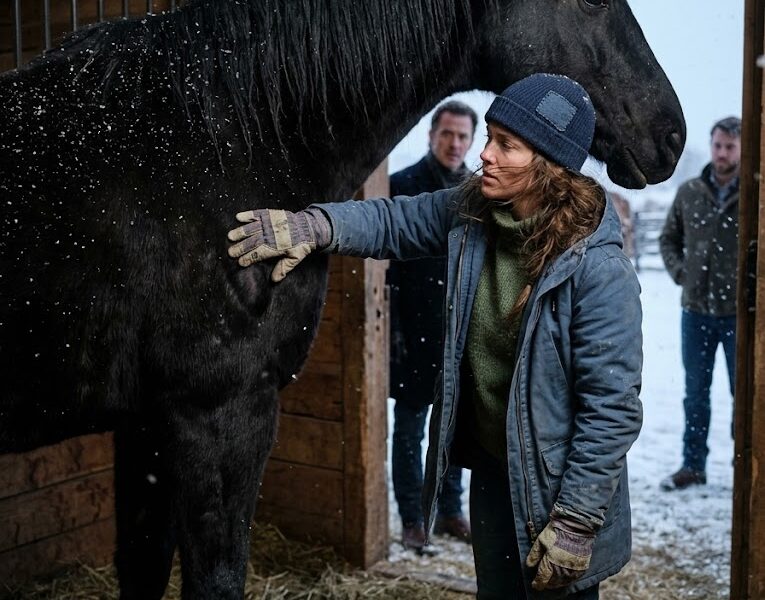
They Laughed When the Broke Stable Girl Volunteered to Ride the Horse That Killed a Billionaire—Then She Found What Was Buried Under His Skin
By the time Lydia Hart walked into the snow-covered training yard at Blackthorne Ranch, eleven men had already tried to ride Midnight.
Three had gone to the hospital.
One had left with a fractured collarbone.
Another had been kicked hard enough to crack two ribs.
And every horseman in northern Wyoming had reached the same conclusion.
The stallion was dangerous.
Some called him insane.
Others called him a killer.
Because two years earlier, Midnight had thrown Charles Blackthorne—the billionaire founder of Blackthorne Land & Energy—and Charles had died before the helicopter reached the hospital.
Now his son wanted the horse gone.
A rifle waited inside the ranch office.
A veterinarian had already been told to stand by.
And more than forty wealthy guests had gathered along the fence that freezing December morning to watch one final spectacle.
Nathaniel Blackthorne had offered $150,000 to anyone who could sit Midnight safely before New Year’s Day.
Nobody expected the money to be claimed.
Certainly not by Lydia Hart.
She was twenty-nine.
She wore a faded blue coat with a repaired seam at the elbow, scuffed boots, and gloves stitched at three fingertips.
Her pickup truck had 240,000 miles on it.
Her bank account had less than four hundred dollars.
And three years earlier, many of the same people standing beside that fence had watched her be humiliated at a charity gala in Jackson Hole.
So when Lydia stepped through the crowd and said,
“I’ll try him,”
the first laugh came almost immediately.
Then another.
Within seconds, half the yard was laughing.
Lydia stopped.
Snow caught in her dark hair.
She knew that sound.
She had heard it three years earlier beneath crystal chandeliers while two hundred guests watched the man she thought she would marry raise a champagne glass and explain why he had changed his mind.
“She’s sweet,” he’d said.
“But Lydia belongs in a barn more than she belongs in this room.”
People had laughed.
He’d kept going.
Too quiet.
Too strange.
Too obsessed with animals.
Too ordinary for the life he wanted.
Lydia had stood there in a borrowed dress while strangers pretended not to enjoy her humiliation.
And among them had been Nathaniel Blackthorne.
Tall.
Rich.
Untouchable.
He hadn’t laughed.
That had almost made it worse.
Because he’d looked at her.
He’d known what was happening.
And then he’d lowered his eyes.
Three years later, he stood twenty feet away in a black wool coat, watching her walk toward the most feared horse in Wyoming.
This time, Lydia didn’t look at him.
She looked at Midnight.
And what she saw made her stop.
The stallion wasn’t furious.
He was trembling.
There was a difference.
Most of the people around her couldn’t see it because they were waiting for violence.
Lydia was looking for pain.
Midnight’s nostrils flared.
His black coat shivered beneath a thin layer of sweat despite the twenty-degree cold.
When a ranch hand approached from his left side, the stallion jerked violently away.
The man cursed.
“See?”
Someone laughed nervously.
“Crazy bastard.”
Lydia’s eyes narrowed.
“Do that again.”
The ranch hand stared at her.
“What?”
“Walk toward him again.”
Nathaniel stepped forward.
“Miss Hart—”
“Not you.”
Her voice was quiet.
But the yard went still.
Lydia pointed at the ranch hand.
“Same direction. Slowly.”
The man glanced toward Nathaniel.
Nathaniel nodded.
He approached.
Midnight’s ears flattened.
Ten feet.
Eight.
Six.
At five feet, the horse shifted his weight away from his left shoulder.
At three, his eyes widened.
The ranch hand lifted one hand.
Midnight screamed.
Not a challenging squeal.
Not aggression.
Pain.
Pure, terrified pain.
Lydia’s stomach tightened.
“Stop.”
The man froze.
Lydia moved toward the stall herself.
Reginald Wickliffe stepped into her path.
He was Nathaniel’s cousin, forty-two, handsome in the polished way expensive men often were—perfect teeth, perfect coat, perfect silver watch.
He had managed much of the Blackthorne family’s business since Charles died.
He smiled at Lydia.
It wasn’t kind.
“This has gone far enough.”
Lydia looked past him toward the horse.
“No.”
“You could be killed.”
“Maybe.”
“And Nathaniel doesn’t need another death associated with that animal.”
Something changed in Nathaniel’s face.
Reginald noticed.
So did Lydia.
There it was.
The wound nobody talked about.
Charles Blackthorne.
Nathaniel’s father.
The man Midnight had supposedly killed.
Reginald turned toward his cousin.
“End this.”
Nathaniel stared at Lydia.
For a moment, she saw the same man from that ballroom three years earlier.
A man deciding whether silence was easier than courage.
Then Nathaniel said,
“Let her through.”
Reginald’s smile disappeared.
Lydia entered the stall.
She didn’t touch Midnight.
She sat on an overturned bucket twelve feet away.
Then she waited.
Ten minutes passed.
Twenty.
Someone outside complained about the cold.
Lydia didn’t move.
After forty minutes, most of the spectators left.
After an hour, Midnight stopped pacing.
After two, he lowered his head.
Lydia began humming.
It was an old song her father used to sing during thunderstorms when frightened horses rattled the doors of their little barn outside Cody.
Her father had been a country pastor, but horses had been his second language.
He had taught Lydia something she’d never forgotten.
Fear and violence could look almost identical from a distance.
The difference was what happened when you stopped demanding obedience.
By the fourth hour, Midnight came to her.
His enormous head lowered.
His breath warmed her hands.
Slowly, Lydia touched his neck.
He didn’t move.
Her palm traveled toward his shoulder.
The horse exploded.
Midnight slammed backward.
Lydia pulled away instantly.
“Easy.”
His eyes rolled white.
“Easy, boy.”
She waited.
When he settled, she tried again.
Neck.
Mane.
Withers.
Then—
Heat.
Lydia froze.
Beneath the thick black hair near his left shoulder was a hard swelling.
Old.
Deep.
Wrong.
She touched around it.
Midnight trembled.
“Oh, God.”
Nathaniel was standing outside the stall.
“What?”
Lydia turned.
“He isn’t trying to hurt people.”
“What are you saying?”
“I’m saying everyone has been hurting him.”
Nathaniel’s expression hardened.
“Eleven trainers examined this horse.”
“I’m not talking about today.”
She looked back at Midnight.
“This has been here a long time.”
“How long?”
“Months. Maybe years.”
Reginald had been walking toward them.
He stopped.
Lydia noticed.
Just for a second, something passed over his face.
Not confusion.
Fear.
And Lydia understood that whatever was buried beneath Midnight’s skin, Reginald Wickliffe was terrified she might find it.
Lydia needed the $150,000.
That was the humiliating truth beneath all the noble reasons people would later invent for what she did.
Her father had died after an eighteen-month fight with pancreatic cancer.
Insurance had covered enough to keep the hospital from taking everything.
It hadn’t covered enough to save the house.
Lydia had borrowed against the property.
Then borrowed again.
The final notice had arrived four days before Nathaniel announced the Midnight challenge.
$86,400.
Payable by March 1.
Otherwise the small house her father had left her would be sold.
Pride didn’t pay mortgages.
So Lydia returned to Blackthorne Ranch the next morning.
She gave Nathaniel conditions.
“No whip.”
“Fine.”
“No spurs.”
“Fine.”
“No crowd.”
Nathaniel nodded.
“No bit.”
He hesitated.
“Lydia—”
“If you want somebody to dominate him, hire a twelfth idiot.”
Nathaniel almost smiled.
“Anything else?”
“Yes.”
“What?”
“You stay behind the fence.”
His eyebrow rose.
“My ranch.”
“My horse until January first.”
“Our horse.”
“Then treat him like one.”
Nathaniel studied her.
Then he stepped backward.
“Fine.”
For six days, Lydia barely left the stable.
She used warm compresses.
Gentle massage.
Heat therapy.
She cleaned the area repeatedly and monitored Midnight’s temperature.
She slept three hours at a time on a cot beside his stall.
On the fourth evening, Nathaniel appeared carrying a thick wool blanket.
“For Midnight,” he said.
Lydia looked at the blanket.
Then at the horse.
Then at him.
“That’s interesting.”
“What?”
“Midnight is already wearing a blanket.”
Nathaniel looked at the horse.
He was.
Lydia folded her arms.
Nathaniel cleared his throat.
“This one is heavier.”
“Is it?”
“Wyoming gets cold.”
“So I’ve heard.”
He left it on a chair.
Lydia waited until he was gone before wrapping it around her shoulders.
The next afternoon he brought coffee.
Two cups.
He placed one on the fence and retreated.
Lydia stared at him.
“Why are you standing over there?”
“You told me to.”
“That was around Midnight.”
Nathaniel glanced toward the stallion.
“I’ve learned not to approach either of you without permission.”
Lydia laughed before she could stop herself.
The sound changed his face.
His smile disappeared.
Not because he was offended.
Because he remembered.
She saw it immediately.
The ballroom.
Three years earlier.
Her laughter before everything went wrong.
“You remember,” she said.
Nathaniel didn’t pretend otherwise.
“Every second.”
Lydia looked away.
“Convenient.”
“No.”
His voice was low.
“Not convenient.”
She said nothing.
Nathaniel gripped the fence.
“I wanted to say something that night.”
“But you didn’t.”
“My father stopped me.”
Lydia turned.
“Did he sew your mouth shut?”
Nathaniel flinched.
“No.”
“Then your father didn’t stop you.”
She picked up her coffee.
“You did.”
He had no answer.
That was the first thing Lydia began to respect about him.
He didn’t manufacture one.
The question of Midnight’s injury wouldn’t leave Nathaniel alone.
Lydia had asked him who had examined the horse after his father’s death.
Nathaniel realized he didn’t know.
Not really.
Every report had come through Reginald.
So before sunrise the next morning, Nathaniel drove seventy miles through snow to visit Dr. Henry Cole, the equine veterinarian supposedly attacked by Midnight eighteen months earlier.
Cole stared at him across his kitchen.
“Attacked?”
“You wrote that the horse was too dangerous to examine.”
“I wrote no such thing.”
Nathaniel went still.
Cole disappeared into another room.
He returned with a folder.
Inside was a letter bearing Nathaniel’s signature.
BLACKTHORNE FAMILY OFFICE.
Cease examination immediately.
No further services required.
Nathaniel read it twice.
“I didn’t send this.”
Cole stared at him.
“I assumed you did.”
Nathaniel visited two farriers next.
Both told essentially the same story.
Each had been paid five thousand dollars.
Each had been told the Blackthorne family wanted discretion.
Each had been warned never to discuss Midnight.
“Who paid you?”
Nathaniel asked.
Neither man wanted to answer.
Nathaniel waited.
Finally, one did.
“Your cousin.”
Nathaniel drove home after dark.
Lydia was kneeling beside Midnight under the yellow glow of a stable lamp.
She looked at Nathaniel’s face.
“What happened?”
He handed her the forged letter.
She read it.
Then looked up.
“Who benefits if nobody discovers what’s wrong with this horse?”
Nathaniel already knew.
But he couldn’t say the name.
Not yet.
Reginald Wickliffe had been Nathaniel’s shadow for two years.
After Charles Blackthorne died, Nathaniel had barely functioned.
His last conversation with his father had been an argument.
A vicious one.
Charles wanted Nathaniel to take greater responsibility for the family company.
Nathaniel accused his father of controlling every decision he’d ever made.
Charles told him responsibility was not control.
Nathaniel told him to go to hell.
His father walked out.
An hour later, Charles took Midnight onto the northern trail.
He never came home alive.
Reginald had been the person who found Nathaniel afterward.
He had put a hand on his shoulder.
“You couldn’t have known.”
Then, over months, the words changed.
Your father wouldn’t have ridden if you hadn’t refused.
Then:
Guilt can destroy a man if he lets it.
And eventually:
Let me handle things until you’re ready.
Nathaniel let him.
Company decisions.
Trust accounts.
Staffing.
Legal correspondence.
Midnight.
Everything.
Grief made surrender feel like survival.
Now Nathaniel began wondering whether his cousin had spent two years keeping him alive—or keeping him blind.
Someone else had been watching Lydia.
Nathaniel’s younger sister, Eleanor.
She was twenty-two and had once been fearless.
Before her father’s death, she rode competitively.
She traveled.
She danced barefoot in the kitchen at midnight.
After the accident, she stopped riding.
Then she stopped going out.
Eventually, she stopped eating dinner with guests.
Most days, she remained in the west wing of the house.
One morning Lydia found her standing outside the stable.
Eleanor immediately stepped backward.
“Sorry.”
“For what?”
“I shouldn’t be here.”
Lydia looked around.
“Are you banned from the barn?”
“No.”
“Then you’re doing a terrible job of trespassing.”
Eleanor blinked.
Then smiled.
It was tiny.
But real.
Lydia invited her inside.
Within days, Eleanor began coming every morning.
Lydia showed her how to read Midnight’s ears.
How to watch breathing.
How to recognize tension before panic.
Eleanor learned quickly.
“You have a good eye,” Lydia told her.
The young woman looked startled.
“What?”
“You notice things.”
Nobody had complimented Eleanor for noticing things in years.
That mattered more than Lydia understood.
One evening, over coffee and stolen cinnamon rolls, Eleanor told Lydia about Samuel Fletcher, one of the ranch hands.
“He doesn’t treat me like I’m fragile.”
“Do people?”
“Everyone.”
“Maybe stop letting them.”
Eleanor laughed.
Then her expression changed.
“Lydia?”
“Hmm?”
“Can I tell you something?”
“Of course.”
“About the morning Dad died.”
Lydia put down her cup.
Eleanor’s hands tightened around hers.
“I was in the barn before sunrise.”
“Okay.”
“I saw Reginald.”
Lydia stopped breathing.
“Where?”
“Coming out of the tack room.”
“When?”
“Maybe forty minutes before Dad rode Midnight.”
“What was he doing?”
“I don’t know.”
Eleanor swallowed.
“But his hand was bleeding.”
Lydia’s skin prickled.
“Bleeding how?”
“He had a white handkerchief wrapped around it.”
Her voice dropped.
“It was soaked through.”
“Did you tell anyone?”
“Reginald.”
“What did he say?”
“He told me grief was confusing my memory.”
Lydia stared at her.
“You told him after your father died?”
Eleanor nodded.
“He said I’d been traumatized.”
For two years, Eleanor had believed him.
Lydia reached across the table and took her hands.
“You were scared.”
Tears filled Eleanor’s eyes.
“I said nothing.”
“You were twenty.”
“I could have—”
“No.”
Lydia squeezed harder.
“Being afraid doesn’t make you guilty.”
Behind Eleanor, Midnight stood quietly in the lantern light.
A wounded horse.
A dead father.
A forged letter.
A bloody hand.
And one charming man who seemed to exist at the center of all of it.
December 23 brought the Blackthorne Christmas dinner.
Lydia didn’t want to attend.
Eleanor refused to go downstairs without her.
So Lydia wore the only formal dress she owned—a dark blue dress her mother had bought years earlier.
Twenty-four guests sat beneath the massive iron chandeliers of Blackthorne Lodge.
Executives.
Ranch owners.
Local politicians.
Old-money families.
People Lydia recognized from the night she’d been humiliated.
Reginald sat beside Nathaniel.
He was charming.
Funny.
Generous.
He complimented the chef.
Asked after everyone’s children.
Told stories that made the table laugh.
Then dessert arrived.
Reginald lifted his wineglass.
“I think we should recognize Lydia.”
The room quieted.
Lydia’s stomach tightened.
“For what she’s done with Midnight.”
Polite applause.
Reginald smiled at her.
“Remarkable dedication.”
Lydia said nothing.
“Especially from someone with so much to gain.”
Nathaniel looked at him.
“Reginald.”
“What?”
The cousin smiled innocently.
“I’m complimenting her.”
Then he looked around the table.
“Still, one can’t help wondering whether a hundred and fifty thousand dollars is the only prize Lydia has her eye on.”
Silence.
Someone suppressed a laugh.
Reginald continued.
“Single woman. Twenty-nine. Spending every night on the estate of one of Wyoming’s wealthiest bachelors.”
A woman at the far end covered her smile with her napkin.
Reginald lifted his glass.
“Perhaps Midnight isn’t the only Blackthorne she hopes to tame.”
A few people laughed.
Lydia didn’t look at Reginald.
She looked at Nathaniel.
This was not about needing rescue.
She had survived humiliation before.
She needed to know something.
Had Nathaniel changed?
His hand tightened around his glass.
His jaw flexed.
His eyes dropped.
And he said nothing.
The pain was immediate.
Not because Reginald’s insult mattered.
Because silence did.
Again.
Three years vanished.
Lydia was back beneath the chandeliers in Jackson Hole.
Same laughter.
Same humiliation.
Same man looking down.
She folded her napkin.
“Thank you for dinner.”
Eleanor whispered,
“Lydia—”
“I need to check Midnight.”
She walked out.
Only after the door closed did Nathaniel move.
And by then it was too late.
At midnight, Lydia packed.
She was leaving.
She would find some other way to save her house.
Some things cost more than money.
But before driving away, she went to Midnight one final time.
The moment her fingers touched his shoulder, she knew she couldn’t leave.
The abscess had changed.
It was ready to drain.
If she walked away now, infection could spread.
The horse could die.
Lydia closed her eyes.
“Damn you.”
Midnight breathed against her cheek.
She set down her bag.
“I wasn’t talking to you.”
She sterilized her father’s old instruments.
Prepared towels.
Heated water.
Then she heard footsteps.
Nathaniel stood in the doorway.
Still wearing his dinner clothes.
Snow melted on his shoulders.
“Go away.”
“No.”
She laughed without humor.
“Found your voice?”
He took that without defending himself.
“You’ll need someone to hold him.”
“I’ve managed.”
“You shouldn’t have to.”
Lydia stared at him.
Nathaniel didn’t apologize.
Not yet.
Perhaps he understood that apologies were cheap when offered in private by men who remained silent in public.
Finally, Lydia handed him the lead.
“Stand at his head.”
Nathaniel entered.
Midnight stiffened.
Nathaniel whispered something Lydia couldn’t hear.
The stallion’s ears moved.
Then something extraordinary happened.
Midnight lowered his head.
And pressed his forehead against Nathaniel’s chest.
Nathaniel froze.
His face broke.
“Oh, buddy.”
His hand moved slowly into Midnight’s mane.
“I’m sorry.”
Lydia looked away.
Nathaniel wasn’t talking only to the horse.
She began working.
The incision released pressure immediately.
Midnight shuddered.
Nathaniel held him.
Lydia cleaned the wound.
Then probed deeper.
Metal touched metal.
Click.
She stopped.
“What?”
Nathaniel asked.
“There’s something inside.”
Carefully, Lydia reached deeper.
Midnight trembled.
Then her forceps closed around something.
She pulled.
An inch.
Two.
Then it came free.
Lydia stared at the object in her hand.
A rusted iron nail.
Nearly three inches long.
Broken at one end.
Caught beneath the head was a fragment of blue saddle cloth and a strip of old leather.
Nathaniel’s face turned white.
“No.”
“You recognize it?”
He took the leather.
Stamped into one corner was a tiny maker’s mark.
R.H.
Nathaniel’s hands began shaking.
“My father’s saddler.”
Lydia said nothing.
“The pad.”
His voice cracked.
“My father’s saddle pad was blue.”
The stable became impossibly quiet.
Nathaniel looked toward Midnight.
Then back at the nail.
Lydia understood first.
Someone had driven the nail through the saddle pad.
When a rider put weight into the saddle, the point would drive into Midnight’s shoulder.
The pain would be catastrophic.
The horse would panic.
Buck.
Rear.
Do anything to escape it.
During Charles Blackthorne’s final ride, the nail had snapped.
Part remained buried inside Midnight.
For two years.
Every trainer afterward had unknowingly pressed weight against the same wound.
Every scream had been called aggression.
Every attempt to escape pain had been called madness.
And Nathaniel had blamed himself for his father’s death.
His knees nearly gave out.
“I thought I killed him.”
Lydia stepped closer.
“You didn’t.”
“He rode because of me.”
“No.”
“My last words—”
“Nathaniel.”
She held up the nail.
“This killed your father.”
His eyes lifted.
“Someone put it there.”
For the first time in two years, Nathaniel’s grief had somewhere else to go.
And that made it dangerous.
He apologized to Lydia that night.
She didn’t accept it.
Not because she believed he was insincere.
Because sincerity wasn’t enough.
“You failed me twice.”
“I know.”
“Both times there were people watching.”
“I know.”
“But you apologize when nobody’s here.”
Nathaniel looked down.
Lydia remembered how much she had once hated that gesture.
“No.”
She touched his chin and forced him to look at her.
“Don’t do that.”
“What?”
“Don’t look at the floor.”
His eyes stayed on hers.
“Say it where you were silent.”
He understood.
“January first.”
“Everyone who laughed.”
“I’ll invite them.”
“Then I’ll stay until January first.”
His expression changed.
“And after?”
Lydia picked up the bloody towels.
“After that, I’m done.”
The next morning Eleanor stopped Lydia in the orchard.
She carried a leather strap.
It was an old saddle girth.
Almost severed.
Not torn.
Cut.
Eleanor explained that Margaret Fletcher, the Blackthorne housekeeper, had kept it hidden for two years.
Her late husband, Thomas Fletcher, had been head groom.
The night before Charles died, Thomas discovered the damaged girth in the tack room.
He intended to report it.
Before he could, a silver watch disappeared from Charles’s office.
Thomas was accused.
Reginald testified that he’d seen him near the room.
Thomas was fired.
Nobody would hire him.
He died eight months later.
His widow had spent years believing the truth would never matter because nobody would believe a groom over a Blackthorne relative.
But she’d watched Lydia with Midnight.
She’d watched Eleanor begin laughing again.
And she had finally opened the box where she’d hidden the girth.
Lydia held the leather.
The nail.
The cut strap.
Eleanor’s memory.
Pieces.
But still not motive.
That arrived December 29.
Nathaniel’s family attorney, Edmund Vale, drove through a blizzard carrying two boxes of financial records.
Inside them was a letter written by Charles Blackthorne nine days before his death.
Charles had ordered an audit.
Specifically, an audit of the trust established for Eleanor.
Original balance:
$18 million.
Current balance:
$392,000.
Nathaniel stared at the figure.
“That’s impossible.”
Vale opened another ledger.
It wasn’t.
Loans.
Shell investments.
Transfers.
Companies that existed only on paper.
And again and again, one name appeared.
Reginald Wickliffe.
Charles had discovered irregularities.
The audit was scheduled for October 12.
Charles died October 9.
Reginald had needed time.
Maybe he hadn’t intended to kill Charles.
Maybe the damaged saddle was supposed to cause an accident severe enough to delay the audit.
But Charles had broken his neck.
Then Reginald had buried the evidence.
Destroyed the saddle.
Silenced veterinarians.
Discredited Thomas Fletcher.
Forged Nathaniel’s signature.
And spent two years whispering guilt into Nathaniel’s ear until Nathaniel surrendered control of everything.
Including the truth.
Nathaniel sat alone for a long time.
Then he stood.
“What are you doing?” Vale asked.
“Inviting people.”
“To what?”
Nathaniel looked toward the snow-covered stable.
“To hear the truth.”
He personally wrote every invitation.
People who had laughed at Lydia.
People who had called Midnight dangerous.
People who had trusted Reginald because his suits were expensive and his voice was calm.
Each invitation contained one sentence.
You laughed. Come see what you were laughing at.
January 1 arrived beneath a hard blue Wyoming sky.
Cars lined the Blackthorne driveway.
Dozens of people crowded around the training yard.
Reginald arrived last.
He carried a locked rifle case.
Nathaniel met him at the gate.
“Leave it in the truck.”
Reginald smiled.
“The board agreed Midnight should be put down.”
“The board doesn’t own Midnight.”
“The liability—”
“Leave it.”
For the first time in years, Reginald obeyed Nathaniel.
Then the stable door opened.
Lydia stepped outside.
She wore the same blue dress she’d worn at Christmas beneath a heavy coat.
No jewelry.
No expensive boots.
No attempt to resemble the women who had once laughed at her.
Midnight walked beside her.
Calm.
His coat shone in the winter sun.
Lydia led him to the center of the yard.
She hummed.
That old harvest song.
Then she placed a thick pad across his back.
No saddle.
No bit.
No spurs.
Samuel Fletcher gave her a leg up.
Lydia settled gently onto Midnight.
The crowd stopped breathing.
Midnight stood still.
Lydia touched his neck.
“Good boy.”
Then she asked him to walk.
He did.
One circle.
Then another.
She asked for a trot.
Midnight moved as smoothly as dark water.
No bucking.
No screaming.
No violence.
When Lydia stopped beside the fence, the silence was complete.
Nathaniel walked into the yard.
“Three years ago, many of you watched Lydia Hart be humiliated.”
Nobody moved.
“I was there.”
His voice carried.
“I didn’t laugh.”
Lydia watched him.
Nathaniel continued.
“For years, I told myself that mattered.”
He looked at the people around him.
“It didn’t.”
His eyes found Lydia.
“Silence can be another way of joining the crowd.”
Nobody laughed now.
Nathaniel walked toward her.
“In this house, six nights ago, my cousin humiliated her again.”
Reginald’s expression changed.
“And again, I stayed silent.”
Nathaniel stopped directly in front of Lydia.
“Not because I agreed.”
His voice tightened.
“Because cowardice becomes a habit if you practice it long enough.”
Then, before everyone who had watched him fail her, Nathaniel said,
“Lydia Hart, I am sorry.”
No whisper.
No private confession.
No lowered eyes.
“I should have defended you three years ago. I should have defended you at my table. You deserved better from me both times.”
Lydia looked at him for several seconds.
Then nodded once.
Nathaniel turned toward the crowd.
“And now you’re going to hear what she discovered.”
Lydia removed a small evidence bag from her coat.
Inside was the nail.
Reginald went pale.
Nathaniel saw it.
So did the county sheriff standing near the gate.
Lydia explained Midnight’s wound.
The hidden nail.
The saddle pad.
Then Nathaniel displayed the cut girth.
Margaret Fletcher stepped forward.
Her voice shook.
But she spoke.
She told them what Thomas had found.
How he had been framed.
How he died disgraced.
Then Eleanor came forward.
Reginald laughed.
“Oh, come on.”
Eleanor stopped.
Reginald spread his hands.
“She’s been traumatized since Charles died.”
Eleanor’s face drained.
For one terrible second, Lydia thought the old fear had won.
Then Eleanor looked at her.
Lydia said nothing.
She didn’t need to.
Eleanor lifted her chin.
“I saw you leaving the tack room.”
Reginald’s smile vanished.
“Your right hand was bleeding.”
“That’s ridiculous.”
“You wrapped it in a white handkerchief.”
“Enough.”
“I remember the blood.”
Reginald stepped toward her.
Nathaniel stepped between them.
Then another voice came from the crowd.
“I remember the hand.”
Everyone turned.
A retired judge named Frederick Ashby stood near the fence.
“You wore a glove for almost a month afterward, Reginald.”
Reginald stared at him.
“Even at dinner.”
Edmund Vale stepped forward next.
He carried Charles Blackthorne’s letter.
Then the ledgers.
Then the bank records.
One transaction after another.
Millions.
Eleanor’s money.
Reginald’s companies.
The audit.
October 12.
Charles’s death.
October 9.
Reginald’s face changed.
The polished charm vanished.
“You don’t understand.”
Nathaniel said nothing.
“I was going to replace it.”
Still nobody spoke.
“The investments collapsed.”
Reginald looked around desperately.
“I only needed time.”
Nathaniel’s voice was almost a whisper.
“So you sabotaged the saddle.”
Reginald shook his head.
“No.”
“You put the nail there.”
“No.”
“You cut the girth.”
“I didn’t mean to kill him!”
The words tore across the yard.
Silence followed.
Reginald realized what he’d said.
Too late.
He looked toward the sheriff.
Then Nathaniel.
Then Eleanor.
“I only meant for him to fall.”
His voice cracked.
“A broken arm. A shoulder. Something that would delay the audit.”
Eleanor covered her mouth.
Reginald kept talking because frightened men often mistook more words for escape.
“I didn’t know Midnight would throw him like that.”
Nathaniel moved toward him.
For one second Lydia feared he would hit him.
He didn’t.
That mattered.
Nathaniel stopped inches away.
“You let me believe I killed my father.”
Reginald swallowed.
“You needed someone to blame.”
“You made it me.”
The sheriff approached.
Reginald backed away.
“You can’t seriously believe these people.”
Nathaniel looked toward Lydia.
Toward Eleanor.
Toward Margaret Fletcher.
Toward Midnight.
“I believe the people I should have listened to years ago.”
The handcuffs clicked shut.
Reginald Wickliffe was led across the snow.
Nobody defended him.
Afterward, Nathaniel cleared Thomas Fletcher’s name publicly.
He paid Margaret every dollar in wages Thomas would have earned, plus interest.
He gave her the small cottage she’d rented for years.
Samuel became head trainer.
And above the entrance to the restored stable, Nathaniel later placed a bronze plaque bearing Thomas Fletcher’s name.
Then he handed Lydia a check for $150,000.
She stared at it.
“My house.”
Nathaniel smiled.
“Your house.”
Lydia laughed softly.
Then Nathaniel did something she wasn’t expecting.
He knelt.
In the snow.
In front of everyone.
Lydia’s smile vanished.
“Oh, no.”
A few people laughed.
Nathaniel looked up.
“Lydia Hart—”
“Get up.”
“I love you.”
The yard became silent again.
“Nathaniel.”
“I know the timing isn’t ideal.”
“You’re proposing to me next to a sheriff’s tire tracks.”
“Yes.”
“After your cousin confessed to manslaughter.”
“Also yes.”
“And half the county is watching.”
Nathaniel glanced around.
“That part may have been a tactical error.”
Lydia tried not to smile.
Failed.
Nathaniel reached for her hand.
“Will you marry me?”
She looked down at him.
Three years earlier, she’d wanted someone powerful to stand beside her.
Now she understood something she hadn’t understood then.
A man didn’t become brave because he made one grand gesture.
Bravery was repetition.
Choice after choice.
Nathaniel had only just begun learning.
So Lydia squeezed his hand.
“Ask me again.”
His face fell.
“When?”
“When nobody’s watching.”
Someone behind them laughed.
This time, Lydia laughed too.
That evening, the ranch became quiet.
Cars disappeared down the mountain road.
Snow began falling again.
Lydia found Midnight beside the fence.
His shoulder was healing beautifully.
Nathaniel approached alone.
No audience.
No photographer.
No ring.
He stopped several feet away.
“May I come closer?”
Lydia smiled.
“You finally learned.”
He joined her at the fence.
For a while, neither spoke.
Then Nathaniel said,
“I can’t change who I was at that gala.”
“No.”
“I can’t change Christmas dinner.”
“No.”
“I can’t promise I’ll never be afraid again.”
Lydia looked at him.
“Good.”
He frowned.
“Good?”
“I don’t trust people who say they’re never afraid.”
Nathaniel smiled faintly.
“What can I promise?”
“Nothing.”
That surprised him.
Lydia turned toward him.
“Show me.”
Snow settled in his hair.
“Show you what?”
“That next time it’s difficult, you don’t look away.”
Nathaniel nodded.
“I can do that.”
“Then ask.”
He took her hands.
No crowd.
No speech.
No billionaire heir kneeling dramatically in the snow.
Just a man standing in front of a woman he had failed twice and hoped never to fail the same way again.
“Lydia Hart.”
His voice was quiet.
“Will you marry me?”
She thought about her father.
Her little house.
The ballroom.
The Christmas table.
Midnight pressing his head against Nathaniel’s chest.
She thought about how strange life was.
She had walked onto Blackthorne Ranch for money.
She had stayed for a horse.
Somewhere along the way, she’d uncovered a murder, restored a dead man’s name, helped a frightened young woman find her voice, and forced a grieving son to look at the truth he’d spent two years avoiding.
And somehow, impossibly, she’d fallen in love.
“Yes.”
Nathaniel didn’t move.
Lydia laughed.
“I said yes.”
“I heard you.”
“You look confused.”
“I am.”
“Why?”
“I’ve spent the last week assuming you’d eventually realize I’m an idiot.”
“I realized that on day one.”
He laughed.
Then he pulled her close.
Lydia rested her cheek against his chest.
Behind them, Midnight released a long breath.
Nathaniel glanced toward him.
“Was that approval?”
“No.”
“What was it?”
“He thinks you’re an idiot too.”
Nathaniel laughed harder.
And for the first time in years, laughter carried across Blackthorne Ranch without hurting anyone.
Three winters later, Midnight still ran across the northern pasture whenever snow began falling.
His shoulder had healed.
A faint scar remained beneath his coat.
Lydia never tried to hide it.
Scars, her father had taught her, weren’t proof that something was ruined.
Sometimes they were proof that somebody finally stopped pretending the wound wasn’t there.
A young black colt lived in the neighboring paddock.
He had a white star between his eyes.
His name was Thomas.
The plaque above the stable entrance read:
THOMAS FLETCHER
HE SAW THE TRUTH WHEN OTHERS CHOSE NOT TO.
Margaret cried the first time she saw it.
Samuel pretended he hadn’t.
And on a cold December afternoon, the entire ranch was decorated for a wedding.
Not Lydia’s.
She and Nathaniel had married quietly two years earlier.
This wedding belonged to Eleanor and Samuel.
Eleanor crossed the snowy yard wearing a simple white dress beneath a heavy coat.
Three years earlier, she had barely been able to walk downstairs for dinner.
Now she was laughing so loudly that guests turned toward her before she even reached the ceremony.
Nathaniel watched his sister.
Lydia watched him.
“You okay?”
He nodded.
“Just thinking.”
“Dangerous.”
He smiled.
“About my father.”
Lydia slipped her hand into his.
“He would have liked this.”
“I hope so.”
“He would’ve complained about the chairs.”
Nathaniel laughed.
“Definitely.”
“And the flowers.”
“Absolutely.”
“And your tie.”
Nathaniel looked down.
“What’s wrong with my tie?”
“Nothing.”
“Lydia.”
She grinned.
From the stable, Midnight whinnied.
Lydia began humming the old harvest song.
Nathaniel recognized it immediately.
Then, badly and without embarrassment, he began singing along.
Lydia turned.
“I didn’t know you remembered the words.”
Nathaniel looked toward Midnight.
Then toward the plaque bearing Thomas Fletcher’s name.
Then toward his sister walking toward a future she once believed she’d never have.
“There are things worth remembering.”
Snow drifted slowly across the yard.
Years earlier, Lydia Hart had arrived at Blackthorne Ranch with repaired gloves, eighty-six thousand dollars of debt, and no expectation that anyone there would ever see her as anything other than the strange woman they’d once laughed out of a ballroom.
She had come to save her father’s house.
Instead, she found a horse everyone called violent because nobody had bothered to ask where he hurt.
She found a young woman everyone called fragile because nobody had bothered to ask what she remembered.
She found an innocent man whose name had been buried because nobody powerful had bothered to listen.
And she found Nathaniel.
A man who had mistaken silence for decency.
Guilt for responsibility.
And avoidance for peace.
Midnight had never needed someone strong enough to conquer him.
He needed someone patient enough to notice his pain.
Perhaps people weren’t so different.
Nathaniel tightened his arm around Lydia as Eleanor reached Samuel beneath the snow-covered arch.
For years, Blackthorne Ranch had been a place where everyone carried something unspoken.
A dead father’s last argument.
A daughter’s memory.
A widow’s evidence.
A son’s guilt.
A woman’s humiliation.
A horse’s pain.
Reginald had survived because each person believed his or her piece of the truth was too small to matter.
The truth became dangerous only when they finally placed those pieces together.
Lydia watched Midnight run.
The stallion crossed the white pasture at full speed, black against endless snow, no saddle on his back and no pain beneath it.
For the first time, Nathaniel understood why Lydia always smiled when she watched him run.
Midnight wasn’t beautiful because he had forgotten what happened.
He was beautiful because he remembered—
and ran anyway.
Nathaniel looked down at the woman beside him.
Three years earlier, when Lydia had been humiliated before a room full of people, he had believed courage meant making some dramatic speech.
That misunderstanding had cost him years.
Now he knew better.
Love had not begun when he knelt in the snow.
It had not begun when Lydia said yes.
It had not even begun the night they discovered the nail.
It began much earlier, in a stable filled with cold air and lantern light, when a frightened animal screamed and everyone else called him dangerous.
Everyone except Lydia.
She had looked closer.
She always looked closer.
And Nathaniel had finally learned the lesson that changed his family forever:
Sometimes the cruelest thing you can do to someone in pain is decide what they are before asking what happened to them.
And sometimes love begins with something far less romantic than a kiss.
Sometimes it begins when everyone else is laughing—
and one person finally chooses not to look away.









