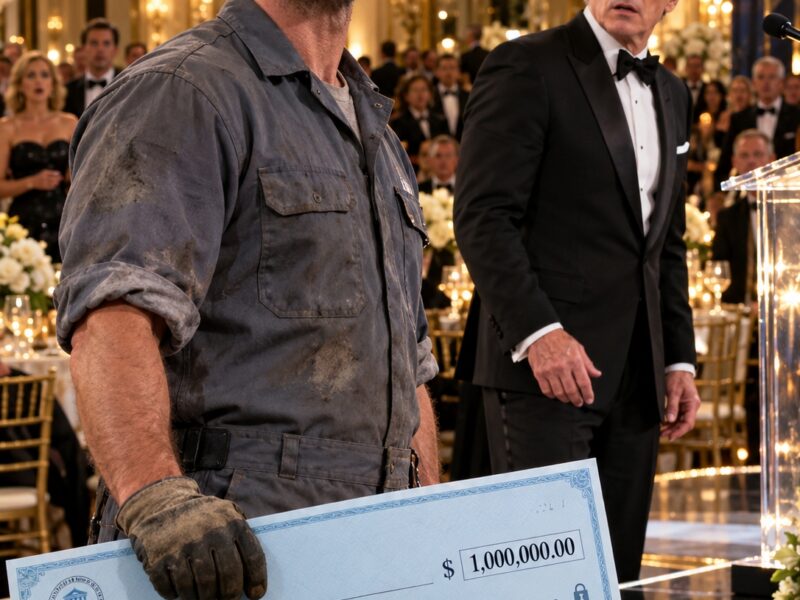
THEY LAUGHED WHEN THE MAINTENANCE MAN CHALLENGED A $1 MILLION BODYGUARD—8.6 SECONDS LATER, THE VICE CHAIRMAN WENT PALE
The first thing Nolan Ror heard was laughter.
Not nervous laughter.
Not polite laughter.
The kind that comes when four hundred wealthy people are absolutely certain they know who the joke is.
He stood at the edge of a competition mat inside the Grand Ashford Hotel ballroom in Charlotte, wearing a faded maintenance uniform, secondhand work boots, and gray gloves that still smelled faintly of electrical dust.
Across from him stood Victor Kaine.
Six-foot-four.
Two hundred and forty pounds.
Former professional fighter.
Chief of security for Whitmore Global Holdings.
Three trained men had already tried to beat him that night.
All three had failed.
Now Evelyn Whitmore, the thirty-eight-year-old billionaire CEO whose company controlled one of the largest private holding groups in the Carolinas, stared at the maintenance worker who had somehow walked onto her stage.
“You understand the challenge?” she asked.
Nolan nodded.
Behind her, displayed beneath the ballroom lights, was a pale blue check worth one million dollars.
Beat Victor under the published rules, and it was yours.
Evelyn studied Nolan’s face.
“You really believe you can defeat him?”
Nolan looked past her.
Above the stage, an enormous digital clock waited at zero.
Then he looked at Victor.
“I think ten seconds will tell you everything you need to know.”
For half a heartbeat, the ballroom was silent.
Then the laughter exploded.
A banker at the front table actually slapped the table.
Someone near the bar said, “Ten seconds?”
Another voice answered, “He won’t last five.”
Even Evelyn’s mouth moved slightly, not quite a smile, but close.
Only one person in the room did not laugh.
Grant Blackwood.
Executive vice chairman of Whitmore Global Holdings.
Four hours earlier, Blackwood had looked at Nolan as though he were furniture.
Now he was staring at him as if he had just seen a dead man walk through a locked door.
And nobody noticed.
Not yet.
Victor rolled his shoulders and stepped closer.
Nolan did not remove his gloves.
The referee called both men toward the center.
Victor looked down at him.
There was no anger in his expression. No fear.
Only the bored courtesy of a professional being asked to humor someone who did not understand the difference between courage and competence.
Then Nolan leaned slightly forward.
He said five words too quietly for the microphones.
Victor’s face changed.
The laughter continued around them.
But the giant man across from Nolan suddenly stopped smiling.
Because he knew those words.
He just couldn’t understand how a maintenance worker knew them.
And eight-point-six seconds later, an entire corporation would begin coming apart.
Four hours before that moment, Nolan had been lying on his back beneath the ballroom with a flashlight clenched between his teeth.
The service corridor under the Grand Ashford smelled of concrete dust, old wiring, and hot metal.
Above him, workers were arranging champagne flutes beneath chandeliers imported from Italy.
Below them, Nolan was tracing a dead circuit through wiring old enough to have existed when parts of Charlotte still looked like another century.
The ballroom renovation had cost roughly forty million dollars.
The junction box in front of Nolan looked like it had cost twelve.
That was how buildings worked.
People admired what they could see.
The things holding everything together were usually hidden behind walls.
Nolan understood that better than most.
His uniform had once been navy blue.
Eleven years of washing had turned it gray.
The knees were worn soft. One corner of his name patch had begun to separate from the fabric.
His boots had belonged to two men before him.
He could have bought a new pair for ninety dollars.
He hadn’t.
Paige was still $1,100 short on her engineering tuition.
Ninety dollars mattered.
So did overtime.
So did every hour he could get.
Nolan touched one probe to the circuit, checked the meter, then checked it again.
He never hurried around electricity.
There were things in life you could survive by being lucky.
Electricity wasn’t one of them.
A second later, the circuit came alive.
Far above him, the chandeliers bloomed.
Nolan removed the flashlight from his mouth.
“Got you.”
Nobody applauded.
Nobody even knew.
That was normal.
He packed his meter into his toolbox, closed the panel, and climbed the service stairs.
When he pushed through the staff entrance, the world changed.
The hotel lobby smelled of orchids, perfume, polished marble, and cold champagne.
Men in tailored tuxedos stood in loose circles beneath the chandeliers Nolan had just restored.
Their laughter floated easily.
Women in evening gowns crossed the room with champagne glasses balanced between their fingers.
One dress probably cost more than Nolan’s truck.
Maybe two of them.
He lowered his eyes and kept near the wall.
Maintenance workers learned certain things without anyone teaching them.
Which elevators they were supposed to use.
Which doors they were supposed to enter.
How to cross an expensive room without appearing to occupy it.
How to repair a place without becoming part of it.
After eleven years, Nolan had become excellent at being invisible.
But Grant Blackwood saw him.
Blackwood stood near the coat check beside a young banker, one hand around a whiskey glass.
His tuxedo fit perfectly.
His silver hair looked expensive in a way hair should not have been able to look expensive.
His eyes passed across Nolan.
Then stopped.
Something moved across his face.
Recognition.
It lasted perhaps half a second.
Then came calculation.
Then nothing.
Nolan almost wondered if he had imagined it.
Blackwood turned toward the hotel manager.
“I was under the impression this floor had been cleared for guests.”
His voice was pleasant.
That made it worse.
The manager followed his gaze.
“Oh. Of course, Mr. Blackwood. I apologize. He’s maintenance. There was an electrical issue.”
“I’d hate for the chairman’s photographs to feature a man carrying a wrench.”
The banker laughed.
The manager apologized again.
Nolan kept walking.
Blackwood took a sip from his glass.
Then, just loudly enough for several nearby guests to hear, he added, “People like him should fix the lights, not stand beneath them.”
More laughter.
Small.
Effortless.
Cruel because nobody in the group considered it cruelty.
Nolan didn’t turn around.
There had been a time when he would have.
Fourteen years earlier, he might have crossed the room.
Eleven years earlier, he might have demanded an apology.
Now he knew the mathematics of pride.
The cost of answering Blackwood was unpredictable.
The cost of staying quiet was $1,100.
One semester.
Paige’s semester.
So Nolan swallowed whatever had risen into his throat and walked away.
But as he did, one thought stayed with him.
Blackwood’s insult had been too deliberate.
Too careful.
Almost as if he wanted Nolan gone before Nolan had seen something.
The hotel manager caught up with him near the ballroom doors.
“Sorry about that.”
“Not your fault.”
“I need you near the stage for the rest of the evening. We had that flicker during rehearsal.”
Nolan nodded.
“Where?”
“Service column on the west side. Stay out of the sightline if you can.”
Stay out of sight.
Nolan almost smiled.
“Shouldn’t be difficult.”
He placed his toolbox behind a column at the edge of the ballroom and waited.
For the next hour, nobody looked at him.
Then the lights dimmed.
Applause rolled through the room.
Evelyn Whitmore walked onto the stage.
She was younger than Nolan had expected.
Thirty-eight, according to the event materials.
She controlled Whitmore Global Holdings with the particular confidence of someone who had spent years being the youngest person in rooms full of older men waiting for her to make a mistake.
She spoke without notes.
She thanked donors.
She announced the amount raised for the Children’s Trauma Center.
Then the giant screen behind her changed.
WHITMORE GLOBAL PROTECTION SERVICES.
EXECUTIVE PROTECTION.
CERTIFIED READINESS.
A logo appeared beneath the words.
Nolan stopped breathing.
Chevron.
Circle.
Small lettering beneath it.
The wrench inside his pocket suddenly felt cold against his palm.
He knew that logo.
Not something similar.
That logo.
He knew the angle of the chevron.
He knew the spacing between the letters.
He knew because fourteen years earlier, in a rented office in Raleigh, he had wasted two weeks arguing with a graphic designer about that spacing.
Back then, he had possessed a professional credential.
Back then, people returned his calls.
Back then, his wife was alive.
Back then, Paige had been small enough to fall asleep against his chest.
Nolan stared at the screen.
A name appeared beneath the description of the readiness methodology.
Architect of the program.
It wasn’t his name.
For several seconds, he simply stood there.
Then Evelyn introduced Victor Kaine.
Victor came onto the stage like a door swinging open.
He was enormous without looking slow.
That mattered.
Plenty of large fighters moved like large fighters.
Victor didn’t.
He had balance, patience, and the relaxed posture of a man whose body had been trained until movement no longer required conscious permission.
Nolan watched him disarm one staff member.
Redirect another.
Then throw the second man cleanly onto the demonstration mat.
The crowd erupted.
Nolan heard none of it.
He was watching Victor’s left foot.
A second attacker approached from an unexpected angle.
Victor reacted.
His shoulder moved.
His hips turned.
And immediately before they did, his weight shifted forward.
Barely.
A quarter inch.
Nolan’s stomach tightened.
No.
Victor reset.
Another sequence.
Another unexpected angle.
Again.
The same forward shift.
A quarter inch.
Almost invisible.
But Nolan knew it.
He had spent years of his life studying that quarter inch.
He had written a report about it fourteen years ago.
A report that was supposed to have stopped this program before it reached a single paying client.
Yet there it was.
On a stage.
Inside a ballroom.
Being sold.
Evelyn waited for the applause to fade.
Then she held up a pale blue check.
“Our protection division trains some of the best close-protection officers in North America.”
She smiled.
“I’m told that’s a marketing claim.”
Laughter.
“So tonight, let’s test it.”
The rules had been printed in the event program two weeks earlier.
Any physically qualified guest or employee could enter.
No weapons.
No strikes to the head.
Independent referee.
Medical supervision.
Either competitor could stop at any time.
A legitimate win over Victor Kaine meant one million dollars.
It was a corporate stunt.
A brilliant one.
The first challenger was a regional welterweight champion from Atlanta.
He lasted one minute and forty seconds.
The second was a twenty-six-year-old collegiate wrestler built like a refrigerator.
Victor put him on his back in less than a minute.
The third challenger was a former military combatives instructor with gray in his beard.
He made Victor work.
For nearly two minutes.
Then he tapped.
Every victory made the room louder.
Every victory made Evelyn look more certain.
Every victory made Grant Blackwood smile.
But every victory made Nolan more afraid.
Because Victor’s flaw wasn’t disappearing under pressure.
It was getting worse.
The third match gave Nolan four clean examples.
Each time the threat came from outside the expected vector, Victor’s weight moved forward before his hips committed.
Quarter inch.
Quarter inch.
Quarter inch.
Quarter inch.
Not a habit.
Training.
Nolan knew exactly which exercise caused it.
A reflex battery designed to measure reaction speed.
Except it didn’t actually reward reaction.
It rewarded anticipation.
Officers learned, unconsciously, to guess what was coming.
Against a predictable opponent, they looked impossibly fast.
Against someone who understood the system, they became vulnerable.
Fourteen years ago, Nolan had said exactly that.
He had written it down.
He had warned them.
He had asked for five months to rebuild the battery.
And somehow, after everything that happened to him, the defective version had survived.
Worse.
It had become a product.
Grant Blackwood stepped onto the stage between matches and took the microphone.
That hadn’t been scheduled.
“The trouble with the modern world,” Blackwood said, “is that people increasingly confuse effort with expertise.”
A few guests nodded.
“Everyone has an opinion. Everyone believes trying hard makes their opinion equally valuable.”
He gestured toward Victor.
“But competence is rare. Competence is earned.”
Then he smiled.
“Money has a remarkable habit of finding the people who deserve it.”
The room applauded.
Nolan stared at the giant screen.
Airports.
Hospital systems.
School districts.
Those were among the markets listed for the protection division.
This wasn’t a ballroom trick anymore.
These people were about to sell the flaw.
Nolan looked toward the exit.
He thought about Paige.
He thought about his truck’s soft rear tire.
He thought about the shift report waiting downstairs.
He could leave.
He had learned, over eleven years, how to leave things alone.
Then Blackwood saw him.
Perhaps Nolan had moved.
Perhaps he had stared too long.
Whatever the reason, Blackwood’s gaze found him beside the column.
His smile changed.
“We seem to have an expert among us.”
Nolan’s blood went cold.
Four hundred heads turned.
Blackwood pointed toward him.
“The gentleman by the column has been studying Mr. Kaine all evening with a very critical expression. Perhaps he’d like to share his professional assessment.”
Someone laughed.
Nolan said, “I’m here to fix the lights.”
His voice didn’t carry.
A man near the front repeated it.
“He fixes the lights!”
The laughter became louder.
Blackwood waited.
He enjoyed the timing.
Then he leaned toward the microphone.
“Of course. I only ask because men who repair things for a living often have very strong opinions about people who actually trained for theirs.”
More laughter.
“It’s a charming instinct.”
Nolan stared at him.
Blackwood stared back.
And suddenly Nolan understood something.
Blackwood remembered him.
Maybe not completely.
Maybe the gray hair and maintenance uniform had delayed it.
But that first look near the coat check hadn’t been imagination.
Blackwood knew.
And he was humiliating Nolan publicly because he believed humiliation would make him disappear.
Again.
Nolan looked at Victor.
Then at the screen.
Then at the blue million-dollar check.
He thought about the report that had destroyed his career.
He thought about Paige’s $1,100.
But strangely, the money was no longer the number that mattered.
The number that mattered was four.
Four times Victor’s weight had shifted.
Four clean failures.
Nolan bent down.
He set his toolbox against the column.
The laughter softened.
He straightened his sleeves.
Then he walked toward the stage.
By the time he reached the steps, nobody was laughing quite as loudly.
Evelyn approached him.
Up close, she looked less amused.
“Do you understand what you’re volunteering for?”
“Yes, ma’am.”
“Victor is a professional.”
“I know.”
“You could be injured.”
“I know that too.”
Her eyes narrowed.
“And you believe you can defeat him?”
Nolan glanced at the clock.
“I think ten seconds will tell you what you need to know.”
The laughter came again.
But Evelyn didn’t join it this time.
The referee brought Nolan the waiver.
He signed.
The doctor checked his pulse.
“Are you sure?”
“Yes.”
“Any recent injuries?”
“Nothing recent enough to matter.”
That earned the first genuine smile from Victor.
Nolan rolled his sleeves to his elbows.
People nearest the mat noticed his forearms.
Not a fighter’s muscles.
A working man’s.
Years of carrying conduit, transformers, motors, ladders.
Hands that had been broken before.
Hands that had healed without ever being allowed to become delicate.
He left the gloves on.
Victor stepped forward.
“You really want to do this?”
Nolan looked up at him.
“Reflex Sequence Delta Four.”
Victor’s smile vanished.
Nolan continued quietly.
“They still have you drilling it, don’t they?”
Victor’s eyes sharpened.
“What did you say?”
The referee raised his hand.
Victor stared at Nolan.
Delta Four wasn’t a marketing term.
It wasn’t printed in brochures.
It was internal language.
A phrase from a windowless training room in Greensboro.
A sequence Victor had drilled hundreds of times at the beginning of his protection career.
“How do you know—”
“Ready?”
The referee’s hand came down.
Victor moved.
Exactly as Nolan knew he would.
Long step.
Collar tie.
Pressure forward.
Nolan did not retreat.
He moved slightly off line.
His hands remained low.
His chin stayed tucked.
He deliberately gave Victor the opening Delta Four had trained him to recognize.
Victor saw it.
His training made the decision before his conscious mind could question it.
Commit.
His weight rolled forward.
Quarter inch.
Nolan stepped inside.
He caught Victor’s wrist after the larger man’s base had already begun to collapse.
He turned his hips.
He didn’t throw Victor.
He didn’t need to.
He simply gave Victor’s own momentum somewhere to finish.
Two hundred and forty pounds hit the mat.
The sound killed the laughter instantly.
Nolan followed the arm down.
Shoulder control.
Elbow line secured.
Knee braced.
Legal.
Clean.
Victor tried to roll.
The lock tightened because of Victor’s own movement.
And in that instant, Victor understood.
The position hadn’t been improvised.
It had been waiting for him.
Victor slapped the mat.
Once.
Twice.
The referee stopped the match.
Above them, the clock froze.
8.6 SECONDS.
Nobody moved.
Nobody applauded.
Somewhere near the second table, a champagne glass rolled off a plate.
It hit the floor and shattered.
The sound seemed enormous.
Victor lay staring at the ceiling.
Not injured.
Something worse.
Confused.
His understanding of himself had just been rewritten in front of four hundred people.
Evelyn Whitmore was standing.
She couldn’t remember standing up.
At the press table, three journalists were already typing.
And Grant Blackwood had gone white.
Not embarrassed.
Not angry.
White.
Because fourteen years too late, he finally recognized the face beneath the maintenance cap.
Nolan released Victor immediately.
Then he held out his hand.
Victor stared at it.
Finally, he took it.
Nolan pulled him upright.
Victor leaned close.
“Who taught you that?”
Nolan looked at him.
“Someone who was supposed to make sure you never had to learn it this way.”
He turned toward Evelyn.
“Miss Whitmore.”
The stage microphone caught his voice.
“Before your company certifies another officer under that program, have someone independent review the reflex evaluation protocol.”
The room quieted again.
“What happened here wasn’t a trick. It’s reproducible.”
Evelyn stared at him.
Nolan pointed toward Victor.
“Anyone who understands the pattern can create the same opening in anyone you’ve trained with it.”
Victor looked toward the screen.
Nolan’s next words came more quietly.
“On a real protection detail, the other person won’t stop when somebody taps.”
Blackwood moved immediately.
“That’s enough.”
He took the microphone.
“The result is obviously void.”
Murmurs spread through the ballroom.
“The challenge was intended for qualified competitors, not hotel employees with privileged access to the event.”
The referee looked toward him.
Blackwood continued.
“This man had access to the facility. He clearly obtained information about the demonstration sequence. What you’ve just seen is an exploitation of a staged exercise.”
Nolan said nothing.
Blackwood pointed toward hotel security.
“Escort him out.”
Two security officers moved.
“Stop.”
It was Evelyn.
She stepped between them.
“Was the match legal?” she asked the referee.
“Yes.”
“Was the control legal?”
“Yes.”
“Did Mr. Kaine tap voluntarily?”
“Yes.”
“Any violation?”
“No.”
Evelyn looked toward the state athletic commission official.
“You’ll confirm that?”
“Yes.”
She turned toward the production crew.
“Put the recording on the main screen.”
Blackwood stepped closer.
“Evelyn—”
“Quarter speed.”
The video appeared behind them.
Four hundred people watched.
Victor moved.
Nolan shifted.
And this time everyone could see it.
Victor’s weight moved forward before Nolan attacked.
Quarter inch.
The room watched again.
Slowly.
Without music.
Without applause.
Without Blackwood’s explanation.
What had looked like a miracle at full speed now looked disturbingly mechanical.
Evelyn turned toward Nolan.
“Where did you learn that?”
Nolan looked at the logo behind her.
“I helped design the test that teaches it.”
Victor turned.
Blackwood didn’t.
Evelyn stared at Nolan for several seconds.
“What?”
“Years ago I worked in close-protection assessment. We were building evaluation batteries to measure how officers reacted under genuine uncertainty.”
“What company?”
“It was acquired.”
“What’s the methodology called?”
Nolan hesitated.
“Sentinel Protocol.”
Victor swore.
The microphone caught it.
Nobody laughed.
Sentinel.
Victor knew that name.
Every protection officer in Whitmore’s division knew it.
Sentinel had been the curriculum that transformed Victor from a retired fighter into a professional protection officer.
The manuals.
The drills.
The laminated reference cards.
The evaluation standards.
All of it.
Victor looked at Nolan as if the man had suddenly changed shape.
“You designed Sentinel?”
“Part of it.”
Evelyn knew the name too.
Whitmore Global had acquired the Sentinel package the year she joined the board.
She remembered the acquisition summary.
And somewhere in the back of her mind, a sentence surfaced.
Original technical lead terminated for cause.
Falsified validation reporting.
Credentials revoked.
Materials reassigned to internal authorship.
Evelyn looked at Nolan’s name patch.
Ror.
Her stomach tightened.
“That technical lead was named Ror.”
Nolan nodded.
“Yes, ma’am.”
Blackwood moved.
Fast.
Smooth.
He took control of the microphone with the ease of a man who had survived corporate disasters by understanding that the first coherent story usually won.
“This is becoming absurd.”
He turned toward the guests.
“Mr. Ror was removed from the Sentinel project fourteen years ago after serious questions were raised regarding his professional conduct.”
Nolan watched him.
Blackwood continued.
“His credentials were revoked after evidence showed falsification in validation reporting.”
Whispers moved through the ballroom.
“He disappeared from the industry and has apparently spent the intervening years nursing a grievance.”
Now Blackwood looked directly at Nolan.
“And tonight he used a charity event to ambush this company.”
It was a good speech.
Maybe on another night, it would have worked.
But Evelyn wasn’t watching Blackwood.
She was watching the frozen video.
Victor’s left foot.
Quarter inch.
Whitmore Global employed nine certification specialists.
Two consulting biomechanists.
A vice president of training.
Millions of dollars in professional expertise.
Not one of them had noticed what a maintenance worker had identified from forty feet away in the dark.
There were only two explanations.
Either Nolan Ror was one of the most sophisticated frauds she had ever encountered.
Or the file was wrong.
Evelyn looked at him.
“If you found this defect fourteen years ago, what did you do?”
Blackwood’s jaw tightened.
Nolan answered.
“I reported it.”
“In writing?”
“Twice before certification. Once afterward.”
“Recommendation?”
“Hold certification until the reflex battery could be rebuilt.”
Evelyn looked toward the screen.
“What happened?”
Nolan’s expression barely changed.
“The report came back through the system with my signature attached to language I didn’t write.”
Blackwood said, “That’s a lie.”
Nolan kept looking at Evelyn.
“Six weeks later, I was under investigation for falsifying the report.”
Silence.
“If you filed a formal warning,” Evelyn said, “there should be a record.”
“There was.”
She turned toward one of her attorneys.
“Pull the original Sentinel validation package. Every version. Full edit history.”
Blackwood answered too quickly.
“That’s impossible.”
Evelyn slowly turned.
“Why?”
“Records from that period were purged under retention policy.”
Three people noticed how fast he had answered.
One of them signed his bonus.
The charity auction never resumed.
Within forty minutes, the eight-second clip had escaped the ballroom.
Phones appeared everywhere.
Journalists disappeared into corridors.
Executives formed small circles and stopped laughing.
Nolan found himself in a conference room near the mezzanine with two cups of coffee, a company attorney, and a folder he hadn’t asked for.
Grant Blackwood entered.
He closed the door.
The contempt was gone.
That frightened Nolan more than the contempt had.
“Mr. Ror.”
“Mr. Blackwood.”
“I owe you an apology for my remarks earlier.”
Nolan said nothing.
Blackwood sat across from him.
“The prize can be processed tonight.”
He slid two pages across the table.
“One million dollars.”
Nolan looked down.
Blackwood’s voice became almost gentle.
“In exchange, we need a routine mutual understanding concerning the historical Sentinel matter.”
Nolan read.
Confidentiality.
Non-disparagement.
No discussion of development history.
No discussion of validation records.
No discussion of correspondence.
Permanent.
He read it again.
The challenge rules had contained five conditions.
None of this had been among them.
“This isn’t the prize agreement.”
“It’s how the actual world works.”
“The published terms don’t say anything about a settlement.”
“The published terms are marketing.”
Nolan looked up.
Blackwood leaned back.
“In the actual world, you’re a man with a revoked credential and an hourly wage.”
Nolan’s face remained still.
Then Blackwood made his mistake.
“And you have a daughter attending a state engineering school with an outstanding tuition balance of eleven hundred dollars.”
Nolan’s fingers closed.
Blackwood noticed.
“I know because it took one phone call.”
For the first time all night, Nolan wanted to hit him.
Not because of the fourteen years.
Not because of his license.
Not because of the humiliation upstairs.
Because Blackwood had reached into Paige’s life.
Blackwood pushed the document closer.
“You can walk out tonight with a million dollars.”
He paused.
“Or you can walk out as the defendant in a defamation action funded by a corporation whose annual legal budget exceeds everything you will earn for the rest of your life.”
Nolan looked at the pages.
“I want you to think carefully,” Blackwood said, “about which version of you your daughter gets to have.”
Nolan breathed once.
Then again.
There was a camera in the corner.
He saw it.
Blackwood probably had forgotten it was there.
Nolan placed both palms flat on the table.
“I’ll accept the prize under the published rules.”
Blackwood’s eyes hardened.
“I won’t sign this.”
“You’re making a poor decision.”
“I’ve made plenty.”
Nolan pushed the pages back.
“This isn’t one.”
The door opened.
Evelyn Whitmore stood there.
Beside her was outside counsel.
In his hand was another copy of the same two-page document.
A junior associate had routed it for signature review eleven minutes earlier.
The junior associate hadn’t understood what it was.
So he had done exactly the right thing.
Evelyn looked at Blackwood.
Not Nolan.
“The prize will be paid under the published terms.”
“Evelyn—”
“No additional conditions.”
Blackwood stood.
“You don’t understand the exposure.”
“I understand enough.”
She turned toward counsel.
“Independent legal team. Tonight. Every Sentinel record on every system we control.”
Blackwood tried one final time.
“The retention schedule—”
“Applies to operational records.”
Evelyn’s voice remained flat.
“Not materials incorporated into an acquisition.”
She looked at Blackwood.
“Good night, Grant.”
In the corridor, Victor was waiting.
His jacket hung over one arm.
A bag of ice rested against his shoulder.
He looked uncomfortable.
“They taught us about you,” he said.
Nolan stopped.
Victor swallowed.
“Week one.”
Nolan said nothing.
“Your case was in the ethics module.”
That surprised him more than almost anything else that night.
“What did they say?”
Victor looked down.
“That you signed off on something you shouldn’t have. Then when it went wrong, you tried to rewrite the history.”
Nolan gave a small nod.
“I believed it for nine years.”
Victor’s voice tightened.
“I taught it to new officers.”
“You believed the training file.”
“That doesn’t make it better.”
“That’s what training files are for.”
Victor looked at him.
“I put four men through Delta Four last month.”
Nolan picked up his toolbox.
“Then call them tomorrow.”
Outside, the loading dock was cold.
Nolan stood between a dumpster and stacked banquet tables when his phone rang.
The screen was cracked.
Tape held one corner together.
PAIGE.
He answered.
“Hey.”
“Dad?”
Her voice was too fast.
“You okay?”
“I’m fine.”
“I saw the video.”
Of course she had.
“How many times?”
A pause.
“Eleven.”
Despite everything, he smiled.
“That’s ten too many.”
“Are you hurt?”
“No.”
“Did you eat?”
Nolan looked back through the loading entrance.
“No.”
“Dad.”
“I’ll eat.”
“When are you coming home?”
“Late.”
“How late?”
“There’s something here I need to finish.”
She went quiet.
Paige had always known when questions wouldn’t help.
“Okay.”
Then, softly:
“Just come home.”
Nolan closed his eyes.
“I will.”
After the call ended, he stood alone under the loading-dock light.
The million dollars wasn’t what he was thinking about.
Neither was his reputation.
He had stopped wanting that back years ago.
What mattered was simpler.
Something he had built was still capable of hurting people.
And for the first time in fourteen years, somebody with power was finally looking.
At 11:40 p.m., Evelyn’s outside counsel found her.
Blackwood had been partly right.
The operational archive from fourteen years earlier was empty.
But he had forgotten something.
The Sentinel package had been attached as an exhibit to the acquisition due-diligence file.
Nobody had deleted it.
Nobody had thought to.
Why would they?
Nobody had expected anyone to look.
The files were still there.
Every version.
Every timestamp.
Every edit.
By midnight, Evelyn was in a conference room on the fourteenth floor with two attorneys and a forensic records specialist dragged out of bed in Raleigh.
Nolan sat at the far end.
He didn’t celebrate when they found the first report.
He didn’t smile when the metadata loaded.
He simply watched.
Fourteen years earlier, Nolan Ror had submitted a validation report concerning the reflex battery at the heart of Sentinel.
The conclusion was clear.
The battery rewarded anticipation rather than true response.
An officer trained under it would perform exceptionally against expected threat patterns.
But under genuine uncertainty, the same officer could commit early.
The physical signature of that premature commitment was exactly what Nolan had seen on Victor.
Forward weight transfer.
Quarter inch.
At precisely the wrong moment.
Nolan had recommended suspending certification.
Estimated correction time:
Five months.
The commercialization lead responsible for delivering Sentinel on schedule had been Grant Blackwood.
A delay would have threatened a contract milestone tied to an eight-figure payment.
Nine days after Nolan’s report, a revised version appeared.
The suspension recommendation was gone.
In its place was language affirming readiness.
Evelyn stared at the metadata.
The account that made the change wasn’t Nolan’s.
But Nolan’s name remained in the author field.
And on the signature line.
When Nolan refused to countersign, an internal complaint had been opened.
Against Nolan.
For falsifying validation data.
And the revised report itself had been used as evidence.
Evelyn leaned back.
“How long did you fight it?”
Nolan looked at the screen.
“Two years and eleven months.”
“What did it cost you?”
He was quiet for a moment.
“My credential.”
Another pause.
“My firm.”
He looked at his hands.
“House in Morsville.”
Evelyn waited.
“Most of what we’d saved.”
“We?”
“My wife and me.”
Something in his voice changed.
Barely.
“She got sick while it was happening.”
Evelyn said nothing.
“I kept fighting for a while.”
He rubbed one thumb across the seam of his glove.
“Then there were lawyers during the day and hospitals at night, and eventually you realize there are only so many hours a person gets.”
The room became very still.
“She had fewer left than we thought.”
After the funeral, Nolan said, there had been a sixth-grade girl who needed breakfast.
There had been bills.
There had been grief.
And there had been a building services company in Charlotte willing to hire a man with a lapsed professional license as long as he could repair electrical systems and show up on time.
So Nolan showed up.
For eleven years.
Evelyn placed the original report beside the revised version.
Then she opened the current Sentinel curriculum.
The defect hadn’t been removed.
It had been renamed.
Different internal code.
Same battery.
Same behavior.
Same quarter inch.
At nine that morning, Grant Blackwood was scheduled to sign the $340 million sale of Whitmore Global’s protection-services division.
The buyer held contracts involving eleven regional airports.
A hospital network spanning four states.
The certification record wasn’t merely part of the asset.
It was the asset.
Every officer trained under the program carried the same potential defect.
Evelyn finally understood the ten seconds.
“Why ten?” she asked.
It was nearly three in the morning.
The attorneys had left for coffee.
On the screen, Victor’s foot remained frozen in mid-commitment.
Nolan looked at it.
“The original test window was ten seconds.”
Evelyn frowned.
“It wasn’t bravado?”
“No.”
Nolan leaned back.
“An anticipation-trained officer commits to the false read under pressure inside that window. Give him longer and he starts correcting. Make it shorter and you might not force the commitment.”
“You knew you would beat Victor?”
“No.”
That answer stopped her.
“You didn’t?”
“I knew the defect would appear.”
He looked at her.
“I didn’t know whether I’d still be standing when it did.”
Evelyn stared.
Nolan continued.
“I couldn’t subpoena your files. I couldn’t make your executives talk to me. I couldn’t walk into that ballroom and ask two hundred people to believe a maintenance technician over a corporate certification.”
“So you made the defect demonstrate itself.”
“In front of an independent referee, a commission official, a doctor, cameras, the press, and the buyers.”
He shrugged slightly.
“Whether I won wasn’t the important part.”
For perhaps the first time that night, Evelyn understood the man sitting across from her.
He hadn’t stepped onto that mat because he thought he was stronger than Victor.
He had stepped onto it because he was willing to lose publicly if losing could expose the flaw.
“Why didn’t you try again?” she asked.
“After the investigation.”
“I did.”
“For how long?”
“Four years.”
Nolan counted them without drama.
“Licensing board. Certifying body. Two trade associations. Your company twice.”
“What happened?”
“Every answer came back to the same report.”
The forged one.
Nolan looked toward the dark window.
“Eventually I had a daughter to raise.”
He paused.
“And a life to hold together.”
“Do you regret stopping?”
He thought about it.
“No.”
Then:
“I’m not proud of stopping.”
He looked at Evelyn.
“But I’m not ashamed either.”
At seven that morning, Evelyn suspended the signing.
At 7:20, Grant Blackwood called her.
His voice was calm.
He informed her that she did not possess unilateral authority to stop the divestiture.
Nine months earlier, the board had granted him execution authority.
He intended to sign at nine.
He also intended to raise Evelyn’s conduct before the full board.
At eight, nine board members gathered in a private dining room.
Six physically.
Three by conference line.
Blackwood spoke first.
His version was elegant.
A publicity demonstration had been compromised by a disgruntled employee with a documented history of falsification.
That employee had manipulated the chief executive.
Evelyn had then jeopardized a $340 million transaction based on the accusations of an hourly maintenance technician.
She had exposed the company to reputational damage.
Market risk.
Potential litigation.
He recommended proceeding with the sale immediately.
Evelyn listened.
When he finished, she did something Blackwood hadn’t expected.
She didn’t defend herself.
She turned the meeting over to outside counsel.
The forensic specialist displayed the original validation report.
Then the revision.
Then the metadata.
Timestamp by timestamp.
Account by account.
He used the word “unexplained” repeatedly.
He did not accuse anyone of a crime.
That wasn’t his job.
He simply showed the board what the records said.
Then the door opened.
Nolan entered.
Still wearing the gray maintenance uniform.
He had been awake all night.
He hadn’t gone home.
He placed a thin folder on the table.
Blackwood looked at it.
For the first time that morning, something like fear crossed his face.
Nolan opened the folder.
Certified mail receipts.
Copies of letters.
Original correspondence.
Dates stamped by the post office in Morsville.
Fourteen years old.
“You kept these?” one board member asked.
Nolan nodded.
“Why?”
He looked across the table.
“Because when somebody rewrites you once, you learn to keep the originals.”
The letters matched the deleted section of the validation report.
Almost word for word.
Blackwood tried one last time.
He called Nolan an opportunist.
He described the entire situation as corporate extortion dressed in a sympathetic story.
“A maintenance worker performs one clever trick in front of cameras,” he said, “and suddenly this board is prepared to jeopardize hundreds of millions of dollars?”
Nobody answered.
Blackwood leaned forward.
“Think about the precedent.”
A voice came from the doorway.
“I’d like to answer that.”
Victor Kaine entered.
His shoulder was stiff.
In one hand, he carried his current curriculum manual.
In the other was his laminated training card.
He placed both on the table.
“I am the senior operating officer responsible for the division’s field-readiness program.”
Blackwood’s expression hardened.
Victor continued.
“The reflex battery described in Mr. Ror’s fourteen-year-old report is still in the curriculum.”
Nobody moved.
“I personally instructed four officers in it last month.”
He swallowed.
“And based on what I saw last night and what I’ve reviewed this morning, I cannot sign the professional attestation required by the buyer.”
Victor looked down when he said it.
He knew exactly how expensive that sentence could become.
Possibly the most expensive sentence of his career.
But he said it anyway.
The vote took nine minutes.
The $340 million divestiture was suspended pending independent audit.
The Sentinel certification program was pulled from the market that morning.
The alteration of the validation record was referred to outside investigators and appropriate authorities.
The board carefully stated that no final finding of wrongdoing had yet been made.
Then came the last vote.
Seven to two.
Grant Blackwood’s executive authority was suspended for the duration of the inquiry.
Nobody shouted.
There were no security guards.
No dramatic confrontation.
Blackwood reached toward his jacket.
He unclipped his executive access badge.
For a moment, he held it between two fingers.
Then he placed it beside a cold cup of coffee.
Fourteen hours earlier, he had ordered a maintenance worker removed because he believed a man with a wrench shouldn’t stand beneath expensive lights.
Now Nolan stood at the end of the table in the same gray uniform.
Blackwood was the one leaving.
At the doorway, he stopped.
“This isn’t over.”
Evelyn looked at him.
“No.”
Her voice was quiet.
“You spent fourteen years making sure nobody listened to him.”
She glanced toward Nolan.
“Last night, you made sure everyone did.”
Blackwood left.
The million-dollar prize arrived in the least cinematic way possible.
Paperwork.
The referee filed his statement.
The commission official confirmed the result.
Finance issued a written award under the published terms.
Required taxes would be withheld.
The transfer would be scheduled.
No suitcase full of money.
No champagne photograph.
No secret clause.
That last part mattered most to Nolan.
He folded the award confirmation once.
Then again.
He placed it inside the chest pocket of his faded uniform as though it were a receipt from a hardware store.
Evelyn walked with him toward the loading dock.
Workers were already dismantling the ballroom.
The stage where four hundred people had watched Nolan overturn Victor in 8.6 seconds was becoming plywood, cable, and steel.
By afternoon, it would look as if nothing had happened there.
At Nolan’s truck, Evelyn stopped.
“I want you to come work for me.”
Nolan looked at her.
“Director of Protection Assurance.”
He almost laughed.
She didn’t.
“You’d report directly to me. Seven-figure compensation package. Your own team. Independent budget. Full authority to rebuild Sentinel under your name.”
Nolan looked past her.
Through an open service door, he could see part of the chandelier system he had repaired eighteen hours earlier.
Then he looked toward the pale morning sky.
“I’ll think about it.”
Evelyn seemed surprised.
Most people did not say they would think about seven figures.
Nolan opened his truck.
The driver’s seat had a tear in it.
“I really mean that,” Evelyn said.
“So do I.”
Five weeks passed.
The audit continued.
Real audits were slow.
The important ones were slower.
Whitmore Global formally corrected Nolan’s internal personnel record, stating that the adverse finding against him was not supported by the underlying documentation.
Company counsel sent supporting evidence to the licensing board.
The board opened a review.
It would take months.
Maybe most of a year.
There was no applause for any of it.
Just forms.
Signatures.
Waiting.
Nolan preferred that.
Paperwork had destroyed his name.
Paperwork was now, slowly, restoring it.
One Tuesday afternoon, Evelyn drove alone to the service yard on Triion Street.
No photographer.
No communications team.
No assistant.
She found Nolan standing in front of an open electrical panel with a multimeter in one hand.
She waited until he finished.
He closed the panel.
“What brings you here?”
“I owe you an apology.”
Nolan said nothing.
Evelyn looked toward the ground for a moment.
“I judged you by a uniform.”
He leaned against the workbench.
“And by a job title. And by one sentence at the bottom of a due-diligence page.”
She met his eyes.
“I was one of the few people in that ballroom with the authority to check whether that sentence was true.”
A pause.
“I didn’t.”
Nolan wiped his hands on a rag.
“I’m sorry,” she said.
He nodded.
“I appreciate that.”
Evelyn waited.
“But?”
“The important part isn’t my file.”
“What is?”
“The four officers Victor had to call back.”
She understood.
Nolan tossed the rag onto the bench.
“Fix the battery.”
He looked at her.
“And keep fixing it after people stop paying attention.”
In the end, Nolan did not accept the executive position.
Instead, he negotiated something smaller.
Twelve days per quarter on an independent safety review panel.
Direct reporting to the board.
No management chain.
And one condition Evelyn initially disliked but ultimately accepted:
Nolan could publish his findings.
The company could respond.
It could disagree.
It could provide context.
But it could not edit his conclusions.
The position paid less than one tenth of what Evelyn had originally offered.
It also allowed Nolan to be home for dinner most nights.
That was the number he had been calculating all along.
The million dollars changed things.
Just not the things strangers expected.
Paige’s tuition balance disappeared.
The patched roof on their house was finally replaced.
The remaining legal debt from the fight Nolan had lost fourteen years earlier was paid.
He created an education account in Paige’s name.
He did not buy a new car.
He did not buy a bigger house.
He kept the truck.
Victor called during the second week.
“I have a retraining outline.”
Nolan sighed.
“You’re calling me about homework?”
“Basically.”
“Send it.”
Victor did.
Then he called again.
And again.
Eventually the calls stopped being only about training.
Sometimes Victor showed up at the service yard carrying two coffees.
There is a particular kind of respect between two men who discover they were both betrayed by the same document.
Victor had been trained to believe Nolan was a fraud.
Nolan had every reason to resent Victor for teaching that lie to others.
Neither man found much value in blaming the other.
There was enough work to do.
One ordinary October evening, Nolan came home carrying his boots because they were muddy.
Paige was sitting at the kitchen table.
Her laptop was open.
The eight-second video was paused on the screen.
By then, millions of strangers had watched it.
Nolan still hated seeing it.
Paige turned the laptop toward him.
“Seriously?”
Nolan put his boots by the door.
“What?”
“Eighteen years.”
He looked at the screen.
“Paige.”
“Eighteen years, Dad.”
She pointed at the frozen image.
“You never told me you could do that.”
“I don’t usually wrestle the dishwasher.”
“That’s not what I mean.”
Nolan went to the refrigerator.
“You never told me you were anybody.”
His hand stopped on the refrigerator door.
He turned around.
Paige immediately realized how the sentence had sounded.
“Dad, I didn’t mean—”
“I know.”
He took out the milk.
“I wasn’t hiding it from you.”
“Then why didn’t you tell me?”
Nolan considered the question.
Because there were answers adults gave children.
And answers parents gave themselves.
Finally, he pulled out the chair opposite her.
“I stopped being that man before you were old enough to understand who he was.”
Paige looked at him.
“And by the time you were old enough…”
He smiled faintly.
“I liked the man I’d become more.”
Her eyes filled.
“You were one of the best people in the country at something.”
“I was good at one small thing.”
“One small thing?”
“Very small.”
“You threw a two-hundred-and-forty-pound man in eight seconds.”
“Eight-point-six.”
Paige stared at him.
Nolan smiled.
“Accuracy matters. You’re an engineering student.”
She laughed despite herself.
And there it was.
Her mother’s laugh.
For a moment, Nolan couldn’t speak.
Paige noticed.
She always noticed.
“Dad?”
He looked down at his hands.
Then back at her.
“Being your father was the part I was always proudest of.”
Paige looked away.
“That’s annoyingly sentimental.”
“I’ve been saving it.”
“For eighteen years?”
“Apparently.”
On a shelf in the living room, beside an old photograph taken at a lake house that no longer belonged to anyone in the picture, stood a single sheet of paper.
Confirmation of a one-million-dollar award.
It had been there five weeks.
Nolan had never framed it.
A thin line of dust had already collected along its top edge.
He didn’t look at it.
Instead, after dinner, he stood at the kitchen counter with their coffee maker in pieces.
A screwdriver rested between his teeth.
Paige leaned against the counter.
“Just buy another one.”
Nolan removed the screwdriver.
“This one is fixable.”
“You have a million dollars.”
“That’s not a diagnostic criterion.”
“It costs thirty-eight dollars.”
“That’s thirty-eight dollars we don’t need to spend.”
“You’re impossible.”
“Your tuition is paid.”
“That doesn’t make this normal.”
“Normal is overrated.”
Paige rolled her eyes.
Nolan held a tiny plastic component beneath the kitchen light.
Outside, the neighborhood was quiet.
No cameras.
No reporters.
No board members.
No billionaire CEO.
No giant clock.
No one laughing.
Just a tired father repairing an appliance while his daughter argued with him.
Five weeks earlier, Nolan Ror had needed 8.6 seconds to make a ballroom full of powerful people go silent.
Fourteen years earlier, powerful men had needed only a few pages to take his career, his reputation, his savings, and nearly every professional identity he possessed.
For years, the world had mistaken what remained for failure.
A faded uniform.
A secondhand pair of boots.
An old truck.
A maintenance job.
A quiet man who lowered his head when executives walked past.
But silence had never meant surrender.
Sometimes silence meant a man had discovered that not every battle deserved the hours it would take from his daughter.
Sometimes walking away was not cowardice.
Sometimes the smaller life was the one worth protecting.
Paige watched him examine the broken coffee maker.
“Can you actually fix that?”
Nolan put the screwdriver back between his teeth.
He turned the damaged part toward the light.
Then he smiled.
That small, patient smile of a man who had spent half his life understanding that the most important failures were often almost invisible.
“Give me ten minutes.”
Paige laughed.
“Ten?”
Nolan looked toward her.
For one second, both of them remembered the giant clock.
Eight-point-six seconds.
The ballroom.
The video.
The million dollars.
The truth.
Then Nolan looked back at the coffee maker.
“No,” he said.
“This one’s harder.”
Paige laughed again.
And because it was her mother’s laugh, Nolan stopped working for just a moment and listened.
The million-dollar confirmation remained untouched on the shelf behind him.
He had already stopped looking at it.
Maybe that was the part the people in the ballroom would never understand.
They thought that night had revealed who Nolan Ror used to be.
The engineer.
The specialist.
The man who had designed part of Sentinel.
The man capable of dropping Victor Kaine in 8.6 seconds.
But Paige knew something they didn’t.
That wasn’t the greatest thing Nolan had survived.
And it wasn’t the most important thing he had become.
Fourteen years earlier, someone had taken his name off his own work.
Years later, strangers had laughed because they saw a maintenance uniform and assumed there couldn’t possibly be anything important underneath it.
Both mistakes came from the same arrogance.
The belief that value announces itself.
That strength looks powerful.
That intelligence comes with a title.
That the person holding the microphone must know more than the person fixing the wire behind the wall.
Nolan had learned otherwise.
Buildings were held together by things nobody saw.
Sometimes families were too.
And sometimes the strongest person in a room was simply the one everyone had already decided wasn’t worth looking at.
Nolan pushed the repaired component back into place.
The coffee maker clicked.
A tiny green light came on.
Paige stared at it.
“No way.”
Nolan picked up his mug.
“Engineering.”
“Maintenance.”
“Same universe.”
She shook her head.
He poured the coffee.
Outside the kitchen window, another ordinary evening settled over Charlotte.
And Nolan Ror, who had once lost nearly everything because powerful people rewrote the truth, stood beneath a cheap kitchen light with his daughter beside him.
No applause.
No million-dollar check raised overhead.
No one watching.
Exactly where he wanted to be.









