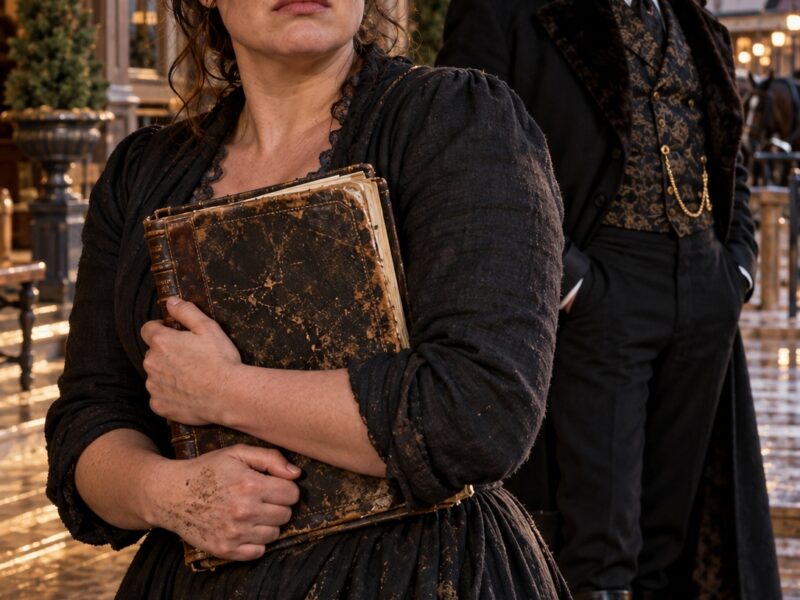
THEY LAUGHED WHILE I CRAWLED THROUGH THE MUD—SIX WEEKS LATER, I OPENED ONE LEDGER AND DESTROYED THE MOST POWERFUL MAN IN TOWN

The first thing Mabel Whitlock heard was laughter.
Not loud laughter.
That would have been easier.
It was the low, comfortable kind—the kind people used when cruelty had become entertainment and nobody in the crowd expected to pay a price for enjoying it.
Mabel was on her knees in the mud outside Hattie Bowman’s boarding house, trying to gather the pieces of her life before someone’s boot crushed them.
Her carpetbag had been thrown from the front door hard enough to break the latch.
Her spare dress lay half-submerged in a wagon rut.
A small tin box had burst open, scattering three years of carefully saved coins beneath the boardwalk.
Her mother’s embroidered handkerchief had landed beside a horse trough.
And her father’s old ledger book—the one possession Mabel would have run into a burning building to save—was lying face-down in the dirt.
Around her, perhaps fifteen people watched.
Nobody bent down.
Nobody offered a hand.
Then a man’s expensive boots stopped inches from her father’s ledger.
Mabel looked up.
Silus Vain smiled down at her.
He was fifty-one, prosperous, respected, and powerful enough that most people in Red Willow, Wyoming, lowered their voices when they disagreed with him.
He owned the largest cattle brokerage in the valley.
He financed ranchers when banks would not.
He arranged freight.
He negotiated contracts.
He knew judges, merchants, county officials, land agents.
And now he looked at Mabel as though she were something unpleasant stuck to the bottom of his boot.
“Can’t say I’m surprised,” he said.
Several people laughed again.
Mabel slowly reached for her father’s ledger.
Silus placed his boot beside it.
Not on it.
Just close enough that she understood he could.
“I’ve heard things about this woman from at least two other towns,” he announced.
Mabel froze.
She looked up.
“What towns?”
Silus gave a small shrug.
“Does it matter?”
“It matters if you’re accusing me.”
“I’m not accusing you of anything.”
His smile widened.
“I’m warning decent people.”
Hattie Bowman stood in the doorway behind him, arms crossed.
Eight dollars and forty cents had disappeared from her cash drawer that morning.
There had been no investigation.
No search.
No questions for the boarding-house guests.
Mabel had simply been the only woman awake before sunrise.
And the easiest person to blame.
“Take your things,” Hattie had told her, “and get out.”
Nineteen days of cooking, cleaning, managing supplies and keeping accounts had earned Mabel three dollars.
Now half the town was watching her retrieve those three dollars from the mud.
Someone behind Silus muttered something about her weight.
Another man laughed.
Mabel’s face became still.
She had practiced that expression for years.
When pain became visible, people often mistook it for permission.
So she gave them nothing.
She picked up one coin.
Then another.
Then another.
“Leave Red Willow before sundown,” a woman said.
Mabel didn’t look toward the voice.
“Nobody here will hire you.”
Another coin.
“Nobody here wants you.”
Mabel’s fingers closed around the ledger.
And then another voice came from behind the crowd.
“Leave her alone.”
It wasn’t shouted.
That was why everyone heard it.
People turned.
Caleb Rollins walked through them.
He was thirty-six, broad-shouldered from years of ranch work, sun-browned, plainly dressed, and utterly uninterested in performing importance.
But people moved anyway.
Caleb stepped off the boardwalk.
He looked at Mabel.
Then at her belongings.
Then at the people surrounding her.
He crouched.
Picked up the tin box.
Placed it carefully beside her knee.
Then he found the embroidered handkerchief.
“Is this yours?”
Mabel stared at him.
“Yes.”
He handed it to her.
No pity.
No speech.
No attempt to touch her.
He simply helped collect what had been scattered.
Only when everything was inside the broken carpetbag did Caleb stand and face Hattie.
“Can you prove she stole from you?”
Hattie’s mouth tightened.
“I know what I know.”
“That’s not what I asked.”
Silence.
Caleb repeated himself.
“Can you prove it?”
“No.”
Caleb nodded.
“Didn’t think so.”
Silus stepped forward.
“This isn’t your business, Rollins.”
Caleb looked at him.
“I’m making it mine.”
Something changed in the crowd.
Silus felt it too.
Mabel saw the brief tightening around his eyes.
Caleb turned toward the people who had been laughing.
“You stood over a woman while she was on her knees picking her belongings out of the mud.”
Nobody moved.
“Not one of you helped.”
The laughter had disappeared.
Caleb picked up Mabel’s carpetbag and held it toward her.
She took it.
Then he said something she would remember for the rest of her life.
“I need a cook.”
Mabel blinked.
“And somebody who understands accounts. My last cook left three weeks ago. Books are behind. Supplies are a mess. Ranch is six miles north.”
Mabel studied him.
Caleb continued.
“Pay isn’t generous. Work is hard. You’d have your own room.”
Then, as if he understood exactly what she was afraid of, he added:
“That’s a job offer, ma’am. Not charity.”
Behind him, Silus Vain’s smile disappeared.
Mabel looked at Caleb for a long moment.
“I keep honest books.”
“Good.”
“If something is wrong, I say it’s wrong.”
“That’s what I need.”
“I expect to be paid for every day I work.”
“You will be.”
Mabel tightened her grip on the carpetbag.
“What happens if your ranch hands don’t like taking instructions from me?”
Something almost resembling amusement moved through Caleb’s eyes.
“Then they’ll learn.”
For the first time that morning, Mabel nearly smiled.
“All right.”
She looked once at Silus Vain.
“I accept.”
She did not know it yet, but that decision would eventually cost Silus Vain nearly everything he owned.
Because Silus had made one catastrophic mistake.
He thought Mabel Whitlock was dangerous because she might talk.
He had no idea how dangerous she was when she started counting.
They were nearly a mile outside Red Willow before Caleb spoke again.
“You don’t owe me an explanation.”
Mabel looked across the wagon seat.
“About what?”
“The missing money.”
“I didn’t take it.”
“I know.”
“You can’t know.”
Caleb kept his eyes on the road.
“Hattie’s had three women working that kitchen in two years. All three traveled alone. Money supposedly disappeared around the time each one left.”
Mabel’s posture changed.
“You knew that?”
“I pay attention.”
“And Silus?”
Caleb’s jaw tightened slightly.
“He showed up awfully fast.”
Mabel remembered the sound of his expensive boots on the boardwalk.
The prepared accusation.
The vague reference to other towns.
“You think he planned it?”
“I think powerful men don’t usually humiliate strangers in public without a reason.”
That sentence stayed with her.
At the ranch, Caleb showed her the kitchen first.
It was not dirty.
It was neglected.
Flour had been stored badly.
Several jars were unlabeled.
Salt pork was running low.
The pantry inventory existed mostly in Caleb’s head, which Mabel informed him was not an inventory.
He accepted the criticism without argument.
Then he showed her the accounts.
That was where everything changed.
Three ledgers sat on a desk beside a stack of invoices.
Mabel opened the first one.
Within ten minutes, she forgot about the kitchen.
Within thirty, she forgot how tired she was.
Within an hour, she knew something was wrong.
“You’ve been overcharged.”
Caleb leaned against the doorway.
“For what?”
“Freight.”
“How much?”
“I don’t know yet.”
She turned another page.
“Also brokerage fees.”
He stepped closer.
“Silus?”
“His company.”
Mabel compared an invoice with the corresponding cattle-shipment record.
Then another.
Then another.
The numbers were small enough to escape notice.
Forty pounds here.
A minor transportation surcharge there.
A fee that appeared ordinary until compared with the contract that supposedly authorized it.
Mabel felt the familiar tightening in her mind—the sensation she had experienced since childhood when numbers stopped being numbers and became a story.
Her father had taught her that.
He had owned a small store once.
Every evening he opened the ledger and sat beside her.
“Numbers don’t lie, Mab,” he used to say.
“People lie about numbers. That’s different.”
Now, sitting in Caleb Rollins’s neglected office, Mabel heard his voice again.
She opened another invoice.
And another.
At midnight, she had filled eleven pages with notes.
The discrepancy repeated across fourteen months.
Always in the same direction.
Always benefiting Silus Vain.
Forty pounds wasn’t enough to destroy one rancher.
But forty pounds multiplied across shipments, cattle, families and years became something else.
It became theft disguised as arithmetic.
Mabel closed the ledger.
Outside, the ranch had gone quiet.
She should have been frightened.
Instead, for the first time in years, she felt useful in a way nobody could take from her with gossip.
Then Caleb appeared in the doorway.
“You haven’t slept.”
“I’ll sleep.”
“When?”
“When these numbers stop bothering me.”
“Do numbers bother you often?”
“Only when people make them dishonest.”
He looked at the eleven pages of notes.
“Anything serious?”
Mabel hesitated.
“Possibly.”
“How serious?”
She looked at him.
“Serious enough that I don’t want to tell you until I’m sure.”
Caleb nodded.
“Fair.”
No demand.
No wounded pride.
No insistence that they were his books and therefore his answers.
He simply turned toward the hallway.
“You’ve had a bad day.”
“I’ve had worse.”
“I believe you.”
He paused.
“You don’t have to prove anything tonight.”
Mabel looked at the ledger.
“I’m not proving anything.”
“What are you doing?”
“Checking.”
Caleb almost smiled.
“That’s somehow more frightening.”
He left.
Mabel opened the next invoice.
And found the same discrepancy.
At four-thirty the next morning, she made biscuits.
At six, she reorganized the pantry.
At seven, she informed Pete Grady, Caleb’s oldest ranch hand, that if he left muddy boots beside her flour sacks again, he would be eating his next breakfast outside.
Pete stared at her.
Mabel stared back.
He moved the boots.
By the end of the week, the kitchen worked.
By the end of the second week, the accounts worked.
But the deeper Mabel went into Caleb’s records, the less she believed the irregularities were accidental.
She created separate columns.
Weight discrepancies.
Freight surcharges.
Brokerage fees.
Late-payment penalties.
Contract amendments.
Silus Vain’s name appeared everywhere.
Not directly.
That would have been stupid.
Silus wasn’t stupid.
Instead, his fingerprints appeared as patterns.
Mabel began asking questions.
“Who else sells cattle through him?”
“Almost everyone,” Caleb said.
“Who finances through him?”
“Half the valley.”
“Who handles disputed accounts?”
“Usually Silus.”
“And land used as collateral?”
Caleb stopped.
“Why?”
Mabel looked up.
“Because if the numbers I’m seeing repeat elsewhere, somebody isn’t making money from cattle.”
She tapped the ledger.
“He’s making money from ranchers.”
Caleb stared at her.
“What’s the difference?”
“One requires ranchers to succeed.”
She closed the book.
“The other doesn’t.”
That afternoon, Caleb took her to meet Tom and Clara Henderson.
The Hendersons had been ranching south of Red Willow for nineteen years.
Their accounts looked clean at first.
Then Mabel found two unexplained deductions from cattle payments.
Tom shrugged.
“Silus said freight adjustment.”
“Did he show you the freight invoice?”
“No.”
“Did you ask?”
Tom looked embarrassed.
“He’s Silus Vain.”
Mabel understood.
That was the entire system in four words.
He’s Silus Vain.
Meaning he knew more.
Meaning questioning him was impolite.
Meaning everyone assumed somebody else understood the paperwork.
Mabel copied the entries.
Before she left, Clara touched her arm.
“I heard what happened at Hattie’s.”
Mabel stiffened.
Clara continued.
“I’m sorry nobody helped.”
“You weren’t there.”
“No.”
Clara’s expression tightened.
“But I know people who were.”
Mabel didn’t know what to do with kindness that asked nothing from her.
So she nodded.
“Thank you.”
Two days later, she visited Frank Mallister.
His problem was worse.
A supplemental clause had appeared in a routine brokerage agreement.
Frank had signed it without realizing the language could be interpreted as collateralizing part of his north pasture.
“Did anyone explain this?”
Frank shook his head.
“Silus said it was standard.”
Mabel’s stomach tightened.
“Nothing that can cost you land is standard.”
She began collecting copies.
Contracts.
Receipts.
Freight records.
Bank notices.
Property transfers.
Every family held one piece of the story.
Nobody held enough to see the whole thing.
Until Mabel.
Silus Vain noticed.
Of course he noticed.
Men like Silus survived by recognizing threats before threats recognized themselves.
The first rumor reached Mabel through Clara.
Silus was telling people Mabel had been dismissed from previous positions for stealing.
Then came the second rumor.
That one was more precise.
More poisonous.
He said she sought out unmarried men with property.
Made herself indispensable.
Learned their finances.
Then manipulated them.
Mabel heard two women discussing it behind her in the dry goods store.
“Poor Caleb Rollins.”
“He should know better.”
“Men living alone too long stop thinking clearly.”
“Silus says she attaches herself.”
Mabel stood at the counter with a package in her hands.
For most of her life, she would have left.
Silence had protected her before.
Or at least she had believed it had.
That morning, something changed.
She turned.
Both women stopped talking.
Mabel looked at them.
“I worked nineteen days for Hattie Bowman.”
Neither answered.
“I was accused without evidence and paid three dollars.”
One woman looked away.
“I went to Rollins Ranch because a man offered me honest work. Since then, I have found financial irregularities affecting ranching families throughout this valley.”
Their expressions changed.
Mabel continued.
“I understand you don’t know me.”
Her voice remained calm.
“And I understand Silus Vain is important.”
She stepped closer.
“But perhaps you should ask yourselves why an important man is spending so much time trying to destroy the reputation of a woman you all keep insisting is nobody.”
She walked out.
Her hands began shaking only after she reached the wagon.
She pressed them against her thighs until they stopped.
That afternoon, Pete found her in the kitchen.
“Letter came for Mallister.”
Mabel turned.
“What letter?”
“Vain’s calling a debt. Thirty days. Says if Frank doesn’t cover it, north pasture goes as collateral.”
Mabel went cold.
The rumors weren’t the attack.
They were cover.
Silus was moving on the land.
Caleb found her working after midnight.
Again.
He set coffee beside her.
He had begun doing that without asking.
Every night.
Always on the same corner of the desk.
Never interrupting.
That night he didn’t leave.
“Clara told me about the rumors.”
Mabel kept writing.
“I know.”
“I heard one myself.”
Her pen stopped.
Caleb sat across from her.
“He told three men at the feed store I hired you because a man living alone gets lonely.”
Mabel looked up.
“And?”
“I walked away.”
She studied him.
“Because punching him wouldn’t help the investigation?”
“That was the secondary consideration.”
Despite herself, Mabel almost smiled.
“What’s the primary?”
“Punching him wouldn’t help you.”
Silence filled the room.
Caleb leaned forward.
“I’ve watched you work.”
Mabel’s smile disappeared.
“I know exactly what you are.”
Her body stiffened automatically.
Caleb saw it.
He corrected himself.
“That came out wrong.”
“A little.”
“What I mean is, I know your character.”
He gestured toward the documents.
“You’ve spent weeks helping people who wouldn’t have crossed the street to help you pick up your own belongings.”
Mabel looked away.
“You don’t know everything about me.”
“No.”
His voice softened.
“But I know enough not to let Silus Vain tell me who you are.”
Something inside her shifted.
Dangerously.
She returned to the papers.
“I need two more weeks.”
“You have them.”
She didn’t have two weeks.
Silus accelerated.
Frank Mallister’s debt deadline moved closer.
Another rancher discovered an inexplicable lien.
A third produced a contract containing a clause nearly identical to Frank’s.
Then Mabel found what she had been missing.
Water rights.
Apprentice Creek crossed the Mallister north pasture.
Without it, the land lost much of its value.
Mabel requested county records.
When they arrived, she read the first page twice.
Then a third time.
Fourteen months earlier, the water rights had been transferred from an agricultural trust to a Denver landholding company.
Quietly.
Legally on paper.
Almost invisibly.
Mabel traced the company.
Territorial Land Associates.
The ownership structure had been buried behind intermediaries.
But the trail ended exactly where she expected.
Silus Vain.
The manufactured debt wasn’t designed merely to extract money.
It was designed to acquire property.
Mabel spread everything across Caleb’s desk.
Six ranching families.
Six financial disputes.
Six properties Silus had acquired or attempted to acquire.
Freight manipulation.
Manufactured debt.
Predatory contract amendments.
Water rights.
Each case looked like misfortune when viewed alone.
Together, they formed a machine.
Caleb stood behind her.
“My God.”
“No.”
Mabel looked at the papers.
“Not God.”
She tapped Silus’s name.
“Accounting.”
For the first time, Caleb laughed.
It lasted less than a second.
Then his expression became serious.
“What do we do?”
“We prove all of it.”
For eleven days, Mabel barely slept.
Her master ledger grew to forty-three pages.
Then fifty-one.
She created what she privately called the acquisition map.
Every Silus Vain property acquisition over three years.
Beside it, the financial event that had preceded the acquisition.
The pattern was undeniable.
Families trusted Silus because each believed its problem was unique.
One thought it had negotiated badly.
Another believed freight costs had risen.
Another blamed a poor cattle season.
Another thought it had misunderstood a contract.
Silus had not hidden the scheme by making it complicated.
He had hidden it by making every victim feel alone.
Mabel understood that better than anyone.
Isolation was the oldest trick power knew.
She had lived inside it for eight years.
Now she was drawing lines between the isolated pieces.
And Silus knew she was close.
Three days before the autumn cattle sale, Caleb received a letter.
His cattle would not be accepted for sale.
Silus claimed outstanding financial obligations.
Caleb handed the letter to Mabel.
She read it once.
“He’s forcing the confrontation.”
“At the sale.”
“Publicly.”
Caleb nodded.
“He thinks he can humiliate us before you present the records.”
Mabel looked toward the window.
Six weeks earlier, she had been kneeling in the mud while Red Willow watched.
Silus had chosen the audience then.
Now he was choosing one again.
There was something almost poetic about it.
“He wants public?”
Mabel folded the letter.
“Let’s give him public.”
Arthur Dean arrived from the territorial land office on the morning of the cattle sale.
Mabel met him in a back room of the county building at seven-thirty.
He was around fifty, compact, precise, with wire-rimmed spectacles and the controlled expression of a man who had spent eleven years learning that showing surprise gave information away.
He opened Mabel’s master ledger.
Twenty minutes later, he removed his spectacles.
“Miss Whitlock.”
Mabel waited.
“This is the most thorough fraud analysis I’ve received from a private citizen in eleven years.”
“There are weaknesses.”
Dean stared at her.
“You’ve just been complimented.”
“I heard you.”
“And your response is to tell me what’s wrong with your own case?”
“I’d rather you discover weaknesses from me than from Silus Vain.”
Dean put his spectacles back on.
“I think I’m going to enjoy working with you.”
They reviewed everything.
When Mabel reached the Denver company, Dean became very still.
“Territorial Land Associates?”
“Yes.”
“You couldn’t establish direct ownership?”
“Not conclusively.”
Dean closed the file.
“I can.”
Mabel looked up.
The company had already been flagged eight months earlier in a separate territorial inquiry.
Investigators had suspected Silus.
They had connections.
Transfers.
Corporate documents.
But not enough evidence of underlying fraud to act.
Mabel had supplied the missing half.
Dean tapped her master ledger.
“You just connected the institutional records to the victims.”
Mabel felt six weeks of scattered pieces lock together.
“He’s already under investigation.”
“Preliminary.”
Dean looked toward the window.
“Not anymore.”
Then he told her what he needed.
Silus had to make his move publicly.
In front of witnesses.
Dean would identify himself and establish the investigation on the record.
Mabel understood immediately.
“You need him to demonstrate the scheme.”
“Yes.”
“He’ll attack me personally.”
“Almost certainly.”
Mabel thought of the mud.
The laughter.
The dry goods store.
The rumors.
She closed the leather case.
“I’m ready.”
By nine-thirty, nearly all of Red Willow had gathered around the cattle-sale platform.
Ranchers.
Merchants.
Families.
Curious townspeople.
The Hendersons stood near Mabel.
The Mallisters stood on the other side.
Pete and three Rollins ranch hands waited behind Caleb.
Silus arrived at nine-forty-five.
Perfect coat.
Polished boots.
Silver watch chain.
Same measured walk.
Same confidence.
He shook hands.
Accepted coffee.
Smiled.
Then he saw Mabel.
For less than a second, the smile vanished.
She saw him recalculate.
Then the mask returned.
“Miss Whitlock.”
“Mr. Vain.”
He looked at the leather case beside her.
“Still playing accountant?”
Mabel met his eyes.
“I stopped playing years ago.”
The sale began.
Two ranches went through.
Then three.
When Rollins cattle were called, one of Silus’s men stepped forward.
“There is a hold on the Rollins consignment.”
Murmurs moved through the crowd.
Caleb didn’t react.
Silus climbed onto the platform.
“I’m afraid Mr. Rollins has unresolved financial obligations.”
Mabel heard people whisper.
Exactly as Silus intended.
He continued.
“Until those obligations are satisfied, his cattle cannot be processed.”
Caleb spoke.
“Show me the debt.”
Silus smiled.
“You’ve received written notice.”
“Show everyone.”
Silus’s eyes narrowed.
“This isn’t a public accounting.”
Mabel stepped forward.
“Why not?”
Every face turned toward her.
Silus smiled.
There it was.
The opening he wanted.
“Ladies and gentlemen, I believe we should remember who is speaking.”
Mabel said nothing.
Silus looked around the crowd.
“This woman arrived in Red Willow under questionable circumstances. Within weeks she attached herself to an unmarried rancher and gained access to his finances.”
Someone shifted uncomfortably.
Silus continued.
“She has a documented accusation of theft against her.”
Hattie Bowman stood somewhere in the crowd.
Mabel did not look for her.
“And now,” Silus said, “she expects respectable ranchers to believe she has somehow uncovered a conspiracy.”
Mabel opened the leather case.
“Are you finished?”
Silus blinked.
She removed the master ledger.
“I asked whether you’re finished.”
His expression hardened.
“For now.”
“Good.”
Mabel turned toward the crowd.
“Six weeks ago, many of you watched me kneeling in the mud.”
Nobody spoke.
“Some of you laughed.”
Silence.
“Some of you believed I was a thief because someone important told you I was.”
Silus’s jaw tightened.
Mabel opened the ledger.
“I’m not going to ask you to believe me today.”
She lifted the book.
“I’m going to ask you to believe your own records.”
That changed the room.
She began with Caleb.
Shipment weights.
Contract weights.
Brokerage records.
Forty-pound discrepancies repeated over fourteen months.
Then Henderson.
Unexplained freight deductions.
Then Patterson.
Fees not authorized by the original contract.
Then Mallister.
The supplemental clause.
Manufactured debt.
North pasture collateral.
Silus interrupted.
“Anyone can arrange numbers to tell a story.”
Mabel looked at him.
“You’re right.”
Silus seemed surprised.
“Numbers require source documents.”
She lifted an envelope.
“Which is why I brought them.”
A murmur moved through the crowd.
She handed copies to Arthur Dean.
Silus finally noticed him properly.
“And you are?”
Dean stepped forward.
“Arthur Dean. Territorial Land Office.”
Silus’s face changed.
Barely.
But Mabel saw it.
Dean continued.
“Mr. Vain, Territorial Land Associates has been under preliminary review for eight months.”
Nobody moved.
Mabel watched Silus.
For the first time since she had met him, he had nothing prepared.
Dean held up the documents.
“Miss Whitlock’s records establish probable fraudulent activity connecting your brokerage operation to six property acquisitions and attempted acquisitions in this valley.”
Silus recovered quickly.
“This is absurd.”
Mabel opened another folder.
“Then let’s discuss Apprentice Creek.”
Frank Mallister stopped breathing.
Mabel held up the county record.
“Fourteen months ago, the water rights serving Frank Mallister’s north pasture were transferred to Territorial Land Associates.”
She turned toward Silus.
“A company you own.”
Silus’s face went pale.
The crowd became completely still.
“The debt letter wasn’t about recovering money,” Mabel said.
“It was about taking the land after you’d already taken the water.”
Silus looked at Dean.
Then Caleb.
Then Mabel.
And Mabel saw it.
The exact instant he understood.
For years, Silus had been the only person who could see the entire machine.
Every rancher saw one piece.
Every clerk saw one document.
Every family experienced one crisis.
Silus alone saw the map.
Until Mabel Whitlock.
The woman he had watched crawl through mud had reconstructed the whole thing.
And she had brought it into daylight.
“This isn’t finished,” Silus said quietly.
Mabel closed the ledger.
“No.”
She looked directly at him.
“It’s just started.”
Dean turned toward the county sheriff.
“Take him in.”
This time, when people stepped aside for Silus Vain, they did not move because he was important.
They moved because they no longer wanted to stand near him.
Justice was not immediate.
Mabel learned that quickly.
Investigations required interviews.
Lawyers filed motions.
Documents had to be authenticated.
Silus hired three attorneys from Denver.
They attacked Mabel’s qualifications.
They attacked her character.
They attacked the chain of custody.
They even submitted Hattie Bowman’s original accusation of theft.
But Arthur Dean had spent eight months building the government side of the case.
Mabel had built the human side.
Together, the two sets of records were devastating.
The first major ruling came in December.
Frank Mallister’s fraudulent debt was voided.
The Apprentice Creek water rights were restored.
Frank arrived at Rollins Ranch carrying the ruling.
He placed it on Mabel’s kitchen table.
“It’s done.”
Mabel read it.
“The full case isn’t.”
“I know.”
Frank pressed his hand against the paper.
“But my children aren’t losing the creek.”
His voice broke slightly.
“You gave us this.”
Mabel started to object.
Frank stopped her.
“No.”
He looked directly at her.
“Learn to let somebody thank you.”
So she did.
It was surprisingly difficult.
“You’re welcome.”
Christmas arrived quietly.
Mabel cooked roast beef, fresh bread and dried-apple pie.
Danny Pierce ate two slices and declared it the best thing he’d eaten since leaving his mother’s kitchen in Ohio.
Pete said nothing.
Mabel had learned Pete’s silence meant the food was excellent.
After dinner, she found Caleb washing dishes.
“You don’t have to do that.”
“I know.”
“Then why are you?”
He glanced at the mountain of plates.
“Because apparently seven grown men can dirty every dish we own in forty minutes.”
Mabel laughed.
It surprised both of them.
Caleb looked at her.
Not at her body.
Not at her usefulness.
At her.
The laughter faded.
Something quieter remained.
Weeks earlier, on the church steps, Caleb had finally told her what had been sitting between them for months.
He loved her.
He had said it plainly.
Then he had done something Mabel had never expected from a man who wanted something from her.
He waited.
No pressure.
No bargaining.
No reminder of what he had done for her.
He simply continued bringing coffee.
Continued treating her work as important.
Continued making space.
That frightened her more than pursuit would have.
Because she wanted to trust it.
And wanting something had always been more dangerous than losing something she had never allowed herself to want.
In January, criminal charges were approved against Silus Vain.
Seven counts.
His brokerage license was suspended.
His cattle contracts were voided.
An interim broker was appointed so valley ranchers could continue operating.
When Clara Henderson burst through the kitchen door with the news, Mabel was rolling dough.
“Seven counts!”
Mabel stopped.
“Seven?”
“Dean thinks more could come.”
Clara hugged her.
Mabel’s first instinct was to stiffen.
Then she made herself stop.
She let Clara hold her.
“What are you going to do now?” Clara asked later.
“About what?”
“Your life.”
Mabel stared at her.
It was an unfamiliar question.
Not where will you go.
Not who will employ you.
Not how will you survive.
What do you want?
Mabel realized she had an answer.
She simply wasn’t ready to say it aloud.
In February, she asked Caleb for his office for two hours.
He handed it over without questions.
Mabel sat at the desk.
Took out clean paper.
And wrote:
WHITLOCK BOOKKEEPING AND CONTRACT REVIEW.
She stared at the words.
Then continued.
Services for ranching and farming families.
Bookkeeping.
Contract review.
Pre-signing consultation.
Financial record reconciliation.
She thought about Frank Mallister signing away rights he did not understand.
The Fowler brothers.
The Hendersons.
Families sitting across desks from men like Silus Vain, embarrassed to admit they didn’t understand the language placed in front of them.
Mabel could be the person sitting beside them.
She could be the time they didn’t have.
The knowledge they hadn’t been given.
When Caleb came in, he read the proposal twice.
“Your rates are too low.”
Mabel frowned.
“These families aren’t wealthy.”
“I know.”
“Then—”
“Your work still has value.”
He pointed at one line.
“This contract-review rate should be nearly double.”
“Caleb—”
“You can make your services affordable without pretending they’re worth less than they are.”
Mabel stared at him.
Then at the number.
Slowly, she crossed it out.
She wrote a higher one.
Caleb nodded.
Nothing more.
He stood to leave.
“Caleb.”
He turned.
Mabel’s heart began pounding.
Months earlier, he had asked her to stay.
Not marry him.
Not belong to him.
Stay.
He had understood that permanence itself was the thing she feared most.
“You said you’d ask me again.”
Caleb became very still.
“When things were quieter.”
“They’re quieter.”
He came back.
Sat across from her.
No dramatic speech.
No kneeling.
No promises about forever that neither of them could prove.
Just Caleb.
“Mabel Whitlock.”
“Yes?”
“Will you stay?”
She felt tears burn behind her eyes.
She didn’t hide them this time.
“Yes.”
They married in April.
Mabel did not wear white.
She chose deep blue.
The color of the Wyoming sky just before evening.
When she purchased the fabric, the woman behind the dry-goods counter was one of the women who had once gossiped about her.
The woman looked embarrassed.
“Miss Whitlock…”
Mabel waited.
“What I said last fall…”
She swallowed.
“I should have known better.”
Mabel considered giving her an easy escape.
She didn’t.
“Yes.”
The woman looked down.
“You should have.”
Then Mabel softened—not enough to erase what happened, but enough to leave room for something better.
“I hope you do next time.”
She carried the blue fabric outside.
And stopped.
This was the boardwalk.
The same place.
Eight months earlier, she had knelt here gathering coins from the mud.
Mabel looked down at the wood beneath her boots.
She expected triumph.
Instead, she felt something quieter.
The past had not disappeared.
She did not need it to.
That woman in the mud was still part of her.
She had simply stopped being the ending.
Clara made the dress.
On the final fitting, Mabel stood before the bedroom mirror.
The dress did not attempt to make her smaller.
Did not hide her body.
Did not apologize for her shape.
For years, Mabel had entered rooms already preparing to shrink.
Now she looked at herself.
Thirty years old.
Strong.
Dark-haired.
Broad.
Alive.
Loved.
Useful.
Still difficult when difficulty was required.
She did not look away.
At the wedding, Caleb waited in the ranch yard.
Pete wore a good jacket and looked miserable about it.
Danny had apparently practiced his handshake.
The Hendersons came.
The Mallisters came.
Arthur Dean traveled from the county seat.
The ceremony was small.
That was how Mabel wanted it.
When the reverend asked her question, Mabel answered clearly.
“Yes.”
Caleb’s hands closed around hers.
Warm.
Steady.
And for once, permanence did not feel like a trap.
Three weeks later, Whitlock Bookkeeping and Contract Review opened on Main Street.
Mabel painted the door blue.
The first client was Earl Grover.
He brought a new supply contract.
Mabel found two dangerous clauses before he signed.
When they finished, Earl paid her and stood awkwardly beside the desk.
“Can I ask you something?”
“Of course.”
“At that cattle sale…”
He rubbed the brim of his hat.
“I almost believed Silus.”
“Most people did.”
“Why didn’t you quit?”
Mabel looked at her father’s ledger lying open beside her.
“I had the records.”
Earl waited.
Mabel smiled faintly.
“True things don’t stop being true because someone inconvenient is carrying them.”
Earl nodded.
Then he told her his brother-in-law needed help reviewing a grazing lease.
“Send him.”
After he left, Mabel opened the ledger and recorded the appointment.
Name.
Date.
Contract.
Outcome.
Her father had taught her to keep records because people had a remarkable talent for rewriting history when nobody could prove what happened.
Mabel intended to make forgetting difficult.
In May, the final verdict came.
Silus Vain was convicted on five of seven counts, including fraudulent water-rights transfer and four counts of commercial fraud.
He was ordered to pay restitution to six ranching families.
Two properties acquired through the scheme had to be liquidated.
One returned to its former owner.
Frank Mallister purchased another at a fair restitution auction.
He sent Mabel a note afterward.
One sentence.
“My grandfather would have been proud of what this valley did this year.”
Mabel pinned it above her desk.
She did not pin Silus’s conviction there.
That surprised some people.
But Silus Vain was not the most important thing that had happened to her.
He was simply a man who had once believed her small enough to crush.
He had been wrong.
That summer, Mabel walked through Red Willow and people greeted her by name.
Some had apologized.
Some hadn’t.
Hattie Bowman never did.
For a while, Mabel thought she needed that apology.
Eventually, she understood that she didn’t.
Not every person who hurt you needed to admit it before you were allowed to heal.
Not every wrong needed a perfect reckoning.
And not every scar had to disappear for the skin around it to become strong again.
One evening in January, months before the wedding, Mabel had finally taken her old carpetbag from beneath the bed.
For eight years she had kept it packed.
Always.
Every boarding house.
Every rented room.
Every temporary kitchen.
Her spare dress.
Ledger.
Tin box.
Handkerchief.
Pencil.
Ready to leave.
Ready to be dismissed.
Ready for someone else’s decision to become her emergency.
Caleb had been standing on the porch when she carried the bag outside.
He didn’t ask what she was doing.
Mabel opened an old storage chest.
She looked at the broken latch.
The worn leather.
The scratches from wagons and boarding-house floors.
She couldn’t throw it away.
That would have meant pretending the woman who needed that bag had never existed.
So Mabel folded it carefully.
Not like garbage.
Like history.
She placed it inside the chest.
Closed the lid.
When she turned, Caleb was waiting on the porch.
He held out his hand.
Mabel looked at it.
Once, a man’s hand had been the thing that helped her rise from the mud.
But Caleb had never rescued her.
She understood that now.
He had simply made enough room for her to stand.
Everything after that had been hers.
The ledgers.
The investigation.
The confrontation.
The business.
The choice to stay.
The choice to love.
The choice to stop living with one hand permanently wrapped around the handle of a packed bag.
Mabel took Caleb’s hand.
Together they walked toward the warm light spilling from the ranch-house windows.
Months later, sitting behind the blue door of her own office, she opened her father’s ledger to a fresh page.
Outside, Red Willow was waking.
A wagon passed.
Someone called good morning.
Her first appointment would arrive in ten minutes.
Mabel uncapped her pen.
Above her desk hung Frank Mallister’s note.
Beside it sat her mother’s embroidered handkerchief.
And somewhere miles north, inside an old storage chest, lay the carpetbag she no longer needed to keep packed.
Mabel rested the pen against the paper.
Once, this town had watched her crawl through the mud and decided she was nothing.
They had called her a thief.
A schemer.
A desperate woman attaching herself to any man foolish enough to help her.
They had told her to leave before sundown.
They had been wrong about almost everything.
But perhaps their greatest mistake had been believing Caleb Rollins was the person who saved her.
He wasn’t.
He had picked up a tin box.
He had returned a handkerchief.
He had offered honest work.
And when everyone else demanded that Mabel become smaller, quieter, easier, prettier, more grateful or less inconvenient before she deserved a place among them, Caleb had done something much simpler.
He moved aside.
He gave her room.
Mabel had done the standing herself.
And once she stood, she discovered something that Silus Vain, Hattie Bowman and half the town of Red Willow should have understood from the beginning.
A woman who has spent years being pushed down learns a great deal about the ground.
She learns where people bury things.
She learns what they hope nobody notices.
She learns which numbers don’t add up.
Which signatures don’t belong.
Which stories collapse when somebody finally bothers to compare them with the facts.
Most importantly, she learns that standing isn’t the same thing as being rescued.
Sometimes standing is simply the moment you stop asking the people above you for permission to rise.
Mabel wrote the date.
Then the name of her next client.
Then she turned to a clean page.
Outside, morning sunlight struck the blue-painted door.
Inside, Mabel Whitlock lowered her pen and began again.









