THEY MADE THE TEMP EAT CHRISTMAS DINNER IN THE BASEMENT—AT MIDNIGHT, EVERY EXECUTIVE’S PHONE STARTED RINGING
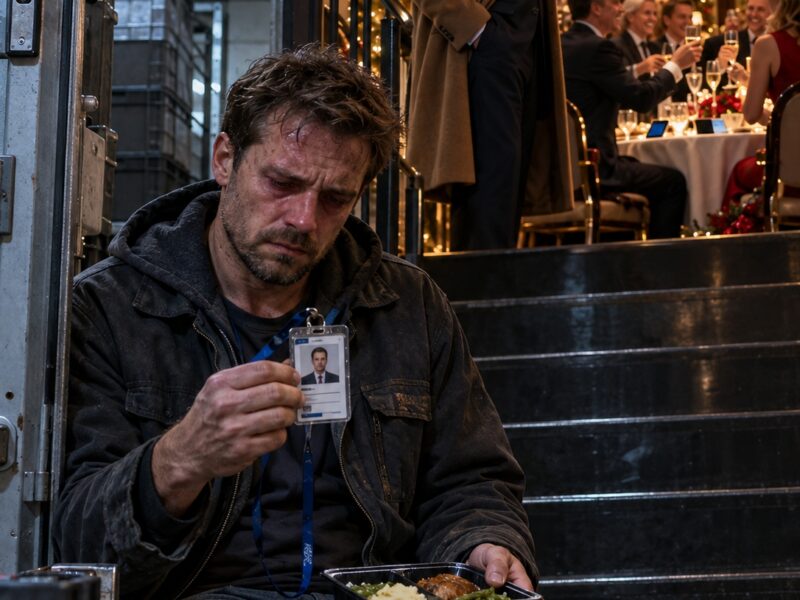
At 11:58 p.m. on Christmas Eve, Daniel Reeves was sitting alone on a wooden pallet in the basement of Halverson Freight and Cold Storage, eating turkey so cold the gravy had formed a skin.
Above his head, the executives were laughing.
Crystal glasses clinked through the ceiling vent.
Someone applauded.
Then came the unmistakable voice of Gordon Halverson, owner of the company, third-generation businessman, local philanthropist, and the kind of man whose photograph appeared beside oversized donation checks in newspapers all over northern Minnesota.
“To another year of taking care of our own.”
More applause.
Danny stared at the plastic fork in his hand.
Beside his work boot sat a gingerbread cookie wrapped in a white hotel napkin.
He hadn’t touched it.
His phone glowed on his knee.
A message from his ten-year-old daughter filled the screen.
Dad, I saved you a plate.
Danny read it twice.
Then the first phone began ringing upstairs.
A second followed.
Then a third.
Within seconds, so many phones were vibrating and chiming above him that the sound came through the vent like a swarm trapped inside the walls.
Danny slowly raised his eyes toward the ceiling.
The clock clicked.
11:59.
He knew exactly why those phones were ringing.
And the men upstairs had less than sixty seconds to understand what they had ignored for twenty-one days.
Six hours earlier, none of them had even considered Danny Reeves important enough to invite to dinner.
Snow was already blowing sideways off Lake Superior when he pulled his rusted Ford Ranger into the employee lot shortly after five-thirty.
The temperature had fallen below zero.
Steam from the building’s exhaust vents curled into the darkness and froze almost immediately, making the enormous warehouse seem as though it were breathing.
Danny killed the engine but remained behind the wheel for a few seconds.
The heater fan rattled.
On the passenger seat lay a red envelope with his daughter’s name written across it.
LILY.
Inside was a twenty-dollar bookstore gift card and a handwritten coupon promising one full Saturday with her—breakfast, sledding, hot chocolate, movie, no work calls.
The gift card had cost twenty dollars.
The Saturday was worth considerably more.
Danny understood that now.
Four years earlier, he hadn’t.
His phone buzzed.
A picture appeared.
Lily stood beside Mrs. Lindquist’s ceramic Christmas tree wearing pajamas under her winter coat. Her dark blond hair was pulled into a crooked ponytail, and she was holding a plate covered in aluminum foil.
Under the picture she’d typed:
Don’t be late.
Danny smiled.
Then he looked at the warehouse.
Christmas Eve paid double through the staffing agency.
Double meant groceries.
Double meant the overdue furnace repair.
Double meant he could stop pretending the knocking sound coming from the front suspension of the Ranger was “probably nothing.”
So he put the phone away.
“Just tonight,” he whispered.
He had been saying that about work for most of his adult life.
Earlier that afternoon, Lily had stood on Mrs. Lindquist’s porch with her sketchbook pressed against her chest.
“You’ll be home before morning?”
“Before you wake up.”
“You said that last Christmas.”
“There was a blizzard last Christmas.”
She had tilted her head.
That particular expression belonged to her mother.
Claire used to do the same thing whenever Danny offered an explanation that was technically true and emotionally dishonest.
Lily was only ten, but she’d inherited the look perfectly.
“There’s always a blizzard,” she’d said.
Danny hadn’t had an answer.
So she saved him one.
“I’ll keep you a plate.”
Then she’d disappeared inside before he could promise anything else.
At 6:15, the night crew gathered in the employee break room.
Operations manager Brent Kowalski stood near the vending machines holding a clipboard.
Brent was forty-four, broad through the shoulders, with a carefully trimmed beard and the permanent expression of a man who believed every room contained at least one person wasting his time.
“Quick announcement,” he said.
Nobody spoke.
“Mr. Halverson is hosting the annual leadership Christmas dinner on the executive floor tonight. Full-time employees, your holiday envelopes are waiting at the front desk.”
A few people smiled.
Then Brent looked toward Danny.
“Agency staff aren’t included.”
The room changed by half a degree.
Not enough for anyone to challenge him.
Enough for everyone to notice.
Brent continued.
“That means you, Reeves. Meal break at eight-thirty. Storage Room B. There’s a tray in the fridge.”
Someone near the coffee machine shifted uncomfortably.
Danny said, “Understood.”
“The motion lights downstairs shut off every fifteen minutes. Just wave your arm.”
A couple of men looked down.
Brent smiled.
“Wouldn’t want you eating in the dark.”
Danny’s face remained still.
Only his right thumb moved, pressing hard into the side of his forefinger.
Once.
Then it stopped.
Years ago, Danny Reeves had been the sort of man who would have answered.
He had sat across polished conference tables from executives whose annual bonuses exceeded the value of the entire warehouse.
He had questioned CEOs.
He had testified before audit committees.
He had once stopped a $140 million acquisition because four numbers in a compliance report didn’t reconcile.
But that Danny had worn tailored suits and carried two phones.
That Danny had a wife waiting at home.
That Danny believed competence could protect a person from life.
Cancer had corrected him.
By seven o’clock, Gordon Halverson arrived.
He wore a camel-colored overcoat over a charcoal suit and a red silk tie.
Silver touched both temples.
At fifty-eight, Gordon had perfected the kind of warmth that photographed well.
He carried cream-colored envelopes and shook the hand of every permanent employee.
“Merry Christmas, Rosa.”
“Merry Christmas, Walter.”
“Good work this year, Mitch.”
His family name was everywhere in Duluth.
Halverson Ice Arena.
The Halverson Children’s Wing.
Halverson Family Food Drive.
Three generations had built the freight company from six trucks into a regional logistics empire handling everything from frozen food to pharmaceuticals.
Gordon’s favorite phrase was painted in the lobby.
WE TAKE CARE OF OUR OWN.
When he reached Danny, his eyes passed across the stitched agency logo on Danny’s jacket.
Then past him.
No handshake.
No envelope.
Nothing intentionally cruel enough to complain about.
Just absence.
Danny had learned there were humiliations designed precisely that way.
At the boardroom entrance upstairs, Gordon placed a wicker basket on a table.
“One rule tonight,” he announced.
“Phones go in the basket. Christmas belongs to the people at the table.”
Laughter followed.
Danny went back to moving pallets.
At 7:03, the lobby doors opened.
A woman stepped inside carrying snow on the shoulders of a charcoal wool coat.
She was thirty-seven, maybe thirty-eight, with dark hair pinned loosely behind her head and the alert expression of someone who entered buildings already noticing what everyone else had stopped seeing.
She approached the security desk.
Rosa Delgado looked up.
The woman placed an identification wallet on the counter.
“Meredith Callahan. Department of Transportation, Office of Inspector General.”
Rosa straightened.
Brent appeared almost immediately.
“Agent Callahan.”
“Mr. Kowalski?”
“We weren’t expecting you until January.”
Meredith signed the visitor log.
“That’s usually the idea.”
Brent laughed.
She didn’t.
“The department is conducting a pre-award integrity review related to the eighty-million-dollar federal cold-chain contract.”
Something flickered behind Brent’s eyes.
Only for an instant.
Then the professional smile returned.
“Of course. Whatever you need.”
Danny happened to be crossing the lobby with a pallet jack.
Meredith stepped aside.
Her eyes dropped to the name stitched above his pocket.
REEVES.
Then to his face.
She nodded.
Danny nodded back.
Behind the security desk, Rosa watched the exchange.
She opened her mouth as if she might say something.
Then Brent looked toward her.
Rosa lowered her eyes.
At 8:30, Danny retrieved his Christmas dinner.
One slice of turkey.
Green beans that had surrendered several hours earlier.
A dinner roll.
Mashed potatoes.
He carried the tray down the service stairs.
Storage Room B was exactly what its name promised.
Concrete walls.
Metal shelves.
Archive boxes.
A humming fluorescent tube.
No window.
No Christmas decorations.
Danny pulled a pallet away from the wall and sat.
Through the ceiling vent came laughter.
Someone upstairs began telling a story.
Another burst of laughter followed.
Danny peeled back the foil.
The turkey looked like a wet envelope.
He almost laughed.
Instead he took a bite.
There was a time when humiliation would have made him angry.
Now he performed arithmetic.
A man who talks back loses the shift.
A man who loses the shift loses double pay.
A man who loses enough shifts falls behind on the mortgage.
A father with a ten-year-old daughter doesn’t get to spend pride like cash.
He had left most of his pride beside Claire’s hospital bed four years earlier anyway.
The elevator opened shortly after nine.
Boots approached.
Meredith Callahan appeared around the corner holding a flashlight and a tablet.
Her coat was gone.
A streak of archive dust crossed one wrist.
“Sorry,” she said. “They told me inbound receiving records were down here, but I’ve been given three different locations.”
Danny put down his fork.
“Aisle four. Second tier.”
She stopped.
“Barcodes start R-I-N. They’re organized by dock door, not date. Index binder is on the end cap.”
Meredith studied him.
“Dock door?”
“Old system used door numbers. They changed software but never reorganized the physical archive.”
She found the binder exactly where he’d said.
“How long have you worked here?”
“Seven months.”
Meredith turned several pages.
Then, without looking at him, asked, “Refrigerated trailer arrives with a temperature excursion. Procedure?”
Danny knew what she was doing.
Testing him.
He answered anyway.
“Trailer gets quarantined. Product gets tagged hold. Quality records duration and peak temperature. Client notification within four hours. Anything outside two to eight Celsius for longer than thirty minutes requires stability disposition before release.”
Meredith slowly lowered the binder.
“That’s Appendix C.”
“Yes.”
“Most of the management team upstairs couldn’t answer that.”
Danny picked up his fork.
“They’re upstairs.”
For the first time, something almost resembling amusement touched her face.
“I need the full name of everyone I interview.”
“Daniel Reeves.”
“Identification?”
He reached for his wallet.
The leather had gone soft with age.
He pulled out his staffing-agency card.
Something else slipped free.
Two laminated cards struck the concrete.
Meredith bent before he could reach them.
The first read:
CERTIFIED FRAUD EXAMINER.
The second carried a Chicago corporate logo and a photograph of Danny nearly a decade younger.
Suit.
Tie.
Less gray.
Underneath:
DANIEL R. REEVES
DIRECTOR — INTERNAL AUDIT & COMPLIANCE
Meredith stopped breathing for a second.
She read it again.
Then looked at him.
“No.”
Danny held out his hand.
“Agent Callahan.”
But she wasn’t looking at the badge anymore.
She was looking at him.
“The Reeves escalation model.”
His expression changed.
Barely.
“You wrote it.”
“I helped.”
“I’ve been quoting you for six years.”
Danny took the cards gently from her fingers.
“My supervisor made us diagram your escalation chain from memory before we were allowed to carry cases.”
He slid the cards behind his agency ID.
Meredith looked around the concrete room.
At the pallet.
At the gray turkey.
At the fluorescent light.
Then back at him.
“What happened?”
Danny stared at the wallet.
“My wife got sick.”
Meredith waited.
“She died four years ago.”
His voice remained controlled.
“Lily was six.”
The laughter upstairs came through the vent again.
Danny looked toward it.
“I had to decide which job I could still do properly.”
“And you chose this?”
“I chose being her father.”
That ended the questions.
Meredith reached into her blazer pocket.
She removed a gingerbread cookie wrapped in a hotel napkin.
“I stole this from the airport lounge.”
Danny glanced at it.
“I believe that’s a federal confession.”
“It’ll never hold up.”
She placed it beside his tray.
Danny looked at the cookie longer than he should have.
Then he said quietly, “Agent Callahan.”
“Yes?”
“I need this job.”
Meredith understood immediately.
Whatever admiration had entered her expression disappeared behind professional neutrality.
“What wallet?”
Danny looked at her.
“I didn’t see one.”
She picked up the flashlight.
At the end of the aisle, she paused.
“Good night, Mr. Reeves.”
“Good night, Agent Callahan.”
She walked away.
Inside the elevator, Meredith whispered his name once.
Daniel Reeves.
She knew that name.
Every federal examiner trained in freight-integrity compliance knew that name.
The question wasn’t how a former director of internal audit ended up driving a pallet jack.
The question was why a man who had helped write the rules governing an eighty-million-dollar contract was sitting in the basement of the company about to receive it.
The answer had begun three weeks earlier.
Dock Six.
2:07 a.m.
Danny had been moving cartons into Zone C, where Halverson stored vaccine lots for the state health department.
He glanced at the cooler display.
49°F.
He stopped.
The maximum allowable temperature was 46.
He waited ten minutes.
49.2.
49.1.
49.3.
Then he checked the handwritten log.
IN RANGE.
Danny didn’t photograph it.
Didn’t touch the ledger.
Didn’t confront anyone.
Fifteen years in audit had taught him that evidence and witnesses shared one weakness.
Both could be contaminated.
He wrote the sensor serial number, time and temperature on the back of his time card.
Then slipped it into his boot.
For two weeks, he checked again.
Six additional nights.
Same pattern.
The electronic display showed excursions.
The handwritten logs showed perfection.
Real systems produced ugly numbers.
41.6.
38.9.
44.3.
Fraud preferred round ones.
Someone was cleaning the history.
Danny asked casually where old logs were stored.
Then he did exactly what the compliance model he’d designed told frightened employees to do.
He called the anonymous hotline.
At two in the morning.
From the parking lot of a closed public library.
Dates.
Sensor numbers.
Times.
Nothing else.
No accusation.
No name.
Then he went home, slept three hours, and made Lily pancakes.
There was one feature of the hotline almost nobody at Halverson remembered.
Danny remembered because he’d fought to include it years earlier.
A clock.
If management failed to acknowledge a high-risk report for twenty-one days, the system automatically escalated it beyond management.
Audit committee.
Lenders.
Insurer.
Contracting agency.
Regulators.
Twenty-one days.
That clock was still running.
At 9:40 on Christmas Eve, Meredith returned to the basement carrying several printouts.
She placed them beside Danny’s untouched gingerbread cookie.
“Zone C sensor data.”
Another sheet.
“Company ledger.”
Danny didn’t touch either.
“They don’t match,” Meredith said.
“How many nights?”
“Seventeen.”
Danny looked up.
“The ledger runs eight to ten degrees cooler almost every time.”
“If I were checking whether someone edited the records…”
Meredith waited.
“I’d look at rounding.”
She examined the columns.
Danny continued.
“Real temperatures are messy. Fake temperatures are written by people who like tidy numbers.”
Her pen moved down the page.
Almost every entry ended in zero or five.
Meredith’s jaw tightened.
“Sensor vendor?”
“Probably mirrors the raw data to cloud storage.”
“Probably?”
“People delete the copy they can see. They forget the copy they can’t.”
Meredith stared at him.
“You sound like someone who’s thought about this.”
Danny picked up his fork.
“I sound like a man with a pallet jack.”
She gathered the papers.
At the elevator, she stopped.
“Mr. Reeves?”
“Yes?”
“If somebody had submitted an anonymous report, I wouldn’t be allowed to tell them I’d found it.”
Danny met her eyes.
“And if somebody had submitted one, they wouldn’t be allowed to tell you.”
A tiny nod.
“Then we’re clear.”
Upstairs, Brent Kowalski was staring at a compliance inbox on his phone.
An inbox he had quietly redirected to himself years ago.
Three weeks of alerts sat unopened.
He’d assumed they were automated junk.
Now one subject line had changed.
FINAL ESCALATION WARNING.
Brent opened it.
Then another.
Then another.
His face drained.
He looked toward the elevator.
Then at the staffing roster.
Only a handful of employees had worked Zone C during the relevant nights.
One had recently asked where old paper logs were kept.
Daniel Reeves.
At 10:10, Brent entered Storage Room B.
Danny was standing before the elevator doors finished opening.
Brent ran one finger across an archive box.
Looked at the dust.
“Somebody’s been through my records.”
“Federal inspector.”
“What did you tell her?”
“Where the index was.”
“Anything else?”
“No.”
Brent smiled.
“How long have you been agency?”
“Seven months.”
“Funny thing about temps.”
Danny said nothing.
“One phone call and you’re gone. No hearing. No severance. No union.”
Brent stepped closer.
“Especially around Christmas.”
Danny’s hand closed around a metal shelf.
“You’ve got a daughter, right?”
Everything inside Danny went silent.
Brent smiled.
“Cute kid.”
Danny’s fingers tightened until the shelf edge bit his palm.
For one terrible second, he saw himself breaking Brent’s nose.
Saw the blood.
Saw the police.
Saw Lily waking Christmas morning at Mrs. Lindquist’s house without him.
So he did nothing.
Brent laughed once.
Then walked away.
Only when the elevator doors closed did Danny breathe.
At 10:30, Lily called.
Her face filled the screen.
“Dad! Look.”
She held up a drawing.
A crooked Christmas tree.
Three people at a table.
One tall.
One small.
One woman in a yellow dress.
Danny recognized Claire immediately.
“That’s Mom,” Lily said.
“I know.”
“Mrs. Lindquist says it’s okay to set a plate for somebody who can’t come.”
Danny smiled.
Something inside the smile broke.
He wiped one eye.
“That’s a beautiful drawing, Lil.”
“You crying?”
“No.”
“Your nose is doing the thing.”
“My nose doesn’t do a thing.”
“It does.”
She wrinkled hers dramatically.
He laughed.
For the first time that night, the sound was real.
“Did you eat?”
“Best turkey in Minnesota.”
“You’re lying.”
“How do you know?”
“Nose.”
Danny laughed again.
“I saved you mashed potatoes.”
“I’ll be there before you wake up.”
“You better.”
“I love you.”
“Love you too. Don’t eat the basement turkey.”
The call ended.
Danny remained motionless.
He didn’t know Meredith had been standing outside the doorway.
She had come to ask another question.
Instead she’d watched the entire call.
When she left, she no longer saw Daniel Reeves as the name attached to a famous compliance model.
She saw a widower sitting on a pallet trying not to disappoint a ten-year-old girl on Christmas.
Ten minutes later, Rosa Delgado appeared.
She brought coffee.
“I was checking the thermostat.”
Danny looked at the cup.
“Of course.”
Rosa didn’t leave.
“You should tell her.”
“Tell who?”
“The federal woman.”
Danny’s eyes lifted.
“I’ve watched Brent go into that records room after two in the morning for three weeks.”
“Rosa—”
“I know what he’s doing.”
“Then report it.”
She laughed bitterly.
“Easy for you to say.”
“No. It isn’t.”
She studied him.
“I know who you used to be.”
Danny froze.
Rosa nodded toward his wallet.
“I’ve worked security nineteen years. People leave things at the desk.”
He lowered his voice.
“You’re eight months from your pension.”
“I know exactly how many months.”
“Then don’t do anything stupid.”
Rosa’s eyes became wet.
“If I speak, I might lose everything.”
Danny looked at her.
“If I speak, I might be fired tonight.”
He glanced at Lily’s dark phone screen.
“And I have a ten-year-old waiting for me.”
Rosa put the coffee beside him.
Her hand touched his shoulder.
“That’s how men like Brent survive,” she whispered. “Everybody has something they can’t afford to lose.”
Then she left.
At 10:50, Meredith returned carrying a space heater.
“The records office had two.”
“Did it?”
“One is plenty.”
She plugged it in.
Orange light spread across the concrete.
“There is something I should tell you that I’m not permitted to tell you.”
Danny looked at the heater.
“Then don’t.”
Meredith nodded.
“Okay.”
She started away.
“Agent Callahan?”
“Yes?”
“Thank you.”
She looked back.
“For the heater?”
Danny looked at the cookie.
“For not asking me to be who I used to be.”
Her expression softened.
“Maybe you still are.”
Then she disappeared upstairs.
At 11:18, Danny carried a trash bag toward the first floor.
He heard Brent before he saw him.
“No. Listen to me, Mitch.”
Danny stopped in the stairwell.
Brent was one flight above.
His voice had become thin.
“I don’t care how. Wipe the server before midnight.”
Danny’s body went cold.
A pause.
“And the paper ledgers. Shred them.”
Another pause.
“All of them.”
Danny looked through the railing.
Brent’s phone illuminated his face.
Across the screen, red numbers counted down.
CASE ESCALATION: 42 MINUTES.
Danny put down the trash bag.
There it was.
The choice.
Stay silent and keep his job.
Or move and reveal himself.
For four years, every important decision Danny made had been measured against one question:
What does Lily need?
Tonight the answer changed.
She needed groceries.
She needed heat.
She needed her father home.
But someday she would also need to know what kind of man her father had been when silence was easier.
Danny took the stairs two at a time.
The control room door was open.
Inside stood Walter Puit.
Seventy-one.
Janitor.
Scarred hands.
Gray hair.
A man most employees assumed barely spoke.
Beside him sat a mop bucket.
“Mr. Puit?”
Walter turned.
“I heard Brent.”
Danny stared.
Walter’s voice was rough from disuse.
“He’s going to erase something.”
“Yes.”
“I came to stop him.”
“You know computers?”
“No.”
Despite everything, Danny almost smiled.
“Neither do I.”
Walter looked at him.
Then reached beneath his cleaning cart.
He pulled out a battered black-and-white composition notebook.
“Six years.”
Danny took it.
Inside were handwritten dates.
Temperatures.
Lot numbers.
Trailer numbers.
Hundreds of entries.
“What is this?”
“Every shift.”
Walter’s hands trembled.
“I carry my own thermometer.”
Danny looked up.
“Why?”
Walter swallowed.
“My granddaughter Hannah.”
He stared at the notebook.
“Type 1 diabetes.”
Danny understood before Walter finished.
“Six years ago, she got insulin from a bad shipment. Reefer failed in July. Four days ICU.”
Walter’s voice cracked.
“They said there was no way to trace what happened.”
He kicked lightly at the plastic bag beneath his cart.
Nine more notebooks.
“So I traced it.”
Danny couldn’t speak.
“Why didn’t you report this?”
Walter’s mouth tightened.
“Mr. Halverson sent flowers when Ruth died.”
Danny waited.
“Biggest flowers in the church.”
Walter’s eyes filled.
“How do you accuse a man who sends flowers?”
The sentence seemed to exhaust him.
Then he pushed the notebook against Danny’s chest.
“You say good night to me.”
Danny blinked.
“Every night.”
Walter nodded.
“Nobody else does.”
He pressed harder.
“So you take it.”
For three weeks, Danny had believed he was alone.
He had been working beside a seventy-one-year-old man carrying six years of evidence under a mop bucket.
Danny hugged the notebook against his chest.
Then he ran.
Meredith was in the records office.
“I can’t tell you where this came from.”
She saw the notebook.
Then his face.
“A man gave it to me. He wants it in the right hands.”
Meredith took it carefully.
“My vendor export arrived four minutes ago.”
She opened her tablet.
Placed Walter’s handwritten record beside the cloud data.
March 11.
Walter: 48.2.
Cloud: 48.1.
June 29.
Walter: 51.0.
Cloud: 51.0.
September 8.
Walter: 49.7.
Cloud: 49.8.
Meredith turned page after page.
Six minutes passed.
When she finally stopped, her hand rested flat against the notebook.
Her eyes were bright with anger.
“This is enough.”
“For what?”
“To open a federal criminal case.”
Danny closed his eyes.
For one second.
Then opened them.
“Then it’s done.”
“No.”
Meredith looked at the clock.
“It’s beginning.”
She lowered her voice.
“Go downstairs. Stay out of sight until I call you.”
Danny reached the door.
“Danny.”
He stopped.
It was the first time she’d used his first name.
“Thank you.”
He nodded.
At 11:40, he was back on the pallet.
His turkey was cold.
The gingerbread cookie remained untouched.
The heater clicked softly.
Then Lily’s message arrived.
Dad, I saved you a plate.
Danny smiled.
The door slammed against the wall.
Brent entered with two security guards.
Mitch.
Cole.
Brent’s collar was wet with sweat.
“I saw the control-room camera.”
Danny stood.
“Walter’s cart. You took something.”
“I don’t know what you mean.”
“Don’t play stupid.”
Brent stepped closer.
“Give it back.”
Danny put the tray down.
“I’m on my meal break.”
“You won’t have a job in five minutes.”
“Then I guess this is my last meal.”
“Cole.”
Cole grabbed Danny’s arm.
A voice came from the doorway.
“Take your hand off him.”
Everyone turned.
Rosa Delgado stood there.
Reading glasses pushed into her hair.
Security radio in one hand.
Logbook in the other.
“Rosa,” Brent snapped. “Go back upstairs.”
“No.”
“Excuse me?”
“The dispatch recorder has been live since you kicked that door open.”
Brent went still.
Rosa raised the radio.
“Everything you’ve said is recorded.”
Her hand shook.
Her voice didn’t.
“Nineteen years I’ve kept my mouth shut.”
“Rosa—”
“I watched you enter the records room after two in the morning for three weeks. Every night.”
Brent’s face hardened.
“You want to throw away your pension?”
Rosa looked at Danny.
Then at Brent.
“I’m eight months away.”
She took a breath.
“And you can have it.”
Cole released Danny.
Footsteps approached.
Meredith entered with her credentials open.
Behind her came Gordon Halverson.
His red tie hung loose.
“Special Agent Meredith Callahan, Department of Transportation Office of Inspector General.”
She looked directly at Brent.
“As of this moment, all paper and electronic records at this facility are under federal preservation order.”
Nobody moved.
“Altering, destroying, concealing or attempting to destroy those records may constitute a federal offense.”
Gordon stepped forward.
“Agent Callahan, I’m certain this is a misunderstanding.”
“I’m not.”
“My family has served this community for sixty years.”
Meredith didn’t blink.
“I know.”
“I can call Washington.”
“Do it.”
Gordon stared.
Meredith continued.
“But no one you’re calling can erase the preservation order.”
Silence.
Then Danny spoke.
“Mr. Halverson.”
Gordon turned.
“My name is Daniel Reeves.”
“I know who you are. You’re agency.”
“No.”
Danny removed his wallet.
He placed the old corporate badge on the pallet.
“Four years ago, I was Director of Internal Audit and Compliance at Lakeshore Continental in Chicago.”
Gordon’s face changed.
“I helped develop the escalation model incorporated into Section Fourteen of your federal contract.”
Meredith watched Gordon understand.
Slowly.
Painfully.
Danny continued.
“Three weeks ago, I filed an anonymous report.”
Brent stepped backward.
“Zone C. Seventeen nights. Seven vaccine lots recorded in range while independent sensors showed excursions.”
Gordon looked toward Brent.
“Under Section Fourteen, an unacknowledged report escalates automatically after twenty-one days.”
Danny glanced at the wall clock.
11:57.
“Your company had twenty-one days.”
Gordon whispered, “Brent?”
Brent said nothing.
“All someone had to do,” Danny said, “was open an email.”
Through the ceiling came a faint buzzing.
Then another.
Then several at once.
Meredith checked the clock.
11:58.
Footsteps thundered down the stairs.
Linda Marsh, the CFO, appeared carrying the wicker basket from the boardroom.
Every phone inside it was glowing.
Executives crowded behind her.
“Gordon.”
She was out of breath.
“Something’s happening.”
The phones vibrated violently against one another.
“Hotline vendor.”
Linda lifted one.
“Final notice.”
Another.
“Case escalation.”
Meredith turned her tablet.
A countdown filled the screen.
CASE 0417
STATUS: UNACKNOWLEDGED
AUTOMATIC NOTIFICATION: 00:01:34
Below it:
AUDIT COMMITTEE CHAIR.
LENDER COMPLIANCE.
INSURANCE CARRIER.
FEDERAL CONTRACTING OFFICER.
DEPARTMENT OF TRANSPORTATION.
Gordon stared.
Danny said nothing.
00:58.
00:41.
00:23.
Brent suddenly lunged toward the door.
Mitch blocked him.
“Move.”
Mitch didn’t.
“That’s an order.”
Mitch looked at Rosa.
Then at Brent.
“Sorry, boss.”
00:08.
Gordon turned toward Danny.
“You can stop this.”
Danny shook his head.
“No.”
“You built the system.”
“I helped build it so people like me wouldn’t need permission from people like you.”
00:03.
00:02.
00:01.
Midnight.
The screen changed.
NOTIFICATIONS SENT.
Every phone in the wicker basket began ringing.
Not buzzing now.
Ringing.
One after another.
A dozen separate tones bounced off the concrete walls.
Linda picked up the nearest.
“Northland Bank.”
Another.
“Insurance regional director.”
Another.
“Audit committee chairman.”
She looked at Gordon.
“He’s called four times.”
Then she saw the last screen.
Her voice dropped.
“The federal contracting officer.”
Gordon didn’t answer any of them.
The light from the screens moved across his face.
Finally he looked at Danny.
“You did this.”
Danny shook his head.
“I filed a report.”
“You destroyed my company.”
“I reported a temperature.”
“I gave you work.”
That landed differently.
Danny stared at him.
Then looked down at his Christmas dinner.
Cold turkey.
Gray beans.
Untouched gingerbread.
“You gave me work?”
Gordon’s jaw tightened.
Danny’s voice remained quiet.
“Tonight you gave me a pallet in a basement.”
No one moved.
“All I wanted was to eat dinner.”
Danny looked toward the executives.
“You picked the table.”
For perhaps the first time in Gordon Halverson’s adult life, there was no speech waiting behind his teeth.
Then Meredith’s phone buzzed.
She read the message.
Her expression changed.
Danny noticed immediately.
“What?”
Meredith locked the screen.
“Outside counsel accessed the hotline case eleven times.”
Gordon closed his eyes.
“And?”
She looked at him.
“This isn’t the only facility.”
The room seemed to shrink.
Meredith slipped the phone into her pocket.
“The night isn’t over.”
By 12:20, federal agents and Duluth police had arrived.
Brent left between two officers.
Rosa signed her statement with the same ballpoint pen she’d used at the security desk for nineteen years.
Walter sat on the stairs holding his notebooks.
Meredith filled out a whistleblower-protection form with his name across the top.
Nobody hurried him.
Nobody interrupted.
Danny watched Walter surrender the notebooks one by one.
The old man’s shoulders seemed to rise after each one left his hands.
Like he’d been carrying something impossibly heavy for six years and had finally been told he could put it down.
At three in the morning, the lobby looked like the aftermath of a storm.
Federal technicians restored cloud logs.
Agents carried boxes outside.
Executives left clutching attorneys’ numbers scribbled on napkins.
Gordon was the last.
At the front doors, he stopped.
He looked toward the basement stairs.
Then stepped into the snow.
He never put on his coat.
Meredith found Danny on the loading dock.
“My truck is behind the federal tape.”
“I know.”
“I can walk.”
“It’s twelve below.”
“I’ve walked in worse.”
“Get in the car, Reeves.”
He almost smiled.
The government sedan was warm.
They drove through empty Christmas streets.
Lake Superior steamed beyond the buildings.
Neither spoke.
At a red light with no traffic in any direction, Meredith stopped.
Danny noticed.
She waited for green.
He liked that.
He didn’t say so.
Mrs. Lindquist’s porch light was still burning.
Before Danny reached the steps, the door opened.
Lily came running outside wearing boots, pajamas, and Claire’s old green winter coat.
She carried a covered plate.
“You’re late.”
Danny looked at the snow.
“Blizzard.”
Lily narrowed her eyes.
“There’s always a blizzard.”
He laughed.
Then she noticed Meredith.
“Who’s she?”
“This is Agent Callahan.”
Meredith stood awkwardly near the sidewalk.
“She helped me tonight.”
Lily examined her.
Then handed Danny the plate.
“Hold this.”
She disappeared inside.
Seconds later she returned with her drawing.
She gave it to Meredith.
Meredith unfolded it.
The same crooked Christmas tree.
The same table.
Danny.
Lily.
Claire in the yellow dress.
But now there were four plates.
At the end of the table stood an empty chair.
“I added one,” Lily said.
“Why?”
“In case somebody came.”
Meredith looked at the drawing.
Then at Danny.
Then back at Lily.
The wind moved a strand of hair across her cheek.
For once, she didn’t fix it.
“Thank you.”
Her voice nearly failed.
“Merry Christmas, Lily.”
“Merry Christmas.”
Danny looked away toward the snow.
Because sometimes gratitude was harder to survive than humiliation.
The consequences arrived quickly.
The Department of Transportation suspended Halverson’s eighty-million-dollar contract award.
A federal grand jury convened in Minneapolis.
Regulators expanded the investigation to other Halverson facilities.
Outside counsel was subpoenaed.
Brent Kowalski became the focus of obstruction and falsification allegations.
The board placed Gordon Halverson on administrative leave.
Days later, his resignation was accepted.
But Danny didn’t celebrate.
He’d spent too many years auditing disasters to confuse consequences with healing.
Companies could replace executives.
They couldn’t replace insulin spoiled in a hot trailer.
They couldn’t return four days of a frightened child’s life in intensive care.
They couldn’t give Rosa back nineteen years of silence.
And they couldn’t give Claire another Christmas.
On December 30, the interim board chair called Danny.
Margaret Ostro was a retired federal judge with a voice that made unnecessary words feel expensive.
“We want you to rebuild the compliance program.”
“No.”
There was silence.
“May I ask why?”
Danny was standing in his kitchen making grilled cheese while Lily did homework.
“Because I’ve already lost one family to a job.”
Judge Ostro didn’t answer immediately.
“What would make you reconsider?”
Danny looked at his daughter.
“Part-time.”
“How part-time?”
“Four days.”
“Salary—”
“I’m not talking about salary.”
Another pause.
“Home by five.”
“Mr. Reeves—”
“No calls after dinner.”
“Compliance emergencies don’t observe dinner.”
“Then find someone else.”
Judge Ostro sighed.
“What qualifies as an emergency?”
Danny looked at Lily.
She was pretending not to listen.
“The building being on fire.”
Lily smiled into her homework.
One month later, Danny signed the contract.
Four days per week.
Out by five.
No calls after dinner unless the building was literally burning.
Judge Ostro initialed the clause herself.
“Most people negotiate money.”
Danny capped the pen.
“I’m negotiating dinner.”
Rosa retired with her full pension.
The new board protected it.
During her second week of retirement, she taught her grandson cribbage and discovered that sleeping until nine in the morning felt almost illegal.
Walter Puit was invited to the winter board meeting.
He wore a borrowed jacket.
For the first time in decades, a room filled with senior executives learned how to pronounce his last name.
The company established a nursing scholarship in Hannah’s name.
Hannah, now nineteen, sat in the front row holding her grandfather’s wrist while people thanked him.
Walter didn’t give a speech.
He simply nodded.
For him, that was enough.
Late one Friday in January, Meredith Callahan parked outside a small blue house on Chestnut Street.
A manila folder sat on the passenger seat.
She told herself she was delivering a final witness declaration.
She told herself Monday would have worked just as well.
She told herself this three times before ringing the bell.
Lily opened the door.
“You’re early.”
Meredith checked her watch.
“It’s six exactly.”
“Dad’s burning the garlic bread.”
“I am not burning it,” Danny shouted from the kitchen.
Smoke drifted faintly through the hallway.
Lily raised one eyebrow.
Meredith laughed.
The house smelled like butter, tomato sauce and garlic.
A small Christmas tree still stood in the corner even though January was nearly over.
One ornament hung upside down.
Another had apparently been attacked by the cat.
Meredith entered the kitchen.
Four places were set.
Mismatched plates.
Paper napkins.
Water glasses.
At one end of the table sat a place slightly apart from the others.
Yellow napkin.
Small empty glass.
Meredith stopped.
Lily followed her eyes.
“That’s Mom’s.”
Danny appeared carrying garlic bread.
Slightly black around the edges.
“Only a little burned.”
Lily pointed triumphantly.
“I told you.”
Danny ignored her.
Meredith looked again at the empty place.
Every night, Lily set it.
Every night, Danny allowed her.
Meredith didn’t say she was sorry.
She didn’t say Claire would want them to move on.
She didn’t offer one of those sentences people use when grief makes them uncomfortable.
Instead, she walked around the table.
She chose the chair beside Claire’s.
And sat.
Danny put down the bread.
Then poured Meredith tea from a chipped blue pot.
His knuckles brushed hers.
Half a second.
Both pulled back.
Across the table, Lily noticed.
A small smile appeared.
Then vanished.
She picked up her fork.
Nobody mentioned it.
They ate.
They talked about ordinary things because ordinary things were sometimes the greatest luxury people could recover.
Lily explained fractions using a dinner roll.
Meredith argued that garlic bread couldn’t legally be called burned until it became structurally unsound.
Danny objected.
Snow drifted past the kitchen window.
Across town, Halverson Freight and Cold Storage was almost empty.
Storage Room B had been cleaned.
The pallet was gone.
The flickering fluorescent tube had been replaced.
It burned steadily now over bare concrete.
Upstairs, the long boardroom table remained.
But the wicker basket was gone.
No rule required phones to be surrendered at the door anymore.
And on Chestnut Street, beneath a warm yellow window glowing against the Minnesota snow, four places remained set around a kitchen table.
One belonged to a woman who would never come home.
One belonged to a little girl who still believed saving someone a plate was a form of love.
And beside the empty chair sat a woman who understood that she had not been invited to replace anyone.
She had simply been given a place.
Danny looked around the table.
For years, he’d believed losing Claire had divided his life into before and after.
Maybe it had.
But sitting there, listening to Lily laugh while Meredith tried to rescue the least-burned piece of garlic bread, he understood something quieter.
An after did not have to mean an ending.
Sometimes it was just the part of the story where you finally learned which things were worth coming home for.
Outside, snow covered the street.
Inside, nobody was eating alone.









