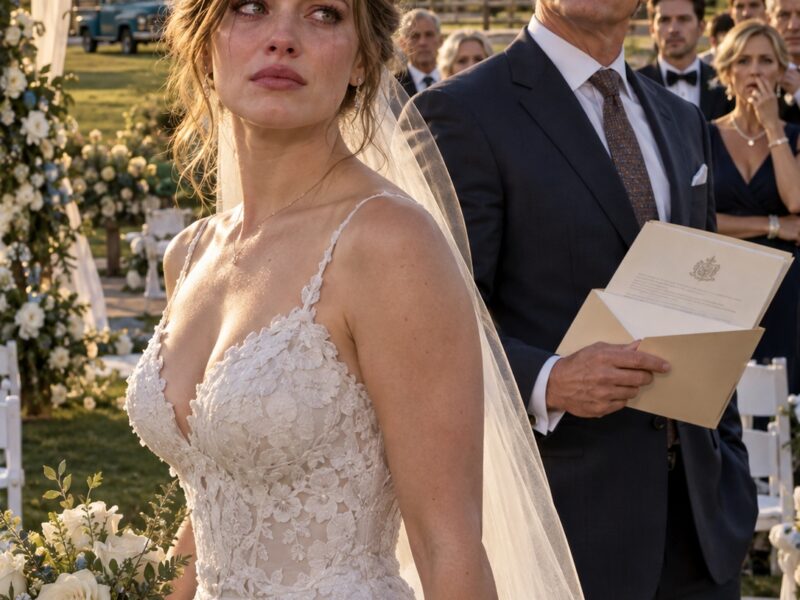
They Mocked Her for Marrying a Broke Ranch Hand—Then Her Father Opened One Envelope and Turned Pale
The laughter started before Emily Carter had even reached the aisle.
Not loud enough to interrupt the violinist playing beneath the cottonwood trees. Not cruel enough for anyone to admit later that they had been mocking her on her wedding day. It came in careful little bursts behind champagne glasses and folded programs—the kind of laughter wealthy people used when they wanted to be vicious without appearing impolite.
Emily heard every bit of it.
Her cousin Caroline leaned toward another cousin and whispered something behind her hand. Aunt Margaret glanced toward the white wooden arch at the end of the lawn, then shook her head with the solemn embarrassment of a woman watching somebody make a public mistake.
Even Emily’s older brother, Michael, wouldn’t meet her eyes.
And standing beneath the arch, waiting for her, was the reason.
Daniel Hayes.
He wore a dark charcoal suit that fit well enough but had no designer label anyone in Emily’s family would recognize. His boots were polished, though the leather was old. His hands—resting loosely in front of him—were rough from wire, rope, tools, winter feed, engine grease, and years of honest work.
Behind the guest parking area sat his faded blue Ford pickup.
There was still Montana dust on the rear bumper.
To the Carter family, the truck said everything they believed they needed to know about the man Emily was about to marry.
Poor.
Unconnected.
Unpolished.
A ranch hand.
A nobody.
Emily looked past all of them and found Daniel’s eyes.
He smiled.
Not broadly. Daniel almost never performed emotion for an audience. It was simply the small, steady smile he gave her when he knew she was nervous—the same smile he had given her beside a broken-down car on County Road 16, in the middle of a thunderstorm, while rain soaked through his shirt and she apologized for calling him so late.
You called me, he’d said.
Of course I came.
Emily held onto that memory as her father, Richard Carter, offered her his arm.
But Richard didn’t move.
For one strange second, he stood beside his daughter at the beginning of the aisle and stared at Daniel as though he were looking at a man he had never seen before.
Emily noticed.
“Dad?”
Richard blinked.
His face looked different that morning. Older somehow. Tired around the eyes.
For the past three days, he had barely spoken at family meals. Twice, Emily had caught him studying Daniel from across the room. The previous night, she’d heard voices behind her father’s office door after midnight.
One of them had been Daniel’s.
When she asked Daniel about it, he had kissed her forehead and said, “Your dad had a question.”
“What question?”
“A complicated one.”
“And?”
“And I gave him an honest answer.”
Daniel had refused to say more.
Now Richard’s grip tightened slightly around Emily’s arm.
“What is it?” she whispered.
Her father looked down at her.
There was something in his eyes she couldn’t identify.
Regret, perhaps.
Or shame.
“Nothing,” he said quietly. “Not yet.”
Then he started walking.
Emily had no idea that hidden inside her father’s jacket was a folded copy of a legal document bearing Daniel’s full name.
She had no idea that three nights earlier Richard had learned something about the quiet ranch hand waiting beneath the flowers.
Something Michael didn’t know.
Something Victoria didn’t know.
Something even Emily didn’t know.
And before the wedding day was over, the same relatives who were laughing at Daniel’s old truck would be staring at him in stunned silence.
Because Daniel Hayes had been hiding a secret.
And Richard Carter had decided the secret could no longer stay hidden.
Emily Carter had spent most of her thirty years being told how fortunate she was.
People said it when they saw the Carter ranch spread across miles of rolling Montana grassland, where black cattle moved like ink across green hills and snowcapped mountains cut the western horizon.
They said it when they entered the Carter home—a restored stone-and-timber farmhouse with twelve bedrooms, two kitchens, a library, a wine cellar Richard rarely used, and windows tall enough to turn every sunset into a painting.
They said it when they learned the Carter family owned not only cattle operations but commercial property in Billings, grain-storage interests, equipment dealerships, and a small investment company Michael was increasingly expected to inherit control of.
You’re lucky, Emily.
She heard it so often that eventually the phrase stopped sounding like admiration.
It sounded like an instruction.
Be grateful.
Don’t complain.
Don’t embarrass the family.
And above all, understand what people like us are supposed to look like.
Michael understood.
At thirty-five, he was everything Richard’s friends expected a Carter son to become. He had earned an MBA from Northwestern, returned to Montana in fitted jackets and expensive watches, and quickly transformed himself into their father’s unofficial second-in-command.
Michael could discuss beef futures over breakfast and property acquisitions before lunch. He knew which county commissioner played golf on Thursdays and which banker preferred whiskey to wine. He remembered everyone’s name when money was involved.
Richard was proud of him.
Everyone knew it.
Victoria understood the Carter world too.
Three years older than Emily, Victoria lived in Denver and worked with nonprofit boards, charity galas, donor networks, and people who said things like “summer in Jackson” without needing to explain what that meant.
Victoria’s social media showed champagne receptions, ski weekends, black dresses, white tablecloths, and smiling photographs taken beside people whose names appeared on buildings.
She wasn’t cruel by nature.
But she had learned to measure success the way the Carter family measured land—by visible boundaries.
Emily never fit.
She could tolerate a gala for an hour before slipping outside to help the caterers load trays.
She owned expensive dresses because Victoria bought them for her, but she preferred jeans faded at the knees and boots she could actually get dirty.
She liked horses, veterinary clinics, community food drives, old diners, fence lines at sunrise, and people who didn’t care what her last name could do for them.
At family dinners, that made her “free-spirited.”
At business events, she was “the sweet one.”
When Richard was frustrated, she was “unfocused.”
None of the descriptions felt true.
Emily wasn’t unfocused.
She simply wasn’t interested in becoming a smaller version of somebody else’s idea of a successful Carter.
Then Daniel Hayes walked into her life carrying an injured calf through freezing rain.
It happened in April.
A spring storm had rolled over the valley so fast that afternoon workers barely had time to close equipment sheds. Wind bent the cottonwoods. Rain struck the barn roofs in horizontal sheets.
Emily had driven to the neighboring Bell ranch to return veterinary supplies when she saw a figure moving across a flooded pasture.
At first she couldn’t understand what she was looking at.
Then lightning flashed.
A man was coming toward the barn carrying a calf against his chest.
The calf was nearly seventy pounds and terrified. One of its back legs hung awkwardly. The man’s jacket was soaked black with rain, his boots sinking into the mud with every step.
Two other workers stood beneath the barn overhang shouting at him.
“Leave it, Hayes!”
Daniel ignored them.
He reached the barn, carried the calf inside, dropped to one knee, and started examining the leg.
Emily stood beneath the awning twenty feet away.
“You know you’re insane, right?” one of the workers said.
Daniel wiped rain out of his eyes.
“Probably.”
“Boss said we’d get it in the morning.”
“By morning it would’ve been hypothermic.”
“It’s a calf.”
Daniel looked up.
“Yeah.”
The other worker stared at him.
Daniel’s expression didn’t change.
Finally the man muttered, “You’re gonna kill yourself over somebody else’s cattle.”
Daniel pulled a dry blanket around the shaking animal.
“Then I guess somebody else’s cattle had a good day.”
That was the first time Emily really saw him.
She’d noticed Daniel before. Everyone at Bell Ranch had.
He had been hired six weeks earlier and somehow earned the respect of men who normally required years before deciding a newcomer wasn’t useless.
He didn’t talk much.
Didn’t brag.
Didn’t flirt with the ranch owner’s daughters.
Didn’t complain about the worst jobs.
He simply showed up before sunrise and usually left after everybody else.
That afternoon Emily crouched beside him while he held the calf still.
“You need a veterinarian.”
“Already called one.”
“You have a phone?”
Daniel glanced at her.
The corner of his mouth moved.
“No. Sent a carrier pigeon.”
Emily stared at him for half a second.
Then laughed.
It surprised both of them.
He looked at her then.
Really looked.
“You Richard Carter’s daughter?”
There it was.
The surname.
Emily’s stomach sank a little.
Usually that was the moment conversations changed.
People became more careful or more interested.
Daniel simply returned his attention to the calf.
“Emily,” she said.
He nodded.
“Daniel.”
“I know.”
That made him smile again.
“Am I famous?”
“Bell’s new guy carried a calf half a mile through lightning. Word travels.”
“It wasn’t half a mile.”
“How far?”
“Maybe a quarter.”
“So you’re only moderately stupid.”
“That’s what my annual performance review says.”
She laughed again.
The veterinarian arrived fifteen minutes later.
Emily stayed.
She couldn’t have explained why.
Over the next few weeks she kept finding reasons to visit Bell Ranch.
Sometimes she actually had business there.
Sometimes she didn’t.
Daniel never seemed impressed by her last name, which was precisely why Emily wanted him to notice her.
He repaired a gate while she sat on the fence beside him.
He showed her why a section of irrigation line kept losing pressure.
He could identify mineral deficiency in a herd from the condition of their coats. He understood drainage, grazing rotation, breeding records, machinery depreciation, and soil quality with an ease that didn’t match his job title.
One afternoon Emily watched him examine a broken post.
“Concrete base failed,” he said.
“You can tell by looking?”
“Look at the break.”
She leaned closer.
He pointed.
“Water got down here. Froze. Expanded. Somebody patched it twice without fixing the drainage.”
Emily looked at him.
“How do you know all this?”
Daniel became busy with his wrench.
“Worked a lot of places.”
“Doing what?”
“Things.”
“Very specific.”
“I try.”
“You go to agricultural school?”
He paused.
For less than a second.
But Emily saw it.
“No.”
“College?”
“Some.”
“Some college?”
Daniel tightened a bolt.
“Emily.”
“Yes?”
“You’re interviewing me.”
“I’m flirting with you.”
That stopped him.
He looked at her.
Emily immediately wished she could grab the sentence out of the air and swallow it.
Then Daniel wiped his hands on a rag.
“That’s worse.”
“Why?”
“Because now I’m nervous.”
“You don’t look nervous.”
“I have an excellent face.”
She smiled.
“Is that what you call it?”
He stepped closer.
The joking faded.
For several seconds, there was only wind moving through the grass and the distant metallic clank of a gate.
“You sure?” Daniel asked quietly.
Emily knew what he meant.
Not Are you sure you want me to kiss you?
Are you sure you understand what people will say?
She answered anyway.
“Yes.”
Their first kiss tasted faintly of coffee and Montana dust.
It changed her life.
Not immediately.
Life rarely changed as dramatically as people later remembered it.
There was no music.
No lightning.
No revelation.
Just a growing collection of ordinary moments.
Daniel bringing coffee when Emily helped with vaccinations before sunrise.
Emily sitting on his tailgate while he ate a gas-station sandwich after twelve hours of work.
Daniel fixing Mrs. Whitmore’s tractor and refusing the seventy dollars she tried to press into his hand.
Emily discovering he kept dog treats in his pickup because there were three farm dogs along his usual route.
Daniel remembering that a ranch worker’s eight-year-old daughter had a spelling competition and asking about it two weeks later.
Once, a horse disappeared from a low-income family’s small property north of town.
Daniel searched until four in the morning.
When Emily asked why he cared so much, he looked confused by the question.
“Their little boy sleeps with that horse’s picture beside his bed.”
“So?”
“So we find the horse.”
That was Daniel.
He behaved as though kindness was not a moral performance but simply the next job that needed doing.
Yet for all the things Emily learned about him, his past remained a locked room.
He had been raised partly in Wyoming, partly in Colorado.
His mother had died when he was young.
His father was also dead.
He had no siblings.
That was nearly everything.
“What was your dad like?” Emily asked one night.
They were sitting on the hood of his pickup outside an all-night diner after helping deliver a difficult calf.
Daniel’s face changed.
“Complicated.”
“You loved him.”
“Yeah.”
“Was he a rancher?”
Daniel looked toward the highway.
“In a way.”
“What does that mean?”
He rubbed his thumb over the edge of his coffee cup.
“He knew land.”
“So that’s where you learned?”
“Some of it.”
Emily waited.
Daniel said nothing more.
She could have pushed.
She didn’t.
Everyone had a locked room somewhere.
She didn’t need to own every key.
Five months after they started dating, Emily’s SUV died thirty miles outside town.
Daniel arrived forty minutes later.
It was nearly midnight.
He climbed beneath the hood with a flashlight between his teeth while Emily stood beside him apologizing.
“You worked fourteen hours today.”
He shrugged.
“Thirteen.”
“Daniel.”
“What?”
“I could’ve called roadside assistance.”
“But you called me.”
“Because I knew you’d come.”
He looked at her.
There was no joke this time.
“That’s the idea.”
Something shifted inside Emily.
Not fireworks.
Not panic.
Certainty.
She knew.
Two months later, Daniel proposed beside a frozen pond behind an abandoned line cabin.
He didn’t have a photographer hiding nearby.
No flowers.
No champagne.
His hands shook when he held out the ring.
“I’m not going to give you the life your family thinks you should have.”
Emily stared at him.
Daniel continued.
“I don’t know if that’s fair to you.”
“What life are you going to give me?”
“The honest one.”
She started crying before he finished the question.
When Emily announced the engagement, the Carter dining room fell silent.
Her family had been expecting something.
They had not been expecting Daniel Hayes.
Aunt Margaret was the first to react.
“The ranch worker?”
Emily set her fork down.
“His name is Daniel.”
Margaret blinked.
“I know his name.”
“Then use it.”
Victoria stared at the ring.
Michael leaned back in his chair as though someone had just presented an amusing business problem.
Richard said nothing.
That frightened Emily more than everyone else combined.
Michael finally broke the silence.
“How long have you known him?”
“Almost a year.”
“And you think that’s enough time to marry somebody whose history you don’t even know?”
“I know him.”
“That’s not what I asked.”
Emily looked at her brother.
“What exactly are you implying?”
Michael spread his hands.
“Nothing. I’m asking practical questions.”
“No, you’re not.”
“Em—”
“You want to know how much money he has.”
Michael gave a humorless laugh.
“That would be one question, yes.”
“There it is.”
“Marriage involves money.”
“So does prostitution. That doesn’t make the two things identical.”
Victoria whispered, “Emily.”
Michael’s jaw tightened.
“I’m trying to protect you.”
“From what?”
“A man who shows up out of nowhere, dates Richard Carter’s daughter, and suddenly proposes.”
Daniel, seated beside Emily, hadn’t spoken.
Michael looked at him.
“Convenient story, isn’t it?”
Emily felt Daniel’s hand lightly touch hers beneath the table.
Don’t.
She knew what he meant.
Don’t fight every battle.
Michael leaned forward.
“Daniel, I’m sure you’re a nice guy.”
“That’s generous,” Daniel said.
Michael ignored the dry tone.
“But my sister has lived a very protected life.”
Emily laughed.
“Please continue talking about me like I’m not sitting here.”
“She doesn’t always understand how people see this family.”
Daniel finally looked directly at Michael.
“I think Emily understands people better than most of us.”
Michael’s face hardened.
“And what do you want?”
“From Emily?”
“From this family.”
Daniel answered immediately.
“Nothing.”
Michael smiled.
Nobody at the table mistook it for warmth.
“Everybody wants something.”
Daniel considered that.
“Maybe.”
“So what do you want?”
Daniel turned toward Emily.
She felt the entire table watching.
“Her.”
The simplicity of the answer made Emily’s eyes sting.
Michael looked away first.
Later that night, Richard asked Emily to join him in his office.
Her father poured two glasses of water instead of whiskey.
That meant he was serious.
“You’re angry,” Emily said.
“No.”
“Disappointed.”
Richard sat behind his desk.
“I am concerned.”
“About Daniel being poor.”
“About you making a permanent decision based on emotion.”
“What do you know about his finances?”
“Very little.”
“Exactly.”
Richard rubbed a hand across his mouth.
“Emily, marriage isn’t a romance novel. There are mortgages, medical bills, children, retirement, responsibilities.”
“I know.”
“Do you?”
Her face changed.
Richard saw it but continued.
“You have never had to worry about money.”
“And that’s my fault?”
“I didn’t say it was.”
“It sounds like you’re saying I’ve been spoiled.”
“You have been protected.”
Emily stood.
“Protected from what, Dad? Working?”
“That is not what I mean.”
“Daniel works harder than half the people you admire.”
“I’m not questioning whether he’s hardworking.”
“Then what are you questioning?”
Richard hesitated.
That hesitation hurt more than an answer.
Emily nodded slowly.
“His class.”
“Emily—”
“His clothes? His truck?”
“No.”
“His family name?”
Richard’s silence answered for him.
Emily’s throat tightened.
“You know what I think is strange?”
“What?”
“You spent my entire childhood telling me character mattered.”
“It does.”
“Apparently right up until I marry somebody who doesn’t own enough property.”
She walked toward the door.
Richard stood.
“Emily.”
She turned.
Her father looked torn.
“I need to know that this man isn’t interested in what you inherit.”
Emily stared at him.
Then she laughed once.
There was no humor in it.
“Daniel doesn’t even know what I inherit.”
Richard frowned.
“What?”
“He doesn’t know the structure of the Carter estate. He doesn’t know what percentage Michael gets, what Victoria gets, what I get. He has never asked.”
“He could assume.”
“I offered to buy him a truck.”
Richard’s expression shifted.
“He refused.”
Emily continued.
“I offered to introduce him to people in your equipment division. He refused that too. I told him you could get him a management position.”
“What did he say?”
“That if he ever worked for a Carter company, he wanted to earn the job before anyone knew who he was dating.”
Richard said nothing.
Emily opened the door.
“I know exactly what you’re afraid of, Dad.”
She looked back.
“You think Daniel is pretending to be good because he wants access to our money.”
Her voice softened.
“What you should be afraid of is that we’re showing him exactly who we are.”
The weeks before the wedding made everything worse.
Michael’s jokes grew sharper.
At Sunday dinner, Daniel arrived wearing muddy boots after helping contain cattle that had broken through a section of fence.
Michael looked under the table.
“You know we do own pavement, right?”
Daniel glanced at his boots.
“Really?”
“We’ve had it for years.”
“I thought that gray stuff was decorative.”
Victoria hid a smile behind her wineglass.
Michael didn’t.
Another evening, Aunt Margaret asked Daniel where he and Emily planned to honeymoon.
“Not sure yet,” Daniel said.
Margaret lifted her brows.
“Camping?”
Emily nearly dropped her fork.
Daniel calmly took a drink.
“I was thinking Paris, but I hear the tent permits are brutal.”
Emily kicked him under the table.
He looked at her innocently.
The fact that Daniel refused to become humiliated frustrated them.
Emily noticed that.
Some people wanted him to lose his temper so they could point and say, See?
See where he belongs?
But Daniel never gave them the satisfaction.
Only once did Emily see the judgment get through.
It happened after an engagement party at the Carter house.
A group of cousins were standing near the driveway.
They didn’t know Emily and Daniel were approaching from behind the barn.
One cousin laughed.
“I give it two years.”
“That long?”
“Depends how fast he gets access to the trust fund.”
Another voice said, “Emily’s always wanted to rescue something.”
They laughed.
“Stray dogs. Injured horses. Now unemployed cowboys.”
Daniel stopped walking.
Emily felt his hand leave hers.
She turned.
His face was blank.
Too blank.
“Daniel.”
“I’m fine.”
“No, you’re not.”
They walked to his pickup.
He opened her door.
She didn’t get in.
“Say something.”
He looked past her toward the lights of the Carter house.
“What do you want me to say?”
“That they’re idiots.”
“They’re idiots.”
“Mean it.”
Daniel sighed.
“Emily.”
“Why don’t you defend yourself?”
“Because people who have already decided what you are don’t usually change their minds because you make a good speech.”
“So you just let them laugh at you?”
“I know who I am.”
“I know.”
“Then we’re good.”
Emily searched his face.
There was sadness there.
But not the sadness she expected.
It wasn’t humiliation.
It looked almost like disappointment.
As if her family had failed a test none of them knew they were taking.
Three days before the wedding, Richard Carter received a FedEx envelope from a law firm in Cheyenne.
He nearly gave it to his accountant unopened.
The Carter family received legal correspondence constantly—land-use agreements, corporate notices, tax documents, leases, easements.
This one concerned a dormant agricultural partnership created twenty-four years earlier.
Richard remembered it vaguely.
His father had entered several regional land-development ventures during the late 1990s. Most were eventually dissolved.
The attached letter said the firm was completing final disposition of a parcel and water-right interest once held jointly by Carter Agricultural Holdings and Hayes Western Enterprises.
Richard stopped reading.
Hayes.
He knew that name.
Not Daniel.
Thomas.
Thomas Hayes had once been impossible not to know.
At his peak, Thomas Hayes controlled cattle ranches in three states, agricultural-processing businesses, seed investments, heavy equipment companies, and vast tracts of land.
Richard had met him twice.
Thomas was wealthy enough to make wealthy men uncomfortable.
Then something happened.
Richard remembered hearing that Thomas’s wife had died.
There had been rumors about a family tragedy.
Within several years, Hayes began selling companies.
He resigned from boards.
Withdrew from public life.
Eventually, the name almost disappeared.
Richard looked at the legal document again.
The dormant partnership’s successor representative was listed as:
Hayes Family Agricultural Trust.
Beneficiary:
Daniel Thomas Hayes.
Richard didn’t breathe.
He read the name twice.
Then a third time.
Daniel Thomas Hayes.
Age thirty-two.
Current legal address protected through trustee representation.
Only son of Thomas Everett Hayes.
Richard sat very still.
Outside his office window, evening light stretched gold across the Carter pasture.
Somewhere near the north barn, a tractor engine started.
Richard reached for his phone.
His first search produced almost nothing recent.
Daniel Hayes was common enough.
But Thomas Everett Hayes was not.
Old newspaper photographs appeared.
Richard clicked one.
Thomas Hayes stood beside a governor at the opening of an agricultural processing facility.
Next to Thomas was a boy of perhaps eight.
Richard enlarged the picture.
The resolution was poor.
But the eyes were unmistakable.
Daniel.
Richard sat back.
“No,” he whispered.
He called the attorney listed on the letter.
Professional confidentiality prevented the man from discussing the trust in detail.
But he confirmed enough.
Yes, Daniel Thomas Hayes was Thomas Hayes’s son.
Yes, the trust still existed.
Yes, its agricultural holdings were substantial.
“How substantial?” Richard asked.
The attorney paused.
“I can’t disclose a private valuation.”
“Ballpark.”
“Mr. Carter.”
“I’m not asking for a statement.”
Another pause.
Then the lawyer said carefully, “The Hayes trust would be considered one of the more significant privately held agricultural estates in that region.”
Richard ended the call.
He stared at the wall.
For months his family had joked about Daniel’s pickup.
His boots.
His salary.
His lack of property.
And all along, the young man could likely have purchased half the valley without financing it.
But that wasn’t the part Richard couldn’t understand.
Why?
Why work for ranch-hand wages?
Why drive an eighteen-year-old truck?
Why refuse Emily’s money?
Why say nothing?
Richard continued investigating.
He found fragments.
A Wyoming property transfer.
A Colorado corporate filing.
An old interview with Thomas Hayes discussing succession.
One quote stopped Richard.
I don’t want my son to inherit comfort before he inherits competence.
Richard read it twice.
Later that evening, he contacted an old attorney who had known Thomas.
The man was reluctant.
Then Richard explained that his daughter was marrying Daniel.
Silence.
“You’re serious?”
“Yes.”
The attorney laughed softly.
“Well.”
“You know him?”
“I knew his father.”
“What is Daniel doing working ranch jobs?”
“You’d have to ask Daniel.”
“I am asking you.”
“Then I’ll tell you what I’m comfortable telling you.”
Richard waited.
“Thomas didn’t trust inherited identity.”
“What does that mean?”
“It means he’d watched rich families produce children who could sign checks but couldn’t survive inconvenience. He was terrified Daniel would become one of them.”
“So he cut him off?”
“Not exactly.”
The attorney explained that after Daniel’s mother died, Thomas became obsessed with giving his son a life outside money.
Daniel attended good schools, but Thomas also sent him to ranches owned by family friends.
He repaired equipment.
Cleaned stalls.
Worked feedlots.
Studied agricultural management informally and formally.
Then Thomas died.
The trust gave Daniel generous access under certain circumstances, but Daniel had voluntarily delayed taking control of most of it.
Richard frowned.
“Voluntarily?”
“Yes.”
“Why would anyone do that?”
The attorney chuckled.
“You sound exactly like most people.”
Richard wasn’t amused.
“What condition is he trying to satisfy?”
“That’s private.”
“You’re already telling me private things.”
“I’m telling you things that have been discussed publicly in industry circles.”
“Then tell me this.”
Richard leaned toward the phone.
“Is Daniel broke?”
“No.”
“Has he ever been broke?”
A pause.
“Not in the legal sense.”
“Does he have access to money?”
“Yes.”
Richard closed his eyes.
“Then why the hell is he living like this?”
The attorney’s voice changed.
“Maybe because he can.”
Richard opened his eyes.
“What?”
“Poor people don’t get to choose poverty, Richard. Wealthy people occasionally choose simplicity. The difference matters.”
Richard bristled.
“Don’t lecture me.”
“I’m not.”
“Then answer.”
The man sighed.
“After Thomas died, Daniel discovered something unpleasant.”
“What?”
“People changed.”
Richard said nothing.
“Friends became investors. Girlfriends became curious about estate structures. Distant relatives discovered affection. People who ignored Daniel suddenly wanted lunch.”
Richard’s stomach tightened.
“So he disappeared.”
“He stepped away.”
“For years?”
“More or less.”
“Working ranches?”
“Among other things.”
“And nobody knows?”
“Daniel wanted to find out who he was when his surname stopped opening doors.”
Richard looked out the window.
There, crossing the lower pasture on horseback, was Daniel.
Richard recognized the old brown jacket.
The same jacket Michael had mocked two weeks earlier.
The attorney continued.
“If Daniel Hayes is marrying your daughter while she believes he’s an ordinary ranch employee, there’s one thing I’d advise you to consider.”
“What?”
“She may be one of the first people in years who passed a test she didn’t know she was taking.”
The call ended.
Richard remained in the office until long after dark.
He thought about Emily.
About Daniel.
About the engagement dinner.
Everybody wants something, Michael had said.
What do you want?
Her.
Richard remembered the answer.
It suddenly sounded very different.
But one question gnawed at him.
Emily didn’t know.
That bothered Richard.
Love didn’t excuse deception.
The next morning, he went looking for Daniel before sunrise.
He found him behind the horse barn repairing a sagging gate.
Daniel was kneeling in the dirt with a socket wrench.
“Morning,” Daniel said.
Richard stood over him.
“Thomas Hayes.”
Daniel stopped moving.
The morning went silent.
Not literally.
Horses shifted behind the fence.
A meadowlark called from a post.
Somewhere, irrigation water hissed through grass.
But between the two men, everything stopped.
Daniel slowly set the wrench down.
“Where did you hear that name?”
Richard’s suspicion returned instantly.
“That shouldn’t be your first question.”
Daniel stood.
He wiped his hands on his jeans.
“No. Probably not.”
Richard pulled the copied legal page from his jacket.
Daniel looked at it.
His shoulders dropped slightly.
Not fear.
Resignation.
“I knew it might come out eventually.”
“Eventually?”
Richard’s voice hardened.
“You’re marrying my daughter in three days.”
“I know.”
“And you were planning to tell her when?”
Daniel looked toward the barn.
“After the wedding.”
Richard stared at him.
“That’s unacceptable.”
“I know how it sounds.”
“Do you?”
“I do.”
“No, Daniel, I’m not sure you do.”
Richard stepped closer.
“Emily thinks you’re a ranch worker who barely owns the truck he drives.”
“I am a ranch worker.”
“Don’t play games with me.”
“I’m not.”
“You are the sole beneficiary of a trust that may be worth hundreds of millions of dollars.”
Daniel’s face tightened.
“Keep your voice down.”
Richard almost laughed.
“That’s what concerns you?”
“Yes.”
“My daughter doesn’t know who she’s marrying.”
Daniel’s eyes flashed.
“She knows exactly who she’s marrying.”
“No. She knows the version you’ve allowed her to know.”
Daniel absorbed the blow.
Richard continued.
“If the roles were reversed and Emily had hidden a fortune from you, what would you call that?”
Daniel looked down.
“A mistake.”
“Then why make it?”
Daniel was quiet for a long time.
Finally he said, “Because the last time people knew before they knew me, I stopped being a person.”
Richard frowned.
Daniel leaned against the gate.
“My father had money before I was born. A lot of it. I didn’t understand what that meant when I was a kid.”
His voice was calm, but something old moved beneath it.
“My mom died when I was eleven. Cancer. After that my dad became… difficult.”
“How?”
“Obsessed with preparing me.”
“For the business?”
“For people.”
Richard said nothing.
Daniel looked toward the mountains.
“My dad used to tell me money didn’t change people. It gave them permission to reveal what was already there.”
Richard remembered the quote he’d read.
Daniel continued.
“He made me work every summer. Not fake work where the owner’s kid walks around with gloves for photographs. I lived in bunkhouses. Fixed fence. Cleaned stalls. Got screamed at by foremen who didn’t care whose son I was.”
A faint smile touched his face.
“One fired me.”
Richard raised an eyebrow.
“For what?”
“Showing up late.”
“How late?”
“Eight minutes.”
“Your father let him?”
“My father gave him a bonus.”
Despite himself, Richard almost smiled.
Daniel looked down.
“At the time I hated him for it.”
“And later?”
“I understood.”
He picked up the wrench, then set it down again.
“When my dad died, I was twenty-four. Suddenly everybody had ideas about what I should do.”
“Business advisers.”
“Business advisers. Lawyers. People who’d known me since childhood. People I’d never met.”
Daniel’s jaw tightened.
“A woman I was dating started asking how the trust worked.”
Richard watched him.
“Maybe she was curious.”
“Maybe.”
“You don’t believe that.”
“She emailed one of the trustees without telling me.”
Richard went still.
“About what?”
“What she’d receive if we married.”
“Oh.”
“Yeah.”
Daniel gave a small humorless laugh.
“We weren’t engaged.”
Richard had no answer.
“So I left.”
“You walked away from all of it?”
“Not legally. That’s more complicated. But from the lifestyle, yes.”
“Why?”
“Because I didn’t know whether anyone saw me anymore.”
Daniel looked directly at him.
“You know what it’s like when you walk into a room and everybody already thinks they know who you are?”
Richard thought of his own surname.
“Yes.”
“Imagine knowing they also have a dollar amount attached.”
That landed.
Richard folded the document.
“And Emily?”
Daniel’s expression softened immediately.
“Emily saw me carrying a calf.”
“Romantic.”
“I smelled terrible.”
“She likes animals more than people.”
“I noticed.”
For the first time that morning, both men almost smiled.
Then Richard’s face became serious again.
“She deserves the truth.”
“I know.”
“When?”
“After the ceremony.”
“Why after?”
Daniel breathed out.
“Because I need one day.”
Richard frowned.
“One day for what?”
“To marry her as Daniel.”
“You think a bank account changes your name?”
“No.”
“Then I don’t understand.”
Daniel looked toward the house.
“I’ve watched your family laugh at me for six months.”
Richard stiffened.
Daniel raised a hand.
“I’m not asking you to defend it.”
The shame came before Richard could stop it.
Daniel continued quietly.
“Emily never joined them. Not once.”
Richard looked away.
“She fought with all of you. She offered to walk away from this wedding venue and marry me at the courthouse because she thought I’d had enough.”
“I didn’t know that.”
“She didn’t want you to know.”
“Why?”
“Because she still wanted her father there.”
Richard’s throat tightened.
Daniel stepped closer.
“I don’t need your family’s approval.”
“That much is obvious.”
“But Emily does care. She pretends she doesn’t. She does.”
Richard knew that was true.
“So what happens when she learns?”
Daniel swallowed.
“She’ll be angry.”
“You think?”
“Very.”
“She should be.”
“I know.”
“She may feel tested.”
That struck Daniel harder than anything else Richard had said.
His eyes lowered.
“That’s what I’m afraid of.”
Richard watched him.
“Was she?”
Daniel immediately shook his head.
“No.”
“You said yourself—”
“I never tested Emily.”
“Daniel.”
“I tested the world around me. There’s a difference.”
“Is there?”
The question remained between them.
Daniel had no easy answer.
Finally he said, “When she offered me money, I refused because I didn’t need it. When she defended me, I didn’t ask her to. When she loved me, I kept waiting for the moment I’d have to tell her.”
“But you didn’t.”
“No.”
“Why?”
Daniel’s voice dropped.
“Because for the first time in my life I knew exactly why somebody loved me.”
Richard felt something inside him shift.
Not approval.
Not yet.
Recognition.
He folded the document and put it away.
“You tell her.”
Daniel nodded.
“I will.”
“Before the wedding.”
Daniel’s head came up.
“Richard—”
“Before.”
“I asked for one day.”
“And I’m telling you secrets don’t become more honorable because you keep them until after vows.”
Daniel looked away.
Richard turned to leave.
Then he stopped.
“There is another thing.”
Daniel waited.
“My family has treated you badly.”
Daniel said nothing.
Richard forced the words out.
“So have I.”
Still nothing.
“I’m not apologizing because I found out you’re wealthy.”
Daniel studied him.
“I’d hope not.”
“I’m apologizing because finding out you’re wealthy made me realize how much your poverty mattered to me.”
Daniel’s expression changed.
Richard looked toward the Carter house.
“I don’t like what that says about me.”
He walked away before Daniel could answer.
But the wedding morning arrived, and Emily still didn’t know.
Daniel tried twice.
The first time, Emily’s bridesmaids swept into the room.
The second time, Emily’s mother called from downstairs because the florist had delivered the wrong table arrangements.
By noon, guests were arriving.
Emily stood before the mirror in her childhood bedroom wearing a simple ivory dress with lace sleeves and no diamonds except her grandmother’s small earrings.
Victoria adjusted the train.
“You could still run.”
Emily looked at her sister in the mirror.
Victoria smiled.
“I’m joking.”
“Are you?”
The smile faded.
Victoria sat on the edge of the bed.
“I don’t hate him.”
“Comforting.”
“I don’t.”
“You’ve spent six months making jokes about his truck.”
“I make jokes about Michael’s car.”
“No, you criticize Michael’s taste. You criticize Daniel’s worth.”
Victoria flinched.
Emily turned around.
“Do you know the difference?”
“Yes.”
“Then why?”
Victoria looked at her hands.
“Because I’m worried.”
“About me being poor?”
“About you being different.”
Emily frowned.
Victoria struggled for words.
“You always do things the hard way.”
“What does that mean?”
“You could’ve married somebody who fit.”
Emily’s face softened with sadness.
“Fit where?”
“Here.”
Victoria gestured around the enormous bedroom.
Emily looked at the carved furniture, the antique rug, the mountain view.
“Maybe I don’t.”
Victoria stared at her.
Emily smiled faintly.
“Maybe that’s what everyone keeps getting wrong.”
Outside, the violinist began to play.
Victoria’s eyes filled.
“Oh God.”
“What?”
“You’re actually doing this.”
Emily laughed.
“I told you I was.”
Victoria stood and hugged her.
For the first time in months, she whispered, “I hope we’re wrong.”
Emily closed her eyes.
“You are.”
Downstairs, Daniel stood alone for thirty seconds behind the ceremony lawn.
He had a letter in his jacket pocket.
Not legal paperwork.
A letter to Emily.
He had written it at three that morning because he’d failed to find the courage to say everything aloud.
It began:
Emily,
There is something about my life I should have told you before you ever agreed to marry me.
He hated the letter.
It sounded like a confession because it was one.
Richard found him staring at it.
“She knows?”
Daniel shook his head.
Richard’s jaw tightened.
“I tried.”
“Trying isn’t telling.”
“I know.”
“Then go upstairs.”
“Her mother will have me shot.”
“I’m serious.”
“So am I.”
Richard stared at him.
Daniel looked at the guests gathering beneath white chairs.
“Five minutes.”
“You don’t have five minutes.”
“I need to tell her face-to-face.”
“Then tell her at the altar if you have to.”
Daniel looked at him sharply.
Richard didn’t blink.
“No vows until she knows.”
Daniel nodded slowly.
“Fair.”
Neither man noticed Michael standing near the corner of the building.
He had heard only the last sentence.
No vows until she knows.
Michael watched Daniel walk away.
Suspicion ignited.
He found Richard ten minutes later.
“What does Emily need to know?”
Richard’s face closed immediately.
“Nothing that concerns you.”
Michael laughed.
“She’s my sister.”
“Then act like her brother and let her handle her marriage.”
“What did he do?”
“Nothing.”
“Then why are you threatening to stop the vows?”
Richard stepped closer.
“I am not threatening anything.”
“You’re hiding something.”
Richard lowered his voice.
“So are most adults, Michael.”
“Don’t do that.”
“Do what?”
“Treat me like a child.”
Richard looked at his son for a long moment.
“Then stop behaving like one.”
Michael’s face hardened.
Richard left.
For the first time in Michael’s adult life, his father had deliberately excluded him from a family matter.
He did not take it well.
At one-thirty, guests were seated.
Emily stood beside Richard at the beginning of the aisle.
Then she heard the laughter.
A whisper.
A muffled joke.
Her aunt.
Her cousins.
Someone behind her said, “At least the photos will be interesting.”
Richard heard that one too.
Emily felt his arm stiffen.
She expected him to ignore it.
Instead he turned.
The guests nearest them fell quiet.
Richard Carter looked directly at the cluster of relatives.
“Is there something funny?”
Aunt Margaret’s face flushed.
“No.”
“Then let’s keep it that way.”
Emily stared at her father.
Richard faced forward.
“Ready?”
She searched his face.
“Dad…”
“I’ve been an idiot.”
Her lips parted.
“That’s not usually a wedding-day announcement.”
“No.”
A faint smile appeared.
“Probably overdue.”
Before Emily could ask what he meant, the violin changed.
Everyone stood.
Richard walked his daughter down the aisle.
Daniel watched her coming.
For a few seconds, the trust didn’t exist.
The money didn’t exist.
The Carter family didn’t exist.
There was only Emily.
She reached him.
Richard took her hand.
Tradition required him to place it into Daniel’s.
He hesitated.
Daniel looked at him.
Both men understood.
Tell her.
Daniel gave the smallest nod.
Richard placed Emily’s hand in his.
The officiant began.
“Family and friends, we are gathered here—”
Daniel wasn’t listening.
His heartbeat was too loud.
Emily squeezed his fingers.
“You okay?” she whispered.
“No.”
Her smile vanished.
“What?”
The officiant continued.
Daniel looked at Richard.
Richard’s face said the same thing.
Now.
The officiant reached the first vow.
Daniel released Emily’s hand.
“Wait.”
The single word moved through the lawn like a gunshot.
Guests stirred.
Emily went pale.
“What?”
Daniel looked at the officiant.
“I’m sorry.”
Then at Emily.
“I need five minutes.”
Her voice dropped.
“Daniel, you’re scaring me.”
“I know.”
“What happened?”
Behind them, chairs creaked.
Michael stood.
“I knew it.”
Richard turned.
“Sit down.”
“No.”
Michael walked into the aisle.
“I knew there was something.”
“Michael.”
“What did he do?”
Emily stared between them.
“Dad?”
Daniel closed his eyes.
This was becoming exactly what he had feared.
Michael pointed toward him.
“I heard Dad this morning. He said you couldn’t marry Emily until she knew something.”
Whispers spread.
Emily looked at Daniel.
The hurt in her face nearly broke him.
“What is he talking about?”
Daniel reached inside his jacket.
Before he could remove the letter, Richard stood.
“Enough.”
Daniel turned.
“Richard.”
“No.”
Richard faced the guests.
Daniel’s expression hardened.
“Don’t.”
Richard looked at him.
“It’s gone too far.”
“This is my truth to tell.”
Emily stepped between them.
“What truth?”
Silence.
The laughter was gone now.
Every eye on the lawn was fixed on Daniel.
Emily whispered, “Tell me.”
Daniel pulled out the letter.
His hands—hands that could calm a panicked horse, repair machinery in freezing weather, stitch wire in darkness—were trembling.
He looked at Emily.
“My full name is Daniel Thomas Hayes.”
She blinked.
“I know your name.”
“No.”
He swallowed.
“You know part of it.”
Richard closed his eyes.
Daniel continued.
“My father was Thomas Everett Hayes.”
No reaction from Emily.
But behind her, Richard’s business associates began looking at one another.
One older rancher actually whispered, “Jesus.”
Michael frowned.
Victoria stared at her father.
Daniel spoke only to Emily.
“My dad owned Hayes Western Enterprises.”
Emily searched his face.
She clearly didn’t understand.
Daniel forced himself to continue.
“He owned ranches. Agricultural companies. Land. Investments.”
“Okay.”
“When he died, most of it went into a trust.”
Emily stopped breathing.
Daniel’s voice became quiet.
“I’m the beneficiary.”
The wind moved the flowers behind them.
Somebody dropped a program.
Emily stared at him.
“Beneficiary of what?”
Richard answered before Daniel could.
“A very large agricultural estate.”
Daniel looked at him sharply.
Richard didn’t stop.
“The man this family has been calling a penniless ranch hand could probably buy every property represented at this wedding and still have enough money left to make Michael feel insecure.”
A few shocked sounds escaped the guests.
Michael’s face drained.
Daniel’s jaw tightened.
“I asked you not to turn this into money.”
Richard’s voice rose.
“I’m not.”
He looked at the guests.
“I’m turning it into shame.”
Aunt Margaret looked away.
Richard walked to the center aisle.
“For months, members of this family have judged Daniel because of a truck, a salary, a pair of work boots.”
He paused.
“I did it too.”
Emily’s eyes remained fixed on Daniel.
Richard continued.
“And three days ago I learned that Daniel Hayes is the son of Thomas Hayes and heir to an agricultural trust larger than most of us can imagine.”
Gasps spread through the rows.
Victoria covered her mouth.
Michael whispered, “You’re kidding.”
“No.”
Richard turned toward him.
“I’m not.”
Michael looked at Daniel as though the man’s body had physically changed.
Daniel saw it.
And hated it.
Richard saw that too.
“Look at yourselves,” he said.
Nobody moved.
“Five minutes ago some of you were embarrassed for my daughter.”
His voice sharpened.
“Now you’re impressed.”
Aunt Margaret stared at the ground.
Richard shook his head.
“That is the problem.”
Then Emily spoke.
“Everybody leave.”
Her voice was quiet.
Nobody reacted.
She turned.
“I said leave.”
Victoria stood.
“Emily—”
“Not you. Family stays.”
Daniel’s face tightened.
Emily looked at the officiant.
“I’m sorry.”
The man nodded and stepped aside.
Guests slowly began moving toward the reception building.
Whispers erupted the moment they were far enough away to pretend Emily couldn’t hear.
Within minutes, only Emily, Daniel, Richard, Michael, Victoria, Emily’s mother Susan, and the officiant remained near the arch.
Emily faced Daniel.
“How much?”
Daniel shook his head.
“It doesn’t matter.”
“Don’t decide what matters to me right now.”
He swallowed.
“I don’t know an exact current valuation.”
“Millions?”
“Yes.”
“Tens of millions?”
Daniel said nothing.
Emily’s eyes widened.
“Hundreds?”
Richard looked away.
That was answer enough.
Emily actually laughed.
It was a broken sound.
“Wow.”
She stepped back.
“You let me offer to buy you a truck.”
Daniel looked miserable.
“I know.”
“You let me worry about whether you had health insurance.”
“I have insurance.”
“I know that now!”
Her voice cracked.
Daniel didn’t move toward her.
He knew better.
Emily pressed both hands against her face.
“When were you going to tell me?”
“This morning.”
“This morning?”
“I tried.”
“But you didn’t.”
“No.”
“So when?”
Daniel looked at the letter.
“Before the vows.”
Emily laughed again.
“How romantic.”
“Emily.”
“No. You don’t get to say my name like that and make this softer.”
He nodded.
“You’re right.”
She stared at him.
“Was I a test?”
Daniel went still.
The question he had feared.
“No.”
“Think before you answer.”
“I don’t need to.”
“You pretended to be poor.”
“I never pretended.”
“You hid being rich.”
“Yes.”
“That’s a word game.”
“I know.”
“You watched me defend you.”
Daniel’s eyes filled.
“I didn’t ask you to.”
“That makes it better?”
“No.”
“You listened while my family humiliated you, and all this time you knew something that would’ve shut them up in ten seconds.”
“That’s exactly why I didn’t tell them.”
Emily froze.
Daniel took one step closer.
“I never wanted them to respect me because of my father.”
“But you were willing to let me be humiliated with you?”
“No.”
“That’s what happened.”
“I know.”
“You could’ve trusted me.”
Daniel’s composure finally broke.
“I was terrified.”
Emily stared at him.
Daniel’s voice was rough now.
“Do you know what happened the last time I trusted someone with this?”
Richard looked down.
Daniel told her.
About the girlfriend.
The email to the trustee.
The questions about prenuptial agreements before there had been a proposal.
People calling after his father’s funeral.
Friends asking for investments while condolences were still sitting unopened.
Relatives contesting trust provisions.
Business associates treating a grieving twenty-four-year-old like an acquisition opportunity.
“I left because I couldn’t tell the difference anymore,” he said.
Emily’s eyes filled.
“And then I met you.”
“That doesn’t excuse lying.”
“No.”
“Stop agreeing with me!”
Daniel flinched.
Emily wiped her cheek angrily.
“I need you to fight with me.”
“I can’t.”
“Why?”
“Because you’re right.”
That silenced her.
Daniel looked down at the letter.
“I should have told you.”
“Yes.”
“I kept waiting because every normal day with you felt…” He struggled for the word. “Safe.”
Emily closed her eyes.
“And you thought the truth would destroy that.”
“Maybe.”
“So instead you nearly destroyed it yourself.”
“Yes.”
The answer was barely audible.
Susan began crying quietly.
Victoria stared at her brother-in-law with a completely different expression than she’d worn twenty minutes earlier.
Michael still looked stunned.
Emily turned away.
Beyond the wedding lawn stretched miles of Carter land.
Land.
Money.
Names.
Inheritance.
All the things everyone believed separated Daniel from them had turned out to be illusions.
Yet Emily didn’t feel relieved.
She felt betrayed.
And that frightened Daniel more than losing the trust ever could.
“Do you still want to marry me?” he asked.
Richard looked sharply at him.
Emily didn’t turn.
“Don’t ask me that.”
“I need to know.”
“No.”
Daniel went pale.
Emily finally faced him.
“I mean don’t ask me while I’m standing in a wedding dress with two hundred people waiting for us to finish.”
Daniel breathed.
She looked around.
“Everyone goes inside.”
“Emily—”
“Please.”
They obeyed.
Daniel stayed.
Emily looked at him.
“You too.”
He swallowed.
Then he nodded.
When Emily was alone beneath the arch, she finally cried.
Not because Daniel was rich.
Not because her relatives had laughed.
Because the one person she had trusted precisely because he seemed uninterested in appearances had been hiding the largest appearance of all.
Twenty minutes passed.
Then thirty.
Inside the reception hall, nobody touched the champagne.
Guests whispered.
Michael paced.
Victoria snapped at three relatives who tried to ask questions.
Daniel stood outside the kitchen entrance, tie loosened, staring at nothing.
Richard approached him.
“You okay?”
Daniel gave him a look.
“Stupid question.”
“Fair.”
“I told you I wanted to do this privately.”
Richard’s jaw tightened.
“And I told you she deserved the truth.”
“Not like that.”
“No.”
Richard looked toward the lawn.
“I made it worse.”
Daniel didn’t answer.
“Why aren’t you angry?”
“I am.”
“At me?”
“At everybody.”
Richard almost smiled.
“Good.”
Daniel looked at him.
“Your family laughed at me this morning.”
Richard nodded.
“Yes.”
“Now half of them are probably searching my father’s name on their phones.”
“Probably.”
“And the part that makes me sick is that tomorrow they’ll treat me better.”
Richard looked down.
“You’re right.”
Daniel shoved his hands into his pockets.
“I’d rather they kept laughing.”
“I wouldn’t.”
Daniel’s eyes moved to him.
Richard’s voice softened.
“Because now I have to look at why I was laughing with them.”
“You weren’t.”
“I didn’t stop them.”
Daniel said nothing.
Richard breathed out.
“Sometimes silence is just cowardice dressed as manners.”
Before Daniel could answer, the hall doors opened.
Emily stood there.
Everyone went silent.
She had removed her veil.
Her eyes were red.
But her voice was steady.
“Daniel.”
He walked toward her.
She looked at the guests.
“We’re finishing the ceremony.”
A wave of surprise moved through the room.
Daniel stopped.
“Emily, you don’t have to—”
She held up a hand.
“I know.”
He closed his mouth.
She came closer.
“I’m still angry.”
“I know.”
“Very angry.”
“I know.”
“If you say I know one more time, I might actually hit you.”
A few nervous laughs escaped nearby.
Even Emily almost smiled.
Daniel nodded.
She looked into his eyes.
“We are not getting married because you are secretly wealthy.”
“Good.”
“And we’re not getting married because Dad publicly turned your bank account into some morality lesson.”
Richard winced.
“Also fair.”
Emily continued.
“We are getting married because yesterday, before I knew any of this, I wanted to marry you.”
Daniel’s eyes filled.
“But.”
His expression tightened.
“There are conditions.”
“Name them.”
“No more secrets that affect our life.”
“Agreed.”
“I get to be angry about this for as long as I’m angry about it.”
“Agreed.”
“You don’t get to use your past as an excuse to test my loyalty.”
“I won’t.”
“And tomorrow we’re having a long conversation with lawyers.”
Daniel blinked.
Emily’s eyebrow lifted.
“Problem?”
“No.”
“Prenup.”
Daniel smiled faintly.
“Definitely.”
Michael’s face did something complicated.
Emily noticed.
“Relax. His lawyers are probably better.”
Victoria snorted.
Michael glared at her.
Emily took Daniel’s hand.
Then she whispered, so only he could hear, “You almost lost me today.”
His eyes closed briefly.
“I know.”
This time she didn’t object.
The ceremony resumed.
When Daniel spoke his vows, his voice trembled.
“I spent years believing the safest way to be loved was to make sure nobody knew what they could take from me.”
He looked at Emily.
“You taught me that love can’t grow where trust is rationed.”
Emily’s eyes filled.
“I promise you that whatever I own, whatever name I inherited, and whatever life comes after today, I will never again make you prove that you chose me.”
Silence filled the room.
Emily answered.
“I don’t promise to forget what happened today.”
A few people shifted uncomfortably.
Daniel nodded.
“But I promise not to confuse a terrible mistake with an entire person.”
His face broke.
Emily continued.
“I loved the man who carried a calf through a storm when nobody was watching.”
She squeezed his hand.
“I still do.”
They married.
But there was no magical transformation afterward.
The hurt didn’t disappear because rings were exchanged.
That night, long after the guests left, Emily sat on the edge of the bed in the small cabin she and Daniel had planned to use after the wedding.
No luxury hotel.
No private jet.
Just a cabin near Yellowstone they’d reserved months before.
Daniel sat across from her.
Between them lay several legal documents.
Emily rubbed her forehead.
“I still cannot believe this.”
Daniel nodded.
She glared.
He raised both hands.
“Not saying it.”
That made her laugh despite herself.
Then she began crying.
Daniel stayed where he was.
“Come here,” she whispered.
He crossed the room.
She rested her forehead against his chest.
“I feel stupid.”
“Don’t.”
“I defended you because I thought everybody was judging you for not having money.”
“They were.”
“But you did have money.”
“That doesn’t make their judgment better.”
“No.”
She wiped her eyes.
“But it changes the story.”
Daniel thought about it.
“Maybe.”
Emily looked at him.
“What happens now?”
“Whatever we decide.”
“No. What’s actually in the trust?”
Daniel exhaled.
“Land.”
“How much?”
“A lot.”
“Daniel.”
“About forty-eight thousand acres directly. More through partnerships.”
Emily stared.
“Forty-eight thousand?”
“Approximately.”
“Companies?”
“Minority stakes in several. Majority interest in two.”
“Cash?”
“I don’t keep that number in my head.”
“That is the most rich-person sentence I’ve ever heard.”
He grimaced.
“Sorry.”
“No, you’re not.”
“I’m deeply ashamed of my diversified asset structure.”
She threw a pillow at him.
He caught it.
For the first time all day, Emily laughed properly.
Then the laughter faded.
“Why are you working for twelve dollars over minimum wage?”
Daniel looked at the floor.
“Because I’m good at it.”
“That’s not enough.”
“I like work that ends.”
“What?”
“You fix a gate. It’s fixed. You treat an animal. It gets better or it doesn’t. You mend fence. Tomorrow you can see what you accomplished.”
He looked at her.
“With money, nothing ends. It multiplies. Every decision becomes another meeting about another decision.”
Emily understood more than she expected.
“So what do you want?”
Daniel’s answer surprised her.
“I don’t know.”
It may have been the first completely vulnerable thing he’d said all day.
Emily took his hand.
“Then maybe that’s what we figure out.”
Months passed.
The Carter family changed slowly.
Not everyone improved for noble reasons.
Aunt Margaret suddenly found Daniel fascinating.
Two cousins who had barely spoken to him before the wedding began asking questions about “potential agricultural opportunities.”
Daniel answered both with cheerful vagueness until they stopped.
Victoria changed differently.
One afternoon she found Daniel replacing a hydraulic hose on a tractor.
She stood nearby in boots too expensive for mud.
“Can I say something?”
Daniel didn’t look up.
“Usually.”
“I was awful.”
He glanced at her.
Victoria folded her arms.
“I thought you were using Emily.”
“That wasn’t the awful part.”
“I know.”
She swallowed.
“The awful part was that even if you had been completely honest and exactly what I thought you were—a man who earned ranch wages—I still would’ve considered you beneath her.”
Daniel returned to the hose.
“Yeah.”
Victoria winced.
“You could make this easier.”
“I’m tightening something.”
She watched him work.
“I’m sorry.”
Daniel finally stood.
“Okay.”
“That’s it?”
“What do you want, a speech?”
“No.”
“Then okay.”
Victoria smiled slightly.
“Emily was right about you.”
“She usually is.”
“Don’t tell her I said that.”
“Too late.”
Michael took longer.
His humiliation had been public.
For weeks, he avoided Daniel.
Then one morning Richard ordered both men to inspect a disputed grazing parcel.
Michael arrived in a spotless Range Rover.
Daniel arrived in the old Ford.
Michael stared at it.
“You still drive that thing?”
Daniel looked at the Range Rover.
“You still drive that thing?”
Michael almost smiled.
They spent six hours together.
By noon, Michael discovered something he found both irritating and impressive.
Daniel understood ranch economics.
Not casually.
Deeply.
He could analyze feed-cost exposure, land carrying capacity, equipment replacement cycles, water rights, insurance risk, and labor efficiency.
At one point Michael stopped beside a fence.
“Where did you learn finance?”
Daniel studied a water map.
“Wharton.”
Michael stared.
Daniel kept reading.
“You went to Wharton?”
“For a while.”
“You told Emily you had ‘some college.'”
“I transferred.”
“To where?”
“Colorado State.”
“For agriculture?”
“Yes.”
Michael laughed in disbelief.
“You’re unbelievable.”
“I’ve heard that lately.”
Michael looked at him.
“You know, I genuinely thought you were stupid.”
Daniel nodded.
“I knew.”
“No offense.”
“That’s usually what people say after saying the offensive thing.”
Michael shoved his hands into his jacket.
“I was protecting Emily.”
Daniel folded the map.
“You keep saying that.”
“Because it’s true.”
“Partly.”
Michael’s expression hardened.
“What’s that supposed to mean?”
“You were protecting the family hierarchy.”
Michael stared at him.
Daniel continued.
“You didn’t like that Emily chose somebody you couldn’t rank.”
“That’s amateur psychology.”
“Probably.”
“You think because you’ve got money—”
Daniel laughed.
Michael stopped.
“What?”
“There it is.”
“What?”
“You were about to accuse me of arrogance because I have money.”
“So?”
“Six months ago you accused me of being unsuitable because I didn’t.”
Michael opened his mouth.
Then closed it.
Daniel handed him the water map.
“That’s why I never told you.”
Michael looked at the paper.
For once, he had no comeback.
Richard’s transformation was quieter.
He started finding reasons to work near Daniel.
At first Emily suspected guilt.
Then curiosity.
Eventually respect.
They repaired a loading chute together.
Drove fence lines.
Sat in silence on horseback.
Discussed cattle genetics, drought strategy, land stewardship.
One afternoon Richard asked, “If you had access to your trust this whole time, why didn’t you start your own operation?”
Daniel leaned against a post.
“Maybe I will.”
“What stopped you?”
“I didn’t want my father’s operation.”
“Why?”
“Because then every success would’ve belonged to him.”
Richard nodded slowly.
“And every failure?”
“Mine.”
“That’s convenient.”
Daniel smiled.
“Exactly.”
Richard laughed.
Daniel continued.
“I needed to fail somewhere nobody could rescue me because of my name.”
“You failed?”
“Constantly.”
“Never heard about it.”
“That’s because poor ranch hands don’t get profiles written about their mistakes.”
Richard looked at him.
Daniel’s expression was dry, but the point landed.
Months later, Daniel did take greater control of the trust.
Not because the condition forced him.
Because he finally decided refusing an inheritance could become another way of letting money control him.
Emily helped him see it.
“You built your entire adult life around proving you don’t need the trust,” she told him one night.
“Maybe.”
“That’s still letting it define you.”
Daniel frowned.
She continued.
“Use it.”
“For what?”
“For something that would make you respect yourself.”
That became the beginning.
Daniel created an agricultural training foundation.
Not a glossy charity where donors attended black-tie dinners and posed beside tractors.
A practical program.
Scholarships for students entering agricultural science, mechanics, veterinary technology, irrigation management, and rural business.
Paid apprenticeships.
Housing stipends for trainees who couldn’t afford to work unpaid.
Emergency grants for small family farms hit by medical crises or disasters.
He insisted that at least half the foundation board be working farmers, ranch employees, mechanics, veterinarians, and agricultural educators rather than financiers.
Michael called the structure financially inefficient.
Daniel smiled.
“Good.”
Richard laughed so hard he nearly spilled his coffee.
The first scholarship ceremony took place in a machine shop at a community college.
No chandeliers.
No orchestra.
Metal folding chairs.
Coffee in paper cups.
One recipient was the daughter of a ranch worker Daniel had known years earlier.
Another was a young man whose parents had lost their dairy farm after his mother’s cancer treatment.
A third had spent six years repairing tractors because college felt financially impossible.
Daniel stood behind a cheap podium.
He hated public speaking.
Emily watched from the front row.
“I’ve spent part of my life with people assuming I had more than I deserved,” Daniel said.
He paused.
“And another part with people assuming I had less.”
The room went quiet.
“Both assumptions were mistakes.”
He looked around.
“What somebody owns tells you what they own.”
A small smile.
“That’s about it.”
Richard sat beside Emily.
His eyes were wet.
She pretended not to notice.
Afterward, Richard and Daniel walked outside.
The sun was sinking behind the mountains.
For a while neither man spoke.
Finally Richard said, “I owe you something.”
Daniel groaned.
“If this is another apology—”
“It’s not.”
“Good.”
Richard looked toward the parking lot.
Daniel’s old Ford was still there.
“You taught me something.”
Daniel shook his head.
“No.”
“Yes.”
“You figured it out yourself.”
“Don’t ruin my moment.”
Daniel smiled.
Richard grew serious.
“I spent my life building things so my children would never be looked down on.”
Daniel listened.
“Money. Reputation. Property. Education. Connections.”
Richard’s eyes drifted toward the mountains.
“And somehow, while protecting them from being judged, I taught them how to judge.”
Daniel didn’t answer.
Richard continued.
“That’s on me.”
“Not all of it.”
“Enough.”
They stood quietly.
Then Richard said, “You know what’s embarrassing?”
“What?”
“When I found out about the trust, for about five minutes I was relieved.”
Daniel looked at him.
“Relieved?”
“That my daughter hadn’t married beneath her.”
Richard gave a bitter laugh.
“That’s the ugliest thought I’ve ever admitted aloud.”
Daniel was quiet.
Richard looked at him.
“Then I realized that thought meant I still hadn’t learned anything.”
“You have now.”
“Have I?”
Daniel shrugged.
“You apologize more.”
Richard laughed.
“That’s miserable.”
“Growth usually is.”
Years later, people still told the story wrong.
They said Emily Carter shocked her wealthy family by marrying a poor ranch hand who turned out to be a secret millionaire.
Some versions made Daniel a billionaire.
Some claimed he had disguised himself intentionally to find a worthy bride.
One ridiculous article suggested Emily had known from the beginning.
None of that was true.
Emily hated those versions.
“They make it sound like a fairy tale,” she told Daniel once.
They were sitting on their back porch while their daughter chased a dog across the yard.
Daniel was repairing a leather rein.
“It kind of was.”
She stared at him.
“You lied to me at our wedding.”
“Before our wedding.”
“Do you want to sleep outside?”
“No.”
“Then choose your next sentence carefully.”
Daniel smiled.
Emily watched him.
They lived comfortably by then.
More comfortably than Daniel once had.
But not extravagantly.
The old Ford eventually died when its transmission failed for the third time.
Daniel mourned it for two full weeks.
Emily bought him a new pickup.
He objected.
She handed him the keys.
“You hid nine figures from me. I get to buy one truck.”
He accepted.
Their marriage wasn’t flawless.
There were fights.
Real ones.
Emily sometimes accused Daniel of retreating into silence.
Daniel sometimes accused Emily of turning every disagreement into a referendum on trust.
They went to counseling after their second year.
They argued about work.
About children.
About how much money was too much money to give away.
About whether Richard was spoiling the grandchildren.
He was.
About Michael’s inability to attend a barbecue without discussing market conditions.
He remained hopeless.
But they kept choosing each other.
Not because Daniel had money.
Not because Emily didn’t.
Because marriage, they discovered, was less about one dramatic vow than thousands of ordinary decisions made after the audience went home.
The last time Richard told the wedding story publicly, he was seventy-two.
He was speaking at a dinner honoring the foundation Daniel had built.
Emily sat near the stage.
Daniel sat beside her.
Richard had aged.
His hair was almost completely white.
His steps were slower.
But his voice remained strong.
“I was asked tonight when I first realized Daniel was the right man for my daughter.”
Daniel leaned toward Emily.
“Here we go.”
“Behave.”
Richard continued.
“People assume it was when I learned who his father was.”
The room chuckled.
Richard shook his head.
“It wasn’t.”
He looked at Daniel.
“The truth is, discovering Daniel had money only exposed how foolish I had been.”
The room quieted.
“I had spent months asking whether he deserved my daughter.”
Richard paused.
“I should have been asking whether we deserved the loyalty she kept giving us while we mocked the person she loved.”
Emily lowered her eyes.
Daniel reached for her hand beneath the table.
Richard continued.
“I once believed my daughter was marrying beneath the life I had built for her.”
His voice softened.
“Then I learned something humiliating.”
He smiled.
“Daniel had never been beneath us.”
A pause.
“And not because he was secretly wealthy.”
Richard looked across the room.
“He wasn’t beneath us because decent people don’t exist on vertical scales.”
Silence.
“Character isn’t above a ranch hand or below a CEO. It isn’t hidden inside a bank account, a degree, a surname, a truck, a suit, a house, or a piece of land.”
Richard looked at Emily.
“My daughter knew that before I did.”
Her eyes filled.
“And the best thing she ever inherited from me may have been the stubbornness to ignore me.”
The room laughed.
Richard waited.
Then his voice became quieter.
“Daniel once told me his father believed money revealed people’s priorities while hardship revealed their character.”
He looked at Daniel.
“I think Thomas Hayes was almost right.”
Daniel raised an eyebrow.
Richard smiled.
“Sometimes money reveals character too.”
The laughter disappeared.
“It revealed mine.”
Richard’s eyes glistened.
“And I didn’t like what I saw.”
He stepped away from the podium.
For a moment Emily thought he was finished.
Then Richard turned back.
“There are mistakes we make because we don’t know better.”
He looked toward his family.
“And there are mistakes we make because we do know better, but pride is louder.”
His gaze returned to Daniel.
“I am grateful my son-in-law gave me enough years to become quieter.”
Daniel swallowed.
The audience stood.
But Daniel remained seated for a second.
Emily looked at him.
“You okay?”
He nodded.
“No.”
She smiled.
“Come here.”
They stood together.
Richard came down from the stage.
Daniel hugged him.
Not the stiff handshake-and-pat embrace they’d exchanged years earlier.
A real one.
Richard whispered something into Daniel’s ear.
Emily never heard it.
Later, as they drove home beneath a dark Montana sky, she asked.
“What did Dad say?”
Daniel looked through the windshield.
“Nothing.”
“Daniel.”
He smiled.
She narrowed her eyes.
“We have rules about secrets.”
“It’s not a secret.”
“Then tell me.”
Daniel drove another few seconds.
“He said he was sorry he needed to find out I was rich before he realized being poor wouldn’t have made me less worthy of you.”
Emily became quiet.
The highway stretched ahead of them.
Fences moved past in the darkness.
Daniel reached across the console and took her hand.
She squeezed it.
After a while she said, “He really changed.”
“Yeah.”
“Do you think people actually change?”
Daniel thought about Michael.
Victoria.
Richard.
Himself.
Emily.
The wedding.
The letter.
The old pickup.
All the versions of them that no longer existed.
“Sometimes,” he said.
“That’s optimistic.”
“I married you.”
“You were terrified of everybody.”
“Exactly.”
She smiled.
They drove in silence.
Years before, Daniel had believed the only way to know whether love was genuine was to hide everything people might want from him.
He had been wrong.
Emily had taught him that love was not proven by ignorance.
It was proven by truth—and by what two people chose after the truth became inconvenient.
Richard had been wrong too.
He had spent decades believing status protected the people he loved.
In the end, status had nearly blinded him to the value of the man standing in front of him.
And Emily?
Emily had never needed Daniel to be poor.
She had never needed him to be rich.
She had needed him to be real.
That had turned out to be the hardest gift he could give her.
The Carter ranch eventually passed partly to Michael, partly into conservation agreements, and partly into family trusts. Victoria continued her nonprofit work but stopped judging waiters by their accents and ranchers by their boots—at least most of the time.
Richard retired slowly and complained constantly about retirement.
Daniel never became the kind of heir business magazines expected.
He attended board meetings in clean boots but still wore boots.
He knew the names of employees’ children.
He kept tools behind the seat of every truck he owned.
And when the foundation opened its largest agricultural training center, he refused to put his own name on it.
Instead, the building was named after a ranch mechanic who had taught Daniel how to rebuild an engine when he was seventeen.
A reporter once asked him why.
Daniel answered, “Because he taught me something my father couldn’t buy for me.”
“What?”
“How to be useful.”
Emily kept that newspaper clipping.
Not because Daniel looked handsome in the photograph.
He did.
Not because the foundation had become successful.
It had.
She kept it because the reporter’s final paragraph mentioned something nobody else seemed to notice.
After the ceremony, while donors went inside for dinner, Daniel stayed behind to help a maintenance worker move folding tables out of the rain.
The reporter found it symbolic.
Emily didn’t.
It was simply Daniel.
The same man she had watched carry an injured calf through a storm years earlier.
The same man her family had laughed at.
The same man who had made a painful mistake because he had been too frightened to trust happiness.
The same man who spent the rest of his life trying to deserve the second chance she had given him.
Years after Richard died, Emily found an envelope while cleaning his office.
Her name was written on the front.
Inside was a single page.
Emily,
There are things fathers want to teach their children, and there are things children end up teaching their fathers.
I spent years believing I had given you everything.
A safe home.
An education.
Land.
Opportunity.
A respected name.
It took me far too long to understand that none of those were the thing you valued most.
You wanted the freedom to decide what mattered.
I almost took that from you because I confused experience with wisdom.
The day you married Daniel, I believed I had discovered his secret.
What I actually discovered was my own.
I had become the kind of man who believed he could recognize someone’s worth from the outside.
You saw Daniel before any of us did.
Not the Hayes name.
Not the trust.
Not the land.
The man.
Hold on to that way of seeing people.
It is rarer than anything our family ever owned.
Love,
Dad.
Emily read the letter twice.
Then she sat alone in Richard’s old chair and cried.
Daniel found her there near sunset.
He saw the paper.
He didn’t ask immediately.
He simply sat beside her.
After several minutes, Emily handed him the letter.
Daniel read it.
His eyes stopped near the end.
He rubbed his thumb against the page.
“He never showed me this.”
“It was for me.”
“Apparently.”
Emily leaned her head against his shoulder.
Outside the window, late summer light covered the fields in gold.
Cattle moved slowly toward water.
A pickup traveled along the north road, leaving dust behind it.
For a while, neither of them spoke.
Then Emily whispered, “Do you remember our wedding?”
Daniel looked offended.
“Vaguely.”
She elbowed him.
He laughed.
“I remember thinking you were going to leave.”
“I almost did.”
“I know.”
She looked at him.
“You would’ve let me.”
Daniel’s expression softened.
“Of course.”
“Why?”
“Because loving you didn’t mean I got to trap you inside my mistake.”
Emily stared out the window.
“That might be the smartest thing you’ve ever said.”
“Write it down.”
“My father already used all the paper.”
Daniel smiled.
She folded Richard’s letter carefully.
Then she looked at the fields again.
Once, those fields had been part of the world that convinced her family they could measure people.
Acres.
Assets.
Inheritance.
Names engraved on buildings.
But time had reduced all those numbers to background.
The things Emily remembered were smaller.
Daniel carrying an animal through rain.
Richard asking forgiveness.
Victoria standing in expensive boots beside a broken tractor.
Michael finally laughing at himself.
A letter hidden in a desk.
A hand reaching across a truck console in the dark.
Those were the things that remained.
Not the fortune Daniel had concealed.
Not the fortune Emily had been born into.
Not the businesses.
Not the houses.
Not even the old blue pickup everyone once laughed at.
What remained was the lesson Richard had learned too late and Daniel had nearly lost everything trying to understand:
A person’s worth can be hidden by poverty.
It can also be hidden by wealth.
And sometimes the only way to truly see someone is to stop asking what they have long enough to notice what they do when nobody important is watching.
Emily looked at Daniel.
His hair had begun turning gray at the temples.
There were lines beside his eyes now.
He was still reading Richard’s letter.
“What?” he asked.
“Nothing.”
“You’re staring.”
“I know.”
“Why?”
Emily smiled.
“Just making sure you’re still the ranch hand I married.”
Daniel folded the letter.
“I was never just a ranch hand.”
“I know.”
He gave her a suspicious look.
She rested her head against his shoulder again.
Outside, the sun slipped behind the Montana hills.
The old Carter house grew quiet.
And somewhere beyond the window, on land that generations of wealthy men had spent their lives measuring and dividing and valuing, the evening wind moved through the grass without caring who owned any of it.









