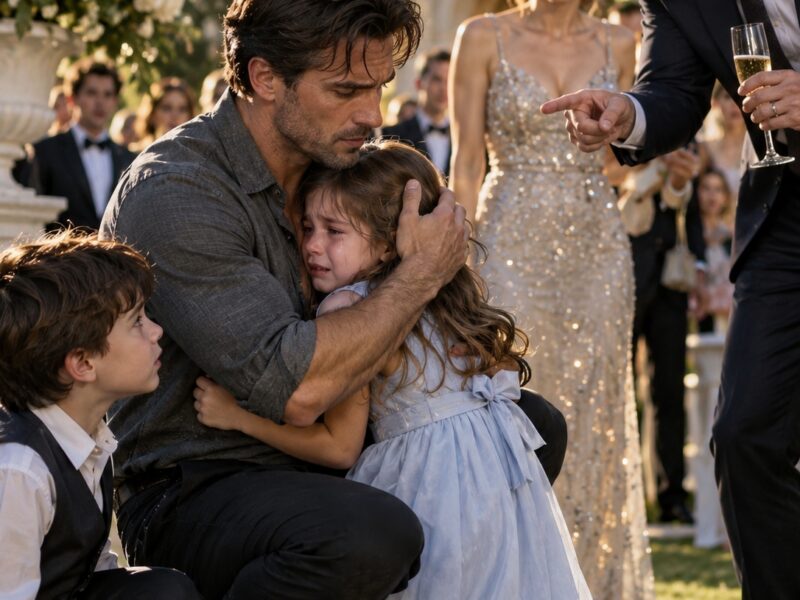
THEY MOCKED THE SINGLE DAD AT A BILLIONAIRE’S PARTY—THEN HER DAUGHTER RAN TO HIM AND DID THE UNTHINKABLE
The laughter started quietly.
It always did.
First came a whisper beneath the clink of champagne glasses. Then a smirk hidden behind a manicured hand. Then the kind of soft, privileged laughter people used when they were certain the person being mocked did not belong in the same world they did.
Adrien Cole heard every word.
“Who invited him?”
“Probably one of the workers.”
“No, look. He brought his kid.”
“God. That’s worse.”
Adrien stood beneath the afternoon sun at the edge of the Bellamy Estate garden, one hand resting on a cardboard box filled with craft supplies, the other hovering protectively near his six-year-old son.
Theo was pretending not to hear.
That hurt Adrien more than the laughter.
The boy stared at the paper airplane in his hands and carefully pressed a crease with his thumbnail.
Adrien leaned closer. “Wing’s crooked.”
Theo glanced up.
“So?”
“So,” Adrien said solemnly, “we’ve got a major aviation crisis.”
The corner of Theo’s mouth lifted.
Adrien took the plane and adjusted the fold.
“There. Federal disaster avoided.”
Theo giggled.
Across the lawn, Grant Holloway watched them and raised his champagne glass.
“Careful,” he called loudly enough for several people to hear. “You might want to keep an eye on the silverware.”
A few guests laughed.
Adrien’s fingers stopped on the paper airplane.
Only for a second.
Then he handed it back to his son.
“Try it now.”
Theo didn’t move.
“Dad.”
“Yeah?”
“He was talking about us.”
Adrien looked into his son’s face.
Six years old.
Too young to understand class contempt, but old enough to recognize cruelty.
Adrien had been shot at without flinching. He had spent nights listening to explosions close enough to shake dust from ceilings. He had carried wounded men through darkness while his own blood soaked through his uniform.
None of those memories made him feel as helpless as watching his son learn that some adults measured human worth by the price of a shirt.
Adrien crouched.
“Look at me.”
Theo did.
“You know what that airplane needs?”
Theo frowned. “What?”
“Air.”
“That’s not what I—”
“And you know what it doesn’t need?”
Theo waited.
“Permission from people standing on the ground.”
For a moment, the boy simply stared at him.
Then he smiled.
Adrien stood again.
He never saw the little girl in the pale blue dress watching him from across the garden.
And he had no idea that within minutes, she would run straight into his arms and turn an afternoon of casual humiliation into a silence nobody at Bellamy Estate would ever forget.
Vivian Ashford had spent fourteen months learning that money could solve almost anything except the one problem she would have paid everything to fix.
Her daughter no longer laughed.
Not really.
Eight-year-old Sienna Ashford stood beside her mother beneath an ivory canopy while nearly two hundred guests moved through the gardens surrounding Bellamy Estate.
The property looked as though someone had designed wealth itself and planted flowers around it.
White roses climbed polished trellises. Crystal glasses caught the sunlight. A quartet played near the reflecting pool. Beyond the gardens, the pale stone mansion rose against the Virginia sky, every window gleaming.
The Ashford Foundation’s annual children’s benefit was supposed to feel hopeful.
Vivian had approved every detail.
The flowers.
The caterer.
The security.
The guest list.
She could control all of that.
She could not make Sienna smile.
“You want some lemonade?” Vivian asked.
Sienna shook her head.
“Strawberry tart?”
Another shake.
“There’s a magician near the fountain.”
Nothing.
Vivian stopped trying.
She had learned that pushing made Sienna retreat further.
Fourteen months earlier, her daughter had been a child who narrated her entire life. She talked during breakfast, in the car, during bath time, and sometimes even while falling asleep.
Then her father died.
And silence moved into the Ashford home.
It occupied his empty chair at breakfast.
It lived inside his closet, where three suits still hung because Vivian had never found the courage to remove them.
It slept beside Sienna at night.
Vivian had hired therapists, grief counselors, tutors and specialists. She had rearranged her schedule, canceled international meetings and converted an unused room into an art studio because Sienna had once loved painting.
Nothing restored the child she remembered.
Some mornings, Vivian would stand outside Sienna’s bedroom and hear her daughter whispering to a photograph of her father.
Those were the mornings Vivian closed the door quietly and cried where no one could see.
“Vivian.”
Grant Holloway appeared beside her with a practiced smile.
At forty-two, Grant had the polished ease of a man who had never entered a room wondering whether he belonged there.
His navy suit probably cost more than most families’ monthly rent.
“Beautiful event,” he said.
“Thank you.”
“You look exhausted.”
“Thank you again.”
He laughed.
Vivian didn’t.
Grant was useful professionally. He managed a private equity group that frequently partnered with Ashford Holdings, and he had spent the past year behaving as if proximity to Vivian might eventually become something more.
Vivian had never encouraged it.
Grant had never quite accepted that.
He followed her gaze.
Across the lawn, Adrien was helping Theo launch the repaired paper airplane.
Grant’s mouth curved.
“Your foundation is becoming very inclusive.”
Vivian looked at him. “Meaning?”
“Oh, come on.”
“No. Explain it.”
Grant hesitated.
Vivian had built a company large enough to put her name on towers in three cities. She knew exactly what people meant when they suddenly became afraid to explain their jokes.
Grant took a drink.
“I’m saying security should probably know who’s wandering around.”
“He has a volunteer badge.”
“So do the caterers.”
“And?”
Grant smiled.
“Nothing.”
Vivian turned away.
Then she felt Sienna move.
It was such a small thing that nobody else would have noticed.
But Vivian noticed everything her daughter did now.
Sienna had lifted her head.
She was staring across the lawn.
At Adrien.
No.
At the paper airplane.
Theo threw it.
The little plane climbed awkwardly, tilted left and landed in the grass.
Theo laughed.
Adrien put both hands on his hips.
“Pilot error.”
“You made it!”
“Defamation. I’m calling my lawyer.”
Theo laughed harder.
And beside Vivian, there was a sound so faint she almost thought she had imagined it.
A breath.
Then another.
Sienna smiled.
Vivian’s heart seemed to stop.
Not the polite expression Sienna occasionally produced when adults asked whether she was okay.
A real smile.
Tiny.
Fragile.
Alive.
Vivian stared at her daughter.
“Sienna?”
The girl did not answer.
Her eyes remained fixed on Adrien and Theo.
Then Sienna stepped away.
Vivian instinctively reached for her hand.
“Sienna, honey—”
The girl slipped free.
She walked.
Then faster.
“Sienna?”
Guests turned.
Sienna began to run.
Her blue dress moved like water behind her as she crossed the lawn.
“Sienna!”
Vivian followed.
Adrien was kneeling beside Theo when he heard footsteps.
He turned.
A little girl he had never seen before was running directly toward him.
His first instinct was to move aside.
He barely had time.
Sienna reached him and wrapped both arms around his waist.
Adrien froze.
The paper airplane fell from his hand.
Theo stared.
Vivian stopped several yards away.
The quartet continued playing for perhaps three more seconds before one violinist noticed the commotion and lowered his bow.
One by one, conversations died.
The garden became silent.
Sienna held Adrien as though letting go would cause something terrible to happen.
Adrien looked at Vivian.
The fear on her face told him immediately who the child was.
“I’m sorry,” he said quietly. “I didn’t—”
Vivian shook her head.
She had no explanation either.
Adrien slowly lowered himself onto one knee.
He did not pull Sienna away.
He did not ask why she had hugged him.
He simply waited.
That was something he understood.
Sometimes frightened people needed questions.
Sometimes they needed silence.
Sienna finally loosened her arms.
Her eyes were wet.
Adrien spoke softly.
“Hey.”
She looked at him.
“I’m Adrien.”
No response.
“This troublemaker is Theo.”
“Dad.”
“What? Your criminal record is extensive.”
Theo rolled his eyes.
Sienna looked at him.
Then at the paper airplane lying in the grass.
She pointed.
Adrien followed her finger.
“You like airplanes?”
She nodded.
He picked it up.
“This one?”
Sienna shook her head.
Adrien understood.
“You want your own?”
Another nod.
He reached into the craft box and pulled out a clean sheet of white paper.
Then he sat down on the grass.
A man wearing a twenty-dollar gray shirt sat cross-legged in the middle of one of the most expensive private estates in Virginia while nearly two hundred wealthy guests watched him teach a billionaire’s daughter how to fold a paper airplane.
Theo sat beside him.
Sienna copied every movement.
Vivian remained standing.
Her hand covered her mouth.
For fourteen months, experts had told her to be patient.
For fourteen months, she had waited.
Now her daughter was sitting in the grass with a stranger.
And smiling.
Grant Holloway broke the silence.
“Well,” he said with an awkward laugh, “children are unpredictable.”
Nobody answered.
Sienna finished her plane.
Adrien inspected it.
“Very serious aircraft.”
A tiny voice replied.
“Does it fly?”
Vivian’s knees nearly gave way.
She had heard her daughter speak every day, of course.
But not like that.
Not with curiosity.
Not with life.
Adrien pretended not to notice Vivian’s reaction.
“There’s only one way to find out.”
Sienna stood.
Theo joined her.
“Throw it up a little,” he instructed. “Not down.”
Sienna drew her arm back.
The plane left her fingers.
It sailed across the grass.
She laughed.
Vivian closed her eyes.
The sound went through her like sunlight entering a room that had been locked for a year.
Then Grant spoke again.
“Guess you found the right way to get noticed.”
Adrien looked over.
Grant approached slowly, champagne in hand.
Vivian’s expression hardened.
“Grant.”
“What? I’m complimenting him.”
“No, you aren’t.”
Grant stopped beside Adrien.
Up close, Adrien was slightly taller.
Grant seemed to notice.
His smile became thinner.
“You volunteer here?”
“For the foundation.”
“Interesting.”
Adrien waited.
Grant glanced at Theo.
“Must be a nice afternoon for your son. Seeing how the other half lives.”
Theo’s smile vanished.
That did it.
Adrien stepped between Grant and his child.
Not aggressively.
Just enough.
Grant noticed.
“So what do you do?” he asked.
“Maintenance work mostly.”
“Maintenance.”
“Yes.”
“Where?”
“Wherever pays me.”
Grant laughed.
“Honest, at least.”
Adrien’s jaw tightened.
Vivian moved toward them.
“Grant, stop.”
“I’m making conversation.”
“No. You’re embarrassing yourself.”
A few nearby guests suddenly became fascinated by their drinks.
Grant’s cheeks colored.
He looked at Adrien’s shirt.
“Forgive me. I just find it unusual when someone brings a child to an event like this dressed like—”
He stopped.
Adrien waited.
“Like what?”
Theo whispered, “Dad.”
Adrien looked down.
His son’s face was red.
That cooled something inside him.
He could absorb humiliation.
Theo shouldn’t have to.
Adrien took his son’s hand.
“We’re leaving.”
Sienna’s expression changed immediately.
“No.”
Everyone turned.
She ran toward him.
“No.”
Vivian bent toward her daughter. “Honey—”
“Don’t make him go.”
Grant exhaled sharply.
“Vivian, surely you’re not going to let an eight-year-old decide who—”
The sound came from behind him.
A metallic snap.
Adrien heard it before anyone screamed.
His head turned.
Twenty yards away, a decorative lighting truss had shifted.
A steel support cable whipped loose.
For everyone else, the next seconds happened too quickly.
For Adrien, time slowed.
He saw the frame.
The angle.
The crowd beneath it.
The open path to the left.
And the child standing directly under the falling structure.
A boy.
Maybe seven.
Frozen.
Adrien released Theo’s hand.
“Stay here.”
Then he ran.
Someone screamed.
The truss tipped.
People scattered.
The boy did not move.
Adrien sprinted harder.
Ten yards.
Six.
Three.
He hit the child around the waist and twisted.
Metal crashed behind them.
Glass shattered.
The sound tore through the garden.
Adrien hit the ground shoulder first, shielding the boy with his body.
For one terrible second, nobody moved.
Then the screaming began.
Adrien rolled upright.
“Hey. Look at me.”
The child sobbed.
“Can you move your legs?”
A nod.
“Hands?”
Another nod.
“Good. Stay with me.”
Adrien scanned the garden.
His entire posture had changed.
The quiet volunteer was gone.
His eyes moved across exits, debris, cables, people.
“Kill the power to the lighting rig!” he shouted.
A security officer reacted instantly.
“You heard him! Power off!”
Adrien checked beneath the collapsed frame.
“Anybody trapped?”
“No!”
“Keep everyone back. That second support could go.”
The security officer stared at him.
“How do you know that?”
Adrien ignored the question.
He lifted the rescued boy and carried him toward his parents.
The child’s mother grabbed him, sobbing.
“Thank you. Oh my God, thank you.”
Adrien stepped back.
“You should have him checked anyway. He hit the ground hard.”
His left sleeve was torn.
Blood ran from his elbow.
Theo reached him first.
“Dad!”
Adrien crouched.
“I’m okay.”
“You’re bleeding.”
“Looks worse than it is.”
“You said that last time.”
Adrien went still.
So did Theo.
The boy lowered his eyes.
Vivian caught the exchange.
Last time?
Before she could ask, the estate’s head of security approached.
His name was Marcus Bell, a former Army MP Vivian had hired five years earlier.
He looked at Adrien differently now.
“You military?”
Adrien stood.
“A long time ago.”
“Branch?”
Adrien hesitated.
“Navy.”
Marcus studied him.
“That wasn’t basic Navy training.”
Grant had gone pale.
The entire crowd seemed to be listening.
Adrien wiped blood from his arm with a napkin.
“It doesn’t matter.”
A voice came from behind them.
“Actually, I think I know him.”
An older man stepped out from among the guests.
Silver hair.
Black cane.
Retired Rear Admiral Thomas Keating had served on the Ashford Foundation board for years.
He stared at Adrien.
Adrien’s expression changed.
Not fear.
Recognition.
Keating came closer.
“Cole?”
Adrien said nothing.
“Lieutenant Cole?”
Theo looked at his father.
Grant’s face lost what little color remained.
Keating stopped directly in front of Adrien.
“I thought you disappeared.”
Adrien’s voice was quiet.
“I left.”
“You were Navy SEAL Team—”
“Sir.”
The single word stopped him.
Adrien glanced at Theo.
Keating understood.
But the damage was done.
Whispers spread through the crowd.
Navy SEAL.
Grant stared at the man he had mocked for wearing inexpensive clothes.
Keating lowered his voice.
“I heard what happened overseas.”
Adrien’s eyes hardened.
“That isn’t a conversation for today.”
“No.”
Keating nodded.
“But these people should know something.”
Adrien shook his head.
“They don’t need to.”
Keating looked around the garden.
At the guests.
At Grant.
At the wrecked structure.
Then back at Adrien.
“You always hated recognition.”
“I still do.”
“I remember.”
Keating extended his hand.
Adrien looked at it.
Then shook it.
The older man’s voice dropped.
“Good to see you alive, son.”
Something flickered across Adrien’s face.
It disappeared almost instantly.
But Vivian saw it.
So did Theo.
And suddenly Vivian understood that the story everyone was whispering about was not a story Adrien wanted told.
It was a wound.
The crowd began looking at him differently.
That seemed to bother him more than their contempt had.
Minutes earlier, people had avoided standing beside him.
Now they wanted to approach.
Adrien hated both versions.
Grant cleared his throat.
“Cole.”
Adrien turned.
“I may have misjudged—”
“You did.”
Grant stopped.
Adrien’s voice remained calm.
“But that’s not important.”
Grant glanced around.
“I was just—”
“My son heard you.”
Silence.
Adrien took one step closer.
“You want to think I’m poor? Fine. You want to think my clothes are cheap? They are. You want to decide I’m worth less than you because I repair buildings for a living?”
He shrugged.
“That’s your problem.”
Grant’s eyes shifted toward Theo.
“But you made my son feel ashamed of standing next to his father.”
Adrien’s voice dropped.
“That becomes my problem.”
Nobody laughed now.
Grant looked at Theo.
For perhaps the first time that afternoon, he seemed genuinely embarrassed.
“I apologize.”
Adrien studied him.
“Don’t apologize because you found out who I used to be.”
Grant said nothing.
“Apologize because you shouldn’t have treated anyone that way in the first place.”
Then Adrien walked away.
Vivian watched him kneel beside Theo.
She had spent most of her adult life around powerful men.
CEOs.
Senators.
Investors.
People who entered rooms expecting attention.
Adrien Cole had spent the entire afternoon trying to avoid it.
And somehow, he was the only man everyone was watching.
Sienna ran to him again.
This time she didn’t hug him.
She simply took his hand.
Adrien looked down.
She looked up at him.
“You saved that boy.”
“He needed help.”
“Were you scared?”
The question seemed to catch him off guard.
“Yes.”
Grant stared.
So did several guests.
Sienna frowned.
“But you ran.”
Adrien crouched.
“Being scared doesn’t mean you can’t move.”
She thought about that.
Then she asked the question that would stay with Vivian for years.
“Is that what brave means?”
Adrien glanced toward Theo.
His son was listening too.
“Sometimes.”
Sienna tightened her fingers around his hand.
Vivian looked away because tears had filled her eyes.
Her husband used to say something similar.
Courage wasn’t the absence of fear.
It was deciding something else mattered more.
She had not heard those words since his funeral.
Later, after the guests began leaving and emergency crews cleared the damaged lighting structure, Vivian found Adrien near the service drive.
He was loading craft boxes into an old Ford pickup.
Theo sat in the passenger seat.
“You’re leaving.”
Adrien looked over.
“I think your party has had enough excitement.”
“I owe you an apology.”
“You didn’t do anything.”
“I invited Grant.”
“That’s not a crime.”
“Some days I’m reconsidering.”
Adrien almost smiled.
Vivian folded her arms.
“Why didn’t you tell anyone?”
“About what?”
“You know what.”
Adrien shut the tailgate.
“Because I was here to volunteer.”
“You were a Navy SEAL.”
“I was.”
“You saved a child today.”
“He was in trouble.”
“You say everything as though it’s ordinary.”
Adrien leaned against the truck.
“Maybe ordinary is underrated.”
Vivian studied him.
“Rear Admiral Keating said he thought you disappeared.”
Adrien’s expression closed.
She noticed immediately.
“I’m sorry.”
“It’s fine.”
“No, it isn’t.”
He looked toward Theo.
The boy was drawing something on the fogged edge of the truck window.
Adrien lowered his voice.
“Some parts of my life aren’t useful anymore.”
“Useful?”
“I have a son. He needs a father who comes home.”
Something in the way he said it made Vivian stop asking questions.
Then she looked back toward the estate.
Sienna stood at the edge of the lawn with her nanny.
Watching.
“She hasn’t connected with anyone like that since her father died.”
Adrien followed her gaze.
“I’m sorry.”
“Everyone says that.”
“I know.”
Vivian looked at him.
“Do you?”
Adrien’s face became still.
Then Theo called from inside the truck.
“Dad?”
“Yeah?”
“Can we get pizza?”
“We have food at home.”
“We have broccoli at home.”
“Exactly.”
“That’s not food.”
Adrien sighed.
“Your disrespect for vegetables is becoming a character issue.”
Theo grinned.
Vivian laughed.
The sound surprised her.
Adrien looked at her.
For one strange moment, neither spoke.
Then Sienna ran across the gravel.
“Sienna!”
Vivian followed.
The girl stopped beside Adrien.
“Will you come back?”
Adrien glanced at Vivian.
She waited.
“That depends,” he said.
“On what?”
“Whether your airplane passed inspection.”
Sienna looked horrified.
“I lost it.”
“Then we have a serious problem.”
“I can make another.”
Adrien smiled.
“Then I guess I’ll have to come back and inspect it.”
Sienna nodded as if they had signed a legally binding contract.
Adrien climbed into the truck.
Vivian watched the battered Ford disappear beyond the estate gates.
She had no idea why her daughter had trusted him.
Not yet.
But she knew one thing.
For the first time in fourteen months, Sienna was already looking forward to tomorrow.
Adrien returned to the foundation center the following Saturday because he had promised Sienna he would.
He told himself that was the only reason.
Vivian knew better.
So did Theo.
Sienna arrived carrying seventeen paper airplanes.
Adrien stared at them.
“This is excessive.”
“You said you had to inspect one.”
“One.”
“I wanted backups.”
Theo whispered, “She’s smarter than you.”
“Everybody’s smarter than me before coffee.”
Within an hour, the children had transformed the activity room into an airport.
Sienna laughed twice.
The next Saturday, she laughed five times.
Three weeks later, Vivian heard her daughter singing quietly in the back seat of the car.
She pulled over two blocks from home and cried.
Healing did not arrive dramatically.
It came in pieces.
A paper airplane.
A joke.
A shared cookie.
Theo teaching Sienna how to ride a skateboard and Sienna immediately crashing into a hedge.
Adrien bandaging her knee while she insisted she was not crying.
“I didn’t say you were.”
“You looked like you were going to.”
“I was looking at the cut.”
“You have a face.”
“I’ve been told.”
“What does that mean?”
“I don’t know anymore.”
Sienna laughed.
Vivian watched from the doorway.
But as her daughter grew brighter, Vivian began noticing something else.
Adrien carried his own darkness.
He hid it well.
Most people would never have noticed.
Vivian did.
A tray crashing in the kitchen could make his shoulders lock.
He always sat facing doors.
If a helicopter passed low overhead, his eyes followed it until it disappeared.
And every afternoon at exactly 4:30, no matter what he was doing, Adrien checked the time.
At 4:45, he left.
Always.
One evening Vivian finally asked why.
“Theo.”
“What about him?”
“I pick him up.”
“You could hire someone.”
Adrien looked at her.
“I could.”
That was the whole answer.
Vivian understood.
Months later she would learn the rest.
After leaving the Navy, Adrien had been offered security jobs that paid six figures.
Some involved international travel.
Others required weeks away at a time.
He refused them all.
Theo’s mother had died when Theo was three.
An aneurysm.
Sudden.
No warning.
Adrien had been overseas when it happened.
By the time he got home, his wife was gone and his son had learned that sometimes adults promised to return and did not.
Adrien never again wanted Theo waiting at a window wondering whether his remaining parent would come home.
So the decorated former SEAL repaired air conditioners.
Fixed roofs.
Replaced broken doors.
Worked construction.
Did whatever allowed him to finish before school pickup.
Vivian discovered the truth by accident.
She and Adrien were sitting outside the charity center while Theo and Sienna played nearby.
“You know,” she said, “Ashford Holdings has an executive security division.”
Adrien groaned.
“No.”
“I haven’t even asked anything.”
“You’re about to offer me a job.”
“Maybe.”
“No.”
“You’re impossible.”
“I’ve been called worse.”
“The salary would be significantly higher.”
“I know.”
“Benefits.”
“I have benefits.”
“Better ones.”
“Probably.”
“Then why won’t you even consider it?”
Adrien looked toward Theo.
The answer was so obvious that Vivian felt foolish for asking.
“He lost his mother,” she said.
Adrien’s eyes stayed on his son.
“Yes.”
“How old?”
“Three.”
Vivian swallowed.
“I’m sorry.”
“There it is.”
“What?”
“The sentence.”
She looked at him.
Adrien rubbed his hands together.
“Everybody says it because there’s nothing else to say.”
“What would you rather they say?”
He thought for a moment.
“Nothing.”
Vivian nodded.
They sat in silence.
After a while, Adrien said, “Her name was Emily.”
Vivian did not interrupt.
“She was thirty-two.”
His voice remained steady.
“She complained about a headache on a Tuesday. By Wednesday morning, she was gone.”
Vivian stared at him.
“I was six thousand miles away.”
“Adrien—”
“I had spent years convincing myself I was protecting my family.”
His jaw tightened.
“Then the one time my son actually needed me, I wasn’t there.”
“You couldn’t have known.”
“Doesn’t matter to a three-year-old.”
“No.”
Adrien looked at her.
“That’s why I leave at 4:30.”
Vivian nodded slowly.
Then she said, “Daniel died in a car accident.”
Adrien knew who Daniel was.
Sienna’s father.
“My assistant called me six times that morning,” Vivian continued. “I was in a board meeting and kept declining the call.”
Adrien said nothing.
“I thought it was about a contract.”
Her eyes filled.
“The seventh call came from a police officer.”
The playground blurred beyond her tears.
“I spent months thinking that if I had answered the first call, somehow the ending would have changed.”
“Would it?”
“No.”
“But you still think it.”
“Every day.”
Adrien nodded.
“Yeah.”
That was the moment Vivian understood why Sienna had run toward him.
Not because children possessed some magical ability to see heroic men.
Not because fate had whispered his history to her.
Sienna had recognized something quieter.
Adrien knew how to sit beside grief without trying to fix it.
He knew because he lived there too.
Summer became fall.
Then winter.
The relationship between the two families deepened without anyone naming it.
Vivian never asked Adrien to replace Daniel.
Adrien never tried.
When Sienna talked about her father, Adrien listened.
When she cried, he did not tell her to be strong.
When she asked whether being happy meant she was forgetting him, Adrien sat beside her on the steps outside the foundation center.
“No.”
“How do you know?”
“Because forgetting and living aren’t the same thing.”
She picked at a loose thread on her sleeve.
“Sometimes I don’t think about Dad all day.”
Adrien waited.
“Then I remember at night and I feel bad.”
“Why?”
“Because I had fun.”
Adrien looked toward Theo playing basketball across the yard.
“Can I tell you something?”
Sienna nodded.
“After Theo’s mom died, I laughed at something on television.”
“What?”
“I don’t even remember.”
“What happened?”
“I felt terrible.”
“Why?”
“Same reason.”
She looked at him.
“What did you do?”
Adrien breathed slowly.
“I realized loving someone who died doesn’t mean you have to die with them.”
Sienna’s eyes filled.
“My dad wouldn’t want me sad?”
“No.”
“How do you know?”
Adrien smiled faintly.
“Because I’m a dad.”
That night, Sienna asked Vivian to take one of Daniel’s photographs out of the drawer.
They put it beside her bed.
Not hidden.
Not worshiped.
Simply there.
In spring, Vivian hosted the Ashford Foundation gathering again.
Same estate.
Same gardens.
Many of the same guests.
Adrien almost refused the invitation.
Then he saw the envelope.
It did not say volunteer.
It said:
Adrien Cole and Theo Cole — Honored Guests.
He called Vivian.
“No.”
She laughed.
“You haven’t even said hello.”
“Absolutely not.”
“You saved a child.”
“That was a year ago.”
“You’ve volunteered hundreds of hours.”
“So have other people.”
“Bring them.”
“Adrien.”
“I’m serious.”
Vivian went quiet.
“What?”
“If you’re honoring volunteers, honor the volunteers.”
She smiled to herself.
“Fine.”
“Fine?”
“All of them.”
Adrien paused.
“That was suspiciously easy.”
“I’m a billionaire. Occasionally I can afford chairs.”
So Adrien came.
Through the front entrance.
He wore a dark suit Theo had forced him to buy.
“You look weird,” Theo informed him.
“Thank you.”
“Like a lawyer.”
“That’s the cruelest thing you’ve ever said.”
The first person Adrien saw inside was Grant Holloway.
Grant stopped.
For a second, both men remembered the previous year.
Then Grant walked over.
“Adrien.”
“Grant.”
Grant extended his hand.
Adrien shook it.
“I owe you a better apology.”
“You already apologized.”
“No. I apologized after I found out you were a SEAL.”
Adrien waited.
Grant looked uncomfortable.
“I’ve thought about what you said.”
“That sounds dangerous.”
Grant laughed despite himself.
Then his face became serious.
“I treated you badly because I thought you couldn’t do anything for me.”
Adrien’s expression changed slightly.
Grant continued.
“And the embarrassing part is, I didn’t even realize that was how I saw people.”
Adrien looked across the garden.
“You realize it now?”
“Yes.”
“Then do something with it.”
Grant nodded.
Adrien started to walk away.
“Cole?”
He turned.
“For what it’s worth, your suit still looks cheap.”
Adrien stared at him.
Grant almost smiled.
Adrien looked down at himself.
“My son chose it.”
Theo called from behind him.
“I did not!”
For the first time, Adrien laughed with the man who had once mocked him.
Vivian watched from the terrace.
She had changed too.
The previous year, she had spent the party moving from investor to investor.
This year she was barefoot before sunset because Sienna had convinced her to play soccer on the lawn.
The shoes probably cost two thousand dollars.
Vivian left them beneath a table.
She did not care.
Near the garden wall, Sienna and Theo launched paper airplanes.
Sienna was talking constantly now.
Sometimes too constantly.
Vivian treasured every exhausting word.
Adrien joined her near the terrace.
“You look different,” she said.
“The suit.”
“No.”
“The haircut?”
“No.”
“I’m running out of options.”
“You look happy.”
Adrien watched Theo.
“I am.”
Vivian followed his gaze.
“Do you ever miss who you were?”
Adrien knew what she meant.
The uniform.
The team.
The man Rear Admiral Keating remembered.
“Sometimes.”
“Would you go back?”
“No.”
“Why?”
Adrien was quiet for a long time.
Then he said, “For years I thought the most important thing I would ever do was something nobody could know about.”
Vivian waited.
“I was wrong.”
“What’s the most important thing?”
Theo tripped over a soccer ball and immediately blamed the ground.
Adrien smiled.
“That.”
Vivian laughed.
Then she became serious.
“Are you ever angry?”
“At the ground?”
“At everyone who judged you.”
Adrien looked around.
Some of the guests who had laughed at him the previous year now greeted him respectfully.
“I used to carry a lot of anger.”
“What happened?”
“I got tired.”
“That simple?”
“No.”
He looked at her.
“But carrying anger is heavy. Eventually you have to decide whether the person who hurt you deserves that much space in your hands.”
Vivian absorbed the words.
Across the lawn, Sienna saw Adrien.
Her entire face brightened.
She ran.
The scene was almost identical to the one a year earlier.
Blue sky.
Golden sunlight.
Expensive clothes.
Champagne glasses.
A little girl crossing the grass toward a man who once seemed hopelessly out of place.
Except this time nobody laughed.
Sienna reached Adrien and threw her arms around him.
He caught her.
“You’re getting heavy.”
She gasped.
“That is rude.”
“It’s physics.”
“I’m telling Mom.”
“Your mother already knows about physics.”
Vivian approached.
Sienna stayed wrapped around Adrien.
For a moment, Vivian saw two versions of her daughter at once.
The silent child from a year earlier.
And this one.
Alive.
Laughing.
Still grieving sometimes.
Still missing Daniel.
But alive.
Vivian’s eyes filled.
Adrien noticed.
“You okay?”
She nodded.
“Yes.”
Sienna looked between them.
“Why are you crying?”
Vivian wiped her cheek.
“I’m not.”
“You are.”
“Allergies.”
“There aren’t allergies in tears.”
Adrien whispered, “Don’t argue. Your mother owns companies.”
Sienna whispered back, “That doesn’t make her right.”
Vivian laughed through her tears.
The three of them stood there while Theo chased another paper airplane across the lawn.
And then something small happened.
Something almost nobody noticed.
A catering assistant passed carrying a heavy crate.
One of the guests stepped aside impatiently.
Adrien reached out and took the other end.
“I’ve got it.”
The young man looked surprised.
“Sir, you don’t have to.”
“I know.”
Together they carried it toward the service entrance.
Vivian watched him go.
That was Adrien.
He had been mocked when people thought he was nobody.
Respected when they discovered he had once been somebody.
And through both versions of the world’s opinion, he remained exactly the same man.
Later, when the sun sank behind Bellamy Estate and the garden turned amber, Sienna sat beneath the old oak tree folding another paper airplane.
This one was different.
She wrote something inside before closing the fold.
Adrien sat beside her.
“What’s that?”
“Secret.”
“Highly suspicious.”
She smiled.
Then she threw it.
The airplane caught the evening breeze.
It climbed.
For a second, it seemed as if it might fall.
Then the wind lifted it again.
It sailed across the lawn and landed near Vivian.
She picked it up.
Sienna shouted, “Don’t read it!”
Too late.
Vivian unfolded the plane.
Inside, in a child’s uneven handwriting, were seven words.
Dad, I laughed today. I still remember you.
Vivian stopped breathing.
Sienna saw her face.
The little girl suddenly looked frightened.
“Mom?”
Vivian crossed the lawn.
She knelt.
Then she wrapped her arms around her daughter.
Sienna began crying.
“I’m sorry.”
“No.”
“I didn’t mean to make you sad.”
“You didn’t.”
“But you’re crying.”
Vivian held her tighter.
“These aren’t bad tears.”
Sienna buried her face against her mother.
“I still miss him.”
“I know.”
“Do you?”
“Every day.”
Sienna pulled back.
“Even when you’re happy?”
Vivian looked toward Adrien.
He stood several yards away with Theo.
He did not intrude.
He simply waited.
Vivian turned back to her daughter.
“Especially then sometimes.”
Sienna thought about that.
Then she took the paper airplane from her mother.
She smoothed the wrinkles.
“Can we keep this one?”
Vivian kissed her forehead.
“Forever.”
They walked toward the house together.
Halfway there, Sienna stopped.
She looked back.
Adrien was standing beneath the oak tree.
The setting sun outlined him in gold.
Not Lieutenant Cole.
Not a decorated Navy SEAL.
Not a hero from a story strangers could admire after learning the right facts.
Just Adrien.
A father who chose ordinary work because ordinary evenings with his son had become precious.
A widower who understood that grief did not need to be defeated.
A man who had once run toward danger because a child needed him.
And who had spent the year afterward doing something far quieter.
Staying.
Sienna ran back.
She hugged him one more time.
Adrien bent and held her gently.
The first time she had done this, a garden full of wealthy people had stared because they could not understand why a billionaire’s daughter would choose a man they had dismissed as nobody.
Now nobody questioned it.
Vivian finally understood why.
Children had not yet learned all the complicated measurements adults used to decide who mattered.
They did not see portfolios.
Titles.
Tailored suits.
Mansions.
Military commendations.
Bank accounts.
They noticed smaller things.
Who kneels when they are frightened.
Who listens without interrupting.
Who does not laugh when they cry.
Who keeps promises.
Who stays.
A year earlier, everyone at Bellamy Estate had looked at Adrien Cole and seen a poor single father who had entered the wrong gate.
Sienna had looked at him and seen something else.
Safety.
And perhaps that was why she recognized his worth before anyone else did.
Because adults often spent their entire lives learning how to judge people.
Children sometimes knew something wiser.
They simply learned whom they could trust.
The evening grew cooler.
Theo called from the lawn.
“Dad! Come on!”
Adrien released Sienna.
“I’m being summoned.”
Sienna smiled.
“Go.”
He walked toward his son.
Vivian watched the two of them disappear into the soft gold light beyond the trees.
Then she looked down at the wrinkled paper airplane in her hand.
Once, she had believed healing would mean waking up one morning and no longer hurting.
She understood now that grief did not disappear like that.
It changed shape.
It made room.
For laughter.
For new people.
For ordinary afternoons.
For paper airplanes.
For memories that could hurt and comfort you at the same time.
She folded the airplane carefully along its old creases and slipped it into her purse.
Years later, she would still have it.
Not because it reminded her of the day a former Navy SEAL was finally recognized by people who had mocked him.
That had never been the important part.
She kept it because of seven crooked words written by an eight-year-old girl who had once believed that smiling meant betraying the father she lost.
Dad, I laughed today. I still remember you.
And beneath the fading Virginia sunset, Sienna laughed again.
This time, nobody in the garden went silent.
They smiled.
And somewhere between the sound of her laughter and the sight of a tired father chasing his little boy across the grass, Vivian understood that some people did not enter your life to replace what you had lost.
They came to remind you that you were still allowed to live after losing it.









