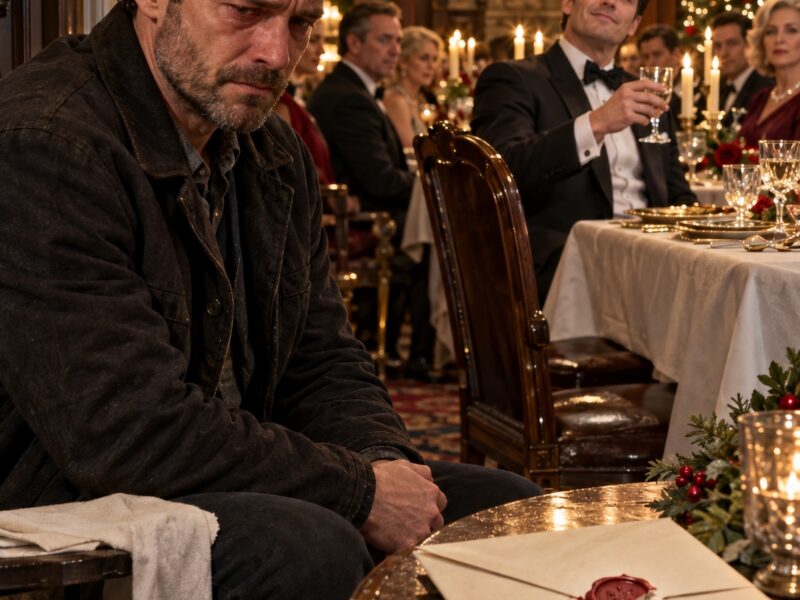
THEY SEATED ME WITH THE SERVANTS AT CHRISTMAS—THEN HER BILLIONAIRE FATHER LOCKED THE DOORS AND READ HIS WILL

By the time August Whitmore locked the dining-room doors, my name card was still sitting beside a water glass on a paper tablecloth behind the kitchen.
Forty feet away, twenty people were seated beneath three crystal chandeliers.
My ex-wife was there.
Her new husband was there.
Her brother—the man who had helped destroy my career eleven years earlier—was there.
And every one of them had watched me spend Christmas Eve eating with the drivers, housekeepers, and serving staff because, according to the Whitmore family, that was where I belonged.
Then August placed a sealed cream envelope on the white silk runner.
His attorney stood beside him.
The laughter died.
August looked toward me through the open service door and said, very calmly, “The person who will control the future of Whitmore Development after my death is Elias Rowan.”
For a few seconds, nobody understood what he had said.
Then the room exploded.
Vivien Whitmore stood so fast her chair struck the hardwood.
Grant swore.
Preston Carrington laughed once, sharply, because he thought it had to be a joke.
My ex-wife, Clare, did nothing.
She simply stared at me.
And I sat at the servants’ table with both hands wrapped around a glass of water, wondering how a man could spend eleven years learning to live without justice only to have justice arrive on Christmas Eve wearing a tailored suit and carrying a will.
But the strangest part was this:
I had no idea it was coming.
Three days earlier, I had been standing alone in my workshop when the invitation arrived.
It came on paper.
That was the first thing that bothered me.
People like the Whitmores did almost everything through assistants, calendars, emails, lawyers, and people whose job titles contained words like “relations” or “coordination.” They did not send handwritten invitations to former sons-in-law they had spent three years pretending did not exist.
The envelope was thick cream stock.
My name had been written across the front in black ink.
Elias Rowan.
The handwriting belonged to August Whitmore.
Inside was one line.
Christmas Eve. Seven o’clock. Come alone. I need you here.
I read it twice.
Then a third time.
Around me, my workshop smelled of walnut dust, mineral spirits, old glue, and the cold December air slipping beneath the loading door.
On the workbench beside me sat the dismantled drawer from a nineteenth-century sideboard. Behind it was a rocking chair waiting for new joints, two dining chairs with their upholstery stripped away, and a rolltop desk that had been sitting in my shop for almost four years.
August’s desk.
I looked at it longer than I looked at the invitation.
That should have told me something.
It didn’t.
I was forty-two years old, divorced, and finally at peace with a life the Whitmores considered evidence of failure.
My truck had nearly a quarter-million miles on it.
My furniture-restoration business occupied a leased bay behind a tire store.
The heater complained every morning before deciding whether to work.
I had one employee three days a week and a waiting list that, for the first time since opening, stretched longer than my unpaid invoices.
My daughter was in her first year of college.
She called every Sunday unless exams swallowed her whole.
I owned no lake house.
I sat on no charitable boards.
Nobody had ever named a hospital wing after anyone in my family.
And I slept better than I had when I possessed a company title, a tailored wardrobe, and a bedroom in a house where I constantly felt like a guest.
So I should have thrown the invitation away.
Instead, I thought about a phone call from two weeks earlier.
August had called me on a Tuesday afternoon.
We had not spoken in almost three years.
His voice sounded thinner than I remembered.
“Do you still have the rolltop desk?” he asked.
“Yes.”
“You haven’t restored it?”
“Not completely.”
A pause.
“And the bottom left drawer?”
I looked across the shop at the desk.
“Still locked.”
“You never opened it?”
“You told me not to.”
The silence on the other end lasted so long I checked the screen to make sure the call had not dropped.
Then August said something I had never expected to hear from him.
“There are some things I have been wrong about for far too long.”
I waited.
He offered no explanation.
Six minutes later, the call ended.
Now I had his invitation in my hand.
Three days after that, at 6:50 on Christmas Eve, I drove through the stone gates of the Whitmore estate.
Some sentences can pull a man across a county even when every instinct tells him to keep driving in the opposite direction.
August had found one.
The Whitmore house stood on twelve landscaped acres outside the city, though calling it a house had always seemed dishonest.
It was an institution disguised as a residence.
That night, every window glowed.
Garland wrapped the columns.
White lights climbed bare trees along the circular drive.
The snow had stopped an hour earlier, leaving the grounds so clean and carefully lit that the estate looked less like a place where people lived than an advertisement for the idea of belonging.
Cars lined the drive.
Bentley.
Rolls-Royce.
Range Rover.
Mercedes.
Black SUVs polished so perfectly the Christmas lights slid across them like water.
Then came my gray pickup.
It had a dent above the rear wheel and a passenger-side mirror held steady by a repair I kept promising myself was temporary.
The valet looked at it.
Then at me.
He was maybe twenty.
“Evening, sir.”
“Evening.”
He pointed toward the far side of the drive.
“Would you mind leaving it near the service entrance? We’re tight up front.”
“I’ve parked in worse places.”
He smiled.
That small smile turned out to be the warmest welcome I received for quite a while.
Preston Carrington was standing on the front steps.
Clare’s second husband.
He wore a charcoal dinner jacket and held a crystal tumbler in one hand while three men listened to him tell a story.
He saw my truck before he saw me.
Then he waited.
That was Preston’s gift.
He understood timing.
He waited until I was close enough to hear but far enough away that answering would require me to stop and make a scene.
Then he looked toward the valet and said, “Poor kid probably couldn’t decide whether to park it or tow it.”
The men laughed.
Not hard.
Men in those circles rarely laughed hard when the joke belonged to someone wealthier than they were.
They produced a precise, professional amount of amusement.
I kept walking.
Through the open doorway, I saw Clare.
Deep green dress.
Hair pinned back.
A diamond at her throat.
She looked older than when we had divorced, but not in a bad way. There was more restraint in her face now. More calculation before expression.
She heard Preston.
“Preston.”
One word.
Quiet.
A warning he had clearly heard before.
He smiled at her.
“What?”
That was another thing he was good at.
Making cruelty sound confused when anyone objected to it.
I climbed the steps.
“Good evening.”
Preston lifted his glass.
“Eli.”
“Preston.”
Clare’s eyes stayed on mine half a second longer.
“Dad invited you?”
“He did.”
Something changed in her face.
She had not known.
That bothered me more than Preston’s joke.
Before she could ask anything else, Vivien Whitmore appeared behind her.
My former mother-in-law had turned sixty-eight without surrendering an inch to age.
Silver-blond hair.
Pearls.
Black dress.
Perfect posture.
Vivien could make a funeral feel socially competitive.
“Elias.”
She took my hand briefly in both of hers.
“How good of you to come.”
“Thank you for having me.”
“Oh, of course.”
Her smile stayed in place.
“We’ve prepared your place.”
There was something in the way she said it.
Not enough to accuse.
Just enough to remember.
Walter Briggs took my coat.
Walter had been the Whitmores’ head butler since before Clare and I met.
He was in his late sixties now, his hair almost completely white.
“Mr. Rowan.”
“Walter.”
His expression softened.
“Good to see you, sir.”
“How’s Daniel?”
His eyebrows lifted.
“My son?”
“Still Coast Guard?”
“Mobile now.”
“Last time we talked, he was trying for Mobile.”
“That was years ago.”
“I remember.”
Walter looked at me strangely.
Then toward Vivien.
Then back at me.
“Yes, sir,” he said quietly. “You do.”
He led me toward the dining room.
The main table ran almost the length of the east wing beneath three chandeliers.
White silk runner.
Silver candlesticks.
Winter roses.
Crystal.
Twenty engraved place markers.
I saw Clare beside Preston.
Grant Whitmore near the head of the table, on his father’s right.
A judge.
A state senator’s wife.
A developer from Charlotte.
A couple whose surname was carved into the entrance of a cancer center.
Every person’s importance seemed to have been polished and placed directly in front of them.
I looked for my name.
Once.
Then again.
It wasn’t there.
Walter stood beside me.
“Mr. Rowan.”
His voice had changed.
“This way, sir.”
He led me through the service door.
The pantry beyond was warm from the kitchen.
A folding table had been set against the wall with a paper cloth.
Seven chairs.
Two drivers.
Three household employees.
A kitchen assistant.
Space for servers to eat between courses.
And one printed place card.
ELIAS ROWAN.
I stared at it.
Someone had gone to the trouble of printing my name.
That mattered.
This had not been an oversight.
Through the open service door, the main table had a direct view of us.
Several people were already looking.
Then Preston’s voice carried across the room.
“Well, at least they found him a table that fits.”
Laughter.
A little stronger this time.
Grant smiled.
Clare half rose from her chair.
Then stopped.
Vivien never turned around.
For a moment, I considered leaving.
My truck was outside.
My workshop was twenty-eight minutes away.
There was coffee in the thermos.
There was an old desk waiting beneath a work light and nobody there who needed me to prove what kind of man I was.
Three years earlier, I probably would have left.
Eleven years earlier, I might have demanded another chair.
But humiliation only works if the person humiliating you still controls the definition of what you should be ashamed of.
I pulled out the folding chair.
Sat down.
Unfolded the paper napkin.
Then looked at the woman across from me.
“I’m Eli.”
She blinked.
“Dorothy.”
“How long have you worked here, Dorothy?”
“Six years.”
“Then you probably know where they hide the good food.”
She stared at me for one second.
Then laughed.
Behind us, the laughter from the dining room faded.
That was the first thing that went wrong with their plan.
They had expected me to be embarrassed.
Instead, I had dinner.
Walter’s son was still in the Coast Guard.
One of the drivers, Frank, had worked hauling materials on a construction site I managed years earlier, and within ten minutes we were arguing about whether the city had deliberately designed a bridge closure to destroy every working man’s blood pressure.
A young server named Mateo caught a tray against the doorframe.
Six appetizers hit the tile.
The boy froze.
I knew that look.
The look of someone young enough to believe a mistake has just revealed his entire worth.
I crouched and started helping him.
“I once dumped a gallon of walnut stain on a client’s white oak floor.”
His eyes widened.
“What happened?”
“I discovered three new swear words and lost four thousand dollars.”
He laughed despite himself.
“Mr. Rowan, you don’t have to—”
“Neither did gravity.”
We picked up the tray.
At the main table, conversation had become quieter.
The back table became louder.
Not deliberately.
That was why it worked.
We were having a better time.
Halfway through dinner, Walter leaned beside me to refill my water.
He didn’t straighten immediately.
“Mr. Whitmore asked for you personally.”
“I figured that from the handwriting.”
“He asked twice whether the invitation had been delivered.”
I looked at him.
“Did he say why?”
“No, sir.”
Walter glanced through the doorway.
Then lowered his voice further.
“His personal attorney arrived at six.”
That got my attention.
“Nathaniel Brooks?”
“Yes.”
“What’s he doing here?”
“He’s been waiting in the library.”
Walter straightened.
Walked away.
And left the question sitting beside my plate.
August came downstairs at 7:20.
Everyone at the main table stood.
The back table did not know whether we were supposed to, so half of us started to rise before August waved us down.
He was seventy-two.
He had lost weight.
His shoulders seemed narrower beneath his jacket.
He moved carefully, as though his body now charged him for unnecessary motion.
But his eyes were unchanged.
Pale.
Patient.
Dangerously observant.
They traveled down the main table.
Then stopped on me.
He saw the folding table.
The paper cloth.
My printed name card.
He saw Dorothy beside me.
Walter standing near the service door.
The drivers.
Everything.
Four seconds passed.
August said nothing.
Then he took his seat.
I remember thinking:
So he knew.
Whatever humiliation Vivien intended, August had seen it and allowed it to stand.
For some reason, that hurt more than I expected.
Dinner continued.
Preston talked about a portfolio acquisition in Savannah.
Grant discussed Whitmore Development’s proposed waterfront redevelopment—a nine-hundred-million-dollar project that would be the largest undertaking in the company’s history.
Grant spoke about it the way heirs talk about futures they assume have already been assigned to them.
He looked toward August.
“Groundbreaking should be within six weeks.”
August nodded once.
Nothing more.
Eventually Preston turned his attention back to me.
“How’s the wood shop, Eli?”
“Still there.”
“That’s good. Truly.”
I waited.
He smiled.
“I read somewhere most small businesses don’t survive the first few years.”
Several people looked through the doorway.
I put down my fork.
“I’ve been fortunate.”
“How so?”
“My customers apparently don’t read statistics.”
The judge laughed.
So did the senator’s wife.
Someone farther down the table covered a smile.
Preston’s mouth tightened.
Grant stepped in.
“I suppose Eli always did prefer smaller-scale work.”
Clare looked at him.
“Grant.”
But Grant was looking at me.
“He worked for Whitmore Development once, you know. Junior project management. Fairmont Row.”
There it was.
A name I had spent eleven years teaching myself not to react to.
Grant continued.
“Construction at that level can be brutal. Schedules, liability, pressure. Not everyone is built for it. There’s no shame in recognizing your ceiling and finding somewhere you can breathe.”
He said it kindly.
That was what made Grant dangerous.
Cruelty dressed as concern travels farther.
Preston raised his glass.
“Some men build empires.”
He looked toward my hands.
“And some men repair what other people throw away.”
A few smiles.
I looked at him across forty feet of candlelight.
“You’re right.”
He had expected resistance.
I gave him agreement.
“I’ve learned something interesting about that.”
“What’s that?”
“Sometimes what people throw away turns out to be worth more than what they just bought.”
Nobody laughed.
Clare lowered her eyes.
Preston stopped smiling.
And for the first time that evening, August spoke directly to me.
“Eli.”
Every conversation stopped.
“Yes?”
“Do you still have my desk?”
“The rolltop?”
“Yes.”
“I do.”
“Have you repaired it?”
“Most of it.”
August’s eyes stayed on mine.
“The bottom drawer?”
“No.”
Grant turned toward his father.
I saw it.
Just a flicker.
Fear.
I had never seen Grant Whitmore afraid of furniture before.
“You told me not to open it,” I said.
August nodded.
“That’s right.”
Then he returned to his dinner.
Nobody knew what had just happened.
Including me.
But from that moment on, almost nobody touched dessert.
After the plates were cleared, August stood.
“Walter.”
“Yes, sir?”
“Close the dining-room doors.”
The heavy double doors shut.
August then walked toward the service entrance himself.
Vivien frowned.
“August?”
He ignored her.
He pushed the service door fully open.
Then placed the brass stop beneath it.
The servants’ table and the family table were now, visually at least, part of the same room.
Nathaniel Brooks entered from the library carrying a leather portfolio.
Grant leaned back.
“You cannot be serious.”
August looked at him.
“About what?”
“Whatever this is.”
August walked to the head of the table.
“I cannot think of a better night to discover who my family actually is.”
Vivien set down her glass.
“August.”
Nathaniel removed a thick cream envelope.
Wax seal.
Legal markings.
August placed it on the silk runner.
The room changed.
Not gradually.
Instantly.
Preston stopped smiling.
Grant put both hands flat on the table.
Clare stared at the envelope.
And I understood only one thing:
I should not have been in that room.
Yet August had made certain I was.
“This,” he said, “contains the material terms of the most recent distribution of my estate.”
Vivien’s face went still.
Grant said, “What?”
“Executed in October. Properly witnessed. It supersedes all previous versions.”
“Why are we discussing this tonight?”
“Because I have watched too many families discover what they are at funerals.”
August broke the seal.
“And I would prefer to meet mine while I’m still alive.”
No one moved.
“I am not dying tonight,” he added. “As far as I know.”
A nervous breath moved through the room.
August didn’t smile.
“I am simply done being lied to about what my money has done to the people I love.”
He began reading.
Vivien would be protected completely.
The estate.
The Jackson Hole property.
Lifetime income.
Clare would receive a substantial trust structured for herself and her daughter, with control passing directly to Clare at forty.
Grant received property.
Art.
Cash.
Enough personal wealth that no reasonable person could call him disinherited.
There were gifts to universities, charitable foundations, Walter, and several longtime employees.
Then August stopped.
He set the page down.
“The controlling interest in Whitmore Development Group will be treated differently.”
Grant’s head lifted.
August continued.
“The seventy-one-percent voting block will not pass to my son.”
Silence.
Grant spoke first.
His voice was almost gentle.
“Then to whom?”
August turned.
Not toward Vivien.
Not toward Clare.
Not toward Grant.
He looked through the open service door.
At me.
“The person responsible for determining the future control of Whitmore Development after my death will be Elias Rowan.”
Vivien was standing before he finished my name.
“No.”
Grant shoved his chair backward.
Preston laughed.
Clare stared at me as if I had become a stranger while sitting perfectly still.
I remember the condensation on my water glass.
I remember Dorothy beside me whispering, “Oh, Lord.”
I remember thinking August must have used the wrong name.
Then the room erupted.
“You’re not well,” Vivien said.
Grant pointed toward me.
“He’s not family!”
Preston said, “This is absurd.”
August waited.
Then raised one hand.
The room stopped.
“I will be precise.”
He looked toward Nathaniel.
The attorney opened the portfolio.
“Elias Rowan is not inheriting Whitmore Development.”
A fraction of tension left the room.
Then August continued.
“He receives no stock. No dividends. No beneficial ownership whatsoever. The voting block will be placed into trust. Elias will serve as independent trustee and exercise voting control according to conditions set out in the instrument until an eligible Whitmore family member satisfies those conditions.”
Grant’s face changed again.
“And if nobody does?”
Nathaniel answered.
“The block may be sold under the trust terms.”
Grant stared at his father.
“You planned this.”
“Yes.”
“You’ve lost your mind.”
Nathaniel adjusted his glasses.
“Mr. Whitmore underwent independent capacity evaluations by two physicians in September. Those evaluations are attached to the instrument. There is also a no-contest provision.”
Grant looked at Nathaniel.
Then August.
Months.
August had been planning this for months.
I stood.
Every face turned toward me.
“No.”
August watched me.
“I don’t want this.”
“I know.”
“I didn’t ask you for anything.”
“I know.”
“I have a business. I have a life.”
“I know.”
“Then find someone else.”
August’s expression softened almost imperceptibly.
“That,” he said, “is precisely why it has to be you.”
Grant laughed bitterly.
“Of course.”
He pointed toward me.
“He has no stake because he has nothing. Is that the qualification now?”
“Grant,” Clare said.
“No. I’d like to understand this.”
He looked at his father.
“He has no finance degree. No board experience. He’s been out of the industry for more than a decade. He isn’t even family anymore.”
August leaned back.
“You just explained my reasoning.”
Grant frowned.
“Everyone else at this table has a financial interest in what happens to those shares.”
August looked toward me.
“He does not.”
Preston spoke.
“Or maybe he already got what he wanted.”
Clare turned sharply.
“Stop.”
But Preston had found his angle.
He looked at me.
“How long did this take, Eli?”
“What?”
“Getting into the old man’s head.”
“Preston.”
“A visit here. A phone call there. Lonely billionaire. Former son-in-law with a struggling business—”
“I haven’t been inside this house in three years.”
“You expect us to believe—”
“I spoke to August once.”
I checked my memory.
“Six minutes. About a desk.”
August nodded.
“That is correct.”
Preston’s expression tightened.
August continued.
“I deliberately did not tell Elias what I intended.”
“Why?”
“Because the quality I require is the one quality I could not test if he knew there was a reward.”
Nobody spoke.
Then August looked at Grant.
“I suppose I owe everyone an explanation.”
He paused.
“It begins with Fairmont Row.”
Something cold moved through me.
Eleven years disappeared.
I was thirty again.
Hard hat.
Steel-toe boots.
A wife at home.
A six-year-old daughter.
A mortgage.
A career I believed was finally becoming something.
Fairmont Row had been Whitmore Development’s most important residential project at the time.
Four hundred units.
Three residential towers.
Retail.
Parking structure.
Grant was the executive overseeing the project.
I managed the structural phase.
Eight months in, I found a discrepancy.
The steel certifications did not match the material delivered.
At first I thought it was paperwork.
Then I checked the lot numbers.
Then the invoices.
Then the physical tags.
The supplier had substituted a lower grade of structural steel in portions of the parking structure and the lower floors.
Some of it was already enclosed.
Correcting it would mean demolition.
Seven months.
Nearly fifty million dollars.
I brought it to Grant.
He stared at my report for maybe thirty seconds.
Then pushed it back.
“We have an engineering opinion.”
He handed me a letter.
The letter said the substitution fell within acceptable tolerance.
I read it twice.
“This doesn’t address fatigue assumptions.”
“It addresses compliance.”
“Not the actual load profile.”
“Eli.”
“It needs independent review.”
Grant leaned back.
“Do you know what a seven-month delay costs?”
“Yes.”
“No, you know the number. You don’t know what it costs.”
“I know what signing this costs.”
His eyes hardened.
“You’re project manager.”
“Which is why my signature is on the acceptance.”
“Exactly.”
I refused.
Once verbally.
Once by email.
Then a third time in the Whitmore study.
August had not attended that meeting.
Grant had.
Two attorneys.
An engineer.
A vice president whose name I had forgotten until that night.
Grant put the certificate in front of me.
“Sign it.”
“No.”
“Then you’re done here.”
I remember looking at the pen.
Not Grant.
The pen.
My daughter needed braces.
Our mortgage payment was due in twelve days.
Clare had just left her job because we had agreed one of us needed to be more available for our daughter.
I knew what unemployment would mean.
I also knew exactly what my signature meant.
So I pushed the certificate back.
I was gone before the end of the month.
Within a week, the story had changed.
I had cracked under pressure.
I wasn’t ready for a project of that scale.
I had become emotional.
Difficult.
Unreliable.
Calls stopped being returned.
Interviews became polite rejections.
People who had once asked me to join projects suddenly said they were going in another direction.
And the worst part was that Clare never knew the whole story.
I told her it hadn’t worked out.
At first, that was because I was ashamed.
Later, because I was angry.
Then because too much time had passed.
And eventually because explaining the truth began to feel like begging her to believe I was the man I had always claimed to be.
So I started restoring furniture.
Clare defended me to her family.
For a while.
Then she got tired.
I got quieter.
She started apologizing for me before anyone had asked her to.
I started hearing contempt in questions that may not always have contained it.
We stopped fighting.
That was worse.
We became two polite people sharing the ruins of an explanation neither one of us knew how to give.
Eventually, the marriage ended.
Now August Whitmore was telling the story I had buried.
In front of everyone.
“Elias identified the substitution,” August said. “Grant obtained an engineering letter stating that it was acceptable.”
Grant stared at the table.
“Elias refused to sign the structural acceptance.”
Nobody looked at me now.
They looked at Grant.
“He refused three times.”
August’s voice remained level.
“I was informed there was a personnel issue. I accepted my son’s account without reading the underlying documents.”
Clare slowly turned toward me.
Her eyes were wet.
I looked away.
“Elias left the company,” August continued. “And the story that followed him was that he could not handle the pressure.”
He looked directly at me.
“I allowed that story to stand.”
The admission seemed to cost him something.
“Four years later, I discovered what actually happened.”
Grant looked up.
August continued.
“The steel was replaced.”
A murmur.
“The certificate Elias refused to sign remained outstanding for eleven days. During those eleven days, the general contractor’s insurer demanded an independent structural review.”
He let the silence settle.
“The review forced remediation.”
The judge at the main table removed his glasses.
August said, “Had Elias signed when he was ordered to, the project would have continued without that review.”
Clare covered her mouth.
“Four hundred residences,” August said. “A compromised structural system. An exposure that could have destroyed the company if the failure had manifested later.”
Grant finally spoke.
“That’s speculation.”
“No.”
August looked at Nathaniel.
Nathaniel removed several documents.
“It has been independently reviewed.”
August looked back at Grant.
“One man refusing to sign one piece of paper saved this company from a risk none of us were willing to see.”
He turned toward me.
“And we rewarded him by destroying his career.”
The room disappeared around me.
I had imagined hearing something like that once.
Years ago.
Back when I still needed it.
I had imagined August calling me.
Grant apologizing.
Clare finally understanding.
I thought vindication would feel like getting oxygen back.
It didn’t.
It hurt.
Because vindication arriving eleven years late cannot return eleven years.
It cannot repair a marriage.
It cannot give a thirty-year-old man back the nights he lay awake wondering whether he had destroyed his daughter’s future by refusing to write his name on a lie.
Clare whispered, “Why didn’t you tell me?”
I looked at her.
There were a thousand possible answers.
Because I was ashamed.
Because you would have confronted them.
Because I was afraid you might believe them.
Because eventually I realized part of me needed you to believe me without evidence.
Because silence became pride, and pride became habit, and habit became the wall we called a marriage.
I chose the smallest answer.
“I didn’t know how.”
She closed her eyes.
August was not finished.
“There is another part.”
Grant’s head snapped toward him.
For the first time, genuine fear crossed his face.
Six months earlier, August explained, a retired Whitmore employee had contacted him.
The man had kept copies.
Not because he wanted money.
Because he had been afraid.
August had spent six months verifying every document.
Emails.
Material tags.
Mill certifications.
Draft engineering letters.
Internal memoranda.
Forty-one pages of correspondence.
And when the verification was complete, he changed his will.
Nathaniel crossed the room.
He came through the service doorway.
Then stopped beside me.
From his pocket he removed a small brass key.
He placed it on the paper tablecloth.
I knew immediately what it opened.
“The bottom drawer,” I said.
August nodded.
The room was silent.
Four years earlier, August had sent the rolltop desk to my shop.
He told me to restore it.
But he gave me one instruction.
Do not open the bottom left drawer.
I never had.
Not once.
Not even after our divorce.
Not even when invoices piled up and I wondered whether something valuable might be inside.
Not even when August stopped answering calls about the restoration.
I had simply worked around it.
Now August said, “The safest place I could think to keep those documents was somewhere no one in this family would ever look.”
Grant stared at him.
August almost smiled.
“A furniture workshop behind a tire store.”
Nobody laughed.
“In that drawer,” he continued, “is the complete Fairmont Row file.”
He looked at Grant.
“Including correspondence beginning six weeks before Elias discovered the substitution.”
Grant went completely still.
That was the moment everything changed.
Until then, Grant could still claim pressure.
A bad deadline.
A judgment call.
An engineer’s mistake.
A misunderstanding.
Six weeks earlier meant something else.
Planning.
Knowledge.
Intent.
August’s voice lowered.
“You knew.”
Grant said nothing.
“You knew the steel had been substituted before Elias discovered it.”
Nothing.
“You arranged the engineering opinion in advance.”
Nothing.
“You expected a junior project manager with a mortgage and a young child to sign what you put in front of him because you assumed he needed his career more than he needed his name.”
Still nothing.
Clare stared at her brother.
“Grant.”
He didn’t look at her.
“Tell him he’s wrong.”
Grant remained silent.
That silence was the closest thing to a confession we received.
August looked toward me.
“I did not choose Elias because I feel guilty.”
He paused.
“I do.”
Another pause.
“But guilt is not a qualification.”
His eyes moved around the room.
“I did not choose him because he married my daughter.”
Clare lowered her gaze.
“I chose him because at thirty years old, with a wife, a child, a mortgage, and everything to lose, he was offered his career in exchange for his signature.”
August looked at Grant.
“And he said no when nobody outside that room would ever have known if he had said yes.”
No one moved.
Then August looked at the engraved place markers.
At the silver.
At the candles.
At the table where wealth had been arranged like rank.
“For eleven years, this family has asked what Elias Rowan was worth.”
His gaze settled on my hands.
“We should have been asking what his signature was worth.”
Vivien’s face had lost all color.
August looked toward my printed place card.
“Vivien.”
She stiffened.
“Yes?”
“Did you seat Elias there?”
Everyone looked at her.
“It was practical.”
August waited.
“The main table was set for family and close associates. Elias is no longer family in any formal sense.”
August nodded slowly.
“Reasonable.”
Vivien seemed relieved for half a second.
Then August said, “It is interesting.”
“What is?”
“The only person in this house I trust with my life’s work is sitting beside the only people here who are not waiting for me to die so they can become richer.”
Nobody breathed.
Dorothy looked down at her hands.
Walter’s face remained perfectly professional, but I saw his jaw tighten.
Vivien sat down.
The seating arrangement that had been designed to reduce me had suddenly become evidence against everyone who designed it.
I had done nothing.
That was what made it devastating.
I had not demanded respect.
I had not exposed anyone.
I had not walked into that house planning revenge.
I had simply sat where they placed me.
And somehow the chair had changed meaning beneath me.
Grant stood.
“This isn’t justice.”
August looked at him.
“It’s punishment.”
“No.”
“You’re using him to humiliate me.”
“No, Grant.”
“Because of something that happened eleven years ago?”
“Because eleven years ago tells me who you are today.”
Grant laughed bitterly.
“You don’t know who I am.”
August’s face changed.
Sadness.
Not anger.
“That is the problem. I finally do.”
Nathaniel closed the portfolio.
Then added one more fact.
The Whitmore board had been briefed two days earlier.
An internal investigation was underway.
Grant had been temporarily stripped of decision-making authority.
And the nine-hundred-million-dollar waterfront redevelopment—the project he had spent dinner boasting about—was under formal review.
Grant looked as if someone had removed the floor beneath him.
Then August turned toward Preston.
Preston had spent the previous twenty minutes becoming smaller in his chair.
“Since we are clearing things up tonight,” August said, “you should know your Carrington portfolio acquisition will not be approved.”
Preston blinked.
“What?”
“The Savannah deal.”
“That transaction has already been negotiated.”
“Not approved.”
“August, this has nothing to do with—”
“You are correct.”
August raised one hand.
“It has nothing to do with your remarks about Elias’s truck.”
Preston stopped.
“I barely noticed those.”
That hurt him more than anger would have.
“The audit committee reviewed the properties.”
August picked up his glass.
“The valuation is approximately forty percent below the price you proposed.”
Preston’s face changed.
“The difference between those numbers is too large to call a difference of opinion.”
Silence.
Preston did not speak again.
Clare sat between the two men she had married.
The first one at a folding table behind the kitchen.
The second beside her beneath a chandelier.
And for the first time all night, I understood what was happening inside her.
She wasn’t choosing between us.
That would have been simpler.
She was realizing she had spent much of her adult life allowing other people to choose what she believed.
Her parents had told her what success looked like.
Grant had told her what weakness looked like.
Her social circle had told her what kind of husband made sense.
I had made my own contribution by refusing to tell her the truth when it mattered.
Then Preston had arrived wearing every answer her family preferred.
Now those answers were collapsing around her.
She looked at me.
I gave her nothing.
No invitation.
No accusation.
No hope that this night might somehow restore what we had lost.
There are truths that can explain a divorce without undoing it.
Ours was one of them.
Vivien stood.
Her voice had lost some of its certainty.
“Elias.”
I looked at her.
She gestured toward an empty chair near August.
“Perhaps you should join us.”
Someone began pulling it out.
Everyone watched.
I knew what they expected.
The ending was obvious.
The humiliated former son-in-law rises from the servants’ table.
He walks across the room.
He takes his rightful place beside the billionaire.
The hierarchy reverses.
The people who laughed lower their eyes.
Victory.
At thirty, I would have crossed that room in four steps.
At forty-two, I looked around my table.
Dorothy.
Walter.
Frank.
Mateo.
People who had treated me exactly the same before August opened the envelope and after.
I folded my napkin.
Then I looked at Vivien.
“Thank you.”
I glanced at the chair.
“But I’m fine right here.”
She stared at me.
There was no sarcasm in my voice.
No anger.
That was important.
I wasn’t refusing their table to punish them.
I simply no longer needed it.
I picked up my fork.
Then turned toward Walter.
“Did your pastry chef make this chestnut cream from scratch?”
Walter stared at me.
A tiny smile appeared.
“Yes, sir.”
“It’s excellent.”
The silence from the main dining room became enormous.
Then something happened that I did not expect.
August picked up his plate.
His glass.
His napkin.
Vivien said his name.
He ignored her.
At seventy-two years old, August Whitmore walked the length of his own dining room.
Past the judge.
Past the senator’s wife.
Past Grant.
Past Clare and Preston.
Past the engraved place markers.
He stepped through the service door.
Then he sat in the empty folding chair beside me.
The paper tablecloth crackled beneath his plate.
Nobody knew what to do.
August looked across at Dorothy.
“How is your mother?”
Dorothy froze.
“My mother?”
“Walter told me about the surgery.”
“She’s recovering, sir.”
“Good.”
August picked up his fork.
Then looked at me.
“Chestnut?”
“Apparently.”
He tasted it.
“Not bad.”
I almost laughed.
Behind us, twenty important people sat in complete silence.
For the first time that evening, nobody at our table cared.
I left the estate just after ten.
Clare followed me outside.
Snow had started again.
Small flakes caught in her hair.
“Eli.”
I stopped beside my truck.
She wrapped her arms around herself.
For several seconds, neither of us spoke.
Finally she said, “I’m sorry.”
I looked at her.
“For tonight?”
“For more than tonight.”
“You didn’t know.”
“I should have.”
“No.”
She shook her head.
“I should have asked better questions.”
“I should have given better answers.”
“That doesn’t excuse me.”
“I’m not trying to excuse you.”
She looked toward the house.
“I believed them.”
I said nothing.
“Sometimes.”
Her voice broke slightly.
“I believed them about you.”
“I know.”
That hurt her.
Maybe I should have softened it.
But we had spent enough years softening things until they became lies.
She wiped beneath one eye.
“Why did you let me?”
“I didn’t.”
She looked at me.
“I just stopped trying to stop you.”
Snow landed on the hood between us.
“What happens now?” she asked.
“With us?”
She hesitated.
“With everything.”
I looked toward the glowing windows.
“I go home.”
“And the trust?”
“I haven’t accepted it.”
“Will you?”
“I don’t know.”
She nodded.
Then she surprised me.
“Dad was right about one thing.”
“What?”
“You’re probably the only person who doesn’t want it.”
I opened the truck door.
“Good night, Clare.”
“Good night, Eli.”
She didn’t ask me to stay.
I didn’t ask her to come with me.
Some endings become kinder when nobody mistakes understanding for resurrection.
I drove back to the workshop.
It was nearly eleven when I turned on the lights.
The rolltop desk waited beneath the work lamp.
I stood in front of it with the brass key in my palm.
For four years, I had honored a promise not to open one drawer.
Now the man who made me promise had given me permission.
I inserted the key.
It turned easily.
Inside were folders.
Old ones.
Heavy.
Dates.
Photographs.
Material certifications.
Emails.
Signatures.
I saw Grant’s name before I read anything else.
Then mine.
I sat on the concrete floor.
Eleven years of my life were inside that drawer.
Proof that I had not imagined it.
Proof that I had not failed.
Proof that being right and being vindicated are two completely different experiences.
I closed the drawer.
Not because I was afraid of what was inside.
Because I suddenly understood something.
The papers could prove what Grant had done.
They could prove what August had ignored.
They could prove why my career ended.
But they could not tell me who I had become afterward.
That part belonged to me.
The following March, August stepped down as chairman.
He did not die.
This reportedly disappointed several people who had been making private financial plans around the possibility.
The board hired an outside chief executive.
Grant lost every role that carried meaningful decision-making authority while the investigation continued.
By summer, two outside law firms were involved.
So was the state licensing board.
The engineering letter from Fairmont Row became very interesting to people who had not found it interesting eleven years earlier.
Grant kept his houses.
His investments.
His art.
His money.
August did not make him poor.
He did something Grant found much harder to survive.
He made him irrelevant to the decisions he had once assumed were his birthright.
Clare took direct control of her trust in February.
It was the first major financial decision of her life that she made without asking her family office what they preferred.
Her marriage to Preston ended slowly over the next nine months.
She never gave me all the details.
I never asked.
They belonged to her.
We did not get back together.
That surprised people who heard some version of the Christmas story.
People like symmetry.
They like suffering to produce a reward.
They like the wronged husband to reclaim the woman who finally sees his worth.
Life is usually less theatrical.
Clare and I had loved each other.
We had also hurt each other.
The truth about Fairmont Row explained part of our destruction.
It did not erase the years after it.
So we became something we had never managed to become while married.
Honest.
We talked about our daughter.
College bills.
Thanksgiving plans.
A terrible boyfriend who lasted six weeks.
A professor she adored.
A summer internship.
Sometimes Clare came by the workshop.
Sometimes I had coffee with her.
Neither of us tried to turn kindness into a promise.
It was enough.
I accepted the trusteeship.
Nathaniel convinced me after explaining that my role was narrower than I feared.
I requested the court-set fee at the low end of the permitted schedule.
August called that ridiculous.
I told him he was free to complain to the court.
He laughed.
I kept the shop.
In April, I hired a second full-time woodworker.
In June, I bought a drum sander I had wanted for three years.
That was about as dramatic as my financial transformation got.
Once a month, I drove my gray pickup to Whitmore Development headquarters.
At first, security assumed I was there to repair something.
Eventually they stopped asking.
I attended governance meetings in a canvas jacket.
I read everything.
Not because I enjoyed power.
Because I knew what happened when nobody read the appendices.
Executives learned quickly that I asked short questions.
They also learned that short questions could be expensive.
“Who verified this?”
“Why did the estimate change?”
“Whose signature is missing?”
“What happens if the assumption is wrong?”
I never shouted.
I never reminded anyone about Fairmont Row.
I didn’t need to.
A year passed.
The next Christmas Eve, I was alone in the workshop again.
Snow threatened but had not started.
The radio played something old.
The rolltop desk stood on sawhorses beneath a work light.
Most of it was finished now.
The wood had been cleaned and restored.
The brass fittings polished.
The drawers repaired.
The old finish removed carefully enough to preserve the grain beneath it.
At three in the afternoon, a sedan pulled up outside.
Ten years old.
Badly parked.
August got out.
No driver.
No assistant.
No appointment.
He walked into the shop carrying two coffees.
“You’re getting careless,” I said.
“With what?”
“People might discover you own a normal car.”
“It belonged to Vivien.”
“That explains the parking.”
He handed me a coffee.
Then walked toward the desk.
For a while he said nothing.
He ran one hand lightly over the restored wood.
“You finally finished it.”
“No.”
He frowned.
“Eli.”
“What?”
“I have eyes.”
“Debatable at your age.”
He ignored that.
“This is finished.”
I pointed toward the upper right side.
A scar ran diagonally through the wood.
Deep.
The length of a forearm.
I had cleaned it.
Stabilized it.
Oiled it.
But I had not removed it.
August touched the mark.
“You missed this.”
“No.”
“You left it?”
“Yes.”
“Why?”
I put down my cloth.
“Some marks shouldn’t be removed.”
He looked at me.
“They’re the only record of what a thing survived.”
The workshop became very quiet.
August looked back at the scar.
He understood.
Neither of us mentioned Fairmont Row.
Neither of us mentioned Clare.
Neither of us mentioned Grant.
August had apologized once.
Properly.
Publicly.
Anything more would have been for his comfort, not mine.
So I cleared a stack of sandpaper from the bench.
He sat.
I poured the rest of my thermos coffee into two mismatched mugs because the expensive coffee he brought was already cold.
We talked about the waterfront project.
Then about an obsolete hinge I had been trying to find.
Then about nothing important.
Outside, the December light turned blue.
The tire shop next door closed early.
Somewhere on the radio, a singer reached the final verse of a song neither of us could name.
And at some point, without ceremony, August Whitmore stopped being a billionaire who had once judged me wrongly.
I stopped being the failed son-in-law he had spent years underestimating.
We became two men sitting in a cold workshop who had wasted eleven years reaching a conversation that could have happened in an afternoon.
I thought about the previous Christmas.
The chandeliers.
The engraved name cards.
The laughter when Walter led me through the service door.
I remembered looking at that folding chair and thinking someone had decided exactly how much space I deserved in that house.
For years, I had believed that was the wound.
It wasn’t.
The wound was that I had once agreed with them.
Not consciously.
But somewhere inside me, I had believed the better chair would prove something.
The company title would prove something.
Clare defending me would prove something.
August apologizing would prove something.
Grant being exposed would prove something.
Then I lost all of it.
And somehow, in a workshop behind a tire store, sanding scratches out of furniture other people had decided was no longer worth keeping, I discovered the thing they had never been able to give me.
My own measure of myself.
That was why, when Vivien finally offered me a chair at the main table, I could refuse without anger.
The victory was never getting invited upward.
It was discovering there was no upward.
Not in any way that mattered.
August finished his coffee.
He stood.
At the door, he stopped.
“Merry Christmas, Eli.”
“Merry Christmas, August.”
He stepped outside.
I watched him walk toward the badly parked sedan.
Then I turned back to the desk.
The scar caught the work light.
I ran my thumb along its edge.
I could have sanded it away.
Given enough time, enough pressure, enough careful work, I could have made the surface look almost untouched.
But untouched would have been a lie.
So I left it.
Because some things become beautiful only after you stop demanding that they look as though nothing ever happened to them.
And some men spend half their lives trying to earn a seat at a table before realizing the chair was never the measure of them.
On one Christmas Eve, I entered the Whitmore estate as the former son-in-law they were comfortable placing behind the kitchen door.
I left carrying a brass key.
But the key was not the thing that changed my life.
Neither was the trust.
Neither was Grant’s fall.
Neither was August’s apology.
What changed me had happened much earlier, quietly, while nobody important was watching.
It happened the day I learned to live without their approval.
Everything that came afterward was only proof that I had been right to stop asking for it.









