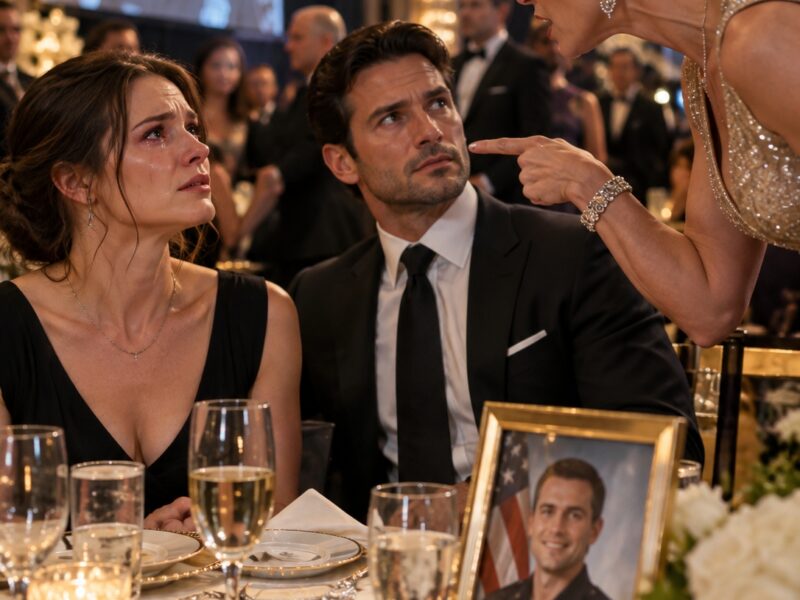
They Seated the Poor Widow Beside a “Nobody” as a Cruel Joke—Then the Entire Ballroom Learned Who He Really Was
The first laugh came before Lauren Hayes had even reached the table.
The second came when Richard Thornton pulled out the chair.
But it was Vanessa Carmichael who made sure everyone understood the joke.
“Perfect,” she said, lifting her champagne glass as Lauren crossed the Sterling Heights ballroom. “Put the charity cases together.”
A few people laughed.
Not loudly.
That would have been vulgar.
These were wealthy people, after all. People who donated five-figure checks, sat on nonprofit boards, attended hospital galas, and knew how to make cruelty sound like sophisticated humor.
So they laughed softly.
Politely.
Behind crystal glasses and practiced smiles.
Lauren heard every bit of it.
She also saw the man waiting at the table.
Mid-thirties, maybe a little older. Dark hair. Quiet eyes. A well-cut charcoal suit without a designer logo screaming from the fabric. No champagne. No entourage. No eager crowd around him.
Just a glass of water in one hand.
Apparently, he was the other charity case.
Richard stopped beside him.
“Daniel,” he announced with theatrical cheerfulness, “we found you some company.”
The man looked first at Richard.
Then at Lauren.
And something in his expression changed.
Not embarrassment.
Not anger.
Recognition, perhaps.
As if he understood exactly what was being done.
Richard didn’t notice.
Vanessa certainly didn’t.
They were too busy enjoying themselves.
“You two should have plenty to discuss,” Vanessa added. “Single parenting. Bills. Coupons.”
Another ripple of laughter.
Lauren’s face burned.
For one humiliating second, she considered turning around, walking through the ballroom, getting into her fifteen-year-old Honda, and driving home to her eight-year-old daughter.
She could already imagine Emma asleep on the couch under the pink fleece blanket she refused to admit she’d outgrown.
She could take off these painful shoes.
Wash off the makeup she’d spent forty minutes getting right.
Return the borrowed clutch to her sister tomorrow.
Pretend this night had never happened.
Then she remembered why she’d come.
Her husband was going to appear on the screen later that evening.
Captain Michael Hayes.
Firefighter.
Husband.
Father.
Dead at thirty-seven.
Lauren looked at Richard.
Then Vanessa.
Then at the empty chair.
She sat down.
“Enjoy yourselves,” she said quietly.
Vanessa blinked.
It wasn’t the response she’d expected.
Richard smirked and walked away.
And the quiet man beside Lauren stood, gently adjusted her chair, and waited until she was comfortable before sitting again.
For several seconds, neither of them spoke.
Across the ballroom, Vanessa was still watching.
Lauren exhaled.
“Well,” she murmured, “that was subtle.”
The man looked into his water.
Then the corner of his mouth moved.
“I’m guessing subtlety isn’t their strongest skill.”
Lauren almost smiled.
Almost.
Then she looked at him properly.
“You know we’re the joke, right?”
“Oh, yes.”
“And you’re just sitting here?”
“So are you.”
“I have a reason.”
“So do I.”
She studied him.
There was something strange about the answer.
Something stranger about him.
She couldn’t have known it then, but less than an hour later, the same people laughing at their table would be standing in stunned silence.
Richard Thornton would be begging this man to understand that everything had been a misunderstanding.
Vanessa Carmichael would lose the color in her face.
A foundation chairman would demand a resignation.
And Lauren would discover that the quiet stranger sitting beside her had already changed her daughter’s future before he’d ever learned Lauren’s name.
But at that moment, he was simply Daniel.
And that was exactly how he wanted it.
The Sterling Heights Charity Gala was built around the idea of generosity.
At least, that was what the invitations said.
The ballroom occupied the top floor of the Bellweather Hotel downtown, with thirty-foot windows overlooking the city and chandeliers hanging like frozen explosions of glass.
A string quartet played near the staircase.
Waiters moved silently through the room carrying champagne.
The women wore gowns Lauren had seen in magazines while waiting at the dentist’s office.
The men wore watches worth more than her car.
Every table displayed a card explaining the foundation’s mission:
HONORING THOSE WHO SERVE.
Lauren had stared at those words when she entered.
Now they seemed almost obscene.
Three years earlier, Michael had died after a drunk driver ran a red light at 2:47 in the morning.
Lauren remembered the exact time because grief did strange things to memory.
She couldn’t remember what she’d eaten the day before.
She couldn’t remember the last ordinary conversation she’d had with her husband.
But she remembered 2:47.
She remembered the phone vibrating on the nightstand.
She remembered Michael’s side of the bed being empty because he had taken an extra shift.
She remembered a man’s voice asking whether he was speaking to Mrs. Hayes.
After that, life divided itself into two eras.
Before the call.
After the call.
Before, Lauren had been someone who laughed loudly in restaurants.
Someone who bought groceries without adding prices in her head.
Someone who complained when Michael left wet towels on the bathroom floor.
Afterward, she would have given everything she owned to find one of those towels there again.
Money disappeared faster than sympathy.
Insurance helped.
Benefits helped.
Neither replaced a second income.
Neither replaced a husband who could fix the leaking kitchen faucet at midnight or pick Emma up from school when Lauren was sick.
Eventually Lauren took extra shifts at Patterson’s Diner.
She learned which utility companies allowed extensions.
She learned that thrift-store clothes became “vintage treasures” if you said it with enough enthusiasm.
She learned how to smile when Emma asked whether they could afford gymnastics.
“We’ll see, baby.”
Two words mothers used when the real answer hurt too much.
Tonight’s invitation had arrived three weeks earlier.
The foundation was honoring fallen first responders.
Michael’s photograph would be part of the presentation.
Lauren had nearly thrown the invitation away.
Then Emma had found it.
“Are they going to show Daddy?”
“Yes.”
“You should go.”
Lauren had hesitated.
Emma had looked at her with Michael’s brown eyes.
“Someone should be there for him.”
So Lauren came.
She had not expected to be punished for it.
Daniel’s voice pulled her back.
“Lauren?”
She realized he had said her name twice.
“Sorry.”
“You disappeared for a second.”
“I do that sometimes.”
“Bad memories?”
She looked at him.
“Expensive room.”
He nodded as though that explained everything.
Maybe it did.
“My name is Lauren Hayes.”
“Daniel Reeves.”
They shook hands.
His grip was warm, firm without being performative.
“They said you’re a single parent,” Lauren said.
“I am.”
“Boy or girl?”
“Girl. Sarah. Ten.”
Lauren’s expression softened despite herself.
“Emma’s eight.”
“Good age.”
“Depends what time of day you ask me.”
Daniel smiled.
“Sarah has recently decided adults are mostly inefficient systems that children have been unfairly forced to tolerate.”
Lauren laughed before she could stop herself.
A real laugh.
It surprised her.
Daniel noticed.
He didn’t point it out.
That made her like him slightly more.
“Emma discovered sarcasm six months ago,” Lauren said. “I blame television.”
“Sarah discovered negotiation.”
“Worse.”
“Much worse. She requested a later bedtime last month and brought a written list of supporting arguments.”
Lauren stared.
“No.”
“Three pages.”
“You’re raising an attorney.”
“God help me.”
Lauren laughed again.
Across the room, Vanessa looked over.
Her smile disappeared.
That, Lauren decided, was unexpectedly satisfying.
“How long have you been doing it alone?” she asked.
Daniel’s expression changed.
Not dramatically.
Just enough.
“Four years.”
Lauren understood immediately.
“You lost your wife.”
He nodded.
“Rebecca. Cancer.”
“I’m sorry.”
“So am I.”
There was no sentimental speech attached.
No attempt to make tragedy poetic.
Lauren appreciated that.
“And you?” he asked.
“Three years.”
“Accident?”
She looked up sharply.
Daniel immediately explained.
“Your name. Hayes. They’re honoring Michael Hayes tonight, aren’t they?”
Lauren swallowed.
“Yes.”
“The firefighter.”
“Yes.”
Daniel stared at the tablecloth for a moment.
When he spoke again, his voice was different.
“Your husband saved my uncle’s life.”
Lauren stopped breathing.
“What?”
“Warehouse fire. 2019. South Mercer.”
She remembered it.
Michael had come home at dawn smelling like smoke.
There had been a cut above his eyebrow.
Lauren had yelled at him because he hadn’t gone to the hospital.
He’d kissed her forehead and said, You should see the other guy.
“Your uncle was there?”
“Trapped on the third floor.”
Daniel looked toward the darkened stage.
“The building had already been declared unstable. They were pulling crews out. Michael went back in.”
Lauren felt the ballroom blur around her.
“He never told me.”
“Maybe he didn’t think it was extraordinary.”
“That sounds like him.”
“My uncle survived because of him.”
Daniel paused.
“He raised me after my parents died. So when I say I owe your husband something, Lauren, I mean it.”
Her throat tightened.
For three years, people had told her Michael was a hero.
Newspapers had used the word.
Politicians had used it.
The fire department had engraved it onto a plaque.
But grief made public words feel strangely distant.
This was different.
A man was sitting across from her because Michael had once walked into a burning building when everyone else was coming out.
Michael’s life had reached into another family.
And neither of them had known.
Lauren blinked rapidly.
“I’m sorry.”
“For what?”
“I promised myself I wasn’t going to cry tonight.”
Daniel reached for a clean napkin and slid it across the table.
“Then don’t call it crying.”
“What should I call it?”
“An allergic reaction to expensive charity events.”
She laughed through the tears.
And for the first time since entering the ballroom, Lauren forgot that anyone was watching.
Daniel Reeves had spent most of his adult life learning what people did when they wanted something from him.
They laughed harder.
Listened more carefully.
Remembered birthdays.
Suddenly shared his interests.
Suddenly loved his ideas.
Suddenly found him fascinating.
Money didn’t make relationships easier.
It made motives harder to see.
That was why Daniel occasionally went places without the armor of his name.
No assistant.
No driver waiting visibly at the entrance.
No watch recognizable from financial magazines.
No introduction as CEO of Reeves Development.
Tonight he’d even checked in as Daniel.
Just Daniel.
The gala staff had clearly made a mistake afterward.
He had been assigned to the head table.
He hadn’t corrected them.
Not yet.
He’d watched Richard Thornton humiliate Lauren from across the room.
He could have ended it with one sentence.
Instead, he’d waited.
Some might have called that cruel.
Daniel considered it information.
Power had taught him something uncomfortable:
If people knew you could hurt them, they usually behaved well.
That didn’t make them good.
It made them cautious.
To know someone’s character, Daniel believed, you had to see how they treated a person who could do absolutely nothing for them.
Richard thought Daniel was powerless.
Vanessa thought Lauren was irrelevant.
So Daniel watched.
And what he saw disgusted him.
Lauren, however, surprised him.
She didn’t flatter him.
Didn’t complain endlessly.
Didn’t ask what he earned.
When she asked what he did for work, he said, “Development.”
“Construction?”
“Mostly commercial projects.”
She nodded.
No sudden interest.
No probing questions.
Then she told him she waited tables.
“Not glamorous,” she said, “but it keeps the lights on.”
“Honest work.”
Her eyes flicked toward him.
“You actually mean that.”
“Yes.”
“How do I know?”
“Because I spent three summers waiting tables during college.”
“You?”
“I was terrible.”
Lauren smiled.
“How terrible?”
“I once dropped an entire tray of iced tea on a city councilman.”
“Please tell me you got fired.”
“Promoted eventually.”
“Now I know you’re lying.”
He laughed.
Two other couples arrived at the table.
The Hendersons greeted Richard at another table across the room, then glanced at Lauren and Daniel.
Mrs. Henderson whispered something to her husband.
They sat at the farthest available seats.
Lauren noticed.
Daniel noticed her noticing.
“Don’t,” he said.
“Don’t what?”
“Give them space in your head.”
“Easy for you to say.”
“Not really.”
She looked at him.
He leaned forward.
“People who need someone else to feel small usually aren’t very big inside.”
Lauren glanced toward Mrs. Henderson.
“She has a seven-carat diamond.”
“Diamonds don’t fix insecurity.”
“You sound experienced.”
“I’ve met a lot of insecure people with excellent jewelry.”
She smiled again.
Then the ballroom lights dimmed.
Speeches began.
Men in tuxedos talked about sacrifice.
Women in gowns talked about community.
Daniel listened to one board member praise “our brave working families” ten minutes after that same man had ignored a server asking him to move his chair.
The contradiction made Daniel’s jaw tighten.
Lauren leaned closer.
“Emma wants gymnastics.”
Daniel turned.
“What?”
“She asked last month. Sorry. I don’t know why I said that.”
“Because this speech is boring.”
Lauren suppressed a laugh.
“Maybe.”
“Sarah wanted violin.”
“Oh no.”
“Oh yes.”
“Did you survive?”
“Barely. The first six months violated several international treaties.”
Lauren covered her mouth.
Mrs. Henderson looked over disapprovingly.
Daniel continued in a whisper.
“Now she’s good, which is almost worse because I have to attend concerts.”
“You monster.”
“Twelve children playing Twinkle, Twinkle, Little Star at twelve different speeds.”
Lauren’s shoulders shook.
For several minutes they talked about children.
Homework.
Lunch boxes.
School pickups.
The guilt of missing events.
The exhaustion of being the only parent in the house when someone had a fever at two in the morning.
Eventually Lauren became quiet.
“Do you ever think you’re failing?”
Daniel didn’t answer immediately.
“Every day.”
She looked surprised.
“You?”
“Why does that surprise you?”
“You seem…”
She searched for the word.
“Steady.”
“That’s because you’re seeing me in public.”
“What happens in private?”
“I Google things like ‘how much attitude is normal for a ten-year-old girl’ at midnight.”
Lauren laughed.
Then her expression softened.
“Emma told me last week I’m the best mother in the world.”
“That sounds promising.”
“My first thought was, You have a very limited sample size.”
Daniel smiled.
“Sarah thinks I know everything.”
“How long do you have left?”
“Maybe six months.”
They looked at each other.
Two tired parents.
Two people carrying ghosts.
For a few minutes, the chandeliers and dresses and money disappeared.
Then Richard Thornton pulled out the chair beside them.
And the evening changed.
“Well, well.”
Daniel looked up.
Richard was smiling.
“Look at the lovebirds.”
Lauren stiffened.
Richard noticed.
That was why he continued.
“I suppose misery really does love company.”
Nearby conversation slowed.
Daniel placed his water glass on the table.
Carefully.
“I don’t believe we’ve been properly introduced.”
Richard gave a small laugh.
“Richard Thornton. Foundation board.”
He said it like a royal title.
Daniel nodded.
“The foundation honoring Lauren’s husband?”
“Among others.”
“The foundation that exists because men like Michael Hayes ran into burning buildings while men like you attended meetings about them?”
Silence spread outward from the table.
Richard’s smile vanished.
Lauren turned toward Daniel.
There was something in his voice she hadn’t heard before.
Not loudness.
Authority.
Richard leaned back.
“Excuse me?”
Daniel’s expression remained calm.
“I asked whether this is the foundation honoring people like Michael Hayes.”
“Obviously.”
“Then I’m confused.”
“About what?”
“Why one of its board members seems so comfortable humiliating his widow.”
Richard’s face reddened.
“Oh, please. It was a joke.”
“Was she laughing?”
Richard glanced at Lauren.
She wasn’t.
“You’re taking this very seriously for someone who came here on a community invitation.”
Daniel tilted his head.
“Is that what you call it?”
“We have a category for people in your situation.”
Richard made quotation marks with his fingers.
“Community outreach.”
Mrs. Henderson laughed.
Richard continued.
“It’s mostly for tax purposes.”
Daniel stared at him.
Something cold settled behind his eyes.
“How much did you donate this year, Richard?”
Richard blinked.
“What?”
“Personally.”
“That’s none of your business.”
“Fifty thousand?”
Richard scoffed.
“More.”
“One hundred?”
“What does it matter?”
“I’m trying to calculate the price of moral superiority.”
A few people nearby looked down to hide smiles.
Richard saw them.
His embarrassment hardened into anger.
“Listen, I don’t know who you think you are—”
“No,” Daniel said quietly.
“You don’t.”
The words hung there.
Lauren felt something move through the room.
Not recognition.
Not yet.
Instinct.
Richard should have stopped.
He didn’t.
“I’m tired of people like you,” he said.
Vanessa appeared behind him.
“Richard.”
He ignored her.
“People show up at events like this and expect everyone to feel sorry for them. Life is hard for everybody.”
Lauren went still.
Richard pointed loosely toward her.
“Lost a spouse? Raising a kid alone? Join the club. Some of us still manage to pull ourselves together and contribute to society.”
Daniel’s chair moved back an inch.
“Stop.”
Richard laughed.
“Or what?”
Daniel looked at him for several seconds.
“That’s your opportunity.”
“My opportunity for what?”
“To stop talking before you say something you can’t take back.”
Richard’s pride made the decision for him.
“Look around this room. Some people add value. Other people take up space. You two were seated together for a reason.”
Daniel nodded slowly.
“You’re right.”
Richard smiled triumphantly.
“We were.”
Lauren turned toward him.
Daniel’s gaze never left Richard.
“Just not for the reason you think.”
The smile faded.
“What does that mean?”
“It means tonight has been useful.”
“Useful?”
“I wanted to know what kind of people were involved with this foundation.”
Richard frowned.
“And?”
Daniel stood.
“I found out.”
He turned toward Lauren.
“Would you like to leave?”
Every part of her wanted to say yes.
She nodded.
Daniel pulled back her chair.
They started walking away.
Behind them Richard laughed.
“Running away? Typical.”
Daniel stopped.
Lauren felt his hand lightly touch her elbow.
He turned around.
The ballroom had become almost completely silent.
“Richard, I’m going to tell you something.”
His voice was soft.
“The way you treat people when you believe they have no power over you tells me more about your character than anything you’ve said from that podium.”
Richard’s jaw tightened.
“And yours is profoundly lacking.”
Richard sneered.
“Big words from a nobody.”
Daniel looked at him.
There was no anger on his face anymore.
That somehow made the moment worse.
“We’ll see.”
Then he turned away.
Lauren had taken exactly four steps when someone called from behind them.
“Mr. Reeves!”
Daniel closed his eyes briefly.
Almost regretfully.
A young foundation employee hurried toward them.
“Mr. Reeves, I’m so sorry.”
Lauren looked at Daniel.
The woman was pale.
“There was a mix-up with the seating chart. We didn’t realize you’d checked in using only your first name.”
Richard’s face changed.
The woman continued.
“You were supposed to be seated at the head table with Mr. Caldwell and Mayor Lynn.”
No one laughed now.
“It’s fine, Melissa,” Daniel said.
“But Mr. Caldwell specifically requested—”
“Melissa.”
His tone remained kind.
“It’s handled.”
She nodded nervously.
“I’ll tell Mr. Caldwell you’re here.”
“Thank you.”
She hurried away.
Lauren slowly turned toward Daniel.
Behind them, whispers began.
Reeves.
The name traveled faster than sound should have traveled.
Vanessa stared at Daniel.
Then she reached for her phone.
Her face drained of color.
“No,” she whispered.
Richard looked at her.
“What?”
She didn’t answer.
“Vanessa?”
Her eyes remained fixed on the screen.
Then on Daniel.
“You’re Daniel Reeves.”
Daniel said nothing.
Richard frowned.
“Who the hell is Daniel Reeves?”
Nobody answered him.
Not immediately.
Because half the room was already searching.
And within seconds, Richard Thornton was about to discover that the “nobody” he had spent the evening humiliating controlled one of the largest private development companies in the state.
Lauren barely remembered reaching the terrace.
Cold night air struck her face.
The city stretched below them in ribbons of white and red.
Behind the glass doors, people were still staring.
“I need an explanation.”
Daniel loosened his tie slightly.
“I know.”
“Who are you?”
“My name is still Daniel.”
“Don’t.”
He stopped.
Lauren folded her arms.
“You sat there while they mocked us.”
“Yes.”
“You let me tell you I work at a diner.”
“Yes.”
“You told me you work in development.”
“I do.”
She stared at him.
“That is technically true in the same way the President technically works for the government.”
Daniel almost smiled.
He thought better of it.
“Fair.”
The terrace door opened.
An older man stepped outside.
Marcus Caldwell.
Lauren recognized him from the program.
Foundation chairman.
He walked directly toward Daniel.
“Daniel.”
Not Mr. Reeves.
Daniel.
The familiarity answered another question.
Marcus looked at Lauren.
“Mrs. Hayes?”
“Yes.”
His expression changed immediately.
“Michael Hayes’s widow.”
Lauren nodded.
He took her hand.
“Your husband was an extraordinary man.”
“Thank you.”
“We’ve been trying to reach you.”
“For what?”
Marcus glanced at Daniel.
Daniel looked away.
Lauren caught it.
“For what?” she repeated.
Marcus hesitated.
“The Michael Hayes First Responder Scholarship.”
Lauren stared.
“The what?”
“A scholarship established last year in your husband’s name. For children of firefighters, police officers and EMTs killed in the line of duty.”
Her heart began beating faster.
“I’ve never heard about this.”
“The donor requested anonymity.”
Marcus glanced at Daniel again.
This time Lauren followed his eyes.
“No.”
Daniel exhaled.
“Lauren—”
“You?”
He didn’t answer quickly enough.
Her hand went to her mouth.
Marcus cleared his throat.
“The original endowment was two million dollars.”
Lauren sat down.
Not gracefully.
Her knees simply stopped cooperating.
“Two million?”
“Structured for long-term investment income,” Marcus explained. “The goal is perpetual funding.”
Lauren stared at Daniel.
Emma.
College.
Tuition.
The numbers she’d calculated late at night.
The savings account that never seemed to grow fast enough.
The fear that one day her daughter would be accepted somewhere Lauren couldn’t afford.
“You did that?”
Daniel sat beside her.
“Michael saved my uncle.”
“So you gave away two million dollars?”
“It wasn’t about the amount.”
“That is something only a very rich person can say.”
Marcus coughed suspiciously into his fist.
Daniel almost smiled.
Lauren pointed at him.
“Don’t you dare laugh.”
“I wasn’t.”
“You were about to.”
“I was.”
Marcus rescued him.
“The mayor has been asking for you, Daniel.”
“Of course she has,” Lauren muttered.
Marcus excused himself.
Lauren waited until the door closed.
“How rich?”
Daniel rubbed the back of his neck.
“Does it matter?”
“Right now? Very much.”
“Reeves Development is privately held.”
“I know the name.”
Of course she did.
Everyone did.
Reeves Development had built the new hospital wing.
The waterfront complex.
Office towers.
Housing developments across several states.
Lauren stared at him.
“You own Reeves Development.”
“Yes.”
“How much are you worth?”
“I don’t discuss—”
“Daniel.”
He sighed.
“Several hundred million, depending on valuation.”
Lauren laughed.
It came out slightly hysterical.
“Several hundred million.”
“On paper.”
“Oh, thank God. For a second I thought you were rich.”
That made him laugh.
She hated that she laughed too.
Then she became serious.
“You should have told me.”
“I know.”
“Why didn’t you?”
“Because then tonight would have changed.”
“It did change.”
“Exactly.”
He gestured through the glass.
“Look at them now.”
Lauren did.
People who hadn’t acknowledged Daniel an hour earlier were standing near the terrace doors.
Waiting.
Watching.
People who had barely looked at Lauren were suddenly whispering her name.
“What did you want to prove?”
“I didn’t come here planning to prove anything.”
“But you let it happen.”
“Yes.”
“Why?”
Daniel looked through the glass toward Richard.
“To see who people are when they believe there are no consequences.”
Lauren said nothing.
“And now I know.”
His voice hardened.
“Richard Thornton shouldn’t be on the board of an organization serving grieving families.”
Lauren’s stomach tightened.
“What are you going to do?”
“I don’t need to do much.”
He looked back into the ballroom.
“He did it himself.”
“And Vanessa?”
Daniel’s jaw moved slightly.
“Carmichael Interiors is bidding on the convention center renovation.”
Lauren stared at him.
“Your convention center renovation?”
“My company’s.”
“Daniel.”
“What?”
“You’re terrifying.”
“Only administratively.”
Despite herself, she laughed.
Then Marcus Caldwell opened the terrace door again.
“Daniel.”
“Yes?”
“We have a situation.”
Daniel glanced toward Richard.
“He wants to apologize?”
“Desperately.”
“Interesting.”
“Three board members also want to speak with me.”
“About?”
Marcus’s expression became grim.
“Apparently tonight wasn’t Richard’s first incident.”
Lauren looked at him.
“What do you mean?”
“There have been complaints from recipient families. Condescending remarks. Humiliating questions. Comments about financial assistance.”
Daniel’s face went cold.
Marcus continued.
“Nothing anyone could substantiate well enough for formal action.”
“Until tonight.”
“Until tonight.”
Lauren stood.
“I should go.”
Daniel turned.
“No.”
She stiffened.
He immediately softened his tone.
“Sorry. I don’t mean no. I mean—you don’t have to leave because of them.”
“This isn’t my fight.”
Daniel looked at her.
“Lauren, it became your fight when Richard used your husband’s death as a punchline.”
That landed.
Hard.
“You can leave if you want,” he said. “My driver will take you home.”
Then he added:
“Or you can walk back into that room with me and decide for yourself how this night ends.”
Lauren looked through the doors.
Richard was waiting.
So was Vanessa.
So were dozens of people who had watched her cross that ballroom earlier as if she were entertainment.
An hour ago, Lauren had wanted to become invisible.
Now she understood something.
Leaving would give them the ending.
She wanted hers.
“I’m staying.”
Daniel nodded.
“All right.”
They opened the doors.
The ballroom went silent.
It was extraordinary how quickly contempt could become respect when money entered the room.
Lauren watched it happen in real time.
People moved aside.
Not subtly.
They actually created a path.
An hour earlier she had been the widow in the department-store dress.
Now she was the woman walking beside Daniel Reeves.
Nothing about Lauren had changed.
Not her dress.
Not her bank balance.
Not the apartment where Emma’s drawings were taped to the refrigerator.
Only their perception of her had changed.
And suddenly she understood Daniel’s experiment.
She hated that she understood it.
Richard waited beside table twelve.
Sweat shone along his hairline.
“Mr. Reeves.”
Daniel stopped.
Richard swallowed.
“I had no idea you were attending tonight.”
Daniel nodded.
“I know.”
“If I had known—”
“You would have treated me differently.”
Richard froze.
“That isn’t what I meant.”
“It is exactly what you meant.”
“The seating situation was a misunderstanding.”
“No.”
Daniel’s voice remained almost conversational.
“The seating arrangement was deliberate.”
Vanessa stepped forward.
“Daniel, surely we can—”
“Mr. Reeves.”
She blinked.
“Excuse me?”
“You don’t know me well enough to call me Daniel.”
Lauren saw the blow land.
Vanessa stepped back.
Richard tried again.
“I apologize if some of my comments were taken out of context.”
Lauren felt something inside her finally snap into place.
“Your comments were perfectly clear.”
Every face turned toward her.
Richard looked stunned that she had spoken.
Lauren stepped forward.
“You said people like us were sob stories.”
“I didn’t specifically mean—”
“You did.”
Her voice didn’t shake.
“You said some people contribute to society and others take up space.”
Richard opened his mouth.
“You said my husband’s death was something I should simply get over because everyone has problems.”
“I never said—”
“You didn’t need to.”
She looked directly at him.
“Michael ran into burning buildings for strangers.”
The ballroom was silent.
“He missed birthdays because someone else’s house was on fire. He left dinners because someone else’s child was trapped in a car. He died three years ago, and I have spent every day since then trying to raise our daughter without letting her believe that losing her father means the world gets to make her feel smaller.”
Richard looked down.
Lauren continued.
“So no. I didn’t misunderstand you.”
Her eyes burned.
“You just didn’t think I’d ever be standing in a room where anyone cared that you said it.”
Daniel didn’t interrupt.
He didn’t rescue her.
He let the words belong to her.
Marcus Caldwell stepped forward.
“Richard.”
Richard looked at him.
“I think you should submit your resignation from the foundation board.”
His face went white.
“What?”
“Effective immediately.”
“Marcus, this is ridiculous.”
“No.”
Marcus’s voice was tired rather than angry.
“What’s ridiculous is that this is the third complaint involving your treatment of beneficiary families.”
Murmurs moved through the room.
Richard looked around.
People avoided his eyes.
The same people who had laughed earlier.
“Everyone was joking!”
Nobody answered.
“Vanessa?”
Vanessa stepped away from him.
That was almost crueler than anything Lauren had seen all night.
Richard looked at Daniel.
“Mr. Reeves, surely you don’t want to destroy someone’s career over one bad joke.”
Daniel finally spoke.
“I don’t want your apology.”
Richard blinked.
“What?”
“I want accountability.”
Daniel looked around the room.
“This foundation exists because people sacrificed things money cannot replace.”
His voice carried effortlessly.
“Firefighters. Police officers. EMTs. Their spouses. Their children.”
He glanced at Lauren.
“People like Michael Hayes.”
Then back at the donors.
“If charity becomes a social ladder where wealthy people use donations to purchase the right to feel superior to the people they’re supposedly helping, it isn’t charity anymore.”
No one moved.
“My uncle is alive because Michael Hayes entered a building he had been ordered to evacuate.”
Lauren closed her eyes briefly.
“I got years with the man who raised me because someone in this room’s photograph was willing to risk never seeing his own family again.”
Daniel looked at Richard.
“So don’t tell his widow she takes up space.”
Richard’s face crumpled.
For once, he had nothing to say.
Marcus motioned quietly to a staff member.
Richard left the ballroom alone.
Vanessa did not follow him.
The strangest part came afterward.
People suddenly wanted to know Lauren.
Businessmen introduced themselves.
Women complimented her dress.
Someone asked where Emma went to school.
Another person said they had “always admired first-responder families.”
Lauren watched it all with a kind of detached fascination.
“They didn’t know my name an hour ago,” she whispered.
Daniel leaned closer.
“They knew it.”
“They didn’t care.”
“That’s different.”
“Is this what your life is like?”
“Frequently.”
“That sounds exhausting.”
“It is.”
A man approached with a business card.
“Daniel! Jonathan Pierce. I’ve been trying to reach you about the waterfront parcel.”
Daniel smiled politely.
“Call my office Monday.”
Another appeared.
Then another.
Lauren began laughing.
Daniel looked at her.
“What?”
“You’re being hunted.”
“Welcome to my natural habitat.”
Vanessa appeared next.
Her expression had been reconstructed into remorse.
“Lauren.”
Lauren waited.
“I owe you an apology.”
“Yes.”
Vanessa seemed surprised.
“I was joking earlier.”
“No.”
“Excuse me?”
“You weren’t.”
Lauren’s voice was calm.
“You meant it.”
Vanessa’s smile trembled.
“Lauren—”
“And that’s okay.”
Vanessa stared at her.
“Now I know who you are.”
For the first time all evening, Vanessa had no reply.
She walked away.
Daniel looked at Lauren.
“What?”
“That was brutal.”
“I work in a diner. I deal with angry brunch customers every Sunday.”
“I underestimated you.”
“So did everyone else.”
He offered his arm.
Lauren looked at it.
“Where are we going?”
“The head table.”
“I don’t belong at the head table.”
Daniel’s expression changed.
“Neither did Richard.”
She considered that.
Then took his arm.
Mayor Patricia Lynn greeted Daniel like an old friend.
Which, Lauren discovered, she was.
The mayor shook Lauren’s hand and spoke about Michael’s service record.
For once, the interest felt genuine.
Dinner resumed.
The program continued.
Eventually the lights dimmed.
A photograph appeared on the screen.
Michael.
Lauren forgot how to breathe.
He was wearing his uniform.
Smiling.
Alive.
For one irrational second, her mind rejected reality.
There you are.
Then another photograph.
Michael with his crew.
Michael receiving a commendation.
Michael kneeling beside a child outside a burned apartment building.
Lauren’s hands trembled beneath the table.
Daniel didn’t touch her.
He didn’t say I’m sorry.
He simply sat beside her.
Present.
When the tribute ended, the room applauded.
Lauren wiped her cheek.
“Are you okay?” Daniel whispered.
She surprised herself with the answer.
“Yes.”
And she was.
Not healed.
Grief didn’t work like that.
But okay.
For this moment.
“This is the first time,” she whispered, “that I’ve watched people honor him and didn’t feel like they were using him for something.”
Daniel nodded.
“He deserves better than that.”
She turned.
“So does Rebecca.”
His eyes shifted toward her.
“Your wife.”
“Yes.”
“What was she like?”
Daniel smiled.
And suddenly he wasn’t Daniel Reeves, CEO.
He was a widower.
“Stubborn.”
Lauren smiled.
“That’s the first thing you say?”
“She would approve.”
“What else?”
“Brilliant. Funny. Terrible cook.”
“Sarah looks like her?”
“Exactly like her.”
The smile faded slightly.
“Sometimes that’s wonderful.”
“And sometimes it hurts.”
“Yes.”
Lauren understood.
Daniel looked back at Michael’s final photograph disappearing from the screen.
“My uncle raised me after my parents died.”
“You mentioned that.”
“He was the closest thing I had to a father.”
Daniel swallowed.
“When that warehouse caught fire, I was in Chicago negotiating a deal. Someone called me and said he was trapped.”
Lauren listened.
“I remember standing in a conference room surrounded by lawyers while someone told me they didn’t think anyone could reach him.”
His voice roughened.
“Then Michael did.”
Lauren’s eyes filled again.
“The scholarship wasn’t charity,” Daniel said.
“It was the only way I knew to say thank you to a man I never got to thank.”
Lauren reached beneath the table.
For the first time that night, she touched his hand.
“Michael would have liked you.”
Daniel looked down at their hands.
“I wish I’d met him.”
“He would have made fun of your suit.”
“Why?”
“He made fun of everyone wearing a suit.”
“Then I’m certain we would have gotten along.”
Lauren smiled.
And somewhere between the applause and the final photograph fading into darkness, the night stopped being about humiliation.
It became something else.
Not romance.
Not yet.
Something quieter.
Recognition.
Near midnight, Daniel found Lauren in the lobby.
“Can I take you home?”
“You’ve done enough.”
“That’s not an answer.”
“My car is here.”
“You’ve had wine.”
“One glass.”
“And it’s late.”
She narrowed her eyes.
“Are you always this controlling?”
“I prefer annoyingly practical.”
“That’s worse.”
“Probably.”
She looked toward the parking garage.
Then at her shoes.
Her feet were killing her.
“All right.”
Daniel’s “ordinary sedan” turned out to be a Tesla.
Lauren stared.
“This is your inconspicuous car?”
Daniel looked offended.
“It is inconspicuous.”
“You have rich-person brain damage.”
Carlos, his driver, laughed from the front seat.
Daniel pointed at him.
“You’re fired.”
“No, I’m not,” Carlos replied.
Lauren burst out laughing.
During the drive, city lights slid across the windows.
Eventually Lauren became serious.
“Why did you wait?”
Daniel looked at her.
“With Richard.”
“You could have stopped him immediately.”
“Yes.”
“Why didn’t you?”
Daniel was quiet.
“Two reasons.”
“I’m listening.”
“First, I wanted to see how far he’d go.”
“That sounds slightly sociopathic.”
“Occupational hazard.”
“Daniel.”
He smiled faintly.
“People behave differently when they know you’re powerful. I needed to know whether Richard’s attitude was one bad comment or something deeper.”
“And the second reason?”
He looked at her.
“I wanted you to see it.”
Lauren frowned.
“See what?”
“That none of what they said had anything to do with your worth.”
Her expression hardened.
“I already knew that.”
“Did you?”
The question irritated her because she didn’t know the answer.
Daniel continued gently.
“When Vanessa talked to you, you shrank.”
Lauren looked out the window.
“When Richard escorted you across the room, you looked like you wanted to disappear.”
She said nothing.
“They made you feel ashamed of things you survived.”
“That doesn’t mean I believed them.”
“No.”
Daniel’s voice softened.
“But sometimes knowing something intellectually isn’t the same as feeling it.”
Lauren stared through the glass.
He was right.
She hated that too.
The car stopped outside her apartment.
Daniel looked through the window.
Three-story brick building.
Laundry room downstairs.
Bicycles chained near the entrance.
Mrs. Jensen’s television flickering behind curtains in 3B.
The Martinez children doing homework at the kitchen table.
Lauren suddenly felt defensive.
“This is home.”
Daniel looked around.
“Seems nice.”
“Nice?”
“Kids’ bikes outside. Lights on. People know each other?”
“Yes.”
“Then nice.”
“It’s not exactly your neighborhood.”
“Good.”
She looked at him.
“Good?”
“My neighborhood is full of houses with rooms nobody uses.”
That made her smile.
Then Daniel became serious.
“Lauren.”
She knew the moment was changing.
“What?”
“I’d like to see you again.”
Her heart stumbled.
She almost laughed.
Instead she stared at him.
“Why?”
“That is a deeply encouraging response.”
“I’m serious.”
“So am I.”
“You’re worth hundreds of millions of dollars.”
“Several hundred million.”
“Do not correct me right now.”
“Sorry.”
“And I’m a waitress.”
“Yes.”
“I drive a Honda that makes a noise every time I turn left.”
“That’s concerning.”
“Daniel.”
“Sorry again.”
She looked down at her hands.
“We live in different worlds.”
“Do we?”
“Yes.”
“From where I’m sitting, we’re two single parents trying to raise daughters while missing people we loved.”
“Money changes everything.”
“It changes some things.”
“Most things.”
Daniel nodded.
“Maybe.”
Then he surprised her.
“But you don’t understand my life either.”
Lauren looked up.
“You don’t know what it’s like to wonder whether every new friend wants access to your money.”
His expression had lost its humor.
“Whether someone laughs because you’re funny or because you own the company signing their contract.”
Lauren remained silent.
“Whether a woman wants dinner with Daniel or Daniel Reeves.”
He looked toward the building.
“Whether Sarah’s friends actually like her or like the house with the pool.”
Lauren hadn’t considered that.
Daniel turned back.
“Tonight you talked to me before you knew.”
“I didn’t know you had anything to offer.”
“Exactly.”
She frowned.
“That sounds insulting.”
“I mean you weren’t performing.”
“Oh.”
“You were just Lauren.”
His voice softened.
“And I got to be just Daniel.”
Something in her chest shifted.
“I have Emma.”
“I know.”
“I don’t introduce people casually.”
“Neither do I.”
“You have Sarah.”
“Yes.”
“So if this happens—”
“Slowly.”
“Very slowly.”
“Painfully slowly.”
“And I’m paying for dinner sometimes.”
Daniel smiled.
“Fine.”
“I mean it.”
“I know.”
“I will not become another charity project.”
His smile disappeared.
“You never were.”
Lauren believed him.
That frightened her more than anything else.
She opened the door.
Then paused.
“Okay.”
Daniel blinked.
“Okay what?”
“One dinner.”
His entire face changed.
Lauren pointed at him.
“Don’t make me regret it.”
“I wouldn’t dare.”
“And somewhere normal.”
“How normal?”
“No private chef.”
“Fine.”
“No restaurant you own.”
“That eliminates more places than you’d think.”
She stared.
“Daniel.”
“Kidding.”
She stepped out.
Then leaned back toward the open door.
“For what it’s worth?”
“Yes?”
“I liked you better before I knew you were rich.”
He smiled.
“That’s probably the nicest thing anyone’s said to me this year.”
Lauren closed the door.
The car pulled away.
She stood beneath the yellow apartment light watching the taillights disappear.
Then her phone vibrated.
A text.
Daniel: Just confirming that technically you agreed to dinner before discovering how bad I am at texting.
Lauren stared at it.
Then smiled.
For the first time in three years, the feeling scared her.
Because it felt dangerously close to hope.
Three months later, Lauren sat in a neighborhood coffee shop watching two girls attempt cartwheels on the grass outside.
Emma fell sideways.
Sarah collapsed laughing.
Emma immediately tackled her.
Daniel lowered his tablet.
“Should we intervene?”
“No.”
“They’re fighting.”
“They’re eight and ten. That’s friendship.”
“Good to know.”
Lauren sipped her coffee.
Three months.
They had kept their promise.
Slow.
Careful.
No fairy tale.
Daniel’s schedule occasionally ruined plans.
Lauren occasionally became overwhelmed by his world.
Their first argument happened after he tried to quietly pay for repairs to her Honda.
Lauren found out.
She nearly ended the relationship.
Daniel apologized.
Then spent an entire Saturday in her apartment eating grocery-store pizza while Emma forced him to help build a cardboard castle.
He never tried it again.
Lauren met Sarah gradually.
Daniel met Emma gradually.
Then the girls met each other.
That had been the dangerous part.
They adored each other immediately.
Richard Thornton, meanwhile, had resigned from the foundation.
Then his firm.
Last Lauren heard, he’d moved to Nebraska and taken a position with his father-in-law’s insurance business.
Vanessa’s company lost the convention-center contract.
She sent Lauren a formal apology letter.
Lauren read it once.
Then put it in a drawer.
Not every apology needed forgiveness.
And not every wound needed revenge.
Sometimes distance was enough.
The Sterling Heights Foundation changed too.
Daniel pushed for new policies governing how recipient families were treated.
Beneficiaries were added to advisory committees.
Complaint procedures became independent.
Marcus Caldwell jokingly called it a revolution.
Lauren called it overdue.
“I got a letter yesterday,” she said.
Daniel looked up.
“Bad?”
“Weird.”
“Those are usually more interesting.”
“They want me to speak at next year’s gala.”
Daniel smiled.
“You should.”
“No.”
“Why?”
“Because I would rather undergo dental surgery.”
“You have a story worth telling.”
“I am not a public speaker.”
“You spoke pretty effectively to Richard.”
“That was anger.”
“Excellent public-speaking fuel.”
Lauren rolled her eyes.
Daniel reached across the table.
“I’ll be there.”
She looked at him.
“Front row.”
“You say embarrassingly cheesy things.”
“It’s one of my better qualities.”
Outside, Emma shouted.
“Mom!”
Lauren turned.
Emma attempted another cartwheel.
This one almost worked.
“I saw it!”
Sarah tried next.
Daniel watched her with the expression Lauren had come to recognize.
Pure father.
No billionaire.
No CEO.
Just Daniel.
“She’s getting better,” Lauren said.
“She’s been practicing.”
“Emma will probably have them organizing a gymnastics competition by tomorrow.”
“Fearless.”
“Emma?”
Daniel looked at Lauren.
“Both of you.”
Lauren laughed.
“I am possibly the least fearless person you know.”
“You went to that gala alone.”
“For Michael.”
“You stayed when they mocked you.”
“Because I was too embarrassed to leave.”
“You walked back into the ballroom.”
“Because you asked.”
“No.”
Daniel shook his head.
“I gave you the choice.”
Lauren became quiet.
“You made it.”
He covered her hand with his.
“That’s courage.”
She turned her palm upward and intertwined their fingers.
Three months earlier, she had been sitting at a table designed to humiliate her.
Now the same man they’d seated beside her as part of the joke was holding her hand while their daughters laughed in the autumn sunlight.
It still didn’t feel like a fairy tale.
That was why she trusted it.
Fairy tales skipped the difficult parts.
This hadn’t.
There had been arguments.
Boundaries.
Grief.
Awkward conversations about money.
Nights when Daniel missed Rebecca.
Days when Lauren suddenly heard a song Michael loved and had to pull the car over because she couldn’t see through her tears.
Neither tried to replace the dead.
They simply learned that loving someone who was gone did not require refusing everyone who remained.
“Do you ever think about that night?” Lauren asked.
Daniel smiled.
“Often.”
“Do you regret waiting so long to tell them?”
He considered it.
“No.”
“Why?”
“Because then I wouldn’t have learned who everyone was.”
Lauren looked at him.
“And maybe I wouldn’t have learned who you were.”
She smiled.
“They put us together as a joke.”
Daniel squeezed her hand.
“Best joke anyone ever played on me.”
Across town, Vanessa Carmichael sat at brunch with three women who had once competed for her attention.
Now they spoke to her carefully.
Social consequences among the wealthy rarely arrived with dramatic announcements.
They came as unanswered invitations.
Contracts that went elsewhere.
Tables where a seat was suddenly unavailable.
One woman mentioned seeing Lauren Hayes at the theater with Daniel Reeves.
“I heard they’re serious,” another said.
Vanessa stared into her coffee.
Three months earlier, she had pointed across a ballroom and laughed.
Put her with the other charity case.
She had thought she was placing two insignificant people at the worst table in the room.
Instead, she had introduced them.
The irony was almost elegant.
Back at the coffee shop, Sarah and Emma ran inside.
“Dad,” Sarah said, “can we have hot chocolate?”
Daniel looked outside.
“It’s sixty degrees.”
Emma frowned seriously.
“Hot chocolate doesn’t have a temperature requirement.”
Daniel looked at Lauren.
“She makes a compelling legal argument.”
“We’re outnumbered.”
“We’ve always been outnumbered.”
Daniel went to order.
Emma climbed into the chair beside Lauren and stole a sip of her coffee.
She immediately made a face.
“Gross.”
“You stole it.”
“I was checking.”
“For what?”
“Sarah says her dad is rich.”
Lauren nearly inhaled her coffee.
“Emma.”
“What?”
“That’s not—”
“It’s okay.”
Emma shrugged.
“I told her we’re rich too.”
Lauren looked at her daughter.
“Honey…”
“We are.”
Emma said it with the absolute confidence only an eight-year-old could possess.
“We have each other.”
Lauren stopped.
Outside the window, leaves moved across the sidewalk.
For one moment, Michael was everywhere.
In Emma’s eyes.
In the memory of a firefighter walking into a collapsing building.
In a scholarship carrying his name.
In the strange chain of events that had brought Daniel into their lives.
Lauren pulled her daughter close and kissed her hair.
“You’re right.”
Emma leaned against her.
Daniel returned carrying four hot chocolates.
Sarah took hers.
Emma took hers.
Daniel sat beside Lauren and raised his cup.
“To unlikely beginnings.”
Lauren raised hers.
“And complicated middle parts.”
Daniel smiled.
“The best kind.”
The girls immediately began arguing about whether their next weekend should involve the zoo, an aquarium, or somehow both.
Daniel leaned back.
Lauren watched him.
There was no certainty about where this would lead.
Maybe that was the part she loved most.
Life had taught her what certainty was worth.
A phone could ring at 2:47 in the morning.
A husband could leave for work and never come home.
A woman could walk into a ballroom expecting only to honor the man she’d lost and leave with the phone number of a stranger who understood why grief never really left.
Across the city, Richard Thornton’s phone lit up.
REEVES DEVELOPMENT ANNOUNCES MAJOR EXPANSION OF MICHAEL HAYES FIRST RESPONDER SCHOLARSHIP.
Richard stared at the headline.
For several seconds, his thumb hovered over the screen.
Then he deleted the notification.
Some lessons arrived too late.
Some apologies couldn’t restore what arrogance had destroyed.
And some jokes stopped being funny the moment the person laughing discovered he had been the punchline all along.
At the coffee shop, Daniel was wiping whipped cream from Sarah’s nose.
Emma was laughing.
Lauren looked at them and thought about the empty chair at table twelve.
About Vanessa pointing toward it.
About Richard smiling as though seating two grieving single parents together was an act of humiliation.
They had wanted Lauren to feel small.
They had wanted Daniel to understand that he didn’t belong.
Instead, in trying to isolate two people they considered worthless, they had placed a widow beside the one man in that ballroom who understood exactly what her husband had given the world.
They had seated a lonely father beside a woman who spoke to him before she knew his last name mattered.
They had created the one conversation neither Lauren nor Daniel had known they needed.
Lauren once believed losing Michael meant the meaningful part of her life had already happened.
Daniel had quietly believed something similar after Rebecca.
Neither of them was completely healed.
Perhaps they never would be.
But healing, Lauren had begun to understand, wasn’t forgetting the people who were gone.
It wasn’t replacing them.
It wasn’t closing the door behind you and pretending the room had never existed.
Sometimes healing was simply discovering that grief could sit beside hope without destroying it.
Daniel looked across the table.
“What?”
Lauren realized she had been staring.
“Nothing.”
“You’re doing that thing.”
“What thing?”
“Thinking something and refusing to tell me.”
She smiled.
“I was thinking about table twelve.”
Daniel groaned.
“Not again.”
“It was a terrible table.”
“Objectively terrible.”
“Near the kitchen.”
“Unforgivable.”
“Half the chairs were empty.”
“Tragic.”
Lauren laughed.
Then her expression softened.
“I think Michael would’ve found the whole thing funny.”
Daniel became quiet.
“Rebecca too.”
For a moment, neither spoke.
They didn’t need to.
Outside, two little girls raced back toward the playground, carrying cups of hot chocolate they had already been warned not to spill.
The autumn sun fell across the table.
Lauren watched Emma run.
Then she felt Daniel’s fingers find hers.
No grand declaration.
No diamond.
No promise that nothing bad would ever happen again.
Just a hand.
Warm.
Present.
Real.
She held it.
Three months earlier, a ballroom full of people had decided where Lauren belonged based on the price of her dress.
They had decided Daniel’s worth based on the absence of a recognizable watch, an expensive car at the entrance, or a famous name announced loudly enough.
They had been wrong about both of them.
But that wasn’t the lesson Lauren carried with her.
The lesson wasn’t that people should be careful mocking strangers because one of them might secretly be rich.
That would have been too easy.
Too shallow.
Richard hadn’t been wrong because Daniel turned out to be powerful.
He had been wrong when he believed Daniel was powerless.
Vanessa hadn’t been wrong because Lauren later walked beside a multimillionaire.
She had been wrong when Lauren was simply a waitress in an old dress raising a daughter alone.
A person’s dignity did not appear when someone important recognized it.
It had been there all along.
That was what Richard never understood.
That was what Vanessa learned too late.
And perhaps that was why Lauren no longer wished she had walked out of the gala when the first laugh came.
Because sometimes the table meant to humiliate you became the place where someone finally saw you.
Sometimes the stranger everyone dismissed was carrying a story that connected to yours in ways neither of you could imagine.
Sometimes the worst seat in the room became the beginning of something worth staying for.
Lauren squeezed Daniel’s hand.
He looked at her.
“You okay?”
She watched their daughters laughing beneath the trees.
Then she looked at the man beside her.
Not Daniel Reeves.
Not the owner of buildings whose name appeared across the city.
Not the man Richard had suddenly respected when Google told him he was rich.
Just Daniel.
A father.
A widower.
A man who had lost someone and somehow found the courage to remain open to what came next.
Lauren smiled.
“Yeah.”
This time she didn’t have to convince herself.
“I am.”
And somewhere in the distance, beyond the coffee shop windows and the playground and the city where Michael Hayes’s name now lived on through children he would never meet, life continued doing what it had always done.
Taking.
Giving.
Breaking.
Surprising.
Opening doors where people had been certain only walls remained.
Lauren didn’t know what would happen next.
Neither did Daniel.
That uncertainty no longer frightened her the way it once had.
Because she had finally learned that second chances rarely arrived looking like second chances.
Sometimes they looked like an empty chair.
Sometimes they sounded like strangers laughing.
Sometimes they began at the worst table in the room.
And sometimes, only much later, did you realize that the night someone tried to remind you how little you mattered was the same night life quietly placed something priceless beside you.
All you had to do was stay long enough to see it.









