THEY THREW A HOMELESS-LOOKING OLD MAN OUT OF THE CITY’S FINEST RESTAURANT—THEN HE PULLED OUT THE ONE KEY NO MANAGER WAS SUPPOSED TO HAVE
“That’s enough. Get out. This place isn’t for you.”
The words reached Elias Carter before the warmth did.
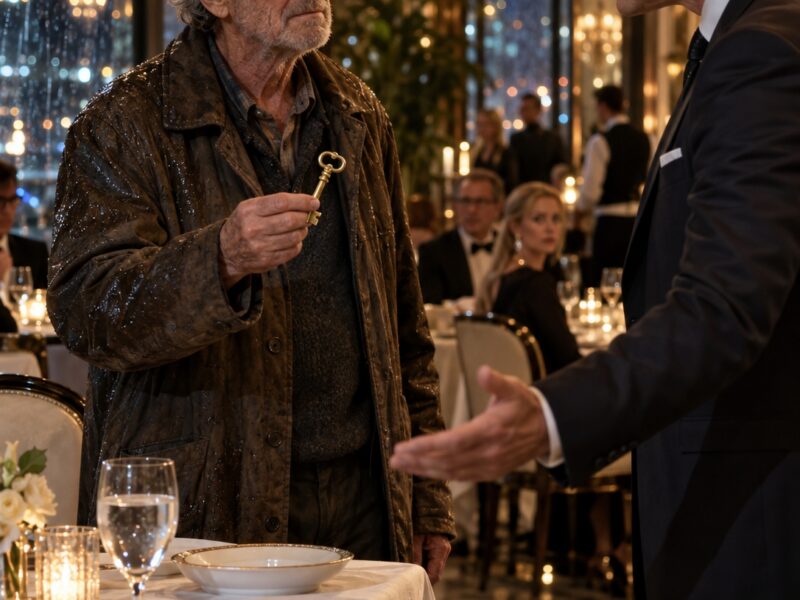
He stood just inside the brass-framed entrance of Bellamy House, rainwater sliding from the shoulders of his faded brown coat and gathering in small dark drops on the polished marble beneath his boots.
For a moment, nobody moved.
Outside, rain hammered the awning over Madison Avenue, turning the October night into a silver blur. Inside, everything glowed.
Crystal chandeliers.
White linen.
Champagne glasses.
A pianist playing softly beside a wall of amber glass.
Men in tailored jackets leaned toward women wearing diamonds that caught the candlelight every time they laughed.
And in the middle of all that expensive perfection stood Elias.
His gray hair was damp. His coat had seen better years. The leather on his boots was cracked around the toes. He carried no umbrella, no briefcase, no visible sign that he belonged anywhere near a restaurant where the least expensive entrée cost more than some families spent on groceries for a week.
Elias looked at the man who had spoken.
“I just need somewhere dry.”
He said it quietly.
That seemed to make things worse.
The floor manager, Grant Mercer, stared at him with the strained expression of a man who believed politeness was something reserved for paying customers.
Grant was forty-two, immaculate, and ambitious enough to notice the watch on every wrist before he noticed the person wearing it.
Tonight mattered to him.
Friday reservations were full.
A city councilman was dining near the windows.
A venture capitalist had booked the private booth.
Two food writers had been rumored to be coming.
Grant had spent the afternoon telling his staff that Bellamy House wasn’t simply a restaurant.
It was an experience.
And Elias Carter did not fit the experience.
“Sir,” Grant said, lowering his voice, “you can’t stand in the entrance.”
Elias glanced behind him.
Rain poured beyond the glass.
“I understand.”
“Then I’m going to have to ask you to move along.”
Elias studied Grant for perhaps two seconds.
Not angrily.
That would have been easier.
He simply looked at him.
Then a young woman appeared from behind the host stand.
“Excuse me,” Elias said. “Is there a place where I can sit?”
The hostess froze.
Her name was Maya Bennett.
Twenty-six years old. Three months into the job. Still new enough to remember what it felt like to be intimidated by the place.
She looked at Elias.
Then at Grant.
Then back at Elias.
“I’m sorry, sir. We’re quite busy tonight, and I’m not sure we have a suitable place for you right now.”
Suitable.
The word hung between them.
Maya seemed to hear it after she said it.
Her face tightened.
Elias noticed.
So did Grant.
Before Grant could intervene, Maya pointed toward a small two-person table near the service corridor, far from the windows and the chandelier-lit center of the dining room.
“You can sit over there.”
Grant turned sharply toward her.
But Elias simply nodded.
“That’s fine. Thank you.”
He walked across the dining room.
Heads turned.
Not many.
Just enough.
A woman in a cream dress stopped talking as he passed. A man wearing a navy suit looked down at Elias’s wet boots and shifted his chair several inches closer to his table.
Elias noticed that too.
He noticed everything.
The changed wallpaper.
The new bar.
The marble floor that had replaced the old walnut boards.
The brass light fixtures.
The flowers.
The paintings.
He even noticed the narrow column near the kitchen entrance where, decades ago, someone had carved two initials into the wood before the column had been covered in decorative stone.
His eyes rested there for a second.
Then he sat.
Maya approached.
Elias removed his wet coat and folded it carefully over the empty chair opposite him.
“Excuse me,” he said. “Could I see the menu?”
Maya hesitated.
Grant was watching from the host stand.
“We usually serve guests with reservations.”
Elias looked around.
Several tables were empty.
One directly beside him had not been occupied since he entered.
He could have pointed that out.
He didn’t.
“Then could I at least have a glass of water?”
Maya swallowed.
“I’ll see what I can do.”
She turned toward the service station.
Grant intercepted her.
“Don’t serve him yet.”
Maya stopped.
“He only asked for water.”
“I heard him.”
“Then why—”
“I said wait.”
Maya stared at him.
Grant lowered his voice.
“We have paying customers waiting for service. Take care of them first.”
“He is sitting at a table.”
“He isn’t a customer.”
“He asked for a menu.”
“And he doesn’t have a reservation.”
Maya looked back.
Elias sat alone beneath the small wall lamp, hands folded loosely on the table.
He wasn’t staring at them.
That somehow made it worse.
“Mr. Mercer—”
“I’ll handle it.”
Grant walked toward Elias.
“Sir, is there something I can help you with?”
Elias raised his eyes.
“I just need a little water.”
Nothing else.
No accusation.
No embarrassment.
No anger.
Just water.
For the first time that evening, Grant became aware that several employees were listening.
“Just bring him some water,” he said.
“Yes, sir,” Maya replied.
She filled a glass.
She had already taken two steps toward Elias when Grant spoke again.
“The water is ready.”
Maya turned.
Grant nodded toward the service counter.
“Leave it there for now.”
Her eyebrows drew together.
“What?”
“Leave it there.”
“Why?”
“Because table twelve has been waiting for wine.”
“Another server has twelve.”
“Maya.”
His tone ended the conversation.
She set the water down.
Across the room, Elias could see the glass.
Cold condensation rolled down its side.
He waited.
One minute.
Then two.
Servers crossed the dining room carrying steaks, salmon, wine and desserts topped with delicate curls of chocolate.
The water remained twenty feet away.
Maya glanced toward him again.
“He’s still waiting.”
Grant didn’t even turn.
“Let him wait.”
Elias heard him.
Grant didn’t know that.
But Elias heard every word.
His fingers slowly closed around the edge of the linen napkin.
For the first time since walking through the door, something changed in his face.
Not anger.
Pain.
Old pain.
The kind that doesn’t begin in the moment that causes it.
The kind that comes from realizing something you loved has become something you no longer recognize.
Nearly thirty years earlier, there had been no marble here.
No chandeliers.
No reservations.
No valet.
There had been twelve mismatched tables, a kitchen that overheated every summer, and a handwritten menu taped beside the register.
And on freezing nights, Elias Carter’s father had kept a pot of soup simmering after closing.
Not for customers.
For anyone who knocked.
Elias remembered asking him once why.
His father had looked at the twelve-year-old boy standing beside him and said, “Because hunger doesn’t make reservations.”
Elias had never forgotten it.
Apparently, the restaurant had.
Maya finally picked up the water.
She crossed the room quickly.
“I’m sorry for the wait, sir.”
Elias looked at her.
For a moment, Maya expected him to complain.
Instead he said, “It’s all right.”
She placed the glass before him.
He drank slowly.
Maya remained there.
“Is there anything else?”
“Could I order something to eat?”
She looked toward Grant.
“I can check with the manager.”
“You don’t have to make trouble for yourself.”
That surprised her.
“It’s my job.”
Elias glanced around the dining room.
“Is it?”
Maya wasn’t sure what he meant.
Neither was she sure why the question stayed with her after she walked away.
Grant was reviewing the reservation book when she approached.
“He wants food.”
Grant sighed.
“What exactly would he like?”
“Anything simple.”
Grant looked toward Elias.
The old man’s coat still dripped onto the chair.
“Bring him the house soup.”
“Should I give him a menu?”
“No.”
“Why not?”
Grant finally looked at her.
“Because we’re not doing this all night.”
Maya said nothing.
She went to the kitchen.
Several minutes later, she returned with a white porcelain bowl.
Steam curled above the broth.
“Here you go, sir.”
Elias looked at the soup.
Then at her.
“Thank you.”
The words were so sincere that Maya felt embarrassed on behalf of everyone else in the room.
He picked up the spoon.
He tasted the broth.
And for the first time that night, he smiled.
Barely.
But he smiled.
“Is something wrong?” Maya asked.
“No.”
“You looked surprised.”
Elias stirred the soup once.
“It tastes familiar.”
Maya smiled uncertainly.
“That’s probably a good thing.”
“Maybe.”
He took another spoonful.
The recipe had changed.
More cream.
Less thyme.
But underneath it was something unmistakable.
A base of roasted onion and celery prepared the way his father had taught the first kitchen crew decades earlier.
Elias looked toward the kitchen doors.
“Is this place always this busy on rainy nights?”
“Usually, yes. Especially on weekends.”
“I see.”
He looked toward a nearby table.
“Excuse me. Is that seat taken?”
Maya followed his gaze.
“No, sir. That table is reserved.”
“I understand.”
He returned to his soup.
Grant watched from across the room.
“Why is he asking so many questions?”
Maya glanced at him.
“I don’t know.”
“Keep an eye on him.”
“He’s eating soup.”
“Just do what I asked.”
Elias heard that too.
A few minutes later, when Maya returned to refill another table’s water, Elias spoke.
“How long has this restaurant been here?”
“Almost twenty years, sir.”
He looked around slowly.
“Twenty years.”
Maya nodded.
“That’s a long time.”
“Yes.”
She noticed something strange then.
He wasn’t looking at the restaurant like a visitor.
He was looking at it like someone searching his own memory.
His eyes moved toward corners no customer cared about.
The molding above the old fireplace.
The service door beside the wine room.
The wall behind the bar.
A narrow hallway marked STAFF ONLY.
“Have you been here before, sir?”
Elias looked up at her.
“A long time ago.”
“Really?”
“A very long time.”
Before Maya could ask anything else, Grant approached.
His patience was gone.
“Sir, I think you’ve had enough.”
Elias looked at the half-full bowl.
“You need to leave.”
“Leave?”
“Yes.”
“I haven’t finished my soup.”
Grant’s jaw tightened.
“This isn’t the place for you.”
The words were louder this time.
Several nearby conversations stopped.
Elias put his spoon down.
“Have I done something wrong?”
“You’re making the other guests uncomfortable.”
Elias looked around.
“I haven’t spoken to anyone.”
“Please don’t make this harder. Just leave.”
Maya stepped forward.
“Mr. Mercer—”
Grant raised one hand.
“Not now.”
Elias reached inside his coat.
“At least let me pay for the meal.”
Grant stiffened, perhaps expecting a crumpled handful of coins.
“There’s no need. Just go.”
Elias stopped.
Slowly, he withdrew his hand.
“All right.”
He stood.
The room had become strangely quiet.
Elias lifted his coat from the chair.
Then something near the host station caught his attention.
He stopped.
Behind Grant, mounted inside a small decorative frame, was an old brass token.
Most guests probably assumed it was part of the restaurant’s vintage décor.
Elias stared at it.
“You still have this?”
Grant followed his gaze.
“What?”
Elias stepped closer.
The brass token was scratched and dark with age. A small bell had been engraved on one side. On the other were two nearly invisible letters.
E.C.
Grant looked from the token to Elias.
“You’ve seen that before?”
“A long time ago.”
Maya stepped closer.
“How do you know this place?”
Elias looked around.
“I knew it before it became this.”
A faint tension moved through the room.
“A lot has changed,” he added.
Maya studied him.
“Was this restaurant different back then?”
“Very different.”
“Who owned it?”
Elias didn’t answer immediately.
His eyes went to the old token again.
“Someone who believed everyone deserved a seat.”
Maya’s expression changed.
“Do you remember his name?”
Elias looked at her.
“I remember the man.”
“Did you know him?”
A small, almost sad smile touched Elias’s face.
“Better than most people did.”
Maya turned toward Grant.
“Sir, he knew the old restaurant.”
Grant gave a dismissive laugh.
“That doesn’t mean anything.”
Elias nodded once.
“Maybe it doesn’t.”
Then a voice came from behind them.
“Excuse me, but what is he still doing here?”
The man speaking was seated with three guests near the center of the room.
Richard Halston.
Real estate developer.
Regular customer.
One of the restaurant’s biggest spenders.
He stared at Elias as though his presence were a stain on the tablecloth.
“Some of us are trying to have dinner.”
Grant immediately changed posture.
“Sir, please. He’s leaving.”
“Then he should have left already.”
The humiliation was now public.
Maya’s face flushed.
Elias remained still.
Richard shook his head.
“Manager, are you really going to let this continue?”
Grant looked at Elias.
His voice hardened.
“Sir, you heard him. Please go.”
Elias studied him.
Then the chandeliers seemed almost too bright.
“I will.”
Grant exhaled.
“But there’s something you should know.”
Grant stopped.
“What?”
Elias slipped his wet coat over one arm.
“You should know who you’re asking to leave.”
Richard laughed.
“And who exactly are you?”
Elias turned toward him.
Then back toward Grant.
“The person who built this place.”
Silence.
Not ordinary silence.
The kind that changes the temperature of a room.
Maya stared at him.
Grant blinked.
Someone near the windows actually laughed.
Grant recovered first.
“You built this place?”
“Yes.”
Richard leaned back in his chair.
“This should be good.”
Grant crossed his arms.
“If that’s true, then prove it.”
Elias looked at him.
“I don’t need to prove it to you.”
“Convenient.”
Elias said nothing.
Instead, he walked toward the hallway marked STAFF ONLY.
Grant stepped after him.
“Sir, you can’t go back there.”
Elias continued.
“I’m serious.”
At the end of the corridor stood an old wooden door.
Everything around it had been renovated.
The door hadn’t.
It was narrower than modern doors, painted dark green, with a brass lock polished by decades of hands.
Grant stopped several feet behind Elias.
“That room is private.”
Elias reached beneath his shirt.
A thin chain rested against his chest.
Hanging from it was a key.
Old brass.
Long stem.
Three uneven teeth.
Maya’s eyes widened.
Grant stared.
Elias placed the key in the lock.
Click.
The door opened.
Grant’s face lost its color.
“How do you have a key to that?”
Elias looked back.
“Because I was the one who locked it.”
Nobody laughed now.
Maya followed him into the room.
Grant came behind her.
Even Richard had left his table.
The room smelled of dust and cedar.
It was small.
No marble.
No crystal.
No luxury.
Just shelves, an old desk, several wooden crates, faded photographs and a steel filing cabinet.
Maya looked around.
“What is this place?”
Elias touched the edge of the desk.
“Nothing in here was ever meant to impress anyone.”
His fingers lingered on the wood.
“This is where everything started.”
Maya looked at him.
“You’ve been in this room before.”
Elias walked directly toward the far wall without searching.
“I remember where everything was.”
He moved a wooden crate.
Behind it sat an old metal box.
Grant stared.
“What are you looking for?”
Elias knelt.
“Something this place should never have forgotten.”
He opened the box.
Inside were yellowed documents wrapped in cloth.
He removed the top folder.
His hands were steady.
Grant’s were not.
Elias opened the document and placed it on the desk.
“This was the first signature on this restaurant.”
Maya leaned closer.
“Whose signature?”
Elias tapped the bottom of the page.
“Mine.”
There it was.
Elias Carter.
The date was nearly twenty years old.
Grant stared.
“You expect me to believe this?”
“You don’t have to believe me yet.”
Elias pushed the document toward him.
“Look at the date.”
Grant did.
His face changed.
“This is from the first year.”
“Exactly.”
Richard, suddenly much quieter, leaned over Grant’s shoulder.
Grant looked around the room.
“How did you know this was here?”
Elias met his eyes.
“Because I put it there.”
Maya stared at the old photographs.
One showed the building before the renovation.
Another showed a younger Elias standing beside the front door in work clothes, one hand resting on the shoulder of an older man.
The same eyes.
The same face.
Just decades younger.
“You knew exactly where to find everything,” Maya whispered.
“I didn’t forget.”
Grant looked at him.
“Then why come back like this?”
That question changed Elias.
Until then, he had been calm.
Now the old man looked tired.
“I needed to see something for myself.”
He reached into the box again.
Maya noticed another document.
“What is that?”
Elias lifted it.
“The part you haven’t seen yet.”
At the top of the page was a name.
ELIAS CARTER.
Maya read it aloud.
“Elias Carter.”
Elias nodded.
“That’s my name.”
Grant stared at him.
Then at the paper.
Then at the photograph.
Recognition came slowly, followed by something much worse.
Fear.
“You’re the owner.”
Elias’s answer was quiet.
“I never stopped being the owner.”
Grant’s mouth opened.
Nothing came out.
The man who had controlled every inch of the dining room ten minutes earlier suddenly seemed unsure where to put his hands.
Richard stepped backward.
Maya stared at Elias.
“Then why did you come in like this?”
Elias looked at his damp coat.
“Like what?”
Nobody answered.
They didn’t need to.
Grant finally found his voice.
“Mr. Carter, I owe you an apology.”
Elias turned toward him.
“You don’t have to apologize to me.”
Grant seemed confused.
“Then who should I apologize to?”
Elias held his gaze.
“To the person you were talking to before you knew my name.”
The sentence landed harder than shouting could have.
Grant looked down.
Maya’s eyes filled.
“You wanted us to see what we were doing.”
“No.”
Elias shook his head.
“I wanted to see it for myself.”
“You came here deliberately like this?”
“Yes.”
Grant’s embarrassment hardened slightly.
“So this was a test?”
Elias looked through the open doorway toward the dining room.
“I wasn’t testing the food.”
Nobody spoke.
“I wasn’t checking the wine list. I wasn’t interested in the chandeliers or whether the tables were set correctly.”
His eyes returned to Grant.
“I was watching how people treated someone they thought didn’t matter.”
Maya stepped forward.
“Sir, I did try to help.”
“I know you did.”
“I should have done more.”
Elias studied her.
There was no performance in her face.
No fear for her job.
Only shame.
“I know,” he said softly.
Maya lowered her eyes.
Elias closed the metal box.
“There was one more thing I wanted to know.”
Grant swallowed.
“What?”
Elias looked toward the dining room, where wealthy guests were pretending not to listen.
“Whether respect still mattered when you thought I had no power.”
Nobody had an answer.
Elias walked back into the restaurant.
The same room that had made him wait for water was silent for him now.
The same guests who had avoided looking at him were watching every step.
The same manager who had ordered him out followed several feet behind.
Maya came beside Elias.
He stopped at the little table near the service corridor.
His soup was still there.
Cold now.
Beside it sat the glass of water he had waited so long to receive.
Elias touched the rim.
Then he looked at Maya.
“You were the only one who tried to help me.”
Her voice cracked.
“I wish I’d done more, sir.”
“You did enough to remind me that kindness still exists.”
Grant stepped forward.
“Mr. Carter.”
Elias looked at him.
“I was wrong,” Grant said. “I judged you before I even spoke to you.”
Elias waited.
Grant took a breath.
“I saw your coat. Your shoes. I assumed you couldn’t afford to be here.”
Richard Halston shifted uncomfortably near his table.
Grant continued.
“I told myself I was protecting the restaurant.”
“From what?”
Grant couldn’t answer.
Elias glanced at his clothes.
“From me?”
Grant’s face tightened.
“Yes.”
Elias nodded.
At least it was truthful.
He pulled out the chair and sat again.
No one knew what to do.
Finally Elias pointed toward the chair opposite him.
“Sit down, Grant.”
The manager obeyed.
Maya remained standing nearby.
Elias looked around Bellamy House.
“When we opened this place, we had six employees.”
Grant listened.
“Two cooks. Two servers. A dishwasher. And me.”
His fingers moved slowly across the tablecloth.
“We couldn’t afford linen like this.”
A few employees gathered near the kitchen.
“My father had owned a little lunch counter before this building existed. Nothing fancy. Coffee. Eggs. Soup. Sandwiches.”
Elias glanced toward the locked back room.
“He died before he ever saw Bellamy House open.”
Maya listened closely.
“But he taught me something I apparently failed to protect.”
Elias looked at Grant.
“He said a restaurant is one of the few places where strangers willingly sit in a room together and trust someone else to feed them.”
Grant said nothing.
“He believed that made hospitality a responsibility.”
Elias looked toward the front doors.
“Not a performance.”
The rain continued beyond the glass.
For a few seconds, it was the only sound in the room.
Grant rubbed his palms together.
“I don’t know what to say.”
“Then listen.”
Elias’s voice wasn’t harsh.
That made everyone listen harder.
“When I walked through that door, nobody knew my name.”
He pointed toward the entrance.
“That should not have mattered.”
His hand moved toward the table.
“I asked for a seat.”
Then the water.
“I asked for a glass of water.”
His eyes moved toward the cold soup.
“Then I asked for food.”
He looked at Grant.
“At every step, I became less human to you because you believed I had less money than the people around me.”
Grant’s face reddened.
Elias turned toward Richard.
“And when another guest decided my presence bothered him, you protected his comfort instead of my dignity.”
Richard straightened.
“Now, wait a minute—”
Elias raised one hand.
“No.”
Richard stopped.
“You’ve already had your turn.”
The room went still again.
Elias wasn’t loud.
He didn’t need to be.
“You wanted me removed because looking at me made you uncomfortable.”
Richard glanced around.
“I was trying to have dinner.”
“So was I.”
Richard had no response.
Elias looked back at Grant.
“You asked me to leave before I finished my meal.”
“I know.”
“You refused to let me pay.”
Grant nodded.
“I know.”
“Why?”
Grant struggled.
“Because I wanted the situation over.”
Elias leaned back.
“There was no situation until you created one.”
Grant closed his eyes briefly.
That sentence hurt because it was true.
Elias had not shouted.
He had not bothered another guest.
He had not demanded free food.
He had not threatened anyone.
He had entered wet from the rain and asked to sit down.
Everything after that had been created by other people’s assumptions.
Maya wiped beneath one eye.
Elias noticed.
“You don’t need to cry.”
“I’m embarrassed.”
“Good.”
She looked surprised.
Elias softened.
“Embarrassment isn’t always bad, Maya. Sometimes it means you still know the difference between who you were and who you should have been.”
Grant stared at him.
“What happens now?”
Every employee seemed to stop breathing.
There it was.
The question beneath every apology.
Was Grant fired?
Would the restaurant close?
Would Elias expose them publicly?
Would Maya lose her job for disobeying the manager?
Elias looked at Grant for a long moment.
“You’re wondering whether I’m going to fire you.”
Grant didn’t deny it.
“Yes.”
“That’s the first honest thing you’ve said to me tonight without being forced.”
Grant lowered his head.
Elias stood.
“I could fire you.”
Grant’s jaw tightened.
“I could fire everyone who watched and said nothing.”
Several employees looked away.
“I could walk upstairs, call the board, pull the security footage and have new management here by Monday.”
Grant swallowed.
“But then you’d learn the wrong lesson.”
Grant looked up.
Elias pointed toward the glass of water.
“You’d learn to treat people well because one of them might secretly own the building.”
He shook his head.
“That isn’t kindness.”
Nobody moved.
“That’s fear.”
Maya looked at him.
Elias continued.
“If you take anything from tonight, don’t take this: Be careful who you disrespect because they might be powerful.”
He looked around the dining room.
“Take this instead.”
His voice lowered.
“Treat them with dignity even when you’re absolutely certain they have no power at all.”
A server near the kitchen lowered her eyes.
Elias looked toward Maya.
“That’s what she tried to do.”
Maya shook her head.
“Not enough.”
“No. Not enough.”
He wasn’t going to give her an easy absolution either.
“But more than anyone else.”
He turned toward Grant.
“Tomorrow morning, we’re going to sit down with every employee.”
Grant nodded.
“Of course.”
“We’re going to review how people are welcomed here.”
“Yes, sir.”
“Not dress codes.”
Grant nodded.
“Not reservation priorities.”
Another nod.
“People.”
“I understand.”
Elias watched him.
“No, you don’t.”
Grant looked up.
“Not yet.”
That silenced him.
“You’ll understand when the next person walks through that door looking like I did tonight, and you have no reason to believe they’re anybody important.”
Elias lifted his coat.
“That will be your test.”
Grant stood.
“Mr. Carter, I really am sorry.”
Elias looked at him.
“Then remember this the next time someone walks through that door.”
He glanced at Grant’s tailored suit, then at his own worn coat.
“Their clothes don’t tell you their worth.”
Nobody in Bellamy House moved.
Elias walked toward the entrance.
Maya followed him.
“Mr. Carter?”
He stopped.
“Will you come back tomorrow?”
Elias looked at the restaurant.
For a moment, he could almost see what had been there before.
The cheap tables.
The scratched counter.
His father standing near the stove.
A teenage Elias carrying bowls of soup.
People coming in from the cold without anyone asking whether their coats were expensive enough.
“Yes,” he said.
Maya smiled faintly.
“Good.”
Elias started toward the door.
Then he stopped one last time.
He turned toward the room.
“A restaurant can serve the finest food in the city.”
Every face turned toward him.
“It can have chandeliers from Europe. Wine worth thousands of dollars. Chefs people wait months to meet.”
He looked at the little table where he had been seated.
“But if it cannot respect the person sitting at the table, none of it means anything.”
The rain had softened outside.
Elias opened the door.
Cold air entered the dining room.
Before stepping out, he looked back at Grant.
“Remember that.”
Then he disappeared into the wet Chicago night.
For several seconds, nobody spoke.
The pianist had stopped playing.
Richard Halston quietly returned to his table.
The employees slowly returned to work.
But the room felt different.
Grant remained beside the entrance.
He looked at the place where Elias had stood when he first arrived.
A few drops of rainwater were still visible on the marble.
Earlier, Grant had seen those drops and thought only about the floor.
Now he couldn’t stop thinking about the man who had left them there.
Maya walked back toward Elias’s table.
The bowl of soup was cold.
The water glass was nearly empty.
She picked it up.
Underneath it lay something she hadn’t noticed before.
A folded paper napkin.
There were six handwritten words on it.
She opened it carefully.
Everyone deserves a seat at the table.
Maya stared at the sentence.
Grant came up behind her.
He read it.
Neither of them spoke.
Outside, Elias stood beneath the awning for a moment.
He could have called a car.
Instead, he stepped into the rain.
Twenty years earlier, on the night Bellamy House first opened, his father had stood outside this same building beside him.
There had been no photographers.
No investors.
No expensive cars.
Only a hand-painted sign and twelve tables waiting inside.
His father had looked through the window and asked him one question.
“What kind of place are you building, son?”
Elias had laughed.
“A restaurant.”
His father had shaken his head.
“No. I asked what kind of place you’re building.”
Elias hadn’t understood the difference then.
Tonight, he finally did.
Buildings survived.
Names survived.
Recipes survived.
Money survived.
Values did not.
Values survived only when people chose them again and again, especially when there was no reward for doing so.
Especially when nobody important was watching.
Elias crossed the street.
Behind him, Bellamy House continued glowing against the rainy darkness.
It still looked beautiful.
Perhaps more beautiful than it had ever looked.
But Elias knew something now that marble, crystal and money could never hide.
A place wasn’t defined by how it treated the people everyone wanted to impress.
It was defined by how it treated the person everyone believed they could ignore.
And somewhere behind those golden windows, a young woman was still holding a napkin with six words written across it.
Everyone deserves a seat at the table.
Tomorrow, Elias would return wearing clean shoes and a tailored coat.
People would open doors for him.
Managers would know his name.
Employees would stand straighter when he entered.
But none of that would tell him whether Bellamy House had changed.
That answer would come later.
It would come on another rainy night, when another stranger stepped through those doors looking tired, wet, poor, or lost.
A stranger who owned nothing.
A stranger with no secret key.
A stranger whose name meant absolutely nothing to anyone in the room.
And when that person quietly asked for a glass of water, Elias Carter hoped no one would make them wait.









