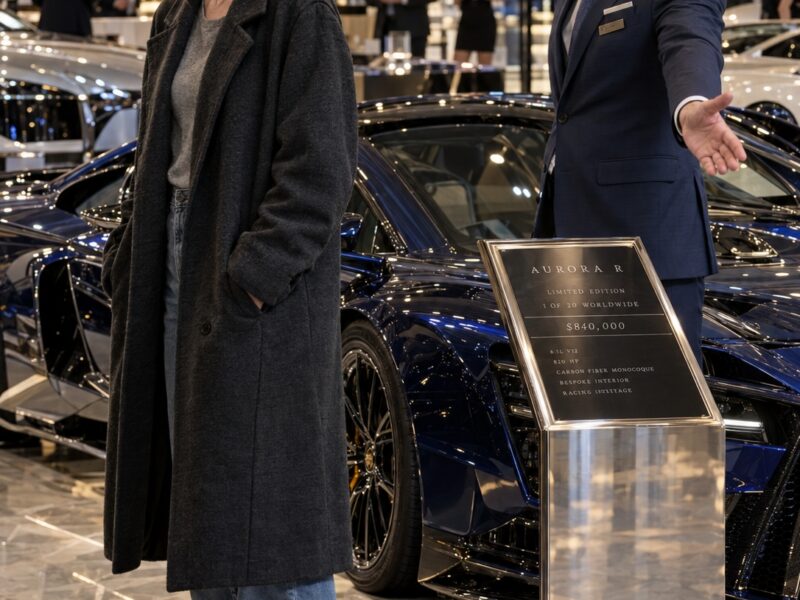
THEY THREW HER OUT OF AN $840,000 SUPERCAR SHOWROOM—THEN THE OWNER WALKED IN AND ASKED WHY SHE WAS STANDING BY THE EXIT
The first thing the showroom manager noticed about Chloe Vale was not her face.
It was her coat.
Faded charcoal. Too large through the shoulders. A little frayed near one cuff.
Then he noticed her shoes—plain white sneakers with a faint gray mark near the sole.
And just like that, before Chloe had spoken a single word, Marcus Hale decided exactly what kind of woman she was.
Someone who did not belong there.
“Please step away from the vehicle.”
His voice crossed the showroom with enough force to make two customers turn their heads.
Chloe did not move immediately.
She stood beside a midnight-blue supercar displayed beneath a ceiling of white architectural lights, her hands tucked loosely into the pockets of her coat.
She wasn’t touching the car.
She wasn’t leaning against the glass barrier.
She wasn’t even particularly close.
She was simply looking through the driver’s-side window.
“I’m looking through the glass,” she said calmly. “I’m not touching it.”
Marcus walked toward her.
His polished black shoes clicked against the marble.
Around them, the showroom looked less like a dealership than a private gallery for people who had never needed to ask what anything cost.
Italian leather chairs.
Floor-to-ceiling windows.
A coffee bar with hand-thrown ceramic cups.
Six cars arranged beneath individual pools of light like sculptures.
The one in front of Chloe was the rarest.
A silver plaque beside it read:
LIMITED PRODUCTION — 20 WORLDWIDE
Chloe glanced at it.
“Only twenty?”
Marcus folded his hands in front of himself.
“Yes.”
“I’d like a closer look at the dashboard.”
“You’ve looked.”
She turned toward him.
Something in his tone interested her more than the car did.
“I’d still like to see the interior.”
Marcus smiled.
It was technically a smile.
But there was no kindness in it.
“People who understand these cars know where to stand.”
For the first time, Chloe looked directly at him.
“Excuse me?”
“You heard me.”
“I did. I was giving you the opportunity to say something different.”
Across the showroom, a young salesman stopped organizing brochures.
His name was David Mercer.
Twenty-nine years old.
Three months into the job.
Still new enough to believe that the words printed inside the employee handbook mattered.
Every guest is to be treated as a potential client until the guest indicates otherwise.
Marcus had told him during training that the sentence was “corporate nonsense.”
David had laughed because everyone else had.
He wasn’t laughing now.
Chloe looked back through the window.
The dashboard was stitched in deep navy leather. Carbon-fiber trim framed a digital instrument cluster. The steering wheel carried several controls unique to the limited production series.
She leaned slightly, studying them.
Marcus stepped closer.
“Ma’am.”
“I still haven’t touched it.”
“That’s not the point.”
“Then what is?”
A pause.
Marcus looked at her coat again.
“That outfit doesn’t exactly suggest you understand these cars.”
David slowly lowered the brochures in his hands.
Chloe turned.
There was no visible anger on her face.
That somehow made the silence worse.
“Does what I wear determine whether I belong here?”
Marcus exhaled through his nose.
“Let’s not make this into something it isn’t.”
“I’m asking you a simple question.”
“And I’m trying to protect an eight-hundred-thousand-dollar automobile.”
“From me looking at it?”
Marcus glanced toward a couple near the coffee bar.
The man wore a navy suit and a gold watch. His wife carried a handbag that probably cost more than Chloe’s entire outfit.
Marcus lowered his voice.
“This showroom serves a very specific clientele.”
Chloe’s eyes remained on him.
“What determines who is allowed near the cars?”
He should have stopped.
David would later think about that moment more than any other.
There had been an exit.
A simple one.
Marcus could have apologized.
He could have changed his tone.
He could have said, Everyone is welcome. Let me show you the vehicle.
Instead, he looked at Chloe’s sneakers one more time.
And said:
“If you can’t afford it, you don’t belong near it.”
The showroom became very quiet.
Not silent.
The ventilation system still whispered overhead.
A milk steamer hissed behind the coffee bar.
Somewhere near the entrance, a phone vibrated against a glass desk.
But human conversation stopped.
Chloe stared at Marcus.
Then she looked at the car.
For several seconds, she said nothing.
David felt something twist in his stomach.
He knew Marcus.
Marcus liked wealthy customers because wealthy customers made him feel wealthy.
He remembered their names.
Their preferred drinks.
Their watches.
Their wives.
Their assistants.
But if someone entered wearing work boots, faded denim, a delivery uniform, or clothes Marcus considered cheap, his entire body changed.
His smile disappeared.
His sentences shortened.
His patience evaporated.
David had noticed it before.
He had simply never challenged it.
Until now.
Chloe looked toward the plaque again.
Then back at Marcus.
“All right.”
Marcus seemed relieved.
“Thank you.”
“Tell me the price.”
His relief vanished.
“The price?”
“Yes.”
“You saw the plaque.”
“The plaque tells me how many exist. I asked you how much this one costs.”
Marcus hesitated.
“Eight hundred forty thousand dollars before options.”
Chloe nodded.
“What options does this one have?”
Marcus stared at her.
She waited.
“Carbon package?” she asked. “Track telemetry? Upgraded audio? Bespoke interior?”
That caught him off guard.
Only slightly.
But David noticed.
Marcus recovered quickly.
“Ma’am, this isn’t really a vehicle people comparison-shop.”
“I didn’t ask whether people comparison-shop it.”
“I think we’re wasting each other’s time.”
“You told me I couldn’t afford it.”
“I said—”
“I remember exactly what you said.”
Her voice remained low.
No shouting.
No scene.
Just precision.
“Now I’m asking the price and specifications. Isn’t that what salespeople usually discuss with customers?”
Marcus’s jaw tightened.
“Now please leave.”
David moved before he had fully decided to.
“She asked a clear question.”
Marcus turned.
“David.”
The warning in his voice was immediate.
David stopped several feet away.
Marcus stared at him.
“Stay out of this.”
David glanced at Chloe.
She wasn’t looking at him.
She was looking at the car again.
And for some reason that bothered him even more.
She had been insulted so casually that everyone expected her to absorb it quietly.
David swallowed.
“Maybe I can answer her questions.”
Marcus gave a small laugh.
“No.”
“Why?”
“Because I’m handling it.”
David looked at Chloe’s hands.
Still in her coat pockets.
Not touching anything.
Not threatening anyone.
Not causing a disturbance.
He heard his father’s voice in his memory.
His father had spent thirty-one years repairing elevators in office buildings he could never have afforded to work inside.
Once, when David was fourteen, they had entered a luxury hotel because his father needed to deliver paperwork.
A concierge had stopped them before they reached the front desk.
Not because they had done anything.
Because his father’s work jacket had grease on the sleeve.
David had forgotten the concierge’s face.
But he had never forgotten his father’s expression.
That tiny moment when a proud man realized someone had looked at his clothes and decided his worth.
David stepped forward.
“Ma’am, if you’d like, I can explain the interior and the available options.”
Marcus’s expression hardened.
“David.”
David continued.
“I can also review approved purchase plans if you’re interested.”
Chloe finally turned toward him.
For the first time since entering the showroom, something changed in her expression.
Not gratitude exactly.
Attention.
“What would you recommend?” she asked.
David glanced at the car.
“If you actually intend to drive it rather than store it, I’d start with the suspension configuration. The carbon package is mostly weight reduction, but the adaptive setup matters more on normal roads.”
Chloe raised an eyebrow.
“You’ve driven one?”
David almost smiled.
“I’m not important enough.”
“You know the car.”
“I study.”
“Why?”
“Because I sell cars.”
It was such an obvious answer that Chloe nearly laughed.
Marcus did not.
“Enough.”
His voice cut through the room.
“David, step away and stop interfering.”
David turned.
Marcus was no longer embarrassed.
He was angry.
“You’re still under evaluation.”
David’s stomach dropped.
That was true.
His ninety-day performance review was Friday.
Two days away.
He needed the job.
Not vaguely.
Not in the abstract.
He needed it.
His mother’s physical therapy bills were stacked on his kitchen counter.
His rent had increased in September.
His savings account had fallen below two thousand dollars.
He had already postponed replacing the transmission in his twelve-year-old Honda.
Losing this job would not be an inconvenience.
It would change his life.
Marcus knew that.
Which was exactly why he had said it.
“You risk your job, David.”
The words hung between them.
Chloe looked at David.
This time, she studied him.
Marcus stepped closer.
“Don’t risk your job for her.”
For her.
Not for a customer.
Not for a woman.
Not for another human being.
For her.
David felt his face warm.
He could retreat.
Everyone in the room would understand.
He could apologize to Marcus later.
He could tell himself he had tried.
He could keep his paycheck.
He could go home.
Instead, he looked at Chloe.
“Would you like a vehicle overview,” he asked, “or would you prefer purchase options?”
Marcus stared at him.
David could hear his own heartbeat.
Chloe answered slowly.
“Vehicle overview.”
David nodded.
“Of course.”
Marcus moved between them.
“I manage this showroom floor.”
His voice had changed.
It now carried the cold authority of someone who felt his control slipping.
“Our vehicle-protection policy requires staff-controlled access.”
David frowned.
“She hasn’t requested access.”
“She’s standing too close.”
“I’m four feet from the car,” Chloe said.
Marcus ignored her.
“This conversation is over.”
Chloe tilted her head.
“Your position doesn’t excuse rudeness.”
“I’m enforcing policy.”
“No. You’re hiding behind policy after deciding I wasn’t worth serving.”
Marcus’s face reddened.
“That’s enough.”
“Is it?”
“Please leave, or I’ll request security.”
A woman near the coffee bar quietly lifted her phone.
David noticed.
Marcus did too.
“Put that away,” he snapped.
The woman lowered it.
But now the humiliation had become public.
And Chloe understood something.
This was no longer about the car.
Maybe it never had been.
She looked around the showroom.
Three salespeople were pretending not to watch.
A receptionist stared down at her monitor.
The couple by the coffee bar had moved closer together.
Nobody spoke.
Nobody intervened.
Except David.
Chloe looked back at Marcus.
“You’re turning a service dispute into an order to leave.”
“She hasn’t done anything,” David said. “Don’t escalate this.”
Marcus pointed toward the rear offices.
“David, go to the staff room.”
“No.”
The word came out before David could soften it.
Marcus blinked.
“What?”
“I said no.”
David’s palms had begun sweating.
He wiped one against his trousers.
“She hasn’t touched the car. She hasn’t raised her voice. She asked the price. She asked about options. That’s a customer interaction.”
Marcus stared at him with disbelief.
“You think you understand this business better than I do?”
“No.”
“Then stop.”
“I understand how people should be spoken to.”
Marcus’s face went still.
That was worse than anger.
“Go to the staff room.”
David didn’t move.
Marcus looked at Chloe.
“Leave the showroom now.”
Chloe’s gaze did not change.
“Why should I leave?”
“If you refuse, I’ll request security.”
“I’ve heard the consequence.”
She removed her hands from her pockets.
Marcus stiffened.
Chloe simply folded them loosely in front of herself.
“Is this your final decision?”
Marcus gave her a humorless smile.
“Yes.”
David stared at him.
“Marcus.”
“My final decision.”
Chloe nodded once.
“Okay.”
Something about the way she said it made David uneasy.
No anger.
No threat.
No promise that Marcus would regret it.
Just okay.
She turned toward the exit.
David watched her walk across the marble floor.
She passed the reception desk.
Passed the silver grand-tourer displayed beneath a rotating spotlight.
Passed a framed photograph of the dealership’s opening night, where Marcus stood beside politicians, athletes, and men whose names appeared on buildings.
At the door, Chloe stopped.
Not because Marcus called her.
Because a black sedan had just pulled up outside.
The receptionist looked through the glass.
Her posture changed instantly.
“Mr. Whitmore is here.”
Marcus froze.
David recognized the name.
Adam Whitmore.
Regional operating partner.
The man who represented the ownership group.
Marcus straightened his jacket.
His entire personality transformed in less than three seconds.
“Everyone, positions.”
David almost laughed at the absurdity of it.
Marcus adjusted his tie.
“David, we’ll discuss your behavior later.”
The showroom doors opened.
Adam Whitmore entered carrying a leather portfolio.
Gray suit.
Silver hair.
The relaxed posture of a man who never needed to announce that he was important.
Marcus crossed the floor immediately.
“Adam. Welcome.”
Adam barely looked at him.
His eyes had gone to the woman standing beside the exit.
He stopped.
Then frowned.
“Why is Chloe standing by the door?”
Marcus’s smile remained on his face.
But only technically.
“What?”
Adam looked at Chloe.
Then at her coat.
His eyebrows rose.
“Why are you dressed like that?”
Nobody moved.
David felt the atmosphere change before he understood why.
Chloe slipped one hand into her coat pocket.
“It was a test.”
Adam closed his eyes for half a second.
“Oh, God.”
Marcus looked between them.
“What test?”
Chloe turned.
Her face was calm.
Almost tired.
“I wanted to know how people are treated here when no one thinks they matter.”
Marcus stared at her.
The receptionist had stopped typing.
The other salespeople were no longer pretending to work.
Adam looked at Marcus.
“What happened?”
Marcus opened his mouth.
Nothing came out.
Chloe answered for him.
“I asked to look at a car.”
Adam’s eyes shifted toward the midnight-blue limited-production model.
“The Valenza?”
“Yes.”
“And?”
“I was told my clothes suggested I didn’t understand cars.”
Marcus finally found his voice.
“That isn’t exactly—”
Chloe continued.
“Then I asked what determined who was allowed near them.”
Adam looked at Marcus again.
Chloe finished the sentence quietly.
“He told me that if I couldn’t afford the car, I didn’t belong near it.”
Adam said nothing.
That silence was devastating.
Marcus’s face drained of color.
“Miss Vale…”
David heard the name.
Vale.
Something about it was familiar.
Then one of the salespeople behind him whispered:
“Oh, hell.”
David turned.
The salesman was staring at Chloe as if he had seen a ghost.
Chloe Vale.
Only daughter of Charles and Eleanor Vale.
Heir to Vale Meridian Holdings.
A family fortune so enormous that financial magazines stopped describing individual purchases and simply wrote about industries.
Hotels.
Logistics.
Real estate.
Technology.
Private aviation.
Manufacturing.
The Vale family didn’t buy luxury products to prove they were wealthy.
They owned pieces of the companies that made them.
David looked at Chloe’s worn coat.
Then at the $840,000 car.
And suddenly understood why she had never seemed intimidated by the price.
Marcus understood too.
His transformation was almost painful to watch.
“Miss Vale, I didn’t know who you were.”
Chloe looked at him.
There it was.
The sentence that confirmed everything.
Not I shouldn’t have treated you that way.
Not I was wrong.
Not even I apologize.
I didn’t know who you were.
Chloe’s eyes hardened.
“That’s the problem.”
Marcus stepped toward her.
“Please. Let me explain.”
“You’ve been explaining yourself for twenty minutes.”
“I was protecting the vehicle.”
“From what?”
“We have procedures.”
“Show me the procedure that says someone wearing inexpensive clothing must stand farther from the cars.”
Marcus glanced at Adam.
Adam did not rescue him.
“Miss Vale, if I’d known—”
“Stop saying that.”
Her voice rose for the first time.
Not loudly.
But sharply enough that Marcus fell silent.
“If you had known my last name, you would have offered me coffee.”
Nobody breathed.
“If you had recognized me, you would have opened the car.”
Marcus stared at the floor.
“You probably would have asked what color I wanted.”
Chloe took one step toward him.
“But you didn’t know.”
Another step.
“So I got to meet the version of you that ordinary people meet.”
Marcus swallowed.
Chloe pointed toward the supercar.
“Let me help you understand something about money.”
Her voice softened.
“My family could buy that car.”
A pause.
“We could buy every car in this building.”
Marcus said nothing.
“We could probably buy the building.”
Another pause.
“And none of that makes me more deserving of basic respect than the woman cleaning your bathrooms tonight.”
David felt those words land somewhere deep.
Chloe looked around the showroom.
“At what price does dignity become included?”
Nobody answered.
“Ten thousand dollars?”
Silence.
“A hundred thousand?”
She looked at Marcus.
“Eight hundred forty thousand?”
Marcus’s lips parted.
Nothing came out.
Chloe shook her head.
“It should have been free.”
Adam finally spoke.
“Chloe, I’m sorry.”
She turned toward him.
“Don’t apologize yet.”
Adam frowned.
“Why?”
“Because you should know what happened next.”
She looked at David.
David’s throat tightened.
“This employee tried to serve me.”
Marcus immediately said, “David violated direct instructions.”
Chloe looked at him.
“You threatened his job.”
“He’s under evaluation.”
“For answering my questions.”
“For interfering with management.”
“For treating a customer like a customer.”
Marcus’s jaw tightened.
“This is being presented unfairly.”
David almost couldn’t believe what he was hearing.
But Chloe merely nodded.
“Then present it fairly.”
Marcus blinked.
“What?”
“Tell Adam exactly what happened.”
“I’ve explained—”
“No. Start from the beginning.”
Marcus looked at Adam.
Adam folded his arms.
“I’d like to hear it too.”
For the first time that afternoon, Marcus looked frightened.
He described Chloe approaching the vehicle.
He described the protection policy.
He described asking her to step back.
But his language changed around the important moments.
He had not insulted her.
He had “clarified customer expectations.”
He had not judged her clothing.
He had “assessed risk.”
He had not threatened David.
He had “reinforced reporting structure.”
Chloe listened without interrupting.
When he finished, she asked one question.
“Did you tell me, ‘If you can’t afford it, you don’t belong near it’?”
Marcus hesitated.
Adam’s eyes narrowed.
“Marcus?”
“It may have been phrased poorly.”
Chloe almost smiled.
“Did you say it?”
“Yes.”
“Thank you.”
Marcus looked toward David.
“And David repeatedly undermined my authority.”
Adam turned.
“David?”
David’s heart began pounding again.
He had expected Chloe’s identity to save him.
Suddenly he realized something uncomfortable.
It shouldn’t.
If he defended himself only because the woman turned out to be wealthy, then he was participating in the same logic Marcus had used.
So David told the truth.
“I did refuse his instruction.”
Marcus nodded quickly.
“Exactly.”
Adam looked at David.
“Why?”
David took a breath.
“Because it was wrong.”
Marcus scoffed.
David continued.
“She wasn’t disruptive. She wasn’t touching anything. She asked legitimate questions. The situation was escalating because of how she looked, not because of what she did.”
Adam watched him carefully.
“You knew who she was?”
“No.”
“You recognized her?”
“No.”
“Did she tell you?”
“No.”
Adam glanced at Chloe.
Chloe shook her head.
David continued.
“I thought she was just someone who came in to look at a car.”
Marcus laughed bitterly.
“Exactly. Someone who clearly wasn’t buying it.”
David turned toward him.
“How could you know?”
Marcus opened his hands.
“Come on.”
“No.”
David surprised himself with the firmness in his voice.
“Explain it.”
Marcus stared at him.
“You know what I mean.”
“I actually want you to say it.”
The room became silent again.
David pointed gently toward Chloe’s coat.
“Was it the coat?”
Marcus said nothing.
“The shoes?”
Nothing.
“The fact she didn’t arrive in an expensive car?”
Marcus’s expression hardened.
“This is ridiculous.”
“No,” David said. “This is the entire problem.”
Chloe watched him.
Something inside her shifted.
She had come to the dealership expecting to learn whether employees treated anonymous customers fairly.
She had expected indifference.
Maybe condescension.
Maybe performative politeness.
She had not expected someone with everything to lose to stand beside her.
That was what made David different.
It cost Marcus nothing to be respectful to Chloe once he learned her identity.
It had cost David something to be respectful before he knew it.
And Chloe understood the difference.
Marcus turned toward Adam.
“Are we really going to let a probationary salesman lecture management because a billionaire decided to play dress-up?”
The moment the words left his mouth, he knew they were a mistake.
Adam’s expression changed.
Chloe became completely still.
David looked down.
Not because he was afraid.
Because he was embarrassed for Marcus.
Chloe spoke quietly.
“You think this was a game?”
Marcus said nothing.
“This coat belonged to my mother.”
That surprised everyone.
Chloe looked at the frayed cuff.
“She wore it when she was twenty-six.”
Her fingers brushed the fabric.
“Before Vale Meridian. Before the houses. Before anyone cared about our last name.”
Adam’s face softened.
Chloe continued.
“She worked nights at a hotel outside Pittsburgh. She used to tell me that wealthy people revealed themselves most clearly in the way they spoke to workers they believed they would never need.”
Marcus looked away.
“When she died, I kept this coat.”
Chloe swallowed.
The first real crack appeared in her composure.
“Sometimes I wear it when I need to remember what our name looked like before people started opening doors for us.”
David stared at her.
The showroom suddenly felt different.
The marble looked colder.
The cars looked less important.
Chloe glanced toward the blue supercar.
“I came here because my father is considering expanding our partnership with this dealership group.”
Marcus’s head snapped up.
Adam closed his eyes.
There it was.
The consequence.
Not manufactured.
Not revenge.
Business.
Chloe continued.
“He asked me to visit several locations without announcing myself.”
Adam looked toward Marcus.
Marcus had gone pale.
“We wanted to understand the customer culture before signing anything.”
“Chloe,” Adam said carefully, “the partnership—”
“I haven’t made a recommendation.”
Marcus exhaled.
Too soon.
Chloe noticed.
“But I will.”
Marcus stepped forward.
“Please give us another chance.”
Chloe looked at him.
“Another chance to do what?”
“To show you how we actually operate.”
She shook her head.
“You already did.”
“Today was an exception.”
“How do I know?”
“I’m telling you.”
“You also told me I didn’t belong near your car.”
Marcus flinched.
“Miss Vale—”
“Chloe.”
He stopped.
She glanced at David.
“He called me ‘ma’am’ before he knew who I was. You can call me Chloe now that you do.”
Marcus’s humiliation deepened.
He looked toward Adam again.
“Please.”
Chloe understood that word.
It wasn’t an apology.
It was fear.
Fear of losing a partnership.
Fear of losing status.
Fear of consequences.
And that mattered.
Because regret and fear often wore the same face.
But they were not the same thing.
“I won’t spend a dollar here today,” Chloe said.
Marcus’s shoulders sagged.
“Please reconsider.”
“You chose to belittle me more than once.”
“I’m sorry.”
“Are you sorry about what you did?”
Marcus looked at her.
“Or are you sorry about who you did it to?”
He had no answer.
Chloe nodded.
“That’s what I thought.”
Then she said something David would remember for years.
“Wealth reveals character. It can’t create it.”
She turned toward the exit.
“Chloe.”
David’s voice stopped her.
She looked back.
He hesitated.
Now that the confrontation was over, reality was returning.
His rent.
His mother’s therapy.
His review.
His job.
Marcus looked at him with cold fury.
David knew exactly what Monday would look like if he stayed.
Every late arrival documented.
Every minor error recorded.
Every sale questioned.
Every break timed.
Maybe Marcus would wait a month.
Maybe two.
But eventually David would be gone.
Chloe seemed to understand.
“You treated me fairly without knowing me,” she said.
David forced a smile.
“That’s supposed to be the job.”
Marcus stepped forward.
“David, we need to speak privately.”
David looked at him.
“No.”
Marcus’s eyes narrowed.
“You need this job.”
That landed.
Everyone knew it.
David felt shame rise into his face because Marcus knew exactly where to press.
“Yes,” David said.
Marcus softened his voice.
“Then don’t make another emotional decision.”
David stared at him.
For three months, he had tolerated things.
Comments.
Jokes.
Customers dismissed because of clothing.
A construction worker ignored for fifteen minutes until another salesperson discovered he owned a commercial plumbing company.
A young Black couple followed through the showroom because Marcus thought they were “taking content for social media.”
A woman in scrubs told to make an appointment, while a man wearing a Rolex was offered espresso before he even gave his name.
David had noticed.
And every time, he had told himself he was new.
That he needed the job.
That someone else would speak.
That it wasn’t his responsibility.
Today, someone had finally spoken.
Unfortunately, it had been him.
He reached into his jacket.
Removed his employee badge.
Placed it on the reception desk.
Marcus stared at it.
“What are you doing?”
David’s fingers trembled.
He hated that they trembled.
But courage did not always feel powerful.
Sometimes courage felt like nausea.
“I resign.”
Marcus laughed.
“Don’t be stupid.”
“I’m serious.”
“You have no idea how difficult it is to get into this business.”
“I know.”
“You’ll regret this tomorrow.”
“Probably.”
“Then stop.”
David looked at the badge.
Three months ago, receiving it had felt like proof that his life was finally moving forward.
Now it looked like a piece of plastic.
Marcus stepped closer.
“You’re throwing away your career because she happens to be rich.”
David raised his eyes.
“No.”
His voice was quiet.
“Not because she’s wealthy.”
He looked at Chloe.
“Because she was right.”
Nobody said anything.
David picked up his cheap canvas backpack from beneath his desk.
He walked toward the door.
When he reached Chloe, she smiled.
Not the controlled smile she had used with Marcus.
A real one.
Small.
Almost sad.
“You know,” she said, “you could have kept your job.”
David looked through the glass doors at the parking lot.
“I know.”
“Why didn’t you?”
He thought about his father.
That hotel lobby.
The grease on his sleeve.
The concierge who had looked through him.
“My dad used to say you don’t know what something costs until you have to pay for it.”
Chloe waited.
David shrugged.
“I guess I wanted to know what I was willing to pay.”
She studied him.
“And?”
He looked back through the showroom.
Marcus stood beneath the perfect white lights, surrounded by machines worth millions.
For the first time, David did not envy him.
“Apparently one job.”
Chloe laughed softly.
Adam approached them.
“David.”
David turned.
Adam held out a business card.
“Call me tomorrow.”
Marcus’s face tightened.
David looked at the card.
“For what?”
“A conversation.”
“I don’t want Marcus’s job.”
Adam almost smiled.
“I didn’t offer it.”
David glanced at Chloe.
She was watching Adam carefully.
Adam continued.
“We have other locations.”
David shook his head.
“I don’t want a reward for doing the minimum.”
Chloe’s expression changed again.
Adam lowered the card.
“That might be the best argument for why I should talk to you.”
David hesitated.
Then took it.
“Just a conversation,” Adam said.
David slipped the card into his pocket.
“Okay.”
Chloe and David walked outside together.
The October air was cooler than the showroom.
A light rain had begun, dotting the pavement and turning the luxury cars parked outside into blurred reflections beneath the gray afternoon sky.
A black sedan waited near the curb.
David started toward the employee parking lot.
Chloe looked at him.
“Where are you going?”
“My car.”
She glanced toward the far corner.
“Which one?”
David pointed toward a faded Honda Accord.
Chloe stared.
“That?”
He laughed.
“Try not to sound devastated.”
“The left headlight is cloudy.”
“I’m aware.”
“And I think your rear bumper is held on by hope.”
“Hope and two zip ties.”
Chloe laughed.
It was the first uncomplicated sound she had made all afternoon.
David looked at the black sedan.
“Your ride seems slightly better.”
“Marginally.”
He started walking.
“David.”
He turned.
Chloe stood beneath the dealership awning.
Her mother’s old coat moved slightly in the wind.
“Thank you.”
He nodded.
“You don’t have to thank me.”
“I know.”
That made him stop.
Chloe smiled.
“That’s why I am.”
Then she got into the sedan.
David stood in the rain for several seconds after it disappeared.
He did not know that Chloe would spend most of the drive home thinking about him.
Not because he had defended a billionaire.
Because he hadn’t.
He had defended a woman in cheap sneakers.
And there was a difference.
The next morning, David woke at 6:12 to the sound of his phone vibrating across his nightstand.
For half a second, he thought he had overslept.
Then he remembered.
He had no job to be late for.
The realization landed heavily.
He stared at the ceiling.
Courage looked much less romantic in a one-bedroom apartment with rent due in eight days.
His phone vibrated again.
His mother.
David answered.
“Morning.”
“You sound terrible.”
“Thank you.”
“Did you sleep?”
“Some.”
“You’re lying.”
“Also some.”
She laughed.
Then coughed.
David sat up.
“How’s your knee?”
“Still attached.”
“Mom.”
“Physical therapy at eleven.”
“I’ll drive you.”
“Aren’t you working?”
Silence.
His mother knew immediately.
“David.”
He rubbed his forehead.
“I quit.”
Another silence.
Longer.
“What happened?”
David told her.
Not everything.
Just enough.
When he finished, his mother sighed.
“Your father would have been proud.”
David looked toward the photograph on his dresser.
His father in an old work jacket.
Grease near the sleeve.
“Pride doesn’t pay rent.”
“No.”
She paused.
“But sometimes it tells you which rent is worth paying.”
David smiled despite himself.
“You two rehearsed these sayings before he died, didn’t you?”
“Thirty-four years of marriage. We had material.”
After the call, David made coffee.
He opened his laptop.
Updated his résumé.
Then stared at Adam Whitmore’s business card on the table.
He almost threw it away.
He didn’t want charity.
He didn’t want Chloe making a phone call because she felt guilty.
He didn’t want the story to become poor salesman rewarded by billionaire.
That would cheapen the only thing about yesterday that mattered.
He had made the decision before knowing who she was.
He wanted it to remain that way.
At 9:17, his phone rang.
Unknown number.
David nearly ignored it.
“Hello?”
“David Mercer?”
“Yes.”
“This is Adam Whitmore.”
David sat straighter.
“Good morning.”
“Still unemployed?”
David looked at his coffee.
“It’s been approximately seventeen hours.”
“So yes.”
“Yes.”
Adam chuckled.
“I’m at our North Shore location until noon. Come see me.”
David hesitated.
“Did Chloe ask you to call?”
“No.”
“Did she suggest it?”
“No.”
“Did she—”
“David.”
“Yes?”
“You’re making this exhausting.”
David smiled.
Adam continued.
“I reviewed security footage last night.”
The smile disappeared.
“All of it?”
“All of it.”
David said nothing.
“There were other incidents.”
David’s stomach tightened.
“What incidents?”
“Marcus.”
David looked toward the rain streaking his apartment window.
“How many?”
“Enough.”
Adam’s voice became quieter.
“I should have seen them earlier.”
David remembered Chloe’s question.
How do I know today was an exception?
Apparently, it wasn’t.
Adam continued.
“I want to talk about what happens next.”
David glanced at the business card.
“I told you I don’t want Marcus’s job.”
“I remember.”
“Then what are we discussing?”
Adam paused.
“Whether we can build a showroom where someone wearing your father’s work jacket receives the same service as someone wearing a ten-thousand-dollar suit.”
David froze.
He had never told Adam about his father.
“Chloe told me,” Adam said.
Of course.
David looked down.
“What exactly are you offering?”
“A chance to help us fix something we should have fixed years ago.”
David remained silent.
Then Adam added:
“And a salary.”
David smiled.
“That part is useful.”
“Eleven o’clock?”
David looked at the clock.
“Eleven.”
Across the city, Chloe Vale sat at the end of a walnut conference table overlooking downtown Chicago.
Her mother’s old coat hung over the back of her chair.
Twelve executives waited for her recommendation.
On the screen behind her was a proposed expansion agreement worth more than $180 million.
The dealership group’s name appeared at the top.
Her father sat opposite her.
Charles Vale was seventy-one now, white-haired and sharp-eyed, the kind of man newspapers described as intimidating because they did not know what else to call quiet people with enormous power.
He looked at his daughter.
“Well?”
Chloe glanced around the room.
Everyone expected a business answer.
Margins.
Expansion potential.
Market penetration.
Customer demographics.
She had all of those numbers.
Instead, she placed a printed photograph on the table.
It was a still image from the showroom security camera.
Marcus stood near the blue supercar.
Chloe stood in her mother’s coat.
David stood several feet away.
Her father looked at it.
“What am I seeing?”
“Culture.”
Charles studied his daughter.
Chloe explained.
When she finished, nobody spoke.
Finally, her father leaned back.
“And the salesman?”
“Quit.”
“Why?”
“Because the manager threatened him for serving me.”
Charles looked at the photograph again.
“He knew who you were?”
“No.”
That changed something in his expression.
Charles picked up the image.
“So he defended you when he thought you were nobody.”
Chloe looked out the window.
“No.”
Her father waited.
Chloe turned back.
“He defended me because he didn’t think anybody was nobody.”
Charles smiled faintly.
There it was.
The sentence that settled the room.
The partnership was not canceled that morning.
Chloe did something more difficult.
She made it conditional.
New customer-service standards.
Independent mystery-shopper evaluations.
Documented complaint reviews.
Protection for employees who challenged discriminatory treatment.
Mandatory reporting.
Leadership accountability.
Marcus Hale was removed from customer-facing management pending an internal review.
The review uncovered enough previous complaints that he was eventually dismissed.
But Chloe refused to turn his firing into a public spectacle.
“No press release,” she told Adam.
“Why not?”
“Because humiliation isn’t reform.”
Adam nodded.
“What do you want?”
“Change.”
“And Marcus?”
“He gets consequences.”
She looked at her mother’s coat.
“There’s a difference.”
Three weeks later, David began working at the North Shore location.
Not as manager.
He refused that.
Instead, Adam created a customer-experience training position that allowed David to remain in sales while helping redesign service standards across the group.
The salary was better.
His mother’s physical therapy continued.
He replaced the Honda’s failing transmission.
He did not replace the Honda.
Chloe found that strangely reassuring.
Six months later, she returned to the original showroom.
This time she wore a tailored cream suit.
The moment she entered, two salespeople recognized her.
One approached quickly.
“Miss Vale, welcome back.”
Chloe smiled.
“Thank you.”
Then she noticed something.
Near the blue supercar—still unsold—a teenage boy stood beside his father.
The father wore paint-stained work pants.
The boy’s hoodie was too large.
They were looking through the window.
A salesperson approached them.
Chloe stopped walking.
The father immediately stepped backward.
“Sorry. We’re just looking.”
The salesperson smiled.
“No need to apologize.”
He unlocked the car.
The boy’s eyes widened.
“Want to see the inside?”
The father looked stunned.
“We’re not buying.”
“That’s okay.”
“You sure?”
“Absolutely.”
The salesperson opened the door.
The boy looked at his father.
His father nodded.
Carefully, almost reverently, the teenager sat behind the wheel.
His hands hovered above it without touching.
The salesperson crouched beside the open door.
“That control changes the drive mode,” he explained. “And these paddles are carbon fiber.”
The boy listened as though someone had opened the door to another world.
Chloe stood across the showroom.
Nobody noticed her.
That was perfect.
She looked at the salesperson.
He was new.
He had no idea Chloe Vale was watching.
Which meant the kindness was real.
Chloe felt something tighten in her throat.
David appeared from the hallway carrying two coffees.
He saw her.
Then followed her gaze.
The teenager was laughing now.
His father had taken out his phone to photograph him.
David walked over.
“Better?”
Chloe nodded.
“Better.”
He handed her a coffee.
She looked at it.
“How did you know I was coming?”
“Adam.”
“Traitor.”
“He said you’d complain about the coffee.”
“I probably will.”
David smiled.
They stood together watching the father and son.
After a moment, Chloe said, “Do you remember what you told me that day?”
“I said many brilliant things.”
“You said you were doing the job you were hired to do.”
David nodded.
Chloe looked around the showroom.
“Turns out that was the entire problem.”
“What was?”
“Too many people thought their job was selling expensive cars.”
David waited.
Chloe smiled.
“The job was making people feel like they were allowed to dream.”
The teenage boy finally climbed out.
Before leaving, he turned back for one last look at the car.
The salesperson handed him a brochure.
“Come back when you buy your first one.”
The boy laughed.
“That’ll be like twenty years.”
The salesperson shrugged.
“I’ll wait.”
The father looked down.
For a moment, his expression changed.
Chloe recognized it.
It was the opposite of the expression her mother had described from years of being ignored in expensive places.
It was what happened when someone expected humiliation and received dignity instead.
The father shook the salesperson’s hand.
“Thank you.”
“Anytime.”
They left.
David took a sip of coffee.
“So?”
Chloe looked at him.
“So what?”
“Are you finally buying the car?”
She looked toward the midnight-blue machine.
Eight hundred forty thousand dollars.
Twenty in the world.
Hand-built engine.
Carbon body.
A vehicle designed to announce that whoever owned it had arrived.
Chloe smiled.
“No.”
David nearly choked.
“You’ve tortured these people for six months.”
“I never said I wanted it.”
“You asked about the suspension.”
“I was curious.”
“The telemetry.”
“Also curious.”
“The carbon package.”
“Very curious.”
David shook his head.
“You’re impossible.”
Chloe started toward the exit.
He followed.
Outside, her black sedan waited at the curb.
But before getting inside, Chloe stopped.
“David?”
“Yeah?”
She looked back through the showroom windows.
The marble still gleamed.
The cars were still impossibly expensive.
The lights were still perfect.
From the outside, almost nothing had changed.
That was the strange thing about real change.
Sometimes it did not announce itself.
Sometimes it was simply a door that opened for someone who expected it to stay closed.
“My mother used to say money makes people listen.”
David nodded.
“Sounds true.”
“She hated that.”
“I can see why.”
Chloe touched the frayed cuff of the old charcoal coat she had chosen to wear again that day.
“She said the real test was what you did before anyone had a reason to listen.”
David looked through the glass at the new salesperson returning the brochure stand to its place.
Then he smiled.
“Your mother sounds terrifying.”
“She was.”
“I think I would’ve liked her.”
Chloe looked at him for a long moment.
“She would’ve liked you.”
David’s smile disappeared.
Not because the words hurt.
Because they mattered.
Chloe got into the sedan.
The door closed.
David stood beneath the awning as the car pulled away into the Chicago traffic.
Inside the showroom, the blue supercar remained beneath its perfect circle of light.
Still rare.
Still beautiful.
Still worth $840,000.
But six months earlier, a woman wearing an old coat had stood beside it and exposed something more valuable than anything under that roof.
She had exposed the price people quietly put on dignity.
One man had believed respect belonged to those who could afford the car.
Another had risked his livelihood because he believed respect belonged to everyone.
And in the end, the most important thing Chloe Vale bought that afternoon was nothing at all.
She walked out without the car.
David walked out without his job.
Marcus lost the authority he had mistaken for character.
And the showroom learned a lesson no luxury brand could engrave on a silver plaque:
You never really know who is standing in front of you.
But that was never supposed to matter.
Because character is not how you treat someone after discovering their name.
It is how you treat them when you believe their name can do absolutely nothing for you.









