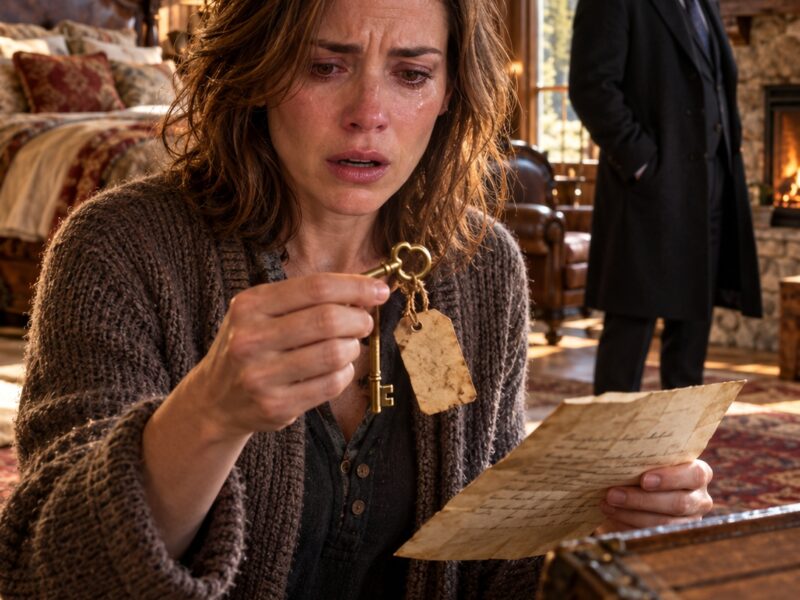
THEY THREW MY 7-YEAR-OLD DAUGHTER AND ME INTO THE STREET WITH $11—THEN A DEAD MAN LEFT ME A KEY TO A CABIN SEALED SINCE 1948

The first thing I found inside my grandfather’s cabin was proof that a dead man had known my daughter’s name.
The second was a box of letters he had spent half a century refusing to send.
The third was enough money to change our lives.
But none of those things frightened me as much as the sentence carved into the wood above the door.
I stood beneath it with my seven-year-old daughter, Lily, behind me, her sneakers muddy from the Blue Ridge trail and her fingers curled around the back of my jacket.
The cabin had been sealed since 1948.
Seventy-eight years.
My grandfather had supposedly never returned.
And yet beneath a set of initials carved when he was twenty-one were three names that belonged to women who had not even existed when the door was sealed.
Margaret.
Mara.
Lily.
My mother.
Me.
My daughter.
I remember staring upward until my neck hurt.
“Mama?”
Lily’s voice sounded very small.
I couldn’t answer.
Because suddenly the abandoned old man I had spent most of my life resenting didn’t feel absent anymore.
He felt close.
Too close.
And underneath the bed behind us sat a wooden chest I hadn’t opened yet.
I didn’t know then that opening it would force me to reconsider almost every cruel thing I believed about my family.
I only knew one thing.
Three days earlier, Lily and I had been sleeping in a station wagon with eleven dollars between us.
And now a dead man seemed to be telling us we had finally come home.
Three days earlier, I was sitting in a laundromat on Sycamore Street watching my last clean clothes tumble behind scratched glass.
That was where the letter found me.
Not at a house.
I didn’t have one anymore.
Not at an apartment.
That belonged to somebody else now.
It found me because Mrs. Alvarez, the manager of our old building, had apparently kept a handful of mail after we were evicted and had given it to a woman who knew a woman who knew where Lily and I sometimes washed our clothes.
Poverty develops its own postal system.
People pass information through checkout counters, church kitchens, school offices and motel desks because addresses become luxuries before dignity does.
I was thirty-seven years old.
I had eleven dollars in my wallet.
My daughter was doing second-grade math homework on top of a detergent box.
And someone had sent me a brass key.
“Mama?”
I looked over.
Lily had her pencil between her teeth.
“What’s eight times seven?”
“Fifty-six.”
“You didn’t even think.”
“I’m secretly a genius.”
She smiled.
That smile hurt sometimes.
Children are supposed to know when life is bad. They’re supposed to complain when dinner comes from a gas station or when their mother tells them sleeping in the car is an adventure.
Lily rarely did.
That was worse.
Seven-year-olds should not become good at protecting their mothers.
I turned the envelope over.
The return address belonged to a law office in North Carolina.
Inside were three pages, a smaller sealed envelope and the key.
The first line read:
Dear Ms. Whitfield,
We regret to inform you of the death of your maternal grandfather, Thomas Walter Whitfield.
I stopped reading.
Thomas Whitfield.
My grandfather.
A man I had met exactly twice.
Once when I was four, though I remembered only a tall shadow beside a doorway.
Once when I was nine, when I remembered his hands more clearly than his face.
Large hands.
Scarred knuckles.
A wedding ring.
He had stood on our porch while my mother blocked the doorway.
I had heard her say, “You don’t get to appear every ten years and call it love.”
He had answered quietly.
“I know.”
Then he left.
That was the closest thing to a relationship we ever had.
My mother, Margaret, never explained much.
When I asked about him, she said he was complicated.
When I asked whether he loved us, she changed the subject.
When I was fifteen, something happened between them—something involving a letter, an argument and my mother crying behind her bedroom door.
After that, his name disappeared completely.
And when my mother died three years ago, Thomas Whitfield did not come to the funeral.
That had settled the question for me.
Whatever else he was, he was not family.
Now he was dead.
And apparently he had remembered I existed.
I continued reading.
He had left me property.
I almost laughed.
I imagined acreage. A neglected house. Something that would immediately require taxes I couldn’t pay.
Then I found the description.
One cabin.
Blue Ridge Mountains.
Constructed 1947.
Sealed October 1948.
No recorded residential occupancy since.
My eyes returned to those words.
Sealed October 1948.
“What does sealed mean?” Lily asked.
I hadn’t realized she was reading over my elbow.
“It means closed.”
“Like locked?”
“More than locked.”
“Why?”
“I don’t know.”
The brass key lay in my palm.
A small tag hung from it.
Four words were written there.
FOR THE GIRL WHO COMES ASKING.
I stared at them.
Lily leaned closer.
“Are you the girl?”
“I’m thirty-seven.”
“You can still be a girl.”
“According to who?”
“Me.”
I laughed before I could stop myself.
Then I covered my mouth because laughter had become an expensive emotion. Once it started, crying sometimes followed.
The smaller envelope contained two hundred dollars in cash and a handwritten note from the notary.
Travel expenses were provided for you by Mr. Whitfield. Please come when you are able.
I counted the money twice.
Then a third time.
Two hundred dollars.
To most people it was groceries.
To us it was gasoline, motel money, dinner and the possibility of discovering whether a dead man had left us something that might keep us from sleeping another week in a station wagon.
I should have felt hopeful.
Instead I felt suspicious.
That is another thing poverty does.
It teaches you that every gift is merely a bill whose price has not yet been revealed.
We had not always been homeless.
I need to say that because people imagine homelessness as a personality.
As if you wake one morning possessing a house and then decide to become irresponsible before lunch.
For eleven years I worked the front office of a dental practice outside Richmond.
I paid bills.
I packed Lily’s lunches.
I kept an emergency fund.
Then the practice was purchased by a corporate group.
My position disappeared.
I found another job.
Fewer hours.
No benefits.
Then Lily got sick enough to spend four nights in the hospital.
Then my car needed a transmission.
Then our rent increased.
Then the second job I took at a grocery store cut overnight hours.
Then I borrowed money.
Then I borrowed more.
Then I stopped answering numbers I didn’t recognize.
Life did not collapse dramatically.
It leaked.
A hundred dollars here.
Three hundred there.
A missed payment.
A late fee.
A warning.
Another warning.
By the time the eviction notice came, I had already spent months pretending the floor beneath us wasn’t disappearing.
Lily was at school when the sheriff’s deputy stood beside our apartment door.
Our landlord, Gregory Hale, wouldn’t look at me.
“I told you I needed another week.”
“Mara, this isn’t personal.”
People say that right before doing something extremely personal.
“You know I have a child.”
“I gave you extensions.”
“Three days.”
“I can’t.”
“Three days, Gregory.”
He rubbed the back of his neck.
The deputy stared at the floor.
“I’m sorry.”
I remember thinking how useless those two words sounded.
Sorry did not carry furniture.
Sorry did not pay rent.
Sorry did not explain to a seven-year-old why her stuffed rabbit was suddenly packed inside a trash bag.
We slept in the car that night.
I told Lily we were camping.
She looked around the station wagon and said, “Do campers usually park behind Walmart?”
“No.”
“Okay.”
She pulled her blanket to her chin.
Then she said the sentence that almost destroyed me.
“You don’t have to make it fun, Mama. I know we’re having trouble.”
I turned my face toward the windshield so she wouldn’t see me cry.
That was seven months before the letter.
Seven months of motels when I could afford them, couches when pride allowed it, parking lots when neither option existed.
Seven months of learning which gas stations let you wash your face without buying anything.
Seven months of keeping Lily’s school uniform folded neatly inside a plastic storage bin so nobody would know.
Seven months of being tired enough to forget what hope felt like.
Then Thomas Whitfield died.
And left me a key.
The notary’s office was in a small North Carolina town with brick sidewalks and hanging flower baskets.
Mrs. Penhaligan was eighty if she was a day.
White hair.
Pearl earrings.
Eyes sharp enough to remove paint.
She looked at Lily first.
Then me.
Then our station wagon through the window.
She understood more than I wanted her to.
“You made good time.”
“We didn’t have anywhere else to be.”
Something shifted in her face.
She didn’t offer pity.
I appreciated that.
Instead she opened a folder.
“Your grandfather owned the mountain property outright.”
“Was it worth anything?”
“A strange first question.”
“It’s an honest one.”
“Yes.”
She folded her hands.
“I suppose it is.”
She explained that the cabin sat on several acres.
No mortgage.
Taxes current.
Thomas had maintained legal ownership but instructed everyone to leave the structure untouched.
“Why?”
“He never told me everything.”
“You knew him?”
“For thirty-four years.”
That startled me.
“What was he like?”
Mrs. Penhaligan studied me.
“You really don’t know?”
“No.”
She looked down at the folder.
“He was a man who mistook punishment for responsibility.”
I felt irritation rise immediately.
“I’m not interested in somebody making him sound noble.”
“I didn’t say noble.”
Her eyes met mine.
“I said punished.”
The distinction silenced me.
Before we left, she pushed two folded twenty-dollar bills across her desk.
“I can’t take that.”
“It isn’t charity.”
“What is it?”
“Gas.”
“I have the travel money.”
“You have a child.”
“I said no.”
“And I am old enough to ignore you.”
Lily giggled.
Mrs. Penhaligan winked at her.
Then she looked back at me.
“Your grandfather thought of everything.”
I nearly laughed.
“My grandfather didn’t think of my mother for most of her life.”
The old woman’s expression changed.
Not disagreement.
Pain.
“He thought of her,” she said.
I waited.
She did not elaborate.
“Then why didn’t he come?”
“That,” she said, “is something I think you should ask the cabin.”
The road climbed until cell service disappeared.
Late-April rain had washed the mountains clean.
Dogwoods flashed white between dark trunks.
Fog rested in the valleys.
Lily pressed her forehead against the passenger window.
“Are there bears?”
“Yes.”
“Big ones?”
“Yes.”
“Do they eat people?”
“Rarely.”
She turned slowly.
“That was not the correct answer.”
I laughed.
Twenty minutes later, pavement became gravel.
Gravel became packed dirt.
The station wagon complained at every incline.
Then the road simply ended.
The cabin stood in a clearing.
Small.
Dark.
A stone chimney.
Sagging porch.
Boarded windows.
No electricity lines.
No neighboring houses.
Nothing.
I switched off the engine.
Neither of us moved.
“That’s ours?” Lily asked.
“Apparently.”
“It looks haunted.”
“Thank you.”
“I like it.”
“Of course you do.”
She reached for the door.
“Wait.”
I don’t know why I stopped her.
Maybe because seventy-eight years suddenly felt like a physical thing.
A pressure.
My grandfather had been twenty-one when this door was sealed.
He had returned from World War II.
My mother once said Italy had taught him to become silent.
He built this cabin before marriage.
Before children.
Before me.
Before Lily.
Whatever waited inside had been placed there by a version of him none of us had known.
For one irrational moment, I wanted to leave.
I had survived by learning not to open doors unless I already knew what was behind them.
But Lily touched my wrist.
“Mama?”
I looked at her.
“We came all this way.”
Children are terrifyingly reasonable.
So we got out.
The porch groaned beneath us.
Waxed cloth had been pressed around the doorframe.
It peeled away brittle beneath my fingers.
The lock was orange with age.
I inserted the key.
It slid in perfectly.
I hesitated.
Lily squeezed my hand.
“Do it.”
I turned.
The lock clicked.
The door opened with something almost like a sigh.
Air moved across my face.
Dry wood.
Old paper.
Pine.
A faint sweetness I couldn’t identify.
Inside, thin blades of sunlight slipped between the boarded windows.
Dust moved through them.
A potbellied stove stood in one corner.
A table.
Two cups turned upside down.
A shelf.
A bed.
And that was when something about the room disturbed me.
It wasn’t abandoned.
Not exactly.
It was paused.
The bed was made.
A quilt folded carefully at one corner.
Two cups had been washed before being turned upside down on a cloth.
A coat hook waited beside the door.
The room looked as though somebody had walked outside seventy-eight years ago and expected to return before dark.
Lily stepped toward the bed.
“Can I touch it?”
“Carefully.”
She ran her fingers across the quilt.
“It’s soft.”
On the nightstand were two photographs.
I picked up the first.
My grandfather.
Young.
Military jacket.
Crooked smile.
I had never seen him smile.
Not once.
The second photograph showed a woman.
She sat on this same porch wearing a dark summer dress.
She was laughing at whoever held the camera.
Beautiful, yes.
But that wasn’t what held me.
It was the intimacy.
The photograph had clearly been taken by someone she trusted.
On the back:
Eleanor. June 1948.
“Who is she?” Lily asked.
“I don’t know.”
“She looks happy.”
“Yes.”
“She looks like she knows a secret.”
I looked again.
In Eleanor’s lap sat a brown leather book.
My eyes moved toward the window.
The same book rested on the sill.
I crossed the room.
Opened it.
April 14, 1948.
Thomas brought me to the cabin today.
I stopped breathing.
He says he built it for us with his own hands before he shipped out.
I read another line.
He carved my initials above the door, but he made me promise not to look until he tells me. He says some things should wait.
I closed the journal.
Not because I wasn’t curious.
Because suddenly curiosity felt intrusive.
These were not artifacts.
They were two people.
A twenty-year-old woman.
A twenty-one-year-old man.
A cabin.
A promise.
And something had happened here powerful enough that my grandfather sealed the door and kept it sealed for the rest of his life.
“Mama?”
“Yeah?”
“Are we staying tonight?”
I looked around.
We had blankets.
Food.
Candles.
There was a creek behind the cabin.
A hand pump stood beside the porch.
And our alternative was another motel room we could barely afford.
“One night.”
We stayed three.
Lily transformed the place almost immediately.
Children do that.
Adults enter ruins and see what was lost.
Children see available territory.
She named two chipmunks.
She discovered the creek.
She drew trees on the backs of old math worksheets.
She made a crown from twigs.
And that first night, after I lit the stove and heated canned soup, she ate sitting cross-legged on the bed and announced:
“This is better than the car.”
I froze.
She kept eating.
Seven years old.
Matter-of-fact.
No accusation.
That somehow made it worse.
“I’m sorry,” I said.
She looked confused.
“For what?”
“For everything.”
“Mama.”
She put down her spoon.
“I like being with you.”
There are sentences a child should never have to use to comfort her parent.
I smiled anyway.
“Finish your soup.”
After Lily fell asleep, I opened Eleanor’s journal.
I told myself I would read ten pages.
I read until the candle burned halfway down.
Eleanor Mercer had been twenty.
A schoolteacher.
She met Thomas at a church supper six weeks after he returned from Italy.
She wrote:
Thomas is quiet in a way that makes other men’s quiet seem noisy.
I read that sentence three times.
They courted through winter.
In spring, he blindfolded her and walked her up the mountain.
When he removed the cloth, the cabin stood before them.
“This is ours if you want it,” he told her.
She wanted it.
They planned to marry in October.
The entries became domestic.
Curtains.
Shelves.
Recipes.
Rain.
A mouse in the flour tin.
Thomas fixing the roof.
Eleanor teasing him for pretending not to enjoy dancing.
Then children.
Names.
If we have a daughter, we will call her Margaret after his mother.
I stopped.
My mother’s name had been Margaret.
My grandfather eventually married a woman named Ruth.
Margaret was born in 1956.
Eight years after Eleanor wrote that sentence.
I felt the first real chill of the night.
Something had happened.
I turned pages faster.
August 28, 1948.
He told me there is something in his lungs.
The doctors say perhaps one year. Two if God is feeling extravagant.
He offered to release me from our engagement.
Release me.
As though love were a contract.
I told him no.
The next pages were angry.
Eleanor refused to leave.
Thomas insisted.
She accused him of cowardice.
He accused her of sacrificing her life.
Then the entries became sparse.
October 11.
Last night in the cabin.
I am writing beside him.
He is asleep.
He asked me to leave this journal here.
He says the cabin should keep something of me.
He says tomorrow he will seal it.
One day, he says, someone will open it again.
Someone will know we were here.
I do not know who he means.
Perhaps he does not either.
He has always trusted time more than I do.
I am leaving tomorrow.
I am leaving the life I wanted.
I am leaving him.
If you are reading this, please know we were happy here.
The world took us apart.
But it did not get to take that.
Eleanor.
I closed the book.
Across the room Lily slept beneath the quilt Eleanor had probably chosen.
I looked at my daughter’s face.
Then at the journal.
My grandfather had not died in 1948.
That was the problem.
He had lived.
For seventy-eight more years.
He survived the illness.
Married someone else.
Had my mother.
Became a grandfather.
Became an old man.
And somewhere during those decades he chose never to open this cabin again.
Why?
Guilt?
Loyalty?
Fear?
Or because some doors, once closed, become easier to worship than reopen?
I slept badly.
The next morning Lily was outside trying to persuade a chipmunk to eat cracker crumbs from her palm when I remembered the lintel.
Eleanor’s initials.
I stood beneath the doorway.
Looked up.
At first I saw nothing.
Then light caught the cuts.
E.M. + T.W.W.
I smiled despite myself.
Then I noticed another line beneath it.
The carving was newer.
Still old.
But not 1948 old.
I dragged a chair beneath the doorway.
Climbed up.
Brushed dirt from the wood.
And stopped.
M + M + L
FOR WHOEVER COMES HOME.
My pulse began pounding.
M.
M.
L.
Margaret.
Mara.
Lily.
“No.”
I touched the carving.
“No, no, no.”
My mother had not been born when the cabin was sealed.
I had not been born.
Lily certainly had not.
Someone had returned.
Someone had entered—or at least stood beneath this doorway—after all.
My grandfather.
He had come back.
He knew our names.
He had carved them here.
And yet he never knocked on my door.
Never came to my mother’s funeral.
Never called.
Never sent a birthday card.
Never showed up.
The contradiction made me furious.
I climbed down too fast.
The chair tipped.
“Mama?”
Lily ran toward me.
“I’m fine.”
“What happened?”
“Nothing.”
But I was already crossing the cabin.
Because I had seen something under the bed.
A wooden chest.
I pulled it out.
No lock.
No label.
I lifted the lid.
Letters.
Dozens.
No.
Hundreds.
Every envelope carried my mother’s name.
Margaret Whitfield.
None had stamps.
I opened one.
My mother had been sixteen.
Margaret,
I saw your photograph in the church bulletin from Asheville. You won an essay prize. Your essay was about forgiveness.
I read it four times.
You write the way your mother used to speak.
I am proud of you.
I will not send this because I have not earned the right to enter your life simply because I miss you.
Dad.
I sat on the floor.
Opened another.
The year I was born.
Margaret,
I hear you have a daughter.
Mara.
A beautiful name.
I have arranged for money to be put aside for her.
You will be told it comes from an estate.
The estate is me.
I am sorry.
I do not know how to be a person you can know.
Dad.
My vision blurred.
Another.
Mara started school this year.
Another.
I heard what happened between you and Daniel. I wish I had the right to come help.
Another.
Mara married.
Another.
Lily is three.
She apparently likes strawberries and refuses carrots.
I laughed through my tears.
How did he know?
How had he known any of it?
My entire childhood I had believed Thomas Whitfield had forgotten us.
My mother believed it too.
She had spent years carrying the particular wound created when a parent remains alive but chooses absence.
At her funeral I stood beside her grave and hated him.
He did not even come to bury his own daughter.
Yet inside this box was evidence that he had followed her life for fifty years.
Not loudly.
Not bravely.
Not well.
But relentlessly.
Love had existed.
And somehow that made his absence hurt more.
Because indifference would have been simpler.
Indifference could be hated cleanly.
Love tangled everything.
I reached the bottom.
One final envelope.
My name.
Mara.
The handwriting shook.
March 3.
This year.
I opened it.
Mara,
I have been told I will not see another summer.
I am eighty-nine years too late for courage.
I smiled through tears at his arithmetic because he had always apparently been terrible at emotional mathematics.
Then I kept reading.
I have decided after a lifetime of not deciding to leave the cabin to you.
I do not know whether you will come.
I do not know whether you hate me.
If you do, I have earned some of it.
Perhaps all.
I am not asking forgiveness.
Forgiveness is too convenient a word.
I am asking only that you understand one thing.
I stayed away because I convinced myself absence could protect people.
I learned that mistake when I was young.
I repeated it with your mother.
Then with you.
A mistake repeated long enough begins to resemble character.
That does not make it less of a mistake.
My hands were shaking.
I continued.
The cabin has waited.
For most of my life I believed what was inside belonged to Eleanor.
Then I understood it belonged neither to her nor to me.
It belonged to whoever needed a place to begin again.
There is an account.
I have contributed to it for almost sixty years.
Small amounts.
Whatever I could spare.
It is yours.
For you.
For Lily.
For whatever life you still have the courage to build.
I stopped reading.
The room disappeared behind tears.
Then came the sentence that broke whatever remained.
I should have come when Margaret died.
I should have stood beside you.
I should have held you.
I should have been the kind of man who knocks on doors instead of leaving things behind them.
I was not.
Please be better at love than I was.
Please open the cabin.
Please let what is inside belong to you now.
Your grandfather,
Thomas Whitfield.
For a long time I could hear only Lily outside.
Her laughter.
The creek.
Birds.
Wind moving through pine needles.
Ordinary sounds.
I had always imagined revelations came with thunder.
They don’t.
Sometimes your understanding of your entire childhood changes while a chipmunk steals crackers from your daughter ten feet away.
I folded the letter.
Placed it back.
Then walked outside.
Lily sat on the porch drawing.
She looked up.
“Mama?”
“Yeah?”
“You’re crying.”
“A little.”
“Are you sad?”
I sat beside her.
I thought about saying no.
Then I thought about all the times adults had lied to children because truth was inconvenient.
“A little sad.”
She leaned against me.
“And something else.”
“What?”
I looked at the mountains.
“I think I’ve been found.”
She considered that.
“Like lost-and-found?”
I laughed.
“Kind of.”
“Who found you?”
I wrapped my arm around her.
“A man who took way too long.”
She nodded as though this made complete sense.
Then she held out her drawing.
It showed the cabin.
Two stick figures.
A giant sun.
And over the door she had drawn a heart.
Mrs. Penhaligan did not look surprised when I returned.
“You opened the chest.”
It wasn’t a question.
“You knew.”
“Some of it.”
“He watched us.”
“Not in the sinister sense you’re imagining.”
“Then explain it.”
She removed her glasses.
“Thomas kept track through people. Church newsletters. Friends. Public notices. Occasionally your mother’s acquaintances. He never asked anyone to interfere.”
“He knew Lily hates carrots.”
Mrs. Penhaligan smiled.
“That might have been me.”
I stared at her.
“You?”
“I sent him Christmas cards.”
“You knew my mother?”
“Not personally.”
“So everybody knew about us except us.”
“That is one interpretation.”
“What’s the other?”
“That an old man spent decades standing outside a life he was terrified to enter.”
“That doesn’t make it better.”
“No.”
Her answer came instantly.
Good.
I didn’t want excuses.
“He abandoned my mother.”
“Yes.”
“He abandoned me.”
“Yes.”
“He missed her funeral.”
“Yes.”
“Then why are you defending him?”
“I’m not.”
She leaned forward.
“Understanding someone is not the same as acquitting them, Mara.”
That sentence stayed with me.
Then she opened another folder.
“The account.”
I braced myself.
It wasn’t millions.
This was not that kind of story.
Thomas had been a forester.
Later a carpenter.
He had lived modestly.
But sixty years is a long time.
Small deposits accumulated.
Interest accumulated.
Investments matured.
The amount was enough.
Not enough to become wealthy.
Enough to become safe.
There is an enormous difference.
Enough to repair the station wagon.
Enough to rent a small place while we restored the cabin.
Enough to pay debts.
Enough to put money aside for Lily.
Enough for me to return to school.
Enough to breathe without calculating how many days remained until disaster.
I stared at the figure.
Mrs. Penhaligan waited.
“He did this every month?”
“Almost.”
“For sixty years?”
“Yes.”
“Why?”
She looked almost offended.
“Because he loved you.”
Anger flashed through me.
“People who love you show up.”
“Yes.”
“People who love you call.”
“Yes.”
“People who love you don’t hide behind bank accounts.”
“Yes.”
I looked at her.
She didn’t blink.
“Then stop saying it like this fixes anything.”
“I’m not saying it fixes anything.”
Her voice softened.
“I’m saying human beings can love each other terribly.”
That silenced me.
Because I knew she was right.
Not beautifully.
Not correctly.
Not enough.
Terribly.
Sometimes love does not fail because it is absent.
Sometimes it fails because the person carrying it is too damaged to deliver it.
That does not erase the damage.
It only changes the shape.
Mrs. Penhaligan slid the papers toward me.
“He spoke about you.”
I stared down.
“How?”
“Rarely. But when he did, it sounded as though he were describing someone he expected to meet tomorrow.”
“He never met me.”
“Not properly.”
She nodded.
“I think he rehearsed being your grandfather for thirty-seven years.”
My throat tightened.
“And never walked onstage.”
“No.”
She reached across the desk and covered my hand.
“That was his tragedy.”
Then she glanced toward Lily sitting outside.
“It doesn’t have to become yours.”
We went back to the cabin.
Not forever.
Not immediately.
But we went back.
I repaired things slowly.
The roof first.
Then plumbing.
Electricity came later.
Lily got a bedroom.
A real one.
She chose pale yellow walls and taped glow-in-the-dark stars above her bed.
The first night she slept there, I stood in the doorway watching her.
“You’re staring,” she said.
“I’m allowed.”
“It’s creepy.”
“I gave birth to you.”
“That doesn’t make staring less creepy.”
I smiled.
“Good night.”
“Mama?”
“Yeah?”
“Can they ever make us leave here?”
I stopped.
Children remember instability differently than adults.
Adults remember numbers.
Children remember doors.
Suitcases.
Whispers.
The expression on their parent’s face when somebody knocks.
“No,” I said.
Then corrected myself.
Because I had learned not to make promises bigger than life.
“Not easily.”
She smiled.
“Good enough.”
I closed the door halfway.
That became our life.
Good enough.
Then better.
I enrolled in nursing school.
At thirty-eight, I was older than most students.
I didn’t care.
There is freedom in arriving late to your own life.
You stop worrying about whether everyone else reached the station first.
I worked weekends.
Studied at the cabin table.
Sometimes I used Eleanor’s journal as a paperweight when the windows were open.
That would have horrified me months earlier.
Eventually I understood the cabin did not want to become a museum.
It wanted life.
Coffee rings.
Homework.
Wet boots.
Arguments.
Burned toast.
Lily singing badly.
Me falling asleep over anatomy textbooks.
The whole beautiful mess.
I found Eleanor six months later.
Or rather, I found her obituary.
Eleanor Mercer Caldwell.
She had married.
Moved west.
Taught elementary school for forty-two years outside Portland.
Three children.
Seven grandchildren.
Two great-grandchildren.
The obituary included a photograph of an old woman whose eyes I recognized instantly.
Same smile.
Same secret.
One sentence stopped me.
Her grandchildren remember her as the quietest happy woman they ever knew.
I read it repeatedly.
Quietest happy woman.
For years I had believed quiet meant emptiness.
My grandfather taught me otherwise.
Eleanor did too.
People can carry sealed rooms inside themselves and still build lives around them.
They can lose one future and love another.
They can remember without betraying what came later.
I found the address of Eleanor’s youngest granddaughter.
Then I spent three weeks deciding whether to write.
Finally I did.
My grandfather built a cabin for your grandmother in 1948.
I have her journal.
I have photographs.
I want you to know she was loved there.
The cabin is still standing.
If your family ever wants to see it, the door is open.
I expected nothing.
Two weeks later a letter arrived.
Her granddaughter wrote:
My grandmother never spoke Thomas’s name to us.
But she kept a small wooden carving of a cabin on her dresser until she died.
We never knew why.
I sat down hard at the kitchen table.
Then I read the next sentence.
I would like to come in spring.
Late September brought cool mornings.
Almost one year had passed since the laundromat.
Lily was eight now.
She had grown enough that carrying her on my shoulders hurt.
I did it anyway.
We stood beneath the lintel.
I held a hammer and chisel.
“You sure?” she asked.
“No.”
“Then why are we doing it?”
“Because being unsure doesn’t always mean stop.”
“That sounds like grown-up nonsense.”
“It probably is.”
Above us remained the first carving.
E.M. + T.W.W.
Below it:
M + M + L
FOR WHOEVER COMES HOME.
My grandfather had returned sometime after Lily’s birth to carve that.
I still didn’t know exactly when.
Perhaps I never would.
Some questions do not need to become answers to matter.
I positioned the chisel.
“What are you writing?” Lily asked.
“Something true.”
Tap.
The first letter appeared.
Then another.
My hands were not as steady as Thomas’s must have been.
That felt appropriate.
When I finished, Lily climbed down.
We stood together.
Four new words rested beneath his.
AND WE FINALLY DID.
Lily read them aloud.
“And we finally did.”
Then she slipped her hand into mine.
I thought about my mother.
Margaret never saw the cabin.
That remained the hardest part.
No inheritance could change that.
No explanation could return the years she spent believing her father didn’t love her.
Thomas had loved her.
He had also failed her.
Both things were true.
I had spent most of my life believing truth needed to choose sides.
Good father.
Bad father.
Love.
Abandonment.
Forgiveness.
Anger.
But families are rarely that merciful.
Sometimes the person who hurt you also saved something for you.
Sometimes the person who abandoned you spent fifty years writing letters he was too ashamed to send.
Sometimes love exists and still fails its most important test.
Sometimes forgiveness is not saying, You did nothing wrong.
Sometimes it is saying, What you did wrong will not decide what I do next.
I still wished he had knocked.
I wished he had come to my mother’s funeral.
I wished he had met Lily.
I wished he had sat at this table while she explained why carrots were morally offensive.
I wished I had heard his voice say my name.
Those wishes did not disappear simply because he left money behind.
But something else had disappeared.
The certainty that we had been unwanted.
That was enough.
The following spring, Eleanor’s granddaughter came.
Her name was Claire.
She was sixty-two.
When she stepped from her rental car, she stood staring at the cabin without moving.
I knew that feeling.
Lily ran toward her.
“Are you Eleanor’s granddaughter?”
Claire laughed through immediate tears.
“I suppose I am.”
“I’m Lily.”
“I know.”
That stopped me.
Claire looked at me.
“My grandmother kept your grandfather’s photograph.”
I swallowed.
“Until she died?”
“Until the day she died.”
We sat on the porch.
I gave Claire the journal.
She did not open it immediately.
She simply rested both palms over the leather.
“My mother never knew.”
“About Thomas?”
“No.”
She smiled sadly.
“Maybe she did. Children know more than parents think.”
We stayed quiet.
Then Claire asked the question I had wondered about for months.
“Do you hate him?”
I looked toward the trees.
“No.”
“Did you forgive him?”
I thought longer.
“I don’t know.”
Claire nodded.
“That sounds more honest.”
“I understand him better.”
“Maybe that’s enough.”
Maybe.
Before she left, Claire stood beneath the lintel.
She touched Eleanor’s initials.
Then Thomas’s.
Then Margaret, Mara and Lily.
Finally the words I had added.
She cried silently.
“I spent my whole life thinking my grandmother had one life,” she said.
“She did.”
Claire looked at me.
“You know what I mean.”
I did.
She touched the wood once more.
“Thank you for opening the door.”
After her car disappeared down the mountain road, Lily asked:
“Was Eleanor Grandpa Thomas’s girlfriend?”
“Fiancée.”
“What’s that?”
“Someone you’re going to marry.”
“But he married somebody else.”
“Yes.”
“So did he stop loving Eleanor?”
I looked toward the cabin.
“No.”
Lily frowned.
“Isn’t that bad?”
There are questions children ask that reveal how little adults understand.
“I think people can love more than one person in different ways.”
She considered this.
“Like how I love you and pancakes?”
“Not exactly.”
“I love pancakes a lot.”
“I know.”
She skipped toward the porch.
I watched her go.
It has been almost a year now since we moved permanently into the cabin.
The station wagon still runs.
Barely.
I keep threatening to replace it.
Lily says it survived with us and deserves retirement rather than abandonment.
So apparently I am raising a sentimental mechanic.
The account my grandfather left is still there.
Most of it.
I use it carefully.
School.
Repairs.
Emergencies.
A future for Lily.
I do not think of it as compensation anymore.
No amount of money can compensate for absence.
I think of it as evidence.
Evidence that Thomas tried to speak in the only language he trusted.
Work.
Wood.
Savings.
Preparation.
He could build houses.
He could repair roofs.
He could preserve a cabin for seventy-eight years.
He could put away money month after month.
He could write hundreds of letters.
The one thing he could not do was knock.
I understand that now.
I refuse to inherit it.
So I knock.
When Lily closes her bedroom door after we argue, I wait ten minutes.
Then I knock.
When I hurt someone, I call.
When I miss someone, I tell them.
When I am afraid, I try not to disguise fear as sacrifice.
I fail often.
But I knock.
That may be the greatest inheritance Thomas Whitfield left me.
Not the cabin.
Not the money.
Not even the letters.
A warning.
Love kept silent for too long eventually becomes indistinguishable from absence to the person waiting for it.
I wish he had learned that sooner.
But perhaps some lessons arrive generations late.
Perhaps that is why families keep going.
One person makes the mistake.
Another names it.
Someone else finally stops repeating it.
Sometimes at night, after Lily is asleep, I sit on the porch.
The mountains turn black first.
Then the sky.
The creek continues talking in the darkness.
I imagine Thomas here in 1948.
Twenty-one.
Terrified.
In love.
Certain he was dying.
Certain that sending Eleanor away was noble.
I imagine him returning decades later.
Older.
Perhaps seventy.
Perhaps eighty.
Standing beneath this doorway with a chisel.
Carving three letters.
M.
M.
L.
Maybe his hands shook.
Maybe he stood where I stand now and wondered whether any of us would ever see them.
Maybe he almost drove to my house afterward.
Maybe he sat inside his truck with the engine running and lost his courage.
I will never know.
That used to bother me.
It doesn’t anymore.
Not every sealed room needs to surrender every secret.
Some truths are enough.
Thomas loved Eleanor.
He let her go.
He survived.
He married Ruth.
He had Margaret.
He failed Margaret.
He loved her anyway.
He watched me grow from a distance.
He failed me too.
He saved for me anyway.
He knew Lily’s name.
He never held her.
He carved it into a house instead.
None of those facts cancels another.
Together, they make a man.
Flawed.
Afraid.
Loving.
Cowardly.
Patient.
Too late.
Human.
And maybe that is the hardest inheritance of all.
Discovering that the people who shaped your pain were not monsters.
Because monsters are easy.
Human beings require grief.
Last Tuesday, Lily came home from school carrying a family-tree assignment.
I almost laughed.
“What?”
“Nothing.”
“You’re making the face.”
“What face?”
“The weird one where you’re going to cry but pretend you have allergies.”
“I have allergies.”
“In October?”
“Very aggressive allergies.”
She rolled her eyes.
We spread the worksheet across the same table where Eleanor once wrote in her journal.
Lily filled in my name.
Then her grandmother Margaret.
Then she reached Thomas.
She paused.
“What should I write about him?”
“What does the assignment ask?”
“One interesting fact.”
I looked toward the door.
The lintel was visible from the table.
Sunset touched the carved letters.
I could have told her he fought in a war.
That he was a forester.
A carpenter.
That he lived nearly a century.
Instead I said:
“He built this house.”
Lily wrote it.
Then stopped.
“That’s boring.”
“It is?”
“He did more than that.”
I smiled.
“What do you want to write?”
She thought.
Then her pencil moved.
I leaned over.
Thomas Whitfield — built a house for people he hadn’t met yet.
I stared at the sentence.
Seven words.
A child had understood him better than I had.
Maybe better than he understood himself.
“That okay?” Lily asked.
I kissed the top of her head.
“Yeah.”
She squirmed.
“Mom.”
“Sorry.”
“You’re doing the crying thing.”
“Allergies.”
“Sure.”
She went back to her worksheet.
I walked outside.
The evening was cool.
I stood beneath the lintel.
E.M. + T.W.W.
M + M + L.
FOR WHOEVER COMES HOME.
AND WE FINALLY DID.
I ran my fingers over the grooves.
Once, I thought inheritance meant what the dead leave behind.
Money.
Property.
Objects.
Debts.
Names.
Now I think inheritance is stranger.
Sometimes we inherit unanswered questions.
Sometimes fear.
Sometimes unfinished apologies.
Sometimes the consequences of decisions made before we were born.
And sometimes, if we are extraordinarily lucky, we inherit a chance to finish something differently.
My grandfather sealed a door because he thought protecting love meant keeping his distance.
Seventy-eight years later, his granddaughter opened it because she had nowhere else to go.
Inside she found the life of a woman she had never known.
The love of a man she had misunderstood.
Hundreds of apologies nobody received.
And enough money to give her daughter a bed.
But the most important thing I found inside that cabin was not hidden under the bed.
It was not written in Eleanor’s journal.
It was not deposited in a bank.
It was carved above a doorway.
My name.
My mother’s name.
My daughter’s name.
Proof that long before I arrived exhausted and angry with eleven dollars in my wallet, somebody had imagined the possibility that I might come.
Somebody had prepared a place.
Badly.
Silently.
Too late.
But prepared it nonetheless.
For most of my life, I thought nobody was coming for me.
I thought that was adulthood.
You stop waiting.
You save yourself.
You carry your child.
You sleep in the car.
You count eleven dollars twice because counting it cannot make it become twelve.
You keep moving because nobody is coming.
Then one day a letter arrives.
A brass key falls into your palm.
And you discover that somewhere in the long, complicated silence behind you, an imperfect man had been carving your name into a doorway.
Waiting.
Not well.
Not bravely.
But waiting.
I wish he had opened the door himself.
I wish he had walked through it while he was alive.
I wish my mother had known.
Those wishes will probably remain with me forever.
But tonight Lily’s shoes are beside the door.
Her backpack is hanging from Thomas’s old coat hook.
Her laughter comes through the wall.
My nursing textbook is open on the kitchen table.
There is soup on the stove.
Running water in the pipes.
A repaired roof above us.
And four lines carved into the lintel.
The cabin no longer looks paused.
It is loud.
Messy.
Warm.
Alive.
Exactly what Thomas and Eleanor once imagined it might become.
Maybe not with the people they expected.
Maybe not in the century they expected.
But life has never been particularly respectful of plans.
I look up at those names every morning.
Margaret.
Mara.
Lily.
Three women Thomas could not bring himself to hold close enough.
Three women he nevertheless carried for decades.
And beneath them, my own imperfect answer.
AND WE FINALLY DID.
Lily calls from inside.
“Mom! The soup is doing something weird!”
“What does that mean?”
“Come look!”
I laugh.
“I’m coming.”
And before I step through the doorway, I touch the old carving once.
Not because everything has been forgiven.
Not because the past has been repaired.
Some things cannot be repaired.
But because I finally understand what Thomas was trying to give us.
Not an apology.
Not money.
Not even a house.
A place where the next person could do better.
Then I walk inside.
I do not close the door behind me.









