They Tied Her to Four Stakes and Left Her to Die—Then a Stranger Cut the First Rope and Uncovered a Terrifying Secret…
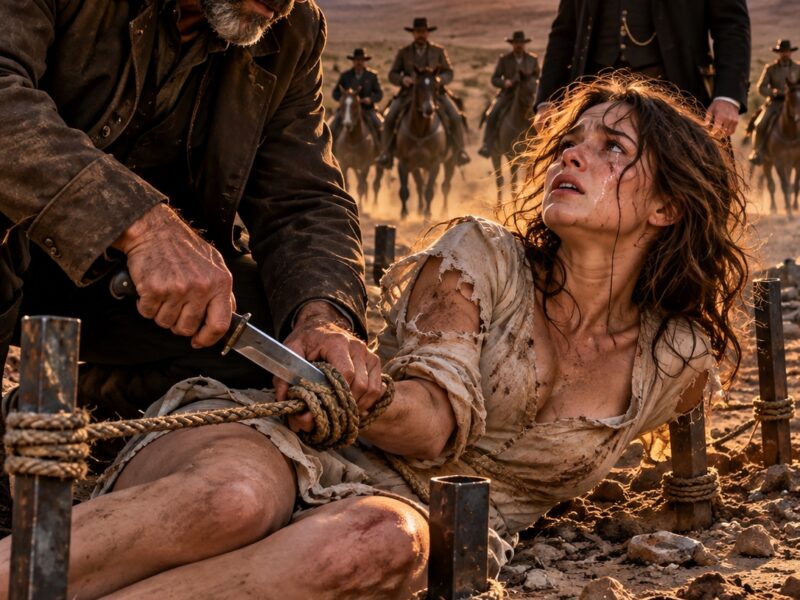
 The first rope snapped beneath Desmond Harker’s knife at 6:17 p.m.
The sound was small.
Barely more than a dry pop beneath the Nevada wind.
But on the ridge half a mile away, one of the two men watching through binoculars immediately lowered them, turned his motorcycle around, and disappeared toward Vesper Wells.
Desmond saw him go.
So did the woman tied to the ground.
Her swollen eyes opened a fraction.
“You shouldn’t have done that,” she whispered.
Desmond looked down at her.
She couldn’t have been more than twenty-three or twenty-four. Her wrists were raw where nylon rope had cut through the skin. Her lips were split from dehydration. Four steel stakes had been driven into the hard desert earth around her, one at each wrist and ankle, stretching her beneath a sun that had spent the entire day trying to kill her.
A laminated sign had been zip-tied to one of the stakes.
THIEF.
Underneath it, someone had written:
THE COMPACT REMEMBERS.
Desmond stared at the words.
Eleven years earlier, another rule had cost him the woman he loved.
He had spent every year since telling himself that looking away was sometimes the price of surviving.
Then he looked at the young woman again.
“Who put you here?”
Her cracked lips barely moved.
“Rufus Gant.”
That name made something cold move through him despite the heat.
Desmond glanced toward the ridge.
The second watcher was still there.
Still watching.
Still making no attempt to hide.
“You steal something from him?”
The woman swallowed painfully.
“No.”
“What are they saying you stole?”
“Gold.”
“How much?”
“Thirty bars.”
Desmond almost laughed.
Not because it was funny.
Because the accusation was absurd.
Thirty standard refinery bars from a secured commercial vault represented millions of dollars and hundreds of pounds of metal. Nobody carried that out in a purse. Nobody slipped it beneath a jacket.
And nobody did it alone.
The woman saw the disbelief in his face.
“I told them that.”
“What did they say?”
“That I had access.”
“That’s it?”
Her eyes closed.
“That was enough.”
Desmond looked at the remaining three ropes.
Then at the man on the ridge.
Then toward the distant buildings of Vesper Wells, shimmering beneath the evening heat.
He understood exactly what cutting the second rope would mean.
The first could perhaps be explained as impulse.
The second was a decision.
The third would be defiance.
By the fourth, he would be declaring war.
The woman opened her eyes again.
“They’ll kill you.”
Desmond slid the knife beneath the second rope.
“They can stand in line.”
And cut.
Three hours earlier, Lavinia Crowell had stopped sweating.
That was when she knew she was in real trouble.
Her father had taught her enough about desert survival to understand what it meant.
When the body stopped sweating in extreme heat, it wasn’t recovering.
It was failing.
She lay on the cracked ground of Sunwatch Flat and stared into a white Nevada sky so bright that the edges of everything seemed to disappear.
The ropes had gone numb against her wrists.
That frightened her more than the pain had.
Pain meant nerves were still speaking.
Numbness meant something was shutting down.
She tried to move her fingers.
Nothing.
“Dad,” she whispered.
There was no answer.
Barton Crowell had been dead for fourteen months.
Some mornings Lavinia still reached for her phone intending to call him before remembering there was nowhere left to call.
She could see him now anyway.
Not as he had looked during his final months, thin and tired beneath fluorescent hospital lights, but as he had been when she was nine years old, standing beside a battered workbench in their garage.
He had placed a tiny gold coin in one of her palms and a brass washer in the other.
“Close your eyes.”
She had laughed.
“Why?”
“Because your eyes are lazy.”
“My eyes are not lazy.”
“Everybody’s are. Close them.”
She had obeyed.
He tapped the coin against a metal plate.
A bright, clear note.
Then the brass.
A duller sound.
“Gold tells you what it is,” Barton had said. “Weight. Density. Sound. People lie. Metal usually doesn’t.”
Years later, that lesson had made Lavinia valuable.
And eventually, it had nearly gotten her killed.
Vesper Wells was the kind of town that looked prosperous from the highway.
A renovated historic district.
Coffee shops with reclaimed-wood counters.
Electric vehicle chargers beside buildings from the 1890s.
A luxury resort on the eastern hill.
A private airstrip.
And beyond everything, rising from the desert like enormous black scars, the open-pit mines belonging to Gant Meridian Resources.
The company employed nearly half the county directly and supported much of the rest indirectly.
Rufus Gant had inherited a regional mining operation from his father and turned it into a billion-dollar metals empire.
Copper.
Lithium.
Rare earths.
And gold.
He also funded the hospital.
The high school football stadium.
The sheriff’s reelection campaign.
The local newspaper.
The church renovation.
Three county commissioners.
Half the businesses on Main Street.
People in Vesper Wells joked that Rufus Gant didn’t own the town.
He simply owned everything the town needed.
Nobody laughed very hard.
Lavinia had worked for Gant Meridian for four years.
Official title: senior bullion verification specialist.
Unofficially, she was the woman who checked the gold.
Every bar leaving the processing facility passed through a chain of custody involving cameras, biometric access, serial records, assay reports and multiple signatures.
It was supposed to be impossible to falsify.
That was why the discrepancy had bothered her.
At first, it was tiny.
Forty-eight grams.
Then seventy-one.
Then ninety-three.
Differences small enough to be blamed on calibration.
Except calibration errors drifted.
These didn’t.
The weights were wrong in patterns.
Lavinia began staying late.
She compared shipping manifests.
Assay certificates.
Vault logs.
Security footage.
Production numbers.
She told nobody.
Not even her closest friend, Naomi Pierce, who worked in accounting.
Especially not Naomi.
Her father had taught her something else.
When numbers began lying in the same direction, someone was making them lie.
Three weeks later, Lavinia selected one bar at random from shipment batch 7C-41.
She weighed it.
Then weighed it again.
Then she stared at the display.
The bar was wrong.
Not by grams.
By pounds.
She carried it into the assay room after midnight, locked the door and ran a density test.
Her hands began trembling before the result finished.
The exterior was gold.
The interior wasn’t.
Tungsten.
A gold shell around a tungsten core.
Someone had been replacing genuine bullion with counterfeits.
And doing it inside one of the most secure mining facilities in Nevada.
Lavinia sat alone in the assay room until nearly two in the morning.
Then she called the one person she believed would take the discovery seriously.
Rufus Gant.
That was her first mistake.
Her second was telling him exactly what she had found.
Her third was believing the frightened silence on the other end of the phone meant he was shocked.
By sunrise, thirty genuine bars were missing.
By noon, security records showed Lavinia accessing the vault repeatedly over the previous six weeks.
At 12:43 p.m., sheriff’s deputies arrived at her apartment.
At 1:10, Rufus Gant stood before company employees and announced that a trusted member of his organization had betrayed them.
At 2:00, Lavinia discovered that the sheriff wasn’t taking her to jail.
He was taking her to Sunwatch Flat.
“What is this?” she demanded when the cruiser stopped.
Nobody answered.
She saw people waiting.
Hundreds of them.
Employees.
Ranchers.
Store owners.
Retirees.
Families.
People she had known since elementary school.
Her third-grade teacher was there.
The woman who cut her hair was there.
The pharmacist who had filled her father’s cancer prescriptions was there.
And standing at the center of them all was Rufus Gant.
He wore a white shirt with the sleeves rolled neatly to his elbows.
No tie.
No jacket.
He looked less like a billionaire than a man preparing to give a motivational speech.
Behind him stood four members of the Sunwatch Compact.
Officially, the Compact was a historical preservation organization dating back to the mining camps of the nineteenth century.
In reality, it was something else.
Business owners joined.
Ranchers joined.
Local officials joined.
Judges attended its dinners.
Sheriff’s deputies wore its silver sun pins beneath their badges.
The Compact settled disputes quietly.
It decided which businesses received loans.
Which families got contracts.
Which people found themselves suddenly unwelcome in Vesper Wells.
Most of its rules were symbolic.
Some were not.
Lavinia had heard stories.
Everyone had.
But stories were different when four steel stakes were lying in the dirt.
Rufus approached her.
“You can make this easier.”
She stared at him.
“You know I didn’t take those bars.”
A murmur moved through the crowd.
Rufus’s expression never changed.
“You were given extraordinary trust.”
“I found counterfeit gold in your vault.”
The murmuring stopped.
That silence told her everything.
Rufus stepped closer.
“You’re dehydrated and distressed.”
“I found tungsten cores.”
His jaw tightened.
Only slightly.
But Lavinia saw it.
So did one other person.
Ike Waddle.
Seventy-two years old.
Former mine foreman.
Friend of her father.
He stood near the back of the crowd with both hands gripping his cane.
Lavinia looked directly at him.
“Ike.”
The old man lowered his eyes.
Her heart sank.
He knew something.
“Tell them,” she said.
Ike’s mouth opened.
Rufus turned his head.
Nothing more.
Just a look.
Ike closed his mouth.
Lavinia understood.
Fear had won.
Again.
Rufus faced the crowd.
“The Compact existed before any of us,” he said. “It exists because law means nothing if a community refuses to defend itself.”
Lavinia laughed once.
It sounded almost hysterical.
“This is kidnapping.”
“The sheriff is standing twenty feet away.”
“Then he’s part of it.”
The sheriff looked at the ground.
Rufus continued.
“The old rule is clear. A person who steals from the survival reserve faces the judgment of Sunwatch.”
Someone in the crowd whispered, “Jesus.”
Rufus heard.
“The condemned remains beneath the open sky. No food. No water. No interference.”
Lavinia stared at him.
“You’re going to murder me in front of three hundred people?”
“No.”
His voice was almost gentle.
“You’re going to tell us where the gold is.”
“I don’t know.”
“Then perhaps you’ll remember.”
That was when two Compact men grabbed her.
Lavinia fought.
She kicked.
Screamed.
Begged.
Nobody moved.
As they tied her wrists, she searched the crowd for one face willing to look directly at hers.
Most people couldn’t.
That hurt worse than the ropes.
Because cruelty was one thing.
Cowardice multiplied it.
By five o’clock, the crowd was gone.
By six, Lavinia believed she would die alone.
Then she heard hoofbeats.
Not a truck.
Not a motorcycle.
A horse.
For a moment she thought the sound was another hallucination.
Then a gray gelding appeared through the heat.
The rider was broad through the shoulders, gray threaded through his beard, his face darkened by years outdoors.
Desmond Harker.
She knew the name.
Everybody did.
He owned Harker Ranch north of the ridge, nearly six thousand acres of high desert grazing land and old mineral claims.
He almost never came to town.
People said he hated Vesper Wells.
People also said Vesper Wells had given him reason.
Lavinia watched him slow his horse.
Look at her.
Then look away.
He began turning north.
Something inside her broke.
“Please.”
The word barely came out.
He stopped.
She forced air into her lungs.
“Please… untie me.”
The horse stood still.
So did the man.
For several seconds, Lavinia thought he would continue riding.
Then Desmond Harker turned around.
Now, with two ropes cut and the sun dropping toward the mountains, Lavinia watched him slice through the third.
Blood rushed painfully into her hand.
She cried out.
Desmond immediately stopped.
“Easy.”
“It hurts.”
“I know.”
“No, you don’t.”
His eyes met hers.
Something changed in his expression.
“You’d be surprised.”
He cut the fourth rope.
Lavinia tried to sit.
The world tilted.
Desmond caught her before her head hit the ground.
She felt his coat around her shoulders.
Then a canteen touched her mouth.
She grabbed it desperately.
He pulled it away.
“No.”
“Please.”
“Small sips.”
“I’m dying of thirst.”
“That’s why.”
She glared at him with what little strength remained.
“Are you always this irritating?”
“Mostly.”
He let her drink again.
One mouthful.
Then another.
She closed her eyes as water touched her throat.
It was the best thing she had ever tasted.
“My name is Lavinia Crowell.”
“I know.”
Her eyes opened.
“How?”
“Your father fixed a pump for me fifteen years ago.”
“You knew Dad?”
“Everybody who owned machinery within fifty miles knew Barton.”
For the first time that day, something almost like a smile touched her face.
Then Desmond looked toward the ridge.
Two men.
Watching.
One left.
The other stayed.
Lavinia’s faint smile disappeared.
“Mr. Harker—”
“Desmond.”
“You need to leave.”
“So do you.”
“You don’t understand Rufus.”
“I understand men who need everybody afraid of them.”
“No. You really don’t.”
Desmond stood.
Dust moved around his boots.
“Then explain him while we ride.”
He had just lifted her toward the saddle when four motorcycles appeared over the southern ridge.
Compact wardens.
Brown jackets.
Silver sun emblems.
They came fast.
Lavinia felt Desmond’s body become still.
“Those men aren’t here to talk.”
“I figured.”
He placed her against the saddle.
“Can you hold on?”
“I think so.”
“That wasn’t confidence-inspiring.”
“I spent four hours tied to the ground.”
“Fair point.”
He turned.
The motorcycles stopped thirty yards away.
The lead man removed his helmet.
Dale Mercer.
Former sheriff’s deputy.
Current head of security for Gant Meridian.
“Desmond.”
“Dale.”
“You know what this is.”
“I know what it looks like.”
“Then walk away.”
Desmond glanced back at Lavinia.
“No.”
Mercer sighed.
“You haven’t changed.”
“Neither has this town.”
“This isn’t about your wife.”
The sentence hit harder than a fist.
Lavinia saw Desmond’s face change.
Mercer realized too late that he had pushed the wrong wound.
“You don’t get to say her name,” Desmond said.
“I didn’t.”
“You thought it.”
Mercer stepped forward.
“Put the girl back.”
Girl.
Not woman.
Not employee.
Not citizen.
Girl.
As if making Lavinia smaller made what they were doing easier.
Desmond’s hand settled near the revolver at his hip.
It was an old-fashioned weapon for a modern world.
But nobody laughed.
Mercer looked at it.
“You going to shoot four men over someone you don’t know?”
“No.”
Desmond paused.
“I’m hoping you’re smart enough that I won’t have to.”
One of the wardens moved first.
He rushed Desmond with a telescoping baton.
Lavinia screamed.
Desmond stepped sideways.
The baton missed his temple by inches.
He caught the man’s wrist, drove a shoulder into his chest and sent him crashing into the dirt.
The next man reached beneath his jacket.
Desmond drew.
The revolver’s barrel stopped directly between the man’s eyes.
Everything froze.
“Don’t,” Desmond said.
The man didn’t.
Mercer stared at him.
Then, unexpectedly, he smiled.
“You just made this much bigger than it needed to be.”
“No,” Desmond said. “Rufus did that when he tied a woman to four stakes.”
Mercer backed toward his motorcycle.
“You won’t make the county line.”
Desmond holstered the gun.
“Tell Rufus something for me.”
“What?”
Desmond looked across the empty flat.
“Next time he wants to murder somebody, he should have the courage to stay and watch.”
Mercer’s smile vanished.
They rode away.
That should have frightened Lavinia.
Instead, something else did.
Desmond knelt where she had been tied.
He struck the hard ground with the handle of his knife.
Clang.
Not stone.
Not packed clay.
Metal.
He struck it again.
Clang.
Lavinia stared.
“What is that?”
Desmond brushed away the dust.
A rusted steel edge appeared beneath the surface.
He dug with his fingers until several inches were exposed.
It wasn’t a plate.
It was a hatch.
And stamped faintly into the metal beneath decades of dirt were three words:
SUNWATCH PROCESSING CO.
Desmond looked toward Vesper Wells.
Then at Lavinia.
“What exactly did your father do before he repaired pumps?”
Her breathing stopped.
Because suddenly she remembered something Barton Crowell had said three weeks before he died.
Something she had dismissed as morphine and memory mixing together.
If they ever accuse you of stealing the gold, sweetheart, don’t look inside the vault.
Look underneath the lie.
Desmond got her onto Tinder.
They rode north.
And nobody followed them.
That bothered Desmond more than pursuit would have.
Rufus Gant had men.
Vehicles.
Drones.
County deputies.
Private security.
He could have blocked every road leaving the valley within twenty minutes.
Instead, nothing happened.
The desert behind them remained empty.
“Why aren’t they coming?” Lavinia whispered.
Desmond had been wondering the same thing.
“I don’t know.”
“That’s worse, isn’t it?”
“Yes.”
Harker Ranch sat behind two ridges where cellular service disappeared and the highway became a pale line in the distance.
The house was modest.
The barn was not.
Desmond had spent years restoring horses, machinery and land while allowing the house to remain almost exactly as Maren had left it.
Lavinia noticed that immediately.
A woman’s ceramic mug still sat on a shelf.
A faded yellow raincoat hung beside the back door.
A photograph stood on the fireplace.
Desmond and a dark-haired woman beside a river.
Lavinia looked away before he caught her staring.
He helped her onto the kitchen table and opened a medical kit.
“You need a hospital.”
“The hospital is named after Rufus Gant.”
“That complicates things.”
“You think?”
“I said it complicates things.”
Despite everything, she laughed.
It hurt.
Then she began crying.
The change was so sudden that Desmond stopped unwrapping gauze.
Lavinia covered her face.
“I’m sorry.”
“For what?”
“I don’t know.”
She laughed through the tears.
“That’s stupid.”
“No.”
“I thought I was going to die there.”
Desmond said nothing.
“I kept waiting for somebody to stop it.”
Still nothing.
“My teacher was there.”
Her voice broke.
“Mrs. Bell. She used to bring me muffins when Dad was sick.”
Desmond cleaned the wounds around her wrists.
Lavinia flinched.
“She watched them tie me down.”
Desmond’s hands became gentler.
“I kept thinking she’d say something. Or Ike. Or the sheriff. Anybody.”
She lowered her hands.
“Why didn’t they?”
Desmond met her eyes.
“Because most people don’t become cowards all at once.”
She waited.
“It happens one small surrender at a time.”
That sounded practiced.
Lived.
Lavinia looked toward the photograph.
“Your wife?”
His hands stopped.
“Maren.”
“What happened?”
Desmond resumed wrapping the bandage.
“Long time ago.”
“Dale said—”
“I heard what Dale said.”
She went quiet.
A minute later Desmond said, “She had an ectopic pregnancy.”
Lavinia’s eyes lifted.
“We were out near Granite Wash. I was helping move cattle. She started bleeding.”
He taped the gauze.
“The fastest route to the clinic crossed private land controlled by the Compact. Gate was locked after nine. Three men had keys.”
His voice remained flat.
That made it worse.
“She asked them.”
Lavinia felt cold.
“They refused?”
“Rules were rules.”
“Desmond…”
“By the time somebody decided dying might qualify as an exception, she’d lost too much blood.”
He put the medical supplies away.
“I spent eleven years pretending I hated Vesper Wells because they killed her.”
He looked at the photograph.
“Truth is, part of me hated myself because I wasn’t there.”
Lavinia understood then why he had turned around in the desert.
He hadn’t saved a stranger.
He had answered a question that had been haunting him for eleven years.
What would he have wanted someone to do for Maren?
His phone rang.
Both of them froze.
Desmond looked at the screen.
Unknown number.
He answered.
“Yeah?”
Rufus Gant’s voice came through the speaker.
“Good evening, Desmond.”
Desmond’s expression hardened.
Lavinia sat upright.
“How’d you get this number?”
“I own a telecommunications company.”
“Of course you do.”
“I understand there was an unfortunate confrontation.”
“You mean when your men tried to drag a dying woman back into the desert?”
A pause.
“Is Lavinia alive?”
She stared at the phone.
Desmond said, “Disappointed?”
“Actually, no.”
Something about the answer unsettled both of them.
Rufus continued.
“I’m going to give you one opportunity. Bring her back.”
“No.”
“You didn’t let me finish.”
“I saved us both time.”
“Desmond.”
Rufus’s voice softened.
“Do you remember what Maren used to say about stubborn men?”
Desmond went completely still.
Lavinia watched his fingers tighten around the phone.
“You don’t say her name.”
“I knew your wife.”
“You knew the men who let her die.”
Another pause.
“Yes.”
That single word filled the kitchen.
Then Rufus said something neither of them expected.
“I’m not sending anyone after you tonight.”
Lavinia looked at Desmond.
He looked equally confused.
“Why?”
“Because you’re going to bring Lavinia back voluntarily.”
“Not likely.”
“You will.”
“What makes you so sure?”
Rufus waited.
Then said, “Ask her what her father buried beneath Sunwatch Flat.”
The call ended.
For several seconds neither spoke.
Desmond slowly turned toward Lavinia.
She looked terrified.
“I don’t know what he means.”
“You sure?”
“Yes.”
“Think.”
“I am thinking.”
“Your father ever mention Sunwatch?”
“No.”
“Processing company?”
“No.”
“Underground storage?”
“No.”
She stopped.
Desmond saw it.
“What?”
Lavinia stared at the table.
“Dad had a key.”
“What kind?”
“Old brass key. He wore it around his neck.”
“Where is it?”
“I don’t know.”
“Think.”
“When he died, the hospital gave me his belongings.”
“Was the key there?”
Lavinia’s face changed.
“No.”
Desmond leaned closer.
“Who was with him when he died?”
She looked up.
“Rufus.”
The next morning, Vesper Wells woke to a different story.
Gant Meridian released security footage allegedly showing Lavinia entering the vault after midnight.
Local news called her the prime suspect in a $24 million bullion theft.
Sheriff Nolan Price issued a statement saying Lavinia had escaped “lawful protective custody” with assistance from an armed rancher.
Desmond watched the broadcast from his kitchen.
“Armed rancher.”
Lavinia sat beneath a blanket with coffee between both hands.
“You are armed.”
“That’s not the point.”
“They made you sound like a terrorist.”
“I’ve been called worse.”
Her phone had been destroyed during her capture.
Desmond gave her an old laptop.
She logged into Gant Meridian’s employee portal.
Access denied.
Personal email.
Locked.
Cloud storage.
Locked.
Bank account.
Frozen.
She stared at the screen.
“They erased me.”
“No.”
Desmond set down his coffee.
“They’re trying to isolate you.”
“What’s the difference?”
“One means you’re gone.”
He pointed at her.
“You’re sitting here.”
At 9:12 a.m., somebody knocked on the door.
Desmond drew his revolver before opening it.
Ike Waddle stood outside.
The old man looked twenty years older than he had the previous afternoon.
“Put that thing away.”
Desmond didn’t.
Ike looked past him.
“Is she alive?”
Lavinia stood.
“Ike.”
His face collapsed.
“I’m sorry.”
She didn’t answer.
He stepped inside.
“I should’ve spoken.”
“Yes.”
“I was afraid.”
“I know.”
“Your father would hate me.”
Lavinia’s eyes filled.
“Dad’s dead.”
Ike lowered his head.
“I know.”
He reached into his coat.
Desmond’s hand moved toward his gun.
Ike slowly produced a small envelope.
Inside was a brass key.
Lavinia stopped breathing.
“Ike…”
“Your father gave it to me six months before he died.”
“Why?”
“He told me if anything happened to him, I was supposed to give it to you.”
“Then why didn’t you?”
Ike’s eyes filled with shame.
“Because Rufus came to my house the morning after Barton died.”
Desmond’s jaw tightened.
“What did he want?”
“The key.”
“You told him you didn’t have it?”
“Yes.”
“And he believed you?”
“No.”
Ike sat heavily.
“He showed me pictures of my granddaughter walking into school.”
Lavinia closed her eyes.
Desmond said nothing.
He didn’t need to.
Ike placed the key in Lavinia’s palm.
“Your father discovered something thirty years ago.”
“What?”
“Sunwatch Flat wasn’t always empty desert.”
Ike looked toward the northern window as though he could see through the ridges.
“There was a processing facility there. Built in 1978. Closed in ’96 after a fire.”
“The hatch.”
Ike nodded.
“Most of the plant was underground.”
“Why?”
“Security. Temperature control. And because there were things Gant Meridian’s predecessor didn’t want inspectors finding.”
Lavinia tightened her fingers around the key.
“What things?”
Ike looked at her.
“Gold.”
She almost laughed.
“That’s not a secret. It was a gold-processing plant.”
“Not that gold.”
The room went quiet.
Ike leaned forward.
“For decades, the Gant family reported lower production than the mines actually produced. The missing output was moved through Sunwatch, melted, recast and sold through private channels.”
Desmond understood first.
“Off-book bullion.”
“Millions at first.”
Ike shook his head.
“Eventually billions.”
Lavinia stared at him.
“Dad knew?”
“Your father helped maintain the underground equipment when he was young. He found records. Shipping ledgers. Assay reports. Names.”
“Why didn’t he expose them?”
“He tried.”
Ike looked toward Desmond.
“Then a man disappeared.”
“Who?”
“Federal investigator named Samuel Reese.”
Desmond’s face changed.
He knew the name.
Everyone over forty in Vesper Wells did.
Samuel Reese had supposedly vanished while hiking in 1995.
His truck had been found near Sunwatch Flat.
His body never was.
Lavinia whispered, “Oh my God.”
Ike continued.
“Barton got scared. He copied what he could and hid it.”
“Under Sunwatch?”
“I don’t know.”
“You said the key—”
“I only know what he told me.”
Ike looked directly at her.
“He said the truth was underneath the place where the Gants taught everyone to look away.”
Desmond thought of the hollow ground.
The hatch.
The four stakes.
Then another realization came.
“Rufus knows the evidence is there.”
Ike nodded.
“Probably.”
“Then why hasn’t he destroyed it?”
“Because he doesn’t know where underground.”
Lavinia stared at the brass key.
And suddenly Rufus’s decision to let them escape made sense.
He didn’t need to chase them.
He needed them to lead him to whatever Barton Crowell had hidden.
Desmond stood.
“We leave.”
Lavinia looked up.
“Where?”
“Anywhere except here.”
“No.”
He stared at her.
“No?”
“If we run, Rufus wins.”
“You nearly died yesterday.”
“And thirty bars of real gold are still missing.”
“Which means?”
“It means somebody replaced counterfeit bars and removed the genuine ones.”
She pushed herself upright.
“And if Rufus framed me, those bars are connected to whatever is under Sunwatch.”
“You’re in no condition—”
“My father spent thirty years afraid of this.”
“Exactly.”
“No.”
Her voice sharpened.
“He spent thirty years waiting for somebody to finish it.”
Desmond saw Barton in her then.
Not physically.
Something harder.
The refusal to accept an answer simply because it was safer.
“You really are your father’s daughter.”
“I’m choosing to take that as a compliment.”
“It wasn’t entirely one.”
For the first time, Desmond smiled.
Then a rifle shot shattered the kitchen window.
Ike fell from his chair.
Lavinia screamed.
Desmond dragged her to the floor as a second bullet punched through the wall.
“Ike!”
Blood spread across the old man’s shirt.
Desmond crawled toward him.
Outside, an engine roared.
Then faded.
Ike was still breathing.
Barely.
Lavinia pressed both hands against the wound.
“Call 911.”
Desmond looked at her.
They both knew what that meant.
The hospital.
The sheriff.
Rufus.
Ike coughed.
“No hospital.”
“You’re bleeding.”
“Listen.”
His fingers closed around Lavinia’s wrist.
“Your father… left numbers.”
“What numbers?”
“Back of the key.”
She flipped it over.
Tiny scratches had been etched into the brass.
11-3-17-4.
“What does it mean?”
Ike’s eyes fluttered.
“Not coordinates.”
“Then what?”
“Weights.”
Lavinia froze.
Ike whispered two more words.
“Gold sings.”
Then his hand went limp.
He survived.
Barely.
Desmond drove him to a small tribal clinic forty miles north, where a physician who owed Rufus Gant nothing agreed to treat him without reporting his location.
By afternoon, Desmond and Lavinia were alone again.
She sat in the truck outside the clinic.
“Eleven. Three. Seventeen. Four.”
“Mean anything?”
“Dad taught me sequences using calibration weights.”
She stared through the windshield.
“Maybe positions.”
“Positions where?”
“The old processing floor.”
“You’ve never been inside.”
“No.”
“Then how would you know?”
She turned toward him.
“Because I have Dad’s notebooks.”
“Where?”
“My apartment.”
Desmond sighed.
“Of course you do.”
Going into Vesper Wells after dark was either courageous or stupid.
Desmond suspected the distinction depended entirely on whether they survived.
Lavinia wore one of Maren’s old jackets.
Desmond noticed.
She started to remove it.
“I’m sorry. It was hanging by the door.”
“Keep it.”
“You sure?”
He nodded.
“She hated being cold.”
The sentence carried more tenderness than anything he had said all day.
They entered town through an abandoned service road.
Vesper Wells looked normal.
That was the disturbing part.
People ate dinner behind restaurant windows.
Teenagers stood outside an ice cream shop.
A couple walked a golden retriever.
Above Main Street, banners advertised the annual Gant Meridian Community Festival.
Lavinia stared.
“Yesterday three hundred people watched me get tied to the ground.”
“And today they’re ordering pizza.”
“How?”
Desmond looked ahead.
“People are very good at continuing dinner after terrible things happen to somebody else.”
Her apartment door had been broken.
Everything inside had been searched.
Drawers emptied.
Mattress cut.
Cabinets opened.
Photographs smashed.
Lavinia walked through the destruction without speaking.
Then she saw her father’s picture.
The frame was broken.
Glass covered his face.
She knelt.
Desmond watched her pick it up.
“Did Rufus do this?”
“No.”
“How do you know?”
“Rufus doesn’t break things when he can own them.”
She turned the photograph over.
The backing had been removed.
Empty.
Her expression changed.
“The notebooks were here.”
“Gone?”
She smiled faintly.
“No.”
She went into the kitchen.
Opened the freezer.
Removed a bag labeled CHICKEN STOCK.
Inside were three small black notebooks wrapped in plastic.
Desmond stared.
“Your father hid evidence in frozen soup?”
“He didn’t trust banks.”
“I like him more every minute.”
They opened the notebooks on the kitchen floor.
Pages of weights.
Dates.
Serial numbers.
Hand-drawn diagrams.
At first none of it made sense.
Then Lavinia found a page dated September 17, 1995.
SUNWATCH.
Below it was a rectangular grid.
Numbers ran across the top and side.
She whispered, “Eleven. Three. Seventeen. Four.”
Desmond leaned closer.
“What?”
“Row eleven. Column three. Row seventeen. Column four.”
“Two locations.”
She nodded.
“Dad wasn’t telling us where one thing was.”
Her finger moved between the coordinates.
“He was telling us where two things were.”
A floorboard creaked behind them.
Desmond turned.
A woman stood in the doorway.
Naomi Pierce.
Lavinia’s best friend.
She held a pistol with both hands.
And it was pointed directly at Lavinia.
“Give me the notebooks.”
Lavinia stared.
“Naomi?”
Her friend’s face was wet with tears.
“I’m sorry.”
“Put the gun down.”
“I can’t.”
Desmond remained motionless.
“Who has your family?”
Naomi looked at him.
That was enough.
Lavinia’s anger faltered.
“Your mom?”
Naomi began crying harder.
“They took her this morning.”
“Who?”
“I don’t know. Dale. Somebody.”
“Naomi—”
“They said if I didn’t bring them the notebooks, she’d disappear.”
Lavinia slowly stood.
“You knew about the gold.”
Naomi’s silence answered.
“How long?”
“Six months.”
The betrayal landed harder than Lavinia expected.
“You let them blame me.”
“No.”
“You knew.”
“I knew the numbers were wrong. I didn’t know what Rufus was doing.”
“You could’ve told me.”
“I was scared.”
That sentence again.
Everybody was scared.
Ike.
Naomi.
The sheriff.
The crowd.
Fear had become Vesper Wells’s most reliable currency.
Desmond spoke quietly.
“Naomi, if Rufus wanted those notebooks, he could’ve searched the freezer.”
“He did.”
Lavinia frowned.
“What?”
Naomi looked toward the notebooks.
“He already knows where they were.”
Silence.
“Then why send you?”
Naomi’s face changed.
Desmond understood.
“Because he wants us moving.”
Lavinia looked at the diagrams.
“Toward Sunwatch.”
A red dot appeared on Desmond’s chest.
Laser sight.
“Down!”
He slammed Lavinia to the floor.
The window exploded.
Naomi screamed.
Desmond fired once toward the building across the alley.
Then they ran.
They escaped through the rear stairwell, leaving the notebooks behind.
Or apparently leaving them behind.
Lavinia had torn out the Sunwatch page and slipped it beneath Maren’s jacket before they moved.
By midnight they were back beyond the ridge.
Neither spoke for several miles.
Finally Lavinia said, “I trusted Naomi.”
Desmond kept driving.
“Trust isn’t proof somebody will never fail you.”
“What is it, then?”
“Giving them the chance not to.”
“She failed.”
“Yes.”
“That’s it?”
“What do you want me to say?”
“I don’t know.”
He glanced at her.
“People can love you and still be weak.”
Lavinia looked out the window.
“That might be worse.”
“It usually is.”
At 2:14 a.m., Desmond parked overlooking Sunwatch Flat.
The desert lay silver beneath the moon.
No lights.
No vehicles.
Nothing.
Too quiet.
Lavinia held the brass key.
“You think this is exactly what Rufus wants?”
“Yes.”
“And we’re doing it anyway?”
“Yes.”
“That seems stupid.”
“It is.”
“Good. Just checking.”
They waited until 3:00.
Then approached on foot.
The hatch opened with the brass key.
Cold air rose from below.
A steel ladder disappeared into darkness.
Desmond switched on a flashlight.
“You stay behind me.”
“Why?”
“Because I’m older.”
“That makes no sense.”
“It makes enough.”
They descended.
Thirty feet.
Forty.
Then their boots reached concrete.
The underground facility was enormous.
Rusting pipes.
Old processing tanks.
Electrical panels.
Rail tracks embedded in the floor.
Dust lay everywhere except along one corridor.
Desmond noticed first.
“Someone’s been here.”
They followed the disturbed dust.
At the end of the corridor stood an old weighing room.
Lavinia’s flashlight moved across the floor grid.
Eleven.
Three.
She counted.
Stopped.
A steel plate was set into the concrete.
Desmond pried it open.
Inside was a waterproof case.
Lavinia’s hands shook as she opened it.
Documents.
Microfilm.
Photographs.
Shipping manifests.
And a cassette tape.
On top was an envelope.
For Lavinia.
She stopped breathing.
The handwriting belonged to her father.
She opened it.
Sweetheart,
If you are reading this, then I failed to end something I should have ended a long time ago.
Do not confuse my silence with innocence.
I was afraid.
And because I was afraid, better men paid for what I knew.
Lavinia covered her mouth.
Desmond looked away, giving her privacy even underground.
She continued.
The Gants did not build Vesper Wells with gold.
They built it with silence.
Samuel Reese discovered the unreported bullion operation in 1995. Rufus’s father ordered him stopped. I witnessed what happened afterward.
Lavinia’s eyes blurred.
She forced herself to continue.
Samuel Reese is beneath Sunwatch.
And he is not alone.
She lowered the letter.
Desmond’s face had gone pale.
“What?”
She handed it to him.
He read.
Then looked toward the second coordinates.
Row seventeen.
Column four.
They walked there together.
Desmond knelt.
He removed the steel panel.
Beneath it was not another case.
It was a shallow concrete chamber.
Inside lay human bones.
A corroded federal badge rested beside them.
Lavinia backed away.
“Oh my God.”
Desmond shone the light farther.
There was another skeleton.
Then another.
Three bodies.
Maybe four.
Sunwatch wasn’t simply a processing plant.
It was a grave.
Behind them, a light came on.
Then another.
Then another.
The entire corridor illuminated.
Rufus Gant’s voice came through an old speaker system.
“Now you understand why I let you leave.”
Lavinia froze.
Desmond drew his revolver.
Rufus’s voice echoed underground.
“Thank you for finding what your father hid.”
Men appeared at both ends of the corridor.
Armed.
Dale Mercer among them.
Desmond looked at Lavinia.
She whispered, “We walked straight into it.”
“Yes.”
Rufus stepped from the darkness.
Perfect shirt.
Perfect hair.
No visible weapon.
He looked at the bones.
“My father was an extraordinarily unpleasant man.”
Lavinia stared at him.
“You murdered people.”
“No.”
“Your family did.”
“Yes.”
The honesty startled her.
Rufus looked almost tired.
“That is the problem with inherited empires, Ms. Crowell. You inherit the assets. You also inherit the graves.”
“You framed me.”
“Yes.”
“Why?”
“Because your father never told me where the archive was.”
“So you tied me in the desert?”
“I needed pressure.”
“You were going to let me die.”
Rufus looked at her for a long moment.
“No.”
Desmond laughed without humor.
“She was hours from death.”
“I had medical personnel monitoring her.”
Lavinia stared at him.
“That makes it better?”
“No.”
For the first time, Rufus’s composure cracked.
“It makes it controlled.”
Desmond stepped forward.
“People like you always have a prettier word.”
Dale raised his weapon.
Rufus lifted one hand.
“No.”
Dale hesitated.
Rufus turned back to Lavinia.
“The thirty bars were never stolen.”
She stared.
“What?”
“They were moved.”
“By whom?”
“Me.”
Silence.
Even Dale looked uncomfortable.
Rufus continued.
“The counterfeit bars were planted because I needed you to discover them.”
Lavinia felt the floor disappear beneath everything she thought she understood.
“You wanted me to find the fraud?”
“Yes.”
“Why?”
Rufus looked toward the bones.
“Because I have spent twenty-three years trying to dismantle something my father built without bringing the entire valley down with it.”
Desmond laughed.
“You expect us to believe you’re the hero?”
“No.”
Rufus looked at him.
“I stopped believing that about myself a long time ago.”
He turned toward Lavinia.
“The Compact controls judges, contractors, law enforcement, pension funds, mineral rights and hundreds of shell companies. My father built it. Dale’s father enforced it. Men you’ve never heard of still profit from it.”
Dale’s face hardened.
“Careful, Rufus.”
There it was.
Lavinia saw it.
For the first time, Rufus Gant looked at Dale Mercer with something resembling fear.
Not employer to employee.
Prisoner to jailer.
Rufus continued anyway.
“I couldn’t simply expose the archive. If I did, the Compact would destroy it and kill anyone connected to it.”
“So you used me.”
“Yes.”
“You almost killed me.”
“Yes.”
“You destroyed my life.”
“Yes.”
Each answer made her angrier.
“Stop saying yes!”
Her scream echoed through the facility.
Rufus went silent.
Tears filled Lavinia’s eyes.
“You don’t get to confess calmly and make that accountability.”
Rufus looked at her.
“I know.”
“No, you don’t.”
She stepped toward him.
“My father spent thirty years afraid. Ike got shot. Naomi’s mother was taken. Three hundred people watched me beg for water because you taught this town that fear was tradition.”
Rufus’s eyes lowered.
“You could have come to me.”
“I did.”
“What?”
“My father tried to give you the evidence.”
Rufus looked up.
Lavinia remembered the letter.
A final paragraph.
She had not read it aloud.
Rufus came to me once, years ago, asking for proof against his father.
I refused him.
I believed he was another Gant.
Maybe I was wrong.
Maybe I was not.
But if he is standing beside you when you read this, remember something important:
A man does not become innocent simply because he regrets benefiting from evil.
Lavinia repeated the words.
Rufus closed his eyes.
“My father never trusted you,” she said.
“He was right not to.”
Behind Rufus, Dale slowly raised his gun.
Desmond saw it.
So did Lavinia.
Rufus didn’t.
The gunshot exploded underground.
Rufus dropped.
Chaos followed.
Desmond fired.
Lights shattered.
Lavinia grabbed the archive case and ran.
Dale shouted.
“Get her!”
Desmond overturned a steel cart.
Bullets struck concrete.
Rufus lay on the floor clutching his shoulder.
Lavinia stopped.
Desmond screamed, “Go!”
She looked at Rufus.
The man who had framed her.
Humiliated her.
Nearly killed her.
Then she saw Dale aiming again.
At Rufus’s head.
Lavinia kicked the gun from Dale’s hand.
He struck her.
She fell.
Desmond hit him from the side.
The two men crashed into the rail track.
Rufus crawled toward the control panel.
Blood covered his shirt.
“North tunnel!”
Desmond punched Dale once.
Twice.
“Go!”
Lavinia dragged Rufus upright.
Desmond joined them.
They ran.
Behind them, alarms began screaming.
“What did you do?” Lavinia shouted.
Rufus staggered between them.
“Opened the emergency flood valves.”
Desmond stared at him.
“You’re flooding the facility?”
“The Compact can’t bury what’s already leaving.”
“What does that mean?”
Rufus smiled weakly.
“Your father wasn’t the only one who made copies.”
They reached the north tunnel.
At the far end, dawn was beginning to break.
Then Lavinia’s phone—one Rufus handed her from his pocket—began vibrating.
Hundreds of notifications.
Emails.
News alerts.
Messages.
Files.
The archive had been released.
Everywhere.
Federal investigators.
Major newspapers.
State regulators.
Shareholders.
Employees.
Families.
Thirty years of records were suddenly outside Rufus Gant’s control.
Outside everyone’s control.
Dale’s voice echoed behind them.
“You think this changes anything?”
They turned.
He stood fifty yards away.
Gun raised.
“It changes you,” Rufus said.
Dale fired.
Desmond pushed Lavinia down.
Another shot.
Then another.
Rufus collapsed.
This time he didn’t get up.
Sirens sounded outside.
Not local sheriff’s vehicles.
Federal vehicles.
State police.
Rufus had planned more than Lavinia realized.
Dale looked toward the tunnel entrance.
For the first time, the man who had terrified an entire town understood there was nowhere left to go.
He dropped the gun.
The sun rose over Sunwatch Flat at 6:21 a.m.
Almost exactly twelve hours after Desmond had cut the first rope.
By noon, Vesper Wells was full of federal agents.
By evening, Sheriff Nolan Price had resigned.
Within forty-eight hours, six Compact members had been arrested.
Within a week, investigators recovered twenty-three sets of human remains beneath Sunwatch and two other abandoned Gant facilities.
Samuel Reese was identified through dental records.
The thirty genuine gold bars were recovered from a secured Gant Meridian warehouse.
They had never left company custody.
Rufus survived.
The bullet missed his heart by less than an inch.
His lawyers advised him to remain silent.
He ignored them.
He testified.
For eleven days.
He admitted framing Lavinia.
Admitted authorizing her illegal detention.
Admitted using the counterfeit bullion operation to force Barton Crowell’s hidden archive into the open.
And admitted something that became the most repeated sentence of the hearings.
“I told myself I was committing a smaller evil to destroy a larger one. That is how men like my father always began.”
He accepted a plea agreement that guaranteed prison.
Some people called him brave.
Lavinia never did.
Some called him a monster.
She didn’t use that word either.
The truth was less comfortable.
Rufus Gant had helped destroy the system that made him powerful.
He had also hurt innocent people to do it.
One truth did not erase the other.
Naomi’s mother was found alive in an isolated company-owned cabin.
Naomi testified against Dale Mercer.
Ike recovered slowly.
The first time Lavinia visited him, he cried before she reached the bed.
“I’m sorry.”
She sat beside him.
“I know.”
“I should’ve spoken.”
“Yes.”
He looked surprised.
Lavinia took his hand.
“Forgiveness doesn’t require pretending you were brave when you weren’t.”
He nodded.
“Your father would be proud of you.”
Lavinia looked out the window.
“I hope so.”
“He would.”
“Did he forgive you?”
Ike swallowed.
“Before he died.”
“Then maybe you should consider doing the same.”
“For myself?”
“Yes.”
“That’s harder.”
“I know.”
Vesper Wells changed slowly.
Real change usually did.
The Compact building closed.
The silver sun emblems disappeared from storefronts.
Gant Meridian entered federal receivership.
Employee pensions were protected through a court-supervised restructuring funded partly by liquidation of Gant family assets.
The hospital removed Rufus’s name.
The high school removed his father’s.
Sunwatch Flat became a protected federal investigation site.
Months later, twenty-three small markers were placed along the ridge.
Not all had names.
Some might never have them.
Lavinia returned on the morning they installed the last marker.
Desmond came with her.
The four steel stakes were gone.
She stood where she had once been tied.
For a long time neither spoke.
“You okay?” Desmond finally asked.
“No.”
He nodded.
“Good answer.”
She looked at him.
“Do you ever give normal responses?”
“Occasionally.”
“When?”
“Can’t remember.”
She smiled.
The desert wind moved her hair.
She was twenty-four now.
Her scars had faded but had not disappeared.
Neither had the nightmares.
Sometimes she woke feeling rope around her wrists.
Sometimes she dreamed of the crowd.
That was always worse than dreaming of Rufus.
Rufus had been cruel.
The crowd had been ordinary.
And ordinary people looking away had frightened her more deeply than any powerful man ever could.
She crouched and placed something on the ground.
Her father’s old calibration weight.
Desmond recognized it.
“You sure?”
She nodded.
“He taught me with this.”
They stood together.
“Gold sings,” Desmond said.
Lavinia looked at him.
“You remembered.”
“Hard to forget.”
She looked toward Vesper Wells.
“Dad was wrong about one thing.”
“What?”
“Metal doesn’t tell the truth by itself.”
Desmond waited.
“Someone has to weigh it.”
He smiled faintly.
“Sounds like something Barton would’ve liked.”
They began walking toward the truck.
Halfway there, Lavinia stopped.
“Desmond?”
“Yeah?”
“Why did you really turn around that day?”
He looked across the flat.
For months she had assumed she knew.
Maren.
Guilt.
The past.
But his answer surprised her.
“I heard you.”
“That’s it?”
“That’s it.”
“You didn’t know whether I was innocent.”
“No.”
“You didn’t know me.”
“No.”
“You knew helping me could ruin your life.”
“Pretty much.”
She stared at him.
“Then why?”
Desmond took a long breath.
“Because I spent eleven years asking why nobody helped Maren.”
His eyes moved toward the empty desert.
“And then one afternoon the world gave me the chance to become one of those people.”
Lavinia said nothing.
“I figured I could keep asking the question,” he continued, “or I could finally answer it.”
Her eyes filled.
Desmond looked embarrassed by emotion, as he always did.
“So,” he said, “you coming?”
Lavinia wiped her cheek.
“In a minute.”
He walked toward the truck.
She remained behind.
The morning sun spread across Sunwatch Flat.
There had once been four stakes here.
Four ropes.
A sign calling her a thief.
Three hundred witnesses.
A powerful man who believed he could use fear like a tool.
And one stranger who had been given every reasonable excuse to keep riding.
Lavinia closed her eyes.
For years, Vesper Wells had believed its greatest danger was the Gant family.
It wasn’t.
Rufus had possessed money.
Dale had possessed guns.
The Compact had possessed influence.
But none of them could have ruled the valley without something much simpler.
Silence.
The silence of the sheriff.
The silence of employees.
The silence of neighbors.
The silence of decent people who told themselves that somebody else’s suffering was none of their business.
That was the real machinery buried beneath Sunwatch.
Not the processing equipment.
Not the stolen bullion.
Not even the bodies.
It was the belief that survival required looking away.
Desmond had broken that machinery with a pocketknife.
Not because he was fearless.
Lavinia understood that now.
He had been afraid.
He simply cut the rope anyway.
She opened her eyes.
Across the desert, Desmond stood beside the truck waiting for her.
He did not call.
Did not hurry her.
He simply waited.
Lavinia looked once more at the place where she had nearly died.
Then she turned her back on it.
Years later, people in Vesper Wells would argue about when the old order truly ended.
Some said it ended when the federal files became public.
Others said when Dale Mercer was sentenced.
Some said when the Compact building came down.
A few believed it ended when Rufus Gant stood in federal court and admitted that the empire bearing his family name had been built partly on theft, fear and graves.
Lavinia never agreed with any of them.
She knew exactly when it ended.
6:17 p.m.
A dying woman beneath a Nevada sky.
A stranger kneeling beside her.
Two men watching from a ridge.
And the quiet sound of the first rope breaking.
Because sometimes an empire does not begin to fall when someone powerful loses power.
Sometimes it begins when one ordinary person finally decides that a rule is less important than a human life.
And refuses to look away.









