They Tried to Give Away a Three-Year-Old Orphan for 25 Cents—Until a Silent Rancher Stepped Forward and Said Something That Stunned the Entire Town
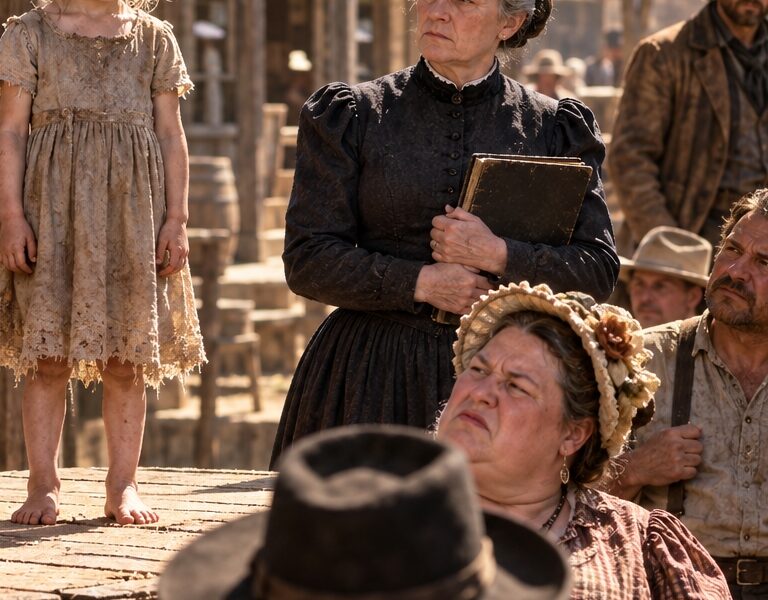
The little girl had stood barefoot on the auction platform for nearly two hours, and not one person had offered to take her home.
When the auctioneer lowered her price to twenty-five cents, someone in the crowd laughed.
Then a dust-covered rancher stepped forward, looked at the trembling child, and said, “Before anybody touches that girl, I want to know what happened to her mother.”
The laughter died.
It was July 1887, and the sun had turned the streets of Red Willow, Kansas, into a furnace. Dust floated above the hitching rails, horses stood with their heads lowered, and the shade beneath the general store awning had filled with townspeople who had come to watch the county’s latest placement auction.
Three-year-old Elsie Mae Carter stood in the center of a hastily built wooden platform. Her small feet were red from the heat. Her faded cotton dress hung loosely around her narrow shoulders, and somebody had cut her blond hair unevenly after a lice outbreak at the Juniper County Orphan Asylum.
She had not cried.
That was what bothered people most.
Children were supposed to cry when frightened. They were supposed to reach for familiar hands, ask questions, or hide behind an adult’s skirt. Elsie did none of those things. She stood with her arms hanging at her sides, staring at a narrow crack between two floorboards.
The auctioneer, Walter Briggs, cleared his throat.
“Number seventeen,” he announced, glancing at a yellowed paper. “Female child, approximately three years old. No known physical infirmities. Quiet disposition. Available for placement with a respectable household.”
A heavyset woman near the front crossed her arms.
“If she’s so healthy, why doesn’t she speak?”
Briggs turned toward Mrs. Prudence Hargrove, the asylum director.
Mrs. Hargrove wore a severe gray dress with a high collar despite the blistering heat. She held a thick ledger beneath one arm and looked at Elsie with the weary irritation of someone describing a stubborn mule.
“The child is difficult,” she said. “She refuses instruction, will not answer when addressed, and shows little gratitude for the Christian charity extended to her.”
A farmer scratched his chin.
“Can she carry water?”
“Not without supervision.”
“Wash dishes?”
“She has been taught to assist.”
“Then what good is she?”
A few men chuckled.
Mrs. Hargrove’s mouth tightened.
“With proper discipline, she may become useful.”
Elsie stared at the boards.
She understood some of the words. Difficult. Bad. Ungrateful.
She had heard them before, especially when her bed was wet in the morning or when she failed to answer questions she could barely understand. Silence had gradually become the only thing she could control.
The auctioneer tried again.
“Fifty cents. Who will offer fifty cents?”
No one raised a hand.
“Twenty-five, then.”
A man leaning against a wagon laughed. “I’ve paid more for a lame chicken.”
The laughter traveled through the square.
Elsie did not move.
Near the back of the crowd, a tall man in a dust-covered brown coat slowly straightened.
His name was Samuel Whitaker.
He was forty-two years old, owned a cattle ranch twenty miles west of Red Willow, and had not brought a child into his home since the winter his wife and young daughter died.
Nobody expected him to step forward.
Most people barely knew him anymore.
Samuel had become a man of brief conversations, necessary errands, and locked doors. He bought flour and coffee every few weeks, collected his mail, paid what he owed, and rode back toward the hills before sunset.
But he had been standing near the hitching rail for almost an hour, watching the people around the platform.
Not the girl.
The adults.
He had listened as strangers discussed what a three-year-old child might be worth. He had watched Mrs. Hargrove turn the pages of her ledger without once looking at Elsie’s burned feet.
And when the auctioneer called twenty-five cents, Samuel could no longer remain where he was.
“I’ll take her.”
His voice was not loud.
It didn’t need to be.
Briggs blinked.
“Pardon?”
“The child,” Samuel said. “I’ll take responsibility for her.”
Mrs. Hargrove turned sharply.
“Mr. Whitaker, this is a serious undertaking.”
“I understand that.”
“You live alone.”
“I do.”
“A young girl requires proper female guidance.”
Samuel looked at her.
“Then perhaps someone should have provided it before putting her on that platform.”
A few people shifted uncomfortably.
Mrs. Hargrove’s cheeks flushed.
“The child has received every consideration our institution can provide.”
Samuel took one step closer.
“Has she?”
He looked down at Elsie’s bare feet.
The little girl instinctively curled her toes.
Something moved across his face, so briefly that most people missed it.
“Get her off those boards,” he said.
Briggs glanced at Mrs. Hargrove.
“The placement has not been finalized.”
“Then bring the papers.”
Samuel reached into his coat and withdrew a silver dollar.
He set it on the edge of the platform.
But before Briggs could touch it, Samuel covered the coin with his palm.
“And I want to see her records.”
Mrs. Hargrove went still.
“That is highly irregular.”
“Then consider today irregular.”
The town marshal, who had been watching from beside the general store, stepped forward.
“Samuel, what’s this about?”
Samuel didn’t take his eyes off the asylum director.
“Her name is Elsie Mae Carter. That’s what you said.”
Mrs. Hargrove nodded stiffly.
“And her mother?”
“Deceased.”
“Her maiden name?”
The director hesitated.
“I don’t see how that concerns you.”
Samuel’s voice hardened.
“Because six years ago, my younger sister married a man named Daniel Carter.”
For the first time, Elsie lifted her head.
Samuel continued, slowly.
“My sister’s name was Hannah.”
Mrs. Hargrove’s fingers tightened around the ledger.
“And she had a little girl.”
The silence that followed seemed to swallow the entire town square.
Samuel’s eyes moved from the ledger to the child.
“She would be about three years old now.”
Mrs. Hargrove took a step backward.
“Mr. Whitaker, there are many families named Carter.”
Samuel nodded once.
“Then open the book.”
The director didn’t move.
And that was when the marshal noticed something else.
Mrs. Hargrove’s hand was trembling.
Samuel had received the letter eleven days earlier.
It had arrived at his ranch folded inside an envelope stained with rain and dirt. There was no return address, only a shaky signature belonging to a woman named Ruth Bell, a former laundress at the asylum.
I knew your sister Hannah. I was told you should be informed about a child being kept here. I cannot say more in a letter. They are moving the children on the twenty-first. Please come before then.
For nearly six years, Samuel had believed Hannah wanted nothing to do with him.
Their last conversation had ended badly.
She had been twenty-one, newly married, and determined to follow Daniel Carter north despite Samuel’s concerns about Daniel’s gambling debts. Samuel had accused her husband of using her inheritance. Hannah had called her brother proud and controlling.
They parted without embracing.
Two years later, a letter informed Samuel that Hannah had died of fever.
He wrote back asking about her daughter.
Nobody answered.
Daniel Carter’s last known address led nowhere. Samuel’s inquiries through a lawyer produced rumors of a failed business and a family that had moved repeatedly. Eventually, the trail went cold.
He had carried the failure quietly.
Then Ruth Bell’s letter arrived.
Now he stood in the Red Willow square, looking at a child whose pale eyes were painfully familiar.
Hannah had possessed those same gray-blue eyes.
But resemblance wasn’t proof.
Samuel knew enough about grief to distrust what people desperately wanted to believe.
“Open the ledger,” Marshal Thomas Reed told Mrs. Hargrove.
The director pulled herself upright.
“These records are the property of the asylum.”
“And the child is not,” Samuel said.
Reed held out his hand.
“Prudence.”
After several moments, she surrendered the book.
The marshal opened it beneath the general store awning.
Samuel followed, but not before removing his coat and asking the shopkeeper for water.
The shopkeeper’s wife, Mrs. Ellis, hurried forward with a cup and a clean towel. She knelt near Elsie, careful not to reach for her suddenly.
“Sweetheart, these boards are hurting your feet. May I help you down?”
Elsie looked at the cup.
Her lips were dry.
Mrs. Ellis waited until the child made a tiny movement toward her before lifting her carefully from the platform. She carried Elsie into the shade and sat her on a folded blanket.
The child drank three eager mouthfuls before stopping abruptly.
Mrs. Ellis gently tipped the cup toward her again.
“You can have more.”
Elsie stared.
At the asylum, children were sometimes punished for asking for another helping.
Mrs. Ellis seemed to understand something from the way the little girl held the cup.
“There’s plenty,” she said softly.
Elsie drank.
Inside the store, the marshal turned another page.
“Elsie Mae Carter,” he read. “Admitted January tenth, 1887. Parents listed deceased.”
Samuel leaned closer.
“Where’s her birthplace?”
“Not recorded.”
“Mother’s maiden name?”
“Not recorded.”
“Who brought her in?”
Reed read the line again.
There was a blank space where a name should have been.
Mrs. Hargrove cleared her throat.
“Records are sometimes incomplete.”
Samuel pointed to the entry directly beneath Elsie’s name.
“Then explain why someone wrote Hannah Whitaker here and scraped it away.”
A faint impression remained in the paper.
The name was barely visible.
But it was there.
Mrs. Hargrove swallowed.
“I cannot account for every clerical mistake.”
Marshal Reed closed the ledger.
“I think you’d better come to my office.”
She started protesting.
Samuel no longer listened.
He walked outside.
Elsie was sitting on the blanket with the empty cup between her hands. Mrs. Ellis had brought her bread and a small dish of preserves, but the child hadn’t touched either.
Samuel crouched several feet away.
He was a large man with weathered hands, a broken nose, and the kind of stillness that frightened horses until they learned he meant no harm.
“Hello, Elsie,” he said.
She watched him.
“My name’s Sam.”
Nothing.
“I knew somebody named Hannah once.”
The child’s fingers tightened around the cup.
“She used to sing while she cooked. Never could remember all the words.”
Elsie’s eyes moved toward his face.
Samuel felt something catch beneath his ribs.
He remembered Hannah standing barefoot in their mother’s kitchen, stirring stew and inventing verses when she forgot the proper ones.
“She had a song about a little bird,” he continued.
His voice faltered.
He had not sung in years.
Still, he tried to remember the tune.
“Little bird, little bird, where will you sleep…”
Elsie’s cup slipped from her hands.
The metal struck the wooden floor with a sharp clang.
She flinched violently.
Samuel stopped immediately.
“It’s all right,” he said. “Nobody’s angry.”
The child’s breathing quickened.
Then, slowly, she raised one hand toward the front of his coat.
He remained still.
Her little fingers closed around the worn fabric.
And for the first time since he had arrived in Red Willow, Samuel was afraid to move.
The papers were not signed that afternoon.
Marshal Reed insisted that Samuel provide proof of his identity and relationship before the county approved a permanent placement. Mrs. Hargrove demanded the girl’s return to the asylum, but Reed refused to send her back while questions about the records remained unresolved.
Mrs. Ellis volunteered to keep Elsie overnight.
Samuel paid for a room at the boarding house across the street and spent the evening sitting in its dim dining room with a cup of coffee he never finished.
At eight o’clock, Mrs. Ellis came to see him.
“She ate a little supper,” she said. “And she let me wash her feet.”
Samuel nodded.
“Did she speak?”
“No.”
“Did she cry?”
Mrs. Ellis lowered her eyes.
“Not even when I found the blisters.”
Samuel looked toward the window.
Outside, a lantern swung in the warm night breeze.
Mrs. Ellis placed a small object on the table.
It was a faded blue ribbon, frayed at one end.
“She had this sewn inside the lining of her dress. I found it while mending the hem. I thought you ought to see it.”
Samuel reached for the ribbon.
Hannah had worn blue ribbons in her hair as a girl. That meant nothing by itself, but he recognized the tiny, uneven stitches holding the fabric together.
Their mother had taught both children to sew.
Hannah always made the same crooked double stitch at the end of a seam.
Samuel ran his thumb across it.
“I need to speak to Ruth Bell,” he said.
Mrs. Ellis nodded.
“Then go early. Mrs. Hargrove has been asking where she lives.”
Samuel folded the ribbon and put it inside his pocket.
For the first time that day, he felt something colder than fear.
He felt urgency.
BƯỚC 1 — THE STORY CONTINUES
Ruth Bell lived in a narrow house near the creek, half a mile beyond town.
Samuel arrived shortly after sunrise.
An older woman opened the door only as far as the chain permitted. Her hair was white, her shoulders bent, and one of her hands was wrapped in a stained bandage.
“You’re Hannah’s brother,” she said.
Samuel nodded.
Ruth looked behind him.
“Did they let you take the child?”
“She’s safe for now.”
Ruth closed her eyes.
“Thank God.”
She removed the chain.
Inside, the little house smelled of soap, boiled potatoes, and damp wood. Ruth offered Samuel a chair, then sat opposite him with both hands folded tightly in her lap.
“I knew Hannah before the fever,” she began. “She came through Red Willow with her husband and baby. Daniel was looking for work at the railway depot.”
Samuel leaned forward.
“Was she ill then?”
“No. Tired, but healthy. She was doing laundry for families in town. Daniel drank more than he worked.”
That part did not surprise Samuel.
“What happened?”
“Fever came through the boarding houses that autumn. Daniel fell ill first. Hannah cared for him until she caught it herself.”
Ruth rubbed her palms together.
“Daniel died. Hannah lived another eleven days.”
Samuel stared at the floor.
For years, he had imagined Hannah dying somewhere far away, surrounded by strangers who didn’t know how fiercely she once laughed or how frightened she had been of thunderstorms as a child.
“She asked me to write to you,” Ruth whispered.
Samuel looked up.
“She did?”
“She gave me your name and the location of your ranch. Said you were stubborn, but good. Said you’d come if you knew about her little girl.”
Samuel’s throat tightened.
“Why didn’t I get the letter?”
Ruth swallowed.
“I handed it to the man handling her affairs. Mr. Albert Finch. He said he’d see that it was posted.”
“Finch?”
“He was a county clerk then. He helped Mrs. Hargrove arrange the child’s admission.”
Samuel recognized the name.
Albert Finch now served as a county commissioner.
Ruth reached beneath her apron and removed a folded paper.
“I kept this because something about it never seemed right.”
It was a copy of a receipt.
The paper recorded the sale of several household possessions belonging to Daniel and Hannah Carter: a sewing machine, two wooden trunks, a bedstead, and a horse.
At the bottom was a note stating that the proceeds would be held for the surviving minor child.
The amount was one hundred and eighty-six dollars.
Samuel read it twice.
“Where is that money?”
Ruth shook her head.
“I asked once. Mrs. Hargrove said the child’s expenses had consumed it.”
“Six months in the asylum?”
“That’s what she said.”
Samuel folded the paper carefully.
For a long moment, he couldn’t speak.
Then he asked the question that had frightened him since Red Willow.
“Did Hannah know she was dying?”
Ruth nodded.
“She knew.”
Samuel stared at his hands.
“Did she say anything else about me?”
Ruth watched him with tired, compassionate eyes.
“She said you used to make pancakes too thick, but you never minded when she fed them to the dogs.”
A sound escaped Samuel’s chest.
He pressed his hand over his mouth.
Ruth waited.
“She said she wished she’d written sooner,” Ruth added. “And she said you mustn’t think she stopped loving you.”
Samuel bowed his head.
Six years of silence had hardened around a misunderstanding he could no longer repair.
Ruth reached across the table and touched his sleeve.
“She didn’t forget you, Mr. Whitaker.”
Samuel wiped his eyes with the heel of his hand.
“Neither did I.”
At the marshal’s office that afternoon, Samuel placed Ruth’s receipt beside the asylum ledger.
Marshal Reed read both documents carefully.
He had known Albert Finch for twenty years. They attended the same church, served on town committees, and had once traveled together to Topeka.
But Reed had also seen Elsie’s feet.
He had watched a child stand in the heat while respectable adults argued about whether she was worth a coin.
He put on his hat.
“We’ll speak to Finch.”
Finch was a polished man with a silver watch chain and a reputation for charitable giving. He received the marshal and Samuel in his office, where the windows overlooked the courthouse lawn.
His smile disappeared when he saw the documents.
“These are old administrative matters,” Finch said.
Samuel remained standing.
“Where is my niece’s money?”
Finch leaned backward.
“Your alleged niece.”
“Her mother was Hannah Whitaker Carter.”
“That still needs to be established.”
“Then let’s establish it.”
The commissioner sighed.
“Samuel, I understand you’ve suffered losses. But grief can lead a man to make connections where none exist.”
Samuel’s jaw tightened.
Reed spoke before he could answer.
“Albert, there’s a missing name in the asylum ledger and a receipt for a child’s property. I need an accounting.”
Finch stared at his old friend.
“You’re taking his side?”
“I’m asking for records.”
For several moments, Finch said nothing.
Then he opened a desk drawer and removed a key.
“There are older files in the storage room,” he said. “I’ll have them brought over.”
But when the marshal returned the following morning, the storage room was locked.
And Finch had left town before dawn.
That evening, Mrs. Hargrove arrived at the Ellis home with two men and a signed document demanding Elsie’s immediate return.
Samuel was on the porch repairing a loose step when the wagon stopped.
Mrs. Ellis came to the doorway.
Elsie stood behind her, clutching the hem of her skirt.
Mrs. Hargrove stepped down.
“The girl belongs in institutional care until a proper guardian is appointed.”
Samuel set aside his hammer.
“She belongs somewhere she’s safe.”
“You have no legal authority to keep her.”
“Neither do you, if the placement records were falsified.”
Mrs. Hargrove’s expression turned cold.
“You have become emotionally attached to a child you barely know. That does not make you her guardian.”
Samuel stood.
“No, ma’am. It doesn’t.”
He glanced toward Elsie.
“But it does mean I won’t stand here and watch you frighten her.”
One of the men accompanying Mrs. Hargrove moved toward the porch.
Elsie immediately stepped backward.
Her eyes widened.
Then she crouched beside the door, covered her head with both arms, and began shaking.
Everyone stopped.
Mrs. Ellis knelt beside her.
“Elsie, honey, nobody’s going to hit you.”
Samuel slowly turned toward the asylum director.
His voice was quiet.
“Why did she think he was going to hurt her?”
Mrs. Hargrove said nothing.
“Who taught her to do that?”
Still nothing.
The little girl trembled behind Mrs. Ellis.
Samuel had known anger before. He had felt it when his cattle died in an unexpected freeze, when drought took half his grazing land, and when he stood beside two graves with a spade in his hands.
But this was different.
This anger did not burn.
It settled.
He stepped between Elsie and the visitors.
“You’ll need to speak to the marshal.”
Mrs. Hargrove turned sharply and climbed back into the wagon.
As it rolled away, Samuel heard Elsie make a small, broken sound.
He turned.
She was reaching toward him.
Not toward Mrs. Ellis.
Toward him.
Samuel lowered himself to one knee.
“I’m here,” he said.
Elsie pressed her face against his shoulder.
For a moment, he forgot how to hold someone so small.
Then his arms closed around her.
It took twelve days to untangle the truth.
Finch was located in Wichita and ordered to return for questioning. The sheriff recovered papers establishing that Daniel Carter’s remaining estate had been transferred to a county-controlled guardianship account. Much of the money had been spent without clear authorization.
Hannah’s marriage record, Elsie’s baptismal entry, and statements from two women who had known the family confirmed the child’s identity.
The judge appointed Mrs. Ellis as Elsie’s temporary guardian pending a final hearing. He also directed the county to investigate the management of the asylum.
Samuel visited Elsie every day.
At first, she watched him from behind furniture.
Then she began bringing him objects.
A spoon.
A wooden horse.
A smooth white pebble she found beside the porch.
Samuel treated each offering with the seriousness of a rancher receiving valuable equipment.
“Fine stone,” he said one afternoon, turning the pebble over in his palm. “Solid. Could be useful.”
Elsie stared at him.
“Maybe I’ll keep it in my pocket.”
He did.
On the fifth day, she sat beside him while he repaired Mrs. Ellis’s garden gate.
On the seventh, she reached for his hand while crossing the street.
On the ninth, she fell asleep with her head against his arm.
But she still did not speak.
Samuel never asked her to.
Mrs. Ellis had explained that frightened children sometimes needed long stretches of ordinary, uneventful days before they trusted anything enough to change.
So Samuel gave Elsie ordinary days.
He brought peaches from his ranch, let her touch the nose of his gentle old gelding, and showed her how to make a whistle from a blade of grass.
When she dropped something, he helped her pick it up.
When she spilled water, he fetched a towel.
When she woke from a nightmare, Mrs. Ellis sat with her until she slept again.
Nothing was taken away as punishment.
Nobody called her difficult.
It was a beginning.
The hearing took place on an August morning.
The courtroom was crowded.
Mrs. Hargrove sat beside her attorney, her gloved hands folded over her lap. Finch had been removed from his county responsibilities while the financial investigation proceeded, though the court had not yet determined whether the irregularities were criminal.
Samuel waited near the front with his lawyer.
Elsie sat on Mrs. Ellis’s lap, wearing a clean yellow dress and little brown shoes that were slightly too large.
The judge reviewed the documentary evidence and testimony.
Then he looked toward Samuel.
“Mr. Whitaker, I understand you wish to petition for guardianship of this child.”
“Yes, sir.”
“You are unmarried and live some distance from town.”
“Yes.”
“You have limited experience caring for a child of this age.”
Samuel’s gaze dropped briefly.
“I had a daughter, Your Honor.”
The courtroom became quiet.
“She died when she was four.”
The judge’s expression softened.
“My condolences.”
Samuel nodded.
“But that was five years ago,” the judge continued. “Circumstances have changed.”
“They have.”
“And why do you believe you can care for Elsie now?”
Samuel looked toward the little girl.
She was examining a loose thread on Mrs. Ellis’s cuff.
He remembered his wife Caroline standing in their kitchen, laughing because their daughter had put flour in his boots.
He remembered the silence after the winter sickness.
He remembered closing the bedroom door because he couldn’t bear to see the small wooden toys beneath the bed.
For years, he had believed that keeping the house unchanged was a form of loyalty.
Now he understood it had also become a way of avoiding the living.
“Because I have a home,” he said. “And I have work that pays enough to keep her fed and clothed. Mrs. Ellis has agreed to stay at the ranch for a time and help me settle her in.”
He paused.
“But I don’t expect the girl to earn her place there.”
The judge looked up.
Samuel continued.
“She doesn’t have to work for her supper. She doesn’t have to speak before she’s ready. She doesn’t have to thank me for giving her a bed.”
His voice roughened.
“She is my sister’s child. And even if she weren’t, she’d still deserve those things.”
Across the courtroom, someone lowered their head.
Samuel looked directly at the judge.
“I can’t promise I won’t make mistakes. But I can promise she’ll never stand on another platform while strangers decide what she’s worth.”
The judge studied him for a long moment.
Then he asked Mrs. Ellis to bring Elsie forward.
The little girl hesitated when Mrs. Ellis rose.
Samuel stepped into the aisle and crouched.
“It’s all right, sweetheart.”
Elsie looked around the courtroom.
So many faces.
So many adults.
So many voices that might suddenly become angry.
She clutched Mrs. Ellis’s hand.
Samuel held out his own but did not move closer.
For several seconds, nothing happened.
Then Elsie crossed the space between them.
She put her small hand in his.
The judge watched silently.
And when she climbed against Samuel’s knee, resting her cheek on his shoulder, nobody in the courtroom needed an explanation of what she wanted.
The judge approved Samuel’s guardianship, subject to continued oversight and a home visit.
The gallery stirred.
Samuel barely heard the ruling.
Elsie had begun playing with the button on his coat.
He lowered his face toward her hair.
“Let’s go home.”
The Whitaker ranch stood beyond a stretch of rolling prairie where cottonwood trees followed a narrow creek.
The house was whitewashed, with a broad porch and a red barn beyond the vegetable garden. Its windows had been kept clean, but the rooms inside had been quiet for years.
When Samuel carried Elsie through the front door, he felt the old grief rise unexpectedly.
His daughter’s height marks still stood on the kitchen doorframe.
Caroline’s blue mixing bowl sat on a shelf.
A small wooden horse rested on the mantel.
Mrs. Ellis came behind them with a carpetbag and a bundle of Elsie’s clothes.
“We’ll make her comfortable,” she said gently.
Samuel nodded.
He had prepared a bedroom at the end of the hall.
There was a narrow bed with a patchwork quilt, a pitcher of fresh water, a small chair, and a wooden box containing toys he had found in the attic.
But when he showed Elsie the room, she froze.
Her eyes fixed on the narrow bed.
Samuel understood too late.
At the asylum, beds had meant darkness, locked doors, and separation.
He crouched beside her.
“You don’t have to sleep here tonight.”
Elsie looked at him.
“You can stay near Mrs. Ellis. We’ll leave the door open.”
He gestured toward the quilt.
“This room will be here when you’re ready.”
For the next three weeks, Elsie slept on a cot in Mrs. Ellis’s room.
Then one evening, she carried her pillow down the hallway and placed it on her own bed.
Samuel saw her through the doorway.
He didn’t congratulate her.
He simply asked whether she wanted the lamp left burning.
She nodded.
He left it burning.
Autumn came slowly.
The prairie grass turned gold. Mornings grew cool enough for coats, and the cattle moved toward sheltered pasture.
Elsie began to change in small ways.
She laughed once when a calf sneezed into Samuel’s sleeve.
The sound startled them both.
Samuel looked at her, his face breaking into a smile before he could stop it.
She immediately covered her mouth.
He pretended not to notice.
A few days later, she laughed again.
This time she didn’t hide.
Mrs. Ellis wrote to her daughter that the house no longer seemed empty. Samuel began leaving the parlor door open, and Elsie took to carrying the wooden horse from room to room.
There were difficult days.
Some mornings she refused breakfast. Some nights she woke screaming but could not explain why. Once, after Samuel accidentally knocked over a tin plate, she hid beneath the kitchen table and would not come out for nearly an hour.
Samuel sat on the floor nearby.
He talked quietly about the weather and the new fence posts he needed to set.
Eventually Elsie crawled toward him.
He offered his hand.
She took it.
Nobody hurried her.
Mrs. Ellis remained through the first cold weeks, helping Samuel arrange reliable care and showing him how to manage the routines he had forgotten since his daughter was small. When she returned to Red Willow, a neighboring widow named Martha Greene agreed to assist during the busiest ranch days.
Samuel learned to braid hair badly.
Elsie learned that his burnt biscuits were still edible with enough butter.
Together, they learned that a family could be made from repeated ordinary kindnesses rather than grand promises.
But one thing continued to trouble Samuel.
Elsie had never called him anything.
He had no intention of insisting.
Still, sometimes he wondered whether she understood who he was.
One November afternoon, he took Hannah’s old photograph from a drawer and placed it on the kitchen table.
It showed a young woman in a simple dress, smiling faintly, her hair pinned behind her ears.
Elsie noticed it immediately.
She reached toward the picture.
Samuel lifted it for her.
“That’s Hannah,” he said softly.
The little girl’s hand went still.
“My sister.”
He swallowed.
“Your mama.”
Elsie stared at the photograph.
She touched the glass with one finger.
For a long time, neither of them moved.
Then Samuel began humming the little bird song.
His sister’s song.
The tune wandered uncertainly at first, but he found it again as he watched the child.
Elsie turned toward him.
Her lips moved.
Samuel stopped humming.
“What was that, sweetheart?”
She lowered her eyes.
He waited.
Several seconds passed.
Then she whispered one word.
“Mama.”
Samuel felt the floor shift beneath him.
He nodded carefully.
“Yes.”
Elsie touched the photograph again.
“Mama.”
Her voice was fragile, a little rusty from disuse, but perfectly clear.
Samuel sat down because his knees no longer felt steady.
“Yes, honey. That’s your mama.”
Elsie studied his face.
Then she put the photograph down and climbed into his lap.
For the first time, Samuel allowed himself to cry in front of her.
He did not sob loudly.
He simply held her while tears moved down his weathered cheeks.
Elsie watched them with great seriousness.
Then she reached up and wiped one away.
The following spring, Samuel returned to Red Willow for a final meeting concerning Elsie’s guardianship.
The investigation had led to repayment orders and further proceedings against Finch for mishandling the child’s estate. Mrs. Hargrove had resigned from the asylum, which was now under new county supervision. The public auctions had been discontinued while officials arranged a different placement process.
None of those changes could return the months Elsie had lost.
Samuel knew that.
He also knew that justice, when it arrived at all, often came slowly and incompletely.
He had stopped measuring his niece’s future by what might happen to the people who had harmed her.
Instead, he measured it by things that had once seemed impossible.
She slept through most nights.
She had learned to ask for bread when she was hungry.
She sometimes argued about wearing her boots.
And every evening, she waited for him by the kitchen window.
After the meeting, Samuel walked with Elsie through the town square.
The old auction platform was gone.
A new bench stood beneath the general store awning.
Elsie held his hand as they passed the place where she had once stood barefoot in the heat.
She paused.
Samuel looked down.
“What’s wrong?”
The little girl stared at the empty stretch of ground.
He waited.
Her fingers tightened around his.
“Sam?”
It was a word she had begun using only recently.
“Yes, sweetheart?”
She pointed toward the store.
“Hot.”
Samuel understood.
He crouched beside her.
“Yes. It was hot that day.”
Elsie looked toward the ground again.
“Feet hurt.”
His throat tightened.
“I know.”
She considered this.
Then she looked directly into his face.
“You came.”
Samuel closed his eyes briefly.
When he opened them, she was still watching him.
“Yes,” he said. “I came.”
Elsie wrapped both arms around his neck.
“Take me home?”
Samuel lifted her into his arms.
“Always.”
He carried her down the street toward the waiting wagon.
Two years later, when Elsie was five, she asked Samuel why he still kept a silver dollar in a small wooden box above the fireplace.
It was the same coin he had placed on the platform that afternoon.
He took it down and let her hold it.
“Some folks once thought they could put a price on a little girl’s life,” he told her.
Elsie turned the coin over in her palm.
“How much?”
Samuel hesitated.
“Less than this.”
She frowned.
“That’s silly.”
He smiled sadly.
“Yes. It was.”
She returned the coin to him, then climbed into his lap with a picture book.
“Read to me, Uncle Sam.”
He opened the book.
Outside, the wheat fields moved beneath a warm summer breeze. A horse whinnied near the barn, and somewhere in the kitchen Martha was singing as she prepared supper.
Samuel looked at the little girl curled safely against his chest.
Once, he had believed his house would remain silent forever.
Now there were muddy shoes beside the back door, ribbons scattered across the kitchen table, and pencil marks climbing the doorframe again.
He had never stopped missing Caroline, their daughter, or Hannah.
He never would.
But grief no longer occupied every room.
Elsie turned a page before he had finished reading it.
“Slow down,” he told her.
She giggled.
“Keep going.”
So he did.
And the silver dollar remained above the fireplace, not as a reminder of what Elsie had cost, but of a day when a lonely man finally understood something his sister had once tried to teach him.
Love was not measured by what someone could give in return.
Sometimes it began with the simple decision to stay.









