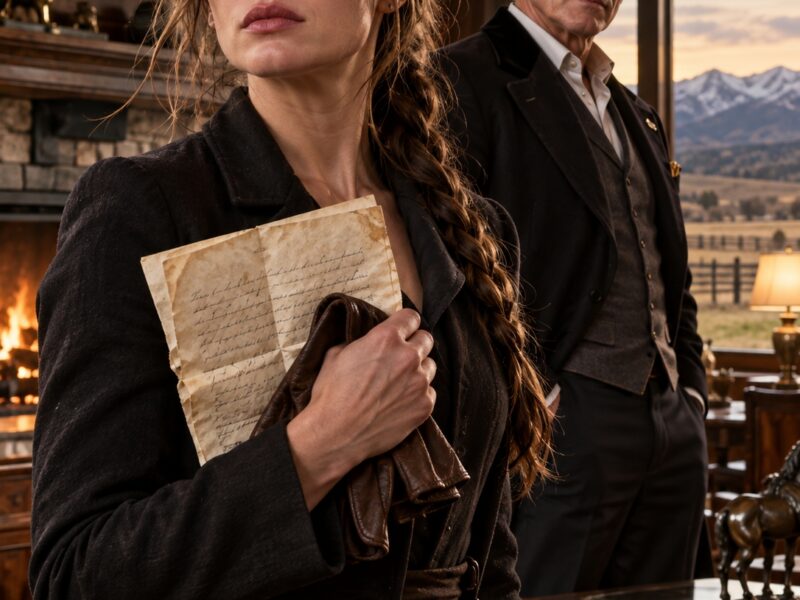
THEY WAITED FOR HER TO LOSE EVERYTHING—THEN ONE COWBOY WALKED INTO THE ROOM AND EXPOSED THEM ALL
The day Clara Whitfield buried her father, one of the richest men in Dry Creek offered to buy her ranch before the dirt on Thomas Whitfield’s coffin had settled.
Seven days later, no man in the valley would work for her.
The bank would not lend to her.
The general store suddenly had no winter feed to sell her.
Three hundred cattle were waiting to be moved before the first major snow sealed the high country, and somehow every road Clara tried seemed to close just before she reached it.
Everyone called it bad luck.
Everyone said it was nothing personal.
And every evening, Cyrus Barlo waited.
He waited for the twenty-eight-year-old woman on the Whitfield ranch to understand what the rest of Dry Creek had already decided for her:
She could inherit her father’s land.
She could inherit his cattle.
She could inherit his debts, his broken fences, his leaking barn, his exhausted horses and every frozen acre carrying the Whitfield name.
But she could not inherit his authority.
Not in their eyes.
Not while she was a woman standing alone.
And yet, while the town quietly tightened a rope around her future, someone else was coming to her ranch after dark.
Someone split firewood and stacked it beside her porch.
Someone repaired a fence she had not had time to touch.
Someone delivered enough hay to keep her cattle fed.
No note.
No request for payment.
No name.
Only boot prints in the frost and an old hammer marked with two burned letters:
J.C.
Clara thought discovering the identity of the man helping her would be the biggest surprise of that winter.
She was wrong.
Because before the first snow was finished with Dry Creek, one man would lose nearly two hundred cattle.
Another would lose control of the entire valley.
And Clara would receive a letter written by her dead father containing one sentence about her mother that would make everything she thought she knew about her family suddenly feel like a lie.
But on the morning they buried Thomas Whitfield, Clara knew none of that.
All she knew was that the coffin looked too small.
The sky over Dry Creek, Texas, hung low and gray that Thursday in October, heavy enough to make the valley feel flattened beneath it.
Half the town had come.
That was what towns like Dry Creek did when a man like Thomas Whitfield died.
People showed up.
They wore their good coats.
They removed their hats.
They said respectful things about the dead that they had sometimes forgotten to say while the man was alive.
Reverend Allen stood beside the grave reading about green pastures and still waters while the wind worried at the pages of his Bible.
A few women cried.
Several men stared at their boots.
Clara did neither.
She stood at the head of the grave wearing her mother’s old black dress, the sleeves ending slightly above her wrists because she had been seventeen the last time she wore it.
She watched two men lower her father into the earth.
The ropes creaked.
That sound would remain with her longer than the prayer.
Thomas Whitfield had been broad-shouldered and loud when he laughed. He could fill the kitchen merely by entering it. His boots had always landed heavily on the porch. His hands had been rough enough to scrape bark from a fence post, yet Clara had watched those same hands pull a breech calf from a dying cow with impossible gentleness.
Now those hands were folded over his chest.
His mouth was closed.
His voice was gone.
And somehow all of him fit inside a pine box.
Clara had cried while he was dying.
She had cried after he died.
She had cried alone in the barn with her forehead pressed against the stall door because she could still smell tobacco and saddle soap on his coat hanging from a nail.
Then, sometime during the fourth night, the tears had stopped.
Not because the grief had.
The grief had simply gone somewhere deeper.
It had hardened.
Her father once told her that the most dangerous ice was the ice that looked like ordinary water.
That was what grief felt like now.
Still on top.
Bottomless underneath.
Thomas had taught her almost everything she knew.
He taught her to ride before she could read.
He taught her never to approach a frightened horse straight on.
He taught her how to look at clouds over the western ridge and know whether she had twenty minutes or two hours before rain.
He taught her that cattle spoke constantly if a person was quiet enough to notice.
A turned ear.
A restless hoof.
A calf standing too far from its mother.
A lead steer looking repeatedly toward a horizon nobody else was watching.
“Animals tell the truth before people do,” Thomas used to say.
At twenty-eight, standing beside his grave, Clara was beginning to understand how useful that lesson might become.
After the service, people formed a line.
They squeezed her hands.
They lowered their voices.
They said things like, “He was a fine man.”
Or, “If there’s anything you need…”
Clara thanked them.
She did not believe most of them meant harm.
She also did not believe most of them wanted to be taken seriously.
Old Mr. Hardrove, who owned the general store, held her hand in both of his.
“A fine man, Clara. Truly. Your father was one of the best.”
“Thank you, Mr. Hardrove.”
“If there’s anything you need.”
She looked at him.
For one second, his expression changed.
Just slightly.
As though he had suddenly realized she might actually ask.
Clara almost smiled.
“I’ll remember that.”
Hardrove cleared his throat.
“Anything at all.”
Then he escaped toward the church.
Cyrus Barlo came last.
He owned nearly eleven thousand acres along the creek and chaired the Dry Creek Cattlemen’s Association.
There were elected officials in Texas with less practical power than Cyrus Barlo possessed inside that valley.
He controlled contracts.
He knew bankers.
He bought cattle in quantities large enough to move prices.
If a ranch hand angered him, that man could discover by sunset that employment had become remarkably difficult to find.
Cyrus was tall, silver-haired and handsome in the careful way of a man who had spent decades learning that power worked better when it smiled.
He removed his hat as he approached Clara.
“Your father and I disagreed on plenty.”
“So he told me.”
Something amused Cyrus.
“But I never doubted his word.”
Clara said nothing.
He took her hand.
His palm was warm.
He held hers a little too long.
“It’s a hard thing, losing a father.”
“Yes.”
“Harder still when he leaves such responsibility behind.”
There it was.
Not yet an insult.
Just the shadow of one.
Clara withdrew her hand.
“The ranch will be fine.”
“Of course.”
His voice remained soft.
“Still, a place that size is difficult even for an experienced man.”
“I’ve worked it since I was twelve.”
“I know you have.”
The smile stayed.
That somehow made it worse.
“You’re capable, Clara. Nobody doubts that.”
She wondered why people always said nobody doubts that immediately before explaining precisely what they doubted.
Cyrus glanced toward the valley.
“Winter comes quickly.”
“So does spring.”
His eyes returned to hers.
For the first time, she saw something behind the warmth.
Calculation.
Then it disappeared.
“When you’re ready to discuss practical matters, come see me. I would make you a very fair offer for the Whitfield place.”
“The ranch isn’t for sale.”
“Of course not.”
“Not now. Not in spring. Not next year.”
A faint silence settled between them.
Cyrus smiled again.
“Grief makes all of us certain of things, my dear.”
“And time changes them?”
“Sometimes.”
He placed his hat back on his head.
“Winter has a way of changing people’s minds.”
Then he walked away.
Clara watched him cross the churchyard.
Something cold crawled over the back of her neck.
Her father had taught her another thing about animals.
A horse could bare its teeth in something that looked almost like a smile.
But if its ears were pinned flat, you did not admire the smile.
You moved.
Clara looked toward the road.
That was when she saw Jack Callahan.
He had not joined the condolence line.
He stood near the churchyard fence, apart from everyone else, wearing a black hat and a faded brown coat.
Jack had known Thomas for twenty years.
He owned a working ranch north of town and employed more riders than almost anyone except Barlo.
He was not rich in the polished way Cyrus was rich.
Jack’s wealth looked like cattle, scarred hands, exhausted horses, repaired tack and men who stayed with him year after year.
He had spoken perhaps twenty words to Clara in the previous twelve months.
Now he stood with his hat in his hands.
When Clara looked at him, Jack met her eyes.
He did not smile.
He did not offer advice.
He did not tell her everything happened for a reason.
He only nodded once.
Slowly.
Then looked away.
It was almost nothing.
Yet it was the only moment all day when Clara did not feel completely alone.
Four days later, the real trouble began.
Clara spent the weekend at the kitchen table with Thomas’s account books spread around her.
The ranch was not in immediate financial danger.
That should have comforted her.
Instead, it terrified her.
Because the numbers proved the ranch could survive.
If it failed now, it would not be because Thomas had ruined it.
It would be because Clara had.
Nearly three hundred head of healthy cattle needed to be moved to winter pasture before snow closed the passes.
The hay was cut.
The herd was strong.
But the north fence had collapsed across a long section, the barn roof leaked, and the fall roundup was less than two weeks away.
For thirty years Thomas had kept four hired hands.
By the time he became seriously ill, three had already left.
Two had gone to Barlo for better wages.
The third simply disappeared west.
Only Amos Tall remained.
Amos had been on Whitfield land since before Clara was born.
She found him Monday morning sitting on an overturned bucket inside the barn.
A travel bag rested beside his boots.
Clara stopped.
“No.”
Amos looked down.
“Miss Clara—”
“No.”
“I haven’t even said anything yet.”
“You packed a bag.”
His hands tightened around his hat.
“My sister has a place in Wyoming.”
“Your sister has had a place in Wyoming for seventeen years.”
He looked up, surprised.
“My father told me.”
“Then he probably told you she’s been asking me to come.”
“He told me that too.”
Amos exhaled.
For several seconds, the barn was filled only with the sound of a horse chewing hay.
“It ain’t that I don’t think well of you.”
Clara felt something inside her sink.
There were sentences a person only began when they intended to hurt you politely.
“I know.”
“A place this size…”
“Needs a man?”
Amos closed his eyes.
“Don’t make me say it that way.”
“Is there a better way?”
He stood.
His back was more bent than she remembered.
That frightened her almost as much as the packed bag.
“I know you can work, Miss Clara. Hell, I’ve watched you work since you were small enough to fall asleep in a feed trough.”
“Then stay.”
His eyes filled.
“I don’t know who’s going to believe in this place now.”
“I do.”
“I know.”
“Then stay.”
“I can’t spend whatever years I’ve got left watching it go under.”
That was the sentence that hurt.
Not because he meant it cruelly.
Because he meant it honestly.
Clara stared at the man who had eaten at their table for three decades.
She wanted to tell him he owed Thomas more.
She wanted to tell him she needed him.
Most of all, she wanted to say, Please don’t leave me too.
But Thomas had taught her never to trap a frightened animal against a fence.
Give it somewhere to go.
Otherwise fear became violence.
So Clara stepped aside.
“Thank you for thirty years, Amos.”
His mouth trembled.
“Miss Clara…”
“Go see your sister.”
She watched him walk down the road until he became a dark mark against the autumn fields.
Only after he disappeared did Clara enter an empty stall and grip the wooden divider until her knuckles turned white.
Then she saddled her horse.
If she had no crew, she would hire one.
The unofficial hiring hall of Dry Creek consisted of a bench outside the feed store.
Six men sat there that morning.
Conversation stopped when Clara approached.
She dismounted.
“I need four hands.”
Nobody answered.
“Fall roundup starts in two weeks. After that, winter drive. Standard wages, paid every Saturday.”
Still nothing.
She recognized Dutch Hollis.
He had worked three summers for Thomas.
“Dutch.”
He studied his boots.
“Miss Whitfield.”
“You know my cattle.”
“Yes, ma’am.”
“You know the route.”
“Yes, ma’am.”
“Then what’s the problem?”
His jaw moved.
“I already gave my word to Mr. Barlo.”
“For his roundup?”
“And winter.”
“Since when?”
Dutch looked at her then.
“Recently.”
Something passed between them.
Clara turned to the others.
“Anyone?”
A young cowboy at the far end began to raise his hand.
The older man beside him looked at him.
Nothing more.
Just looked.
The young man’s hand fell.
Clara saw it.
So did everyone else.
Finally, a leathery man in his fifties cleared his throat.
“Nothing personal, miss.”
There were those words.
“What isn’t?”
“Men are uncertain.”
“About what?”
“Well…”
He gestured vaguely toward the valley.
“A woman alone. A ranch that size. Winter coming.”
“The ranch has no debt.”
“I’m sure.”
“My cattle are healthy.”
“Yes, ma’am.”
“My money spends the same as Barlo’s.”
Nobody moved.
The older man gave her a smile filled with sympathy.
“A man doesn’t like signing onto a ship if he isn’t sure it’s staying afloat.”
Clara stared at him.
Then she climbed back into the saddle.
“I didn’t realize cattle ranches had become ships.”
A few men almost smiled.
None stood.
She rode away.
Tuesday, she went to the bank.
The clerk, Mr. Puit, listened while she explained that she wanted a short-term advance against the herd to secure labor and winter feed.
He folded his hands.
“Perfectly reasonable.”
“Good.”
“If your husband will sign.”
“I don’t have a husband.”
Puit blinked.
“Perhaps a brother?”
“No.”
“An uncle?”
“No.”
“Adult son?”
Clara stared at him.
“I’m twenty-eight.”
“Yes. Of course.”
“I own the land.”
“Yes.”
“I own the cattle.”
“Yes.”
“The ranch has no outstanding loan.”
“That appears correct.”
“Then why do I need a man who owns none of it to sign for money borrowed against property that belongs to me?”
Puit shifted.
“Policy.”
“Show it to me.”
That surprised him.
“I beg your pardon?”
“The policy.”
His smile weakened.
“Miss Whitfield—”
“You said the bank requires a male co-signer. Show me where.”
Puit glanced toward the manager’s closed office.
“It is a matter of discretion.”
“So not policy.”
“I didn’t say that.”
“You just did.”
His cheeks colored.
Then he leaned forward.
“If you want practical advice, perhaps Mr. Barlo—”
Clara stood.
And suddenly the pieces began moving.
“Mr. Barlo what?”
Puit froze.
“Nothing.”
“Would he qualify?”
The hesitation lasted less than a second.
It was enough.
“I believe Mr. Barlo has expressed an interest in your situation.”
Clara slowly picked up her gloves.
“My situation.”
Puit swallowed.
She left without another word.
On Wednesday, Mr. Hardrove told her the winter feed shipment was sold.
“All of it?”
He looked miserable.
“All of it.”
“To whom?”
“Clara…”
“Who bought it?”
His eyes fell.
“Mr. Barlo.”
“How much?”
“A great deal.”
“He doesn’t need that much.”
Hardrove polished a perfectly clean section of counter.
“I sell feed, Clara. I don’t ask a man why he buys it.”
“When is the next shipment?”
“November.”
“Early November?”
He said nothing.
“Late?”
“I don’t know.”
“You told me at my father’s grave that if I needed anything—”
His face crumpled.
“I know what I said.”
“Then help me.”
“I can’t.”
“Can’t?”
Or won’t?
She did not say it.
She no longer needed to.
Thursday, she rode to neighboring ranches.
One woman served her tea and apologized because her workers had already promised Barlo their winter labor.
Pete Doyle’s father removed his hat and claimed his corn harvest needed every hand.
The Pierce brothers laughed and asked whether she had considered selling while she could still get a good price.
Every refusal was polite.
Every explanation was reasonable.
Taken separately, none proved anything.
Together, they formed a wall.
By Friday evening, Clara finally understood the elegance of what was happening.
Cyrus Barlo had not threatened anyone.
He did not need to.
He simply made helping Clara inconvenient.
Expensive.
Socially dangerous.
A ranch hand could work for her and wonder whether Barlo would hire him later.
A merchant could sell to her and risk losing Barlo’s enormous business.
A banker could approve her loan and wonder whether the most powerful cattleman in the county might move his accounts.
No single person had to destroy Clara Whitfield.
They only had to make the sensible decision.
One by one.
Until she had nowhere left to stand.
She rode home after dark.
The house was black.
The barn roof sagged against the sky.
No smoke rose from the chimney because she had not split firewood in nearly a week.
Clara dismounted.
For one second, her knees failed.
She caught herself against her horse.
Then she pressed her forehead to the animal’s warm neck.
“I can’t do this alone, Papa.”
The confession escaped before pride could stop it.
Her voice broke.
“I can’t.”
The horse breathed against her shoulder.
The valley said nothing.
Saturday morning, Clara opened the front door and found enough split firewood to last two weeks stacked against the porch.
She stood there barefoot beneath her shawl.
Frost covered the yard.
One set of boot prints led toward the road.
No returning prints.
No note.
No bill.
No explanation.
Clara stared at the wood.
Then carried an armful inside.
Sunday morning, she rode north expecting to spend half the day repairing fence.
The entire section had been fixed.
New rails.
Reset posts.
Wire pulled tight.
Whoever had done it knew exactly what he was doing.
A hammer and fencing pliers hung from the last post.
Clara lifted the hammer.
The handle had been worn pale by years of use.
At its base was a small burned mark.
A C inside a circle.
Or perhaps two letters.
A and C.
She narrowed her eyes.
Callahan?
She hung it back.
On Monday, hay appeared inside her barn.
Not scraps.
A full wagonload.
Sweet, dry and stacked almost to the rafters.
Clara walked around it twice.
She went outside.
Heavy wagon tracks led east.
That night, she sat at the kitchen table.
Firewood.
Fence.
Hay.
All delivered or repaired in darkness.
A hammer.
A mark.
J.C.
She thought of the cemetery.
One man had not offered sympathy.
One man had not told her what she should do.
One man had simply stood apart and nodded.
Jack Callahan.
Tuesday morning, she found him behind the livery stable shoeing a horse.
“You’ve been on my land.”
Jack kept working.
“Morning, Clara.”
“Firewood.”
Hammer.
“Fence.”
Hammer.
“Hay.”
The hammer stopped.
Clara stepped closer.
“And you left your tool.”
Jack sighed.
“Good hammer.”
He set the horse’s hoof down.
“Hated losing it.”
“Why?”
“Because it’s a good hammer.”
“You know what I’m asking.”
He wiped his hands on a rag.
For the first time, she noticed the dark circles beneath his eyes.
He really had been working at night.
“Your father came to see me.”
Everything inside Clara went still.
“When?”
“About a month before he died.”
“He could barely ride a month before he died.”
“I know.”
“What did he want?”
Jack looked toward the stable.
“He sat right there.”
He pointed toward an overturned bucket.
“He told me he hadn’t told you how sick he was.”
Clara’s jaw tightened.
“That sounds like him.”
“He said something else.”
“What?”
Jack hesitated.
“He said, ‘If something happens to me, don’t let her know I asked you for anything.’”
Clara looked away.
Of course.
Even dying, Thomas had understood his daughter too well.
“He asked you to watch me?”
“Not exactly.”
“Sounds exactly like that.”
“He said you were the best hand he’d ever worked beside.”
Her eyes returned to him.
Jack continued.
“He said you’d refuse help if somebody called it help. So he asked me that if I happened to be riding past and happened to notice a broken fence…”
Despite herself, Clara almost laughed.
Instead, grief struck.
Hard.
She turned away.
“I can’t take charity.”
“It isn’t charity.”
“It looks like charity.”
“To whom?”
“To everyone.”
Jack waited.
Clara’s voice sharpened.
“If I survive because you carry me, Barlo wins anyway. Everyone who refused me gets to say they were right. They’ll say Clara Whitfield couldn’t keep the ranch until a man stepped in.”
Jack’s expression changed.
“Barlo.”
“What?”
“Barlo is why nobody will work for you.”
Clara stopped breathing for a second.
Jack leaned against the rail.
“He’s been visiting ranches since your father’s funeral.”
“I suspected.”
“You don’t know half of it.”
“Then tell me.”
“He offered double wages to men who might have hired on with you.”
Clara said nothing.
“He bought more winter feed than his ranch could use.”
“I know.”
“He let people understand that anyone who crossed him wouldn’t have much future with the association.”
Her fingers tightened around her gloves.
“And the bank?”
“Puit talked after enough whiskey.”
Jack’s mouth hardened.
“There’s no rule requiring a male co-signer for a landholder borrowing against registered stock.”
Clara felt heat rise through her.
“He lied.”
“Yes.”
“Because Cyrus told him to?”
“I can’t prove the exact conversation.”
“But?”
“But Cyrus wants the Whitfield land.”
“Why?”
“Water.”
That landed differently.
Jack looked toward the distant hills.
“Your western boundary controls creek access. Put your acreage together with Barlo’s and he owns an uninterrupted line from the lower creek almost to the mountains.”
Clara suddenly remembered conversations between Thomas and Cyrus.
Arguments that stopped when she entered.
Survey maps folded too quickly.
Her father’s repeated refusal to discuss selling the west pasture.
“He’s been waiting.”
“Yes.”
“For Papa to die.”
Jack did not answer.
He did not have to.
Clara stared at the dirt.
“Then he’s won.”
“No.”
“I have no crew.”
“No.”
“No feed.”
“You have feed.”
“Because you bought it.”
“I had hay.”
“My cattle have to move before snow.”
“Yes.”
“And every man in town is afraid of him.”
Jack nodded.
“Which is why you need to stop fighting him privately.”
Clara looked up.
“What does that mean?”
“It means men like Cyrus do their best work in whispers.”
Jack’s eyes hardened.
“So make him answer in a room full of people.”
The first Saturday of November, Clara Whitfield climbed the stairs above the Dry Creek saloon alone.
Thirty men sat around the long table.
Ranchers.
Buyers.
Merchants.
The bank manager.
And at the head sat Cyrus Barlo.
Conversation died.
Cyrus rose.
“Miss Whitfield.”
“I’d like to address the association.”
His smile appeared immediately.
“This is traditionally a meeting for—”
“Landholders?”
Someone coughed.
Clara continued.
“My name is on the Whitfield deed. Our cattle are registered with this association. Unless those rules changed after my father died, I believe I qualify.”
A murmur passed through the room.
For one tiny instant, Cyrus’s smile tightened.
Then he gestured.
“By all means.”
Clara walked to the front.
She had rehearsed a speech.
She had practiced it in the barn.
On horseback.
At the kitchen table.
Now every word vanished.
Thirty men watched her.
Dutch Hollis was there.
Hardrove too.
Puit stood near the back wall.
Clara’s heart pounded.
Then she remembered being twelve years old inside a round pen with a terrified mare.
She had pushed too hard.
The mare panicked.
Thomas stopped her.
“Slow down,” he’d said.
“But she won’t listen.”
“She can’t listen while she’s afraid.”
“What do I do?”
“Nothing.”
Thomas leaned against the fence.
“Let the fear come. Let it pass. Then ask again.”
Clara inhaled.
Let the fear come.
Let it pass.
Then ask.
“I need riders for the Whitfield winter drive.”
Silence.
“Fair wages. Standard terms.”
Nothing.
“I’ve been told men are reluctant to work for me because I’m a woman.”
Several faces changed.
“So I’d like to ask whether that is the official position of this association.”
Cyrus stood.
“Of course not.”
“Good.”
She looked around.
“Then who will ride?”
Silence.
The piano downstairs played something cheerful.
Nobody moved.
Cyrus spread his hands.
“You see?”
His voice was gentle again.
“There is no conspiracy.”
Clara turned toward him.
“I didn’t use that word.”
“No. But your implication is obvious.”
“Is it?”
“Men are cautious.”
He looked around the room, inviting agreement.
“You are young. Alone. You have nearly three hundred cattle and winter approaching. There is no shame in admitting the burden exceeds your experience.”
“I’ve managed that herd for years.”
“Beside your father.”
“Under his name.”
“Yes.”
Cyrus let the distinction hang.
Then he smiled sadly.
“I told you at the funeral that when you were ready, I would make you a fair offer.”
“Fair?”
“I believe so.”
He named the number.
Clara almost laughed.
A third of what the land was worth.
Maybe less once the water rights were considered.
A few men shifted.
Nobody objected.
That hurt more than Cyrus’s offer.
Because suddenly Clara saw the truth.
Cyrus was only one man.
The real power behind him was the silence of everyone willing to let him be that man.
She looked around the table.
Men who had eaten her father’s beef.
Borrowed his equipment.
Asked him to pull cattle from mud.
Sent for him when a horse colicked at midnight.
Thirty men.
And not one could meet her eyes.
Something inside Clara became very calm.
“Thank you for your time, gentlemen.”
She turned.
“I’ll find another way.”
Her hand reached the doorframe.
Then the door downstairs slammed open.
Boots struck the stairs.
Not one pair.
Many.
Heads turned.
A cowboy entered.
Then another.
Then another.
Twelve men climbed into the room wearing saddle coats and dusty boots.
Jack Callahan’s entire crew.
Jack came last.
He stopped inside the doorway.
The silence changed.
Cyrus’s face did too.
“Callahan.”
“Cyrus.”
“This is a closed meeting.”
“I know.”
Jack removed his gloves.
“I’m a member.”
Several of his men lifted membership cards.
“So are they.”
Jack looked at Clara.
“Sorry we’re late, Miss Whitfield.”
She stared at him.
He came to stand beside her.
Not in front.
Beside.
That distinction mattered.
Then Jack faced the room.
“I want something understood.”
Nobody moved.
“I’m not here because I feel sorry for Clara Whitfield.”
Cyrus’s mouth tightened.
“I’m here because I’m a cattleman.”
Jack rested both hands on the back of an empty chair.
“And because I’m tired of watching men confuse prejudice with business judgment.”
Someone inhaled sharply.
Jack continued.
“Clara Whitfield is the best stockwoman in this valley.”
Clara’s throat tightened.
“She can tell a sick calf before most men notice it stopped eating. She can settle a horse that’s thrown riders twice her weight. She’s been managing Whitfield cattle since half the men in this room were still calling her a girl.”
Cyrus interrupted.
“Callahan—”
“I’m not finished.”
The room went completely still.
Jack’s voice never rose.
“Callahan Ranch is taking its herd to winter pasture. We have room on the North Range, and I’m buying the Whitfield calf crop at market price.”
Cyrus laughed once.
“Convenient.”
“Above market, actually.”
That erased the laugh.
“And I’m putting twelve riders at Miss Whitfield’s disposal for her drive.”
A murmur rolled through the room.
Cyrus leaned forward.
“Under whose direction?”
Jack looked at him.
“Hers.”
Someone whispered.
Cyrus’s face changed.
“You’d put twelve experienced riders under a woman?”
Jack’s answer came instantly.
“I’d put them under the best foreman available.”
The room erupted quietly.
Then Jack reached inside his coat.
“But since we’re discussing business, there are a few other things.”
He placed folded papers on the table.
Cyrus stared at them.
Jack looked toward Hardrove.
“I’ve heard strange stories about winter feed.”
Hardrove turned pale.
“About a buyer purchasing a hundred and twenty tons he didn’t need.”
Cyrus’s smile disappeared.
“Careful.”
“I am.”
Jack placed another paper down.
“I’ve also heard about ranch hands being offered double wages on the condition that they not take work at one particular ranch.”
He added another.
“And a bank employee telling a registered landholder she needed a man’s signature to borrow against cattle she owned outright.”
Puit went white.
Cyrus stood.
“These are serious accusations.”
“No.”
Jack looked directly at him.
“An accusation would require me to guess.”
He tapped the papers.
“This is a list.”
Nobody breathed.
“Hardrove gave me one half.”
Mr. Hardrove stared at the table.
“Puit gave me another.”
Puit looked as though he might faint.
“And these are invoices from the Fort Worth feed merchant.”
Jack slid them forward.
“One hundred twenty tons purchased in your name, Cyrus.”
Cyrus did not touch them.
“You don’t have enough cattle to use half of it.”
“I can buy whatever I please.”
“Absolutely.”
Jack nodded.
“You can also explain why you bought it immediately after Thomas Whitfield died and immediately before his daughter tried to order winter feed.”
Cyrus’s jaw tightened.
Jack turned away from him.
“I believe Miss Whitfield asked this room a question.”
He looked at the men.
“She asked whether anyone would work for her.”
Jack picked up his hat.
“I’ve answered for myself.”
His crew stood behind him.
“And for my men.”
Then he waited.
“Anybody else?”
For several terrible seconds, nobody moved.
Clara could hear the piano downstairs.
Then—
Scrape.
A chair moved.
Dutch Hollis stood.
His face was red.
He twisted his hat between both hands.
“Miss Whitfield.”
Clara looked at him.
“I told you I’d promised Mr. Barlo.”
“You did.”
“I did promise him.”
Dutch swallowed.
“But I’m ashamed of why.”
Cyrus stared at him.
Dutch kept looking at Clara.
“If you’ll still take me, I’ll ride your drive for standard wage.”
Another chair moved.
Pierce stood.
“I’ll ride.”
Then another voice.
“Me too.”
Pete Doyle’s father rose.
“My corn can wait.”
A few men laughed nervously.
Then more chairs scraped.
One by one.
Cowboys.
Ranchers.
Men who had refused her.
Men who had watched.
Within a minute, nearly half the room was standing.
Cyrus Barlo remained seated.
For the first time Clara had ever seen him, he looked smaller than his chair.
She should have felt victorious.
Instead, tears rose.
She turned away.
Jack stepped near her.
He still did not touch her.
“You were going to do it alone.”
Clara nodded.
“And you probably would’ve managed.”
She looked at him.
“Probably?”
The corner of his mouth moved.
“Fine. You would’ve done it.”
A tear escaped despite her.
Jack’s voice softened.
“But you shouldn’t have had to.”
That broke something.
Clara pressed her hand against her mouth.
“Your father would’ve been proud.”
And for the first time since Thomas Whitfield’s coffin disappeared beneath the earth, Clara cried where another person could see her.
The drive began Monday.
Three hundred Whitfield cattle stretched across the frozen plains.
Nineteen riders worked point, flank and drag.
Clara rode her father’s gray gelding at the front.
The first morning, several men still looked toward Jack whenever Clara gave an order.
Jack ignored them.
The second day, fewer did.
By the third, none.
Clara rode the herd twice daily.
She checked hooves.
Calves.
Water.
Wind.
Grass.
She spoke little.
But she noticed everything.
On the fifth afternoon, she stopped on a rise.
Jack rode up.
“What is it?”
Clara did not answer immediately.
The sky was pale blue.
No clouds.
No wind.
Yet the cattle were wrong.
The older cows had been restless since noon.
Lead steers repeatedly turned northwest.
Mothers kept calves unusually close.
The herd drifted.
Not randomly.
Away from something.
“Storm.”
Jack looked at the empty sky.
“Where?”
“Northwest.”
“There isn’t a cloud.”
“I know.”
“When?”
“Tonight.”
She watched a cow lift its head.
“Maybe before dawn.”
Jack studied the horizon again.
“I don’t see it.”
“Neither do I.”
She turned toward him.
“But they do.”
Clara raised her voice.
“Dutch!”
He rode over.
“Turn the herd south.”
“South?”
“Cutter Creek Hollow.”
Dutch stared.
“That’s three miles off route.”
“I know.”
“We’ll lose half a day.”
“Yes.”
He looked upward.
“Miss Clara, there isn’t a cloud in the sky.”
Several riders had gathered.
This was the moment.
Not the association room.
Not Cyrus’s papers.
This.
Because now there was no conspiracy to expose.
No man to blame.
Only Clara’s judgment against nineteen men’s eyes.
She remembered Thomas.
Winter of ’79.
Forty cattle frozen on open ground.
“My father lost forty head on these flats once.”
Dutch nodded.
“He told me.”
“He was watching the sky.”
She looked at the cattle.
“He should’ve been watching them.”
Dutch hesitated.
Clara met his eyes.
“I’m asking you to trust me.”
For several seconds he said nothing.
Then he turned his horse.
“You heard her!”
He waved his arm.
“South! Move them!”
The crew worked until dark.
Men complained quietly.
Clara heard them.
She said nothing.
By nightfall, all three hundred cattle stood inside Cutter Creek Hollow, sheltered by cottonwoods and low ground.
The stars were visible.
The sky remained perfectly clear.
Dutch sat near the fire.
“That’s some storm.”
A few men laughed.
Clara drank coffee.
Jack sat opposite her.
“You worried?”
“Yes.”
“About being wrong?”
“No.”
That surprised him.
“Then what?”
“That I’m right.”
At two in the morning, the world exploded.
The wind hit first.
It came from the northwest with a roar like a freight train.
Men woke shouting.
Horses screamed.
Within minutes the temperature collapsed.
Snow came sideways.
Water froze inside canteens.
The sky disappeared.
The open plains three miles north became a white killing ground.
But inside Cutter Creek Hollow, cottonwoods broke the wind.
The cattle pressed together.
Steam rose from their backs.
They were frightened.
Cold.
But alive.
Every one.
The men gathered around a protected fire.
Ice clung to their beards.
Nobody spoke for a long time.
Finally Pierce stared into the storm.
“We’d have lost them.”
Dutch nodded.
“All of them.”
Pierce looked at Clara.
“Maybe some of us too.”
Clara sat wrapped in a blanket.
Jack lowered himself beside her.
Close.
Not too close.
“You knew.”
She shook her head.
“I didn’t.”
“You moved three hundred cattle three miles because you didn’t know?”
“I listened.”
“To what?”
She looked toward the herd.
“Them.”
Jack smiled.
“What?”
“At the association meeting, I said you could read weather off a steer’s back.”
“I remember.”
“I thought I was exaggerating.”
Clara laughed.
The sound surprised her.
It was the first time she had laughed since Thomas became sick.
Across the fire, Dutch removed his hat.
He tipped it toward her.
Pierce followed.
Then another man.
Another.
One by one, nineteen rough cattlemen sitting in a blizzard quietly tipped their hats to Clara Whitfield.
Nobody made a speech.
They did not need one.
That was the night Clara stopped being Thomas Whitfield’s daughter to them.
She became Clara Whitfield.
They reached winter pasture on November twelfth.
Three hundred cattle entered.
Three hundred were counted.
Not one lost.
Cyrus Barlo’s herd had been caught on open ground.
He lost nearly two hundred head.
News reached Dry Creek before Clara did.
By the time she rode into town, everyone knew.
They knew she had ordered her herd three miles off route beneath a cloudless sky.
They knew experienced men had questioned her.
They knew she had been right.
They knew Barlo had been wrong.
And people who had spent a month saying a woman could not run a ranch suddenly became very interested in explaining that they had never personally doubted Clara.
She listened.
Mostly, she said nothing.
Cyrus did not attend the December association meeting.
Or January’s.
By spring, someone else’s name occupied the chairman’s seat.
Mr. Puit was transferred to Waco.
Nobody publicly explained why.
Copies of the feed invoices eventually reached the territorial marshal.
Dry Creek preferred not to discuss what followed.
By the next autumn, the Barlo ranch was sold at auction.
Its creek water rights were divided among neighboring properties.
The Whitfield ranch remained exactly where it had always been.
Clara repaired the barn roof.
Dutch and Pierce held the ladder while she did it.
She hired four permanent hands in spring.
When she rode toward the hiring bench, men stood before she even dismounted.
That amused her.
It also made her sad.
Because respect offered after proof had never been the same thing as fairness offered before it.
Still, the ranch survived.
That mattered.
The cattle survived.
That mattered too.
But something else had changed.
For most of her life, Clara had believed strength meant needing as little from other people as possible.
Her father had admired her stubbornness.
Perhaps too much.
Grief had sharpened it into armor.
Then Jack Callahan had done something she had not known how to understand.
He had helped without taking control.
He had stood beside her without standing in front of her.
He had given her men and still made them answer to her.
He had defended her ability without demanding her gratitude.
And he never once asked her to become smaller so he could feel larger.
On the last evening before they turned home from the winter pasture, Clara found him sitting alone beyond the firelight.
The plains were dark.
Stars covered the sky.
She sat beside him.
For a while neither spoke.
Then Clara said, “I never thanked you.”
“You didn’t need to.”
“I know.”
Jack glanced at her.
“That sounds like the beginning of an argument.”
“It might be.”
He smiled.
Clara looked toward the darkness.
“I thought I was alone.”
Jack said nothing.
“I’d been alone for so long that I stopped knowing the difference between being strong and refusing to let anybody close.”
The fire cracked behind them.
Jack rubbed his thumb across an old scar on his palm.
“Your father knew.”
Clara looked at him.
“What?”
Jack’s expression had changed.
There was something uneasy in it now.
Something he had been carrying.
“There’s one more thing Thomas asked me to do.”
Clara’s body went still.
“What?”
“The day he came to see me…”
Jack reached inside his coat.
“…he didn’t only talk about the ranch.”
He withdrew a small object wrapped in dark oilcloth.
A leather thong held it closed.
Clara stared at it.
“What is that?”
“He gave it to me.”
“When?”
“That same day.”
“Why didn’t you tell me?”
“He told me not to.”
Anger flickered.
“Jack.”
“Listen first.”
She stopped.
“He told me I wasn’t allowed to give this to you when you needed help.”
Clara frowned.
“That doesn’t make sense.”
“I told him the same thing.”
Jack looked down at the bundle.
“He said I’d know when.”
“When what?”
“When you didn’t need anybody to save you anymore.”
Clara stared at him.
Jack’s voice became quieter.
“He said there would come a day when you’d prove to yourself that you could stand alone.”
The wind moved gently across the grass.
“And then,” Jack continued, “you’d have to learn something harder.”
“What?”
“That standing alone and choosing to let somebody stand beside you aren’t opposites.”
Clara could not speak.
Jack finally looked at her.
“I think tonight might be the night.”
He held out the bundle.
Clara accepted it with both hands.
It was heavier than she expected.
Her fingers trembled as she loosened the leather thong.
The oilcloth opened.
Inside lay a small battered journal.
She knew it immediately.
Her father’s.
The leather cover had been darkened by decades of sweat, dust and rain.
Thomas Whitfield’s handwriting crossed the front.
Clara stopped breathing.
“I’ve never seen this.”
“I know.”
“You read it?”
“Never.”
“Not even once?”
Jack shook his head.
“He trusted me with it.”
Clara opened the cover.
A folded envelope slipped into her lap.
Her name was written across it.
Not Miss Whitfield.
Not Clara Whitfield.
Just:
Clara.
Her father’s handwriting.
She touched it with one finger.
For one impossible second, she was eight years old again.
Thomas was alive.
Her mother was alive.
The house smelled like coffee and biscuits.
Nothing had been buried.
Nothing had been taken.
Then the night returned.
Clara opened the envelope.
Jack turned his face away, giving her privacy without moving from her side.
She unfolded the letter.
The paper shook.
“My dearest Clara…”
She stopped.
Jack looked at her.
“What is it?”
She read the next sentence.
And every bit of color left her face.
Jack shifted toward her.
“Clara?”
She did not answer.
Her eyes remained fixed on the page.
Because Thomas Whitfield had written:
My dearest Clara, there is something I never told you about the day your mother died. And I think the time has come that you should know.
The wind moved softly over the plains.
The fire cracked behind them.
Clara read the sentence again.
Then a third time.
Her mother had been dead eleven years.
Clara knew the story.
At least, she had always believed she knew it.
She remembered the funeral.
She remembered her father’s silence afterward.
She remembered the locked drawer in his desk that he never allowed her to open.
She remembered how he stopped speaking whenever Clara asked what her mother had said during her final hours.
She remembered something else too.
Something she had not thought about in years.
The night before her mother died, Clara had awakened to voices downstairs.
Her parents had been arguing.
Not loudly.
That was why it had frightened her.
Thomas Whitfield was a loud man when he was angry.
But that night, his voice had been almost a whisper.
Her mother had said one sentence.
Clara had forgotten the exact words.
Until now.
Suddenly they returned.
She can never know.
Clara slowly lifted her eyes from the letter.
Jack was watching her.
“What does it say?”
She looked toward the darkness beyond the fire.
For twenty-eight years, Clara Whitfield had believed the hardest truth she would ever face was that her father was dead.
Then she looked down at the letter in her hands and understood something far more frightening.
Thomas Whitfield had gone to his grave protecting a secret.
Her mother had apparently died protecting the same one.
And whatever was written on the next page had frightened her father enough that he refused to let Clara read it until he was dead—and until she was strong enough to survive without him.
Clara placed one hand on the journal.
The cattle moved quietly in the darkness.
Far away, a steer called.
Jack waited.
Clara unfolded the rest of her father’s letter.
And beneath the first sentence was a name she had never seen before.
A name that did not belong to Thomas Whitfield.
A name that did not belong to her mother.
Yet somehow, beside it, her father had written two words that made Clara’s heart stop.
Your family.
She stared at them.
Then she turned the page.
And for the second time that autumn, Clara Whitfield felt the ground beneath her disappear.









