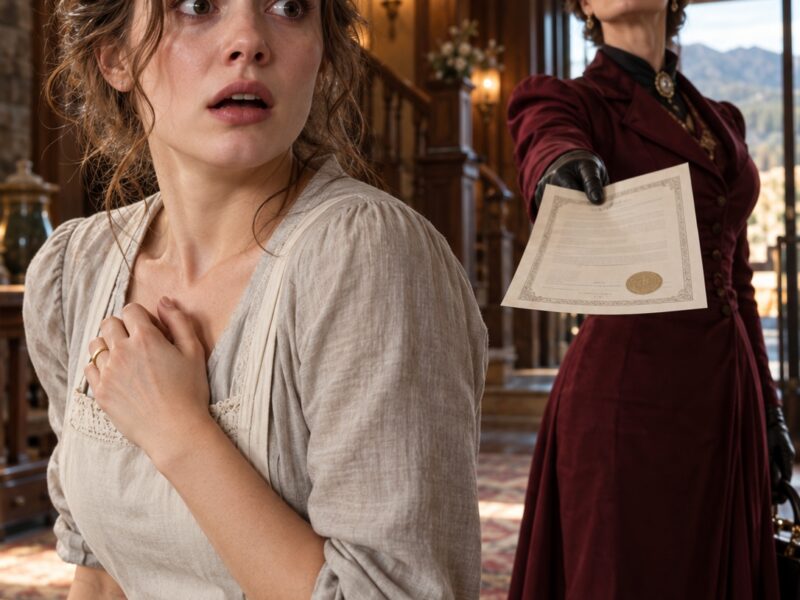
Three Days After I Married a Stranger, a Wealthy Woman Showed Up at His Ranch and Accused Me of Stealing $40,000—But the Secret She Revealed Next Was Far Worse.

Chapter 1: The Stranger at Calder Ranch
The first sign that something extraordinary had happened at Calder Ranch was the silence.
Twelve men who could argue through a thunderstorm, swear over broken fences, and shout insults across forty acres of open pasture sat perfectly still around a long dining table.
Higgins, the ranch foreman, held his spoon halfway to his mouth.
Halfpint, who ordinarily spoke even while chewing, had forgotten to swallow.
Cully stared down into his bowl as though something impossible had appeared beneath the gravy.
At the head of the table, Wyatt Calder slowly lowered his fork.
Across the kitchen, his new wife stood near the doorway, twisting the corner of her apron.
“Is something wrong?” Avalene Marsh Calder asked.
Nobody answered.
Her stomach tightened.
She had been married for three days. Three days in a strange house, surrounded by strangers, with a husband who spoke so little she sometimes wondered whether he regretted the marriage already.
And now she had apparently managed to poison twelve ranch hands with beef stew.
Higgins finally swallowed.
Then he put down his spoon.
“Mrs. Calder.”
Avalene braced herself.
“Yes?”
The old foreman looked at Wyatt.
Then back at her.
“Would you happen to have any more of that?”
A chair scraped violently against the floor.
Halfpint was already standing.
“Because if Higgins gets another helping before I do, there’s liable to be trouble.”
Cully reached for the bread.
“Best stew I’ve tasted since my grandmother was alive.”
“Your grandmother couldn’t cook,” Higgins snapped.
“She cooked better than you.”
“An injured badger cooks better than me. That ain’t saying much.”
The room exploded into laughter.
Avalene stood motionless, unable to understand what had just happened.
Wyatt watched her from the head of the table.
His wife had the expression of someone who had spent her entire life preparing for criticism and had never learned what to do with kindness.
He found that strangely difficult to look at.
“There’s more in the pot,” she said quietly.
Halfpint made a triumphant noise.
Within seconds, the men were scrambling toward the stove.
Wyatt remained seated.
Avalene approached to collect his bowl.
“Was yours all right, Mr. Calder?”
He looked up.
She had been calling him that since their wedding.
He had told her twice she could use his first name.
She had smiled politely both times and continued calling him Mr. Calder.
“It was good.”
A small smile appeared on her face.
“Thank you.”
He could have left it there.
That would have been the sensible thing.
Instead, he heard himself say, “Better than good.”
Her eyes widened.
Wyatt cleared his throat.
“I haven’t eaten like this in a long time.”
The smile faded, replaced by something softer.
“I’m glad.”
She turned toward the stove.
Wyatt watched her go, wondering why those two simple words had made his chest feel unexpectedly tight.
He had married Avalene Marsh because his dead mother had wanted him to.
He had never expected her to make him feel anything.
And that, he was beginning to realize, might become a problem.
Three days earlier, Avalene Marsh had stepped off the Bell Haven train carrying everything she owned.
One battered trunk.
A small carpetbag.
A worn Bible that had belonged to her mother.
And a folded letter from a man she had never met.
She had read that letter so often the paper had softened along its creases.
Miss Marsh,
My mother believed we might be suited to one another. I own a ranch outside Bell Haven. It is respectable, though the house has suffered some neglect.
I cannot promise affection. I can promise honest treatment, a permanent home, and that you will never be expected to answer for debts belonging to other people.
If such an arrangement is agreeable, I will meet your train on Thursday.
Wyatt Calder.
Avalene had been most struck by the sentence about debts.
She wondered what his mother had told him.
The platform was crowded with travelers and freight workers, but Avalene recognized Wyatt immediately.
He stood beside a dark horse, tall and broad-shouldered, with a weathered face and serious brown eyes.
His jacket was clean but old.
His boots were polished.
He held his hat in one hand.
“Miss Marsh?”
She nodded.
“Mr. Calder.”
His gaze moved to her trunk.
“Is that all?”
She stiffened.
“Yes. I didn’t think there would be room for more.”
“I meant I could carry another if you had one.”
Her cheeks warmed.
“Oh.”
He picked up the trunk.
She followed him toward the wagon.
They rode through Bell Haven in uncomfortable silence.
Avalene tried three times to begin a conversation.
Each time, Wyatt answered politely but briefly.
Finally, she asked, “Did your mother describe me to you?”
His hands tightened on the reins.
“She said you were dependable.”
Avalene almost laughed.
Dependable.
It was the word people had used for her since she was sixteen.
Dependable Avalene would mind the younger girls.
Dependable Avalene would manage the accounts.
Dependable Avalene would stay home when everyone else went dancing.
Dependable Avalene would understand.
“That was kind of her,” she replied.
Wyatt glanced at her.
“She said something else.”
“What?”
“That you sounded lonely.”
Avalene turned toward the passing countryside.
Her throat had closed.
After a moment, she whispered, “Your mother must have been a very perceptive woman.”
“She was.”
He said nothing more.
But she noticed the way grief changed his face.
The courthouse wedding took less than fifteen minutes.
The judge was distracted by a dispute involving a missing mule.
The clerk had forgotten where he put the register.
There were no flowers, no music, and no family members to offer congratulations.
When the judge asked Wyatt whether he took Avalene as his lawful wife, the rancher answered without hesitation.
“I do.”
Avalene looked at him.
It was the clearest, strongest thing he had said all morning.
When her turn came, her voice trembled.
“I do.”
Wyatt slipped a plain gold ring onto her finger.
It had belonged to his grandmother.
For one brief second, his hand enclosed hers.
Warm.
Steady.
Then he released her.
They left the courthouse as husband and wife.
Neither knew how to behave.
Calder Ranch lay beyond miles of rolling grassland, bordered by cottonwoods and distant mountains.
The property was larger than Avalene expected.
The buildings were sturdy.
The cattle looked healthy.
The barn was immaculate.
But the house was another matter.
Dust gathered on the windowsills.
The curtains had faded.
A cracked vase stood on the mantel.
There were no flowers, no freshly washed linens, and no evidence that anyone had considered the rooms worth making beautiful.
Wyatt showed her upstairs.
“This was my mother’s room.”
He opened the door to a spacious bedroom overlooking the southern pasture.
Avalene stopped at the threshold.
“Where will you sleep?”
“Down the hall.”
She looked at him.
He seemed almost embarrassed.
“I thought you might prefer your own space.”
She had spent months imagining what marriage to a stranger might require of her.
His answer surprised her so thoroughly that she could only nod.
“Thank you.”
Wyatt put down her trunk.
“If you need anything, ask.”
Then he left.
Avalene closed the door and sat on the edge of the bed.
For the first time in years, nobody was calling her name.
Nobody needed medicine.
Nobody demanded money.
Nobody was waiting for her to mend a shirt, prepare supper, or apologize for an offense she hadn’t committed.
The silence ought to have felt peaceful.
Instead, it frightened her.
She opened her carpetbag and took out a small blue ribbon.
Her mother’s ribbon.
She wrapped it around her fingers.
“I did it, Mama,” she whispered.
But the words brought no comfort.
Because her mother had never wanted her to marry a stranger.
She had wanted Avalene to be free.
And Avalene wasn’t entirely certain she had escaped the thing that had made freedom necessary.
The following morning, she woke before dawn.
The ranch kitchen was almost painfully neglected.
There was stale flour in a wooden barrel, bacon wrapped in paper, six eggs, and a small supply of potatoes.
A half-empty coffee tin sat beside the stove.
The pantry shelves were nearly bare.
Avalene surveyed the room.
Then, for the first time since leaving home, she smiled without forcing herself.
“This,” she whispered, rolling up her sleeves, “I know how to do.”
By sunrise, the smell of fresh biscuits drifted across the yard.
The first ranch hand entered suspiciously.
Halfpint was twenty, painfully thin, and permanently hungry.
He stopped in the doorway.
“What’s that smell?”
“Breakfast,” Avalene replied.
He stared at the biscuits.
“Those real?”
Avalene blinked.
“Of course.”
“Can I have one?”
“Please sit down. Everyone can eat together.”
He looked almost offended by the suggestion.
Then he stole one anyway.
The first bite stopped him in his tracks.
A moment later, he sprinted outside.
“GET IN HERE!”
Men came running from the stable, bunkhouse, and corrals.
Higgins arrived last.
He examined the table as if searching for evidence of trickery.
“What happened to the usual breakfast?”
“What was the usual breakfast?” Avalene asked.
Halfpint answered through a mouthful of biscuit.
“Burnt things.”
“Burnt what?”
“Depends on who was cooking.”
Higgins sat down.
“Mrs. Calder, I wouldn’t get accustomed to feeding this lot fancy food. They’ll eat you out of house and home.”
“Then we’ll need to order more flour.”
Higgins grunted.
Five minutes later, he had eaten three biscuits.
Wyatt appeared while the men were arguing over the final piece.
He stopped at the kitchen entrance.
For a moment, he looked confused.
Then he saw Avalene standing beside the stove.
“Morning,” she said.
“Morning.”
“There’s coffee.”
He poured himself a cup.
Tasted it.
Looked down at the mug.
Then took another sip.
Avalene waited anxiously.
“Too strong?”
“No.”
“Too weak?”
“No.”
“Would you like something else?”
Wyatt studied her.
“Mrs. Calder.”
“Yes?”
“You don’t need to apologize for breakfast.”
The men went silent.
Avalene stared at him.
“I wasn’t apologizing.”
“You were about to.”
She lowered her eyes.
He didn’t know why that bothered him.
But it did.
Later, as the ranch hands left for work, Cully paused at the doorway.
“Might there be biscuits tomorrow?”
Avalene looked into the flour barrel.
“If there’s flour.”
“There’ll be flour,” Wyatt said from behind her.
He was already calculating how much he could purchase in town.
Not because the men needed biscuits.
Because he wanted to see his wife smile again.
Over the next two days, Calder Ranch began changing.
Avalene scrubbed the kitchen until the wooden counters gleamed.
She washed the curtains.
She aired the bedding.
She discovered a patch of neglected herbs behind the house and brought rosemary and thyme indoors.
She baked bread every morning.
The men began inventing reasons to walk through the kitchen.
Halfpint claimed the pump needed inspecting.
Cully suddenly developed an interest in repairing chairs.
Higgins appeared twice to inquire whether the pantry shelves were sturdy enough.
Avalene understood perfectly.
She simply pretended not to.
For the first time in years, people appreciated what she could give without demanding something else in return.
Yet even amid the newfound warmth, certain sounds still frightened her.
A carriage approaching the house.
An unfamiliar voice in the yard.
An unexpected knock.
Every time, she went still.
Wyatt noticed.
On the third afternoon, he found her standing beside the kitchen window, looking toward the road.
“Expecting someone?”
She turned too quickly.
“No.”
He frowned.
“Something wrong?”
“Not at all.”
She smiled.
It was the sort of smile he had begun to recognize as false.
He didn’t press.
But that evening, when she thought she was alone, he heard her mutter, “Not yet. Please, not yet.”
The words stayed with him.
That same afternoon, in Bell Haven, a woman wearing a burgundy traveling dress stepped into the telegraph office.
Her name was Beatrice Vale.
She was forty-one, elegant, wealthy-looking, and accustomed to having men stand when she entered a room.
The telegraph clerk hurried to greet her.
“Mrs. Vale. What can I do for you?”
“I’m looking for someone.”
She removed a glove.
“An unmarried woman named Avalene Marsh.”
The clerk considered the name.
“Marsh?”
“Yes.”
“She isn’t unmarried anymore.”
Beatrice’s expression changed.
“Explain.”
“Married Wyatt Calder just the other day.”
For the first time in years, Beatrice Vale lost control of her face.
“Wyatt Calder?”
“Rancher east of town. Fine man.”
Beatrice stood motionless.
Then she laughed.
It was not a pleasant sound.
“Of course.”
The clerk shifted uncomfortably.
“Ma’am?”
“Nothing.”
She drew a folded paper from her handbag.
“Send this wire.”
The clerk took it.
Its destination was a law office in Denver.
The message was brief.
FOUND HER. MARRIED CALDER. SEND INSTRUCTIONS IMMEDIATELY.
When the reply arrived that evening, Beatrice read it twice.
Then she burned it in the stove of her hotel room.
Only one line troubled her.
DO NOT APPROACH WITHOUT SECURING THE ORIGINAL DOCUMENT.
Beatrice watched the paper turn to ash.
Her employer had waited eleven years for this opportunity.
She had no intention of disappointing him.
But she also had no intention of allowing Avalene Marsh to vanish again.
At Calder Ranch, supper became an event.
Avalene prepared beef stew with potatoes, carrots, onions, and herbs gathered behind the kitchen.
She had learned the recipe from her mother when she was twelve.
Her mother had always insisted that the secret to good cooking was patience.
“People can taste whether you resent feeding them,” she used to say.
As Avalene stirred the pot, she remembered her childhood kitchen.
Her mother’s laughter.
Her father’s polished shoes crossing the floor.
Her sisters whispering over new dresses.
And a young man named Edwin Vale standing beneath the apple tree, telling her she was the most remarkable woman he had ever met.
At nineteen, she had believed him.
At twenty-one, she had learned what his promises were worth.
Her father’s business had collapsed after a series of disastrous investments.
Creditors descended.
Her mother became ill.
The house was sold.
Her sisters married quickly.
Edwin broke their engagement.
“I need a wife who can contribute something to a marriage,” he had told her.
“Not merely good bread and pretty manners.”
Avalene remembered standing in the garden, watching him walk away.
She had not cried until nightfall.
And then she had cried so hard her mother came to sit beside her.
“Listen to me,” her mother whispered. “A person who measures your worth by what you own is too poor to deserve you.”
Avalene had tried to believe that.
But poverty had a way of making cruel words seem true.
Years later, after her mother’s death, things became worse.
Her father spoke endlessly of restoring the family fortune.
He made promises.
Borrowed money.
Lost it.
Eventually, he stopped asking Avalene to trust him.
He simply demanded it.
Then came the winter when she discovered a document hidden inside her mother’s sewing chest.
A document with her own name written across the top.
And a signature she knew she had never made.
Avalene had stared at it for a very long time.
Then she had done the one thing her father had never imagined.
She had taken it.
And left.
The memory still made her hands shake.
She gripped the wooden spoon.
Not here, she told herself.
Not now.
She had a new name.
A new home.
Perhaps even the beginning of something good.
She would not let the past ruin it.
The twelve ranch hands assembled for supper with suspicious punctuality.
Higgins sampled the stew first.
Silence followed.
Then Halfpint took a bite.
And Cully.
And the rest.
Avalene feared disaster until Higgins demanded another helping.
By the time the men began laughing, the tightness in her chest had loosened.
Wyatt sat at the end of the table, watching the transformation unfold.
His mother had loved this room.
She had insisted that supper was sacred.
No matter how difficult the day, everyone sat together.
After her death, the men had gradually stopped gathering indoors.
Meals became something swallowed quickly before returning to work.
The kitchen fire burned only when necessary.
Wyatt had allowed it.
He had been too busy grieving to notice that the house was dying around him.
Now Halfpint was telling a ridiculous story about falling into a creek.
Cully was laughing.
Higgins was pretending not to enjoy himself.
And Avalene stood beside the stove, smiling at them all.
Wyatt suddenly remembered his mother’s handwriting.
This one, Wyatt. Write to this one.
He had obeyed because he loved her.
He was beginning to wonder whether she had understood something he hadn’t.
After supper, the men disappeared reluctantly.
Avalene began clearing plates.
Wyatt stood.
“Leave those.”
She looked surprised.
“They need washing.”
“They’ll still need washing tomorrow.”
She smiled faintly.
“I’d rather do them tonight.”
He stepped closer.
“Then I’ll help.”
She stopped moving.
“Why?”
He almost laughed.
“Because I ate off them.”
She seemed uncertain what to do with that answer.
Eventually, she handed him a dishcloth.
They worked quietly.
The evening light faded through the windows.
Outside, cattle shifted in their pens.
Avalene washed.
Wyatt dried.
At one point, their hands touched over a plate.
She immediately withdrew hers.
“Sorry.”
He set the plate down.
“Absolutely.”
She looked at him.
“You don’t have to keep doing that.”
“Doing what?”
“Acting like you’re in trouble.”
The room went very still.
Her gaze moved toward the window.
“I suppose old habits are difficult to lose.”
“What happened to you?”
The question escaped before he could stop it.
She stiffened.
Wyatt immediately regretted his bluntness.
“You don’t have to answer.”
For a long moment, she said nothing.
Then she whispered, “I spent a great many years being told that everything was my fault.”
His expression hardened.
“By whom?”
She shook her head.
“It doesn’t matter.”
“It matters if they’re still bothering you.”
Her eyes met his.
Something unspoken passed between them.
Fear.
Hope.
And the dangerous possibility of trust.
“No,” she answered.
“Not anymore.”
Wyatt wanted to believe her.
But he had seen her looking toward the road.
“All right,” he said.
He resumed drying dishes.
After a while, Avalene spoke.
“Your mother must have been wonderful.”
He nodded.
“She was stubborn.”
The avalanches smiled.
“So are you.”
He looked at her.
She seemed startled by her own boldness.
Then, unexpectedly, he laughed.
It was a small sound.
Almost reluctant.
But it changed his face completely.
Avalene stared.
Wyatt had an unexpectedly handsome smile.
She realized she wanted to see it again.
And that frightened her almost as much as the past.
Later that night, Wyatt entered his mother’s old study.
The room smelled faintly of leather and cedar.
He had avoided it for months.
Her knitting basket still stood beside the chair.
Her spectacles lay on the desk.
He opened the drawer containing her correspondence.
Among the papers was Avalene’s final letter.
He unfolded it.
The handwriting was neat, careful, and strangely formal.
I have worked since childhood. I can cook, clean, keep household accounts, preserve food, and manage a sickroom.
I have no fortune, and I do not wish to pretend otherwise.
I am not asking for romance, Mr. Calder. I am asking for a roof and a purpose.
Below the signature, his mother had written:
This one, Wyatt. Write to this one.
He turned the paper over.
There was another notation, smaller and nearly hidden along the bottom.
His mother’s handwriting again.
Ask her about the blue ribbon.
Wyatt frowned.
He remembered seeing a blue ribbon tucked inside Avalene’s carpetbag when he carried her belongings upstairs.
At the time, he had thought nothing of it.
Now his mother seemed to be speaking from the grave.
Why would she know anything about Avalene’s ribbon?
He searched the remaining letters.
Nothing.
Then he noticed a narrow envelope caught behind the drawer.
It was addressed to him.
The seal was broken.
Inside was a single sheet.
My dear Wyatt,
If Miss Marsh accepts, do not let her mistake your silence for indifference.
She has been made to believe that kindness must be earned.
Show her otherwise.
And if the people she fears should find her, remember that the truth is not always the story told by the loudest voice.
Wyatt read the letter three times.
Then he stood.
His mother had known something.
Something she had deliberately kept from him.
He looked toward the ceiling.
Above him, Avalene was sleeping in his mother’s old bedroom.
Or perhaps lying awake, listening for the sound of approaching wheels.
He folded the letter carefully.
“All right, Ma,” he said into the empty room.
“Whatever this is, I’ll find out.”
The following morning, Avalene entered the kitchen to discover fresh flour stacked beside the pantry.
Three sacks.
Good flour.
And beside them, a small bundle of cinnamon sticks.
She touched the cinnamon.
“Where did these come from?”
Wyatt stood in the doorway.
“Town.”
“You went to town?”
“Yesterday afternoon.”
“But you didn’t say anything.”
“Didn’t seem necessary.”
She looked at the flour.
Then back at him.
“That’s rather a lot.”
“The men eat rather a lot.”
She laughed.
He watched her fingers move over the cinnamon.
“Do you like it?”
“My mother used to put it in apple cakes.”
“I thought you might make one.”
She looked delighted.
Then immediately cautious.
“Of course. If you’d like.”
Wyatt frowned.
“Absolutely.”
Her smile disappeared.
“I didn’t buy it because I expect cake.”
She stared at him.
“I bought it because I thought you might enjoy having it.”
For several seconds, she could not speak.
Then her eyes filled unexpectedly.
She turned away.
Wyatt felt a rush of panic.
Had he offended her?
“Did I say something wrong?”
“No.”
Her voice trembled.
“No, Mr. Calder.”
She pressed her fingers against her eyes.
“Nobody has bought me something simply because they thought I might like it in a very long time.”
Wyatt stood perfectly still.
Then he said the only thing that came to mind.
“Well. That seems a poor way to live.”
A startled laugh escaped her.
She looked back.
He was serious.
Utterly serious.
Something shifted inside her.
She had come to Calder Ranch hoping for shelter.
She had never expected gentleness.
In Bell Haven, Beatrice Vale received the second telegram shortly after breakfast.
This one contained only six words.
THE WILL CANNOT BE OPENED WITHOUT HER.
Beatrice crushed the paper in her fist.
She had spent years protecting a carefully constructed story.
Years ensuring that certain documents remained hidden and certain people remained silent.
And now Avalene had resurfaced, married into a respectable family, and apparently gained the protection of a man known for keeping his word.
It complicated everything.
But Beatrice was not without resources.
She had brought copies of papers that appeared to prove Avalene had stolen money from her father’s estate.
There were statements from creditors.
A sworn affidavit.
And a letter supposedly written by Avalene herself.
All beautifully prepared.
All persuasive.
All dangerous.
The original document was another matter.
It had vanished eleven years earlier.
And Beatrice suspected Avalene knew where it was.
She rang for her driver.
“We’re leaving.”
“Where to, madam?”
“Calder Ranch.”
“Shall I announce your visit?”
“No.”
Beatrice pulled on her black gloves.
“I want to see her face before she has time to invent a lie.”
At the ranch, the morning passed quietly.
Avalene mixed dough.
Wyatt examined accounts at the kitchen table.
It was the first morning they had spent together without feeling obliged to fill the silence.
At one point, Wyatt noticed a blue ribbon tied around Avalene’s wrist.
His mother’s strange note returned to him.
“That’s pretty.”
She glanced down.
“The ribbon?”
“Yes.”
“It was my mother’s.”
“She gave it to you?”
Avalene’s expression softened.
“She wore it in her hair when she married my father.”
Wyatt looked at the faded silk.
“Must mean a great deal.”
“It does.”
She began kneading again.
He hesitated.
“Did she know my mother?”
Avalene stopped.
“Why would you ask that?”
“Just wondered.”
“No.”
Her answer came too quickly.
Wyatt watched her.
“The Avalene—”
The distant sound of horses interrupted him.
Wheels rattled over the hard-packed road.
Avalene went still.
Wyatt glanced toward the window.
“Company.”
Her hands remained buried in the dough.
“Are you expecting someone?”
“No.”
The carriage drew closer.
A polished black vehicle pulled into the yard.
Its driver climbed down.
Then the carriage door opened.
A woman in an expensive burgundy traveling dress stepped onto the ground.
She adjusted her gloves.
Raised her head.
And looked directly toward the house.
Avalene saw her face.
The color drained from her cheeks.
The wooden spoon slipped from the counter and clattered to the floor.
Wyatt turned.
“The Afghans?”
She backed away from the window.
“No.”
Her voice was barely audible.
“No, no, no.”
Wyatt stood immediately.
“What’s wrong?”
She stumbled against the table.
The bowl shifted.
Dough spilled across the wood.
Outside, the woman approached the front steps with unhurried confidence.
Avalene pressed a hand to her mouth.
Wyatt had never seen anyone look so frightened.
He stepped toward her.
“Who is that?”
She couldn’t answer.
Three hard knocks struck the front door.
The sound echoed through the house.
Avalene grabbed Wyatt’s arm.
Her fingers were ice-cold.
“Please,” she whispered.
“Don’t let her in.”
Wyatt looked toward the entrance.
“Who is she?”
Tears gathered in Avalene’s eyes.
“She found me.”
Another knock.
Harder.
Then a woman’s voice carried through the door.
“Avalene Marsh! I know you’re in there.”
Wyatt moved in front of his wife.
“Stay here.”
But Avalene seized his sleeve.
“You don’t understand.”
“Then tell me.”
The woman outside spoke again.
“Mrs. Calder, I have no intention of standing on this porch all morning.”
Avalene’s breathing quickened.
“She’ll tell you terrible things about me.”
Wyatt looked into her face.
“Are they true?”
Avalene opened her mouth.
Closed it.
Then whispered, “Some of them.”
Wyatt felt the floor shift beneath him.
Before he could answer, the front door opened.
Higgins stood there, looking deeply irritated.
“Found this woman hammering on your door, boss.”
Beatrice Vale stepped inside.
She paused when she saw Avalene.
A slow smile spread across her face.
“Well,” she said.
“Look at you.”
Avalene stood frozen.
Beatrice’s gaze traveled over the gray dress, cream apron, and wedding ring.
“Still pretending to be respectable, I see.”
Wyatt stepped forward.
“You’re in my house, ma’am.”
Beatrice turned.
“Then you must be Wyatt Calder.”
“That’s right.”
She studied him with cold satisfaction.
“I was wondering what sort of man would marry a woman without knowing her history.”
Wyatt’s jaw tightened.
“State your business.”
Beatrice opened her leather handbag.
“I represent the interests of Avalene’s family.”
Avalene shook her head.
“No. You don’t.”
Beatrice ignored her.
“I’ve come about a matter involving stolen property, fraudulent signatures, and a debt that has remained unpaid for eleven years.”
Wyatt looked at his wife.
Avalene was trembling so violently she could scarcely stand.
“What debt?” he asked.
Beatrice removed a folded document.
“A rather substantial one.”
She held it out.
Wyatt took it.
The first page bore Avalene’s full name.
The second contained figures large enough to make his stomach drop.
And the third carried a signature.
Avalene Marsh.
Beatrice watched his expression change.
Then she delivered the words she had rehearsed throughout the carriage ride.
“Your wife didn’t come to Bell Haven looking for a home, Mr. Calder. She came here because she’s wanted for stealing forty thousand dollars.”
Wyatt stared at the paper.
Behind him, Avalene whispered, “I didn’t steal it.”
Beatrice smiled.
“No?”
She reached into her handbag again.
“Then perhaps you’d like to explain why your mother’s final will names you as the only living witness to your father’s crime.”
Avalene’s breath caught.
Beatrice unfolded another sheet.
“And why, if this document is genuine, the man you’ve just married may already own the very fortune your father stole.”
Wyatt looked up sharply.
“What?”
Beatrice’s smile disappeared.
For the first time, her voice held something close to fear.
“Because your mother-in-law didn’t choose this marriage by accident, Mr. Calder.”
She turned toward Avalene.
“She knew exactly who you were.”
And then Beatrice revealed the name of the person who had sent her.
A name Wyatt had last seen written on his mother’s death certificate.
“Your mother.”









