THREE MINUTES BEFORE HE SAID “I DO,” THE MAID RAN INTO THE WEDDING—WHAT SHE WHISPERED MADE THE MILLIONAIRE TURN WHITE
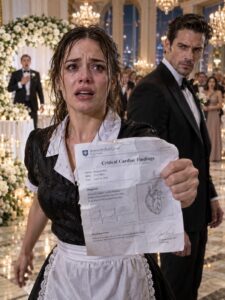
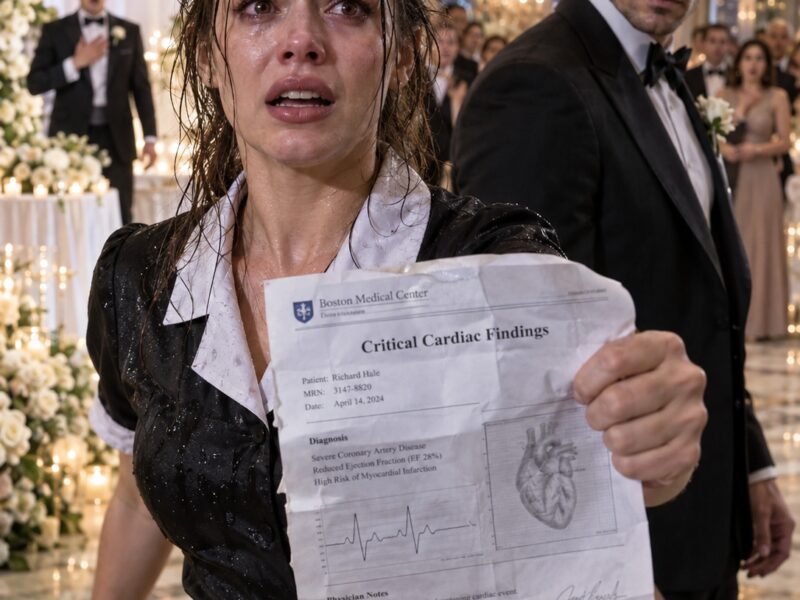
Three minutes before Andrew Whitmore was supposed to marry the woman everyone in Boston expected him to marry, a maid burst through the ballroom doors with rainwater dripping from her hair and a folded medical report clenched in her shaking hand.
The string quartet stopped in the middle of a note.
Four hundred guests turned at once.
Victoria Langford stood beneath an arch of white roses, one hand resting lightly against the waist of a wedding gown that had taken nine months to make. Beside her, Andrew stared toward the doors with the irritated confusion of a man whose entire life had been built around making sure nothing unexpected happened.
Hannah Brooks knew exactly what she looked like.
Twenty-six years old. Black service uniform. Wet shoes. No makeup. Breathing so hard she could barely form a sentence.
Security was already moving toward her.
Someone in the second row whispered, “Oh my God.”
Another guest lifted a phone.
Victoria’s mother looked as if Hannah had dragged mud across an altar.
But Hannah wasn’t looking at any of them.
She was watching Andrew.
More specifically, she was watching the way his right hand had moved toward his chest.
He had done it twice in the last ten minutes.
The first time, through the narrow glass panel outside the ballroom, Hannah had told herself she might have imagined it.
The second time, she stopped caring whether she lost her job.
“Mr. Whitmore,” she said.
Her voice disappeared into the vast room.
Andrew’s brow tightened.
“Hannah?”
The fact that he knew her name almost made things worse.
She crossed the polished floor while hundreds of people watched her approach the altar.
A security guard reached for her elbow.
Andrew raised one hand.
“Let her through.”
Hannah stopped in front of him.
Up close, he looked wrong.
His skin had gone pale beneath the carefully controlled expression. A thin line of sweat darkened his hair at the temple even though the ballroom was cool. His breathing was shallow.
Hannah held out the folded paper.
“I found this in your office.”
Andrew’s eyes dropped to it.
Victoria turned.
“What is that?”
Hannah swallowed.
“I think you need a doctor.”
A small, humorless smile touched Andrew’s mouth.
“At my wedding?”
“Now.”
The word came out sharper than she intended.
A ripple passed through the guests.
Victoria stared at Hannah. “Excuse me?”
Hannah didn’t take her eyes off Andrew.
“You’ve been having chest pain.”
His face changed.
Not dramatically.
Just enough.
And Hannah knew.
“You’ve been feeling it for days, haven’t you?”
“Hannah,” he said quietly.
“I saw you on the stairs Tuesday. You stopped halfway up and held the railing until no one was looking.”
Victoria’s head snapped toward him.
“Andrew?”
He looked at her.
For the first time all morning, the polished millionaire disappeared.
There was only a tired man in a tuxedo being forced to admit he was frightened.
“It was stress.”
Hannah unfolded the paper.
“This says ‘critical cardiac findings.’ It has your name on it. It’s dated three days ago.”
Andrew stared.
For one second, Hannah watched confusion move across his face.
Then something colder replaced it.
“Three days ago?”
“Yes.”
“I never received this.”
“I know.”
“How?”
“Because I found it hidden in your office.”
The room seemed to shrink.
Victoria stepped closer.
“Hidden by whom?”
Hannah opened her mouth.
She never got to answer.
Andrew’s knees gave way.
The groom who had survived recessions, lawsuits, hostile negotiations, and the collapse of his first company reached for the altar as though the floor beneath him had disappeared.
Victoria screamed his name.
Hannah caught his arm.
Two men from the front row rushed forward.
Somewhere behind them, a champagne glass shattered.
Andrew tried to speak, but the color had drained completely from his face.
“Call 911,” Hannah shouted.
No one moved.
She turned toward the frozen room.
“CALL 911!”
That broke the spell.
Phones appeared. Chairs scraped backward. Security rushed forward. Victoria dropped to her knees beside Andrew, her white dress spreading across the marble like spilled light.
Andrew looked at Hannah through unfocused eyes.
The orchestra had gone silent.
The guests had gone silent.
The entire wedding had stopped because a woman most of them had never noticed had walked into a room where she wasn’t supposed to belong.
And when Andrew finally managed to speak, his voice was barely audible.
“Who put that report in my office?”
Hannah looked at the folded paper in her hand.
Then she remembered the stranger carrying the black medical case.
And suddenly she understood something that frightened her even more than Andrew collapsing at the altar.
The report hadn’t simply been forgotten.
Someone had hidden it.
Three hours earlier, Hannah had thought the most dangerous thing she could do that day was spill champagne on a billionaire.
The morning had begun before sunrise beneath a cold October rain.
Boston looked almost colorless at five-thirty, the sidewalks reflecting traffic lights in long red and green streaks while delivery trucks hissed through wet intersections. Hannah sat near the back of the Number 43 bus with one hand around a paper cup of coffee and the other inside her coat pocket, touching the corner of an overdue electric bill.
She had forty-seven dollars until Friday.
Her mother needed a new pair of nonslip shoes for work.
Her landlord had mentioned the rent increase again.
And Hannah had agreed to cover an extra twelve-hour shift at the Whitmore mansion because weddings meant overtime.
She told herself that was good news.
At twenty-six, she had become skilled at turning bad mathematics into optimism.
The bus climbed toward Beacon Hill while rain moved across the windows.
By six-fifteen, Hannah was walking through the employee entrance of Whitmore House, one of the largest private residences in the neighborhood.
The mansion had been built in 1891 for a railroad investor whose name was still carved above the library fireplace. Andrew had purchased it six years earlier and restored nearly every room, although he used only a fraction of the space.
For the wedding, the building had been transformed.
White roses climbed the staircase.
Crystal chandeliers glowed over marble floors.
Florists carried arrangements worth more than Hannah made in three months.
A florist’s assistant dropped a box of orchids near the service elevator and whispered a curse when he realized what they cost.
Hannah helped him pick them up.
“Thanks,” he said.
“No problem.”
“You work here?”
“Unfortunately, that means I know where everything is.”
He smiled.
“You know where the coffee is?”
“Now you’re asking dangerous questions.”
He laughed.
It was a tiny exchange no one else noticed.
That was what Hannah’s life was mostly made of—small things other people did not notice.
She noticed the banquet captain rubbing his wrist after lifting silverware boxes.
She noticed one of the young servers crying in the downstairs bathroom because her boyfriend had broken up with her by text.
She noticed Andrew’s father arriving alone and standing for several seconds in the foyer staring at a photograph of Andrew’s late mother.
And she noticed Andrew himself coming down the back staircase at seven-twenty with one hand pressed flat against the center of his chest.
He didn’t know Hannah was there.
She had been carrying folded linens from the laundry room.
Andrew stopped on the landing.
His fingers tightened around the railing.
He closed his eyes.
Five seconds.
Maybe six.
Then he inhaled carefully, straightened his jacket, and continued downstairs.
When he saw Hannah, he smiled.
“Morning.”
“Good morning, Mr. Whitmore.”
He kept walking.
Hannah looked after him.
“You okay?”
Andrew stopped.
It was a strange question for an employee to ask a man whose net worth had been discussed in newspapers.
He turned slightly.
“Excuse me?”
“You looked dizzy.”
The silence lasted just long enough to remind Hannah of the difference between concern and overstepping.
Then Andrew gave her the practiced smile she had seen in magazine photographs.
“Didn’t sleep much.”
“Maybe eat something.”
His smile became real for half a second.
“Yes, Mom.”
Hannah almost apologized.
Instead she said, “I’m serious.”
“I know.”
He walked away.
That should have been the end of it.
By eight o’clock, the mansion had become organized chaos.
The wedding planner spoke into three headsets.
Caterers moved through the basement kitchen.
Photographers tested lenses beneath the rose arch.
A van arrived with cases of wine under private security.
Another delivered the wedding cake.
Then, at eight-forty-three, a black sedan stopped beside the service entrance.
Hannah was in the corridor inventorying water glasses when she saw a man step inside carrying a small black case.
He wasn’t wearing catering identification.
He wasn’t one of Andrew’s security personnel.
He wore a dark raincoat over a gray suit and moved with the impatience of someone who expected doors to open automatically.
A junior event employee signed a clipboard for him.
“What is that?” another server asked.
The junior employee shrugged.
“Medical delivery.”
“For who?”
“Whitmore.”
Hannah looked up.
The man continued down the corridor.
She felt the first small twist of unease.
It was irrational.
Rich people had doctors come to their homes. They had private nurses, nutritionists, massage therapists, IV hydration, private pharmacies—an entire invisible infrastructure that ordinary people encountered only in movies.
She went back to counting glasses.
Twenty-three.
Twenty-four.
Twenty-five.
Then she stopped.
If Andrew needed a medical delivery, why had he just told her he was fine?
She found Eleanor Pike, the household manager, in the pantry arranging staff assignments.
“Ms. Pike?”
Eleanor didn’t look up.
“If this is about the linen count, put it on the sheet.”
“It isn’t.”
That made Eleanor raise her eyes.
“There was a medical delivery for Mr. Whitmore.”
“And?”
“Did he order something?”
Eleanor frowned.
“Not that I’m aware of.”
Hannah waited.
Eleanor was sixty-one, immaculate, and capable of making a grown man feel twelve years old with a single look.
“Hannah.”
“Yeah?”
“Today is not the day to investigate the household.”
“I wasn’t investigating.”
“You have that face.”
“What face?”
“The one that has cost me three housekeepers and possibly a plumber.”
Hannah almost smiled.
Then Eleanor saw that she wasn’t joking.
“What did you see?”
“A man with a black case. He said it was for Mr. Whitmore.”
“Where did he go?”
“East corridor.”
Eleanor’s expression tightened.
“That area is closed.”
“I know.”
Andrew’s office was in the east corridor.
So was a private study used for confidential business meetings.
Eleanor set down her clipboard.
“I’ll handle it.”
Hannah nodded.
For the next twenty minutes, she tried to forget.
She failed.
At nine-ten, she saw the same stranger.
He emerged from the east corridor.
The black case was no longer in his hand.
He looked down at his phone as he passed Hannah.
For a moment, she saw his visitor badge.
The name had been handwritten.
D. KELLER.
He turned the corner.
Hannah stared after him.
Eleanor was nowhere nearby.
She could have called security.
She should have.
Instead, she walked toward the east corridor.
The carpeting changed there, from patterned runner to deep blue wool that muffled footsteps.
The mansion seemed quieter.
The noise of preparation faded behind her.
Andrew’s office door stood slightly open.
Hannah stopped.
She heard something inside.
A drawer closing.
Then footsteps.
Her stomach tightened.
Before she could move, the door opened.
Another man stepped out.
Not Keller.
Marcus Hale.
Andrew’s business partner.
Hannah knew him because everyone in the house knew Marcus.
He had co-founded Whitmore Hale Technologies with Andrew almost ten years earlier. Where Andrew seemed reserved, Marcus seemed effortless. He remembered birthdays. He tipped generously. He made jokes with drivers and shook hands with waiters.
He was also Andrew’s best man.
Marcus smiled when he saw her.
“Hannah.”
“Mr. Hale.”
“You lost?”
“No.”
His eyes flicked toward the service corridor behind her.
Then toward the office.
The smile remained.
“Big day.”
“Yes, sir.”
“Andrew’s going to need all the help he can get.”
Something about the sentence bothered her.
She couldn’t explain why.
Marcus adjusted his cuff.
“Could you ask someone to send coffee upstairs?”
“Of course.”
“Black.”
“I know.”
His smile widened.
“You really do notice everything.”
Then he walked away.
Hannah remained where she was.
A second later, Andrew’s office door moved slightly in the draft.
Open.
Inviting.
Wrong.
She should have left.
She knew that.
Instead, she stepped inside.
Andrew’s office looked exactly the way Hannah expected the office of a technology millionaire to look and nothing like she imagined a happy person’s office should look.
Glass. Dark wood. Screens. Perfectly arranged books.
No family photographs except one of Andrew and his mother.
On the credenza beside the window sat the black medical case.
Hannah didn’t touch it.
Her pulse had begun to beat too quickly.
She scanned the room.
Nothing seemed disturbed.
Then she saw a sheet of paper partly underneath a leather folder on the desk.
The Whitmore name caught her attention.
She stepped closer.
At the top was the logo of a private cardiology laboratory.
Patient: Andrew James Whitmore.
Age: 38.
The medical language below meant very little to her.
But three words did.
Critical cardiac findings.
Hannah stopped breathing.
She read the line twice.
A recommendation appeared farther down.
Immediate cardiology consultation.
She looked toward the door.
Why was the report here?
Why wasn’t Andrew holding it?
She checked the date.
Three days earlier.
Her skin went cold.
She remembered Andrew on the stairs.
The hand against his chest.
The pause.
The lie about being tired.
“Hannah?”
She spun around.
Eleanor stood in the doorway.
Hannah thought she was about to be fired.
Instead Eleanor saw the page.
“What is that?”
Hannah handed it to her.
Eleanor read.
The color changed in her face.
“Where did you find this?”
“On the desk.”
“Who else was in here?”
“Marcus.”
“Mr. Hale?”
“And that delivery man came down this hallway.”
Eleanor stared toward the black case.
Neither woman moved.
Then Eleanor said something so quietly Hannah almost didn’t hear it.
“Mr. Whitmore doesn’t know.”
“How do you know?”
“Because I’ve managed this house for six years. If he knew this existed, his physician would be here.”
Hannah looked at the black case again.
“What do we do?”
Eleanor folded the paper.
“We find him.”
They tried.
That was the problem.
A wedding of that size didn’t make the groom accessible.
It buried him.
Andrew was moved from room to room by photographers, family members, security, planners, lawyers and friends.
Eleanor called his personal assistant.
No answer.
She called Andrew’s phone.
Straight to voicemail.
She contacted security and was told Andrew had entered a private preparation suite and could not be disturbed.
“Tell them it’s medical,” Hannah said.
“I did.”
“And?”
“They said Marcus already checked on him.”
Both women went silent.
Hannah felt something shift inside her.
“Marcus?”
Eleanor looked toward the staircase.
“Yes.”
At ten-fifteen, Victoria arrived.
Even Hannah, who had no interest in society weddings, understood why photographers loved her.
Victoria Langford was thirty-three, tall, composed and beautiful in the way expensive things often appeared effortless from a distance.
Her family had made its money in commercial real estate.
She worked for an arts foundation.
Every public photograph of Victoria and Andrew showed them looking exactly right together.
On the wedding morning, she walked into the upstairs bridal suite surrounded by bridesmaids, stylists and women carrying garment bags.
Hannah glimpsed her only once.
Victoria was laughing.
For a moment, Hannah wondered whether she was about to destroy the happiest day of two people’s lives because she had misunderstood a piece of paper.
That doubt followed her for the next hour.
Maybe Andrew already knew.
Maybe Marcus was helping.
Maybe the report had been copied.
Maybe the black case was ordinary.
Maybe poor people survived by minding their own business for a reason.
At eleven-thirty, the first guests arrived.
At noon, cameras lined the entrance.
At twelve-forty, Andrew posed for photographs with his father.
He looked tired but steady.
Hannah watched from behind a service door.
She almost convinced herself everything was fine.
Then Andrew laughed at something the photographer said.
The laugh stopped abruptly.
He turned away.
His hand went to his chest again.
Hannah’s doubt vanished.
She found Eleanor.
“He did it again.”
Eleanor understood immediately.
“Where?”
“Ballroom hallway.”
Eleanor swore under her breath.
“We get him now.”
But by then the processional had begun.
The ballroom doors closed.
Security locked down the hall.
And suddenly hundreds of years of etiquette stood between Hannah and a man who might be in danger.
“Ma’am,” she told the security guard, “I need to speak to Mr. Whitmore.”
“After the ceremony.”
“It can’t wait.”
The guard, a broad man with a radio at his shoulder, remained polite.
“Staff are not permitted inside once the processional begins.”
“This is medical.”
“Medical personnel are on standby.”
“No, you don’t understand.”
“I understand.”
“No, you don’t.”
His expression hardened.
Hannah looked through the narrow glass panel.
Andrew was at the altar.
Victoria was preparing to walk down the aisle.
The string quartet began.
Hannah felt panic climbing her throat.
Then Andrew shifted.
His hand moved beneath his jacket.
Pressed against his chest.
He closed his eyes.
One second.
Two.
Hannah reached for the door.
The guard blocked her.
“Don’t.”
She looked at him.
“I’ll lose my job.”
“Yes.”
She looked through the glass again.
Andrew’s face had gone pale.
Hannah thought of her father.
She had been eleven years old the first time she understood adults could lie because they were afraid.
Her father had stood in their kitchen in Worcester one winter morning gripping the counter while her mother asked if he needed a doctor.
“Just indigestion,” he had said.
He had smiled.
He had gone to work.
He collapsed six hours later.
He survived that first attack.
The next years were a slow negotiation between hospital bills, medications, missed appointments and pride.
Hannah remembered her parents whispering about money after they thought she was asleep.
She remembered her father cutting pills in half.
She remembered asking why he didn’t tell the doctor.
“We’re fine, kiddo.”
They hadn’t been fine.
By the time he died, Hannah was fifteen.
She had spent eleven years afterward hating one sentence.
We’re fine.
Standing outside Andrew Whitmore’s ballroom, she heard it again.
Just stress.
Didn’t sleep much.
I’m fine.
Hannah put her hand on the door.
The security guard stepped forward.
“Miss Brooks.”
She looked at him.
“I’d rather get fired for being wrong than keep my job because I stayed quiet.”
Then she pushed the door open.
Everything after that happened too quickly.
The guests turning.
Victoria’s face.
Andrew’s disbelief.
The medical report.
The collapse.
Paramedics entered the ballroom at 1:17 p.m.
Andrew was conscious when they placed him on the stretcher, but barely.
He kept asking one question.
“Where did the report come from?”
No one could answer him.
Victoria climbed into the ambulance.
Andrew’s father followed in a second car.
Marcus stood beneath the mansion’s front awning speaking urgently into his phone.
Hannah watched him.
Rain blew across the steps.
Marcus looked up.
Their eyes met.
His conversation stopped.
For the first time since Hannah had met him, Marcus Hale did not smile.
And that was when she became certain she had seen something she had never been meant to see.
Massachusetts General Hospital had no interest in Andrew Whitmore’s wedding.
That was one of the things Hannah remembered most clearly.
The ballroom had cared about everything—flowers, photographs, seating charts, family names.
The emergency department cared about pulse, blood pressure and cardiac enzymes.
Money became temporarily irrelevant.
Andrew became a patient in a hospital gown.
Victoria became a woman sitting in a plastic chair with mascara beneath her eyes.
Andrew’s father became an old man staring at the floor.
Hannah became a witness.
She sat in the corner of a private waiting area still wearing her black uniform.
No one had told her to stay.
No one had told her to leave.
She kept thinking someone would suddenly remember she was an employee and ask what she was doing there.
Instead, a detective arrived.
Then another.
The black case from the mansion had been collected by Andrew’s security team and transferred to hospital staff.
A cardiologist named Dr. Priya Raman spoke with the family after nearly two hours.
“The important thing,” she said, “is that he came in when he did.”
Victoria gripped the arms of her chair.
“Is he going to be okay?”
“He’s stable.”
The word seemed to make everyone breathe.
Dr. Raman continued.
“He has a cardiac condition that needs immediate treatment and careful follow-up. This didn’t begin today. The warning signs were already there.”
Andrew’s father looked up.
“Could the wedding have killed him?”
The doctor paused.
“I wouldn’t frame it that way. But physical stress, emotional stress, lack of sleep, continuing to ignore symptoms—none of those things were helping.”
Victoria covered her mouth.
Hannah stared at the floor.
Dr. Raman looked at her.
“You found the report?”
“Yes.”
“Do you know whether Mr. Whitmore saw it?”
“No.”
“He says he didn’t.”
Hannah’s head lifted.
Andrew was awake.
Twenty minutes later, a nurse approached.
“Ms. Brooks?”
Hannah stood.
“Mr. Whitmore wants to speak with you.”
Victoria looked at her.
For a second Hannah saw something complicated in the bride’s face.
Gratitude.
Humiliation.
Fear.
And perhaps the smallest trace of resentment that a stranger knew something about Andrew before she did.
Hannah understood.
She would probably have felt the same.
Andrew looked smaller in the hospital bed.
Without the tuxedo and cameras and people arranging his life around him, he looked young.
Not twenty-five young.
Human young.
Fragile in a way wealth usually hid.
Hannah stopped inside the doorway.
“You wanted to see me?”
Andrew turned his head.
“Yes.”
She waited.
“You went into my office.”
There it was.
Hannah nodded.
“Yes.”
“You read a confidential medical document.”
“Yes.”
“And interrupted my wedding.”
“Yes.”
He looked at her for several seconds.
Hannah prepared herself.
Then Andrew said, “Thank you.”
She blinked.
“What?”
“I said thank you.”
“I heard you.”
“You look surprised.”
“I thought you were going to fire me.”
“I haven’t decided.”
Despite everything, she laughed once.
Andrew smiled.
Then the smile faded.
“Why did you do it?”
“What?”
“Why did you walk into that room?”
“Because you were sick.”
“That wasn’t your responsibility.”
“No.”
“You could’ve told security.”
“I did.”
“My assistant?”
“Tried.”
“Eleanor?”
“She helped.”
Andrew looked toward the window.
“Then why you?”
Hannah knew what he was asking.
Not what happened.
Why she had crossed the invisible line.
She looked down at her hands.
“My dad had heart problems.”
Andrew waited.
“He got sick when I was a kid. We didn’t have much money. He hated hospitals because every appointment meant a bill. Every bill meant my mom picked up another shift. So he started pretending things weren’t serious.”
Her throat tightened.
“He became very good at saying he was fine.”
Andrew didn’t speak.
“One morning he almost collapsed in our kitchen. My mom wanted to call an ambulance. He refused.”
“How old were you?”
“Eleven.”
Andrew looked at her.
“He died four years later.”
“I’m sorry.”
“So when I saw you on the stairs…”
She stopped.
Andrew’s eyes changed.
“You remembered him.”
“I remembered everyone believing him when he said he was okay.”
She looked directly at Andrew.
“I wasn’t going to do that again.”
For several seconds, neither of them spoke.
Then Andrew asked, “Did you know who I was when you opened those doors?”
Hannah frowned.
“You’re my employer.”
“No.”
He shook his head.
“Did you think about my company? My money? The guests? The press?”
“I thought about getting fired.”
Andrew almost laughed.
“That was it?”
“And maybe getting arrested.”
“Reasonable.”
“But mostly I thought you might fall down before anyone listened.”
Andrew looked toward the ceiling.
The silence stretched.
Then he said, “Everyone in that ballroom had known me longer than you.”
Hannah didn’t know what to say.
He turned his head back toward her.
“You were the only person who stopped the ceremony.”
The observation sounded less like gratitude than grief.
Before Hannah could respond, the door opened.
Marcus Hale walked in.
For half a second, he froze when he saw Hannah.
Then the smile returned.
“There he is.”
Andrew’s face changed too.
Not enough for Marcus to notice.
Enough for Hannah.
Marcus approached the bed.
“You scared ten years off my life.”
“You don’t have that many to spare,” Andrew said.
“Good. Sarcasm means you’re alive.”
Marcus looked at Hannah.
“And apparently we have Ms. Brooks to thank.”
Hannah said nothing.
Marcus nodded toward her.
“Hell of a thing you did.”
“It seemed necessary.”
“Clearly.”
His smile remained pleasant.
But his eyes did not.
Andrew watched both of them.
“Marcus.”
“Yeah?”
“Did you know about my lab results?”
The smile disappeared.
Only for an instant.
“What lab results?”
“The ones from Tuesday.”
Marcus frowned.
“No.”
“You sure?”
“Of course I’m sure.”
Andrew’s voice stayed calm.
“My report was in my office.”
Marcus looked genuinely surprised.
Or he was extraordinarily good at pretending.
“In your office?”
“With a medical delivery.”
Marcus shook his head.
“I have no idea what you’re talking about.”
Hannah remembered him leaving the office.
Andrew noticed her expression.
“So you weren’t in my office this morning?”
There was a pause.
Marcus looked toward Hannah.
Then back at Andrew.
“I was.”
“Why?”
“I was getting the merger documents you asked me to review.”
“I asked you yesterday.”
“And you told me the signed copy was in your desk.”
Andrew’s eyes narrowed.
Maybe that was true.
Maybe it wasn’t.
Marcus touched the bed rail.
“Andrew, whatever is going on, deal with it when you’re not attached to a heart monitor.”
He sounded concerned.
That was what made Hannah uneasy.
He sounded exactly right.
Andrew stared at him.
Then said, “You’re right.”
Marcus relaxed slightly.
Hannah saw it.
Andrew did too.
After Marcus left, Hannah stood.
“I should go.”
Andrew didn’t answer.
She moved toward the door.
“Hannah.”
She stopped.
“What?”
“What did Marcus say to you this morning?”
Her hand tightened around the door handle.
“Nothing important.”
“Tell me anyway.”
“He said you were going to need all the help you could get.”
Andrew stared at her.
“Anything else?”
Hannah remembered the last thing Marcus had said.
You really do notice everything.
She repeated it.
Andrew’s face became completely still.
That evening, the wedding was officially postponed.
The statement released to the press called it a “medical emergency.”
It contained no information about the report.
No information about the black case.
No information about Marcus.
By midnight, photographs of Hannah entering the ballroom were everywhere online.
Some headlines called her a heroic maid.
Others called her a wedding crasher.
One website claimed she was Andrew’s secret lover.
Another claimed she had poisoned him.
Hannah read three articles and stopped.
Her mother called at 12:17 a.m.
“Baby?”
“I’m okay.”
“People are saying your name on television.”
“I know.”
“What did you do?”
Hannah lay on her couch in her small apartment, still too wired to sleep.
“I opened a door.”
Her mother was silent.
“Hannah.”
“I might have saved somebody’s life.”
A longer silence.
Then her mother began to cry.
Not because Andrew was rich.
Not because reporters were outside the mansion.
Because she knew exactly which memory had pushed Hannah through those doors.
“Oh, sweetheart.”
Hannah closed her eyes.
“I kept thinking about Dad.”
“I know.”
“What if I was wrong?”
“You weren’t.”
“But what if I had been?”
Her mother answered gently.
“Then you’d have been embarrassed.”
Hannah laughed weakly.
“And unemployed.”
“Maybe.”
Another pause.
“But you’d still be able to sleep.”
That answer stayed with Hannah.
At eight the next morning, Andrew’s attorney called her.
Not the household manager.
Not Human Resources.
His personal attorney.
“We’d like you to come to the hospital.”
“Am I being sued?”
The lawyer paused.
“No.”
“Then why do I need a lawyer calling me at eight in the morning?”
“Because the medical report appears to have been deliberately intercepted.”
Hannah sat upright.
“What?”
“And the delivery you saw may be connected.”
Her apartment suddenly felt very quiet.
“Connected how?”
“We don’t know yet.”
“Does Mr. Whitmore know?”
“Yes.”
“Does Marcus?”
The attorney went silent.
That was answer enough.
The investigation stayed private at first.
Andrew did not want police speculation destroying his company before anyone had evidence.
His attorneys hired an outside forensic firm.
Security footage from the mansion was collected.
Email logs were preserved.
Phone records were requested.
The delivery man, Daniel Keller, was identified as a contractor working for a private concierge medical company.
Keller insisted he had merely transported a sealed case.
Who hired him?
A corporate medical account associated with Whitmore Hale Technologies.
Who authorized the account?
The request had been routed through executive administration.
That narrowed nothing.
Andrew and Marcus shared executive infrastructure.
The medical case itself contained legitimate medication.
That almost ended the suspicion.
Almost.
But the label carried Andrew’s name even though Andrew had never spoken to the prescribing service.
The medication was not inherently dangerous.
What frightened Andrew’s cardiologist was what it represented.
Someone had apparently attempted to manage Andrew’s symptoms privately instead of ensuring he received the urgent cardiology consultation recommended in the report.
It could have delayed real treatment.
The prescription had been requested using medical information that should have been confidential.
Andrew sat in his hospital room staring at the report while his attorney, Robert Ellis, explained it.
“So somebody got my lab results before I did.”
“Yes.”
“They requested medication in my name.”
“Yes.”
“And hid the actual report.”
“That appears likely.”
Andrew looked toward the window.
“Why?”
Robert did not answer immediately.
“That’s what we’re trying to establish.”
Hannah sat in a chair near the wall.
Andrew had asked her to attend because she was the only person who had seen both Keller and Marcus near the office.
She wished she hadn’t.
Every hour made the situation feel less like an accident.
Andrew looked at her.
“What aren’t you saying?”
Hannah hesitated.
“Nothing.”
“You have the face.”
“What face?”
“The same one Eleanor says you have when you’re investigating.”
Hannah blinked.
“She told you that?”
“Eleanor tells me everything.”
“Apparently not your medical results.”
The room went silent.
Hannah immediately regretted it.
Andrew stared at her.
Then, unexpectedly, he laughed.
It hurt.
He pressed a hand against his ribs.
Robert sighed.
“Please don’t kill my client while we’re investigating whether someone tried to exploit his health.”
Hannah looked down.
“Sorry.”
Andrew’s smile faded.
“Say what you’re thinking.”
She hesitated.
“Why now?”
Robert looked at her.
“What do you mean?”
“If someone wanted to hide his report, why do it during his wedding?”
Andrew’s expression changed.
Hannah continued.
“Everyone was distracted. Mr. Whitmore wasn’t checking emails. Staff were everywhere but nobody was paying attention to anything except the ceremony. And if he collapsed…”
She stopped.
Robert leaned forward.
“If he collapsed?”
“Everyone would assume the wedding caused it.”
No one spoke.
Andrew’s eyes dropped slowly to the blanket over his legs.
Hannah wished she could take the sentence back.
Because once spoken, it created a possibility none of them could ignore.
Someone may not have been trying to kill Andrew Whitmore.
They may simply have been waiting for him to become incapable of making decisions.
And in Andrew’s world, incapacity could be worth hundreds of millions of dollars.
Whitmore Hale Technologies had begun in a Cambridge apartment with two laptops, one folding table and a coffee machine Marcus claimed Andrew stole from a university lounge.
Ten years later, the company employed more than four thousand people.
Its cybersecurity platforms were used by banks, hospitals and federal contractors.
Andrew owned the largest individual share.
Marcus owned the second largest.
For most of a decade, that difference had meant nothing.
They had been friends before they were rich.
They had slept on office floors.
They had borrowed money from Andrew’s mother to make payroll.
Marcus had stood beside Andrew at his mother’s funeral.
Andrew had been best man at Marcus’s first wedding.
There were photographs of them at twenty-nine, skinny and exhausted, holding their first investment check like children who had won the lottery.
That history was exactly why Andrew resisted suspicion.
“No.”
He said it when Robert first raised Marcus’s recent financial decisions.
They were sitting in the hospital late Monday afternoon.
“No what?” Robert asked.
“Marcus wouldn’t do this.”
“We haven’t said he did.”
“You’re building toward it.”
Robert opened a folder.
“Three months ago, Marcus began negotiating a structured acquisition of Armitage Data Systems.”
“I know.”
“You rejected it.”
“The valuation was insane.”
“He continued discussions.”
Andrew stared at him.
“With whose authorization?”
“That is one of the issues.”
Andrew sat very still.
Robert continued.
“Two weeks ago, he circulated a proposed temporary executive-control framework.”
“I never saw it.”
“It was presented as contingency planning.”
“Contingency for what?”
Robert looked at him.
“Your health.”
The room changed.
Hannah watched Andrew’s face harden.
“What health?”
“The document refers to concerns regarding executive continuity in the event you became temporarily unable to perform your duties.”
Andrew took the folder.
His hands were steady.
His eyes were not.
“Who drafted this?”
“Outside counsel retained by Marcus.”
Andrew flipped pages.
“Who approved it?”
“It hasn’t been approved.”
“But it was ready.”
“Yes.”
“For the board.”
“Yes.”
“When?”
Robert hesitated.
“Friday.”
Andrew looked up.
Friday was six days after the wedding.
“If I were hospitalized?”
“Marcus could argue the company needed temporary leadership.”
“How much control?”
“Potentially significant.”
Andrew stopped turning pages.
“How significant?”
“Enough to advance transactions you opposed.”
Silence.
Hannah could hear the monitor beside Andrew’s bed.
One steady electronic pulse after another.
Andrew closed the folder.
“Get out.”
Robert frowned.
“Andrew—”
“Not you.”
He looked at Hannah.
She understood.
This was no longer a story about a maid finding a report.
It was about two men who had built an empire together.
She stood.
“I’ll wait outside.”
“Hannah.”
She stopped.
Andrew didn’t look at her.
“Was Marcus smiling when he came out of my office?”
The question seemed strangely small.
“Yes.”
Andrew nodded.
“Thank you.”
Hannah left.
Through the door, she heard nothing for almost a minute.
Then something struck the wall.
Victoria came to the hospital that evening.
She wore jeans, a cashmere sweater and no makeup.
It was the first time Hannah had seen her look ordinary.
She sat beside Andrew.
Hannah was in the hall and never intended to listen, but the door was partly open.
“You knew you weren’t feeling well,” Victoria said.
Andrew answered quietly.
“I knew I was tired.”
“You were having chest pain.”
“I didn’t know what it was.”
“You didn’t tell me.”
“I didn’t want to scare you.”
Victoria laughed once.
There was no humor in it.
“We were getting married, Andrew.”
“I know.”
“No, I don’t think you do.”
She stood.
“I was about to promise my life to you in front of four hundred people, and a woman who folds towels in your house knew more about what was happening to your body than I did.”
Hannah took a step away from the door.
Andrew said, “That’s not fair.”
“Isn’t it?”
“She saw me on the stairs.”
“And I slept beside you.”
Silence.
Then Victoria’s voice softened.
“I don’t care that the wedding stopped.”
Andrew looked up at her.
“I care that you would rather collapse at an altar than admit you were afraid.”
That sentence followed Hannah down the corridor.
She thought Victoria would leave.
Instead, Victoria emerged a few minutes later and saw Hannah.
They stood facing each other.
Hannah suddenly felt guilty despite having done nothing wrong.
Victoria approached.
“You heard?”
“A little.”
Victoria nodded.
“It’s fine.”
Hannah glanced toward the room.
“He didn’t want to ruin the wedding.”
“I know.”
Victoria looked tired.
“He’s been protecting everybody from his feelings since his mother died. Protecting his father. Protecting employees. Protecting me.”
She smiled sadly.
“It’s exhausting being protected by someone who never lets you protect him back.”
Hannah didn’t know how to answer.
Victoria studied her.
“Thank you.”
“You don’t have to—”
“Yes.”
Victoria’s voice broke slightly.
“I do.”
She swallowed.
“I hated you for about thirty seconds.”
Hannah almost smiled.
“I get that.”
“You were standing in the middle of my wedding holding a piece of paper while everyone looked at us.”
“I would’ve hated me longer.”
That made Victoria laugh.
Then her face changed.
“But if you hadn’t done it…”
She looked away.
The sentence remained unfinished.
Some possibilities did not need endings.
Over the next four days, the evidence stopped looking accidental.
An assistant in the company’s executive office admitted she had been told to reroute Andrew’s medical correspondence to a private encrypted account because of “wedding confidentiality.”
Who gave the instruction?
A vice president who reported directly to Marcus.
The vice president insisted Marcus had not explained why.
A server log showed someone using Marcus’s administrative credentials to access an email containing Andrew’s laboratory notification.
Marcus denied doing it.
His attorneys said his credentials could have been compromised.
Security video from the mansion showed Daniel Keller entering the east corridor.
Four minutes later, Marcus entered.
Seven minutes after that, Keller left without the case.
Three minutes later, Marcus emerged.
Again, Marcus had an explanation.
He had gone to retrieve merger documents.
The explanation might even have been true.
Then investigators found the text messages.
Not from Marcus directly.
From an intermediary.
A private consultant named Joel Mercer had communicated with the concierge medical service using a prepaid phone.
Mercer had been paid $47,500 by a consulting company.
The consulting company had been incorporated six months earlier.
Its only disclosed client was a firm controlled by Marcus’s brother-in-law.
Andrew read the report twice.
Then he called Marcus.
His attorneys advised him not to.
He did it anyway.
Hannah was not present for the call.
Later, Andrew told her what happened.
Marcus answered on the second ring.
“Andrew.”
“Did you intercept my medical report?”
Silence.
Then, “What?”
“Did you intercept it?”
“You’ve been listening to lawyers too long.”
“Answer me.”
“I didn’t intercept anything.”
“Did you authorize Joel Mercer to obtain my medical information?”
Another pause.
“Who?”
Andrew almost admired it.
The calm.
The instinctive distance from danger.
The same qualities that had made Marcus extraordinary in negotiations.
“Did you know I had a heart condition before my wedding?”
“No.”
“Did you know I was being evaluated?”
“I knew you’d been having tests.”
Andrew’s hand tightened around the phone.
“How?”
“You told me you weren’t feeling great.”
“I told you I was tired.”
“Same difference.”
“No.”
Andrew’s voice became quiet.
“It isn’t.”
Marcus exhaled.
“Andrew, listen to yourself. You nearly died and now you’re looking for someone to blame.”
“I didn’t nearly die.”
“Fine.”
“I got sick.”
“Fine.”
“And somebody used my medical records to prepare an emergency control plan for my company.”
“That’s business continuity.”
“Before I knew I was sick?”
Silence.
There it was.
The first real crack.
Andrew waited.
Marcus eventually said, “You’ve been running yourself into the ground for years.”
“So you planned for me to disappear?”
“I planned for the company to survive.”
Andrew looked through the hospital window at the Boston skyline.
“Our company.”
“Yes.”
“Then why didn’t you tell me?”
Marcus didn’t answer.
“Why hide the report?”
“I didn’t.”
“Why the medication?”
“I don’t know anything about medication.”
“Why was Mercer paid through your brother-in-law?”
Silence.
Longer now.
Then Marcus’s voice changed.
The warmth disappeared.
The old friendship disappeared.
For the first time, Andrew heard the executive underneath it.
“You know what your problem is?”
Andrew almost laughed.
“I’m fascinated.”
“You think the company is you.”
“No.”
“Yes.”
Marcus’s breathing was audible.
“You think because your name comes first, you’re the only one who gets to decide what happens. Every acquisition. Every expansion. Every vote. Every risk.”
“You could’ve challenged me at the board.”
“I did.”
“You lost.”
“Exactly.”
Andrew closed his eyes.
“So this was about control.”
“This was about survival.”
“Whose?”
Marcus didn’t answer.
Andrew continued.
“If Hannah hadn’t found the report, what was supposed to happen?”
“Nothing.”
“I go through the wedding?”
“Yes.”
“I ignore the symptoms?”
“I didn’t tell you to ignore anything.”
“I collapse later?”
“You’re being dramatic.”
“My board meets Friday.”
Silence.
Andrew felt something inside him finally break.
Not anger.
Something worse.
Recognition.
He had spent days trying to preserve a version of Marcus that no longer existed.
“Were you waiting for me to become incapacitated?”
Marcus said nothing.
Andrew whispered, “Jesus.”
“Don’t do that.”
“Do what?”
“Turn this into attempted murder.”
“I didn’t.”
“You’re thinking it.”
“No.”
Andrew looked at the medical tape on his hand.
“I think you were willing to let me get sicker because it helped you.”
Marcus’s voice dropped.
“You don’t understand what was at stake.”
“There it is.”
“What?”
“The sentence.”
Andrew closed his eyes.
“The sentence people use when they already know what they did was wrong.”
Marcus said his name.
Andrew hung up.
The next morning, Marcus resigned temporarily from Whitmore Hale Technologies pending an independent investigation.
Within forty-eight hours, the board suspended him.
Within two weeks, several financial irregularities connected to the proposed Armitage acquisition surfaced.
The medical scheme was never simple enough for a television headline.
Marcus had not hired an assassin.
He had not put poison in a glass.
He had done something less cinematic and, to Andrew, almost more disturbing.
He had learned his business partner might be medically vulnerable.
He had quietly gathered information.
He had helped create a system that kept the seriousness of that information away from Andrew while simultaneously preparing to assume control if Andrew became unable to lead.
He had not needed Andrew dead.
He had only needed Andrew weak.
The distinction haunted Andrew.
Marcus eventually faced civil litigation, corporate investigations and criminal scrutiny related to unlawful access to private medical information and financial misconduct.
His lawyers denied that he had intended physical harm.
Marcus maintained that the medical arrangements had been designed to help Andrew function through the wedding weekend while protecting the company from instability.
Andrew never believed that explanation.
Neither did Hannah.
The black case became the object Andrew hated most.
It sat in evidence storage while lawyers argued about chain of custody.
A legitimate case.
Legitimate medicine.
A legitimate label.
Everything about it looked helpful.
That was what made it frightening.
Sometimes betrayal did not arrive looking like betrayal.
Sometimes it arrived carrying exactly what you thought you needed.
Andrew left the hospital nine days after the wedding.
There were photographers outside.
He used a private exit.
Victoria came with him.
Hannah did not.
She had returned to work.
Or tried to.
The mansion felt wrong afterward.
The roses were gone.
Rental furniture had been removed.
The ballroom floor had been polished until there was no visible sign anyone had collapsed there.
A worker dismantled the altar.
Someone boxed hundreds of unused wedding favors.
Hannah stood in the ballroom doorway one afternoon watching two florists carry away the final white rose arrangement.
Eleanor joined her.
“You’re staring.”
“I know.”
“You do that too much.”
“I know.”
Eleanor folded her arms.
“You’re famous now.”
“Please don’t say that.”
“The baker asked for your autograph.”
“He was joking.”
“He wasn’t.”
Hannah groaned.
Eleanor smiled.
Then she became serious.
“You did well.”
“I ruined a wedding.”
“No.”
Hannah looked at her.
Eleanor nodded toward the empty altar.
“You interrupted one.”
The words stayed with Hannah.
A wedding could be rescheduled.
A life could not.
Andrew returned to the mansion three weeks later.
He walked more slowly.
He had lost weight.
A small device beneath his shirt monitored his heart.
Doctors had ordered medication, sleep and what Andrew described bitterly as “a life containing fewer conference calls at midnight.”
Hannah saw him in the kitchen.
He was making coffee.
Or attempting to.
She stopped.
“Sir?”
Andrew looked at the machine.
“I think this is broken.”
“You own a technology company.”
“That doesn’t mean I understand this.”
“It has one button.”
“I pressed it.”
“The water’s empty.”
Andrew stared at the reservoir.
“That feels unnecessarily judgmental.”
Hannah filled it.
Andrew watched her.
“You’re not nervous around me anymore.”
“I ran into your wedding.”
“Fair.”
The coffee began brewing.
Andrew leaned against the counter.
“I want to offer you another job.”
Hannah froze.
“No.”
“You don’t even know what it is.”
“Still no.”
“A household coordinator position.”
“No.”
“Better salary.”
“No.”
“Benefits.”
“No.”
“Do you negotiate every offer this aggressively?”
“I’m not negotiating.”
Andrew smiled.
“Why?”
Hannah put a mug beneath the machine.
“Because everybody already thinks I did what I did for money.”
“Who cares?”
“I do.”
“You saved my life.”
“I interrupted your wedding.”
“You’re committed to minimizing your role.”
“And you’re committed to making it bigger.”
Andrew’s smile faded.
“Hannah.”
She looked at him.
“I don’t know how to repay you.”
The honesty surprised her.
“You don’t.”
“I want to.”
“Then don’t.”
“What?”
“Don’t turn it into a transaction.”
Andrew stared.
Hannah immediately wondered if she had gone too far.
Then she continued.
“I didn’t do it because you were rich. If you give me money because I helped you, you’re turning it back into something about money.”
Andrew looked down at his coffee.
For a long moment, the only sound was the machine.
Then he nodded.
“Okay.”
Hannah relaxed.
Andrew picked up his mug.
“But your mother is still allowed to get a job through the community employment program.”
Hannah narrowed her eyes.
“What?”
“She applied.”
“You contacted her?”
“No.”
“Did you tell someone to contact her?”
Andrew looked offended.
“I’ve been informed I need boundaries.”
“By whom?”
“My cardiologist. My therapist. My father. You.”
Hannah tried not to smile.
“She applied on her own?”
“With help from someone who may or may not have mentioned the opening.”
“Andrew.”
“I’m going to walk away now.”
She laughed despite herself.
He took three steps.
Then turned.
“One more thing.”
“I knew it.”
“My mother had a scholarship fund.”
Hannah’s expression changed.
“It hasn’t been active for several years. I’m restarting it.”
“Okay.”
“I want to add your father’s name to one of the emergency family grants.”
Hannah stared at him.
“No publicity.”
She didn’t speak.
“No press release. No plaque in the ballroom. No giant check.”
Her eyes burned.
Andrew’s voice softened.
“You told me what happened to your family. There are probably thousands of families doing the same mathematics your parents did.”
Hannah looked away.
“I don’t want this to be about me.”
“It won’t be.”
“Promise?”
“Yes.”
She wiped beneath one eye with the back of her hand.
“Then okay.”
Andrew nodded.
He left the kitchen.
Hannah stood beside the coffee machine for several minutes after he was gone.
It was the first time she understood that gratitude could be dangerous when it was used to create debt.
And beautiful when it was used to create something that outlived both people.
The wedding was never rescheduled.
Not officially.
For several months, Andrew and Victoria stayed together.
They tried counseling.
They spent weekends away from Boston.
They had dinners without photographers.
They talked about things they had apparently avoided during two years of engagement.
Fear.
Ambition.
Children.
Andrew’s instinct to retreat into work.
Victoria’s frustration at being treated like part of his public life rather than a person allowed into his private one.
Hannah saw very little of Victoria during that period.
One December afternoon, Victoria came to the mansion alone.
She found Hannah in the library arranging donated books for a holiday drive.
“Hi.”
Hannah looked up.
“Hi.”
Victoria wore a camel coat and carried no engagement ring.
Hannah noticed immediately.
She wished she hadn’t.
Victoria saw her eyes move.
“It’s okay.”
Hannah set down the books.
“I’m sorry.”
“Don’t be.”
Victoria walked toward the window.
Snow had begun to fall over Beacon Hill.
“We love each other.”
Hannah said nothing.
Victoria smiled faintly.
“That’s the problem with stories, isn’t it? Everybody thinks love is the ending.”
She touched the bare place on her finger.
“Sometimes it’s just one of the things that happened.”
Hannah didn’t know what to say.
Victoria continued.
“We were good at being impressive together.”
“That sounds sad.”
“It is.”
“Did the wedding change things?”
“The wedding exposed things.”
She looked at Hannah.
“You didn’t break us.”
“I didn’t think—”
“Yes, you did.”
Hannah went still.
Victoria smiled.
“I would’ve.”
That honesty hurt more than blame would have.
Victoria sat on the edge of a leather chair.
“Andrew spent years believing love meant making sure nobody ever saw him fall apart. I spent years believing patience meant pretending that didn’t hurt.”
Hannah looked toward the snow.
“Maybe you could still work it out.”
“Maybe.”
Victoria’s expression softened.
“But sometimes two people can forgive each other and still understand they shouldn’t get married.”
The sentence carried no anger.
Only grief.
A beautiful, exhausted kind of grief.
When Victoria left the mansion that afternoon, Hannah watched from the window.
She walked down the snowy steps.
Stopped once.
Looked back.
Then continued toward the waiting car.
Andrew did not come downstairs.
Six months later, he and Victoria released a short joint statement announcing the end of their engagement.
There was no scandal.
No accusation.
No villain.
Some endings were painful precisely because no one had done anything unforgivable.
By spring, Andrew’s life looked different.
Not transformed.
Different.
That mattered.
He still worked too much.
He still checked his phone during dinner occasionally.
He still frightened his father by treating medical appointments like scheduling inconveniences.
But he began leaving the office before midnight.
He stopped pretending sleep was weakness.
He visited his father on Sundays.
He learned how to make coffee.
Badly.
He began attending meetings at a community center in Roxbury that provided meals, tutoring and emergency support to working families.
Hannah volunteered there on Saturdays.
At first, Andrew donated money.
Then one morning the director handed him a box of canned food.
Andrew looked at it.
“What do you want me to do with this?”
“Put it on the shelf.”
“I could fund ten shelves.”
The director shrugged.
“Today you can stock one.”
Hannah heard about it later and laughed for five straight minutes.
A week afterward, Andrew appeared beside her in the food pantry.
“I’ve been reassigned.”
“To what?”
“Rice.”
“What did you do?”
“Asked too many strategic questions about canned vegetables.”
She handed him a box.
“Rice doesn’t require strategy.”
“Everything requires strategy.”
“Put it on the shelf, Andrew.”
He did.
Slowly, awkwardly, with the expression of a man discovering that not every problem improved when he tried to optimize it.
Children at the center did not know his net worth.
One little boy knew him only as “the tall guy who doesn’t know where pasta goes.”
Andrew liked that.
Hannah noticed.
Their friendship grew there, away from the mansion.
Not romantically.
Not dramatically.
Neither of them needed another story people could turn into a headline.
They became something quieter.
Two people who had seen each other at moments stripped of status.
Hannah knew Andrew could be arrogant, stubborn and emotionally evasive.
Andrew knew Hannah could be judgmental, impulsive and physically incapable of ignoring something once she believed it was wrong.
They argued.
Often.
When Andrew tried to fund every problem at the community center, Hannah accused him of confusing generosity with control.
When Hannah refused opportunities because she was afraid people would think she hadn’t earned them, Andrew accused her of confusing humility with self-sabotage.
One evening, after a particularly unpleasant argument about a management course he wanted her to take, Andrew said, “You know you don’t have to spend your entire life proving you didn’t save me for personal gain.”
Hannah stared at him.
“That isn’t what I’m doing.”
“Yes, it is.”
“You don’t know what I’m doing.”
“You’ve refused three promotions.”
“Because I wasn’t qualified.”
“You were.”
“You can’t decide that just because you’re grateful.”
“I’m not grateful anymore.”
Her face changed.
Andrew sighed.
“That came out wrong.”
“No, it came out pretty clear.”
“Hannah.”
“What?”
“I mean gratitude isn’t why I think you’re capable.”
She folded her arms.
“Then why?”
“Because I’ve watched you.”
The answer stopped her.
Andrew continued.
“You see systems the way you see people. You notice where things fail. You remember names. You know which families don’t fill out the medical assistance forms because they’re embarrassed to ask for help. You know which kids pretend they’ve eaten.”
Hannah looked away.
“You know why employees quit before their managers know they’re unhappy.”
“That’s not management.”
“It is.”
Andrew stepped closer.
“You think the only valuable thing you ever did was run into a ballroom.”
“I don’t think that.”
“I do.”
She looked at him.
His voice softened.
“I think you believe courage only counts when it’s dramatic.”
Hannah had no answer.
A week later, she enrolled in the course.
Almost a year after the interrupted wedding, Andrew returned to Whitmore House on another rainy morning.
But this time, there were no limousines.
No velvet barriers.
No society photographers waiting on the sidewalk.
The mansion doors were open.
Families entered carrying umbrellas.
Children ran through hallways once reserved for executives and senators.
The ballroom where Andrew had nearly collapsed contained folding tables stacked with donated medical supplies.
White roses had been replaced by handmade drawings.
A little girl had taped a picture of a purple dinosaur directly beneath an eighteenth-century painting that probably cost more than Hannah’s apartment building.
Eleanor saw it.
She considered removing it.
Then she walked away.
Hannah stood near the entrance wearing a navy dress and a plastic name tag.
Not a maid’s uniform.
Not yet an executive’s suit.
Something in between.
Something hers.
The event launched the Whitmore Family Health Foundation, a nonprofit designed to help working families facing emergency medical costs, transportation barriers and temporary loss of income during major health crises.
Andrew had resisted putting his own name on it.
His board insisted.
Hannah had told him, “For once in your life, losing an argument won’t kill you.”
He had replied, “Too soon.”
Now hundreds of people filled the mansion.
Andrew stood at the back of the ballroom watching them.
His father joined him.
“You okay?”
Andrew smiled.
“Yes.”
His father raised an eyebrow.
“You sure?”
Andrew laughed.
The question carried history now.
“Actually? I’m tired. My shoulder hurts because I helped move tables I was specifically told not to move. And I am nervous about the speech.”
His father nodded approvingly.
“Look at that.”
“What?”
“Growth.”
Andrew rolled his eyes.
Across the ballroom, Hannah helped an elderly woman complete a form.
Andrew watched her.
One year earlier, she had stood in almost the same place soaked with rain while hundreds of guests stared at her as though she had violated the natural order of the universe.
Today, people were lining up to ask her for help.
A reporter approached Andrew.
“Mr. Whitmore, can I ask what inspired the foundation?”
Andrew glanced toward Hannah.
Then toward the place where the wedding altar had once stood.
“My wedding.”
The reporter smiled.
“The one that didn’t happen?”
“Yes.”
“That’s an unusual answer.”
“It was an unusual day.”
The reporter checked her recorder.
“Most people know the story as the day a maid crashed your wedding.”
Andrew’s expression changed.
“She didn’t crash it.”
The reporter paused.
“No?”
“She interrupted it.”
“What’s the difference?”
Andrew looked across the room.
“A person crashes something because they want attention.”
Hannah glanced up.
Their eyes met.
Andrew continued.
“She interrupted it because nobody else was paying attention.”
The reporter followed his gaze.
“Hannah Brooks?”
“Yes.”
“Do you credit her with saving your life?”
Andrew took a breath.
“I credit her with doing something much harder than liking someone.”
The reporter frowned slightly.
“What?”
“Risking being disliked.”
He looked back at Hannah.
“She knew everyone in that room might hate her for what she was about to do.”
“And she did it anyway.”
“Yes.”
“Why?”
Andrew smiled.
“You’d have to ask her.”
Later, Andrew stepped onto the small platform at the front of the ballroom.
There was no orchestra.
No altar.
No tuxedo.
He wore a simple charcoal suit.
The room quieted.
Andrew looked at the prepared speech in front of him.
Then pushed it aside.
Hannah immediately became suspicious.
She was standing near the back wall beside Eleanor.
“Oh no,” she whispered.
Eleanor smiled.
“What?”
“He’s improvising.”
“Is that bad?”
“Historically.”
Andrew began.
“Almost one year ago, I stood in this room believing I was about to begin the most important day of my life.”
People listened.
“I had four hundred guests. Flowers everywhere. Cameras outside. Enough champagne downstairs to make several very bad decisions.”
Laughter moved through the room.
“I thought important days were supposed to look impressive.”
His expression became serious.
“Then a twenty-six-year-old employee walked through those doors and embarrassed me in front of everyone I knew.”
More laughter.
Hannah closed her eyes.
Andrew smiled toward her.
“She was wet. Terrified. Completely inappropriate.”
“Andrew,” Hannah muttered.
“And right.”
The room became quiet.
“She had found medical information that had been deliberately kept from me. She had noticed warning signs I’d spent days pretending weren’t important.”
Andrew rested both hands on the podium.
“I have spent most of my adult life believing intelligence means seeing opportunities other people miss.”
He paused.
“I was wrong.”
Hannah looked at him.
“Sometimes intelligence is seeing suffering other people have learned not to notice.”
No one moved.
“Hannah Brooks saw mine.”
Her throat tightened.
“She did not know what would happen when she opened those doors. She didn’t know whether I would thank her, fire her or have security drag her outside.”
Several people laughed softly.
Hannah did not.
“She knew only one thing. Someone might need help.”
Andrew looked around the ballroom.
“That should not be extraordinary.”
His voice softened.
“But too often, it is.”
He explained the foundation.
Emergency medical grants.
Transportation funds.
Temporary wage replacement.
Navigation assistance for families overwhelmed by hospital systems and insurance paperwork.
Then he looked toward Hannah.
She knew immediately.
“No,” she whispered.
Eleanor squeezed her arm.
Andrew continued.
“Our first community outreach program will be directed by someone who understands these problems better than any consultant I could hire.”
Hannah stared at him.
“She understands what it means to choose between a bill and an appointment. She understands what pride can cost. And she understands that people who need help do not always know how to ask for it.”
Her eyes filled.
“Hannah Brooks.”
Applause filled the ballroom.
Hannah didn’t move.
Eleanor nudged her.
“Go.”
“I hate him.”
“No, you don’t.”
“This wasn’t supposed to be public.”
“The appointment isn’t charity.”
“I know.”
“Then go.”
Hannah walked forward.
One year earlier, every step toward Andrew had felt like walking toward disaster.
This time, the room stood.
Not because she was rich.
Not because her dress was expensive.
Not because anyone suddenly believed she had become more human than she had been while carrying towels upstairs.
They stood because someone had finally told the story correctly.
Hannah reached the platform.
Andrew held out his hand.
She ignored it and leaned toward the microphone.
“You could have warned me.”
The room laughed.
Andrew whispered, “Then you might’ve said no.”
“I still might.”
“You already signed the contract.”
She stared at him.
He smiled.
Hannah turned toward the crowd.
She had prepared no speech.
For several seconds, nothing came.
Then she remembered her father.
A cold kitchen.
A pill cut in half.
A man smiling because he did not want his family to know he was afraid.
“My father was sick for a long time,” she began.
The room quieted.
“My family wasn’t poor enough to have nothing. We were poor in a more complicated way.”
She took a breath.
“We had jobs. We had a home. We had food. We also knew exactly how much an emergency could cost.”
Her voice shook.
“So we learned to postpone things.”
A few people lowered their eyes.
“Dentists. Tests. Prescriptions. Rest.”
Hannah looked at Andrew.
“And sometimes fear.”
The room was completely silent.
“When I interrupted Andrew’s wedding, people later called me brave.”
She smiled faintly.
“I wasn’t.”
Andrew frowned.
“I was terrified.”
She looked toward the ballroom doors.
“My hands were shaking so badly I almost dropped the report.”
A little laughter.
“But courage is not the absence of fear.”
She paused.
“It’s deciding somebody else’s life matters more than your embarrassment.”
Andrew looked down.
Hannah’s eyes filled again.
“This foundation is for people who have spent too long saying, ‘We’re fine,’ because telling the truth feels too expensive.”
No one applauded immediately.
The silence afterward was better.
It meant they had heard her.
Eventually the applause came.
Hannah stepped away from the microphone.
Andrew leaned toward her.
“You’re better at this than I am.”
“Obviously.”
“I created a monster.”
“You opened the door.”
“No.”
Andrew smiled.
“You did.”
The rain stopped just before sunset.
Families slowly left the mansion carrying information packets, medical supplies and bags of groceries.
Volunteers folded tables.
Children’s drawings remained taped to the ballroom walls.
Hannah stood alone for a few minutes near the doors she had once pushed open.
Andrew approached.
“You okay?”
She looked at him.
“You stole my line.”
“You stole my wedding.”
“Still dramatic.”
He stood beside her.
For a while, neither spoke.
The room had become almost empty.
“Do you ever wish it had gone differently?” Hannah asked.
“What?”
“That day.”
Andrew looked toward the place where the altar had stood.
“Yes.”
She waited.
“I wish Marcus hadn’t betrayed me.”
Hannah nodded.
“I wish Victoria and I had understood each other earlier.”
His voice held no bitterness.
“I wish my mother had been alive.”
Hannah looked at him.
Andrew continued.
“I wish I hadn’t spent years thinking being needed was the same thing as being known.”
The confession hung quietly between them.
“But do I wish you hadn’t opened those doors?”
He shook his head.
“No.”
Hannah smiled faintly.
“You might have had a wedding.”
“I might have had a funeral.”
“Your doctor said—”
“I know what my doctor said.”
He smiled.
“Let me be dramatic once.”
“You’ve used your annual allowance.”
They both laughed.
Then Andrew became quiet.
“Victoria sent a donation.”
Hannah looked at him.
“She did?”
“Yes.”
“How much?”
“I’m not telling you.”
“That much?”
He laughed.
“Enough.”
Hannah looked toward the empty ballroom.
“Do you miss her?”
Andrew took his time answering.
“Yes.”
The word was simple.
Honest.
Hannah appreciated that.
“Do you regret letting her go?”
“No.”
Another pause.
“Those things can both be true.”
Hannah nodded.
Outside the tall windows, the clouds had broken over Boston.
Late sunlight touched the wet rooftops.
Andrew put his hands in his pockets.
“You know what the papers got wrong?”
“Only one thing?”
“They kept writing that you changed my life.”
Hannah looked at him.
“You did.”
“I interrupted your wedding.”
“You keep saying that.”
“Because it’s accurate.”
Andrew shook his head.
“You made me stop.”
“Same thing.”
“No.”
He looked directly at her.
“Stopping is different.”
Hannah waited.
Andrew’s voice became quieter.
“I had spent years moving so fast that nobody could ask whether I was happy.”
The words landed heavily.
“Then my body stopped me.”
He smiled.
“And you made sure I listened.”
For once, Hannah had no sarcastic answer.
They stood together while volunteers turned off lights one by one.
The mansion slowly darkened.
A year earlier, Andrew had filled the room with white roses so everyone could witness him promising a future.
Tonight, the floor was marked by folding chairs.
There was tape on the wall.
A child had left a red crayon beneath one of the tables.
And somehow the room had never looked more beautiful.
Years later, when journalists wrote about Andrew Whitmore, they usually mentioned the company first.
They mentioned the cybersecurity contracts.
The lawsuits.
The restructuring after Marcus Hale’s departure.
The billions in market value.
They mentioned Andrew’s eventual decision to step back from daily operations and devote more of his time to the foundation.
When they wrote about Hannah Brooks, they called her the maid who crashed a millionaire’s wedding.
She corrected them every time.
“I didn’t crash it.”
The interviewer would usually smile.
“What did you do?”
“I interrupted it.”
Most people thought she was being modest.
She wasn’t.
To Hannah, the distinction mattered.
She hadn’t gone into the ballroom to destroy anything.
She had gone inside because there was still something worth saving.
The foundation expanded beyond Massachusetts.
Its emergency programs helped families pay for transportation, temporary lodging, medications and income gaps during medical crises.
Hannah eventually became executive director of community outreach.
She still lived without much interest in luxury.
She bought her mother a new refrigerator before she bought herself a better car.
Andrew teased her about it.
She told him the refrigerator had better judgment.
Eleanor retired.
Andrew’s father grew older.
Victoria married several years later in a small ceremony in Vermont.
Andrew attended.
So did Hannah.
There were no scandals.
No secret jealousy.
No cinematic declarations.
Sometimes healing looked disappointingly ordinary.
That was what made it real.
Marcus became a name Andrew rarely spoke.
The legal battles lasted years.
Money was recovered.
Some damage wasn’t.
Andrew once told Hannah that betrayal was strange because anger faded faster than memory.
“You stop wanting revenge,” he said.
“But you never again become the person who didn’t know it could happen.”
Hannah understood.
Everybody carried a before and an after.
For Andrew, the line between them was a pair of ballroom doors opening.
For Hannah, it had happened years earlier in a small kitchen when her father said he was fine.
Neither of them could change those moments.
They could only decide what grew from them.
On the tenth anniversary of the foundation, Andrew and Hannah stood again inside Whitmore House.
The building no longer functioned primarily as a private residence.
Large sections had been permanently converted into offices, training rooms and community spaces.
The ballroom had become a multipurpose hall.
The wall where white roses once climbed now displayed photographs of families helped by the foundation.
One photograph showed a nurse holding a sleeping baby.
Another showed a construction worker ringing a cancer-treatment bell.
Another showed a single mother standing beside a teenage son after a heart transplant.
Hannah stopped in front of that one.
Andrew joined her.
“You okay?”
She smiled.
“You still ask that a lot.”
“I learned from an expert.”
They continued toward the old ballroom doors.
The wood had been restored, but Hannah could still remember exactly where her wet hand had touched the brass handle.
Andrew noticed her looking.
“Three minutes.”
“What?”
“That was how close we were to starting.”
Hannah smiled.
“You remember?”
“I remember everything.”
“The flowers?”
“Yes.”
“The music?”
“Yes.”
“The report?”
“Yes.”
“My hair looking insane?”
“Especially that.”
She elbowed him.
Andrew laughed.
Then he grew quiet.
Hundreds of people were gathering in the hall behind them for the foundation’s anniversary dinner.
Doctors.
Families.
Volunteers.
Former patients.
Employees.
Some wealthy.
Some struggling.
Some who had once believed places like Whitmore House were designed to keep people like them outside.
Andrew looked through the open doors.
“I used to think the worst thing that happened here was losing my wedding.”
Hannah glanced at him.
“What do you think now?”
He considered the question.
“I think the worst thing almost happened because everyone was afraid to interrupt.”
Hannah looked at the brass handle beneath her hand.
Andrew continued.
“And the best thing happened because one person wasn’t.”
Across the room, a little girl laughed.
Someone dropped a spoon.
A volunteer called for more chairs.
Life continued in all its untidy, unimpressive detail.
Hannah smiled.
Because after all those years, she had learned that the moments that changed lives almost never looked important while they were happening.
Sometimes they looked like a woman taking two buses to work.
Sometimes they looked like an unpaid bill on a kitchen table.
Sometimes they looked like a tired man saying he was fine.
And sometimes they looked like a frightened maid standing outside a room full of powerful people, knowing everyone on the other side might believe she had no right to enter.
Then opening the door anyway.
Andrew’s wedding never happened that day.
For years, strangers treated that as the tragedy.
It wasn’t.
The tragedy would have been silence.
The tragedy would have been Hannah lowering her eyes because she was “only” an employee.
It would have been security protecting etiquette more carefully than life.
It would have been Andrew smiling through the pain because powerful men were not supposed to look afraid.
It would have been four hundred people watching a beautiful ceremony while something invisible went terribly wrong three feet in front of them.
Instead, Hannah opened the door.
The music stopped.
The photographs were ruined.
The bride cried.
The groom collapsed.
A friendship ended.
An engagement eventually ended.
A company nearly broke apart.
There was nothing clean or magical about what followed.
But a man lived long enough to understand who he could trust.
A woman who had spent years believing compassion was ordinary discovered it was a form of leadership.
Families they would never have met received help at the moments they needed it most.
And an old mansion built to display wealth became a place where frightened people could walk through the front doors without apologizing for needing something.
Years after the headlines disappeared, Andrew was once asked during an interview to name the most important day of his life.
The reporter offered possibilities.
The day he founded his company.
The day it became profitable.
The day it crossed a billion dollars in valuation.
The day Marcus finally lost his legal fight.
The day the foundation opened its hundredth regional program.
Andrew rejected them all.
Then he smiled.
“It was raining.”
The reporter waited.
Andrew looked across the room at Hannah, who was arguing with a hospital administrator over transportation funding.
“She was twenty-six.”
“Who?”
“The person who taught me the difference between being surrounded by people and having someone actually see you.”
The reporter followed his gaze.
“Hannah Brooks?”
Andrew nodded.
“She walked into my wedding carrying the worst news I’d ever received.”
“That was the best day of your life?”
Andrew thought for a moment.
“No.”
His smile faded into something quieter.
“It was the day the life I was pretending to have finally ended.”
Across the room, Hannah glanced toward him.
“What are you saying about me?” she called.
Andrew smiled.
“Nothing flattering.”
“Good.”
The reporter laughed.
Andrew didn’t.
He watched Hannah return to her conversation.
Then he looked toward the old ballroom doors.
“The truth is,” he said, “I remember being angry when I first saw her walking toward me.”
“Why?”
“Because I thought she was ruining the moment.”
He paused.
“I didn’t understand that she was saving me from it.”
Outside, rain began tapping softly against the windows.
Not a storm.
Just enough to be heard.
Andrew listened.
And for one brief second he was thirty-eight again, dressed in a tuxedo beneath a wall of white roses, surrounded by powerful people, believing his life was completely under control.
Then the doors opened.
A frightened young woman walked inside.
And everything worth saving began with the sound of the music stopping.









