THROWN OUT ON CHRISTMAS EVE, SHE BROKE INTO THE DUKE’S EMPTY MANSION—UNAWARE HE WAS COMING HOME THAT VERY NIGHT

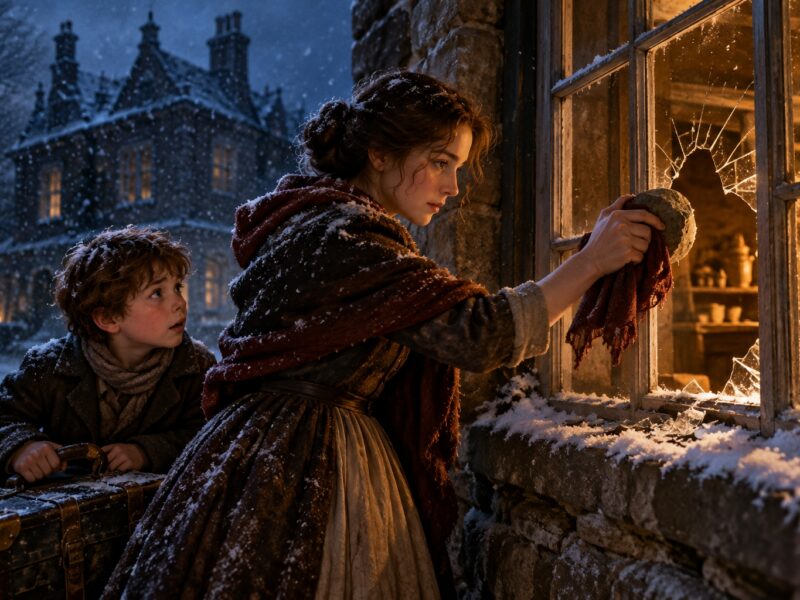
Hannah Low had never stolen anything in her life. But on Christmas Eve, with her eight-year-old brother shivering beside her and nowhere left to go, she wrapped a stone in her shawl and broke a window in the Duke of Ashmir’s abandoned mansion.
For nine years, the enormous house had stood dark and silent above the valley. No one expected its owner to return.
Least of all Hannah.
The glass broke with a surprisingly small sound.
She had expected something louder. A crash that would carry down the hillside, perhaps, or enough noise to wake every dog in Lower Ashmir. In her imagination, even the church bell had begun ringing before she finished what she was doing.
Instead, there was a dull crack, a delicate scattering of glass on the stone floor, and the endless hiss of wind driving snow across the hill.
“Is that it?” Sam whispered.
He stood a few feet behind her, gripping both handles of their father’s old trunk. He was eight years old, painfully thin beneath his winter coat, and had been holding that trunk for nearly twenty minutes because Hannah had told him not to let go.
“That’s it,” she answered. “Mind the glass.”
She reached through the broken pane, felt around until her fingers found the latch, and pushed the window inward.
Cold air poured out of the house.
It was somehow colder than the air outside, the particular cold of rooms that had gone years without a fire or a human breath to warm them.
Ashmir House had stood empty for nine winters.
Everyone in Lower Ashmir knew the story. The Duke had closed it after his mother’s death, and he had never returned. The chimneys never smoked. The windows remained shuttered. The long gravel drive had gradually disappeared beneath weeds and fallen leaves.
Only Mr. Silas Pike, the Duke’s land agent, visited once a month. He rode up the hill, inspected the property, and returned to the village looking satisfied with himself.
It was that same Mr. Pike who had put Hannah and Sam into the street just before noon.
Their father, Walter Low, had been the village chandler. He had made candles for families, churches, and anyone who could afford the clean, golden light of beeswax. His candles were known throughout the district, and Hannah had spent much of her childhood helping him make them.
Then, in October, Walter had died.
Three months of rent remained unpaid on the shop.
Hannah had begged Mr. Pike for a little time. Christmas was their busiest season, she reminded him. Her father had left wax, molds, and orders that she was perfectly capable of finishing.
She could pay what they owed.
Mr. Pike had listened with a pleasant smile.
“The estate cannot wait indefinitely, Miss Low.”
That was all.
Two men arrived on Christmas Eve and carried her father’s trunk into the lane.
Hannah had spent the afternoon knocking on doors.
There were families who had known her since she was born, women who had once bought candles from her father, neighbors who had attended his funeral.
But every cottage and shop in Lower Ashmir belonged to the Duke’s estate, and every tenant knew what might happen if Mr. Pike became displeased.
Some people apologized.
Others would not meet her eyes.
Every door eventually closed.
By late afternoon, snow had soaked through Sam’s boots, and the cough he had developed that autumn had grown deep and frightening.
Hannah had looked toward the great black silhouette of Ashmir House and made the only decision left to her.
Now she climbed through its broken scullery window, holding her carpetbag between her teeth.
She landed awkwardly on the stone floor and turned to help Sam inside.
He was so light she barely felt his weight.
Getting the trunk through was harder. It caught twice against the window frame, and Hannah scraped her knuckles dragging it over the sill.
At last, they were inside.
She closed the window and stuffed her shawl into the broken pane to keep out some of the wind.
“It’s very dark, Hannah,” Sam whispered.
“I know.”
“Are there ghosts?”
She found his hand.
“No. Only cold rooms.”
He considered this.
“Can we fix cold rooms?”
“We can try.”
She knelt beside their father’s trunk and opened it by touch.
Near the top, carefully wrapped in cloth, was a small tin box containing a tinderbox and a single candle.
Hannah lifted the candle as gently as if it were made of glass.
Her father had made it a week before he died.
It was thick pure beeswax, the warm color of honey, with a narrow band of red wax around its body about a third of the way down.
Every Christmas, Walter Low had made one just like it for his family.
On Christmas Eve, they lit the candle and allowed it to burn until the flame reached the red band. Then they extinguished it and kept what remained for another year.
It was a small family tradition, but Hannah had never imagined a Christmas without it.
“Father’s candle,” Sam said softly.
“Yes.”
She struck the flint.
Nothing.
She tried again, her cold fingers clumsy around the steel.
On the third attempt, a spark caught.
A little flame rose from the wick, straight and clear, illuminating Hannah’s hands.
Beeswax burned differently from tallow.
A tallow candle smoked, sputtered, and carried the unmistakable smell of animal fat. Beeswax burned steadily and smelled faintly of honey and summer flowers.
Hannah had been able to recognize the difference with her eyes closed since she was six.
Now that familiar scent spread through the abandoned kitchen, and for one aching moment, she could almost believe her father was nearby.
The candlelight revealed stone sinks, old copper pans hanging from hooks, a dresser, and a wide doorway opening into a kitchen dominated by an enormous iron range.
And on the kitchen table sat a very large gray cat.
Sam gripped Hannah’s arm.
The animal regarded them with enormous yellow eyes. It glanced at the candle, looked Sam over, and then jumped down with the dignity of an elderly bishop.
It approached their trunk and rubbed its head against the wood.
Hannah let out the breath she had been holding.
“Well. At least someone still lives here.”
“Can we keep him?”
“He doesn’t belong to us.”
“Neither does the house.”
“No,” Hannah said, trying not to smile. “And we must remember that.”
Sam crouched to stroke the cat.
“We’re guests who weren’t invited.”
“Exactly.”
She looked toward the range.
“Come along. We need a fire before anything else.”
They found coal in the cellar and dry wood stacked beneath a small covered shelter near the back door. The yard pump still worked after Hannah primed it with water, just as her father had taught her.
Within half an hour, a fire was burning in the kitchen range.
Within an hour, breathing no longer hurt.
Hannah found a sealed crock of oats in the larder, along with salt and a jar of honey that had turned pale and solid with age.
She scrubbed a copper pan with sand, filled it with water, and made porridge.
Sam ate two bowls.
The gray cat, whom he had already named Bishop, accepted a saucer without objection.
Then Hannah arranged a bed beside the range using her cloak and two dust sheets she had found in the passage.
She sat with her hand resting lightly on Sam’s back until his coughing eased and his breathing became regular.
Only then did she allow herself to feel how frightened she was.
She had broken into a duke’s house.
If anyone discovered her, she could be arrested. She might be sent to prison, or face a punishment that would leave Sam alone in the world.
She had no excuse that the law was certain to recognize.
She had only a sick little brother and a Christmas Eve without shelter.
At the long kitchen table, Hannah watched her father’s candle burn toward the red line.
In the morning, she would leave the two shillings and sixpence she had saved as payment toward the broken glass and whatever food and fuel they had used.
Then she would walk the eleven miles to Kendal with Sam and look for work.
It was not much of a plan.
But it was the only one she possessed.
She moved the candle onto the deep kitchen windowsill, where its light fell across the table.
She did not think about the window facing the long drive.
Or the drive facing the valley road.
Or how noticeable a single flame might be in a house that had stood dark for nine years.
Far below, a solitary rider was making his way through the snow.
His name was Edmund Crowe.
And he was the ninth Duke of Ashmir.
Edmund had not intended to return home for Christmas.
He owned a fine residence in Grosvenor Square, staffed by forty servants and furnished with rooms that were admired by people who visited them.
He cared for none of those rooms.
For the past nine years, he had spent his Christmases in London, remaining there until Twelfth Night. It was easier than returning to Ashmir House and remembering what had happened there.
His mother had died beneath its roof.
Afterward, Edmund had closed the estate’s principal residence and left its management to Silas Pike.
He had convinced himself that distance was preferable to grief.
Three weeks earlier, however, Pike had written to him.
Ashmir House was costing the estate three hundred pounds a year, the letter explained. There were expenses for coal, candles, watchmen, necessary repairs, and measures to keep damp from damaging the property.
The agent respectfully suggested that His Grace consider selling.
Edmund had read the letter twice.
The thought of strangers owning the house where his mother had lived and died had disturbed him more than he expected.
So he had ordered his horse saddled and ridden north alone.
If he was to sell the house, he wanted to stand inside it once more.
He wanted no servants watching him.
No sympathetic whispers.
No one asking whether he was quite well.
Snow had caught him near Shap, thickening until the road began to disappear beneath the horse’s hooves.
He continued anyway.
It was past eleven when he reached the last bend overlooking the valley.
Out of habit, he raised his eyes toward the dark house on the hill.
Then he pulled sharply on the reins.
A light was burning in the kitchen window.
Edmund sat motionless in his saddle.
One steady point of gold shone against the black front of the house, small and bright as a star.
His first thought was so foolish that it hurt.
Someone had lit a candle for him.
His second thought was considerably more practical.
Someone had broken in.
He led his horse into the old coach house before walking around to the rear of the building.
Beneath the scullery window, he discovered footprints in the snow.
Two sets.
One belonged to someone with an adult’s stride.
The other was unmistakably a child’s.
He studied the smaller prints for a long moment before moving toward the kitchen window.
Through the glass, he saw his mother’s kitchen illuminated by firelight.
A young woman sat at the table, her chin resting on her hands. Dark hair had slipped loose from its pins, and exhaustion showed in the way she held her shoulders.
Near the range, a child slept beneath a dust sheet.
On the child’s feet lay an enormous gray cat.
Edmund recognized the animal with a start.
A gardener’s boy had left it behind nine years earlier. Edmund had assumed it was long dead.
He leaned closer.
Then he knocked.
The young woman sprang from her chair.
Before Edmund could speak, she had seized the poker from the hearth and placed herself between the window and the sleeping boy.
She did not scream.
She did not run.
He noticed both things.
She held the poker firmly, like someone accustomed to handling tools rather than pretending to be dangerous.
“Open the door,” he said through the glass. “I’m not going to hurt you. It’s freezing out here.”
She studied him.
He wore a plain riding coat, wet boots, and a hat pulled low against the snow.
After a moment, she approached the back door and drew the bolt.
She stepped aside, keeping the poker raised.
Edmund entered, stamping snow from his boots.
Warm air struck his face.
The kitchen smelled of wood smoke, porridge, and something sweet that stirred an almost forgotten memory.
He closed the door.
“Who are you?” he asked.
“Who are you?” she demanded at precisely the same instant.
They stared at each other.
“You first,” Edmund said.
“You’re the one standing in someone else’s house.”
Her chin lifted.
“My name is Hannah Low. That’s my brother, Sam. We were turned out of our home at noon by Mr. Pike, the Duke’s agent. Nobody in the village would take us in, and my brother is ill.”
She glanced toward the broken window.
“I broke the glass. I’ll pay for it. We’ll leave in the morning.”
Then she looked directly at him.
“Now you.”
Edmund should have told her who he was.
Later, he would remember that moment with painful clarity.
It would have required only a few words.
But she had spoken of the Duke with such weary resentment that he hesitated.
For nine years, almost everyone who approached him had seen his title before they saw anything else.
Some never seemed to notice the man at all.
Here was a woman who looked at him without the slightest intention of flattering him.
“Ned,” he answered.
He paused.
“I keep an eye on the house for the Duke.”
She lowered the poker slightly.
“Mr. Pike keeps an eye on the house for the Duke.”
“Mr. Pike,” Edmund replied, “keeps an eye on a great many things. I am something else.”
It was true, in its way.
Perhaps Hannah believed him.
Perhaps she was simply too tired to argue.
“Are you going to send for the constable?”
Edmund looked past her.
Sam coughed in his sleep, a long, wet cough that seemed to go on after the little boy had run out of breath.
Hannah moved toward him instinctively.
Edmund’s mother had died after a cough that would not stop.
The sound tightened something inside his chest.
“Not tonight,” he answered. “Nobody is going anywhere. The road behind me is already closing. By morning, it will be impassable.”
Hannah lowered the poker.
Only then did he notice that her hand was trembling.
“Sit down,” he said more gently. “Before you fall down.”
“I can manage my own fire.”
“Strictly speaking, it’s my fire.”
She looked at him sharply.
He almost winced.
Then the corner of her mouth moved.
It was not quite a smile, but it was close enough.
“Strictly speaking,” she replied, “it’s the Duke’s.”
“Yes. Of course. That’s what I meant.”
He turned hastily toward the range and added more coal.
After a while, Hannah pushed the porridge pan toward him.
Edmund found a bowl and ate the remaining porridge standing beside the fire.
It was the finest meal he could remember having in a very long time.
The candle on the sill eventually burned down to its red ring.
Hannah reached over and extinguished it between two practiced fingers.
Edmund looked up.
“Why did you put it out?”
“It’s a Christmas candle.”
She carefully wrapped the warm stub in its handkerchief.
“My father made one every year. We burn it down to the red ring on Christmas Eve, then save the rest for next year.”
Her fingers lingered on the cloth.
“There won’t be another Christmas in our old house. But there might be one somewhere else.”
Edmund was quiet.
“My mother used to buy those candles.”
Hannah looked at him.
“From my father?”
He immediately regretted speaking.
“From whichever chandler supplied the house,” he said. “My mother worked here, before—”
He stopped, aware that the explanation was becoming increasingly difficult to maintain.
“She liked the red ring,” he finished.
“Everyone liked it.”
Hannah smiled faintly at the memory.
“It was the old Duchess who started the tradition, you know.”
Edmund turned toward her.
“What?”
“Father told me about it. She came into his shop one year and asked whether he could make a candle that would tell her when to stop waiting.”
Hannah smoothed the handkerchief across her knee.
“She said she always stayed awake too late on Christmas Eve, hoping her son would come home from somewhere. Father put a ring of red wax around the candle so she would know when it was time to go to bed.”
She looked toward the flame’s lingering smoke.
“After that, half the valley wanted one.”
Edmund turned back to the fire.
He remembered those Christmases.
Cambridge first.
Then London.
Friends, suppers, parties, invitations he had believed impossible to refuse.
He had always arrived late.
Sometimes not at all.
There had always seemed to be another Christmas waiting ahead.
He had never known his mother sat awake with a candle beside her.
He had never known she had needed a way to tell herself when to stop waiting.
“Are you all right?” Hannah asked.
“Smoke,” he answered.
He cleared his throat.
“The chimney may need sweeping.”
“It doesn’t,” she said. “I checked.”
But she did not press him.
He was grateful for that.
Eventually, Hannah fell asleep with her head resting on her folded arms.
Edmund remained awake.
He sat beside the range with the gray cat curled on his knee, listening to Sam’s breathing and watching the snow climb higher against the window.
For the first time in nine years, he was home on Christmas Eve.
And his mother’s kitchen was warm.
Christmas morning arrived beneath a silence so complete that even the wind seemed to have disappeared.
The drive had vanished beneath snow.
The yard lay white to a man’s knees, and the road beyond was impossible to distinguish from the surrounding fields.
Hannah woke to the scrape of a shovel.
Through the kitchen window, she saw Ned digging a path toward the woodpile.
He had removed his riding coat.
Underneath, he wore a linen shirt so fine that it seemed entirely out of place on a caretaker.
His sleeves were rolled to the elbows, and his face was red from the cold.
She also noticed him slip a gold ring into his waistcoat pocket before beginning his work.
A caretaker’s wages did not ordinarily provide such jewelry.
But Hannah reminded herself that she was in no position to question another person’s honesty.
When he returned, stamping snow from his boots, she handed him a cup of tea from an old tin she had found in the housekeeper’s room.
“You’re awake,” he said.
“I’ve been awake for an hour.”
She nodded toward the range.
“Sam’s better. The warmth has helped him.”
“I’m glad.”
She waited until he had taken a drink.
“I need to ask you something.”
“Ask.”
“Where are the candles?”
Edmund blinked.
“The candles?”
“In this house. I went looking this morning. The shutters make most of the rooms dark even in daylight. A house this size ought to have a candle room, or at least a well-stocked cupboard.”
She folded her arms.
“I found the housekeeper’s store. Every shelf is empty.”
“Empty?”
“Not a single candle. Not even a stub. Not even a rushlight.”
Edmund lowered his cup.
“There should be candles.”
“That’s what I thought.”
He stared toward the doorway.
“Mr. Pike’s accounts—”
He stopped.
Hannah watched him.
“What about them?”
“Pike tells the Duke he purchases candles for the house. A great many candles, supposedly for the rooms and the night watchmen.”
“There are no watchmen.”
Edmund turned slowly.
“None?”
“Not since the old Duchess died. Everyone in Lower Ashmir knows it.”
Hannah gestured toward the window.
“Mr. Pike comes up once a month, walks around the outside, and goes home. That’s all.”
Edmund stood very still.
“Who does he claim to buy the candles from?” she asked.
For a moment, he said nothing.
Then an uncomfortable memory returned.
He had examined the estate accounts quarterly for nine years. Or rather, he had looked at their totals, signed where necessary, and trusted the figures beneath them.
He remembered the supplier’s name.
“Low and Daughter,” he said slowly. “Chandlers of Lower Ashmir.”
Hannah set down the teapot.
“We never supplied this house with a single candle after the Duchess died.”
Edmund looked at her.
“Are you certain?”
“I kept Father’s order book myself for the last five years.”
She took a breath.
“Father used to say it was a shame, a beautiful house standing dark when there was no reason for it. But there were no orders from here. Not one.”
She considered the empty shelves.
“How much does Mr. Pike say he spends?”
Edmund hesitated, then repeated what he remembered from the accounts.
“Sixty pounds’ weight of beeswax candles each month. Something over forty pounds sterling a year at the prices he records.”
Hannah stared at him.
“Sixty pounds’ weight a month?”
“Yes.”
“Do you know how much beeswax Father made in his best year?”
“No.”
“Ninety pounds’ weight. For the whole valley, including the church.”
She shook her head.
“Beeswax is expensive. Most families buy tallow, or make rushlights. Father sold beeswax to the church, the vicarage, the squire, and a few households at Christmas.”
Her voice grew quieter.
“An order that large would have made him a wealthy man.”
She looked down at her roughened hands.
“And he died owing rent to Mr. Pike.”
Edmund walked to the window.
Beyond the glass, the snow stretched untouched across the yard.
“I’m sorry,” Hannah said after a moment. “I shouldn’t have spoken that way. You work for the estate. This isn’t your doing.”
“Isn’t it?”
His voice sounded unlike the voice she had heard before.
“Someone should have looked,” he said. “Someone should have come home and looked.”
Hannah was about to ask what he meant when Sam appeared in the doorway, holding Bishop against his chest.
“Is it really Christmas?”
Edmund turned.
Whatever had darkened his expression a moment earlier seemed to lift.
“It is indeed.”
Sam glanced around the kitchen.
“It doesn’t look very Christmassy.”
Edmund considered the room.
“No. And this house hasn’t had a proper Christmas in nine years. I think it’s owed one.”
He looked at the boy.
“What do you think we need?”
Sam pondered the question seriously.
“Holly.”
So they found holly.
There was a magnificent holly tree beside the old chapel wall.
Edmund dug a path through the snow, cut branches, and carried them back with Sam marching proudly behind him.
Together, the three of them decorated the kitchen mantel and the dresser.
Hannah discovered a box of the old Duchess’s ribbons in an upstairs drawer and asked whether she might use them.
Edmund stood looking at the faded silk for several seconds.
“I think,” he said quietly, “the Duchess would like that very much.”
Hannah did not wander through the rest of the house.
Most rooms remained shuttered and covered in dust sheets.
Opening them felt almost like reading someone else’s private letters.
But later that afternoon, while searching for blankets, she opened a small sitting room on the first floor.
It was different from the others.
The furniture had not been covered.
An embroidery basket stood beside a chair, with unfinished needlework still inside. A shawl lay over the arm of a sofa. The room seemed less abandoned than interrupted, as though its owner might return at any moment.
On a little table by the window stood a silver candleholder.
Inside was the remains of a beeswax candle.
A red ring circled the stub near its base.
Hannah approached it slowly.
The candle had burned well past the red mark.
Almost all the way to the holder.
She stared at it.
She knew what the red ring meant.
She knew the old Duchess had been supposed to extinguish her candle when the flame reached it.
But that last Christmas Eve, she had not stopped waiting.
She had remained awake long after her candle told her to go to bed.
Hannah touched the edge of the little table, then quietly withdrew.
She carried the blankets downstairs and said nothing about what she had discovered.
That evening, after Sam was asleep, she opened her father’s trunk.
Inside lay his old candle molds, a spool of plaited cotton wick, and a block of pale yellow beeswax weighing about two pounds.
It was the last of the summer stock.
She had packed it on Christmas Eve, before Mr. Pike’s men arrived.
Now she took it out and set a pan of water on the range.
“What are you doing?”
Edmund stood in the doorway, snow in his hair.
“Making candles.”
Hannah placed a smaller pan inside the hot water and began breaking the wax into pieces.
“This house needs light.”
“You don’t have to do that.”
“I know.”
She lowered another piece of wax into the pan.
“I’m a chandler’s daughter. When someone needs light, this is what I do.”
She looked down.
“It’s the only thing I’m good for.”
“I don’t believe that.”
She raised her eyes.
He stood with his coat over one arm, studying her with an expression she could not quite interpret.
“Then come here,” she said.
He looked startled.
“Why?”
“Because you can make yourself useful. You can cut wicks.”
And that was how the ninth Duke of Ashmir spent Christmas night in his mother’s kitchen, sitting at a table with his sleeves rolled up and cutting cotton wicks under the instruction of a chandler’s daughter.
Hannah explained that a good candle needed a properly plaited wick, not simply a twisted cord.
A plaited wick curled as it burned, helping it trim itself.
She showed him how to dip the wick into the melted wax, draw it out, allow the coating to cool, and repeat.
Thirty times.
Sometimes forty.
The candle slowly grew thick enough to stand on its own.
“Slower,” she told him when he lifted his hand too quickly.
Edmund inspected his work.
“It’s still crooked.”
“Because you’re hurrying.”
“I didn’t know candle-making required quite so much patience.”
“Beeswax doesn’t like to be hurried.”
“I have noticed.”
He held up a particularly misshapen candle.
It resembled a parsnip.
Hannah laughed.
The sound escaped before she could stop it.
She immediately covered her mouth, looking almost embarrassed.
Edmund stared at her.
It was the first time he had heard her laugh.
Until that moment, he had known her exhaustion, her stubborn courage, her grief, and the fierce protectiveness she showed her brother.
He had not known what her laughter sounded like.
And now he found himself hoping to hear it again.
They worked until nearly midnight.
By the time they finished, eleven candles hung drying near the range.
It was hardly enough for a great house.
But it was eleven more candles than Ashmir House had possessed in nine years.
Edmund selected one.
“May I?”
“Of course.”
He carried it upstairs.
Hannah did not follow him.
Later, as she passed the small sitting room on her way to bed, she noticed a thin line of golden light beneath the door.
From inside came the low sound of a man’s voice.
She could not make out the words.
She did not try.
She continued down the passage, leaving him alone with whatever he had come home to remember.
Boxing Day dawned bright and blue.
The storm had passed, and sunlight glittered so fiercely across the snow that Sam ventured outside only to return a moment later, blinking and rubbing his eyes.
“Hannah?”
She was washing bowls at the kitchen sink.
“What is it?”
“There are people coming.”
She dried her hands and went to the window.
A small crowd was making its way up the long drive.
At its head rode Silas Pike on a stout brown horse, dressed in his best black coat.
Beside him walked Tom Fen, the village constable, looking thoroughly unhappy.
Behind them came a dozen villagers, including the broad-shouldered Dorson brothers and Mrs. Tibs, the baker’s widow.
Several children trailed along, delighted by the prospect of excitement.
Hannah felt her stomach tighten.
“They saw the smoke,” she whispered.
She turned.
Edmund was already standing behind her.
He had seen the approaching crowd.
His expression had become very quiet.
“Stay here with Sam,” he said. “Let me speak to them.”
“No.”
“Hannah—”
“This is my doing.”
She removed her apron and folded it carefully.
“You’ve been kinder than you had to be, Ned. I won’t have you dismissed because I broke into this house.”
Before he could answer, she went to unbolt the kitchen door.
Silas Pike had dismounted by the time she stepped into the yard.
He was a tall, narrow man with an equally narrow face and immaculate gloves.
When he saw Hannah, he smiled.
It was the same smile he had worn while ordering her father’s trunk carried into the street.
“Miss Low. I had a feeling we might find you here.”
“Mr. Pike.”
He barely acknowledged her greeting.
“Constable.”
Tom Fen shifted uneasily.
Pike raised his voice for the villagers.
“This is the woman who was lawfully evicted for nonpayment of rent. She has now broken into His Grace’s private residence.”
A murmur moved through the crowd.
“I want her taken into custody.”
Hannah stood straight.
“I broke the window. I’ll pay for it.”
Pike looked past her toward the house.
“There was valuable silver in this property. I dread to think what we may discover missing.”
“I’ve taken nothing.”
She could feel the heat rising in her face.
“I used coal and oats, and I’ll pay for those too. But I have stolen nothing.”
“So you claim.”
He turned.
“Constable.”
Tom Fen looked miserable.
“Miss Low, I’m sorry, but I—”
“You needn’t do anything, Tom.”
The voice came from the kitchen doorway.
Everyone turned.
Edmund stepped into the yard wearing his riding coat.
On his right hand was the gold ring Hannah had seen him remove before shoveling snow.
He walked across the yard without haste and stopped beside her.
Then he looked at Pike.
The agent’s face lost every trace of color.
For several seconds, no one spoke.
At last, Pike removed his hat.
His gloved hands were trembling.
“Your Grace.”
The words seemed to pass through the crowd like a sudden gust of wind.
One by one, the men uncovered their heads.
Women struggled into awkward curtsies in the snow.
Mrs. Tibs covered her mouth.
Hannah did not move.
She stared at the man beside her.
At the ring on his hand.
At the way every villager was now looking at him.
She felt something inside her become terribly cold.
“Your Grace,” Pike repeated, recovering a little, “we had no word that you intended to return. Had I known, I would have arranged to have the fires lit and the rooms prepared.”
“The candles lit, too, I suppose.”
Pike hesitated.
Edmund smiled pleasantly.
“I have been here for two days, Pike. In that time, I have not found one candle in this entire house, apart from those Miss Low made last night using her own wax.”
The agent said nothing.
“I find that rather curious, considering the quantities charged to my estate.”
Edmund took a step closer.
“Sixty pounds’ weight of beeswax a month. That is a remarkable quantity of candles to have vanished.”
The villagers grew silent.
Pike glanced toward Hannah.
“Your Grace, there is a perfectly reasonable explanation. I would be happy to provide it privately, with the accounts before us.”
“Then bring them.”
“Of course.”
“Every account book you hold for this estate. Here, by noon tomorrow.”
Pike swallowed.
Then his expression changed.
“I must also say, Your Grace, with the greatest respect, that you have spent two nights alone in this house with a young woman of no family or fortune.”
He allowed his gaze to rest on Hannah.
“People will talk. I would hate to think Your Grace had been deceived by—”
“Be very careful how you finish that sentence.”
Edmund’s voice was quiet.
It was enough.
Pike closed his mouth.
“Miss Low is my guest,” Edmund continued. “Anyone who suggests otherwise will answer to me.”
He turned to the constable.
“Tom, go home. Have your Christmas dinner a day late, with my apologies.”
Tom removed his hat.
“Yes, Your Grace.”
Edmund looked at Pike again.
“Tomorrow. Noon.”
The agent mounted his horse and rode down the drive without looking back.
The crowd dispersed slowly.
Hannah remained still until the last villager had turned away.
Then she walked into the kitchen and began packing her father’s trunk.
Edmund followed.
He closed the door.
“Hannah—”
“Miss Low.”
He stopped.
She folded the borrowed dust sheets and placed them neatly on the table.
“I think, Your Grace, it ought to be Miss Low.”
“Please let me explain.”
“There is nothing to explain.”
She kept packing.
“You allowed me to believe you were a servant for two days. You listened while I spoke about the Duke, about his house, about my father.”
She turned.
“Was it amusing?”
“No.”
“Was it entertaining to hear what poor people say when they believe no one important is listening?”
“Hannah, it wasn’t like that.”
“Then what was it like?”
He struggled for an answer.
“It was the first time in nine years that anyone had spoken to me as though I were a man rather than a title.”
“And whose fault is that?”
The question struck harder than any accusation she had made.
Hannah’s eyes were bright, but her voice remained controlled.
“You shut this house and went away. You left Mr. Pike in charge of everyone in the valley.”
She looked toward her father’s trunk.
“My father died owing rent to a man who was charging you for candles my father never made.”
Edmund stood motionless.
“You could have come home. You could have looked. You didn’t.”
Her voice trembled.
“And when you finally did come back, you lied to me.”
He wanted to defend himself.
He could explain his mother’s death, the grief that had made the house unbearable, the years that had slipped away while he convinced himself everything was being managed properly.
But every explanation sounded like an excuse.
And Hannah was right.
“Thank you for letting Sam stay beside the fire,” she said after a moment. “I mean that. Thank you for not calling the constable.”
She closed the trunk.
“I’ll send payment for the window when I can.”
“Hannah, where will you go?”
“I don’t know.”
“She’ll come with me.”
A voice sounded from the doorway.
Mrs. Tibs stood there with snow clinging to her skirts and her bonnet sitting crookedly on her head.
She was breathing hard from the walk back up the hill.
Hannah stared.
“Mrs. Tibs?”
The older woman took a moment to recover her breath.
“I’ve been ashamed of turning you away on Christmas Eve, Hannah Low.”
She straightened her bonnet.
“I was afraid of that dreadful man. I’ve been ashamed ever since.”
Her eyes moved briefly toward Edmund.
“Well, I’m not afraid of him now.”
She turned back to Hannah.
“You and the boy will come down to the bakery. There’s a room over the ovens. Warmest room in the valley.”
Hannah pressed her lips together.
For a moment, she was unable to speak.
“Thank you,” she managed.
She tucked her father’s order book into the trunk, put on her bonnet, and took Sam’s hand.
At the kitchen door, she paused.
Without looking at Edmund, she removed something from her pocket and placed it on the windowsill.
It was the stub of her father’s Christmas candle, still wrapped in its clean handkerchief.
“For the Duchess’s room,” she said quietly.
“She would want one. Even a used one.”
Then she left.
Edmund watched them walk down the drive.
Mrs. Tibs on one side.
Hannah on the other.
Sam between them.
Three small shapes moving through the snow.
He watched until they disappeared from sight.
The gray cat jumped onto the windowsill beside the candle.
Edmund looked at it.
“I know,” he said.
And for once in his life, knowing was nowhere near enough.
Silas Pike did not arrive with the account books at noon the following day.
He came at four o’clock.
A young clerk accompanied him, carrying papers.
Pike also brought a sworn statement signed before Sir Henry Dalby, the district magistrate.
According to that statement, Hannah Low had stolen two silver candlesticks from the dining room of Ashmir House.
Pike’s clerk, nineteen-year-old Jacob Moss, claimed to have seen the candlesticks in her trunk.
Constable Fen had subsequently found them there, in the room above Mrs. Tibs’s bakery.
The accusation was serious.
A woman accused of stealing valuable silver from a duke’s house could face consequences far beyond the loss of her reputation.
Sir Henry Dalby had been a friend of Edmund’s father.
He also disliked Silas Pike intensely.
But the magistrate could not ignore a sworn complaint simply because he distrusted the man who had made it.
That evening, he sent a note to Ashmir House.
The hearing would take place on December 30, at the Lamb Inn.
Sir Henry suspected most of the valley would attend.
Edmund went down to the bakery that night.
Mrs. Tibs admitted him through the back door.
“She doesn’t want visitors,” the widow told him.
“Will you give her a message?”
Mrs. Tibs hesitated.
“Go on.”
“Tell Miss Low that I believe her completely. Tell her I will bring the best lawyer in the north if she wishes.”
Mrs. Tibs went upstairs.
Several minutes passed.
When she returned, her expression had softened.
“She says thank you.”
Edmund waited.
“But she says no.”
He looked down.
“She says it’s her name and her father’s name, and she’ll speak for them herself.”
A faint, unwilling smile crossed his face.
“That sounds like Hannah.”
“She says you may come and listen, if you like.”
Mrs. Tibs paused.
“And she needs to borrow something from your house.”
“Anything.”
She told him what Hannah wanted.
For the first time since the accusation, Edmund’s expression changed.
He listened carefully.
Then he nodded.
The morning of December 30 was gray and still.
By nine o’clock, every seat in the long room of the Lamb Inn was occupied.
Those who could not enter stood in the snow outside, hoping to hear through the open windows.
Sir Henry Dalby sat at a table near the front, his clerk beside him.
Before them stood two tall silver candlesticks.
Their surfaces had tarnished almost black.
Pike sat to the magistrate’s right, wearing his good black coat, with Jacob Moss beside him.
Hannah sat on the left in a plain brown dress.
Mrs. Tibs was on one side.
Sam was on the other.
Her father’s order book rested on her knee.
Edmund arrived last.
The room became silent as he entered.
He looked toward the front bench, but there was no room beside Hannah.
So he moved to the side wall and stood there with his arms folded.
Not in front of her.
Not beside her.
He had come because she had allowed him to listen.
Hannah did not look at him.
But Mrs. Tibs noticed her shoulders relax slightly.
Sir Henry cleared his throat.
“This hearing will determine whether Miss Hannah Low should be sent for trial at the Kendal assizes on a charge of theft.”
He turned toward Pike.
“You made the complaint. State your case.”
Silas Pike rose.
He spoke smoothly, as he always did.
Miss Low, he explained, had been desperate. Her father was dead. Her brother was ill. She had no home and no employment.
Nobody could blame a woman in such circumstances for facing temptation.
The candlesticks, however, had been found in her trunk.
The law was the law.
Then he turned to another matter.
“As for the candle accounts His Grace has questioned, I have brought the receipts.”
He laid a substantial bundle of papers before the magistrate.
“Signed by Walter Low himself.”
A murmur moved through the room.
Pike shook his head with an expression of deep regret.
“If Miss Low’s father accepted payment and failed to deliver the goods, that is a sad matter. I regret having to speak ill of a deceased tradesman, but any such failure was his, not mine.”
Hannah stared at the papers.
They were accusing her father now.
Not merely of dishonesty.
Of stealing from the very estate whose agent had forced his children into the snow.
Sir Henry adjusted his spectacles.
“Miss Low, have you engaged counsel?”
“No, sir.”
She stood.
“I would like to speak for myself, if you’ll allow it.”
“Very well.”
Hannah walked to the front.
She was pale.
Her hands tightened around her father’s order book.
But when she began speaking, her voice carried to the back of the room.
“I’ll begin with the candles, sir, since Mr. Pike has raised them.”
She looked at the bundle of receipts.
“Mr. Pike claims my father supplied sixty pounds’ weight of beeswax candles every month for nine years.”
“That is correct,” Pike interrupted.
Hannah did not turn toward him.
“I cannot tell the court who wrote those signatures. Some may resemble my father’s handwriting.”
She placed the order book on the table.
“But I can prove that my father never made the number of candles those papers describe.”
Sir Henry leaned forward.
“How?”
“With Mr. Rudd’s records.”
She turned toward the rear of the room.
“Mr. Rudd?”
A short, round man with spectacles stood up, looking surprised to find himself suddenly important.
Everyone knew him.
Mr. Rudd was the district excise officer.
“Every chandler pays duty on candles produced,” Hannah explained. “Before candles leave the shop, their weight is recorded, and the duty must be paid.”
She spoke without hurrying.
“My father paid the required duty on every candle he made. If he had produced the quantities Mr. Pike claims, those quantities would appear in Mr. Rudd’s records.”
She turned.
“Did you bring your ledger, sir?”
“I did, miss.”
Mr. Rudd lifted a thick leather-bound book.
“You asked me to bring it.”
“Would you read my father’s total production of beeswax candles for any year you choose?”
The excise officer opened his ledger and adjusted his spectacles.
He ran one finger slowly down the columns.
“Walter Low,” he read. “Chandler. Lower Ashmir.”
He found the entry.
“Year ending Michaelmas, 1815. Beeswax candles: ninety-one pounds’ weight. Duty paid in full.”
He looked up.
“That’s his total for the whole year, sir. All his customers together. It’s also the highest annual quantity recorded for him.”
The room became utterly silent.
Hannah faced the magistrate.
“Ninety-one pounds in a year.”
She pointed toward Pike’s receipts.
“And Mr. Pike claims he purchased seven hundred and twenty pounds’ weight every year from my father for Ashmir House alone.”
She allowed the figures to settle.
“Either my father concealed hundreds of pounds of beeswax candles from the excise officer year after year, without anyone noticing, or those candles were never made.”
Mr. Rudd straightened indignantly.
Sir Henry looked at him.
“Mr. Rudd, could a chandler have concealed that much production from you?”
“Not from me, sir.”
He sounded personally offended by the suggestion.
“Not in my district. And Walter Low was one of the most honest men whose goods I ever weighed.”
A soft sound passed through the room.
It was almost as though everyone had released a breath together.
Sir Henry picked up the receipts.
He examined them for several moments.
Then he placed them carefully to one side.
“Continue, Miss Low.”
Hannah turned toward the silver candlesticks.
“May I ask something about these?”
“Certainly.”
“Mr. Pike says they were taken from the dining room at Ashmir House on Boxing Day.”
“That is correct,” Pike answered.
“And they were used to light that room?”
“Of course. They are the dining room candlesticks. They’ve stood on that table for forty years.”
Hannah nodded.
“Then they must have held candles burned at Ashmir House.”
She faced Sir Henry.
“Would you examine the sockets, sir?”
The magistrate raised his eyebrows.
Nevertheless, he leaned forward.
“There is old wax inside.”
“A considerable amount?”
“Yes.”
“What color is it?”
Sir Henry looked more closely.
“A dirty yellow. Rather greasy.”
Hannah folded her hands.
“Would you smell it?”
Several people exchanged curious glances.
Sir Henry did not appear to consider the request particularly dignified.
But he lifted one candlestick and brought it toward his nose.
His expression changed immediately.
“Good Lord.”
He lowered it.
“It smells like a mutton chop.”
“That’s tallow, sir.”
Hannah’s voice was steady.
“Animal fat. The cheapest kind of candle.”
She glanced toward Edmund, then back at the magistrate.
“The old Duchess never burned tallow candles. She purchased beeswax from my father until she died. And since her death, no candles have been supplied to Ashmir House at all.”
She took a breath.
“So I would like to know where these candlesticks have been used.”
Pike shifted in his chair.
“That proves nothing.”
Hannah continued as though he had not spoken.
“My father never made tallow candles. He wouldn’t have them in the workshop.”
She turned toward the crowded room.
“Wherever those candlesticks have been burning tallow, it was neither at Ashmir House nor at our shop.”
For a moment, nobody moved.
Then Mrs. Tibs stood.
“I can tell you where!”
Her voice filled the room.
“I’ve delivered bread to Silas Pike’s house every Saturday for eight years.”
She planted her hands on her hips.
“His parlor smells of tallow like a butcher’s yard. He’s too mean to burn anything else!”
The room erupted.
People began speaking all at once.
Some laughed bitterly.
Others turned toward Pike with open anger.
Sir Henry struck the table repeatedly before order was restored.
Hannah waited.
Then she spoke again.
“There’s one more thing, sir.”
The room quieted.
“Mrs. Tibs told His Grace that I wished to borrow something from Ashmir House.”
She looked toward the side wall.
“I asked for the long linen runner from the dining room table. The one that lay beneath the candlesticks.”
Edmund stepped forward carrying a roll of gray linen.
He placed it on the magistrate’s table and unfolded it without speaking.
Then he returned to his place against the wall.
Down the length of the cloth, where the candlesticks had once stood, were two circular marks.
The surrounding linen was gray with years of settled dust.
The circles beneath the former positions of the candlesticks were lighter.
But they were not clean.
A fine layer of dust covered them too.
Hannah pointed to the marks.
“I’m a chandler’s daughter, sir, not a housemaid. But anyone who has kept a home knows what dust does.”
She looked around the room.
“If those candlesticks had remained in position until Boxing Day, the cloth directly beneath them would be perfectly clean.”
Sir Henry leaned over the runner.
“The circles aren’t clean.”
“No, sir.”
Hannah paused.
“Dust has been settling on those places for years.”
She looked at Pike.
“I believe those candlesticks were removed from Ashmir House a very long time ago. Five years at least, perhaps more.”
She let her eyes travel from the silver to the greasy wax inside its sockets.
“Someone took them down the hill and used them to burn tallow candles.”
Pike’s face had turned gray.
“And when that person needed to accuse somebody of stealing them, he remembered he still had them.”
No one spoke.
Sir Henry stared at the linen.
Then he looked at Jacob Moss.
“Mr. Moss. Stand up.”
The young clerk rose unsteadily.
Ink stained his fingers.
His face had lost almost all its color.
“You swore that you saw these candlesticks in Miss Low’s trunk.”
“Yes, sir.”
Sir Henry removed his spectacles.
“I am going to ask you once whether that statement is true.”
He leaned forward.
“Before you answer, consider the assizes at Kendal and what can happen to a young man who swears a false oath.”
The clerk’s mouth opened.
Nothing came out.
“Think carefully.”
Jacob looked toward Pike.
Pike did not return his glance.
The young man swallowed.
“He gave them to me.”
A faint murmur rose.
Sir Henry remained still.
“Who?”
“Mr. Pike.”
Jacob’s voice was scarcely audible.
“He gave me the candlesticks in a sack. Told me to put them in her trunk while Mrs. Tibs was downstairs in the shop.”
Hannah gripped the edge of the table.
“He said she would never know,” Jacob continued. “He said if I refused, I’d lose my employment and my character.”
His voice broke.
“Same as her.”
He covered his face.
“I’m sorry, Miss Low. I’m so sorry.”
Sir Henry turned toward Pike.
But the agent had already risen.
He was moving toward the door.
He reached the end of the bench before discovering his path blocked by the two Dorson brothers.
Both men were large.
Neither moved.
Constable Fen stepped forward.
“Sir Henry,” he said, “I believe there’s some work for me after all.”
Silas Pike was taken into custody and escorted to the lockup behind the church.
Later that winter, the proceedings at Kendal would reveal that Pike had misappropriated nearly four thousand pounds from the estate over nine years.
He had falsified accounts for candles, coal, wages, and repairs.
He had charged for work never performed and supplies never delivered.
And there was another discovery.
A month before his death, Walter Low had visited Pike’s office.
He had politely asked why the estate records appeared to contain his name against quantities of candles he had never manufactured.
Pike had understood the danger.
Hannah’s Christmas Eve eviction had not been merely an attempt to recover unpaid rent.
It had also been intended to close the shop and silence the surviving keeper of its records.
But on the morning of December 30, those later discoveries were still ahead.
What mattered then was that Sir Henry Dalby rose from his chair.
He addressed the crowded room.
“The charge against Miss Hannah Low is dismissed, with the apologies of this court.”
The words seemed to reach Hannah from a great distance.
Sir Henry removed his spectacles.
“And I will add something that is not strictly the business of this hearing, but which I am too old to keep to myself.”
He looked directly at her.
“Your father was a good man, Miss Low.”
His expression softened.
“You have done his name proud today.”
Hannah tried to answer.
“Thank you, sir.”
She had planned to say more.
But suddenly she could not speak.
For weeks, she had been too busy keeping Sam warm, finding food, and defending what remained of their father’s livelihood to understand how frightened she truly was.
Now the fear was leaving her body, and she found herself unable to do anything except stand still.
People came forward as the room emptied.
Some touched her arm.
Others offered congratulations or apologies.
Mrs. Tibs gathered Sam close, crying freely now and making no attempt to conceal it.
Eventually, almost everyone had gone.
One man remained standing beside the wall.
Edmund approached slowly.
He stopped a little way from Hannah, as though unsure whether he had the right to come closer.
“You didn’t need me at all,” he said.
“No.”
She looked at him.
“I knew you wouldn’t.”
“I wanted to be here anyway.”
She studied his face.
He looked tired.
His eyes carried the shadows of several sleepless nights.
“You were magnificent,” he said.
“I was terrified.”
“Yes.”
His mouth softened.
“That’s what made it magnificent.”
For the first time since Boxing Day, Hannah looked at him without anger taking up all the space between them.
“Why did you do it?” she asked.
He knew what she meant.
“Why did you let me believe you were someone else?”
Edmund was silent.
Then he answered.
“Because when you looked at me in that kitchen, you didn’t see the Duke of Ashmir.”
He glanced down at his hands.
“You saw a man with snow on his coat.”
Hannah listened.
“I’d forgotten that man existed. I wanted one night of being him.”
His voice grew quieter.
“Then one day. And every hour I told myself I would explain. Every hour, I wanted just a little longer.”
He met her eyes.
“It was cowardly.”
She did not deny it.
“You were right about the estate,” he continued. “I should have come home years ago. I should have looked at the accounts, at the houses, at the people living on my land.”
He swallowed.
“If I had, your father might still have had his shop.”
Hannah’s expression changed.
Edmund continued before he lost his courage.
“I don’t expect you to forgive me for that.”
For a long time, she said nothing.
Then she rested one hand on the old order book.
“My father used to say a candle cannot choose where someone sets it down.”
Edmund looked at her.
“It can only choose how well it burns.”
She paused.
“You came home, in the end. You looked.”
“Is that enough?”
“I don’t know yet.”
Her answer was honest.
“Ask me again.”
“When?”
Hannah held his gaze.
“When you’ve done something about this valley.”
She looked toward the windows, beyond which the villagers were returning to their homes.
“Not for me. For them.”
Something changed in Edmund’s face.
For the first time in nine years, he smiled as his mother used to say he smiled when he was a boy.
Not politely.
Not cautiously.
With his whole face.
“Done,” he said.
He did not waste the following week.
By New Year’s Day, every tenant in Lower Ashmir had received a letter written in the Duke’s own hand.
All debts imposed through Pike’s administration were canceled.
Rents were returned to the levels charged during the old Duchess’s lifetime.
Repairs that Pike had claimed to have completed would finally be undertaken, beginning with the poorest cottages.
Roofs that leaked would be mended.
Families who had spent years fearing the agent’s displeasure could begin making plans without wondering whether a single complaint might cost them their homes.
On January 2, the boarded windows of the chandler’s shop on Church Lane were opened.
Its lease was granted rent-free for life to Hannah Low and her brother Samuel.
When Hannah learned what Edmund had done, she went straight to Ashmir House.
She intended to tell him that she could not possibly accept such an extraordinary gift.
Instead, she found him in the kitchen.
Sam sat beside him at the long table.
Bishop was sleeping nearby.
The Duke and the little boy were attempting to make candles.
Six misshapen examples hung on a rack.
Every one looked like a parsnip.
“You can’t give me the shop,” Hannah announced from the doorway.
Edmund did not look up.
“I haven’t.”
“The lease—”
“The estate owes your father nine years of his good name.”
He concentrated on the wick in his hand.
“And it owes you one Christmas Eve.”
Sam dipped a candle enthusiastically.
“Slower,” Edmund told him. “Beeswax doesn’t like to be hurried.”
“That’s what Hannah says.”
“Hannah is always right,” Edmund replied.
He sighed.
“It’s very annoying.”
Sam nodded solemnly.
“You’ll get used to it.”
Hannah stood in the doorway with her bonnet in her hands.
All the arguments she had prepared suddenly seemed unnecessary.
So she removed her cloak, approached the table, and took the wick from Edmund.
“You’re doing it wrong again.”
“I suspected as much.”
She showed him how to dip it properly.
He watched with an expression that suggested he was learning rather more than the art of candle-making.
On January 5, a letter arrived at the shop on Church Lane.
It bore the Duke’s seal.
Inside was an order for three hundred beeswax candles, to be delivered to Ashmir House by dusk the following day.
The estate would pay the full price.
Duty would be paid in advance.
Mr. Rudd would weigh every candle so that nobody could ever question the transaction.
The order also requested that the chandler attend to arrange the candles throughout the house.
Beneath the formal instructions was a sentence in Edmund’s smaller handwriting.
There is one more thing I would like to ask you, but I would rather ask it in person.
Hannah read that sentence several times.
Then she folded the letter and put it carefully away.
She had an enormous order to fill.
Sam helped.
Mrs. Tibs helped.
Four of the Dorson girls helped.
They worked through the night and most of the following day, dipping wicks, trimming imperfect candles, and laying finished ones carefully into straw-lined boxes.
The shop smelled of warm beeswax.
For the first time since Walter Low’s death, its windows shone with light long after the rest of the village had gone to bed.
At noon, Mr. Rudd arrived to weigh the candles and record the duty.
He departed looking remarkably pleased with himself.
At four o’clock, a cart came down from Ashmir House.
Hannah rode beside the driver, with Sam on her knee and the boxes of candles packed behind them.
As they approached the hill, she looked up.
The mansion’s shutters were open.
Every shutter.
On every floor.
The windows faced the winter dusk, and on each windowsill stood an empty candleholder.
Some were silver.
Some brass.
Some pewter.
Others were plain tin.
They stood in rows, waiting.
Edmund was at the front door.
“I wasn’t sure how to do it properly,” he admitted when Hannah climbed down from the cart.
She looked past him into the great hall.
“So I thought the chandler ought to light them.”
He smiled.
“It’s your light.”
Hannah did not know what to say.
For once, he did not require an answer.
They carried the candles inside.
Hannah moved from room to room with a taper.
Sam followed with a basket.
Edmund placed each candle in its holder before she lit it.
The dining room brightened.
Then the library.
The long gallery, where eight dead dukes looked down from their portraits upon a chandler’s daughter and seemed not to object.
They climbed the great staircase.
They entered bedrooms that had not known candlelight in years.
They lit the attics and the passages.
And down in the valley, people began stepping out of their doors.
One by one, they turned toward the hill.
At first, there was a single illuminated window.
Then three.
Then ten.
A ribbon of golden light spread along the great facade, moving from room to room and floor to floor.
The building that had stood dark for nine years began to glow against the winter sky.
Mrs. Tibs watched from the bakery doorway.
When the entire front of the house was shining, she raised her apron to her eyes.
The final room was the small sitting room on the first floor.
The old Duchess’s room.
Hannah stopped outside it.
Edmund opened the door.
Inside, the furniture had been dusted.
A fire burned in the grate.
The unfinished embroidery had been put away.
But the little table beside the window remained just where Hannah remembered it.
On the table stood two silver candleholders.
One held the almost entirely burned candle that had belonged to Edmund’s mother.
The other held the remaining stub of Walter Low’s Christmas candle.
Its red ring lay just beneath the wick.
Hannah stared at the two candles standing together.
“I didn’t know where else to put it,” Edmund said quietly.
He stood behind her.
“It seemed to belong here.”
“It does.”
She took the taper.
When she touched it to her father’s candle, the wick caught immediately.
Warm, honey-colored light spread across the room.
Edmund stepped closer.
Then he took her hand.
“I said there was something I wanted to ask you.”
Hannah looked up.
For reasons she could not explain, her heart had suddenly forgotten how to behave properly.
“You told me to ask you again when I had done something about the valley.”
“I remember.”
“I’ve done what I could. And I’ll keep doing it.”
He paused.
“Whatever you say tonight, none of that was meant as a price.”
She understood.
His promises to the tenants, the restored shop, the repairs—none of them were intended to purchase her forgiveness or affection.
He had needed to make those things right.
Whether she stayed or not.
“But I would like to ask now,” he continued.
His hand tightened slightly around hers.
“Not as the Duke of Ashmir.”
He smiled faintly.
“As the man you found in the kitchen with snow on his coat.”
Hannah’s throat tightened.
“Can you still see him?” he asked.
“Yes.”
Edmund took a breath.
“Then I would like that man to ask whether you would marry him.”
The candle flame moved between them.
“Not tomorrow,” he added quickly. “Not until you’re ready. Until Sam is ready. Until the shop is in good hands.”
His voice grew softer.
“In the spring, perhaps. When the roads are open and the bees are working again.”
He glanced toward the window.
“I would like this house to have its light back for good.”
Then he looked at her.
“And I find I don’t want any light in it but yours.”
Hannah stood very still.
She had entered this house through a broken window because she was afraid her brother would freeze to death.
She had believed herself a criminal.
Then she had discovered a stranger who had given them shelter, a Duke who had disappointed his people, and a man capable of admitting his failures.
Now that same man stood before her, waiting for an answer.
She thought of her father.
Of his workshop.
Of the way he had patiently taught her how to dip a wick until the candle stood straight.
“My father would have liked you,” she said.
Edmund smiled uncertainly.
“Would he?”
“He would have said you were slow and stubborn.”
“Both fair criticisms.”
“And that you make candles like a man stirring porridge.”
“That is also fair.”
Her eyes filled.
“Then he’d have told you to sit down and taught you how to do it properly.”
Her voice wavered.
She let it.
“Because he never turned away anyone who wanted to learn.”
Edmund said nothing.
He waited.
Hannah looked at their joined hands.
“Yes.”
He scarcely moved.
“In the spring,” she whispered.
Then she looked into his eyes.
“Yes.”
For a moment, Edmund was unable to speak.
He lifted her hand and held it against his cheek with extraordinary care.
Behind them, in the doorway, came a sudden shout.
Sam had been listening to the entire conversation with Bishop tucked beneath one arm.
His delighted whoop seemed loud enough to reach the village.
Hannah began laughing.
This time, she did not cover her mouth.
They were married on April 20 in the little church at Lower Ashmir.
Every window of the church was lit by the finest beeswax candles from Low and Daughter, though it was broad daylight and no one needed them.
Mr. Rudd weighed every candle.
Sir Henry Dalby gave the bride away.
Mrs. Tibs baked the wedding cake and wept into the icing, insisting afterward that the steam from the ovens had troubled her eyes.
Sam carried the wedding ring on a cushion.
He dropped it only once.
That autumn, he would begin attending grammar school in Kendal at the Duke’s expense.
The shop on Church Lane remained open.
Hannah trained the eldest Dorson girl in the chandler’s trade and continued visiting the shop three mornings a week for the rest of her life.
She never forgot the smell of melting beeswax or the feel of a wick between her fingers.
Nor did she stop making Christmas candles.
Every Christmas Eve, the Duchess of Ashmir prepared one with her own hands.
Pure beeswax.
The color of honey.
A narrow red ring a third of the way down.
She placed it in the window of the small sitting room on the first floor, where its flame could be seen across the valley.
And every Christmas Eve, Edmund sat beside her.
They talked quietly while the candle burned.
Sometimes about the village.
Sometimes about Sam.
Sometimes about Hannah’s father or Edmund’s mother.
And sometimes they simply sat together, listening to the winter wind outside.
When the flame reached the red ring, they extinguished it.
Then they saved what remained for another year.
Because now, unlike the years when the old Duchess had waited alone, neither of them had to wonder whether someone would come home.
There would always be another Christmas to share.
And the great house on the hill was never dark again.









