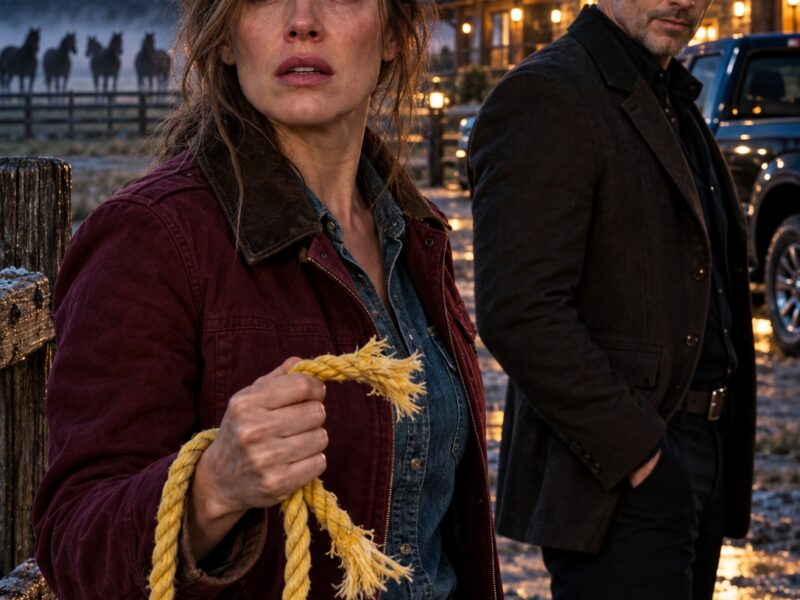
Twenty Wild Horses Appeared Outside My Ranch at 3:47 A.M.—Then I Learned Why Someone Had Tried to Make One of Them Disappear
At 3:47 in the morning, Marin Callaway woke to the sound of a horse trying to break through wood.
Not kicking randomly.
Not panicking.
Calling.
The impact came again from the barn.
BANG.
Then again.
BANG.
Marin sat upright in bed, heart already racing before she understood why.
The house was black except for the weak green numbers on the clock beside her bed. Wyoming wind pressed against the old windows with the dry whisper of sagebrush scraping siding.
Then the horse struck the stall door again.
Marin grabbed the flashlight from the nightstand, pulled on her boots without socks, and ran through the kitchen.
The clock above the stove read 3:47.
She would remember that number for years.
Outside, the March cold cut through her sweatshirt immediately.
“Juniper?”
The dun mare she had brought home less than twenty-four hours earlier was standing inside the open-sided barn, but she wasn’t trying to escape.
That was the first thing Marin noticed.
The second was worse.
Juniper wasn’t looking at her.
The mare’s head was high. Her ears were locked forward. Her nostrils trembled.
Every muscle in her body pointed north.
“Easy,” Marin whispered.
Juniper struck the door once more.
BANG.
Then Marin heard something beyond the barn.
Not a sound exactly.
Movement.
She swept the flashlight across the corral, expecting a coyote, maybe a mountain lion if her luck had finally become that bad.
The beam passed over fence posts.
Sage.
Frozen ground.
Then it caught two eyes.
Then four.
Then ten.
Marin stopped breathing.
She lowered the flashlight.
Moonlight slowly gave shape to what the beam had hidden.
There were horses standing beyond her north fence.
Wild horses.
Not three.
Not five.
Twenty.
They stood in a loose line along the wire approximately eighty feet from Juniper’s stall.
None grazed.
None wandered.
None ran when Marin stepped into the open.
They simply watched.
Every head was turned toward the dun mare.
Marin had lived in Wyoming most of her life. She knew wild horses. You sometimes saw a band stretched across a distant slope, appearing almost too beautiful to belong to the same hard country as busted pumps, bank notices, dead calves, and January wind.
But wild horses kept distance.
They survived because distance was one of the things they understood.
These horses had come to her fence.
And they weren’t afraid.
A thick-necked bay stallion stood several yards ahead of the others, an old blaze on his face faded yellow in the moonlight.
He walked forward.
One step.
Then another.
His chest stopped inches from the wire.
Marin tightened her grip on the flashlight.
The stallion lowered his head.
Not to graze.
Almost to the ground.
And held it there.
Behind Marin, Juniper made a sound.
It was so quiet Marin nearly missed it.
Not a whinny.
Not a nicker.
Something lower.
Older.
The kind of sound that seemed to belong less to the throat than to the ribs.
The stallion lifted his head.
Juniper stopped trembling.
Just like that.
Her body softened. Her breathing slowed.
The frantic animal Marin had watched for hours became completely still.
Marin stared from the mare to the twenty animals outside the fence.
And suddenly the rope burn around Juniper’s throat looked different.
So did the ribs showing beneath her dusty coat.
So did the fact that she had been standing alone beside a county road the afternoon before.
One thought formed so clearly in Marin’s mind that she almost heard herself say it.
They know her.
Then came the second.
Someone put a rope around that horse.
And for the first time since finding Juniper, Marin stopped wondering where the mare had come from.
She began wondering who had wanted her gone.
Three days earlier, Marin’s biggest problem had been money.
At least, that was what she believed.
Callaway Ranch sat in a shallow bowl of grass and sage in the high country of Wyoming, eleven hundred acres assembled and paid for across three generations.
Her grandfather had survived cattle prices that nearly wiped him out.
Her father had survived winters that killed animals standing.
Marin had inherited two drought summers, a barn roof that leaked in three places, an east fence sagging badly enough to embarrass the dead, and a bank note she avoided calculating unless absolutely necessary.
From her kitchen window, she could see almost everything she owned.
She could also see almost everything she didn’t.
Beyond the northern boundary, the land rolled toward a blue ridge of timber.
Most of it belonged to Whitlock Range Holdings.
The Whitlocks had spent four decades buying ranches.
They rarely bullied anyone publicly.
They didn’t need to.
They waited.
A rancher got sick.
A marriage broke.
A drought lasted too long.
A son decided Denver had more to offer than cattle.
A bank changed the terms.
Then a Whitlock truck appeared in the driveway with a clean contract and a number large enough to turn exhaustion into consent.
They bought one tired ranch at a time.
Always politely.
Always patiently.
Marin was the last Callaway on the road.
And hers was the last major property in the area that wasn’t theirs.
On Tuesday afternoon, Preston Whitlock had driven into her yard in a black pickup so clean Marin suspected the bed had never carried anything heavier than luggage.
Preston was thirty-nine and handsome in the expensive, bloodless way of a man whose clothes never seemed to remember the weather.
He handled acquisitions for his family.
He parked where Marin would have to walk toward him.
That was Preston.
Even courtesy had geometry.
Marin came out of the equipment shed wiping grease from her fingers.
“What?”
Preston smiled.
“Nice seeing you too.”
“You didn’t come to see me.”
“No.”
“Then save us both some daylight.”
He glanced toward the barn.
“Grant wants to make another offer.”
“No.”
“You haven’t heard it.”
“I’ve heard three.”
“This one’s better.”
“So was the last one.”
Preston leaned against his truck.
“Marin, another dry year and this stops being a negotiation.”
She stared at him.
He continued.
“The bank knows it. You know it. Grant knows it.”
“Then Grant can enjoy knowing things from his side of the fence.”
Preston’s smile narrowed.
“You’re fighting awfully hard to keep something that died when your father was still alive.”
That landed.
He knew it would.
Marin’s father had been dead less than two years.
For one dangerous second she imagined picking up the wrench on the workbench behind her.
Instead, she wiped her hands again.
“You’ve got until the light hits the gate to get off my road.”
“Marin—”
“After that, I’ll assume your truck broke down.”
Preston studied her.
Then he smiled again.
“You can’t be sentimental forever.”
She looked toward the fading sun.
“Better hurry.”
He left.
Marin waited until his dust disappeared before allowing herself to breathe normally.
Then she went into town to buy a hydraulic fitting she couldn’t afford.
On the way home, she took the old county cut.
That decision changed everything.
The pavement ended five miles out and became a pale strip of dirt running between sage and low broken hills.
She saw the horse in the bar ditch just before sunset.
A dun mare.
Dusty gold coat.
Dark stripe along the spine.
Head low.
One hind leg resting.
At first Marin assumed she belonged to somebody nearby.
Then the truck slowed.
The mare didn’t move.
That was wrong.
A loose ranch horse usually came toward a truck expecting feed or moved away because it knew it wasn’t supposed to be there.
This horse simply watched.
Marin stopped.
She sat behind the wheel for several seconds.
“You are not my problem,” she told the windshield.
The mare flicked one ear.
Marin closed her eyes.
“Damn it.”
She got out.
Up close, the animal looked worse.
Her ribs showed, but not like the ribs of an old neglected horse. There was still hard muscle beneath the loss of weight.
Mud had dried from hock to belly.
And around her throat was a raw band where hair had been rubbed away.
Marin stopped.
Someone had cinched something around that neck.
Hard.
And left it there.
She approached slowly with a lead rope.
“Easy, girl.”
No brand.
No tag.
No halter.
Nothing.
“Where did you come from?”
The mare watched her.
Marin knew what she should do.
Call the county.
Report a loose animal.
Leave.
Instead, twenty minutes later she lowered the ramp on her stock trailer.
The mare looked into the dark steel interior.
Marin expected resistance.
A frightened horse did not voluntarily enter a dark metal box.
This one did.
She stepped onto the ramp.
Paused.
Then walked inside as though she had already made the decision before Marin arrived.
That bothered Marin all the way home.
When she unloaded the mare into the corral, the horse didn’t investigate the hay.
Didn’t drink immediately.
Didn’t inspect the other horses.
She turned north.
And stared.
The only juniper tree on the Callaway place grew near the north gate.
So Marin called her Juniper.
The next morning, Hollis Vane came out.
Hollis was fifty-eight, a large-animal veterinarian with rough hands, bad knees, and the irritating habit of appearing whenever somebody needed him whether they could afford him or not.
He had spent fifteen years consulting on wild horse gathers.
He examined Juniper for almost forty minutes.
Then he stood back.
“What?”
Hollis didn’t answer.
“Hollis.”
“She hasn’t been starving.”
“I can count ribs.”
“I didn’t say she isn’t underweight. I said she hasn’t been starving.”
Marin frowned.
“What’s the difference?”
“Time.”
He ran a hand down Juniper’s shoulder.
“This condition dropped fast. Recently. That’s different from an animal nobody’s fed for months.”
He crouched and examined a hoof.
Then another.
His expression changed.
“What now?”
“Wear.”
“What about it?”
“Too even.”
Marin waited.
Hollis stood.
“This isn’t pasture wear.”
“Meaning?”
“Meaning this horse has been covering serious country.”
“How serious?”
“Twenty miles a day wouldn’t surprise me.”
Marin stared at him.
Hollis looked at Juniper again.
Then asked quietly, “You sure this was ever somebody’s horse?”
The question stayed with Marin.
That night Juniper refused the barn.
She entered as far as the doorway, then planted all four feet.
Marin tried grain.
Nothing.
Gentle pressure on the lead.
Nothing.
Then Juniper swung her head north.
Marin followed her gaze.
Six miles away, beyond the darkness, began land Whitlock Range Holdings had acquired six months earlier.
“All right,” Marin murmured. “Sleep outside.”
She opened the corral.
Near midnight, Marin sat on the porch with coffee going cold between her hands.
Juniper stood at the north rail.
Then the mare made that strange low call.
It carried across the sage.
Marin listened.
Nine seconds.
Maybe ten.
An answer came from somewhere in the hills.
She barely slept.
At 3:47, the pounding began.
And twenty horses appeared outside her fence.
By daylight, they were still there.
That frightened Marin more than their arrival.
Wild horses should have moved.
Instead, the band remained near the north boundary.
Juniper remained focused on them.
Marin drove back to the place where she had found her.
This time, she didn’t look at the road.
She looked at the ground.
Truck tracks.
Dual rear tires.
A rig large enough to haul a stock trailer.
Then four holes in the hardpan.
Roughly square.
Marin crouched.
Beside the holes lay three lengths of nylon rope.
Cut.
Not broken.
She walked inside the imaginary square.
The ground was destroyed.
Hoofprints overlapped until individual tracks disappeared.
An animal had turned and turned and turned inside a space too small to escape.
Then Marin found the tracks leading south.
One horse.
Running hard.
She stood there in the wind, holding a length of rope.
Someone had built a temporary holding pen here.
Someone had kept a horse inside it.
Juniper.
Long enough for her to lose weight.
Then somehow Juniper had escaped.
But one detail wouldn’t fit.
A terrified horse breaking free from people should run toward open country.
Toward cover.
Toward high ground.
Juniper had run toward a road.
And stopped.
When Marin returned home, there were trucks parked along the county shoulder.
Word had spread.
Twenty wild horses standing outside one rancher’s fence qualified as entertainment in a county where entertainment usually required driving an hour.
Hollis stood beside the wire.
“Think they’re here for her?” Marin asked.
He watched the band.
“Maybe.”
“That doesn’t sound convincing.”
Hollis pushed his hat back.
“When a wild horse stops acting like a wild horse, something’s already broken upstream.”
Marin looked north.
“What does that mean?”
“I don’t know yet.”
Preston Whitlock returned on the third day.
This time he got out of his truck.
He looked at the horses and laughed.
“That’s impressive.”
Marin said nothing.
“Particular talent, turning a failing cattle operation into an animal shelter.”
“Did you drive over here just to practice that?”
His smile disappeared.
“Grant increased the offer.”
He named the number.
For the first time, Marin didn’t immediately answer.
It was close to what the ranch was actually worth.
Not distressed value.
Not a predatory number.
Real money.
Preston saw the hesitation.
“Seventy-two hours.”
That brought her eyes back to him.
“What?”
“Offer expires in seventy-two hours.”
“Why?”
“Because we’re done chasing you.”
He said it casually.
Too casually.
The Whitlocks didn’t chase.
They waited.
Their entire business model was patience.
A seventy-two-hour deadline meant someone was watching a clock Marin couldn’t see.
Preston looked toward Juniper.
“What are you planning to do with that mare?”
Marin’s attention sharpened.
“Why?”
“Just curious.”
“You’re never just curious.”
He shrugged.
Later in the conversation, he asked again.
Not directly.
Just carefully enough.
When he finally drove away, Marin happened to be looking at Juniper.
The mare had been calm around strangers for three days.
The moment Preston’s truck passed the corral, she threw her head up.
Then she backed violently into the far corner.
Wood creaked behind her.
Her eyes showed white.
She trembled until the truck disappeared.
Marin stared after it.
That evening she went into her father’s office.
Nothing had changed since his death except dust.
He had saved maps the way other people saved photographs.
Survey sheets.
Range overlays.
Water records.
Fence plans.
Old county plats.
Marin opened the map case and spread everything across the floor.
Near midnight she found a range overlay from the 1960s.
A dashed line ran from badlands southeast of the ranch, crossed directly through what was now Callaway Ranch, then continued north through a notch in the ridge.
The legend identified it as a seasonal movement corridor.
Marin traced the line with one finger.
Again.
Again.
Wild horses had been crossing this ground before the Callaways owned it.
And the valley at the northern end of that route now belonged to Whitlock Range Holdings.
Hollis arrived at 9:30 that night wearing reading glasses and carrying convenience-store coffee.
He studied the map.
Then he sat back.
“Older mares hold the map.”
Marin looked at him.
“What?”
“In wild bands. Routes like this aren’t reinvented every generation. Older mares know where the water is, where the crossings are, where to move in different seasons. Younger animals learn by following.”
“So?”
“So a band can keep using a water source fifty years after the horse that originally found it is dead.”
He tapped the dashed line.
“They don’t remember like we remember. They walk memory.”
Marin felt cold.
“And if the route gets blocked?”
“They come back.”
“How long?”
Hollis looked at her.
“Longer than you’d think.”
The next morning they rode the north fence.
Two hours later, they reached the Whitlock boundary.
The fence was new.
Five strands.
Drum-tight wire.
Steel posts.
The ground on Marin’s side was pulverized.
For nearly a mile, thousands of hoofprints ran parallel to the fence.
Back.
Forward.
Back again.
Hollis crouched.
“This isn’t last night.”
“How long?”
“Weeks. Maybe longer.”
Marin looked toward the horses in the distance.
“They’ve been looking for an opening.”
They followed the fence east.
Eventually the ground dropped into an old creek bed.
Marin knew that creek.
Her father had watered cattle there during drought.
There were photographs in the hallway of Marin as a child being carried across it.
Now the creek was barely wider than her hand.
She stared at it.
Nine days earlier, the county had received two inches of rain.
Every ditch should have been running.
This one looked as though it had forgotten water.
That afternoon Grant Whitlock came to Callaway Ranch himself.
Grant was forty-six.
Silver at the temples.
Boots worn just enough to suggest practicality without ever risking discomfort.
Unlike Preston, he didn’t make Marin walk to him.
He came to the porch.
“My father respected yours,” he said.
“That’s an interesting opening.”
“It’s true.”
“He’d have preferred you respected his property lines.”
Grant smiled faintly.
Then he named a number.
Nearly double Preston’s offer.
Marin looked at him.
He let the silence work.
“I know how this looks,” he said. “My family buys land. Then we buy more. From where you stand, I imagine it feels like weather.”
“Weather doesn’t send contracts.”
“No. Weather just takes things without paying.”
Grant’s voice remained gentle.
“I’d rather see you leave here whole than watch a bank carry you out.”
Marin felt the old shame rise.
Past-due notices.
Her father’s medical bills.
The saddle she’d sold in February.
The equipment loan.
All the quiet calculations she made alone after midnight.
“No.”
Grant didn’t flinch.
That frightened her.
He walked down two porch steps.
Then stopped.
“You rescued a horse.”
Marin went still.
Grant turned.
“That was a decent thing to do.”
She said nothing.
“Just be careful you don’t let it become the reason you lose everything else.”
Then he left.
Marin remained on the porch after the dust settled.
She had never told Grant Whitlock she had rescued a horse.
That evening she cleaned Juniper properly.
Warm water.
Sponge.
Slow movements.
Under the mane, high on the left side where neck met withers, Marin found an oval patch of pale skin.
At first she thought it was another scar.
Then she rubbed away the dirt.
A number appeared.
And a letter.
Faint.
Deliberate.
Hollis was back before dark.
One look changed his face.
“I know that mark.”
“What is it?”
“Old range identification.”
Marin stared at him.
“Public-land inventory work. They used marks like this years ago.”
“So she—”
“Let me check.”
At eleven that night Hollis returned carrying three file boxes.
They searched until almost three in the morning.
At 1:40, Hollis stopped turning pages.
“Marin.”
She came around the table.
He pointed.
A four-year-old dun mare.
High basin band north of the ridge.
Surveyed repeatedly across eleven years.
Lead mare.
Frequently observed guiding the band to water.
Then the records stopped.
Absent from the two most recent inventories.
Status:
Unaccounted for.
Marin read it twice.
Then looked through the kitchen window toward the corral.
“She wasn’t abandoned.”
“No.”
“She was never anybody’s horse.”
“No.”
Juniper had been wild.
She had been taken off the range.
Restrained.
Moved.
Then escaped.
And the twenty horses outside Marin’s fence had not simply wandered there.
They belonged to the world Juniper had been removed from.
But that discovery created a worse question.
Marin sat down.
“There are hundreds of wild horses around here.”
Hollis nodded.
“Nobody wants them.”
“No.”
“They don’t have commercial value.”
“No.”
“Then why steal one?”
Neither of them had an answer.
The county notice arrived Monday.
Three complaints.
Livestock creating a road hazard.
Fence damage to adjoining property.
Unpermitted concentration of animals.
Marin had fourteen days to demonstrate the animals were contained or removed.
If the county intervened, she could be assessed the removal costs.
She did the math standing in her yard.
She couldn’t afford it.
Which meant the notice wasn’t merely inconvenient.
It could finish her.
Then the town began talking.
At the café, someone said Marin was feeding the wild horses deliberately.
Someone else said she wanted attention.
A third person said desperation did strange things to judgment.
At the cattlemen’s meeting, Preston Whitlock stood near the coffee urn and said loudly enough for several ranchers to hear:
“It’s really something. Woman can’t save her own outfit, so she decides to save the American West.”
Two men laughed.
Marin heard them from the doorway.
She walked back outside.
Sat inside her pickup.
Put both hands on the steering wheel.
And waited until they stopped shaking.
Bill Mercer found her afterward.
She had stacked hay for him as a teenager.
“I didn’t file any complaint,” he said.
Marin stared through the windshield.
“But?”
Bill sighed.
“Nobody around here can afford a fight with that family.”
That sentence hurt more than Preston’s joke.
Because Bill wasn’t cruel.
He was afraid.
And fear was how powerful families became landscapes.
Two days later Preston put another contract on Marin’s kitchen table.
The number would clear everything.
Bank note.
Equipment loan.
Her father’s remaining medical debt.
There would even be enough left for a smaller ranch.
One with better water.
“This expires in forty-eight hours,” Preston said.
Marin looked at the pages.
“No fifth offer?”
“No fifth offer.”
His eyes moved toward the window.
Juniper stood outside.
“If you do sell, is the mare going with you?”
Marin looked up.
“What is your obsession with that horse?”
“No obsession.”
“Then stop asking.”
“The family could arrange transport. Somewhere appropriate.”
Marin felt something settle inside her.
Not proof.
Not yet.
But shape.
“I haven’t decided.”
Preston wrote a telephone number across the top page.
“Forty-eight hours.”
Then he left.
Hollis found the next clue because he watched horses instead of people.
“They’re not using the fence evenly,” he said one morning.
Marin joined him outside.
The band came down from the north around the same time each day.
They always gathered near one two-hundred-yard section where the land dipped into a shallow swale.
There was better grass east.
Shade near the barn.
Water in Marin’s stock tank.
They ignored all of it.
Juniper did the same.
When released into the larger pasture, she walked directly to the swale and faced north.
“Horses don’t pick a place on a fence because it’s pretty,” Hollis said.
“Then why?”
“Because that’s where the route goes.”
Marin returned to her father’s office.
This time she searched water records.
She found an old tube marked in pencil.
Inside were irrigation filings from the 1950s.
A hand-drawn hydrology sketch.
A surveyor’s letter.
The swale wasn’t random.
It was the head of a natural drainage.
That drainage ran north through the notch to a spring called Red Willow.
Red Willow had once supplied year-round water to the upper valley.
Its outflow fed the creek crossing Callaway Ranch.
The spring was four miles inside Whitlock property.
Marin and Hollis walked the creek the following day.
The evidence was visible once they knew how to read it.
A watermark three feet above the present trickle.
Old staining on rock.
Dry gravel colonized by plants that shouldn’t have established so quickly if water had only recently disappeared.
Then machine tracks.
Fresh disturbance.
Recontoured earth.
A scar across the landscape.
The new Whitlock fence ran directly over it.
Marin stood above the nearly dry creek.
“Water didn’t disappear.”
Hollis said nothing.
“Somebody moved it.”
Two days of county records confirmed why.
Whitlock Range Holdings had filed plans for a major North Valley development.
Residential parcels.
Guest lodge.
Equestrian center.
Land worth roughly grazing value transformed into luxury view lots.
But the entire project depended on one thing.
Reliable water.
The application identified the source:
Red Willow Spring.
Marin sat inside her truck in the county parking lot with the documents on her lap.
And suddenly every offer made sense.
The deadlines.
The money.
The questions about Juniper.
Grant didn’t want Callaway Ranch because of the grass.
He didn’t want the house.
He didn’t care about the barn.
He needed the land because Callaway Ranch sat in the middle of something older than all of them.
The migration corridor.
If Red Willow Spring became formally identified as the critical water source for a documented historic wild horse corridor, the Whitlock development could face years of environmental and historic-use review.
And the corridor could only be proven continuous if it crossed from the southeastern badlands, through Callaway Ranch, through the northern notch, and into the upper valley.
Her ranch was the missing link.
Marin sat behind the wheel and laughed once.
There was no humor in it.
For two years, she had believed what everyone had taught her to believe.
That she was failing.
That she was stubborn.
That the world had moved forward and she had refused to notice.
That the Whitlocks were offering her money because they pitied the last Callaway.
But men did not quadruple offers for worthless land.
They did not attach forty-eight-hour deadlines to property they could simply wait to acquire through foreclosure.
And they did not repeatedly ask about one thin dun mare unless that mare mattered.
Grant Whitlock had never believed Marin was powerless.
He needed Marin to believe it.
Right up until she signed.
After that, she stopped waiting for proof to come to her.
Every morning she photographed the creek from the same four locations.
She measured flow.
Recorded dates.
Documented fence conditions.
Hollis searched archives.
Then one evening he entered her kitchen carrying a box.
“You’re going to want to sit down.”
Inside were records from a university research project twenty-two years earlier.
Three wild horse bands had been tracked for three and a half years.
Six animals wore collars.
Their locations had been recorded.
Hollis spread the printout across Marin’s kitchen table.
Dots formed lines.
South through the badlands in late autumn.
North again in spring.
Across the center of Callaway Ranch.
Through the notch.
Then a dense cluster.
Red Willow Spring.
Marin looked from the map to Hollis.
“Juniper?”
He nodded.
The identification mark matched one of the instrumented mares.
Juniper wasn’t simply evidence that wild horses had once existed there.
She was a living animal documented traveling that exact corridor more than two decades before the Whitlocks purchased the North Valley.
A route.
A water source.
A specific mare.
All connected.
“Paper can be argued with,” Hollis said. “Lawyers can argue maps, interpretations, seasonal movement, old surveys.”
He glanced outside.
Juniper stood at the fence.
“But that’s corroboration that breathes.”
Marin finally understood why somebody had taken her.
Not because Juniper was valuable.
Because she remembered.
Grant came to the ranch two evenings later.
No contract this time.
He sat on the porch step.
For once, he didn’t pretend the conversation was about helping her.
“The North Valley project is the largest thing my family has ever attempted.”
“I know.”
“I intend to see it built.”
“I know that too.”
He named his final number.
Marin’s chest tightened.
It was enough.
Enough to erase every red number that woke her at night.
Enough to pay the bank.
Enough to clear the equipment.
Enough to bury her father’s medical debt.
Enough to buy another ranch.
A better ranch, maybe.
A ranch where rain didn’t determine whether she slept.
Grant looked toward the pasture.
“You’ve been carrying this place alone.”
Marin said nothing.
“You don’t have to.”
“What exactly am I selling?”
“The property.”
“No.”
Grant looked at her.
“What am I really selling?”
Silence.
Finally he said, “A way out.”
That night Marin sat alone on the porch after he left.
She allowed herself to imagine saying yes.
That mattered.
She didn’t want to turn herself into some noble version of a woman who didn’t need money.
She needed it desperately.
She was thirty-four years old and tired in a way sleep couldn’t repair.
In February she had sold her father’s good saddle and told herself it was only leather.
Nobody in town had stood beside her at the Grange Hall.
The horses weren’t hers.
Red Willow wasn’t hers.
The entire problem had existed before she understood it.
There was a possible future in which she signed.
Bought a smaller place.
Paid everything.
Slept.
Maybe the horses found another route.
Maybe nothing terrible happened.
Maybe refusing millions of dollars for animals that didn’t know her name was the stupidest thing she would ever do.
Marin sat with that future for an hour.
Then she went inside.
And did not sign.
Four nights later, the wild horses disappeared.
Marin woke before dawn.
The north fence was empty.
Juniper stood with her chest against the pasture gate, body pointing north.
Marin watched her.
“No.”
Juniper didn’t move.
“Don’t ask me.”
The mare stared toward the ridge.
Marin put her hand on the latch.
“This is a terrible idea.”
She opened the gate.
Juniper walked past her.
Then trotted.
Then ran.
Marin saddled her gelding and called Hollis.
They found the band on public ground east of the Whitlock line.
The horses traveled single file.
Not wandering.
Not searching.
Following.
Seven miles in three hours.
Hollis checked the twenty-two-year-old tracking map twice.
“They’re on it.”
“What?”
“The old route.”
Shortly after ten, the horses crested a rise.
Every one of them stopped.
Ahead stood a fence.
Eight feet high.
Heavy mesh.
Steel posts set in concrete.
Not a livestock fence.
A barrier.
Behind it, the willows that had given Red Willow Spring its name had been bulldozed and burned.
The band spread along the mesh.
Nobody pawed.
Nobody tested it.
They had already tried.
The trench worn along the base proved that.
Hollis lifted his binoculars.
Then silently handed them to Marin.
Behind the fence stood concrete headworks.
A sluice gate.
And a steel pipe roughly forty inches across.
The pipe ran west.
They worked around the boundary on public ground.
Over the shoulder of the hill, they found where it ended.
A lined holding basin.
Almost a small lake.
Hidden from the road.
Marin stared at the water.
The missing creek.
The missing spring flow.
Here.
Then she saw something else.
Four filled post holes.
A square.
Trailer grooves.
And half buried in dirt—
yellow nylon rope.
The same weave Marin had found beside the county road.
Hoofprints churned the ground inside the square.
Hollis walked the site twice.
Then sat on a rock.
His face had gone gray.
“What?”
He didn’t answer immediately.
“Hollis.”
“A band doesn’t navigate by vote.”
Marin waited.
“The older mares carry the route. The others follow because the older mares know water.”
He looked toward Juniper.
“If you’ve blocked a water source and you want the band to stop returning, you don’t have to move twenty horses.”
Marin already knew what he was going to say.
“You move the memory.”
Hollis nodded.
“Take the lead mares. Haul them far enough away. Turn them loose. After a season or two, the remaining animals drift. The route disappears when the animals carrying it disappear.”
Nobody had stolen Juniper to sell her.
Nobody had wanted her.
That was precisely the point.
They wanted the route to forget itself.
Juniper had been captured near Red Willow Spring.
Held.
Loaded into a trailer.
Taken south to the temporary holding site near the county road.
Then sometime in the darkness she had broken free.
Her throat raw.
Her body exhausted.
Alone.
And instead of fleeing randomly into high country, she had followed the map she had carried since she was four years old.
South.
Through the corridor.
Across the one private property nobody had successfully closed.
Toward Callaway Ranch.
Toward the road.
Marin remembered seeing her standing in that ditch.
She had thought she had rescued a lost horse.
Now she understood.
Juniper hadn’t been lost.
She had been exactly where memory told her to go.
The county hearing was scheduled for the second Tuesday of the month.
By then, it was no longer about a nuisance complaint.
The room held a county commissioner, a hydrologist from the state engineer’s office, a land-use planner, conservation-board members, ranchers whose properties touched the drainage, lawyers, and a stenographer.
Grant arrived with two attorneys and a professionally bound presentation.
Preston carried the contract.
He placed it where Marin could see it.
Marin came with Hollis.
Three ring binders.
And a folding table she carried in herself.
The Whitlocks presented first.
Their hydrologist described the Red Willow diversion as a permitted improvement on private land.
Reduced downstream flow, he said, was an expected consequence of lawful development.
Their planner discussed jobs.
Tax revenue.
Economic activity.
Then their attorney addressed the horses.
He was good.
Gentle.
Reasonable.
Nobody disputed wild horses existed in the region, he explained.
But animal movement across open country was naturally opportunistic.
Seasonal.
Driven by forage and weather.
There was no evidence of an established historic corridor.
Only photographs.
Old maps open to interpretation.
And, he said carefully, “a sympathetic story.”
Marin had predicted that exact sentence three nights earlier.
When her turn came, she didn’t make a speech.
She placed the 1960s range overlay on the table.
Then historic aerial photographs.
Her father’s hydrology sketch.
The surveyor’s letter identifying Red Willow as the source of the upper valley drainage.
Then photographs of the creek.
Watermarks.
Flow measurements.
Recontoured earth.
Machine tracks.
The headworks.
The forty-inch pipe.
The hidden holding basin.
Then the tracking data.
Six horses.
Three and a half years.
Twenty-two years earlier.
A line appeared across the modern parcel map.
Badlands.
Callaway Ranch.
The notch.
Red Willow Spring.
The room became quieter.
Hollis testified next.
Eleven minutes.
No outrage.
No accusations.
Just facts.
Juniper’s rapid weight loss was inconsistent with long-term neglect.
The hair loss around her throat was consistent with sustained restraint.
Her hoof wear matched a range animal covering long distances.
Her identification mark matched archived inventory records.
Those records matched one of the animals in the university tracking project.
He described the pacing trenches.
The post holes.
The cut nylon rope found at both locations.
The Whitlock attorney asked the obvious question.
“Dr. Vane, can you state who constructed those holding sites?”
“No.”
“Can you state who restrained the mare?”
“No.”
“Can you state that my clients instructed anyone to capture a wild horse?”
“No.”
The attorney sat back slightly.
Then Hollis added, “But you didn’t ask whether I can tell you what happened to the horse.”
The attorney looked up.
Hollis continued.
“I can.”
Silence.
“She was restrained. She lost weight rapidly. She escaped. She followed a documented movement route. And the band repeatedly gathered at the section of fence corresponding with the historic drainage despite better forage and accessible water elsewhere.”
The attorney stood again.
“Could forage explain their presence?”
“No.”
“Why not?”
“Because there is better feed in four directions.”
Hollis looked toward the commissioner.
“Horses don’t form sentimental attachments to low spots in the ground.”
Preston had stopped smiling.
Grant hadn’t moved.
Then Marin reached for the last binder.
Grant leaned forward slightly.
It was barely noticeable.
But Marin saw it.
Men like Grant Whitlock recognized danger before other people did.
“My family has owned Callaway Ranch since 1941,” Marin said. “My father kept everything.”
She placed a document on the table.
“I found this four nights ago.”
It had been inside a cardboard tube behind an old wood stove.
An agreement dated 1958.
Executed between Marin’s grandfather and the owner of the upper valley.
Recorded with the county.
Running with the land.
In exchange for the Callaway family permanently giving up any claim to irrigate from the creek, the owner of Red Willow Spring—and all successors in interest—accepted a binding obligation to maintain the historic outflow through the drainage.
The room went completely still.
The state hydrologist read the agreement.
Then read it again.
“Can I have a copy of this?”
“Yes.”
The senior Whitlock attorney stood.
He correctly pointed out that the enforceability of a decades-old covenant required legal review.
County counsel nodded.
“Agreed.”
For the first time, Grant relaxed slightly.
Then county counsel continued.
“And that is precisely why the project cannot proceed until that review is complete.”
Grant’s expression didn’t change.
But Preston’s did.
The Whitlocks had bought the land legally.
They had paid real money.
They had purchased property from families who had forgotten what their own grandfathers signed.
But they had not purchased the unrestricted right to take Red Willow Spring and send it somewhere else.
The commission suspended the relevant permits pending full hydrological and historic-use review.
The diversion works and the two staging sites were referred to the state for investigation.
Preston sat down slowly.
The contract folder remained closed.
For the first time in months, he had nothing to say.
Grant buttoned his jacket.
Then walked toward Marin.
He stopped beside her table.
“What number?”
Marin looked at him.
“What number makes this go away?”
He spoke quietly.
Not angrily.
That almost made it worse.
“A review can take years. You’ll carry that ranch through every one of them. The bank won’t become sentimental because you won a hearing.”
Marin said nothing.
“I’m still the only serious buyer you’re ever going to have.”
He glanced at the contract.
“Name the number.”
Marin looked at the folder.
For two years, men had told her she was finished.
That she was holding dead land.
That her stubbornness was a financial illness.
That eventually arithmetic would teach her humility.
She put two fingers against the folder.
And slid it six inches toward Grant.
“You still think everything out here is for sale.”
Grant looked at her for a long moment.
Then took the folder.
The water returned before the paperwork was finished.
Within three weeks, the state ordered the sluice gate opened enough to restore historic flow.
By the end of October, the wild horses no longer gathered at Marin’s north fence every night.
They traveled through the notch.
Up the drainage.
Toward Red Willow.
Exactly where the old dashed line said they always had.
Juniper healed.
The hollows above her eyes filled.
Her winter coat came in thick.
The rope burn faded into a pale ring around her throat.
She became comfortable around Marin.
That was the problem.
Because by then, Marin loved her.
On the first morning of November, frost silvered the grass.
Marin walked to the north pasture gate.
Juniper followed.
Three-quarters of a mile up the slope stood twenty horses.
Waiting.
Marin put both hands in her coat pockets.
“You know I’m going to regret this.”
Juniper looked toward the band.
Then back at Marin.
For longer than Marin expected.
Long enough for her throat to tighten.
“Go.”
Marin opened the gate.
Juniper walked through.
She didn’t run.
Not at first.
She crossed the pasture at a walk.
Then a trot.
Halfway up the hill she broke into a run.
The band moved toward her.
And for a few seconds Marin couldn’t see clearly enough to count them.
Hollis waited beside his truck until she had herself under control.
Then he said, “You know the part we’ve been getting wrong?”
Marin wiped her face with the heel of her hand.
“Can we be wrong tomorrow?”
“No.”
“Of course not.”
Hollis looked toward the ridge.
“You thought those horses came here for Juniper.”
“They knew her.”
“They did.”
“Then what am I wrong about?”
“You gave it a human shape.”
Marin frowned.
“At first, you thought twenty wild horses came out of the hills to rescue one of their own.”
Marin said nothing.
“Then we decided Juniper had led them here because your ranch was safe.”
“That isn’t what happened?”
“Not exactly.”
Hollis nodded toward the swale.
“The band has been traveling that drainage every autumn and spring longer than anybody’s been counting.”
Marin looked at him.
“They were coming here before Juniper escaped?”
“For months. Maybe longer.”
The realization arrived slowly.
The hoofprints along the fence.
The worn trench.
The repeated visits.
The animals losing condition.
The blocked spring.
“They weren’t coming to my ranch.”
“No.”
“They were trying to get through it.”
“Yes.”
Hollis looked at the open gate.
“They didn’t come because you were kind. They didn’t come because Juniper chose you.”
Marin looked toward the ridge where the horses had disappeared.
“Then why did she stop beside my truck?”
“Because the route crossed that road.”
Nothing mystical.
Nothing sentimental.
Juniper had escaped in darkness with a raw throat.
She had done the one thing twenty-two years of survival had taught her.
Follow the map.
Terrain.
Water.
Memory.
She followed the old corridor south.
The county road crossed it.
Marin happened to be driving there.
She happened to stop.
Juniper had not chosen Marin.
The wild horses had not chosen Callaway Ranch.
Marin had simply been the last person on that road who had not closed the final gate.
For some reason, that truth moved her more than the beautiful version had.
She hadn’t been selected because she was special.
The truth hadn’t arrived because she deserved it.
It had found the only open door left.
And someone happened to be standing behind that door long enough to ask why.
Nine months later, Callaway Ranch still wasn’t rich.
The east fence still needed forty posts.
The barn roof had been patched instead of replaced.
Marin’s pickup still had a driver’s door that occasionally required two tries.
The bank note still existed.
But it no longer felt like a countdown.
A voluntary conservation agreement on the northern third of the property permanently protected the corridor and the drainage head.
Payments resulting from the water review carried the ranch through the dry months while Marin continued running cattle on the rest.
It wasn’t a fortune.
It was a floor.
Marin had never had one before.
Whitlock Range Holdings didn’t collapse.
Companies like that rarely do.
The North Valley project was reduced by roughly two-thirds and redesigned around water the Whitlocks had to purchase elsewhere at considerable expense.
The diversion works were removed.
The investigation into the staging sites eventually cost a contractor his license.
The Whitlock family name remained carefully separated from the illegal capture itself.
Grant wasn’t ruined.
Preston wasn’t marched through town in disgrace.
Life rarely gives endings that clean.
Grant’s defeat was quieter.
He had spent months measuring Marin by the money she didn’t have.
In the end, what stopped him was what she knew.
And what she refused to sell.
On a cold, bright morning in the second week of July, Marin walked from the house carrying coffee.
She passed the barn.
Stopped.
There were horses on the northern hillside.
She counted automatically.
Twenty-one.
The extra animal was a long-legged foal standing half asleep against its mother’s flank.
Marin smiled.
Then she saw the dun mare.
Near the middle of the band.
Dusty gold.
Dark dorsal stripe.
A thin pale ring around her throat where hair would never grow normally again.
Juniper lifted her head.
For three or four seconds, the mare looked down toward the house.
Marin set her coffee on a fence post.
She didn’t call.
Didn’t whistle.
Didn’t walk toward her.
Juniper turned.
The band moved.
Twenty-one horses disappeared over the rise.
Marin stood there until the last back vanished.
Then she picked up her coffee.
At the home pasture, she closed the gate behind her out of habit, the way her father had taught her.
She checked the latch twice.
Then she looked north.
That gate remained open.
Beyond it, grass rolled toward the swale.
Beyond the swale, the old route climbed toward the notch.
And beyond the notch, water ran again.
For most of her life, Marin had believed inheritance meant possessing something.
A ranch.
A house.
A family name.
A fence drawn around eleven hundred acres.
She understood it differently now.
Sometimes what you inherit isn’t a thing you’re supposed to keep.
Sometimes it’s a promise somebody made before you were born.
Sometimes it’s a path.
Sometimes it’s water moving downhill because people sixty-eight years ago understood that owning the ground beneath it did not mean owning every life that depended on where it went.
And sometimes the most important thing you can do with what you’ve inherited is refuse to close it.
Marin looked once more toward the ridge.
There was no horse there now.
No miraculous sign.
No proof Juniper remembered the woman who had stopped beside her on a county road.
Marin no longer needed one.
Juniper had never come looking for her.
The twenty horses had never gathered outside her fence because they believed Marin Callaway would save them.
The truth was both smaller and larger than that.
They were following a road home.
Someone powerful had tried to erase that road by taking away the animals that remembered it.
And Marin—broke, tired, mocked, nearly foreclosed on, and considered by almost everyone around her to be the weakest person standing between the Whitlocks and what they wanted—had unknowingly been holding the final open link.
She hadn’t saved everything.
The ranch was still hard.
The debt was still real.
The world hadn’t become fair.
But water moved again.
The horses could pass.
And somewhere beyond the ridge, a dun mare with a scar around her throat was teaching a new foal a route no document could fully contain.
Marin finished her coffee.
Then she walked back toward the barn.
Behind her, the home-pasture gate clicked shut.
Ahead of her, the north corridor remained open.
Because sometimes the thing that needs saving isn’t a horse.
It isn’t a ranch.
It isn’t even the person everyone believes is about to lose.
Sometimes it’s only the road home.
And whether somebody, somewhere, is willing to leave it open.









