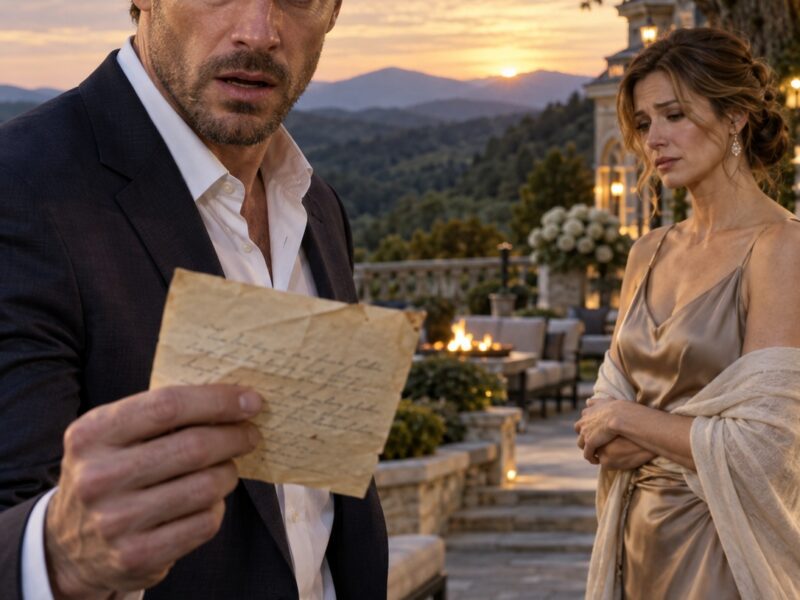
TWENTY YEARS AFTER SHE LEFT, MY FIRST LOVE ASKED IF I’D READ HER LETTER—THEN SHE TOLD ME WHO WAS WAITING FOR ME
The moment Hannah asked me about the letter, twenty years of my life stopped making sense.
We were standing beneath an old oak tree behind the country club, far enough from our college reunion that the music had softened into a distant pulse. Beyond the lawn, the Blue Ridge Mountains were turning dark beneath a September sky, their edges fading into the evening haze.
Hannah stood three feet from me.
Older.
Different.
Still unmistakably Hannah.
There was silver threaded through the brown hair I remembered falling across my pillow when we were twenty-two. Fine lines gathered at the corners of her eyes when she smiled. She wore a dark green dress and a thin gold chain around her neck, nothing flashy, nothing designed to make anyone stare.
But I stared anyway.
Because some faces don’t return to your life.
They return to the exact place inside you where you buried them.
For the first half hour after seeing each other again, we’d managed the safe questions.
Work.
Parents.
Cities.
Friends.
The bland geography of two lives that had spent two decades moving in opposite directions.
Then Hannah’s eyes dropped to her hands.
Her fingers tightened around one another.
And she asked quietly, “Caleb… did you ever read the letter I sent you?”
I thought I had misunderstood her.
“What letter?”
Her head came up.
There are moments when a person’s face changes so completely that you know the next sentence is going to divide your life into before and after.
This was one of them.
“The letter I sent you from California.”
“I never got a letter.”
She stared at me.
I stared back.
The voices from the reunion blurred behind us. Someone laughed near the patio. A glass shattered inside the ballroom, followed by applause when a waiter apparently managed to save the tray.
Neither of us moved.
Then Hannah whispered, “Oh my God.”
A cold pressure spread across my chest.
“What was in the letter?”
She took one step backward.
Not dramatically.
Almost instinctively.
Like twenty years had suddenly become dangerous.
“Hannah.”
She shook her head.
“I thought you knew.”
“Knew what?”
She closed her eyes.
And when she opened them again, they were wet.
“Caleb,” she said, “I was pregnant.”
For several seconds, the world continued without me.
Wind moved through the oak leaves.
Cars passed somewhere beyond the property.
Music floated through open ballroom doors.
But inside my body, everything went silent.
“What?”
Hannah pressed her lips together.
“I found out after I got to California.”
I looked at her as though she had suddenly begun speaking a language I couldn’t understand.
“No.”
“Caleb—”
“No. You would’ve told me.”
“I did.”
“No, you didn’t.”
“I wrote you.”
“I never got it.”
“I know that now.”
“You could’ve called.”
“I did call.”
The words hit harder than they should have.
I remembered ringing phones.
Hospital hallways.
My father’s oxygen machine.
Invoices spread across the kitchen table.
Twelve-hour shifts at the hardware store.
My mother’s exhausted face.
Calls I had missed.
Messages I had intended to return.
Days when surviving until midnight had felt like an accomplishment.
But surely I would have remembered Hannah telling me she was pregnant.
Surely a man couldn’t lose something that large without noticing.
Could he?
I dragged a hand across my mouth.
“What happened?”
Her answer came softly.
“I had her.”
Her.
One word.
One syllable.
Twenty stolen years.
I turned away because suddenly I couldn’t look at Hannah.
The mountains had disappeared into darkness.
Behind us, people from our graduating class were drinking wine and remembering who had kissed whom behind the library. Somewhere inside that building was the version of my life everyone believed was true.
Caleb Mercer.
Forty-two.
Photographer.
Never married.
No children.
A man who traveled too much and stayed too little.
Except apparently one of those things had never been true.
I turned back.
“Hannah.”
She already knew the question.
“Her name is Grace.”
My knees almost gave beneath me.
And that was how, at forty-two years old, beneath an oak tree at a college reunion I almost hadn’t attended, I learned I had a twenty-year-old daughter.
The first time I met Hannah Cole, she was arguing with a vending machine.
It was October of our senior year at Western Carolina, and I was cutting through the student center with a camera hanging around my neck when I heard a woman say, “I gave you a dollar. We had an agreement.”
I slowed down.
She slapped the side of the machine.
Nothing happened.
“You don’t get to change the terms after taking my money.”
I should’ve kept walking.
Instead, I laughed.
Hannah looked over her shoulder.
She was wearing jeans, a faded university sweatshirt, and white sneakers with blue ink on one toe. Her hair was tied back badly enough that half of it had already escaped.
“You think this is funny?”
“A little.”
“It stole my peanut M&M’s.”
“Then this is serious.”
“Thank you.”
I walked over and studied the machine.
The bag had lodged against the spiral.
I hit the glass once with the heel of my hand.
It fell.
Hannah looked at me, then at the candy.
“You’ve done this before.”
“My father owns a hardware store. Hitting things until they work is basically our family philosophy.”
She laughed.
It was not a polite laugh.
It came from somewhere deep and warm, and for reasons I couldn’t have explained, I wanted to hear it again.
She picked up the candy.
“I owe you.”
“You don’t.”
“I do. I believe in paying my debts.”
“Coffee.”
She raised an eyebrow.
“That was fast.”
“You said you owed me.”
“For a one-dollar bag of candy.”
“Coffee’s cheap.”
“Depends where you buy it.”
“The student union.”
“That isn’t coffee.”
“Then you choose.”
She studied me for a second, then pointed at the camera around my neck.
“You take pictures?”
“Sometimes.”
“Of what?”
I shrugged.
“Things people don’t notice.”
She smiled.
“Maybe I’ll buy you coffee after all.”
That was Hannah.
She could turn a conversation into a door before you realized you’d stepped through it.
We started with coffee.
Then another coffee.
Then a walk beside the river that lasted two hours.
Then dinner.
Then a Saturday drive into the mountains because the leaves had turned red and gold and Hannah insisted anyone with a camera had “a moral obligation” to photograph them.
By Thanksgiving, everyone assumed we were together.
By Christmas, we stopped pretending we weren’t.
Our relationship wasn’t spectacular in the way people describe love after enough time has passed to make memory dishonest.
We fought.
Hannah hated that I left wet towels on the floor.
I hated that she stole my fries after saying she wasn’t hungry.
She studied late and became irritable when tired. I avoided difficult conversations until silence became its own kind of argument.
There were no private jets.
No dramatic proposals in the rain.
No luxurious vacations.
Most nights we couldn’t afford dinner anywhere that didn’t have laminated menus.
But she knew how I took my coffee.
I knew she cried whenever dogs died in movies, even if the dogs weren’t real.
She left notes inside my camera bag.
DON’T FORGET TO EAT.
YOU’RE BETTER THAN YOU THINK.
CALL YOUR MOM.
STOP PHOTOGRAPHING ME WHEN I’M CHEWING.
Once, after a terrible fight about whether I was actually applying to photography programs after graduation or merely talking about them, I found a note under my windshield wiper.
It said:
I’M STILL MAD AT YOU.
I STILL LOVE YOU.
BOTH THINGS CAN BE TRUE.
I kept it for years.
Maybe part of me still has it memorized because Hannah understood something at twenty-two that took me half a lifetime to learn.
Love wasn’t the absence of contradiction.
Sometimes love was contradiction.
Sometimes it was wanting someone desperately while being furious with them.
Sometimes it was letting them go because you believed you were doing the right thing.
And sometimes the choice that looked most generous became the wound that never closed.
My father got sick three weeks before graduation.
At first, everyone told us it was manageable.
Then there were more tests.
Then specialists.
Then words nobody in our family had prepared for.
His heart was failing.
Not quickly enough for an immediate goodbye.
Not slowly enough for denial.
My father, Tom Mercer, had spent thirty years running Mercer’s Hardware on Main Street outside Asheville. The store smelled like lumber, fertilizer, dust, machine oil and the peppermint candies he kept beside the register.
He knew every contractor in three counties.
He extended credit to people he probably shouldn’t have.
He fixed lawnmowers behind the building even though we didn’t technically offer repair services.
Most of all, he believed that if a man woke up every morning and did the work in front of him, life would eventually reward the effort.
Then his heart began failing, and effort turned out to be irrelevant.
Graduation came.
Hannah got into a graduate education program in California.
I got an acceptance letter from a photography institute in New York.
For approximately forty-eight hours, it felt like both of us were standing at the edge of everything we’d wanted.
Then Dad collapsed in aisle six beside the plumbing supplies.
I withdrew from New York that week.
Hannah found me behind the hardware store breaking down cardboard boxes with more violence than necessary.
“You didn’t tell me.”
“There wasn’t anything to tell.”
“You withdrew.”
“I can reapply.”
“When?”
“When things settle down.”
Her face changed.
“Caleb.”
“What?”
“When are things going to settle down?”
I sliced through another box.
“I don’t know.”
“That’s my point.”
“He’s my father.”
“I know.”
“My mom can’t run the store.”
“I know.”
“They’re drowning.”
“I know.”
“Then what do you want me to do?”
“I want you to stop talking to me like I’m the person asking you to abandon your family.”
I looked at her.
She was crying.
Hannah rarely cried when we argued.
That scared me more than anger would have.
“I don’t know what you want from me,” I said.
“The truth.”
“The truth is my father may be dying.”
“No.” She wiped under one eye. “That’s the truth about your father. I want the truth about you.”
I didn’t answer.
She stepped closer.
“Are you giving up New York because you want to stay?”
“I need to stay.”
“That’s not what I asked.”
“I don’t have the luxury of wanting things right now.”
The instant I said it, I regretted it.
Hannah looked as if I’d slapped her.
Because she knew she was one of those things.
Things I wanted.
Things I apparently didn’t have the luxury to want.
I reached for her.
She stepped back.
“Don’t.”
“Hannah.”
“I got into California.”
“I know.”
“My deadline is Friday.”
“You should go.”
Her expression went still.
“What?”
“You worked for this.”
“What are you saying?”
“I’m saying go.”
“And us?”
“We’ll figure it out.”
“How?”
“Phones exist.”
“California isn’t across town, Caleb.”
“I know where California is.”
“Then stop acting like this is simple.”
“It doesn’t have to be the end.”
She searched my face.
“Would you wait for me?”
“Yes.”
The answer came immediately.
Because I meant it.
I believed then that sincerity was enough protection against reality.
She whispered, “How long?”
“As long as it takes.”
“You don’t know what you’re promising.”
“Neither do you.”
That almost made her smile.
Almost.
She moved into my arms.
I held her beside the dumpster behind Mercer’s Hardware while traffic passed on Main Street and a delivery truck idled near the loading entrance.
It was not a cinematic place to make a promise.
Maybe that’s why I trusted it.
The real promises never happen under perfect lighting.
They happen when you’re scared.
They happen between ordinary people who have no idea what life is preparing to do to them.
Hannah left in August.
The night before, we sat on the hood of my old Ford behind my parents’ house.
Fireflies moved across the yard.
My father was sleeping inside after another difficult week.
Mom had finally gone to bed.
Hannah leaned against me.
“You’re going to forget me.”
“I’ll forget my own name first.”
“That isn’t reassuring.”
“You’ll call.”
“You’ll call.”
“We’ll write.”
“You hate writing.”
“For you, I’ll develop literacy.”
She laughed softly.
Then she became quiet.
“What?”
“Nothing.”
“You have the face.”
“What face?”
“The face you get when you’re thinking something you don’t want to say.”
She looked toward the trees.
“I do have something to tell you.”
I waited.
Her fingers tightened around mine.
Then she shook her head.
“Not tonight.”
“Hannah.”
“I want to be sure first.”
“Sure about what?”
She looked at me.
There was fear in her eyes.
At the time I thought she was afraid of leaving.
Years later, I would understand how blind love can make a person when the truth does not match the future they’ve imagined.
“I’ll tell you when I get there,” she said.
“You’re making it sound ominous.”
“Maybe it isn’t.”
“Now you definitely have to tell me.”
She leaned over and kissed me.
“California.”
“What?”
“I’ll tell you from California.”
“Promise?”
“Promise.”
The next morning I drove her to the airport.
I watched her walk toward security.
She turned around twice.
The second time, she lifted her hand.
I lifted mine.
Then she disappeared into the crowd.
For the rest of my life, whenever I remembered losing Hannah, that was the picture I saw.
A young woman walking away.
I never imagined there had already been two people leaving me.
For the first few weeks, we did exactly what we’d promised.
She called late because of the time difference.
I called early from the stockroom.
She described her apartment, classes, professors, traffic, grocery stores where everything seemed three times more expensive than North Carolina.
I told her about Dad.
Mostly, I lied about Dad.
He’s okay.
Stable.
Doctor says they’re adjusting medication.
Store is fine.
Mom is fine.
I’m fine.
The truth was that Dad had begun collapsing more frequently.
My mother was sleeping four hours a night.
The store’s accounts were bleeding.
I was borrowing money from one bill to pay another.
And beneath all of it was a shame I couldn’t explain.
Hannah was moving toward her future.
I was disappearing inside my family’s emergency.
I didn’t resent her.
That would’ve been easier.
Instead, I resented myself for becoming someone whose biggest ambition was making it through Friday.
One Tuesday afternoon, Dad was admitted again.
I spent the night at Mission Hospital.
I came home the next morning, showered, changed, and drove directly to the store.
Mom was sitting behind the register surrounded by envelopes.
“You’ve got mail,” she said.
“What kind?”
“Bills, mostly.”
“Of course.”
“And something handwritten.”
I was already walking toward the stockroom.
“Put it somewhere safe.”
“Caleb.”
“Mom, please. I have to deal with the distributor before ten.”
She looked tired enough to be seventy instead of fifty-three.
“I’ll put it with your things at home.”
“Thanks.”
That was it.
A sentence.
A distracted answer.
One ordinary moment.
I did not see the envelope.
I did not see Hannah’s handwriting.
I did not know that inside it were six pages she had rewritten three times because she couldn’t figure out how to tell a twenty-two-year-old man drowning beneath his father’s illness that he was about to become a father himself.
At eleven forty-seven that night, my mother called the store.
Dad had stopped breathing.
He survived.
But the next forty-eight hours became a blur of ICU corridors, physicians, insurance forms, vending-machine coffee and my mother crying silently in a bathroom because she didn’t want him to see.
The letter disappeared.
Maybe Mom put it inside a drawer.
Maybe it slid beneath a stack of invoices.
Maybe it ended up in one of the cardboard boxes we later moved between the store and the house.
I don’t know.
All I know is that I never opened it.
And Hannah never knew that.
Her calls became less frequent.
So did mine.
At first there were explanations.
Class.
Hospital.
Work.
Time difference.
Exhaustion.
Then apologies.
Sorry I missed you.
Call tomorrow?
Crazy week.
Thinking about you.
Then silence began filling the spaces between us.
A day.
Three days.
A week.
One night I called her apartment six times.
No answer.
She called the hardware store the following afternoon.
I was with my father at a cardiology appointment.
Mom answered.
Years later, Hannah would tell me she’d asked if everything was all right.
Mom, exhausted and distracted, said something like, “Nothing’s all right around here anymore.”
Hannah asked me to call.
I didn’t get the message until several days later.
By then, I was angry.
Not at Hannah.
At everything.
But anger is lazy.
It lands on whoever is closest.
I called.
Her roommate answered.
“Hannah’s not here.”
“Where is she?”
“I don’t know.”
“You live with her.”
“She’s out.”
“With who?”
A pause.
“I don’t know, Caleb.”
There are questions you ask because you want information.
And questions you ask because you are already afraid of the answer.
“Is she seeing somebody?”
Her roommate went silent.
That should’ve told me nothing.
Instead, I let it tell me everything.
“Forget it,” I said.
“Caleb, wait—”
I hung up.
Hannah called the next morning.
I was unloading lumber.
“Why did you ask Rachel if I was seeing someone?”
“Are you?”
“What?”
“It’s a question.”
“No.”
“Okay.”
“That’s it?”
“What do you want me to say?”
“I want you to sound like you care.”
“I care.”
“You sound exhausted.”
“I am exhausted.”
“So am I.”
“Then maybe we should stop doing this tonight.”
“Doing what?”
“This.”
Silence.
Then she said, “Do you want me to come home?”
I froze.
Her question contained an offer I desperately wanted to accept.
Come home.
Come save me from this.
Come stand beside me while my father’s body fails and my mother breaks and every dream I had gets packed into smaller and smaller boxes.
But then another thought arrived.
If she came back, she might never leave again.
She would sacrifice California.
For me.
And eventually she might hate me for it.
So I said the sentence I thought was loving.
“No.”
Hannah went very quiet.
“You don’t want me there?”
“That isn’t what I said.”
“It sounded exactly like what you said.”
“You need to finish school.”
“I’m asking if you need me.”
“I need to know you’re not throwing your future away because my life fell apart.”
“Caleb—”
“Stay.”
Another silence.
Longer.
When she spoke again, her voice was barely audible.
“Okay.”
The call ended five minutes later.
I didn’t know it then, but Hannah sat on her kitchen floor afterward with one hand on her stomach and cried until her roommate came home.
She thought I had received the letter.
She thought I knew.
And she thought that when I said stay, I wasn’t protecting her future.
She thought I was rejecting our child.
The weeks after that became uglier in quiet ways.
No screaming.
No dramatic breakup.
Just distance.
She stopped saying she loved me at the end of every call.
Then I stopped saying it first because I wanted to know whether she would notice.
She noticed.
She just didn’t understand.
I mistook her hurt for indifference.
She mistook my exhaustion for abandonment.
Two people who had once known each other’s coffee orders better than their own became strangers through a thousand small misunderstandings.
Eventually there was no final call.
No official goodbye.
Just a conversation that ended with Hannah saying, “I can’t keep asking you to want to be part of my life.”
And me answering, “I can’t keep proving something you already decided not to believe.”
Neither sentence meant what the other person heard.
But sometimes relationships don’t end because love disappears.
Sometimes they end because pain becomes a translator.
A few months later, Dad died.
He was fifty-eight.
I was twenty-three.
After the funeral, I found myself sitting alone inside Mercer’s Hardware after midnight.
The store was dark except for the light above the register.
His coffee cup was still beneath the counter.
There were pencil marks beside the phone where he’d calculated prices.
A flannel jacket hung on a hook behind the office door.
I remember staring at it and realizing death was mostly objects waiting for someone who would never use them again.
I thought about calling Hannah.
I didn’t.
Pride is a strange thing.
At twenty-three, it can feel almost identical to self-respect.
I told myself she had moved on.
She had chosen California.
She hadn’t come to the funeral.
I didn’t know she hadn’t known Dad had died.
Eventually I stopped checking for her name whenever the phone rang.
At least, I pretended I did.
I ran the hardware store for another three years.
Then one morning, I looked around and understood something my father probably would’ve hated hearing.
His dream wasn’t required to become mine simply because he had died.
I sold the business.
Mom moved to Tennessee to be near my sister.
I bought a used Nikon I couldn’t really afford, packed two duffel bags into my truck and started taking every photography job anyone would give me.
Weddings.
Graduations.
Real estate.
Birthdays.
Corporate events.
Family portraits.
For a while, I was terrible.
Then I became competent.
Then good.
Then, somewhere in my thirties, people started hiring me specifically because I could capture moments that looked unplanned.
A father seeing his daughter in her wedding dress.
A soldier dropping his bag when his son ran toward him.
A grandmother touching the face of a newborn.
A bride’s mother crying when she thought nobody was looking.
My career was built on recognizing emotional moments before other people understood they were happening.
The irony did not occur to me until much later.
I could see everybody’s life clearly through a camera.
Except my own.
People asked why I never married.
I had answers.
Travel.
Timing.
Work.
Haven’t met the right person.
All technically true.
None completely true.
There were women.
Good women.
Smart women.
Funny women.
Women who deserved more than half of me.
One came close.
Her name was Julia.
We dated for almost two years.
One night, she found a box while helping me move apartments.
Inside were old photographs.
College.
Mountains.
Hannah.
Julia held one up.
“Who’s this?”
I knew which picture before looking.
Hannah sitting on the hood of my truck with her face turned away because she hated being photographed.
“College girlfriend.”
Julia studied me.
“The college girlfriend?”
“What does that mean?”
“The one.”
“There isn’t a one.”
She handed me the picture.
“You didn’t answer.”
“We were kids.”
“That isn’t an answer either.”
I put the photograph back.
“She’s married somewhere, probably.”
“You don’t know?”
“No.”
“You never looked?”
The lie came too easily.
“No.”
I had looked.
Once.
Then twice.
Then occasionally for years.
Hannah’s social media had been private.
I found references to a teaching position in California.
Later a married name.
Later nothing.
I stopped searching when doing so began to feel pathetic.
Julia sat on the floor beside the box.
“Caleb, can I ask you something terrible?”
“That introduction guarantees I’m going to love it.”
“If she walked through that door right now and said she’d made a mistake, would you still choose me?”
I opened my mouth.
Nothing came out quickly enough.
Julia nodded.
“That was my answer.”
We broke up three months later.
She married someone else.
They had twins.
I photographed their family once by coincidence at a charity event.
Julia looked happy.
I was glad.
But driving home, I wondered whether some people spend their whole lives mistaking emotional unfinished business for loyalty.
Maybe I had.
Then, at forty-two, the reunion invitation arrived.
I almost threw it away.
Our twentieth reunion was being held near Asheville because someone on the alumni committee had apparently become successful enough to belong to a private country club overlooking the mountains.
I left the invitation on my kitchen counter for a week.
Then I put it in the trash.
The next morning, I took it out.
I still couldn’t explain why.
Maybe it was age.
Maybe twenty years felt like a respectable amount of time to stop being afraid of a room.
Maybe I was tired of proving Hannah no longer mattered by organizing my life around avoiding reminders of her.
So I registered.
The night of the reunion, I sat in my car for seven minutes before going inside.
I nearly left twice.
Then I saw a former classmate through the windows and knew he’d already noticed me.
Too late.
Inside, everything smelled like expensive perfume, whiskey and nostalgia.
People hugged me whose names I had forgotten.
Someone slapped my shoulder and shouted, “Mercer!”
A woman I barely recognized showed me pictures of three children.
Someone else asked if I was still “doing the camera thing,” which made me laugh because I had recently photographed a cover for a national magazine.
I smiled.
I drank half a beer.
I answered questions.
And every few minutes, I looked toward the entrance.
I hated myself for it.
At eight seventeen, Hannah walked in.
No spotlight.
No music stopping.
No cinematic miracle.
She simply entered through the ballroom doors beside another woman.
And my entire nervous system recognized her before my mind did.
She laughed at something her friend said.
Then she turned.
Saw me.
Stopped.
People moved between us.
Someone walked past carrying champagne.
A couple posed near the alumni banner.
But Hannah and I stood approximately forty feet apart in a crowded ballroom staring at each other like two survivors who had just discovered they remembered the same disaster differently.
Then she smiled.
Small.
Uncertain.
My chest tightened.
I walked toward her.
She walked toward me.
“Caleb.”
“Hannah.”
For a second, neither of us knew whether to hug.
Then she solved it.
She stepped forward.
I put my arms around her.
It lasted perhaps two seconds.
Maybe three.
Long enough for me to smell her perfume.
Long enough to understand that memory had lied about everything except how it felt to hold her.
When she stepped back, she looked at me carefully.
“You have gray hair.”
“So do you.”
“I was going to be polite.”
“We were never good at that.”
She laughed.
That laugh.
Older now.
Softer.
But still capable of collapsing twenty years.
We talked inside for almost an hour.
She’d finished graduate school.
Taught middle school English for several years.
Moved into educational administration.
Married at twenty-nine.
Divorced at thirty-eight.
The marriage, she said, hadn’t ended in betrayal or scandal.
“Nothing dramatic,” she told me. “We just spent a long time pretending being decent to each other was the same thing as being right for each other.”
“I’m sorry.”
“I’m not.”
I raised an eyebrow.
“That sounds cold.”
“It took me years to understand that ending something peacefully isn’t the same as failing.”
She asked about Dad.
I told her when he had died.
The color left her face.
“Caleb… I didn’t know.”
“I figured.”
“No. I mean I truly didn’t know. Nobody told me.”
“It was a long time ago.”
Her eyes filled.
“He was kind to me.”
“He liked you.”
“He used to pretend he didn’t.”
“He pretended not to like everybody.”
She smiled sadly.
Then she asked about Mom.
My sister.
Photography.
I asked about her life.
She mentioned a daughter.
I remember that clearly.
But I didn’t understand the significance.
“You have a daughter?”
“Yes.”
“How old?”
“Twenty.”
I nodded.
“College?”
“Finished early. She’s in Charlotte now, working at a hospital while finishing additional nursing certification.”
“You must be proud.”
The look that crossed Hannah’s face confused me.
“I am.”
“What?”
“Nothing.”
That was when I should have known.
Instead, someone interrupted us.
Old classmates.
Photographs.
Stories.
We survived another twenty minutes before Hannah touched my arm.
“Can we go outside?”
Something in her voice made me say yes.
We walked across the terrace and onto the lawn.
Past the benches.
Past the conversations.
Past the soft yellow light spilling from the windows.
Then we stopped beneath the oak tree.
And Hannah asked about the letter.
I don’t remember sitting down.
One moment I was standing.
The next I was on a wooden bench with my elbows on my knees, trying to understand how language worked.
Hannah remained several feet away.
“Grace,” I said.
“Yes.”
“Our daughter.”
Her mouth trembled.
“Yes.”
I laughed once.
Not because anything was funny.
Because sometimes the human body has only so many responses available before it starts choosing randomly.
“I have a daughter.”
Hannah wiped her cheek.
“Yes.”
“For twenty years.”
“Yes.”
“And she knows about me?”
Hannah hesitated.
That hesitation cut deeper than any answer.
“What does she know?”
“She knows your name.”
“What else?”
“She knows we were together.”
“What did you tell her?”
“The truth as I understood it.”
I stood.
“And what truth was that?”
Hannah flinched.
I immediately hated my tone, but I couldn’t stop.
“What did you tell my daughter about me?”
“I told her I wrote to you.”
“And?”
“That you never answered.”
“So she thinks I abandoned her.”
“I never used that word.”
“She didn’t need the word.”
“Caleb—”
“Twenty years, Hannah.”
Her expression hardened.
“You think I don’t know how many years it was?”
“I would have come.”
She looked away.
“I would’ve come.”
“I didn’t know that.”
“You knew me.”
“I thought I did.”
That shut me up.
Hannah folded her arms across herself.
“When I found out I was pregnant, I was terrified. I was twenty-two. I was across the country. You were taking care of your father. Every phone call with you sounded like I was reaching someone who was drowning.”
“So you sent a letter?”
“I tried calling first.”
“I never heard you say it.”
“Because every time I tried, something happened. Your father went back to the hospital. You were at the store. Your mother answered. You sounded exhausted. And I…” She swallowed. “I lost my nerve.”
“So you wrote.”
“Six pages.”
“What did you say?”
“Everything.”
Her voice broke.
“That I was pregnant. That I was scared. That I loved you. That I didn’t expect you to abandon your family. That I wasn’t asking you to choose me over your father. I told you I could stay in California through the semester. I told you we could figure it out together.”
“And then?”
“I mailed it.”
I stared at the ground.
“My mother.”
“What?”
“She told me something handwritten had arrived.”
Hannah went completely still.
“When?”
“Right before Dad’s emergency. She said she’d put it somewhere safe.”
“Caleb.”
“I never saw it.”
Hannah covered her mouth.
I continued because stopping felt impossible.
“That night he stopped breathing. Then the hospital. The store. Insurance. Everything. I forgot about the mail.”
She turned away.
I could see her shoulders shaking.
“You really didn’t know.”
“No.”
“Oh God.”
“Hannah.”
“I thought you knew.”
She pressed both hands against her face.
“I thought every time you told me not to come home, you knew.”
I felt physically sick.
The conversation returned to me with brutal clarity.
Do you want me to come home?
No.
Stay.
Finish school.
Don’t throw your future away because my life fell apart.
I had thought I was freeing the woman I loved from becoming trapped by my family’s crisis.
She had heard the father of her unborn baby saying he didn’t want them.
“I didn’t know,” I whispered.
“I know that now.”
“I didn’t know.”
“I know.”
“I would’ve been there.”
“I know.”
“You don’t know.”
This time she let me be angry.
Maybe she understood that underneath the anger was grief too large to hold.
“I would’ve been there when she was born.”
“I believe you.”
“I would’ve changed diapers.”
“I know.”
“I would’ve taken her to school.”
Hannah was crying openly now.
“I know.”
“Birthdays.”
“I know.”
“Christmas.”
“I know, Caleb.”
“I would’ve known my own daughter.”
Her face crumpled.
“I know.”
That was what broke me.
Not blame.
Not accusation.
Agreement.
I sat again.
For a long time, Hannah and I said nothing.
Eventually I asked the question I feared most.
“Does she hate me?”
Hannah looked at me.
“No.”
“You hesitated.”
“Because it’s complicated.”
“Does she hate me?”
“No.”
“Does she want to meet me?”
“I don’t know.”
The answer hurt more because it was honest.
“She knows I’m here tonight?”
“Yes.”
“What did she say?”
Hannah looked toward the country club.
“She told me not to protect her from the truth anymore.”
I frowned.
“What does that mean?”
“It means Grace is twenty years old. She isn’t a child. She knows I was coming here. She knows there was a chance I’d see you.”
“And?”
“She said if I did, I should finally ask about the letter.”
“Finally?”
Hannah lowered her eyes.
“She wondered for years whether there might be another explanation.”
Grace.
My daughter.
A woman I had never met had considered defending me against a story I didn’t even know existed.
I pulled out my phone.
My hand was shaking.
“Give me her number.”
Hannah stepped closer.
“Caleb, don’t do this tonight.”
“Why?”
“Because you just found out she exists.”
“Exactly.”
“And she’s lived with this her whole life.”
“So I should wait?”
“You should breathe.”
“I’ve already waited twenty years.”
“You didn’t know you were waiting.”
“That doesn’t make them come back.”
“No.”
Her voice became firmer.
“And calling Grace at ten o’clock at night while you’re in shock won’t bring them back either.”
I hated that she was right.
I hated everything she was right about.
“So what am I supposed to do?”
“Go back to your hotel.”
“And sleep?”
“No.”
Despite everything, the answer almost made me smile.
Hannah sat beside me.
“Think.”
“I’ve thought enough for twenty years.”
“No. You’ve thought about the wrong story for twenty years.”
That sentence stayed with me.
I had spent half my life believing Hannah left me.
Hannah had spent half hers believing I rejected her and our child.
Grace had spent her entire life existing inside the space between those two false stories.
And somewhere, perhaps in a landfill or the back of an old drawer, six pages of paper had quietly carried the truth none of us received in time.
I didn’t sleep.
My hotel room overlooked a highway.
At 1:12 a.m., I sat on the edge of the bed.
At 2:30, I walked downstairs and bought coffee.
At 3:15, I searched for Grace online.
I stopped before clicking anything.
It felt invasive.
At four, I cried.
Not loudly.
Not dramatically.
I just sat against the headboard and let twenty years move through me.
I thought about photographing other men’s daughters walking down aisles.
I thought about the father-daughter dances I’d watched through my lens.
I thought about little girls standing on boxes because they weren’t tall enough for family portraits.
Teenagers rolling their eyes at fathers who embarrassed them.
Graduation photographs.
Hospital newborn sessions.
Christmas cards.
Every image now contained an absence I hadn’t known belonged to me.
At 5:07, Hannah texted.
ARE YOU AWAKE?
I stared at the question.
Then typed:
I DON’T THINK I’LL EVER SLEEP AGAIN.
Three dots appeared.
Disappeared.
Returned.
Finally:
GRACE SAID SHE’LL MEET YOU.
My heart began pounding so violently I had to set the phone down.
WHEN?
SATURDAY. CHARLOTTE.
It was Thursday.
Two days.
Forty-eight hours to prepare for the most important meeting of my life.
No preparation was possible.
The cafe Grace chose was small and quiet, tucked between a bookstore and a florist in Charlotte.
I arrived forty minutes early.
Then I left because forty minutes early felt desperate.
I walked around the block twice.
Then returned twenty-two minutes early.
I ordered coffee and didn’t drink it.
Hannah sat across from me.
“You’re bouncing your knee.”
“I know.”
“You always did that.”
“When?”
“When you were nervous.”
“I don’t remember.”
“I do.”
I looked toward the door.
“What if she doesn’t come?”
“She’ll come.”
“How do you know?”
“Because when Grace decides something, weather systems usually adjust around her.”
I looked at Hannah.
“Is that you or me?”
“Unfortunately, both.”
The door opened.
A young couple entered.
Not Grace.
Five minutes later, an older man.
Not Grace.
Then the door opened again.
A woman stepped inside wearing navy scrubs beneath a gray jacket.
She paused beside the entrance.
And I forgot how to breathe.
She had Hannah’s smile.
Even before she smiled.
But the eyes were mine.
There was no reasonable explanation for how certain I was.
I had seen those eyes every morning in mirrors for forty-two years.
Grace looked at Hannah.
Then at me.
Nobody moved.
Finally Hannah stood.
Grace walked to the table.
“Hi.”
One word.
I stood so quickly my chair scraped backward.
Several people looked over.
“Hi.”
Brilliant, I thought.
Twenty years and that’s what you have.
Hi.
Grace looked at me.
“You’re Caleb.”
I nodded.
“Yes.”
Her mouth moved as if she might smile.
“You look like your pictures.”
“I could say the same thing, except I’ve never seen yours.”
The sentence landed badly.
I knew it the moment it left my mouth.
Grace looked down.
“Sorry.”
“No,” she said. “It’s okay.”
Hannah touched her arm.
“I’ll get coffee.”
Grace glanced at her.
“You don’t have to leave.”
“I’m twenty feet away.”
We both knew what Hannah was doing.
She was giving us space.
Grace sat.
I sat across from her.
The table suddenly seemed impossibly small.
“I don’t know how to do this,” I admitted.
“Good.”
That surprised me.
“Good?”
“I don’t either.”
For the first time, she smiled slightly.
There was Hannah again.
And something inside me cracked.
“I need to tell you something before anything else.”
Grace folded her hands around a paper cup.
“Okay.”
“I didn’t know.”
She looked at me for a long time.
“I know that’s what Mom said.”
“It’s true.”
“I didn’t say it wasn’t.”
“I never got the letter.”
She nodded.
“If I’d known—”
“Please.”
Her voice was calm.
But firm.
I stopped.
Grace looked toward the window.
“I’ve imagined this conversation a lot.”
I waited.
“In some versions, you’re terrible.”
Fair enough.
“In others, Mom lied to me.”
My stomach tightened.
“She didn’t.”
“I know.”
“She told you what she believed.”
“I know.”
“And she had every reason to believe it.”
Grace looked back at me.
“You’re defending her.”
“Yes.”
That seemed to surprise her.
“I don’t want you meeting me by deciding your mother is the villain.”
“She isn’t.”
“I know.”
“But you’re angry.”
“Yes.”
“At her?”
“At everything.”
Grace nodded slowly.
“That makes more sense.”
I leaned forward.
“There are things I wish she’d done differently. There are things I wish I’d done differently. But none of that is your responsibility.”
Her eyes became wet.
I continued before courage disappeared.
“I was twenty-two when you were born.”
“I know.”
“I was stupid.”
She gave me the smallest smile.
“Mom has mentioned that.”
“I’m sure she has.”
“But I wasn’t so stupid that I would’ve walked away from my child.”
Grace’s smile disappeared.
“I need you to understand that.”
“I want to.”
“I would’ve come.”
Her eyes dropped.
“I would’ve been there.”
“I know.”
“No. You don’t.”
My voice broke.
“I need to say it anyway.”
Grace looked up.
So I did.
I told my daughter all the things twenty years had denied me the chance to say.
I would’ve come to the hospital.
I would’ve held you.
I would’ve learned how to change diapers badly.
I would’ve taken terrible first-day-of-school pictures.
I would’ve worried when you got sick.
I would’ve embarrassed you in front of your friends.
I would’ve taught you to drive and probably terrified both of us.
I would’ve known your favorite food.
Your favorite song.
Who broke your heart.
What made you laugh.
I would’ve wanted all of it.
The beautiful things.
The exhausting things.
The ordinary things.
Especially the ordinary things.
Grace covered her mouth.
I was crying too.
“I didn’t choose to miss your life.”
She whispered, “I know.”
“But I missed it.”
“Yes.”
“And I’m sorry.”
That was when Grace said the sentence I would remember for the rest of my life.
“I never hated you.”
I wiped my eyes.
She continued.
“I didn’t know enough about you to hate you.”
It was not forgiveness.
It was not cruelty.
It was the truth.
And somehow the truth hurt more cleanly than either.
Grace looked at her coffee.
“For a long time, you were basically a name.”
I nodded.
“Mom never said awful things about you.”
“I’m glad.”
“She said you were funny.”
“That sounds suspicious.”
“She said you wanted to be a photographer.”
“I became one.”
“I know.”
“You looked me up?”
Grace blushed.
“A few times.”
“When?”
“Since I was sixteen.”
My chest tightened.
“Why didn’t you contact me?”
She gave a short laugh.
“What was I supposed to write? Hi, I’m possibly your daughter, Mom says you knew I existed but didn’t want us?”
I had no answer.
Grace rubbed her thumb against the seam of her cup.
“I was afraid.”
“Of me?”
“Of being right.”
“About what?”
“That you didn’t want me.”
I looked directly at her.
“I want you.”
She froze.
Maybe it was too much.
Too fast.
But I couldn’t take it back.
“I don’t mean I expect you to call me Dad tomorrow. Or ever, if that isn’t something you want. I don’t expect Christmases or birthdays or some movie ending where we pretend twenty years didn’t happen.”
My throat tightened.
“But if you’re asking whether I want you in my life now that I know you exist…”
I swallowed.
“Yes.”
Grace’s eyes filled.
“Yes, I do.”
She reached across the table.
Her hand stopped halfway.
I met it.
Our fingers closed.
The first time I touched my daughter, she was twenty years old.
No hospital bracelet.
No newborn blanket.
No tiny fingers wrapping themselves around mine.
A cafe table stood between us.
Her hand was already grown.
And I loved it anyway.
The months that followed were nothing like the sentimental version people might prefer.
We did not instantly become father and daughter.
We became two people learning whether those words could someday belong to us.
Grace asked questions.
Some were easy.
What music did I like?
Did I play sports?
Why photography?
Had I ever been married?
Some were harder.
“Were you happy without knowing about me?”
That question came during dinner six weeks after we met.
I put down my fork.
“Yes.”
She looked hurt.
So I continued.
“And no.”
“What does that mean?”
“It means happiness isn’t one thing.”
She waited.
“I had good days. Great days. I traveled. I built a career. I had people I loved. But there was always something in my life that felt unfinished.”
“You mean Mom.”
“I thought I meant your mom.”
“And now?”
I looked at her.
“Now I think maybe I was missing more than I knew.”
Grace didn’t answer.
But when we left the restaurant, she hugged me for the first time.
It lasted less than a second.
I stood beside my truck afterward pretending to look for my keys because I didn’t want her to see me cry.
Another time, we argued.
Really argued.
It happened around Thanksgiving.
I had started texting Grace often.
Too often.
Good morning.
How was work?
Did you eat?
Driving tonight? Weather looks bad.
She answered less and less.
Finally she called.
“Caleb, you have to stop.”
The use of my name told me something was wrong.
“Stop what?”
“Checking on me every three hours.”
“I don’t.”
“You texted me five times yesterday.”
“I was asking how you were.”
“I know.”
“Then what’s wrong with that?”
She sighed.
“You’re trying to fit twenty years of parenting into three months.”
The sentence embarrassed me.
“I’m not.”
“You are.”
“I care about you.”
“I know.”
“Then why does that bother you?”
“Because I had a life before you found out about me.”
I went silent.
Grace continued.
“I know this is new for you. It isn’t new for me.”
“What does that mean?”
“I’ve had a father-shaped question my whole life.”
I closed my eyes.
She wasn’t being cruel.
She was being honest.
“I’ve had years to imagine you,” she said. “You had one night to imagine me. We’re not in the same place.”
That was the moment I understood something important.
My grief did not outrank hers just because mine arrived all at once.
I couldn’t demand intimacy as compensation for lost time.
So I apologized.
Then I did something harder.
I gave her room.
She called four days later.
“Are you mad?”
“No.”
“You didn’t text.”
“You told me I was texting too much.”
“Okay, this is annoying.”
I smiled.
“What?”
“You’re supposed to find the reasonable middle ground.”
“I’ve been a father for three months. Training materials were not provided.”
She laughed.
And little by little, we found our rhythm.
Hannah and I found one too.
At first, nearly every conversation returned to the past.
Why didn’t you call one more time?
Why didn’t you ask somebody where I was?
Why didn’t I search harder?
Why didn’t you?
Why didn’t we?
Eventually the questions exhausted us.
One evening we sat on her back porch outside Asheville.
Grace had left an hour earlier.
Hannah was drinking tea.
I had coffee.
“You know what I hate?” I said.
“That list could take all evening.”
“I hate that there isn’t one person to blame.”
Hannah looked at me.
“That would be easier.”
“If your roommate had hidden the letter, I’d hate her.”
“She didn’t.”
“If my mother had intentionally thrown it away, I’d be furious.”
“She didn’t.”
“If you had lied…”
“I didn’t.”
“If I’d known and walked away, at least the story would make sense.”
Hannah stared into her cup.
“But nobody did one terrible thing.”
“No.”
“Just a lot of ordinary things went wrong.”
“Yes.”
“That feels worse.”
She looked toward the yard.
“Most tragedies aren’t planned, Caleb.”
I waited.
“They’re built from tired people, bad timing, pride, fear and conversations that ended five minutes too soon.”
We sat quietly.
Then Hannah smiled.
“Do you remember the vending machine?”
I laughed.
“How could I forget?”
“You acted like you were very impressive.”
“I rescued your M&M’s.”
“You punched a machine.”
“It was tactical.”
“You asked me out immediately.”
“You owed me.”
“For one dollar.”
“Inflation.”
Hannah laughed.
For a moment we were twenty-two again.
Then we weren’t.
That was the strange beauty of knowing her now.
The past didn’t disappear.
It simply stopped demanding that we live inside it.
We began having coffee occasionally.
Then dinner.
Then longer conversations.
There was no dramatic rekindling.
No impulsive kiss beneath the oak tree.
Maybe twenty-two-year-old Caleb would’ve wanted that.
Forty-two-year-old Caleb understood something younger people rarely believe.
Finding someone again is not the same as returning to them.
You cannot return.
The people who loved each other twenty years ago no longer exist.
You can only meet the people they became.
And decide whether you want to know them.
One night, nearly a year after the reunion, Hannah called.
“Are you home?”
“Yes.”
“Can I come over?”
“Everything okay?”
“Yes.”
She arrived carrying a small cardboard box.
“What is that?”
“Something I’ve had for a long time.”
We sat at my kitchen table.
Hannah opened the box.
Inside were photographs.
Grace as a baby.
Grace at two.
Grace missing her front teeth.
Grace in a school play.
Grace holding a soccer trophy.
Grace at thirteen, glaring at a camera.
Grace at high school graduation.
I picked them up one by one.
Each photograph was beautiful.
Each photograph hurt.
“These are for you,” Hannah said.
“All of them?”
“They’re copies.”
I laughed softly.
“Of course.”
Near the bottom was an older photograph.
Hannah holding newborn Grace.
She looked exhausted.
Terrified.
Young.
A hospital bracelet circled her wrist.
Grace was wrapped against her chest.
For several seconds, I couldn’t speak.
I turned the photograph over.
There was handwriting on the back.
Hannah’s handwriting.
Dated twenty years earlier.
Someday I hope the three of us can sit in the same room and know that love survived, even if life did not happen the way we planned.
My vision blurred.
“You wrote this then?”
“Yes.”
“Why?”
“I don’t know.”
“You must’ve thought I didn’t want either of you.”
“I did.”
“Then why write this?”
Hannah’s eyes filled.
“Because part of me never believed you were who I thought you had become.”
I looked at her.
“That sounds contradictory.”
“It was.”
She smiled through tears.
“I told you a long time ago. Two things can be true.”
I remembered the note beneath my windshield.
I’M STILL MAD AT YOU.
I STILL LOVE YOU.
BOTH THINGS CAN BE TRUE.
I set down the photograph.
“I loved you for a long time.”
“I know.”
“I was angry with you for a long time too.”
“I know.”
“Sometimes I wasn’t sure which one I was feeling.”
“Me either.”
Then Hannah reached across the table.
Her hand covered mine.
Not the touch of young lovers reclaiming something stolen.
Something quieter.
More honest.
“Caleb,” she said, “we don’t have to make the past worth it.”
I frowned.
“What?”
“I think that’s what people try to do when something painful happens. They need the ending to be beautiful enough that the suffering suddenly makes sense.”
She shook her head.
“It doesn’t.”
I looked at the photographs.
“No.”
“We lost twenty years.”
“Yes.”
“You lost Grace’s childhood.”
My throat tightened.
“Yes.”
“She lost you.”
“Yes.”
“I lost…” Hannah paused. “Whatever we might have been.”
I looked at her.
“And none of that becomes okay because we’re sitting here now.”
“No.”
“But we’re sitting here now.”
That was the difference.
For years, I had imagined second chances as opportunities to recover what had been taken.
I was wrong.
Some things cannot be recovered.
Grace’s first word existed without me.
Her first steps.
First day of kindergarten.
First broken heart.
First time driving.
First graduation.
There were no second chances for those things.
There would never be.
But life had offered something more difficult and perhaps more valuable than recovery.
It had offered continuation.
The chance to stop losing.
A year after I met Grace, she called me on a Tuesday afternoon.
“I have a question.”
Her voice sounded strange.
“What happened?”
“Nothing.”
“Then why do you sound nervous?”
“I’m not nervous.”
“You sound nervous.”
She exhaled.
“Will you stop being a photographer for thirty seconds?”
“I don’t understand the request.”
“I mean stop analyzing everything.”
“Fine.”
A pause.
Then Grace said, “Daniel proposed.”
I stood from my desk.
“What?”
“He proposed.”
“Are you happy?”
“Yes.”
“Then I’m happy.”
“Good.”
Another pause.
“What?”
“There’s another question.”
“Okay.”
“I want you to photograph the wedding.”
I couldn’t speak.
Grace misread my silence.
“You don’t have to. I know it might be weird.”
“No.”
“No?”
“I mean no, it isn’t weird.”
“Oh.”
“I’ll do it.”
“You sure?”
“Yes.”
Then she said, almost casually, “I thought you’d understand which moments matter.”
I had to sit down.
The wedding was held the following spring at a vineyard outside Asheville.
The morning began with rain.
By noon, the clouds broke.
Grace got ready upstairs in an old farmhouse with Hannah, her friends and Daniel’s mother.
I photographed details because details were safer.
The dress.
Shoes.
Flowers.
Rings.
A handwritten note Daniel had left for her.
Then Grace stepped into the dress.
Everyone went quiet.
Hannah cried.
Grace rolled her eyes.
“Mom.”
“I gave birth to you. I’ll cry whenever I want.”
I lifted my camera.
Through the lens, I saw Hannah fixing Grace’s veil.
Mother.
Daughter.
Twenty-one years of moments between them that did not belong to me.
Once, that would’ve destroyed me.
Now I pressed the shutter.
Because love sometimes means recognizing that another person’s history is not an accusation against your absence.
It is simply their history.
Later, just before the ceremony, Grace found me outside.
“You’re supposed to be photographing people.”
“I am.”
“You’re hiding.”
“Occupational privilege.”
She smiled.
Then became serious.
“I changed something.”
“What?”
“The processional.”
I lowered the camera.
“How?”
“Mom’s walking me halfway.”
“Okay.”
Grace looked directly at me.
“And I want you to meet us halfway.”
For a moment, I thought I’d heard incorrectly.
“What?”
“I want both of you.”
My throat closed.
“Grace…”
“You don’t have to.”
“I do.”
“You’re sure?”
I laughed shakily.
“You really have to stop asking me that.”
When the music began, I stood near the front.
For once, I wasn’t looking through a camera.
Hannah appeared at the end of the aisle with Grace beside her.
My daughter.
A woman now.
Not the baby in the hospital photograph.
Not the little girl in the school pictures.
Not the teenager who had searched my name online and wondered whether the man on the screen wanted her.
Grace.
Simply Grace.
Halfway down the aisle, they stopped.
Hannah looked at me.
There were tears on her face.
I walked toward them.
For one heartbeat, the three of us stood together.
Exactly as Hannah had once written on the back of an old photograph.
Not healed.
Not restored.
Not pretending the years hadn’t happened.
Just together.
Grace slipped her arm through mine.
“You ready?” she whispered.
I looked at her.
“I’ve been twenty years late to everything.”
She smiled.
“Then don’t be late to this.”
We walked.
After the ceremony, I returned to the camera.
Work helped.
I photographed laughter.
Champagne.
Dancing.
Hands.
Grandparents.
Children stealing frosting.
Hannah barefoot on the grass because her shoes hurt.
Grace leaning her head against Daniel’s shoulder when she thought nobody was watching.
Near sunset, I walked toward the edge of the vineyard.
Hannah followed.
“You disappeared.”
“I was thinking.”
“Dangerous.”
I smiled.
For a while, we watched the wedding from a distance.
Then Hannah asked, “Do you regret coming to the reunion?”
I turned toward her.
The answer should’ve been easy.
Instead, I looked across the lawn at Grace.
“Yes.”
Hannah seemed surprised.
“And no.”
She understood immediately.
Two things can be true.
“I regret knowing what I lost,” I said. “Before that night, the past hurt. Afterward, it became specific.”
Hannah nodded.
“But?”
“But I would’ve regretted never finding out more.”
The music changed.
Grace laughed somewhere behind us.
I looked at Hannah.
“I spent twenty years thinking the worst thing that happened to me was losing you.”
Her expression softened.
“And now?”
“Now I think the worst thing would’ve been never finding out there was still something left to find.”
Hannah looked down.
“Caleb.”
“Yes?”
“What happens now?”
It was the question we had asked twenty years earlier.
Except we were no longer young enough to mistake promises for guarantees.
So I gave her the only honest answer.
“I don’t know.”
She smiled.
“That used to scare me.”
“Me too.”
“And now?”
I looked at the lights strung above the vineyard.
At Grace dancing with her new husband.
At the people laughing beneath a warm North Carolina sky.
“At least now,” I said, “I know not knowing isn’t the same as losing.”
Hannah slipped her hand into mine.
And this time, neither of us promised forever.
We had already learned what forever could do to people who trusted it too easily.
We simply stood there.
Present.
That was enough.
For most of my life, I believed photography was about preserving moments.
I was wrong about that too.
A photograph doesn’t preserve anything.
The moment still ends.
Children still grow.
Parents still die.
People still leave.
Letters disappear.
Years pass whether you’re ready or not.
A photograph merely proves something existed.
That a hand was once held.
That a person once stood beside you.
That somebody loved somebody.
That for one fraction of a second, light touched a face exactly that way.
Years after Grace’s wedding, the photograph I returned to most often wasn’t one I had taken.
A guest had captured it on a phone.
The image wasn’t particularly sharp.
The composition was terrible.
A waiter was visible in the background carrying glasses.
But in the center of the picture stood Hannah, Grace and me halfway down the aisle.
Grace was laughing.
Hannah was crying.
I was looking at Grace.
Three people connected by twenty years of misunderstanding and one lost letter.
For a long time, I couldn’t look at that photograph without thinking about everything missing from it.
The birthdays.
The Christmas mornings.
The school plays.
The arguments.
The scraped knees.
The nights Grace had cried for reasons I would never know.
Eventually, though, I started seeing something else.
We were there.
Not in the version of life we’d once imagined.
Not in the version we deserved.
Not in the version we would’ve chosen.
But there.
And sometimes that’s what a second chance really is.
Not the return of what you lost.
Not a magical repair of the past.
Not an apology large enough to erase years.
Sometimes a second chance is simply discovering the door isn’t locked yet.
And having the courage to open it before time closes it for you.
I never found Hannah’s letter.
After Mom died, my sister and I searched through the boxes she’d kept from the old house.
Receipts.
Photographs.
Medical bills.
Dad’s records.
Warranty cards from appliances nobody owned anymore.
I looked everywhere.
Nothing.
For a while, that bothered me.
I wanted those six pages.
I wanted to touch the paper that had changed three lives without ever being read.
I wanted proof.
Then one afternoon, Grace came over while I was sorting through the last box.
“Still looking?”
“Yes.”
“For the letter?”
I nodded.
She sat beside me on the floor.
“What happens if you find it?”
“I read it.”
“And then?”
“I don’t know.”
Grace picked up one of Dad’s old photographs.
“Maybe that’s why you can’t find it.”
“What do you mean?”
“Maybe you’ve spent enough time reading things that were written twenty years ago.”
I looked at her.
She shrugged.
“Mom already told you what it said.”
“I know.”
“You believe her?”
“Yes.”
“You believe you would’ve come?”
“With everything in me.”
“Then maybe you don’t need the paper.”
I smiled.
“When did you become smarter than me?”
“Probably around birth.”
“That tracks.”
She laughed.
Then she leaned against my shoulder.
I looked around the room.
Open boxes.
Dust.
Old photographs.
Fragments of people who were gone.
For years I’d believed answers lived inside the past.
If I could only understand what happened.
If I could reconstruct the phone calls.
Find the envelope.
Remember the exact words.
Assign enough responsibility.
Maybe then the loss would make sense.
But the past does not owe us clarity.
Sometimes all it gives us are consequences.
Grace reached into another box.
“What’s this?”
She held up an old folded piece of paper.
My heart jumped.
For one stupid second, I thought it was the letter.
It wasn’t.
It was Hannah’s note from college.
The one she’d left beneath my windshield after our argument.
The paper was yellowed along the edges.
Grace opened it.
I tried to stop her.
“Wait—”
Too late.
She read aloud.
“I’m still mad at you. I still love you. Both things can be true.”
She looked at me.
“Mom wrote this?”
“Yeah.”
Grace smiled.
“Sounds like her.”
Then she handed it back.
I stared at Hannah’s twenty-two-year-old handwriting.
And suddenly I understood why I had kept that note through moves, career changes, relationships, grief and decades.
Not because Hannah had been my destiny.
Not because some part of me had known we’d find each other again.
I had kept it because the words contained a truth larger than either of us.
You can grieve what you lost and love what you found.
You can forgive someone and still wish they had chosen differently.
You can be grateful for today and furious about yesterday.
You can understand that nobody meant to destroy your life and still mourn the damage.
You can love the people standing beside you without pretending the empty spaces never existed.
Both things can be true.
I folded the note carefully.
Grace watched me.
“What are you going to do with it?”
I thought for a moment.
Then I handed it to her.
“Keep it.”
“Why?”
“Because one day you’ll probably need to remember that.”
She tucked it into her purse.
Then she stood.
“You hungry?”
“Always.”
“Mom’s meeting us for dinner.”
I checked the time.
“We’re late.”
Grace stared at me.
Then smiled.
“For once,” she said, “not twenty years.”
I laughed.
We walked out together.
I switched off the light.
Closed the door.
And left the boxes behind.
For most of my life, I thought the saddest thing that could happen to a person was discovering he’d missed the life he should have had.
I don’t believe that anymore.
The saddest thing would have been learning the truth and still spending the rest of my years staring backward.
I lost twenty years with my daughter.
Nothing will change that.
Hannah and I lost the people we might have become together.
Nothing will change that either.
There was no miracle waiting to restore us to twenty-two.
No hidden envelope capable of undoing time.
But I learned Grace’s coffee order.
I learned she hates tomatoes but loves tomato soup.
I learned she calls when she’s angry and goes silent when she’s hurt.
I learned she taps her fingers on the steering wheel exactly like I do.
I learned she inherited Hannah’s habit of leaving notes when spoken words feel too difficult.
One Christmas morning, years after we met, I found a folded piece of paper beneath the mug she had given me.
Three lines.
I spent a long time reading them.
YOU DIDN’T GET THE FIRST LETTER.
SO HERE’S ONE YOU WON’T MISS.
I’M GLAD YOU’RE MY DAD.
I sat alone in my kitchen and cried harder than I had beneath that oak tree years earlier.
Not because the lost letter had stopped mattering.
It always would.
But because this one had arrived.
And for the first time, I understood that life does not always give back what it takes.
Sometimes it gives you something new and asks whether you’ll be wise enough to recognize it.
A daughter you meet twenty years late.
A woman you once loved returning as someone entirely different.
A family assembled from pieces that were never meant to fit this way.
A second letter.
A second chance.
Not to rewrite the beginning.
But to stop missing the rest of the story.









