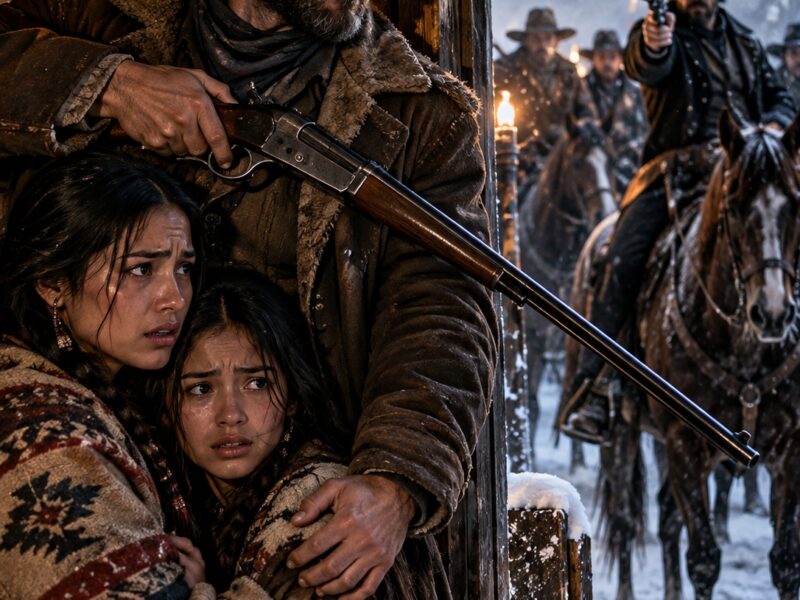
TWO SISTERS WERE LEFT TO FREEZE TO DEATH—THEN A LONELY COWBOY FOUND OUT WHO WANTED THEM SILENCED
“OPEN THE DOOR, COWBOY!”
The voice came through the storm just after midnight.
Caleb Ror stood in the darkness of his cabin with a Winchester pressed against his shoulder and four armed riders waiting beyond his fence.
Behind him, two young women were trying not to make a sound.
One was still too weak to stand without holding the wall.
The other had wrapped both hands around a kitchen knife.
Three days earlier, Caleb had never seen either of them before.
Three days earlier, he had believed there was nothing left in this world worth dying for.
Then the man outside shouted again.
“We know you found them.”
Caleb’s finger tightened beside the trigger.
Snow swept across the yard in silver sheets. The moon appeared and vanished behind racing clouds, illuminating four horses, four rifles, and the tall stranger standing alone at the gate.
The stranger raised his voice.
“Give us the Apache girls and we’ll forget we ever saw this place.”
Caleb glanced over his shoulder.
Ayla stood beside the hearth, pale and shaking.
Sarah was closer to the bedroom doorway.
She wasn’t shaking.
That frightened him more.
Her expression belonged to someone who already knew exactly what these men were capable of.
Caleb looked down at the gold wedding band he had refused to remove for five years.
Margaret had once told him that courage wasn’t about being unafraid.
It was about deciding what mattered more than fear.
For five years, nothing had.
Until now.
Caleb pushed the shutter open two inches and aimed into the darkness.
“Nobody is taking those women out of my house.”
Silence followed.
Then the stranger laughed.
And Caleb realized he had just started a war.
Three days earlier, the prairie had been so white that Caleb almost walked past the bodies.
He was checking the northern fence when he noticed something dark protruding from a drift near the ninth post.
At first, he assumed one of his cows had wandered out during the night.
That alone would have been bad enough.
Caleb owned only three.
There had once been twenty-seven cattle on the Ror ranch.
There had once been horses in the south pasture, chickens filling two coops, wheat behind the barn, and Margaret standing on the porch shouting that supper was getting cold.
Now there were three cows.
Twelve chickens.
One aging gelding.
And a man who had slowly reduced his life until there was almost nothing left for death to take.
Caleb pushed through the snow toward the dark shape.
Then he saw fingers.
Human fingers.
He stopped.
For half a second, his mind refused to understand what his eyes were telling him.
Then he dropped the fencing pliers and ran.
The first woman was nearly buried.
Only part of her shoulder and one hand remained visible beneath the wind-packed snow.
Caleb fell to his knees and dug frantically with both gloves.
“Come on.”
He uncovered her face.
Young.
Dark hair frozen against her cheek.
Lips blue.
Eyes closed.
“No.”
He pressed two fingers against her neck.
Nothing.
He moved them.
Pressed harder.
“Come on.”
There.
A faint pulse.
So weak he wondered if he had imagined it.
Then he saw the second woman.
She was sitting behind the first, almost completely covered, her body curled around the other woman as though she had spent her final conscious moments trying to shield her from the wind.
Caleb brushed snow from her face.
The resemblance hit him immediately.
Same cheekbones.
Same dark hair.
Same age, perhaps twenty-five or twenty-six.
Sisters.
Maybe twins.
“Dear God.”
He checked her pulse.
Weak.
But alive.
The wind screamed across the open land.
His cabin stood a quarter mile south.
A quarter mile was nothing in summer.
In that storm, carrying two unconscious women through waist-deep drifts, it might as well have been twenty miles.
Caleb looked toward the cabin.
Then toward the women.
A practical man would have gone for his horse.
But the barn was farther away than the house.
A practical man might have waited for the storm to ease.
They would be dead before then.
A practical man might have admitted that one forty-three-year-old widower could not save two people alone.
Caleb had become very practical since Margaret died.
Practical enough to stop visiting neighbors.
Practical enough to sell most of his herd.
Practical enough to sleep on one side of a bed built for two because removing Margaret’s pillow felt too much like admitting she would never return.
He looked at the women again.
Then, somewhere beneath the wind, he heard Margaret’s voice.
Not literally.
He knew that.
But memory could be cruelly convincing.
You don’t get to choose who needs help, Caleb.
He closed his eyes.
“I know, Maggie.”
He slid his arms beneath the first woman.
She weighed almost nothing.
That scared him.
He lifted her and staggered south.
Twenty steps.
Thirty.
His boots disappeared into the drifts.
At forty, his lungs burned.
At sixty, his back screamed.
He lowered her carefully into the snow, marked the spot, and turned around.
The storm had nearly erased his footprints already.
“Damn it.”
He fought his way back.
The second woman hadn’t moved.
Caleb lifted her.
Carried her south.
Returned for the first.
Then repeated it.
Again.
And again.
A hundred yards became fifty.
Fifty became thirty.
Once, Caleb fell face-first and remained there for several seconds, breathing snow.
He wanted to stay down.
The cold whispered that staying down would be easier.
Then he thought about Margaret beneath the cottonwood tree.
He forced himself upright.
“Not today.”
He carried one sister another twenty yards.
“Not on my land.”
Then the other.
“Not while I’m still breathing.”
By the time he reached the porch, his legs were trembling uncontrollably.
He dragged both women inside.
Closed the door.
And collapsed beside them.
For several minutes, three people lay motionless on the cabin floor.
Then Caleb crawled toward the hearth.
He built the fire carefully.
He knew enough about exposure not to place frozen bodies directly against intense heat.
He removed their wet outer clothing without exposing more than necessary, wrapped them in Margaret’s old wool blankets, and warmed water.
The sight of those blankets almost stopped him.
Margaret had sewn the blue one herself.
Caleb had kept it folded inside a cedar chest for five years.
He had never allowed himself to use it.
Now a dying stranger was wrapped inside it.
Something about that felt strangely right.
“Don’t make me regret ruining Maggie’s best blanket,” he muttered.
Neither woman answered.
Hours passed.
Caleb remained beside them.
He checked their breathing.
Changed warm cloths.
Fed the fire.
Listened.
Every few minutes he convinced himself one had stopped breathing.
Every time, he leaned closer until he heard the faint movement of air.
Near dawn, exhaustion finally dragged his chin toward his chest.
A sound woke him.
A gasp.
Caleb looked up.
The woman beneath Margaret’s blue blanket had opened her eyes.
She stared at the ceiling first.
Then the fireplace.
Then him.
Fear flooded her face.
She tried to sit.
“Easy.”
She recoiled.
“Don’t touch me.”
Caleb immediately raised both hands.
“Fine.”
Her breathing came quickly.
“My sister.”
“She’s here.”
The woman turned.
Her expression collapsed when she saw the second body.
“Sarah.”
“She’s breathing.”
She tried to crawl toward her.
Her arms gave out.
Caleb caught her before her face hit the floor.
This time she didn’t resist.
“Sarah,” she whispered again.
“She hasn’t woken yet,” Caleb said. “But she’s alive.”
The woman closed her eyes.
A single tear rolled into her hair.
Caleb had forgotten how painful another person’s relief could be to witness.
Later, when she could swallow safely, he gave her warm water.
She held the cup with both hands.
“What’s your name?”
“Ayla.”
He nodded toward her sister.
“Sarah?”
Ayla nodded.
“I’m Caleb.”
She looked around the cabin.
“Where are we?”
“My ranch.”
“How did we get here?”
“I found you near my northern fence.”
Her fingers tightened around the cup.
“You found us?”
“Unless someone else dragged you onto my property and forgot to mention it.”
Ayla didn’t smile.
Instead, she looked toward the window.
Caleb noticed the change immediately.
Fear.
Not confusion.
Fear.
“You were running from something.”
Ayla remained silent.
“Ayla.”
Her eyes returned to him.
“Men.”
“What men?”
“I don’t know their names.”
“How many?”
She swallowed.
“There were more before.”
Before.
Caleb didn’t like that word.
“Before what?”
Ayla stared into the water.
“When they burned our settlement.”
The room seemed to become smaller.
Caleb pulled out the chair opposite her.
He didn’t interrupt again.
The story came slowly.
Not because Ayla had forgotten.
Because remembering hurt.
Her family had lived among a small community several days north and west.
Roughly fifty people.
Parents.
Children.
Old men.
Women.
Families who had survived enough already to understand the value of keeping to themselves.
Then armed riders arrived after dark.
Ayla remembered dogs barking.
Then gunfire.
Then flames.
Her father had pushed both daughters toward the trees.
“Run.”
That was the last word she heard him say.
Their mother stayed behind to help an injured neighbor.
Ayla never saw her again.
She and Sarah ran.
They didn’t know where they were going.
They only knew riders were behind them.
Then the storm arrived.
Snow erased the land.
Eventually Sarah stumbled.
Ayla helped her.
Then Ayla stumbled.
Sarah helped her.
Finally, neither could continue.
They sat down together.
Just for a minute.
That was what they told each other.
One minute.
Then they would stand.
They never did.
Until Caleb found them.
He sat silently after she finished.
His coffee had gone cold.
“Did you see who attacked you?”
Ayla hesitated.
Caleb noticed.
“You did.”
“Some.”
“Would you recognize them?”
Another hesitation.
“Yes.”
That answer changed everything.
Caleb leaned back.
Witnesses.
Maybe that was why the riders had followed.
Not because the sisters had escaped.
Because they had seen something.
Before he could ask more, Sarah woke.
Unlike Ayla, she didn’t wake frightened.
She woke fighting.
Her hand shot beneath the blanket as though searching for a weapon.
Caleb stepped backward.
“Your sister’s beside you.”
Sarah froze.
“Ayla?”
“I’m here.”
Ayla crawled to her.
The sisters held each other.
Caleb turned away.
Not because the moment embarrassed him.
Because suddenly he remembered Margaret dying in their bed.
He remembered holding her while fever stole the strength from her hands.
He remembered promising she wasn’t going anywhere.
She had died ten minutes later.
Some memories never faded.
They simply learned where to hide.
The sisters recovered slowly.
Ayla was gentler.
Sarah watched everything.
Doors.
Windows.
Caleb’s rifle.
The road.
Whenever a horse moved outside, Sarah’s head snapped toward the sound.
On the second afternoon, Caleb found her standing beside the front window.
“You expecting someone?”
“Yes.”
The answer unsettled him.
“Who?”
“The men who want us dead.”
Caleb stared at her.
“You know they’ll come?”
Sarah looked at him.
“They followed us into a blizzard.”
That night, Caleb checked every window twice.
He told himself it was common sense.
He also loaded the Winchester and placed it beside his bed.
That was common sense too.
Probably.
On the fourth evening, Sarah noticed his wedding ring.
“You’re married?”
Caleb stopped chewing.
“Was.”
Ayla looked up.
Sarah said nothing.
Caleb could have left it there.
Instead, perhaps because he had spent too many years with nobody asking, he continued.
“Margaret.”
He looked toward the photograph on the mantel.
“She died five years ago.”
Ayla followed his gaze.
The photograph showed a younger Caleb beside a smiling woman in a plain summer dress.
Margaret’s hand rested against his chest.
Caleb had forgotten how happy he looked.
“What happened?” Ayla asked.
“Fever.”
He scraped his spoon against the bowl.
“Three days.”
Ayla’s expression softened.
“I’m sorry.”
“It was five years ago.”
Sarah looked directly at him.
“That doesn’t mean it stopped hurting.”
The spoon stopped.
Caleb raised his eyes.
There was no pity in Sarah’s expression.
Only recognition.
For some reason, that was harder to endure.
“No,” he said quietly.
“It doesn’t.”
Silence settled over the table.
Then Caleb said what he had been rehearsing all day.
“When you’re strong enough, I’ll take you south.”
Ayla frowned.
“South?”
“There are settlements. Mission stations. Places where you might find help.”
Sarah understood immediately.
“You want us gone.”
Caleb stiffened.
“I said I’d help you.”
“You said we could stay until we recovered.”
“And you’re recovering.”
Ayla looked between them.
Sarah leaned forward.
“And if those men find us?”
Caleb’s jaw tightened.
“You keep moving.”
“Sarah,” Ayla whispered.
“No.”
Sarah’s voice remained calm.
“Ask him.”
Caleb pushed his chair backward.
“This isn’t a fortress. I’m one man.”
“We know.”
“I’ve got three cows, twelve chickens, and barely enough grain to make spring. I can’t protect strangers from armed men.”
Sarah stood.
She was still weak enough to sway.
But she stood anyway.
“We didn’t ask you to.”
“Good.”
Caleb hated himself as soon as the word left his mouth.
Sarah nodded once.
“Then we’ll leave tomorrow.”
Ayla looked shocked.
“Sarah—”
“We survived before him.”
Sarah walked toward the bed.
Caleb watched her go.
That night, he couldn’t sleep.
Wind moved against the cabin walls.
The clock ticked.
Margaret’s side of the bed remained untouched.
Caleb stared into the darkness.
“You’d tell me I’m a coward,” he whispered.
No answer.
He closed his eyes.
“I saved them.”
Silence.
“What else am I supposed to do?”
He knew what Margaret would have said.
That was the problem.
Sometime after midnight, Caleb heard hoofbeats.
His eyes opened.
For one second, he thought he was dreaming.
Then he heard them again.
Several horses.
Slow.
Approaching.
Caleb reached for the Winchester.
By the time he entered the main room, Sarah was already awake.
She had heard them too.
Ayla sat upright.
“How many?” Sarah whispered.
Caleb moved toward the window.
“Four.”
Sarah’s face lost its color.
“It’s them.”
Caleb looked at her.
“You’re certain?”
“I recognize the tall one.”
Outside, a rider dismounted.
He walked toward the gate.
“CALEB ROR!”
Caleb’s blood went cold.
They knew his name.
The stranger continued.
“OPEN THE DOOR!”
Caleb opened the shutter slightly.
“What do you want?”
The man smiled.
Even from that distance, Caleb could see it.
“We know you’re hiding two Apache girls.”
Ayla covered her mouth.
The stranger raised his voice.
“Send them outside and this doesn’t concern you.”
Caleb glanced at Sarah.
“What did you see?”
She didn’t answer.
“Sarah.”
Her eyes filled with something he hadn’t seen before.
Guilt.
“They didn’t attack us randomly.”
Caleb stared.
“What?”
The man outside shouted again.
“LAST CHANCE!”
Sarah stepped closer.
“Our father knew they were coming.”
“What are you talking about?”
“He found something.”
Caleb felt the room tilt.
“What?”
Sarah opened her mouth.
A rifle fired outside.
The bullet punched through the shutter.
Ayla screamed.
Caleb pulled Sarah down.
Wood splinters scattered across the floor.
The riders laughed.
Caleb’s fear vanished.
Not because he became brave.
Because anger was easier.
He opened the opposite shutter.
Raised the Winchester.
And fired.
One rider’s hat flew off.
The horses reared.
Caleb shouted through the storm.
“Nobody is taking those women out of my house!”
The laughter stopped.
The tall man stepped backward.
“You have no idea what you’re protecting.”
Caleb worked the rifle lever.
“Then explain it.”
“You’re willing to die for two strangers?”
Caleb looked toward Margaret’s photograph.
“No.”
He aimed again.
“I’m willing to make you die for trying to take them.”
The riders withdrew.
Not far.
Just beyond rifle range.
That frightened Caleb more than if they had fled.
They weren’t leaving.
They were waiting.
Morning brought silence.
Too much silence.
Caleb found tracks circling the property.
The riders had studied the barn.
The well.
The road.
They were planning something.
Inside, Sarah finally told him the rest.
Two weeks before the attack, her father had discovered a leather ledger hidden among supplies abandoned near their settlement.
The ledger contained names.
Payments.
Land descriptions.
Several wealthy ranchers and speculators had been paying hired raiders to terrorize communities from valuable territory.
The attacks weren’t chaos.
They were business.
Burn families out.
Claim the land.
Sell it.
Repeat.
Their father intended to take the ledger to federal authorities.
Someone learned about it.
Then the riders came.
“Where’s the ledger?” Caleb asked.
Sarah looked at Ayla.
Ayla slowly reached toward the hem of her damaged dress.
From beneath the stitching, she removed a folded piece of oilcloth.
Caleb stared.
Inside was a torn page.
Names.
Numbers.
Dates.
And one name appeared repeatedly.
Harlan Voss.
Caleb stopped breathing.
Sarah noticed.
“You know him.”
Caleb sat down.
Harlan Voss owned thousands of acres south of the Ror ranch.
He also owned the grain warehouse.
Two saloons.
Half the freight wagons in the county.
And, according to rumor, several local officials.
Caleb had bought seed from him.
Drunk whiskey beside him.
Shaken his hand.
“You’re saying Voss ordered the attack?”
“We’re saying our father believed this proves he paid for it.”
Caleb studied the page.
At the bottom was another property description.
His property.
Ror Ranch.
He read it twice.
Then a third time.
Beside it was a date.
Spring.
Only months away.
Caleb looked toward the sisters.
“They weren’t only coming for you.”
Sarah shook her head.
“No.”
The ranch had been marked before Caleb ever found them.
Suddenly the shrinking herd made sense.
The pressure to sell.
The mysterious damaged fences.
The offers from Voss’s agents.
Caleb had believed bad luck was slowly killing his ranch.
Maybe it wasn’t luck.
Someone had been starving him out.
And now Caleb understood why the riders hadn’t burned his cabin during the night.
Voss didn’t want the property destroyed.
He wanted Caleb frightened enough to surrender it.
The realization changed the battle.
Caleb rode to his nearest neighbor before noon.
Thomas Bell had known him for twenty years.
Thomas listened.
Read the ledger page.
Then locked the door.
“You need to leave.”
Caleb stared.
“You believe me?”
“That’s why you need to leave.”
Thomas’s voice dropped.
“You think you’re the first man Voss wanted gone?”
Caleb felt cold.
“How many?”
Thomas wouldn’t answer.
That answer was enough.
By evening, Caleb returned home with ammunition, food, and a decision.
“We’re not running.”
Sarah stared at him.
“You told us to leave.”
“I was wrong.”
Ayla looked surprised.
Caleb removed his coat.
“I’ve spent five years thinking the safest way to survive was to have nothing worth losing.”
He looked around the cabin.
“At some point, I confused surviving with living.”
Sarah said nothing.
Caleb placed ammunition on the table.
“They want this land.”
Then he placed the ledger page beside it.
“They want you dead.”
Finally, he looked toward Margaret’s photograph.
“And I’m tired of giving death everything it asks for.”
The next two days became a waiting game.
Then Harlan Voss himself arrived.
Not at night.
At noon.
He came in a polished carriage with six armed men.
He wore an expensive black coat and stepped onto Caleb’s snow-covered yard as though arriving for a business meeting.
“Caleb.”
“Harlan.”
Voss smiled.
“You look terrible.”
“Been busy.”
“I heard.”
His gaze moved toward the cabin.
“Two women staying with you?”
Caleb rested one hand on his rifle.
“You keeping count of my guests now?”
Voss sighed.
“Don’t make this difficult.”
“What’s difficult?”
“You’re a tired man sitting on failing land.”
Voss produced a folded document.
“I’ll buy the ranch.”
Caleb laughed once.
“Generous timing.”
“More generous than you’ll get later.”
“How much?”
“Enough to start somewhere else.”
Caleb looked at him.
“I started here.”
Voss’s smile disappeared.
“Your wife is buried here.”
Caleb went still.
Voss continued softly.
“You really want violence happening beside Margaret’s grave?”
That was the moment Caleb knew.
No innocent businessman would use Margaret.
No innocent businessman would know exactly where to place the knife.
Caleb stepped closer.
“You burned that settlement.”
Voss’s expression didn’t change.
“Careful.”
“You killed their families.”
“Careful.”
“You sent men after two women because they saw what you did.”
Voss leaned toward him.
“Very careful.”
Caleb smiled.
It surprised them both.
“Harlan, you’re scared.”
For the first time, Voss’s eyes flickered.
Caleb saw it.
“That’s what this is.”
He stepped closer.
“You aren’t here because you’re powerful.”
Another step.
“You’re here because two women survived.”
Voss’s jaw tightened.
“And somewhere there’s proof.”
Silence.
Then Voss said quietly:
“You have until sunset.”
He returned to his carriage.
Caleb watched him leave.
Sarah stepped onto the porch.
“He’ll come back.”
“I know.”
“With more men.”
“I know.”
“You could still leave.”
Caleb looked at her.
“So could you.”
Sarah’s expression softened.
“Not anymore.”
That evening, three neighboring ranchers appeared.
Thomas Bell had spoken.
Then five more men arrived.
Then a widow named Eleanor Shaw came carrying a shotgun that had belonged to her husband.
“My south barn burned two years ago,” she told Caleb. “Voss offered to buy the property the next morning.”
Another rancher said his cattle had been poisoned.
Another had lost his water rights through suspicious paperwork.
The ledger page hadn’t created their suspicions.
It had given their suspicions a name.
By sunset, seventeen people stood around Caleb’s cabin.
For five years, Caleb had believed he was alone.
Now he understood something humiliating.
He had been alone partly because he had chosen to be.
Darkness fell.
Voss returned.
This time with twelve armed riders.
The standoff lasted twenty minutes.
Then a gunshot broke it.
Nobody ever knew who fired first.
The night exploded.
Glass shattered.
Horses screamed.
Men dove behind fences and wagons.
Caleb fired from the porch.
Thomas covered the barn.
Sarah and Ayla remained inside until a bullet struck the lamp and darkness swallowed the cabin.
Then Sarah saw flames.
“The barn!”
Someone had set it on fire.
Caleb turned.
That moment almost killed him.
A rider rushed from behind the shed.
Sarah saw him before Caleb did.
She grabbed Caleb’s spare rifle.
Raised it.
Fired.
The rider fell into the snow.
Caleb stared at her.
Sarah stared at the smoking rifle in her hands.
Neither spoke.
Then another bullet struck the porch.
Caleb dragged her down.
“Inside!”
“No!”
“Sarah!”
“My family died because we ran!”
Caleb froze.
Tears filled her eyes.
“I am not running again.”
Something inside him broke open.
Not pity.
Understanding.
He nodded.
“Then stay low.”
The battle shifted when Thomas’s son arrived with the county marshal and six deputies.
Voss had counted on fear.
He hadn’t counted on witnesses.
His men began surrendering.
Others fled.
Voss ran toward the barn.
Caleb followed.
He found him near the cottonwood tree.
Near Margaret.
Voss had lost his hat.
Blood ran from his temple.
His revolver trembled in one hand.
“This didn’t have to happen,” Voss said.
Caleb aimed his rifle.
“No.”
Voss looked toward the grave.
“You think your wife would want you to kill me?”
Caleb’s expression changed.
For one dangerous second, anger nearly answered.
Then he lowered the rifle slightly.
“No.”
Voss smiled.
Then Caleb continued.
“She’d want me to make sure you lived long enough to answer for it.”
The marshal appeared behind him.
“Drop the gun, Voss.”
Voss looked at Caleb.
Then the marshal.
Then the people gathering behind them.
The empire he had built on frightened individuals had finally encountered something it couldn’t control.
People standing together.
His revolver fell into the snow.
The investigation lasted months.
The surviving ledger pages were eventually recovered from a hiding place Sarah’s father had described to his daughters before the attack.
The evidence connected Voss and several associates to land fraud, arson, intimidation, and multiple killings.
Some men were convicted.
Others disappeared before trial.
Not every crime received justice.
Caleb learned that justice rarely arrived cleanly.
But Voss never returned to the Ror ranch.
Spring came late that year.
Snow melted into mud.
Grass appeared.
The cottonwood behind the cabin produced its first leaves.
Ayla and Sarah stayed.
At first, Caleb told himself it was temporary.
Then Ayla planted herbs beside the kitchen window.
Sarah repaired the chicken coop without asking.
Caleb complained that she had used the wrong nails.
She told him to repair it himself.
He inspected her work.
It was better than his.
He never mentioned the nails again.
Slowly, the cabin changed.
There were three cups on the table instead of one.
Boots beside the door.
Voices in the morning.
Arguments over chores.
Laughter he sometimes heard from outside and stopped walking just to listen to.
Ayla eventually began helping families displaced by the attacks.
Sarah worked with Thomas and other ranchers rebuilding homes.
Neither sister forgot their parents.
Neither pretended survival had erased grief.
Caleb understood that better than anyone.
One evening, Sarah found him beneath the cottonwood.
He was sitting beside Margaret’s grave.
“You still talk to her?” Sarah asked.
“Sometimes.”
“What do you tell her?”
Caleb looked toward the cabin.
Through the window, Ayla was kneading bread.
The same window Margaret used to open every spring morning.
“Mostly that things got complicated.”
Sarah smiled.
She started walking away.
“Sarah.”
She turned.
Caleb hesitated.
“You were right.”
“About what?”
“Pain.”
He looked at Margaret’s name carved into the stone.
“It doesn’t stop.”
Sarah waited.
Caleb touched his wedding ring.
“But maybe it isn’t supposed to.”
She frowned slightly.
He looked toward the ranch.
“Maybe pain is just love with nowhere to go.”
Sarah’s expression softened.
Caleb stood.
For the first time in five years, he removed the wedding band.
He didn’t throw it away.
He didn’t bury it.
He placed it carefully beside Margaret’s headstone.
“Thank you, Maggie.”
Then he walked toward the house.
Halfway there, he heard Sarah behind him.
“Caleb?”
He turned.
She was standing beside the grave.
“There was something Ayla never told you about the night you found us.”
Caleb stopped.
“What?”
Sarah looked toward the northern pasture.
“We didn’t reach your land by accident.”
His expression changed.
Sarah walked closer.
“Our father knew your name.”
Caleb stared at her.
“What did you just say?”
“Years ago, before you married Margaret, our father met a young ranch hand who helped him during another winter storm.”
Caleb felt the world become strangely quiet.
Sarah continued.
“He told us that if we ever had nowhere left to go, we should find the ranch near the cottonwood tree.”
Caleb couldn’t speak.
“He said the man who lived there once risked his life for a stranger.”
Sarah’s eyes filled.
“And a man who did that once might do it again.”
Caleb looked toward Margaret’s grave.
Then toward the northern pasture where he had found two bodies beneath the snow.
For days, he had believed chance brought Ayla and Sarah to his fence.
It hadn’t.
Their father had sent them toward the last good man he remembered.
The only problem was that Caleb had stopped believing that man still existed.
Sarah touched his arm.
“He was right about you.”
Caleb shook his head slowly.
“No.”
His voice broke.
“He remembered someone I used to be.”
Sarah looked toward the warm light spilling from the cabin.
“Maybe.”
Then she smiled.
“Or maybe he remembered someone you weren’t finished being.”
From inside the house, Ayla called that supper was ready.
Caleb looked toward the open door.
For five years after Margaret died, he had always closed that door quickly against the cold.
That evening, it remained open.
Warm light stretched across the porch and onto the earth.
Caleb walked toward it.
Behind him stood the grave of the woman he had loved.
Ahead of him waited two women he had found half-dead beneath the snow.
He finally understood that one did not betray the dead by continuing to live.
Sometimes the greatest way to honor the people we lose is to become again the person they once loved.
Caleb stepped inside.
Sarah followed.
Ayla placed three bowls on the table.
Outside, wind moved gently through the cottonwood branches.
And for the first time in five winters, the Ror ranch did not sound empty.
It sounded like home.









