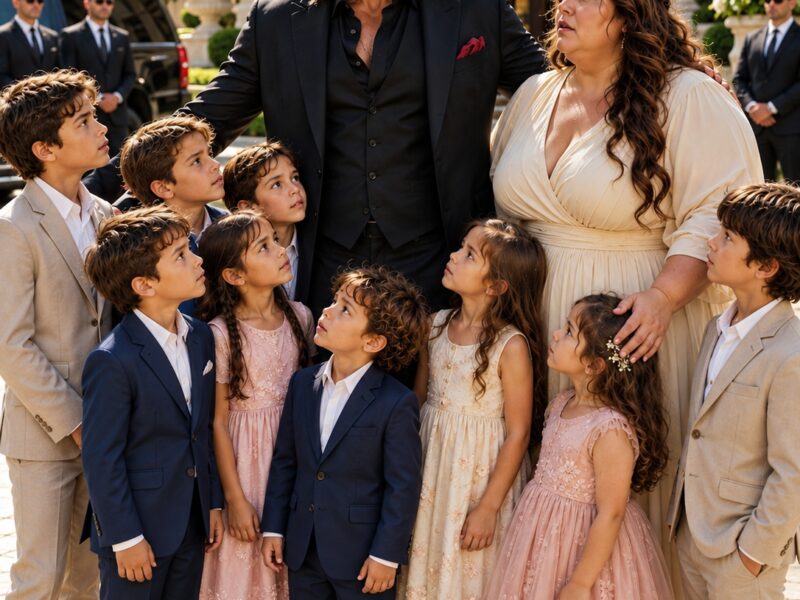
9 Abandoned Kids Found a Father When the Mafia Boss Told a Plus-Size Woman, “They’re Mine Now.”
The heater in the Fenwick Street brownstone had been dead for three days when I finally ran out of believable lies.
I had already told nine children that the repairman was coming tomorrow.
Then I told them tomorrow had been moved because the repairman’s truck broke down.
By the third night, five-year-old Bibi stood in the doorway of our crowded living room wearing two sweaters, a winter coat, and socks pulled over her pajama pants, and asked me in a voice too calm for a child her age, “Mari, does cold mean we have to move again?”
I was holding a saucepan of water over the stove because the kitchen flame was the only reliable heat left in the house.
I looked at her small face and lied.
“No, baby.”
She studied me.
Children who have been abandoned become very good at hearing the difference between reassurance and truth.
“You promise?”
My throat tightened.
“Yes.”
That lie hurt more.
My name is Marisol Vega, but everyone called me Mari. Back then, I was thirty-seven, plus-size, perpetually tired, and running what social workers politely called an “informal emergency residence” whenever they needed somewhere to put a child after five o’clock.
The city had another name for it.
Unlicensed.
I called it home.
The house belonged to my aunt before she died, though the mortgage technically belonged to a bank that had started sending increasingly unfriendly envelopes. It was a narrow brownstone in a Boston neighborhood where three-story buildings leaned toward one another like exhausted relatives.
There were nine children inside.
None were biologically mine.
All of them were mine in every way that mattered.
Talia, fourteen, acted older than me whenever she was scared.
Jamal, twelve, had learned to repair almost anything with tape because adults had broken so many promises before they ever fixed anything.
The twins, Caleb and Nico, were ten and fought constantly except when somebody else threatened either of them.
Sophie was nine and slept with a library book under her pillow.
Matteo was eight and rarely asked questions unless he already knew half the answer.
Luis was seven and collected bottle caps as if preparing for a currency collapse.
Avery was six, quiet enough to disappear in a crowded room.
And then Bibi.
Five.
Tiny.
Fearless until bedtime.
I had not planned on nine.
Nobody plans on nine.
Children arrived one at a time.
One emergency placement became three weeks.
Three weeks became a school year.
A shelter closed.
A foster family backed out.
A grandmother died.
A father went to prison.
A mother vanished.
A file was misplaced.
A caseworker changed jobs.
The state promised temporary solutions until temporary became childhood.
I kept opening the door.
That was how a woman with no husband, limited savings, a part-time catering job, and one working bathroom became the person nine abandoned children called when the world failed again.
That Thursday night, unpaid bills covered my kitchen table.
Gas.
Electric.
Mortgage.
The heater repair estimate.
A notice from the city.
And underneath all of them, an official letter informing me that unless I completed licensing upgrades I could not afford, the house would be deemed unsuitable for continued placement.
The children did not know.
They knew the heater was broken.
They knew the landlord—technically the bank’s property manager by then—had visited twice.
They knew I was making soup from increasingly creative combinations of canned food.
They did not know we had until the end of the month.
I sat alone at midnight wearing my coat over my sweater, staring at a calculator that had stopped giving me new answers.
Then headlights swept across the living-room wall.
Three black vehicles turned slowly onto Fenwick Street.
I looked up.
Nobody on our block owned cars that clean.
The first stopped under the dead streetlamp.
The second pulled directly in front of our house.
The third remained half a block back.
My body reacted before my brain caught up.
I stood.
Four men stepped out.
Dark coats.
No visible hurry.
No visible confusion.
They did not look at the house first.
They looked at the street.
At parked cars.
At windows.
At rooftops.
Then the rear door of the middle vehicle opened.
A man stepped out alone.
Tall.
Broad-shouldered.
Dark overcoat buttoned against the October cold.
He did not scan house numbers.
He looked directly at my second-floor window.
At me.
I stepped back instinctively.
My first thought was not mafia.
People always imagine danger arrives wearing a label.
It does not.
My first thought was child services.
My second was creditor.
My third was that somebody had finally discovered I had nine minors living in a house with a broken boiler and decided to make an example of me at midnight.
Then the man climbed the steps.
I went to the front door before he could knock because if nine frightened children woke to pounding, I would spend the rest of the night getting them calm again.
I opened it six inches.
“Can I help you?”
The man stopped.
Up close, he looked somewhere in his early forties.
Dark hair.
A faint white scar following the edge of his jaw.
A face that might have been handsome if it had ever learned how to relax.
“Marisol Vega?”
His voice was quiet.
Not gentle.
Contained.
Like the quieter he spoke, the more seriously everyone around him listened.
“Who wants to know?”
He looked past me.
I moved instinctively to block his view.
Too late.
A floorboard creaked.
I turned.
Matteo was sitting halfway down the stairs in Spider-Man pajama pants and a sweatshirt, hugging one knee.
The stranger went completely still.
It happened so fast I almost missed it.
His face changed.
Not recognition exactly.
Impact.
“That’s Matteo.”
My hand tightened on the door.
Nobody outside the state placement system knew every child in my house.
I never posted their pictures.
Never named them publicly.
Even neighborhood charities received first names only.
“How do you know that?”
He did not answer immediately.
Matteo stared at him.
The stranger’s eyes moved to the boy’s left wrist.
Matteo’s sleeve had ridden up.
A small strawberry-shaped birthmark rested just beneath his palm.
The man’s breath changed.
One shallow inhale.
Then another.
I opened the door wider only so I could step into the threshold and keep my body between him and the children.
“You need to leave.”
His eyes returned to mine.
“I’m not here to hurt anyone.”
“Four men are standing behind you.”
“They’re here because other people might.”
“That is not comforting.”
One of the men behind him almost smiled.
The stranger did not.
“My name is Dante Serrano.”
The name meant nothing to me then.
It meant something to people on our street.
Across the road, an upstairs blind moved and immediately stopped.
Dante watched me process none of that.
“I need five minutes.”
“You’re not getting five minutes.”
“Then give me two.”
“No.”
His jaw tightened, but not with anger.
With restraint.
Behind me, Matteo stood.
“Mari?”
Dante looked at him again.
And that was when I saw grief.
Not theatrics.
Not manipulation.
Something old.
Something almost physical.
“Please,” Dante said.
The word sounded difficult for him.
“Just five minutes.”
Every instinct I had developed over six years told me not to let a stranger with bodyguards into a home full of vulnerable children.
Another instinct said men intending harm rarely asked permission while standing in plain view of three doorbell cameras and Mrs. Caruso from across the street.
Neither instinct made me feel safe.
But I looked at Matteo.
He had stopped rubbing his wrist.
He was staring at Dante with the same strange intensity.
I stepped aside.
“Five.”
Dante entered alone.
His men remained outside.
That mattered.
I locked the door behind him anyway.
He followed me into the kitchen.
The room looked especially poor with him inside it.
Peeling paint.
Secondhand chairs.
A refrigerator covered in report cards, chore assignments, and one crayon drawing of me shaped like a purple triangle.
I gestured toward the table.
“Sit.”
Dante removed his coat.
Underneath was an expensive charcoal suit.
No tie.
He sat.
Not at the head.
One of the side chairs.
I put coffee on because my hands needed a task.
“Don’t suppose you want cream.”
“No.”
“Sugar?”
“No.”
“Good. We’re low on both.”
He looked at the unpaid bills spread beneath my elbow.
I covered them with a dish towel.
His eyes moved away immediately.
That small act surprised me.
Most powerful men would have looked longer.
Dante folded his hands.
“Eight years ago, I had a son.”
Had.
The word changed the room.
Matteo stood in the doorway.
I turned.
“Bed.”
He shook his head.
“Matteo.”
Dante said, “He can stay if you allow it.”
“I don’t allow it.”
Matteo disappeared.
I heard no footsteps climbing the stairs.
He was listening from the hallway.
Dante knew it.
So did I.
Neither of us said anything.
“My wife was named Elena,” he continued. “There was an attack on our family.”
I stared.
“An attack?”
“She died.”
Something in his face became unreadable.
“My son was six weeks old. I was told he died too.”
He reached inside his jacket slowly.
I stiffened.
He placed an old photograph on the table.
A newborn wrapped in a hospital blanket.
Dark hair.
Sleeping face.
One tiny left hand visible.
At the wrist was a strawberry-shaped mark.
My skin prickled.
Dante turned the photograph toward me.
“I buried an empty casket.”
I looked at him.
“Why empty?”
“The hospital room burned during the attack. I was told there was nothing identifiable.”
He said it like someone reciting a legal fact.
His right thumb pressed hard against his left palm.
The only sign the words cost him anything.
“I believed it for eight years.”
I looked toward the hallway.
Then back to the photograph.
“You think Matteo is your son.”
“I know he is.”
“No.”
Dante did not move.
“No?”
“You think.”
“I had a private lab compare DNA from an object he discarded outside school.”
I stood so quickly the chair scraped.
“You tested him without permission?”
“Yes.”
“What the hell is wrong with you?”
“A long list.”
“That is not funny.”
“I wasn’t joking.”
Heat rose into my face.
“You had people following an eight-year-old?”
“I had people confirming he was safe.”
“You had strangers watching children.”
“Yes.”
“And you thought coming here with three black cars would reassure me?”
“No.”
“Then you’re not as smart as everyone probably tells you.”
For the first time, a faint expression moved across his face.
Not offense.
Almost respect.
“I’ve been told worse.”
“I doubt people survive telling you worse.”
Dante’s eyes cooled.
“There are things about my life I’m not going to lie to you about, Miss Vega.”
“That sounds ominous.”
“It should.”
I crossed my arms.
“I’m listening.”
“I’ve made money in businesses that never appeared in tax filings.”
Silence.
“I’ve worked with violent men.”
My stomach tightened.
“I’ve threatened people.”
He paused.
“I’ve hurt people.”
There it was.
Not a confession designed to charm me.
A warning.
“What exactly are you?”
Dante held my gaze.
“The kind of man you think I am.”
I almost laughed from disbelief.
“And you want me to hand you a child?”
“No.”
That answer stopped me.
“No?”
“I want you to let me know him.”
I stared.
“I’m not removing him from this house tonight.”
“Because you can’t.”
“I could.”
The room went quiet.
Dante’s voice remained calm.
“If I were the man you’re afraid I am, I could create enough legal pressure by morning to have this house inspected, your informal placements questioned, and Matteo removed while everyone argues over jurisdiction.”
My hands clenched.
“You threaten me in my kitchen—”
“I am telling you what I refuse to do.”
He leaned forward slightly.
“I spent eight years believing my son was dead. I am not going to return to his life by destroying the woman he trusts.”
The anger in me lost one clear target.
I hated that.
“Why now?”
“A nurse confessed before she died.”
“To you?”
“To a priest.”
Dante’s eyes dropped to the photograph.
“The priest found me. The nurse admitted a baby had been moved out of the hospital during the chaos. Someone in my organization wanted him hidden because they believed another attack was coming.”
“Who?”
“I don’t know.”
“Convenient.”
“I agree.”
“What happened?”
“The courier was supposed to take him to a family in Vermont under another name. He never arrived.”
“Why?”
“The courier disappeared.”
“And Matteo?”
“Entered an emergency shelter outside Hartford when he was approximately three months old. No verified parent information. Different name.”
I knew parts of Matteo’s file.
Not that.
His earliest records had always been strangely incomplete.
“What name?”
Dante swallowed.
“Michael Reyes.”
I stared.
Matteo had been listed as Matteo Reyes when he came to me at six.
“His foster mother changed Michael to Matteo because he wouldn’t answer to Michael,” I said.
Dante’s eyes sharpened.
“Elena wanted Matteo.”
“What?”
“My wife.”
His voice softened.
“If our son had been born two weeks later, she wanted to name him Matteo.”
A cold feeling passed through me.
Coincidence.
Or memory buried in a child too young to remember consciously.
I did not know.
Neither did Dante.
For the first time, his certainty looked fragile.
I poured coffee.
Dante did not drink.
“Why didn’t you take him tonight?” I asked.
He looked toward the hallway.
“Because he watched you tuck eight other children into beds last night.”
I froze.
“What?”
“My people have watched this house for three weeks.”
The mug hit the table harder than intended.
“You keep saying things that make me want to throw you out.”
“I know.”
“You watched us?”
“Yes.”
“You watched the children?”
“To understand where my son was.”
“You could have asked.”
“I did not know whether you were safe.”
“And now?”
He looked at the kitchen.
At the taped cabinet hinge.
At the chore chart.
At nine lunch boxes lined under the counter.
“At first I thought you were running an illegal foster house.”
“I am.”
His mouth shifted.
“I noticed.”
I glared.
He continued.
“Then I saw you walk six blocks in the rain because one of the twins forgot his asthma inhaler.”
My anger stalled.
“I saw you leave a grocery store without buying half your list so Talia could get a winter coat.”
I said nothing.
“I saw three different caseworkers come to this house asking you to keep children longer because they had nowhere else.”
My throat tightened.
Dante looked at me directly.
“I know what you are to them.”
“What am I?”
“The only adult who didn’t leave.”
I looked away.
Compliments made me suspicious.
Especially accurate ones.
“So what do you want?”
“To begin with Matteo.”
“Slowly.”
“Yes.”
“On his terms.”
“Yes.”
“And mine.”
Dante hesitated.
I raised an eyebrow.
“And mine.”
His answer came firmer.
I nodded.
“Fine.”
His shoulders loosened by less than an inch.
Then he said, “There’s more.”
Of course there was.
“With men like you, there’s always more.”
Dante looked toward the ceiling.
Footsteps had gathered overhead.
The children were awake now.
Listening.
“They all have nobody.”
It was not a question.
My expression hardened.
“You investigated them too.”
“Yes.”
“You crossed a line.”
“I know.”
“Several.”
“I know.”
“You keep saying that like awareness makes it less invasive.”
“It doesn’t.”
That answer irritated me because again, he refused to defend the indefensible.
Dante continued.
“Talia’s mother has not been located in five years.”
I said nothing.
“Caleb and Nico’s last verified relative died eighteen months ago.”
Nothing.
“Sophie’s father signed away custody.”
My eyes narrowed.
“Stop.”
“Luis has an aunt in Arizona who declined placement.”
“Stop.”
“Avery’s file has three disconnected numbers.”
“Dante.”
“Bibi’s mother left a shelter when she was two and never returned.”
“Enough.”
My voice cracked.
Dante went silent.
The kitchen seemed suddenly full of every absence I worked daily to hide from them.
“You don’t get to come in here and read their abandonment like a report,” I whispered.
His face changed.
“You’re right.”
I looked at him.
“No family is looking for them,” he said more quietly. “That is all I meant.”
“I know.”
The anger drained.
That was worse.
He looked toward the hallway again.
“Maybe I’m not only here for one child.”
Before I could ask what that meant, my phone vibrated against the countertop.
Unknown number.
Three words.
THEY KNOW NOW.
I stared.
Dante was on his feet before I moved.
“What is it?”
I showed him.
Every trace of softness disappeared.
He crossed to the window, moved the curtain less than an inch, and looked outside.
One of his men near the corner had gone rigid.
A dark sedan rolled slowly past.
Then again.
Dante took out his phone.
His voice changed.
Not louder.
Sharper.
“Ruiz.”
A man outside answered.
“Seen it.”
“Plate?”
“Stolen.”
Dante closed his eyes briefly.
“Castellano.”
My stomach tightened.
“Who?”
He ignored me long enough to say, “All exits. Quiet. No visible weapons.”
Then he turned.
“Get the children into the back bedroom.”
“What?”
“Now.”
I did not argue.
That terrified me more than anything.
Six years had taught me the difference between panic and urgency.
Dante was not panicking.
I ran upstairs.
Nine frightened faces met me in the hallway.
“Big bedroom.”
“What happened?” Talia asked.
“Nothing yet.”
“That’s not an answer.”
“It’s the answer I have.”
I lifted Bibi.
“Move.”
They moved.
Even the twins.
That was how scared they were.
The back bedroom had one street-facing window blocked by another building.
I gathered them inside.
Talia stood by the door.
“Who is that man?”
“I don’t know completely.”
“Is he dangerous?”
“Yes.”
Bibi buried her face against my neck.
I added, “I also think he may be trying to protect us.”
Talia stared.
“That sounds worse.”
“I know.”
Matteo sat apart.
He rubbed his thumb over the birthmark at his wrist.
“Is he my dad?”
The room went still.
Damn children and their ears.
I crossed to him.
“I don’t know yet.”
“He said he knows.”
“He believes he knows.”
Matteo looked at me.
“Do you?”
I knelt.
“I think there’s a real possibility.”
He looked down.
I touched his knee.
“Nothing changes tonight.”
“What if he wants me?”
“People wanting you does not erase people who already love you.”
His eyes filled.
“But what if he takes me?”
I held his face.
“He will have to get through me.”
Bibi whispered, “Mari is strong.”
I smiled without humor.
“Damn right.”
Downstairs, Dante was speaking rapidly.
Then I heard my own name.
I returned to the landing.
His back was against a wall beside the window.
“Castellano,” I said.
He turned.
“You’re going to explain.”
Dante looked at the stairs.
“Not here.”
“You brought him here.”
Regret flashed across his face.
“Yes.”
“Who is he?”
“A man I used to work for.”
I almost laughed.
“You work for someone?”
“Used to.”
“What happened?”
“I stopped.”
“That simple?”
“No.”
Of course.
Dante looked toward the street.
“Castellano controls crews I spent years helping build.”
“Criminal crews.”
“Yes.”
“You left.”
“Two years ago.”
“Why?”
He hesitated.
“Because I got tired of becoming better at things I hated being good at.”
That was not the answer I expected.
“He considered leaving betrayal.”
“Yes.”
“And now he knows about Matteo.”
“Apparently.”
My hands turned cold.
“Why would he care about children?”
“He doesn’t.”
Dante’s eyes hardened.
“He cares about me caring.”
The sentence settled badly.
“He spent two years looking for something I valued enough to use against me.”
His jaw tightened.
“I was careful because I thought I had nothing left.”
“And then you found your son.”
“Yes.”
I looked upstairs.
“Nine children.”
Dante did too.
“Nine.”
“You should leave.”
His head turned.
“You led them here.”
“Yes.”
“Then leave.”
“No.”
“If he is coming because of you—”
“He is.”
“Then get away from my kids.”
Real pain crossed his face.
Not insult.
Guilt.
“I should.”
“Then why aren’t you?”
“Because the moment I leave, this house becomes the place he thinks I abandoned under pressure.”
I stared.
“He may test that.”
“Meaning?”
“Men outside. Threats. Surveillance. Someone breaking a window at three in the morning. Someone calling child services anonymously. He doesn’t need to hurt anyone to terrify you.”
My stomach dropped.
Dante’s voice lowered.
“I will not leave you alone with consequences I brought to your door.”
“That choice isn’t yours.”
“I know.”
“Then stop acting like it is.”
He looked at me.
For the first time, uncertainty entered his expression.
Then headlights swept across the ceiling.
A second car appeared.
Another behind it.
The front door opened.
Ruiz stepped inside.
Older.
Gray beard.
Calm face.
“Boss.”
Dante turned.
“They’re here.”
What followed lasted perhaps four minutes.
It felt like an hour.
Dante killed the hallway lights.
Two of his men went to the back entrance.
One remained near the stairs.
He came upstairs himself.
The children pressed closer together when he entered.
He stopped at the threshold.
Something remarkable happened.
The man who had just issued commands sharp enough to cut glass lowered his body until he was crouching.
His voice softened.
“I know none of you know me.”
Bibi peeked around my side.
Dante continued.
“I need you to do something difficult.”
Caleb asked, “Are people going to shoot us?”
“No.”
The certainty in Dante’s voice was immediate.
Outside, I heard men speaking.
Low.
Controlled.
No shouting.
No obvious weapons.
Dante looked at Caleb.
“Nobody is coming into this room.”
“How do you know?”
“Because I won’t let them.”
Talia crossed her arms.
“That’s not proof.”
Dante looked at her.
“No.”
He nodded once.
“It’s a promise.”
“Promises are easy.”
Talia’s voice had the flatness of a child who had tested that theory too many times.
Dante absorbed it.
“You’re right.”
She blinked.
He continued.
“So don’t trust the promise yet.”
His eyes moved across all nine children.
“Just watch what I do next.”
Talia’s arms lowered slightly.
Dante looked at Bibi.
“Can you all be very quiet for five minutes?”
Bibi swallowed.
“How quiet?”
“The quietest kids in Boston.”
“That’s impossible.”
A few children smiled despite themselves.
Dante almost did too.
“Then top ten.”
Bibi nodded seriously.
“Okay.”
He stood.
Matteo reached for his sleeve.
Dante froze.
“Are you my dad?”
Every adult in the room stopped breathing.
Dante looked down.
Matteo’s hand remained on his sleeve.
Dante lowered himself again.
“I think I am.”
“Do you want me?”
Something in Dante’s face broke open.
“Yes.”
The word came too fast to be controlled.
Then he corrected himself.
“I mean… yes. But wanting you doesn’t mean I get to decide everything.”
Matteo stared.
Dante continued.
“You already have people you love.”
His eyes moved toward me.
“And I will not ask you to prove anything by leaving them.”
Matteo let go.
But he did not move away.
Dante stood and left.
Outside, voices rose.
Then stopped.
I heard one man say Castellano’s name.
Another replied in Spanish.
No shot came.
No crash.
Only that terrible civilized tension that exists when dangerous people understand exactly what violence would cost.
Twenty minutes later, Dante returned.
His shoulders were still tight.
But the immediate danger had passed.
“They’re gone.”
“For now?” I asked.
“For now.”
Bibi frowned.
“That’s not a good answer.”
Dante looked at her.
“No.”
He nodded.
“It’s honest.”
Something softened in her expression.
Children who have been lied to often prefer frightening honesty to comforting fiction.
Dante looked around the room.
Nine faces.
Nine children.
One biological son.
Eight others who had no reason to matter to him.
At least, that was what I thought.
He crouched again.
“I have to tell you something.”
His voice cracked on the first word.
That startled him.
He cleared his throat.
“Eight years ago, I lost somebody.”
Matteo watched him.
“I thought I lost everything important that night.”
Dante looked down at his hands.
“For a long time, I stopped wanting anything I couldn’t control because if you don’t want something, nobody can take it.”
Talia’s face changed.
She understood that language.
Every abandoned child does.
Dante continued.
“Tonight I learned I was wrong.”
He looked at Matteo.
“I didn’t lose everything.”
Matteo looked away.
Dante’s eyes moved to the others.
“And then something else happened.”
He almost laughed at himself.
“I came here expecting one child.”
He looked at me.
Instead, I think I found nine.”
I stiffened.
“Dante.”
He stood.
His eyes remained on the children.
“None of you should be sleeping in coats.”
That hit me like accusation.
I stepped forward.
“They are warm enough—”
“I know you’re doing everything you can.”
He looked at me.
“That’s not what I meant.”
Then his gaze returned to the children.
“No child in this house should ever have to wonder whether the next adult is going to send them away.”
Talia’s jaw tightened.
Dante spoke slowly now.
As though the words were surprising him while he said them.
“I don’t only want Matteo back.”
Matteo looked up.
Dante’s eyes moved over all nine.
Sophie.
Luis.
Avery.
The twins.
Bibi.
Talia.
Then me.
He said the sentence that changed all of us.
“They’re mine now.”
Silence.
“All nine of them,” he added. “If you’ll let me.”
I stared at him.
The children stared at me.
Dante apparently realized the problem only after hearing himself.
I crossed my arms.
“No.”
His eyebrows moved.
“No?”
“You do not walk into my house at midnight, nearly get us surrounded, discover one biological son, look at eight other abandoned children, and claim them like neighborhoods.”
“I didn’t mean—”
“They’re not territory.”
“I know.”
“They’re not employees.”
“I know.”
“They are not yours because you announced it dramatically.”
His mouth tightened.
“I said it wrong.”
“You think?”
Avery giggled.
I pointed upstairs.
“Everyone to bed.”
Bibi raised her hand.
“Is he staying?”
“No.”
Dante glanced at me.
“Apparently not.”
Talia almost smiled.
The children slowly dispersed.
Matteo remained.
Dante looked at him but did not ask him to stay.
That mattered.
Matteo went upstairs with the others.
When the house finally settled, Dante and I stood alone in the kitchen.
The heater made one dead clicking sound from the basement.
I looked at him.
“You don’t get to rescue us.”
He nodded.
“I know.”
“No, you don’t.”
I stepped closer.
“Men with money love rescuing people because rescue makes them heroes and everyone else grateful.”
Dante said nothing.
“I have spent six years keeping these kids alive without a motorcade.”
“I saw.”
“I know who has night terrors.”
He listened.
“I know who steals food because she thinks cupboards can become empty overnight.”
His eyes lowered.
“I know which twin lies when he’s scared and which one gets quiet.”
Nothing.
“I know who hates closed doors. Who pretends asthma attacks aren’t serious because his last foster family called him expensive.”
Dante’s jaw tightened.
“I know exactly what they need.”
“Yes.”
“You don’t.”
“No.”
That stopped me.
He looked directly at me.
“I don’t.”
The anger lost momentum.
Dante pulled out a chair.
He did not sit.
“What do they need?”
I stared.
He repeated.
“Not what I think children need. Not what money buys. What do they need?”
I did not answer immediately.
Finally I said, “Consistency.”
He nodded.
“Heat.”
His eyes flicked toward the radiator.
“Licensed beds.”
Nod.
“Therapy that does not change every six months.”
Another nod.
“A school that doesn’t treat unstable addresses like misbehavior.”
“Yes.”
“And nobody showing up one day promising to love them and disappearing the next.”
Dante went very still.
I looked at him.
“If you mean what you said, you don’t prove it tonight.”
“How?”
“You come back tomorrow.”
He waited.
“And the day after.”
His face changed.
“And after that.”
I walked toward the stairs.
“For as long as they need before anybody believes you.”
The next morning, Dante came back at seven forty.
Alone.
He carried breakfast.
Not catered trays.
Paper bags.
Bagels.
Fruit.
Hot chocolate.
I opened the door.
“You’re early.”
“You said tomorrow.”
“I did not mean sunrise.”
“It’s nearly eight.”
“Children consider that sunrise.”
He looked over my shoulder.
Bibi was already standing on the stairs.
“Did you bring chocolate?”
Dante looked at the bag.
“Yes.”
“You can come in.”
I closed my eyes.
“Wonderful. Apparently she owns the house.”
“She has leadership qualities.”
Dante stepped inside.
That first morning was awkward.
Matteo barely spoke.
Talia watched Dante as if she were conducting a background investigation.
The twins wanted to know whether his car was bulletproof.
Dante said yes before I could stop him.
That produced forty-five minutes of questions.
By noon, a licensed heating company arrived.
I cornered Dante in the hall.
“No.”
He looked confused.
“No what?”
“You are not buying us a heater.”
“I am fixing a heater.”
“I cannot pay you back.”
“I didn’t ask.”
“That’s the problem.”
He considered.
Then nodded.
“All right.”
He called the company manager.
“Invoice Ms. Vega.”
I stared.
Dante continued, “And apply the emergency housing grant.”
“What emergency housing grant?”
He looked at me.
“The one I funded this morning through an existing neighborhood foundation.”
“You created a grant?”
“No. I funded one.”
“That is the same thing wearing paperwork.”
“It’s legally different.”
I wanted to strangle him.
He almost smiled.
I made him show me the documents.
No ownership interest.
No debt.
No repayment.
No strings.
The heater was repaired.
That night, Bibi slept without a coat.
Dante came back the next evening.
And the next.
At first, his men waited in the car.
Then Ruiz began bringing books.
Ruiz had a surprising weakness for crossword puzzles and Sophie adopted him immediately.
Dante learned Talia hated being called “young lady.”
He learned Luis would eat broccoli if it was roasted but considered boiled broccoli an insult.
He learned Caleb was the twin who lied when frightened.
Nico was the one who became silent.
He learned Avery hated loud doorbells.
So Dante stopped ringing.
He knocked twice.
Softly.
Always twice.
Bibi had thunder anxiety.
The first storm after Dante began visiting, she crawled behind the sofa.
He found her there.
I watched from the kitchen doorway.
Dante sat on the floor.
He did not reach for her.
He did not tell her storms were harmless.
He simply said, “I hate fireworks.”
Bibi peeked out.
“You’re scared?”
“I don’t enjoy not knowing exactly when the next loud sound comes.”
“Me too.”
They sat on opposite sides of the sofa for twenty minutes.
When Bibi eventually crawled out, she sat beside him.
Not on him.
Beside.
Dante did not move.
That was how he learned fatherhood.
By not grabbing at what he loved.
With Matteo, he was even more careful.
DNA testing through legal channels confirmed what Dante already knew.
Matteo Serrano.
His son.
A family court attorney explained custody could become complicated.
Dante said, “Then make it uncomplicated for him.”
“What does that mean?” the attorney asked.
“It means no sudden removal.”
“You are his biological father.”
“Yes.”
“You have rights.”
Dante looked at me.
“He has attachments.”
That answer earned him something from me I did not want to give.
Trust.
A little.
Matteo visited Dante’s home once after three weeks.
I went too.
Calling it a home was generous.
It was a twelve-room mansion outside the city overlooking the harbor.
Stone.
Glass.
Security gates.
A staircase wide enough for our entire brownstone.
Bibi whispered, “This is a castle.”
Dante said, “It’s a house.”
Talia muttered, “That is what rich people call castles.”
Dante heard her.
He smiled.
Matteo walked through rooms cautiously.
No toys.
No family photographs except one framed picture of Elena near the study.
Matteo stopped there.
“That’s my mom?”
Dante stood several feet away.
“Yes.”
“She’s pretty.”
“She was.”
Matteo studied the photo.
“Did she want me?”
Dante’s face broke.
“Yes.”
“How much?”
Dante swallowed.
“With everything she had.”
Matteo touched the frame.
“Did you?”
The room became painfully still.
Dante looked at his son.
“I didn’t know how much until I thought I lost you.”
Matteo nodded.
Then said, “Mari says sometimes people learn things too late, but that doesn’t mean they’re fake.”
I looked away.
Dante looked at me.
I pretended interest in the curtains.
Three weeks into this strange new life, Ruiz told me the truth about Dante.
Not the criminal truth.
I already knew enough of that.
The childhood truth.
We were washing dishes after dinner while Dante sat on the living-room floor losing badly at cards to Talia, Caleb, and Luis.
Ruiz dried a plate.
“Boss grew up in St. Catherine’s.”
“The church?”
“The orphanage.”
I stopped.
“There was an orphanage?”
“Closed twenty-five years ago.”
Ruiz looked toward the living room.
“His mother left him there when he was four.”
I said nothing.
“Father unknown.”
That explained nothing.
And everything.
“He aged out at eighteen?”
Ruiz nodded.
“They gave him a duffel bag, a hundred dollars, and a bus pass.”
I watched Dante.
Bibi was climbing onto his back while he tried to read his cards.
He let her.
Ruiz continued.
“He built everything after that so no one could ever make him feel disposable again.”
My throat tightened.
“Is that why he said they’re his?”
“Probably.”
Ruiz smiled faintly.
“He doesn’t know the language for family. He knows the language for possession, protection, territory, obligation.”
“That’s not reassuring.”
“No.”
Ruiz looked at Dante again.
“But he’s learning.”
That evening, after the children slept, Dante found me on the porch.
Fenwick Street was quiet.
His security presence had become nearly invisible, though I knew men still watched from cars farther down.
I hated it.
I had also started sleeping better.
Those two truths lived together.
Dante leaned against the railing.
“Castellano sent a message.”
My stomach dropped.
“What?”
“He wants a meeting.”
“No.”
Dante looked at me.
“He says if I come alone, he will stop pressure on the house.”
“No.”
“I haven’t finished.”
“You don’t need to.”
“Marisol.”
“You think because you speak calmly, bad ideas become reasonable.”
A corner of his mouth moved.
“This one is not reasonable.”
“Good.”
“It’s necessary.”
“No.”
Dante looked toward the upstairs windows.
Light glowed behind Talia’s curtain.
Another in the twins’ room.
“I brought danger here.”
“Yes.”
“I cannot ask nine children to spend months living behind security because of my past.”
“So your answer is to walk into a trap.”
“Yes.”
I stared.
He corrected himself.
“Potential trap.”
“That is not better.”
“It’s the only opening Castellano has offered.”
“Maybe because he wants to kill you.”
“Possible.”
My anger became fear too quickly.
I hated that too.
“You cannot finally walk into Matteo’s life and then disappear.”
Dante looked at me.
“I know.”
“Do you?”
His jaw tightened.
“Every second.”
The honesty stopped me.
Dante sat on the porch step.
For once, he looked tired.
Not powerful.
Not controlled.
Just a man sitting outside a house full of children who had somehow become the center of his life.
“I spent most of my adulthood protecting the wrong things,” he said.
I sat beside him.
“Money?”
“Power.”
He looked at his hands.
“Reputation.”
Silence.
“Men who would replace me by breakfast if I died.”
I said nothing.
“And then I found Matteo.”
His voice changed.
“Then I found this house.”
I looked at him.
Dante smiled without humor.
“Your heater was broken.”
“That is your emotional revelation?”
“Apparently.”
I bumped his shoulder.
He looked surprised.
Then almost smiled.
“I saw nine kids sleeping in coats because one woman would rather freeze with them than send them somewhere uncertain.”
My eyes burned.
“That was not noble. I had nowhere to send them.”
“That’s not true.”
I looked at him.
“You could have called the state.”
“And let them be separated?”
“Yes.”
“That was never happening.”
“Exactly.”
We sat quietly.
Dante finally said, “If I do not come back—”
“Don’t.”
“Marisol.”
“No goodbye speeches.”
“I have documents.”
I turned.
“What documents?”
“Trusts.”
Of course.
“Dante.”
“For all nine.”
My anger returned.
“Are you planning your funeral on my porch?”
“I’m planning for children who have had enough adults disappear without paperwork.”
That shut me up.
He continued.
“Nothing changes custody. Nothing removes you. Education, medical costs, housing. Independent trustees.”
I stared at the street.
“You thought of everything.”
“No.”
He looked at me.
“I forgot to ask whether you would hate me for doing it.”
“I might.”
“I can live with that.”
“You’d have to.”
The next night, he left.
Nine children watched from the windows.
Matteo stood on the porch.
Dante stopped before getting into the car.
He looked at his son.
Neither spoke.
Then Matteo ran down two steps.
“Wait.”
Dante turned.
Matteo reached into his pocket.
He handed Dante a bottle cap.
Blue.
Dante looked at it.
“What’s this?”
“Luis says blue ones are lucky.”
Luis called from the porch, “I said rare!”
Matteo ignored him.
“Bring it back.”
Dante closed his hand around it.
“I will.”
Matteo nodded.
Then, quietly, “Dad?”
Dante stopped breathing.
It was the first time.
Nobody moved.
Matteo looked frightened by his own word.
Dante did not rush toward him.
Did not make the moment bigger.
He simply said, “Yeah?”
“Come back.”
Dante’s face tightened.
“I will try very hard.”
It was not a promise.
That mattered.
He left.
The hours afterward stretched.
Bibi fell asleep in my lap around midnight.
Talia pretended to read.
The twins did not fight once.
Matteo sat by the window.
At three forty in the morning, I found him still awake.
“Bed.”
“No.”
“Matteo.”
“He said try.”
I sat beside him.
“Yes.”
“That means he might not.”
“Yes.”
His eyes filled.
“I hate honest answers.”
“Sometimes I do too.”
“Why didn’t he promise?”
“Because he respects you.”
“That’s stupid.”
I smiled sadly.
“Also yes.”
At four fifty-two, headlights swept across the ceiling.
Matteo stood so fast the chair fell.
We ran.
The front door opened before the car stopped fully.
Dante got out slowly.
Bruise darkening along his jaw.
One hand held close to his ribs.
But walking.
Alive.
Matteo flew down the steps.
Dante barely had time to brace before his son hit him around the waist.
He winced.
Then wrapped both arms around him.
The most feared man I had ever met knelt on cracked concrete and buried his face in an eight-year-old’s shoulder.
Matteo cried.
Dante did not hide his own tears.
I stood in the doorway holding Bibi.
Ruiz stepped from the driver’s side.
“What happened?”
He looked exhausted.
“Castellano is in custody.”
I stared.
Dante looked up from Matteo.
“Not dead.”
He seemed to understand what I feared.
“Arrested.”
“How?”
Dante stood carefully.
“I’ve spent two years collecting evidence against him.”
I blinked.
“The meeting was coordinated.”
“With police?”
“Federal agents.”
“You?”
“I was not always cooperative.”
“Apparently now you are.”
His mouth shifted.
“The plan began the night I came here.”
My anger rose.
“You could have told me.”
“I could have.”
“Why didn’t you?”
“Because if it failed, you would spend three weeks waiting for the failure.”
“That was my choice.”
Dante nodded.
“You’re right.”
I stared.
He added, “I’m learning.”
That became his most irritating sentence.
Because he usually meant it.
Castellano’s arrest did not magically turn Dante into a harmless man.
Life is not that clean.
He still had businesses built on questionable history.
Still had men who called him boss.
Still knew things ordinary fathers did not know.
But after that night, he started dismantling pieces of the world he no longer wanted.
Not dramatically.
Contracts.
Sales.
Lawyers.
Tax settlements.
Several investigations.
One company closed.
Two became legitimate under outside management.
Ruiz once told me Dante spent more money becoming legal than he ever spent becoming powerful.
“That sounds like him,” I said.
The Fenwick house changed too.
Not into a mansion.
I refused.
The roof was repaired through a housing nonprofit.
The heater was replaced.
Smoke detectors.
Railings.
Second bathroom.
Licensing.
Background checks.
Emergency exits.
Fire inspection.
Every improvement came through paperwork that kept my name in control.
Because Dante learned.
The children noticed.
Talia asked him one evening, “Why don’t we move to your house?”
Dante looked at me before answering.
“Because this is your home.”
“Your house is bigger.”
“Yes.”
“You have a pool.”
“Yes.”
“The twins share a room here.”
“They throw socks at each other.”
“They do.”
Dante shrugged.
“Then maybe someday we find a bigger place everybody chooses.”
Talia studied him.
“You could just buy one.”
“I could.”
“But?”
“But Mari would kill me.”
I called from the kitchen, “Correct.”
For the first time, Talia laughed openly with him.
The legal process took a year.
Not because money could not speed things.
Because I would not allow money to replace scrutiny.
Dante underwent background checks.
Home evaluations.
Psychological evaluations.
Financial disclosures.
Court hearings.
Interviews.
His criminal history created problems.
His recent cooperation helped.
His legitimate assets were separated legally.
And the most important condition was mine.
The children stayed together.
Every single one.
No exception.
No adoption of Matteo alone.
No separate placement for the younger ones.
No selecting the easiest cases.
Dante never challenged that.
In fact, at the first serious hearing, a county attorney asked whether his interest in guardianship extended only to his biological son.
Dante looked at the attorney.
“No.”
“You understand the other eight are unrelated to you.”
“Yes.”
“You have no biological claim.”
“I understand.”
“Then why?”
Dante looked toward the gallery.
Nine children sat beside me.
Bibi swung her feet.
Matteo watched him without blinking.
Dante answered.
“Because biology explained why I came through the door.”
He paused.
“It does not explain why I stayed.”
The courtroom went quiet.
The attorney looked at him for several seconds.
Then nodded.
That sentence spread through the house afterward.
Talia pretended not to care.
I found her crying in the laundry room.
“You okay?”
She wiped her face angrily.
“I hate him.”
“No, you don’t.”
“He says stupid things.”
“Very stupid.”
She looked at me.
“What if he changes his mind?”
There it was.
The real question behind every joke.
I leaned against the dryer.
“Then he will have to answer to me.”
“That’s not enough.”
“No.”
I moved closer.
“You are allowed to be scared.”
She stared at the floor.
“I don’t want to want this.”
My heart broke.
“I know.”
“Because then he can take it.”
I thought of Dante on the porch.
If you don’t want something, nobody can take it.
“Talia.”
She looked up.
“Wanting a family does not make you weak.”
Her jaw trembled.
“It makes you human.”
She cried then.
Not dramatically.
Quietly.
The kind of crying children learn when walls are thin and adults unreliable.
I held her.
Three months later, she asked Dante if he could teach her to drive someday.
He said yes.
She immediately added, “Not one of those mafia cars.”
Dante looked offended.
“They are excellent cars.”
“Normal car.”
“What qualifies?”
“One without bullet-resistant glass.”
He considered.
“Difficult.”
She rolled her eyes.
But smiled.
The adoption became possible through a combination of guardianship conversions, terminated parental rights, and court findings that every child had formed a stable sibling-family unit under my care.
The legal language was ugly.
The result was not.
All nine could stay.
With me.
With Dante.
Together.
The judge asked the children privately.
One by one.
No pressure.
No adults present.
Later, Bibi reported that the judge had snacks.
She considered that the most important procedural detail.
The final hearing happened eleven months and twenty-six days after the night Dante first came to Fenwick Street.
He wore a navy suit.
No black overcoat.
No men flanking him.
Ruiz sat three rows back.
Mrs. Bianchi—who somehow had become involved after discovering our licensing situation through a charity connection—sat near the aisle and cried before anyone else.
I wore a green dress the girls chose because Talia said black made the day look like a funeral.
The children dressed badly and beautifully.
Caleb’s tie was crooked.
Nico’s shirt came untucked before we reached security.
Luis wore two different socks “for luck.”
Bibi carried a stuffed elephant the judge had met twice already.
Matteo sat between me and Dante.
The judge reviewed documents.
Asked final questions.
Then looked over her glasses.
“Mr. Serrano.”
“Yes, Your Honor?”
“You understand this order creates permanent legal responsibility for nine children.”
“Yes.”
“Financially.”
“Yes.”
“Emotionally.”
His eyes moved toward the children.
“Yes.”
“And that parenthood is not an arrangement you may terminate when inconvenient.”
A strange expression crossed his face.
“That is why I want it.”
The judge studied him.
Then she looked at me.
“Ms. Vega?”
“Yes?”
“You understand you will retain equal parental rights under the joint adoption and guardianship structure approved by this court.”
“I do.”
“Is that what you want?”
I looked at nine children.
Then Dante.
A year earlier, I had thought the greatest danger in my life was losing the house.
Now I understood the greater danger had always been teaching children to expect loss.
“Yes.”
The judge smiled.
“Then I believe we can stop making everyone nervous.”
She signed.
One signature.
That was all.
No orchestra.
No dramatic speech.
Ink on paper.
Bibi whispered, “Is that it?”
The judge looked at her.
“That’s it.”
“We’re a family now?”
The judge smiled.
“You were already a family.”
I covered my mouth.
Dante looked down.
Bibi frowned.
“Then what was all the paperwork for?”
The judge laughed.
“To make sure the law catches up.”
Talia turned.
She looked at Dante.
For one second, she was fourteen again.
Not the sarcastic oldest child.
Not the girl who managed groceries and school forms.
Just a child.
“Dad?”
Dante closed his eyes.
Nobody had called him that except Matteo.
Not until then.
Talia smiled nervously.
“You okay?”
Dante looked at the ceiling.
His throat worked.
Then he nodded.
“Yeah.”
His voice broke.
“I’m okay.”
Bibi climbed onto him before anyone could maintain courtroom dignity.
The twins followed.
Then Sophie.
Luis.
Avery.
Matteo.
Talia tried to resist.
I pushed her.
“Go.”
She laughed and joined them.
Nine children wrapped around a man who had once believed wanting family was too dangerous.
Ruiz turned away.
Mrs. Bianchi openly sobbed.
Even the judge wiped her eye.
And I stood three feet away thinking about the sentence that once infuriated me.
They’re mine now.
Dante had said it wrong.
Completely wrong.
But one year later, I understood what he had been trying to say.
Not ownership.
Commitment.
He had meant:
If the world leaves them, I won’t.
If they are frightened, I stay.
If they are difficult, I stay.
If they mistrust me, I stay.
If loving them costs me money, sleep, reputation, freedom, comfort, I stay.
He just had not known how to say stay yet.
That evening, we returned to Fenwick Street.
The children refused the restaurant Dante suggested.
They wanted pizza on the living-room floor.
So that was what we did.
Nine kids.
Four pizzas.
Two arguments over toppings.
One spilled soda.
The twins tackled each other over the last garlic knot.
Dante sat against the sofa in shirtsleeves, watching the chaos with something close to wonder.
I sat beside him.
“Regret it?”
“Deeply.”
I smiled.
Bibi climbed into his lap.
He looked at me.
“Too late now.”
“Judge said permanent.”
“So I heard.”
Bibi fell asleep against his chest before nine.
Dante did not move for almost an hour because he was afraid of waking her.
I watched him.
Somewhere during that year, he had changed.
So had I.
I had spent my adult life believing accepting help meant surrendering control.
Dante had spent his believing offering help meant taking control.
We met painfully in the middle.
He learned to ask.
I learned sometimes saying yes did not make me less capable.
We also fought.
A lot.
About security.
Money.
Discipline.
He thought Talia’s first boyfriend required “background awareness.”
I threatened to ban Dante from parent-teacher conferences for life.
He thought seventeen cameras around the property were reasonable.
I permitted four.
He bought Bibi a pony without asking.
I nearly killed him.
“It’s small,” he argued.
“It is livestock.”
“She asked.”
“She also asked for the moon.”
“I researched lunar property law.”
I stared.
He smiled.
I hated when he got funny.
Because I liked it too much.
Our relationship changed slowly.
No dramatic seduction.
No immediate romance.
There was too much history.
Too many children.
Too much legal chaos.
But late nights became normal.
Coffee after homework.
Conversations on the porch.
The first time he called me beautiful, I laughed because I thought he was trying to distract me from an argument about finances.
“I’m serious.”
“So am I.”
He looked confused.
I had spent years in rooms where women like me became background.
Too large.
Too practical.
Too tired.
Comfortable shoes.
Hair pulled back.
Clothes chosen for stain resistance rather than attention.
Dante looked at me as if I had always been visible.
That frightened me.
“You don’t have to say things like that.”
“I know.”
“Then don’t.”
“No.”
“Dante.”
“You are beautiful.”
I looked away.
He added, “And terrifying.”
“That part I believe.”
He smiled.
The first time he kissed me happened six months after the adoption.
Not before.
We were on the porch.
Snow fell over Fenwick Street.
The repaired heater hummed inside.
I had just spent twenty minutes yelling at him because he tried to anonymously pay off the mortgage.
“I fixed it.”
“You created a shell trust.”
“A legal trust.”
“To hide that you paid it.”
“I knew you would say no.”
“That means don’t do it.”
“I canceled it.”
“After Maria threatened you.”
“She is very persuasive.”
“She is my lawyer now.”
“That was my worst strategic error.”
I laughed despite myself.
Dante looked at me.
The laugh faded.
He touched my face.
Slowly.
Asking without words.
That mattered more than anything.
“Can I?”
I nodded.
The kiss was quiet.
Warm.
Nothing like the dramatic world he came from.
Afterward, we stood forehead to forehead.
Then Bibi opened the window above us.
“ARE YOU MARRIED NOW?”
I jumped.
Dante closed his eyes.
Nine faces appeared behind the glass.
Talia shouted, “I told you!”
The twins began celebrating.
I covered my face.
Dante looked up.
“Go to bed.”
“You kissed Mari!” Bibi screamed.
“Yes.”
“Again!”
“No.”
I looked at him.
He glanced sideways.
“Later.”
The children lost their minds.
He proposed almost exactly two years after he first came to Fenwick Street.
Same porch.
Same cracked step, though everything else had been repaired.
No orchestra.
No expensive restaurant.
No diamond the size of a grape.
He had learned.
Nine children pretended not to watch from inside.
They were terrible at pretending.
Dante stood beside me holding a simple ring.
“I spent most of my life building walls.”
I looked at the house.
“You’ve mentioned.”
“I thought walls made a home safe.”
“Sometimes.”
“They don’t make it a home.”
I stayed quiet.
He looked at me.
“You did.”
My eyes filled.
“You made a home before you had enough money, enough space, enough heat, enough legal paperwork, enough anything.”
He exhaled.
“I had everything and never made one.”
“Dante—”
“I don’t have anything uncomplicated to offer you.”
I almost smiled.
“That may be the truest thing you’ve ever said.”
“Nine children.”
“Already have them.”
“A reputation.”
“Unfortunately.”
“Security problems.”
“Working on it.”
“A man who still wakes at three in the morning checking doors.”
I softened.
“We can work on that too.”
Dante looked down at the ring.
“But if you let me, I want the ordinary things.”
That surprised me.
“What ordinary things?”
“Arguing about groceries.”
I laughed.
“School pickups.”
“Continue.”
“Paying too much for strawberries.”
“Criminal.”
“Falling asleep watching terrible television.”
“Very ambitious.”
His voice softened.
“Growing old somewhere nobody calls me boss.”
My throat tightened.
Inside, Bibi’s face flattened against the window.
Dante noticed.
He smiled.
“I want them to see one adult choose another and stay.”
That did it.
I cried.
“I hate you.”
“Is that yes?”
“Yes.”
The window exploded with cheering.
Dante laughed.
A real laugh.
The same one the children had slowly taught him.
We married six months later in a small courthouse ceremony followed by a huge backyard dinner because apparently nine children create guest lists more efficiently than adults.
No guns.
No black cars.
Ruiz wore a blue suit and cried through the entire ceremony while denying it.
Talia gave me away because she insisted nobody else had earned the job.
Matteo stood beside Dante.
Bibi threw flower petals at people’s faces.
Caleb and Nico lost the rings for eleven terrifying minutes.
Sophie found them in Luis’s jacket.
Luis swore innocence.
Nobody believed him.
When the judge asked Dante if he took me as his wife, he looked at me.
“Yes.”
Not dramatic.
Not powerful.
Just certain.
Years passed.
The children grew.
That may be the strangest part of parenting.
You spend years fighting to keep them safe and then one morning they become taller than you and start leaving anyway.
Talia went to nursing school.
Exactly like she said she would.
Caleb became an electrician because, according to him, no child in his family would ever sleep through another broken heater.
Nico studied architecture.
Sophie became a librarian.
Luis started a small auto shop with Dante’s help, though he insisted the loan documents be “normal bank boring.”
Avery became a social worker.
Bibi developed into the loudest person in three zip codes and eventually studied education.
Matteo?
Matteo surprised everyone.
He studied law.
Family law.
When Dante asked why, Matteo said, “Because paperwork decides too much about kids who never get to read it.”
Dante could not speak for several minutes.
By then, the Fenwick brownstone had become officially licensed as the Vega-Serrano House.
Not an orphanage.
Not exactly foster care.
A transitional home for sibling groups and children at risk of being separated.
We never took more children than we could support.
That was my rule.
Dante agreed after learning that my rules, unlike his old ones, were not suggestions.
Every child who came through knew one thing before anything else.
Nobody promised forever on the first day.
We promised dinner.
A bed.
School tomorrow.
Breakfast after that.
Then another day.
Then another.
Because forever is frightening to children who have been lied to.
Consistency is quieter.
And more convincing.
People later romanticized Dante’s transformation.
They said nine abandoned children softened a mafia boss.
I hated that version.
It made the children sound like magical therapy.
They were not.
They were children.
Messy.
Difficult.
Funny.
Scared.
Sometimes ungrateful.
Sometimes impossible.
They did not redeem Dante.
Dante did the work.
He dismantled his old business ties.
Testified in cases that cost him relationships.
Paid restitution where lawyers determined it was owed.
Sold properties.
Lost friends.
Received threats.
Went to therapy.
That one nearly killed him from embarrassment.
He learned parenting.
Poorly at first.
Then better.
He learned that apologies did not reduce authority.
That saying “I don’t know” did not create weakness.
That love without control was still love.
Perhaps more so.
And I learned something too.
Being needed can become its own kind of armor.
For years, I had measured my worth by how much suffering I could absorb without asking anyone to help.
Cold house?
I managed.
No money?
I managed.
Nine children?
I managed.
Fear?
I managed.
Dante once said, “You do not have to prove you love them by exhausting yourself.”
I told him to mind his business.
He said, “You married my business.”
I threw a dish towel at him.
But he was right.
Years later, on a winter evening almost identical to the night he arrived, the heater at Vega-Serrano House broke again.
A newer heater.
Better house.
Licensed repair contract.
Still broke.
I stood in the kitchen while a technician worked downstairs.
Dante entered wearing reading glasses he hated.
He had gone silver at the temples.
I had more gray than I cared to admit.
The house no longer held our original nine children.
Most had their own apartments, careers, partners, lives.
But six foster kids were staying there that winter.
And Bibi, twenty-one now, was home from college taking up half the couch with textbooks.
A five-year-old boy named Mason appeared in the kitchen wearing a coat over his pajamas.
He looked at me.
“Miss Mari?”
“Yes?”
“Do we have to move because the heater broke?”
Time stopped.
For one second I was thirty-seven again.
Unpaid bills.
Nine sleeping coats.
Black cars outside.
Fear hidden behind reassurance.
Before I could answer, Dante crouched.
“No.”
Mason looked suspicious.
“Promise?”
Dante glanced at me.
He had learned better.
“No.”
The boy frowned.
“You don’t promise?”
“I promise we’re working on the heater.”
Dante smiled gently.
“And I promise nobody is sending you away because something broke.”
Mason studied him.
“That’s different.”
“Yes.”
“Okay.”
He wandered back toward the living room.
I looked at Dante.
“You learned.”
“I had an aggressive teacher.”
I smiled.
He stood beside me.
Downstairs, the repairman hit something metallic.
The old pipes clanged.
Bibi shouted from the living room, “If we freeze, I’m suing!”
Dante called back, “Your brother is a lawyer!”
“He charges too much!”
From the doorway Matteo said, “Family discount is ten percent.”
I turned.
He had arrived without us hearing.
Behind him came Talia carrying food.
Then Caleb.
Then Nico.
Then Sophie.
Luis.
Avery.
One by one.
And suddenly my kitchen was too small again.
Exactly the way I loved it.
Bibi looked around.
“Why is everyone here?”
Talia shrugged.
“Mari said heater.”
“I said the heater is broken.”
“Same thing.”
Caleb put down his toolbox.
“I can fix it.”
Dante frowned.
“There is already a technician.”
Caleb looked offended.
“I’m an electrician.”
“He is HVAC certified.”
“Still.”
Within twenty minutes, all nine were home.
Adults now.
But not entirely.
Nobody ever becomes entirely adult in the place where they were finally allowed to be a child.
They ate soup.
Argued.
Stole each other’s chairs.
Matteo teased Dante about reading glasses.
Bibi brought up the pony incident for the six-thousandth time.
Talia corrected everybody’s medical opinions.
The heater began working before dessert.
Nobody left.
I stood in the kitchen doorway watching them.
Dante appeared beside me.
“What?”
“Nothing.”
He looked at me.
“Your nothing face is suspicious.”
I leaned against him.
“Do you remember what you said the first night?”
His eyes narrowed.
“I have said many regrettable things.”
“They’re mine now.”
Dante closed his eyes.
“I was hoping you had forgotten.”
“Never.”
“It was poorly phrased.”
“It was terrible.”
“Possessive.”
“Extremely.”
“Arrogant.”
“Very.”
He looked around the room.
Talia was arguing with Matteo.
The twins were stealing Luis’s dessert.
Bibi had Mason on her shoulders.
Sophie was stacking dishes because she still could not sit through chaos without organizing something.
Avery was helping another foster child with homework.
Dante’s expression softened.
“I meant it.”
I looked at him.
He continued.
“Not the ownership.”
“I know.”
“The staying.”
My throat tightened.
“Yes.”
“I meant that.”
Across the kitchen, Matteo looked up.
“Dad.”
Dante turned.
“What?”
“Stop whispering romantically and help with dishes.”
Dante sighed.
“This is the gratitude I receive.”
Talia pointed.
“You wanted nine.”
“I was emotional.”
“You signed paperwork.”
“Under pressure.”
The room erupted in laughter.
Dante looked at me.
Once, men had gone silent when he entered a room.
Now nine children—grown, complicated, loud—laughed at him without fear.
I think that may have been the greatest victory of his life.
He picked up a dish towel.
Matteo handed him a plate.
Bibi shouted something from the other room.
Dante answered.
And nobody lowered their voice.
Nobody watched the door.
Nobody counted the days until someone left.
That was the part no newspaper ever understood.
Dante Serrano did not save nine abandoned children.
Not exactly.
He gave them resources, safety, legal permanence, and a father they had stopped believing existed.
But those nine children gave him something too.
They forced a man who knew how to own territory to learn how to belong somewhere.
They showed him the difference between claiming people and choosing them.
They showed him that protection without tenderness becomes another prison.
And I?
I had spent years believing a family was something I had to hold together alone.
Dante taught me that staying did not always mean standing by yourself.
Sometimes staying meant making room.
For help.
For trust.
For love.
For a man who arrived at midnight in a black car with four guards and the emotional vocabulary of a brick wall.
And for nine children who had once slept in winter coats because the world kept telling them nothing warm lasted forever.
They stopped believing that.
Not because we promised.
Because we stayed long enough to prove it.
And every time someone asks Dante when he knew those children were his, he gives the same answer.
Not the courtroom.
Not the adoption.
Not the first time they called him Dad.
He says it happened the night he stood in our freezing kitchen, looked toward nine children hiding upstairs from men who wanted to frighten him, and realized something terrifying.
He had come to reclaim one son.
But if he walked away with only Matteo, eight other children would watch another adult choose who was worth keeping.
Dante could not do it.
So he looked at me, still wearing my old sweater and the coat I had slept in because the heater was broken, and said the only language he knew at the time.
“They’re mine now.”
He was wrong about the words.
But not about the choice.
Because years later, every one of those nine children knew exactly what he had meant.
Nobody was being abandoned again.









