Hotel Manager Threw Her Out in the Rain—Unaware Her Billionaire Husband Owned the Hotel
“Try the hostel three blocks down.”
Claire Whitmore stared across the marble counter at the general manager of the Callister Hotel and, for a moment, genuinely wondered whether exhaustion had distorted what she had heard.
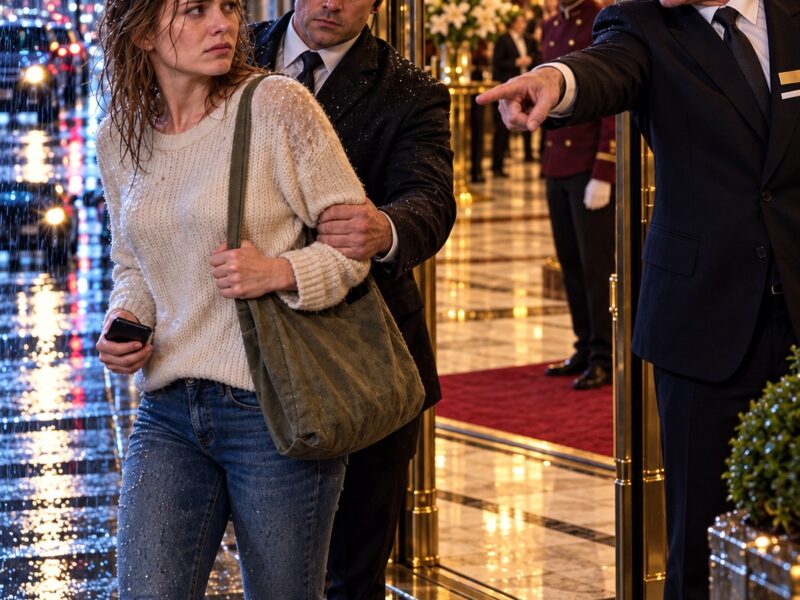
Rain hammered the tall glass doors behind her. Water ran from her dark hair, down the back of an old black sweater, and gathered in a thin puddle around her canvas shoes. Her luggage had been lost somewhere between Minneapolis and Chicago, her phone battery was at four percent, and the airline had given her a plastic toothbrush in a paper pouch as if that somehow made up for everything.
Still, none of that should have mattered.
She had a reservation.
“Excuse me?”
The man behind the counter did not blink.
Preston Vance wore a navy suit that fit him perfectly and a gold name badge reading GENERAL MANAGER. His silver hair was carefully styled, his cuff links matched his tie bar, and his expression carried the practiced patience of someone accustomed to explaining rules to people he had already decided were beneath them.
“There’s a hostel three blocks west,” he repeated. “Clean enough, from what I hear.”
Claire rested both hands on the counter.
“My name is Claire Whitmore.”
His eyes moved briefly to her sweater.
“Yes. You’ve said that.”
“My husband booked the executive suite.”
“And I told you there is no such reservation.”
“You haven’t checked.”
Vance sighed.
Behind Claire, an elegantly dressed couple shifted impatiently.
She heard the woman whisper, “Unbelievable.”
Claire glanced back.
The woman immediately looked away.
Claire returned her attention to Vance.
“Could you please type my name into the system?”
“I know tonight’s arrivals.”
“Then you know mine.”
“No, ma’am.”
Claire’s jaw tightened.
The last twelve hours had already gone wrong in enough small ways to become almost funny.
Her flight out of Milwaukee had been delayed.
Then diverted.
Then delayed again.
Daniel’s jet had been grounded in New York because of storms, and he had insisted she continue without him rather than spend another night sleeping near an airport gate.
His last message had arrived forty minutes earlier.
Take the suite. I’ll meet you there.
Claire had responded with a photograph of herself in the cheap sweater she bought during the layover.
Very glamorous majority shareholder’s wife.
Daniel had answered immediately.
You could wear a garbage bag and still terrify the board.
She had laughed then.
She was not laughing now.
“Executive suite,” she said. “Top floor. Under Whitmore.”
Vance leaned slightly closer.
“Let me save us both some time.”
Claire waited.
“This is the Callister.”
“I’m aware.”
“We are a five-star property.”
“I’m also aware of that.”
“We have security protocols.”
Claire’s eyes narrowed.
“What does my sweater have to do with security?”
His mouth tightened.
“I didn’t say anything about your sweater.”
“You looked at it three times.”
That made the man behind her cough into his hand, disguising a laugh.
Vance noticed.
Color rose slightly into his face.
“Do you have a confirmation number?”
“My phone is almost dead, and the email isn’t loading.”
“So no.”
“So check the name.”
Vance looked past her.
“Next guest, please.”
Claire did not move.
The dressed-up couple behind her hesitated.
“Mr. Vance.”
He looked back at her reluctantly.
“My husband’s name is Daniel Whitmore.”
Nothing.
Claire continued.
“Whitmore Hospitality Partners.”
One eyebrow rose.
“He owns thirty-eight percent of this hotel directly. The family trust holds another seventeen.”
Vance stared at her for a beat.
Then laughed.
The sound was quiet at first.
It grew.
Claire felt heat rise in her face.
He shook his head.
“Of course.”
Her voice became very still.
“Of course what?”
“Of course your husband owns the hotel.”
Claire waited.
Vance smiled toward the couple behind her.
“Apparently we have a billionaire’s wife visiting tonight.”
The woman laughed awkwardly.
Her husband did not.
Claire felt something inside her go cold.
Not because he didn’t believe her.
She could understand disbelief.
It was the pleasure he seemed to take in humiliating her.
“You’re making a mistake.”
Vance shrugged.
“People say that when they don’t like an answer.”
“Check the ownership file.”
“I don’t need to.”
“Then get someone who does.”
His smile vanished.
“I am the general manager.”
“Then act like one.”
The words landed hard.
Vance straightened.
“Excuse me?”
Claire took a breath.
Her mother’s voice surfaced in her memory.
When somebody is trying to drag you into their bad behavior, decide whether joining them helps you.
Claire had grown up Claire Bennett.
Her father repaired commercial elevators in Milwaukee. Her mother worked twenty-seven years in a public library and believed rudeness was usually evidence of insufficient reading.
Money arrived later.
Daniel arrived later.
Claire still remembered what it felt like to calculate grocery totals before reaching the register.
She remembered being twenty-two and watching a restaurant hostess look past her because the women behind her carried designer bags.
Marriage to Daniel had changed how people treated her.
Usually.
Tonight, nobody knew.
That made the moment strangely useful.
Claire stepped aside.
“Fine. Help the couple behind me.”
Vance looked surprised.
“But I’m staying right here while someone checks.”
“That isn’t how this works.”
“It can be.”
Vance greeted the couple.
Their reservation appeared instantly.
Champagne had been arranged in the room.
Anniversary.
Upgrade.
Claire watched.
The same computer apparently incapable of locating her reservation functioned beautifully for people Vance thought looked correct.
When the couple left, Claire returned to the counter.
“Now.”
Vance stared at her.
“I told you this conversation was over.”
“And I told you I’m not leaving.”
“What exactly do you expect me to do?”
“Your job.”
His eyes hardened.
“Miss—”
“Mrs.”
“I don’t care.”
Claire went silent.
So did the clerk standing two stations away.
Vance heard himself.
For the first time, his expression changed.
Not enough.
“Security.”
Two men near the revolving doors looked over.
Claire almost laughed.
“You’re calling security because I asked you to check a name.”
“You are refusing to leave the desk.”
“I stepped aside for the guests.”
“You are harassing staff.”
“No.”
“Security.”
One guard approached.
He was younger than Claire expected, Latino, perhaps early thirties. His badge read MARCUS REYES.
He slowed as he reached her.
“Ma’am.”
His voice was careful.
Claire looked at him.
“I don’t want trouble.”
“Neither do I.”
“Can we step away from the desk?”
Claire nodded.
“I’ll step away.”
Vance’s mouth tightened, as if disappointed Marcus had not grabbed her.
Claire picked up her small carry-on.
The second guard came closer.
Vance said, loudly enough for half the lobby to hear, “Get her outside before she scares off a paying guest.”
Marcus’s face changed.
Claire saw it.
The other guard reached lightly for Claire’s elbow.
She stepped away.
“Don’t touch me.”
His hand dropped.
Marcus gestured toward the doors.
“This way.”
Claire walked.
No struggle.
No shouting.
No dramatic scene.
That somehow made the humiliation sharper.
The revolving door carried her into November rain.
Cold water hit her face immediately.
She stopped under the narrow awning.
Marcus followed.
The other guard stayed inside.
“I’m sorry.”
Claire looked at him.
“What are you apologizing for?”
Marcus glanced through the glass.
“I don’t know exactly.”
“That might be the most honest thing anyone has said to me tonight.”
He gave a strained smile.
Claire looked at her phone.
Three percent.
She tried loading Daniel’s driver’s number.
Nothing.
Marcus noticed.
“You need a charger?”
“USB-C.”
“I have one at the desk.”
He looked through the door.
Claire saw the hesitation.
“You don’t have to risk your job.”
Marcus looked at her.
“My grandmother cleaned offices at night.”
Claire waited.
“Sometimes I sat in building lobbies waiting for her shift to end.”
He shrugged.
“I remember how people looked at us.”
Claire’s anger softened slightly.
Marcus pulled out his own phone.
“Use mine.”
She stared.
“If Vance sees—”
“He already thinks I’m replaceable.”
“That is not encouraging.”
“It’s honest.”
Claire took the phone.
“Thank you.”
Marcus turned back inside.
“Wait here.”
“Apparently that’s tonight’s theme.”
He almost smiled.
Claire dialed the Whitmore corporate transport line.
Two menu options.
Then three.
A man answered.
“Whitmore executive transport.”
“Thomas?”
Silence.
“Mrs. Whitmore?”
Claire closed her eyes.
Thomas Bell had been Daniel’s driver before becoming head of executive transport. He had known Claire since she was twenty-eight and still refused to stop calling her Mrs. Whitmore no matter how many times she told him not to.
“Hi.”
“Whose phone is this?”
“A hotel security guard.”
A pause.
“Why?”
Claire looked through the glass.
Preston Vance was now telling a story to two people at the bar.
“Where’s Daniel?”
“His flight diverted into Midway. We’re fifteen minutes out.”
“Good.”
“Claire.”
She winced.
Thomas used her first name only when something was wrong.
“What happened?”
“My reservation got lost.”
“No.”
Claire frowned.
“No what?”
“Daniel confirmed it personally through corporate.”
“Then the hotel lost it.”
“No.”
Thomas’s voice went colder.
“I have the confirmation in front of me.”
Claire looked at Vance.
“Interesting.”
“Where are you?”
“Outside.”
Silence.
“Outside the hotel?”
“Yes.”
“In this rain?”
“It’s less charming than it sounds.”
Thomas swore.
“Language.”
“I’m calling Daniel.”
“Thomas.”
Too late.
The line went dead.
Marcus returned carrying a gray hotel blanket and a paper cup.
“You got hot chocolate.”
“You look like hot chocolate.”
“What does that mean?”
“Coffee people look angrier.”
Claire laughed unexpectedly.
She wrapped the blanket around her shoulders.
Marcus sat at the opposite end of the bench.
“Did you reach him?”
“His driver.”
“Is he coming?”
“Yes.”
Marcus hesitated.
“Can I ask something?”
“Sure.”
“Is your husband actually Daniel Whitmore?”
Claire took a sip.
“Yes.”
Marcus went still.
“The Daniel Whitmore.”
“Unfortunately.”
He stared through the glass doors.
“Oh.”
Claire smiled slightly.
“You keep saying that.”
“He owns this place.”
“Part of it.”
“Most of it.”
“Technically the holding partnership—”
“He owns this place.”
Claire sighed.
“Yes.”
Marcus covered his face briefly.
“I just gave the owner’s wife my phone.”
“You also threw the owner’s wife out.”
“I did not.”
“Fair.”
Marcus looked through the doors again.
“Vance doesn’t know.”
“No.”
“Should I tell him?”
Claire thought.
Then shook her head.
“No.”
Marcus frowned.
“You want him to keep—”
“I want him to remember exactly what he did before anyone tells him why he should regret it.”
Marcus stared.
Claire looked down at the blanket.
“If Daniel walks through those doors first, suddenly I become believable.”
“You are believable.”
“To you.”
Marcus looked uncomfortable.
Claire continued.
“I want the clerks to remember whether they checked the screen.”
“They didn’t.”
“I want the guests to remember whether they laughed.”
Marcus said nothing.
“I want Vance to remember whether he had a reason.”
She looked through the rain.
“Not whether he had the wrong victim.”
Marcus understood then.
The revolving doors moved.
Preston Vance stepped outside.
His expression hardened when he saw the blanket.
“Still here?”
Claire looked up.
“I told you I’d wait.”
“This is becoming harassment.”
Marcus stood.
“She’s sitting on a bench.”
Vance turned sharply.
“Mr. Reyes.”
“Yes, sir?”
“That blanket belongs to the hotel.”
Marcus looked at Claire.
Then Vance.
“So does the awning.”
Vance’s face tightened.
Claire stood before the exchange could cost Marcus his job.
She handed him the blanket.
“No.”
Marcus frowned.
“It’s okay.”
She gave him the cup too.
Vance smiled.
“Finally.”
Claire stepped into the rain.
Water immediately soaked through the sweater again.
Vance stared as if he had won something.
Claire looked toward the street.
Headlights appeared at the end of the block.
One SUV.
Then another.
Then a third.
Marcus’s eyes widened.
Claire sighed.
“That’s them.”
The first vehicle pulled hard to the curb.
The rear door opened before Thomas fully stopped.
Daniel Whitmore stepped out.
No umbrella.
No coat buttoned.
Nothing about him resembled the polished photographs appearing in business magazines.
He looked terrified.
Then angry.
He saw Claire.
His face changed.
“Claire.”
She lifted one hand.
“I’m okay.”
He crossed toward her.
His hands went to her shoulders.
“You’re soaked.”
“I noticed.”
“What happened?”
“Daniel.”
“Who did this?”
“I said I’m okay.”
He looked at Marcus.
Marcus straightened instinctively.
“I gave her the blanket, sir.”
Daniel looked him over.
“Were you the one who removed her?”
“No.”
“Did you touch her?”
“No, sir.”
“The other guard reached for my elbow,” Claire said. “I moved before he did.”
Daniel’s jaw tightened.
She grabbed the front of his coat.
“Do not turn into yourself right now.”
He looked down.
Claire knew exactly what that meant.
So did Daniel.
The version of him inherited from his father believed money existed partly to remove obstacles and people existed partly to become one.
Thirteen years of marriage had taught him to ask one question first.
“What do you want?”
Claire exhaled.
“For you to come inside.”
“And?”
“Listen.”
“Then?”
“We decide.”
Daniel nodded.
“Okay.”
Thomas remained near the SUV.
Corporate security stayed back.
Claire pointed at them.
“They stay outside.”
Daniel’s expression said he disliked that.
Claire stared.
He sighed.
“They stay.”
They entered the hotel.
The lobby changed before Preston Vance understood why.
A bartender stopped polishing a glass.
One clerk whispered something.
The couple who had laughed earlier turned from the elevator.
Daniel Whitmore was not movie-star famous, but Chicago business circles recognized him.
Vance’s smile appeared automatically.
“Mr. Whitmore.”
Daniel stopped.
“Mr. Vance.”
“Had we known you were arriving—”
Daniel looked at Claire.
Vance followed his eyes.
His smile vanished.
Claire stood beside Daniel in the same wet sweater.
For the first time that evening, Preston Vance looked genuinely afraid.
“Sir.”
Daniel waited.
Vance swallowed.
“There seems to have been a misunderstanding.”
Claire raised an eyebrow.
Daniel said, “What was misunderstood?”
“The reservation system.”
Claire almost admired the speed.
“The system you never opened?”
Vance looked at her.
Daniel looked at him.
“You didn’t check?”
“I believed—”
“What?”
Vance’s mouth opened.
Nothing.
Daniel’s voice remained quiet.
“My wife told you her name.”
“Yes.”
“She told you mine.”
“Yes.”
“And you told her to try a hostel.”
The lobby went completely silent.
The couple near the elevators looked at the floor.
Vance’s face reddened.
“I wasn’t aware—”
Claire stepped forward.
“That I was important?”
“No. That isn’t—”
“That Daniel was really my husband?”
“Yes. I mean, no.”
Claire’s voice softened.
“You still don’t understand.”
Vance stared.
“You did not need to know who I was.”
He looked down.
“You needed to treat me like a person.”
Daniel’s face changed.
Some of the anger remained.
But something else entered it.
Recognition.
Vance began talking again.
“My job requires judgment. People try scams. They use names. They pressure employees. I protect the hotel.”
Claire said, “By looking at sweaters.”
“No.”
“Shoes?”
“No.”
“Luggage?”
“Mrs. Whitmore—”
“Claire.”
Vance stopped.
She glanced toward the staff.
“This should not be handled in the lobby.”
Daniel looked at her.
“Your office,” she said.
Vance nodded quickly.
“Of course.”
Daniel pointed toward Marcus.
“He comes.”
Marcus blinked.
“Sir?”
“You were there.”
Claire added, “And he helped me.”
They went upstairs.
Vance’s office was immaculate.
Fifteen years of awards covered the wall.
Five-star plaques.
Hospitality leadership certificates.
A framed newspaper story about a major renovation.
Daniel noticed them.
Claire did too.
It would have been emotionally easier if Vance’s career had obviously been worthless.
It wasn’t.
That made what happened worse.
Daniel remained standing.
“Start from the beginning.”
Vance sat behind his desk.
“Daniel, surely—”
“Mr. Whitmore tonight.”
Vance went still.
Daniel rarely used status for theater.
When he did, everybody noticed.
“Start.”
Vance described Claire entering.
Wet.
Without luggage.
Without confirmation readily available.
Casually dressed.
Claiming a top-floor suite.
Daniel listened.
Claire listened more carefully.
Then Vance said it.
“She did not present like our executive-level clientele.”
Claire looked at him.
“There.”
Vance frowned.
“What?”
“That sentence.”
He looked toward Daniel.
Claire said, “Forget Daniel.”
Vance’s eyes returned to her.
“What does executive-level clientele look like?”
He didn’t answer.
Claire waited.
Daniel moved toward the window.
He knew better than to interrupt her when she sounded like that.
“Does it look white?”
Vance flinched.
“Absolutely not.”
“Designer?”
“No.”
“Older? Younger?”
“Claire—”
“Rich.”
Vance stopped.
Claire nodded.
“There.”
He looked away.
“You were deciding who could afford dignity.”
“That is not fair.”
Marcus shifted near the door.
Claire heard it.
She looked at him.
“Say something?”
Marcus hesitated.
Vance shot him a warning glance.
Daniel noticed.
“Mr. Reyes.”
Marcus looked up.
“You are protected for anything you say in this room.”
Vance laughed.
“He reports to me.”
Daniel looked at him.
“No. He reports to a company I chair.”
The laughter stopped.
Daniel turned to Marcus.
“Has this happened before?”
Marcus looked at Claire.
Then at Vance.
“Not exactly.”
Vance said, “Be very careful.”
Daniel’s expression cooled.
“That sounded like retaliation before the answer was even given.”
Vance sat back.
Marcus swallowed.
“He has standards.”
Claire waited.
Marcus continued.
“We’re sometimes told to discourage certain people from staying in the lobby.”
“What people?” Daniel asked.
Marcus looked miserable.
“People who appear… unlikely to spend.”
Vance stood.
“That is an outrageous simplification.”
Marcus’s voice strengthened.
“Old luggage.”
Vance stared.
“Work clothes.”
“Stop.”
“Guests asking prices before ordering.”
“Marcus.”
“A family last Christmas.”
Vance went pale.
“What family?” Claire asked.
Marcus looked at her.
“Black family. Two children.”
Daniel’s face became unreadable.
Marcus continued.
“They asked where the brunch elevators were. Mr. Vance told me they were wandering and to keep them away from guest areas.”
“They were wandering.”
“They had reservations.”
Silence.
Vance looked around the room as if everyone had suddenly betrayed him.
“This is luxury hospitality.”
Claire said quietly, “No.”
He looked at her.
“This is fear wearing a tie.”
Daniel turned away because, despite the situation, the line was very Claire.
Vance’s face hardened.
“I built the Callister.”
“You managed it,” Daniel corrected.
“For fifteen years.”
“And tonight you used those fifteen years to decide you didn’t need to check.”
Vance’s anger finally cracked through his panic.
“You think running a hotel like this is just smiling at everyone?”
Daniel said nothing.
“You have investors demanding numbers. Guests paying two thousand dollars a night who complain about the wrong people sitting near them. Luxury rankings. Brand audits. Security problems. Fraud.”
Claire listened.
For the first time, Preston Vance sounded less like a villain and more like a man explaining how he became one.
It did not excuse him.
But she wanted to understand the mechanism.
Vance continued.
“You begin filtering.”
Claire nodded.
“Yes.”
He stopped.
“That’s exactly what happened.”
His face tightened.
“You filtered until people became categories.”
No answer.
Daniel took out his phone.
Vance stood.
“Daniel.”
Daniel called Evelyn Grant, CEO of Whitmore Hospitality.
She answered immediately.
“Daniel?”
“Claire was removed from the Callister tonight.”
Silence on the phone.
“Is she all right?”
“Yes.”
Claire mouthed physically.
Daniel almost smiled.
“Physically.”
He continued.
“Preston Vance is suspended immediately.”
Vance’s face collapsed.
“Daniel.”
“Corporate access frozen tonight. Badge collected before he leaves.”
“Fifteen years.”
Daniel ignored him.
“Independent review. Guest complaints, security logs, HR files, resignations, mystery-shopper feedback. Three years minimum.”
Claire touched Daniel’s arm.
He looked at her.
She mouthed:
No blacklist.
Daniel frowned.
Claire stared.
He sighed.
“And Evelyn.”
“Yes?”
“No calls to other hotel groups.”
Vance looked surprised.
Daniel clearly hated saying it.
“No industry blacklist.”
Claire’s shoulders relaxed.
Daniel ended the call.
Vance stared at her.
“You’re protecting me?”
“No.”
Claire walked closer.
“I am refusing to become you.”
He flinched.
Daniel looked at her.
Claire continued.
“You decided I deserved consequences because of what you assumed I was.”
She gestured toward him.
“I’m not going to decide the rest of your life because tonight I have enough power to do it.”
Vance sat.
Claire said, “You should lose this job if the review shows tonight was part of a pattern.”
His face tightened.
“But after that, whether you learn anything belongs to you.”
Daniel crossed his arms.
“That is more mercy than he gave you.”
Claire looked at her husband.
“That’s the point.”
The review took seventy-two hours before the board had enough to act.
Claire did not need seventy-two hours to know the result.
She read the report from the executive suite the next morning.
Seventeen complaints.
Five involved appearance-based assumptions.
Three involved race.
Two involved disability.
One involved an elderly man who was asked to leave the lobby while waiting for his granddaughter because staff believed he was homeless.
The man had owned a manufacturing company before retiring.
Claire almost laughed at the absurdity.
Then stopped herself.
His wealth was irrelevant too.
A young couple had been warned twice about restaurant prices after arriving in casual clothes.
A hotel employee had been disciplined for allowing a woman with dementia to remain inside while staff located her family.
The employee was Marcus Reyes.
Claire set down the report.
Daniel was reading beside her.
“That’s why he helped you.”
“Maybe.”
“Promote him.”
Claire looked at him.
“You have known him one night.”
“He has judgment.”
“Daniel.”
“He does.”
“He also has no management experience.”
“We can give him some.”
Claire laughed.
“You cannot solve every good quality with a promotion.”
“Why not?”
“Because human beings are not video-game characters.”
Daniel frowned.
“I don’t understand that reference.”
“Of course you don’t.”
The review concluded Preston Vance had established an unofficial culture of “protecting presentation.”
There were no written policies.
There didn’t need to be.
Employees learned through correction.
Which guests received immediate smiles.
Which guests received suspicion.
Which people security watched.
Which people were allowed to be imperfect.
The board terminated him.
Daniel wanted him escorted through the lobby.
Claire said no.
“He humiliated you publicly.”
“So?”
“He should understand.”
“He does.”
“How do you know?”
“I don’t.”
Daniel paced.
Claire looked up.
“Why do you want everyone to watch?”
“Because they watched you.”
“There.”
He stopped.
“What?”
“You want symmetry.”
“Yes.”
“That isn’t justice.”
Daniel stared.
“You are incredibly irritating when morally correct.”
“I work hard at it.”
Vance surrendered his badge through the service office.
Quietly.
His contractual severance was paid.
The investigative findings stayed in his record.
No recommendation letter.
No calls blacklisting him.
That was the consequence.
Fifteen years gone.
Not fifteen seconds.
Fifteen years brought to judgment by the culture those years had eventually produced.
Marcus received an interview.
Not a promotion.
Claire insisted.
The interview panel included people who had never met her.
When Evelyn asked why he had helped Claire, Marcus looked confused.
“She was cold.”
Evelyn waited.
He shrugged.
“She needed a phone.”
“Did you know your manager would be angry?”
“Yes.”
“Why do it anyway?”
Marcus looked down at his hands.
“My grandmother cleaned offices.”
Claire listened.
“She would finish after midnight. Sometimes she took me.”
He smiled faintly.
“I learned early that expensive buildings have two kinds of doors. The ones on the plans and the ones people decide whether you deserve.”
Nobody spoke.
Marcus continued.
“When I saw Mrs. Whitmore outside, I didn’t know who she was.”
Claire smiled.
“That’s why it mattered.”
Marcus did not become guest relations lead.
He became assistant manager for guest experience, with a year-long rotational training requirement.
He worked front desk.
Reservations.
Housekeeping.
Restaurant service.
Complaints.
Claire saw him six months later carrying luggage because a bell attendant called in sick.
“You’re management now.”
Marcus grinned.
“Tell that to the luggage.”
The Callister changed.
Not through posters.
Claire refused posters.
The first consulting company Daniel hired proposed a campaign called Everyone Belongs at Callister.
Claire stared at the presentation slide.
“This is embarrassing.”
The consultant looked wounded.
Daniel looked delighted.
“I told you.”
“Don’t enjoy this.”
The campaign disappeared.
Instead, they changed procedures.
Every reservation complaint required a name search before escalation.
Security could not remove a nonviolent guest solely on one manager’s request without documented behavior.
Employees gained confidential reporting channels outside property management.
Mystery guests arrived in business suits.
Work boots.
Wheelchairs.
Sweatshirts.
Designer clothing.
Old clothing.
Sometimes reservations existed.
Sometimes they didn’t.
The question remained the same:
How are they treated?
Claire asked that the training include her night.
Not her name.
Not Daniel’s.
The case study read:
A tired traveler arrives in poor weather wearing casual clothes. Her phone is dying. She says she has a prepaid suite, but staff cannot immediately confirm it. What do you do?
The first version of the answer was eleven bullet points.
Marcus deleted ten.
The final answer became:
Help her find out.
Claire approved it.
Months passed.
The story briefly reached local media because someone in the lobby had recorded Daniel arriving.
Headlines made Claire cringe.
BILLIONAIRE’S WIFE KICKED OUT OF HIS OWN HOTEL
GENERAL MANAGER FIRED AFTER HUGE MISTAKE
HOTEL BOSS HUMILIATES SECRET OWNER
Every headline missed the point.
Claire rejected interview requests.
One producer asked whether she wanted to “tell viewers what it felt like when Vance realized who you were.”
Claire replied, “That was the least interesting part.”
The producer never called again.
One rainy afternoon, Claire returned to the Callister alone.
No announcement.
No reservation.
Same sweater.
Dry this time.
She sat in the lobby for twenty minutes.
Nobody questioned her.
A young desk clerk asked if she wanted water.
Claire said no.
An elderly man sat nearby wearing paint-stained work clothes.
A suitcase rested between his shoes.
Claire watched a new bell attendant approach.
“Sir, are you checking in?”
The man shook his head.
“Waiting for my granddaughter.”
“No problem.”
The attendant pointed toward the café.
“They’ve got coffee if you want it. Restroom is around the corner.”
The man smiled.
“Thanks.”
Nothing dramatic happened.
Claire felt more satisfaction than she had watching Vance lose his badge.
Daniel met her upstairs later.
“You tested them.”
“No.”
“You absolutely tested them.”
“I sat in a chair.”
“In that sweater.”
She smiled.
“Coincidence.”
Daniel kissed her forehead.
“You’re dangerous.”
“You married me.”
“I was young.”
“You were thirty.”
“Emotionally young.”
Claire laughed.
Then he asked, “You okay here now?”
She looked around the suite.
“Yes.”
“Because we changed things?”
“Partly.”
“What’s the other part?”
She thought.
“Because I came back on my own terms.”
Daniel nodded.
He understood.
Their marriage had survived money better than either expected.
That did not mean money had been easy.
When Claire first met Daniel, he had inherited enormous privilege and very little understanding of what privilege did to rooms.
On their fourth date, he had tipped a waiter two hundred dollars after poor service.
Claire asked why.
Daniel said, “Because he probably had a bad night.”
She had liked that.
Two weeks later, Daniel bought the small nonprofit where Claire volunteered a new van without asking anyone.
Claire nearly ended the relationship.
He had not understood.
“Why are you angry?”
“Because they were fundraising.”
“I solved the problem.”
“No. You replaced their process with yourself.”
“It’s a van.”
“It’s dignity.”
Daniel had thought she was being absurd.
Then he attended a fundraising meeting and watched six retired teachers who had spent months planning the campaign quietly stop participating because the billionaire had already solved everything.
He apologized.
Sold the van to the nonprofit for one dollar after they completed the campaign.
Claire married him three years later.
That history mattered now.
Daniel wanted to fix the Callister with force.
Claire wanted it changed without becoming dependent on the threat of Daniel’s force.
One night, he sat at their kitchen table looking at employee survey results.
“People still say they’re afraid of managers.”
“Which managers?”
“Across the group.”
Claire sat opposite him.
“There you go.”
“What?”
“This isn’t a Callister problem.”
Daniel frowned.
“You think it’s all the hotels?”
“I think the Callister made us look.”
He leaned back.
“I own twenty-three hotels.”
“Exactly.”
“That sounded expensive.”
“Probably.”
Daniel rubbed his face.
“I liked you better when you just yelled at me about vans.”
“You didn’t.”
“No.”
He smiled.
“But I understood the invoices.”
They expanded the review.
Not publicly.
Across Whitmore Hospitality.
Anonymous employee reporting.
Manager conduct audits.
Guest-complaint pattern analysis.
One property in Arizona had almost no complaints.
It also had extraordinarily high staff turnover.
They investigated.
Another Vance.
Different style.
Same problem.
Claire joined the board’s culture committee despite refusing a board seat.
For two years she attended meetings without compensation.
Daniel called this “financially offensive.”
Then the governance chair, a woman named Evelyn Patel, told Claire:
“You’re already doing the work. Either let us pay you or stop allowing your husband’s company to exploit your labor.”
Claire stared.
Daniel almost fell out of his chair laughing.
She accepted a formal independent-director seat the following year.
Her first proposal was employee anti-retaliation protection.
Not guest-service slogans.
Not luxury standards.
“When an employee sees a manager mistreat a guest,” Claire told the board, “they should not have to calculate whether rent matters more than speaking.”
A director asked, “Can we guarantee there will never be retaliation?”
“No.”
Claire looked around the table.
“But we can make retaliation expensive enough that managers think twice.”
Daniel looked at her with something close to pride.
She kicked him under the table.
Preston Vance disappeared from their lives.
Mostly.
A year after the incident, a letter arrived at Claire’s home.
Daniel saw the return address first.
“Madison.”
Claire opened it.
Mrs. Whitmore,
I do not expect forgiveness, and I am not requesting it.
Daniel leaned over.
Claire pushed his face away.
“Private.”
“He wrote to my wife.”
“Exactly.”
She continued.
Vance had spent three months unemployed.
He then accepted a reservations-management position at a convention hotel in Wisconsin.
Smaller.
No prestige.
Lower salary.
He wrote about his first week.
A man in paint-stained overalls entered the lobby and asked to use a restroom while waiting for his wife.
Vance’s first instinct had been to ask whether he was staying there.
He stopped himself.
Let the man use it.
Twenty minutes later, the man’s wife arrived with a wedding planner.
Their daughter’s wedding would bring four hundred guests to the property.
Vance wrote:
For one ugly second, I congratulated myself because the man turned out to be valuable business. Then I realized I was still learning the wrong lesson.
Claire paused.
Daniel’s expression changed.
She continued.
The point was not that I nearly insulted a profitable customer. The point was that I nearly asked a tired man to prove he deserved a restroom.
Claire read that sentence again.
Vance continued.
You told me I did not need to know who you were. I needed to treat you like a person.
At first I thought I understood because losing my job frightened me. I did not understand. Fear only made me careful. It did not make me better.
I am trying to become better.
I am sorry.
Preston Vance
Daniel waited.
“Well?”
Claire folded the letter.
“I think he means it.”
“Maybe.”
“You are very suspicious.”
“He threw you outside.”
“Yes.”
“In the rain.”
“I remember.”
“I enjoy repeating it.”
Claire smiled.
“He has consequences.”
“Not enough.”
“Daniel.”
He sighed.
“I know.”
Claire wrote back a week later.
Mr. Vance,
Thank you for writing.
What happened remains unacceptable, and I will not pretend otherwise.
I hope the next person at your desk receives the version of you that I should have met.
Claire
No Whitmore.
No title.
No threat.
No absolution.
That was enough.
Three years after the incident, Marcus called Claire.
“I need you not to laugh.”
She laughed immediately.
“I hate you.”
“What happened?”
“I have an interview.”
“For?”
“General manager.”
Claire sat up.
“Where?”
“The Callister.”
She stopped smiling.
“Marcus.”
“I know.”
“You want it?”
“I think so.”
“Then why do you sound like you’re calling before surgery?”
“Because six years ago I was moving luggage.”
“Everyone starts somewhere.”
“Not usually six years before being considered for a five-star general manager role.”
“Did Daniel arrange this?”
“No.”
“Are you sure?”
“I checked three times.”
Claire smiled.
“Good.”
“Should I do it?”
She thought.
“Do you want my answer?”
“Yes.”
“Then stop asking whether the old version of you deserves the job.”
Marcus went quiet.
Claire continued.
“Ask whether the current version can do it.”
He exhaled.
“That was annoyingly useful.”
“Send me a consulting invoice.”
Marcus got the job.
Not unanimously.
One board member favored someone from a larger luxury property.
Daniel abstained from the vote because of his personal connection.
Claire wasn’t on the hotel operating committee and stayed completely out of it.
Marcus earned the offer.
He cried when Evelyn called.
He denied that for years.
On his first morning, he gathered the Callister staff before sunrise.
Claire came without telling him.
Daniel came without telling Claire.
They stood near the café.
Marcus held no notes.
“I worked security in this lobby six years ago.”
Older employees knew the story.
Newer ones did not.
Marcus looked toward the main doors.
“One night, a woman came in wet, exhausted, wearing clothes that made a manager decide what she was worth before checking her name.”
Claire looked down.
Marcus continued.
“The easy version of this story says the manager made a terrible mistake because the woman was married to the owner.”
He shook his head.
“That is not the story.”
The lobby became very quiet.
“The story is that the manager should have treated her properly if she had been married to nobody.”
Claire felt Daniel’s fingers find hers.
Marcus went on.
“The woman turned out to have power.”
He looked toward Claire.
“Most people who come through those doors will not.”
He faced his staff again.
“That makes our obligation bigger, not smaller.”
Claire’s eyes filled.
“The person walking through those doors does not need to be secretly important.”
Marcus paused.
“They are already important because they are standing in front of us.”
Nobody applauded immediately.
Claire was glad.
Some sentences deserved a second to settle.
Then applause began.
Not loud.
Real.
That afternoon, Claire and Marcus sat on the same bench beneath the awning.
Rain fell lightly.
“I almost didn’t help you,” Marcus said.
Claire looked at him.
“What?”
“That night.”
“You gave me your phone.”
“After hesitating.”
“People hesitate.”
“I was afraid of Vance.”
“That was reasonable.”
Marcus shook his head.
“People tell the story now like I was brave.”
“You acted while afraid.”
“That’s not how it felt.”
Claire smiled.
“Courage rarely feels like the marketing department describes it.”
Marcus laughed.
“Can I ask something?”
“Sure.”
“Why did you stop Daniel from destroying him?”
“Vance?”
“Yes.”
Claire looked at traffic.
“Because Daniel could.”
Marcus waited.
Claire continued.
“Power feels cleanest when you use it against someone who deserves consequences.”
“Okay.”
“That’s when you have to be most careful.”
Marcus thought.
“So you felt sorry for him.”
“No.”
She smiled.
“Not much.”
He laughed.
“I wanted him accountable.”
“But.”
“But I didn’t want my humiliation to teach Daniel that humiliation is a good leadership tool.”
Marcus nodded slowly.
“You two are weird.”
“Extremely.”
The Callister won a major hospitality award the following year.
Daniel wanted Claire to attend the ceremony.
She refused.
“Why?”
“Because it will turn into that story.”
“What story?”
“The billionaire’s wife fixes hotel.”
“You did help fix it.”
“No.”
Claire pointed toward Marcus on the event program.
“He did.”
“Elena did.”
“Hundreds of employees did.”
She smiled.
“I got wet.”
Daniel shook his head.
“You are impossible to celebrate.”
“That is why anniversaries exist.”
Daniel considered.
“Can I buy you jewelry?”
“No.”
“A trip?”
“Maybe.”
“That is growth.”
Their twentieth wedding anniversary arrived in October.
Daniel booked the Callister.
Claire discovered only because his assistant accidentally copied her on the reservation email.
“Top suite?”
Claire asked over breakfast.
Daniel looked guilty.
“Tradition.”
She narrowed her eyes.
“You arranged something.”
“No.”
“Daniel.”
“I may have requested flowers.”
“How many?”
“Reasonable amount.”
“That means seventy.”
“Forty.”
“Cancel half.”
He looked wounded.
On the anniversary night, Chicago rain came hard against the windows.
Claire stood in front of her closet.
Daniel appeared in the doorway wearing a tuxedo.
She pulled out the black sweater.
He stared.
“No.”
“Yes.”
“Absolutely not.”
Claire smiled.
“It survived.”
“It has become more hole than garment.”
“It’s vintage.”
“It was inexpensive when new.”
“History adds value.”
Daniel shook his head.
“I will donate one million dollars to your literacy foundation if you wear literally anything else.”
Claire gasped.
“Bribery.”
“Philanthropy.”
She wore the sweater.
With black trousers.
Canvas shoes.
Daniel sighed dramatically.
“You understand we’re having dinner in the ballroom.”
“You understand the sweater caused institutional reform.”
“It caused me hypertension.”
They arrived through the main entrance.
No convoy.
No announcement.
Marcus was off duty.
A new young employee stood at the front desk.
Claire approached first.
“Good evening.”
The clerk smiled.
“Welcome to the Callister. Checking in?”
“Yes.”
“Name?”
“Whitmore.”
The clerk typed.
“Daniel and Claire?”
“That’s us.”
“Happy anniversary.”
Daniel looked pleased.
Claire looked suspicious.
“Does the system tell you that?”
“Yes, ma’am.”
“Good.”
The employee handed them keys.
“Top-floor suite. Mr. Whitmore, I see a note requesting—”
Claire looked at Daniel.
He coughed.
“Nothing.”
The clerk wisely stopped.
“Anything else?”
Claire glanced down at herself.
“Do I look like I belong here?”
The employee froze.
Daniel covered his face.
“Please ignore my wife.”
The clerk looked from one to the other.
Then smiled carefully.
“You look like someone who came through our front door.”
Claire waited.
“So yes.”
Her expression softened.
“That’s an excellent answer.”
They moved toward the elevators.
A young man entered the lobby behind them.
Paint-spattered jacket.
Work boots.
Old backpack.
He approached the desk uncertainly.
“Sorry. I think I might be in the wrong hotel.”
The same employee smiled.
“Let’s find out.”
Claire stopped walking.
Daniel looked back.
The young man explained that his company had reserved a room while he completed emergency restoration work nearby.
He had no confirmation number.
Phone dead.
The employee asked his name.
Typed.
Found the booking.
No suspicion.
No security.
No laughter.
“Found you.”
The young man’s shoulders relaxed.
“Really?”
“Yep. You’re on twelve.”
“Thank you.”
“Of course.”
Claire’s eyes filled.
Daniel touched her hand.
“You okay?”
She nodded.
“That.”
“What?”
“That’s the ending.”
Daniel looked at the young man.
Then at Claire.
“To what?”
“The story.”
He smiled.
“I thought the ending was me arriving dramatically in three SUVs.”
“That was the middle.”
“I looked very impressive.”
“You looked insane.”
“Thomas says I looked decisive.”
“Thomas gets paid by you.”
They entered the elevator.
Upstairs, dinner waited.
Only twelve roses.
Daniel had compromised.
After dessert, rain continued against the windows.
Claire stood overlooking Michigan Avenue.
Daniel came behind her.
“You know what I remember most from that night?”
Claire asked.
“What?”
“Not Vance.”
Daniel waited.
“The bench.”
“Outside?”
“Yes.”
“Marcus?”
She nodded.
“The few minutes before you came.”
Daniel’s arms folded around her waist.
“I hated those minutes.”
“I know.”
“I still hate thinking about them.”
Claire leaned back against him.
“I needed them.”
He frowned.
“Why?”
“Because before you came, I had no proof anyone cared about.”
“That isn’t true.”
“To them it was.”
She turned toward him.
“And I got to feel, very briefly, what our policies feel like to someone who cannot make a phone call to the owner.”
Daniel’s expression softened.
“I wish you hadn’t had to.”
“So do I.”
She touched his tie.
“But if I hadn’t, we might still be congratulating ourselves on beautiful lobbies while people were afraid inside them.”
Daniel looked toward the city.
“Do you think we fixed it?”
“No.”
He looked at her.
Claire smiled.
“You finally stopped asking me for comforting answers.”
“That is marriage-induced trauma.”
She laughed.
“No system stays fixed.”
She glanced toward the hotel below.
“People come in. People leave. Managers get tired. Numbers create pressure. Bad habits return.”
“So what do we do?”
“Keep looking.”
Daniel nodded.
“Keep listening.”
“Yes.”
“And never insult that sweater.”
Claire smiled.
“Now you understand.”
Five years later, Claire attended Preston Vance’s funeral.
Daniel thought she was joking when she said she wanted to go.
She wasn’t.
Vance had died unexpectedly from a heart attack at sixty-four.
The notice came through Marcus, who had remained occasionally in touch after Vance apologized to several former Callister employees.
Daniel offered to attend.
Claire said no.
“I barely knew him.”
“That has never stopped rich people from attending funerals.”
“True.”
She drove to Madison alone.
The funeral was small.
Two adult daughters.
One former wife.
Several hotel employees.
Claire sat in the back.
Nobody recognized her.
That felt appropriate.
One of Vance’s daughters spoke.
“My father was difficult.”
A few people smiled through tears.
“He believed excellence meant seeing every flaw before anyone else did.”
Claire looked down.
“He became very good at seeing flaws.”
The daughter’s voice trembled.
“And for a while, I think he forgot to see people.”
Claire’s chest tightened.
“But the last few years of his life were different.”
She described him mentoring young hotel managers.
Teaching them not to confuse luxury with exclusion.
Volunteering at a hospitality training program for people returning from incarceration.
Claire had not known that.
Afterward, the daughter approached.
“Mrs. Whitmore?”
Claire was surprised.
“You know me?”
“My father kept your letter.”
Claire swallowed.
“He did?”
“In his desk.”
The daughter smiled sadly.
“He didn’t talk about that night much.”
She paused.
“But he talked about the lesson constantly.”
Claire looked toward the casket.
“I’m sorry for your loss.”
“Thank you.”
The woman hesitated.
“Did you forgive him?”
Claire considered.
Years earlier, she might have felt pressured by the question.
Now she understood forgiveness was not a courtroom verdict.
“I stopped needing to decide.”
Vance’s daughter looked confused.
Claire explained.
“I didn’t trust him again. I didn’t forget what happened.”
She smiled faintly.
“But I was glad he became somebody else afterward.”
The woman’s eyes filled.
“So was I.”
Claire returned to Chicago that evening.
Daniel waited at home.
“How was it?”
“Sad.”
“He really changed?”
“I think he tried.”
Daniel nodded.
After a moment he asked, “Was keeping me from blacklisting him the right decision?”
Claire looked at her husband.
Twenty-five years together.
Gray now at his temples.
Still impatient.
Still learning.
“Yes.”
Daniel smiled.
“I hate when you’re right for decades.”
“Occupational hazard.”
He handed her tea.
“Did you think about the hotel?”
“The whole drive.”
“Regret anything?”
Claire sat beside him.
“Yes.”
Daniel looked concerned.
“What?”
“I should have taken Marcus’s blanket when Vance demanded it back.”
Daniel stared.
Then laughed.
Claire smiled.
“That was a good blanket.”
“Claire.”
“I’m serious.”
They laughed until she leaned against him.
Years later, when Whitmore Hospitality sold its majority stake in the Callister, Daniel asked Claire whether she wanted to keep the hotel.
“Sentimental reasons.”
She shook her head.
“No.”
“You sure?”
“Yes.”
The new owners agreed to retain the employee-protection standards and reporting structures.
Marcus had moved into a regional leadership role by then.
He no longer needed Daniel’s ownership to protect what they built.
That mattered.
On the final day before the sale closed, Claire walked through the lobby one last time.
No cameras.
No press.
Daniel stayed outside because she asked.
She crossed the exact stretch of marble where Preston Vance had looked at her sweater and decided what she was worth.
She stood at the front desk.
A young woman smiled.
“Can I help you?”
Claire looked around.
Travelers.
Families.
A tired flight crew.
A delivery worker carrying flowers.
An elderly couple arguing gently over directions.
A teenager in pajama pants checking in with her mother.
Nobody extraordinary.
Everyone extraordinary.
Claire smiled.
“No. I’m just looking.”
The clerk nodded.
“Take your time.”
Claire walked toward the revolving doors.
Outside, rain had started.
Of course.
She stepped beneath the awning.
Daniel waited near the curb holding an umbrella.
No convoy anymore.
Just him.
He saw her sweater and shook his head.
“You did this on purpose.”
Claire looked down.
Same black sweater.
Repaired twice.
Older than some hotel employees.
She smiled.
“I wanted the outfit correct.”
Daniel opened the umbrella.
“Ready?”
Claire looked back through the glass.
A man in dusty work clothes had entered the lobby.
The desk clerk greeted him immediately.
No hesitation.
Claire watched only long enough to hear:
“Good evening. How can I help you?”
She turned back to Daniel.
“Now I am.”
They walked away together.
The Callister doors closed behind them.
The hotel continued without Claire Whitmore.
That was the most satisfying part.
Because real change was never supposed to depend forever on a billionaire’s wife standing nearby to make people behave.
It was supposed to become ordinary.
A tired woman walks in from the rain.
Someone looks up.
They do not inspect her sweater.
They do not guess what she can afford.
They do not ask whether somebody powerful will arrive later.
They simply see a person standing in front of them.
And they say:
“How can I help you?”