“Mister, Look! I Have Tattoos Just Like You!” the Toddler Told the Mafia Boss—He Burst Out Laughing!
“Mister, look!”
I stopped breathing in the hallway.
My three-year-old son had walked into the one room in the Romano house where grown men waited for permission before crossing the threshold.
Nico didn’t know that.
He didn’t know the man behind the enormous walnut desk controlled half the shipping contracts along the lakefront, or that people in Chicago had been lowering their voices around the Romano name for longer than I had been alive.
All Nico saw were tattoos.
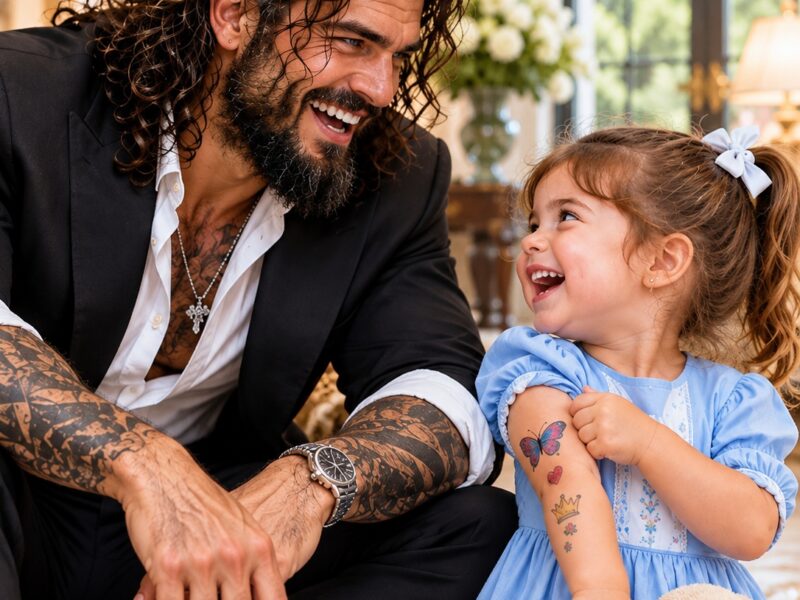
He pushed the sleeve of his little red sweater above his elbow and proudly displayed the temporary tattoos I had stuck there the night before because he had agreed to take a bath without screaming.
A green dinosaur.
A yellow star.
A crooked orange sun.
“I have tattoos just like you!”
The pen in Alessandro Romano’s hand stopped.
I gripped the vacuum cleaner so hard my fingers hurt.
For three months, I had worked inside that house without ever breaking a rule.
No visitors.
No children.
No exceptions.
That morning I had broken all three.
Alessandro lifted his eyes.
I had seen him from a distance before. Usually he moved quickly through the house with two or three men following him, his expression controlled, his shirts expensive, his voice never raised.
Up close, what struck me first was not that he looked dangerous.
It was that he looked tired.
Not the ordinary kind.
The kind sleep does not fix.
His charcoal shirt was rolled to his elbows, exposing dark ink across both forearms. A cross. Roman numerals. A line of script I could not read. Near his right wrist, a small black bird with its wings open.
Nico studied them with complete delight.
Alessandro studied Nico.
Then he looked at the dinosaur.
Something happened to his face.
His mouth twitched.
Once.
Then again.
And suddenly the most feared man I had ever met threw his head back and laughed.
Not politely.
Not the small social laugh wealthy people use when they want you to leave feeling appreciated.
It came out of him helplessly.
Deep and loud and startled, as if someone had opened a locked door inside his chest.
He put one hand over his eyes.
I heard a guard rush toward the study.
Shoes scraped against marble.
Someone behind me whispered, “What the hell?”
A hand touched a holster, then apparently reconsidered what exactly the appropriate response was when your employer was laughing at a toddler.
Alessandro finally looked at Nico again.
“You have a dinosaur.”
Nico nodded solemnly.
“Yes.”
Alessandro wiped beneath one eye.
“I only have a bird.”
He showed him the tattoo near his wrist.
Nico considered this carefully.
“The dinosaur is braver.”
Another laugh escaped Alessandro.
“I imagine he is.”
That was when he looked past my son and saw me.
Everything inside me dropped.
I started talking too quickly.
“Mr. Romano, I’m so sorry. My sitter got sick this morning and I had no one else. I kept him downstairs. He was supposed to stay in the storeroom. I know the rules. I know I shouldn’t have—”
A smooth voice came from behind me.
“I’ll take care of it, Don.”
Bruno Caravello.
Alessandro’s right hand.
The man who had frightened me more than Alessandro since the day I started working there.
Bruno was in his late fifties, silver-haired and always perfectly dressed. He smiled often, but his smiles never seemed connected to anything else in his face.
His fingers closed around my elbow.
Not hard.
Hard enough.
“Come on.”
Alessandro stopped laughing.
“Leave her.”
Bruno’s grip remained for one second too long.
Then he released me.
That one second would matter later.
At the time, all I noticed was that I could feel every beat of my heart in my throat.
Alessandro rose from behind the desk.
He was taller than I expected.
Nico held his ground.
Children have a useful ignorance about power.
Alessandro crouched in front of him.
“What do they mean?”
Nico looked at his arm.
“The dinosaur is brave.”
“A good start.”
“The star is bedtime.”
“Understandable.”
“The sun is just because.”
Alessandro nodded seriously.
“In my experience, most tattoos have worse reasons.”
Nico smiled.
Then Alessandro stood and looked at me.
“The boy will not stay in a storeroom again.”
I swallowed.
“He won’t be here again. I promise.”
“That isn’t what I said.”
I stared.
Alessandro’s face had gone unreadable.
“A frightened employee hiding a child in a closet creates problems.”
My stomach turned.
He continued.
“A mother who has nowhere else to put him is different.”
His eyes held mine.
“Which are you?”
There are moments when lying feels safer than truth.
That morning I was too tired for either.
“My neighbor watches him while I work. She called at six with a fever. The agency told me I’d be replaced if I missed another shift.”
“Another?”
“Nico had pneumonia in January.”
Alessandro glanced at my son.
“He is healthy now?”
“Yes.”
“And his father?”
My mouth tightened.
“Not available.”
That was the gentlest version of the truth.
Alessandro studied me for several seconds.
Then he said one word.
“Stay.”
I blinked.
“Sir?”
“Finish your shift.”
He looked toward the hallway.
“And somebody find the child something better than a storeroom.”
Bruno said, “Don—”
Alessandro turned.
Bruno stopped.
“Nico,” Alessandro said.
My son looked up.
“Yes?”
“Do not touch anything in this room.”
“Okay.”
“Especially the red button on the desk.”
Nico’s eyes immediately moved toward the desk.
I closed mine.
Alessandro smiled faintly.
“There is no red button.”
Nico laughed.
That was how my son entered Alessandro Romano’s life.
And, although none of us knew it yet, that was also how the first crack appeared in a wall that had been standing for eleven years.
My name is Alina Marino.
I was twenty-nine then.
Nico was three and still called spaghetti “pasghetti.” We lived in a two-bedroom apartment above a bakery in Berwyn, where the walls were thin enough that I knew when the couple next door fought and when the college student upstairs showered at two in the morning.
The Romano job paid almost twice what I could make cleaning hotels.
That mattered.
My divorce had left me with more than custody papers.
Dario Marino had never been good with money. After we separated, I learned “not good with money” was a phrase people used when the real truth was too humiliating.
He borrowed.
Gambled.
Borrowed more.
Then he began borrowing from people who did not send reminder notices.
I had spent eighteen months making sure his debts did not become mine.
Changing accounts.
Changing locks.
Changing Nico’s daycare.
Changing my phone number twice.
For a while Dario disappeared.
I thought I had gotten lucky.
I should have known better.
The Romano estate sat north of the city behind stone walls and iron gates.
The house itself was old, European-looking, built around a courtyard with climbing ivy and fountains that were drained every winter. It had twenty-three bedrooms, though most remained closed. There were staff corridors, a wine cellar, two kitchens, a private chapel nobody used, and enough security cameras to make me feel as if the walls themselves were watching.
The agency had called it a private household.
That was technically true.
They had neglected to mention the armed men.
On my first morning, Bruno gave me the rules.
“Never enter the study unless assigned.”
“Yes.”
“Never ask guests their names.”
“Yes.”
“If you hear something, you forget it.”
“Yes.”
“No photographs.”
“Of course.”
“No visitors.”
“Yes.”
“No children.”
I hesitated.
Bruno saw it.
“Problem?”
“No.”
“There are no exceptions.”
“I understand.”
He smiled.
“No, Mrs. Marino. You will.”
Three months later, my babysitter woke sick enough that she could barely speak.
I stared at Nico eating dry cereal from a plastic cup while I tried everyone in my phone.
My sister was in Indiana.
My mother had died when I was nineteen.
Dario did not answer.
Two neighbors had already left for work.
The agency had warned me after Nico’s pneumonia that another last-minute absence could cost me the placement.
So I did something I still cannot believe I did.
I put Nico inside a laundry cart.
He thought it was magnificent.
“This is a secret train,” he whispered beneath the towels.
“This is not fun.”
“It’s fun.”
“Quiet.”
“Fun quiet.”
I smuggled my child past two armed guards.
If motherhood has taught me anything, it is that dignity becomes optional around five minutes after desperation begins.
I hid him in a small storage room behind the kitchen with crackers, crayons, his blue stuffed rabbit, and a tablet with headphones.
He stayed there almost two hours.
Then someone sent me upstairs to clean the east hallway.
When I returned, the storeroom door was open.
His rabbit lay on the floor.
I think my heart actually stopped.
I found him outside Alessandro’s study.
The rest you know.
What you don’t know is what happened afterward.
By lunch, a little wooden table had appeared in a corner of the staff kitchen.
Nobody admitted ordering it.
Beside it sat a new box of colored pencils, paper, blocks, and enough children’s books to open a tiny library.
Mama Gina, the seventy-year-old cook who had worked for the Romanos since Alessandro was a teenager, looked at the table and snorted.
“House elves.”
“There are no house elves.”
“In this house there are. They wear suits.”
Nico became hers within two days.
She fed him pastry ends, scolded him for leaving crumbs, and once threatened a bodyguard with a wooden spoon because he taught Nico how to say “capisce” incorrectly.
Around four every afternoon, Alessandro began finding reasons to enter the kitchen.
At first, I assumed coincidence.
Then it happened every day.
He would appear with a folder beneath his arm.
“What is today’s tattoo?”
Nico would run to him.
A shark.
A rocket.
A smiling cloud.
Once, a pirate ship that had peeled in half.
Alessandro inspected each one like a jeweler examining diamonds.
One afternoon Nico found a washable marker and drew a lopsided face on Alessandro’s wrist.
I nearly died.
“Nico!”
Alessandro held up his hand.
“Let him finish.”
The face had three eyes.
“Why three?” Alessandro asked.
“So you can see bad guys behind you.”
The kitchen went silent.
Then Alessandro said, “Practical.”
He walked into a meeting ten minutes later with the drawing still on his skin.
According to Mama Gina, no one at the meeting mentioned it.
I tried not to become comfortable.
Comfort is dangerous when you are poor.
You begin mistaking temporary kindness for permanent safety.
I noticed things.
Cars arriving after midnight with no front plates.
Conversations ending when I entered.
Men leaving Alessandro’s study looking relieved, angry, or pale.
I saw photographs in hallways of Alessandro shaking hands with mayors, judges, senators, businessmen.
I also saw photographs being removed whenever reporters were expected.
The house existed in two worlds.
One polished.
One hidden.
I learned not to ask where they touched.
But I noticed other things too.
Three days after my neighbor Señora Peña recovered from her illness, she called me crying.
“A man came.”
My stomach dropped.
“What man?”
“Gray coat. Very polite.”
“What did he want?”
“He brought money.”
I sat down.
“What?”
“For the doctor. My medicine. He said I should rest.”
My throat tightened.
“Did he give a name?”
“No. He said names make gifts complicated.”
I knew.
Of course I knew.
I never thanked Alessandro.
Something told me he preferred it that way.
One night I found him in the garden after midnight.
I had returned to retrieve my phone.
The estate was quiet.
Alessandro stood beneath an old lemon tree beside a stone bench.
I almost backed away.
He heard me.
“You’re walking quietly.”
“Occupational skill.”
He looked at the tree.
“My wife planted it.”
I said nothing.
The name of Alessandro Romano’s wife had never been spoken around me.
“She said Chicago was the wrong climate for lemons, so naturally she bought one.”
His mouth softened slightly.
“Eleven years. Never produced a single fruit.”
“Maybe it needs more sun.”
“It has sun.”
“Better soil?”
“Three gardeners have tried.”
I smiled faintly.
“Maybe it’s stubborn.”
Alessandro looked at me.
“That was her theory.”
For several seconds neither of us spoke.
Then he said, “Stubborn trees are the only kind worth keeping.”
He walked back toward the house.
I watched him go.
There are people who look lonely.
Alessandro did not.
He looked like someone who had built loneliness deliberately, stone by stone, and then forgotten where he put the door.
Nico seemed completely uninterested in those walls.
That should have frightened me.
Instead, for the first time in two years, I heard my son laugh without looking toward me first to make sure laughing was safe.
I began sleeping better.
Then Dario called.
Unknown number.
I nearly ignored it.
Something made me answer.
“Hello?”
“Lina.”
My stomach turned.
Only Dario called me that.
I walked out of the grocery aisle and toward the back of the store.
“What do you want?”
“That’s rude.”
“Goodbye.”
“Wait.”
His voice changed.
“Don’t hang up.”
I stopped.
Dario had always known how to make softness sound threatening.
“I heard you got a nice job.”
I said nothing.
“Big house.”
My fingers tightened around the shopping cart.
“Good family.”
“Leave me alone.”
“You think they know who they hired?”
“Dario.”
“Relax.”
He laughed.
“I need a favor.”
“No.”
“You haven’t heard it.”
“No.”
Silence.
Then his voice became very quiet.
“You walk into Romano’s study every morning, don’t you?”
The supermarket seemed to disappear around me.
“What?”
“There’s a phone on his desk. Maybe a computer.”
“I don’t know what you’re talking about.”
“Sure.”
I heard someone speaking near him.
A man.
Then Dario returned.
“I’m going to leave something for you.”
“I’m not doing anything.”
“You’re going to put it somewhere in that room.”
“No.”
“Small thing.”
“No.”
“Then maybe certain people learn exactly where Nico sleeps.”
My body went cold.
I whispered, “If you come near my son—”
“I’m not the one you should worry about.”
“Dario.”
“You think I want this?”
His voice cracked.
For one second, I heard the man I had married.
Afraid.
Weak.
Then he buried it.
“I owe people.”
“That is not my problem.”
“It becomes your problem if they decide family is collateral.”
The call ended.
I stood in the cereal aisle staring at a box with a cartoon dinosaur on it.
I remember that ridiculous detail better than almost anything.
The next morning, a brown envelope sat inside my mailbox.
The device was smaller than a quarter.
Black.
Smooth.
No markings.
I held it in my palm and felt as though I were holding a live insect.
For two days I carried it inside the pocket of my apron.
I rehearsed telling Alessandro.
Every version ended badly.
My ex-husband is threatening my son.
Possible.
He wants me to put a listening device in your office.
Less possible.
I brought it into your home.
That was where every imaginary conversation stopped.
I knew enough about Alessandro’s world to understand that people disappeared for less.
Maybe not literally.
Maybe the stories were exaggerated.
Fear doesn’t require facts.
It only requires uncertainty.
On the third morning, I entered the study alone.
The room smelled of leather, coffee, and the faint cigar smoke that seemed embedded in the bookshelves.
I dusted the desk.
Vacuumed near the windows.
Then I took the device from my pocket.
My hand shook.
I thought about Nico sleeping in the small staff bedroom the household had quietly given us after our first week.
I thought about Dario.
About unknown men knowing where my son slept.
Then I heard Nico singing in the hallway.
Something about a dinosaur living inside a shoe.
Off-key.
Happy.
I closed my fist.
I could not do it.
I started putting the device back into my pocket.
“You should hold it between two fingers.”
My blood froze.
Alessandro stood in the doorway.
Arms folded.
Expression unreadable.
“Less likely to drop it.”
My mouth opened.
Nothing came out.
He walked toward me.
Not quickly.
That was worse.
He stopped several feet away and held out his palm.
I stared at it.
“Alina.”
I put the device into his hand.
My entire arm trembled.
He turned it over once.
“Cheap.”
I couldn’t breathe.
“Mr. Romano—”
“Your husband made two mistakes.”
“Ex-husband.”
“Fine.”
His eyes lifted.
“He chose inexpensive equipment.”
I swallowed.
“And?”
“He chose a woman who cannot lie.”
I stared.
He walked toward his desk.
“I’ve known since the first night.”
“What?”
“Bruno’s security team intercepted the delivery.”
The room tilted.
“You knew?”
“Yes.”
“And you let me bring it here?”
“Yes.”
My fear changed shape.
“You were testing me.”
Alessandro looked tired again.
“I was hoping not to.”
“That’s not an answer.”
“No.”
He placed the device on the desk.
“I needed to know whether you would install it.”
I laughed once.
The sound came out broken.
“And if I had?”
Alessandro did not answer.
That was answer enough.
I turned away.
My eyes filled.
“I hate this house.”
He remained silent.
“I hate every door. Every camera. Every person who knows something I don’t.”
My voice began shaking.
“I hate that my son finally feels safe somewhere and the only reason he is here is because his mother works for people she is afraid to ask questions.”
“Alina.”
“My husband owes money.”
“Dario.”
I spun around.
“You know his name?”
“Yes.”
“How?”
“I know the names of people threatening employees inside my home.”
A tear slipped down my face.
“Then why didn’t you stop him?”
“Because Dario is not working alone.”
I went still.
Alessandro gestured toward the chair.
“Sit.”
“I don’t want—”
“Please.”
That word changed everything.
Alessandro Romano had said please.
I sat.
He poured water into a glass and placed it before me.
“Dario owes Salvador Vitale.”
I knew the name.
Everyone did.
Not because newspapers printed it.
Because some names moved through neighborhoods like weather warnings.
Alessandro sat across from me.
“Vitale and I once shared businesses.”
“What happened?”
“We disagreed about ownership.”
“That sounds polite.”
“It is.”
“What is the impolite version?”
“He tried to take what belonged to me.”
I looked at the device.
“So he wants information.”
“Yes.”
“Through Dario.”
“Yes.”
“Why me?”
“Because you clean my study.”
I laughed bitterly.
“Finally, a straightforward answer.”
Alessandro almost smiled.
Then his face changed.
“But this device isn’t the real problem.”
“What does that mean?”
“Vitale already knows things he should not know.”
“What things?”
“Schedules. Deliveries. Meetings.”
A chill moved through me.
“So someone here is helping him.”
“Yes.”
“Who?”
Alessandro looked toward the closed door.
“That is what I intend to learn.”
I stared at him.
He leaned forward.
“You carried that device for two days.”
“Yes.”
“You could have put it under my desk and bought yourself safety.”
“I didn’t know it would buy safety.”
“Fair.”
He paused.
“You also could have thrown it away.”
“I was afraid they would know.”
“Also fair.”
“You’re being strangely reasonable.”
“I am capable of it.”
“I haven’t seen much evidence.”
That earned a brief smile.
Then Alessandro said, “I want you to keep it.”
My stomach dropped.
“No.”
“Listen first.”
“I’ve done enough listening devices for one lifetime.”
“We let Dario believe it works.”
I stared.
“You feed him information.”
“You want me to spy.”
“I want you to lie.”
“Better.”
“Only things we agree on.”
“And Nico?”
His expression changed.
“You and Nico move tonight.”
“Where?”
“East guest wing. Separate entrance. Two guards.”
“No.”
“Alina.”
“I am not putting my child deeper inside this house.”
“He is already inside this.”
The sentence hurt because it was true.
Alessandro’s voice softened.
“I wish he weren’t.”
I looked at him.
For a moment there was something in his expression I had never seen.
Grief.
Not sympathy.
Recognition.
“Why do you care about him?” I asked.
Alessandro looked toward the window.
Silence stretched.
Then he said, “A long time ago, I had a son.”
My breath caught.
“Matteo.”
He spoke the name carefully.
“He was three.”
Same age as Nico.
Alessandro’s eyes remained on the rain.
“My wife’s name was Chiara.”
I said nothing.
“They were killed eleven years ago.”
The room became very still.
“I’m sorry.”
“So am I.”
“What happened?”
His jaw tightened.
“A car followed theirs.”
He stopped.
“That is enough for today.”
I did not push.
He looked at me again.
“Nico walked into this room with a dinosaur on his arm.”
The corner of his mouth moved.
“I hadn’t laughed since Matteo died.”
My throat tightened.
Alessandro stood.
“I will not let Dario use your son.”
“Can you promise that?”
“No.”
His honesty scared me more than a promise would have.
“But I can promise I will treat his life as more important than whatever I’m trying to protect.”
I looked at the small black device.
Then at him.
“All right.”
Alessandro nodded.
“Good.”
I stood.
My knees felt weak.
He caught my elbow.
Only briefly.
Unlike Bruno, his hand did not tighten.
It simply steadied me.
“Alina.”
“Yes?”
“If you become uncomfortable with this arrangement, you tell me.”
“Would you let me stop?”
“Yes.”
“Even if it hurts your investigation?”
“Yes.”
I studied his face.
“Why?”
He released my arm.
“Because consent obtained through fear is just another threat.”
I remembered that sentence for years.
That night Nico and I moved to the east wing.
He considered it a promotion.
There was a small bedroom for him with blue curtains and a shelf full of books. Mine had its own bathroom. A guard remained in the corridor.
I hated the guard.
I slept ten hours.
At midnight the next evening, Mama Gina found me in the kitchen.
She was making bread.
“What did he tell you?”
I looked at her.
“Who?”
She gave me a look.
“Alessandro.”
My silence answered.
Mama Gina continued kneading dough.
“He told you about Matteo.”
“How do you know?”
“Because the Don has looked at your boy every day for three weeks like somebody returned a sound he forgot existed.”
I sat.
“What happened?”
Mama Gina’s hands slowed.
“Chiara took Matteo to the lake.”
She looked toward the dark windows.
“Alessandro was supposed to ride with them home.”
“What changed?”
“A meeting.”
Of course.
“He stayed behind.”
Mama Gina punched the dough harder than necessary.
“Cars boxed Chiara in on the road.”
I swallowed.
“Vitale?”
“Everyone said Vitale.”
“Alessandro believes that?”
“For eleven years.”
“Do you?”
Mama Gina looked at me.
“I believe somebody told Vitale which car.”
That night I understood why Alessandro watched every door.
And why a toddler with fake tattoos had frightened him more than armed men.
Nico had walked through a wall Alessandro built over a grave.
For three weeks, Dario called.
I lied.
A delivery supposedly moved from Wednesday to Friday.
Alessandro would supposedly dine at one restaurant instead of another.
A lawyer supposedly arrived at three.
We fed him crumbs.
The first two went nowhere.
Then Alessandro gave me a false delivery time.
“Tell Dario nine Friday morning. North gate.”
“What’s the real time?”
“Seven. South.”
I called Dario.
He sounded pleased.
“Good girl.”
I nearly hung up.
Instead I said, “Tell whoever you owe that I’m done after this.”
Dario laughed.
“You’re done when they say.”
Friday arrived.
At nine, two dark cars appeared near the north gate.
Exactly where my false information pointed them.
Then both suddenly left.
Alessandro watched from the study window.
His face remained still.
“Something wrong?” I asked.
“Someone corrected them.”
My stomach tightened.
“Who knew the real time?”
He looked at me.
“Three people.”
“Me?”
“No.”
Relief.
“Marcus?”
“No Marcus in this story; Alessandro had a smaller inner circle—Bruno, Carlo, and himself.”
He corrected himself almost absently, as if thinking through the list.
“Carlo received a different time.”
“And Bruno?”
Alessandro’s silence told me.
I remembered Bruno’s fingers around my elbow.
One second too long.
“Give them different information,” I said.
Alessandro looked at me.
“What?”
“You said three people.”
I stood.
“Give Bruno one schedule. Carlo another.”
A faint expression crossed his face.
Approval.
“You’ve been paying attention.”
“Occupational hazard.”
The trap took twenty-four hours.
Bruno received information that Alessandro would meet a port commissioner at a seafood restaurant near the coast.
Carlo received a different location.
A trusted security team followed both information channels.
Bruno left the estate at six.
At seven eighteen, someone photographed him sitting across from Salvador Vitale.
Grilled fish between them.
Wine.
Bruno smiling.
Alessandro stared at the photograph for a long time.
He did not shout.
Did not break anything.
He sat slowly behind his desk.
One hand covered the lower half of his face.
The first time I saw him do that, he had been laughing at Nico.
This time nothing came out.
“Thirty years,” he said.
I remained near the door.
“He taught me to shoot.”
His eyes stayed on the photograph.
“He stood beside me when my father died.”
He swallowed.
“He carried Chiara’s coffin.”
I wanted to say something.
There was nothing useful.
Then Alessandro looked up.
“The car.”
I felt cold.
“What?”
“Eleven years ago.”
His face went pale.
“Only one person knew I had stayed behind at that meeting.”
I understood.
“Bruno.”
Alessandro closed his eyes.
“He told me for years Vitale had somehow learned the route.”
His voice became quieter.
“It was easier to hate a stranger.”
I moved toward him.
Then stopped.
He looked at the photograph again.
“The man who helped me build every wall was the one leaving the doors open.”
Nico entered in pajamas.
His blue rabbit dragged by one ear.
I had not heard him.
He looked at Alessandro.
“Mister?”
Alessandro quickly turned the photograph facedown.
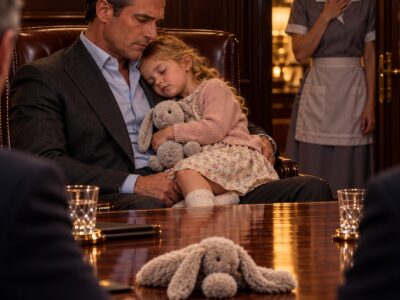
Nico climbed into the green leather chair beside him as if thirty years of organized crime had been created primarily to provide him comfortable furniture.
“Why are you sad?”
Alessandro stared.
Nico considered the matter.
Then brightened.
“You want a tattoo?”
I covered my mouth.
Something broke across Alessandro’s face.
He lifted Nico carefully onto his lap.
“Yes.”
His voice was barely audible.
“I think I would.”
Nico produced a sheet from his pajama pocket.
Children plan for emergencies differently than adults.
He selected a blue rocket.
Alessandro held out his forearm.
Nico pressed it beside the bird.
For thirty seconds, he counted badly.
“One, two, free, four…”
Alessandro closed his eyes.
When Nico peeled away the paper, the rocket leaned sideways.
“There.”
“Perfect,” Alessandro said.
“It goes to space.”
“I hope so.”
Nico rested his head against Alessandro’s chest.
Five minutes later he was asleep.
I stood across the room watching a man who had just discovered his oldest friend had betrayed him hold my child as carefully as something sacred.
That was when I made my first serious mistake.
I believed we had found the worst secret.
At two in the morning, my phone buzzed.
Unknown number.
A photograph loaded.
My bedroom window.
Taken from outside.
Through the glass, Nico could be seen asleep.
Below the photograph were five words.
TOO LATE TO BE LOYAL.
My scream woke half the wing.
Alessandro arrived first.
Barefoot.
Gun in his hand.
He saw the phone.
His face changed.
He ordered security doubled.
Then tripled.
Rooms changed.
Routes changed.
Staff credentials reset.
Bruno was told he was being placed on leave because of “health concerns.”
No confrontation.
Not yet.
Alessandro wanted evidence connecting him to Vitale and to what happened eleven years earlier.
But we had forgotten something.
A man trusted for thirty years does not need a key when he helped choose the locks.
Two days later the sun came out.
It was the first warm afternoon in weeks.
Nico played in the garden near Chiara’s lemon tree.
I hung laundry ten steps away.
A white delivery van came through the service gate.
Ordinary.
Approved.
The guards waved it past.
Later we learned the delivery code had not been used in nine years.
Bruno remembered it.
I heard Nico laugh.
Then a door slammed.
I turned.
A man was running toward him.
I dropped the laundry.
I remember shouting.
Someone grabbed me from behind.
A hand covered my mouth.
The world tilted.
I hit the grass.
When I opened my eyes, Mama Gina was kneeling over me with a cold towel.
The laundry basket lay upside down.
One of Nico’s tiny socks had landed near the fountain.
His red ball rolled slowly across the lawn.
My son was gone.
There are kinds of panic that make you scream.
There are kinds that make you silent.
I could not make a sound.
Alessandro came running from the house.
He moved faster than I thought a man his age could move.
He stopped beside the ball.
Then dropped to his knees.
He picked it up.
For several seconds he stared at it as if the toy might explain how history had found him again.
I saw Matteo in his face.
Not the child.
The loss.
“No,” he whispered.
I started crying.
“This is my fault.”
Alessandro looked up.
“I brought him here.”
He stood.
“Alina.”
“I took the job.”
“Stop.”
“I hid him in your house.”
He crossed the lawn and put both hands on my shoulders.
“Look at me.”
I couldn’t.
“Alina.”
I did.
“This is not your fault.”
“He was standing ten feet away.”
“The man who planned this is responsible.”
“If I had—”
“No.”
His grip tightened just enough to keep me present.
“I have spent eleven years blaming myself because I stayed behind for a meeting.”
His voice broke for the first time.
“I will not let you spend the rest of your life doing the same thing.”
Forty minutes later, Alessandro’s private phone rang.
He put it on speaker.
A smooth older voice filled the study.
“Alessandro.”
Salvador Vitale.
Alessandro’s face became stone.
“Where is the child?”
“Safe.”
In the background I heard something.
A small voice.
Nico.
My knees nearly gave way.
“He’s eating ice cream,” Vitale said. “Bruno has been very kind.”
Alessandro closed his eyes briefly.
“What do you want?”
“The docks.”
Silence.
“The contracts. The routing agreements. Names. Your signatures.”
Vitale sounded almost bored.
“By midnight.”
“Where?”
“Old fish warehouse. South pier.”
Alessandro looked toward his men.
Vitale continued.
“Come alone.”
No one moved.
“One weapon that is not mine, one vehicle I did not authorize, and you know what happens.”
Alessandro’s jaw tightened.
“I want to speak to Nico.”
A pause.
Then my son’s voice.
“Hello?”
I collapsed into the chair.
“Nico,” I said.
“Mama?”
“I’m here.”
“Bruno gave me chocolate.”
I cried into my hand.
“Are you okay?”
“Yes.”
“Did anybody hurt you?”
“No.”
“Listen to me. I love you.”
“I love you too.”
The phone changed hands.
Vitale returned.
“Midnight.”
The line went dead.
The study exploded into voices.
“We hit the warehouse.”
“No.”
“We have men on the pier.”
“No.”
“We take Vitale before he—”
“No!”
Alessandro’s voice silenced everyone.
He stood behind his desk.
“If one shot is fired, there is a three-year-old child standing in the middle of it.”
Nobody argued.
“Don, we cannot give him the docks.”
Alessandro looked at the man who said it.
“A dock can be rebuilt.”
Silence.
“A child cannot.”
He spent the next hour signing documents.
Real documents.
Transfer authority.
Port contracts.
Companies.
Assets.
Thirty years of control reduced to black ink.
I watched.
“You’re giving him everything.”
Alessandro did not look up.
“No.”
“What’s left?”
He signed another page.
“The thing that matters.”
At eleven, he carried the leather folder toward the door.
I followed.
“You cannot go alone.”
“I have to.”
“He’ll kill you.”
“Possible.”
“Alessandro.”
He stopped.
It was the first time I had used his first name.
He looked at me.
I had thought many things about that man.
Feared him.
Hated what he represented.
Resented his ability to solve problems with money I would never see.
Trusted him against my better judgment.
Now I could not bear the idea that Nico might come home and Alessandro might not.
“What aren’t you telling me?”
He gave the smallest smile.
“You’ve started asking dangerous questions.”
“Answer.”
He looked toward the men behind us.
“I finally learned not to tell everyone everything.”
Then he walked out.
I rode in a separate car.
Not to the warehouse.
Three blocks away.
No weapons.
No Romano men storming doors.
Only me, Mama Gina, a federal liaison I had never met, and a borrowed radio sitting in the dark.
I turned to the federal officer.
“What is happening?”
He hesitated.
Then said, “Mr. Romano made an arrangement.”
“What arrangement?”
“He gave us evidence.”
“What evidence?”
“Everything.”
My stomach dropped.
The night Alessandro discovered Bruno’s betrayal, he had made one phone call.
Not to a soldier.
Not to an ally.
To Judge Annelise Ferry.
A federal judge he had known for twenty years.
He had never asked her for a favor because he understood there were some relationships you protected by never using them.
He did not ask for a favor that night either.
He asked for a number.
Then he contacted federal prosecutors.
He gave them financial records.
Ledgers.
Shipping routes.
Accounts.
The entire architecture connecting Vitale to smuggling, extortion, corruption, and multiple deaths.
He also gave them his own records.
His own crimes.
His own signatures.
“Why?” I whispered.
The agent looked toward the warehouse.
“Because he wanted a legal team inside before Vitale could use the boy as leverage.”
“He’s destroying himself.”
The agent did not answer.
We both knew.
The radio crackled.
Footsteps.
A metal door.
Vitale’s voice.
“You came.”
Alessandro answered.
“I said I would.”
“Folder.”
“Where is Nico?”
Then—
“Mister!”
My hand flew to my mouth.
Nico sounded cheerful.
Alive.
Bruno’s voice came next.
Older than I remembered.
Tired.
“Alessandro.”
Silence.
“I wanted you to understand.”
“Understand what?”
“Why I did it.”
“You sold my family’s route to Vitale eleven years ago.”
My breath stopped.
Bruno said nothing.
Alessandro continued.
“Chiara and Matteo.”
“It wasn’t supposed to happen like that.”
“You always say that when consequences finally develop names.”
Bruno’s voice sharpened.
“You were going to pull back.”
“Eleven years ago?”
“You were talking about leaving the docks.”
Alessandro said nothing.
Bruno continued.
“You had Chiara. The boy. You were becoming cautious.”
“And that offended you?”
“It endangered everything.”
“So you gave Vitale the route.”
“To scare you.”
Alessandro’s voice went very quiet.
“He killed them.”
“I know.”
“You carried their coffins.”
The radio went silent.
Bruno whispered, “I know.”
My skin went cold.
Alessandro said, “The child leaves first.”
“Alessandro—”
“Whatever happens between us, Nico walks out before I sign anything over.”
A long silence.
Then Vitale said, “Sign first.”
“No.”
“You’re not in a position—”
“If you wanted a coward, you kidnapped the wrong man’s child.”
The radio crackled.
I could hear my own heart.
Then Alessandro said, “Nico.”
“Yes?”
“Remember your dinosaur?”
“Yes.”
“Is he brave?”
“The bravest.”
“Then you’re going to be brave like him.”
“I already am.”
Something inside me broke.
Alessandro laughed once.
Softly.
“I know.”
The radio suddenly cut out.
I stood.
“What happened?”
The federal agent pressed his earpiece.
Nobody answered me.
Seconds felt like hours.
Then the agent opened the car door.
“Move.”
We drove.
Later, people called it a raid.
That isn’t how I remember it.
I remember a fish-delivery truck parked beside a warehouse.
I remember men in dark jackets moving quickly but not shouting until doors were already controlled.
I remember discovering the contracts Alessandro carried were real, but prosecutors had photographed and timestamped every page before he left.
The handoff itself completed the conspiracy evidence they needed.
Vitale surrendered.
No gunfight.
No dramatic last stand.
He was too surprised.
Bruno sat on an overturned crate near the back wall.
Nico was asleep against his shoulder.
A half-melted ice cream cone lay on the floor.
Bruno had not hurt him.
That was the one part of Bruno I could understand and never forgive.
A man capable of selling his closest friend’s grief could still hum a lullaby to somebody else’s child.
I ran.
I don’t remember the distance.
I remember concrete beneath my shoes.
Diesel.
Salt.
My own voice repeating Nico’s name.
He stirred.
“Mama?”
I fell to my knees.
He climbed into my arms.
“Bruno said the dinosaur is brave.”
I held him so tightly he complained.
“I was brave too.”
“Yes.”
I kissed his hair.
“Yes, you were.”
Over his shoulder, I saw Alessandro.
He stood with the leather folder under one arm while agents moved around him.
His face looked exhausted.
But something else was there.
Peace.
He looked at Nico.
Then at me.
No words passed between us.
None were necessary.
Bruno was arrested.
Vitale was arrested.
Dario was picked up two days later.
He cooperated almost immediately.
I expected to feel satisfaction.
I felt tired.
Alessandro’s consequences came more slowly.
He had not traded information for immunity.
That mattered to him.
When his lawyers tried to negotiate too aggressively, he dismissed one.
He pleaded guilty to financial conspiracy, obstruction, and crimes connected to businesses he had spent years pretending he could control without being responsible for everything they did.
The cooperation agreement reduced what could have been a much longer sentence.
It did not erase it.
Six months later, I sat in the courtroom behind Mama Gina while Alessandro answered questions under oath.
No dark suit worth ten thousand dollars.
No men flanking him.
Plain gray jacket.
No watch.
No rings.
The prosecutor asked about accounts.
He answered.
Shipments.
He answered.
Payments to officials.
He answered.
His father.
Bruno.
Vitale.
He answered.
Then the prosecutor asked:
“Mr. Romano, why did you come forward?”
Alessandro looked toward the gallery.
For a second, his eyes found Nico beside me.
Nico was coloring.
A dinosaur.
Alessandro turned back.
“Because I spent most of my life telling myself there was a difference between the things I ordered and the things I allowed.”
The courtroom went silent.
“There was a difference.”
He swallowed.
“Just not enough of one.”
He received forty-two months.
With credit and later adjustments, he would serve a little over three years.
The judge’s voice shook slightly when she imposed the sentence.
Judge Ferry.
The woman he had trusted enough to destroy himself honestly.
Alessandro asked me for one thing before marshals led him away.
“Take the house.”
I almost laughed.
“No.”
“Alina.”
“Absolutely not.”
“Nico likes the kitchen.”
“Nico also likes garbage trucks. I am not accepting one.”
Mama Gina coughed to hide a laugh.
Alessandro looked exhausted.
“Then what?”
We argued for two weeks through attorneys and monitored calls.
Eventually we reached the kind of compromise stubborn people call reasonable only after everyone is too tired to continue.
The estate went into an independent charitable trust.
Not my trust.
Not Alessandro’s.
A foundation.
Temporary housing for single parents escaping coercion and debt-related threats.
Legal services.
Childcare.
Job placement.
The staff wing became family apartments.
The old ballroom became classrooms and offices.
Mama Gina insisted on running the kitchen.
Nobody was brave enough to stop her.
Señora Peña never paid for medication again, though she complained loudly about “mysterious donors.”
The lemon tree remained in the garden.
That condition came from Alessandro.
I allowed it.
The first time I took Nico to visit him, it was early spring.
He was four by then.
The visiting room was bright in the unpleasant way institutional places often are.
Gray tables.
Plastic chairs.
A vending machine that hummed constantly.
Alessandro entered wearing a plain shirt.
Sleeves rolled up.
His tattoos looked strange without the expensive surroundings.
More human.
Nico saw him and ran.
I barely caught his jacket.
“Walking feet!”
He ignored me.
Alessandro crouched.
Nico climbed onto the chair beside him.
“I brought you something.”
Alessandro looked at me.
I shrugged.
Nico reached into his pocket and produced a small paper packet.
Temporary tattoo.
A green dinosaur.
“Like mine.”
Alessandro stared at it.
“So we match.”
For several seconds he said nothing.
Then he held out his forearm.
“Where?”
Nico inspected the old ink.
“By the bird.”
Alessandro nodded.
“Good place.”
Nico pressed the wet paper against his skin.
He counted to thirty.
Mostly correctly now.
When he peeled it away, a crooked green dinosaur appeared beside the black bird.
Alessandro looked at it.
Then at Nico.
And he laughed.
Not the enormous laugh from the study years earlier.
This one was quieter.
Warmer.
The laugh of a man no longer startled by his own happiness.
“Now I have two.”
Nico pointed.
“Dinosaur is braver.”
Alessandro looked over Nico’s head at me.
His eyes were bright.
“Yes.”
He held my gaze.
“I think he is.”
We visited once a month.
Sometimes twice.
I never promised Alessandro a future.
He never asked for one.
That mattered.
He wrote Nico letters.
Short ones.
Mostly terrible drawings.
A bird.
A dinosaur.
Once something he claimed was a boat and Nico insisted was a potato.
He wrote to me too.
Those letters were different.
He never wrote that prison changed him.
He disliked easy sentences.
Instead he wrote about ordinary things.
Books.
The sound of rain on the narrow window.
How strange it felt to stand in line.
How much he hated powdered eggs.
Once he wrote:
I spent thirty years believing freedom meant having enough power that nobody could tell me no.
Turns out freedom may be knowing somebody can tell you no and staying anyway.
I read that letter three times.
I did not answer for a week.
Then I wrote:
That sounds suspiciously like growth. Don’t get dramatic about it.
His reply arrived ten days later.
Impossible. I’m Italian.
I laughed in my kitchen.
Nico asked why.
“Nothing.”
“Is it Mister Tattoos?”
I looked at him.
“Mister Tattoos?”
“That’s what I call him.”
Of course.
Three years and three months after the raid, Alessandro Romano walked out of federal custody carrying one cardboard box.
No convoy.
No bodyguards.
No black sedans.
Mama Gina wanted to rent a limousine.
I threatened to cancel the trip if she did.
So we drove my Honda.
Nico was seven.
He sat in the back holding a handmade sign he refused to show me.
Alessandro appeared outside the gate.
Older.
Thinner.
Gray at both temples now.
He looked around once.
Then he saw us.
Nico rolled down the window.
“HEY, MISTER TATTOOS!”
Alessandro stopped.
Then laughed.
I parked.
Nico launched himself out before I fully stopped the engine.
Alessandro caught him.
Nearly fell.
“You got heavy.”
“You got old.”
“I see prison did nothing for your manners.”
Nico held up the sign.
WELCOME HOME DINOSAUR MAN
Alessandro looked at me.
“Your parenting.”
“Entirely.”
He set Nico down.
Then we stood facing each other.
For years, every interaction between us had contained something else.
Employer.
Employee.
Don.
Maid.
Protector.
Protected.
Prisoner.
Visitor.
Now there was nothing.
Alessandro glanced toward the car.
“You came.”
“You noticed.”
“I wasn’t sure.”
“Neither was I.”
He nodded.
Good answer.
He never punished uncertainty anymore.
The foundation had purchased a smaller property during his final year inside.
The old estate had become too expensive to maintain as housing, so most of it was eventually sold to fund programs.
The garden acreage remained with the foundation.
Including the lemon tree.
We drove there first.
Alessandro stood beneath it.
For eleven years the tree had refused to produce fruit.
Then, during his second year in prison, Mama Gina called me screaming.
Three lemons.
Small.
Ugly.
Perfect.
We had refused to pick them until they fell naturally.
That spring, the branches were covered in blossoms.
Alessandro touched one.
“Chiara would be unbearable about this.”
I smiled.
“She’d say she won.”
“She always did.”
Nico ran through the garden.
Alessandro watched him.
“You did all this.”
“No.”
I shook my head.
“We did.”
He looked at me.
“The foundation board. Mama Gina. Lawyers. People who actually know what they’re doing.”
“That excludes you?”
“I know how to clean a fourteen-bedroom house and negotiate preschool tantrums.”
“You also stood in front of federal prosecutors and refused to let them turn Dario’s crimes into yours.”
“That was anger.”
“Useful skill.”
We walked toward the stone bench.
Chiara’s plaque remained.
Alessandro sat.
I sat beside him.
He looked toward Nico.
“Can I ask you something?”
“You just did.”
He smiled.
“Still impossible.”
“Prison made you slow.”
He laughed.
Then became serious.
“Dinner.”
I waited.
“With me.”
“That sounds familiar.”
“I am attempting to ask rather than decide.”
“Very advanced.”
“Alina.”
I looked at him.
There was nervousness in his hands.
Tiny.
Almost invisible.
I had spent years cleaning houses.
Raising a child.
Living around men who believed control was the same thing as strength.
I had learned to watch hands.
“Yes,” I said.
Alessandro blinked.
“You didn’t even let me finish.”
“I’ve had three years.”
That silenced him.
I continued.
“One dinner.”
“One.”
“No private restaurant closed for us.”
“Fine.”
“No five-course nonsense.”
“Cruel.”
“No bodyguards at the next table.”
He hesitated.
“Alessandro.”
“Fine.”
“And you do not buy me anything.”
He looked offended.
“Food?”
“You may purchase the food.”
“Generous.”
I smiled.
“One dinner.”
He held out his hand.
Not to shake.
Just there.
An offer.
I placed mine inside it.
Nico came running toward us.
“Mama!”
“What?”
“Mister Tattoos needs a new one.”
Alessandro looked at his bare forearm.
The temporary dinosaur from prison had disappeared years earlier.
Nico produced another packet.
This one was a blue shark.
Alessandro frowned.
“I thought we were dinosaur men.”
“I’m older now.”
“Betrayal.”
“Sharks are cooler.”
Alessandro looked at me.
“Do I have a choice?”
I raised an eyebrow.
“What did we learn about choices?”
He sighed.
Then held out his arm.
“Yes.”
Nico grinned and slapped the wet paper onto his skin.
We waited thirty seconds.
When he peeled it away, the shark was crooked.
Very crooked.
Alessandro stared at it.
Nico waited anxiously.
“Well?”
Alessandro nodded.
“Terrifying.”
Nico smiled.
I watched Alessandro laugh beneath the lemon tree his wife had planted, with his dead son’s memory still present and my living child’s hand wrapped around his wrist.
Nothing had been erased.
That mattered.
Chiara was still dead.
Matteo was still dead.
Alessandro had still done terrible things and paid only part of the price those choices deserved.
Dario remained Nico’s biological father, though supervised contact would come years later only after treatment, restitution, and more changes than I had once believed him capable of making.
Bruno spent the rest of his life in federal custody.
Salvador Vitale died there.
There was no clean ending.
Real life rarely offers one.
What we got instead was something harder.
A future that did not pretend the past had never happened.
Nico grew up knowing Alessandro had once been a powerful man.
He also grew up knowing power was not the part worth admiring.
The story he loved most was still the first one.
How he marched into a forbidden office in dinosaur socks.
How his mother nearly fainted.
How armed guards panicked.
How the frightening man behind the desk looked at three cheap temporary tattoos and laughed so hard he had tears in his eyes.
When Nico was twelve, he asked Alessandro why he had laughed.
We were eating dinner at the small house Alessandro eventually bought two blocks from the foundation.
Nothing enormous.
Three bedrooms.
A normal kitchen.
No armed guards.
Alessandro put down his fork.
“I hadn’t laughed in eleven years.”
Nico frowned.
“That’s unhealthy.”
“Apparently.”
“Why me?”
Alessandro looked at him.
“Because you didn’t know who I was.”
“I knew you were Mister Tattoos.”
“Exactly.”
Nico waited.
Alessandro leaned back.
“Everyone else saw something when they looked at me.”
“What?”
“Money. Danger. Authority. A problem. A solution.”
He smiled.
“You saw a bird tattoo and thought your dinosaur was better.”
“It was.”
“It absolutely was.”
Nico smiled.
Alessandro’s expression softened.
“For about thirty seconds, I wasn’t the person everyone expected me to be.”
He looked toward me.
“I was just a man with bad tattoos being judged by a toddler.”
I laughed.
Nico considered this.
“You still have bad tattoos.”
“Thank you.”
“And Mom says the shark looked stupid.”
I nearly choked.
“I did not say stupid.”
“You said unfortunate.”
Alessandro pointed at me.
“Cruel woman.”
By then the temporary shark was long gone.
The bird remained.
So did the date in Roman numerals.
Matteo’s birthday.
Alessandro never covered it.
He never covered Chiara’s name either.
Love did not require pretending one life began only after another ended.
Years earlier, I had thought safety meant finding a place where nothing bad could reach us.
The Romano estate had proved how foolish that idea was.
Fortresses fail.
Guards betray.
Locks remember old codes.
Money can buy protection and still fail to purchase peace.
Safety, I eventually learned, was something more ordinary.
It was people who told the truth when lies would be easier.
People who asked instead of ordered.
People who admitted when they were wrong.
People willing to lose power rather than sacrifice someone smaller to keep it.
One spring afternoon, long after the house had stopped belonging to any Romano, I visited the foundation garden alone.
The lemon tree was heavy with fruit.
Actual lemons.
Bright yellow.
Ridiculous.
I picked one.
Mama Gina shouted at me from the kitchen window.
“Those are mine!”
“You have twelve.”
“All mine!”
I laughed.
Near the stone bench, children from one of the foundation’s family-housing programs were drawing with chalk.
A boy had covered both arms with marker.
Dinosaurs.
Stars.
Suns.
I stood very still.
Then I heard Alessandro behind me.
“What?”
I pointed.
He saw the boy.
For a moment, all the years between then and now disappeared.
The dark study.
Rain against windows.
Nico’s dinosaur socks.
My hand gripping the vacuum cleaner.
Alessandro smiled.
“You know,” he said, “for a woman who hated that house, you remember a lot about it.”
“I remember the important parts.”
“Such as?”
I handed him the lemon.
“The morning my son nearly got me fired.”
“I never planned to fire you.”
“I did not know that.”
“I was busy being judged by a dinosaur.”
I smiled.
The boy in the garden ran toward another child and shouted about his tattoos.
Alessandro looked down at his own arms.
He had not added any permanent ink since Matteo died.
Not one mark.
There had been temporary dinosaurs, rockets, sharks, and whatever Nico decided he needed.
But nothing permanent.
I once asked why.
He answered, “I spent too many years thinking pain needed a monument.”
That day beneath the lemon tree, I understood what he meant.
Some memories belonged in ink.
Others survived perfectly well in laughter.
Alessandro took my hand.
The children shouted somewhere across the lawn.
Mama Gina argued with someone through an open kitchen window.
Cars moved along the road beyond the old wall.
Ordinary sounds.
A life no one would have associated with Alessandro Romano when I first met him.
He squeezed my hand.
“What are you thinking?”
I looked at him.
“The first thing Nico ever said to you.”
Alessandro smiled.
“He was rude.”
“He was three.”
“Still rude.”
I laughed.
Then, in the exact serious voice Nico had used all those years earlier, I said:
“Mister, look. I have tattoos just like you.”
Alessandro’s head dropped.
His shoulders shook.
And once again, the man an entire city had once been afraid of burst out laughing.
Only this time, nobody reached for a gun.
Nobody froze in a hallway.
Nobody wondered whether laughter was allowed.
It simply belonged there.