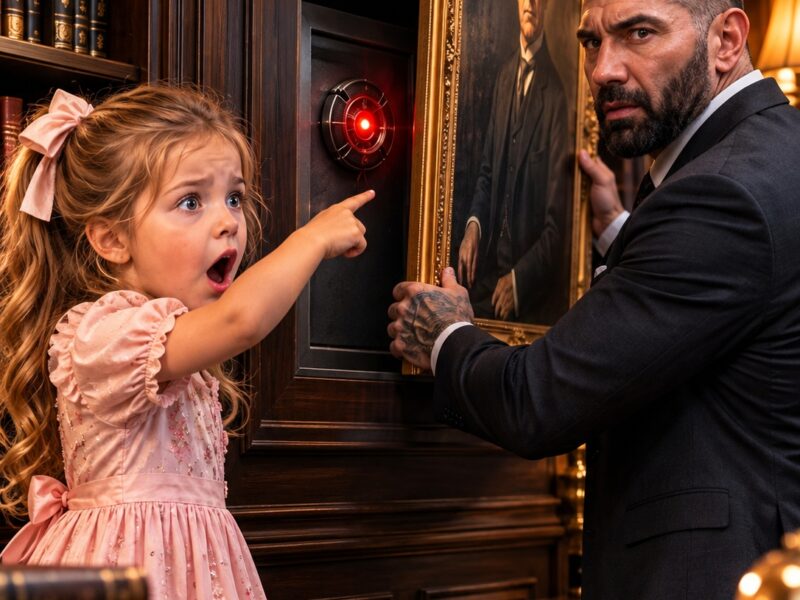
“A Bad Guy Was Here,” the Little Girl Told the Mafia Boss—Then He Looked Behind His Brother’s Painting and Found the Secret His Family Had Buried for Thirty Years
Dante had come looking for anything that might explain who killed his younger brother, but the child across the street had been recording details no adult thought mattered.
What he found behind that painting would eventually force him to choose between avenging Enzo’s death and exposing the person who had spent his entire life teaching him what family loyalty meant.
“A bad guy was here.”
Dante Rizzo stopped with one hand on the light switch.
Sofia Vega stood six feet inside his dead brother’s apartment in pink sneakers, a navy school sweater buttoned one hole wrong, and a black-and-white composition notebook pressed against her chest. She was eight years old and looked at the room with the concentration of someone checking arithmetic.
Her mother, Marisol, caught up from the hallway.
“Sofia.”
The girl pointed.
“That painting moved.”
Dante looked toward the far wall.
A framed oil painting of Lake Michigan hung above a narrow bookcase. It had belonged to Enzo for years—a cheap harbor scene bought at a church sale because his younger brother liked the crooked red sailboat in the foreground.
Nothing about it appeared unusual.
Marisol placed a hand on her daughter’s shoulder.
“We came to leave the notebook, Mr. Rizzo. That’s all.”
Dante barely heard her.
“How do you know?”
Sofia looked at him.
“The top corner used to touch the crack.”
“What crack?”
She crossed the room before Marisol could stop her.
There was a hairline fracture in the plaster above the frame, nearly invisible in the dim afternoon light.
Sofia tapped the wall beside it.
“The gold corner used to be under that.”
Dante stepped closer.
The painting hung perhaps half an inch lower than it should have.
Marisol said quietly, “Sofia notices things.”
Dante lifted the frame.
Behind it, a pale rectangle marked the wall where dust had not settled.
Someone had removed the painting recently.
And taped to the plaster behind it was a small brass key.
Dante did not move.
Three days earlier, he had stood at St. Jerome’s Church while one hundred forty people watched Father Bellini bless his brother’s coffin. He had listened to the priest say that Enzo Rizzo had gone home to God and wondered why heaven should have the only decent man in a family that had spent two generations teaching decent men to become useful ones.
Enzo had been twenty-nine.
Cook.
Amateur baker.
Collector of old cookbooks.
The kind of man who brought soup to neighbors and left pastries anonymously outside the apartments of widows because accepting thanks embarrassed him.
At 7:10 on the first evening of October, he had stepped onto Wallace Street carrying groceries.
A gray sedan rolled forward from the curb.
Witnesses heard sharp noises and saw Enzo collapse.
The car disappeared before the oranges from his grocery bag finished rolling into the gutter.
Police had no reliable plate.
No useful camera.
No face.
Dante had something else.
Thirty years of people being afraid to disappoint him.
That usually produced answers quickly.
This time it had produced rumors.
The Marchesi family.
A port dispute.
A union grievance.
A retaliatory message.
Each explanation sounded plausible enough to become dangerous.
Now an eight-year-old girl was staring at a key taped behind Enzo’s painting.
Dante removed it carefully.
A white paper tag hung from the ring.
314
No name.
No location.
Sofia said:
“That wasn’t there before.”
Dante looked at her.
“You saw behind the painting?”
“No.”
“Then how do you know?”
“Because Mr. Enzo hated tape on walls.”
Marisol closed her eyes.
“Sofia.”
“He did.”
The girl sounded mildly offended by the challenge.
“He said tape pulls paint off.”
Dante almost smiled.
Almost.
Instead he asked:
“When were you last in here?”
“September twenty-seventh.”
Marisol’s head turned.
“You never told me you came inside.”
“I brought his book back.”
“What book?”
Sofia held up the composition notebook.
Dante looked at it.
There were twenty more like it across the street in the Vega apartment.
He knew because Enzo had mentioned them once.
There’s a kid who watches cars, he had said.
Writes down every plate.
Dante had laughed.
Enzo had not.
“She pays attention,” his brother told him. “That’s rarer than being smart.”
Dante held out his hand.
“May I?”
Sofia pulled the notebook closer.
“No.”
Marisol inhaled.
“Sofia.”
“It’s mine.”
Dante lowered his hand.
“You’re right.”
That surprised both mother and daughter.
Dante Rizzo was forty-six, six-foot-three, broad through the shoulders, gray beginning at the temples. He had spent most of his adult life in rooms where people treated his requests as decisions already made.
He crouched so his eyes were closer to Sofia’s.
“Can you tell me what’s in it?”
The girl considered.
“Cars.”
“What kind?”
“All kinds.”
“From Wallace Street?”
She nodded.
“Did you write down the gray car?”
Marisol’s fingers tightened on her daughter’s shoulder.
Sofia’s expression changed.
Not fear.
Recognition.
“Yes.”
“How many times?”
“Eleven before that day.”
Dante stopped breathing.
Marisol stepped between them.
“That’s enough.”
“Ms. Vega—”
“No.”
Her voice was low.
Flat.
The controlled tone of an emergency-room nurse who had spent twelve years making frightened relatives obey her without realizing they were obeying.
“My daughter is not evidence.”
Dante looked at her.
“She may have seen the people who killed my brother.”
“And you are exactly the reason I don’t want her telling you.”
The room went still.
Dante’s driver, Salgado, waited downstairs.
Two Rizzo men occupied the lobby.
Marisol knew who they were.
Everyone in that neighborhood knew.
Dante said:
“I am not going to hurt your daughter.”
“That is not what I’m afraid of.”
“What are you afraid of?”
“What you do after she talks.”
There was no accusation in her face.
That made it harder.
Dante looked down at the key in his palm.
Then at Enzo’s kitchen.
Rosemary still sat in a clay pot near the window.
A loaf of bread had hardened on the counter.
A blue ceramic bowl contained six oranges, one beginning to soften.
Sofia whispered:
“Mr. Enzo didn’t like oranges.”
Dante turned.
“What?”
“He liked clementines.”
Something cold passed through him.
“How do you know?”
“He gave them to me.”
The girl looked toward the bowl.
“Those are regular oranges.”
Marisol touched her daughter’s back.
“We’re leaving.”
Dante stood.
He did not block them.
At the apartment door, Sofia stopped.
She looked at the painting still lifted from its hook.
Then at Dante.
“The bad guy didn’t find the key.”
“How do you know?”
“Because it’s still there.”
She walked away.
Dante remained in Enzo’s apartment with the brass key in his hand and the first useful question anyone had given him since the funeral.
If somebody had searched the room but missed the key, what had they been looking for?
The answer began across the street.
The Vega apartment was small enough that every room borrowed sound from the others.
Marisol heard Sofia sharpening a pencil at the kitchen table while she heated soup and stared at the dark window.
Across Wallace Street, lights remained on in Enzo’s apartment.
Dante Rizzo was still inside.
That frightened her more than if he had left quickly.
Men like Dante were supposed to act.
A threat.
A car.
A name.
Then consequence.
Waiting suggested doubt.
Doubt made powerful men unpredictable.
Sofia said:
“He listened.”
Marisol turned.
“To what?”
“When I said the painting moved.”
“That does not mean you trust him.”
“I didn’t say I trust him.”
Her daughter continued sharpening.
“You always add things I didn’t say.”
Marisol almost smiled.
That was Sofia.
Literal when adults wanted implication.
Precise when people preferred comfort.
She had been that way since she learned to speak.
At three, she lined toy cars according to how often they passed the apartment window.
At five, she corrected a preschool teacher who claimed Tuesday had been sunny because Sofia remembered the rain began during snack.
At seven, she started writing license plates.
Not because anyone asked.
Because patterns soothed her.
Enzo encouraged it.
He gave her the first composition notebook one July afternoon.
Marisol had been working an overnight shift.
Mrs. Okafor from 2C watched Sofia.
Enzo found the girl sitting on the front steps writing car colors on the back of grocery receipts.
He returned ten minutes later with three notebooks and a packet of pencils.
“You’re a person who notices,” he told her.
“The world has enough people who guess.”
That sentence had become scripture to Sofia.
Now Enzo was dead.
And the man people whispered about had asked to see the notebook.
Marisol put soup on the table.
“From now on, you don’t talk to Mr. Rizzo unless I’m there.”
Sofia frowned.
“Why?”
“Because adults can take your words and use them for things you didn’t mean.”
“Like lying?”
“Sometimes.”
“Does he lie?”
“I don’t know.”
Sofia thought.
“He said he wasn’t sure.”
“About what?”
“If he would hurt somebody.”
Marisol froze.
“When?”
“Before.”
She had not heard that exchange.
Sofia added:
“He didn’t say no.”
Marisol looked toward the window.
Across the street, Dante emerged from Enzo’s building.
He stood under the streetlight.
Looked up.
Not directly at them.
Near enough.
Then climbed into his car.
The black sedan drove away.
Marisol released a breath.
The following morning, Dante brought the brass key to a locksmith who did not ask questions.
It belonged to a commercial safe-deposit locker.
Older model.
Likely bank or private storage.
Number 314 was not enough.
Dante asked Salgado to search discreetly.
Salgado had been with the Rizzo family thirty-one years.
Fifty-eight.
Heavy shoulders.
Silver hair.
Spoke rarely.
He had driven Dante to school when Dante was fourteen.
Had taught Enzo to ride a bicycle.
Had carried Dante’s father’s coffin.
If Dante trusted anyone without checking the reason, it was Salgado.
“Every locker company in Cook County?”
Salgado asked.
“Start near Federal Plaza.”
“Why?”
Dante looked at the key.
“Enzo was hiding something.”
Salgado’s expression did not change.
“What?”
“If I knew, we wouldn’t be searching.”
Salgado nodded.
By afternoon, he found the match.
Private records facility on Dearborn.
Locker 314.
Registered not to Enzo.
To attorney Miriam Hale.
Dante knew the name only faintly.
Federal defense work.
Whistleblower cases.
Labor corruption.
That combination made his stomach tighten.
He called before visiting.
Miriam Hale answered herself.
“You are Enzo’s brother.”
Not a question.
“You knew him.”
“Yes.”
“I found a key.”
Silence.
“Where?”
“Behind a painting.”
Longer silence.
“Come tomorrow.”
“Today.”
“Tomorrow.”
“I don’t wait well.”
“I know.”
Her voice remained dry.
“That was one of the things Enzo worried about.”
Dante’s fingers tightened.
“What did my brother tell you?”
“Tomorrow, Mr. Rizzo.”
She hung up.
That evening, Vinnie Rizzo arrived at Dante’s house furious.
Dante’s cousin had heard about the gray sedan from one of the men who heard about it from Salgado, which was how information traveled in families that believed loyalty and gossip were opposites.
“Marchesi.”
Vinnie slapped a photograph onto the kitchen table.
Gray Chevrolet Malibu.
Registered to Calabrese Towing & Salvage.
Cicero.
Anthony Calabrese was Tony Marchesi’s brother-in-law.
The Marchesi family had used the salvage yard for years.
Dante stared at the image.
“What do we know?”
“That car was logged entering Calabrese property in August.”
“And leaving?”
“No exit record.”
“Then?”
“Plate shows up in front of Enzo’s building eleven times.”
“That came from Sofia.”
Vinnie stopped.
“The kid?”
“Yes.”
“You’re trusting an eight-year-old?”
“I’m trusting records.”
Vinnie laughed without humor.
“She writes license plates for fun.”
“That does not make them wrong.”
“Your brother is buried, Dante.”
“I attended.”
“Then act like it.”
Dante looked at him.
Vinnie lowered his voice.
“They are laughing at us.”
“Who?”
“Everybody.”
“Name one.”
Vinnie’s face reddened.
Dante continued.
“You keep telling me what people think because you want me to stop asking what we know.”
Silence.
Vinnie sat.
“We know the car.”
“We know the plate.”
“Not the driver.”
“Not the passenger.”
“Not whether it was the same physical car each time.”
Vinnie stared.
“What does that mean?”
Dante remembered Sofia.
The bad guy didn’t find the key because it’s still there.
Details.
Not stories.
“I don’t know yet.”
That night Dante dreamed of oranges rolling along a curb.
The next morning, Miriam Hale met him at seven.
She was fifty-five, small, sharp-faced, with reading glasses hanging from a black cord. Her office near Federal Plaza looked almost aggressively ordinary.
No art worth stealing.
Metal filing cabinets.
Coffee strong enough to remove paint.
Dante placed the key on her desk.
Miriam did not touch it.
“Enzo told me you might come eventually.”
“Eventually?”
“He hoped he would come first.”
Dante felt a pressure behind his sternum.
“What was he doing with you?”
“Preparing.”
“For what?”
“To tell the truth.”
Dante’s face stayed still.
“What truth?”
Miriam studied him.
“Before I answer, I need to know whether you came as his brother or as the head of the Rizzo organization.”
“They are the same man.”
“That was his problem.”
The sentence irritated him because it was true enough to feel personal.
Miriam opened a drawer.
Removed a photocopy.
Gray sedan.
License plate written beneath.
Same as Sofia’s.
“Enzo came in August.”
“He believed money had been diverted from a union pension account connected to several businesses your family influenced.”
Dante’s jaw tightened.
“How much?”
“Millions over decades.”
“My father’s time?”
“Beginning then.”
“Continuing now.”
“Who?”
“Enzo didn’t know all names.”
“He knew enough.”
“Did he accuse me?”
“No.”
That answer hurt in a different way.
“He was afraid to tell you because he loved you.”
Dante looked toward the window.
“Love makes people strange accountants.”
Miriam said nothing.
“What is in locker 314?”
“Documents Enzo asked me to preserve.”
“Why hide the key?”
“He believed someone had searched his mail.”
“Did he know who?”
“No.”
“Did he mention Marchesi?”
“Only as an obvious suspect if something happened.”
Dante looked back.
“Obvious?”
“He said the obvious answer worried him.”
Miriam finally touched the key.
“There was another matter.”
“What?”
“A thirty-year-old disappearance.”
Dante went still.
“Who?”
“Isaac Brandt.”
The name belonged to childhood.
Union organizer.
Friend of Dante’s father.
Disappeared in 1994.
Rumor said Mexico.
Gambling debt.
Another woman.
Nobody knew.
Dante remembered Brandt as a loud man who brought cannoli and let children steal cherries from his drink.
“What does Enzo have to do with Brandt?”
Miriam’s eyes softened.
“I cannot give you all of it yet.”
“Why?”
“Because your brother gave written instructions.”
“If he died before his scheduled meeting with federal prosecutors, I was to deliver the materials through counsel.”
“Not to you.”
Dante’s voice cooled.
“He is dead.”
“I am aware.”
“He wanted to tell me first.”
“Yes.”
“Then tell me.”
“Not yet.”
He stood.
Miriam did not flinch.
“Mr. Rizzo, if I thought intimidation would persuade me, I would never have represented your brother.”
Dante looked at her.
Then sat again.
That surprised her.
“Fine.”
“What can you tell me?”
Miriam slid the key back.
“Your brother planned to meet prosecutors October third.”
Two days after he died.
“He planned to tell you September thirtieth.”
Dante looked at the date.
The day before Enzo was killed.
“Did he?”
“I don’t know.”
“No.”
Dante whispered.
“He didn’t.”
Miriam leaned forward.
“Then find out what happened September twenty-ninth and thirtieth.”
The number stayed with him.
September twenty-ninth.
Back on Wallace Street, Sofia had a notebook for every month.
Dante did not go immediately.
He called Marisol.
She answered from the hospital.
“No.”
“I haven’t asked yet.”
“You were going to ask about the notebooks.”
“Yes.”
“No.”
“Ms. Vega.”
“My daughter slept four hours last night because she thinks a murderer knows she saw his car.”
Dante closed his eyes.
“I did not know that.”
“Now you do.”
“What would make you comfortable?”
“Nothing involving you.”
Fair.
He waited.
Silence.
Then Marisol sighed.
“Come tonight.”
“Alone.”
“I will.”
“And if I see one man in a dark coat anywhere near my building, conversation ends.”
“Understood.”
“Seven-thirty.”
She hung up.
At 7:29, Dante stood alone on the landing.
Marisol opened the door.
No smile.
Sofia sat at the kitchen table arranging colored pencils.
Dante removed his coat.
Waited.
Marisol pointed to a chair.
“Sit.”
He did.
Sofia looked up.
“You’re early by one minute.”
“My watch is fast.”
“Then you’re not early.”
Dante almost smiled.
“September twenty-ninth.”
he said.
Sofia’s hand stopped.
“Notebook eighteen.”
She went to shelf.
Marisol said:
“You do not hand it to him.”
Sofia nodded.
Opened it herself.
Turned pages.
September twenty-ninth.
Rows of time.
Vehicles.
Pedestrians.
Delivery trucks.
At 2:15:
BLACK LINCOLN — HSN 208
Dante’s chest tightened.
“Black Lincoln?”
Sofia nodded.
“Not gray.”
“No.”
“Whose?”
“I don’t know.”
“Did you see anyone?”
“A man drove.”
“Big.”
“Gray hair.”
Dante’s mind offered Salgado.
He rejected it.
Too fast.
“Anyone else?”
Sofia traced a finger down the page.
“A lady.”
“What lady?”
“Old.”
Marisol looked at Dante.
“Older than Mom.”
Sofia continued.
“Black coat.”
“Black scarf.”
“She had a bag.”
“What kind?”
“Paper.”
“What was inside?”
Sofia looked confused.
“I couldn’t see through paper.”
Dante corrected himself.
“Did you see anything from the bag?”
“One orange fell.”
The room changed.
Marisol felt it.
“What?”
Dante did not answer.
His mother brought oranges.
To hospitals.
Funerals.
Neighbors.
Priests.
Every Sunday dinner ended with fruit.
He looked at the line again.
HSN 208.
The family’s black Lincoln.
No.
There were dozens.
Could be similar.
“Did the woman go into Enzo’s building?”
“Yes.”
“How long?”
“Eleven minutes.”
“How do you know?”
“I wrote when she went in and when she came out.”
“Was Enzo with her?”
“When she came out, he stood in doorway.”
“What happened?”
“She was crying.”
Dante’s mouth went dry.
“Could you hear them?”
“No.”
“What happened after?”
“She left.”
Sofia turned page.
Then stopped.
“What?”
Dante asked.
Her forehead tightened.
“There should be another note.”
“What note?”
“I drew a star.”
“Why?”
“Car was parked wrong.”
She pointed.
No star.
Marisol leaned closer.
“Maybe you forgot.”
Sofia looked offended.
“I don’t forget stars.”
Dante looked toward binding.
One page edge seemed uneven.
“May I?”
Sofia hesitated.
Then pushed notebook across.
Dante opened center seam.
A sheet had been removed.
Not torn by a child.
Cut close to stitching.
Cleanly.
Marisol’s face drained.
“That wasn’t like that.”
“When did you last check?”
Sofia answered immediately.
“Saturday.”
“And today?”
“Wednesday.”
Someone had entered apartment.
Marisol stood.
“Get your backpack.”
“Mom?”
“Now.”
Dante rose.
“Wait.”
“No.”
“Marisol.”
She turned.
“I told you.”
Her voice broke for first time.
“I told you what would happen if you brought this to my door.”
“I came alone.”
“That does not mean your world did.”
Sofia had stopped moving.
Dante lowered his voice.
“Do you have somewhere safe?”
“Yes.”
“Do I know where?”
“No.”
“Good.”
Marisol stared.
Dante took out his phone.
Called Salgado.
“S.”
“Boss.”
“Where are you?”
“Home.”
“You sure?”
Pause.
“Yes.”
Dante looked at cut page.
“Stay there.”
He ended call.
Marisol saw his expression.
“You think someone close to you did this.”
“I think someone knew enough to look.”
Sofia whispered:
“The bad guy came here too.”
Marisol knelt.
“No, baby.”
“Somebody cut my book.”
“I know.”
“Bad people cut things because they don’t want the page.”
Dante looked at the girl.
She was not frightened in the theatrical way adults expected children to be.
She was offended by the violation of order.
Dante asked:
“Do you remember the missing page?”
Sofia closed her eyes.
Marisol said:
“Don’t pressure her.”
“I’m not.”
Sofia began.
“September twenty-ninth.”
“No.”
Dante said.
“The cut page.”
“September twenty-eighth.”
She opened eyes.
“There was a gray car.”
Same plate.
“Dent?”
“Left back.”
“Wheel covers?”
“Plain.”
“Anything else?”
“A man standing beside it.”
“Who?”
“I don’t know his name.”
“Have you seen him?”
“Yes.”
“Where?”
Sofia pointed toward downstairs.
“The lobby.”
Dante felt cold.
“Salgado?”
“I don’t know his name.”
“Big man?”
“Yes.”
“Gray hair?”
“Yes.”
Marisol stared at Dante.
Dante called Salgado again.
No answer.
For thirty-one years, Salgado answered by second ring.
Always.
Dante said:
“Pack.”
Marisol did not argue.
Sofia went to bedroom.
Dante stood by window.
A black Lincoln was parked half a block away.
Engine running.
Plate:
HSN 208.
He knew that plate.
He had ridden behind it every Sunday for years.
His mother’s car.
A figure leaned against driver door.
Salgado.
Looking directly at the building.
Dante stepped away from window.
Marisol whispered:
“What?”
“Go now.”
“Where?”
“Anywhere I don’t know.”
She studied him.
“You’re serious.”
“Yes.”
“What are you going to do?”
Dante looked at Sofia’s cut notebook.
“For once?”
he said.
“Nothing quickly.”
They left through back stairwell.
Dante watched from window until Marisol’s car disappeared.
Only then did he walk downstairs.
Salgado stood in lobby.
“Boss.”
“Why are you here?”
“Your mother worried.”
“She asked me to watch.”
“Why?”
“Because the girl knows things.”
Dante looked at him.
“What things?”
Salgado’s face did not change.
“That’s what I’m supposed to find out.”
The answer arrived too easily.
Dante stepped closer.
“Did you go into their apartment?”
“No.”
“Did you take a page?”
“No.”
Thirty-one years.
Birthdays.
Funerals.
School pickups.
Enzo on a bicycle.
Dante wanted to believe him so badly it felt like pain.
“Go home.”
Salgado nodded.
As he turned, Dante noticed something.
A tiny white thread on the cuff of Salgado’s coat.
Composition books were bound with white thread.
Meaningless.
Maybe.
Dante said nothing.
The next morning, he entered Enzo’s apartment alone.
Rosemary.
Stale bread.
Oranges.
He stood before Lake Michigan painting.
The crooked red sailboat.
A bad guy was here.
Behind the painting, where key had been taped, Dante noticed a second pale mark.
A rectangle smaller than key tag.
Something else had once been there.
He removed painting completely.
There was a shallow slit in plasterboard.
Not visible unless frame came off.
Dante inserted fingers.
Found a folded envelope.
Whoever searched had missed it too.
Front:
DANTE
Enzo’s handwriting.
Dante sat on floor before opening.
Inside was one business card.
Miriam Hale.
One receipt for retainer.
And a handwritten note.
If something happens, look at who benefits from the answer you’re given.
Beneath:
Dad knew about Brandt. Mom did too. I’m sorry.
Dante read it four times.
Mom.
His mother.
Livia Rizzo.
Seventy-one.
Five feet tall.
Rosary around wrist.
Black dresses since her husband died.
Woman who fed half the neighborhood.
Woman who sent soup to grieving families before newspapers printed obituaries.
Woman who taught Dante never to raise his voice at dinner.
He folded note.
Not evidence yet.
A sentence.
He needed more.
Miriam Hale gave it to him the following morning.
Locker 314 contained a sealed package.
Enzo’s instructions permitted release after his death once Dante presented the key.
Miriam placed package between them.
“You should sit.”
“I’m fine.”
“Sit anyway.”
He did.
Inside was a yellowed envelope.
His father’s handwriting.
FOR ENZO — WHEN YOU ARE OLD ENOUGH
Dante knew the script from birthday cards.
His father, Giuseppe Rizzo, had died eleven years earlier.
Enzo had apparently received the letter only months ago while clearing storage.
Dante unfolded three pages.
The first sentence dated the confession.
Eleven days before Giuseppe’s death.
In April 1994, union organizer Isaac Brandt discovered a pension diversion scheme.
Money moved from worker funds through construction contracts into accounts benefiting men aligned with Rizzo businesses.
Brandt planned to meet federal prosecutors.
He went first to Giuseppe.
Old friend.
Wanted him to know.
Giuseppe panicked.
Told Livia.
The letter continued.
I did not tell your mother to do what she did. But I gave her the information, and afterward I helped hide what happened. That makes the distinction smaller than I told myself it was.
Dante stopped.
“What happened?”
Miriam said:
“Keep reading.”
Brandt disappeared.
Official story:
He fled.
Debt.
Mexico.
Reality:
Livia confronted him behind the union hall.
The letter did not describe graphic detail.
Only:
He did not come home.
Giuseppe arranged disappearance.
Changed books.
Paid people.
Let Ruth Brandt, Isaac’s daughter, believe her father abandoned her.
Your mother told herself she protected the family. I told myself the same. We were both cowards in different clothes.
Dante’s hands remained still.
That frightened him.
Final page:
Enzo, you are kinder than Dante and therefore perhaps braver. Dante carries responsibility like armor. He will think truth is another burden to control. Do not let him. Tell him anyway.
Dante stared.
Miriam pushed Enzo’s typed statement across.
August 9.
His brother had confirmed old pension records.
Confirmed Brandt’s disappearance through archived correspondence.
Planned to meet prosecutors October 3.
Last two lines underlined:
I have told my mother what I intend to do.
I do not wish to destroy her. I wish to give Ruth Brandt the truth about her father.
A handwritten addition:
September 29 — told Mama the date. She begged me to wait. I said no. Tell Dante tomorrow.
Dante closed his eyes.
September twenty-ninth.
Black Lincoln.
Oranges.
Eleven minutes.
Enzo in doorway.
Livia crying.
Salgado driving.
Gray sedan watched Enzo throughout September.
Same plate.
Different physical details.
Someone had used a vehicle tied to rival family.
Created answer.
Look at who benefits from answer.
Dante stood.
“Mr. Rizzo.”
Miriam’s voice softened.
“Do not do anything stupid.”
He almost laughed.
“That instruction arrives late in my life.”
“Then make it useful now.”
He drove to Livia’s house.
Did not enter.
Sat across street forty minutes.
Watched curtains.
Salgado’s Lincoln in driveway.
Mother’s cook carried groceries inside.
Normal life.
The worst truths do not change weather.
Dante called Tony Marchesi.
They met in a diner on Taylor Street under an old neighborhood agreement.
No men inside.
No threats.
Only coffee.
Tony Marchesi was sixty.
Silver-haired.
Tired around eyes.
Bad heart.
Dante slid photo of gray Malibu across.
Tony read.
“Calabrese yard.”
“Yes.”
“My brother-in-law’s.”
“Yes.”
“You think we killed Enzo.”
“I thought so.”
“And now?”
“I’m asking.”
Tony leaned back.
“In August, that Malibu disappeared.”
“We did not report it.”
“Why?”
“It was used for favors.”
“Reporting invites questions.”
“Who had access?”
“Too many.”
“Did Salgado?”
Tony’s eyes sharpened.
“Your mother’s driver?”
“Yes.”
Tony considered.
“Twenty years ago, maybe.”
“He knew Calabrese.”
“Everyone knew Calabrese.”
Dante showed plate changes from Sofia’s notes.
Dent.
No dent.
Wheel covers changed.
Tony read slowly.
“Cloned plate.”
“Possibly.”
“A child wrote this?”
“Yes.”
Tony shook his head.
“Then you nearly started a war because adults wanted a cleaner answer than an eight-year-old.”
Dante did not defend himself.
Tony pushed paper back.
“I did not kill your brother.”
“I believe you.”
“Why?”
Dante thought of Livia’s oranges.
“Because I finally looked at who benefits.”
Tony’s face changed.
He knew enough not to ask.
“Then stop your men.”
“I will.”
“Before they do something neither of us can undo.”
Dante nodded.
He should have done it that day.
He did not.
That was his failure.
He returned to family council and allowed preparations against Marchesi to continue.
Not because he still believed rivals guilty.
Because he needed time.
Because stopping suddenly would expose suspicion inside his own house.
Because Vinnie was already angry and Livia watched every shift in tone.
Because Dante, despite all evidence, still wanted a version in which his mother had frightened Enzo but not caused his death.
Hope can be as dangerous as rage.
The planned retaliation was set for October twenty-fifth during the Marchesi St. Rocco dinner.
Dante told himself he had thirteen days to know for certain.
On October fourteenth, Marisol called.
“Someone entered my apartment.”
Dante arrived nineteen minutes later.
She and Sofia had returned from temporary stay with Marisol’s sister because hospital schedule forced them back to city.
Nothing stolen.
Except another notebook page.
This time Sofia saw exactly which.
Page 41.
September twenty-ninth.
Black Lincoln.
Old woman.
Oranges.
Dante stood in doorway.
Mrs. Okafor from 2C admitted she let Salgado in.
“He said radiator.”
“He had key.”
Marisol looked at Dante.
“You gave him one?”
“No.”
“Who did?”
“My mother.”
The words felt like a door closing.
Sofia sat on floor.
Notebook in lap.
Dante knelt.
“Do you remember page forty-one?”
“Yes.”
“Everything?”
“Yes.”
Marisol sat beside her.
Sofia closed eyes.
“2:04 mail truck.”
“2:10 woman red coat walking.”
“2:14 white van.”
“2:15 black Lincoln.”
She gave plate.
HSN 208.
“Driver?”
“Mr. Salgado.”
Dante’s throat tightened.
“Passenger?”
“Old lady.”
“Could you describe?”
“Small.”
“Black wool coat.”
“Black scarf.”
“Paper bag.”
“Orange rolled out.”
“Mr. Salgado picked it up.”
She continued.
Woman entered Enzo’s building.
Eleven minutes.
Exited crying.
Enzo stood in doorway.
Then Lincoln left.
Sofia opened eyes.
“That’s all.”
Dante whispered:
“No.”
“What?”
“That’s enough.”
Sofia looked at him.
“Did I do it right?”
“You did it perfectly.”
The girl relaxed.
Then Dante asked one more question.
“Have you seen that Lincoln since?”
“Yes.”
“When?”
“October fourth.”
His mother had visited Vega apartment with soup on October fourth.
Same car.
Same driver.
Sofia looked guilty.
“She was nice.”
“I know.”
“I wanted her to be somebody else.”
Dante’s heart broke at innocence of sentence.
“So did I.”
Marisol heard.
She said nothing.
Dante went to window.
Black Lincoln below.
Engine idling.
Salgado beside door.
Watching up.
Dante’s phone buzzed.
MAMA
He let it ring.
That night, he finally entered Enzo’s apartment after dark and sat at kitchen table.
He noticed blue bowl of oranges.
Sixteen days old.
Some soft.
One green at base.
His mother had brought them September twenty-ninth.
Enzo had not eaten one.
Dante put his head down.
Wept.
Not dramatically.
No one saw.
The faucet dripped.
Refrigerator hummed.
Rosemary smelled faintly from window.
When tears stopped, he searched bread box.
Found small folder.
Federal prosecutor appointment.
October 3.
Room 1412.
Note:
Tell Dante first.
His brother had planned to tell him.
That truth hurt worse than accusation.
Neighbor Mr. Delgado knocked.
Retired postal worker.
He had heard light.
Wanted condolences.
Then said:
“I heard your mother that Tuesday.”
Dante looked up.
“September twenty-ninth?”
“Yes.”
“She was crying.”
“What did she say?”
“Please.”
“Over and over.”
“And Enzo?”
“He said, ‘I can’t, Ma.’”
Delgado swallowed.
“Then something about a daughter waiting thirty years for her father.”
Ruth Brandt.
Dante nodded.
Miriam Hale helped arrange next step.
Not revenge.
Documentation.
Independent counsel.
Contact with federal prosecutors through lawyer.
But before that, Dante confronted Livia.
Sunday dinner.
Same white tablecloth since childhood.
Same crucifix above sideboard.
Enzo’s empty chair placed between Dante and Vinnie.
Livia at head.
Black cardigan.
Rosary.
Soup steaming.
Vinnie talked about St. Rocco dinner.
Cars.
Men.
Entries.
Dante barely heard.
Finally set fork down.
“Mama.”
She looked up.
“Where were you September twenty-ninth at two in afternoon?”
Vinnie stopped chewing.
Livia cut one piece of veal smaller.
“Why?”
“A black Lincoln was outside Enzo’s building.”
Her knife paused.
“Plate HSN 208.”
She looked at him.
“Salgado drove.”
“You went upstairs with oranges.”
Silence.
“Eleven minutes.”
“Who told you?”
“A child.”
Livia breathed out.
“The notebook child.”
Dante had never told her Sofia kept notebooks.
Not directly.
There it was.
Small mistake.
Truth escaping between sentences.
“Take the others into kitchen.”
Dante told Vinnie.
Vinnie stared.
“Now.”
Door closed.
Dante and mother remained with Enzo’s chair between.
“You knew he planned to go federal.”
“Yes.”
“You begged him not to.”
“Yes.”
“You knew about Isaac Brandt.”
Livia’s face changed.
Not surprise.
Grief.
“Yes.”
“Dad wrote confession.”
She closed eyes.
“Your father was weak at end.”
“Was he lying?”
“No.”
Dante looked at hands that had made his school lunches.
Buttoned his coat.
Held his face during fever.
“You arranged Enzo’s death.”
Livia whispered:
“I tried not to.”
“That isn’t answer.”
She opened eyes.
“Yes.”
The word entered room without sound.
Dante’s chest went empty.
She continued because once people surrender one lie, the rest often rushes out relieved.
Enzo told her in August.
She begged.
Threatened.
Pleaded.
Salgado watched Enzo’s apartment beginning September second.
Not to hurt him at first, Livia claimed.
To know whether he went to prosecutors.
She arranged stolen Malibu from Marchesi-connected yard.
Cloned plate across more than one gray car so witnesses would remember rival connection.
If Enzo abandoned plan, nothing happened.
September twenty-ninth, she begged one final time.
He refused.
“He loved me.”
Livia’s voice broke.
“He said he loved me and still could not keep a grave hidden.”
Dante looked at empty chair.
“What happened October first?”
“I gave Salgado the order.”
“You framed Marchesi.”
“I gave your grief somewhere to go.”
Dante looked at her.
She did not apologize in way he expected.
She said:
“If there was no rival, you would look inward.”
“So you pointed me outward.”
“Yes.”
“You were prepared for men to die.”
“Men die in our world.”
“Enzo did not belong to that sentence.”
“He was born into it.”
“No.”
Dante’s voice sharpened for first time.
“He spent his whole life trying not to.”
Livia’s eyes hardened.
“That boy has notebooks.”
“Leave Sofia out.”
“I want them.”
“No.”
“She remembers.”
“I know.”
“Then paper is not enough.”
Dante stood.
“Do not touch her.”
Livia’s expression barely changed.
“I am your mother.”
“That is why I’m saying it once.”
She stared.
Then:
“You think you’re better now?”
“No.”
He answered honestly.
“I think I am responsible for next thing I do.”
Livia laughed sadly.
“That is Enzo talking.”
“Good.”
He took coat.
“I’m going to federal building tomorrow.”
Her face drained.
“They will take you.”
“Yes.”
“They will take me.”
“Yes.”
“Vinnie.”
“Maybe.”
“Businesses.”
“Maybe.”
“Everything your father built.”
“If it cannot survive truth, it isn’t worth inheriting.”
Livia stood.
“Dante.”
He paused.
“I gave you life.”
“I know.”
“I protected you.”
“I know.”
“I did terrible things so you would never have to.”
Dante looked at her.
“That is what I cannot forgive.”
He left.
His phone rang before he reached front door.
Unknown area code.
Marisol.
Her voice low.
Fast.
“We left eleven days ago.”
“I’m at my sister’s outside Pilsen.”
“Salgado found us.”
Dante stopped.
“He’s downstairs.”
“Two men with him.”
“He says your mother wants to speak to Sofia.”
“Don’t open.”
“They have building manager.”
Crash in background.
Marisol whispered:
“I put my phone in pocket.”
Then Sofia’s voice:
“Mom.”
Another sound.
Door.
Marisol:
“Dante, please.”
Line did not disconnect.
Sound muffled.
Moving.
Dante ran outside.
Not to gather men.
Not to start war.
He called Miriam Hale first.
“Call federal contact.”
“Now.”
“Why?”
“Witnesses are being moved.”
Then Carlo, oldest captain.
One man Dante trusted because Carlo had questioned cloned plate at first meeting.
“I need your help.”
“Where?”
“Track Salgado’s Lincoln through traffic contacts.”
“No violence.”
Carlo paused.
“Understood.”
Dante listened to open line.
Inside Marisol’s pocket came road noise.
Then Sofia.
Very quietly.
“Mom, I’m counting.”
Dante closed eyes.
The girl who recorded everything.
“Forty-one seconds.”
“Left.”
“Straight.”
“Three minutes ten.”
“A bridge.”
“Train bell.”
“Right.”
“Twelve seconds.”
Dante drove.
Sofia continued.
“Gravel.”
“Tires sound crunchy.”
A man’s voice:
“Kid, quiet.”
“I’m talking to my mom.”
Dante nearly laughed despite terror.
Map formed.
Bridge.
Archer crossing.
Gravel.
Old Rizzo cannery along river.
Closed since 1998.
His father once stood on loading dock and said someday this is yours.
Of course.
Livia still controlled property through dormant company.
Salgado knew gate.
Dante called Miriam.
“Old cannery.”
“Send federal agents?”
“Not inside yet.”
“Why?”
“My mother may be coming.”
“Dante—”
“I need her there when they arrive.”
“That sounds like a trap.”
“It is evidence.”
He reached property forty minutes later.
Carlo already waited two blocks away.
No entourage.
No weapons displayed.
Dante left car.
Walked to side entrance.
Inside, old industrial space smelled of oil and river damp.
Salgado sat at folding table.
Marisol beside Sofia.
Their wrists were not tied.
Door was closed.
Two men stood back uncertainly.
No one expected Dante alone.
Salgado rose.
“Boss.”
“Open the door.”
“I can’t.”
“Yes.”
“She’s coming.”
“Who?”
Salgado’s face crumpled.
“You know.”
Dante looked at Sofia.
“You okay?”
She nodded.
Marisol’s voice:
“Physically.”
Good distinction.
Dante looked at Salgado.
“You taught Enzo to ride a bicycle.”
Salgado’s jaw shook.
“Don’t.”
“You watched his door a month.”
“Don’t.”
“You drove my mother September twenty-ninth.”
“Dante.”
“You carried the order October first.”
Salgado sat.
Covered face.
Sofia watched him.
Then asked:
“Did you like Mr. Enzo?”
Everyone went still.
Salgado lowered hands.
“What?”
“You waved at him September fourteenth.”
He stared.
“I wrote it.”
“He came out with garbage.”
“A brown dog was by dumpster.”
“He gave dog sandwich.”
“You laughed.”
Salgado’s face collapsed.
“He knew how I took my coffee.”
he whispered.
“Then why?”
Sofia asked.
Marisol touched her daughter’s shoulder.
Salgado looked at Dante.
“Because she asked me.”
Thirty-one years in one sentence.
He began talking.
No pressure.
No threats.
Just exhaustion.
Livia asked him to watch.
Then to arrange cars.
Then to make Enzo’s death look like Marchesi work.
He had tried to delay.
Enzo waved at him one afternoon.
Asked whether Livia was well.
Salgado almost confessed then.
Did not.
On October first he carried out order.
Now Livia ordered him to bring Sofia and Marisol because notebooks endangered everyone.
“Did she tell you to hurt them?”
Dante asked.
Salgado shook head.
“She said bring them.”
“Talk to girl.”
“Get notebooks.”
“And if Sofia refused?”
Silence.
“I was supposed to make sure she forgot.”
Marisol went pale.
Dante’s voice dropped.
“How?”
“She said I’d know.”
Salgado began crying.
“I didn’t know.”
“I swear.”
“I didn’t know.”
Headlights swept broken windows.
Livia had arrived.
Dante turned to Marisol.
“Go.”
“Where?”
“Gate.”
“Miriam Hale is waiting.”
Sofia stood.
At door, she looked back.
“Mr. Rizzo.”
“Yes?”
“It’s 10:06.”
He frowned.
“The St. Rocco dinner starts at midnight.”
Dante understood.
The revenge plan.
Still active.
Men already preparing.
Vinnie had not been told truth.
Five hours fifty minutes until violence based on lie.
“Thank you.”
Sofia nodded.
Then left with mother.
Livia entered moments later.
Black coat.
Silver hair.
Rosary in hand.
She looked at Salgado.
Then empty chairs.
“Where is girl?”
“Gone.”
“You let them leave.”
“Yes.”
Her face turned toward Dante.
Not monster.
Mother.
Old woman.
Terrified.
“I did this for you.”
“I know.”
“For family.”
“I know.”
“For your father.”
“I know.”
“So you would not have to choose.”
Dante stepped closer.
“That was the crime beneath all others.”
“You decided what truth I could survive.”
She flinched.
“Enzo was going to destroy us.”
“No.”
“He was going to stop us from destroying everyone else.”
Livia shook head.
“You sound like him.”
“Good.”
Dante looked at Salgado.
“Federal investigators are coming.”
Livia’s face went white.
“No.”
“Yes.”
“You called them?”
“My attorney did.”
“Dante, listen.”
“No.”
“For once, you listen.”
He leaned down and kissed her forehead.
Her skin smelled of cedar.
And oranges.
“I love you.”
Livia’s eyes filled.
“I love you.”
“Then come with me tomorrow.”
“Tell truth.”
She whispered:
“I will die in prison.”
“Maybe.”
“You can live with that?”
“No.”
His voice broke.
“But Enzo could not live with lie.”
He walked out.
Carlo drove him to Taylor Street.
11:41 p.m.
Rizzo men positioned around Marchesi Social Club.
Vinnie furious.
“Where have you been?”
“Stand down.”
“What?”
“All of it.”
Men turned.
Dante walked into street.
“The Marchesi family did not kill Enzo.”
Murmurs.
Vinnie’s face changed.
“The car.”
“Stolen.”
“Plate cloned.”
“By who?”
“Salgado.”
Silence.
“On whose orders?”
Dante looked at cousin.
“My mother.”
No one spoke.
He told them.
Not every detail.
Enough.
Enzo had found old crime.
Planned prosecutors.
Livia ordered him stopped.
Gray car manufactured evidence.
Sofia’s notebooks showed inconsistencies.
Salgado confessed.
Vinnie’s hand curled.
“You expect us to swallow this because a child wrote wheel covers?”
“No.”
Dante said.
“I expect you to swallow it because I have my father’s letter, Enzo’s statement, Salgado’s confession, and federal counsel waiting.”
Carlo stepped beside Dante.
“The girl told us the plate changed in first week.”
He looked at men.
“We didn’t listen.”
“I’m not doing it twice.”
One by one, people backed away.
No gunfire.
No attack.
Cars left.
Men lowered anger because certainty had broken.
Vinnie remained.
“You’re giving everything away.”
“Yes.”
“For what?”
Dante thought of Enzo’s note.
Look at who benefits from answer.
“For him.”
At 11:58, Dante walked alone into Marchesi Social Club.
Forty men and relatives at long tables.
Candles.
Pasta.
Wine.
Tony Marchesi stood.
Dante kept hands visible.
“Two hours ago,” Dante said, “men outside were prepared to destroy this room.”
Silence.
“I stopped them.”
Tony’s face remained still.
“Why?”
“Because you were right.”
“About?”
“I looked at who benefited.”
Dante told story plainly.
No embellishment.
When he finished, clock ticked midnight.
Tony sat.
Then:
“Eat.”
Dante almost laughed.
“I’m not hungry.”
“You look terrible.”
“That is true.”
Tony poured water.
“What will you do?”
“Tomorrow I go federal.”
“About mother?”
“Everything.”
“And yourself?”
“Yes.”
Tony studied him.
“That may cost you years.”
“I know.”
“Then why?”
Dante looked toward window.
“Because my brother tried to tell me first.”
Federal authorities arrived at Livia’s house Monday morning.
She opened door herself.
Black cardigan.
No drama.
Salgado sat at kitchen table.
He had stayed all night.
Both cooperated.
Investigations spread beyond Enzo’s murder.
Pension diversions.
Union coercion.
False contracts.
Old Brandt disappearance.
Ruth Brandt, sixty-three, was told her father had not abandoned her.
His remains were eventually located through information in Giuseppe’s letter.
She buried him under his real name.
Dante pleaded guilty to federal charges tied to financial and organizational conduct he had personally approved over years.
He did not claim Enzo made him innocent.
He was not.
Cooperation reduced sentence.
He served twenty-six months at a low-security federal facility in Wisconsin.
Kitchen work.
Bread.
He found irony unbearable first month.
Then stopped resisting it.
Marisol and Sofia moved to Evanston.
New apartment.
Different street.
Sofia kept writing.
Cars.
Times.
Weather.
One notebook became twenty-three.
Then twenty-seven.
Therapy helped with nightmares after cannery.
Marisol returned to nursing.
Pediatric ward.
She and Dante exchanged letters rarely while he was incarcerated.
Not romance.
Nothing like that.
Mostly updates.
Sofia won a school science award.
Livia died fourteen months after arrest in federal medical center from heart disease she had hidden for years.
Dante attended no funeral because custody restrictions did not permit.
He wrote prayer instead.
Did not know whether he forgave her.
Stopped believing forgiveness was an assignment.
Two years after his sentencing, cold October morning, prison gate opened.
Dante walked out wearing gray jacket and borrowed shoes.
Thinner.
Hair more white.
One small bag.
He stopped beneath enormous Wisconsin sky and covered eyes.
A yellow taxi waited.
So did a woman.
Marisol.
Ten-year-old Sofia sat on bench nearby with composition notebook on knees.
Dante lowered hand.
He saw them.
Did not move.
Sofia looked at rocket watch.
8:02.
She wrote date.
Time.
Then:
8:04 A.M. — YELLOW TAXI.
Driver waved.
Dante began walking.
Sofia paused.
For years she had written what came and went.
Plate numbers.
Colors.
Times.
Proof that something happened because she had seen it.
This time she added no plate.
No make.
No color.
Only three words beneath the line.
He came back.
Dante reached them.
Marisol looked older.
So did he.
Neither spoke immediately.
Sofia closed notebook.
Dante looked at it.
“You still writing everything down?”
“Not everything.”
“What changed?”
She shrugged.
“I learned some things matter even when they don’t have numbers.”
Dante smiled.
Small.
Real.
“Your uncle taught you that?”
“No.”
“You did.”
He looked surprised.
“How?”
“You stopped.”
“On stairs.”
“First day.”
“You didn’t make me say it twice.”
Dante remembered.
Eleven, Mr. Rizzo.
Not twelve.
He had stopped.
Listened.
A child had noticed that too.
Marisol opened passenger door.
“Come on.”
“Where?”
“Breakfast.”
Dante looked at Sofia.
“Do I get a choice?”
“No.”
“Good.”
They drove.
Not toward Chicago.
Not yet.
Some stories needed time before returning to old streets.
Months later, Dante visited Wallace Street alone.
Enzo’s building had new tenants.
Vega apartment belonged to another family.
The cracked plaster where Lake Michigan painting once hung had been repaired.
Painting itself was in storage.
Dante brought it home.
Hung it in modest apartment above kitchen table.
Crooked red sailboat still leaned into painted wind.
He intentionally hung frame half inch lower than crack.
Then laughed at himself.
Fixed it.
Straight.
Behind it, nothing.
No key.
No note.
No secret.
That was the point.
The last lie his family buried had once needed a wall.
The truth did not.
On certain mornings sunlight hit painting and made water look real.
Dante would stand there with coffee and remember Sofia’s first sentence.
A bad guy was here.
She had been right.
Just not in way any of them first believed.
The bad man was not one person.
It was the story everyone preferred because it was easier.
A rival car.
A familiar enemy.
A family that must be protected.
A mother who could do no wrong.
A brother who asked too many questions.
A child whose details were too small to matter.
Dante had spent most of his life believing power meant knowing which story to enforce.
Enzo died trying to prove otherwise.
Sofia survived because she never chose a story first.
She wrote what she saw.
A dent disappeared.
Wheel covers changed.
A Lincoln parked where it should not.
An old woman carried oranges.
A painting moved half an inch.
Tiny facts.
Enough to break an empire.
Years later, when Sofia was seventeen, she visited Dante with a new notebook.
She placed it on his kitchen table.
He opened.
First page:
THINGS THAT DON’T FIT YET.
Dante smiled.
“That’s a good title.”
Sofia sat across.
“I’m studying investigative journalism.”
“Your mother happy?”
“She wanted medicine.”
“Of course.”
“She says journalists make no money.”
“She’s probably right.”
Sofia looked at Lake Michigan painting.
“Still straight.”
“Yes.”
“Good.”
Dante leaned back.
“What are you investigating?”
“School board contracts.”
He groaned.
“You’re going to make enemies.”
“Maybe.”
“Be careful.”
“I am.”
She looked at him directly.
“But careful isn’t same as quiet.”
Dante laughed.
“No.”
“It isn’t.”
Before leaving, she touched painting frame.
Noticed something.
“Dust.”
Dante raised eyebrow.
“Where?”
“Top edge.”
“You haven’t cleaned.”
He stared.
“That is your mystery?”
“For now.”
She smiled.
At door, Dante called:
“Sofia.”
She turned.
“Thank you.”
“For what?”
“Not deciding what mattered before you wrote it down.”
She considered.
Then:
“Mr. Enzo taught me that.”
“Yes.”
Dante looked at painting.
“He did.”
Sofia left.
Door closed softly.
Dante stood alone.
No guards.
No men downstairs.
No cars idling.
No mother deciding which truths should survive.
Just apartment.
Morning traffic.
A crooked red sailboat painted decades ago by someone he never knew.
He adjusted frame once.
Perfect.
Then let go.
For the first time in his life, there was nothing behind it.









