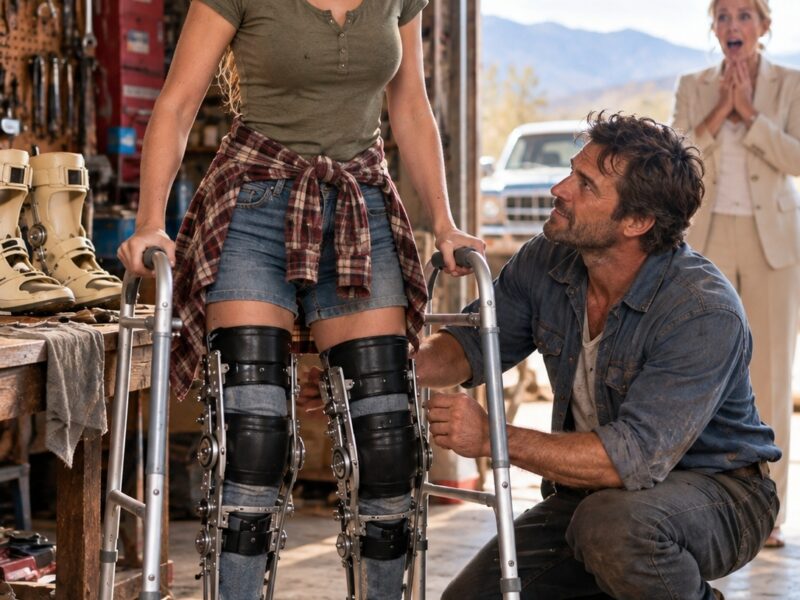
A Billionaire Paid $400,000 for Her Daughter’s Braces—Then a Poor Mechanic Heard One Click, Questioned Everything, and Built the Device Nobody in the Room Wanted to Believe
Boone Holloway heard the tiny metallic click before he ever learned Piper Larkin’s name, and the sound stopped him colder than the billionaire’s black SUV steaming beneath the Arizona sun.
For eleven years, specialists had told Piper the pain was complicated, subjective, or simply part of her spinal injury—until a grease-stained mechanic looked at her braces and said the problem might be mechanical.
What none of them understood yet was that the $400,000 device had become more than medical equipment: it was a mother’s penance, a famous engineer’s reputation, and a daughter’s last reason to wonder whether anyone would ever believe her.
The black SUV rolled into Holloway’s Garage at eleven-forty on a Thursday morning with steam pushing through the seams of its hood and a driver who looked personally offended by the existence of engine temperature.
Boone Holloway slid out from beneath a Ford pickup, wiped his hands on a gray shop rag, and squinted into the white glare outside. His garage sat east of Tucson where the city thinned into tire shops, storage lots, desert scrub, and saguaros tall enough to cast their own afternoon shadows. Expensive vehicles passed on the highway all the time, but they rarely turned into his cracked concrete yard unless something had gone very wrong.
The driver climbed out first. White shirt, dark slacks, Bluetooth earpiece, face tight with urgency. “Coolant warning. Then power dropped. We have to be in Phoenix by three.”
“Then you probably won’t be in Phoenix by three,” Boone said.
The driver stared at him.
Boone walked past.
“I can lie to you prettier if you want.”
The rear passenger door opened before the driver decided whether to be offended.
Genevieve Larkin stepped out.
Boone recognized her immediately, though he did not follow business news closely. Southern Arizona knew Genevieve the way towns know weather systems. Copper mines. Solar fields. Logistics holdings. Enough land around Tucson that people occasionally joked she owned whichever direction she happened to be facing.
She wore a cream suit that looked untouched by the three-hour drive and sunglasses that cost more than most of Boone’s tools.
Then the second rear door opened.
The young woman inside turned sideways slowly.
Boone stopped moving.
She set a walker onto the concrete, braced both arms, and lifted herself from the seat. She was nineteen, maybe twenty, chestnut hair tied low at her neck, face composed with the deliberate blankness of somebody who had spent years teaching strangers not to ask whether she needed help.
Metal braces ran from both thighs to her ankles.
Beautiful equipment.
Polished graphite-black shells, machined silver joints, narrow straps, the small three-wave emblem of VitaMotion Laboratories near each knee.
Boone knew the logo.
Everybody did.
VitaMotion built mobility devices featured in glossy hospital brochures, conference stages, and magazine profiles about the future arriving early.
The girl planted one foot.
Click.
Boone’s hand tightened around the rag.
Second step.
A faint scrape.
Third.
Click.
The sound reached somewhere older than thought.
His mother’s kitchen.
Metal braces squealing when Mabel Holloway struggled up from a chair.
Her jaw clenched because she did not want Boone to notice how badly they hurt.
Boone looked again.
The girl reached the shaded bench beneath his awning and lowered herself carefully.
Genevieve noticed him staring.
“My daughter does not require assistance.”
Boone met her eyes.
“I wasn’t offering any.”
That answer surprised both women.
He lifted the SUV hood.
“Forty minutes if it’s just the hose. Longer if you cooked anything else.”
“We do not have forty minutes.”
“Engine does.”
Genevieve looked as if she had spent three decades teaching clocks to obey her.
The engine, fortunately, had no idea who she was.
Boone worked.
Cracked upper radiator hose.
Low coolant.
Nothing catastrophic.
Behind him, Genevieve began a phone call about production schedules and a solar acquisition. Her voice became harder as the numbers grew larger.
The young woman sat alone at the far end of the bench.
Boone heard the right brace click again when she shifted her leg.
He closed the tool drawer.
Poured water into a paper cup.
Walked over.
“Desert water,” he said. “Tastes like plastic but it’s cold.”
She accepted it.
“Thanks.”
Boone did not leave.
She looked up.
“What?”
“That right knee joint.”
Her eyes changed.
“What about it?”
“How long has it been running off-axis?”
For the first time since she arrived, her face lost its practiced stillness.
“What did you say?”
“The pivot isn’t tracking your knee.”
“How do you know?”
“I can hear it.”
The young woman stared.
Boone crouched several feet away, not touching anything.
“Every third step, metal loads sideways. Small click when it releases. Your left side doesn’t.”
She swallowed.
“It hurts inside the knee.”
Boone nodded.
“And up into the hip after you’ve been upright a while.”
Her fingers tightened around the paper cup.
“How do you know that?”
“Machines complain before they fail.”
“I’ve spent my life listening.”
Her voice dropped.
“I’ve told people that for eleven years.”
Boone said nothing.
“Doctors. Orthotists. Engineers. Rehab specialists.”
She laughed once without humor.
“They told me the braces were fitted correctly.”
“They told me pain is complicated.”
“They told me nerve damage can create false signals.”
Boone looked at the polished equipment.
“Pain is complicated.”
She stiffened.
“But that click isn’t.”
He pointed without touching.
“That’s geometry.”
Genevieve’s voice cut across the yard.
“Piper.”
So that was her name.
Genevieve ended the call and approached.
Boone stood.
“Your car needs another twenty minutes.”
Genevieve looked from him to Piper.
“What were you discussing?”
Boone answered before Piper could.
“Her braces.”
Genevieve’s posture changed.
“Why?”
“Because the right knee pivot is off-axis.”
Silence.
“The calf strap is too high and too tight. Frame looks heavier than it needs to be. Weight’s not distributing evenly.”
Genevieve studied him.
“What exactly are you claiming?”
“I’m saying mechanically, they’re fighting her instead of helping her.”
Piper stared at her mother.
Genevieve looked Boone up and down.
Grease-stained work shirt.
Worn boots.
Calloused hands.
Then she laughed.
Not loudly.
That made it worse.
“Mr. Holloway, do you know what those braces cost?”
“No.”
“Four hundred thousand dollars.”
Boone’s expression did not change.
Genevieve continued.
“They were custom designed by Dr. Nathaniel Crane and an engineering team at VitaMotion.”
“I know the name.”
“Seventeen specialists have evaluated my daughter.”
Boone nodded.
“And you’re telling me a mechanic can see what all of them missed?”
Boone looked at Piper.
Then back at Genevieve.
“Yes, ma’am.”
Piper’s eyes widened.
Genevieve’s face went still.
And for the first time in eleven years, somebody had said the problem might not be Piper.
The SUV left forty-three minutes later.
Boone charged sixty-eight dollars for the hose, coolant, and labor.
Genevieve’s driver tried handing him two hundred.
Boone counted out the exact change.
The black vehicle pulled onto the highway and disappeared in red dust.
Boone stood in the yard long after it was gone.
Then he walked inside.
In the corner beside his workbench sat a wooden chair nobody used.
Sun had faded one arm lighter than the other.
His mother’s chair.
Boone opened the bottom drawer beneath the bench.
For three years, the brown leather notebook inside had remained where he left it after Mabel’s funeral.
He lifted it.
Dust marked the cover.
First page.
A rough sketch of a knee joint.
Second.
Weight-distribution calculations copied from an old biomechanics textbook.
Third.
An articulated brace mechanism shaped like a hinge but designed to move through several degrees of lateral freedom instead of one rigid plane.
Boone sat in Mabel’s empty chair.
Three years earlier, none of the drawings had mattered enough to finish.
Now he could still hear the click.
Forty-two miles west, Genevieve Larkin heard nothing except Piper’s silence.
They rode home through late-afternoon heat.
Genevieve answered three calls.
Rejected a financing proposal.
Approved a mine-shaft ventilation upgrade.
Moved two meetings.
Piper looked through the window.
At home, she went directly upstairs.
Genevieve watched her take the staircase lift without speaking.
That evening she sat alone in her office.
The Larkin estate looked over Tucson from a rocky ridge, all glass walls and sandstone, designed to turn the desert into scenery.
On Genevieve’s desk were photographs of mines, solar farms, ribbon cuttings, governors, investors.
The photograph of eight-year-old Piper remained inside the bottom drawer.
Genevieve took it out.
Piper on a desert trail.
White running shoes.
Arms spread.
Grinning.
March 14.
Eleven years earlier.
Genevieve remembered everything she wished she could delete.
Piper had begged her to drive to the statewide youth-track meet.
“Not Martin.”
“Please, Mom.”
“You never come.”
Genevieve promised.
Then the Bisbee copper acquisition reached its final negotiation window.
The seller threatened to walk.
Genevieve stayed.
Sent the driver.
The car never reached the stadium.
A commercial truck entered an intersection after its driver fell asleep.
No graphic memories remained for Genevieve.
Only sterile hospital language.
Incomplete spinal cord injury.
L2-L3 involvement.
Preserved motor function.
Uncertain prognosis.
Long rehabilitation.
Piper survived.
That became the sentence everyone told Genevieve she should be grateful for.
Genevieve was grateful.
She was also guilty.
The two feelings had lived together so long she no longer knew where one ended.
She responded the only way she knew.
She bought expertise.
Johns Hopkins.
Mayo.
Zurich.
Tokyo.
Rehabilitation centers with marble floors and waiting rooms quieter than churches.
Four surgeries over eleven years.
Specialized therapy.
Then VitaMotion.
Nathaniel Crane had promised no miracle.
That was part of why Genevieve trusted him.
He promised optimization.
Stability.
Mechanical efficiency.
Standing tolerance.
Improved gait.
His team produced a custom brace system that cost four hundred thousand dollars after research, prototypes, fittings, and proprietary joint hardware.
Genevieve signed every invoice.
Every check felt like an apology.
Piper complained of pain.
Genevieve forwarded every complaint.
Crane’s office replied.
No structural defect.
Neuropathic pain possible.
Adaptation period recommended.
Psychosomatic overlay could not be excluded.
Genevieve hated that last phrase.
Still, she accepted it.
Because experts had used it.
Tonight a mechanic with grease under his nails had asked one question.
How long has that joint been off-axis?
Genevieve picked up her phone.
Nathaniel Crane answered on the fifth ring.
“Genevieve?”
“I’m sorry to call late.”
“You never apologize for calls.”
“Piper’s braces.”
Silence changed quality.
“What about them?”
“A mechanic said the right knee joint is misaligned.”
Nathaniel laughed gently.
A warm professional sound.
“What kind of mechanic?”
“Automotive.”
Another pause.
“Genevieve.”
“I know how it sounds.”
“I’m glad you do.”
“He heard a click.”
“Mechanical joints click.”
“He identified exactly where Piper says it hurts.”
Nathaniel’s voice softened.
That was how he sounded on television when explaining difficult medical truths.
“Pain after spinal injury is extraordinarily complex.”
“I know.”
“We have tested Piper’s system repeatedly.”
“I know.”
“A person who repairs engines cannot assess neuromuscular biomechanics by listening from across a garage.”
Genevieve pressed her fingertips to the photograph.
“What if he’s right?”
Nathaniel was quiet.
Then:
“If an unlicensed person alters that device and Piper falls, her injury could worsen.”
Fear entered precisely where guilt already lived.
“One uncontrolled rotation.”
“One bad landing.”
“You could lose functional gains we spent a decade preserving.”
Genevieve closed her eyes.
“I understand.”
“Bring her in Monday.”
“We’ll inspect everything again.”
She thanked him.
Hung up.
Down the hall, Piper sat on her bedroom floor with a cardboard box between her knees.
Inside:
White running shoes.
Child size.
Never worn.
The pair Genevieve bought one week before the race.
Piper took out her phone.
Opened Maps.
Found Holloway’s Garage.
Forty-two miles.
She stared at the pin.
Someone heard it.
That was all she could think.
Someone finally heard it.
At nine the next morning, Boone looked up from an alternator rebuild and saw a taxi entering his yard.
Piper emerged alone.
Walker first.
Then one leg.
Click.
Second.
She crossed the concrete.
“My mother doesn’t know I’m here.”
Boone wiped his hands.
“That’s a bad opening sentence.”
“I’m nineteen.”
“Still bad.”
“I make my own medical decisions.”
Boone studied her.
Piper lifted her chin.
He recognized the posture.
Mabel had used the same one whenever anybody looked at her as if disability automatically transferred authority to the nearest standing person.
Boone pulled a plastic chair into the shade.
“Sit.”
“You’re going to look at them?”
“I’m going to tell you something first.”
She waited.
“I repair cars.”
“I know.”
“I am not an orthotist.”
“I know.”
“I am not a physician.”
“I know.”
“I’m not modifying a four-hundred-thousand-dollar medical device in my garage because I heard a click.”
Disappointment flashed across her face.
Boone continued.
“But I know somebody.”
“Who?”
“Elena Ramirez.”
“Certified prosthetist-orthotist.”
“Worked fifteen years at Banner.”
“Now runs a small clinic near South Tucson and teaches one biomechanics course at the university.”
Piper frowned.
“How do you know her?”
“She fitted my mother’s last brace.”
“Was it good?”
Boone looked toward Mabel’s chair.
“No.”
Piper went quiet.
“Elena hated it too.”
“She could only prescribe what insurance approved.”
Boone reached for his phone.
“If you want someone to examine those properly, she does it.”
“Will she listen?”
“Yes.”
“How do you know?”
“Because she and I have argued for twelve years.”
Piper almost smiled.
Elena arrived during lunch.
Five-foot-three.
Gray curls escaping a bun.
Canvas tool case in one hand.
She entered without greeting Boone.
“Where is the criminally expensive brace?”
Boone pointed.
Piper stared.
Elena looked at her.
“May I examine the device while you are wearing it?”
Piper hesitated.
Not because she objected.
Because nobody had asked that plainly before.
“Yes.”
Elena crouched.
“Only the brace unless you tell me otherwise.”
Piper swallowed.
“Okay.”
Elena used a small alignment gauge.
Then a digital angle finder.
Then asked Piper to stand.
Walk five steps.
Sit.
Stand again.
“Pain?”
“Six.”
“Where?”
“Medial knee.”
“Hip?”
“Four after about ten minutes.”
“Numbness?”
“Calf and foot after twenty to thirty.”
Elena looked at Boone.
He said nothing.
She measured again.
Then removed the brace with Piper’s permission.
Set it on Boone’s workbench.
“Joint center is four-point-two degrees lateral to estimated anatomical axis.”
Piper stopped breathing.
Elena continued.
“Strap placement is compressing soft tissue.”
“Weight?”
Boone handed her a hanging scale.
Elena weighed it.
“Eleven-point-eight pounds for the pair.”
Piper stared.
“Is that bad?”
“Not automatically.”
Elena’s voice was careful.
“But for your strength profile?”
“Yes.”
“Too much.”
Piper looked toward Boone.
“So he was right.”
Elena held up one finger.
“He was right that there is a mechanical problem.”
“That does not mean we know what solution is safe.”
Boone nodded.
“Thank you.”
Piper’s face tightened.
“You sound like all of them.”
Elena sat on the low shop stool.
“No.”
“I sound slower.”
“There’s a difference.”
Piper looked away.
Elena continued.
“You have an incomplete spinal injury.”
“You have real weakness.”
“You have altered proprioception.”
“A brace that reduces pain but increases instability is not better.”
“A brace that feels wonderful for thirty minutes but causes falls is not better.”
“You deserve a device that fits you.”
“But you also deserve not to be experimented on because you’re desperate.”
Piper’s eyes filled unexpectedly.
She blinked it away.
“So what do I do?”
Elena looked at Boone.
Then the old leather notebook he had left open.
“What is that?”
Boone hesitated.
“Something unfinished.”
Elena opened it.
Page after page.
Self-aligning hinge concepts.
Load paths.
Strap geometry.
Handwritten notes.
She stopped.
“You drew these?”
“Yes.”
“When?”
“Three to six years ago.”
“For Mabel?”
“Yes.”
Elena’s expression changed.
“Why didn’t you show me?”
“I fix cars.”
“Apparently badly, because you have too much free time.”
Boone almost smiled.
Elena turned another page.
“This part is naïve.”
“I know.”
“This is impossible with hardware you could afford.”
“I know.”
“This load-distribution idea is good.”
Boone looked down.
Piper leaned closer.
“What is it?”
Elena explained.
“Instead of forcing your knee into the brace’s ideal path, the joint allows limited controlled self-alignment around your actual movement.”
Piper looked at Boone.
“Can it work?”
Boone answered.
“Maybe.”
Elena corrected him.
“As a prototype.”
“Not as medical equipment until tested.”
Piper’s expression sharpened.
“Then test it.”
Both adults looked at her.
“I have spent eleven years being told what my body feels.”
“If you need data, take data.”
“If you need measurements, take them.”
“If you need me to walk in a lab, I’ll walk.”
“But don’t tell me to go home because somebody richer already decided.”
Elena smiled faintly.
“There you are.”
“Who?”
“The patient.”
That afternoon they made a plan.
Not secret construction in Boone’s garage.
Documentation.
Piper would request her full orthotic design record from VitaMotion under HIPAA.
Elena would conduct an independent clinical orthotic assessment.
Boone could contribute mechanical observations and prototype concepts, but no fitting without Elena’s supervision.
Piper would keep using her prescribed braces until they had something safely evaluated.
“Can my mother stop me?”
Piper asked.
“You’re nineteen,” Elena said.
“She can be angry.”
“That’s different.”
Piper nodded.
“Good.”
Boone noticed she seemed relieved by the distinction.
Piper requested her records that night.
VitaMotion delayed.
First they said the request lacked a wet signature.
Then identification verification.
Then proprietary design drawings were excluded.
Elena helped her narrow the request to clinical fitting records, gait-analysis notes, adjustment logs, complaint correspondence, and device specifications used in her care.
Seven days later, nine hundred pages arrived electronically.
Boone printed only the relevant sections.
They covered half his workbench.
Piper sat beside him.
Elena highlighted.
A pattern emerged.
Age twelve.
Medial knee pain.
No visible brace defect.
Age thirteen.
Persistent right-knee discomfort.
Possible neuropathic component.
Age fourteen.
Patient reports clicking.
No reproducible mechanical failure in clinic.
Piper stared.
“They wrote down the click.”
Boone looked at her.
“You told them.”
“They told me it wasn’t real.”
Elena corrected softly.
“They documented it and interpreted it differently.”
“That’s worse.”
No one argued.
Then Elena found something strange.
A service note from six years earlier.
Joint profile maintained to preserve lateral stability and cosmetic envelope. Further axis offset may increase bulk. Patient reports discomfort; no revision recommended.
Boone read it twice.
“They knew alignment was a tradeoff.”
Elena nodded slowly.
“Possibly.”
Piper’s face drained.
“What does cosmetic envelope mean?”
Elena hesitated.
“Appearance.”
Silence.
Piper looked down at the sleek black brace.
“They made it thinner for photographs.”
“We don’t know that.”
Boone said.
Elena read the note again.
“We know aesthetics were considered.”
“We need more before saying anything else.”
That was the first twist.
The brace might not have been accidentally misaligned.
It might have been intentionally compromised.
Genevieve learned of Piper’s records request from Nathaniel.
He called her personally.
“Did you authorize this?”
“No.”
“Piper requested everything.”
Genevieve felt something unpleasant.
Pride.
Fear.
Both.
“She can.”
“Of course.”
Nathaniel paused.
“But I’m concerned somebody is coaching her toward litigation.”
Genevieve stood from her desk.
“Who?”
“The mechanic.”
“You don’t know that.”
“Elena Ramirez’s clinic requested technical clarification.”
Genevieve knew Elena’s name.
Barely.
One of dozens of clinicians who had appeared throughout Piper’s care.
Nathaniel continued.
“Genevieve, I am protecting your daughter.”
“Are you?”
Silence.
It was the first time she had asked.
He heard it.
“So this is where we are.”
“What does that mean?”
“Eleven years of care.”
“Seventeen specialists.”
“Four surgeries.”
“And a man with wrenches makes one accusation and suddenly I am suspect.”
Genevieve closed her eyes.
“No.”
“I’m asking a question.”
“Questions have consequences.”
“So does not asking them.”
Nathaniel’s tone cooled.
“I recommend you bring Piper in.”
Genevieve hung up without answering.
That evening she found Piper at dinner.
Usually they ate separately.
Genevieve had allowed work to make that ordinary.
Tonight she sat across from her daughter.
“You requested your medical records.”
Piper did not look surprised.
“Yes.”
“Why didn’t you tell me?”
“Would you have helped?”
“Yes.”
Piper looked at her.
Genevieve stopped.
The answer had come too quickly.
Piper saw it.
“You would have called Crane.”
Genevieve’s jaw tightened.
“He is your treating specialist.”
“He sells the brace.”
“He also designed it.”
“That’s my point.”
Genevieve put down her fork.
“What are you doing?”
“Getting another opinion.”
“From the mechanic?”
“From Elena Ramirez.”
“Boone is helping.”
Genevieve inhaled slowly.
“Piper.”
“No.”
It was the first time in years Piper interrupted her mother.
“Please listen before fixing.”
Genevieve went still.
“I am not asking for permission.”
“I am telling you what I’m doing.”
“I have independent clinical supervision.”
“No one is modifying my current braces.”
“We are documenting.”
Genevieve’s voice softened.
“You could get hurt.”
Piper’s expression changed.
“Mom.”
“You have been saying that sentence since I was eight.”
“Because you were hurt.”
“I know.”
Genevieve flinched.
Piper continued.
“You think if you control everything after the crash, you can change what happened before it.”
“That is not fair.”
“No.”
“It isn’t.”
Neither spoke.
Piper stood.
“I needed you at the race.”
Genevieve’s face went white.
Eleven years.
They had never spoken the sentence directly.
Piper’s voice shook.
“I needed you to drive me.”
“I needed you to watch.”
“You stayed for the mine.”
“I know.”
“Then after the crash, every time I hurt, you bought another person.”
Genevieve rose.
“Piper—”
“You never believed me.”
“That is not true.”
“You believed bills.”
“You believed doctors.”
“You believed Crane.”
“You believed anybody with credentials who told you there was nothing else you could have done.”
The words landed exactly where Piper intended.
Genevieve could not answer.
Piper’s anger collapsed into exhaustion.
“I’m tired of your guilt being louder than my body.”
She left.
Genevieve stayed at the table.
For the first time in her life, there was no transaction large enough to end a conversation.
The next morning she canceled three meetings.
Then called Elena Ramirez.
“I want to know what you found.”
Elena answered:
“Ask Piper.”
“I’m asking you.”
“She is my patient for this evaluation.”
“I’m her mother.”
“She is nineteen.”
Genevieve closed her eyes.
“Everyone keeps telling me that.”
“Maybe everyone is trying to help.”
Genevieve nearly snapped.
Instead:
“Is she in danger?”
“Not from us.”
“That isn’t what I asked.”
Elena paused.
“The current device is causing measurable pressure concentration and altered joint tracking.”
Genevieve gripped her desk.
“Can you prove it?”
“Yes.”
“How?”
“Pressure mapping.”
“Alignment measures.”
“Gait analysis.”
“Then do it.”
“I will.”
“I’ll pay.”
“No.”
Genevieve blinked.
“What?”
“Your daughter is already paying.”
“How?”
“She’s my patient.”
“Standard evaluation fee.”
“Let her.”
Genevieve did not understand why that sentence hurt.
Then she did.
Money was how she inserted herself into outcomes.
Elena had removed the door.
“Send me the bill anyway.”
“No.”
Genevieve almost laughed.
“You and the mechanic would get along.”
“We do.”
The independent gait evaluation took place at a small university motion lab Elena had access to through her teaching appointment.
Piper wore reflective markers.
Force plates measured loading.
Pressure sensors mapped contact.
High-speed cameras recorded movement.
Boone watched from behind glass, silent.
He hated hospitals.
Too many memories of Mabel.
Piper walked ten meters with the VitaMotion braces.
Turned.
Returned.
Pain at start: four.
After ten minutes: six.
After twenty: seven.
Pressure peaked disproportionately along the right medial knee and upper calf.
The joint trajectory showed lateral deviation.
Elena looked at the graphs.
“No imagination there.”
Piper stared at the screen.
For a moment nobody spoke.
Then she cried.
Quietly.
Boone looked away to give privacy.
Elena did not say “I told you.”
She handed Piper a tissue.
“What happens now?”
Piper asked.
“We ask VitaMotion to reassess.”
“And if they don’t?”
“We document.”
“Then?”
“You decide how far you want to go.”
Boone finally spoke.
“Your body.”
“Your call.”
Piper nodded.
She emailed the report to Genevieve herself.
Not through Elena.
Not through Boone.
Genevieve opened it during a board meeting.
Read the pressure graph.
Then left the room without explanation.
Nathaniel Crane met her in person the next afternoon.
He brought two engineers.
Three legal binders.
A calm smile.
“Independent labs frequently misinterpret proprietary systems.”
Genevieve placed Piper’s report down.
“Is the axis offset intentional?”
Nathaniel stopped.
Only half a second.
Genevieve had built her fortune reading half-seconds.
“Define intentional.”
“You know exactly what I mean.”
He sat.
“The system requires compromises.”
“Every orthosis does.”
“Piper’s neuromuscular profile demanded lateral stability.”
“Why not document that to us?”
“It is documented.”
“Not as a cause of pain.”
“Because we did not establish causation.”
Genevieve stared.
“Seven pain complaints.”
“Pain does not equal failure.”
“The device clicks.”
“So do artificial knees.”
“She loses sensation under the calf strap.”
“Her injury affects sensation.”
Genevieve leaned back.
Nathaniel saw anger.
He shifted strategy.
“Genevieve, I know what this is really about.”
Her eyes sharpened.
“You blame yourself for the accident.”
“That guilt has made you vulnerable to anybody promising there was one mistake you could have fixed.”
Genevieve’s face emptied.
He continued gently.
“A mechanic gave you a simpler villain.”
“Bad engineering.”
“Bad doctor.”
“Correct the brace and somehow the last eleven years become reversible.”
Genevieve said nothing.
Because part of it was true.
That was what made manipulation effective.
Nathaniel softened further.
“I’m not your enemy.”
“I have dedicated years to Piper.”
“Her brace project funded research that helped hundreds of patients.”
“If we declare the device defective based on one independent analysis, investors panic.”
“Clinics stop using the platform.”
“People lose access.”
“Hundreds.”
There it was.
His motive.
Not simply ego.
An entire company.
Patients.
Research.
A reputation built on believing imperfect solutions still mattered.
Genevieve understood that logic intimately.
She had used versions of it in mining.
Do not stop production because one report is uncertain.
Do not cancel an acquisition because one community objects.
Scale required compromise.
Sometimes compromise became a place people hid harm.
“What do you propose?”
Genevieve asked.
“Bring Piper to us.”
“We revise the fit.”
“Quietly.”
“No admission.”
“No public fight.”
“And the other patients?”
Nathaniel’s face changed.
“Other patients are not Piper.”
That answer stayed with Genevieve.
At Holloway’s Garage, Boone and Elena worked evenings.
Not on Piper’s device.
On a test frame.
Aluminum.
Adjustable joint block.
Replaceable straps.
Nothing polished.
Nothing marketable.
Elena made him redo the first hip interface.
“Too rigid.”
“It’s stable.”
“So is concrete.”
Boone frowned.
She pointed.
“Human beings swell.”
“Sweat.”
“Sit differently at four p.m. than nine a.m.”
“You designed this like an axle bracket.”
“I like axle brackets.”
“They don’t have nerves.”
Boone redrew.
Piper joined whenever college classes allowed.
She did not merely stand for measurements.
She argued.
“Strap catches here.”
“Then move it.”
“Joint feels loose on turns.”
Boone adjusted damping.
“Elena says don’t overcorrect.”
“I heard her.”
“You’re doing the face.”
“What face?”
“The mechanic face.”
“There is no mechanic face.”
Elena laughed.
“There absolutely is.”
Piper began to laugh too.
The garage changed.
Mabel’s chair remained untouched.
But the workbench became alive again.
Boone opened old textbooks.
Ordered new ones.
Read published orthotics studies at midnight.
Called a race-car fabricator in Phoenix for lightweight aluminum.
Borrowed pressure foam.
Learned enough to understand how much he did not know.
That mattered more than confidence.
One evening Piper noticed Mabel’s notebook lying open.
“Tell me about her.”
Boone kept filing a joint.
“My mother?”
“Yes.”
“She was stubborn.”
“That’s not a story.”
“She worked grocery checkout thirty years.”
“Raised me alone.”
“Her spine started failing in her fifties.”
“Insurance covered braces that weighed almost as much as yours.”
Piper looked toward the wooden chair.
“She sat there?”
“Every night.”
“Watched me draw.”
“Why didn’t you finish them?”
Boone stopped.
“Pneumonia.”
“Fast.”
“I kept thinking we had time.”
Piper looked down.
“My mother thinks money can buy time backward.”
Boone sat on the bench.
“What do you think?”
“I think she’s scared.”
“That sounds generous.”
“I can be angry and still know what fear looks like.”
Boone smiled faintly.
Piper continued.
“She doesn’t know how to love without managing.”
“That sounds less generous.”
“It’s still true.”
Boone looked at Mabel’s chair.
“My mother used to say fixing is dangerous.”
Piper frowned.
“She said the worst kind of mechanic sees every problem as permission to touch.”
“You listen first.”
“Then decide whether the thing wants fixing.”
Piper smiled.
“Things don’t want.”
“People do.”
There was the lesson Boone had almost forgotten.
The prototype took twelve days.
Not ten.
Elena refused to rush.
By the thirteenth morning, the bare aluminum braces lay on the workbench.
Seven-point-one pounds.
Multi-axis knee joint with controlled lateral accommodation.
Padded load surfaces shaped from Piper’s measurements.
Hip stability feature adjustable under supervision.
Ugly.
Functional-looking.
Piper stared.
“They look homemade.”
Boone nodded.
“They are.”
“I love them.”
Elena held up a hand.
“You have not worn them.”
“Do not love medical equipment before data.”
They fitted the braces in the motion lab.
Not the garage.
Piper stood inside parallel bars first.
Pressure sensors active.
Elena beside her.
Boone behind.
“Slow.”
Piper shifted weight.
No click.
Her eyes widened.
One step.
Second.
Third.
She stopped.
“What?”
Genevieve’s voice would have asked if something hurt.
Elena asked:
“What do you notice?”
Piper looked down.
“Nothing.”
Boone frowned.
“Nothing?”
“No grinding.”
“No hot spot.”
“My knee feels like my knee.”
She laughed once.
A broken little sound.
Then covered her mouth.
They continued.
Five minutes.
Ten.
Pain started at two.
Stayed two.
Pressure distribution improved.
Gait symmetry improved modestly.
Not miracle.
Not cure.
Better mechanics.
Piper wanted more.
“Can I walk without bars?”
Elena said no.
“Tomorrow.”
Piper hated that.
Boone supported Elena.
Piper hated him too for twelve hours.
The next day, with walker, Piper made six steps.
Then eight.
Then turned too quickly.
Her left thigh weakened.
The walker tipped.
Boone moved.
Elena moved faster.
Between them they controlled the fall.
Piper ended sitting on the floor, shaken but uninjured.
The prototype’s locks had prevented twisting.
The lab door opened.
Genevieve stood there.
She had followed Piper after learning about the fitting.
What she saw was not context.
It was her daughter on the floor.
Homemade-looking braces on her legs.
A mechanic kneeling nearby.
Her worst fear given a photograph.
“What happened?”
Piper looked up.
“Mom—”
“What happened?”
Elena stood.
“Controlled loss of balance.”
“She is not injured.”
Genevieve ignored her.
“Take them off.”
Piper’s face changed.
“No.”
Genevieve froze.
“I said no.”
“You fell.”
“I have fallen in the four-hundred-thousand-dollar ones.”
“You could have damaged your spine.”
“I didn’t.”
“That is not the point.”
“It is exactly the point.”
Genevieve turned to Boone.
“You.”
Boone stood.
Genevieve’s fear became anger because anger was easier to direct.
“You built these.”
“With Elena.”
“You have no degree.”
“No.”
“No license.”
“No.”
“And you put my daughter in them.”
“I fitted them.”
Elena interrupted.
“Under my clinical supervision.”
Genevieve swung toward her.
“Then you should know better.”
Piper stood using the bars.
Slowly.
“Mom.”
Genevieve looked at her.
“I just walked six steps with less pain than I have had since I was eight.”
Genevieve’s expression broke for half a second.
Then repaired.
“Get your things.”
“No.”
“Piper.”
“You never watched me run.”
The lab became silent.
Genevieve went white.
Piper’s voice trembled.
“You promised.”
“I waited at the starting area until they told me your car crashed.”
“I have spent eleven years pretending I do not care because every time I look at you, you look like you’re the one who was injured.”
Genevieve’s mouth opened.
Nothing.
“I needed a mother.”
Piper said.
“You became a project manager.”
Genevieve flinched.
Piper continued.
“When I said it hurt, you bought another consultation.”
“When I cried, you booked another clinic.”
“When I said the brace was wrong, you asked the man who built it whether it was wrong.”
Her voice broke.
“You never asked me.”
Genevieve whispered:
“I was trying to save you.”
Piper’s eyes filled.
“I survived eleven years ago.”
“You are still trying to save the girl who got in that car.”
“I need you to know the woman standing here.”
Genevieve looked at her.
At the braces.
At Boone.
At Elena.
Then did the thing she had always done when emotion exceeded language.
She made a decision.
“Take them off.”
Piper stared.
“No.”
“If you keep wearing them, I will not fund this experiment.”
Piper laughed through tears.
“I’m not asking you to.”
Genevieve stopped.
Piper removed the prototype herself.
Handed it to Elena.
Then put the VitaMotion braces back on.
Not because Genevieve won.
Because Piper had decided there would be no more secret tests.
The next one would be documented.
Public enough that nobody could dismiss it.
That night she emailed Nathaniel Crane.
Not her mother.
Not Boone.
Not Elena.
I am requesting a formal side-by-side independent evaluation of my current VitaMotion system and an alternative prototype under neutral clinical supervision. I will not consent to further VitaMotion fitting changes until that evaluation occurs.
She copied Genevieve.
Elena.
Her primary physiatrist.
Hospital patient advocate.
And an attorney she had contacted herself.
That was Piper’s turning point.
Everyone else had spent eleven years deciding what risk she could bear.
Now she chose the process.
Crane refused.
His email was polished.
Prototype lacks FDA clearance.
Unqualified designer.
Unsafe comparison.
Piper’s attorney responded that research-level evaluation of a nonmarketed prototype under licensed clinical supervision did not constitute commercial distribution and that Piper had the right to seek independent care.
The argument became legal.
Then reputational.
Genevieve tried to keep it private.
Piper did not.
Not yet public.
But wider.
She requested every historical complaint.
Every adjustment.
Every internal communication concerning her joint alignment.
VitaMotion produced partial documents.
Elena noticed missing sequence numbers.
Piper’s attorney requested clarification.
Then one former VitaMotion engineer contacted Piper anonymously.
A woman named Maya Chen.
She had worked on Piper’s device seven years earlier.
They met in a coffee shop.
Maya looked nervous.
“I’m not here to destroy anybody.”
Piper waited.
“I left because of this project.”
“What happened?”
Maya placed an old printed email on the table.
Internal.
Nathaniel Crane copied.
The email described repeated pain reports and proposed widening the knee assembly to correct axis mismatch.
Crane replied:
Current profile must remain within cosmetic and stability envelope approved for campaign materials. Patient function acceptable. Defer redesign unless objective deterioration documented.
Piper read it three times.
“Campaign materials?”
Maya looked ashamed.
“VitaMotion was fundraising.”
“Your braces were their flagship.”
“They photographed you.”
“Used your progress in investor presentations.”
“We argued the joint should be wider.”
“He said pain was subjective.”
“Function was measurable.”
Piper’s hands shook.
“Did my mother know?”
“No.”
“I don’t think so.”
“Did Crane know it could hurt?”
“He knew the geometry was not ideal.”
“Whether he believed the pain came from that…”
Maya stopped.
“I can’t tell you what he believed.”
That nuance mattered.
Crane was not secretly trying to hurt Piper.
He had prioritized stability, aesthetics, investor confidence, and measurable function.
Then confirmation bias did the rest.
Every complaint became something to explain rather than investigate.
Piper left the coffee shop with the email in her bag.
She did not call Boone.
She called Genevieve.
“Come home.”
Her mother said.
“No.”
“Meet me.”
Genevieve arrived twenty minutes later.
Piper handed her the email.
Genevieve read.
Then again.
Her face emptied.
“I forwarded seven letters.”
“I know.”
“I sent him every complaint.”
“I know.”
“He told me…”
Her voice failed.
Piper watched her mother understand the thing that would hurt most.
Money had not failed because she lacked enough.
It had failed because she used it instead of listening.
Genevieve sat.
“I believed him.”
“Yes.”
“I believed everybody except you.”
Piper’s anger softened.
Not disappeared.
Changed.
Genevieve looked up.
“I am sorry.”
Piper swallowed.
“That doesn’t fix it.”
“No.”
Genevieve nodded.
“I know.”
It was the first apology Genevieve had ever given without following it with an action plan.
Piper noticed.
Three days later Genevieve called Nathaniel.
She did not accuse.
She invited.
“Holloway’s Garage.”
He laughed.
“Absolutely not.”
“Then I withdraw VitaMotion from every Larkin-funded project.”
Silence.
“You would damage research because your daughter is angry?”
“No.”
“I would stop financing people who refuse inspection.”
Nathaniel arrived Saturday.
Silver hair.
Tailored gray suit.
Television smile.
Genevieve came with him.
Piper arrived separately.
Elena was already there.
So was Piper’s attorney.
No cameras.
No press.
Boone disliked the number of clean shirts in his shop.
Nathaniel walked inside.
Looked at Mabel’s chair.
Then the workbench.
The two braces lay side by side.
VitaMotion.
Black.
Polished.
Three-wave logo.
Boone’s prototype.
Bare aluminum.
Visible file marks.
No logo.
Nathaniel smiled.
“Mr. Holloway.”
“Doctor.”
“I have no doubt your intentions are good.”
“Good.”
“That saves time.”
Nathaniel’s smile faded slightly.
“Good intentions do not replace biomedical training.”
“No.”
“Neither does expensive branding.”
Elena closed her eyes briefly.
Genevieve almost smiled.
Boone pointed to the bench.
“Three minutes.”
“Then we go to the motion lab if Piper still wants the comparison.”
Nathaniel folded his arms.
“Proceed.”
Boone handed Genevieve a hanging scale.
“Weight them.”
She did.
VitaMotion: eleven-point-eight pounds.
Prototype: seven-point-one.
Nathaniel said:
“Mass reduction does not equal performance.”
Boone nodded.
“Correct.”
Second.
Joint resistance.
Genevieve bent the VitaMotion knee.
Rigid.
One plane.
At faster flexion:
Click.
The sound filled the shop.
Genevieve stopped.
She had heard it a thousand times.
Never listened.
She flexed Boone’s prototype.
Smooth.
Slight adaptive lateral movement.
Nathaniel spoke quickly.
“Uncontrolled degrees of freedom can introduce instability.”
Elena answered.
“They are damped and bounded.”
Nathaniel looked at her.
“You endorsed this?”
“I supervised it.”
“That surprises me.”
“It surprised me too.”
Boone opened Mabel’s notebook.
“Third.”
Machinist’s digital angle gauge.
He placed it across the VitaMotion joint alignment.
Then the prototype.
“Doctor.”
Nathaniel did not move.
“Read it.”
“Mr. Holloway—”
“Read the number.”
Genevieve looked at Nathaniel.
“Nathaniel.”
He turned.
She knew that face.
Negotiation.
Avoidance.
Calculation.
“Read it.”
He did.
“Four-point-one degrees.”
Genevieve’s voice became very quiet.
“Piper began reporting knee pain at twelve.”
Nathaniel’s jaw tightened.
“Pain does not establish causality.”
“You received seven letters.”
“I remember.”
“You stamped no clinical basis.”
“Our evaluations showed no objective deterioration.”
Genevieve stepped closer.
“And when your engineer proposed correcting the axis?”
Nathaniel looked at Piper.
Then the attorney.
So he knew.
Piper placed Maya Chen’s email on the bench.
Nathaniel’s television face disappeared.
He read.
Then looked at Genevieve.
“That email is taken out of context.”
“What context makes ‘campaign materials’ relevant to my daughter’s pain?”
“VitaMotion was a young company.”
“We needed investor confidence.”
“The profile was part of the product architecture.”
“The brace functioned.”
Piper spoke.
“It hurt.”
Nathaniel looked at her.
“For many spinal patients, standing at all would be considered extraordinary success.”
“That is not an answer.”
“I gave you function.”
“You gave me pain.”
“I gave you mobility.”
“You gave me a device you knew was misaligned.”
“I knew it involved compromise.”
His voice rose for the first time.
“Every medical device involves compromise.”
“Do you think engineering is magic?”
“You want lighter, you sacrifice stiffness.”
“You want lateral freedom, you risk instability.”
“You want cosmetic acceptability for a young patient, you reduce bulk.”
“You want insurers and donors to fund devices, people have to believe they work.”
Boone’s voice stayed quiet.
“People have to use them.”
Nathaniel turned.
“That is an insultingly simple view.”
“No.”
Boone said.
“That’s the job.”
Silence.
Elena stepped between rhetoric and evidence.
“Enough.”
She looked at Piper.
“Do you want the lab comparison?”
“Yes.”
Neutral motion lab.
Independent physiatrist.
Two orthotists not affiliated with VitaMotion.
Pressure mapping.
Gait cameras.
Muscle activation sensors.
Pain ratings blinded to the test team where possible.
Piper walked with the VitaMotion braces first.
Then rested.
Then the prototype.
Nobody cheered.
That mattered.
This was not a miracle show.
Data arrived.
VitaMotion provided greater frontal-plane rigidity.
Prototype reduced medial pressure substantially.
Energy expenditure lower.
Gait symmetry improved.
Pain after twenty minutes:
VitaMotion, seven.
Prototype, two.
No increased instability under supervised conditions.
The independent physiatrist removed his glasses.
“We need longer-term testing.”
Piper nodded.
“But?”
He looked at her.
“The alternative design appears mechanically better matched to your current movement.”
Piper closed her eyes.
Eleven years.
Nathaniel stared at the graphs.
He did not collapse.
Did not confess dramatically.
He sat.
For the first time, he looked old.
Genevieve approached him.
“How long?”
He did not answer.
“How long did you know enough to investigate?”
Nathaniel rubbed one hand across his forehead.
“Years.”
Genevieve’s breath left.
“I did not know the device was causing all of it.”
“I believed the stability benefit outweighed the complaints.”
“And every year that belief became harder to question.”
Piper looked at him.
“Because questioning it would mean you were wrong.”
Nathaniel met her eyes.
“Yes.”
The word was almost inaudible.
Consequences came slowly.
Not one cinematic destruction.
VitaMotion opened an internal review under pressure from its board and insurers.
The FDA received adverse-event documentation regarding the brace platform.
Several other patients were invited for independent reassessment.
Most devices did not share Piper’s exact geometry.
Some did show similar pressure and alignment concerns.
The company issued a voluntary corrective action for a subset of custom systems.
Nathaniel stepped down as chief clinical designer while investigations proceeded.
His medical license was not magically erased because this was not a simple criminal story.
But he lost leadership.
Consulting contracts.
Public authority.
And eventually faced a malpractice settlement with terms that funded independent patient-device review.
Maya Chen testified.
Elena testified.
Piper testified most clearly.
When an attorney asked why she waited so long to object publicly, Piper answered:
“I objected when I was twelve.”
“That was the whole problem.”
Genevieve faced consequences too.
Not legal ones.
Harder ones.
Piper stopped allowing her mother to attend every appointment.
At first Genevieve felt punished.
Then she understood boundaries were not punishment.
Sometimes she sat in the waiting room.
Sometimes she did not go.
She learned to ask:
“Do you want me there?”
Piper learned the answer could be yes without surrender.
Their relationship repaired in pieces.
One evening Genevieve came to Piper’s room.
No checkbook.
No tablet.
She held the old photograph.
Eight-year-old Piper running.
“I should have driven you.”
Piper looked at her.
“Yes.”
“I wanted the mine.”
“Yes.”
“I told myself I was doing it for our future.”
“I know.”
Genevieve’s eyes filled.
“That does not change what I chose.”
“No.”
“I am sorry.”
Piper moved aside on the bed.
Genevieve sat.
After a while Piper rested her head against her mother’s shoulder.
Nothing was solved.
Something was allowed to begin.
Boone refused Genevieve’s first offer.
Chief engineer.
Seven-figure salary.
Private laboratory.
Full scholarship.
He laughed before she finished.
“No.”
“You haven’t heard all of it.”
“I heard private laboratory.”
“What’s wrong with that?”
“Three receptionists between me and anybody whose brace hurts.”
Genevieve frowned.
“That can be designed around.”
“Maybe.”
“But I know how this works.”
“First I stop opening the garage because meetings.”
“Then somebody tells me patient complaints should go through a portal.”
“Then I become Dr. Crane without noticing.”
“That is unfair.”
“To him?”
“To you.”
Boone thought.
“Probably.”
Elena interrupted.
“Go to school.”
Boone looked at her.
“No.”
“Yes.”
“I’m thirty-four.”
“You’ll still be thirty-eight in four years.”
“I have a garage.”
“Keep it.”
Genevieve smiled.
Boone pointed at her.
“Don’t.”
“What?”
“That face.”
“What face?”
“The billionaire solution face.”
Piper laughed.
They found another arrangement.
Boone enrolled part-time in mechanical engineering and assistive-technology coursework through the University of Arizona.
Elena remained clinical lead.
Genevieve did not own the program.
That was Boone’s condition.
Instead an independently governed charitable foundation provided equipment grants for patients who could not afford orthotic redesign.
No Larkin name on the building.
No naming rights.
No press release.
Genevieve struggled with that.
Then agreed.
Three months later, a workshop opened beside Holloway’s Garage.
Sheet-metal walls.
Industrial fans.
Bright work lights.
A small motion-testing lane.
Machine tools Boone had previously only admired in catalogs.
Sign:
HOLLOWAY MOBILITY WORKS
Below:
WE FIT THE DEVICE TO THE PERSON. NEVER THE PERSON TO THE DEVICE.
Inside the entrance hung one rule.
EVERYONE GETS HEARD.
People came.
Veterans with poorly fitted prosthetics.
Construction workers.
Children wearing cheap braces that rubbed their skin raw.
Older people whose insurers paid for function but not comfort.
Every assessment began the same way.
Boone crouched near the equipment.
“Can I touch the brace?”
Not the person first.
The brace.
Permission.
Then:
“Tell me where it hurts.”
Not as symptom.
As data.
Piper came three afternoons a week.
At first for adjustments.
Then because frightened patients believed her in ways they did not automatically believe able-bodied clinicians.
She did not give false hope.
“Better is not cure.”
“Pain-free does not mean normal strength.”
“You still need therapy.”
“You still have to go slow.”
People trusted that.
One autumn afternoon she laid an envelope on Boone’s bench.
University of Arizona.
Accepted.
Physical therapy program.
Boone read.
Looked up.
“Thought you hated therapists.”
“I hate therapists who don’t listen.”
“Good distinction.”
Piper smiled.
“Machines need people who understand mechanics.”
“Patients need people who understand living inside them.”
“I’m taking the second job.”
Boone nodded.
“Mabel would like you.”
Piper looked toward the old wooden chair.
“Can I sit in it?”
Boone froze.
Nobody had ever asked.
Not Elena.
Not Genevieve.
Not Piper before.
He looked at the chair.
Three years.
Untouched.
A monument disguised as furniture.
Mabel would have hated that.
“Yeah.”
Piper sat.
Nothing terrible happened.
Boone laughed softly.
“Comfortable?”
“No.”
“It’s awful.”
“My mother loved that chair.”
“Your mother had bad taste.”
“Careful.”
Piper smiled.
The final test came one November evening.
Desert sun low.
Copper light across the horizon.
Piper asked Genevieve and Boone to drive with her to an old trail outside Tucson.
She carried a cardboard box.
When they arrived, she opened it.
White running shoes.
Child size.
Untouched.
Genevieve covered her mouth.
“Oh, Piper.”
“I kept them.”
“Why?”
Piper looked at the trail.
“I used to think because I’d run again.”
“Then I realized that wasn’t it.”
“I kept proof.”
“Of what?”
“That she existed.”
“The girl before.”
Genevieve cried quietly.
Piper gave her the shoes.
“Help me.”
Together they placed them beside the trail.
Neat.
Toes pointed toward sunset.
Not a grave.
Not exactly.
A marker.
Piper stood.
Her aluminum braces showed file marks beneath the Arizona light.
No glossy shells.
No expensive logo.
No promise of perfection.
She left the walker in the car.
Genevieve instinctively lifted her hand.
Then stopped.
“Do you want me?”
Piper looked at her.
“Yes.”
One hand rested lightly on her mother’s arm.
Not dependence.
Connection.
They began walking.
Slowly.
Boone remained near the vehicle.
He watched them move toward the copper horizon.
One step.
Second.
Third.
No one counted.
That was important.
For eleven years every clinic had counted something.
Degrees.
Meters.
Pain scales.
Muscle grades.
Minutes standing.
Piper had spent a decade becoming numbers.
Tonight she simply walked.
Genevieve matched her pace.
No advice.
No correction.
No money.
Just presence.
Boone reached into his jacket.
Mabel’s leather notebook.
He opened the final page.
The original brace drawing.
Date from three years earlier.
The design he never completed in time.
Beneath it Boone wrote today’s date.
He considered writing Mabel’s name.
Then Piper’s.
Then some sentence about unfinished work.
He wrote none of them.
Some debts could not be repaid to the person who created them.
They could only be passed forward.
Mabel had spent thirty years behind a grocery register, invisible to people who saw only the apron.
She taught Boone that useful hands did not need permission from strangers to become meaningful.
Piper taught him the second half.
Useful hands still had to listen.
Down the trail, Piper stopped.
Turned.
Called:
“Boone.”
He raised his head.
“Listen.”
He frowned.
“To what?”
She took another step.
Then another.
The desert wind moved through creosote.
A hawk called somewhere beyond the ridge.
Genevieve looked down at her daughter’s braces.
Boone listened.
No grinding.
No scrape.
No tiny metallic release under the right knee.
Piper smiled.
And there was no click.









