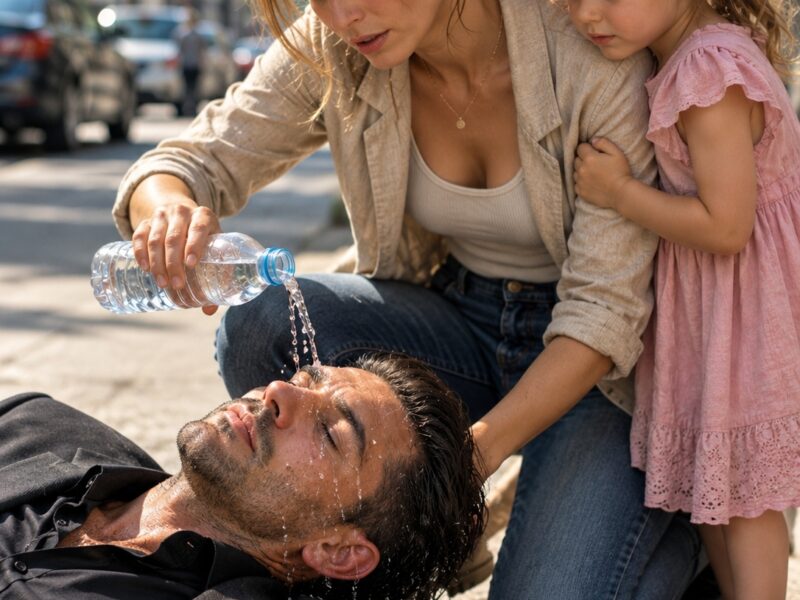
A Broke Single Mother Found Don Alessandro Bleeding Behind a Boston Restaurant—Then Her Five-Year-Old Daughter Forced the Mafia King to Choose…
The first thing Elena Carter saw was a hand.
Not a face.
Not the ruined suit.
Not the blood darkening the rainwater between the garbage bags.
Just a man’s hand lying palm-down on wet pavement behind an Italian restaurant in East Boston, motionless beneath the yellow glow of a broken security light.
Elena stopped so suddenly that her five-year-old daughter walked into the back of her coat.
“Mama?”
Elena did not answer.
Rain struck the hood of her thrift-store jacket hard enough to sound like static. Behind them, traffic hissed along Meridian Street, people driving home to apartments with heat, kitchens with groceries, and lives where Tuesday night did not involve checking restaurant dumpsters for bread.
“Mama,” Mila whispered again.
Elena reached backward without looking and caught her daughter’s wrist.
“Stay behind me.”
That was when the hand moved.
One finger first.
Then the others curled weakly against the pavement.
Elena’s entire body told her to leave.
She had learned to listen to that instinct.
At thirty-four, she had already discovered that most disasters announced themselves quietly. A landlord knocking two days before rent was due. A hospital bill arriving in a white envelope. A husband saying he felt fine three hours before collapsing at work. A supervisor calling you into the office and closing the door.
Trouble rarely screamed at the beginning.
Usually, it whispered.
This whispered through the rain.
“Please.”
The voice came from behind the garbage bags.
Mila tightened her fingers around Elena’s coat.
“He’s alive.”
“I know.”
“We should help him.”
Elena closed her eyes.
Of course Mila would say that.
Mila still believed helping was the obvious response to suffering.
She had not yet learned how expensive goodness could become.
“Elena,” her survival instinct said inside her head. “Take your daughter and go.”
The landlord had given them eleven days.
Her checking account held eighty-six dollars.
The hospital where Elena cleaned offices after dark had cut two weekend shifts from her schedule.
The laundromat paid cash, but not enough.
Mila’s winter boots had started separating at the sole.
There was no room in Elena’s life for a bleeding stranger.
Then Mila said, “What if nobody else comes?”
Elena looked at her.
Five years old.
Wet bangs plastered against her forehead.
A torn grocery bag clutched in purple fingers.
Inside the bag were two loaves of bakery bread thrown away because the printed sell-by date had passed that afternoon.
Mila thought they had gotten lucky.
That had nearly broken Elena ten minutes earlier.
Now the child was looking at a dying stranger with the same expression she used when she found an injured bird.
Elena sighed.
“This is how people die in horror movies.”
Mila blinked.
“What?”
“Nothing.”
Elena took out her phone.
The battery showed nine percent.
She turned on the flashlight and stepped forward.
The bags hid most of him.
She pulled one aside.
Then another.
The man beneath them looked like somebody had taken a wealthy person and tried to erase him.
He was perhaps fifty.
Silver threaded through thick black hair.
His charcoal suit had once been expensive enough for Elena to recognize that she could never afford it, even ruined.
One sleeve was torn.
His face was swollen.
A cut ran along his temple.
There were bruises at his jaw and throat.
The violence was obvious without Elena needing to examine the details.
Somebody had wanted him hurt badly.
And somebody had wanted him found nowhere respectable.
His eyes opened.
Dark.
Focused for half a second.
Then drifting.
He looked at Elena.
Then at Mila.
Something like alarm crossed his face.
“Child…”
“My daughter.”
“Take her…”
His breath caught.
“…go.”
That surprised Elena.
“You’re telling us to leave?”
“Yes.”
“Why?”
His eyes closed.
“Because whoever did this…”
He stopped long enough that Elena thought he had passed out.
Then his lips moved again.
“…may come back.”
Every sensible part of her brain screamed louder.
Mila whispered, “Mama.”
Elena pulled her phone out.
“I’m calling an ambulance.”
The man’s hand moved with startling speed for someone in his condition and caught her wrist.
Not hard.
But firm.
“No police.”
“An ambulance is not the police.”
“It becomes police.”
“You need a hospital.”
His eyes opened again.
“No hospital under my name.”
Elena stared.
That sentence told her far too much.
“What is your name?”
He did not answer.
“Great.”
She tried to pull free.
He released her immediately.
“Jacket.”
“What?”
“Inside pocket.”
Elena hesitated.
He whispered, “Phone.”
She reached carefully inside his coat and found a slim black phone.
No case.
No wallpaper.
No notifications.
He gave her six numbers.
Not a phone number.
A code.
She unlocked it.
“Contacts?”
“R.”
There was one contact listed only as R.
Elena pressed call.
A man answered before the first full ring.
“Boss?”
Elena froze.
The stranger’s eyes closed.
The voice became sharper.
“Who is this?”
Elena looked down at the man.
He barely shook his head.
No location.
“Your friend is hurt.”
Silence.
Then, “Put him on.”
“He can barely talk.”
“Who are you?”
“A person currently regretting answering a phone.”
Mila tugged her coat.
Elena lowered her voice.
“He needs medical help.”
The man on the phone said, “Where are you?”
The stranger’s eyes opened again.
“No.”
Elena stared at him.
The voice heard.
“Boss?”
The injured man forced out, “Compromised.”
Silence.
Something changed on the other end.
“Understood.”
The line disconnected.
Elena stared at the phone.
“You people are exhausting.”
The stranger almost smiled.
Then he lost consciousness.
Mila looked up.
“Are we still leaving?”
Elena looked at the empty alley.
At the stranger.
At her daughter.
At nine percent battery.
At the rain.
“No,” she muttered.
“Of course we’re not.”
Getting him out of that alley took forty minutes.
Elena did not drag him home herself.
She was desperate, not reckless enough to believe an unconscious injured man belonged on her apartment floor without medical care.
There was a twenty-four-hour urgent-care clinic six blocks away whose overnight physician, Dr. Samuel Becker, had once treated Mila’s fever when Elena could not pay upfront. Elena called and told him only enough to make him understand that she had found an injured man who feared whoever attacked him.
Dr. Becker told her to call emergency services.
Elena tried.
The stranger regained enough consciousness to refuse again and gave Becker’s name into the phone after hearing it.
That caused another silence Elena did not understand.
“You know Dr. Becker?” Elena asked.
The man closed his eyes.
“Long time.”
It turned out Dr. Becker knew him too.
That was the first clue that the stranger’s world was larger than Elena wanted it to be.
The doctor came himself.
He arrived in an old Volvo wearing pajama pants beneath a winter coat, looked once at the man, then looked at Elena.
“Where did you find him?”
“Behind Bellini’s.”
Dr. Becker’s face tightened.
“Does anyone know you brought him here?”
“No.”
“Good.”
“That is not a reassuring answer.”
“No,” he said. “It isn’t.”
The doctor examined him enough to decide he needed imaging and more treatment than could safely happen in an apartment. But instead of calling the nearest hospital, Becker phoned a private medical center outside the neighborhood and arranged admission under controlled access.
The injured man stopped him.
“No.”
Dr. Becker stared.
“You don’t get to order me around tonight.”
The stranger opened one eye.
“You always hated that.”
“And yet you’ve spent twenty years trying.”
Elena looked between them.
“Who is he?”
Dr. Becker answered without looking away from his patient.
“A man with enemies.”
“That narrows it down.”
“Tonight, that is enough.”
The man whispered, “No hospital until morning.”
“Why?”
He looked at Elena.
“If I arrive anywhere connected to me tonight, the people who did this learn I survived.”
Elena crossed her arms.
“And staying near my child is somehow safer?”
His eyes moved toward Mila.
No arrogance remained in them.
Only shame.
“No.”
That answer changed something.
“I will leave before I bring danger here.”
Dr. Becker shook his head.
“You’ll die proving how considerate you are.”
He looked at Elena.
“I can stabilize him enough for several hours while I arrange something secure. But he cannot be alone.”
Elena laughed once.
“No.”
“Mrs. Carter—”
“No. Absolutely not.”
Mila raised her hand.
Everyone looked at her.
“He can sleep on our floor.”
Elena stared at her daughter.
“Mila.”
“We have blankets.”
The stranger looked at Mila as if she had just offered him a palace.
Elena rubbed both hands over her face.
This was how her life changed.
Not with music.
Not with destiny.
With a five-year-old offering their only spare blanket to a man Elena should have left in an alley.
By three in the morning, Alessandro Russo was lying on a borrowed folding mattress in Elena’s living room.
She did not know that name yet.
She knew Dr. Becker had arranged to return at dawn.
She knew the stranger had injuries serious enough to frighten the doctor but stable enough that he was not being moved immediately against his will.
She knew two separate numbers on the man’s phone had called repeatedly.
Neither was answered.
And she knew Mila had fallen asleep sitting against the couch while insisting she was “watching the patient.”
Elena carried her into the bedroom.
Their apartment had one actual bedroom.
Mila had the bed.
Elena usually slept on a pullout chair because five-year-olds grew better when they slept properly.
She tucked the blanket under Mila’s chin.
“Mama?”
“I thought you were asleep.”
“Is the man bad?”
Elena sat beside her.
“I don’t know.”
“He looks sad.”
“He looks injured.”
“Same thing sometimes.”
Elena looked at her.
“Who told you that?”
“You.”
Of course.
Mila’s eyes began closing.
“We help him even if he’s bad?”
Elena thought of the phone.
The coded contact.
The doctor who knew him.
The way the man had refused a hospital because enemies might be waiting.
“We helped him because he was hurt.”
“Then tomorrow?”
“Tomorrow we decide tomorrow.”
Mila nodded.
That answer satisfied children better than adults.
She fell asleep.
Elena returned to the living room.
The stranger was awake.
Barely.
“You have a daughter,” he said.
Elena leaned against the wall.
“Observant.”
His mouth moved.
A trace of humor.
“How old?”
“You’ve spoken to her.”
“Five.”
“Yes.”
He looked toward the bedroom door.
“My daughter was five once.”
Elena’s expression changed.
“Was?”
He did not answer.
Rain tapped against the window.
His eyes closed.
For several seconds, she thought he was asleep.
Then he said, “I haven’t seen her in fourteen years.”
Elena did not ask why.
Something in his voice said the answer would be expensive.
Instead she said, “Get some sleep.”
He opened his eyes.
“Why did you help me?”
“My daughter asked.”
“That simple?”
“No.”
Elena folded her arms.
“Nothing is simple when you’re poor.”
He watched her.
She instantly regretted saying it.
Pride was strange.
She had been digging bread from a dumpster an hour before, but admitting poverty aloud still felt like undressing.
The stranger looked toward the kitchen.
The cracked cabinet.
The rust around the sink.
The pile of unopened mail Elena had pushed beneath a towel.
Then he looked away deliberately.
“I’m sorry.”
“For what?”
“I asked a question whose answer was not mine.”
Elena stared.
Dangerous men, in her experience from movies and neighborhood rumor, were not supposed to have manners.
It would have been easier if he had been obviously cruel.
She turned off the lamp.
“Sleep.”
“What’s your name?”
“Elena.”
He repeated it quietly.
“Elena.”
She waited.
“And you?”
A pause.
“Alessandro.”
No last name.
She noticed.
He knew she noticed.
Neither commented.
At dawn, Mila woke before either adult expected.
Elena came out of the bathroom to find her daughter sitting cross-legged on the floor beside Alessandro.
He was awake.
Mila had placed a piece of toast on a plate near him.
The toast was burnt on one side.
“We only have strawberry jam,” she explained.
Alessandro looked at it.
“An excellent flavor.”
“You don’t have to lie.”
Elena stopped in the doorway.
He looked at Mila.
“I wasn’t.”
“Good.”
Mila pointed at him.
“Mama says people lie when they think children are stupid.”
Elena closed her eyes.
“I have apparently said many things without expecting them repeated.”
Alessandro’s mouth twitched.
Mila examined his face.
“Does it hurt?”
“Yes.”
“How much?”
He considered.
“Enough.”
“That’s not a number.”
“Seven.”
“Out of ten?”
“Yes.”
“That’s bad.”
“It has been worse.”
Mila looked offended by the concept.
She pushed the toast closer.
“Eat.”
Alessandro obeyed.
Elena watched him take one bite and wince when moving his ribs.
Mila whispered, “Mama fixes people.”
Alessandro looked toward Elena.
“She says she doesn’t.”
“She fixes me.”
“That is different.”
“Why?”
He had no answer.
Mila reached into a plastic school folder beside her.
“I made you something.”
Elena recognized the paper.
A drawing.
Three stick figures.
One lying horizontally.
Two standing beside him.
A crooked red heart over all three.
“That’s you,” Mila said.
Alessandro stared.
“And that’s Mama.”
She pointed.
“And me.”
He said nothing.
“We’re the rescue team.”
Elena leaned against the doorway.
Something changed in Alessandro’s face.
So quickly she nearly missed it.
The dangerous stillness loosened.
His eyes filled.
Not enough for tears.
Enough to reveal the possibility.
Mila put the picture beside him.
“You can keep it until you’re not sad anymore.”
Alessandro looked down at the crooked heart.
“When will that be?”
Mila shrugged.
“I don’t know.”
She walked away to find cereal.
Elena remained.
Alessandro did not lift his head.
“She is kind.”
“Yes.”
“Be careful with that.”
Elena frowned.
“What does that mean?”
“The world notices kindness.”
“And?”
“Sometimes it punishes it.”
Elena looked at him for a long moment.
“That sounds like something a man tells himself after choosing the wrong world.”
His eyes lifted.
The room went still.
She expected anger.
Instead he whispered, “Yes.”
Dr. Becker arrived twenty minutes later.
He had brought another man.
Late sixties.
Broad shoulders beneath an ordinary winter coat.
Gray beard.
Alert eyes.
The newcomer entered, saw Alessandro alive, and stopped.
For one astonishing second, relief destroyed his composure.
“Jesus Christ.”
Alessandro looked at him.
“Good morning, Gabriel.”
The older man crossed the room.
He did not embrace Alessandro.
Men like them apparently had rules about that.
But he gripped his shoulder carefully.
“They told us you were dead.”
“So I’ve heard.”
“They found the car.”
“Driver?”
Gabriel’s face tightened.
“Gone.”
Alessandro closed his eyes briefly.
“Who?”
“We don’t know.”
“You know.”
Gabriel looked at Elena.
Alessandro followed his gaze.
“Speak.”
Gabriel hesitated.
Then said, “Carbone.”
Alessandro’s face did not change.
That frightened Elena more than if it had.
“Victor?” he asked.
“Yes.”
“Confirmed?”
“Not enough.”
“Then not confirmed.”
Gabriel nodded.
“You always were irritating about evidence.”
“And you always were eager to skip it.”
Elena interrupted.
“Excuse me.”
Both men looked at her.
“I have a child.”
Gabriel’s expression softened immediately.
“I know.”
“That does not make me feel better.”
He nodded.
“Fair.”
“No offense, but you both look like people who bring trouble inside without wiping their shoes.”
Gabriel almost smiled.
“No offense taken.”
Elena pointed at Alessandro.
“Who is he?”
Silence.
Alessandro looked toward Mila, now singing softly in the kitchen.
Then back at Elena.
“My name is Alessandro Russo.”
Nothing.
He added, “People in certain circles call me Don Alessandro.”
Elena stared.
The name arrived slowly.
She had heard it.
Everyone in Boston had heard fragments.
Russo Imports.
Russo Development.
The old North End stories.
The docks.
Restaurants.
Construction.
Rumors nobody printed without lawyers.
Her face went cold.
“Get out.”
Dr. Becker stepped forward.
“Elena—”
“No.”
She pointed toward the door.
“All of you.”
Alessandro tried to rise.
Pain stopped him halfway.
Elena did not soften.
“You brought the mafia into my apartment.”
Mila appeared.
“Mama?”
Elena turned.
“Bedroom.”
“But—”
“Now.”
Mila disappeared.
Alessandro sat back.
“I did not choose your apartment.”
“You chose not to go to a hospital.”
“I was trying to prevent—”
“You don’t get to explain danger like you’re doing me a favor.”
His jaw tightened.
Not in anger.
Because she was right.
Elena continued.
“You should have told me.”
“I could barely tell you my first name.”
“Then you should have left.”
“Yes.”
That immediate agreement only made her angrier.
Gabriel said, “Mrs. Carter, no one followed us.”
“You cannot know that.”
“We were careful.”
“My daughter was eating discarded bread when we found him.”
All three men went still.
Elena laughed bitterly.
“That’s right.”
She had not meant to say it.
Now she could not stop.
“You know what my biggest problem was twelve hours ago? Rent.”
Her voice cracked.
“Not assassins. Not betrayals. Rent.”
Alessandro watched her.
“My daughter thinks expired bread is luck.”
Something moved across his face.
“Now men who murder each other over businesses know this apartment exists.”
“No one will touch you.”
Elena stared.
“Do not make promises you cannot control.”
That silenced him.
After a moment, Alessandro nodded.
“You’re right.”
He looked at Gabriel.
“Move me.”
Dr. Becker protested.
Gabriel arranged it anyway.
An hour later, a plain medical transport vehicle arrived.
No black cars.
No obvious guards.
Alessandro paused at the door.
He held Mila’s drawing in one hand.
Elena noticed.
“You can leave that.”
He looked down.
“She said I could keep it.”
“Until you’re not sad.”
A faint smile.
“I may need time.”
Elena hated that the line affected her.
“Do not come back.”
Alessandro’s expression closed.
“I understand.”
He left.
Mila watched from the bedroom doorway.
“Is Mr. Alessandro bad?”
Elena locked the door.
“Yes.”
Mila’s face fell.
Then Elena added, “And maybe not only bad.”
That answer bothered her more.
Because she knew already that people were rarely only one thing.
Three days passed.
No black cars appeared.
No strange men followed Elena.
Nothing happened.
That should have relaxed her.
Instead she started checking reflections in store windows.
She memorized vehicles parked on the block.
She hated Alessandro Russo for adding fear to a life that already had enough of it.
Then, on Friday morning, Elena’s landlord knocked.
Mr. Pike was not cruel.
That almost made the situation worse.
Cruel landlords could be hated.
Mr. Pike was simply a man whose patience had reached its financial limit.
“Elena.”
“I know.”
“You said Friday.”
“I know.”
“I have the mortgage company calling me too.”
“Give me one week.”
He sighed.
“You already had two.”
Mila watched from behind Elena.
Mr. Pike saw her.
His expression tightened.
“I’m sorry.”
That was when Elena knew.
An angry landlord might bluff.
A sorry one had decided.
“You have until next Thursday.”
“Then?”
“I file.”
Elena nodded.
She closed the door.
Then stood with her forehead against it.
Mila came closer.
“Are we moving?”
Elena turned.
“No.”
Another lie.
Mila stared.
Then quietly asked, “Can we take my books if we do?”
Elena’s heart broke so completely there was no dramatic feeling left.
Only exhaustion.
“Yes.”
“All of them?”
“All of them.”
That afternoon, Elena found an envelope taped beneath the apartment mailbox.
No name.
Inside were twenty thousand dollars.
Cash.
And a note.
You saved my life. I cannot make that debt smaller by pretending it does not exist. Use this or burn it. I will not ask. — A.R.
Elena sat on the stairwell.
Twenty thousand dollars.
More money than she had ever held.
Enough for rent.
Boots.
Food.
Heat.
Enough to breathe.
She hated it instantly.
The money felt warm in her hands.
Blood money, her mind said.
Mila needed boots.
Blood money.
Rent was due.
Blood money.
Elena put it back into the envelope.
That evening, she called Dr. Becker.
“How do I return something to Alessandro Russo?”
Silence.
“What did he send?”
“Money.”
“How much?”
“Enough.”
Dr. Becker sighed.
“Elena.”
“No.”
“You saved his life.”
“I did not save him so he could purchase the right to interfere in mine.”
“That is not what he thinks he’s doing.”
“You know him?”
“Long time.”
“Then explain him.”
Dr. Becker was quiet.
“He grew up hungry.”
Elena looked at the empty refrigerator.
“That doesn’t answer anything.”
“No.”
The doctor continued.
“His father was violent. His mother died young. Alessandro built his entire life around never needing anyone again.”
“That worked well.”
“No.”
“He has a daughter.”
Elena remembered.
“Fourteen years.”
“Yes.”
“Why doesn’t she speak to him?”
“Because children eventually understand what their parents’ choices cost.”
Elena sat down.
“Is he dangerous?”
“Yes.”
“Is he cruel?”
A longer pause.
“He has been.”
That honesty mattered.
“Is he now?”
“Less than he thinks he deserves credit for.”
Elena almost smiled.
“Keep the money if you need it,” Becker said.
“That’s not your decision.”
“No.”
He paused.
“But neither is poverty a moral obligation.”
Elena looked toward Mila’s bedroom.
That sentence stayed.
She used three thousand dollars.
Only three.
Rent.
Boots.
Groceries.
She wrote the exact amount on Alessandro’s note.
I borrowed this. I will repay it.
Then she put the remaining seventeen thousand in a bank safe-deposit box she opened specifically for that purpose.
She told nobody.
Except Mila.
“Mr. Alessandro helped?”
“Yes.”
“Then he is good?”
Elena tied her new boots.
“No.”
Mila frowned.
“Bad?”
“No.”
“Then what?”
Elena looked at her.
“Complicated.”
Mila nodded solemnly.
“Like fractions.”
“Exactly.”
Meanwhile, Alessandro Russo returned to a world that had already begun dividing his empire without him.
His absence had lasted nine days.
Nine days was enough.
Rumors spread.
Accounts shifted.
Men stopped answering calls.
Victor Carbone, Alessandro’s consigliere for twenty-eight years, had quietly taken temporary control of several operations “for stability.”
Gabriel Ruiz brought Alessandro documents in a secure apartment overlooking Charlestown.
“You were right.”
Alessandro read.
“About what?”
“You should not have trusted Victor.”
Alessandro did not react.
“That is not proof.”
“Three shell accounts moved money forty-eight hours before the attack.”
“Whose?”
“Companies tied to Carbone’s nephew.”
Alessandro turned a page.
“What else?”
“Your route changed after you left the Harbor meeting.”
“Who knew?”
“Victor. Me. Driver.”
“Driver is missing.”
“Yes.”
“Your phone?”
“Compromised.”
Alessandro looked toward the table beside him.
Mila’s drawing lay there.
He had flattened the wrinkled paper beneath a book.
Gabriel noticed.
“What is that?”
“None of your business.”
“Three stick people and a heart?”
Alessandro looked up.
Gabriel smiled.
“Terrifying.”
“Continue.”
Gabriel sat.
“There’s something else.”
Alessandro recognized the tone.
“Say it.”
“We opened the archived port records.”
“Why?”
“Carbone used an old routing company to move money. Same company appears in another file.”
Gabriel slid a folder across the table.
Alessandro read the name.
MICHAEL CARTER.
His eyes stopped.
“Who?”
“Dock maintenance electrician. Died four years ago.”
Alessandro stared.
Carter.
Elena Carter.
Gabriel continued.
“Officially an industrial vehicle accident.”
“Unofficially?”
“He reported manipulated container seals three days before he died.”
Alessandro’s hand went still.
“Who did he report to?”
Gabriel said nothing.
That was answer enough.
“Victor.”
“Yes.”
Alessandro looked toward Mila’s drawing.
The crooked heart seemed obscene now.
“Did I know?”
“No evidence you did.”
“That was not my question.”
Gabriel waited.
Alessandro repeated, “Did I know?”
“No.”
He inhaled.
“Did my organization benefit from his death?”
“Yes.”
The room became silent.
Gabriel added carefully, “You did not order it.”
Alessandro’s eyes rose.
“Do you think widows care which layer of management signed the paper?”
Gabriel looked away.
Alessandro opened the file.
Michael Carter had been thirty-six.
Married.
One daughter.
Mila.
Alessandro closed his eyes.
Of course.
The child who had touched his forehead in an alley had already lost her father to the world Alessandro built.
He laughed once.
There was no humor in it.
“What?”
Gabriel asked.
Alessandro looked at the drawing.
“She told me they were a rescue team.”
Gabriel understood slowly.
“Oh.”
“Yes.”
“What do you want to do?”
Alessandro stared out at Boston Harbor.
Once, the answer would have been simple.
Find Victor.
Make an example.
Fear repaired structures quickly.
But Alessandro had already discovered the weakness in fear.
It repaired nothing underneath.
“Find evidence.”
“We have enough to move.”
“Not enough.”
“For what?”
Alessandro looked at him.
“For court.”
Gabriel stared.
“You’re joking.”
“No.”
“You want prosecutors?”
“I want Victor unable to replace himself with another Victor.”
“Alessandro—”
“No bodies.”
Gabriel blinked.
“What?”
“No revenge.”
“That man nearly killed you.”
“And probably killed Elena’s husband.”
“That is why—”
“That is why I do not get to turn her grief into permission for more.”
Gabriel studied him.
“Who are you?”
Alessandro looked at Mila’s drawing.
“I don’t know yet.”
Elena learned who Alessandro Russo really was from a private investigator.
She spent two hundred dollars she did not have.
The investigator, Martin Cole, returned her call within forty-eight hours and asked to meet in a diner rather than speak by phone.
He put a folder on the table.
“Elena.”
She stared.
“I need you to tell me first whether anyone knows you hired me.”
“No.”
“Keep it that way.”
Her stomach tightened.
“How bad?”
Martin exhaled.
“You found Don Alessandro Russo in an alley.”
“I knew the name.”
“You know headlines.”
He tapped the folder.
“This is different.”
She opened it.
Old investigations.
Racketeering allegations.
Labor intimidation.
Tax cases.
Witnesses who recanted.
Businesses linked indirectly to violence.
Photographs of Alessandro entering courthouses with attorneys.
Newspapers calling him “an alleged organized crime figure.”
No conviction serious enough to remove him.
No proof clean enough to make Elena feel safe.
Then she saw something else.
A photograph of a younger Alessandro beside a little girl.
Maybe nine.
The caption identified her.
Isabella Russo.
His daughter.
Another photo seven years later.
Isabella with her mother at a charity event.
Different surname.
Martin pointed.
“She changed it after college.”
“Why?”
“Publicly? Privacy.”
“And privately?”
“Her mother divorced Russo fifteen years ago. Rumor says she told him their daughter would grow up somewhere no one checked cars for explosives before school.”
Elena closed the folder.
“You said rumor.”
“Yes.”
“What do you know?”
“Russo’s dangerous.”
Martin leaned forward.
“But here’s the strange thing.”
“What?”
“He’s disappearing.”
Elena frowned.
“From where?”
“Businesses. Meetings. Several people tied to him got subpoenas this week.”
“Why?”
“Nobody knows.”
Martin watched her.
“If he sent you money, be careful.”
“I used some.”
His face changed.
“Return it.”
“I intend to.”
“Elena.”
“I had rent.”
Martin softened.
“I’m not judging you.”
“Everyone does.”
“I’m warning you.”
She looked down.
“Do you think he’ll hurt us?”
Martin hesitated.
“No.”
The answer surprised her.
“Why not?”
“Because men like Russo don’t usually leave unsigned cash with instructions saying you can burn it.”
He shook his head.
“That bothers me almost more.”
“Why?”
“Because it means you matter.”
Elena did not sleep that night.
Three weeks passed without Alessandro.
Then Christmas Eve arrived.
Boston had snow instead of rain.
Mila helped tape paper stars to their apartment window.
The eviction was gone.
The refrigerator held food.
The boots fit.
Elena should have felt relieved.
Instead she kept the remaining seventeen thousand dollars untouched in the bank.
The borrowed three thousand sat in her mind like a moral debt.
At seven fourteen, someone knocked.
Not hard.
Two knocks.
Elena froze.
Mila looked up.
“Santa?”
“Santa does not knock.”
“He might be polite.”
Elena approached the door.
“Who is it?”
A familiar voice answered.
“Alessandro.”
Every muscle in her body tightened.
She opened the door only with the chain still fastened.
He stood alone.
No suit.
Dark wool coat.
A small wrapped box in one hand.
He looked thinner.
Older.
The bruises were gone.
Something else had replaced them.
Weariness, perhaps.
“I won’t come in unless you ask.”
“You shouldn’t be here.”
“I know.”
“What do you want?”
“To tell you something before somebody else does.”
Elena’s grip tightened on the door.
“What?”
He looked at the floor.
That frightened her more than eye contact.
“Your husband.”
Everything inside her stopped.
“What about Michael?”
Alessandro lifted his eyes.
“I know why he died.”
The hallway vanished around her.
Mila called from behind, “Mama?”
Elena closed the door.
Unlocked the chain.
Stepped into the hall.
Then closed it behind herself.
“Say that again.”
Alessandro did.
“I know why Michael died.”
Her face went numb.
“He died in an industrial accident.”
“No.”
Elena stared.
Alessandro’s voice remained steady only because he was using every piece of discipline he had.
“He found evidence that cargo seals were being altered at the port.”
“What does that have to do with you?”
“My organization controlled part of the operation.”
Her mouth opened.
No sound.
“He reported it to Victor Carbone.”
“Who is that?”
“My second-in-command.”
Alessandro swallowed.
“Victor ordered Michael’s route changed.”
Elena stepped backward until her shoulders touched the wall.
“No.”
“I have records.”
“No.”
“He was struck by a vehicle operated through a company Victor controlled.”
“No.”
“Elena—”
“Stop.”
He stopped.
Her breath came too fast.
Four years.
Police.
Funeral.
The closed casket because Michael’s injuries had been severe.
Mila asking why Daddy could not come home.
The company representative giving Elena an envelope containing five thousand dollars and a condolence letter she had eventually burned.
She looked at Alessandro.
“You.”
He did not defend himself.
“You killed my husband.”
“No.”
His answer was quiet.
That enraged her.
“Do not stand there and make a distinction.”
“I’m not.”
“You just did.”
“I did not order his death.”
“But?”
He looked at her.
“But the world that made Victor believe he had the right to order it existed because men like me built it.”
Elena slapped him.
The sound cracked down the hallway.
Alessandro’s head turned.
He did not move otherwise.
Elena’s hand stung.
Tears blurred her vision.
“You came into my home.”
“Yes.”
“You ate our food.”
“Yes.”
“My daughter drew you a heart.”
His face broke.
“Yes.”
“You knew?”
“Not then.”
“When?”
“After I left.”
“And you stayed away.”
“Yes.”
“Because you were ashamed?”
“Because I was collecting proof.”
“Do not make that sound noble.”
“I won’t.”
Her chest hurt.
“What did you do?”
“Turned it over.”
“To whom?”
“Federal prosecutors.”
Elena stared.
“Along with records of my own crimes.”
For the first time, anger paused.
“What?”
Alessandro continued.
“Victor’s network. Mine. Everything relevant.”
“You expect me to believe that?”
“No.”
“Then why tell me?”
“Because Michael deserves truth whether you forgive me or not.”
Snow drifted past the hallway window.
Elena wiped her face.
“You ruined my life.”
“Yes.”
“You didn’t even know my name.”
“No.”
“That makes it worse.”
“I know.”
She looked at him.
“No, you don’t.”
He accepted that too.
Something about his refusal to defend himself made her want to hit him again.
“Leave.”
Alessandro nodded.
He placed the wrapped box on the floor.
“That’s for Mila.”
“No.”
“Then throw it away.”
“What is it?”
“A new set of crayons.”
Elena laughed through tears.
Of course.
Nothing expensive.
He had learned enough to know better.
“Take it.”
He bent.
Picked it up.
“Elena.”
She looked away.
“I am going to be arrested.”
Her eyes snapped back.
“When?”
“Likely within days.”
“Why are you telling me?”
“So if men come asking questions, you know I gave your name to an attorney as a protected witness only regarding Michael’s file. Nothing else.”
“You used my name?”
“I asked them not to contact you until you choose.”
“That’s not what I asked.”
“No.”
He exhaled.
“I am still learning the difference between protecting people and controlling what they know.”
That sounded like something he had thought about too long.
Elena opened the apartment door.
Mila stood there.
She had heard enough.
Children always did.
Her eyes went straight to Alessandro.
“Mr. Alessandro.”
He froze.
Mila looked at her mother.
“Why are you crying?”
Elena could not answer.
Mila looked at Alessandro.
“Did you make her cry?”
“Yes.”
He did not soften it.
Mila frowned.
“Why?”
Alessandro looked at Elena.
She shook her head.
Not tonight.
He understood.
“I told her something painful.”
Mila studied him.
Then noticed the wrapped box.
“Is that mine?”
Alessandro looked almost embarrassed.
“Yes.”
Elena closed her eyes.
Mila took it.
Opened it.
Crayons.
Sixty-four colors.
The kind with the sharpener in the box.
Her face lit.
Then she remembered her mother was crying and the smile vanished.
“Are you leaving again?”
Alessandro’s throat tightened.
“Yes.”
“For how long?”
“I don’t know.”
Mila considered this.
“Are bad men chasing you?”
“Not exactly.”
“Police?”
Elena stared at her daughter.
“Mila.”
“What? TV.”
Alessandro almost smiled.
Then he crouched.
“Yes.”
“Did you do something bad?”
“Yes.”
“Are you sorry?”
He looked toward Elena.
“Yes.”
Mila nodded.
“Okay.”
Alessandro blinked.
“Okay?”
“Sorry doesn’t fix things.”
Elena stared.
Where had she learned that?
Probably Elena.
Mila continued.
“But it’s where fixing starts.”
Alessandro’s eyes filled.
The little girl opened the crayon box.
She chose red.
Then pulled an old folded paper from beneath the Christmas decorations on a side table.
The rescue-team drawing.
Alessandro stared.
“You kept it.”
“You left yours.”
She had made another copy.
Of course she had.
Mila added something to the original drawing.
A fourth stick figure.
Separated slightly from the three.
Then she drew a dotted line between them.
“What is that?”
Alessandro asked.
“You’re not on the team right now.”
Elena covered her mouth.
Mila continued coloring.
“But the line means maybe.”
Alessandro stood slowly.
“Fair.”
He looked at Elena.
She said nothing.
He left.
Three days later, Alessandro Russo was arrested.
Boston exploded with headlines.
The story was not simple enough for television.
A mafia boss cooperating against his own network.
Dozens of seized accounts.
Victor Carbone arrested while attempting to leave Massachusetts.
Several old cases reopened.
Among them:
The death of Michael Carter.
Elena watched the news in silence.
Mila colored on the floor.
The reporter described Michael not as a random worker killed in an accident, but as a whistleblower whose death had likely been staged.
Elena turned off the television.
Then she went into the bathroom and threw up.
Truth did not heal her.
At first, it reopened everything.
For weeks, she imagined Michael’s final morning.
His coffee.
His work boots.
The kiss he gave Mila on the forehead.
The way he shouted from the door, “Love you!”
Elena had been irritated because he forgot his lunch.
She shouted back, “Your sandwich is on the counter!”
Those were her final words to him.
Not love you.
Not be safe.
Your sandwich is on the counter.
For years she had forgiven herself because accidents were accidents.
Now intention poisoned the memory.
Someone had decided Michael was inconvenient.
Someone had turned a husband and father into a logistical problem.
Elena hated Victor Carbone.
Then she hated Alessandro.
Then she hated herself for remembering him on her floor reading Mila a damaged library book.
Grief resisted clean categories.
The trial process lasted months.
Victor eventually pleaded guilty to multiple charges after financial evidence and testimony connected him to the port operation and Michael’s death.
Alessandro pleaded guilty too.
Not to murder.
To crimes he had actually committed.
Racketeering-related financial offenses.
Coercion.
Conspiracy in older business operations.
His cooperation dismantled enough of the organization that prosecutors recommended a reduced sentence.
Four years.
Elena attended sentencing.
She did not intend to.
Martin, the investigator, told her she had no obligation.
Dr. Becker said the same.
She went anyway.
Alessandro stood before the judge wearing a dark suit without the armor of men behind him.
He looked smaller.
Not physically.
Contextually.
Power had been stripped from the room.
The judge asked if he wished to speak.
Alessandro said, “Yes.”
He turned slightly.
Not toward Elena.
Toward the courtroom.
“For most of my life, I believed I was responsible only for orders I personally gave.”
His voice remained steady.
“That belief allowed me to benefit from cruelty while keeping my hands emotionally clean.”
Elena’s breathing changed.
“Michael Carter died because a man under my authority believed protecting our business mattered more than Michael’s life.”
Alessandro looked down.
“I did not order it.”
Then he lifted his eyes.
“But I helped build the world in which it made sense.”
Silence.
“I cannot return him to his wife or daughter.”
Elena’s eyes burned.
“I cannot ask them to forgive me.”
He looked toward the judge.
“I can only stop protecting what made his death possible.”
Then he sat.
Elena cried afterward in a courthouse bathroom.
Not because she forgave him.
Because for the first time, someone powerful had spoken about Michael as if his life weighed more than the business that killed him.
Alessandro went to prison.
Elena kept living.
That was the less dramatic part.
And the more important one.
A victim compensation fund linked to seized criminal assets paid Elena restitution.
This time she accepted it.
Not from Alessandro personally.
Not as charity.
As money legally recovered from the system that had profited from Michael’s death.
She paid her debts.
Moved into a safer apartment.
Reduced one of her jobs.
Then did something she had not allowed herself to dream about since Mila was born.
She enrolled in nursing school.
The idea frightened her.
She was thirty-five.
Other students were twenty.
She had forgotten algebra.
Her anatomy textbook cost more than her monthly grocery budget used to.
Mila thought college was the most exciting thing in the world.
“You get homework too!”
“This is not the benefit you think it is.”
They studied at the kitchen table together.
Mila practiced spelling.
Elena memorized bones.
Sometimes both fell asleep over books.
Once a month, a letter arrived for Mila.
Federal correctional institution.
Alessandro never wrote Elena directly after she returned the first letter unopened.
He wrote Mila.
Only because Elena allowed it.
The first said:
Dear Doctor Mila,
I am informed by reliable sources that crayons do not work well on prison walls. This is probably for the best. I hope school is treating you fairly.
Mila laughed for ten minutes.
Elena hated that she laughed too.
The letters never asked for forgiveness.
Never described prison dramatically.
Never complained.
They discussed books.
Food.
Mila’s drawings.
One letter contained a careful argument that pineapple did not belong on pizza.
Mila responded with four pages explaining why he was wrong.
The dotted-line drawing remained on her bedroom wall.
Over time, Mila moved the fourth stick figure closer.
Elena noticed.
She never commented.
Alessandro served three years and four months before supervised release.
By then Mila was nine.
Elena had become a registered nurse.
She worked at the same hospital where she once cleaned offices at night.
Her first week wearing scrubs, she stood in a supply room and cried.
Not because she was sad.
Because she remembered stealing expired gauze years earlier when she could not afford a first-aid kit.
Life had become unrecognizable.
Not easy.
Better.
There was a difference.
Alessandro did not appear at their door when released.
That mattered.
He sent one message through Dr. Becker.
I am out. I will not come unless invited.
Elena stared at it for two days.
Mila discovered the message because children apparently develop radar for withheld information.
“Can he come for dinner?”
Elena almost said no.
Instead she asked, “Why?”
Mila looked confused.
“Because he’s out.”
“That’s not a reason.”
“He’s family-ish.”
Elena stared.
“Family-ish?”
Mila pointed toward her bedroom.
“The dotted line.”
Of course.
Elena sat.
“Mila, you understand his people are the reason Daddy died.”
“Yes.”
The answer came quietly.
“And?”
“And Mr. Alessandro didn’t kill Daddy.”
“No.”
“But he helped make the bad system.”
Elena swallowed.
“Yes.”
“And then he broke it.”
“He helped.”
“And went to prison.”
“Yes.”
Mila looked at her hands.
“Daddy is still dead.”
Elena’s throat closed.
“Yes.”
“So forgiving Mr. Alessandro won’t bring Daddy back.”
“No.”
“Not forgiving him won’t either.”
Elena stared at her daughter.
Children did not always understand less.
Sometimes they simply reached the unbearable truth faster.
“Do you forgive him?”
Mila thought.
“Some.”
“What does that mean?”
“I don’t know.”
She shrugged.
“I’m nine.”
Elena laughed through sudden tears.
Fair.
Dinner happened on a Sunday.
Alessandro arrived carrying tomatoes.
No flowers.
No wine.
No expensive gift.
Tomatoes.
Elena opened the door.
He had aged.
Prison had taken weight from his face.
More silver in his hair.
No tailored suit.
Gray coat.
Ordinary shoes.
He held up the bag.
“My mother believed arriving empty-handed was an insult.”
Elena took the tomatoes.
“This is acceptable.”
“High praise.”
Mila flew around the corner.
Then stopped herself from hugging him.
That hesitation hurt all three of them.
Alessandro crouched.
“Hello, Doctor.”
“I’m nine.”
“I understand medical training has accelerated.”
She smiled.
Then hugged him.
Alessandro closed his eyes.
He did not squeeze too tightly.
When she pulled away, he looked at Elena.
“Thank you.”
She nodded once.
Dinner was uncomfortable.
Which made it real.
They ate pasta.
Mila talked enough for three people.
Elena asked Alessandro where he lived.
“A small apartment in Quincy.”
“What do you do?”
“Accounting.”
She stared.
“Seriously?”
“A construction firm.”
“Legitimate?”
“Painfully.”
That almost made her smile.
“You like it?”
“No.”
Mila laughed.
Alessandro continued.
“I like knowing what every number means.”
That sentence carried more history than he said.
After dinner, Mila showed him the dotted-line drawing.
His figure now touched the edge of the heart.
Not fully inside.
He looked at her.
“Progress.”
“You’re on probation.”
He glanced at Elena.
“Clearly.”
The visits remained occasional.
Then monthly.
Then more natural.
Alessandro did not buy things without asking.
He learned that lesson slowly.
The first time he tried to pay for Mila’s summer camp, Elena returned the check.
The second time, he asked.
She still said no.
The third time, he said, “Can I contribute half as a birthday gift?”
Elena considered.
“Yes.”
He looked shocked.
“Do not make me regret it.”
“I would not dare.”
He started volunteering at a neighborhood reentry program.
That surprised Elena more than accounting.
The young men there knew who he had been.
Some admired the wrong parts.
Alessandro hated that.
A seventeen-year-old once told him, “You were a king.”
Alessandro answered, “Kings don’t sleep behind locked doors because they’re afraid of their own friends.”
The boy laughed.
Alessandro did not.
“I had money.”
He pointed toward the folding chairs.
“I did not have peace.”
Another boy asked, “So you regret everything?”
“No.”
That answer startled them.
“I regret enough.”
He paused.
“But pretending my life was only evil would let me avoid understanding why it tempted me.”
Elena heard about that conversation from the program director.
She said nothing to Alessandro.
But something inside her shifted.
Their relationship became friendship before either admitted it.
Elena called him when her car died.
Not because he had money.
Because he knew a mechanic who would not cheat her.
Alessandro called Elena when Dr. Becker had surgery.
Because hospitals still frightened him.
She sat beside him in the waiting room.
He brought coffee.
Then looked at the cups.
“Still suspicious?”
Elena smiled.
“Very.”
He switched cups with her.
“That does not help.”
“It helps me.”
She laughed.
The first time he kissed her happened a year after his release.
It was not romantic in any cinematic way.
They were arguing.
Of course.
Alessandro had discovered Elena still owed part of her student loan.
He wanted to help.
She wanted to throw him out.
“I am not asking you to erase it.”
“Then why are we discussing it?”
“Because the interest rate is criminal.”
“You would know.”
Silence.
Elena immediately regretted it.
Alessandro did not react defensively.
“No.”
He nodded.
“I would.”
That made her feel worse.
“I’m sorry.”
“You don’t have to be.”
“I do when I say something just to hurt you.”
He looked at her.
“You are allowed to be angry.”
“That doesn’t mean I’m allowed to be cruel.”
Something softened in his eyes.
Elena looked away.
“Stop doing that.”
“What?”
“Looking at me like that.”
“How?”
“Like I said something remarkable.”
“You did.”
“No.”
“You distinguished anger from cruelty.”
He stepped closer.
“It took me fifty years.”
Elena’s heart began beating too fast.
“Alessandro.”
“Yes?”
“You are making this complicated.”
“It has been complicated since the alley.”
She almost laughed.
He lifted one hand.
Stopped before touching her.
“May I?”
The question mattered.
More than romance.
More than flowers.
More than the years of tension.
Alessandro Russo, a man who had once taken what he wanted because power taught him he could, was asking.
Elena nodded.
The kiss was gentle.
Almost uncertain.
She pulled away first.
“This does not mean I forgive everything.”
“I know.”
“It does not mean Michael matters less.”
“I know.”
“It does not mean—”
Alessandro touched his forehead to hers.
“Elena.”
She stopped.
“I am not asking you to erase one life so I can enter another.”
Her eyes filled.
“Good.”
“Good.”
From the hallway Mila screamed, “I KNEW IT.”
Elena jumped.
Alessandro closed his eyes.
Mila appeared holding a bowl of cereal.
“You kissed.”
“Go away.”
“Are you getting married?”
“No.”
Alessandro said, “No.”
They answered simultaneously.
Mila narrowed her eyes.
“Suspicious.”
She disappeared.
Elena laughed until she cried.
Marriage came later.
Much later.
Alessandro did not propose with a diamond.
He had learned.
He proposed at the kitchen table.
The same type of table where Elena had once counted coins.
Mila was twelve.
She pretended not to listen from the living room.
Alessandro placed no ring on the table at first.
Only the old drawing.
Original.
The one with three stick figures and a crooked heart.
Elena stared.
“You kept it.”
“I carried it through three safe houses, one trial, and prison.”
“You had it in prison?”
“My attorney returned it after evidence review.”
He looked embarrassed.
“I may have argued about that.”
“Of course you did.”
Alessandro turned the paper.
Mila’s five-year-old handwriting still labeled the figures.
MAMA.
MILA.
MR. ALESSANDRO.
The fourth figure Mila later added had been copied from memory onto the newer drawing.
But the original remained three.
Alessandro looked at Elena.
“I don’t want to replace Michael.”
Her throat tightened.
“I know.”
“I don’t want Mila to forget who her father was.”
“She won’t.”
“I don’t want you to call what I did before acceptable because I became better afterward.”
“I won’t.”
He nodded.
Then finally took out a ring.
Simple.
Warm gold.
No giant stone.
“I want ordinary things.”
Elena smiled.
“You’ve said that before.”
“I remain ambitious.”
“What ordinary things?”
“Grocery lists.”
She laughed.
“Arguing about the thermostat.”
“You will lose.”
“Apparently.”
“Mila borrowing the car and terrifying me.”
From the living room, Mila shouted, “I CAN HEAR YOU.”
Alessandro called back, “GOOD.”
Elena shook her head.
He continued.
“Getting old.”
The humor left his voice.
“Getting boring.”
Her eyes burned.
“Being the man who comes home.”
That was the sentence.
Not love.
Not forever.
Home.
Michael had gone to work one morning and never returned.
Alessandro knew exactly what those words meant.
Elena reached across the table.
“Yes.”
Mila screamed from the living room before Elena finished.
“I KNEW THAT TOO.”
Their wedding was small.
Boston Harbor in autumn.
Dr. Becker.
Gabriel.
A few hospital friends.
Several young men from Alessandro’s reentry program.
No old criminal associates unless they had also left that life.
Mila stood beside Elena.
Before the ceremony she adjusted Alessandro’s tie.
“You nervous?”
“No.”
“You’re lying.”
“Yes.”
“Good.”
He looked at her.
“Why good?”
“Means you care.”
She had grown tall.
Michael’s green eyes.
Elena’s stubborn mouth.
Alessandro swallowed.
“Mila.”
“What?”
“Your father should be here.”
Her hands stopped.
“Yes.”
“I am sorry.”
She looked at him for a long moment.
“I know.”
He did not expect more.
Mila finished the tie.
Then quietly added, “He’d probably hate you at first.”
Alessandro almost laughed.
“Reasonable.”
“But Mama says he judged people by what they did after they messed up.”
Alessandro’s eyes filled.
“Your mother says many dangerous things.”
Mila smiled.
“So maybe eventually.”
“Maybe.”
That was enough.
Years passed.
Not magically.
Alessandro’s past did not vanish because he learned tenderness.
Some doors remained closed.
Some people never forgave him.
A newspaper ran a story about his marriage to “the widow of a victim linked to his former organization.”
Elena hated the headline.
It made her sound captured by tragedy.
She wrote the reporter one email.
I did not marry a criminal empire. I married a man after he dismantled his part of it, accepted legal consequences, and spent years proving change through conduct. Do not confuse forgiveness with ignorance.
They printed part of it.
Not enough.
She stopped caring.
Elena became an emergency-department nurse.
Then a nurse educator.
She eventually created a hospital fund for low-income families who arrived without basic supplies.
She named it the Michael Carter Family Fund.
Alessandro donated anonymously.
Elena discovered it immediately.
“You are terrible at anonymous.”
“I used a foundation.”
“You used Gabriel’s foundation.”
“He has a common name.”
“Gabriel Ruiz is on the board.”
Alessandro sighed.
“Fine.”
She made him sign paperwork removing any control over the fund.
He did.
Happily.
Mila grew.
At sixteen, she found the original drawing in Alessandro’s desk.
It was inside a plastic sleeve.
She carried it into the kitchen.
“You still have this?”
Alessandro looked up from a newspaper.
“Yes.”
Elena smiled from the stove.
Mila sat.
The stick figures had faded.
The red heart remained crooked.
“You know,” Mila said, “this is terrible.”
Alessandro frowned.
“It has been valued highly.”
“I had no spatial awareness.”
“You were five.”
“Your arms are longer than your body.”
“Accurate.”
Mila smiled.
Then became serious.
“This is when everything changed.”
Alessandro looked at the drawing.
“Yes.”
“For us?”
“Yes.”
“For you?”
He was quiet.
“Especially me.”
Mila traced the plastic edge.
“I barely remember the alley.”
Elena turned.
“That’s good.”
“I remember being cold.”
Elena’s face softened.
“I remember Mama telling me not to look.”
Alessandro smiled faintly.
“She was correct.”
“I remember your hand.”
He stopped.
“Your fingers moved.”
Mila looked at him.
“And I thought, if his hand moves, he’s still in there.”
Alessandro could not speak.
Mila continued.
“I didn’t know who you were.”
“That saved us time.”
She smiled.
“I didn’t know anything bad.”
“No.”
“I just knew you weren’t dead.”
Her eyes shifted toward her mother.
“Mama says sometimes that’s enough reason to help.”
Elena wiped her hands.
“Sometimes.”
Mila looked back at Alessandro.
“You used to tell those kids at the youth center that I saved your life.”
“You did.”
“No.”
He frowned.
“Mama saved your life.”
“She helped.”
“Dr. Becker saved your life.”
“He participated.”
“Very generous.”
Mila leaned forward.
“I just saw your hand move.”
Alessandro looked at her.
“That was enough.”
She shook her head.
“No.”
His face changed.
“What?”
“You chose everything after that.”
The kitchen became quiet.
“You chose to give evidence.”
“Yes.”
“You chose prison.”
“I chose cooperation. The court chose prison.”
“Same dramatic energy.”
Elena laughed.
Mila continued.
“You chose to come back different.”
Alessandro stared at her.
“So don’t give a five-year-old credit for thirty years of work you should have done earlier.”
Elena covered her mouth.
Alessandro slowly nodded.
“Your mother has infected you.”
“With what?”
“Accountability.”
“Terrible disease.”
He laughed.
Then Mila stood and walked around the table.
She hugged him.
Not like a small child.
Like a young woman who understood the difference between loving someone and idealizing them.
“I love you, Dad.”
Alessandro closed his eyes.
Even after years, the word still found something unguarded.
“I love you too.”
She pulled back.
“You’re paying for pizza.”
“Why?”
“Because emotional conversations make me hungry.”
“Finally, a philosophy I understand.”
At eighteen, Mila left for college.
Nursing.
Of course.
Elena pretended not to cry.
Alessandro did not pretend.
At the airport, he checked her bag three times.
“Stop.”
“Your passport.”
“Domestic flight.”
“Identification.”
“In my wallet.”
“Phone charger?”
“Yes.”
“Emergency cash?”
“Dad.”
He stopped.
Mila smiled.
“You know I’m coming back.”
His expression changed.
People who had been abandoned, betrayed, or bereaved often struggled with departures long after danger ended.
Mila understood.
“I’m coming back.”
Alessandro nodded.
“I know.”
“No.”
She hugged him.
“Know it.”
He held her.
Then let go.
That was the final lesson.
Letting go without believing it meant losing.
Eleven years after the alley, rain fell over Boston again.
Not freezing November rain.
Soft spring rain.
Elena and Alessandro sat at their kitchen table.
The apartment was long gone.
They lived in a modest house near Jamaica Plain.
Alessandro could have afforded larger.
Elena refused.
“This has four bedrooms.”
“Yes.”
“We are two people.”
“Three when Mila is home.”
“She uses one.”
“Exactly.”
“There is no mathematical path to mansion.”
Alessandro surrendered.
On the wall above the table hung two photographs.
One of Michael holding baby Mila.
One of Elena, Alessandro, and teenage Mila at the harbor.
Neither replaced the other.
That mattered.
The door opened.
Mila entered carrying two grocery bags.
“Why is nobody helping?”
Alessandro stood.
“You said you were coming at six.”
“It’s six.”
“It is five fifty-six.”
“Retirement has ruined you.”
“I am not retired.”
“You alphabetize tax receipts for fun.”
“That is organization.”
Elena kissed her daughter.
They made dinner.
Pasta.
Tomatoes.
Bread.
Normal food.
Normal evening.
The kind of life Alessandro once believed power could purchase.
It could not.
Ordinary peace had to be practiced.
After dinner, Mila pulled the old drawing from her bag.
Alessandro frowned.
“You stole that.”
“Borrowed.”
“From my desk.”
“Yes.”
“That is theft.”
“You know a lawyer?”
Elena laughed.
Mila placed the drawing at the center of the table.
“I need it tomorrow.”
“For what?”
“My presentation.”
She had entered a graduate nursing program focused on community health.
“What presentation?” Elena asked.
“Trauma and intervention.”
Alessandro’s expression changed.
“You are not telling your class—”
“Relax.”
She smiled.
“No mafia details.”
“Good.”
“I’m talking about bystander choices.”
Alessandro looked at the drawing.
Mila continued.
“How people decide someone is worth helping before they know whether that person deserves it.”
Elena sat.
“That’s dangerous territory.”
“I know.”
Mila looked at Alessandro.
“I’m not saying everyone should bring strangers home.”
“Please emphasize that.”
“Very strongly.”
She smiled.
“I’m saying sometimes humanity has to come before biography.”
Alessandro studied her.
Mila touched the crooked heart.
“Mama didn’t know your biography.”
“No.”
“She saw someone alive.”
Elena corrected gently.
“You saw someone alive.”
Mila looked at her mother.
“You were going to leave.”
“Yes.”
“Why didn’t you?”
Elena smiled.
“Because you were annoying.”
“Excellent parenting.”
“You asked what happened if nobody else came.”
Mila went quiet.
Elena looked at Alessandro.
“And I did not have an answer I could live with.”
Rain tapped the window.
Alessandro turned the old drawing carefully.
“You know the strangest part?”
“What?” Mila asked.
“The night you found me, I had already decided dying would be easier.”
Elena’s expression tightened.
He rarely spoke about that.
Alessandro continued.
“I had lost my organization. My oldest friend betrayed me. My daughter wanted nothing to do with me.”
His eyes moved toward the drawing.
“I thought everything important had already been destroyed.”
Mila listened.
“Then you touched my forehead and told me your mother was good at fixing things.”
Elena smiled.
“She was very confident in me.”
“She was correct.”
Mila pointed.
“Careful.”
Alessandro looked at Elena.
“I woke in an apartment smaller than my old bedroom.”
“Much smaller.”
“I ate burnt toast.”
“You complained.”
“I was injured.”
“You were rude.”
“I was honest.”
“You were rude honestly.”
Mila laughed.
Alessandro continued.
“And somehow, for the first time in years, nobody around me wanted anything.”
He looked at Mila.
“You wanted me to eat.”
Then Elena.
“You wanted me to leave.”
“Very badly.”
He smiled.
“That was new.”
The humor faded.
“I spent decades thinking value came from what people feared losing if they disobeyed me.”
His thumb traced the edge of the paper.
“A five-year-old gave me a drawing when I had nothing she wanted.”
Silence settled.
“That confused me more than prison ever did.”
Mila’s eyes filled.
“You figured it out.”
“Slowly.”
“Very.”
Elena reached across the table.
Alessandro took her hand.
He had once controlled docks, unions, companies, men.
Now his most treasured possessions were an old crayon drawing and a place at a kitchen table.
The irony was not lost on him.
“Promise me something,” Elena said.
Mila groaned.
“Mom.”
“I’m serious.”
“That’s worse.”
Elena took her daughter’s other hand.
“No matter what happens.”
Mila looked at Alessandro.
He smiled.
Elena continued.
“No matter where work takes you. Relationships. Children, if you want them. No children, if you don’t.”
“Thank you.”
“No matter how busy.”
She looked at both of them.
“We come back to this table.”
Mila smiled.
“Always.”
Alessandro nodded.
“Always.”
Outside, rain moved across Boston.
Cars hissed over wet streets.
Restaurant workers carried garbage into alleys.
People hurried beneath umbrellas without knowing which ordinary moment might divide their lives into before and after.
Eleven years earlier, Elena Carter had been searching through trash because she could not afford bread.
She had believed survival meant narrowing her world to only what she and Mila could carry.
Then her daughter noticed a stranger’s hand move.
That stranger turned out to be Don Alessandro Russo.
A feared man.
A guilty man.
A betrayed man.
A man whose organization had helped destroy Elena’s first family.
Saving him did not magically repair their lives.
It exposed secrets.
Opened grief.
Forced consequences.
Sent Alessandro to prison.
Forced Elena to decide whether forgiveness could exist without forgetting.
Forced Alessandro to learn that remorse meant nothing unless it changed behavior.
Their lives changed because of the alley.
But not in the way fairy tales would tell it.
Elena did not rescue a mafia boss and receive a mansion.
Alessandro did not buy redemption by rescuing a poor widow.
Mila did not transform a criminal through innocence alone.
They changed because, after one accidental act of compassion, every one of them had to make another choice.
And another.
And another.
Elena chose truth over comfortable lies.
Alessandro chose accountability over revenge.
Mila chose to love without pretending history had disappeared.
Years of choices turned strangers into something resembling family.
Mila picked up the drawing.
The crooked heart had faded almost pink.
“Dad?”
Alessandro looked at her.
“Yeah?”
“When I was five, I drew you with six fingers.”
He examined it.
“That explains many things.”
“You also have no neck.”
“An artistic decision.”
“And Mama’s bigger than both of us.”
Elena raised an eyebrow.
“As she should be.”
Mila laughed.
Then she looked at the picture differently.
“Actually…”
“What?”
“She is.”
Elena frowned.
Mila turned the drawing around.
The stick figure labeled MAMA stood between Mila and the injured stranger.
Larger.
Arms spread.
Alessandro looked at Elena.
The woman who had once believed poverty made her powerless.
The woman who entered a dark alley anyway.
The woman who refused his money, challenged his excuses, demanded his accountability, and somehow made space for the man he became without betraying the husband she lost.
“She always was,” Alessandro said.
Elena’s eyes filled.
“Enough.”
Mila smiled.
“Too emotional?”
“Yes.”
Alessandro stood.
“Coffee?”
Elena and Mila answered together.
“Suspicious.”
He stared.
“That is another family’s joke.”
Mila laughed.
“I like it.”
Alessandro shook his head and walked toward the kitchen.
Elena watched him.
Older now.
Silver-haired.
No guards.
No men calling him Don.
Just Alessandro.
Mila leaned against her shoulder.
“You okay?”
Elena looked at Michael’s photograph.
Then at Alessandro.
Then at the crooked heart.
“Yes.”
And this time, she did not have to lie.









