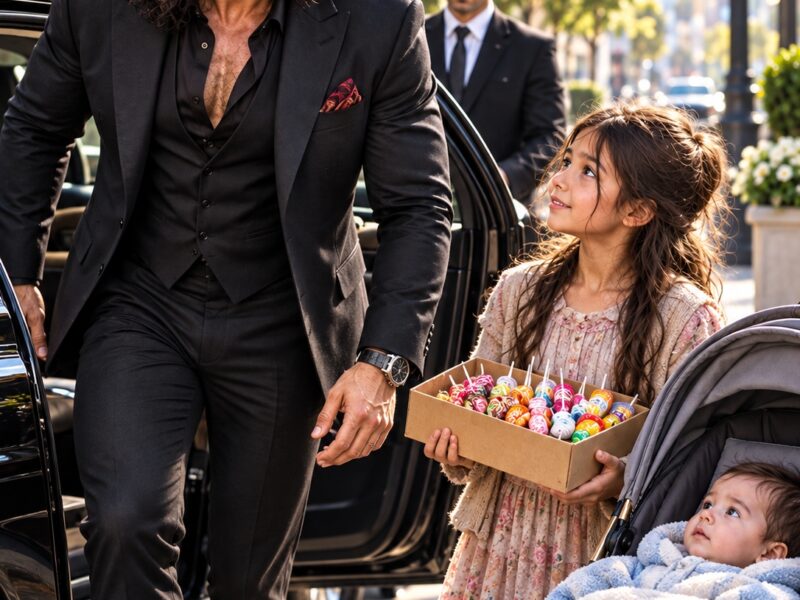
A Mafia Boss Saw an Eight-Year-Old Selling Candy Beside Her Feverish Baby Brother—Then One Step From His Car Exposed a Betrayal He Never Expected
I remember the candy before I remember the girl.
Forty-three chocolate bars arranged in six neat rows inside a cardboard box that had once held printer paper. Every wrapper faced the same direction. The corners of the box had been reinforced with silver duct tape, as if somebody had decided that even poverty should look organized.
Then I saw the child holding it.
She could not have been older than eight.
Her blue jacket was two sizes too large, the cuffs rolled back until they formed thick rings around her wrists. Her hair had been gathered into a crooked ponytail, probably by her own hands, and she stood on the corner of Fifth and Miller in Boston’s old market district with an expression children are not supposed to have.
Patient.
Watchful.
Tired.
Behind her sat a baby in a faded stroller with one bent front wheel.
He was coughing.
I could hear it even through the glass of my car.
“Sir?”
Frank, my driver, glanced at me in the rearview mirror.
We had been stopped at the light for perhaps twenty seconds. I had a meeting across town in eighteen minutes with three men who had already been waiting too long, and under ordinary circumstances I would have been looking at my phone, reviewing numbers, deciding who was lying before I ever entered the room.
Instead, I watched the girl.
“Wait.”
Frank looked through the windshield.
“The light’s green.”
“I know.”
A horn sounded behind us.
I barely heard it.
The baby coughed again.
His entire little body folded forward with it.
The girl set down her candy box immediately, crouched beside him, and pressed the back of her hand to his forehead. Then she pulled a thin blanket higher around his chest and stood again before the next group of pedestrians reached the corner.
“Candy, one dollar.”
I could finally hear her after Frank cracked the window.
“Candy, one dollar, please.”
A man carrying a briefcase passed without looking at her.
A woman in a red coat slowed long enough to shake her head.
Two college students walked around the stroller while laughing at something on a phone.
The girl did not complain.
She simply repeated the words.
“Candy, one dollar.”
There was something about the order of those candy bars that irritated me.
Not because the box was neat.
Because I understood what that neatness meant.
When people have enough, order is preference.
When they have almost nothing, order is often dignity.
“Pull over,” I said.
Frank looked at me again.
“Boss, the Alvarez meeting—”
“Can wait.”
He did not argue a second time.
People who worked for me rarely did.
My name is Nicholas Moretti.
For twenty-three years, men in Boston had learned that when I made a decision, conversations usually ended rather than began. Newspapers called me a shipping executive when attorneys were nearby and used older, less flattering words when they believed I would not sue.
I owned restaurants.
Warehouses.
Construction companies.
Pieces of the waterfront.
And businesses whose ownership was deliberately harder to explain.
There were men who considered me honorable.
There were men who would have called me a monster if they were certain I could not hear them.
Both groups had evidence.
I had spent most of my adult life believing that power was the only reliable protection against loss.
Then an eight-year-old girl sold candy beside a sick baby, and I stepped out of my car.
That turned out to be the most expensive decision I had ever made.
Not in money.
Money was the easiest thing I lost.
I crossed the sidewalk slowly.
The girl noticed me immediately.
Her whole body changed.
Her shoulders straightened.
One foot moved backward until it touched the stroller.
Then she shifted herself between me and the baby.
That told me more than any conversation could have.
Children who feel protected hide behind adults.
Children who have learned they are the protection stand in front.
“I’m not going to hurt you,” I said.
She stared at my coat.
Then at my shoes.
Then past me at the black sedan.
Her eyes narrowed.
Smart child.
“What do you want?”
There was no sweetness in the question.
I almost smiled.
“Candy.”
“One dollar.”
“How many do you have?”
She glanced down.
“Forty-three.”
“I’ll take them.”
She blinked.
“All?”
“Yes.”
“Why?”
“Because I like chocolate.”
She looked at me as if I had insulted her intelligence.
I crouched so I was closer to her height.
“Fine. Because I want to buy all of them.”
“You don’t need forty-three.”
“Neither do most people who buy expensive wine. We all make choices.”
The corner of her mouth moved.
Not quite a smile.
The baby coughed again.
She turned instantly.
Everything about me disappeared from her attention.
“Sam?”
She knelt beside him.
His cheeks were red.
Too red.
His eyes looked heavy.
She touched his forehead.
“Hey.”
The baby made a small sound.
The girl whispered, “I know. I know.”
I looked at Frank.
He had gotten out of the car.
He understood my expression.
“Call Hale.”
The girl looked up.
“Who’s Hale?”
“A doctor.”
Her face closed.
“We don’t need one.”
“Yes, you do.”
“He’s fine.”
“No.”
Her chin lifted.
“You don’t know him.”
“I know fever when I see it.”
She stood.
“He gets sick sometimes.”
“How long has he been coughing?”
Silence.
“How long?”
“Two days.”
“And the fever?”
She looked away.
“Last night.”
I checked the baby again.
“Where are your parents?”
The reaction was almost invisible.
Almost.
Her fingers tightened around the stroller handle.
“My mom’s working.”
“At three in the afternoon while you’re selling candy with a sick one-year-old?”
“He’s fourteen months.”
“Fine. A sick fourteen-month-old.”
Her eyes flashed.
“You don’t have to buy anything.”
There it was.
Pride.
Defensive and immediate.
I knew it well.
I reached into my pocket and pulled out cash.
She watched my hand carefully.
I counted three hundred dollars.
Her eyes widened.
“No.”
“You haven’t even taken it.”
“It’s too much.”
“Call it inflation.”
“No.”
She held out one hand.
“One dollar each.”
I stared at her.
“You are standing outside in October with a sick baby, and you are negotiating downward.”
“I’m not stealing.”
“I didn’t say you were.”
“You’re trying to give me money for nothing.”
“I am buying bad chocolate at an irresponsible quantity.”
“It’s good chocolate.”
“Then I retract one insult.”
She almost smiled again.
I held out the money.
“Take it.”
She shook her head.
“Forty-three.”
“Keep the rest for your brother.”
Her expression changed.
The brave part faded first.
Her mouth trembled.
Then she looked down quickly, embarrassed that I might see.
“I can’t.”
“Why?”
“I don’t know you.”
That answer hit harder than it should have.
No child should have to evaluate what kindness might cost later.
“Good,” I said.
She looked up.
“You shouldn’t trust strangers.”
“Then why should I take your money?”
“Because I’ll give you the doctor’s address, and you can walk there yourself. I won’t touch you. I won’t take your brother. You can keep the door open while you talk to the doctor if that makes you feel better.”
She studied me.
“What’s your name?”
“Nicholas.”
“Last name?”
“Moretti.”
Nothing changed in her face.
Good.
She was too young to know.
“Your name?”
“Lily.”
“And him?”
“Sam.”
Frank approached with his phone.
“Dr. Hale can see them now.”
Lily looked at him.
Then at me.
“Do we have to pay?”
“No.”
Her suspicion returned immediately.
“Why?”
“Because I know the doctor.”
“That doesn’t make doctors free.”
I sighed.
“You ask difficult questions.”
“My mom says people get mad at questions when they don’t like the answers.”
“Your mother sounds exhausting.”
“She is.”
That time she smiled.
Briefly.
Then Sam coughed until tears came from his eyes.
The smile disappeared.
Lily looked at me.
“Where is the doctor?”
Three blocks away.
We walked.
I sent the car ahead.
Lily refused to let anyone push the stroller.
It rattled over every crack in the sidewalk, the crooked wheel pulling left. She corrected it constantly with one hand while balancing the box of candy against her hip.
After half a block, I reached for the box.
She moved away.
“I can carry it.”
“I did not suggest otherwise.”
“You were reaching.”
“I was going to carry the candy.”
“You bought it.”
“Yes.”
“So it’s yours.”
I looked at the box.
Technically correct.
“Then give me my property.”
She considered.
Then handed it over.
Frank looked at me carrying forty-three candy bars through the old market district in a thousand-dollar coat.
I dared him to smile.
He looked away.
Dr. Rebecca Hale ran a small clinic between a pharmacy and an accountant’s office.
She had known me for fourteen years.
The circumstances were not social.
Rebecca had once treated one of my men after he made a poor decision in Providence and an even worse decision about where to seek medical care.
Afterward, I paid to keep her clinic open when she nearly lost it.
She believed the money came with conditions.
It did.
One.
If I called about someone who needed help, she saw them.
She opened the door before we reached it.
“What happened?”
“Baby. Fever. Cough.”
She looked at Sam.
Her expression changed.
“Inside.”
Lily hesitated.
Rebecca crouched.
“Hi. I’m Dr. Hale.”
Lily stayed behind the stroller.
“I’m not taking him away from you.”
Silence.
“You can stay beside him the whole time.”
That worked.
Lily followed her inside.
Within ten minutes, Sam was on an exam table.
Rebecca listened to his lungs.
Checked oxygen.
Measured temperature.
Then looked at me over Lily’s head.
I knew that look.
Serious.
Not catastrophic yet.
But headed somewhere bad.
“How high was his fever?”
“Last night it was one hundred three,” Lily said.
Rebecca stopped.
“How did you measure it?”
“Neighbor has a thermometer.”
“Did she give him anything?”
“Children’s medicine.”
“Do you know how much?”
Lily nodded and showed with her fingers.
Rebecca asked, “Where is your mother?”
Lily went still.
I saw it.
Rebecca did too.
“Working,” Lily whispered.
The same lie.
Rebecca looked at me.
I said nothing.
“Okay,” the doctor said gently. “Sam has pneumonia starting in his right lung. I think we caught it before it became something worse.”
Lily’s face emptied.
“Is he going to die?”
Rebecca immediately knelt.
“No.”
Lily stared.
“No?”
“Not if we treat him. He needs antibiotics, fluids, rest, and someone watching his breathing carefully.”
Lily’s shoulders dropped.
For perhaps the first time all afternoon, she looked eight.
Not twenty-eight trapped in an eight-year-old body.
Just eight.
“Can I watch him?”
Rebecca smiled sadly.
“You’ve been watching him too much already.”
Lily frowned.
“What does that mean?”
“It means you’re his sister.”
Rebecca touched her hand.
“You’re not supposed to be his doctor, his parent, and his entire emergency plan.”
Lily looked down.
Rebecca glanced at me again.
I understood.
We needed the truth.
While Sam received his first breathing treatment, I sat with Lily in the waiting room.
She perched on the edge of the chair, ready to run toward the exam room if he made a sound.
I put the candy box between us.
“Want one?”
She looked offended.
“You bought them.”
“I appear to have too many.”
She took a chocolate bar.
Unwrapped it.
Broke it in half.
Then put half in her jacket pocket.
“For later?”
“For Sam when he’s better.”
Of course.
I leaned back.
“Lily.”
She knew.
Her shoulders tightened.
“Where is your mother?”
“Work.”
“No.”
She stared at the floor.
“I’m not police.”
Nothing.
“I’m not child services.”
Her head lifted quickly.
That was fear.
Real fear.
I softened my voice.
“I’m not going to separate you from Sam.”
“You can’t promise that.”
The words were too adult.
I looked at her carefully.
“Someone already threatened that?”
“No.”
“Lily.”
Her fingers twisted the chocolate wrapper.
“A lady came.”
“When?”
“Last week.”
“To your apartment?”
She nodded.
“County lady.”
“What did she ask?”
“If Mom was home. If someone was staying with us.”
“What did you say?”
“That everything was fine.”
“Was your mother there?”
No answer.
“Lily.”
Her eyes filled.
Then the truth came out in four words.
“She’s in the hospital.”
The room changed.
“How long?”
“Three weeks.”
My jaw tightened.
“Which hospital?”
“St. Bernadette.”
“Why?”
“I don’t know the name.”
She wiped one eye angrily.
“Something with her blood.”
“Who is staying with you?”
“Mrs. Jaffer downstairs.”
“Full-time?”
Lily looked away.
“She works nights.”
“So at night?”
“I take care of Sam.”
Eight years old.
I stopped breathing for a second.
“How?”
She shrugged.
“Food. Bottles. Diapers.”
“School?”
“I go.”
“And Sam?”
“Mrs. Jaffer takes him until she leaves for work.”
“What happens after school?”
“I get him.”
“And then you sell candy.”
Her face crumpled.
“We need money.”
The words came faster now.
“Mom is sick and rent is late and the electricity letter is red and Mrs. Jaffer said county people might come back, and if they know Mom is in the hospital they’ll take us somewhere.”
She took one breath.
“And they might split us.”
Another breath.
“He cries if I’m gone.”
Another.
“He’s all I have.”
That last sentence was not true.
She had a mother alive in a hospital.
But emotionally, in that moment, I understood exactly what she meant.
I had once said the same words in a different form.
I was nine when my mother died.
My father had technically been alive.
That did not mean I had anybody.
I remembered sitting in a hospital waiting room while two adults argued about where I would sleep.
Nobody crouched down.
Nobody said I would be safe.
Nobody asked whether I was hungry.
By twelve, I had learned not to wait for anyone.
By sixteen, I had learned that fear worked faster than trust.
By thirty, I had built a life around that lesson.
Now an eight-year-old girl was sitting beside me, trying not to cry because crying took time away from responsibility.
I stood.
“Where are you going?”
“To see your mother.”
Panic.
“No.”
“Why?”
“She’ll be mad.”
“At you?”
“She told me to stay with Mrs. Jaffer.”
“And you didn’t.”
“I needed money.”
“Does she know?”
“No.”
“Then yes. She will probably be angry.”
Lily’s eyes widened.
I continued.
“But that is not the worst thing happening today.”
“You won’t tell the county?”
“I’ll tell your mother first.”
“That’s not what I asked.”
Again, direct.
I looked at her.
“No one is separating you from Sam today.”
“Today?”
Smart child.
“I will do everything I can to make sure it never happens.”
She studied me.
“Why?”
I looked through the clinic window.
People walked past outside.
Exactly as they had walked past Lily.
“Because everyone else kept walking.”
That was the truth.
Just not all of it.
St. Bernadette Hospital did not like men like me arriving unannounced.
Hospitals prefer problems that fit forms.
I had attorneys.
They had security.
Eventually everyone remembered manners.
Angela Carter was on the fourth floor.
Thirty-two years old.
She looked fifty.
Her hair had thinned.
Her skin had the strange translucent color long illness gives people.
Machines surrounded her.
A nurse explained she had autoimmune hemolytic anemia complicated by another blood disorder.
Treatment existed.
Expensive treatment.
Insurance had denied part of it pending “further documentation.”
I had spent enough years around lawyers to understand what that meant.
Delay until desperation becomes cheaper than approval.
“How much?”
The nurse hesitated.
“I’m not authorized—”
“How much would keep treatment going uninterrupted?”
She gave me a number.
It would have destroyed Angela financially.
It was less than I had spent on a yacht I used four times.
Something ugly moved through me.
Not guilt exactly.
Perspective.
I waited beside Angela until she woke.
Her eyes opened slowly.
She saw me.
Confusion became fear.
Good instincts apparently ran in the family.
“Who are you?”
“Nicholas Moretti.”
Nothing.
Then recognition.
Not the kind I wanted.
Her fingers tightened around the blanket.
“What do you want?”
“I met Lily.”
Everything about her changed.
“Where?”
“Fifth and Miller.”
Angela closed her eyes.
“No.”
“She was selling candy.”
“No.”
“Sam was with her.”
Angela tried to sit.
Pain stopped her.
“Where is he?”
“Safe.”
“What happened?”
“Pneumonia.”
Her face collapsed.
“Oh God.”
“He’s being treated.”
“I told her—”
Angela covered her mouth.
“I told her Mrs. Jaffer would take care of them.”
“She tried.”
Tears came.
“I told Lily not to go outside.”
“She was trying to pay bills.”
Angela sobbed then.
Quietly.
People who have suffered too long often learn to cry without sound.
I knew that too.
“She’s eight.”
“I know.”
“No, you don’t.”
Angela looked at me fiercely through tears.
“She thinks because I’m sick she has to become me.”
I said nothing.
“I hear her on the phone pretending to be older.”
Her voice cracked.
“She lies to nurses. She tells Sam I’m coming home tomorrow because he’s too little to understand weeks.”
She pressed one hand to her eyes.
“And I’m lying here.”
“You are sick.”
“That doesn’t matter to children.”
It did.
But I understood what she meant.
“Where is their father?”
Angela became still.
“Gone.”
“Dead?”
“No.”
“Then where?”
Her jaw tightened.
“He left.”
“When?”
“Two years ago.”
“Name?”
Her eyes sharpened.
“Why?”
“To find him.”
“No.”
That surprised me.
“He abandoned you.”
“You don’t understand.”
“Then explain.”
Angela looked toward the door.
When she spoke again, her voice dropped.
“Daniel Carter worked at the port.”
My attention sharpened.
“What company?”
“Vescari Logistics.”
I knew the name.
Raymond Vescari.
Ray.
A man I had maintained a careful peace with for three years.
Angela continued.
“Daniel handled inventory.”
“When did he leave?”
“He disappeared.”
“You said left.”
“That’s what I tell Lily.”
My skin went cold.
“Why?”
Angela looked at me.
“Because he told me if anyone ever asked, I should say he abandoned us.”
Silence.
“He called one night from a pay phone.”
Her hands trembled.
“He said he had seen something he shouldn’t have. He said men were moving shipments under false numbers.”
“What shipments?”
“He never told me.”
“Did he name Ray?”
Angela looked down.
“No.”
Not convincing.
“Mrs. Carter.”
“He said the name once.”
“Whose?”
“Vescari.”
My entire body became still.
“And then?”
“He came home long enough to pack a bag.”
Tears returned.
“He kissed Lily while she was sleeping.”
Her voice broke.
“Sam wasn’t born yet.”
I stared.
“He left a flash drive.”
That mattered.
“Where?”
“I don’t know.”
“What do you mean?”
“He told me if something happened to him, I should look in the place where Lily learned to read.”
“And?”
“I never found it.”
“Did anyone search your apartment?”
“Yes.”
“When?”
“The week after he disappeared.”
My mind moved quickly.
“What did police say?”
“That adults are allowed to leave.”
Of course.
“Did Ray ever contact you?”
Angela looked at me.
“No.”
Another lie.
“Angela.”
She closed her eyes.
“A man came once.”
“When?”
“Three months after Daniel vanished.”
“What did he want?”
“He said Daniel owed money.”
“Did he?”
“No.”
“What did you do?”
“I paid what I could.”
“How much?”
“Four thousand.”
“Then?”
“He never came back.”
I looked at her machines.
Her hospital gown.
The entire life Daniel’s disappearance had left behind.
“Why didn’t you tell anyone?”
She laughed weakly.
“Tell who?”
Fair.
I stood.
Angela’s face tightened.
“Where are you going?”
“To find out whether your husband abandoned you.”
“And if he didn’t?”
I looked at her.
“Then someone owes this family more than money.”
That sentence would come back to haunt me.
Because in my world, people heard words like that and assumed violence.
A year earlier, they would have been right.
That afternoon, I made two decisions.
The first was simple.
Angela’s treatment would continue.
I paid the outstanding balance through a legitimate charitable foundation attached to one of my companies and instructed attorneys to structure the support so Angela owed me nothing.
The second decision was more complicated.
I told Frank to investigate Daniel Carter.
Quietly.
No pressure.
No threats.
No men disappearing into warehouses.
Information.
That alone showed how much Lily had already changed me.
I returned to Dr. Hale’s clinic after dark.
Sam was sleeping.
His breathing had improved.
Lily sat beside the stroller with her head against the wall.
She was asleep too.
One hand remained wrapped around the stroller handle.
Even unconscious, she refused to let go.
I stood there longer than necessary.
Rebecca came beside me.
“She needs sleep.”
“Yes.”
“She needs an adult.”
“Yes.”
She looked at me.
“Not necessarily you.”
“I’m aware.”
“Are you?”
I gave her a look.
She ignored it.
Rebecca was one of very few people who did.
“Don’t turn compassion into ownership, Nicholas.”
“I’m paying bills.”
“That’s exactly what I mean.”
My jaw tightened.
“These children need help.”
“They do.”
She looked at Lily.
“But they do not need to become another thing you control because control makes you feel safe.”
That irritated me because it was accurate.
“What do you suggest?”
“Help their mother.”
“I am.”
“Protect the children until she’s home.”
“Yes.”
“Then let them remain a family.”
I looked at Lily.
Something uncomfortable moved through me.
“I don’t intend to take them.”
“Good.”
Rebecca walked away.
I hated advice most when it arrived before I realized I needed it.
Frank called at nine twelve.
“Boss.”
“What?”
“We found Carter.”
I stepped into the clinic hallway.
“Alive?”
A pause.
“No.”
Something inside me hardened.
“How?”
“His body was found eighteen months ago in Rhode Island.”
“Name?”
“John Doe until last year.”
I closed my eyes.
“Cause?”
“Drowning.”
“Accident?”
“No.”
“How do you know?”
“Two broken fingers. Fractured jaw.”
Anger rose.
Old anger.
Familiar.
Useful.
Dangerous.
“Ray?”
“Maybe.”
“Maybe is not enough.”
“There’s more.”
I waited.
“Daniel worked for Vescari.”
“I know.”
“He also copied shipping records.”
“Why?”
“Looks like he discovered Ray was moving fentanyl precursors through medical-supply containers.”
The irony turned my stomach.
A man moving poison through shipments labeled as medicine.
“And Moretti routes?”
Frank went quiet.
My blood cooled.
“Frank.”
“One warehouse.”
“Which?”
“Charlestown Nine.”
Mine.
I stared at the wall.
“When?”
“Two years ago.”
“Who managed it?”
“Peter Lombardi.”
My lieutenant.
For fifteen years.
A man who ate Sunday dinner at my house twice a month.
A man who called my mother on her birthday.
“What happened to the records?”
“Missing.”
“Peter?”
“Still says he knows nothing.”
I laughed once.
Not because anything was funny.
Rebecca looked toward me from the exam room.
I turned away.
“Find Daniel’s flash drive.”
“We don’t know where.”
I looked through the glass at Lily.
Then remembered Angela’s words.
The place where Lily learned to read.
“Get someone to the Carter apartment.”
“Quietly?”
“Yes.”
“Ray may be watching.”
“Then be quieter.”
Frank hesitated.
“Boss.”
“What?”
“The Alvarez meeting called four times.”
I almost smiled.
“Cancel it.”
“That’ll send a message.”
“Good.”
“What message?”
I looked at Lily.
“That I found something more important.”
Lily woke ten minutes later.
The first thing she did was check Sam’s forehead.
Then she saw me.
“Did you see Mom?”
“Yes.”
“Is she mad?”
“Very.”
Her eyes dropped.
“But she loves you.”
“I know.”
“She also told me something.”
Lily became wary.
“About Dad?”
That surprised me.
“You remember him?”
“A little.”
“What?”
“He smelled like sawdust.”
Daniel had worked at the port.
“Anything else?”
“He read me books.”
My chest tightened.
“Which books?”
She shrugged.
“Bear books. Princess books. Green Eggs and Ham.”
“Where?”
“Our old apartment.”
“Anywhere special?”
She thought.
“Closet.”
I stared.
“What?”
“The hall closet.”
“You learned to read in a closet?”
Lily frowned.
“It was our fort.”
Of course.
The place where Lily learned to read.
I stood.
Lily grabbed my sleeve.
“Did Dad do something bad?”
The question stopped me.
“Why would you ask that?”
“Mom cries when people say his name.”
Children build explanations in empty spaces.
Sometimes the explanations are crueler than truth.
“No.”
I crouched.
“I don’t think your father abandoned you.”
Lily’s entire face changed.
“What?”
“I think he was trying to protect you.”
Her mouth opened.
No sound.
“Where is he?”
I hated the answer.
I hated Angela for leaving it to me.
I hated Daniel for being dead.
I hated Ray.
Mostly I hated that children always seemed to receive consequences from choices adults made in rooms they never entered.
“I don’t know enough yet.”
That was technically true.
Lily’s eyes filled.
“You’re lying.”
“No.”
“You know something.”
“Yes.”
“What?”
“I know he did not simply leave because he stopped loving you.”
Her lip trembled.
“That’s all?”
“For tonight.”
She wiped her face.
“You sound like Mom.”
“Insulting.”
“She says that.”
I smiled faintly.
Then she asked, “Why do you care?”
I had no easy answer.
So I gave her the honest one.
“When I was about your age, my mother got sick.”
Lily listened.
“She went into a hospital.”
“Like mine?”
“Yes.”
“Did she get better?”
“No.”
Lily looked down.
“I’m sorry.”
“Thank you.”
“Who took care of you?”
“Nobody properly.”
She frowned.
“What happened?”
“I became difficult.”
“You’re still difficult.”
I stared.
She smiled through tears.
I laughed.
Actually laughed.
Frank entered the clinic and stopped.
He had worked for me twelve years.
I had never seen him look so alarmed.
Lily said, “See?”
Frank cleared his throat.
“We found something.”
The flash drive was still in the apartment.
Daniel had hidden it behind a loose wooden panel in the hall closet.
The panel held pencil marks.
LILY 5.
A crooked alphabet.
Three stars drawn in purple crayon.
Frank brought it to me inside an evidence sleeve.
I did not touch it immediately.
Because suddenly Daniel Carter was no longer a dead dockworker in an old report.
He was a father kneeling in a closet, teaching his daughter letters.
“Can we open it?”
“Yes.”
The files were encrypted.
One folder was not.
Inside were photographs.
Shipping manifests.
Container numbers.
Emails.
And a short video Daniel had recorded.
The date was two days before he disappeared.
I watched it alone.
Daniel sat in what looked like a parked car.
Thin face.
Unshaven.
Terrified.
“If anyone sees this…”
He paused.
“If Angela sees this, I’m sorry.”
He looked directly into the camera.
“I found proof that Vescari Logistics is moving chemical shipments through Moretti Warehouse Nine. Peter Lombardi is signing the internal clearances.”
I stopped breathing.
Daniel continued.
“I don’t know if Nicholas Moretti knows.”
My name from the mouth of a dead man.
“If he does, none of this matters.”
He swallowed.
“If he doesn’t, maybe he’s the only person powerful enough to stop Ray.”
The screen blurred for a moment as Daniel adjusted it.
“I’m leaving because Ray knows I copied files.”
He looked away.
“I told Angela I’d call.”
His voice cracked.
“I don’t know if I will.”
Then:
“Lily, if you ever see this someday, Daddy didn’t leave because of you.”
I shut my eyes.
The video continued.
“You were the best thing I ever did.”
A broken smile.
“Sam, you’re not here yet, but I already love you.”
He took one breath.
“Angela, forgive me.”
The video ended.
For a long time, I sat in silence.
Then I called Peter Lombardi.
“Come to my house.”
He knew my voice.
“Now?”
“Yes.”
“Everything okay?”
“No.”
Peter arrived forty minutes later.
Frank searched him at the door.
Peter looked offended.
That told me almost nothing.
Guilty men become offended.
So do innocent ones.
He sat across from me in my study.
“What is this?”
I placed Daniel’s photograph on the desk.
Peter’s face changed.
There.
Not enough for guilt.
Enough for recognition.
“You know him.”
Peter looked down.
“Dock worker.”
“Name.”
“Daniel Carter.”
My anger became cold.
“You remember.”
“Yes.”
“Why?”
“He caused problems.”
“What problems?”
Peter glanced at Frank.
I said, “Look at me.”
He did.
“What problems?”
“He copied manifests.”
“Why?”
“I don’t know.”
Wrong answer.
Peter knew it immediately.
“Try again.”
He leaned back.
“Ray was running product through our warehouse.”
“Product?”
“Chemicals.”
“For narcotics.”
Peter said nothing.
“Did you approve it?”
Silence.
“Peter.”
“Yes.”
Twenty-three years of controlling rooms did not prepare me for how betrayal feels when it arrives calmly.
I had expected rage.
Instead there was grief.
“You used my warehouse.”
“Yes.”
“Without my permission.”
“You wouldn’t have approved.”
“Correct.”
“Which is why I didn’t ask.”
Frank shifted.
I raised one hand.
“Daniel found out.”
“Yes.”
“Did you kill him?”
Peter’s face tightened.
“No.”
“Did Ray?”
“I don’t know.”
“Did you tell Ray Daniel copied files?”
Peter looked away.
That was the answer.
I sat back.
“You gave him Daniel.”
“No.”
“You told a man like Ray that Daniel had evidence.”
“I thought he would scare him.”
I laughed.
Peter flinched.
“That sentence should embarrass you.”
“I didn’t order his death.”
“You sound exactly like every coward who hands someone to a monster and then complains about the teeth.”
His face hardened.
“You’ve done worse.”
The room became still.
Frank looked at me.
Peter had chosen a dangerous truth.
I let him continue.
“You built this world.”
His voice grew stronger.
“Men were afraid to cross us because you taught them fear works.”
“Yes.”
“And now suddenly because some little girl sells candy, you want to pretend your hands are clean?”
I stared at him.
“No.”
That surprised him.
“My hands are not clean.”
Peter hesitated.
“That’s the difference between us right now.”
I leaned forward.
“I know what I am responsible for.”
He swallowed.
“Do you?”
“More than I did yesterday.”
I slid the flash drive toward him.
“A dead man left me evidence because he hoped I might be better than Ray.”
Peter stared.
“I haven’t decided whether that makes Daniel brave or foolish.”
I looked toward the window.
“But I am not going to prove him foolish.”
Peter’s face went pale.
“What are you going to do?”
The old answer appeared instantly.
Destroy Ray.
Punish Peter.
Make examples.
Fear.
Simple.
Efficient.
Familiar.
Then I pictured Lily dividing a chocolate bar in half so her sick brother could have some later.
“No more bodies.”
Frank looked at me.
Peter actually laughed.
“You expect Ray to negotiate?”
“No.”
“Then?”
“I expect federal prosecutors to enjoy reading.”
His laughter stopped.
“You’ll expose yourself.”
“Yes.”
“You’ll expose half our people.”
“Yes.”
“Nicholas.”
He leaned forward.
“You built this.”
“I know.”
“You’ll destroy it.”
“Maybe it deserves to be destroyed.”
Peter stared at me as if I had started speaking another language.
Maybe I had.
I handed Frank the drive.
“Copies.”
“How many?”
“Enough that nobody can make them disappear.”
Peter stood.
“This is because of those kids?”
I looked at him.
“No.”
He waited.
“It is because those kids made it impossible for me to keep pretending I didn’t know what men like us cost everyone else.”
Peter’s face hardened.
“You’re weak.”
Maybe.
For most of my life, that word could have started a war.
Now it sounded tired.
“Leave.”
“What?”
“Go home.”
Peter stared.
“You’re letting me walk?”
“Tonight.”
“Why?”
“Because I want you to decide whether you walk into the U.S. Attorney’s office tomorrow with counsel, or whether they come find you after I give them your name.”
His face drained.
“That’s not mercy.”
“No.”
I stood.
“It’s choice.”
Peter left.
Frank watched the door close.
“You trust him not to run?”
“No.”
“Then why—”
“His accounts are frozen.”
Frank looked at me.
I almost smiled.
“I am changing, Frank.”
“Apparently not completely.”
“One crisis at a time.”
The next morning, Peter surrendered through an attorney.
That surprised me.
His cooperation confirmed Daniel’s story.
Ray Vescari had ordered Daniel abducted.
He had not initially intended to kill him.
According to Peter, Ray wanted the flash drive.
Daniel refused to reveal where it was.
Ray’s men lost patience.
A body appeared in Rhode Island.
A widow was told her husband had abandoned her.
An eight-year-old girl grew up believing her father chose to disappear.
And my warehouse made it possible.
I told Angela myself.
She did not cry immediately.
That scared me.
I sat beside her hospital bed.
“Daniel is dead.”
Her face became empty.
“We found his body.”
Nothing.
“He did not leave you.”
One breath.
“He was trying to protect you.”
Angela turned her head toward the window.
“Don’t.”
I stopped.
She whispered, “I spent two years hating him.”
“You had reason.”
“No.”
Her voice rose.
“I told Lily he left.”
“You were trying to protect her.”
“I made her think her father didn’t want her.”
Tears came now.
“No.”
“Yes.”
Angela covered her face.
“I was angry at a dead man because that was easier than being terrified of men like you.”
I absorbed it.
She looked at me.
“Was it you?”
“No.”
“Did your people help?”
“Yes.”
That honesty cost something.
It should.
Angela stared.
“And you’re helping us.”
“Yes.”
“Why?”
I looked down.
“I could tell you because I saw Lily.”
“Partly.”
“Yes.”
“What else?”
I thought of Daniel’s video.
Because I wanted to be the man he hoped I might be.
But saying that sounded too generous.
So I told the harder truth.
“Because your husband died inside a system I benefited from.”
Angela’s mouth tightened.
“I didn’t order it.”
Her eyes sharpened.
I added quickly, “That sentence is not an excuse.”
Silence.
“I made a world where Peter believed hiding Ray’s operation from me was safer than telling me the truth.”
I swallowed.
“And Daniel paid for it.”
Angela looked at me a long time.
“Are you asking forgiveness?”
“No.”
“Good.”
“I’m asking permission to tell Lily the truth with you.”
That surprised her.
“You think she should know?”
“Not everything.”
“She’s eight.”
“I know.”
“But enough.”
Angela stared at the blanket.
After a while, she nodded.
“Enough that she knows he loved her.”
We told Lily two days later.
Sam slept in a crib beside Angela’s hospital bed.
Lily sat between us.
I had faced armed men with less dread.
Angela held her daughter’s hands.
“Daddy didn’t leave us because he wanted to.”
Lily stared.
“Then where is he?”
Angela’s voice broke.
“He died.”
Lily looked at me.
Not her mother.
Me.
Because I had been the one who first told her he might not have abandoned her.
“Is that true?”
“Yes.”
“How?”
I looked at Angela.
She nodded.
“He found something dangerous at work.”
Lily’s face tightened.
“He tried to tell people.”
“Did bad people hurt him?”
I chose each word.
“Yes.”
She was quiet.
“Did you know them?”
“Yes.”
Angela inhaled sharply.
Lily looked at me.
“Were they your friends?”
The question was worse.
“One worked for me.”
Lily’s eyes filled.
“You got my dad killed?”
Angela whispered, “Lily.”
“No.”
I did not move away.
“No.”
She stood.
“But your man told them.”
“Yes.”
“Then it’s your fault.”
Silence.
I could have defended myself.
Explained hierarchy.
Intent.
Ignorance.
I had used those distinctions for decades.
Instead I said, “Part of it is.”
Angela looked at me.
Lily’s lower lip trembled.
“I hate you.”
That sentence hurt more than it should have.
“Okay.”
She frowned.
“You don’t care?”
“I care.”
“Then why did you say okay?”
“Because you’re allowed.”
She began crying.
“I don’t want your money.”
“Okay.”
“I don’t want your doctor.”
“Sam still needs the doctor.”
She looked furious.
I continued, “You can hate me and still let Dr. Hale treat your brother.”
“That’s stupid.”
“Yes.”
Angela almost laughed through tears.
Lily turned away.
Then asked quietly, “Did Daddy love me?”
Angela broke.
“Yes.”
She pulled Lily toward her.
“He loved you more than anything.”
I took Daniel’s phone video from my pocket.
“Your father left something.”
Lily stared.
“For me?”
“Yes.”
Angela looked at me.
I had warned her.
We played only the last portion.
Daniel looked into the camera.
Lily, if you ever see this someday, Daddy didn’t leave because of you. You were the best thing I ever did.
Lily made one sound.
A small, broken gasp.
Then she crawled into her mother’s bed despite tubes and monitors and curled against Angela’s side.
I left the room.
Some grief is private.
Frank was waiting outside.
“You okay?”
“No.”
He nodded.
“Good.”
I looked at him.
He shrugged.
“Means you’re still human.”
“Debatable.”
My phone rang.
Ray.
Of course.
I answered.
“Nicholas.”
His voice was warm.
Men like Ray often sounded warm before doing cold things.
“You’ve been busy.”
“So have you.”
“I heard you found an old flash drive.”
News traveled quickly.
“You hear too much.”
“I pay well.”
“So did Judas.”
Ray laughed.
“There he is.”
I walked toward the window.
“What do you want?”
“To avoid an unnecessary war.”
“You killed Daniel Carter.”
Silence.
Then:
“That dockworker.”
Not Daniel.
Not father.
Dockworker.
The word decided more than Ray understood.
“He stole.”
“He copied evidence.”
“Same principle.”
“No.”
Ray sighed.
“Nicholas, don’t become sentimental because a child cried on a sidewalk.”
I became very still.
“How do you know about Lily?”
Frank saw my face.
His hand moved toward his jacket.
Ray laughed quietly.
“Relax.”
“Answer.”
“People noticed your car.”
“That’s not an answer.”
“I know enough.”
My voice dropped.
“If anyone goes near those children—”
“There.”
Ray sounded pleased.
“That is exactly the problem.”
“What?”
“You have something to lose.”
He paused.
“I wondered if the stories were true.”
“What stories?”
“That Nicholas Moretti stepped out of his car for a candy girl.”
I said nothing.
“How poetic.”
His tone changed.
“Dangerous too.”
“Ray.”
“Yes?”
“If you are trying to frighten me, choose another method.”
“I’m not frightening you.”
Another pause.
“I’m educating you.”
The call ended.
Frank said, “Move them.”
“Yes.”
Angela objected.
Of course.
“You brought this to us.”
“Yes.”
“And now you want to move my children?”
“Temporarily.”
“No.”
“Angela.”
“You said help, not control.”
The accusation was fair.
I stood beside her bed.
“I need you to listen.”
“I’ve listened to men deciding what happens to my family for two years.”
“I am not taking them away from you.”
“You’re putting them in some guarded mansion?”
“No.”
That surprised her.
“A house in Brookline.”
“Whose?”
“A pediatric nurse named Claire Donovan.”
“Why should I trust her?”
“Don’t.”
Angela stared.
“Meet her.”
I continued.
“Background check her. Call her employer. Speak to her neighbors.”
I handed Angela a folder.
Every detail.
No secrets.
“She fostered children for twelve years before her husband died. Dr. Hale knows her. She has space for Lily and Sam. You can video-call every hour if you want. She will bring them here every day once Sam is well enough.”
Angela flipped pages.
“You prepared this.”
“Yes.”
“You assumed I’d say yes.”
“No.”
“What if I say no?”
“Then I increase security around your apartment and clinic.”
“You really are impossible.”
“Frequently.”
She looked toward the crib.
Fear won.
Not my power.
Not persuasion.
Motherhood.
“Three days.”
“As long as needed.”
“I said three.”
“Three.”
“Then we reevaluate.”
“Yes.”
“And Lily chooses whether she goes.”
I hesitated.
Angela’s eyes narrowed.
I corrected myself.
“Yes.”
Lily listened.
She did not trust Claire immediately.
Good.
Claire did not ask her to.
The house smelled like cinnamon and old books.
Sam had a crib in a room painted pale green.
Lily received a bedroom with a lock she controlled from inside and outside.
“No one enters without knocking,” Claire told her.
“Even him?”
She pointed at me.
“Especially him.”
I liked Claire immediately.
Lily looked at me.
“Are you bad?”
The question came on the second night.
We sat on Claire’s back porch.
Sam was asleep inside.
“You asked before.”
“I asked why you helped us.”
“Different question.”
She nodded.
“Yes.”
I looked at the yard.
“I have done bad things.”
“How bad?”
“Bad enough that I won’t lie and say they were mistakes.”
“What does that mean?”
“A mistake is forgetting milk.”
She waited.
“I made choices.”
“Did you hurt people?”
“Yes.”
Her face changed.
“Like Dad?”
“No.”
“Other people’s dads?”
Maybe.
That was the hardest answer.
“Probably.”
Lily looked away.
I let the silence remain.
“My mother used to tell me good people can come from bad places,” she said.
“Your mother sounds optimistic.”
“She said it about Dad.”
I swallowed.
“Was he good?”
“Yes.”
“You didn’t know him.”
“No.”
“But he made the right choice.”
She stared at the dark yard.
“Are you trying to?”
“Yes.”
She looked at me again.
“Why now?”
I could have given her a grand answer.
Instead:
“Because I’m late.”
She considered.
“That’s not a good reason.”
“No.”
“But it’s true.”
“Yes.”
She nodded.
“Okay.”
Children do not grant absolution.
They simply decide whether to stay in the conversation.
That night Ray’s men appeared outside the Carter apartment.
Not the safe house.
The old apartment.
They asked neighbors where Lily had gone.
Mrs. Jaffer called Frank.
That was when the situation changed.
Ray was no longer testing.
He was looking.
And there was one reason he would need Lily specifically.
The flash drive.
He assumed Daniel might have told his daughter something.
An eight-year-old who barely remembered his smell.
Ray did not care.
Fear makes stupid men thorough.
I arranged a meeting.
Neutral restaurant.
Back room.
No weapons on the table.
Those rules were ceremonial.
Everyone involved knew men themselves were weapons.
Ray arrived with two guards.
I brought Frank.
Ray smiled.
“Candy man.”
I sat.
“You disappoint me.”
“I hear that often.”
“You’re asking about a child.”
“I’m asking why your men are asking about her.”
“Curiosity.”
“No.”
His smile faded.
“You found Daniel’s files.”
“Yes.”
“Then you know he stole from me.”
“He collected evidence of criminal activity.”
Ray laughed.
“Listen to you.”
“What?”
“You sound like a prosecutor.”
“Spend enough time around lawyers.”
“You planning to hand it over?”
“Yes.”
The room went still.
Even Frank looked at me.
Ray leaned back.
“You’re bluffing.”
“No.”
“Those files touch your warehouse.”
“Yes.”
“Your lieutenant.”
“Yes.”
“Maybe you.”
“Then I answer for what touches me.”
Ray stared.
“Because of a child?”
“No.”
I leaned forward.
“Because I finally saw what men like us look like from the sidewalk.”
His eyes narrowed.
“Don’t become philosophical.”
“I’m trying not to become dead.”
“That too.”
Ray smiled again.
“You know what everyone will say?”
“Usually I don’t care.”
“They’ll say Nicholas Moretti found a weakness.”
“Maybe.”
“They’ll come after it.”
“Maybe.”
“You cannot protect those children forever.”
I looked at him.
“That sounds like a threat.”
“It’s advice.”
“Then let me return it.”
Ray waited.
“Do not go near Lily or Sam.”
His smile disappeared.
“You don’t own them.”
“No.”
That distinction mattered.
“I protect them because I chose to.”
“Worse.”
“Why?”
“Ownership has limits.”
Ray looked at me.
“Love makes men stupid.”
There was the word.
Love.
I had not said it.
He had.
I thought about Lily’s hand on the stroller.
Sam coughing.
Angela in a hospital bed.
Daniel’s video.
Maybe Ray was right.
Maybe caring creates vulnerability.
But not caring had created something worse.
A life in which I was powerful enough to frighten everyone and still too weak to stop men under my roof from helping a father disappear.
“Then I’ll be stupid.”
Ray laughed.
I did not.
His expression changed.
“You’re serious.”
“Yes.”
“What do you want?”
“Your men stay away.”
“And the files?”
“They go to prosecutors.”
His jaw tightened.
“Then there’s no deal.”
“I didn’t come to negotiate evidence.”
“Why come?”
“To give you one chance to surrender through counsel before federal agents find you.”
Ray stared.
Then laughed.
Hard.
“You’re turning yourself in too?”
“Yes.”
That stopped him.
“You built half this city.”
“I know.”
“You think they’ll forgive you?”
“No.”
“You think the girl will?”
“No.”
“Then what do you get?”
That question revealed everything about him.
He could not imagine an action without profit.
“Nothing.”
I stood.
Ray looked almost offended.
I buttoned my coat.
“You have forty-eight hours.”
“What happens after?”
“Read the newspapers.”
The evidence went out that night.
Copies to attorneys.
Federal investigators.
State police.
A journalist through counsel, sealed unless anything happened to Angela or the children.
Control through exposure rather than silence.
My younger self would have despised it.
My older self found it efficient.
Ray attempted to leave Massachusetts the following morning.
He made it to Connecticut.
Federal agents arrested him at a private airfield.
Peter Lombardi cooperated fully.
Three warehouse supervisors followed.
Two union officials.
A customs broker.
An accountant.
Then more.
Once people realize the wall is falling, they stop pretending it is permanent.
My own attorneys became very unhappy.
“You understand you are creating exposure.”
“Yes.”
“Criminal exposure.”
“Yes.”
“Potential prison time.”
“Yes.”
“Mr. Moretti, perhaps you are not hearing me.”
“I hear perfectly.”
My attorney removed his glasses.
“Why?”
Everyone kept asking that.
As if consequence required confusion.
“Because I am done asking other people to pay for my decisions.”
He stared.
“You know judges dislike dramatic transformations.”
“So do I.”
“Good.”
“This isn’t one.”
I looked toward the window.
“It’s bookkeeping.”
He frowned.
“What?”
“Debts.”
Not financial ones.
The only ones that had ever mattered.
Angela’s treatment worked.
Slowly.
Not cleanly.
There were complications.
Two frightening nights.
One infection.
A transfusion.
But after five weeks, Dr. Hale called me.
“She’s going home.”
I did not realize how tightly I had been holding myself until I sat down.
Lily was the first to know.
I found her on Claire’s front steps.
She had started school again.
Sam was healthy enough to toddle around furniture.
“Your mother is coming home Friday.”
Lily stared.
“Home home?”
“Yes.”
“Not hospital home?”
“Regular home.”
Her face collapsed into joy.
She hugged me.
It was the first time.
I did not know what to do with my hands.
Frank, ten feet away, looked fascinated.
Eventually I put both arms around her.
She shook against my coat.
“I knew.”
“You cried like you didn’t.”
“Shut up.”
I smiled.
Then she pulled away.
“What happens to you?”
Children notice everything.
“What do you mean?”
“Frank said lawyers keep calling.”
I looked at him.
Frank studied a tree.
“Frank talks too much.”
“Are you going to jail?”
“Possibly.”
Her face changed.
“Because you helped us?”
“No.”
I crouched.
“Because of things I did before I met you.”
“Bad things.”
“Yes.”
“How long?”
“I don’t know.”
She frowned.
“You just got here.”
Three words.
Simple.
They hurt.
“I know.”
“Everybody leaves.”
“No.”
“You are.”
“Leaving and disappearing are different.”
“They feel the same.”
That was true enough to silence me.
I said, “Daniel left without a choice.”
She looked down.
“I have one.”
“Then choose not to.”
I almost laughed.
“That would be easier.”
“So?”
“So easier is how I got many things wrong.”
Lily wiped her eyes angrily.
“I hate grown-ups.”
“Reasonable.”
Angela came home on Friday.
Not to the old apartment.
That lease had collapsed under unpaid rent.
I arranged something different.
With her permission.
That part mattered.
A small two-bedroom apartment near Lily’s school and Dr. Hale’s clinic.
Angela signed the lease.
Her name.
Her control.
The first six months were paid through a victim-support fund created from frozen assets connected to Ray’s operation.
My attorneys approved it.
So did hers.
Angela insisted on hers.
I approved of that.
Lily ran into the hallway when Angela arrived.
She nearly knocked her over.
Sam followed in a walker.
Angela dropped to her knees.
The three of them became one shape.
I stayed by the door.
No one needed me in that moment.
After twenty minutes, Angela noticed.
“Are you leaving?”
“Yes.”
“Come inside.”
I hesitated.
Lily looked over.
“You bought all the candy.”
That apparently qualified as citizenship.
I entered.
Dinner was takeout soup.
Nothing dramatic.
Angela ate slowly.
Sam threw crackers.
Lily talked enough for four people.
For one hour, nobody discussed Daniel.
Ray.
Crime.
Trials.
Money.
I had spent my life attending dinners where every sentence contained strategy.
This one contained spilled milk.
It was better.
Three months later, I pleaded guilty to several financial and conspiracy-related charges.
Not murder.
Not Daniel’s death.
The crimes were mine.
That mattered.
My cooperation was significant enough that the government recommended leniency.
The judge gave me thirty months.
Some people called it too little.
Others called my cooperation betrayal.
Both opinions were probably fair depending on where they stood.
Before sentencing, the judge asked if I wished to speak.
I did.
“My mother died when I was nine.”
The prosecutor looked surprised.
My attorney did too.
“I spent the rest of my childhood believing helplessness was the worst thing a person could feel.”
I kept my eyes on the judge.
“So I built a life where nobody could make me helpless.”
A pause.
“I succeeded.”
The room remained silent.
“And in doing so, I helped build systems where other people became helpless instead.”
I thought of Daniel.
Angela.
Lily.
Sam.
“I did not understand that until an eight-year-old girl stood on a sidewalk selling candy while her baby brother was sick.”
The judge watched me.
“I am not asking the court to treat that realization as innocence.”
I sat.
That was all.
Prison was not transformative.
That is another lie people like telling.
It was boring.
Humiliating.
Loud.
Monotonous.
Necessary.
I read.
Worked.
Answered letters.
Lily wrote first.
Dear Nicholas,
Mom says I have to write nicely because prison mail gets checked. I think that is weird. Sam can say six words now. One is NO. He says it all day. Mom is working part-time again. Dr. Hale says she is annoying because she asks too many questions. I told her I learned it from her.
At the bottom:
P.S. I sold no candy.
I laughed.
My cellmate looked concerned.
I wrote back.
Dear Lily,
Excellent. Please keep it that way. Sam’s vocabulary appears practical. Your mother’s questions are a public hazard.
I paused.
Then added:
Thank you for writing.
She wrote every month.
Sometimes twice.
Angela wrote once.
Only once during the first year.
Her letter was shorter.
Nicholas,
I still don’t know what forgiveness means in a situation like this. Maybe I never will. But Lily sleeps now. She does not get up every hour to check whether Sam is breathing. She is in school. She complains about homework like a normal child. I thought you should know that.
I read that letter until the fold lines weakened.
Sam turned three while I was away.
Lily sent a photograph.
Birthday cake.
Angela healthier.
Sam smiling with frosting across his face.
Lily holding him.
Behind them was an empty chair.
I hated how much I noticed it.
When I was released, Frank met me outside.
“You look terrible.”
“You look older.”
“I am older.”
“Then we agree.”
He drove me to a small apartment my attorney had arranged.
Not my old mansion.
That had been sold as part of settlements and restructuring.
I preferred the apartment.
Less space for ghosts.
That evening, there was a knock.
I opened the door.
Lily stood there.
Eleven now.
Taller.
Hair in braids.
Angela behind her.
Sam holding Angela’s hand.
For a second, nobody spoke.
Then Lily held out a cardboard box.
My chest tightened.
“No.”
She grinned.
Inside were chocolate bars.
Forty-three.
Exactly.
“You’re cruel.”
“I saved money.”
Angela looked tired but healthy.
Her hair had grown back thicker.
She raised one eyebrow.
“You going to invite us in?”
“Yes.”
Sam entered first.
He looked around.
“Small.”
I stared.
Angela laughed.
“He has opinions.”
“Apparently.”
Lily put the candy on my table.
“Do you remember?”
“Yes.”
“How much did you overpay?”
“Two hundred fifty-seven dollars.”
She smiled.
“You remember exactly.”
“I remember invoices.”
“That wasn’t an invoice.”
“No.”
She became serious.
“Why did you stop?”
I knew the answer now.
Not the shallow version.
Not because she looked sad.
Not because Sam coughed.
Not because I had money.
I sat.
“When I was nine, my mother got sick.”
Lily listened.
“She went to a hospital.”
“Did she sell candy?”
“No.”
A smile.
“I waited outside a room for someone to tell me what would happen.”
My voice became quieter.
“Nobody explained anything.”
“Where was your dad?”
“Gambling.”
Lily frowned.
“Bad dad.”
“Yes.”
“Then?”
“My mother died.”
She looked down.
“I’m sorry.”
“Thank you.”
I continued.
“I remember watching people walk past me.”
Hospital staff.
Families.
Adults with places to go.
“I think some part of me stayed in that waiting room for thirty-seven years.”
Angela sat across from me.
I looked at Lily.
“When I saw you on that corner, everyone was walking past.”
Her eyes filled.
“And you were pretending you were fine because if you admitted you weren’t, someone might separate you from Sam.”
She nodded.
“I knew that feeling.”
I smiled sadly.
“So I stopped because somebody should have stopped for me.”
The room went quiet.
Sam broke it.
“Candy.”
We all laughed.
That was how life after prison began.
Not dramatically.
Dinner every other Thursday.
Then weekly.
I did not pay Angela’s bills secretly.
I had learned.
When Lily needed braces, Angela told me the price and asked whether I wanted to contribute to half.
I said yes.
When Sam needed preschool, I offered.
Angela said no.
I accepted no.
It took practice.
I rebuilt my work life in legitimate logistics consulting.
Yes, logistics.
Apparently the universe enjoys irony.
Every contract was audited.
Every payment visible.
I had more compliance officers than friends.
Frank called it character development.
I called it expensive.
Ray Vescari received a long federal sentence.
Peter served less because of cooperation.
Daniel Carter’s death was formally reclassified as homicide.
His name appeared in the newspaper.
Not as a missing father.
Not as a runaway.
As a whistleblower.
Lily cut out the article.
She kept it in the same box as the last book Daniel had read to her.
At thirteen, she asked me something I had feared.
“Did Dad trust you?”
We were sitting outside Angela’s apartment.
Sam was inside shouting at a video game.
“I never met him.”
“That’s not what I asked.”
I looked at her.
“He left the flash drive where you could eventually find it.”
“He said your name in the video.”
“Yes.”
“He said maybe you were powerful enough to stop Ray.”
“Yes.”
She studied me.
“So he trusted you a little.”
I swallowed.
“Maybe.”
“Did you deserve it?”
There was the question.
“No.”
She looked surprised.
“Not then.”
I continued.
“He hoped I might.”
Lily looked toward the street.
“Do you now?”
“I don’t get to answer that.”
“Why?”
“Because people who were hurt by me answer that.”
She smiled faintly.
“You’ve gotten less annoying.”
“Debatable.”
Angela eventually returned to full-time work.
Not two jobs.
One.
She became a patient coordinator at St. Bernadette.
The same hospital that had nearly bankrupted her.
When I pointed out the irony, she said, “Somebody has to help people understand the forms.”
She was good at it.
Very good.
Too good, perhaps.
Insurance companies learned to fear her almost as much as people once feared me.
Lily became protective in healthier ways.
School.
Soccer.
Debate team.
Therapy helped.
She hated therapy for four months.
Then defended it to everyone.
Sam remembered almost none of the street corner.
Good.
Children deserve some mercies.
Years passed.
At sixteen, Lily volunteered at Dr. Hale’s clinic.
At eighteen, she earned a scholarship.
Not from me.
She insisted.
The university offered it.
I still bought her a laptop.
Angela permitted that after negotiations more complicated than any labor dispute I ever handled.
Sam grew tall.
Annoyingly tall.
By fifteen, he looked down at me.
“This is disrespectful,” I told him.
“Genetics.”
“Your father was average height.”
“You never met him.”
“I have photographs.”
Sam smiled.
He knew everything about Daniel now.
Not the graphic details.
The truth.
His father had tried to do the right thing and died because dangerous men wanted silence.
Sam carried that differently than Lily.
Lily became louder.
Sam became thoughtful.
Both were legitimate forms of grief.
Angela never remarried.
Not because she remained frozen.
Because she liked her life.
People asked whether she and I became romantic.
We did not.
That would have made some version of the story neater.
Real life does not owe neatness.
Angela became my closest friend.
We argued.
Constantly.
She insulted my cooking.
I criticized her refusal to replace an ancient sofa.
She called me when her car battery died.
I called her when I received medical paperwork I refused to admit I did not understand.
The children called me Uncle Nick eventually.
Lily started it sarcastically.
Sam made it permanent.
I preferred it to Don.
Much later, Lily asked why I never tried to make myself their father.
“Because you had one.”
“He died.”
“Yes.”
“You could’ve been another.”
“I became another thing.”
“What?”
I thought.
“Someone who stayed.”
She nodded.
“That counts.”
Daniel’s memory never had to shrink to make space for me.
That mattered.
On Lily’s twenty-first birthday, Angela brought out the original cardboard candy box.
I had not known she kept it.
The duct tape had yellowed.
The bottom sagged.
Lily stared.
“You kept this?”
Angela smiled.
“You carried your brother around the city beside that thing.”
Sam looked offended.
“I was adorable.”
“You had pneumonia.”
“Still adorable.”
Lily touched the box.
Nicholas Moretti, once feared on half the waterfront, cried over cardboard.
I denied it.
There were photographs.
Frank had taught the children too many bad habits.
Five years later, Lily graduated medical school.
Pediatrics.
Of course.
At the ceremony, she found me standing near the aisle.
“You’re crying.”
“Allergies.”
“Inside an auditorium?”
“Severe.”
She hugged me.
Then whispered, “Nobody else stopped.”
I froze.
She remembered.
“So I did.”
“Yes.”
She pulled back.
“You know what’s funny?”
“Usually not when you start like that.”
“The candy wasn’t even mine.”
I stared.
“What?”
She laughed.
“A school fundraiser.”
“You sold school fundraiser candy at eight years old to pay household bills?”
“Yes.”
“And I ate terrible chocolate for months.”
“That seems like the important part.”
I shook my head.
She smiled.
Then became serious.
“I’ve thought about that day my whole life.”
“So have I.”
“A hundred people passed.”
“Yes.”
“One stopped.”
I looked at her.
“It could’ve been anyone.”
“But it was you.”
“That doesn’t make me special.”
“No.”
She shook her head.
“It makes stopping special.”
That stayed with me.
A decade after my release, I helped establish the Daniel Carter Family Emergency Fund through a consortium of legitimate companies and hospital partners.
Not the Nicholas Moretti Fund.
I refused.
Daniel deserved his name attached to something that helped families rather than a murder file.
The fund covered temporary childcare, medical transportation, food, and emergency rent for parents hospitalized unexpectedly.
The kinds of small things that collapse first.
Angela chaired the advisory board.
Lily became medical director years later.
Sam handled technology.
I attended meetings and tried not to speak too much.
Nobody believed the last part.
At the opening, a reporter asked Lily why the fund existed.
She looked at me.
Then at Angela.
Then answered.
“When I was eight, my mother was in a hospital and my baby brother was sick.”
The room went quiet.
“I thought I had to keep my entire family together alone.”
She smiled faintly.
“So I sold candy.”
A few people laughed softly.
“One person stopped.”
She continued.
“He was not a perfect person.”
I raised an eyebrow.
Understatement.
“He had done serious harm in his life.”
The reporter glanced at me.
I let him.
“But he made one good decision.”
Lily looked around the room.
“Then another.”
“And another.”
There it was.
The whole story.
Not redemption through one grand gesture.
Repetition.
Choice.
Responsibility.
Staying.
After the ceremony, I found Angela outside.
Cold November air.
Almost the same weather as that first afternoon.
“You okay?” she asked.
“Yes.”
“You have the face.”
“What face?”
“The old-man-thinking face.”
“I’m older than you.”
“By enough to be annoying.”
We stood quietly.
A little boy passed holding his father’s hand.
I watched them.
“I used to think power meant nobody could take anything from me.”
Angela nodded.
“I know.”
“I was wrong.”
“Very.”
“You don’t need to sound happy.”
“I enjoy being correct.”
I smiled.
“What do you think it means now?”
She asked.
I considered.
“The ability to stop.”
“Stop what?”
I looked toward the hospital.
“Sometimes yourself.”
She waited.
“Sometimes something wrong.”
A bus passed.
“Sometimes just the car.”
Angela smiled.
“That sounds almost wise.”
“Careful.”
“Wouldn’t want to damage your reputation.”
My phone vibrated.
I checked it.
A message from Lily.
Clinic emergency. Need your car.
I smiled.
Angela saw.
“What?”
“She needs something.”
“What?”
“My car.”
“Then say no.”
“Why?”
“You finally bought one that isn’t armored.”
“Exactly. Safer.”
She stared.
“Nicholas.”
“I’m kidding.”
Mostly.
That night, Lily came by my apartment.
She still had the old candy box.
“Why are you carrying that?”
“I’m donating it to the fund display.”
“Absolutely not.”
“It’s history.”
“It’s garbage.”
She looked delighted.
“That is exactly what Mom said you’d say.”
“It looks terrible.”
“It looked terrible then.”
“The rows were straight.”
Lily smiled.
“You noticed.”
“Yes.”
She set it on my table.
“Why?”
“What?”
“Why did that matter?”
I thought back.
Forty-three chocolate bars.
Perfect rows.
A child in an oversized jacket.
A baby coughing behind her.
“Because it told me you still cared how the world saw you.”
Lily frowned.
“Even when the world didn’t care enough to look.”
Her face softened.
I continued.
“I understood that.”
“From being poor?”
“No.”
I looked at my hands.
“From being afraid.”
She sat across from me.
“I thought if I looked powerful enough, nobody would notice I was terrified of losing everything.”
Lily touched the cardboard edge.
“I thought if the candy looked neat, people might think I belonged there.”
We smiled sadly.
Different lives.
Same armor.
“Do you know something else?” I asked.
“What?”
“Your brother changed everything.”
She looked offended.
“I was the one selling candy.”
“Yes.”
“But Sam coughed.”
She laughed.
“He got the sympathy?”
“He had excellent timing.”
“I’m telling him.”
“Do.”
She grew quiet.
“Nicholas?”
“Yes?”
“If you could go back to that red light, knowing everything that happened after—Ray, prison, Peter, all of it—would you still stop?”
I answered before she finished.
“Yes.”
No hesitation.
She studied me.
“Even prison?”
“Yes.”
“Even losing the businesses?”
“Yes.”
“Even Dad’s truth?”
That one hurt.
“Especially that.”
Lily nodded.
Then she looked at the candy box.
“I used to think that day was the worst day of my life.”
I understood.
“And now?”
“It was.”
She looked at me.
“And also the day everything started getting better.”
Both could be true.
Trauma did not become good simply because something meaningful grew afterward.
Pain did not need to be romanticized to have consequences beyond itself.
“I’m glad you stopped,” she said.
I looked toward the window.
Boston moved outside.
Cars.
Buses.
People hurrying past one another.
“It’s strange.”
“What?”
“All I did at first was open a car door.”
Lily smiled.
“No.”
She stood.
“First you saw us.”
Then she picked up the old box.
“That was the part everyone else forgot to do.”
She left a few minutes later.
I remained by the window.
For years, men had noticed me before I entered rooms.
That had been power.
Or so I thought.
Fear made people see you.
But that afternoon on Fifth and Miller taught me there is another kind of power.
Choosing to see someone who has become invisible.
An eight-year-old girl.
A feverish little brother.
A mother fighting for her life.
A dead father whose truth waited behind a loose panel in a closet.
A criminal who had spent decades believing that being feared made him safe.
The light changed.
Cars moved.
People crossed.
Life continued the way it always does around private disasters.
Most people never knew how close Lily came to losing Sam.
How close Angela came to losing both children.
How close Daniel Carter came to being remembered as a man who simply walked away.
And how close I came to remaining exactly who I had been.
All because the easiest thing that Tuesday afternoon would have been to look down at my phone until the light changed.
I did not.
I looked out the window.
I saw Lily.
I saw Sam.
Then I stepped out of the car.
Everything after that cost me something.
Money.
Power.
Freedom.
Certainty.
Men I once trusted.
A life I had mistaken for permanent.
And I would pay every piece of it again.
Because decades later, whenever someone asks Lily what happened on that corner, she never begins with the mafia boss.
She never begins with the arrest.
Or the money.
Or even the candy.
She begins with the people walking past.
Then she says:
“One man stopped.”
And whenever she tells the story while I am close enough to hear, I always correct her.
“One man finally stopped.”
Because the difference matters.
Someone should have stopped for Daniel before he died.
Someone should have stopped for Angela before her bills turned illness into catastrophe.
Someone should have stopped for me when I was nine years old sitting alone outside my mother’s hospital room.
Nobody did.
But on one gray Tuesday in Boston, I had enough money, enough power, and—finally—enough humanity to break that pattern.
Lily once asked whether I saved her family.
I told her no.
Dr. Hale saved Sam.
Doctors saved Angela.
Daniel saved evidence.
Federal investigators finished what he started.
Lily herself kept her brother alive long enough for all of us to catch up.
I simply did what a hundred people before me could have done.
I stopped.
Sometimes that is not everything.
Sometimes it is only the beginning.
But beginnings matter.
Especially to people who have spent too long believing nobody is coming.
And for Lily Carter, eight years old, candy box in her arms, watching her sick baby brother breathe beside a Boston sidewalk, the beginning came when a black sedan stopped at a red light—
—and the man inside finally opened the door.









