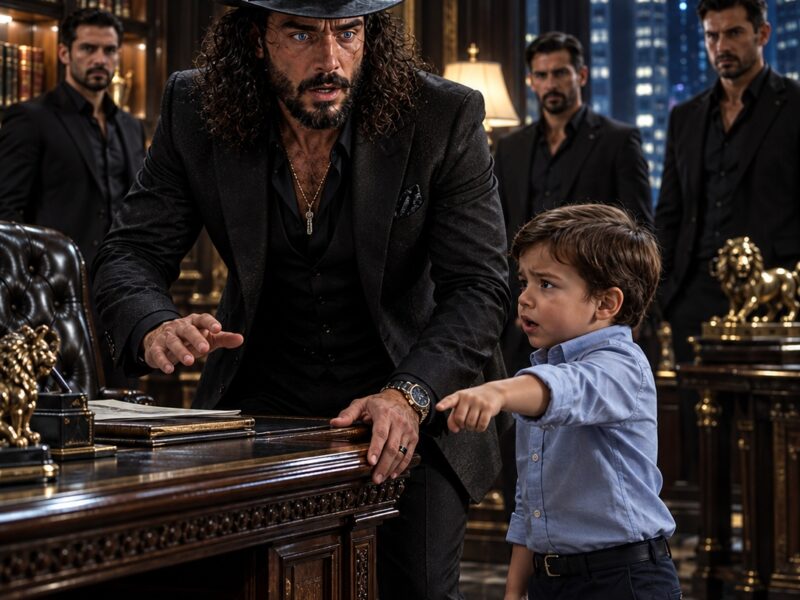
A Maid’s Toddler Whispered, “Sir… There’s Something Under Your Desk”—The Mafia Boss Froze When a Blinking Device Exposed a Betrayal Inside His Inner Circle
“Sir… there’s something under your desk.”
For the first time in twenty-seven years, Vincent Caruso forgot how to hide fear.
The whisper came from a three-year-old boy holding a stuffed rabbit by one ear.
Around Vincent’s conference table sat six men who controlled enough money, shipping contracts, political favors, and carefully concealed violence to make half of Chicago lower its voice when the Caruso name was mentioned.
None of them had heard the child enter.
Vincent had.
He had been watching him from the corner of his eye for almost a minute.
Noah Brooks was the son of Elena Brooks, one of the night-cleaning employees assigned to the executive floor of Caruso Holdings. Elena was not supposed to bring him to work, but her babysitter had canceled before dawn, and losing even one shift could mean missing rent.
Vincent knew that because Elena had apologized to him that morning with trembling hands.
He had surprised everyone by allowing the child to stay.
Now he wondered whether that small act of mercy was about to save his life.
Noah crouched beside the enormous mahogany desk.
His dark curls fell into his eyes as he pointed beneath it.
“It blinks.”
Vincent’s expression did not change.
“Does it?”
Noah nodded.
“Red.”
One of the men at the table, Anthony DeLuca, continued talking about compromised shipping routes.
Vincent stopped listening.
“Show me.”
Noah crawled halfway beneath the desk.
Vincent’s security chief, Marcus Hale, immediately stood.
“Boss.”
Vincent lifted one finger.
Stay.
Marcus obeyed.
Noah pointed.
“Right there.”
Vincent bent as though he had dropped a pen.
What he saw beneath the desk turned his blood cold.
A black device no larger than a pack of cards had been fixed against the underside of the wood, hidden behind a structural panel where nobody sitting normally could see it.
One red indicator pulsed every three seconds.
A second component ran beside it.
Vincent did not know enough about electronics to identify every function.
He knew enough to recognize that it did not belong there.
He straightened slowly.
Nobody at the table spoke.
His oldest friend, Michael Russo, watched him carefully.
Vincent looked at Noah.
“Did you touch it?”
“No.”
“Good.”
Noah hugged his rabbit.
“Is it bad?”
Vincent looked around the table.
Six men.
All trusted.
All powerful.
All suddenly possible enemies.
“Yes,” he said quietly. “I think it might be.”
The office door opened.
Elena hurried inside.
Her face changed the moment she saw her son.
“Noah.”
She rushed forward, then stopped when Marcus stepped into her path.
“I’m sorry. I’m so sorry. He was in the staff room. I turned around for one second—”
Vincent raised his hand.
“Marcus.”
The security chief moved aside.
Elena crossed the room and pulled Noah against her chest.
“Do you have any idea—”
“He found something.”
She stopped.
Vincent looked at the boy.
Noah pointed beneath the desk.
“It has a light.”
Elena’s face drained.
Vincent noticed.
That reaction mattered.
Not guilt.
Maybe recognition.
Maybe ordinary fear.
In his world, a difference that small could decide whether someone went home or disappeared.
Vincent looked at Marcus.
“Clear the floor.”
Every man at the table stiffened.
Marcus understood immediately.
“Nobody leaves?”
“Nobody.”
Anthony DeLuca pushed back his chair.
“Vincent, what is this?”
“A security problem.”
“Then let Hale deal with it.”
“I am.”
Vincent kept his eyes on the room.
“He’s making sure none of you go anywhere.”
Silence changed shape.
Michael Russo leaned back slowly.
“You think one of us put something beneath your desk?”
“I think something is beneath my desk.”
Vincent’s voice remained calm.
“I am postponing conclusions.”
Anthony laughed without humor.
“That means yes.”
“It means sit down.”
Anthony sat.
Vincent turned to Elena.
“Take Noah downstairs.”
She nodded too quickly.
“Of course.”
“Elena.”
She stopped.
His use of her first name made her shoulders tighten.
“Do not leave the building.”
Her face became pale.
“Sir?”
“Just stay downstairs.”
She looked at Noah.
Then back at Vincent.
“Am I in trouble?”
“I don’t know yet.”
Honesty frightened her more than reassurance would have.
Vincent understood why.
Elena Brooks had spent eight months working in his building.
She knew exactly what kind of man signed her paycheck.
To the Illinois secretary of state, Vincent Caruso was chairman of Caruso Holdings, a private corporation with interests in freight, real estate, restaurants, and construction.
To prosecutors, he was a man they had investigated repeatedly without ever finding enough to put before a jury.
To people who worked in the shadows beneath those respectable businesses, he was something simpler.
Boss.
Vincent had not inherited that word.
He had earned it.
At fifty-one, he had survived two attempts on his life, one federal indictment that collapsed when a witness changed his story, and enough betrayals to believe trust was merely another word for temporary usefulness.
Still, he had trusted the men in this room.
That was what made the blinking light beneath his desk so dangerous.
Not merely what the device might do.
What it meant.
Elena started toward the door.
Noah twisted in her arms.
“Bye, Mr. Vincent.”
Every head turned.
Vincent looked at him.
“Goodbye, Noah.”
The boy lifted the stuffed rabbit’s paw and made it wave.
Vincent almost smiled.
Then Elena carried him out.
The second the door closed, Vincent’s face became stone.
“Marcus.”
His security chief approached the desk.
“Do not touch it.”
“I wasn’t planning to.”
“Bring Nathan Cho.”
Nathan was Caruso Holdings’ head of technical security, a former military communications specialist who had spent the last seven years designing systems specifically to prevent what had just happened.
Vincent looked at the ceiling camera.
“Kill all wireless signals on this floor.”
Nathan’s voice came through Marcus’s earpiece before the man could respond.
“Already doing it.”
Vincent glanced toward the conference table.
Michael Russo gave a faint smile.
“At least somebody is earning his salary.”
Marcus ignored him.
Ten minutes later, Nathan entered carrying a compact equipment case.
He looked under the desk.
Then stopped.
“How bad?”
Vincent asked.
Nathan stayed crouched.
“Give me a minute.”
“Take thirty seconds.”
“Then you’ll get a thirty-second answer.”
Vincent almost told him not to be clever.
Instead he waited.
Nathan photographed the device from several angles, then used a handheld scanner near it.
His expression became more serious.
“This is transmitting.”
“To where?”
“Unknown.”
“Audio?”
“Definitely.”
Nathan shifted.
“Possibly data from nearby devices too.”
Anthony swore.
Vincent felt cold anger rising.
Every private conversation held in this office.
Business.
Criminal negotiations.
Names.
Numbers.
Strategies.
Potentially transmitted for weeks.
Then Nathan said, “There’s something else.”
Vincent watched him.
Nathan looked up.
“The secondary component appears to be an energetic charge.”
Michael’s chair scraped faintly against the floor.
Anthony’s face changed.
Vincent did not move.
“Enough to kill?”
Nathan hesitated.
“That depends on exact composition.”
Vincent’s eyes narrowed.
“Would you sit in this chair?”
“No.”
That was enough.
Marcus immediately stepped closer.
“We evacuate.”
Vincent shook his head.
“No.”
“Boss.”
“If whoever planted this is monitoring the room, panic tells them we found it.”
Nathan stood.
“If the device can be triggered remotely—”
“You disabled wireless communication.”
“Commercial frequencies.”
Nathan looked irritated.
“I don’t know what backup system it has.”
Vincent stared at the desk he had used for twelve years.
His sanctuary.
His father’s desk before him.
A place where he had negotiated marriages, funerals, alliances, betrayals, legitimate acquisitions, illegal settlements, and the futures of men who believed they were powerful until they sat across from him.
Someone had turned it into a trap.
“Get everyone out except Marcus and Nathan.”
Anthony stood.
“You said nobody leaves.”
“The room.”
Vincent looked toward him.
“Not the floor.”
One by one, the lieutenants moved into the adjoining conference lounge under guard.
Michael Russo was last.
He paused beside Vincent.
Michael had known him since they were fifteen.
They had stolen cars together before either could afford one.
They had slept in the back of a closed pizzeria during the winter of 1991 because Vincent’s father had thrown him out and Michael’s mother had refused to shelter “another Caruso problem.”
Michael had been best man at Vincent’s wedding.
He carried Vincent’s son’s coffin after the boy died at seventeen in a car crash.
There were very few places in Vincent’s life where memory existed without suspicion.
Michael was one of them.
Or had been.
“You think it could be me.”
Michael did not phrase it as a question.
Vincent looked at him.
“I think somebody entered my office.”
“You could ask me.”
“I could.”
“And?”
Vincent’s jaw tightened.
“If I ask whether you tried to kill me, what answer do you expect?”
Michael held his gaze.
“The truth.”
“Everybody says that until truth becomes expensive.”
Something in Michael’s face closed.
He walked out.
Nathan spent forty-three minutes neutralizing and removing the device.
The explosive element, he eventually confirmed, was real.
Small.
Focused.
Not designed to destroy the room.
Designed to kill the person sitting behind the desk.
Vincent.
“What kind of trigger?”
Marcus asked.
“Encrypted remote command.”
Nathan rotated the unit beneath magnification.
“Could be cellular, radio, or a proprietary signal. Whoever built it knew what they were doing.”
“Can you trace it?”
“Maybe.”
“How long?”
“Hours if we’re lucky. Days if we’re not.”
Vincent looked toward the door.
“Who had physical access?”
Nathan exhaled.
“Housekeeping. Security. Maintenance. Senior executives. Your assistants.”
“Too many.”
“Yes.”
Vincent’s mind moved through names.
Anthony DeLuca handled waterfront contracts.
Dmitri Voss controlled finances.
Thomas Greer supervised union relations.
Michael Russo served as executive vice president of Caruso Holdings and, unofficially, Vincent’s second voice in everything that could not be printed on a business card.
Marcus Hale oversaw security.
Nathan himself.
Then staff.
Assistants.
Cleaners.
Including Elena.
Vincent hated the direction of the thought before it finished forming.
“What?”
Marcus knew him too well.
“Nothing.”
“That usually means something.”
Vincent looked at him.
“The boy found it.”
“Yes.”
“And the mother looked frightened before she knew what he found.”
Marcus’s expression changed.
“You think Elena knew?”
“I think I noticed something.”
“She’s been background-checked.”
“So were the men in the next room.”
Marcus nodded.
Vincent walked to the windows.
Chicago lay below them, glass and traffic and cold November sunlight reflecting off the river.
He had spent thirty years building systems meant to ensure nothing reached him unexpectedly.
Now a toddler had discovered something his security teams missed.
That fact humiliated everyone except Noah.
Vincent almost envied him.
“Review Elena again.”
Marcus hesitated.
“Quietly?”
“No.”
Vincent turned.
“Thoroughly.”
Downstairs, Elena sat in a break room with Noah asleep against her chest.
The stuffed rabbit was trapped between them.
She had stopped shaking twenty minutes ago.
Now she felt numb.
Two security officers stood outside.
Neither had said whether they were protecting her or guarding her.
Elena knew enough about Vincent Caruso to understand the difference might depend on what somebody found next.
She looked at Noah.
His mouth hung slightly open in sleep.
One hand remained wrapped around the rabbit’s worn ear.
“You had to wander.”
She whispered it without anger.
Noah shifted.
Elena kissed his forehead.
She had brought him because Mrs. Alvarez, the elderly neighbor who usually watched him during school holidays and emergency shifts, had developed chest pain at five that morning.
The hospital admitted her.
Elena had no family in Chicago.
No husband.
No dependable friends with free Tuesdays.
No savings substantial enough to miss work casually.
So she had broken company policy.
What she had not expected was Vincent Caruso’s reaction.
No shouting.
No firing.
No humiliation.
He had simply looked at Noah, then at Elena’s panic, and said:
“Next time tell someone. We have an emergency childcare contract.”
Elena had stared.
He added, “You think lawyers cancel meetings because babysitters get sick? Apparently they have more privileges than cleaning staff. We’ll fix that.”
She had almost laughed.
Instead she cried in the restroom afterward.
Because kindness from a feared man is sometimes more destabilizing than cruelty from one.
Cruelty confirms the story you prepared for.
Kindness creates questions.
And Elena already had too many.
The door opened.
Marcus entered.
She stiffened.
“Noah stays asleep.”
She looked at him.
“I wasn’t planning to wake him.”
“I mean you can keep holding him.”
His tone was not unfriendly.
That somehow made things worse.
“Elena, I need to ask you some questions.”
Her stomach tightened.
“About what he found?”
“Yes.”
“I didn’t know it was there.”
“I didn’t say you did.”
“You’re thinking it.”
Marcus pulled out a chair.
“I’m thinking everything.”
That sounded exactly like something Vincent would say.
Marcus sat.
“How long have you worked here?”
“Eight months.”
“Any problems?”
“No.”
“Any disagreements?”
“No.”
“Anyone ask you unusual questions about Mr. Caruso’s schedule?”
Elena looked away too quickly.
Marcus noticed.
“There.”
“What?”
“That.”
His voice softened.
“Somebody did.”
Elena tightened her arms around Noah.
“A lot of people ask things.”
“Who?”
“Delivery drivers. Employees. Sometimes visitors.”
“Specific names.”
“I don’t know.”
Marcus watched her.
“Elena.”
She stared back.
“Am I being detained?”
His eyebrows rose.
“That is not a normal question from a cleaning employee.”
Her heart began pounding.
Marcus noticed that too.
“I want a lawyer.”
Now he became very still.
“Elena.”
“I said I want a lawyer.”
Marcus slowly stood.
“I’ll tell Mr. Caruso.”
Fear entered her face.
He paused.
“You’re afraid of him.”
“Everybody is.”
“That is not an answer.”
“It’s enough.”
Marcus left.
Elena closed her eyes.
Noah stirred.
“Mommy?”
“I’m here.”
“Are we going home?”
“I don’t know.”
He yawned.
“Mr. Vincent nice.”
Her eyes burned.
“Yes.”
That was the problem.
Upstairs, Vincent stared at Marcus.
“She asked for counsel?”
“Yes.”
“Before you accused her of anything?”
“Yes.”
“She understands procedure.”
“Yes.”
“Background?”
“Clean.”
“Too clean?”
Marcus gave him a look.
“That phrase should be illegal.”
Vincent ignored it.
“Family?”
“Widowed.”
“Her husband?”
“Daniel Brooks. Died five years ago. Construction accident.”
“Child?”
“Noah is three.”
“Parents?”
“Deceased.”
“Siblings?”
Marcus hesitated.
“There is a brother.”
Vincent looked at him.
“Why did you hesitate?”
“Because he doesn’t appear on her employment paperwork as emergency family.”
“Name?”
“Alexander Reed.”
“Different surname.”
“Elena married. Reed is maiden name.”
“What does he do?”
Marcus placed a tablet on the desk.
Vincent read.
His face hardened.
Chicago Police Department.
Detective, organized-crime unit.
Currently on medical retirement.
Vincent looked up.
“Why?”
“Shot three years ago.”
“By who?”
“Officially unknown.”
“Unofficially?”
Marcus exhaled.
“Men connected to the Russo Street Crew.”
Vincent’s eyes narrowed.
Not Michael Russo.
No relation.
An independent East Side group that had once done business with Caruso intermediaries and later aligned with a rival family.
“Connection to us?”
“Indirect.”
“How indirect?”
“Two of the attackers were seen leaving a club controlled by a company Thomas Greer used for meetings.”
Vincent’s jaw tightened.
“Does Elena visit her brother?”
“Twice a week.”
“Phone records?”
“Working on it.”
“Locker?”
Marcus said nothing.
Vincent knew that silence.
“What?”
“We searched staff areas.”
“And?”
Marcus placed a clear evidence bag on the desk.
Inside was a small encrypted phone.
Vincent felt something in his chest sink.
“There’s more.”
“Of course there is.”
Marcus laid down photocopies.
Schedules.
Vincent’s.
Meeting times.
Vehicle movements.
Security rotations.
Not handwritten casually.
Structured reports.
Detailed.
Professional.
Then a photograph.
Elena standing beside a man in a wheelchair wearing a Chicago Police Department sweatshirt.
Her brother.
Both smiling.
Vincent looked at the picture.
Noah stood between them.
The boy wore a paper birthday crown.
Marcus said, “We found everything in a false panel inside Elena’s locker.”
Vincent stayed silent.
“She is either the best planted operative we’ve ever missed…”
Marcus paused.
“Or someone wants us to believe she is.”
Vincent looked at him.
“You think planted evidence?”
“I think the child who found the bomb belongs to the woman whose locker contains evidence tying her to police.”
“Yes.”
“That is almost too convenient.”
Vincent looked toward the removed desk panel.
“Convenient things still happen.”
“Unfortunately.”
“Bring her up.”
“With the child?”
Vincent considered.
“No.”
“Elena may refuse to leave him.”
“Then bring them both.”
Marcus hesitated.
“Boss.”
“What?”
“If she was involved in this…”
Vincent knew.
Old rules would be simple.
Betrayal punished.
Questions later.
Fear first.
He had built authority that way.
Then he remembered Noah whispering instead of shouting because he apparently believed important men deserved quiet warnings.
“Bring them.”
Twenty minutes later, Elena entered Vincent’s office carrying Noah.
The child was awake now.
Sleepy.
His cheek rested on her shoulder.
She saw the items on the desk.
Everything inside her collapsed.
Vincent watched it happen.
Not surprise.
Recognition.
Elena’s knees almost gave way.
Marcus stepped toward her.
She shook her head.
“I’m fine.”
She was not.
Vincent closed the office door.
Marcus remained.
Elena looked at him.
“My lawyer?”
“On the way.”
She nodded.
Vincent leaned against the desk rather than sitting behind it.
He no longer trusted the desk.
That irony irritated him.
“Tell me before your attorney arrives.”
Elena looked at the phone.
The reports.
Photograph.
Tears filled her eyes.
“I can’t.”
“You can.”
“No.”
“You brought surveillance equipment into my building.”
Noah lifted his head.
“Mom?”
Elena closed her eyes.
“I need you to be quiet for a minute, baby.”
Vincent’s voice softened unexpectedly.
“Noah.”
The boy looked at him.
“Would you like Marcus to show you the fish tank downstairs?”
Elena immediately tightened her grip.
“No.”
Vincent looked at her.
“He stays with you.”
“Thank you.”
Noah whispered, “I like fish.”
Elena almost laughed.
Wrong moment.
Wrong life.
Vincent waited.
Finally she said, “My brother was a detective.”
“Was?”
“Is.”
She looked at the photograph.
“He says retirement doesn’t change that.”
“Why is he retired?”
“You already know.”
“I want your version.”
Elena stared.
“He was investigating organized crime.”
Vincent almost smiled.
“A broad hobby.”
“You were part of it.”
His expression did not change.
“Probably.”
“He followed a weapons and narcotics network running through South Side freight companies.”
Vincent’s eyes narrowed.
“My companies?”
“Some subcontractors.”
“Names?”
“You know them.”
“Maybe.”
Elena’s voice shook.
“One was Greer Transportation.”
Vincent’s jaw tightened.
Thomas Greer sat thirty feet away in the conference lounge.
Elena continued.
“Alex believed the network connected your organization, the Mancini family, and several independent crews.”
“Believed?”
“He had evidence.”
“What happened?”
“He got shot.”
Noah looked up again.
Elena kissed his hair.
Vincent noticed how quickly she hid pain when the child moved.
“The men were never charged.”
“Why?”
“Witnesses disappeared.”
Vincent said nothing.
“Evidence was lost.”
Still nothing.
“One detective transferred.”
Elena’s voice hardened.
“One retired early.”
“Corruption.”
“Yes.”
“And your brother blamed me.”
“Yes.”
“Did I order the shooting?”
“I don’t know.”
“That wasn’t my question.”
Her eyes flashed.
“He believes you did.”
Vincent absorbed that.
“And you?”
Elena’s face changed.
“I believed him.”
Past tense.
Vincent noticed.
“What changed?”
She looked toward Noah.
“Things.”
“Not enough.”
“My brother asked me to help him.”
“How?”
“Get a job here.”
Marcus shifted.
Vincent did not.
“You manipulated the hiring process.”
“Yes.”
“Background check?”
“Clean because technically I had no record.”
“Connection to a retired organized-crime detective should have appeared.”
“My brother’s friend removed it from the database your people would access.”
Marcus cursed softly.
Vincent looked at him.
“Later.”
Elena continued.
“I was supposed to observe.”
“Observe.”
“Meetings. Visitors. Schedules.”
“Steal files?”
“No.”
“Plant devices?”
Silence.
Vincent’s voice lowered.
“Elena.”
“Yes.”
Noah lifted his rabbit.
Vincent felt something cold behind his ribs.
“How many?”
“Three.”
“Where?”
“Conference room ventilation grille.”
Marcus swore again.
“Employee lounge near executive offices.”
“And?”
Elena looked at the desk.
“Under there.”
Nobody moved.
Vincent’s face became unreadable.
“You planted the device Noah found.”
“The recorder.”
His voice sharpened.
“The device beneath my desk contained enough explosive material to kill me.”
Elena stared.
Then laughed once.
A horrible, disbelieving sound.
“No.”
Vincent watched her.
“No?”
“No.”
“You expect me to believe—”
“My brother gave me a listening unit.”
“He gave you that.”
“No.”
She pointed at the photograph Nathan had taken.
“That isn’t what I installed.”
Marcus looked at Vincent.
Elena stepped toward the desk.
Marcus blocked her.
She stopped.
“The unit Alex gave me was flat.”
Her hands trembled.
“Black casing. Magnetic strip.”
She swallowed.
“No second compartment. No red light.”
Vincent stared.
“Why would a listening device have no status indicator?”
“It did. Green, but internal. You could only see it during setup.”
Marcus asked, “When did you install it?”
“Six weeks ago.”
“Has it been serviced?”
“No.”
“Have you touched it again?”
“No.”
Vincent looked at Elena.
“You’ve been sending information to your brother.”
“Yes.”
“And he’s been giving it to police.”
She hesitated.
“Some.”
“Some?”
“He stopped trusting the department.”
Vincent almost laughed.
A retired detective conducting a private intelligence operation because he believed the police were compromised.
Chicago had produced stranger stories.
“Who else receives it?”
“A federal contact.”
“Name.”
“My lawyer first.”
Vincent nodded.
Fair.
That surprised Marcus.
Elena noticed.
Vincent walked toward the window.
If she was telling the truth, someone had modified her surveillance device.
If she was lying, she had tried to kill him and was using ignorance as protection.
The obvious response would be pressure.
Threaten.
Separate mother from child.
Use fear until truth came out.
That was how Vincent’s father handled uncertainty.
Vincent remembered being twelve and watching his father accuse a warehouse worker of theft.
The man cried.
Denied everything.
Vincent’s father broke two fingers before discovering the missing money had been entered incorrectly by an accountant.
Nobody apologized.
Vincent had spent thirty-nine years telling himself he had become more sophisticated than his father.
Now the easy methods were waiting.
He hated how natural they still felt.
Noah whispered, “Mommy’s crying.”
Elena wiped her face quickly.
“I’m okay.”
“No.”
The toddler touched her cheek.
“You’re wet.”
Vincent turned away.
“Marcus.”
“Yes?”
“Get Nathan.”
Elena looked at him.
“What are you doing?”
“Finding out whether you’re lying.”
Her chin lifted.
“And if I’m not?”
Vincent met her eyes.
“Then somebody used you to put a bomb beneath my desk.”
Nathan arrived.
Elena described the original recorder.
Dimensions.
Placement.
Mounting position.
He listened.
Then pulled up images from the recovered device.
“She’s right about one thing.”
Vincent looked at him.
“What?”
“The explosive assembly is attached separately.”
Elena closed her eyes.
Nathan continued.
“Different adhesive. Different manufacturing marks.”
Marcus stepped closer.
“Could it have been added later?”
“Yes.”
“How much later?”
“Impossible to say yet.”
Vincent’s gaze moved to Elena.
Her breathing shook.
“My brother didn’t tell me.”
“That is not proven.”
“No.”
She looked at him.
“But I swear to you.”
Vincent did not respond.
He had learned young that desperate people swear whatever buys one more minute.
Then Noah said, “Uncle Alex doesn’t like booms.”
Every adult looked at him.
Elena closed her eyes.
“Noah—”
“He gets scared.”
Vincent watched the child.
“Scared of loud noises?”
Noah nodded.
“Fireworks make him cry.”
Elena’s expression cracked.
“My brother was shot four times.”
She looked at Vincent.
“He has panic attacks around sudden explosions. Whatever else Alex has become, he would not build a bomb.”
Vincent said quietly, “Trauma doesn’t make a man incapable of revenge.”
“No.”
“But it matters.”
“Yes.”
Her attorney arrived ten minutes later.
Rachel Kim.
Federal-defense lawyer.
That told Vincent something too.
Ordinary cleaning employees did not keep federal-defense lawyers on speed dial.
Rachel entered the room like she had already decided everybody annoyed her.
“No questioning without me.”
Vincent looked at her.
“You know who I am?”
“Yes.”
“Then you know you’re in my office.”
She placed her bag down.
“And you know kidnapping witnesses is frowned upon.”
Marcus almost smiled.
Vincent liked her immediately.
“Sit.”
Rachel sat beside Elena.
Noah waved.
She softened.
“Hi, buddy.”
“Fish downstairs.”
“Excellent.”
Then she looked at Vincent.
“Talk.”
By midnight, enough pieces had emerged to create a worse picture rather than a clearer one.
Elena had planted listening devices.
That was true.
Her brother Alex had received recordings.
Also true.
A federal agent named Samuel Reed—not related to Elena despite the surname coincidence—had been quietly using some information to build a corruption case involving several Caruso subcontractors.
The surveillance operation had not been properly authorized.
Alex had believed official channels were compromised.
He was probably correct.
But none of them had intended an assassination.
At least according to Elena.
Then Nathan found something.
“The explosive module was installed within the last eight days.”
Vincent looked at him.
“How certain?”
“Adhesive curing, battery status, and device logs.”
Nathan pointed to a diagnostic screen.
“The recorder itself has been in place about six weeks. Secondary module was connected eight days ago.”
Elena’s attorney exhaled.
Marcus looked at Vincent.
That meant Elena had placed the bug.
But someone else had turned it into a bomb.
“Who entered this office during the last eight days?”
Vincent asked.
Marcus already had the list.
“Cleaning.”
Elena looked sick.
“Maintenance.”
“Names.”
“Three.”
“Security.”
“Six.”
“Executives.”
Marcus paused.
“Everyone from today’s meeting except Dmitri.”
Vincent looked toward the locked conference lounge.
Anthony.
Thomas.
Michael.
Marcus himself.
Nathan.
And two assistants.
“Camera footage?”
“Nothing unusual.”
“Meaning?”
“This desk is outside direct camera view.”
Vincent’s jaw tightened.
His privacy protocol had created the blind spot that allowed someone to weaponize his desk.
Another irony.
He was beginning to dislike the day.
“Access logs?”
Nathan looked at him.
“Somebody cloned a security credential.”
“Whose?”
Nathan hesitated.
“Michael Russo.”
The room went silent.
Vincent stared.
“No.”
It came out before he could stop it.
Marcus looked away.
Vincent hated that.
“Say it again.”
Nathan did.
“Michael’s credential accessed the office at 2:13 a.m. six nights ago.”
“Michael was where?”
Marcus checked.
“New York.”
Vincent remembered.
A construction acquisition.
He had spoken to Michael by video from Manhattan.
“So cloned.”
“Almost certainly.”
Marcus added, “Unless Michael gave somebody the credential.”
Vincent looked toward the door.
His oldest friend.
The man who had once taken a knife meant for him outside a bar in Cicero.
Michael had seventeen stitches and complained for years that Vincent owed him better whiskey.
People mistake shared history for proof of future loyalty.
Vincent knew that intellectually.
Emotion had apparently failed to update.
“Bring him in.”
Michael entered alone.
His face was hard.
“You kept me locked in that room for eight hours.”
“Yes.”
“You searched my home.”
“Yes.”
“My phone.”
“Yes.”
“Do you want my blood too?”
“If Nathan asks.”
Michael laughed bitterly.
Then he saw Elena.
His expression changed.
“What is she doing here?”
Vincent watched.
“Why?”
“She’s staff.”
“That doesn’t answer me.”
Michael looked at the evidence bags.
Then Elena.
Something moved across his face.
Small.
Too small.
Recognition?
Concern?
Vincent’s instincts sharpened.
“Her son found the device.”
Michael nodded.
“I know.”
“How?”
Silence.
Marcus became very still.
Michael realized.
“You told us earlier.”
“No.”
Vincent’s voice dropped.
“I told you the child found something.”
Michael’s face changed.
Vincent continued.
“I never told you he found the device.”
Michael exhaled.
“Come on.”
“Answer.”
“Anthony mentioned it in the lounge.”
Marcus said, “Anthony didn’t know until three hours ago.”
Michael looked at him.
“When did I supposedly hear it?”
Nobody spoke.
Michael’s jaw tightened.
“This is ridiculous.”
Vincent felt something break quietly inside him.
Not certainty.
Not yet.
But trust.
“You know Elena?”
“No.”
She stared at him.
Michael looked at her again.
“No.”
Elena suddenly stood.
“I know you.”
Rachel touched her arm.
“Elena.”
“No.”
She looked at Michael.
“You came to the staff entrance.”
Michael’s face remained blank.
“Two weeks ago.”
Vincent watched.
Elena continued.
“It was raining.”
Memory sharpened her voice.
“You asked whether Mr. Caruso was in the office.”
Michael shrugged.
“I probably did.”
“You already knew.”
Vincent looked at him.
Michael’s eyes shifted.
“You had come from upstairs.”
Elena’s breathing quickened.
“I remember because you were angry I asked if you needed an umbrella.”
Michael smiled coldly.
“This is what we’re doing? Interrogating weather?”
“No.”
Elena’s face lost color.
“You smelled like solder.”
Nathan looked up.
Michael turned.
“What?”
“I cleaned electronics assembly at a factory before Noah was born.”
She looked at Vincent.
“My husband worked there.”
Then Michael.
“That smell.”
Michael’s expression remained controlled.
Vincent knew him well enough to see control becoming effort.
Nathan approached.
“The module required manual electrical integration.”
Marcus said, “You know electronics?”
Michael laughed.
“I can barely program my television.”
Vincent remembered something.
Twenty-five years earlier.
Michael building illegal cable boxes in his mother’s basement.
Soldering boards at the kitchen table.
Selling them for fifty dollars.
The memory arrived with cruel precision.
“You used to.”
Michael looked at him.
“Used to what?”
“Electronics.”
Something died in his eyes.
Vincent felt suddenly tired.
“Sit down.”
Michael did not.
“Vincent.”
“Sit.”
The old authority entered his voice.
Michael sat.
For the first time all day, Noah became restless.
He buried his face against Elena.
Vincent noticed.
Children did not understand guilt.
But they understood rooms.
“Why?”
Vincent asked.
Michael stared.
“You haven’t proved anything.”
“Then help me.”
“Against what?”
“Your credential was cloned.”
“Exactly. Cloned.”
“You knew what Noah found before anyone told you.”
“Someone told me.”
“You were in my office two weeks ago.”
“I’m in your office every week.”
“You spent your childhood soldering electronics.”
Michael laughed.
“This is pathetic.”
Vincent leaned forward.
“Then explain why the rival crew knew about the Milwaukee shipment.”
Michael said nothing.
“The route changed two hours before departure.”
Nothing.
“Only three people knew.”
Michael’s face tightened.
“You. Marcus. Me.”
Marcus looked at Vincent.
That had been the secret test.
Three weeks earlier, Vincent intentionally changed the shipment route and told only those two men.
The rival crew intercepted it anyway.
He had not told either that it was a trap.
Marcus had spent the last weeks investigating everyone else.
Michael apparently had too.
Or pretending to.
Vincent looked at his oldest friend.
“I wanted it to be Marcus.”
Marcus gave him a flat look.
“Thank you.”
Michael stood.
“You’ve lost your mind.”
“Sit down.”
“No.”
“This building is locked.”
“You going to shoot me?”
Elena flinched.
Noah looked up.
Vincent saw it.
He also saw Michael see it.
For one ugly second, Vincent understood exactly how old versions of this scene would end.
Threat.
Confession.
Punishment.
Blood.
That was what everyone expected.
Michael especially.
Vincent remained seated.
“No.”
Michael stared.
“No?”
“I am going to call federal investigators.”
The room changed.
Marcus turned sharply.
Michael laughed.
“You?”
“Yes.”
“You’re going to invite federal agents into Caruso Holdings.”
“Yes.”
“You have completely lost your mind.”
“Possible.”
Vincent looked at Elena.
She had risked prison because she believed official systems were corrupt.
Michael had apparently risked murder because betrayal promised power.
The whole building seemed constructed from secrets stacked until nobody remembered which walls were load-bearing.
“I am done investigating my own attempted murder with people who all have reasons to lie to me.”
Marcus frowned.
“That includes me?”
“It includes everyone.”
Vincent looked back at Michael.
“Especially him.”
Michael’s face went cold.
“You think cops will save you?”
“No.”
Vincent picked up his phone.
“I think evidence might.”
Michael lunged.
Not at Vincent.
At Elena.
It happened so quickly that later everyone remembered different details.
Rachel shouted.
Marcus moved.
Elena turned her body around Noah.
Michael grabbed for the evidence bag containing the encrypted phone.
Marcus drove him against the wall before he reached it.
No gunfire.
No knives.
No cinematic explosion.
Just a fifty-two-year-old man losing control because the last clean exit had closed.
Michael struggled once.
Then stopped.
His face pressed against the wall.
Vincent stood.
“Why her phone?”
Michael said nothing.
Marcus searched him.
Inside Michael’s jacket was a small key fob.
Nathan took it.
His expression changed.
“Boss.”
Vincent watched.
Nathan removed the back.
Inside was a compact transmitter.
“What does it do?”
“Likely triggers something.”
Michael closed his eyes.
There.
Proof without confession.
Vincent stared at his oldest friend.
“Was the bomb yours?”
Michael said nothing.
“Michael.”
His face twisted.
“You were going soft.”
Vincent felt no satisfaction.
Only grief.
“Because I stopped killing people over business disputes?”
“You stopped making examples.”
“Examples.”
“You think those men respected us?”
Michael spat the words.
“They feared us.”
“Yes.”
“That was the point.”
Vincent looked at Elena.
At Noah.
At Rachel.
Then Marcus.
“And you thought killing me would fix that?”
Michael laughed bitterly.
“You were dismantling everything.”
“What?”
“The East Side arrangements.”
“Fentanyl routes.”
“Money.”
“Poison.”
“Don’t become righteous now.”
Michael finally turned his face enough to look at Vincent.
“You approved worse things twenty years ago.”
The truth landed.
Vincent did not reject it.
“Yes.”
Michael almost smiled.
“Exactly.”
“No.”
Vincent’s voice stayed quiet.
“I said yes because pretending you’re wrong about my past would make me exactly like you.”
Michael’s smile vanished.
“You sold information.”
Vincent continued.
“You fed rivals routes.”
Silence.
“You wanted losses to make me look weak.”
Michael said nothing.
“You planted an explosive beneath my desk using Elena’s surveillance device as cover.”
Marcus tightened his grip.
Michael laughed once.
“Perfect cover.”
Elena went pale.
Vincent looked at him.
“You knew about her?”
“For months.”
“How?”
“Your background systems are not as impressive as Marcus believes.”
Marcus’s face hardened.
Michael continued.
“I found the connection to Alex Reed.”
Elena stared.
“You knew my brother?”
“Not personally.”
“You knew I was gathering evidence.”
“Yes.”
“Why didn’t you expose me?”
Michael’s smile returned.
“Because you were useful.”
She looked sick.
Vincent understood.
Michael had let Elena continue feeding information outward because the resulting raids and losses helped destabilize Vincent.
Then he modified her device into a bomb so suspicion would fall on her and law enforcement.
One act, multiple outcomes.
Kill Vincent.
Frame the maid.
Discredit police.
Ignite internal retaliation.
Michael had not become irrational.
He had become strategic.
That hurt more.
“Who backed you?”
Vincent asked.
Michael remained silent.
“Which family?”
Nothing.
Vincent looked at Marcus.
“Take him downstairs.”
Michael laughed.
“To the old room?”
Everyone knew what he meant.
Caruso buildings used to have places without cameras.
Rooms meant for pressure.
Marcus waited for instructions.
Vincent looked at Elena.
She watched him.
Noah watched him too.
The boy did not understand.
That somehow mattered more.
“No.”
Vincent said.
Michael’s laughter stopped.
“Hold him for the police.”
Marcus raised an eyebrow.
“Police?”
“Federal.”
Michael stared.
“You’re actually doing this.”
“Yes.”
“You’ll expose yourself.”
“Yes.”
“You’ll go down with me.”
Vincent felt something unexpectedly like relief.
“Maybe.”
Michael’s face filled with disbelief.
“For her?”
He looked at Elena.
Vincent shook his head.
“No.”
Then toward Noah.
“Not for him either.”
Vincent faced Michael.
“For me.”
Michael was taken away.
Two hours later, federal agents entered Caruso Holdings through the front doors.
The building had never seemed quieter.
Vincent’s attorneys arrived furious.
One nearly shouted.
Vincent let him.
Agents collected the explosive device.
The transmitter.
Elena’s surveillance phone.
Michael’s devices.
Server records.
Vincent’s internal reports.
Then they asked about Elena.
She stood beside Rachel.
Noah slept again.
Vincent could have destroyed her.
Legally, she had committed crimes.
Unauthorized surveillance.
Computer access.
Possible conspiracy.
Rachel knew it.
Elena knew it.
Vincent knew it.
Agent Sarah Mitchell looked at him.
“Did Ms. Brooks plant the device?”
“The recorder.”
Elena shut her eyes.
Vincent continued.
“Not the explosive module.”
“You know that?”
“Forensic analysis supports it.”
“Did she gather information against you?”
“Yes.”
“Did you know?”
“Not until today.”
“And you’re not asking us to arrest her?”
Sarah gave him a skeptical look.
Vincent almost smiled.
“I don’t believe I control your arrest decisions.”
“That reputation precedes you.”
“Many inaccurate things do.”
“Many accurate ones too.”
Vincent looked at Elena.
“Then arrest people for what they did.”
Sarah followed his gaze.
“Interesting philosophy from you.”
“Recent.”
Her expression barely changed.
But he saw amusement.
Elena agreed to cooperate fully.
So did Alex Reed.
When agents brought Alex to the building the following day, Vincent finally met him.
Wheelchair.
Broad shoulders.
Gray beginning at his beard.
Anger that entered before the chair did.
Alex stopped ten feet from Vincent.
“So.”
Vincent waited.
“This is the monster.”
Elena whispered, “Alex.”
“No.”
Her brother looked at her.
“You spent eight months inside his building because I asked.”
He looked at Noah.
“You brought my nephew into this.”
Guilt flashed across his face.
Then he turned back to Vincent.
“Do you know what your people did to me?”
Vincent answered carefully.
“I know what men connected to my world did.”
“Your world.”
“Yes.”
“Convenient distinction.”
“It isn’t meant to be.”
Alex laughed bitterly.
“You want credit because you didn’t personally pull the trigger?”
“No.”
That silenced him.
Vincent continued.
“I benefited from systems where men who shot you believed they would be protected.”
Alex stared.
“That is responsibility.”
“Yes.”
“Not the same as ordering it.”
“No.”
“Still responsibility.”
“Yes.”
Elena watched both men.
Alex’s anger lost some momentum because Vincent refused to push back.
“You’re cooperating now?”
“Yes.”
“Why?”
Vincent looked at Noah.
Alex noticed.
“Don’t.”
“What?”
“Don’t make my nephew your redemption story.”
Vincent’s face hardened.
“Fair.”
That answer surprised Alex.
The detective continued.
“He found a bomb.”
“Yes.”
“He saved your life.”
“Probably.”
“And now you feel human.”
Vincent’s jaw tightened.
“No.”
Alex waited.
“I feel responsible.”
Silence.
“That is less flattering.”
Alex stared.
Then, unexpectedly, smiled.
Barely.
“Better answer.”
The investigation lasted nine months.
Michael Russo had not acted alone.
He had partnered with Victor Mancini, head of a rival organization expanding through Milwaukee and northern Illinois.
Michael supplied routes.
Schedules.
Names.
Mancini supplied money.
Equipment.
Contract shooters.
The explosive beneath Vincent’s desk came from a former military contractor already under federal investigation.
Michael had planned to trigger it after a meeting that would place several senior Caruso lieutenants in the room, making the resulting chaos look like an external attack.
Then Mancini would move.
Michael expected to survive by leaving early.
The plan had been patient.
Cold.
Practical.
Exactly the kind Vincent had spent decades respecting when used against someone else.
Now he understood what that admiration had cost.
But Michael’s betrayal exposed something larger.
Financial records tied Caruso companies to corruption Vincent had authorized years earlier.
Union intimidation.
Illegal lending.
Concealed payments.
Not everything federal agents suspected.
Enough.
His attorneys built arguments.
Limit exposure.
Distance yourself.
Blame dead executives.
Blame Michael.
Blame subcontractors.
Vincent listened.
Then asked one question.
“What happens if I tell the truth?”
His lead attorney stared.
“The truth about what?”
“All of it.”
The room became silent.
“You would be admitting crimes we cannot prove.”
“Yes.”
“That is legally irrational.”
“Probably.”
“Why?”
Vincent looked toward the conference room where Noah had once wandered past a row of armed men carrying a stuffed rabbit.
“Because everyone around me has spent thirty years learning that the safest thing is telling me only what I want to hear.”
His attorney waited.
“I built that.”
Vincent rubbed his face.
“Michael used it.”
He looked at the folders.
“Elena infiltrated it because she believed no honest route could reach me.”
Another pause.
“If I solve this by finding better lawyers, I rebuild the same thing.”
His attorney sighed.
“I really preferred you ruthless.”
“I’m noticing.”
Vincent negotiated.
He did not confess to crimes he had not committed.
He did not romanticize accountability.
He did not surrender every asset and wander into poverty as some dramatic cleansing ritual.
Real responsibility was more complicated.
Legitimate companies employing thousands of people needed protection from collapse.
Employees needed pensions.
Victims needed restitution.
Criminal operations needed dismantling without destroying unrelated families.
Vincent worked with prosecutors, independent trustees, compliance monitors, and financial investigators.
Some holdings were sold.
Some frozen.
Several survived under outside boards.
The illegal lending arm disappeared.
Smuggling relationships ended.
Three corrupt officials were charged.
Two union intermediaries entered plea agreements.
Vincent pleaded guilty to conspiracy, financial crimes, and obstruction connected to older operations.
Twenty-eight months in federal prison.
Michael Russo received substantially longer after conviction for the attempted assassination, conspiracy, and other offenses.
Victor Mancini went down with him.
Elena faced charges too.
Her cooperation, lack of knowledge about the explosive, and assistance in exposing the wider conspiracy mattered.
She received probation and community service.
Alex surrendered his unofficial intelligence files.
The police department reopened the investigation into his shooting.
Two men were charged.
Neither case restored the use of Alex’s legs.
Justice rarely restores what damage removes.
But it changed the record.
That mattered.
The morning before Vincent surrendered, Elena brought Noah to his apartment.
Vincent had sold the mansion.
He had moved into a two-bedroom unit overlooking the river while legal proceedings unfolded.
No guards stood inside.
Marcus waited downstairs.
Noah entered carrying the same stuffed rabbit.
Its left ear had been stitched.
“Mr. Vincent.”
“Hello.”
“I found something.”
Vincent froze.
Elena laughed for the first time.
“Relax.”
Noah reached into his pocket.
A plastic dinosaur.
Vincent stared.
“It was under your couch.”
He looked at Elena.
She covered her mouth.
“Apparently that is his specialty.”
Vincent accepted the dinosaur.
“Thank you.”
Noah climbed onto a chair.
“Mom says you’re going away.”
“Yes.”
“Jail?”
Elena closed her eyes.
Vincent answered.
“Yes.”
“Because you’re bad?”
“Noah.”
Elena looked embarrassed.
Vincent shook his head.
“It’s okay.”
He crouched.
“I did bad things.”
The boy frowned.
“Did you say sorry?”
“Yes.”
“Then why jail?”
Vincent paused.
There are questions children ask that reveal how much adults hide behind language.
“Because sorry and consequences are different.”
Noah thought.
“That’s like when I drew on the wall.”
Elena nodded.
“You said sorry.”
“And cleaned it.”
“Yes.”
Vincent smiled.
“Something like that.”
“Do you have to clean jail?”
“Possibly.”
Noah seemed satisfied.
Then he held out the stuffed rabbit.
Vincent stared.
“What?”
“You can take Mr. Bun.”
“Noah.”
“It’s okay, Mom.”
The child looked at Vincent.
“He helps when it’s dark.”
Something in Vincent’s chest tightened painfully.
“I think Mr. Bun should stay with you.”
“I’m not scared.”
Vincent looked at him.
“I am.”
The words came out before he planned them.
Elena looked at him.
Noah considered.
Then pushed the rabbit closer.
“Then you need him more.”
Vincent accepted it.
His hands felt ridiculous holding a faded stuffed rabbit.
He had held guns.
Contracts.
Cash.
His dying son’s hand.
Nothing had felt more exposing.
“Thank you.”
Noah nodded.
“Bring him back.”
“I will.”
Vincent kept that promise.
Prison was less dramatic than movies and more humiliating than powerful men imagine.
Doors controlled by other people.
Lights controlled by other people.
Meals on schedules.
Names replaced by numbers.
Vincent disliked it.
Good.
He spent the first months expecting rage.
Instead he encountered boredom.
Boredom forced memory.
His mother.
His father.
His late wife, Caroline, who had left him emotionally years before cancer eventually killed her.
His son, Daniel, dead at seventeen after driving too fast because teenagers believe mortality is an insult invented by old people.
Michael.
Thirty-six years of friendship reduced not by one betrayal, but by hundreds of earlier moments Vincent had reinterpreted as loyalty because it was easier.
Elena wrote once.
Mr. Caruso,
Noah asked whether prisoners get bedtime stories. I told him probably not. He thinks this is an institutional failure.
Vincent laughed alone in his bunk.
The next line:
Alex says to tell you he still doesn’t like you. He also asked whether you need anything. Apparently hatred has administrative limits.
Vincent wrote back.
Tell Detective Reed I require nothing. Tell Noah the absence of bedtime stories remains under investigation.
Noah sent drawings.
One showed Vincent behind bars with Mr. Bun.
Another had a desk with a red blinking dot crossed out.
At the top, in Elena’s handwriting interpreting Noah’s words:
NO MORE BAD THINGS UNDER DESKS.
Vincent kept it.
Eighteen months into his sentence, Alex visited.
Vincent entered the visitation room and stopped.
“You lost a bet?”
Alex rolled forward.
“Probably.”
They sat.
“What do you want?”
“To ask a question.”
Vincent waited.
Alex looked at him.
“Did Michael know about Elena before she got hired?”
“Yes.”
Alex’s face tightened.
“He could have stopped us.”
“Yes.”
“He used us.”
“Yes.”
Alex stared at his hands.
“I spent three years believing I was clever.”
“So did Michael.”
“That supposed to make me feel better?”
“No.”
Alex looked at him.
“You really are terrible at comfort.”
“So I’ve been told.”
Silence.
Then Alex said, “I almost got my sister killed.”
Vincent did not answer.
“I told myself it was justice.”
His fingers tightened around the wheels.
“I told her we were gathering information.”
“You were.”
“I also knew if it went wrong, you might hurt her.”
Vincent looked at him.
“And you sent her anyway.”
Alex closed his eyes.
“Yes.”
The shame in that word sounded familiar.
Vincent leaned back.
“We both taught ourselves that people we loved were acceptable risks if the cause was important enough.”
Alex looked at him.
“That doesn’t make us the same.”
“No.”
Vincent met his eyes.
“But it means we can learn from the same failure.”
Alex gave a short laugh.
“I still don’t like you.”
“Your sister reported that.”
“She writes you?”
“Occasionally.”
Alex raised an eyebrow.
“Interesting.”
Vincent looked annoyed.
“Do not.”
Alex smiled.
For the first time, they spoke as two men instead of opposing symbols.
It helped.
Not much.
Enough.
Vincent was released after twenty-three months for time served and program credits.
Marcus met him outside.
So did Elena.
And Noah.
The child was five now.
No stuffed rabbit.
Vincent noticed immediately.
“Where is Mr. Bun?”
Noah looked offended.
“You have him.”
Vincent stopped.
Of course.
The rabbit was in a clear belongings bag beside his paperwork.
He handed it over.
Noah inspected it carefully.
“You kept him clean.”
“I feared your review.”
“Good.”
Elena smiled.
Vincent looked at her.
She looked different.
Not physically.
Less afraid.
That was harder to ignore than beauty would have been.
“You didn’t have to come.”
“I know.”
“Then why?”
“Noah wanted to.”
The boy shook his head.
“Mom wanted to too.”
Elena closed her eyes.
Vincent almost smiled.
Noah had apparently not lost his talent for revealing inconvenient truths.
They drove him to a modest apartment in Lincoln Park.
Not luxurious.
Comfortable.
His legitimate investment income remained enough for more.
He intentionally chose less.
Not as punishment.
As scale.
Large houses require staff.
Staff recreate distance.
Vincent had become suspicious of distance.
Elena stood near the window.
“What are you going to do?”
“Work.”
“At what?”
“Consulting.”
She laughed.
“For who?”
“Companies with compliance problems.”
Her laughter became louder.
Vincent looked offended.
“You are enjoying this.”
“A convicted organized-crime figure advising compliance.”
“Experience.”
“That is one word.”
Noah opened the refrigerator.
“You have no juice.”
Vincent looked at him.
“I arrived seven minutes ago.”
“That’s bad planning.”
Elena laughed again.
Vincent realized he had missed that sound.
That irritated him.
Over the following year, they saw each other occasionally.
Mostly because Noah insisted.
Then because Elena stopped pretending she objected.
Vincent contributed—through a transparent legal foundation—to a support program for families of injured first responders and low-income single parents.
Elena refused to let him put her name on anything.
He accused her of being difficult.
She told him prison had not improved his personality.
Alex joined the advisory board.
That surprised everyone.
Especially Alex.
He became relentless about oversight.
“Every dollar documented.”
Vincent said, “Yes.”
“No cash exceptions.”
“Yes.”
“No favors.”
“Yes.”
Alex narrowed his eyes.
“I hate when you agree.”
“I’m learning.”
“Slowly.”
They became, if not friends, men who could share coffee without discussing whose past was worse.
Noah entered first grade.
Then second.
He remembered almost nothing about the blinking device.
Good.
Children should be allowed to forget danger.
One afternoon when he was seven, he visited Vincent’s office at the legitimate consulting company.
Smaller desk.
Glass walls.
No guards.
He immediately crawled beneath it.
Vincent froze.
Elena laughed.
“Noah.”
“What?”
He looked up.
“Checking.”
Vincent sighed.
“For what?”
“Things.”
“There are no things.”
Noah crawled out.
“Good.”
One of Vincent’s employees watched the interaction with confusion.
Elena whispered, “Long story.”
The romance happened so slowly neither called it romance until Alex did.
Elena and Vincent had dinner after meetings.
Then without meetings.
She criticized his habit of ordering food without asking what anyone else wanted.
He stopped.
He criticized her refusal to replace a car that sounded like loose metal fighting in a dryer.
She refused.
He offered money.
She refused harder.
Eventually they negotiated.
She bought the car.
He paid for four new tires as a birthday gift.
It took thirty minutes of discussion.
Noah called them exhausting.
The first time Vincent asked Elena on an actual date, she said no.
He nodded.
That surprised her.
“You’re not going to argue?”
“No.”
“You argue with everybody.”
“You said no.”
“Yes.”
“So the answer is no.”
She stared.
Prison had not taught him that.
Consequences had.
Two months later, Elena asked him.
He stared long enough that she became annoyed.
“Do you want dinner or not?”
“Yes.”
“That was slow.”
“I was enjoying the moment.”
“Don’t.”
He smiled.
Their first date happened in a neighborhood restaurant where nobody recognized Vincent.
That was new.
He liked it.
Halfway through dessert, Elena asked:
“Were you going to hurt me that night?”
He stopped.
“The night you found the phone?”
“Yes.”
Vincent put down his fork.
“I considered every option.”
“That isn’t comforting.”
“No.”
“Did you consider killing me?”
He looked directly at her.
“Yes.”
Elena went very still.
Vincent continued before cowardice could arrive.
“I was trained to treat betrayal as something that had to become frightening enough nobody repeated it.”
Her face tightened.
“And Noah?”
“Never.”
“Alex?”
“Yes.”
She absorbed that.
“Why didn’t you?”
Vincent thought.
“Because your story complicated my anger.”
“That’s all?”
“No.”
He looked down.
“Because Noah found the device.”
She waited.
“He gave me information without wanting anything.”
Vincent’s expression softened.
“I had spent years assuming every person who approached me had a reason.”
“And he didn’t.”
“He wanted me to know there was something blinking under my desk.”
Elena smiled faintly.
“He likes identifying problems.”
“I have noticed.”
Vincent looked back at her.
“But mostly I didn’t because I realized I was about to punish you for becoming exactly what my world had trained you to become.”
“What?”
“Secretive.”
He paused.
“Afraid.”
Another pause.
“Willing to break rules because you believed no honest path could protect someone you loved.”
Elena stared.
“That does not excuse what I did.”
“No.”
“Good.”
“It explains it.”
She looked at him.
“That matters.”
“Yes.”
Dinner continued.
Not magically.
But honestly.
Vincent learned there was intimacy in being allowed to tell an ugly truth without being abandoned or excused.
Elena learned forgiveness was not a single yes.
It was permission to keep examining what had happened without letting it dictate every future decision.
They dated for three years.
Noah became twelve.
Alex complained constantly.
Mostly for entertainment.
Vincent proposed in Elena’s kitchen.
No restaurant.
No crowd.
No expensive spectacle.
He put a small ring on the table.
Elena stared.
“Small.”
Vincent looked offended.
“You complained about large diamonds.”
“I did.”
“So I listened.”
“I’m acknowledging progress.”
Noah pretended to do homework in the next room.
Nobody believed him.
Vincent sat.
“I once believed love meant making sure nobody could take anything from me.”
Elena’s expression softened.
“That sounds healthy.”
“Wait.”
She smiled.
“I built walls. Money. Men. Fear.”
He looked toward the living room.
“Then your son walked into the most secure room I owned.”
Noah shouted, “You’re welcome.”
Vincent closed his eyes.
Elena laughed.
He continued.
“He found the thing everybody trained to protect me had missed.”
The humor left his face.
“And everything after that forced me to understand that being protected is not the same as being safe.”
Elena sat across from him.
“What are you asking?”
“For the rest of the ordinary days.”
Her eyes filled.
“I can’t promise perfection.”
“Good.”
“I can promise transparency.”
“Specific.”
“I have lawyers.”
She laughed through tears.
“I can promise you will never have to guess whether you are allowed to disagree with me.”
“That seems wise.”
“I can promise Alex will continue to dislike me.”
From the hallway Noah called, “He likes you now.”
A distant voice shouted from the television room.
“I HEARD THAT.”
Alex had apparently arrived early.
Elena covered her mouth.
Vincent sighed.
“This family has no boundaries.”
“Your fault.”
“How?”
“You kept inviting us.”
He looked at her.
“That part I don’t regret.”
Elena said yes.
They married six months later.
Small ceremony.
Marcus attended.
Nathan attended.
Rachel Kim attended and threatened to object if anyone called her relationship to the family “romantic.”
Alex gave Elena away only after telling Vincent, “I know where you live.”
Vincent replied, “Everyone does now. It’s on tax documents.”
Alex hated that answer.
Noah stood beside Vincent.
The boy who had once held a stuffed rabbit now wore a suit and complained about the tie.
Before the ceremony he whispered:
“Anything under the table?”
Vincent stared.
Noah grinned.
“Just checking.”
Years passed.
Vincent’s legitimate consulting business grew.
Slowly.
Boringly.
Legally.
He discovered boring profits were surprisingly restful.
Elena finished a degree in facilities management and became regional director for a hospital network.
She refused employment with any company connected to Vincent.
Not because she distrusted him.
Because she wanted something that belonged entirely to her.
He respected that.
Mostly.
He still sent coffee to her office when she worked late.
She allowed it.
Noah entered college studying electrical engineering.
When he announced the major, Vincent stared.
“No.”
“What?”
“You cannot spend your life finding devices under furniture.”
“It’s a field.”
Elena laughed.
Alex said, “He has a calling.”
Vincent considered disowning all of them.
One Thanksgiving, when Noah was twenty-two, he brought home a prototype sensor he had built for detecting unauthorized wireless equipment in secure rooms.
Vincent stared at it.
“You made a professional version of yourself at age three.”
Noah smiled.
“Basically.”
Elena kissed his cheek.
“I’m proud.”
Vincent looked suspicious.
“Does it blink?”
“Yes.”
“No.”
Everyone laughed.
Michael Russo died in federal prison twelve years after the attempt.
Cancer.
Vincent received the notice through an attorney.
He sat alone for a long time.
Elena found him later.
“You okay?”
“No.”
“You want to talk?”
“No.”
She sat anyway.
After several minutes he said, “I still miss him.”
Elena looked at him.
“That doesn’t mean you forgive what he did.”
“I know.”
“He was your friend for most of your life.”
“I know.”
“People can become dangerous without erasing every good memory that came before.”
Vincent looked at her.
“That sounds suspiciously like something you had to learn about me.”
“Yes.”
He took her hand.
Grief did not require innocence.
That was another lesson adulthood arrived late to teach.
Alex died at seventy-one after complications from pneumonia.
Vincent sat beside Elena at the funeral.
Noah delivered the eulogy.
He called Alex stubborn.
Brave.
Infuriating.
Principled.
Wounded.
Funny.
Complicated.
All true.
Afterward, Vincent stood alone near the grave.
“You finally like him?”
Elena asked.
Vincent looked at the stone.
“No.”
She smiled.
“Liar.”
“He was exhausting.”
“He loved you.”
Vincent stared.
Elena continued.
“Eventually.”
“That man spent twenty years accusing me of over-salting food.”
“His love language.”
Vincent laughed.
Then cried.
Quietly.
Elena took his hand.
There were fewer people left who remembered the beginning.
Marcus retired to Florida.
Nathan became a cybersecurity professor.
Rachel became a federal judge and denied knowing any of them socially.
Noah married.
His daughter, Sophie, inherited his curiosity.
This worried Vincent enormously.
At four, Sophie visited her grandparents’ house and disappeared beneath Vincent’s desk.
He nearly had a heart attack.
“What are you doing?”
Her head appeared.
“Looking.”
“For what?”
“Daddy says you always check.”
Noah laughed from the doorway.
Vincent pointed.
“You.”
“What?”
“This is your fault.”
Sophie crawled out holding a crayon.
“Found something.”
Vincent stared.
Elena laughed until she had to sit.
History had softened enough to become comedy.
But Vincent never treated the original moment as a joke.
At seventy-six, he still kept one object inside his study.
Not the explosive.
Not the surveillance recorder.
Not photographs of men he had defeated.
Mr. Bun.
The stuffed rabbit.
Noah had given it back to him after Alex’s funeral.
“You keep him.”
Vincent frowned.
“Why?”
“He did his job.”
“What job?”
Noah smiled.
“He helped when things got dark.”
The rabbit sat on a shelf beside family photographs.
One showed Elena at graduation.
Another showed Alex laughing despite pretending not to.
One showed Noah at eight missing both front teeth.
One showed Vincent and Michael when they were nineteen.
Elena once asked why he kept that one.
“Because forgetting who he was before he betrayed me would make the betrayal easier to understand than it actually was.”
She nodded.
That answer was very Vincent.
On a rainy Sunday afternoon, Noah visited with Sophie.
The little girl ran toward the office.
Vincent called after her.
“No crawling under anything.”
“Why?”
“Because I enjoy having blood pressure.”
She ignored him.
Elena sat nearby reading.
Noah poured coffee.
“Do you remember that day?”
Vincent looked at him.
“Which?”
“The desk.”
Vincent stared.
“You remember?”
“Pieces.”
“What?”
Noah thought.
“Mom crying.”
Elena looked up.
“The rabbit.”
Vincent glanced at the shelf.
“Your office was huge.”
“It was.”
“I remember you smelling like coffee.”
“That seems insulting.”
“And I remember the light.”
Vincent’s expression changed.
“Red.”
“Yes.”
Noah leaned against the desk.
“For years Mom told me I saved your life.”
Vincent shook his head.
“You did.”
“No.”
“You found it.”
“That’s not the same.”
Noah looked toward Elena.
“Mom planted the recorder.”
Elena’s face tightened, though the story had long been safe enough to speak aloud.
“Michael added the bomb.”
“Yes.”
“Nathan identified it.”
“Yes.”
“Federal agents arrested people.”
“Yes.”
“You decided what to do after.”
Vincent watched him.
“So?”
Noah smiled faintly.
“I was three.”
“That has been established.”
“I saw a light.”
His voice softened.
“You did everything important afterward.”
Vincent looked toward the window.
Rain streaked the glass.
“No.”
Noah waited.
“I spent fifty-one years doing enough wrong that doing the right thing for one day felt revolutionary.”
He looked at Noah.
“You interrupted me.”
“What?”
Vincent smiled.
“You interrupted the pattern.”
Elena closed her book.
Noah listened.
“I had a rule for betrayal.”
Vincent continued.
“Punish it.”
“For danger?”
“Destroy it.”
“For fear?”
“Hide it.”
He looked toward Elena.
“For guilt?”
She answered quietly.
“Pay somebody else to carry it.”
Vincent nodded.
Then toward Noah.
“And then you whispered something under my desk.”
Noah smiled.
“You froze.”
“I did not freeze.”
Elena laughed.
“You absolutely froze.”
“I paused strategically.”
“You went white.”
“Unverified.”
Noah laughed.
Vincent gave up.
“For perhaps five seconds.”
“Ten.”
“Five.”
Sophie entered carrying Mr. Bun.
Everyone stopped.
“Grandpa.”
“Yes?”
“Why is this rabbit so ugly?”
Noah gasped theatrically.
Vincent looked deeply offended.
“He is historic.”
Sophie stared.
“One ear is weird.”
“It has character.”
She hugged the rabbit.
“Can I have him?”
Vincent instinctively wanted to say no.
Then he looked at Noah.
The boy who had once offered the rabbit because Vincent admitted being afraid.
The man standing there now.
“Do you promise to take care of him?”
Sophie nodded.
“Very carefully.”
Vincent handed her the rabbit.
She ran away.
Noah watched.
“You okay?”
“No.”
Elena smiled.
“He’ll survive.”
Vincent leaned back.
The desk in front of him was plain oak.
No hidden compartments.
No surveillance devices.
No weapons.
No files capable of destroying anyone’s life.
Only family photographs, a coffee mug, reading glasses, and a crayon Sophie had found beneath it.
Once, Vincent Caruso believed safety came from knowing everything.
Who entered.
Who left.
Who owed.
Who betrayed.
Who feared him.
A three-year-old taught him how little he actually saw.
His guards had missed the device.
His security chief had missed the device.
Vincent himself had sat inches above it.
The child who noticed did not understand organized crime, power, surveillance, or assassination.
He saw only something strange.
Then told the truth.
That was all.
But truth has consequences when everyone else is committed to pretending nothing is there.
The blinking device exposed Elena.
Elena exposed Alex.
Alex exposed corrupted police channels.
The modified bomb exposed Michael.
Michael exposed Mancini.
Mancini exposed parts of the Caruso organization Vincent had spent years pretending he could keep separate from the harm they created.
And eventually Vincent had to expose himself.
Not because a toddler transformed him through innocence.
Children should never be burdened with redeeming adults.
Noah merely opened a door.
Vincent had to decide whether to walk through it.
He could have killed Michael privately.
Could have punished Elena.
Could have frightened Alex into silence.
Could have buried the device, blamed a rival, tightened security, and continued exactly as before.
That would have been easier.
It also would have guaranteed another bomb eventually.
Another Elena.
Another Alex.
Another Michael.
Fear creates obedience.
It also creates people who smile while waiting for a chance to escape you.
Vincent learned that too late to undo everything.
But not too late to stop adding to it.
Elena came beside him.
“You’re doing the face.”
“What face?”
“The memory face.”
Vincent frowned.
“I do not have a memory face.”
“You do.”
Noah smiled.
“Definitely.”
Vincent looked at both.
“I regret letting either of you into my life.”
Elena kissed his temple.
“No, you don’t.”
“No.”
He looked toward the hallway where Sophie was introducing Mr. Bun to several dolls.
“I don’t.”
The rain continued.
Chicago moved beyond the windows.
Somewhere, people made choices.
Some good.
Some terrible.
Most smaller than they realized.
Vincent looked at the crayon on his desk.
Yellow.
Broken in half.
He remembered a red light blinking beneath another desk decades earlier.
A child’s small fingers tugging his sleeve.
A whisper:
Sir… there’s something under your desk.
The sentence had sounded insignificant.
Almost absurd.
It turned out to contain the beginning of everything.
Because sometimes the most dangerous secret in a room is not hidden by brilliance.
It survives because powerful people become too certain they already know where to look.
And sometimes the person who finally sees it is the only one in the room too young to understand why everyone else learned to look away.









