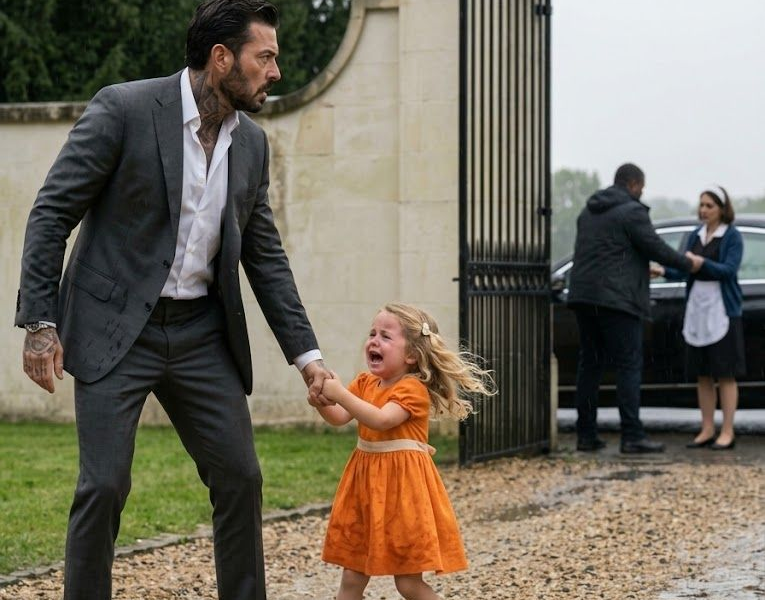
“A Man Is Pushing Mama Into a Black Car Outside,” the Maid’s Toddler Shouted to the Mafia Boss
At 11:40 on a Thursday night in October, Victor Castellano was alone in the one room at Harrow Point nobody entered without knocking twice.
Rain struck the windows hard enough to sound like gravel.
The fireplace had gone cold hours ago. A half-finished cup of coffee sat beside his right hand, untouched since Marcus Dell had called from the security office to tell him the back-gate camera had failed again.
Victor was looking at a shipping ledger when the study door flew open.
No knock.
No guard.
No permission.
A three-year-old girl in a pajama shirt covered with yellow ducks ran across the rug barefoot.
Her curls were wet.
A gray stuffed rabbit with one ear sewn on in red thread was crushed against her chest.
Her face was white.
She stopped in front of Victor’s desk, breathing in small, broken hiccups.
“A man is pushing Mama into a black car outside.”
Victor was standing before she finished the sentence.
“Where?”
“By the back gate.”
He came around the desk.
Poppy Bell grabbed his sleeve.
“He put his hand on her mouth.”
Victor’s blood turned cold.
“Marcus.”
He already had the phone in his hand.
“Back gate. Now.”
He scooped Poppy up with one arm and crossed the study.
The little girl clung to him, rabbit trapped between them.
“Teddy!”
A young guard appeared at the top of the main staircase.
Victor put Poppy into his arms.
“Do not let her out of your sight.”
“But Mama—”
Victor touched one hand to the child’s wet cheek.
“I’m going to get her.”
“You promise?”
Promises were dangerous things in Victor Castellano’s world.
He had spent twelve years refusing to make one he could not guarantee.
Tonight he answered without hesitation.
“I promise.”
Then he ran.
Men in Baltimore had watched Victor walk into rooms for twenty years and had never seen him hurry.
He took the stairs three at a time.
Crossed the front hall.
Ignored the umbrella thrust toward him by one of the night staff.
Rain hit him the moment he stepped outside.
The back gate stood open.
Not broken.
Open.
A set of tire tracks cut through the gravel before turning toward the private road.
The camera above the gate was dark.
Marcus appeared from the security building with a flashlight.
“Gate camera dropped at eleven thirty-one.”
“How long?”
“Still down.”
Victor’s gaze moved across the wet grass.
Something vibrated near the hedge.
He bent.
A phone.
Hannah Bell’s.
Face down in the mud.
His own missed call glowed across the cracked screen.
Marcus looked toward the garage.
“Gregory’s Mercedes is gone.”
Victor slowly straightened.
“What?”
“He left at nine forty.”
“Why?”
“No departure logged.”
For one second, the rain seemed to disappear.
Gregory Vance.
Fourteen years.
Estate manager.
Keeper of schedules.
Keeper of keys.
The man who knew which door Victor used when he could not sleep.
The man who had stood beside Victor at the graves of Elena and Leo twelve Novembers earlier.
The man Victor had trusted enough to stop noticing.
Marcus’s voice hardened.
“Victor.”
He held up his phone.
“I checked the safe access.”
Victor looked at him.
“The missing Delacroix ledgers were not taken by Hannah.”
“What are you talking about?”
“The safe was opened at six oh four this morning.”
Victor felt the ground shift.
“Code access?”
“Yes.”
“Whose?”
Marcus hesitated.
“Yours or Gregory’s.”
Victor stared into the rain.
Four hours earlier, Gregory had placed a tablet in Victor’s hands.
Grainy footage.
Hannah leaving his office.
Hospital debt.
Desperate widow.
Missing ledgers.
A story arranged so neatly Victor had almost accepted it.
He had ordered Hannah to meet him at ten.
He had kept her on the property.
And somebody had used that time to take her.
Victor closed his eyes for half a second.
“I handed her to him.”
“Not yet.”
Marcus pointed toward the house.
“Let’s get inside.”
“I’m not going inside.”
“You don’t know where they went.”
“I’ll find out.”
“You have no plate.”
“I said I’ll find out.”
A small voice came from the open back door.
“Mama has your lucky coin.”
Both men turned.
Poppy stood wrapped in Teddy’s oversized jacket.
The young guard was behind her looking horrified.
“I’m sorry, sir. She—”
Victor lifted one hand.
Poppy sniffled.
“I put it in Mama’s pocket because she was scared.”
Victor stopped breathing.
“The pouch?”
The little girl nodded.
“The little house.”
Marcus stared.
“What pouch?”
Victor tore his phone from his coat.
Twelve years earlier, after losing the same silver coin three times, he had paid a discreet electronics specialist in Philadelphia to sew a tracker the size of a grain of rice into the lining of its leather pouch.
Not because the coin was valuable.
Because Elena had given it to him on their wedding day.
After she died, losing it felt too much like losing her again.
Victor had not opened the tracking application in six years.
The screen loaded.
One second.
Two.
Three.
Four.
A red point appeared on the map.
Moving.
South.
Toward the harbor.
Marcus whispered, “Jesus.”
Victor enlarged the screen.
The dot traveled along Broening Highway.
Pier Fourteen.
The abandoned Kesler shipyard.
Victor turned toward the driveway.
“Get the car.”
“I’m bringing six men.”
“Two.”
Marcus looked at him.
“Victor—”
“Two.”
He called another number.
A woman answered on the fourth ring.
“Ruiz.”
“Detective.”
A pause.
“Castellano.”
Her voice lost its sleepiness.
“This better be extraordinary.”
“It is.”
Victor looked back at Poppy.
She stood barefoot beneath the porch light, clutching Mr. Buttons so tightly the repaired red ear bent sideways.
“I need you at Pier Fourteen.”
“Why?”
“A woman was taken from my property.”
“Your people involved?”
“One of them.”
“Do you have evidence?”
“I have a tracker.”
“And?”
Victor’s voice dropped.
“A twelve-year-old murder.”
Silence.
“Send me the location.”
“No sirens.”
“You don’t get to order the police.”
“Please.”
Another silence.
That word cost him more than money ever had.
Ruiz heard it.
“No sirens.”
Victor put away the phone.
Then returned to Poppy.
He knelt in the rain.
The child looked terrified.
“The luck worked.”
“It did?”
“You put it exactly where it needed to be.”
Her lip trembled.
“Bring Mama back.”
Victor laid his palm gently against her cheek.
“I’m going now.”
Two months earlier, Hannah Bell had sat at a kitchen table in Dundalk counting two hundred eleven dollars for the third time.
The number refused to become larger out of sympathy.
Rent was due Monday.
The electric company had already sent a yellow notice.
And on the refrigerator, held beneath a strawberry magnet, hung a hospital bill with a red stamp across the top.
FINAL NOTICE.
$18,403.17.
Hannah knew the seventeen cents because numbers became intimate when you owed them long enough.
Her husband Caleb had fallen from scaffolding at a downtown parking garage the previous spring.
He lived nine days.
Insurance covered surgery.
It covered emergency transport.
It even covered part of intensive care.
The last nine days of his life somehow fell into a category called non-covered extended support.
The phrase had appeared on three letters.
Hannah had wanted to mail each letter back with a photograph of herself holding Caleb’s hand and ask which part of that counted as unnecessary.
She never did.
She made payment plans.
She worked.
She sold his truck.
Then the hospital sent the remainder to collections.
From the bedroom came Poppy’s voice.
“Mama?”
Hannah wiped beneath one eye.
“Yes, baby?”
“Mr. Buttons can’t sleep.”
She went in.
Poppy sat in the narrow bed they shared, curls flattened on one side.
The gray rabbit lay across her lap.
Its right ear had torn off at a playground six months earlier.
Hannah repaired it with the only thread in the apartment.
Red.
Poppy had studied the stitches and announced that scars were decorations for brave people.
“Why can’t he sleep?”
Hannah asked.
“He’s worried.”
“About what?”
Poppy looked toward the kitchen.
“You counting.”
Hannah laughed.
It came out wetter than she intended.
She climbed onto the bed.
“Mr. Buttons is nosy.”
“He cares.”
“That too.”
She tucked the blanket around them and hummed the wordless song her mother used to sing.
Poppy was asleep before Hannah reached the second verse.
The next morning, Hannah called a number from a laundromat notice board.
PRIVATE ESTATE HOUSEKEEPING.
DISCRETION REQUIRED.
IMMEDIATE START.
The pay was almost double what Hannah made cleaning hotel rooms.
The agency woman asked three questions.
Could she work long days?
Yes.
Could she keep quiet?
Yes.
Could she start Monday?
Hannah looked at the bill on the refrigerator.
“Yes.”
Harrow Point sat above the Chesapeake Bay at the end of a private road forty minutes outside Baltimore.
Hannah’s dented Toyota Corolla looked like it had arrived to apologize when it passed through the iron gates.
The house was stone, glass and silence.
Two guards stood near the garage.
Neither smiled.
Gregory Vance met her at the service entrance.
He was sixty, maybe a little older, with silver hair and polished shoes.
He wore a charcoal vest with a watch chain.
“Hannah Bell?”
“Yes.”
“Widow?”
The question startled her.
“It’s on your paperwork.”
“Yes.”
“One child.”
Hannah stiffened.
Gregory noticed.
“The agency performs background checks.”
“Of course.”
He turned.
“Come.”
The service corridor smelled like lemon oil.
As they walked, Gregory recited rules from memory.
“No personal phones on the main floors.”
“Yes.”
“No discussion of Mr. Castellano’s guests, business or schedule.”
“Yes.”
“Second floor is restricted unless I personally send you.”
“Understood.”
Then he stopped.
“And no children on the property.”
Hannah’s throat tightened.
“Not visiting.”
“Not waiting in vehicles.”
“Not in service areas.”
“Mr. Castellano is absolute on that point.”
Hannah thought of Poppy at Little Sparrows Daycare attempting to feed crackers to the class goldfish.
“Understood.”
For three weeks, the system worked.
Hannah dropped Poppy off at six.
Reached Harrow Point at six thirty.
Cleaned until five fifteen.
Picked Poppy up before daycare began charging one dollar per minute.
She never met Victor Castellano.
She saw evidence.
A black coffee cup left beside a study window.
A suit jacket carried to the dry cleaner.
A closed door on the second floor with a small painted yellow duck mounted at child height.
Once she saw Victor from the far end of a hallway.
Tall.
Black coat.
Two men behind him.
He disappeared around a corner before she could lower her eyes.
Then Little Sparrows flooded.
The director’s text came at five in the morning.
PIPE FAILURE. CLOSED UNTIL FURTHER NOTICE.
Hannah called Mrs. Okafor downstairs.
The retired nurse sometimes watched Poppy for twenty dollars and a casserole.
No answer.
At five forty, Mrs. Okafor’s son called.
His mother had fallen.
Broken hip.
Hospital.
At least a week.
Hannah stood in the kitchen.
Poppy sat at the table eating cereal with Mr. Buttons beside her.
If Hannah missed work, Gregory would replace her.
Maybe not immediately.
But easily.
People who paid double did not need complicated employees.
The hospital bill on the refrigerator seemed to glow.
“Mama?”
Hannah knelt.
“We’re playing a game today.”
Poppy brightened.
“What game?”
“Quiet Mouse.”
“I’m good at mouse.”
“You have to be the quietest mouse ever.”
“How long?”
“Until the sun goes down.”
At Harrow Point, Hannah carried her daughter through the service entrance wrapped in a laundry blanket.
Poppy found this hilarious.
Hannah did not.
She settled her in the basement laundry room between two dryers.
Crackers.
Coloring book.
Juice.
Mr. Buttons.
“Stay here.”
“I know.”
“No hallway.”
“I know.”
“No stairs.”
“I know.”
“If you need me?”
“Hide?”
“No.”
Hannah squeezed her eyes shut.
“Call me.”
“Quietly?”
“Yes.”
The most dangerous choices in a life rarely announce themselves as dangerous.
Sometimes they sound like a mother saying, Just today.
Poppy remained a perfect mouse for two hours and fourteen minutes.
She colored a six-legged purple horse.
Counted crackers.
Lay on warm towels watching sheets turn inside the dryer.
Every half hour Hannah slipped in.
Kiss.
Juice.
“You okay?”
“Yes.”
Three-year-olds were not designed for confinement.
By eleven, Mr. Buttons wanted hide-and-seek.
Poppy hid him behind detergent.
Bad hiding place.
Inside a basket.
Worse.
Then she saw the laundry lift.
A little wooden door in the stone wall.
She had watched Hannah place folded sheets inside.
Close door.
Press round black button.
Hum.
Clunk.
Sheets disappeared.
A secret rabbit elevator.
Poppy placed Mr. Buttons inside.
“Count to twenty.”
Then pressed the button.
Hum.
Clunk.
The box traveled upward.
Poppy waited.
Then opened the door.
Empty shaft.
Her stomach dropped.
Mr. Buttons was alone somewhere in the giant house.
Quiet Mouse said stay.
Mr. Buttons needed her.
The rabbit won.
Poppy climbed the service stairs.
At the second floor she squeezed through a door propped open by a towel cart.
The hallway seemed endless.
Deep red carpet.
Old ships in gold frames.
Tall windows.
Halfway down, the upper laundry hatch stood open.
Sheets stacked inside.
No rabbit.
Then she spotted a pillowcase on the carpet.
Beyond it—
gray fur.
Mr. Buttons lay beside a tall door that was not fully closed.
Poppy ran.
She hugged him.
“You hid too good.”
Then she heard a man speaking inside.
“No.”
His voice was quiet.
“You will call me with the correct number.”
Pause.
“I don’t care what he promised.”
Another pause.
“Nobody speaks for me.”
Poppy peeked through the opening.
A large study.
Books.
Dark desk.
A man standing at the window.
She pushed the door.
“Excuse me.”
The man went still.
“Did you see a bunny with a red ear?”
Victor Castellano turned.
For twelve years, nobody had walked into that study uninvited.
The first person to do it barely reached his desk drawer.
He looked at her.
Pink socks.
Purple crayon mark on one knee.
Yellow shirt.
Stuffed rabbit.
He ended his call.
“Fix it by Friday.”
Then placed the phone facedown.
“How did you get here?”
“Stairs.”
Victor waited.
“Lots of stairs.”
“And who are you?”
“Poppy.”
“Poppy what?”
“Bell.”
Victor knew no Bells.
“Where are your parents?”
“Mama is cleaning.”
His expression hardened.
“Who is your mother?”
“Hannah.”
Now he knew.
Housekeeping.
New hire.
Victor’s eyes went toward the door.
Poppy raised Mr. Buttons.
“This is Mr. Buttons.”
“I see.”
“His ear is red because Mama fixed him.”
Victor looked.
“He appears injured.”
“No.”
Poppy frowned.
“Fixed.”
Something small moved in Victor’s chest.
“Of course.”
Poppy studied him.
“Are you the boss?”
“Who told you that?”
“Mama.”
Victor’s eyebrow lifted.
“She said the boss is scary and I have to be Quiet Mouse.”
Poppy looked pleased with herself.
“But you found me.”
“I did.”
“So I’m bad at mouse.”
Victor almost smiled.
“Terrible.”
“Are you scary?”
No one had asked him that in thirty years.
Not directly.
He came around the desk.
Poppy’s gaze followed.
Instead of calling security, Victor lowered himself onto one knee.
“Some people think I am.”
Poppy considered.
Then patted his forearm twice.
“It’s okay.”
Victor blinked.
“Mama says scary people are mostly tired.”
He had no answer.
Running footsteps approached.
Hannah hit the doorway hard enough to catch herself on the frame.
She saw Poppy.
Saw Victor.
Went white.
“Poppy.”
She crossed the room.
Pulled the girl against her legs.
“Mr. Castellano, I am so sorry.”
Victor stood.
“I know the rule.”
Hannah’s words tumbled.
“Daycare flooded.”
“My sitter is in the hospital.”
“It’s my fault.”
“I’ll go.”
“I’ll get my things.”
“You don’t need to call the agency.”
“I understand.”
“How old?”
Hannah stopped.
“What?”
“The child.”
“Three.”
Poppy corrected, “Three and a half soon.”
Victor looked at her.
Then at Hannah.
“She can stay.”
Hannah stared.
“I’m sorry?”
“Until daycare reopens.”
He turned toward the window.
“In the kitchen.”
“Not the basement.”
“A child doesn’t belong in a basement.”
Hannah’s eyes filled.
“Thank you.”
“Don’t.”
Victor picked up his phone.
“Keep her away from the stairs.”
As Hannah led Poppy out, Gregory stood at the far end of the corridor.
His expression did not change.
Later he called Hannah into the staff office.
“Mr. Castellano has made an exception.”
“Yes.”
“In this house, his exceptions become rules until he changes them.”
He straightened a pen already aligned with the desk.
“Do not mistake weather for climate, Mrs. Bell.”
Hannah frowned.
“Kindness in a house like this feels permanent while you’re standing in it.”
Gregory looked at her.
“It is not.”
The daycare never reopened.
Mold.
Structural damage.
Closure order.
Hannah began searching for alternatives.
Every option cost more than she made.
When she tried to apologize to Victor in the kitchen three days later, he cut her off.
“Don’t bother.”
She stopped.
“Sir?”
“Keep the child in the kitchen.”
That was how Poppy became part of Harrow Point.
Beatrice Almeida, the cook, adopted her instantly.
Within two days Poppy had an apron folded four times around her waist.
Within five, a wooden spoon.
Within seven, a tea set.
At four on Friday afternoon, Poppy arranged four plastic cups on the kitchen table.
“Tea party.”
Beatrice laughed.
“Who’s invited?”
“You.”
“Mr. Buttons.”
“Mama.”
“And the boss.”
Beatrice laughed harder.
“The boss does not come to kitchen tea parties.”
At three fifty-five, Poppy sat on the bottom stair.
She did not climb.
She had promised.
At four, Victor came down toward the garage.
Poppy looked at him.
“You’re late.”
Victor stopped.
“For?”
“Tea.”
He looked toward the tiny pink teapot.
“I have a meeting.”
“It’s short.”
Victor looked at his watch.
Then at the garage door.
Then at Poppy.
Five minutes later, the man half the waterfront feared was sitting on a wooden step stool too small for him.
Poppy poured imaginary tea.
“Careful.”
“Why?”
“It’s hot.”
Victor blew across an empty cup.
Drank.
“Excellent.”
“Chamomile.”
She nodded solemnly.
“Mama says chamomile is for when your brain is too loud.”
Victor set down the cup.
He stayed eleven minutes.
The next day he came again.
By the end of September, nobody scheduled Victor at four unless the city was actively burning.
Sometimes he stayed three minutes.
Sometimes twenty.
Marcus Dell stood in the hallway on several afternoons watching his employer drink imaginary tea.
“I’m not asking,” Marcus said once.
“Good.”
“Just observing.”
“Observe somewhere else.”
Poppy asked questions adults would never dare.
“Why black shirts?”
“Easy.”
“Why?”
“I don’t have to choose.”
“I like choosing.”
She pointed to her leggings.
“Purple.”
Another afternoon she broke the sugar bowl.
The crash startled her so badly she crawled under the table.
When Beatrice coaxed her out, Poppy apologized.
Then turned to Victor.
“Mama says when you do a bad thing, you have to say sorry out loud.”
Victor went still.
“Why?”
“So it doesn’t stay inside forever.”
He looked at the shattered sugar.
Then at the child.
“What if the bad thing is too big?”
Poppy thought.
“Say it louder?”
Beatrice turned toward the stove because her eyes filled.
Victor remained quiet the rest of the party.
One afternoon Poppy asked about the room with the yellow duck.
Victor’s hand stopped around his cup.
“What room?”
“Upstairs.”
“I didn’t go.”
She added quickly.
“I saw from the bottom.”
Victor looked toward the back staircase.
The painted duck had been on that door thirteen years.
He had forgotten anyone could see it from below.
“Nobody uses that room.”
“Why?”
He did not answer.
That day he stayed thirty-one minutes.
Before leaving, he touched the top of Poppy’s head with two fingers.
Like checking whether she was real.
On a rainy afternoon in October, Poppy asked Victor whether he had a sad day.
He almost dismissed it.
Then he saw Hannah across the room.
She had stopped polishing silver.
Beatrice stopped chopping onions.
Marcus stood in the hall.
Victor said, “November twelfth.”
“What happened?”
Victor’s hands lay flat on the table.
“I had a wife.”
Poppy waited.
“Her name was Elena.”
“Pretty name.”
“Yes.”
“And a little boy.”
Victor swallowed.
“Leo.”
“How little?”
“Fourteen months.”
Poppy held her hand low above the floor.
“This little?”
“Close.”
Victor looked at the empty cup.
“He had just learned to walk.”
“Was he good?”
“No.”
For the first time, he smiled.
“He walked like a drunk sailor.”
Poppy giggled.
Victor’s smile disappeared.
“One morning Elena took my car.”
“Her car was being repaired.”
“They were going to a doctor.”
“Someone had placed an explosive beneath mine.”
The adults in the kitchen became very still.
“It was meant for me.”
Poppy did not understand explosives.
She understood endings.
“They didn’t come back.”
“No.”
“The duck room was Leo’s.”
Victor looked at her.
“Yes.”
Poppy climbed down.
She walked around the table.
Held out Mr. Buttons.
“You can hold him.”
Victor stared.
“Mama says hugging helps.”
“I don’t—”
“Even if you’re big.”
Marcus looked at the ceiling.
Victor accepted the rabbit.
A gray toy with one plastic eye and red stitches.
He held it against his chest.
Bow of head.
Three seconds.
Maybe five.
Then handed it back.
Poppy whispered, “Better?”
“No.”
“Oh.”
Then Victor said, “A little.”
Poppy smiled.
Victor reached into his pocket.
A small leather pouch.
He opened it and placed a silver coin into her palm.
Elena had given it to him on their wedding day.
Morgan silver dollar.
“It’s luck.”
Poppy examined it.
“Did it work?”
Victor took time.
“I’ve lost it three times.”
“And?”
“It always comes back.”
Poppy handed it to him.
“Then it works.”
What Poppy did not know was that after Elena and Leo died, Victor became terrified of losing objects.
He hid it well.
After the coin disappeared from a restaurant in New York and was recovered two days later, Victor had a tracking device sewn inside the pouch.
A ridiculous precaution.
He knew.
Grief was not famous for dignity.
That same week, Marcus found the first real crack inside Harrow Point.
The back-gate camera had gone offline three times in October.
Eleven minutes.
Fourteen.
Nine.
Always after ten.
The security program called them power fluctuations.
Marcus checked staffing logs.
Each night, Gregory Vance had been the highest-ranking estate employee present.
Fourteen years.
No sick days.
No missing money.
No reprimands.
Marcus wrote it down anyway.
At roughly the same time, Poppy mentioned Gregory’s second phone.
They were shelling peas.
“Mama.”
“Yes?”
“Mr. Gregory has a phone that isn’t his phone.”
Hannah barely listened.
“What?”
“Little gray one.”
“Where?”
“Cereal box.”
Beatrice snorted.
“What cereal?”
“Bear one.”
“Gregory doesn’t eat cereal.”
Poppy grinned.
“That’s why hiding is good.”
Hannah shook her head.
“Probably a work phone.”
“I saw him whispering.”
“Poppy.”
“I wasn’t spying.”
“Then what were you doing?”
“Hiding.”
Beatrice laughed.
The conversation ended.
Outside the kitchen, Gregory Vance stood still for five seconds.
Then continued down the hall.
The hidden drawer came out on a Tuesday.
Hannah had been sent to clean Gregory’s office.
He was in Baltimore meeting a supplier.
Victor was in New York.
The bottom desk drawer stuck.
Hannah pulled it free to realign the runner.
It felt too heavy.
She turned it.
The wooden base shifted.
False bottom.
Every instinct said stop.
Hannah opened it.
Gray flip phone.
Expired Massachusetts driver’s license.
Gregory’s younger face.
Different name.
WALTER J. HAIL.
A photograph.
Teenage boy.
Ravens jersey.
Dock behind him.
On the back:
DANY — SUMMER 2009.
Then yellow legal paper.
Times.
Roads.
Route 695.
Frederick Road.
Dr. Amani.
A license plate.
BLACK MERCEDES.
At the top, underlined twice:
NOVEMBER 12, 2014.
Hannah sat on the floor.
Poppy had repeated Victor’s story after the tea party.
The sad day.
The car.
The doctor.
The thing meant for him.
Hannah’s hands shook.
She photographed everything.
Replaced everything.
Closed the false bottom.
Pushed the drawer back.
She told nobody.
Not Beatrice.
Not Marcus.
She would tell Victor.
Only Victor.
What Hannah did not know was that Gregory placed one gray hair across the drawer seam every morning before leaving his office.
That night, it was gone.
Gregory sat in darkness behind his desk for almost an hour.
On Wednesday he behaved normally.
“Morning, Mrs. Bell.”
“Morning.”
“How is Poppy?”
“Good.”
“Excellent.”
Hannah smiled.
Her stomach twisted.
That afternoon Gregory called someone from the pantry.
The small gray phone.
Thursday, Victor returned two hours early.
Gregory waited on the steps.
“Sir.”
“What?”
“The Delacroix ledgers are missing.”
Victor stopped.
“Originals?”
“Yes.”
“Safe forced?”
“No.”
“Who entered the wing?”
Gregory hesitated perfectly.
“Housekeeping.”
Victor stared.
“Mrs. Bell cleaned my office Tuesday.”
He produced a tablet.
Security footage.
Hannah leaving.
Dust rag under her arm.
“Her hospital debt is eighteen thousand.”
Gregory’s voice was regretful.
“I checked when she was hired.”
“Desperate people do desperate things.”
Victor watched the video.
Gregory continued.
“The Delacroix group would pay heavily for those books.”
Victor felt old instincts rising.
Distrust first.
Questions later.
Then Marcus approached.
“Before you decide anything.”
Victor looked at him.
“The gate camera outages.”
“Gregory was here all three.”
Gregory’s expression did not change.
“I manage the estate.”
Marcus said, “I’m aware.”
Victor looked between them.
Fourteen years versus two months.
Graveside loyalty versus a widow with debt.
He hated that his mind performed the arithmetic automatically.
“Where is Hannah?”
“Guest wing.”
Gregory said.
Victor gave back the tablet.
“Say nothing.”
At four, Victor almost skipped the tea party.
He stood on the landing.
Then heard Poppy.
“He’s coming, Mr. Buttons.”
Victor went down.
Hannah watched him from the far counter.
Twice she seemed about to speak.
Twice Gregory entered on small errands.
Twice Hannah stopped.
Victor saw nervousness.
Guilt, he thought.
The thought tasted wrong.
“Mrs. Bell.”
She turned.
“Stay late tonight.”
Her face paled.
“Ten o’clock.”
“My study.”
“Yes.”
Then quickly:
“I need to tell you something too.”
“Important.”
Victor studied her.
“What?”
“Just you.”
He nodded.
Poppy tugged his sleeve.
“Boss.”
“Yes?”
“Can I borrow your lucky coin?”
“Why?”
“Mama’s scared.”
Hannah went rigid.
“Poppy.”
“She cried in the bathroom.”
Victor looked at Hannah.
She turned away.
Poppy whispered, “She needs luck more.”
Victor was tired.
Tired men made strange choices.
He handed Poppy the pouch.
“Tomorrow.”
“I promise.”
Later, when Hannah bent over the sink, Poppy slipped the pouch into the deep pocket of her blue cardigan.
A surprise.
At nine forty, Gregory left the garage.
At nine forty-five, heavy rain began.
At ten, Hannah knocked on Victor’s study.
No answer.
He was downstairs with Marcus.
Safe logs.
Six oh four.
Gregory’s code.
Hallway footage missing.
Eleven-minute gap.
Victor sat in a plastic security chair.
“Maybe she saw him use the code.”
Marcus said nothing.
“Say it.”
Marcus looked at him.
“You don’t believe that.”
Victor rubbed one hand across his mouth.
Meanwhile Hannah received a text.
HOUSE STAFF.
Mr. Castellano is delayed.
Wait at garage.
He will speak with you on his way out.
Hannah pulled her cardigan tighter.
Crossed the dark lawn.
By eleven twenty, Victor knew the safe had been opened before Hannah arrived for work.
By eleven thirty-one, the back camera went dark.
In the kitchen, thunder woke Poppy.
Beatrice had gone home.
Hannah was gone.
Poppy climbed onto the bench beneath the window.
A black car waited near the gate.
A large man held Hannah’s arm.
Hannah pulled away.
He covered her mouth.
Forced her into the rear seat.
Poppy forgot every rule she had ever been given.
She ran upstairs.
“A man is pushing Mama into a black car outside.”
Nineteen minutes after Victor found the tracker, his sedan stopped a block from Pier Fourteen.
The red dot was no longer moving.
Marcus drove.
Two trusted men followed in another car.
Detective Anna Ruiz was minutes behind.
Victor entered the old shipyard alone.
He did not want Walter panicking at the sight of a group.
The warehouse smelled of rust, seawater and oil.
Water dripped through the roof.
A single battery lantern burned beside the edge of an empty dry dock.
Hannah sat in a steel chair.
Hands bound behind her.
Blue cardigan soaked.
A bruise darkening along one cheek.
Gregory stood beside her.
Except without the vest and watch chain, he no longer looked like Gregory Vance.
He looked older.
Tired.
A pistol hung loosely in his right hand.
“Four minutes early.”
Walter glanced at a clock.
“I planned to call at one.”
Victor stopped.
“I was going to let you drive around for an hour first.”
Walter frowned.
“How did you find us?”
Victor raised empty hands.
“Let her go.”
“Answer me.”
“Walter.”
The old man froze.
Nobody had called him that in fourteen years.
“My name.”
“I know.”
Walter laughed once.
“No.”
“You know the name.”
“You don’t know the man.”
“Then tell me.”
Hannah looked at Victor.
“Don’t.”
Walter glanced toward her.
“She found the drawer.”
“I truly am sorry about that.”
“You’re sorry?”
Hannah’s voice shook with anger.
“You put me in a chair with my daughter alone in that house.”
Walter looked away.
For the first time, shame.
“You were not supposed to have a child there.”
Victor said, “Enough.”
Walter’s head snapped toward him.
“No.”
His voice cracked.
“For fourteen years, you have been the one who says enough.”
“Tonight you listen.”
Victor took one slow step.
“What happened to Dany?”
Walter stopped breathing.
Hannah looked between them.
The pistol lowered slightly.
“My son.”
Walter’s face changed.
Daniel James Hail.
Nineteen.
Wanted community college.
Could not afford tuition.
A dock worker told him the Castellanos paid cash to boys who moved boxes at night.
Victor’s father’s boxes.
July 2009.
Police raid.
Senior men fled.
Teenagers were left behind.
Dany was arrested.
Five-thousand-dollar bail.
Victor’s father knew.
Did nothing.
Dany had asthma.
His inhaler was not processed properly at booking.
Third night.
Attack.
By morning, he was dead.
Walter’s wife lasted eleven months after losing him.
Then cancer.
Then grief.
Walter buried both.
Changed his name.
Bought a dead man’s employment history.
Entered Harrow Point.
Waited.
“I wanted your father.”
Walter said.
“But he died before I got close.”
“So I took you.”
“November 2014.”
Victor’s jaw tightened.
Walter nodded.
“I gave them the route.”
“The plate.”
“The doctor.”
“The time.”
“It was supposed to be you in that Mercedes.”
His hand shook around the gun.
“Then Elena’s car went into the shop.”
Walter’s eyes closed.
“I told myself I could stop it.”
“I had hours.”
“I did nothing.”
Victor’s throat tightened.
“You killed my wife.”
Walter opened his eyes.
“Yes.”
“My son.”
A tear moved down Walter’s face.
“Yes.”
“Fourteen months old.”
“I know.”
“How?”
Walter’s mouth twisted.
“Because for twelve years I heard footsteps that were not there.”
“I passed that room every day.”
“I knew the yellow duck was on the door.”
“I knew the shoes in your desk drawer.”
Victor went completely still.
“You opened that drawer?”
“No.”
Walter shook his head.
“You opened it once after the funeral.”
“I brought coffee.”
“I saw.”
Victor wanted to kill him.
The desire was clean.
Simple.
Walter saw it.
“Go on.”
He raised the pistol slightly.
“Your father would have.”
“I am not my father.”
“No.”
Walter laughed bitterly.
“You’re worse.”
“Why?”
“Because you learned how to smile again.”
His eyes moved toward Hannah.
“Two months ago I stood outside the kitchen.”
“I heard you laugh.”
“With that little girl.”
His face crumpled.
“My son dies in a cell because your family leaves him behind.”
“Your wife and child die because I become what your family made.”
“And somehow you get a child in your kitchen teaching you how to laugh.”
Walter’s pistol rose toward Hannah.
“You took my son.”
“I took yours.”
“And now I take the thing that brought you back.”
Hannah closed her eyes.
Victor stepped directly between them.
Walter stared.
“Move.”
“No.”
“She is not Elena.”
“I know.”
“She is not yours.”
“I know.”
“Then move.”
“No.”
Victor opened his arms slightly.
“You wanted me.”
“For fourteen years.”
“So take me.”
Walter’s hand shook.
“Do it.”
“You think that fixes Dany?”
“No.”
Victor’s voice softened.
“Nothing fixes him.”
Walter’s face twisted.
“Don’t say his name.”
“Daniel James Hail.”
“I said don’t.”
“He should have come home.”
Walter’s breath hitched.
“My father left those boys.”
Victor continued.
“He chose cargo and men above children doing work they should never have been doing.”
“I was twenty-five.”
“I did not know.”
Walter whispered, “Convenient.”
“Yes.”
Victor nodded.
“It is.”
The honesty confused him.
Victor continued.
“I’ve spent my life saying I didn’t know when not knowing was often something my family paid for.”
Walter’s gun dropped an inch.
“That doesn’t bring Dany back.”
“No.”
“Then shut up.”
“Not tonight.”
Victor thought of the sugar bowl.
Poppy under the table.
Bad people have to say sorry out loud.
Otherwise the bad thing stays inside forever.
“I’m sorry.”
Walter stared.
Victor said it again.
“I am sorry Dany died because my family treated boys like replaceable hands.”
Walter’s face cracked.
Victor had not asked forgiveness.
That mattered.
“I’m sorry my father left him there.”
“I’m sorry I inherited that world and spent years defending parts of it because admitting what it cost other families would have meant admitting what we were.”
Walter’s eyes filled.
“But Hannah does not pay for that.”
Victor took another step.
“Neither does Poppy.”
The gun wavered.
Marcus emerged from darkness behind Walter.
Three seconds.
One tackle.
Pistol across wet concrete.
Over the edge.
A splash.
Walter lay facedown with Marcus’s knee against his back.
He did not fight.
“Go on.”
He turned his face toward Victor.
“Finish it.”
Victor looked toward the black water.
One sentence to Marcus.
Nobody would find Walter.
That was how Victor had been raised.
Eliminate the problem.
Close the ledger.
Then another voice returned.
Tiny.
Serious.
Otherwise the bad thing stays inside forever.
Victor’s fists opened.
“No.”
Walter blinked.
“You don’t get to disappear.”
Victor crouched.
“You’re going to court.”
“You’re going to say November twelfth.”
“Elena.”
“Leo.”
“Dany.”
“All of it.”
Walter laughed brokenly.
“You think the law cares about my son?”
Victor held up his phone.
The call to Marcus had remained active.
Detective Ruiz had heard enough.
Flashlights appeared at the entrance.
Ruiz entered with two officers.
“No sirens.”
she said dryly.
“Look at us cooperating.”
Victor was already moving toward Hannah.
He cut the restraints.
Her hands were cold.
Her whole body began shaking only after she was free.
Victor removed his coat.
Wrapped it around her.
“Poppy.”
“She’s safe.”
Hannah gripped his sleeve.
“She saw?”
“Yes.”
“Oh God.”
“She saved you.”
Hannah covered her mouth.
“I tried to tell you.”
“I know.”
“I found his papers Tuesday.”
“I know now.”
“You thought I stole from you.”
Victor’s face tightened.
“Yes.”
Her eyes filled with anger.
“I stayed late because you ordered me.”
“Yes.”
“And that gave him time.”
“Yes.”
Victor did not soften the word.
“I believed fourteen years over two months.”
Hannah stared.
“I will carry that.”
She looked away.
Her fingers touched something inside her cardigan pocket.
Leather pouch.
She pulled it free.
“What is this?”
Victor’s exhausted face changed.
“Poppy.”
“For luck?”
“Yes.”
Hannah almost laughed.
Then cried.
The return to Harrow Point happened after two in the morning.
Every light burned.
The front door opened before the car stopped.
Poppy came down the steps in Teddy’s giant jacket.
“Mama!”
Hannah dropped to her knees.
Poppy hit her hard enough to nearly knock them both over.
Hannah held her.
Rocked.
Repeated her name.
Victor stayed beside the car.
Some reunions did not need witnesses pressing closer.
After a while Poppy ran to him.
She held out the pouch.
“I kept it in its little house.”
Victor knelt.
“It’s yours.”
“But it’s your luck.”
“It found its way home.”
He folded her fingers around it.
“You keep it.”
Poppy looked toward Hannah.
Then back.
“You came home too.”
Victor’s eyes filled.
“Yes.”
The investigation reached farther than Walter.
Victor opened old dock records.
Dany Hail had indeed been left behind during the 2009 raid.
The evidence showed Victor’s father had authorized evacuation of senior men before contract laborers and temporary workers.
Dany’s family called twice from central booking.
Nobody returned the calls.
Victor read each record.
No excuses.
Walter pleaded guilty.
Kidnapping.
Conspiracy.
Identity fraud.
The 2014 attack.
At sentencing, he turned toward the gallery.
Victor sat beside Marcus.
Hannah sat two rows behind them by choice.
Walter found Victor.
“I am sorry.”
Three words.
Victor did not forgive him.
He nodded.
Acknowledgment was not absolution.
The same month, a scholarship appeared at Baltimore City Community College.
The Daniel James Hail Memorial Fund.
For students from waterfront families.
No Castellano name.
The donor remained anonymous.
Marcus knew.
Hannah guessed.
Neither mentioned it.
The $18,403 did not simply vanish from Hannah’s life because Victor wrote a check.
He tried.
She refused.
“You do not get to pay me for getting kidnapped.”
“That is not what this is.”
“It will feel like it.”
He leaned back.
“What would not?”
Hannah had thought about it.
“The estate failed me.”
Victor said nothing.
“The security system failed.”
“Your manager used his position to lure me outside.”
“Yes.”
“I should receive whatever an employee would receive from a legitimate employer after that.”
Victor nodded slowly.
“Worker compensation.”
“Security negligence settlement.”
“Paid counseling.”
“Lost time.”
“And if you want me to stay, a real job with a real salary.”
Victor almost smiled.
“What job?”
“Gregory’s.”
He blinked.
Hannah folded her arms.
“You need an estate manager.”
“You’re applying?”
“I’ve spent two months watching everything he did wrong.”
“Bold qualification.”
“I also know where Beatrice hides the expensive olive oil.”
Victor nodded.
“Critical.”
Hannah took the job.
The debt disappeared by Christmas through the employment settlement, back wages, and a structured salary advance she insisted on signing with outside counsel.
Victor complained the paperwork was excessive.
Hannah told him respectable employers loved paperwork.
He stopped complaining.
Her first act as estate manager was to remove the rule banning children.
Marcus read the revised handbook.
“Children permitted in designated family areas with supervision.”
He looked up.
“This place has a handbook now?”
“Yes.”
“Gregory kept rules in his head.”
“And look how that went.”
Marcus signed.
The second change was cameras.
Independent security audit.
No single person could disable a gate camera.
Access logs went to two systems.
Victor complained about being unable to turn one off privately.
Hannah said, “Good.”
The third change involved a locked door.
She did not order it.
She only asked.
“What are you going to do with Leo’s room?”
Victor stared at her.
They sat at the kitchen table after Poppy had gone home.
“I don’t know.”
“You don’t have to know tonight.”
He looked toward the back staircase.
“Twelve years.”
“I know.”
“No one has entered.”
“I know.”
Hannah stood.
“Then don’t open it because I asked.”
She walked away.
Three weeks later Victor opened it himself.
Dust.
A small bed.
Wooden blocks.
A yellow duck on the door.
Tiny blue wool shoes in a drawer.
He sat on the floor until sunset.
Nobody interrupted.
The next spring, the room was painted pale yellow.
Not erased.
Changed.
The duck stayed.
Shelves of picture books went up.
A quilt covered in little boats.
Poppy napped there on afternoons when Hannah worked late.
The first time Victor saw her asleep in Leo’s old room, he stood in the doorway for ten minutes.
Hannah found him.
“You okay?”
“No.”
“Do you want me to move her?”
Victor shook his head.
“No.”
He looked at the child.
“I thought making room for anything else would mean I loved him less.”
Hannah leaned against the wall.
“And?”
“It doesn’t.”
“No.”
He swallowed.
“It just means the room isn’t the grave.”
Hannah said nothing.
That answer belonged to him.
On November twelfth, Victor drove to Holly Ridge Cemetery.
For the first time, Poppy came.
Yellow raincoat.
Red boots.
White daisies.
Hannah stayed several steps back.
Poppy put the flowers on Elena’s grave.
Then moved to Leo’s.
She placed Mr. Buttons against the stone.
Victor looked at her.
“What are you doing?”
“He can borrow him.”
“For how long?”
“Until dinner.”
Poppy adjusted the rabbit.
“Nobody likes being lonely.”
Victor turned toward the trees.
His shoulders moved once.
Poppy gave him privacy for approximately six seconds.
Then slipped her hand into his.
On the first warm April afternoon, tea moved outside.
Beatrice brought real chamomile.
Marcus was assigned a child-size chair and protested professionally.
Hannah sat in sunlight with her eyes closed.
The old blue cardigan had been retired.
A green one rested over her shoulders.
Victor came from the house at exactly four.
Poppy stared.
He wore blue.
Not black.
She gasped.
“You chose.”
Victor looked down at his shirt.
“Apparently.”
“I like it.”
“I was afraid.”
“You’re learning.”
He sat on the absurd little stool.
Poppy poured.
“It’s hot.”
Victor blew on the tea.
Across the garden, Marcus checked his phone.
Hannah watched Victor.
There were still men who lowered their voices at his name.
There were still businesses he owned that people preferred not to ask about.
Change had not rewritten his history.
It had only removed the excuse that history had to become destiny.
Victor sipped.
“Excellent.”
“It’s real today.”
“That explains the improvement.”
Poppy looked offended.
Mr. Buttons occupied the cushioned chair.
The silver coin hung inside a tiny leather pouch around Poppy’s neck.
Victor had shortened the cord himself.
Hannah noticed him watching it.
“You regret giving it away?”
“No.”
“It always comes back.”
Hannah smiled.
“Maybe that wasn’t the lesson.”
Victor looked at her.
“What was?”
She nodded toward Poppy.
“Maybe some things come back because you finally learn where they belong.”
Victor considered.
Then Poppy interrupted.
“I have a question.”
Marcus muttered, “God help us.”
Poppy ignored him.
She looked at Victor.
“Are you still scary?”
Beatrice stopped moving near the door.
Hannah tried not to smile.
Victor set down his cup.
“To some people.”
Poppy nodded.
“Are you tired?”
Victor looked toward the bay.
The old study.
The reopened room.
The cemetery.
The pier.
Walter’s face.
Dany’s photograph.
Then toward Hannah.
Finally Poppy.
“Sometimes.”
She reached across the table and patted his arm twice.
Exactly as she had the first day.
“It’s okay.”
Victor laughed.
Not the tiny accidental sound Gregory had once heard behind a door.
A real laugh.
Marcus stared at the sky as if seeking professional guidance.
Poppy smiled proudly.
Hannah felt something in her chest loosen.
She had arrived at Harrow Point because she owed eighteen thousand dollars and had no childcare.
She had believed the danger was losing a job.
Then she believed the danger was discovering a killer.
Later she understood the more difficult danger had been something quieter.
A house full of adults had learned to treat silence as safety.
Victor never spoke about Leo.
Marcus distrusted what he could not prove.
Hannah hid Poppy because poverty had taught her honesty could cost too much.
Gregory buried grief until it became revenge.
Everyone believed keeping one more truth inside would protect somebody.
Then a three-year-old broke every rule.
She wandered upstairs because her rabbit was missing.
She asked the mafia boss whether he was scary.
She told him bad people had to apologize out loud.
She noticed the phone everyone else ignored.
And on a night when every trained guard in Harrow Point missed what was happening beyond the window, she saw her mother being taken.
Poppy had no strategy.
No weapon.
No authority.
She simply ran to the one adult she believed would listen.
That was the part Victor remembered most.
Not the warehouse.
Not Walter’s gun.
Not even the red dot moving across the map.
The study door flying open.
Bare feet.
Yellow ducks.
A rabbit with one red ear.
A child assuming that if she told the truth fast enough, an adult would do something with it.
Victor had spent most of his life becoming the kind of man people feared telling the truth to.
Poppy had not known enough to be afraid.
And because she wasn’t, Hannah came home.
The following year, Harrow Point hired two single mothers.
A small playroom appeared beside the staff kitchen.
Not hidden in the basement.
Windows.
Books.
A table covered in washable paint.
The first morning it opened, Victor walked past and found six children making paper boats.
He stopped.
One little boy looked up.
“You the boss?”
Victor stared at him.
From inside the room, Poppy shouted, “He’s not that scary.”
Victor closed his eyes.
Hannah laughed from the corridor.
“You made the rule.”
“I regret everything.”
“No, you don’t.”
“No.”
He watched Poppy tape a purple sail onto her boat.
“No.”
Years later, when people asked Hannah why she stayed at Harrow Point after everything that happened, she never gave the answer they expected.
It was not because Victor paid well.
Though he did.
It was not because he saved her life.
He had helped.
Poppy had saved it first.
And it was not because she believed Victor Castellano had become a harmless man.
He had not.
Hannah stayed because after the worst night of her life, Victor did something powerful men rarely did when they discovered they had been wrong.
He did not rewrite the facts.
He did not say Gregory had fooled everyone.
He did not tell Hannah she should understand why fourteen years of loyalty mattered more than two months.
He said:
I believed him instead of you.
I was wrong.
I will carry that.
Then he changed the systems that had allowed his mistake to matter.
The cameras.
The access codes.
The staff rules.
The way people could report concerns.
The way employees were named.
The way children were treated.
Even the locked room.
Hannah had known many men who could say sorry.
Caleb had been excellent at it whenever he forgot trash day.
What she had rarely seen was anyone build differently afterward.
That was what convinced her.
Not kindness.
Evidence.
On a Thursday evening years later, heavy rain returned to Harrow Point.
Poppy was seven.
She sat at the kitchen table doing homework.
Mr. Buttons had been repaired twice more.
The silver coin rested inside the little pouch beside her pencil case because Hannah did not allow expensive historic money at school.
Victor came in.
No jacket.
Blue shirt.
Poppy looked toward the window.
“Rain like that night.”
Victor nodded.
“Yeah.”
“Do you still remember?”
“Every second.”
Poppy thought.
“Me too.”
Hannah looked up from a staff invoice.
“You were three.”
“I remember Mama’s cardigan in the car door.”
The room quieted.
Hannah’s hands stopped.
Poppy immediately noticed.
“I remember the boss too.”
Victor looked at her.
“What about me?”
“You were wet.”
“That is deeply moving.”
“And you said you would get her.”
Poppy smiled.
“You did.”
Victor looked toward Hannah.
Hannah held his gaze.
There were promises a person made because a child needed them.
Then there were promises that became the line a person spent the rest of his life trying not to cross backward.
Victor had promised to bring Hannah home.
In some ways, Harrow Point had been trying to come home ever since.
Thunder rolled over the bay.
Poppy returned to her homework.
Hannah resumed the invoice.
Victor crossed to the kettle.
No guards rushed in.
No camera went dark.
No hidden phone counted down inside a cereal box.
Upstairs, the yellow duck remained on a bedroom door that had not been locked in years.
Outside, rain covered the windows.
Inside, the house stayed warm.
And no one had to be a Quiet Mouse anymore.









